Blog Archives
Play Dirty (2025)
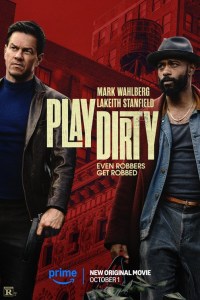 Shane Black is one of the best known writers in Hollywood across three-plus decades. His brand of witty, self-referential genre writing became its own appealing sub-genre of action cinema from the 1980s into the 90s. He resurrected Robert Downey Jr.’s career with Black’s directorial debut, the rollicking and immensely entertaining Kiss Kiss Bang Bang. Downey returned the favor by getting Black the gig writing and directing Iron Man 3. It’s been eight years since Black’s last directing effort, 2018’s messy and ultimately disappointing Predator reboot (Black actually had a small acting role in the original film). Shane Black movies are never ever boring even when they’re not completely working. Play Dirty is based on the Parker book series, a character portrayed by six other actors including Mel Gibson, Jason Statham, and Jim Brown. There are 26 of these Parker books, but after watching Play Dirty, by far Black’s worst movie, I don’t even understand what the appeal would be. This character just plain sucks.
Parker (Mark Wahlberg) is a slick professional criminal trying to score big and get his revenge. In the opening sequence, one of his heist crew, Zen (Rosa Salazar), betrays the group, steals the money, and kills everybody except Parker. He tracks her down and she’s in the middle of an even bigger scheme, one involving billions of dollars from uncovering literal sunken treasure on the ocean floor. He doesn’t like her or trust her but he sure could use his cut of a billion dollars. He taps old colleagues from other old jobs, the colleagues who haven’t been killed, and they must all work together to get their next big score.
 I was blown away by how powerfully unlikable the main character comes across. I don’t need characters to all be beholden to my opinion of likeability, but deficits in this matter are typically offset by writing the character with some degree of personality, menace, or intrigue, something that makes you want to keep watching them onscreen even if you don’t agree with everything they’re doing. However, this Parker guy, as portrayed by Wahlberg, is a big dumb guy who doesn’t recognize he’s a big dumb guy. As a result, he’s beholden to impulsive decisions that come across as cruel to the point of being sociopathic. Again, we’re used to criminal characters being flippant or prone to violence in other stories, but the introductory presentation of this character simply befuddles me and rubbed me the wrong way throughout.
Take for instance the literal opening minutes of Play Dirty. It’s in the middle of a heist but the story doesn’t start us off with the perspective of our thieves collecting their loot. It starts instead with a security guard stumbling onto their heist. He’s with his wife and child in the car and decides, rather than intervening, he’s going to use this opportunity to steal himself some of their ill-gotten loot. Right there, we’re starting with a character making a consequential choice, and our perspectives are not aligned with the robbers but with the robber of the robbers. I wanted him to get away, and frankly, following his story could have proven compelling as well, as someone who gets in over their head and tracked down by professional criminals who want what was taken. Parker gives chase through a race track and eventually shoots this man dead in front of his wife and child. Lest you think Parker is an irredeemable, unfeeling cretin, he takes stock of this woman’s grief and trauma and offers her ten thousand dollars of their loot, to bribe her silence and make amends for the murder of her spouse (that’s not even a good life insurance payout). I don’t know why Black wanted us to begin empathizing from the perspective of some guy who was only intended to be unceremoniously killed, in front of his wife and child. This move made me immediately dislike Parker, and then his little gift for the wife’s trauma felt completely insulting.
 This incident isn’t the only example of Parker being a shoot-first-ask-questions-never brute of limited intelligence. When he reunites with Zen, she’s talking with some guy who planned her new big scheme. Parker doesn’t know anything about this guy other than his physical proximity to Zen. He shoots him dead. For what reason? I don’t know what he was trying to accomplish except an expression of his impatience and hatred for life. I wonder if an elderly nun had been standing next to Zen at this moment and would Parker have committed the same rash act of violence. What about if it was his own mother? To make matters even worse, Parker accompanies Zen to break the news to the dead man’s boyfriend, and it’s in this moment of shock and grief that Parker harasses this bereaved man that Parker berates for crying. He seems to take amusement in how bluntly he informs the other man that his love is never coming back, though leaving out the key part where he carelessly murdered the man. He also shoots Mark Cuban in the leg while he dines in a restaurant for no reason other than being near the guy that he wanted. Again, much of this could be workable if the character of Parker was… anything. He’s not funny, he’s not charming, he’s not really clever or good with plans; he’s just a big dumb guy prone to violence, scowling, and deep sighs. Wahlberg looks bored throughout the whole movie and it makes the character even harder to entertain. If this guy doesn’t want to be here, can we select someone else to be our requisite protagonist?
We might have a leaden dud of a lead, but what about the rest of our enterprising team of thieves and conmen? Do we have any winners here to compensate? Sadly, the team is just as listless. Take Grofield (Lakieth Stanfield) who fraternizes as a theater owner, one who is constantly losing money. That setup has some interest, a criminal who possibly longs to be more of a professional actor, perhaps that eagerness even pushes him into suggesting different covers and roles he could play in their heists. Perhaps he might even see himself above the others since he feels like he is trying to promote the arts. There’s all kinds of ways this introduction could better shape his personality, interests, and contrasts with the other crew. For the rest of the movie, Grofield is just another guy on screen, just another guy driving a car or shooting a gun. There is one brief moment that takes advantage of his interest in acting as he poses as a drunk on a rooftop threatening to jump. After a security guard arrives on the scene, he and Parker subdue the guard, coat him in the same outfit Grofield was wearing, and then toss him off the roof to his death (ho ho). There’s a husband and wife team of crooks (Keegan-Michael Key, Claire Lovering) and that could be interesting, especially if they’re mixing professional and romantic squabbles, or maybe working together is the thing that keeps their spark going, the showcase for their real teamwork. They have one scene with some passing bickering but otherwise they too are just more indiscriminate people onscreen, another person to hold a gun or drive a car. Even the bad guys are boring. Who should I actually care about? I was rooting for that grieving mother and the one guy’s sad boyfriend to team up and punish Parker’s crew.
 Part of the fun of heist crews and con artists are the colorful personalities, the peculiarities, the intra-group conflicts and dynamics, but this movie gives us so little. It’s almost as if the characters are merely meant to trick the brain of a viewer barely paying attention, providing an assurance, “These are the guys,” without forcing thinking over differentiation. It’s like the film equivalent of not wanting to arouse like your elderly grandfather with conflicting evidence contrary to his memories. It’s like accepting defeat.
So the characters are lousy, are there any outstanding or fun caper or action scenes? Black is known for his snappy style and pulpy sensibilities across genres. He hasn’t made a boring movie yet, so I had hoped that even if Play Dirty ultimately proved lackluster, at least it would provide some flash and fun. Nope. Many of the action scenes are Parker and company just throwing caution to the wind and shooting a bunch of guys. There’s one sequence in the middle that involves actually planning and steps to draw our interest, it’s a ridiculously over-the-top plan that shows once again the crew’s disregard for collateral damage. Their valuable cargo is being shipped through the city on an elevated train, so the team decides to derail the train in the middle of the city. Not in a deserted area unpopulated by civilians, in the middle of town. As expected, the train careens off the tracks and through the city, likely causing the deaths of dozens of innocents we’ll never know because their existence is unworthy of the movie’s attention, much like the suffering of that widow and child in the opening sequence. The sequence is the equivalent of killing a mosquito with a flamethrower, and while overkill can certainly be cinematic and pleasingly entertaining, just ask Michael Bay or James Wan, it needs to exist in a world where that overkill is normalized. Otherwise, it just stands out as excessive and causes us to poke holes at the baseline reality.
Play Dirty is astoundingly dull and witless, lacking any of the spark and personality flair I expect from a Shane Black vehicle. Mark Wahlberg’s somnambulist performance is the best symbol for this entire enterprise, a crime thriller going through the motions but with its mind elsewhere. I know I certainly felt my mind going elsewhere while watching. Not just dull and tedious, Play Dirty is also just an uncomfortable experience because we’re stuck watching a group of unrepentantly amoral characters endanger and kill innocent lives in the pursuit of ill-gotten gains, but these characters aren’t intriguing, complex, memorable, or even cool, so the whole movies feels like you’re watching a pack of dude bros just randomly terrorize anecdotal characters out of sheer detached boredom and nihilism. It’s not fun, it’s actually quite the opposite of fun, and I wish Black had put more of himself into this enterprise (hey, the Christmas setting is present). Who wants to play with characters this boring and repulsive for two hours?
Nate’s Grade: C-
Share this:

The Bad Guys (2022)
 Even though it’s based on a popular series of children’s books, if you’ve seen Zootopia, you’ve seen the better version of The Bad Guys. As far as entertainment aimed at the wee ones, you can certainly do worse. It’s brisk, silly, and the animation is quite enjoyable, adding hand-drawn overlays and accents that really make the images pop and provide additional, gratifying textures. The story, on the other hand, is the same old-same old. We have a group of “scary animals” in a world where anthropomorphized creatures walk side-by-side with humans. These spooky creatures get a bad rap because people fear them, so they lean into social prejudices and become a notorious criminal gang. Except now they might want to go good because being good feels better than being bad. Thematically, it’s the same territory that Zootopia trod and with better world-building. We have “bad animals” that are tired of being looked as bad because people wrongly interpret them as scary threats. It’s the predator/prey dynamic but without the depth. Having an all-animal heist crew provides some creative entertainment and Ocean’s 11-style moments of frothy fun; I especially enjoyed that the giant shark is the team’s master of disguise and always very obvious. The character arcs, supposed betrayals, redemption, and plot should be familiar and predictable, which means much of the movie must coast on the appeal of the animation, vocal actors, and general sense of humor. The comedy can be amusing but too often falls upon cheap gags, like the piranha’s defining trait of being a nervous farter. The Bad Guys is suitable for animation aficionados, fans of the book series, and people who have never seen Zootopia, and if that’s you, then just watch Zootopia.
Nate’s Grade: C+
Share this:

Army of Thieves (2021)

So were you ready for the feature-length back-story for the safe-cracker character in Zack Snyder’s Army of the Dead so that you could feel more emotional involvement and understanding why he was so obsessed with cracking that special super vault in Vegas? Oh, you didn’t, well Netflix decided to spin off the goofy, energetic German character, once again played by Matthias Schweighöfer, who also directs the movie too, and now here it is. The character is too goofy to justify anything terribly dramatic, so the prequel becomes about how he was roped into a heist gang after becoming a star in the… underground safe-cracking betting ring. I would say that seems far-fetched but Netflix’s Squid Games pretty much explained its existence with, “Eh, the rich are bored and will bet on anything.” The most fun part for me was when the movie would take a few self-aware winks, as if it knew it was a movie, and characters would express how, if this were a Hollywood heist movie, this would happen, or that would happen, and then it inevitable does. It’s a small thing but it was something that slightly gave the movie its own identity because everything else is so rote and without charm or intrigue. The requisite gang has their requisite tensions and requisite betrayals and requisite unrequited romances. I just didn’t care much and the set pieces never elevated the suspense or interest level. The heist movie formula is ready-made for enjoyable setups and payoffs, as long as you see it through and hopefully give us fun characters and unexpected complications to overcome and improvise. Army of Thieves feels like a slapped-together action thriller that would have served as the years-later direct-to-DVD franchise ripoff except we got it the same year as its zombie franchise launch. And that’s the thing, this movie is literally taking place during a time there is a zombie outbreak and we’re just shrugging and going along with a standard heist that could have existed in any non-zombie outbreak universe? When even your supporting police characters say, “Hey, shouldn’t we pay more attention to that, you know, zombie apocalypse thing?” then maybe you heed their advice.
Nate’s Grade: C
Share this:

Cruella (2021)
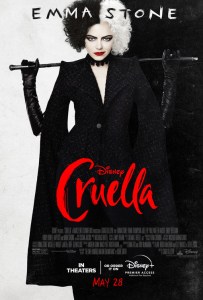 I don’t think I’ll be shocking any readers when I disclose that this Cruella doesn’t kill a single dog in her new movie. I hope I didn’t ruin the experience for anyone hoping for mass puppy slaughter. I figured Disney was going to go this route as they developed a villain biopic for Cruella DeVil, a woman obsessed with making coats from the skin of dalmatians. How exactly does one make a character like that sympathetic? Well by essentially making her a fan fiction version of Cruella DeVil and providing an even more dislikable antagonist to root against. The question then arises does this really count as a villain biopic when the character is so reconstructed? It follows the blueprint of 2014’s Maleficent where it posits that the story we’ve been told has been a matter of misunderstandings and smear campaigns from the Powers That Be. Cruella isn’t a puppy murderer. Now she’s a school outcast, plucky orphan with her own motley crew, and up-and-coming avant garde fashion designer looking to get her big break.
It presents her as an underdog on several fronts and with a back-story that might go down in history for its reclamation. Minor spoilers ahead, considering it’s early in the movie, but Cruella’s mother was literally killed by dalmatians pushing her off a cliff. The blunt re-imagining might even draw titters of laughter as the movie says, “Here’s the real reason she dislikes dogs.” However, even this tragic revision doesn’t make this Cruella hate dogs. There’s even a cute pooch on her team. This is a Cruella that’s not so cuddly but not unlovable either. She’s presented as a scrappy underdog with a punky attitude and whether this works will depend on your adherence to what a Disney villain biopic should be. Personally, I had no fidelity to the character of Cruella DeVil so I didn’t care. I wanted an entertaining movie with a strong lead performance from Emma Stone, and that’s what I got.
 Set in 1970s London, Estella (Stone) is a lonely girl born brilliant but tempered by an uncaring society. After the dalmatian-assisted murder of her mother, Estella and her pals are meeting out their days with small-time grifts and cons. Estella dreams of being a fashion designer and her boys manage to get her an entry level job at a department store. Her experimental window display gets the attention of The Baroness (Emma Thompson), a sharp-tongued and formidable fashionista that makes the world tremble. Estella adopts the identity of “Cruella,” with her natural half-black and half-white hair, to upstage the Baroness, draw publicity for her own unique fashion creations, as well as enact vengeance and retrieve her mother’s missing necklace/family heirloom stolen by the Baroness, as if you needed even more reasons to dislike this lady.
Cruella in many ways feels like The Devil Wears Prada mixed with a superhero origin tale. The Estella/Cruella dynamic is played like a secret identity, wherein she adopts one to achieve a personal goal and becomes seduced by the freedom the alternate identity has to offer. The first half plays quite like Prada, with our fashion upstart working her way up the chain, gaining attention for her insights and designs while fighting against a system meant to squash new ideas. The character of the Baroness is very clearly patterned after Miranda Priestly (Meryl Streep) and the command she wielded in her influential position atop the established fashion industry. At first, Estella wants to gain her approval and become a protégé, and then she wants to topple her, crush her, and it becomes a matter of how far she will go, with characters saying variations on, “You’ve changed. It used to be Estella, now it’s only Cruella.” Even The Devil Wears Prada featured a similar character descent for its protagonist. Except the question never seems too in doubt with Cruella because the character of Cruella is less a person succumbing and fraying, like the Oscar-winning 2019 Joker prequel, and more a tale of self-actualization and empowerment. That’s why it feels more like a superhero origin and less like the Joker’s origin. She’s becoming more confidant, more assertive, and more accepting of her true nature.
 Under the direction of Craig Gillespie (I, Tonya), Cruella feels like a colorful, sprightly caper, something with more attitude and dark humor than I would have believed capable of being forged from the Mouse House with their own intellectual properties. This could have easily been a cash grab but Gillespie and his team of screenwriters, including one of the writers from 2018’s The Favourite, decides to take that big Disney checkbook and have fun with it. This movie reminded me of a PG-friendly version of 2020’s Birds of Prey for adolescents. It’s got slapstick, schemes, contraptions, narrative shuffling, charming and weird characters, and a lot of visual style and attitude to spare. Above all else, this is a fun movie, and one that assembles set pieces and mini-goals that lead to enjoyable payoffs. There’s a funny big heist as the mid-point but it doesn’t go according to plan, as so we watch as Estella and her team have to adapt and get out of a series of escalating traps. The rivalry between Cruella and the Baroness leads to some gaga dress designs I’m certain will get Oscar attention in due time. There’s plenty of life simply coursing through this movie from the actors to the visuals to the extensive music library. Even when the movie is overstaying its welcome (this could have easily been trimmed down by 15 minutes) the movie still finds ways to keep you entertaining and pleased.
Chief among those reasons is Stone (La La Land) as our star. She’s honed her British accent after her Oscar-nominated performance from The Favourite and it’s easy to see a straight-line from that cunning social climber to this new role. Stone finds the right mix of camp and pathos to make the character work. She’s no exaggerated cartoon but she needs a certain energy level to keep you charged. She’s no mousy heroine but a powerful force looking for the right armor that fits. Stone might not be playing the Cruella DeVil of the 1961 cartoon but she’s playing a version of the character that is more capable of carrying a two-hour-plus movie. Special consideration should be paid out to Paul Walter Hauser, who was so memorably dimwitted in I, Tonya, and portrays Horace, a similarly dimwitted member of Cruella’s crew. The man knows what he’s doing when he’s given these roles and it’s easy to see why he keeps getting more.
The amount of needle-drop music cues in this movie puts 2016’s Suicide Squad to shame. I was amazed how that movie could literally go from song-to-song with barely a gap, sometimes only using mere seconds to make its sonic case. The Cruella soundtrack is wall-to-wall music selections, many from the 1960s and 1970s rock and punk scene, and it’s another holdover from I, Tonya that Gillespie has brought with him. The over reliance can become distracting in itself because of the sheer volume of musical selections, many of which can be exceedingly literal (you better believe, yet again, “Sympathy for the Devil” by the Rolling Stones is called in). It’s a sign of just how powerful the Disney brand can be as I’m sure a huge chunk of the movie’s budget went toward getting all these dozens and dozens of music clearances. If you consider it like a kid’s introduction to classic rock songs, it’s excusable, but the number of songs can also be distracting.
 Whether you consider Cruella a faithful or radical reinterpretation of the Disney villain, the live-action showcase is a star vehicle for its shining star. Stone is captivating and having a grand time in her fabulous fashions, and the movie makes it easy to feel her highs as well. It’s not exactly a great movie as many of its supporting characters are underwritten or overly convenient, and its question over the madness and identity of its heroine is more theory than practice, but Gillespie and his team have decided to make Cruella a fun movie, and to that end they have succeeded. It’s colorful, breezy, punky, funny, and consistently amusing, with outlandish set pieces, outlandish characters, and outlandish escapes. Yes, the mom-killed-by-dalmatians tragic back-story might elicit its own howls of bafflement, but the movie doesn’t belabor it for extra ironic impact. Cruella (or Cruella Lite, if you will) is an entertaining reinterpretation that knows what to scuttle to work on its own terms. Whether those alterations are too drastic or defang the character are up to you, but I’d rather watch a kinder, softer, yet still prickly Cruella than one skinning dogs.
Nate’s Grade: B
Share this:

Army of the Dead (2021)
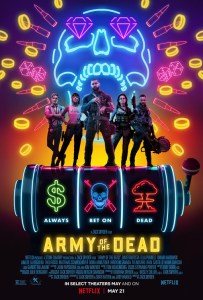 Despite an expensive redo into the editing bay for the supersized Justice League 2.0, this is director Zack Snyder’s first movie in four years and the aftermath of his family tragedy, and it’s the first with that sweet sweet Netflix money. Army of the Dead has an easy concept that seems silly as well as questionable why we haven’t seen this kind of movie before. The world loves zombies movies. The world loves heist movies. Why have we waited until 2021, in the year of our Lord, for a zombie heist flick? Our long drought is finally over and Netflix has answered our collective prayers. When I watch a movie described as “zombie Vegas heist” then I know what I’m hoping for, chiefly a fun, goofy, and well-developed action thriller, and that’s what Army of the Dead provides.
Las Vegas is ground zero for a zombie outbreak. The U.S. government has cordoned off the Vegas strip and contained the zombie virus. The president plans to drop a nuclear bomb and eradicate the zombie plague once and for all. That means there’s still time for one last score. A wealthy businessman wants to hire Scott Ward (Dave Bautista) to put together a crack team to break into a casino vault and steal $200 million before everything gets nuked. Scott gathers a crew of Zombie War vets, specialists, a guide to sneak them into the quarantine zone, and his estranged adult daughter who watched dad out mom down after she became a zombie. Together they’ll venture into certain danger to hit a jackpot.
 It’s easily Snyder’s most laid back and straightforwardly enjoyable movie since his debut feature, 2004’s Dawn of the Dead remake. It’s a movie that knows what we’re here for and provides a colorful band of characters with big personalities and over-the-top bloody violence. I can’t say that I genuinely cared about whether anyone lived or died in the movie, as many are so disposable that I forgot they were in the group, but I missed their presence when the time came to say goodbye. I enjoyed that two characters as outwardly different as Vanderohe (Omari Hardwick) and Dieter (Matthias Schweighöfer) could become best bros, and their chummy dynamic became one of my favorite aspects of the movie. The actual heist component of the movie amounts to less than the perilous journey to get to the giant vault, and the exaggerated booby traps reminded me of Indiana Jones temples. It was just the right splash of ridiculous to make me laugh. This is a movie designed to simply push the right buttons for a schlocky good time. Its opening montage sets the tone with famous Vegas staples falling victim to zombie mayhem. Early on, it’s Snyder assuring you that he’s not taking anything too seriously and that neither should you. There are moments where Snyder just throws out nonsense just to mess with the viewer, like a scene where Vanderohe theorizes that the skeletal corpses might actually be them and they are trapped in a loop, complete with matching edits to link up their clothing and jewelry to make you wonder. I turned to my girlfriend in disbelief; could this actually be happening? It doesn’t at all, but just the fact that Snyder devoted time for this throwaway sci-fi head fake amused me. I almost wished Snyder had given us more of these throwaway joke exit ramps. At one point, a character gets locked in a vault, and I hoped for a brief moment Snyder would frame the film like it’s suddenly evolved into the zombie’s own Ocean 11, where now the zombies need to put together a crack zombie team to break into the vault for some delicious brains. I appreciate that Army of the Dead prioritizes entertainment on all of its fronts.
Snyder and company have also put more deliberation into their world building. Most zombie movies just present a wasteland of the undead, a sea of hands and teeth that serve as a swarming obstacle but without any more thought. In Army of the Dead, the movie presents the beginning of a zombie civilization with a hierarchy. There are zombie alphas and zombie drones and the potential for zombie babies, maybe, but there is the beginning of something we fully do not understand. It reminded me a lot of the 2007 I Am Legend. I liked that the zombies weren’t as dumb as we often see them, and I also liked that the movie presented the possibility of the zombies being open to collaboration. In order to travel through the territory, the zombies demand a payment from the traveling parties, and this understanding and begrudging truce makes these creatures far more interesting than an army of drooling brutes. I liked that even the leader has learned he should be protecting his head from projectiles. There are some solidly constructed suspense sequences here, like where the team has to slowly creep through rooms filled with “hibernating” zombies, taking great pains not to touch them as they pass. It’s immediately accessible and different, as well as working with further world building. I also appreciated that one character who was left for dead went down fighting like a champion. It almost becomes a joke just how far this character keeps fighting, like they’re pushing against being just another disposable stock character in a genre movie. It’s impressive. The action set pieces are fun and well developed and make use of the different expertise from our assorted heist team.
 As a zombie movie, the violence is impressively gory and fun in its visceral splatter effects. With one big exception, there is a clear emphasis on practical effects and physical makeup prosthetics. The zombies at their different states of decay look great, as do their alpha higher-ups, enough to distinguish an easily recognizable class system that also portends further analysis. The deaths can also be gruesomely entertaining. Watching the sticky expertise of the gore wizards makes it even more perversely pleasurable and it’s often played for dark laughs. Two characters having to clear through the smashed remains of a smooshed zombie is gross and grossly funny. While I acknowledge that the recreation of a desolate and desiccated Las Vegas strip is an obvious computer effect, the major CGI addition to the movie is the zombie tiger (that used to belong to Siegfried and Roy) and it doesn’t look terribly great. Part of this is how unnatural it’s destined to fatefully appear, but the zombie horses looked great, though that was a practical costume placed upon a real horse. At least Snyder and company recognize that if you introduce a zombie tiger, you better guarantee it eats somebody and somebody we really don’t like so we can fully enjoy the experience.
There are a few issues that detract from the overall enjoyment of Snyder’s escapist entertainment. When the movie goes sentimental between daddy and daughter, it doesn’t really gibe with the rest of the film. I’m not upset that the movie ever attempted an emotional core to ground our investment in these characters, but there’s a reason you don’t see a tearful heart-to-heart in heist movies, let alone in movies with undead Elvises. I found the daughter character to be a nuisance. She falls under that character mold of the person who insists on tagging along to fulfill some personal goal and who inevitably gets people killed for no reason. The daughter’s goal is to rescue this one stubborn lady who ventured into the zombie quarantine, but this comes to nothing and, infuriatingly, gets many of our group killed trying to save her. Had she never tagged along, many of these people could have better survived, especially since her “expertise” did not save the day at any juncture. Therefore, her very presence was a net negative to the group, which helped drag down my opinion of the whole father-daughter drama.
I also found the overall style of the photography to be distracting. Working for the first time as his own director of photography in a movie, pitting himself in the middle of the action and manning his own camera, Snyder is more directly involved in making sure you see what he wants. However, he utilizes a very shallow depth of field, which obliterates much of the background as a blur. This can work in moments of suspense where seeing beyond waves of zombies can make them feel immense and overwhelming, but when it’s everything including people standing shoulder-to-shoulder exchanging exposition in a warehouse? Not as helpful. This singular focus, or limited focus, can get annoying and feel like an artifice that Snyder simply cannot let go of. It feels like the cameras got stuck on this mode and the filmmakers just said, “Oh well.” While Snyder has deigned that color shall exist in this movie (unlike in Justice League), the color palate is still drained and resembling an overused Instagram filter that cannot be undone.
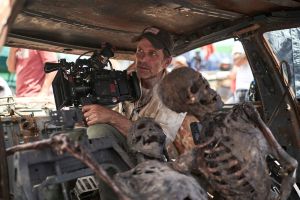 As a side note, originally this movie featured comedian Chris D’Elia as the helicopter pilot of the crew and then Netflix spent millions to digitally erase and replace him with comedian Tig Notaro after it was revealed D’Elia was the latest in a long line of sexual abusers in Hollywood. Notaro filmed all her scenes sans one in front of a green screen and if you never were told otherwise you wouldn’t have known. Bravo to Snyder and company for going the All the Money in the World route and replacing a creep with a beloved actor that should have been hired in the first place. Notaro, it must be said, is also sarcastically great in the film. Her scene where she openly discusses arranging for their corporate babysitter to get axed is a highlight.
Netflix has big plans for Army of the Dead. A prequel starring the Dieter character, and directed by the actor playing him, has already been filmed, and an animated series is also in the works. The studio sees this franchise as a creative well they want to tap dry, and I’m sure the movie will prove popular on the streaming giant and only lead to further network expansion. I think Snyder feels somewhat liberated by making his first movie without superheroes in a decade. He’s always been a first-class visual stylist but his command of narrative and character can be sketchy, hence 2011’s woefully miscalculated “feminist” passion project, Sucker Punch. I think Snyder is best when he keeps things lighter, sillier, schlockier, and absent larger themes and messages meant to make people think deeper about the human condition. Being a filmmaker who understands they work best in the land of shallow blockbusters isn’t some acceptance of limitation or failure. It’s an acknowledgement of where one’s skill set best matches up. I don’t begrudge Snyder as a filmmaker, though I question whether his interpretation of superheroes can escape the shadow of his love for Objectivist philosophy. I think it’s no coincidence that his two best movies, and least problematic, are both his zombie action movies. So bring me more of the Army of the Dead universe. Bring me more Zack Snyder at the helm. It keeps him busy, it keeps me entertained, and it keeps him away from making more four-hour long superhero movies.
Nate’s Grade: B
Share this:

Locked Down (2021)
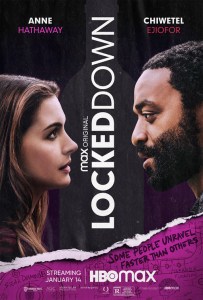 I’m already starting to dread the inevitable onslaught of movies and fictional narratives tackling the COVID crisis, and I don’t know if that’s ever going to be truly inviting for me. After the near year of pandemic fatigue, I can’t see myself wanting to relive the experience through my media. Naturally, this is partially because of how fresh everything is. Years down the road I may hold a different opinion and find COVID-19 stories more engaging. I’m sure there will be worthy ones to explore with the best storytellers that movies and television can afford. Right now, I’m not looking forward to the rom-coms about couples being forced together, or forced apart, and I’m not looking forward to the zombie movies that seem all too obvious in commentary. It is with this context that I watched the new 2021 movie Locked Down with wary curiosity. It was filmed during the quarantine in London over 18 days. It stars big actors, has a director and writer who have worked on highly esteemed projects, and it’s the first big project to feature the pandemic while we’re still in the middle of a worldwide pandemic. It has temporary notoriety but is it any good?
Linda (Anne Hathaway) and her husband Paxton (Chiwetel Ejiofor) are stuck at home like everyone else in London thanks to COVID-19. He’s struggling for work and she’s struggling with the mental weight of her job and the impending knowledge her friends and co-workers will soon be laid off by Linda herself. The couple is also heading for a divorce, though they’re keeping that quiet from concerned family members checking in. Paxton’s sense of self is falling apart, and the rebellious biker who got into one unfortunate bar fight long ago seems to be fading. Now he doesn’t know what he’ll be and he’s forced to sell his prized motorcycle. Linda gets the idea to pull off a jewelry heist that she and Paxton have an unique opportunity for. Could it be the thing that makes them feel excited again? Could it bring them back together?
 Locked Down has some significant tonal shifts but more so in ambition than execution, because at its core its really a talky, mumblecore relationship drama, but one that I found a little too lax and shapeless and ponderous to jibe with. Screenwriter Steven Knight can be a tremendous writer. He’s written Eastern Promises, Locke, Dirty Pretty Things, and created Peaky Blinders. He knows plot, he knows character, he knows structure. This, though, doesn’t feel so much like it was a script needing to be told as it was an experiment in could they make a movie about the pandemic and film it during the pandemic. The heist elements are rather haphazard and ultimately mean little to the overall storyline, merely serving as an instrument to reconcile our couple and force them to rely upon one another for a shared triumph (this shouldn’t be a spoiler). I think your overall view of Locked Down will depend upon your opinion of how the heist elements are handled. If it seemed like the start of something more exciting, more engaging, then you’ll be disappointed. If you didn’t care about the particulars of a heist during COVID times, and you didn’t want a more purely genre plot device to take over from the character-driven relationship drama,then you might be more charitable. For me, I love heist movies and the formula is ready-made for payoffs and entertainment. However, I also enjoy character-driven relationship dramas but I just wasn’t connecting with this one.
The characters of Paxton and Linda felt too overly written for me and lacking the more intriguing nuances that I find in the best of observational mumblecore cinema. To be fair, being overly written is not an indictment in itself. Quentin Tarantino characters are overly written and we love them. Viewers love big characters that demand your attention and equipped with monologues that we wish we could recite when life’s challenges afforded us the opportunity to wax poetic. The central agreement we have with characters, whether they’re realistically drawn or idiosyncratic or cartoonish, is that they need to at least be interesting. You need to want to spend time with the characters.
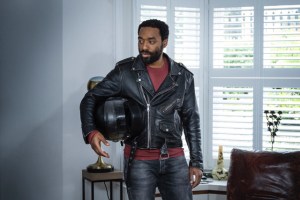 With Locked Down, I was getting as restless as the onscreen couple. I didn’t find them interesting because the same character notes were being hit over and over with little variation. The monologues, while having moments of life and personality, didn’t provide me greater insight at minute 80 than they did at minute 40. The experience felt like watching actors workshop characters and looking for extra meanings that seemed to be elusive. Listening to these characters talk more should make them more interesting, make them more personable, and make them more complex, right? While they uncork some well written asides, they’re each just rubbing the same nub of an identity crisis. The pacing also made the repetitive portions feel even longer. The metaphor of what Paxton’s motorcycle represents is so overblown and simplified. After spending so much time listening to these two bicker and argue in the same rooms, I was hoping for the heist as a needed escape, something that could finally serve to motivate the characters out of their pity parties and force them into a new conflict. I needed something, anything more to hold my waning attention. Alas, I finished Locked Down in the same patient, pursed-lip stupor as it began. These characters did not deserve this much extra breathing room.
I like Hathaway (Colossal) and Ejiofar (12 Years a Slave). Watching them leap into what is essentially a two-hander filmed play sounds like a good bet for entertainment, especially with a writer with the credentials of Knight (we’ll ignore the outlandishly bonkers 2019 Serenity). Hathaway and Ejiofor are good together too. They have a spark that works, her anxiousness melding well with his dismissive pessimism. Again, the characters they’re portraying aren’t poorly written. There just isn’t enough polished material for them. That’s why each feels like they’re grasping to discover the character like it’s being formed in the moment. The entire movie feels like an overextended improv workshop everyone involved is developing in the moment. Good mumblecore movies can make you feel like a fly-on-the-wall with real people, but these characters are so overly written that an improv feeling doesn’t so much replicate the recognizable rhythms of life as it does an ungainly acting class in search of more direction and discretion. There are some other celebrity appearances in the form of Zoom cameos, and that’s something I’m not looking forward to with the incoming COVID movies, the ugly selfie aesthetic prevalence.
 Locked Down feels more like an experiment to see if the filmmakers could make a movie under such unique and trying circumstances. It feels more like an acting exercise in need of more development and a little more vitality. There are fleeting moments that seem to tap into a universal despair and uncertainty many of us have wrestled with during our COVID isolation, but then the movie will just as likely throw in a hidden patch of poppies in a garden and a joke about nobody seeming to recognize the name Edgar Allen Poe. I watched Locked Down over the course of two nights, and mt girlfriend and I literally had forgotten we watched the first hour until coming across it again and going, “Oh yeah, we need to finish that after all.” I feel like that sums up the movie well. Within a day, I had already forgotten it, and that was before I even finished the full movie. They made a movie during COVID. Now make better ones in the future.
Nate’s Grade: C
Share this:

The Last Days of American Crime (2020)
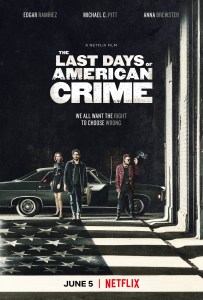 Even by relaxed standards which we judge widely-available Netflix movies during a time of quarantine, The Last Days of American Crime is a staggering waste of 150 minutes. It’s based on a 2009 graphic novel series and even by the sliding scale of shut-your-brain-off action movies, it’s numbing, dreadfully dull, incoherent, and stitched together with hoary genre clichés and little creative forethought. It’s rare that I come across a movie that seems so willfully ignorant to explore the implications of its own premise.
In the near future, the U.S. government is in the final stages of implementing the American Peace Initiative (API), a special radio signal that stops crime in its tracks. It acts as a brain blocker on anything illegal, stopping the user from being able to follow through. Graham Bricke (Edgar Ramirez) finds out the hard way when his bank robbery crew become some of the first test subjects. American citizens are desperate to flee to Canada before the API goes live. Bricke gets seduced by computer hacker Shelby Dupree (Anna Brewster) to pull off one big score. The government is readying to destroy a billion dollars in currency before going digital, and Shelby’s fiancé, Kevin Cash (Michael Pitt), has the connection to pull off the heist of the century.
 Firstly, there is not nearly enough material here to justify the gargantuan Avengers-esque running time. You could realistically slice down a whole hour and not impact its middling entertainment value or clarity. While I was watching it didn’t even feel like a movie, more like a series designed to be binge watched, where the plotting becomes much more slack because the filmmakers anticipate their show will be digested in quick succession and that they have earned patience. It irritates me in television and it certainly irritated me here as well. Don’t blithely assume that your audience has infinite patience when you haven’t given them a proper story to properly engage with. Just about every scene could be trimmed down and some of them go on punishingly long, especially scenes where people are getting shot. There’s one late scene that goes on for what feels like five minutes of just watching two characters get shot. It’s so gratuitous, like much else in the movie, that it borders into unintentional anti-comedy.
As for the action, director Oliver Megaton (Taken 2 and 3) delivers very little of note. There’s a car chase here, a shootout there, but no set piece that actually develops or proves that memorable. It’s all just disposable noise that amounts to little, not even fleeting, escapist entertainment. This is a heist movie where the actual heist planning is ignored. The most enjoyable part of a heist movie is the intricate planning and then execution of that plan, combating the unforeseen complications and overcoming for triumph. If your entire movie is centered on a big heist, don’t treat that like it’s another meaningless plot element. I cannot believe the filmmakers failed to realize that if the viewer doesn’t know what the dangers, problems, and scheme of the upcoming heist will be, then everything feels arbitrary and unsatisfying, and it does so here. The actual heist, pulled off around the 90-minute mark, is not worth the buildup and lack of accessibility. It’s just another haphazard action set piece, not the culmination of planning and an important payoff for carefully manufactured setups. If you’re tuning in for fun action, you’ll be sorely disappointed to find there’s more time spent torturing people onscreen than there is for sustained and exciting action.
The awful characters we’re left to spend 150 minutes with are hardly worth that investment. Everyone is kept strictly as stock archetypes, and even when the screenplay tries to develop them, it follows a strictly predictable path to minimal results. Oh, someone has a family member in custody and is being pressured to snitch? Oh, our silent-and-seemingly-conflicted protagonist wants to avenge his dead brother because he cares and stuff? Oh, our oddball criminal scion wants to make a big name for himself outside of his father’s shadow? The fact the movie spends so much time with these characters while giving them so little dimension, little personality, and little to do is another indictment on the bloated pacing. If we’re spending this much time with our criminal rogues, the least you can do is make them interesting and dramatic and colorful. The protagonist’s name is Graham Bricke, which sounds so boring that it must have been generated by an A.I. The femme fatale super hacker lady is really here just to look sad or sexy, here to deliver three uncomfortable sex scenes including a near rape as well. The other notable female roles in this movie include News Anchor, Lesbian 1 and Lesbian 2, Female Tweeker, and Female Cop. Hooray for depth.
 There are two characters that had a chance of being interesting but are so mishandled. The first is Kevin Cash, our wannabe gangster. Pitt (HBO’s Boardwalk Empire) brings a much-needed dose of energy and theatrics, like he’s trying everything in his power to desperately hold your flagging attention. Even his pathetic overcompensating nature is tiresome. A scene where he, his father, and his younger stepmother (another fine example of female character representation in the movie) shriek and bicker at one another is just embarrassing and misplaced comic relief. He’s boring. The only other potential was with Sharlto Copley (District 9) as a disgraced police officer. We spend plenty of time with him early in the movie, establishing his outsider status, perhaps some regret, and hoping that his position of authority will be better explored as he wrestles with whether the police force is worthy of its state-decreed exemptions to the API. Nope. He just becomes another dude in the final act that could have been replaced by anyone else. It would be like devoting so much time to Henchman #12 and his personal crisis of self in a Bond movie only to watch the lug unceremoniously die in a final action rush. Was that worth the time spent?
Its Purge-like premise sounds intriguing and worthy of exploration until, that is, you really think about how silly it all is. So a magic radio signal is going to inhibit your brain from committing known wrongs, but does that mean that the radio signal will have to blare constantly in order to have a lasting effect, otherwise its enforcement will be limited? What happens to sociopaths who don’t even register right from wrong? They will be able to move and act without abandon. Then there’s the day-to-day corruption, graft, greed from all pillars of society, politicians and Wall Street and officials that exploit their positions for illegal gains. Seriously, if this radio signal inhibits the fruition of illegal acts, would Wall Street just shut down? Would the factory owners who knowingly skirt worker safety for profits be able to operate? Would criminal defense attorneys be able to operate or would they use the ethical justification that everyone, no matter how heinous, deserves legal representation? If you think about a capitalist society, it’s built upon people behaving not so nicely, so would all facets of the economy grind to a screeching halt?
There is one aspect of this world building, even with what the meager story has established, that could be interesting to explore, and that’s the exceptions to this new order. Police officers are getting implants that make them immune to the effects of API, though in a world where a radio wave eliminates criminal acts, do you still need a police force to protect and serve? Regardless, this special class of exception is deserving of further exploration, a socially relevant angle to tap into the inherent advantages offered to the top one percent who don’t think the rules apply to them. In fact, if Last Days of American Crime was going to run with its silly premise as is, and during the pre-activation countdown timeline, they should have presented a story about those who are given the state-sanctioned privilege to act with impunity. Let’s watch the elite get their special exemption chips and plan for the New World where they maintain their vaunted privileges. It would at least make the movie socially relevant as well as a better development of its sci-fi premise.
 Watch, dear reader, as I present you two better scenarios with this silly premise. The first is the most obvious and that’s life AFTER the implication of the AFI, presenting life under a new fascist order and a group of revolutionaries trying to thwart the radio waves. Imagine a group not plotting to pull off a bank heist but ridding their community of the AFI and giving them autonomy over their minds and bodies again? There’s an ever-present hostility that forces the characters to keep their thoughts on safe topics, having to communicate with subterfuge to not set off their brain jailers. It would be like a dystopian version of that classic Twilight Zone episode where little Bill Mumy where everyone had to think “good thoughts” or else he would magically banish them to the cornfield. That’s interesting, that’s genuine conflict, that’s characters under great duress trying to escape a fascist nightmare without tipping off the invisible sensors in their own minds that could trigger. There’s a larger goal of freeing their fellow citizens from this tyranny as well. That’s already one hundred times better than simply trying to steal money before the clock strikes zero. If it was only ever going to be “one big last score” then why even bother with the mind-control antics? It could have been anything at all.
However, if you wanted something more low-key, you could take a different path with the idea of the bucket list before the API goes live. Think of two teenagers who don’t have the means to escape and feel like they haven’t fully lived and a whole lifetime of rebellion and adventures they had been dreaming towards will now be snuffed out. The screenplay already floats the idea of a criminal bucket list but why not run with that idea as the core of your movie? Two teenagers making the most of their time together over the course of one long crazy night of cutting loose, testing their boundaries, and acting out the best ways they know how, learning about each other and the depth of their friendship before their minds will not fully be their own. It takes the teenager coming-of-age model, feeling like a stranger in your own body, and gives it a PG-13-Purge twist, with the distant tragedy of the looming tyranny ahead to up the stakes. Even that development would be better than “one last score,” and these are just two ideas I’ve come up with while writing this film review. Think what could be accomplished if a professional screenwriter spent weeks fleshing out a better version.
Alas, the version of The Last Days of American Crime we do receive is powerfully plodding, incoherent, empty and arbitrary, and definitely not worth your precious 150 minutes. With the current state of the world where thousands of U.S. citizens are protesting in the streets over a militarized police state and wanton brutality, it makes Last Days look even more phony and ill-conceived as entertainment. It doesn’t examine the implications of its own fascist police state, it only uses it as a pointless backdrop for an arbitrarily plotted “last score” heist before it all just falls apart, spent of imagination and intent.
Nate’s Grade: D+
Share this:

Widows (2018)
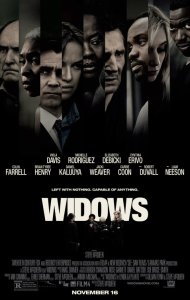 Widows has an all-star cast, an Oscar-nominated director, and a best-selling novelist-turned screenwriter, so my expectations might have been turned up a bit too high. It follows a team of titular widows (Viola Davis, Michelle Rodriguez, Elizabeth Dibecki) picking up the pieces in the wake of their husbands’ deaths. It seems their dearly departed spouses stole money from a local criminal who very much demands the sum returned. The women must enter into a criminal heist, using notes left behind by a dead hubby, to settle the debt and spare their lives. Widows is a higher caliber crime movie with notable texture given to a wide assortment of characters; even the villains are given small character touches to better flesh them out and feel more realized. There’s a concurrent election tying together different corrupt and criminal enterprises that widens the scope of the film into a grander scale. The characters and performances are the selling point of the movie and provide consistent entertainment. Davis (Fences) is the strong-willed linchpin of the group and I could watch her boss around people for hours. Dibecki (The Great Gatsby) has a nice turn as a trophy wife accustomed to being abused. The problem is that there might be too many characters. Rodriguez has far more significance in the first thirty minutes and then is put on ice. Likewise, Carrie Coon and Cynthia Erivo are hastily added when the plot requires something of them. That plot, adapted by Gillian Flynn (Gone Girl) and director Steve McQueen (12 Years a Slave), proves to be the film’s biggest hindrance by the end. The second half plot turns seem to come from a schlockier version of this story, not the classier version we had been treated to beforehand. There are character decisions that baffle credulity and personal safety. The quality of the characters deserved a movie that could refrain from the hacky genre twists. McQueen’s precise camerawork is still alive and well and highlights tension and also moments of social commentary, like when we watch a car travel mere blocks from a rundown inner city neighborhood to a fancy gated residence. There’s a lot to like with Widows, and plenty to get excited about, but I wanted to like even more.
Nate’s Grade: B
Share this:

American Animals (2018)
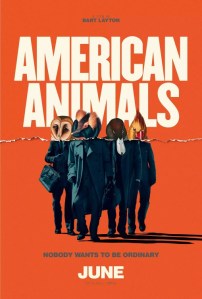 This review is weeks late after having sat down and watched American Animals, and it’s stuck with me in a powerful way. It’s a movie that pulls back the disparity between crime in the movies, so stylized and slick and carefree, and crime in real life, often traumatic, dehumanizing, and with lifelong complications for both victim and perpetrator. It’s a movie that examines a youthful sense of ennui that their lives are missing out on something extraordinary, and a step too far over a very clear moral line thanks to a fantasy given shape by escapist movies and other media. It’s also a slippery I, Tonya-style look at memory and contradiction but this time from the real-life people involved. It’s an entertaining dark comedy, an unexpected true-crime caper, and most resonating of all, a nerve-wracking thriller that left me morally queasy and unwell, but in a good way. In short, American Animals is one of the best films I have seen so far in 2018.
In 2004, at a small Kentucky liberal arts university, four young men are planning their own version of the “perfect crime.” The school has a rare books section including an original copy of Darwin’s Origin of Species and a large and valuable edition of John James Audobon’s The Birds of America. The books are appraised at $12 million dollars. Spencer (Barry Keoghan), an art student, teams up with Warren (Evan Peters), Erik (Jared Abrahamson), and Chas (Blake Jenner) to plot a daring heist. The men feel like their lives are missing something exciting and a heist is just the ticket. They just have to break in, steal the books, and subdue a librarian (Ann Dowd). Easy stuff, right?
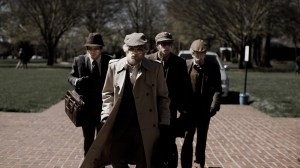
 For the first half of the movie, American Animals plays out like a dark comedy. I had no prior knowledge that we were going to get the real-life subjects appearing as themselves in interviews cut throughout the film (their family members are still actors though). The film even plays around with this narrative hook for a few laughs, making quick cuts for punchlines and trying to square conflicting accounts, like having one scene alternate between two locations in dispute of its telling. It also helps set one of the major themes going forward in a nimble fashion, namely the difference between the reality of events and the whimsical, fantasy movie version of what an excursion into crime would be like. Having been bred on cinema’s glorified depictions of heists, the guys come to assume that a heist is sexy and fun and something that doesn’t end up hurting anyone. There’s a charming quality to the fact that Spencer uses his art skills to create models of the rare books room. There’s a laughable ingenuity to the fact that they’re planning on holding the heist in the middle of their class exams, since who would suspect students during that important time? There’s a bemused naiveté about the power of their disguises when they dress as a shuffling group of old men in powdered faces. We’re set up for a funny story about bumbling students falling all over themselves at attempted criminal shenanigans.
I was expecting a relatively light movie just from the plot particulars. It’s a heist film and the goal is to steal a bunch of books. It seemed small-scale in scope and anodyne. What trouble could a group of students get into attempting to steal books? Writer/director Bart Layton (The Imposter) seems to know this, lulling the audience into a false sense of security. He even teases the movie version of what the heist might be like, with our characters suavely stepping into their parts with practiced precision, all while music reminiscent of the Ocean’s Eleven franchise hums in the background. This is the cool-movie version, the version the characters have fantasized over in their minds, and the version that the audience is more attuned to expect. What we actually get is something very different. The heist itself plays out in excruciating detail and it runs counter to their planning. The reality of subduing the librarian is upsetting. It’s supposed to be so simple, after all, but the reality is anything but. The characters almost avoid this whole scenario, aborting their heist only to return back to it the next day. You feel the anguish of how close they were to turning away at several steps, the moments this ordeal could have been avoided, and yet fate barrels onward, energized by a misplaced sense of purpose. American Animals doesn’t let you or its characters off the hook either. I was fidgeting and sweating nervously throughout the heist and its subsequent fallout. Again, this is all about a bunch of stolen books, and I was beside myself with anxiety.
 It’s only afterwards and looking back that you realize how masterfully Layton has built up his scenes and the necessary information to make you squirm. With every heist, the particulars of the setting, the challenges and tight window need to be established, and once that occurs, we’re hoping for unexpected complications. But in order for those unexpected consequences to really hit hard, we have to be trained with what Plan A was going to be, and American Animals does this superbly. People have their designated roles and areas they refuse to partake in, like Eric makes it clearly known he will not be responsible for subduing the librarian in any way. Of course, you can expect what will eventually happen, pushing his character to an even more uncomfortable place. I was very appreciative that there’s an extended resolution after the heist, where the guys try to unload the books to a seller, and the further complications. You really feel the screws being tightened and the overwhelming feeling of dread. It’s another confirmation for me that I’m just not cut out for a life of crime. The day-to-day anxiety is just too much.
I left this movie feeling a strange mixture of jubilation and sadness, still reeling from the expertly developed and executed moral tension. The technical skills are just as strong, each working in succinct harmonious sequence to bring about Layton’s vision to startling effect. The editing is extremely tightly constructed. The smooth cinematography by Ole Bratt Birkeland frames the tension and comedy expertly, and the ominous music by Anne Nikitin kept me on the edge of my seat. It’s almost like a full-blown David Fincher film by the end. The acting is another strong point, with each actor initially relegated into a stock role (“The Muscle,” “The Wheelman,” etc.) we’ve come to associate with these kinds of movies. The film nicely pushes the characters beyond a casual, cursory understanding, blurring the lines of who they are as they blur lines of their own. A surprise standout is Blake Jenner (unrelated to the Kardashians/Jenner clan) who joins the team the latest, seems like a stereotypical rich jock lunkhead, but when he breaks down and articulates why the team is as screwed as they are, his clarity can catch you off guard. He’s the first to realize they’ve trashed their lives and are doomed and for nothing. Also deserving of praise is the always-wonderful Ann Dowd (The Handmaid’s Tale); your heart hurts for this poor woman who is confused, scared, and undeserving of her harrowing ordeal.
 American Animals hasn’t been able to leave my thoughts for weeks, which is usually the sign of a pretty good movie. It upset me. It rattled me. It entertained me. Most of all, it made me think, about the lines people cross in the name of missing out on some vague sense of grand experience, of the differences between the reality of crime and our appealing fantasy versions of crime, and why those stories appeal to us in general. I kept thinking about the pain these four men had caused themselves and others and their regrets. I kept thinking about how smartly Layton utilizes documentary storytelling techniques to enhance his film as well as better examine the disconnect of reality-versus-movies. It’s a movie that could have been told as a documentary but excels best as a hybrid of the two, one that challenges our conception. I’m shocked it wasn’t credited to a book or news article as its source material, meaning Layton compiled all of this impressively on his own. This is a movie that got under my skin, that made me uncomfortable, but also thrilled me and entertained me from its first minute until its very last. I highly advise looking for American Animals once it becomes readily available.
Nate’s Grade: A
Share this:

Ant-Man and the Wasp (2018)
 Coming off the cataclysm of Avengers: Infinity War, Marvel’s latest serves as a palate cleanser, a breezy and light-hearted comic adventure with little more on its mind than having fun with its possibilities and leaving the audience happy. The basic premise of a team of thieves that can shrink or expand at will calls for a light touch, and returning director Peyton Reed (Bring it On) and his team have a strong idea of what an Ant-Man movie should be. Ant-Man and the Wasp won’t blow anyone away with its story or characters but it hits a sweet spot of silly comic affability that kept me smiling.
Scott Lang (Paul Rudd) is close to ending his two-year house arrest following the events of the Berlin brawl in Captain America: Civil War. His old partner Hope Van Dyne (Evangeline Lily) a.k.a. the Wasp is working with her scientist father, Hank Pym (Michael Douglas), to discover the location of the missing Janet Van Dyne (Michelle Pfeiffer), lost for decades in the subatomic quantum realm. They need Scott’s help to steal the final parts necessary to complete their quantum field transporter. There are other forces looking to make use of Hank Pym’s technology, namely Ghost (Hannah John-Kamen), a woman who can phase through matter, and an unscrupulous local buyer (Walton Goggins) looking to profit. With the help of the Wasp, Scott Lang must protect his friends and allies so they can rescue Janet Van Dyne before she’s lost for good, and he cannot be caught before his house arrest period comes to an end or he’ll go to jail.
 When any action movie has unique circumstances, especially those in the superhero realm because of their unique powers, I crave the proper development of the concept and the action sequences to make clever and imaginative use of their available tools. If you have characters that can shrink, that can make other objects big or small, and there’s a villain that can phase, then I expect a thorough and fun implementation of these elements to separate the movie from others. It takes a while to get going, but once the streamlined exposition is behind us, including multiple instances of explaining the plot to the audience, Ant-Man and the Wasp zips by on its sheer sense of sprightly whimsy and visual wonder. Paul Rudd (Wet Hot American Summer) is still as effortlessly charming as ever and elevates every scene partner. When it’s moving, the film does a fine job at entertaining, with funny quips and charming actors and visual panache. When it slows things down to explain or introduce perfunctory characters (looking at you, Laurence Fishburne) that’s when it becomes less than mighty. Ant-Man and the Wasp kept me laughing throughout, especially with the triumphant return of series MVP Michael Pena (CHIPs) as the energetic, motor-mouthed Luis. There are enjoyable payoffs strewn throughout and solid comic asides. It doesn’t feel too jokey to the point that nobody involved cares. It feels like everyone is united with the same mission statement.
The final act in particular is a blast, as now we have our MacGuffin and all of the various teams vying for it in an elaborate series of chase scenes. The cars are racing back and forth, under and over one another, with characters constantly jockeying for top position. It’s an exciting flourish to a conclusion, and every time a car went tiny for a split-second escape, or an ordinary item like a Pez dispenser went huge to form an obstacle, I grew happier and happier. The screenwriters unleashed a flurry of fun and zippy action ideas. Some will balk at the lower level of stakes in the Ant-Man films, or their general aw-shucks silly charm, but I view both as a virtue. Just because it’s a superhero movie doesn’t mean there can’t be a healthy degree of amusement, if properly executed and applied.
 The villains are kept interesting enough, through concept or casting. With Ghost, here’s another character that can manipulate matter to her advantage. Her back-story is pretty ordinary (science experiment, looking for way to end pain/save her life) and kept mostly uncomplicated, as her plan is a matter of life and death. Hannah John-Kamen (Ready Player One) has a terrific look and physicality to her, but she’s lacking anything really memorable to do as a performer. Her character has some cool moves but that’s all. It feels like more could have been done with this antagonist. Then there’s genteel local criminal Sonny Burch who is given great gusto by Walton Goggins (The Hateful Eight). It’s like he simply plugged his Justified character’s smooth charisma. He’s a gentleman robber who has just enough self-awareness to acknowledge the absurd. A highlight of the film is an exchange between Goggins and Pena. He’s so good in such a relatively throwaway criminal role that I wish Marvel had saved Goggins for something grander down the line, something to really let his charisma seep into his wild, anarchic energy below the surface.
With all that said, the events involving the rescue of Janet Van Dyne are the weakest parts of the movie, and this saps the other Van Dyne characters as well. I just found myself caring very little for this excursion into the quantum realm, especially when we have fancy heists and opponents who can walk through walls. I understand the importance the rescue mission has with the other characters, but it didn’t feel that important to me. I was more invested in Scott’s ever-increasing near misses being caught breaking his house arrest, which was days away from being lifted by the FBI. Those scenes gave me the delightful Randall Park too (TV’s Fresh Off the Boat). Maybe it’s a casualty of the film’s genial tone, but I think the real culprit why I found myself unmoved is that the Janet rescue is the core storyline attached to Hope and Hank. Beforehand, Hank Pym served as a grumpy mentor figure for Scott, and now he’s mostly complaining about Scott’s exploits and how they invariably jeopardize the retrieval of his wife. Hope gets her spotlight, and name in the title, as Wasp, but she too is saddled with the same humdrum boring material. Lily (The Hobbit films) goes from scene to scene with a cloud of pinched annoyance. They’ve taken two characters who were more interesting in the first film, sanded off things that made them interesting, and bumped up their screen time, which is not a great formula. Everyone seems so irritable around this plotline, and when you haven’t invested much in it, that irritation becomes dangerously off-putting.
 If you’re looking for silly, lighthearted escapism, Ant-Man and the Wasp is a superhero flick with entertainment as its top priority and enough infectious fun to achieve its more modest goal. It doesn’t follow the heist formula of the first film but it still finds room for comic asides and stacking payoffs for a lively, inventive final act. It’s definitely a lesser movie in the Marvel Cinematic Universe (MCU) but you need adventures in lower stakes too, especially after twenty movies and counting. Ant-Man and the Wasp could have used some fine-tuning and tightening, especially in its second act, and the quantum stuff definitely didn’t register for me, but it’s a mostly fun and acceptable summer escapade.
Nate’s Grade: B


 nathanzoebl
You must be logged in to post a comment.