Blog Archives
300: Rise of an Empire (2014)
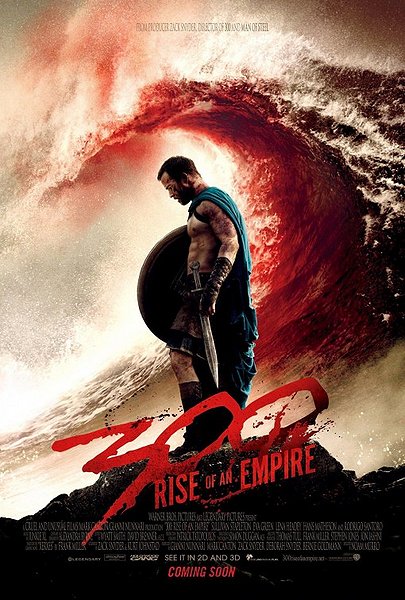 In 2007, the gory, shouty, beefcake-y action flick 300 came out of relative nowhere and took the world by storm, earning over $400 million worldwide and launching the careers of Gerard Butler and director Zack Snyder (Man of Steel, Watchmen). The movie burrowed itself into pop culture, readily mocked and parodied along with its highly stylized action. So where to go next? Also based on a Frank Miller graphic novel, though one that is incomplete as of release, 300: Rise of an Empire is a return to the same stylized excess that made careers. Except now seven years later, what once dazzled seems empty; visually alluring but hollow by all accounts.
Following the brave stand of King Leonidas and his 300 Spartans, Xerxes (Rodrigo Santoro) is pushing forward with his plans to subjugate the city-states of Greece. Long ago, Themistokles (Sullivan Stepleton) killed King Darius during Persia’s first invasion attempt. Xerxes has sworn vengeance since, goaded into action by his second-in-command, general Artemisia (Eva Green). She commands Xerxes’ mighty naval fleet, and she looks to “dance across the backs of dead Greeks.” The many city-states of Greece are squabbling over an appropriate response; Themistokles argues they should unite, while others contend for surrender to Xerxes. Themistokles rallies what armies and ships he can to meet the Persians on the sea and prevent the overpowering invasion.
 The difficulty with a follow-up to 300 is that Snyder’s highly stylized original has been copied and pasted so many times by cheap imitators, so what’s new? The film’s visual style follows the original closely, all those gauzy panoramas and human bodies lovingly showcasing in slow-mo the ugly beauty of bloodshed and violence. The rippling muscles, the glistening sweat, the geysers of blood; it’s all here and in displayed in fawning 3D detail. I didn’t see the film in 3D, but I noticed that every campfire scene was littered with annoying floating embers. However, Rise of an Empire manages some pleasant surprises because a majority of its action takes place at sea. This is a movie devoted to ancient maritime combat, and that’s pretty interesting. The scope of the action is much larger this time, with far more than 300 soldiers in play. The naval battles are brought to life with Hollywood excess but they’re still fairly exciting and fun to watch. The action is well orchestrated, usually easy enough to follow, and suitably thrilling, with each sequence differing from the last. The pumping score by Junkie XL works as a strong driving force with pounding percussion and horns (check out “History of Artemisia”). There are also less nutty monstrous evil henchmen this go-round as well, which helps bring a needed sense of internal reality to all the fantastical action. There are no goat people and blade-handed executioners this time. I don’t think anybody is going to take the movie to task for historical accuracy, but it’s appreciated all the same. Though who’s going to hire Blade Hands now? The guy has a very limited skill set for a workplace.
Plot-wise, the first 300 film was an underdog tale, a group of proud warriors fighting against overwhelming odds eventually giving their lives for the cause. It’s an early chapter in the Noble Lost Cause storytelling playbook, meant to inspire. It’s a Greek Alamo. The problem is when you pick up the story after the Noble Lost Cause. Now the Greeks have to fight the whole of Xerxes’ mighty forces with their own, and while it’s still an underdog story at its core, watching one huge army fight a huger army doesn’t have the same entertainment value. That may be why the film also works as a prequel. There are three flashbacks to fill out the first act’s worth of table setting: the initial war with Persia, Xerxes, and Artemisia. We get storylines happening concurrently with Leonidas and his men, though Gerard Butler declined to reappear in the film. You definitely miss his animalistic fire and screen presence. Ultimately, I don’t know if there’s much of a story here besides a big-screen version of Stratego, where the Greeks move, then the Persians, now everyone is dead or defeated. That’s a glib oversimplification, yes, but the plot boils down to an increasing series of episodes on how the Greeks repel the Persian invaders. Without greater characters and storylines to populate the downtime, it all becomes soulless exercises in CGI bloodshed chasing after whatever is cool looking.
The big problem with 300: Rise of an Empire, despite the ever-present sameness of it all, is that the heroes are bland and the villains are charismatic, which makes it easier to root for the bad guys, which I heartily did. The heroes are chiseled from the blandest of hunks of one-note characterization, with only three real characters being formed. There’s Leader Guy a.k.a. Themistokles, who wants to unite Greece into one power. There’s Father, a.k.a Scyllias, who has a slight scar on his jaw to better identify him, and then there’s his Son, a.k.a. Calisto, who wants to fight. Ladies and gentlemen, that is it, which is all you get when it comes to your heroes. What a shameful pittance. There aren’t even flamboyant supporting characters in their ranks. The heroes are boring, and the father/son storyline plays out exactly as you’d expect, which is a reverse from the original 300. These are not characters you’d follow into uncertain danger. These are characters leftover after all the good ones have been prematurely slain. These are some lackluster leftovers.
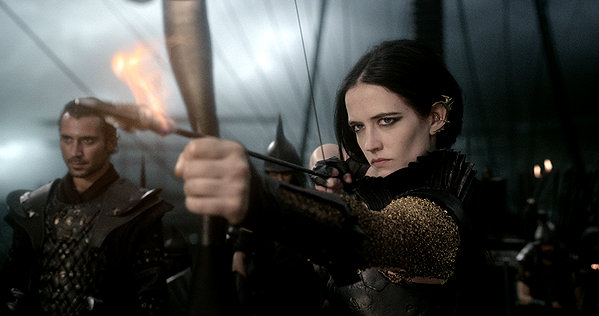 Now, let’s take a look at the enemy camp, namely with chief antagonist, Artemisia. It helps leaps and bounds that she is played by Eva Green (Casino Royale, Dark Shadows), and it’s even more helpful that Green gives it her all, sinking her teeth into the campy villainy. Artemisia is a fierce sword fighter, no-nonsense general, and overall badass supreme. She kisses decapitated heads, is not above fighting topless, and wears wicked outfits with spikes and all sorts of goodies. Every time she departs a scene, you’re left counting down the minutes until you see her again. She’s so delightfully entertaining, chomping at the bit for vengeance and Greek blood. She’s also a woman commanding warships in 500 BC, not exactly a time that recognized women as equals. Another wrong move on the filmmakers’ part was illuminating Artemisia’s back-story. We learn via flashback that Artemisia watched her family get raped and slaughtered by the Greeks. She was sold into sexual slavery at a young age, imprisoned in the bowels of a Greek ship, repeatedly raped for years. Then when these horrible men had had their fill, she was dumped onto an anonymous road and left to die. After seeing this sequence, what person isn’t going to welcome Artemisia? Does she not deserve her vengeance? I was emotionally engaged with her from that moment onward, and so I rooted for her to burn Greece down and vanquish our lame heroes.
The rest of the actors on screen are rather bad. The beefy men on screen could have used some extra work on their underutilized acting muscles. Stapleton (Gangster Squad, TV’s Strike Back) is absent any notable charisma to distinguish him from the stubbly-bearded pack of screaming male heroes. Santoro (The Last Stand) has a certain dour intensity to him, though he spends much of the film watching from a distance. The rest of the cast doesn’t even merit mentioning because the film treats them like featured extras rather than genuine characters. Only Lena Headey’s (TV’s Game of Thrones, The Purge) handful of scenes will grab your attention. It’s ironic that a film that glorifies the heroics of male soldiers, as well as the their chiseled physiques, and the only two women in the entire film are easily the most memorable and entertaining people. Dump the dudes.
While it offers enough thrills and visual power to satisfy a trial viewing, 300: Rise of an Empire is just too empty a spectacle to warrant anything beyond a cursory glance. Director Noam Murro follows Snyder’s blueprint to the best of his abilities, soaking the screen in blood, rippling flesh, and visual grandeur, but the movie goes into convulsions when somebody is forced to talk without kicking people in the face. The plot amounts to little more than a series of attacks played out like stages in a video game. While the original is no masterwork, at least it had characters that we could gravitate toward. Absent any hero worth rooting for, it’s no wonder that Green and her memorable villain reign supreme. She is excellent and has a reasonable motivation for her vengeance. If it had been her movie, 300: Rise of an Empire might have developed into a worthy spectacle anchored by its fiery heroine. Alas, the actual movie is just a Saved by the Bell: The New Class of half-naked men going off to CGI battle, and that’s just not enough.
Nate’s Grade: C+
Share this:

You’re Next (2013)
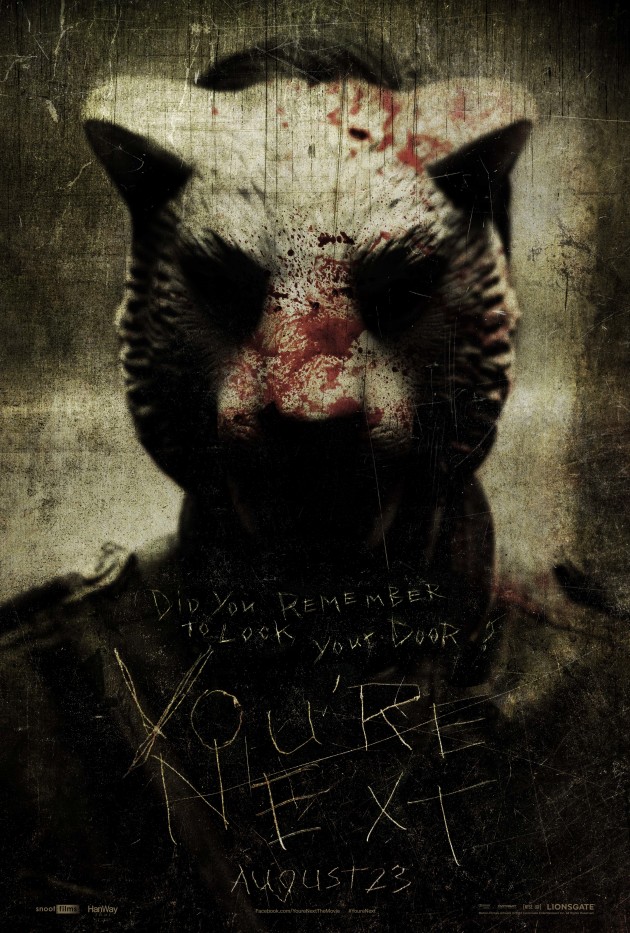 There has been a notable rise in home invasion thrillers in recent years but I am doubtful we’ve hit the crest just yet (this may also be hope speaking since I co-wrote one). Perhaps in an age of real-life anxiety on the news, the invasion of our personal sanctuary strikes an even more horrific chord. Whether you argue the upswing began with Panic Room, or Funny Games, or even the old Audrey Hepburn feature Wait Until Dark, the message is universal: nobody likes having their stuff messed with. This year we’ve already had The Purge make a splash at the box-office, and I’m sure Lionsgate is hopeful that their indie horror flick, You’re Next, which has been reaping great buzz along the festival circuit for years now, will make a similar splash. For me, You’re Next checked every box I would want in an effective horror film: good thrills, good humor, and a good ending. That adds up to one hell of a good time at the movies.
Crispian (AJ Bowen) is traveling all the way upstate for a family reunion at his parent’s palatial mansion in the woods. He’s also going to introduce his new girlfriend, Erin (Charni Vinson), an Australian graduate student that used to work as his teaching assistant at his college. Crispian’s rich family includes his excitable younger sister, his obnoxious older brother, his youngest detached brother, everyone’s boyfriend and girlfriend, and mom and dad. In between a lively family discussion/argument at the dinner table, arrows start flying through their window. Three mean wearing ominous animals masks are stalking outside, armed, and with every intent to kill everyone inside. The masked killers leave ominous messages painted in blood, noting, “You’re next” (I know they’re senseless murderers, but points for using the correct form of “you’re”). Erin snaps into survival mode and assembles a system of defenses but there are more threats than anyone imagined.
 To take nothing away from the artistic merits of You’re Next, the biggest selling point, and its greatest attribute, is that it knows how to properly work over an audience. While nowhere near the genre deconstruction that was last year’s Cabin in the Woods, nor as clever, here is a movie that knows it’s a horror movie, knows you’ve seen these movies before, and knows what you’re looking for as an audience member. And once the killing starts, the movie also gains a delightfully macabre sense of humor, an impish darkness that will leave you chuckling. I heartily recommend seeing this movie in a packed theater because the collective response will add to your enjoyment, or at least it did mine. Never have I experienced a movie where the audience cheered the plugging in of an ordinary kitchen appliance with such reckless enthusiasm. Thanks to director Adam Wingard and screenwriter Simon Barrett, the movie packs great payoffs in its second half, as our prototypical Final Girl outflanks her attackers. There are enough twists and turns to keep things interesting and the pacing swift. Once those arrows pop, this thing just flies by, moving at a speed that keeps you satiated with scares, thrills, and humor. In essence, You’re Next knows how to have fun with an audience, and for whatever reason, with the glut of dank home invasion horror thrillers, this is a surprise. With all the family trauma and killing, watching their loved ones cruelly slip away in horrific fashion, it’s worth praise that Wingard and Barrett find a happy tonal middle-ground that doesn’t blunt the horror or the comedy. The laughs don’t feel out of place with the screams. They make this work. And there are some really sick laughs to be had too.
My only familiarity with Wingard is from his involvement in the horror anthology series V/H/S and The ABCs of Death. It’s also somewhat entertaining to note that all three movies, both V/H/S and its sequel, have been released before You’re Next, a film that was completed two years prior. His anthology segments didn’t point to the same level of promise on full display with You’re Next. Wingard does a great job of orienting his audience to the geography of the play area, so to speak, while juggling different simultaneous threats and maintain a sense of clarity. He knows when to hold back, and he knows when the audience needs a peak of something gruesome. Initially, with the animal masks and the attack on the wealthy, I thought the film was gearing up for a dose of environmental social commentary, as if the killers were extreme defenders of Mother Nature. I’m actually relieved that the film never picks up any ham-handed political subtext.
 As a horror movie, it’s far more effective than most genre deconstructions that will undercut the terror for the chance at a good joke. Even Cabin in the Woods was like this. Again, You’re Next can be riotously funny, especially in the last act, but it can also, and often is, quite suspenseful as well. Once the game get sunder way, you start playing along as well, guessing which of our participants will indeed be next. They place themselves in precarious positions often, especially early, which makes it all the more suspenseful, because you’re suspecting anything can happen at any time. You’re lying in wait, and Wingard does an excellent job of drawing out that tension to a peak level before hitting the horror or gore. There are some gruesomely bloody moments in the film but it doesn’t lovingly linger on the deconstruction of the human body. And just when it seems like the number of housemates fighting for their lives has gotten so low that the thrills would have to be successfully all wrung out, You’re Next supplies a twist that changes gears, introducing a new threat and a new level of dramatic tension. When Erin assembles an ax to smash into the skull of whoever opens the front door, you’re eagerly waiting for that Chekov’s gun to fire (Can we rename it Chekov’s Ax to the Face?). The fact that the movie is almost designed as a Home Alone for demented adults is ingenious.
The acting is a bit hit or miss but the standout, by far, is Vinson (Step Up 3D). She’s our lead heroine, yes, but she takes charge in a way usually reserved for men in these types of movies. She has all sorts of crafty experience with wilderness survival and setting up traps, plus she is able to marshal the family from a bunch of WASPs screaming their guts out into something of a fighting force. And plus, Vinson just has an awesome screen presence to her. It’s a great role for her but credit the actress for knocking it out, giving the audience a strong, extremely capable, and empathetic hero. It’s satisfying to watch the masked killers be outfoxed by their prey. Many of the actors in the film are filmmakers themselves (Joe Swanberg, Ti West, Amy Seimetz), and they’ve collaborated on numerous projects, including other lo-fi horror features, the new Splat Pack if you will.
If you’re looking for a fun horror movie with a dark sense of humor, then You’re Next should be next on your list. It’s savvy, scary, and knows how to goose an audience at just the right moments. Wingard and Barrett know how to give an audience what they want without pandering, and that’s what elevates You’re Next from its peers. This is a horror film that can scare you one minute, make you laugh uncomfortably the next, and then ultimate leave you cheering the vengeful dismemberment of human life with kitchen appliances. It is a more than effectively put together horror thriller from beginning to end.
Nate’s Grade: B+
Share this:

Elysium (2013)
 With the subtlety of a sledgehammer to the face, Elysium is a sci-fi action movie with more on its mind than pyrotechnics. It’s writer/director Neill Blomkamp’s follow-up to 2009’s out-of-nowhere hit, District 9, a film so good that the Academy even nominated it for Best Picture that year, a rarity for a sci-fi flick. The apartheid allegory of District 9 was pretty straightforward, but Blomkamp and company found inspiring and fresh ways to tell a rousing story that worked in tandem with its social commentary. Elysium takes the haves and have nots to an admitted extreme.
IIn 2153, the rich have left Earth for a floating space station known as Elysium. It’s a luxurious paradise where technology can miraculously zap people to complete health. Secretary Delacourt (Jodie Foster) is in charge of Homeland Security and protecting Elysium from the less desirables that want to break in. Those “less desirables” would be the inhabitants of Earth. The planet has become an overcrowded, dirty, impoverished slum; Earth as third world. Max (Matt Damon) is an excon working a factory line for a sneering corporate bigwig (William Fichtner) struggling to leave behind a life of crime. His childhood friend, Frey (Alice Braga), works as a nurse at a hospital, but she’s got her own worries, namely a terminally ill daughter. After an accident at work blasts Max with radiation, he has five days to live. If he can just make it to Elysium, he can be cured. The problem is that Delacourt is shooting down spaceships trying to land on Elysium, including ones filled with women and children. To get off planet, Max needs to help in a heist, but it’s prized codes that could lower the defenses of Elysium and make anyone (ANYONE!) a citizen, thus available for medical treatment. To make sure this doesn’t happen, Delacourt relies on a rogue mercenary, Kruger (Sharlto Copley), a crazed madman who leaps at the chance to do dirty work. The hunt is on for Max.
 The socio-political commentary isn’t terribly veiled here, and maybe that’s because now Blomkamp has bigger targets than South Africa’s governmental policy. I didn’t have a problem with the fact that the inhabitants of luxury are portrayed as all white and that the denizens of the impoverished Earth are mostly non-white minorities (if minorities dominate a future Earth, when do they become majorities?). It’s clear that Blomkamp intends for Elysium to represent the United States. The poor who break through into the Promised Land, many to give their children a better life, or a life at all, only to be deported back to a slum, are clear stand-ins for contemporary immigration, notably Latin America. This is all fine by my book, though I can already hear the persecuted cries of some conservative commentators. It’s not as refined a commentary and that’s fine, not every message needs to be subtle, but I want more with my message than a simple rich vs. poor allusion. We never get to see what the people of Elysium are like, nor what most of that world is like beyond wide idyllic imagery. Fichtner’s character does a good job of symbolizing the callousness of an elite, but then he’s just one guy. The difficulty of maintaining a working wage is given the most care in the film, but much of the higher thinking takes a backseat for the third act movie heroics. The shift is acceptable but it makes a thin development of socio-economic commentary that much thinner.
When it comes to action, Blomkamp certainly knows how to stage a scene to get your pulse racing. The only problem is that there isn’t terribly much action to Elysium, or at least methodically sustained action to satisfy. You always feel like you’re getting a taste of something cooler down the road but it never fully materializes, much like the exoskeleton suit. It looks cool, it provides some progression, but it doesn’t lead to much. What does it accomplish? It allows him a port into downloading the Elyisum codes, but so could anything else. If anything, the metal exoskeleton seems like more of a hindrance, dragging Max down with extra weight and bulk. It pains me to say that the cool exoskeleton, such a prominent marketing feature, could have easily been eliminated as well. The best action in the movie is a heist in the middle that manages to juggle a team of good guys, a team of bad guys, a mark, and a deep sense of urgency for the score. It’s terrific and makes fun use of Blomkamp’s inventive future weapons. The rest of the film is mostly a series of chases, many of which are well orchestrated but only flirt with long-lasting action satisfaction.
The third act on Elysium is an entertaining and noisy conclusion, except Blomkamp sets himself up for limitation. Some spoilers to follow so tread carefully, reader. Elysium gets taken over by Kruger and his team as a defacto coup… except, well there are only three of them. We don’t even get to see them train the robot sentries on enemies or the populace of Elysium. I really don’t know how far-reaching their hastily staged coup is going. We want Kruger to be the big baddie that Max has to fight right before the cusp of the climax, but when there are only two other dudes who aren’t making great use of their fancy resources, it feels too boxed in and restrained. The action is fun while it lasts.
 Another niggling concern is the glut of side characters and their side stories that don’t feel organically integrated into the hero’s story. The flashbacks to Max as a kid could have been completely wiped out. They don’t add more information to the story and feel a tad too hokey for the movie. Sister Saintly Nun espouses wisdom and promises Max will be destined for one great thing in the future (could I settle for two “kinda good” things?). The bigger distraction is Frey and her sick kid, a.k.a. the Angelic Sick Child, you know, the type that feels so at peace with things and with no worry. This is a staple of the movies. Her only purpose in the narrative is to goad Max into making a bigger sacrifice, to think of others, not that beforehand the guy was displayed as being particularly selfish. Then there’s Max’s friend Julio (Diego Luna) who serves little purpose other than to carry him out of the occasional scene and to, of course, be sacrificed to drive the hero forward to achieve his goal. There’s a middleman who arranges for people to get identities that will be read on Elysium, if they get on there safely first. The villains are also pretty one-dimensional in their stock villainy: Kruger a sociopathic killing machine and Delacourt a tyrant. None of these characters leave much of an impression to make you want to take time away from the main story arc. Worse, many of them feel vaguely characterized and are clear plot beat generators rather than people. Maybe Max would be better off as a loner.
The acting is also all over the place. The worst offender is Foster (Carnage), who weirdly over enunciates every syllable in an affected future accent. She also seems to bob and swivel her head a lot as she talks, as if the Oscar-winning actress really had to go to the bathroom but was holding it at bay to complete her takes. Damon (Promised Land) is a reliable action hero but realistically, it’s a little curious that the main character would be, by all accounts, white. It makes much more sense for the savior of planet Earth to be like those left behind, but then I don’t really want to wade into deeper racial subtext than necessary. The real treat of the movie is Copley (The A-Team) who is having a ball playing a sword-wielding psycho killer. He provides a notable spark whenever onscreen, bringing a menace that makes you tale notice. Again, I just wish there was more to the character than his vague back-story and bunt motivations.
Despite what has seemed like a fairly negative review from the start, Elysium still a good movie but beware higher expectations forged from District 9’s unique alchemy. There are a lot of familiar plot beats here and everything from the characters, to the action, to the world building feels like it could have been pushed further. It feels like they took the freshness of District 9 and applied it to a more tired-and-true blockbuster formula. Blomkamp drops us into an intriguing world but I wanted more of just about everything. More with the characters, more with the plot, more with the socio-political commentary, more with the ins and outs of this future world and its inhabitants. The ending is also a bit jubilantly naïve given the powers of the Powers That Be. Really, a keystroke sets everything back to scratch. Again, I’m being more critical than I intend to be. Elysium is quite an entertaining movie with great visuals and Blompkamp is certainly a visionary auteur to praise, but it’s hard not to feel a smidge of disappointment with the man when you know what he’s capable of, even with a perfectly fine movie.
Nate’s Grade: B-
Share this:

Only God Forgives (2013)
 Only God Forgives is an apt title for a movie that is replete with such suffering and brutality. Here is a movie that thinks wanton bloodshed and depravity is the same as character depth, and the fact that it’s from Nicolas Winding Refn, the writer/director of Drive might not be as surprising as you’d believe. I enjoyed 2011’s Drive but I wasn’t as taken with it as other critics, my chief complaint being a groping pretentiousness that confused emptiness as contemplation. I see the same issue with Only God Forgives, a grisly morality play that’s simplistic and overwrought at the same time. Once again Ryan Gosling plays a man of few words, so few that I counted he only says eight by the 28-minute mark (at this pace, he’ll dissolve into the background by 2015). Gosling’s brother was killed after the creep raped and murdered a 16-year-old prostitute in Thailand. Gosling’s ferocious mother (Kristin Scott Thomas) demands retribution on the Thai police, but Gosling has his reservations. What ensues is a string of glossy gore, tedious reprisals, and nonsensical plotting, including numerous karaoke sequences with the Thai cops. The movie’s emphasis is almost entirely on a hellish atmosphere, lots of lurid reds and harsh lighting, providing style but minimal substance. The characters are all detestable and unengaging, the story is awash in dreary and ponderous plotting, and the movie just reeks of pretension, every frame oozing with Important Symbolism (catch the emphasis on hands and wombs yet?). Only God Forgives would be forgivable if all of its admirable style and mood had some greater purpose. It’s a grueling movie to endure but the hardest part is getting through all the tedium thanks to the near-mute characters and a script overdosing on torture. At this rate, Refn’s next film will just be 90 minutes of Gosling punching a baby. Silently, of course.
Nate’s Grade: C
Share this:

Evil Dead (2013)
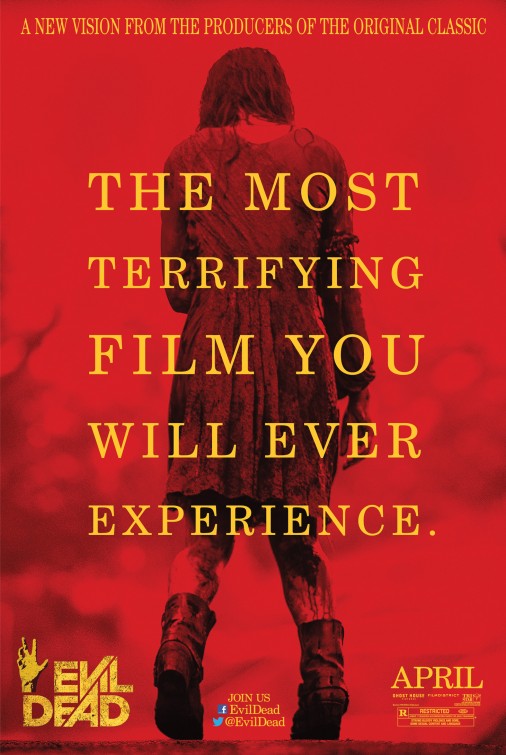 Upping the gore quotient considerably but having little else of merit, the remake of Evil Dead loses just about everything that made the original special. Gone is the sense of humor, unless you just count the quantity of gore to be the qualifier for “humor,” and gone is any real sense of a creative spark. It looks good thanks to director Fede Alvarez, and the practical gore effects can be memorable and truly disgusting in the best possible way, but it just doesn’t feel like an Evil Dead movie. It makes the same mistakes that your typical dumb horror movies do, from a lack of clarity to one-dimensional characters (I think Blonde Girlfriend had one line of dialogue for the first hour) to repeated rule breaking. There are a bunch of callbacks to the original Evil Dead but they serve little other purpose. The finale, after a series of fake-outs, involves a weak showdown with a Big Bad that’s anything but. I expect better from a remake sanctioned and produced by the original director, Sam Raimi, and star Bruce Campbell. Maybe they knew it was only a matter of time before their 1981 film, and its superior 1987 sequel, would be remade by a cannibalistic Hollywood, so they wanted to cash in while they could. Or maybe they just argued, if anyone was going to make a poor remake, it might as well be them. If you’re hungry for gore, then Evil Dead may suffice, otherwise it’s a horror movie that’s too familiar, too mediocre, and ultimately too disappointing to recommend.
Nate’s Grade: C+
Share this:

Django Unchained (2012)
 It’s an understatement that no one makes films like Quentin Tarantino, though after Pulp Fiction it seemed like everyone was trying. The famous writer/director is an audacious filmic DJ, taking samples from all genres and mixing and matching them into a new and elevated form of art; he takes low-grade B-movie concepts and genres and turns them into highly literate A-class films. My only quibble is that, while I heartily enjoy the man’s unique efforts, I don’t know if we’re ever going to see a different Tarantino anymore. Since 1997’s Jackie Brown, he seems intent on re-imagining exploitation films and B-movies and putting his articulate spin on them. I have yet to dislike a Tarantino film (I rate Jackie Brown the lowest but that’s still an A-) and I’ll be first in line for anything the man attaches himself to as writer/director. Django Unchained is Tarantino’s ode to spaghetti Westerns, and it’s every bit as violent and tense and entertaining as you’d hope it to be.
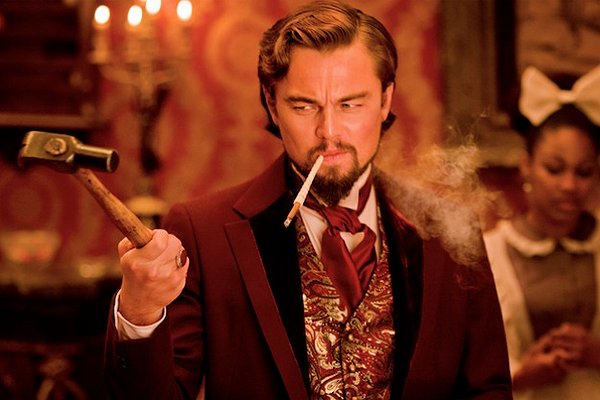
In 1858 Texas, an abolitionist bounty hunter, Dr. King Shultz (Christoph Waltz) frees a slave named Django (Jamie Foxx) and enlists his help in tracking down a team of outlaws. They strike up a mentorship, gunning down outlaws for money. “Kill white folk and they pay you for it? What’s not to like?” Django reasons. After a successful season nabbing bad guys and training Django in the ways of shooting, the men come to a crossroads. Django is looking for his wife Broomhilda (Kerry Washington). She was torn away from him and sold off to wealthy Mississippi plantation owner Calvin Candie (Leonardo DiCaprio). Schultz and Django cook up a scheme to rescue Broomhilda. Schultz will pose as a rich power player wanting to enter the “mandingo fighting” game (think savage gladiatorial combat). Django will play a black slaver, and expert when it comes to picking out prized fighters. With a generous offer, the two get invited to Candie’s family plantation, dubbed Candieland. Standing in the way of their plan is Stephen (Samuel L. Jackson), Candie’s head of the house. Stephen is deeply suspicious of their guests and ready to expose them for who they truly are.
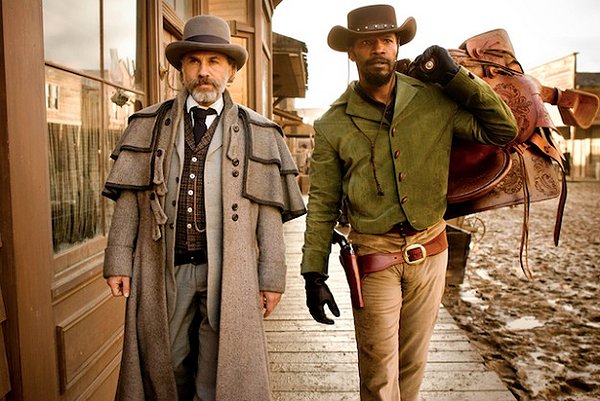 I’ve been dragging my feet writing a review of Django Unchained and I’m trying to determine why that is. Just after typing that sentence I spent 30 minutes checking my e-mail. I’m an avid Tarantino fan, so I’m left wondering what my hesitation is about. I certainly enjoyed the film, thoroughly, but perhaps my question is whether I should have enjoyed the film as much as I did given the historical reality of slavery. No movie will ever approach the true horrors of slavery; even the very act of owning another human is a detestable and crushing reality. Of course I’m coming at this movie from the perspective of a white male, so I feel like aspects of my commentary can only be minor. Is the backdrop of slavery too horrific for Tarantino to stage his spin on a revenge-filled Western? Spike Lee seems to think so via his critical public remarks. Tarantino has great glee in reveling in over-the-top movie violence, the kind that audiences (at least mine) cheer for. I guess the questionable angle is marrying the two realities and tones. You don’t want to take away from the brutality of slavery and at the same time you want to tell a compelling revenge-soaked thriller that satisfies with its buckets of blood. I’d say Django Unchained mostly finds the right balance to hit you in the gut one minute and the next have you clapping along.
It seems like the media is pressing every black celebrity for his or her personal thoughts on Django and especially Tarantino’s copious use of the N-word. Tarantino has gotten into hot water before with his penchant for the N-word, notably his own sequence in Pulp Fiction, but the N-word is entirely period appropriate for Django. Let’s face it, a majority of Americans, let alone Southerners, had really one word for slaves, and it wasn’t kind. This is the word that would have been uttered. However, after seeing the film a second time, I can see the complaints about the overwhelming use of the N-word. If you were to turn this into an awful and disrespectful drinking game, you’d probably pass out before DiCaprio even steps onscreen.
Like Inglourious Basterds, this movie is really a series of sit-downs that simmer with tension. The man has gotten so good with establishing the particulars of a scene, what the characters desire, and to push it to its breaking point when it comes to tension. While I don’t think anything approaches the highpoints of Basterds, this is still a movie that luxuriates in beautifully played tension and the danger lurking underneath Tarantino’s finely crafted words. And let’s talk about those wonderful words of Tarantino talk, the kind that seem so effortless to build sensationally interesting characters. The man sure enjoys writing his umpteenth variances on badasses engaging in verbal pissing contests (the literal kind are far less entertaining, at least for me). When you have character this sharply developed with such counter objectives, I could watch them duke it out all day. There are some pacing concerns with the movie, particularly once we get to Candieland, but when I’m engaged this much in a movie, I’d rather it go overboard than scrimp. Tarantino’s signature cool/funny/funny cool dialogue is alive and well. Every scene advances the plot, pushes it toward its bloody conclusion where bodies explode with sprays of red mist. It’s completely over-the-top in the Kill Bill vein, enough to draw snickers and laughter from a crowd, but Tarantino knows how to serve up a satisfying ending even with a body count to rival Hamlet.
 I don’t want to give the wrong impression that Django Unchained is deadly serious given the subject matter and historical context. I don’t think it disrespectfully sanitizes the horrors of slavery, but Tarantino’s brand of humor finds opportune moments to poke through. There’s a sequence with an early version of the KKK, a group of Southerners on horses arguing over whether they need to wear the ill-fitting bags on their head they prepared (plus Jonah Hill cameo). I was laughing so hard I thought people around me were going to shush me. It may well be the funniest thing Tarantino has ever written. There’s also natural humor to be had in the awkward handling of race relations, something that hasn’t exactly been perfectly ironed out to this day. A wealthy plantation owner (Don Johnson) struggles to explain how his slaves should treat Django, presented as a freeman by Schultz. “You want me to treat him like white people?” someone asks. This is followed promptly with a curt, “No.” There’s also plenty of gallows humor to be had with the over-the-top violence that pervades in the finale. It’s all key moments to blow off steam, so to speak, and make the film more bearable.
Django Unchained follows a traditional Western plot; in fact I’d say what we watch is essentially Tarantino’s whacked out spin on The Count of Monte Cristo (Alexander Dumas is even referenced in the film by name). Our lead character, Django, is in the Clint Eastwood mode of the strong and silent type. Schultz is the one who does all the talking while Django learns and glowers. They make a terrific buddy team and you almost wish that Tarantino had just diverged his story and allowed them to keep doing their bounty business. But Django’s wife needs some saving and that’s where the movie slows down. I wish Broomhilda had been given more character development. She’s pretty much the princess that needs saving, much like the German folk tale we learn is where Broomhilda gets her uncommon name. My sister described Django Unchained as a love story and I think that’s being a little generous (Tarantino did cut much of her torture, physical and sexual, from his script). We certainly feel Django’s desire to rescue her, and we worry about all the plot machinations and masks the characters must wear to accomplish this feat. With that said, the movie still has plenty of sucker punch surprises, much like Basterds, where violence erupts and despicable characters are given arias to illuminate the depths of their depraved worldviews.
I do wish that Tarantino had been a bit more judicious with his editing (the first without longtime editor Sally Menke who died in 2010) and curtailed all his self-indulgent meta film homage nods. We get stuff like Amber Tamblyn (The Sisterhood of the Traveling Pants) in one shot. Why you ask? See her father also stars in the movie in a small role, and he once played a character titled “Son of a Gunfighter.” So in his own credits, Tarantino lists him as “Son of a Gunfighter” and his daughter as, what else, “Daughter of a Son of a Gunfighter.” When all of that contorting is for an end credits gag and one shot in the whole movie, you feel like it was strictly masturbatory. Then there’s the original Django, Franco Nero, asking Foxx how to spell his name. Old Django asking new Django how to spell his name. I guess it’s supposed to be like a cinematic passing of the torch but it’s another moment that feels superfluous in a 165-minute movie. The movie can get a tad exhausting. The final 15 minutes, while still smartly written and boasting some terrific bloody comeuppance, feels like an add-on that wasn’t needed. It does manage to tie some elements back together but at this point the audience is ready for Django to ride off into the sunset, not have another obstacle to overcome in improbable yet badass fashion. At my first viewing, the kid behind me kept complaining to his parents that the movie had failed to end (“This is still going? It’s already been two hours!”). I also understand the fruitless and ironic nature of asking Tarantino to reign in his self-indulgences; that is, after all, what makes him who he is.
As expected from Westerns, the movie is a boy’s show. Foxx (Ray) has a steely screen presence that works very effectively for the character. The man’s quiet confidence and growing insolence play well, as he burrows into a role that boosts his confidence and assertiveness. Foxx’s journey from beleaguered and shell-shocked slave to mighty walking vengeance is definitely a full performance and one that Foxx delivers without any winks to the camera. Waltz (Carnage) will be dinged for playing a character similar to his Oscar-winning role in Basterds, but he’s still joyously entertaining, with that strange speech pattern of his that he plays like a musical instrument. He has a lot to say with plenty of theatrical flourishes, but that’s what makes him so entrancing. Simply put, Waltz and Tarantino are a match made in heaven.
 DiCaprio (Inception) doesn’t appear until over an hour into the film but he’s worth the wait. At my first screening, I thought DiCaprio was good but was unimpressed. Upon a second viewing, I must say my appreciation grew for the man’s performance. Calvin Candie is certainly a vile man and DiCaprio is able to give him such an intriguing brio; he’s not the magnetic source of evil that Waltz was in Basterds, a man able to stay two steps ahead of his prey. Candie is easily taken for a fool. He’s not the smartest guy in the room but he can work up a pretty sizable fury; DiCaprio actually cuts open his hand during a confrontation and remains in character, undeterred. But the best actor in the movie is Jackson (The Avengers). There are far more layers to his head house slave than meets the eyes. It sure seems like he’s really the fist behind the glove. He may put on an act for company, but the man is far more calculating and sinister than anyone else in the film. You know he’s a good villain when the audience cheers the loudest at his demise (don’t act surprised, spoiler-phobes). I wouldn’t be surprised if Waltz, DiCaprio, or even Jackson get nominated for supporting Oscars.
It seems like Tarantino has also stumbled into a hidden lucrative subgenre at the box-office, namely the historical revenge film. Who doesn’t want to see a group historically shafted get some sweet revenge, the bad guys punished, and all with sparkling dialogue? In 2009, Tarantino went on a Nazi scalping spree and got to shoot Hitler in the face. With Django, a brutalized slave becomes the hero of his own story and kills some vile slave owners and traders. It’s essentially a Nat Turner-style rebellion from history, albeit with some harebrained scams and colorful characters. Following this lucrative model, Tarantino could take other maligned minorities and give them cinematic justice. Sadly, there are too many examples to count where Tarantino can take inspiration.
Django Unchained is a bloody, rollicking, talky, messy, exciting, surprising, uncomfortable yet satisfying movie and probably one of the oddest crowd-pleasers in recent memory. I saw it on Christmas day and my theater was a sell out. They loved it, soaking up every minute, laughing at the funny parts and wincing at the gruesome violence. I couldn’t think of a better way to celebrate the birth of baby Jesus. It doesn’t whitewash the evils and viciousness of slavery, but at the same time Tarantino knows how to serve an audience and their demands for big characters, big set pieces, and big vengeance. Django is a sturdy Western/blaxploitation film, and whatever other genres Tarantino feels like tossing into his cinematic blender. Whatever you classify it as, Django Unchained is another Tarantino original specialty and his tremendous talent comes through loud and clear, even with a few false endings and self-indulgences at play. It looks great, has a great soundtrack, and presents great acting talent reciting Tarantino’s great words like they were prized possessions. It’s a bit long and a bit overdone, but when you’re enjoying yourself, who wants to leave the party early?
Nate’s Grade: A
Share this:

Piranha 3DD (2012)
 Wow, I was not expecting the follow-up to the so-bad-it’s-excellent Piranha 3D to pretty much just inhabit the “so bad” spectrum, though I ignored warning signs at my own risk. I found the 2010 Piranha to be a sheer blast of campy entertainment, with some world-class gore effects and a game cast. I was actually terribly excited about a sequel; I’m ashamed to admit it now. Where did things go so horribly wrong? Much like Expendables 2, the movie’s tone shifts from tongue-in-cheek 80s throwback to meta self-awareness. The movie becomes more of a lousy comedy with some absurd violence rather than a horror movie with a nasty sense of humor. The entire premise is so labored, that a water park would become piranha-infested, and the characters are so unlikable; to dub them one-dimensional is to be too kind. The acting is abysmal even by bottom-of-the-barrel B-movie standards. The celebrity cameos feel wasted, with David Hasselhoff soaking up every second of desperation. The tension is next to nil and the gore effects are pretty cheesy, trading gallons of blood for ingenuity (many character deaths occur off screen, like Gary Busey’s). Then once the piranhas strike, the movie just completely abandons any sense of reality and becomes a gonzo comedy of the absurd, with characters behaving like idiots from another dimension. There’s even one character that gets decapitated by a simple string of flags. It’s at this point that Piranha 3DD drops any slapped-together sense of purpose. And yet this ghoulish mess can only barely make it to a scant 70 minutes (good luck getting through the abominably unfunny end credits outtakes). Reportedly, 3DD had almost the same budget of 3D. Where the hell did that money go? Piranha 3DD completely misfires on every level, failing as a horror movie, a horror-comedy, a comedy, a gore movie, hell, as a suitable movie. Whatever the metric, this movie blows. If you’re hard-pressed for gratuitous nudity soaked in blood, watch the superior 2010 Piranha film instead. I’m going to start drinking heavily and forget I ever looked forward to this monstrosity on taste.
Nate’s Grade: D
Share this:

The Cabin in the Woods (2012)
 The Cabin in the Woods has been building an avalanche of buzz in the time it’s been sitting on the shelf. Originally filmed in 2009, the horror comedy from Buffy the Vampire Slayer creative heavyweights Drew Goddard and Joss Whedon has been patiently waiting to unleash its wicked Jack-in-the-box of surprises. Directed by Goddard, and written by Whedon and Goddard, The Cabin in the Woods is a brash enterprise, a blast of entertainment and a breath of fresh air in a genre that typically teeters into self-parody. If you haven’t seen the movie yet and have a strong, or even curious, desire to do so, then stop reading. Go in as blind and unspoiled as possible. Then you can come back and read my witty words. It’s okay. I won’t take offense. In the meantime, I’ll keep myself busy. Back? Good, let’s get started then.
You know the setup. A group of dumb teenagers spend a weekend at a friend’s cabin in the middle of nowhere. There’s the jock (Chris Hemsworth), the slutty girl (Anna Hutchinson), the stoner (Fran Kranz), the bookish one (Jesse Williams), and the mousy girl-next-door virginal type (Kristen Connolly). There’s the scary old guy at the gas station, there’s the promise of debauchery and sweet oblivion. But we’re not the only ones watching the gang. A group of lab techs, led by Hadley (Bradley Whitford) and Sitterson (Richard Jenkins), is watching their every move. They control the cabin and its surroundings and are manipulating events to lead to slaughter. But why are they going to all this trouble? That’s just the tip of the iceberg here.
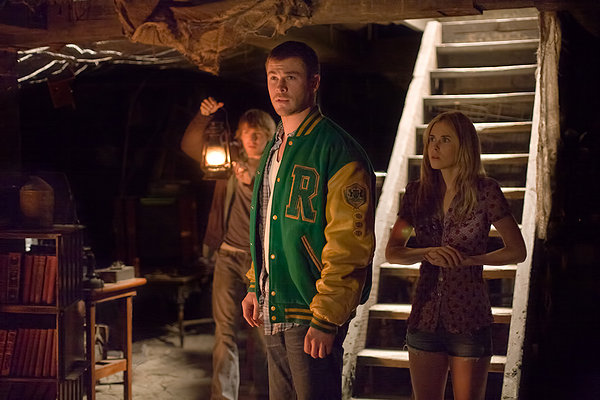 The macabre sense of humor is what will immediately separate Cabin in the Woods from its blood-and-guts brethren. The sharp dialogue is routinely laugh-out-loud funny, absurd in the right parts. Whitford’s downbeat reaction during a joyous moment of celebration had me howling. The movie is so smart, sometimes too smart for its own good. If you’re going to level one major charge against the movie, it’s that it isn’t really ever scary. Oh sure it has some stuff that should be scary given the particulars, and its 31 flavors of horror should find something that tingles everyone’s spine on some level. But this is much more of a deconstruction of the horror genre and its audience than an actual horror movie. Whedon and Goddard undercut their horror almost at every turn, settling for the ironic laugh or satirical tweak and repeatedly cutting back to the lab guys to provide a few good laughs and commentary (Jenkins has a terrific foul-mouth rant aimed at children that left me doubled over in laughter). Do not be mistaken; the lab stuff is easily the best part of the movie. Upon my second viewing, I found myself growing weary with the teens-in-a-cabin stuff and anxiously waiting our next detour into the weird and wonderful lab. The duo of Whitford (TV’s The West Wing) and Jenkins (Friends with Benefits) makes for some terrific and biting middle management corporate satire, as well as satirizing the jaded, bloodthirsty audience of slasher movies. You can tell that Whedon and Goddard love horror movies and are frustrated with the nihilistic rut the genre has found itself mired in. And as a deconstructive exercise, Cabin in the Woods is first-class. Roger Ebert succinctly called the movie a “fanboy final exam.”
It can be a tad clinical at times, failing to give us any true attachment to the characters even in an ironic sense, but when a movie is this fun, this wild, and this clever with its deconstruction of genre, I concede the point of having to root for somebody. The characters break the stereotypical mold; the jock is on academic scholarship, the smart guy happens to also be a hunky jock, the slut isn’t really slutty, the virgin isn’t squeaky-clean, and the stoner is the smartest guy in the group, aided by his cannabis (As one character later reasons, “We work with what we got”). He’s the only one who seems to be able to notice the strange manipulations at work. Once you dig into it, the very nature of how and why we watch horror is analyzed by Cabin in the Woods (get ready for some voyeurism parallels). The nature of fear and sacrifice is given some thought, though this stuff gets a bit lost in the madhouse of a final act. The movie becomes a funhouse of horrors and the frenetic carnage and chaos elevates the energy level. I cannot think of a movie that ended in such a whirling dervish of excitement and deep, demented satisfaction. This is one movie that doesn’t just end with a bang; it ends with every bang you can think of. Horror fans are going to be hopping out of the theaters, foaming at the mouth, desperate to tell every one of their friends what they just witnessed. I wish several of my friends would hurry up and see Cabin in the Woods so I had somebody to talk about its many pleasures, thrills, and surprises with. The movie has several terrific payoffs. This is the most fun I’ve had with a horror movie since 2003’s Cabin Fever. Must be something about cabins that brings out the meta-ness.
 Considering this was on the shelf for over two years while MGM worked out its bankruptcy dealings, it’s fun to see how fate has been to this lot of actors. The biggest name has got to be Hemsworth, better known as the flaxen, hammer-wielding God of Thunder Thor in the Marvel movies, and Whedon’s upcoming Avengers ensemble. He’s rather enjoyable onscreen and his hero moment is one that will definitely be a talking point. The two standouts from the cast, other than Jenkins and Whitford of course, are Connolly (“iGirl” on the Web series, iChannel) as the nubile Final Girl and Kranz (TV’s Dollhouse) as the clever pothead. Connolly has got a great face for movies, looking like the younger sister of Ellie Kemper (TV’s The Office) or Jayma Mays (The Smurfs), and I’m always a sucker for a redhead. Kranz is so good with the comedy that you may fail to notice all the work he’s actually putting into his role, which quickly becomes the audience’s voice of reason.
But the strangest quirk for a movie knotted with them comes to the casting of its resident “slut” played by Hutchinson. The woman has a sultry side that comes through without going overboard into parody. Scanning through her resume, I see that Hutchinson portrayed the Yellow Power Ranger (Lilly) for 32 episodes in Power Rangers: Jungle Fury. Now here’s where things get interesting. Being the movie aficionado that I am, I recognize that Cabin Fever also had an actress, Cerina Vincent, who portrayed the Yellow Power Ranger (Maya) for 45 episodes in Power Rangers: Lost Galaxy. Here’s where it gets even weirder. Both Hutchinson and Vincent are the only cast members in their movies to go nude in their respective films. So two actresses, both different versions of the Yellow Power Ranger, both get naked and star in horror genre deconstructive movies with “cabin” in the title! Is this one of the Mayan signs? Should I contact Dan Brown? Does it say something that the yellow ranger appears to be the most comfortable with nudity? This may be the greatest and most obscure observation I’ve ever made.
Of course there are so many fun surprises that it puts me in a bit of a critical bind. I don’t want to go into too much detail because that would spoil the fun, though rest assured that The Cabin in the Woods does not live or die based upon unknown plot twists. You may think you know given what’s already been revealed via the trailers, but really you have no idea how deep this thing goes and to what ends. Unless you just happened to be me, which at last count there was only one of (my evil twin long since slain… or was he?). I say this not as some point of pretentious bragging, but it’s because I wrote a horror screenplay a year ago that also satirized the genre tropes (for those few interested, it was called Blood Wake). I won’t go into spoiler detail, but both of our bad guys were called into question as being bad, from a greater good standpoint, and the killers had more on their minds than simply punishing dumb, horny teenagers. Well, after watching Cabin in the Woods, I know that screenplay goes back in the shelf now where it will live in eternal slumber thanks to core similarities. But if somebody’s got to be wielding the knife, at least it’s my man crush Joss Whedon.
Nate’s Grade: A-
Share this:

Fright Night (2011)
 Horror is a genre that’s been notoriously cannibalistic, especially as of late. I don’t mean flesh-eating, I mean the glut of remakes that has polluted the horror market in recent years. After remakes of Halloween, A Nightmare on Elm Street, Friday the Thirteenth, The Hills Have Eyes, House of Wax, Prom Night, My Bloody Valentine, The Amityville Horror, The Fog, The Texas Chainsaw Massacre, Black Christmas, Sorority Row, Dawn of the Dead, The Crazies, Don’t Be Afraid of the Dark, I Spit on Your Grave, Last House on the Left, The Thing, and scads more, you’d be forgiven for believing that the remake of 1985’s Fright Night would be another soulless cash grab. It turns out that it’s way better than even the original and quite an entertaining movie that got lost in the shuffle.
In a quiet little suburb outside Las Vegas, students are going missing. Ed (Christopher Mintz-Plasse) suspects that there is a vampire in town. Ed’s former friend, Charley Brewster (Anton Yelchin), dismisses this idea, especially since the would-be vampire in question is his new neighbor, Jerry (Colin Farrell), a home construction worker who seems to work at night mostly. But lo and behold, after Ed goes missing, Charley concludes that his old friend was right all along. Jerry has his eyes set on Charley’s single realtor mom, Jane (Toni Colette), and maybe even Charlie’s sprightly girlfriend, Amy (Imogen Poots). The only ally Charley can muster is a drunken Vegas magician in the Criss Angel tradition. Peter Vincent (David Tennant) has been studying vampires for years due to his tragic personal connection to vampires, notably Jerry.
 Fright Night finds that horror sweet spot, equal parts scary and funny. Credit screenwriter Marti Noxon who cut her teeth on TV’s seminal show (yeah, I said it) Buffy the Vampire Slayer; there’s even a reference to a “Scooby gang” for we Buffy fans. Noxon does a terrific job of establishing a suspenseful situation and then developing it nicely, teasing it out. There’s a sequence where Charley is trying to rescue a neighbor lady that just involves a series of hiding places but uses a simple setup of ducking around corners so well. When our plucky protagonist checks in with Vincent for some assistance, we’re introduced to an array of exotic vampire-hunting weapons and artifacts that the Vegas magician has under glass. With a setup like that, you better believe we’re going to be using those weapons later, and how. The character development is richer than most teens-battle-monster genre films. The relationship between Charley and Ed, and the awkwardness and resentment of two friends growing apart, feels rather believable even dropped into the middle of a vampire adventure. The standard girlfriend role is given a bit more weight, as she’s the one who feels confidant and aggressive. She knows what she wants, and as played by the adorably named Imogen Poots (Solitary Man), you want to be what she wants. Seriously, this actress is striking in her Grecian features and I like a woman who knows how to handle a mace. There are also small touches that I really enjoyed that helped round out the movie. At one moment, a woman is being fed on by Jerry and she spots Charley hiding behind a door. Rather than cry out for help, she carefully draws a shaking finger to her mouth, wishing him to keep quiet and not to save her. The resolution of this rescue attempt is shocking in all the right ways. It’s a surprise that feels completely within reason, and organic twists and turns are always the most satisfying.
Noxon’s script continually surprises even when it starts to follow a by-the-numbers plot. Instead of an axe lopping off a vampire’s head, it just goes about halfway through thanks to the rigidity of bone. That’s a nice touch, but then when that same vampire tries to bite our hero and can’t move his fairly severed neck closer, then that’s when Noxon has capitalized on her cleverness. And she capitalizes often enough for Fright Night to be a real step above most vampire action flicks. Noxon also finds clever spins on vampire mythos; to get around the whole can’t-enter-without-an-invitation rule, Jerry just attempts to blow up the Brewster’s home to drive them out (“Don’t need an invitation if there’s no house”). There’s a particularly ingenious method to light a vampire on fire. And the entire character of Peter Vincent, played brilliantly by Dr. Who actor David Tennant, is a hoot and a great addition. He’s a riot as a cynical, profane, and selfish stage performer. His character is such an enjoyably comic foil, and Tennant plays him with aplomb, that you almost wish for a Peter Vincent spinoff movie.
Director Craig Gillespie shows that he is shocking adept when it comes to staging a horror film. I would not have expected this level of competency from the director of Lars and the Real Girl. It embraces its R-rating and the bloodshed is plentiful though the gore is restrained. Gillespie draws out scenes with judicious editing, letting the dread build steadily. The tension of something simple like Jerry standing in a doorway, waiting for any verbal slipup to come inside, can be terrific. Gillespie also has some nifty visual tricks up his sleeve to complement Noxon’s crafty screenplay. There’s one scene where Jerry walks into a hotel lobby and is confronted by a security guard. The camera pans over a series of security monitors that do not pick up Jerry. Then in the background we see Jerry hurl the guard to the ground to bite him and in the foreground we see the security footage minus Jerry. There’s an ongoing tracking shot inside a fleeing minivan that’s not exactly Children of Men but still a good way to feel the fever of panic. The final showdown between Charley and Vincent versus Jerry is suitably climactic and rewarding, nicely tying back elements that were introduced earlier and giving Poots an opportunity to vamp out, literally and figuratively.
 Farrell (Horrible Bosses) is a charming, sexy, alluring menace as Jerry, which is exactly what you’d want in a vampire (sorry Twilight fans). Vampires are supposed to be seductive; they’re inherently sexual, what with all that biting and sucking and sharing of body fluids. If Jerry is going to be dangerous, he also has to be seductive, and Farrell is exactly that. With his swaggering walk, with his pose-worthy stances, with his grins, he’s a great ambassador for vampire kind. But this guy does more than preen; he’s also a credible threat. He’s the bad boy that is actually quite bad. Farrell’s enjoyment of his villainous role is noticeable. Jerry taunts Vincent: “You have your mother’s eyes.” He shoots and misses the big bad vamp. “And your father’s aim,” he add, chillingly. Having a strong villain can do wonders for an action movie, and Jerry is a formidable foe played with great relish by Farrell.
Not everything goes off without a hitch. The special effects can be dodgy at times, especially when Jerry goes into full CGI vampire face. The vampires tend to look like shark people, with long exaggerated jaws and rows of gnarly teeth. It’s not a particularly good look. While Noxon’s script excels in most areas, there is still enough dangling plot threads. Charley’s mother is really never a figure of significance. Her potential romance of her neighbor/vampire is a storyline that is never capitalized upon, oddly enough. That seems like the kind of storyline you’d build a whole movie around. She’s written out of the movie in hasty fashion, immediately going from a sequence of driving to being unconscious in a hospital bed. How did that happen exactly? After the Brewster house explodes, nobody seems to make a big deal out of this, like it’s just some regular neighborhood occurrence. What kind of neighborhood watch is this?
Fright Night is just a fun night out at the movies. It’s got plenty of laughs thanks to Noxon’s clever script, plenty of scares thanks to Gillespie, and plenty of sex appeal oozing from Farrell (though “sex appeal” and “oozing” don’t sound like an advisable linguistic match). It’s not much more than a vampire action flick but it’s a really good vampire action flick, clearly a cut above the dreck that usually just relies on its audience’s understanding of genre convention to cover up for its shortcomings. There’s no reason you cannot be a good movie with this genre, and Fright Night is proof of that. Convincingly acted, cleverly staged, and surprisingly well-executed, this is one genre movie that hits the right vein.
Nate’s Grade: A-
Share this:

The Grey (2012)
 I’ve always been fascinated with survival thriller/horror, where we think step-by-step with the characters through an unlikely scenario. I greatly enjoyed Frozen, a horror movie about three teens stranded on a ski lift, and Buried was in my top ten list for 2010. I enjoy the thought exercise and find the scenarios easily empathetic as long as people don’t make boneheaded decisions. Director Joe Carnahan has been paying his bills as of late with stylized, overdone, and generally overblown action movies like Smokin’ Aces and The A-Team. I would not have expected Carnahan to deliver anything that could be described as nuanced or meditative, but lo and behold The Grey is a survival thriller that’s as thoughtful and emotional as it is viscerally exhilarating. The Grey is the first great movie of 2012 and I’m astounded that it was released in January, the dumping ground for cinematic dreck.
We follow a group of grunts working on an oil pipeline way out in the northern Alaskan territory. They’re heading south for some R&R when their plane crashes due to electrical issues. Ottway (Liam Neeson) and seven other men are the lone survivors. While checking for supplies, they discover a pack of wolves feasting on some of the choicer corpses. Ottway is a wolf expert, hired by the oil company to patrol the grounds and hunt antagonistic wolves. He explains that wolves have a hunting radius of 300 miles and a kill radius of 30 within the den. It is uncertain where these men find themselves, so they bundle up and head south, hoping to escape the predators, find food and water, and discover a way to help.
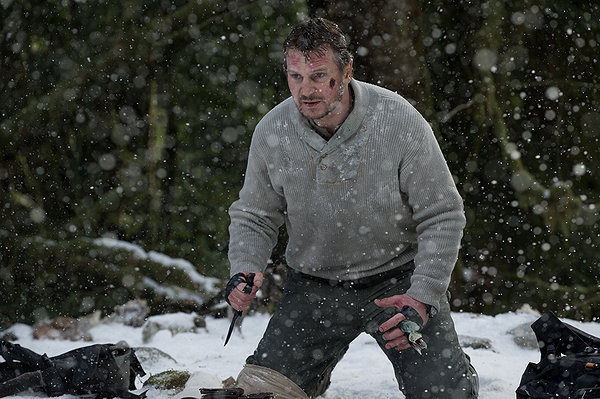 The Grey is a harrowing, haunting, and intense thriller, masterfully played by Carnahan. The threat is real and brutal, enough that it convinces the men to leave the safety of the plane wreckage to possibly escape the wolf kill radius. We’re told that wolves are the only animal that will kill out of vengeance (look out Sarah Palin). The attacks are vicious and the violence is bloody and occasionally shocking, though it never seems gratuitous. The special effects and canine animatronics are seamlessly integrated. The sound design for this movie is exceptional, probably the best use of sound to fashion anxiety since 2007’s No Country for Old Men or even Spielberg’s War of the Worlds. The sounds of the wolf pack echo around the theater, completely keeping you off guard, disorienting the audience. Carnahan creates such a vivid picture of dread that we’re convinced that the wolves could sic at any moment. And when they do the editing becomes chaotic, mimicking the ferocity of the animals and depicting the frenzied fear of the attacked.
I was a terrible bundle of nerves throughout most of this movie. The plane crash is an exemplary sequence of terror, capturing the terrifying moments from Ottway’s limited point of view. The rest of the movie doesn’t get any less tense just because they’re on stable footing. There’s one scene where the wolves attack a guy who has fallen back from the group. Carnahan brilliantly captures the helpless reality by showing the men trying to race back in knee-high snow. They can only stomp so far while the man is ripped apart in the background. The action sequences, though to be fair they’re really more suspense pieces, are the most nerve-wracking I’ve endured since the brilliant Best Picture winner, The Hurt Locker. Of course these being life and death stakes, there is plenty of death, as the men are generally picked off one by one, though not all by the pack of wolves. The frigid elements are just as dangerous as the killer wolves. The men could just as easily freeze to death. The need for shelter and food is dire (the men even joke about the famous cannibalism from Alive). One of them is suffering just from his brain being unable to acclimate to the elevated attitude. That’s almost enviable considering the doom that constantly hangs over the other survivors.
Naturally there’s some friction between the survivors as far as the best course of action. Ottway has assumed Alpha dog status thanks to his expertise on wolves and the Arctic climate, but that does not mean that the rest of the men follow lockstep. Give the alarming situation, it will be in these men’s best interest to work together for survival. Some of the men chafe at being what to do but the movie doesn’t drags out this conflict, thankfully, because jockeying for power positions seems like an absurd waste of time. There are heavier issues at play. The impact of the movie would be blunted if the characters came across as one-dimensional; then we wouldn’t care about their fate. Carnahan and co-writer Ian Mackenzie Jeffers, based on Jeffers’ short story “Ghost Walker,” find creative ways to enrich and reveal the character of these lone men. They feel believable and their reactions to the implausible dangers seem plausible, keeping us invested. Ottway keeps flashing back to an image of his wife (Anne Openshaw) for strength, this angelic brunette telling him not to worry. It’s what he has to hold onto, though when we learn more about the context of this image it becomes even more meaningful. One character has had enough struggling and has no will power to continue. He argues that whatever life he may return to is no reward.
 The thrills and scares are what are to be expected, but The Grey is also a much more thoughtful and intellectually stimulating picture than you may have hoped. Carnahan’s script covers a wide array of survival tactics without breaking from the reality of its premise. It’s just interesting to watch a group of men use their wits to make best use of their dwindling supplies and dire situation. It becomes a game that the audience plays, systematically judging every choice and assessing if we would follow suit. Beforehand, the men engage in a theological discussion regarding the existence of God, faith, the belief that there is a divine plan. The men are fighting for their survival but having an existential crisis all the same, trying to supply meaning to the horrific, find reasons to keep fighting. “We crashed going 400 miles per hour and we survived. That has to mean something,” one of them reasons. Or it all could just be very bad luck. Ottway at one point, an admitted non-believer in a higher power, bellows to the sky for something, anything. His desperation is effective and turns what could have been trite into a nice character moment. One of the men shares a memory of his daughter, who would wake him up by gently dangling her hair in his face. It’s a touching moment and when that same character meets an untimely end and is helped to the other side by a vision of that same daughter, it becomes profoundly moving (the quick snap to reality is a jarring point for grisly comparison). The Grey has plenty more on its mind than making an audience jump. It also wants to make the audience think and, in the end, feel genuine emotion.
The ending may rankle some who felt, especially with the advertising, that the film was going to be a two-hour Neeson ass-kicking vehicle, but for me it was fitting and the only way this story could have ended. Though let me advise all potential ticket-buyers to stay during the end credits for a small bit that offers a tad more resolution, though still leaves as much to be determined by the viewer. It’s not exactly ambiguous considering how things are left.
Neeson (Unknown, Clash of the Titans) has settled nicely into his newest incarnation as middle-aged ass-kicker, such an odd path for the man who famously portrayed Oskar Schindler. At some level, it’s below an actor of Neeson’s standards to be running through such genre frills, but it’s also a joy to see someone who can really, truly act give gravitas to his men of action. After he delivered his warning in Taken, I was completely on board and ready to watch this man bust some skulls. Beyond the physical challenges, the role really puts Neeson through an emotional wringer and the man gives a strong, stirring performance. You’d be glad to have this man in any predicament. The rest of the cast fill out their parts well, with Dermot Mulroney (The Family Stone) making the best use of his time onscreen to create a character.
The Grey is a startling movie; horrific, jolting, thrilling, moving, beautiful, philosophical, and extremely captivating. Carnahan has crafted an exciting movie that transcends genre. There were moments so tense that I was chewing on my knuckles. There were moments so intense I felt like I had to look away. And there were moments so poignant that tears welled up in my eyes. I look forward to watching this movie again and finding even more at work. No grey area here, this is one truly excellent movie.
Nate’s Grade: A


 nathanzoebl
You must be logged in to post a comment.