Blog Archives
The Purge (2013)
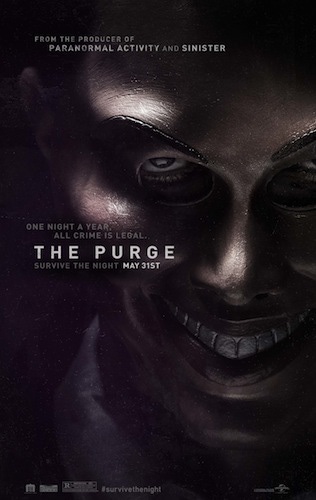 Sci-fi cautionary tales have been an outstanding way to provide commentary for contemporary anxiety. Rod Serling, Charles Beaumont, and the recently departed Richard Matheson were masters of this. A movie can make you think as speculative fiction while still following a thriller/horror blueprint to entertain the masses. And so writer/director James DeMonaco (Assault on Precinct 13, The Negotiator) wades into these waters with The Purge, a home invasion thriller that has a premise that, on the surface, might make you scoff. In 2022, the United States has practically solved unemployment and crime thanks to a nifty little holiday known as the Purge. Every year, for a twelve-hour window, law is rescinded and so are emergency services like police and firefighters. For those 12 hours, good American men and women are allowed to engage in just about every sort of crime up to and including murder. It’s designed for people to release all their aggression and darker impulses, thus allowing for a safer, happier 364 and a half days a year.
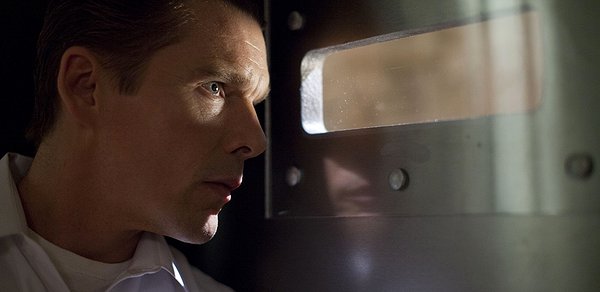
James Sandin (Ethan Hawke) is the top salesman when it comes to hardcore home security systems, the kind with the thick metal doors over your windows and doors. He lives in one of those finely protected homes with his wife, Mary (Lena Headey), and children, Max (Max Burkholder) and Zoey (Adelaide Kaine). They’re prepared for a long night behind barricades. Then a wounded black man (Edwin Hodge) runs through the cushy neighbor, crying desperately for help. Charlie offers him refuge inside the Sandin abode. Shortly after, a group of masked vigilantes, led by a lad who looks like Patrick Bateman, knock on the Sandin home. The bloody ma is their “bait,” and these angry folk demand he be returned to them, or else they will be coming in and sparing no one.
 This high-concept thriller is a well-crafted suspense piece, with several well-developed sequences that squeeze out tension. The premise involves some mighty suspension of disbelief but you’d be surprised how easy it is to accept and move on. The kids provide dissenting voices, mostly Charlie, and we get a lean history of the Purge and all the information we need to go forward, at least for this night. I liked how it’s become a common passing greeting to say “Stay safe” to people on the day before the Purge. Little details like that make the world feel more thought out. I like that engaging in the Purge is thought of as one’s patriotic duty. There are some tantalizing moments of dread as well, like a neighbor sharpening his killing tools outdoors. But really the movie comes down to its suspense, broken up into a series of different goals. James wants to protect his family and return the “bait,” but first he needs to find him and subdue him. Charlie wants to save him and get to him first. It’s your standard people-groping-in-the-dark kind of picture, but when given a strong sense of urgency and some good actors, it can be plenty suspenseful. DeMonaco does a fine job of making sure his story doesn’t get too confusing, tasking the audience with keeping track of too many participants. So when we have Zoey’s bad boyfriend (Tony Oller), he’s dealt with before the manhunt begins. When the home invasion kicks in, the manhunt is over. When it looks like Zoey is heading straight for the stranger, it’s a storyline that culminates very quickly. There’s a good sense of clarity throughout The Purge, which aids the effectiveness of the thrills.
For the first half of the movie, things snap together well enough that you just accept the premise and its implications, forgoing the nitpicks that wait. It isn’t until the third act where you start to disengage from the film and pick it apart. As a cautionary tale, it has some interesting ideas about class warfare; the main villain is right out of Ayn Rand’s Objectivist playbook. But the ideas and moral commentary fade as the movie becomes more a standard, albeit effective, suspense thriller. I really appreciated the argument that unemployment is so low because the Purge takes care of the sick, homeless, and poor and disadvantaged, those chiefly who cannot defend themselves and are easily targeted. It’s an eerie extreme that doesn’t feel too many steps removed from the last presidential election where Republican primary debate audiences cheered the hypothetical death of the poor. But then the nitpicks do come and once they do it’s like a rushing tide that cannot be stopped. Why do people have stockpiles of guns but no bulletproof vests and gear? Why wait for the bad guys to get in when you and your armed, well-defended family in your home fortress can preemptively strike? Why would you order the Sandin family to return your “bait” and then turn off their power? Doesn’t that make it much harder? Why would killing your girlfriend’s father win her over? Do you think she’s really still going to be your girlfriend after that? How big is this house that people get lost in it constantly? Who hides under the bed in this day and age? And, when hiding from intruders who wish to kill you, why in the world would you keep your flashlight on?
It’s late in this last act that the film tries to go one step too far. The home invasion commences, the struggles are pretty dandy to watch with some creepy imagery, and then DeMonaco has to go beyond that, introducing a secondary set of antagonists that at once feel obvious and poorly set up. The family asks, befuddled, why these new antagonists are doing what they’re doing, but they, and you, will not get a straight answer. It’s really designed to be shocking and little else, and so it feels tacked on and unnecessary. The last ten minutes of the film fumble the momentum of the movie. It’s a stumble at the finish line and leaves some lingering doubt as you assess the effectiveness of the whole movie.
 So the premise begs the question: what would you do with a lawless 12-hour window? I think most human beings would be too timid to embrace their animal side. Morals and ethics factor in, naturally, but really I think it’s just good old fear, the fear that anyone else can snuff you out with impunity, and engaging in the Purge also makes you a target. I think most people would probably try and engage in heists, but then the bank would be crawling with twenty different heist teams squabbling over who gets the loot. The banks would also surely increase their security astronomically.
The premise, while intriguing, also permeates with scads of ambiguity. Purge hours are from 7 PM to 7 AM, but what if you’re in the midst of committing a crime and go over the window? To use the bank robbery example, what if you get the money but fail to leave the bank by 7 AM, or even have? At that point, are you considered a criminal? Does the money go back to being counted as stolen goods or if it was pilfered during Purge hours it doesn’t count? Then there are the psychological ramifications of said Purge. If your neighbor raped your wife, Scott-free, you cannot tell me that vengeance isn’t going to play a key part in next year’s Purge. Seeing that face every day, acting “neighborly” while knowing what happened, plotting, waiting, and while the rapist neighbor prepares for the attack as well. Actually, that sounds like a pretty decent sequel (you can have that one for free, Blumhouse). How much Purge-related violence is just retaliatory vengeance? How do people stay in this country? If I as rich and could afford a super pricy security system, perhaps I’d rather take a weekend getaway to Canada instead. Or just stay for good.
The Purge is an effective little thriller until it isn’t, which thankfully only unravels in the concluding ten minutes or so. Until then, DeMonaco gooses his film with enough scares and thrills to justify a sitting, leaving an audience mostly satisfied until they exit and start to pick the film’s nature apart. I would have liked a bit more moral inquiry, political commentary, and some headier looks into these New Founding Fathers running the country, but I was satisfied with the suspense thriller I got. It’s modest, proficient, and well developed with its suspense, so I can’t be too picky. Then again, with this premise, The Purge could have been a lot more than what it is, a lot more disturbing and a lot more contemplative. But I’ll settle for effective and call it a day.
Nate’s Grade: B-
Share this:

Before Midnight (2013)
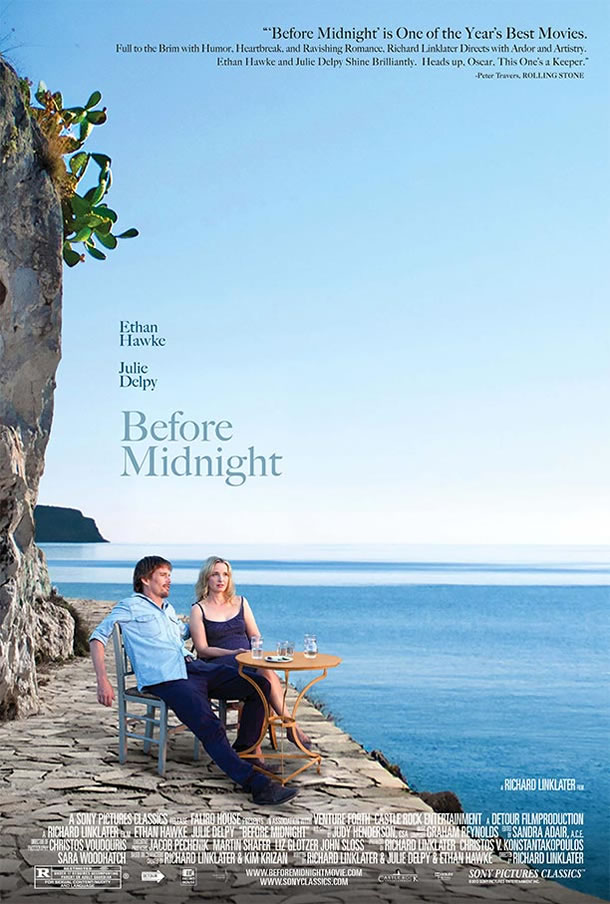 If you’re a fan of writer/director Richard Linklater’s previous movies (Before Sunrise and Before Sunset), as I am, then a new Before movie is a cause of celebration. It feels like we’re checking in with old friends. It’s fascinating to take stock of these characters and their new points in their lives, now approaching middle age. This series is becoming the dramatic equivalent to the 7 Up documentary series that periodically checks up on its subjects every seven years in their lives (56 Up came out this year). Individually, the films are wonderful, but when taken as a whole, the series becomes something truly special, something indelible and sweeping and transporting. Before Midnight is a wonderful movie, brimming with heart as well as ache. It’s also one of the best movies you’ll see this year and another touchstone to the impressive legacy of the series.
In 1995, 23-year-olds Jessie (Ethan Hawke) and Celine (Julie Delpy) met on a train and spent a magical day strolling through Vienna and essentially falling in love. In 2004, Jessie was touring Paris on his book tour, having turned the events of that Vienna night into a successful novel. Celine meets him and the two pal around, reconnecting, with Celine revealing how much that night meant to her as well. Now, in 2013, Jessie and Celine are together, though unmarried, and have twin seven-year-old daughters, Ella and Nina. They’ve been vacationing in Greece for a month while Jessie works on a new novel. Over the course of one long day, the couple will try and stir old passions and question whether they still share the same commitments.
 We’re watching the evolution of two human beings, and your response will vary depending upon your own life’s stopping point at the time of viewing. I must say, as a man now in his early thirties, that I enjoyed Sunrise and Sunset even more, finding greater thematic resonance to the characters, their anxieties, and the concern about faking your way through the “adult world.” I imagine I will find these movies even more emotionally engaging as I continue to age and cross similar hurdles as the characters do. For fans of the series, we’ve already invested 20 years and four hours of screen time with these characters. There’s more at stake when they fight. Watching the other movies beforehand, which I heartily recommend for multiple reasons, also provides stirring points of contrast, the romanticism of youth, the exuberance of promise. What Before Midnight does, and does so exceptionally, is take the romance of the earlier films and put it to the test. There’s a lovely dinner scene with several couples, and you realize that each one is an analogue for Jessie and Celine: the teenagers, the middle-aged couple starting out, the older couple discussing the demise of their previous spouses. It’s hard not to contrast the different stops and the different realities of love by the age.
Fair warning, Before Midnight is the least romantic of all three movies (I want a new movie every 9 years or so until the last one is essentially Amour). The first movie was them connecting. The second movie was about them reconnecting. The third movie establishes that they’ve been together for nine years and have a pair of twin daughters. The focus of Midnight is the struggle of maintaining a long-term relationship, something rarely given such thoughtful, perceptive, and compassionate depth on screen. We’d all rather watch lovebirds make goo-goo eyes at one another while we swoon appropriately, but Midnight’s many battles, small and large, new and ongoing, explore a relationship reality that many should find alarmingly relatable. While the particulars may be different, you may be surprised at how similar these conflicts can be. Exclude stuff like vacationing in Greece, the cushy jobs, and look to the mounting difficulty to retain that spark, a reminder of why you fell in love long ago, with the responsibilities of parenting and work stretching you in different directions. Routine can quickly transform into malaise. Jessie has a teenage son from a previous relationship, and this pushes him into great remorse when the kid departs, making him feel inadequate as a parent, which leads him to suggest unlikely relocation scenarios. Celine, being something of a worst-case scenario creature, notes the moment, saying this is when couples start falling apart. She’s worried he’ll resent her for choosing against a cross-country move. However, as the movie progresses, you realize there are already enough long-simmering resentments between the couple. This is a hard movie to watch at times because Jessie and Celine both go for broke when they argue, and it can get ugly (he dismisses her feelings as “crazy”; she vents about his lack of virility). Ending on a moment of ambiguity, like the other films, it’s perfectly reasonable to assume you just watched a two-hour breakup movie. Their problems don’t really seem resolved but I guess we’ll see in nine years, won’t we? Hopefully the next one isn’t called Before Divorce.
 The hallmark of the series, its sparkling conversation, is alive and well, with added maturity and reflection. When you get dialogue this good, this fluidly natural, this engaging, I could listen to them talk for days. In my mini-review for Before Sunset I compared it to listening to birds sing. The shots can last upwards of ten minutes as the camera just slowly walks ahead of Hawke and Delpy as they converse. In the first film we got a foot-tour of Vienna, the second Paris, and now Greece. The sights, while nice, are incidental because I was consumed with the dialogue, which spills so effortlessly from Hawke and Delpy, relishing playing these characters once more. Their give-and-take is often breathless, with nary a pause between them, and it can become overpowering for the uninitiated (lots of old ladies, I have found, dislike this movie, though when asked, none have seen the previous two). But there’s such added dramatic subtext now that we’ve jumped ahead in time. Rather than yearn for the characters to get together, now we’re assembling what we can of their history together and the durable conflicts. The exposition never feels forced, and each new bit provides another prism to view the character actions. You’re studying the characters, parsing their words, sizing up their honesty, and analyzing the various tests and dodges they dole out to one another. It’s a more active experience than you might expect for watching people talk a lot.
Hawke (The Purge) and Delpy (2 Days in New York) are so exquisitely natural with these characters and together and never better. They know these people inside out, and they should because both are credited yet again as co-screenwriters with Linklater. I’d expect another Oscar nomination in their future, much like Before Sunset. Delpy has a wonderful faux youthful voice she uses for hilarious disdain to narrate Jessie’s female fans. Both actors go a long way to flesh out their characters, provide degrees of new wisdom and worry while making us care about their problems. One character does not have the moral high ground, which makes their arguments all the more challenging to process. I don’t want to make it sound like Before Midnight is some twenty-first century Whose Afraid of Virginia Woolfe? There are innumerous moments of humor and grace and compassion, but the louder ringing of the raging conflicts can swallow them up. I also found it intriguing that this is the first movie in the series with nudity from our couple. Granted, it would seem somewhat forward if it happened in Sunrise and Sunset considering the narrow timeframes. As presented in Midnight, it loses erotic context and becomes another indicator of the struggles of maintaining passion.
I want to reiterate that I really hope that Linklater and his stars continue to bless us with a new film every decade, checking back on the lives of Jessie and Celine. The next one, if we continue the nine-year tradition, will deal with them turning fifty, which seems like a grand opportunity for some existential ennui. Also, Jessie son from a previous marriage will be roughly the same age Jessie was in 1995’s Before Sunrise. That could provide another interesting perspective for dad. I’m just not ready to say goodbye to these characters yet. Much like the 7 Up documentary series, the movies provide a point to reflect on our own lives, how we’ve changed and grown, the setbacks and triumphs, surprises and sadness. Catching up with the series, I viewed the movies very differently than I did when I first watched them. The art remains the same but the frame changes; we change. The glorious aspect of Linklater’s series is that we get to chart that change, checking back with old friends we’ve grown with. The movie’s attention to character and the relatable problems of middle age and long-term relationships is rich, nuanced, and just about everything This is 40 should have been and wasn’t. Before Midnight may lack the idealistic romanticism of previous entries but it substitutes a soulfulness to a series that has always been mature beyond its years. Approaching half a life lived, the characters still have plenty of life in them, plenty of dreams worth pursuing, and plenty more hurdles to go. It has been an ongoing privilege to get to spend time with these two. I pray this is not the end but just another stop on what ends up being one of cinema’s definitive statements on love through the ages.
Nate’s Grade: A
Share this:

Daybreakers (2010)
 Taking a cue from zombie cinema, Daybreakers takes the idea of vampire-as-virus to an apocalyptic crescendo. The world is populated almost exclusively by vampires now. Human beings are farmed for blood but they are in such limited supplies. You see there is an extreme blood shortage because the vampires have lived beyond their means. That’s right, it’s a consumer consumption/environmental metaphor. The limited resources are dire because if vampires go without human blood they begin to devolve into senseless, winged mutating monsters known as “subsiders.” The poor cannot afford the skyrocketing blood prices so they are most fated to doom, while the rich argue that the blood supplies need to go to families first and not be wasted on the lesser dregs. The U.S. vampiric military, when not hunting humans, shackles the subsiders and marches them into the sunlight to be executed. Daybreakers has a lot more on its mind than most vampire movies, and it’s plainly fascinating to explore the realities of a world run by vampires (cars that drive during the day, the Subwalk, blood in your coffee). For most of its running length, Daybreakers is an intriguing setup that makes room for cool visceral action and social commentary. Then in the final act it sort of devolves itself into one big, dumb action movie. Ethan Hawke is a blood scientist trying to work on a synthetic substitute for a super vampire corporation that, of course, is evil. He stumbles upon an outlandish “cure” for vampirism and wants to resurrect humanity. This leads to a climax where Hawke and his human warriors wage battle inside the corporate HQ. For a promising concept, it’s depressing that Daybreakers had to end in such a typical manner. At least the vampires explode in the sun instead of sparkling.
Nate’s Grade: B-
Share this:

Before the Devil Knows You’re Dead (2007)
 Sidney Lumet is 83 years old and still directing movies, God love him. The man is behind cinematic milestones and classics like The Pawnbroker, Serpico, Dog Day Afternoon, Network, and 12 Angry Men, which goes back all the way to 1957 – 50 freaking years ago! The longevity of this man is admirable. He hasn’t pulled together a compelling film in some time, but Before the Devil Knows You’re Dead is a stirring, character-driven crime drama that reveals itself to be a first-rate melodrama.
The film is anchored by two huge performances by Philip Seymour Hoffman and Ethan Hawke, playing a pair of brothers both on hard times. Hoffman’s character, Andy, has been living well outside his means to keep up appearances and to sate his taste for a local heroin den. He’s in charge of company payroll and an internal review just discovered a pair of terminated employees still drawing checks, the source of Andy’s cash to pay for his lavish lifestyle. Hawke’s character, Hank, is behind on child support and belittled by his ex-wife. He’s having a hard time even finding the dough to pay the 100 bucks for his daughter to go see The Lion King in New York City. Andy hatches a scheme to solve both their money woes: they’re going to knock over a mom-and-pop jewelry store. It just so happens that the store belongs to Andy and Hank’s mom (Rosemary Harris) and pop (Albert Finney). The plan goes hopelessly awry and both brothers feel intense pressure in the aftermath.
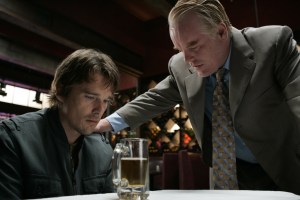 Lumet and debut screenwriter Kelly Masterson really know how to ratchet up the suspense. The nonlinear timeframe keeps the audience on its toes and continuously rewriting what we think we know. Unlike movies like Babel and 21 Grams, the plot is actually assisted by skipping around time and telling the story out of order. We get the basics and then the details begin to take shape, but because of the prior knowledge the film packs an increasing sense of dread that builds in intensity. As the brothers sink lower trying to cover their misdeeds, Lumet and Masterson crank up the tension to a peak. The knotted and twisty narrative exposes the fragile dynamic of this family and keeps the audience alert and hungry for more.
Hoffman is at his sleazy, duplicitous best with this performance. His character is a man accustomed to getting what he wants and he knows all the manipulative tricks to get there, be it bullying or cajoling. He’s a pusher with so much anger and desperation just below the surface. Andy never feels respected or loved by his father, and he has a great scene where he breaks down in a fit of rage and tears in response to his father apologizing for the bad upbringing. Hoffman imbues great emotional complexity to a man whose world is crashing down. It is enthralling to watch.
Not to be outdone, Hawke puts forth his finest effort of his career. He’s the baby of one very corrosive family; he misplaces trust and admiration in his big brother. Hank isn’t the sharpest tool in the shed but he has a distinct weariness to his worries, living day-to-day with the knowledge that the world sees him as a loser or a screw-up, losing the respect of his own daughter. When things go bad he unravels rapidly while still holding to his secrets. It’s a performance brimming with nervous anxiety, mounting regret, and self-effacement.
 The secondary characters don’t get nearly the attention and consideration. Marisa Tomei is more a plot device than a character; she’s Andy’s wife but has been having an ongoing affair with the more nurturing Hank. She spends most of her scenes in some form of undress and feels more like another notch in the complicated relationship between the brothers.
Finney is fine with a rather small role that merely requires him to be aghast or incredulous with the slow police work. I don’t know if a suitable Finney performance can compensate for a staggering leap of character late in the movie, but I suppose I’d rather have any Albert Finney performance in a movie than none at all. Before the Devil places Finney’s character on a perch and just doesn’t give him much outside of his own dawning realization of who was responsible for the botched robbery.
Before the Devil Knows You’re Dead is a gripping family tragedy that takes on a Shakespearean quality as it comes to a somber, chilling close. The wordy titles comes from an Irish drinking toast that states, “May you have food and raiment, a soft pillow for your head; may you be 40 years in heaven, before the devil knows you’re dead.” The message declares the inescapable consequences of our actions. This is a film about the disfiguration of one family; it’s bleak, tragic, but whole-heartedly entertaining and extremely focused in its aims. Lumet has returned to smashing form and reminds an audience that there’s still plenty of vigor left in this 83-year-old director.
Nate’s Grade: B+
Share this:

Lord of War (2005)
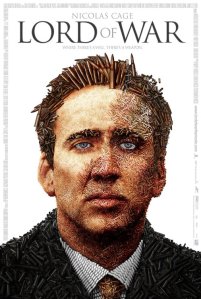 Andrew Niccol is back in my cadre of cool. He’s responsible for two awesome movies (Gattaca, The Truman Show) and one very lackluster Hollywood satire (Simone). But now the man is back and Lord of War is a startling look into the amoral world of international arms dealing. The film is enthralling as Uri (Nicolas Cage) narrates us about the ins-and-outs of his world a la Ray Liotta in Goodfellas. Not to be outdone by a juicy narrative by Niccol the writer, Niccol the director adds lots of stylish flash to his tale. The opening watches the manufacturing and journey of one bullet, it’s ending destination in the head of a little African boy caught in the crossfire. It’s jarring, it’s powerful, and it’s direct. That’s Lord of War in a nutshell.
Nate’s Grade: A-
Share this:

Assault on Precinct 13 (2005)
 It seems that in American cinema, we have a long history of people being holed up in one location and fighting off outside forces. There’s instant drama in fending off forces that outnumber you, and Hollywood knows this. There are historical dramas (The Alamo), fantasy flicks (Lords of the Rings), and nearly every other horror movie (Night of the Living Dead) that have a central conceit of the good guys being outnumbered and with no place to go. Assault on Precinct 13 (a remake of the 1976 John Carpenter cult film) is the latest in this mini-genre. The film has big stars like Ethan Hawke, Laurence Fishburne, Gabriel Bryne and a mustachioed Brian Dennehy (there really should be no other kind) but even star power with facial hair can’t stop Assault on Precinct 13 from feeling run-of-the-mill.
On New Year’s Rockin’ Eve, Sergeant Jake Roenick (Hawke) is left to tidy up precinct 13, which will be shut down in days. The precinct secretary (Drea De Matteo) and seen-it-all veteran Jasper (Dennehy) will keep Roenick company. But alas, they have more company than they expected. A bus transporting prisoners makes an emergency stop at the precinct because of a blizzard. The bus has three small time criminals (John Leguizamo, Ja Rule, Aisha Hinds) and one very big fish, crime kingpin and cop killer Marion Bishop (Fishburne). Late in the night the precinct is besieged by a team of dirty cops led by Marcus Duvall (Byrne). It seems Duvall and his squad of corrupt cops have had many deals with Bishop, enough that they can’t let him live. Jake takes command of the precinct’s motley crew, prisoners included, and attempts to have everyone work together to fight off the invading forces.
 Hollywood upped the budget for this remake but they also upped the plot holes to match the firepower. How are the bad cops going to explain all those dead police officers in commando outfits? There’s likely enough forensic evidence everywhere to point a finger at the long arm of the law’s involvement. I suppose they could have burned the whole place down when they were done, but to paraphrase that great philosopher Ricky Ricardo, “Luuuuuucy, you got some ‘splainin’ to do.”
The acting is a non-issue. Hawke and Fishburne get to trade cool glances, Matteo gets to shake her Sopranos Joisey accent, and Dennehy gets to eat any scenery that isn’t bolted to the ground. I have no idea what Leguizamo was going for. His disturbed junkie performance reminded me of Mr. Ed, because whenever he spoke it looked like Leguizamo’s lip was being pulled up by an invisible string. Some may call this acting; I call it fun to watch.
Assault on Precinct 13 is constructed from so many familiar action elements you may think you’ve seen this movie before. Hawke plays a cop haunted by a bust gone wrong that, surprise, killed his partners. When the siege does go down, of course everyone can pick up a weapon (even a 1920s Tommy gun) and instantly become a trained marksman. There’s the whole “who can we trust” plot element that spurs Mexican standoffs between the cops and the crooks. All the characters are stock types, from Hawke’s reluctant hero, to Matteo’s saucy secretary, to Dennehy’s single-minded hothead to Fishburne’s calm and collected criminal mastermind badass. When a character opines a theory that someone on the inside is really working for the dirty cops, you should be able to immediately follow the falling anvils.
 Even when it comes to the action, Assault on Precinct 13 is too familiar. Because nothing interesting is going on inside the precinct, the audience relies on the spurts of action for their money’s worth. It all gets a little bland after awhile. Cops try breaking in. They get shot. They try breaking in with more cops. They get shot. Granted, replace “cops” with “monsters” and you have 30% of horror movies. There needs to be escalating action and some overall cause and effect with the plot, especially with action movies set in one isolated locale. In Assault in Precinct 13, rarely does the previous moment matter because both sides seem to shrug and move on. The only notoriety director Jean-Francois Richet brings to the action is a peculiar fetish for long takes of fresh head shots. He does enjoy the slow trickle of blood out of a bullet to the cranium (I counted 5 times; turn it into a drinking game at your own danger).
Assault on Precinct 13 is indistinguishable from what Hollywood pumps out every day. The characters are stock, the dialogue is short but stale, the plot holes seem to swallow the film whole, and, most tragically, the action seems meaningless except when paring down the cast (there’s a ten-minute whirlwind that cuts the good guys in half). People hungry for action might find something worthwhile but most will probably walk out of the theater with the same shrug the actors seem to exhibit. Assault on Precinct 13 is a routine action flick that replaces escalation with excess.
Nate’s Grade: C
Share this:

Before Sunset (2004)
 Richard Linklater knows a thing or two about the poetry of language. Few can write conversations better than him, and with Before Sunset, the sequel to 1995’s Before Sunrise, we witness an entire film built around one couple’s conversation. Julie Delpy and Ethan Hawke return as older, wiser versions of their Sunrise characters. They stroll around the avenues of Paris chatting away so casually, so beautifully that it’s like birds chirping. Linklater and his actors have forged a romance through a romance of language, and an audience can’t help but be smitten. Before Sunset will not be for everyone because it is as advertised: 80 minutes of people talking uninterrupted (it put a friend of mine to sleep when we watched it), but for those people that enjoy sumptuous conversation, Before Sunset will cast a spell on you.
Nate’s Grade: A
Share this:

Taking Lives (2004)
 While viewing Taking Lives my mind wandered quite a bit. There was one point where I actually gave credence to a theory that Taking Lives was so intensely bland that is was parodying the glut of serial killer films. Then I just concluded that the movie was dumb. Angelina Jolie plays one of those hard-as-nails criminal investigators who just happen to be drop dead gorgeous. She’s on the hunt for a Canadian serial killer who murders then assumes the lives of his victims. He’s been doing this for over 20 years. My main question is … how? Taking someones identity has so many variables to it. What if any family member found you? Theyd know for sure you wouldn’t be their loved one. Oh yes, and the killer masks the identity of his victims by cutting off their hands and smashing their faces in. Would that even work? All you have to do is draw some blood and do a DNA test. Taking Lives is so by-the-book that it even dares to have a scene where the serial killer calls Jolie and claims that he and her are exactly alike. The ending veers so far off track into the land of implausibility that its almost entertaining. Almost. The only reason to even poke your head in a theater to see this is for a gratuitous nude scene involving Jolie, and even that you’ve seen before in better movies.
Nate’s Grade: C-
Share this:

Training Day (2001)
 Denzel Washington won an Oscar for this? Instead of Malcolm X? For THIS?! Yes he gets to huff and puff as he plays against type as a dirty cop, but is this reason alone to give an Academy Award to such a forgettable and collectively implausible film? Ethan Hawk, his co-star, is actually better in the film. All I can say is right actor, wrong movie. It’s like rewarding Kevin Spacey for Pay It Forward over the other screamingly better movies. It doesn’t make sense. There are plenty of hip-hop stars making cameos or small roles (Dr. Dre, Snoop, Macy Gray) but most of the time Training Day feels like tired and dead air especially as the contrivances begin to pile onto one another the longer this day goes. And Denzel is huffing and puffing but the house still stands. Man, the voters must really have not wanted Russell Crowe to win.
Nate’s Grade: C-


 nathanzoebl
You must be logged in to post a comment.