Blog Archives
Let the Right One In (2008)
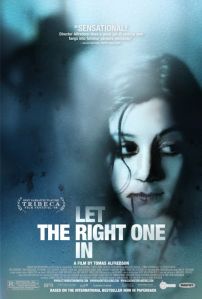 This is a pre-teen vampire love story that is miles away from Twilight folks; it’s solemn, mature, stark, violent, tense, and astoundingly ambiguous. Director Tomas Alfredson pares down the emotions and the entire film takes on a very reserved and curious atmosphere, which I feel heightens the sense of wonder and dread about a supernatural romance. The relationship between 12-year-old Oskar (Kare Hedebrant) and 12-year-old looking vampire girl Elie (Lina Leandersson) is entirely believable and constantly intriguing, as key information is doled out like breadcrumbs. Oskar is negotiating puberty and Elie is well aware of what awaits. The movie works as an example of methodical horror where emphasis is placed upon anticipation and the imagination. The climax at a community pool is one of the best film finishes of the year. I was a tense ball of nerves, and I love the movie’s closing shot. Even better, the movie works as an intriguing and intricate drama about human relationships. I can revisit Let the Right One In and dub it an unconventional and moving romance. Or I can revisit the film and dub it a melancholy examination of a manipulative and parasitic relationship, as Oskar might be doomed to a fated life like Elie’s former guardian. I can keep revisiting this Swedish horror film and discover more to discuss and diagram each time. And I didn’t need a single scene where the vampires played super hero baseball games.
Nate’s Grade: A-
Share this:

Happy-Go-Lucky (2008)
 I wanted to turn this movie off for the first 30 minutes or so and that’s because of Poppy (Sally Hawkins), the deranged optimist that the movie follows. Writer/director Mike Leigh’s latest semi-improvised tale following the English working class centers on a primary school teacher who makes the conscious choice to be happy in life, no matter what life throws her way. Her presence is somewhat exhausting, like a customer who doesn’t know when making jokes has gone from fun to downright annoying. But you know what? Poppy eventually won me over, and I’m all but positive it was the scenes of her and her raging, pessimistic, tightly wound driving instructor (Eddie Marsan) that did it. Before their first driving lesson, I felt like the movie was giving me a slice-of-life that I was hesitant about; Poppy, like anyone who is insanely happy, can be grating. The humor is extremely dry and most of the clever dialogue exchanges will likely go by unnoticed because the actors aren’t delivering big punch lines. Hawkins goes all-out as the unflappable Poppy and she will make you smile through sheer force of will. This was a film I liked more by the time it was winding down, perhaps because Poppy might be easier to take knowing that time is coming to a close much like spending time with a distant relative during the holidays.
Nate’s Grade: B
Share this:

The Visitor (2008)
 The follow-up by Thomas McCarthy, the writer/director of the sparkling Station Agent, is an affecting indictment on our nation’s immigration policies that manages to say a lot of important things in small touches, ditching histrionic messages. Walter (Richard Jenkins, in a commanding and deeply empathetic performance) discovers a pair of illegal immigrant squatters living in his seldom-used New York City apartment. He strikes up an unlikely friendship that moves in subtle strokes that keeps the movie very character-based. The second half of the film revolves around Walter’s attempts to work within the system to free his new friend from detention. I could have spent more time with Walter and Tariq, the Syrian immigrant who teaches Walter how to play the African drum. The Visitor explores a man learning in his autumn years how to reconnect with people, and it has moments of astonishing emotional clarity. McCarthy is a filmmaker that can spin narrative gold from just about anything; The Station Agent had a hot dog vendor, a single mom, and a dwarf. The Visitor is further proof that McCarthy is an extremely talented man who knows how to target and tap the humanity of his unique characters. There are very few moments in this movie that feel false.
Nate’s Grade: B+
Share this:

The X-Files: I Want to Believe (2008)
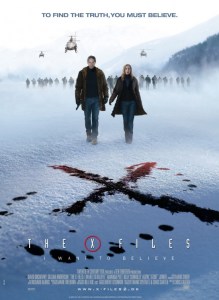 To all fellow X-Files fans out there, the movie is not nearly as bad as you may have been lead to believe. That said, it’s pretty much a so-so standalone episode of the TV show needlessly expanded. And yes, for all concerned fans, Mulder (David Duchovny) and Scully (Gillian Anderson) kiss on more than one occasion. The plot that reunites the characters is fairly mediocre, something about a ring of mad scientists that want to be a modern-day Dr. Frankenstein. You don’t need a two-headed attack dog to know that plot is way too hokey. The most intriguing aspect of the film is a priest (Billy Connolly) who also receives psychic visions, cries tears of blood, and, oh yeah, is a convicted pedophile. Could God be responsible for his special abilities as well as the abhorrent sexual urges? There is so much great conflict and human drama in this character worth examining, so it’s a pitiful shame that he just gets shoved off so the third act can concentrate on the lame mad scientists. A majority of the flick occurs in snowy West Virginia, which doesn’t translate into anything too special to look at. I’ll admit, my rating is inflated because I was an ardent fan of the TV show until the last years when it felt like they weren’t even trying any more. If you stripped away my allegiance, I’d say that the second X-Files movie serves little purpose other than to add a tiny coda to a TV show that went off the air in 2002. The characters are worth revisiting, just not in this tepid tale.
Nate’s Grade: C+
Share this:

Miss Pettigrew Lives for a Day (2008)
 The movie seems to float on the effervescent air of 1930s screwball comedies, and in truth it does possess some of that snappy allure. Francis McDormand travels into the inner circle of the upper social classes in London and befriends a bubbly lounge singer, played by bubbly actress Amy Adams. The film moves at a ridiculously fast pace, sometimes too fast as it tries to pile on complications and setbacks. This day-in-the-life confection is sweet and well natured but rather too digestible. Once the movie is over I do not see myself ever dwelling upon it once again. It’s a pleasant and entertaining experience even if it dances right out of your memory.
Nate’s Grade: B
Share this:

Fireproof (2008)
 Earlier this fall, a small flick financed by evangelical Christians broke into the top of the box office. It was written by the Kendrick brothers, Alex and Stephen, both associate pastors, and directed by Alex. They previously wrote and directed 2006’s small hit Facing the Giants, a Christian-based sports movie. Fireproof is a story about Caleb (Kirk Cameron, the Russell Crowe of direct-to-video Christian produced movies) and his strained marriage to his wife Catherine (Erin Bethea). She works as a public relations rep in a hospital and feels that it may be time to divorce her irritable, selfish, and overall jerk of a husband. Caleb’s born again father convinces him to hold off on any divorce proceedings and passes along a book called The Love Dare, which challenges couples to 40 days of guided help.
This movie is bad. You probably already knew that. I am somewhat alarmed that there appears to be a whole lot of eager Christian filmgoers that will plop down plenty of dollars to see anything, no matter how horrible, if it conveys a Christian message. Just because you can agree with a message doesn’t mean the product is worthwhile. Here are some things to think about if someone ever asks you if you’ve seen the movie Fireproof.
1) Fireproof exists in a world not our own. The characters behave in odd ways that do not appear to resemble observable human behavior. Some leeway is given because, yes, they are fictional characters, but they say dialogue that sounds forced and clichés, and they do actions that are contrived because the movie requires them for the plot. Here are some minor examples that play to this theme:
 a) The town of Albany, Georgia is designed like a small town even though it has a metropolitan population of about 160,000. And yet the town only has one crew of firefighters consisting of five guys, and three of those guys are clearly not in a physical condition that would be deemed passing. Seriously, these guys are too overweight to be firefighters. Because of the film’s small town presentation and the fact that the county clearly doesn’t care about physical fitness for its emergency responders, Fireproof thus gives us a fire crew that has a whole lot of time on their hands. This complicates things because it makes it seem like Caleb would have more time to be nice to his wife.
b) The women are presented in completely unflattering ways. There are two main female characters, Catherine and Caleb’s mother, and a gaggle of female nurses that simply cannot help themselves when it comes to gossiping and clucking like hens. Every black woman in this movie at some point must say the utterance, “Mmmhmmmm,” and of course bob their head as they talk. The dialogue feels forcibly “black” for these characters when it just could have been anything. Caleb’s mother is briefly presented as a concerned figure but Caleb just tells her to shut it and asks for alone time with dad, you know, the man of the house. She never stands up for herself and her husband, Caleb’s father, does a lousy job of telling his idiot son to respect his mother. Now Catherine is given plenty more time and she has some serious grievances with her lunkhead mate, but when he tries doing helpful and nice things she still decides to be cold to him. Why? Maybe Catherine is just a cold person, after all. One of the very first moments we see her character is when she’s talking to her mother, who has recently had a stroke. Catherine is venting about her troubled marriage and then begins to break down to her mother and says, unbelievably, “I miss the real you.” Excuse me? Just because your mother had a stroke doesn’t mean she’s any different mentally, and she can still hear and understand you, dear.
 c) Internet pornography is played with more drama than the Holt’s marriage. When it comes to dramas that center around marital discord, it shouldn’t take much effort to create a compelling conflict. But I just didn’t buy the conflict between Caleb and Catherine from the start. The conflicts in their marriage are rather mundane, which is likely very realistic for many couples but it makes for poor drama. He wants the respect he feels he’s entitled to. She wants her husband to spend time with her and be nicer to her. He wants to buy a boat with his money. She wants new shelves. How expensive can shelves be? Catherine does feel temptation at work from a doctor that takes time out to listen and make her feel special. That’s a real dilemma. On Caleb’s side? His big moment comes when he battles his addiction to Internet pornography, which was an issue the filmmakers also addressed in their previous flick, Facing the Giants. Caleb is looking at boats online when a pop-up appears that asks if he “Wanna see?” a sexy lady. Oh, the horror. Caleb lingers. Then he paces, all the while staring at the tempting pop-up ad a mere click away. He paces more. Dramatic music starts to build. “Why is this so hard?” he angrily asks to no one in particular. This goes on for like a minute solid. Then he resists the temptation and is determined to be a better man for his wife, sans pornography. Great. Except that’s not exactly what he decides to do. He decides to take the computer outside and literally smash it to pieces. There is likely plenty of personal information, credit card numbers, family photos, personal documents, and more on that computer, but alas Caleb decides to get smash happy with a baseball bat. I understand that Internet pornography is a realistic addiction for many people but, again, it makes for terrible drama in a PG-rated movie. His wife is nonplussed when she finds out about the computer being smashed. Human beings do not behave like this! At the very least, she should have been angry that he just wasted money. You know, you can get Adult Web site blocking software for much cheaper than a new computer.
d) Caleb totally got hosed when it came to hospital supplies. This is a lesser charge but it still sticks in my memory. Caleb has saved up $24,000 for a boat but ultimately spends all of it to pay for a wheelchair and a hospital bed for Catherine’s mother. Catherine is so thickheaded that it takes her weeks to figure out her husband spent the dough and not the nice doctor she talks with at the hospital. There is no way that a hospital bed and one electric wheelchair cost that much money. Caleb got taken for a sucker. Catherine’s mother had a stroke, and you’re telling me that in her situation she doesn’t qualify for Medicare? The government probably should have covered the whole thing, if not most of the expenses. But then this incident is just a cheap conflict that makes Catherine look stupid and Caleb look naïve.
 2) The metaphors are leaden and inane. Given the title and the nature of Caleb’s profession, you can bet your bottom dollar you’re going to be inundated with “fire” metaphors: “You never leave your partner behind, especially in a fire.” Or how about: “Fireproof doesn’t mean the fire will never come. It means when the fire comes that you will be able to withstand it.” You get the idea. What’s even worse is that the movie offers metaphors that are intended to be profound but are astoundingly shallow. One character says, “You know a woman is like a rose. If you treat her right she’ll bloom, if you don’t she’ll wither.” That is quite possible the worst simile I’ve ever heard in my life. Read it again, please. It is essentially saying, “A woman is like a [thing]. If you are [good] to her then [good will happen to thing]. If you are [bad] to her then [bad will happen to thing].” This is basic attribution, people. I can come up with equally profound comparisons using this model. How about this one: “A woman is like a ’62 Chevy. If you treat her right she’ll keep running, if you don’t she’ll need to be put up on blocks.”
3) This Love Dare book is tripe. This book actually exists now, by popular demand from the many people that watched Fireproof and asked for this guidebook. I’m supportive for anyone out there that actually tries to save their marriage rather than give up, but let’s face it, sometimes some marriages were meant to be dissolved. Just ask Britney Spears. Caleb’s mentoring firefighter buddy reveals, shocker, he was previously married at one point, and he confesses, “I got married for the wrong reasons and then divorced for the wrong reasons.” Well, if you were married for the wrong reasons and not truly compatible then perhaps you got divorced for the right reasons. Ignoring this, the book that Caleb’s father presents has some tepid advice. Day One: Don’t say anything negative to your spouse. Day Two: Do a small act of kindness. Day Three: Check in on your spouse. Yawn. This is common sense marketed as life-changing behavior recipes. You really needed a book to tell you that a successful marriage is aided by holding your tongue? What really makes the book questionable is what happens on Day 23 or so: remove parasites from your marriage, a.k.a. addictions like gambling, drugs, and pornography. Why is such a monumental step placed at the halfway point? Will saying nice things and buying flowers really matter if you still have a heroin habit?
 4) Little to this movie feels authentic or genuine. I’ve already gone into plenty of detail about why the movie feels unrealistic, but the $500,000 budget doesn’t help matters when it comes to authenticity. Visually, the Kendrick brothers know the language of film but are clueless when it comes to making a visually appealing picture. Fireproof does the term “bland” a disservice. I counted exactly five shots that I thought were visually interesting, and I might have been generous. The editing is also poor and frequently shots will not match up well. Yes, shortcuts are going to have to be made but monetary shortcuts don’t interfere with writing good characters and realistic interplay. Not one single character feels like you would ever find them existing outside of this movie. Even the Christian characters come across unflattering and not genuine. My favorite part in the entire film was when an old nurse at the hospital spotted Catherine and the hunky doctor flirting in the hall. The camera fixed on her disapproving stink-eyed glare and it held for so long, and the woman put so much distaste in her expression that I instantly wanted her face as a Halloween mask. When she appears again to eat with Catherine she takes great pains to excuse herself so she can call attention to her praying before her meal. I cannot fathom a random moviegoer warming up to this woman via her portrayal. Even Caleb gets to threaten the hunky doc with a not so subtle call to a brawl.
I’ve already espoused more words on this movie than it deserves. Fireproof isn’t so much a movie as it is an accessory to a Bible study guide, or a marketing tool for selling the Love Dare book. It cannot stand on its own merits as a worthy film. It’s predictable, unabashedly cheesy, poorly written, poorly directed, and poorly acted. I know Kirk Cameron isn’t a terribly good actor, but man he blows every other actor away in this. There is some fairly pedestrian acting, especially from Bethea. I’m happy if people can walk away from any movie and want to be better people, even if it’s because of dumb movies like Fireproof. I think the most annoying aspect of the film is how insistent it is that a faltering marriage must turn to God in order to be saved. Look, if you need God to tell you to clean the house or be nice to your wife, then you have bigger issues.
Nate’s Grade: C-
Share this:

Slumdog Millionaire (2008)
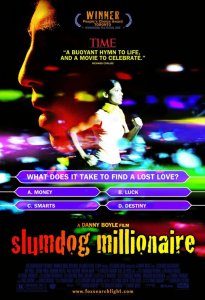 If there is one independent movie that seems to be picking up momentum this awards season, it’s Slumdog Millionaire. The film seems destined to break out into the mainstream, especially in a time where audiences could use a happy story given the ongoing news of economic downturns. Slumdog Millionaire is a highly spirited rags-to-riches tale that marries Hollywood and Bollywood into one fantastic product.
Jamal (Dev Patel) is an 18-year-old kid who grew up impoverished in India’s favellas. He’s also on the verge of winning 20 million rupees on the Indian version of the Who Wants to Be a Millionaire? Game show. The TV host reminds Jamal that lawyers and doctors have never gotten as far as he, a lowly “slumdog” from such humble origins. As each question emerges we discover more about Jamal’s life, from escaping a riot, touring India as a stowaway on a train, conning American tourists at the Taj Mahal, to his assistant work at a call center. Throughout Jamal’s life are two constants: Salim (Madhur Mittal) and Latika (Frieda Pinto). Salim is Jamal’s scheming older brother who has a loose sense of morals. He finds a life of crime as a suitable escape from poverty. Latika is a young orphan girl that Jamal befriended as a child. He declared that she was the “third Musketeer” in their group and has always sworn to love her. This is complicated because Salim’s crime boss wants Latika for a prize, and Salim keeps his younger brother away from Latika. Ultimately, as an entire nation watches with baited breath, Jamal explains that he is appearing on TV because he knew that Latika, his love, would be watching somewhere.
 It’s like City of God and Forrest Gump had a baby that was raised by Oliver Twist. The film is given a dynamic energy thanks to director Danny Boyle’s exuberant camerawork and skillful style. Boyle is a director that knows how to make images jump and Slumdog feels like it is coursing with life. The feel-good fantasy nature of the rags-to-riches plot is offset by some pretty harrowing violence, and Boyle makes great pains to show the realities of living in squalor. At one point a very Fagin-esque local crime lord collects young orphans to be beggars and he has a foolproof scenario to make these kids sympathetic and thus big earners — he blinds them with hot liquid. Despite the fantastical elements, Slumdog is rated R for a reason and that’s because it does show the cruel reality of a life in the slums, granted it’s nowhere near as bleak and formidable as something like City of God. After all, the kid gets to win on a game show, though the movie does open with Jamal being tortured by the police. Boyle has a tremendously natural eye for crafting visuals that delight the senses; he can make his shot compositions feel interesting without ever truly calling attention to being flashy. The views of India are beautiful and fascinating. Plus, having a majority of the movie in a foreign dialect was appreciated (Boyle provides different color background for different character’s subtitles, a nice touch). There’s a magic feeling to the film that definitely takes hold of the audience, an uplift that channels smiles and gasps of joy. While I’ll still credit Millions as Boyle’s best film since Trainspotting, his work on Slumdog is deserving of praise. I don’t know if another director could have made a film with so many contradictory elements (feel-good flick with child prostitutes?) run so smoothly.
The movie is also given a brilliant story structure by screenwriter Simon Beaufoy (The Full Monty). The movie is built around a steady stream of flashbacks linked to the questions Jamal tackles on the game show. So the host will pose a question and then we’ll be treated to a 10-15-minute flashback to Jamal’s life to discover how he knows the answer. The approach is fresh and it reinforces the magical notion that Jamal’s life has all been leading up to this moment of glory. Beaufoy’s script smartly weaves many storylines together to give us an emerging sense of who Jamal truly is. He manages to write an uplifting and hopeful tale that stays clear from easy sentiment. Indeed, Slumdog is an accomplished feat of writing as well as direction. Working from the Indian novel Q&A, Beaufoy has written a modern-day fairy tale in the same fashion as the Brothers Grimm, which means he didn’t skimp on the unpleasantness and hardship. Yet Slumdog is able to find great human spirit amidst the squalor. I doubt I’ll see a climax more rousing and crowd-pleasing all year. Seriously, you’d have to have a pretty hard heart not to feel some excitement and jubilation in the closing moments.
 This unlikely fantasy is aided by sharp performances by a collection of actors. Jamal is an unassuming yet plucky underdog, and Patel nicely handles these elements. He’s a stringy kid but he carries himself with charm and fortitude. As he grows confident he spars with the combative TV host, and it’s fun to watch. Pinto is a swell looking beauty with a great smile but I wish the story had given her more to do as an actress. The young actors who play Jamal, Salim, and Latika as young children actually give the best performances.
And now after all my effusive talk comes the time where I must voice my minor reservations. First off, the structure is ingenious but having Jamal interrogated by the police after the fact seems unnecessary, plus it also tips off the audience from the beginning that this kid has already won it all, which sucks some of the tension out of the game show format. I really think the movie would have been better served just playing out the game show in real time instead. Also, it’s a bit too convenient that every one of the quiz questions triggers a memory in a linear fashion. Jamal can tell his life’s story from beginning to end, but the movie would have been more challenging and interesting if the quiz questions forced Jamal to bounce around in his own memory. That way the script would provide more mysteries that could lead to even more satisfying answers. The Millionaire game show also goes on a commercial break and Jamal is astoundingly allowed to leave and go to the bathroom after he knows one of the high-money questions. In the age of wireless Internet, no game show would ever allow the contestant to leave its sight. Finally, the movie is presented like a Dickensian fable told in chunks, which means I found it hard to fully embrace the central romance that drives Jamal. I will readily follow the romantic notion of locating your true love, however, I will feel more involved in that search if the combined time Jamal and Latika spent together was longer then like a week. Seriously, they see each other every few years for a moment and then are broken apart, only to find each other again for a few moments to be broken apart. She’s more a symbol than a fully translated character, though this did not stop me from rooting for a happy ending.
 Slumdog Millionaire is a thrilling, funny, and triumphant story that courses with lively electricity, thanks to the deft direction of Danny Boyle. This movie is enormously entertaining while still baring a social conscious about the plight of those impoverished, though I hope people don’t get the mistaken idea that all that character-building impoverished life styles will lead to future fortunes like Jamal. The movie is hopeful and uplifting while also balancing tense violence and improbable circumstances. While I’m not on board with the critics calling this the best film of 2008, it has some minor flaws in approach to storytelling and character, Slumdog Millionaire has all the right markings to be a crowd-pleasing sensation. After all, it is destiny. And that’s my final answer.
Nate’s Grade: A-
Share this:

Australia (2008)
 Baz Luhrmann is a filmmaker that doesn’t know the meaning of the word “small.” He paints in giant strokes with lavish creative flourishes that separate him from the pack of visionary auteurs. I’ve enjoyed every one of his films thus far and I fee that Moulin Rouge is a romantic touchstone that I can go back again and again to be dazzled and moved. I anticipated that Australia would be suitably grandiose in scope and style. While it suitably grandiose it definitely could have used some fine-tuning when it came to scope and style.
Australia follows the adventures of Lady Sarah Ashley (Nicole Kidman) entering the land Down Under in 1939. Her husband owns a cattle ranch in the north called Faraway Downs. She suspects that her husband travels to Australia to get a bit more business down under, if you know what I mean. He’s been killed and the only witness is a half-white, half-aboriginal boy named Nullah (newcomer Brandon Walters). It was customary for the Australian government to abduct mixed race children and ship them off to a church mission, where the tykes got to learn how to be servants for rich white people (this government policy only officially ended in the 1970s). Little Nullah hides on the Faraway downs ranch with his aboriginal mother. Lady Ashley must decide what to do with her strip of land. The local meat baron, King Carney (Bryan Brown), owns all the land surrounding Faraway downs and is close to maintaining a monopoly. Carney’s right hand man, Fletcher (David Wenham), has been keeping watch over Faraway Downs. Lady Ashley decides to hold onto the ranch and to drive the 1,000 head of cattle to sell at the town of Darwin. Carney orders Fletcher to stop the competition in its tracks. With little resources, Lady Ashley needs a rugged man to lead the cattle drive. The Drover (High Jackman) is a man of adventure and promises to deliver the cattle to their destination in Darwin. Through the course of 165 minutes Lady Ashley and the Drover will fall in love, Nullah’s freedom will be in jeopardy, and the Japanese will bomb Darwin in 1941.
 The flick is ambitious, I’ll give it that. Just the title itself sets off an aim to summarize an entire country’s history, culture, and people in a declarative and definitive narrative. Somehow I doubt many will leave the theater and say, “Well, now that’s Australia.” Indeed, I find the film’s narrative to be a limp representation for a country. I suppose most big nationalistic history films start with the birth of nations, but when your country began as a repository for English criminals then I suppose you may want to find a different tale to tell. Australia is really three movies in one colossal package: a Western dust-up, a World War II disaster, and a dark history lesson over the country’s treatment of the aborigines. There is too much movie there, especially at a mammoth running time of 2 hours and 45 minutes. I almost think that Luhrmann believes that if he throws out enough storylines and emotions that somehow it will form a cohesive whole, but the pieces never truly mesh satisfactory. The kitchen sink method rarely works without a grander scheme. The war elements could have been dropped entirely considering that the Japanese bombing sneaks in at the very end of the film and serves little other purpose then decimating the town of Darwin. The movie just all of a sudden transitions into Australia at wartime, and various characters have new positions, like Lady Ashley serving as a phone operator. Where did any of this come from? It just sort of happens without any solid setup or transition despite a near three-hour length. You don’t need to nudge in World War II disasters just to introduce sustainable conflict. Australia is filled with moments where the plot or the characters make big leaps without justifying the transition. Lady Ashley goes from a lily-white upper-class fop to a tanned Outback rootin’-tootin’ adventurer over the course of mere minutes.
Director Luhrmann’s over-the-top visual style is absent and the movie feels strangely square, like Luhrmann is keeping his more manic abilities in check so he can tell an old school epic. But [i]Australia[/i] is not an epic despite a running time that would argue otherwise. It has gorgeous cinematography, gorgeous natural exteriors, and a pair of fairly good-looking leads (Jackman was named People Magazine’s sexiest man alive for 2008), but these are all components and not a finished product. I kept wanting Luhrmann to break free from his creative straitjacket and add some pizzazz and inspired sidesteps. It never happened. Lurhmann has been instrumental in the birth of Australia from beginning to end (he is credited with the screen story), but having such an idiosyncratic and surreal talent make a movie that is so backwards in approach and appeal is lunacy. This is not the best use of Lurhmann’s many talents. Australia has some gauzy and gaudy visuals but it feels altogether devoid of style, though it attempts to make up for that loss in sweep.
 The true history of what happened to mixed race aboriginal children is appalling and certainly worth examination. So why then is Australia another case where the story of a minority’s oppression and tragedy must be told through the eyes of valiant white characters? Nullah’s story is far more interesting then Lady Ashley learning to be a country gal or the Drover learning to settle down. There is much more inherent drama in following a child who feels displaced and forever hunted because of his own genetics. That’s far more powerful than watching the tyke play “Somewhere Over the Rainbow” for the 80th time on his harmonica. Whenever Australia dips into serious statements on the plight of the unfortunate aboriginals, the movie feels very awkward. This is because “serious” is not what the movie does best at all. Australia is a large-scale attempt to revitalize that old-fashioned, sweepingly romantic Hollywood filmmaking of the 1950s. You could just as easily imagine John Wayne and Maureen O’Hara in the starring roles, though the movie’s sensuality and outward comments on racial equality would have been tampered down. My point is that Australia is engineered to be this romantic spectacle that nearly overdoses on sentiment, so whenever it cuts to the aboriginals plight (something serious not in a silly movie sense) then it just seems tonally disjointed.
Let’s also talk about the depiction of the aboriginal people in Australia. Clearly Luhrmann has sympathy for these people and their persecution, and rightfully so. However, the movie turns the aborigines into magical otherworldly spiritual creatures. The depiction is similar to how Native Americans are seen in movies that take place in North America. The Native American is always seen as a being more in tune with nature and spirituality; they’re a “magic Indian” and always seem to possess supernatural powers and great wisdom. These portrayals are intended to be flattering but they really come across as hollow and condescending, transforming disadvantaged people into mystical and mysterious figures. Australia is packed with aborigines walking around, singing their songs to the wind, and having a near-psychic connection to the Earth and its inhabitants. There are several moments where King George, an old aboriginal man, will hum to himself and appear out of nowhere across thousands of miles to pose in a flamingo-like stance. It’s this sort of silly attempt at mystical reverence that stops the movie full-force when it touches upon the terrible realities of how the government treated the aborigines.
 The actors do as best they can with such underwritten characters. Kidman found a perfect collaborator with Luhrmann on Moulin Rouge, a performance that deserved the Best Actress Oscar of that year. She has complete trust in Luhrmann. Her character is the typical role where someone from the outside adapts and finds a new home, which means Kidman is mostly comic and overacts in the beginning. She overdoes the comedy, expressing lines with a bit too much energy that almost seems against her will, like someone is pulling an invisible string to stretch her face into extreme expressions. I’ve always believed that Kidman could be a fine actress but honestly I don’t think I’ve loved a Kidman performance since 2001 with, yep, Moulin Rouge (she was quite fine in Dogville and The Interpreter). I’m starting to dread the thought that I may never see another Kidman performance that sets me afire. Jackman’s background in theater comes in handy when it comes to selling such melodrama and cheesy sentiment. He’s a handsome man and the movie takes great pains to showcase him shirtless. His character is another in a long line of solitary men who have to learn to reach out and love again despite the danger of being hurt. It’ all pretty standard for a Drover, naturally. Walters’ performance can at times be too cloying that it becomes grating. Eventually you do build a tolerance and he becomes more endearing than annoying. I had more fun with the supporting cast who can be relied on to offer glimpses of humor and menace.
I will say that I was rarely bored with the movie, though there are occasions that sag in the overly extended middle. Lurhmann still knows how to make an entertaining movie even if it’s one that generally plays by the book. The first third of the film, the cattle driving section, is the most successful and the most compelling, which is somewhat a backhanded compliment when the movie also deals with racial injustice. The stampede sequence is quite exciting and adds some needed action into the proceedings. From a technical standpoint, everything is staged well and looks refined, and my goodness does Walters have big dark soulful eyes that look pristine on the big screen. Kidman and Jackman’s big screen coupling will likely sate fans of romances between proper ladies and men with musk. Theirs is a romance thinly sketched but told with vigor. Australia is far too accomplished to be dismissed as a bad movie or a grandiose failure, but it never really settles into anything alluring or momentous.
 You know what I’ll take away most from Australia? The term “drover.” Jackman’s character never has a real name, he is simply referred to as “Drover” or occasionally, “Mr. Drover,” as manners require after you sleep with a drover. He is not a “driver” of cattle but a “drover,” which sounds like a present use of a past tense. At one point little Nullah says in voice over, “The Drover drove them cheeky bulls.” Can you “druv”? When you are completed is called “droven”? I wonder if Australian school children ever had to diagram this sentence: “The Drover drove the cows until he had droven them far enough to druv.” This grammatical curiosity lodged in my brain and I amused myself elaborating on the “drover” vocabulary.
Now, Australia itself, as many locals will tell you, isn’t bad. It packs a lot of movie in 165 minutes but I just wish it had been a stronger movie. While the visuals are pleasing and the story is mildly engaging, Australia never justifies itself as the epic it so eagerly wants to become. The story is too disjointed and silly to be taken seriously and too square and stifled to be fun and energetic. Lurhmann is a filmmaker who has such limitless potential; he didn’t just resurrect the movie musical in 2001 but gave it a new language. Watching his talents get henpecked and hampered to tell a nostalgic old-fashioned romance that doesn’t resonate is like watching Gene Kelly paint. Sure it might work but the man just wasn’t meant for it. Which then makes it even more bizarre that Australia has been a passion project that Luhrmann has been working on for years. I don’t feel his passion or even his pride for his native land, though cattle drive tours might increase as a result. This is a movie that could have used more of Luhrmann’s brash and buzzy style. The only thing declarative about Australia is that Luhrmann should have been attached to a different movie.
Nate’s Grade: C+
Share this:

Reprise (2008)
 This very New Wave-styled Norwegian film manages to be thoughtful and intelligent, stylish without being vapid, touching, and it brilliantly captures the exuberance of youth on the cusp of adapting into maturity. Reprise follows two best friends and aspiring writers; Phillip finds success immediately but cannot handle it, and Erik must fight through rejections. Director/co-writer Joachim Trier (cousin to Lars) has given the film a hypnotic triptych narrative structure, meaning there are flashbacks, flash forwards, flashbacks within flashbacks, and the viewer is best advised to just succumb to the thrills of the narrative and sort it all out later. The structure made me feel totally immersed in the lives of this small unit of 20-somethings. You get a lifetime of detail thanks to the tangential narrative structure and the help of an occasional narrator. The film has a remarkably deft touch when it comes to crafting realistic characters; the pangs of uncertainty, jealousy, and insecurity all ring true without being trite or obvious. But the movie never gets dour or pretentious as it covers weighty topics. The movie also has an indelible energy that is hard to ignore. Reprise is playfully edited and constantly moving, sometimes forward, sometimes backwards, sometimes telling us a possible scenario that sounds better than reality. I found several small moments to be provocative, like Phillip trying to replicate the happy memories of time and place by trying to re-stage a photo of his girlfriend with his girlfriend (a lovely Viktoria Winge). Reprise is full of small tender moments that speak volumes. This is a terrific film brimming with life and verve and clearly targets Trier as an inspiring filmmaker to watch.
Nate’s Grade: A
Share this:

Quantum of Solace (2008)
 We pick up things almost immediately from where we last left James Bond (Daniel Craig). He’s been wounded by being betrayed by his deceased lover, Vesper (Eva Green). A shadow organization known as Quantum kidnapped Vesper’s boyfriend and threatened to kill him if she did not get close to Bond and then betray him. So now Mr. 007 is on the hunt for anyone associated with this secret club responsible for his lover’s demise. Dominic Greene (Mathieu Amalric) is a slimy businessman who fronts an environmental company but really wants to control world resources. He’s a bigwig with Quantum and Bond follows along, leaving a trail of bodies behind that makes his agency believe he’s gone rogue. But Bond isn’t alone when it comes t seeking vengeance. Camille (Olga Kurylenko) is out to avenge the murder of her family by a Bolivian general, a close ally to Greene. She and Bond form a partnership that naturally extends into the bedroom.
Quantum of Solace feels less like a sequel than a plot hangover. Nothing remarkably new is thrown into the mix, and the story is drilled down to the brass tacks of finding whoever was responsible for Vesper’s betrayal and untimely death. Revenge is a fine motivating factor, and many great movies have been developed around the idea of vengeance, but Quantum of Solace barely takes a breath from the action because it really doesn’t have anything else holding together its tale. By the end of this caper we know precious little more than what we started with. We know there is a big bad shadow organization that “has people everywhere,” as big bad shadow organizations are wont to do in the Bond universe, and we know it’s name is Quantum and that it does bad things. That’s just about it, people. There’s even one plot point that is such a huge rip-off of an iconic image from Goldfinger that I’m baffled that either nobody caught it or they were naïve to think it would be a well-received homage (you’ll know it the instant you see it). The movie is the shortest Bond film ever, barely cracking 100 minutes, a full 40 minutes shorter than Casino Royale. It’s as if the filmmakers are expecting everyone’s good feelings from Casino Royale to cover up for the fact that the story is a leftover. It’s like the plot for Quantum was accomplished by the previous movie; therefore, this flick can be nothing but brawn and steely nerve. I’m not expecting my Bond movies, or even my action movies, to dazzle me with nuanced screenwriting, but I do expect there to be a little more something going on than, “Man chases intel. Gunshots and explosions occur. End.”
 Naturally any hiccups or lapses in plot would be overlooked if the action sequences were something to get excited about. Quantum has taken the Bourne mantra to heart, far more so than its Bourne-flavored predecessor, and that means lots of bursts of action but told through quick-cuts that assault the senses. Now, I’m not one of those who complain about the Bourne fighting style and its infamous editing, but imitators generally fail to find the same pizzazz. The flick is front-loaded with 45 minutes or so of solid action but there’s never really any set-up to the action; it just sort of happens. What really hurts the movie is that none of the action sequences is truly memorable. I can easily recall three or four sequences from Casino Royale, but the only sequence in Quantum that I think will stick in my mind is a fight sequence over scaffolding where the camera follows the plunging actors. There are car chases, boat chases, airplane chases, foot chases, and it all has a more realistic vibe without the assistance of technological wizardry. The stunt work is still sterling but it?s fleeting moments of awe in a landscape of forgetful action sequences.
Making the franchise more closely mirror our own world is an interesting and mildly refreshing decision; it sure has helped the Batman franchise. But there are problems when the typical over-the-top fantastical Bond elements sneak back into the movie. The villainous organization Quantum is pretty vague. They look to rule the planet by some means, but then again if the Bond franchise is taking a more realistic approach then having a world-wide secret organization that can infiltrate loads of covert agencies is pushing it. The baddie of this go-round is an effete Euro trash businessman, fine, but don’t give him an axe and pretend that he’s going to be an effective force against Bond. Also, what’s the point of having a glass hotel in the middle of a desert? Why to blow it all to hell, of course. It reminded me a bit of the ridiculous ice palace in 2002’s Die Another Day.
 Craig is still one of the best decisions the Bond producers ever made. He brings the same level of intensity he did to his blockbuster introduction to the series. Craig is all bruises and determination, doing whatever he can to get his answers. He does his best to show the humanity beneath the brutality, but the script fails him. He’s more reactionary this time and seems to behave like a missile that’s in search of its target ready to explode. The caged fury is still there but it seems put to less good use. Kurylenko (Max Payne) is less a Bond girl than an ass-kicking sidekick. She’s given some minute amount of back-story but she’s essentially the pretty face that gets to handle the big guns. Amalric (The Diving Bell and the Butterfly) can be a sleazeball thanks to his natural bug eyes and he doesn’t get much more to do than sneer. He never comes across as being a fierce threat. Gemma Arterton (RocknRolla) is a fairly pedestrian Bond girl with a fairly tame name, Strawberry Fields. She plays the role like a hot librarian coming alive after being seduced by the sexiest man on the planet. Her time in the movie is so short that I question what significance she had other than supplying a requisite sex scene. Dame Judi Dench is still holding her head high amongst all the spy hijinks.
I think I have figured out a way to make Quantum of Solace feel like its own movie, though it does require some creative license. Pretend that Casino Royale ended shortly after Bond was freed from his naked genital torture (it still hurt to think about it). Now, imagine that the opening of Quantum of Solace is the last twenty minutes of Royale, where Bond and Vesper are canoodling in Venice before the bad stuff happens. That sets up Qauntum‘s conflicts and provides a plausible plot trajectory that makes the movie more its own entity; Vesper establishes the conflict, the conflict is resolved by the end of minute 100 (though it would be minute 120 if we’re adding and subtracting parts). Wouldn’t that be a better Bond movie? At least the film would then have one memorable action sequence, albeit the sequence was stolen from another movie.
I suppose my disappointment is coming across more than I intend, because Quantum of Solace is a rather solid action caper with exotic locations, some nifty camerawork, and a brutal efficiency when it comes to pacing out the action. I certainly was entertained and had a fun time with Quantum of Solace, and I?m sure most filmgoers will echo that experience. But in the age of a realistic James Bond cribbing from the Bourne franchise, I was expecting more than a leftover from an earlier albeit terrific movie.
Nate’s Grade:C+


You must be logged in to post a comment.