Blog Archives
Nick and Norah’s Infinite Playlist (2008)
 When you’re a teenager, sometimes there is nothing more important in life than music. Generally one of the most prominent means for a teenager to outwardly define his or her emerging personality is by music. Coming of age and maturing musical tastes seem to go hand in hand. I may date myself here but I can recall my own personal blossoming thanks to the likes of Green Day, the Smashing Pumpkins, and the Offspring (you couldn’t go anywhere in 1995 without hearing “Self Esteem”). Nick and Norah’s romantic interlude begins over common musical tastes and move from there. Having a person “get” you seems to be linked with having a person “get” your music. Nick and Norah’s Infinite Playlist is an inviting and mostly successful teen comedy that “gets” it.
Nick (Michael Cera) is nursing the common teen ailment of a broken heart. He’s one part of a queer core punk band and just happens to be the only heterosexual band member. Nick has been sending mix CDs to his ex-girlfriend, Tris (Alexis Dziena), but she’s been tossing them in the trash. Norah (Kat Dennings) has been fishing those mix CDs and falling in love with her unknown musical soul mate. Norah’s best pal Caroline (Ari Graynor) has informed her that her favorite indie band, Where’s Fluffy?, is playing a secret late-night show in New York City. The slew of characters, Norah and Caroline and Tris and her new boyfriend, attend a nightclub where Nick’s band performs. Awkward. Norah poses as Nick’s new girlfriend and the two take off together to drive a very drunk Caroline home. It is here that they begin an unforgettable odyssey filled with gross toilets, drag queens, Norah’s ex-boyfriend (Jay Baruchel), jaunts to recording studios, and many stops along the way to try and find Where’s Fluffy?
 Nick and Norah isn’t anything altogether remarkable but its charm comes in how, well, unremarkable it comes across. I do not mean this as faint praise or a backhanded compliment. The majority of teen-oriented films have the habit of slotting characters into rigid archetypes. Earlier this year, the documentary American Teen was released and barely made a blip. The director of this documentary condensed an entire high school year into a feature-length film, but she framed her characters as entrenched stereotypes patterned after movies (movies began the stereotype, now is life merely following its lead?). The marketing even had its main “characters” recreate the Breakfast Club poster with the requisite Jock, Geek, Princess, etc. It’s so easy to paint in broad, well-established strokes when it comes to teenage characters and a high school setting. So it’s genuinely entertaining and encouraging to see Nick and Norah where the characters just are people. Granted the gay characters are a bit too cutesy by half, though they never become swishy stereotypes and the slutty manipulative ex-girlfriend character is a pretty familiar and clichéd antagonist. But the real charm of the movie is seeing characters that cannot be painted in broad strokes, characters that do not hide who they are, and characters that refuse to be typecast. Just watching Nick and Norah interact, I felt like I was watching two friends instead of high school archetypes having the same tired class warfare. Making the characters reasonably realistic and unremarkable is a breath of fresh air.
Not all the elements in Nick and Norah entertain; some feel like they’ve been surgically attached from different movies. The entire subplot involving the sloppy drunk escapades of Caroline seems extraneous at best, providing an unnecessary plot point that keeps Nick and Norah together for the night. It provides some laughs due to Graynor’s highly amusing drunken performance, but the subplot also pushes the movie into outlandish gross-out humor, like when Caroline vomits into a toilet, drops her gum in the same toilet, and then decides to foolishly go after the gum. The same piece of chewing gum has its own fantastic journey. The coupling between Nick and Norah is also given a weird and somewhat unseemly addition. Clearly these two kids “like like” each other and the wild night presents different coupling obstacles before these fun kids eventually decide to make a move. In one scene Norah is taunted by Tris about never having had an orgasm. So then the movie makes it a point that when nick and Norah do hook up that we are presented with Norah earning her first O-face (the whole climactic sequence is done off camera and only with audio). Orgasmic proof was not needed to convince the audience that Norah has finally found a worthy guy. The fact that they’re high school-aged students brings an unsettling, seedy element into an otherwise wholesome film. It wasn’t needed.
The plot of Nick and Norah has a few bumps along the way because the emphasis is on the groovy and genial atmosphere. Watching the movie is somewhat akin to attending a party with some cool people. You leave the theater with your spirits lifted a tad, a smile on your face, and some fond memories for the time being. I’m not saying that Nick and Norah is comparable to the best teen comedies of all time but it manages to spin a little magic. I couldn’t help feel wistful as I watched the teen characters romp through the late night music scene of New York City, a character all its own. The movie manages to capture the exciting essence of being young and alive in an authentic way.
 The two leads are deeply enjoyable. Dennings (The 40-Year-Old Virgin) is a great find and comes across as a natural teenager. She’s not precocious or glib, but she seems grounded, unassuming, and yet intelligent in a way that doesn’t pass as hyper-literate. Dennings gives a spunky performance that is tinged with awkwardness and heartache, as she explores the scary yet exhilarating prospect of romance. She’s also got a bashful beauty to her, like the girl next door that would never admit that she could be attractive. She’s got lips like red licorice and classic features that could work in old Hollywood. Dennings gives every scene a boost of heart and the movie shines brightest every minute she’s onscreen. Cera (Juno, Superbad) seems to have patented his nervous stammer that he’s previously showcased. I wonder what Cera’s acting range actually is because he seems to be playing different variations on the same character. However, I have written before that Cera is the living master of comic understatement and the well-timed pause, and he proves it again. He mopes a bit too much through the movie but Cera manages to make him empathetic and not pathetic. The two of them have a sweet chemistry and it’s easy to yearn for their coupling.
Nick and Norah’s Infinite Playlist exists in a world that doesn’t exactly resemble our own but seems like a swell place to visit. The movie almost contains a certain innocence to its teenage shenanigans. Dennings and Cera make for engaging leads and an adorable couple onscreen. Not all of the parts come together as well as Nick and Norah do, but the movie’s overall vibe is authentic and low-key, apt to provoke cheerful smiles more than laughs.
Nate’s Grade: B
Share this:

Rambo (2008)
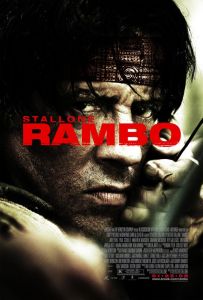 Count me as one of the many who were surprised at how effective Sylvester Stallone was when he dared to make a sixth Rocky movie. That 2006 swan song was an effective and somewhat emotional return for a character that had been dormant for over 15 years. Now Stallone is trying to work his resurrection magic yet again. Rambo was the epitome of the 1980s action star as he laid waste to vast stretches of enemy armies. What few remember is that Rambo’s first film, 1982’s First Blood, is actually more of a psychological drama about a Vietnam War veteran coping with adjusting to life back home. The action only comes at the end and a grand total of four people perish. Stallone had bigger plans for the character, I suppose. Just as he did with Rocky, Stallone has brought back an old character now with an older face.
John Rambo (Stallone) has been living outside the Burma (now known as Myanmar) border in Southeast Asia. He’s commissioned by a group of missionaries, including pretty blonde Sarah (Julie Benz), to transport them upriver into Burma. They want to do aid work, but Rambo says that Bibles cannot help a country overrun by men with guns. Eventually, all those Christian missionaries are kidnapped by a ruthless warlord. Rambo teams up with a group of mercenaries to go back and rescue them. A lot of people die horribly in the process.
Do we need another Rambo movie? The first one was linked to the Vietnam War, the increasingly cartoonish sequels involved John Rambo going back to Vietnam and then going to Afghanistan to help take out the invading Soviets. Perhaps the figure of Rambo should be added as a footnote to Charlie Wilson’s War. But the world has changed and the notion of a one-man army taking out the trash seems a tad ludicrous when a modern enemy isn’t a clear, identifiable source. Stallone wisely returns his scarred soldier to the jungle, back to where atrocities are going down in international lands. In some manner, Rambo becomes like a wishful force for justice, and instead of Vietnamese and Russian soldiers being shot out of jingoistic American glory, it’s Burmese military warlords that meet their makers. Stallone even opens the film with real archival footage of the Burma military junta committing violence acts. The bad guys feel real and relevant, which makes it partially more fulfilling when Rambo meets out his own brand of punishment.
 The dialogue is sparse and kept to an expository minimum. This is for good cause. Ladies and gentlemen, allow me to perfectly showcase for you why it is a blessing that Rambo is as dialogue-free as possible. This exchange happens early in the film and is a glimpse into the philosophical rumblings of one, John Rambo.
Sarah: Really? If everyone thought like you, nothing would ever change.
John Rambo: Nothing does change.
Sarah: Of course it does! Nothing stays the same.
John Rambo: Live your life cause you’ve got a good one.
Sarah: It’s what I’m trying to do!
John Rambo: No, what you’re trying to do is change what is.
Sarah: And what is?
John Rambo: Go home.
That’s the kind of dialogue you hear during fake audition scenes in movies, where the aspiring actors are saddled with ponderous drivel. There is some discussion over whether it is right to take a life. You get an idea of Stallone’s worldview when he has the pacifist preacher eventually kill his fellow man out of survival. After the twenty-five minute mark or so, Rambo essentially becomes a silent movie with added grunts.
The plot is as thin as possible; it’s essentially a rescue mission stretched to 90 minutes. Of course Rambo is a brutal and bloody action flick, but man is this thing tremendously gory, and it’s war gore so that means bodies being blown to bits. I’m somewhat awed at the sheer variety of ways bad guys have giant holes punched in them and through them. Limbs go flying, blood soaks the ground, heads go rolling, insides spend more time on the outside, and bodies are ripped apart. The blood and guts splatter the screen so much that sometimes even the camera can’t escape. There’s so much carnage that you may be advised to wear a poncho if you sit close to the screen. According to the Internet Movie Database, Rambo has 236 onscreen kills and that averages to 2.59 killings per minute. It’s a viscerally violent flick that can become occasionally entertaining, if you can stomach other people’s stomachs exploding in your face. In the end, though, the violence is just another bloodlust high that completely dissipates once the movie concludes, and you?re left with nothing of value. It’s somewhat fun while it lasts, but once it stops Rambo is an empty exercise. Then again, if you’re hungry for lean, mean action, and only action, then Rambo will certainly provide the gory goods.
 Stallone has somewhat re-energized his career by going back to the well. Rambo isn’t as nuanced as that big palooka Rocky, but the taciturn man of action suits Stallone. After a 20-year absence, Stallone eases back into the character and gives him a satisfying weariness, as solitary life has taken its toll. You won’t find me specifying the accomplished feats of acting in this movie because most of the acting is the equivalent of running and falling down, though perhaps not in one whole piece. Credit must be given to the 61-year-old Stallone, who still appears physically agile and spry when he could be cashing a Social Security check. Benz (TV’s Dexter, Saw 5) spends most of her time wailing through tears. It must have been exhausting for her tear ducts and her lungs.
Rambo is a movie that doesn’t pretend it’s anything but a grisly, masculine action flick. The story isn’t anything remotely involving and I doubt that Rambo was a character that needed to be reawakened. However, as a meaty old school action film, it aims to satisfy in the moment. Stallone does what he does well. It should be noted that the Myanmar military government has naturally banned this latest Rambo entry but rebel factions have actually used the film as a source to renew the spirits of the oppressed. They have even taken to using some of the dialogue as rallying cries. To think after all these years Rambo could still have an effect on the world. That’s more amazing than any of the creative carnage within the 90 minutes of Stallone’s rumble in the jungle.
Nate’s Grade: C+
Share this:

21 (2008)
 Glitzy, breezy, and 100 percent predictable, 21 is a simple con movie that goes through the motions with hyper realism. The most interesting part of the film, by far, is learning the systems that help these coeds fleece Vegas for thousands of dollars. In fact, the true story is far more interesting than this typical tale about a good kid who gets a big ego, pushes his true friends away, is humbled, and then learns a lesson while getting the girl too. What’s a MIT engineer want to go to Harvard med school for? And for that matter, you’re telling me there are no scholarships out there to brainy MIT students? Whatever the case, 21 will pass the time nicely without damaging your brain. The card games are ramped up with zooming camerawork and flashy special effects by director Robert Luketic (Legally Blonde), but it’s all window dressing to an interesting story that was white washed into a bland but undeniably commercial movie. It’s a fine time but, like Vegas, will leave you empty in the end. Still, you could do worse than overly stylized con movies about math whiz card sharks.
Nate’s Grade: C+
Share this:

Ghost Town (2008)
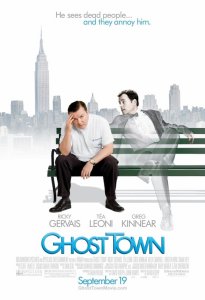 It seems the genesis for this flick was like someone asked what The Sixth Sense would be like with jokes (or someone rented Topper and said, “Why not again?”). The idea of a misanthropic man who sees dead people is elevated by the sheer comic genius of star Ricky Gervais. The famous British comedian is better known across the pond for his dry, sarcastic wit and penchant for awkward, pained comedy, but Ghost Town is a great mainstream introduction to the comedic chops of this squat Englishman. The film follows a familiar trajectory and even introduces a romance for the man who loathes other people, but Gervais and co-writer/director David Koepp make it worthwhile and endearing. I could watch Gervais and his beaming co-star Tea Leoni crack each other up for hours. The comedic premise is finely explored (there are more than enough scenes of people looking odd at Gervais talking to himself). The movie tilts toward being a supernatural romantic comedy in the second half but manages to stay snappy and character-driven. It’s a sweet movie with some nice comic jabs that don’t dwell on nastiness. Ghost Town is a charming and engaging light comedy that might cause a few sniffles in between chuckles. I have a warm place in my heart for this movie.
Nate’s Grade: B
Share this:

Lust, Caution (2008)
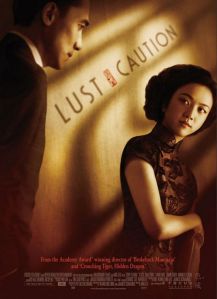 Ang Lee’s period romance is no Brokeback Mountain, though there is a heavy supply of thrusting. Lust, Caution is an NC-17 rated peak into life in China under Japanese occupation in the 1930s. Most of the film follows a school drama club that decides to become freedom fighters. They scheme to murder Chinese officials working with the Japanese government, and one gal (Wei Tang) is tapped to seduce and then kill a high-ranking official. For such a controversial movie, the sex scenes don’t even begin until 90 minutes into the flick (though our undercover heroine is deflowered by her drama club peer for the good of her mission). The movie is exquisitely shot, handsome in its details, and the lead performance by Tang is exceptional, simmering with conflicting emotions and some real sensual heat. The sex scenes doe have an erotic potency to them and they are more explicit than the kinder gentler fare found in typical Hollywood movies that consist of only seeing the slow-motion ecstasy result from a man on top. The offbeat love story gestates too late in the film’s run, leaving little time to delve deeper. Too much of the movie concerns back-story following the drama club’s road to becoming revolutionaries, and while it’s interesting it’s also rather needless on second thought. There’s a nine-minute difference between the R-rated version and the theatrical NC-17 cut; what’s in those nine minutes I do not know since I saw the edited version, but I’ve been told it’s a lot of thrusting. In lusty terms, the movie is heavy on foreplay and too short on a satisfying climax.
Nate’s Grade: B-
Share this:

Grace is Gone (2008)
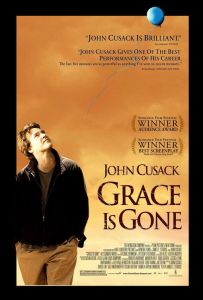 This Iraq War drama means well but it comes across as manipulative and morally questionable. John Cusack stars as a former military man who just found out his wife, on active duty in Iraq, has been killed. The bulk of the film’s conflict deals with how Cusack will tell his two daughters that mommy is not coming home again. Instead of being upfront with his children, he takes them out of school and whisks them away on a family trip to an amusement park. His reasoning is that he wants to squeeze in a few more happy memories before the kids hear the news. To me, this is irresponsible and psychologically damaging; those kids will resent their father holding onto such important information while he encouraged his kids to shop in ignorance. The film is about 80 minutes of watching a guillotine hang over someone’s head, just waiting for the moment to hit. It can get rather uncomfortable. Somewhere in this misguided drama is a poignant look at the domestic cost of the Iraq War from the family’s perspective, a perspective yet to be fully articulated by the movies. Instead, Grace is Gone is a well-acted but contrived drama that favors delaying the pains of reality to the point of incredulity.
Nate’s Grade: C+
Share this:

W. (2008)
 Director Oliver Stone’s first draft at history is never boring but it’s rarely insightful. The film portrays George W. Bush (Josh Brolin) as a stubborn and simple man trying to live outside his abilities and the long shadow of his successful and emotionally distant father. George W. was not the favored son, as he is routinely reminded, and Ma and Pa Bush express their frustration. And yet the son who did not have his family’s support and acumen accomplished what no one else in the family had. He won reelection. He toppled Saddam Hussein. And then it all came crashing down. Ultimately, who was this movie made for? The detractors of Bush will view the film being too light, providing a psychological context that humanizes the man amongst his mistakes. You may even feel some sympathy as George W. repeatedly tries to earn his father’s approval. The movie is not a partisan or mean-spirited skewering. The fans of Bush will consider the film to be a cheap shot that restrings famous blunders and transplants Bush malapropisms into new settings. People may take offense at the idea of the current Iraq War being a result of unresolved daddy issues. Seriously, for a two-hour movie spanning the life and career of the most reviled modern day president, did Stone need to include the moment where Bush almost choked to death on a pretzel? Over the 2000 election debacle? Over the Air National Guard? Over 9/11?
W. lacks a strong point of view and the film’s timeline closes too soon, only going so far as January 2004, not even the halfway point for a two-term president who has only sunk lower in national approval from that moment. A miniseries would be a better medium to explore the failures and calamities and personalities of the Bush Administration. Brolin is terrific in the title role and he never dips into parody. The rest of the actors are hit-or-miss and the movie becomes somewhat of a game of identifying famous historical figures in their one-scene appearances. My biggest surprise was how much I felt emotionally connected to the first President Bush, played by James Cromwell in a performance that doesn’t even attempt to imitate the real-life figure. Stone and screenwriter Stanley Weiser (Wall Street) certainly don’t hide the characters they connect with (Colin Powell, often the voice of reason, is given a stirring speech calling for caution). Certain creative license is taken to provide dream sequences that can point toward the inner turmoil of Bush, like when his father admonishes him for destroying 200 years of the family’s name over the Iraq War. Overall, W. is an empathetic and sometimes dithering portrayal of the 43rd United States’ president that could have succeeded if it had more to say.
Nate’s Grade: B-
Share this:

The Duchess (2008)
 I think I understand the real appeal of costume dramas. No matter what else happens, the costume drama must seem smarter. You have actors, primarily British, waltzing in elaborate costuming in realistic historical settings, each offering demure statements and looking for love and acceptance in a time of chaste expression. You could place Saw 18 in that setting and it would automatically seem smarter. I think the ye olde setting for costume dramas automatically gives these films more plot leeway, but not every film actually proves that it should have earned that leeway. Saul Dibb’s handsomely mounted period drama The Duchess offers little beyond the superficial enjoyment of well-crafted costumes.
In 1770s England, young Georgina (Keira Knightley) has been betrothed to the older Duke of Devonshire (Ralph Fiennes). The newly minted 17-year-old Duchess of Devonshire is whisked away to live in a giant manor. The Duke is rather cold and seems uneasy with human interaction; he shows the most affection for his dogs. He expects Georgina to primarily bear him a son. Several daughters later, the Duke is engaged in affairs and siring illegitimate children. Georgina has become a star of the social sphere, and it is here that she befriends Bess Foster (Hayley Atwell), a woman who is trying to regain her children from her ex-husband. Things get even more complicated when the Duke takes a liking of Bess, and the two become an unofficial union. Georgina has had her only friend taken away and turned into a co-wife. The only solace for the Duchess is in her flirtatious relationship with a politician, Charles Grey (Dominic Cooper). Georgina feels like a prisoner in her own home and yet she cannot desert her children. What’s an oppressed woman to do in 18th century England? That answer should be sadly obvious.
 The Duchess breaks no new ground and, in fact, treads water for the majority of its second half. Georgina was an independent spirit in a time that frowned upon breaking from conformity and tradition. As a woman, she was the victim of a double standard that allowed her husband to sleep with whomever he desired but she could not find physical comfort outside her loveless marriage. Marriage was widely viewed as a means to an end for male progeny, not the culmination of romantic love. Women were pressured into delivering male heirs, despite the fact that men are the ones who determine gender. Typically marriages were family arrangements for class and land ownership, so true passion was procured through marital affairs. I get it because I’ve read Jane Austen novels and seen dozens of period movies that have made the same stilted points. The Duchess presents Georgina as a feminist before her time and then a patriarchal society crushes her spirit. During the second half, when aristocratic life keeps producing heavy obstacles for Georgina, the movie just piles it on. I was left questioning what the point of all this corseted drama actually was.
After a while with my downtime I determined whom this movie is really for – hat enthusiasts. This is a Big Hat movie that puts other hat movies to shame. There are gigantic floppy hats, hats that look like fruit displays, hats that look like eighteen-layer cakes, hats that look like they have their own hat, hats with feathers zigging and zagging in every direction, and hats that look like they are consuming their host’s heads. If you work in the haberdashery industry or have an above average interest in hats and hat-related products, then run, don’t walk to The Duchess. You will be enraptured by the orgy of towering hats that jostle for screen time. Rarely are women seen without hats, so you truly will get your hat money’s worth over the course of the film’s two hours. If there were a specific Oscar category for Hat and Hat-like Accoutrement then The Duchess would dominate. I expect it will get nominated for Costumes, and really that seems like half the point in making these powdered wig period dramas.
I think the other point of The Duchess is to channel the modern story of Princess Diana, who is actually a distant relative of Georgina. The two seem to lead somewhat similar lives since they both married young, both had their husbands prefer the mistresses, both were fashion trend setters, both were beloved by the public, and after death both had their husbands remarry the mistresses. The tagline for the film is, “There were three people in her marriage,” a paraphrased quote that Princess Di said in an interview. The Di parallels seem to be all that the filmmakers intended to do with Georgina as a character; she is the least interesting person in her marriage. The Duke and Bess are far more complex and intriguing figures. I’m sure the Georgina biography that serves as the movie’s source is rich in Georgina characterization and personal detail, but all the movie cares about is establishing her as a marital martyr. There is more to this character but she just endures disappointment and punishment; I cannot fully engage with a character when their only personal attribute is suffering. The movie fails to present any notable reason why this woman of history deserves having a feature film.
 Knightley seems to spend half her film life in corsets. I’m still undecided upon whether she possesses innate acting ability; to me she too often comes across as a pin-up with great cheekbones. That said her eyebrows do a great bit of acting in The Duchess. She has the habit of cocking one ever so slightly and imbuing a scene with a hint of sexual allure or mystique. They’re pretty thick eyebrows too. Knightley does acquit herself well with the material and I doubt this will be the last time I see her in a tremendous silk gown and a humongous hairdo. The most interesting actor is Fiennes because his character is so reserved and awkward in his own skin, so much must be said through the use of gestures, body language, and the perfect execution of line delivery. His character seems just as ill in his setting as Georgina. Atwell is given the most complex character to play. To say that Bess has conflicted loyalties is an understatement. She betrays Georgina but romancing the Duke can ensure that she sees her children once again. Bess should have been the centerpiece of the movie because, as presented, she is far more interesting with more dramatic conflicts and turmoil other than being wronged.
The Duchess is no more and no less than every other costumer period piece you’ve seen before. It starts well but then falls into boring and repetitious plotting (Georgina wants something, she’s denied, she wants something, she’s denied; rather, rinse, repeat, end). The Duchess will delight those in search of yet another unrequited period romance, but I feel that moviegoers should expect more from their entertainment that mechanically fulfilling the period-y checklist. The technical merits like the production art and the costumes, especially the hats, are first rate. There’s little feeling beneath all the fabulous fussing about. It’s too bad the actual drama couldn’t at least be as interesting as the hats.
Nate’s Grade: C+
Share this:

The Dark Knight (2008)
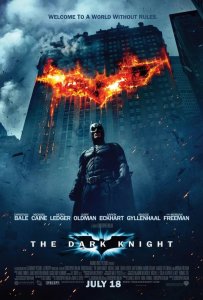 In 2005, Christopher Nolan’s reboot of the Batman series was a critical and commercial success. Gone were the campy and opulent sequences of old and the nipples on the Batsuit felt simply like a bad dream. Nolan served as director and screenwriter and brought serious psychological depth to his story and characters. As a life-long Batman fan, I loved it and wanted a sequel immediately with the exact same people responsible. The Dark Knight has been overshadowed by the passing of actor Heath Ledger, a gifted young actor nominated for a Best Actor Oscar for 2005’s Brokeback Mountain. He’s gone from gay cowboy to the criminally insane, and it’s all anyone can talk about. The buzz on Ledger and The Dark Knight is deafening and I am about to join that joyous chorus. This is a movie for grown-ups and makes lesser super hero adventures look downright stupid.
Bruce Wayne (Christian Bale) is dealing with the repercussions of his choice to assume the masked identity of Batman. He’s cracked down on Gotham City’s mobsters, and in their desperation they have turned to a crazed anarchist that likes to wear strange makeup. The Joker (Ledger) promises to return Gotham back to its old ways but even he knows this isn’t possible. “You’ve changed things,” he tells Batman. “There’s no going back.” The Joker wants to break the will of Batman and Gotham City and sets up elaborate and disturbing moral dilemmas that push many to the edge. His purpose is chaos, which isn’t exactly what the Mob had in mind when they subcontracted his services. Bruce must rely on his trusted butler Alfred (Michael Caine) and company tech guru Lucius Fox (Morgan Freeman) to help him combat a man that “just wants to watch the world burn.” Gotham also has a new district attorney, Harvey Dent (Aaron Eckhart), who is willing to put his name on the line to clean up the city. He’s butting heads with Lt. Gordon (Gary Oldman) because of Gordon’s secrecy and his reliance on Batman to do the things the law won’t allow. Dent wants to prosecute mobsters and is willing to put himself in jeopardy. He believes Batman is waiting for men like him to take the baton. Bruce’s old squeeze Rachel Dawes (Maggie Gyllenhaal replacing Katie Holmes — upgrade) has fallen for Dent. He’s an emotionally available man who wants to do good. Naturally, Dent and Rachel will becomes targets of the Joker.
 First off, believe the hype because everything you’ve read and heard about Ledger’s performance is the gospel truth. The actor vanishes completely underneath the gnarly latex scars, stringy hair, and smeared makeup. He transforms into this menacing figure and he makes Jack Nicholson look like a circus clown in comparison. He’s creepy and funny in a totally demented and spooky way, but he almost comes across like a feral creature that enjoys toying with his prey. Ledger fully inhabits his character and brings a snarling ferocity to the role. The Joker is given no back-story and he takes a macabre delight in crafting differing versions of his sordid past depending upon the audience. Ledger’s Joker is like a mixture of sadist and intellectual, of Alex from A Clockwork Orange and Hannibal Lector; he finds a way to get inside your mind and unleashes torment. There’s a great scene where he’s left alone in a holding cell with a police officer. The Joker taunts the man, getting little reaction from the trained lawman, but then he hits a nerve. The Joker asks how many of his friends, his fellow officers has he murdered. He then rhapsodizes the finer points of using knives instead of guns because guns are too quick. With knives he can see who people truly are in the final moments of existence. “So in a way, I know your friends better than you ever did,” he tells the officer. “Would you like to know which of them are cowards?” This triggers the officer to break his protocol and play into the Joker’s scheme. I’m not ready to say Ledger’s performance overtakes Javier Bardem’s Anton Chigurh (No Country for Old Men) as the most menacing villain of late, but Ledger certainly will make your skin do more than crawl.
Ledger gives a performance worthy of posthumous Oscar consideration. Toward the end of the film I found myself lingering on sadness that, well, this was it. This is all we are ever going to get of the Joker, such a fabulous character, but even more, this was the last full performance we are ever going to get from Ledger. His unnerving performance will stand the test of time when it comes to haunting screen villains, and I’m sure the actor had many more incredibly performances left in him before he passed away.
 The Dark Knight has less in common with other superhero series and should be considered a modern crime drama. It has more in common with Heat than with Spider-Man. Even compared to Nolan’s excellent Batman Begins, this is the first Batman film that feels like it occurs in a real city in our own reality. In Batman Begins, we had the CGI ghetto that happened to be conveniently where all the city’s scum lived, an ancient league of ninjas that wanted to wipe an entire modern city off the map, and then a super microwave that zapped water molecules in the air. Even though it was the most realistic Batman yet, it still had some fantastic elements that kept it from feeling fully believable. This newest Batman adventure feels more like a real city and a city that is being torn apart. You get to see a lot of Gotham City’s moving parts and different social circles and then see the Joker tear them apart. The knotty screenplay by Christopher Nolan and his brother Jonathon is dense and packed with subtext and ambiguity not seen in the likes of other spandex-clad super hero movies. This isn’t a super hero movie so much as an enthralling crime thriller with better gadgets.
Whereas Batman Begins focused on the psychology of a man that dresses up in a costume and fights crime, now the attention turns into examining the impact of Batman. There has been escalation, just as Gordon hinted at the close of the last film. Batman has stepped up law enforcement and now Gotham’s criminal element has placed their trust in a psychopath that promises results. This is a movie about symbols and ideals and about the tenets of civilization. The movie presents an arsenal of mature questions and rarely gives absolute answers. Batman I supposed to be a hero but does he play by the law? Can he make decisions that no one else can? Batman believes in the goodness of others and serves as a symbol for the city to stand up against corruption, but can Batman be corruptible? Does he have a breaking point? Is implanting hidden surveillance and spying on 30 million people in the name of security overstepping? Is it acceptable to cross a line if your enemy crossed it first? The Joker lives at the other ideological end and believes that human beings are selfish and will eat each other when the chips are down. He devises disturbing social experiments that test the limits of ordinary citizens and how far they are willing to go out of self-interest. The Joker is an anarchic force that seeks to tear down civilization itself, and that is a far more interesting and devastating plot than vaporizing water molecules with ninjas. When the movie covers the tired “we’re one in the same” territory that most super hero flicks hit (the Joker responds to Batman with, “I don’t want to kill you. What would I do without you? You complete me.”), it even makes sense given the psychological and philosophical complexity at root.
And oh boy, is The Dark Knight dark. This flick racks up a body count that could compete with movies usually involving some cataclysmic act of nature. The Joker’s unpredictable nature, and the dark twists the film plumbs, creates an atmosphere where you dread anything happening at any time, and mostly bad things happen. Batman must come face to face with his limitations and the realization that his actions, no matter how altruistic, will have negative consequences. This is not a movie for young children. If any parent buys their child a Joker doll and takes them to see this movie then expect years of therapy bills down the line. Much of the violence is implied but the overall effect is still chilling. It’s difficult to call The Dark Knight a “fun” movie. Batman Begins was fun as we followed Bruce Wayne tinker and become his crime-fighting avenger. This movie watches much of what he built get taken away. The movie makes gutsy decisions and for a super hero movie, let alone a summer blockbuster, and this is one decidedly dour flick where no character ends in a particularly pleasant place, especially poor Harvey Dent.
 Speaking of Mr. Dent, while Ledger is deservedly getting all the buzz and plaudits, Eckhart’s excellent performance is going unnoticed. Dent gets just as much screen time as Batman and is the white knight of Gotham, the man unwilling to break the boundaries of the law to merit out justice. Like Batman, he serves as a symbol for Gotham City and its resurrection from the stranglehold of crime. Batman fights in the shadows and serves as an anonymous vigilante but Dent is the face that can inspire the city. That’s what makes his transformation into Two-Face all the more tragic. You really do care about the characters in this movie, so when Dent turns on his principles and seeks out vengeance you feel a weighted sense of sorrow for the demise of a truly decent man. Eckhart and his lantern jaw easily sell Dent’s idealism and courage. After his horrific transformation, Eckhart burrows deep enough to show the intense hatred and mistrust he has even in fate. He gives a terrific performance that plays a variety of emotions and does justice to them all.
The rest of the cast, just to be mentioned, is excellent yet again.
Nolan has also stepped up his directing skills and delivered some high-intensity action. His first foray with Batman had some dicey action sequences that suffered from choppy editing, but he pulls back his camera lens and lets the audience see the action in The Dark Knight. The explosive high point is a long car chase where the Joker tries to attack an armored police car via an 18-wheeler truck. The police look for safe detours to escape the Joker’s line of fire, and when Batman surfaces with the sleek Batpod motorcycle thing get even cooler. What makes the sequence even better is that all of the peripheral characters behave in semi-logical ways, meaning that your secondary cop characters are respectable decision makers. Nolan also shot several sections of the film in IMAX, which boasts the highest resolution possible for film stock. The panoramic views of Batman atop buildings are breathtaking and may strike vertigo in some moviegoers. The movie looks great and it delivers the action goods but it’s really more of a tense thriller with more tiny moments of unease than an out-and-out action flick with gargantuan explosions and blanket gunfire.
Despite the undeniable brilliance of The Dark Knight, the movie is rather exhausting. After a decent 45 minutes of establishing the characters and setting up the stakes, the movie is essentially two hours of climax after climax, and you will be perched on the edge of your seat and tense until the end credits crash onto the screen. It’s exciting and overwhelming but you will feel wiped out by the end of the movie. There are a lot of characters and a lot of subplots and while I’m thrilled the movie has so much intricacy it also makes it hard for the film to come to a stop. The climax with Two-Face and Gordon’s family also feels misplaced. At a tremendous 2 hours and 30 minute running time, The Dark Knight will test your endurance skills in the best way.
 I honestly have no idea where Nolan and crew can take the story now. The Dark Knight seems unlikely to be topped. This is an intense, epic crime thriller with a labyrinthine plot that is packed with emotion, subtext, philosophy, penetrating open-ended questions, and genuine nerve-racking tension. It’s hard for me even to think of this movie as a super hero flick despite that fact that it’s about a billionaire in a rubber suit. This is an engrossing modern crime drama that just so happens to have people in weird costumes. Nolan and his brother have crafted a stirring addition to, not just the Batman canon, but to cinema as a whole. Ledger’s character is the driving force behind the film, the man that makes everyone else react, and his incredibly daring and haunting performance will stand as a last reminder of what talent was lost to the world when he passed away. I for one will be amongst the throng crying out for Oscar recognition but not just for Ledger, for The Dark Knight in general. And I may not be alone. The Dark Knight is currently breaking every box-office record imaginable and seems destined to finish as the number two highest grossing movie of all time, steadily behind James Cameron’s Titanic. If the Academy is looking for a way to shore in better ratings for the Oscars, it might seriously consider nominating The Dark Knight in some key races. It certainly deserves recognition.
Nate’s Grade: A
Share this:

The Wackness (2008)
 Every Sundance Film Festival seems to coronate new talent and new films that never seem to materialize once they step outside of the happy bubble of festival life. It happened with Happy, Texas, with Tadpole, with Hav Plenty, with Primer and numerous others that never managed to get started with the public. At the 2008 Sundance film festival, the biggest buzz followed the documentary American Teen and The Wackness. Writer/director Jonathan Levine’s coming-of-age tale won the Audience Award for Drama and boasts shimmering visuals, formidable actors, and a hip soundtrack. Too bad the drama gets the least attention in that package. I suspect The Wackness will be yet another Sundance buzz flick that, while well made, fails to leave a mark on mainstream crowds (here’s hoping more for American Teen).
Luke (Josh Peck) has just graduated from a New York City high school and is winding down the summer before he moves on to college. He has a unique summer job: Luke sells marijuana out of an ice cream vendor’s box. One of his clients, Dr. Squires (Ben Kingsley), is a therapist. He trades therapy time to Luke for pot. The two of them form an unanticipated bond and Dr. Squires makes it a point to see that Luke is making the most of his youth. Luke is smitten with the doc’s stepdaughter, Steph (Juno‘s Olivia Thirby, gratifyingly authentic), and determined to lose his virginity and find love before the summer fades away.
 The strength of The Wackness is in the unexpected father/son relationship that forms between Luke and Dr. Squires. Kingsley is sensational in his role and provides all the pathos and unexpected discoveries that the coming-of-age genre is associated with. I think that’s what’s most interesting about Levine’s film, is that Kingsley is going through all the coming-of-age moments reserved for teenage protagonists. Dr. Squires and Luke form a surprising and deep relationship where they learn from each other. Luke learns to talk about his life’s sadness and make it a part of his life, instead of sweeping it under a proverbial rug. Dr. Squires learns to re-embrace life and to kick his heavy supply of pharmaceutical prescriptions. He is coming of age at middle age. He even gets to second base with an Olsen twin (Mary-Kate is only in the film for two scenes and an estimated five minutes). Most of all, Dr. Squires needs a friend and Luke fulfills this desperate void. Kingsley is funny, pathetic, and the real star of The Wackness.
My main problem with The Wackness is how familiar it all comes across. It follows the coming-of-age model down to the end, so a savvy audience is going to realize that Luke will fall in love, get his heart broken, stand up for himself, and gather a bit more wisdom by the time the end credits roll. You’ve seen this movie played in a thousand different ways before, and now The Wackness makes it 1001; you will essentially know every beat of this story before it happens. The film doesn’t break any new ground and doesn’t manage to provide much commentary or lasting insight while it comes of age. The screenwriting fails to hide what disinterests Levine. So we get quick glimpses of Luke’s home life and I swear in every one of them his parents are just yelling. That’s all Levine is interested in, setting up one ten second shot of Luke overhearing his parents shouting again and again. Dr. Squires’ wife (Famke Jannsen) gets the same kind of treatment. She gets a cursory amount of screen time to glower and that’s about it. I can tell Levine is only interested in his three main characters (Luke, Dr. Squires, Steph) but then why does he not concentrate on them further and scuttle what he feels is wasted time?
The Wackness is awash in pointless nostalgia. The movie is set during the summer of 1994 for no real reason. The time setting doesn’t impact the film in any manner except for some digs at Mayor Giuliani’s policies (he was only in office for sixth months or so when the film opens). Levine dishes out pop-culture references like the 8-bit Nintendo game system, old chunky GameBoys, Kurt Cobain’s suicide, mix tapes, and lots of rap music. The Wackness is an ode to mid 90s rap music and Luke is a lover of acts like A Tribe Called Quest, De La Soul, and some up-and-coming guy named The Notorious B.I.G. The soundtrack is also meant to convey good nostalgic vibes of a simpler time only — 14 years ago. Setting the film in 1994 is a lazy attempt to cover the lapses in screenwriting with cozy audience nostalgia. And is there anything really culturally transcendent about the summer of 1994?
 Peck may have lost like 100 pounds since he was fat comic relief on a Nickelodeon kids show, and he’s marginally handsome, but this kid needs some more practice before he’s a dramatic actor. I understand that his character gets stoned often and, as a typical teenager, is trying to pull off a too-cool-for-the-world-“whatever” attitude, but he seems freaking catatonic. He’s too aloof for his own good. His acting is dry and monotone and he feels like he’s constantly zoning out. Again, I understand that this works with his stoned persona but Peck is hardly ever convincing in the part and his acting shortcomings rob the role of a greater level of sympathy. A great actor can make you like a character that eats babies and kicks puppies, or the other way around, but Peck is not that actor. I believe that part of The Wackness‘ failure to connect and elevate beyond its genre trappings is due to Peck’s poor performance. He’s just kind of boring character and, to borrow a term from our pals on the other side of the pond, a bit of a wanker.
As a director, Levine has a playful and visually appealing look for the film, bathing it in arid tones to echo the hot summer days. The cinematography is a character all its own, giving the film a colorful and lively flair that makes every scene worth watching even if the script fails to do likewise. Levine has a handful of clever visual tricks up his sleeve, like a middle finger that moves through a crowd of New Yorkers at rapid speed before finding and dialing a pay phone. Levine has definite talent as a director and it shouldn’t be long before Hollywood comes knocking and plucks him away to make The Fast and the Furious 8: The Search for Curly’s Gold.
The Wackness feels like a coming-of-age film that goes through the motions. The main character is stoned to the point of comatose and he’s a rather boring protagonist, made even duller by Peck’s lackluster acting ability. Writer/director Levine flexes enough visual artistry to make him a talent to watch, however, his screenplay is too familiar with little personality or flavor to stand out against the pack. The movie looks good, it sounds good, and Kingsley is certainly good, it’s just a shame that it isn’t his movie. Steph tells the mopey Luke that all she sees is the goodness life has to offer and all he sees is “the wackness” (you can go home happy to understand the title). I guess I similarly be accused of focusing on the “wackness” of The Wackness because it’s certainly not a bad movie. It just happens to be ordinary. Though it does have some torrid Kingsley-on-Olsen Twin action. I suppose that isn’t too wack.
Nate’s Grade: C+


 nathanzoebl
You must be logged in to post a comment.