Blog Archives
Then She Found Me (2008)
 Actress Helen Hunt’s directorial debut is an altogether pleasant film experience without achieving anything memorable or truly accomplished. It’s a simple story of a 40-something grade school teacher (Hunt) torn between her man-boy husband (Matthew Broderick) and a student’s hot father (Colin Firth, who seems to be a middle-aged woman’s dream come true). The extra plotline where Hunt discovers the identity of her biological mother (Bette Midler) never truly seems to coalesce with the romantic foibles. Then She Found Me has a noticeably wry tone, like that of a world-weary adult that’s been-there-done-that. That specific and welcomed tone helps keep the viewer alert and mostly satisfied from beginning to end. It isn’t a warm or sappy movie despite some sitcom-level plot complications. The acting is fairly amusing, though somewhat one-note (the foursome of actors rarely break from the one-sentence descriptions of their characters). The most shocking aspect of the flick is how weathered and gaunt Hunt looks, which is a refreshing and realistic turn for the actress. Hunt is competent behind the camera but doesn’t prove much else when it comes to directorial skills. Then She Found Me is a mildly affecting movie that passes the time well. Stick around to catch acclaimed author Salman Rushdie as Hunt’s OB-GYN.
Nate’s Grade: B
Share this:

Deception (2008)
 Is there a more tired and pathetic genre of filmmaking than that of the erotic thriller? Deception is just about as lazy and bland as its title. The casting director got every role wrong. Ewan McGregor is an accounting nerd that befriends a swanky playboy (Hugh Jackman) and they accidentally switch phones. Of course this leads to people mistaking an accounting nerd for a swanky playboy, and McGregor is introduced to an underground web of anonymous sex (hasn’t anyone heard about Craig’s list?). I suppose the rich would rather take a chance on a stranger than have their handlers recruit some tail. Michelle Williams is completely wrong as the femme fatale who OF COURSE is in on the scheme. Deception plays out exactly as you could predict, and it even bears a somewhat strong resemblance to 2005’s Derailed, another mediocre thriller of little thrills. The chilly cinematography by Dante Spinotti is way too good for this kind of film. It seems that erotic thrillers have graduated from soft focus close-ups of copulating couples set to saxophone music to soft focus close-ups of copulating couples set to electronica beats. I suppose that’s progress for a genre defined by ridiculous plots, unrealistic characters acting like idiots, and, oh yeah, boobs.
Nate’s Grade: C
Share this:

The Sisterhood of the Traveling Pants 2 (2008)
 The ladies that inhabit The Sisterhood of the Traveling Pants 2 are not the same group of gals that charmed the pants off of me in the 2005 original film. This time the foursome is feeling some strain because they’ve all graduated and moved onto insanely ludicrous positions. Tibby (Amber Tamblyn) is making movies at NYU; Lena (Alexis Bledel) is studying art at the Rhode Island School of Design; Bridget (Blake Lively) is assisting with an archeological dig in Turkey; and Carmen (America Ferrera) is at the Brown theater department where she gets the lead in a summer production. Let’s face it, these are not the down-to-earth girls that were presented before. Was it too much to ask that one of the girls have a modestly plausible scenario? The drama is again split into two camps, the petty and comedic (Lena must choose between boyfriends, Carmen has to practice her lines) and the melodramatic (Bridget still has to deal with her mom’s suicide, Tibby has a pregnancy scare). The movie doesn’t work this go-round because every beat of the plot is wholly predictable (of course the guy Lena flirts with in art class will end up being the nude model), and much of the conflict is just inane. The characters act in stupid and contrived ways because the plot demands it. Sure the condom broke but can’t Tibby get the morning after pill at least? Sisterhood 2 also packs a baby birth, reunion between granddaughter and the grandmother she never knew existed, and a climactic trip to Greece for some serious girl power. It’s drama overload and lacks the notable sincerity of the first film.
Nate’s Grade: C
Share this:

Twilight (2008)
 It’s only been three years since the first book in the Twilight series was published, but man has it already become a phenomenon among young girls. Author Stephenie Meyer was a Mormon housewife who professed to never having seen an R-rated movie, so of course she seems like a natural fit for vampire literature. Meyer has taken the torch from Anne Rice and created an insanely popular series of books that chronicle the lives of humans and vampires in the rainy Northwest United States. I had never heard about the books until the spring of 2008, months before the hotly anticipated release of the fourth and final book in the series. Then again, I’m not a preteen girl, so excuse my ignorance. I decided to bear the hormonal, high-pitched squeals and sit with a packed house to experience the movie with the Twilight faithful. Judging from my screening, I think it might be mandatory for all girls between the ages of 7-14 to go see the Twilight film.
Bella Swan (Kristen Stewart, Into the Wild) is the new kid in school. She’s moved back to live with her father (Billy Burke), the sheriff of a tiny Washington town with a population of 3,000 people. Bella has her sights set on the Cullen family, a group of weird kids that are pale and keep to themselves. Edward Cullen (Robert Pattinson) goes out of his way to avoid Bella, and of course this just makes him more mysterious. He tells her that they shouldn’t be friends. Then one day at school he saves her life by stopping a van from crushing her. Bella suspects that this Cullen kid might not be a usual teenager. He’s not. He’s a vampire who hasn’t aged since 1918. Bella is smitten with her otherworldly protector. It’s your typical high school relationship. Bella doodles Edward’s name on her notebook and falls in love with an unattainable boy. Edward must resist the constant temptation to drink Bella’s blood (he and his vamp family are “vegetarians,” meaning they only drink animal blood).
 Let’s examine the distinctions of the Twilight vampire incarnation. Now, the vampire myth is not written in stone, so it allows for creative interpretation. Some vampires cast a reflection, others don’t. Some vampires are thwarted by garlic and crosses and others are not. Some vampires sleep in coffins and others just prefer a comfy mattress. It seems that the two characteristics that follow every vampire tale involve the insatiable thirst for blood to drink and the fact that sunlight is a vampire’s enemy. Meyer’s vampires don’t even adhere to this. They walk around in the daylight with no concern; in fact, we learn they never sleep at all, which means they must have all the late night infomercials memorized by this point. Removing the danger of daylight from the vampire myth proves to be somewhat troublesome decision. This is because, when you think about it, there are little to no drawbacks or limitations to being a vampire in Meyer’s world. Yeah you’ll live forever and crave an unorthodox beverage, but as a vamp you get super abilities, super strength, super speed, and a laughable diamond-like glow when the sun hits your exposed skin (think of those people that encase cell phones in tacky “bling” jewelry). If this is what it means to be a vampire in Meyer’s world then I wouldn’t be surprised if every freaking teenager in the world was signing up to join the army of the undead. The vampire myth brings with it plenty of baggage but it also helps to patch up holes in a narrative; just introducing the concept of a vampire allows an author some free pass with the details. However, vampire tales bring with them a certain set of expectations due to audience familiarity with the popular concept. I could care less if Meyer’s vampires have fangs or chow down on garlic bread, heavy on the garlic, but she loses me when she has vampires roam around during the day with little to no drawbacks. They just don’t feel like vampires. What they feel like are superheroes with skin conditions and a unique appetite. Which is fine, but don’t call it a traditional “vampire” flick.
I completely understand the enormous appeal of the Twilight series because it’s totally pre-teen wish fulfillment. I’m positive that the majority of the pre-teen readership projects themselves as Bella, the typical Every Girl. She encounters a sexy boy who ignores all the flashy and trashy girls and recognizes that special something in the Every Girl. In fact, he respects her and doesn’t want to be physical with her because he’s afraid of giving in to his urges (a rather obvious abstinence metaphor). He wants to love her forever and protect her. He has a dangerous bad boy angle but yet he’s still safe. In short, Edward Cullen is the idealized male for a nation of pre-teen girls who are just stepping into the world of boys (Bella also becomes an object of affection for no less than three boys at school). The Twilight tale even pulls a gender flip: the girl is pressuring the boy to give in to his carnal urges. And yet I can also understand why the books appeal to an older, mostly female, readership as well. If you remove the vampire angle from the story, it’s that old classic literary tale about a gal falling in love with the rebel, the boy who’s misunderstood. Hollywood has been making those sorts of love stories for decades, and so Meyer is able to tap into this classical romantic appeal.
 Twilight never delves too deeply into the dramatic dynamics of a 17-year-old girl dating a 90-year-old vampire. There are a lot of dramatic consequences drawn from dating somebody who cannot age. The Buffy the Vampire Slayer TV show explored the ins and outs of human-vampire relationships with wit and sincerity. Edward is forever seventeen but does that mean he still digs the high school girls? If you’re trapped in the body of a teenager does that mean you are still attracted to teenagers? If I were almost a century old I think I might seek out the comfort and conversation of a more mature woman, which is precisely the notion I’m sure the older female readership also fantasizes about (for all those guilty soccer moms, it doesn’t qualify as fantasizing an underage when he’s undead). Talking to teenagers for the rest of your life seems like a strange form of penance, as does repeatedly completing high school. Are the vampires just bored and attend school to pass the time? Don’t they know that TV was invented?
Twilight doesn’t have much of a plot to fill out a two-hour running time; the bulk of the movie consists of two characters feeling each other out. When the film does introduce an exterior threat (Cam Gigadet as a vamp obsessed with the hunt) it never feels that dangerous or fitting. The outside threat is saved for the very end and is easily dispatched, so the movie would have been better off without forcing a last-minute life-or-death dilemma into its love story. The love story itself doesn’t feel as properly nourished as it needed to be. The whole film experience feels like one long introduction and set-up, not so much an open-and-shut story.
Now, with all of that established, the Twilight film itself isn’t too bad. The movie is well made and certainly has a pulpy romantic vibe. The movie never feels overly burdened by excessive emotion or fake drama. It also follows a leisurely pace but never becomes dull. The actors are a big help. The leads don’t seem like they stepped out of a magazine photo spread; Stewart and Pattinson (Harry Potter and the Goblet of Fire) have a palpable chemistry that simmers throughout. Stewart is a terrific actress that embodies a typical teen, and Pattinson has the heartthrob glower down cold. I think there is rarely a scene where Edward isn’t glowering. Director Catherine Hardwicke (Thriteen) might as well provide onscreen instruction telling the audience when to swoon. Hardwicke is a filmmaker that doesn’t wallow in pretension, so she knows what kind of flick she has at her disposal. On the other hand, she is able to tamp down the inherent cheesiness that can go with a gooey supernatural love story. Twilight is able to work because it strikes the right balance between romance and silliness.
 Fans of Twilight should be delighted by the big screen adaptation of their favorite characters and heartthrobs. Sure the plot is a tad lightweight, the vampires might not be vampires as we traditionally understand them, the characters make giant leaps in their proclamations of love, and the outside conflict is a bit too poorly manufactured, but the movie has some bite. The movie isn’t moody, it isn’t too heavy, and it can come across as entertaining, though I’m at a loss to explain its extraordinary popularity. Now that Hardwicke and company have established the Twilight inhabitants, I hope the inevitable future installments will be better at providing resonating story and characters. If you doubt the certainty of sequels, need I remind you yet again that it is mandatory for girls age 7-14 to see this movie. The Twilight phenom has yet to reach its peak. Get used to it. It’s only a matter of time before Hollywood starts cranking out the Twilight knock-offs. Then, perhaps, I will join the armada of pre-teen girls and shriek wildly.
Nate’s Grade: B-
Share this:

The Other Boleyn Girl (2008)
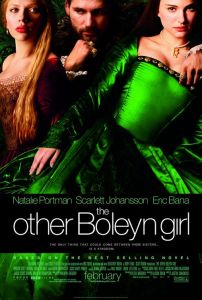 The story of Henry the Eighth and his many wives is a tale full of romance, danger, betrayal, and sweeping historical changes; it’s the most popular soap opera of its age. The 700-page book was naturally going to get slimmed down as a feature film, and The Other Boleyn Girl feels a bit too streamlined for all the heavy historical events that take place. The production values are all top-notch and the story has some juicy moments. It presents an intriguing angle by showcasing the conniving rivalry between the Boleyn sisters (Scarlett Johansson, Natalie Portman). The acting falls under that period film gravity where the actors all speak stately and enunciate every syllable slowly, like they were testing out the sound for the first time. Portman is especially fun in a villainous role. Eric Bana is completely at odds with history as Henry VIII, but I suppose it would be harder for modern audiences to accept young nubile ladies vying for the affection of a huge, ugly man with a leg of mutton in his grip.
Nate’s Grade: B
Share this:

Nick and Norah’s Infinite Playlist (2008)
 When you’re a teenager, sometimes there is nothing more important in life than music. Generally one of the most prominent means for a teenager to outwardly define his or her emerging personality is by music. Coming of age and maturing musical tastes seem to go hand in hand. I may date myself here but I can recall my own personal blossoming thanks to the likes of Green Day, the Smashing Pumpkins, and the Offspring (you couldn’t go anywhere in 1995 without hearing “Self Esteem”). Nick and Norah’s romantic interlude begins over common musical tastes and move from there. Having a person “get” you seems to be linked with having a person “get” your music. Nick and Norah’s Infinite Playlist is an inviting and mostly successful teen comedy that “gets” it.
Nick (Michael Cera) is nursing the common teen ailment of a broken heart. He’s one part of a queer core punk band and just happens to be the only heterosexual band member. Nick has been sending mix CDs to his ex-girlfriend, Tris (Alexis Dziena), but she’s been tossing them in the trash. Norah (Kat Dennings) has been fishing those mix CDs and falling in love with her unknown musical soul mate. Norah’s best pal Caroline (Ari Graynor) has informed her that her favorite indie band, Where’s Fluffy?, is playing a secret late-night show in New York City. The slew of characters, Norah and Caroline and Tris and her new boyfriend, attend a nightclub where Nick’s band performs. Awkward. Norah poses as Nick’s new girlfriend and the two take off together to drive a very drunk Caroline home. It is here that they begin an unforgettable odyssey filled with gross toilets, drag queens, Norah’s ex-boyfriend (Jay Baruchel), jaunts to recording studios, and many stops along the way to try and find Where’s Fluffy?
 Nick and Norah isn’t anything altogether remarkable but its charm comes in how, well, unremarkable it comes across. I do not mean this as faint praise or a backhanded compliment. The majority of teen-oriented films have the habit of slotting characters into rigid archetypes. Earlier this year, the documentary American Teen was released and barely made a blip. The director of this documentary condensed an entire high school year into a feature-length film, but she framed her characters as entrenched stereotypes patterned after movies (movies began the stereotype, now is life merely following its lead?). The marketing even had its main “characters” recreate the Breakfast Club poster with the requisite Jock, Geek, Princess, etc. It’s so easy to paint in broad, well-established strokes when it comes to teenage characters and a high school setting. So it’s genuinely entertaining and encouraging to see Nick and Norah where the characters just are people. Granted the gay characters are a bit too cutesy by half, though they never become swishy stereotypes and the slutty manipulative ex-girlfriend character is a pretty familiar and clichéd antagonist. But the real charm of the movie is seeing characters that cannot be painted in broad strokes, characters that do not hide who they are, and characters that refuse to be typecast. Just watching Nick and Norah interact, I felt like I was watching two friends instead of high school archetypes having the same tired class warfare. Making the characters reasonably realistic and unremarkable is a breath of fresh air.
Not all the elements in Nick and Norah entertain; some feel like they’ve been surgically attached from different movies. The entire subplot involving the sloppy drunk escapades of Caroline seems extraneous at best, providing an unnecessary plot point that keeps Nick and Norah together for the night. It provides some laughs due to Graynor’s highly amusing drunken performance, but the subplot also pushes the movie into outlandish gross-out humor, like when Caroline vomits into a toilet, drops her gum in the same toilet, and then decides to foolishly go after the gum. The same piece of chewing gum has its own fantastic journey. The coupling between Nick and Norah is also given a weird and somewhat unseemly addition. Clearly these two kids “like like” each other and the wild night presents different coupling obstacles before these fun kids eventually decide to make a move. In one scene Norah is taunted by Tris about never having had an orgasm. So then the movie makes it a point that when nick and Norah do hook up that we are presented with Norah earning her first O-face (the whole climactic sequence is done off camera and only with audio). Orgasmic proof was not needed to convince the audience that Norah has finally found a worthy guy. The fact that they’re high school-aged students brings an unsettling, seedy element into an otherwise wholesome film. It wasn’t needed.
The plot of Nick and Norah has a few bumps along the way because the emphasis is on the groovy and genial atmosphere. Watching the movie is somewhat akin to attending a party with some cool people. You leave the theater with your spirits lifted a tad, a smile on your face, and some fond memories for the time being. I’m not saying that Nick and Norah is comparable to the best teen comedies of all time but it manages to spin a little magic. I couldn’t help feel wistful as I watched the teen characters romp through the late night music scene of New York City, a character all its own. The movie manages to capture the exciting essence of being young and alive in an authentic way.
 The two leads are deeply enjoyable. Dennings (The 40-Year-Old Virgin) is a great find and comes across as a natural teenager. She’s not precocious or glib, but she seems grounded, unassuming, and yet intelligent in a way that doesn’t pass as hyper-literate. Dennings gives a spunky performance that is tinged with awkwardness and heartache, as she explores the scary yet exhilarating prospect of romance. She’s also got a bashful beauty to her, like the girl next door that would never admit that she could be attractive. She’s got lips like red licorice and classic features that could work in old Hollywood. Dennings gives every scene a boost of heart and the movie shines brightest every minute she’s onscreen. Cera (Juno, Superbad) seems to have patented his nervous stammer that he’s previously showcased. I wonder what Cera’s acting range actually is because he seems to be playing different variations on the same character. However, I have written before that Cera is the living master of comic understatement and the well-timed pause, and he proves it again. He mopes a bit too much through the movie but Cera manages to make him empathetic and not pathetic. The two of them have a sweet chemistry and it’s easy to yearn for their coupling.
Nick and Norah’s Infinite Playlist exists in a world that doesn’t exactly resemble our own but seems like a swell place to visit. The movie almost contains a certain innocence to its teenage shenanigans. Dennings and Cera make for engaging leads and an adorable couple onscreen. Not all of the parts come together as well as Nick and Norah do, but the movie’s overall vibe is authentic and low-key, apt to provoke cheerful smiles more than laughs.
Nate’s Grade: B
Share this:

Rambo (2008)
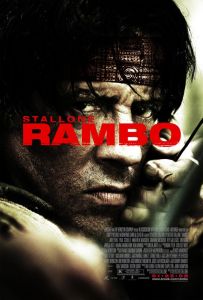 Count me as one of the many who were surprised at how effective Sylvester Stallone was when he dared to make a sixth Rocky movie. That 2006 swan song was an effective and somewhat emotional return for a character that had been dormant for over 15 years. Now Stallone is trying to work his resurrection magic yet again. Rambo was the epitome of the 1980s action star as he laid waste to vast stretches of enemy armies. What few remember is that Rambo’s first film, 1982’s First Blood, is actually more of a psychological drama about a Vietnam War veteran coping with adjusting to life back home. The action only comes at the end and a grand total of four people perish. Stallone had bigger plans for the character, I suppose. Just as he did with Rocky, Stallone has brought back an old character now with an older face.
John Rambo (Stallone) has been living outside the Burma (now known as Myanmar) border in Southeast Asia. He’s commissioned by a group of missionaries, including pretty blonde Sarah (Julie Benz), to transport them upriver into Burma. They want to do aid work, but Rambo says that Bibles cannot help a country overrun by men with guns. Eventually, all those Christian missionaries are kidnapped by a ruthless warlord. Rambo teams up with a group of mercenaries to go back and rescue them. A lot of people die horribly in the process.
Do we need another Rambo movie? The first one was linked to the Vietnam War, the increasingly cartoonish sequels involved John Rambo going back to Vietnam and then going to Afghanistan to help take out the invading Soviets. Perhaps the figure of Rambo should be added as a footnote to Charlie Wilson’s War. But the world has changed and the notion of a one-man army taking out the trash seems a tad ludicrous when a modern enemy isn’t a clear, identifiable source. Stallone wisely returns his scarred soldier to the jungle, back to where atrocities are going down in international lands. In some manner, Rambo becomes like a wishful force for justice, and instead of Vietnamese and Russian soldiers being shot out of jingoistic American glory, it’s Burmese military warlords that meet their makers. Stallone even opens the film with real archival footage of the Burma military junta committing violence acts. The bad guys feel real and relevant, which makes it partially more fulfilling when Rambo meets out his own brand of punishment.
 The dialogue is sparse and kept to an expository minimum. This is for good cause. Ladies and gentlemen, allow me to perfectly showcase for you why it is a blessing that Rambo is as dialogue-free as possible. This exchange happens early in the film and is a glimpse into the philosophical rumblings of one, John Rambo.
Sarah: Really? If everyone thought like you, nothing would ever change.
John Rambo: Nothing does change.
Sarah: Of course it does! Nothing stays the same.
John Rambo: Live your life cause you’ve got a good one.
Sarah: It’s what I’m trying to do!
John Rambo: No, what you’re trying to do is change what is.
Sarah: And what is?
John Rambo: Go home.
That’s the kind of dialogue you hear during fake audition scenes in movies, where the aspiring actors are saddled with ponderous drivel. There is some discussion over whether it is right to take a life. You get an idea of Stallone’s worldview when he has the pacifist preacher eventually kill his fellow man out of survival. After the twenty-five minute mark or so, Rambo essentially becomes a silent movie with added grunts.
The plot is as thin as possible; it’s essentially a rescue mission stretched to 90 minutes. Of course Rambo is a brutal and bloody action flick, but man is this thing tremendously gory, and it’s war gore so that means bodies being blown to bits. I’m somewhat awed at the sheer variety of ways bad guys have giant holes punched in them and through them. Limbs go flying, blood soaks the ground, heads go rolling, insides spend more time on the outside, and bodies are ripped apart. The blood and guts splatter the screen so much that sometimes even the camera can’t escape. There’s so much carnage that you may be advised to wear a poncho if you sit close to the screen. According to the Internet Movie Database, Rambo has 236 onscreen kills and that averages to 2.59 killings per minute. It’s a viscerally violent flick that can become occasionally entertaining, if you can stomach other people’s stomachs exploding in your face. In the end, though, the violence is just another bloodlust high that completely dissipates once the movie concludes, and you?re left with nothing of value. It’s somewhat fun while it lasts, but once it stops Rambo is an empty exercise. Then again, if you’re hungry for lean, mean action, and only action, then Rambo will certainly provide the gory goods.
 Stallone has somewhat re-energized his career by going back to the well. Rambo isn’t as nuanced as that big palooka Rocky, but the taciturn man of action suits Stallone. After a 20-year absence, Stallone eases back into the character and gives him a satisfying weariness, as solitary life has taken its toll. You won’t find me specifying the accomplished feats of acting in this movie because most of the acting is the equivalent of running and falling down, though perhaps not in one whole piece. Credit must be given to the 61-year-old Stallone, who still appears physically agile and spry when he could be cashing a Social Security check. Benz (TV’s Dexter, Saw 5) spends most of her time wailing through tears. It must have been exhausting for her tear ducts and her lungs.
Rambo is a movie that doesn’t pretend it’s anything but a grisly, masculine action flick. The story isn’t anything remotely involving and I doubt that Rambo was a character that needed to be reawakened. However, as a meaty old school action film, it aims to satisfy in the moment. Stallone does what he does well. It should be noted that the Myanmar military government has naturally banned this latest Rambo entry but rebel factions have actually used the film as a source to renew the spirits of the oppressed. They have even taken to using some of the dialogue as rallying cries. To think after all these years Rambo could still have an effect on the world. That’s more amazing than any of the creative carnage within the 90 minutes of Stallone’s rumble in the jungle.
Nate’s Grade: C+
Share this:

21 (2008)
 Glitzy, breezy, and 100 percent predictable, 21 is a simple con movie that goes through the motions with hyper realism. The most interesting part of the film, by far, is learning the systems that help these coeds fleece Vegas for thousands of dollars. In fact, the true story is far more interesting than this typical tale about a good kid who gets a big ego, pushes his true friends away, is humbled, and then learns a lesson while getting the girl too. What’s a MIT engineer want to go to Harvard med school for? And for that matter, you’re telling me there are no scholarships out there to brainy MIT students? Whatever the case, 21 will pass the time nicely without damaging your brain. The card games are ramped up with zooming camerawork and flashy special effects by director Robert Luketic (Legally Blonde), but it’s all window dressing to an interesting story that was white washed into a bland but undeniably commercial movie. It’s a fine time but, like Vegas, will leave you empty in the end. Still, you could do worse than overly stylized con movies about math whiz card sharks.
Nate’s Grade: C+
Share this:

Ghost Town (2008)
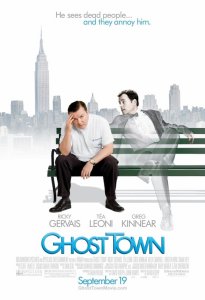 It seems the genesis for this flick was like someone asked what The Sixth Sense would be like with jokes (or someone rented Topper and said, “Why not again?”). The idea of a misanthropic man who sees dead people is elevated by the sheer comic genius of star Ricky Gervais. The famous British comedian is better known across the pond for his dry, sarcastic wit and penchant for awkward, pained comedy, but Ghost Town is a great mainstream introduction to the comedic chops of this squat Englishman. The film follows a familiar trajectory and even introduces a romance for the man who loathes other people, but Gervais and co-writer/director David Koepp make it worthwhile and endearing. I could watch Gervais and his beaming co-star Tea Leoni crack each other up for hours. The comedic premise is finely explored (there are more than enough scenes of people looking odd at Gervais talking to himself). The movie tilts toward being a supernatural romantic comedy in the second half but manages to stay snappy and character-driven. It’s a sweet movie with some nice comic jabs that don’t dwell on nastiness. Ghost Town is a charming and engaging light comedy that might cause a few sniffles in between chuckles. I have a warm place in my heart for this movie.
Nate’s Grade: B
Share this:

Lust, Caution (2008)
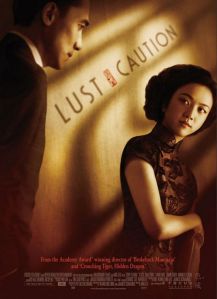 Ang Lee’s period romance is no Brokeback Mountain, though there is a heavy supply of thrusting. Lust, Caution is an NC-17 rated peak into life in China under Japanese occupation in the 1930s. Most of the film follows a school drama club that decides to become freedom fighters. They scheme to murder Chinese officials working with the Japanese government, and one gal (Wei Tang) is tapped to seduce and then kill a high-ranking official. For such a controversial movie, the sex scenes don’t even begin until 90 minutes into the flick (though our undercover heroine is deflowered by her drama club peer for the good of her mission). The movie is exquisitely shot, handsome in its details, and the lead performance by Tang is exceptional, simmering with conflicting emotions and some real sensual heat. The sex scenes doe have an erotic potency to them and they are more explicit than the kinder gentler fare found in typical Hollywood movies that consist of only seeing the slow-motion ecstasy result from a man on top. The offbeat love story gestates too late in the film’s run, leaving little time to delve deeper. Too much of the movie concerns back-story following the drama club’s road to becoming revolutionaries, and while it’s interesting it’s also rather needless on second thought. There’s a nine-minute difference between the R-rated version and the theatrical NC-17 cut; what’s in those nine minutes I do not know since I saw the edited version, but I’ve been told it’s a lot of thrusting. In lusty terms, the movie is heavy on foreplay and too short on a satisfying climax.
Nate’s Grade: B-


You must be logged in to post a comment.