Blog Archives
Lawless (2012)
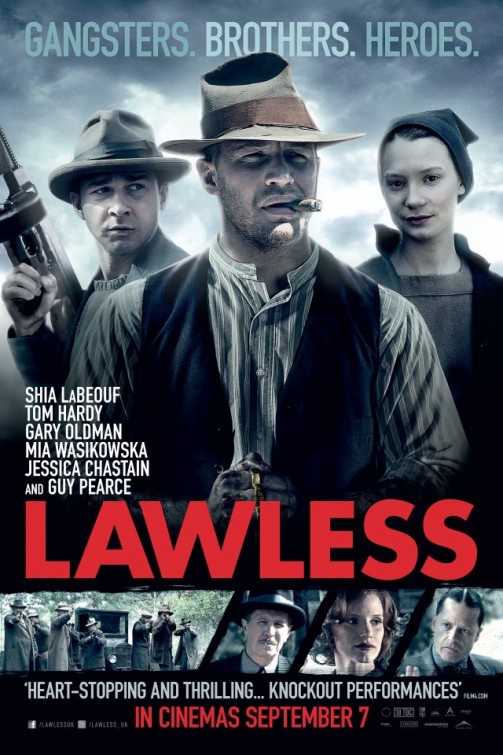 The bootlegging drama Lawless certainly has all the right elements to be an enjoyable movie. It’s by the men who gave us the great noir-Western The Proposition (director John Hillcoat, writer Nick Cave), it’s got a star-studded cast, plenty of bloody action, and a handsomely recreated production of the Prohibition era. But as I watched the Bondurant boys struggle against those who would like to put them in jail and/or murder them, I kept noticing something odd. I wasn’t that engaged. There was plenty of life-and-death drama, but why wasn’t I involved in the story more? Lawless feels like a series of scenes rather than a movie. Even when the plot changes it doesn’t feel like the movie is advancing. Even when things are more desperate it doesn’t feel like the momentum is building. The characters are somewhat sluggish as well, Shia LaBeouf as the scared youngest brother, Tom Hardy as the grumbly big brother who talks like his mouth is full of molasses. Jessica Chastain as the abused Good Woman who opens herself up to our Strong Hurting Man. Then you got a plot with a mobster (Gary Oldman) that weirdly climaxes with an hour left in the movie. He’s ignored for the remainder. Then there’s Guy Pearce as a colorfully fiendish and foppish special deputy that terrorizes the town. I am a Pearce fan but this guy is acting like he’s in his own weirder personal movie; it’s the kind of stuff Marlon Brando did. I appreciated that Lawless kept things gritty and bloody for realism, but I kept finding moments that ripped me out, namely the indestructible nature of Tom Hardy. Seriously, this guy has to be the Terminator. When he miraculously survives yet another seemingly fatal injury, all you can do is laugh. Lawless is passable entertainment but with its pedigree this should have been better.
Nate’s Grade: B-
Share this:

Celeste and Jesse Forever (2012)
 Celeste (Rashida Jones) and Jesse (Andy Sandberg) have been best friends ever since high school, the couple everyone admired. They’ve been married for six years but now they are in the middle of divorce proceedings. Why? Celeste loves her longtime best friend but worries he’s not maturing or stable to be her marriage partner. During their separation, Jesse admits he’s found another woman whom he cares about. Celeste professes to be happy but deep down is troubled, second-guessing her decision now that there’s a real threat she might lose Jesse. The two buds act like nothing has changed, goofing around and paling it up, but how long can they keep up this façade? Eventually, someone is going to get hurt because divorce cannot be shrugged off. Reality has a way of outliving ironic detachment.
Can you remain best friends with someone you once loved? How about someone you once knew as your spouse? Celeste and Jesse are certainly trying but their idealistic “BFF” status seems destined to meet a harsh reality. Celeste and Jesse Forever is labeled as a “loved story” and I think that’s a pretty apt description. These two characters clearly have a deep affection for one another, but after six years the feelings just aren’t enough. What happens when you marry your best friend but that just isn’t enough? I was hoping for some greater answers from the movie, or at least a harder examination on why some relationships fall apart when things look like they should work. That’s not exactly what the movie offers. For a film with an aim to be more realistic about the fallings out of love, the movie follows a familiar formula. There’s the cute guy at yoga (Chris Messina) into Celeste, but first she has to get settled. I think I wouldn’t have minded this character if he didn’t feel so much like a plot device, a hasty happy ending meant to be put in a holding pattern until called upon. The “Jesse” half of the title will be gone for lengthy chunks of the movie. His portrayal also borders on simplistic. I wish we got more of his side of the relationship, especially since he’s going through sudden change himself. After seeing the trailer, I thought I was going to find the movie immensely relatable. Maybe I just got all the recognizable personal drama out of my system with The Five-Year Engagement (double feature for bitter lovers?).
 Fortunately, the movie is also fairly funny. The comedy can feel a tad sitcomish at times with misunderstandings and catching people in embarrassing situations. The screenplay by Jones and co-star Will McCormack (TV’s In Plain Sight) is routinely amusing, settling with soft chuckles rather than anything histrionic. It fits the subdued tone of the movie, since it’s about people coming to terms with messy emotions and not whacky mishaps. Then there’s a whole subplot involving a teen pop star (Emma Roberts) that feels recycled from a whole other movie. This storyline leads to a few good jokes but it doesn’t seem to add anything of value to the plot. The comedy doesn’t overpower the dramatics, and Celeste and Jesse Forever finds a nice tonal balance between the heartache and humor. I wouldn’t say the film is necessarily quirky but it certainly operates to an offbeat comedic rhythm. There are a few cringe-worthy editions but the characters and the actors make it worth any personal discomfort.
If Jones (TV’s Parks and Recreation) needs a good boyfriend I will gladly volunteer my services. My God this woman is beautiful. I don’t want to set off any alarm bells, but this woman is a goddess. She’s also extremely talented and a naturally charming presence. Her chemistry with Sandberg (That’s My Boy) is out of this world. They are so relaxed together, so amiable, so enjoyable, that it really does come as a shock when their unamused friends have to sternly remind them they are getting a divorce. They have a wealth of in-jokes and secret couple codes, and they’re so cute together that you wonder if maybe, just maybe, they’ll reconcile by the end. Sanberg is better than I’ve ever seen him, giving a strong, heartfelt performance as a nice guy trying to make sense of his eroding situation. But this movie is Jones’ movie, and she shines. While her facial expressions can get a little overly animated at times (TV-ish mannerisms?), this movie is a terrific showcase for her dramatic and comedic talents. This woman will excite you, frustrate you, break your heart, make you laugh, but you’ll be glued to the screen.
 The tricky part is that Celeste is both our protagonist and antagonist. She is the root of her own unhappiness, and coming to terms with the fact that she was wrong is a big moment of personal growth, however, it’s not exactly the direction audiences may be happy with. It’s harder to root for a character that is sabotaging her own progress. Jessie, especially as played by Sandberg, is pretty much an adorable puppy dog throughout the whole movie; it’s hard to stay upset with him, and occasionally Celeste will lead him on and then punish him for following. She tells him to move on but then pulls him back to her when he threatens to do just that. She chastises him for not being serious enough, for not having direction, yet you get the impression throughout the movie that Celeste bares some responsibility in this situation as well. Jesse is laid back, though hardly the arrested development slackers dotting most of modern comedy these days. As one character notes, perhaps Celeste enjoyed keeping her husband grounded, limited, stuck. I don’t chalk it up as malice, more a comfortable situation that Celeste is afraid to disrupt. She’s the overachiever, he’s the underachiever, they compliment one another, that is, until Celeste decides they don’t. Then when it looks like Jesse’s growing up, she wants him back, or thinks she does, at least this newer version of Jesse. As you can see, it’s complicated. At no point would I dismiss Celeste as a callous person, but the movie is tethered to her personal growth of being able to admit fault. Her window with Jesse has passed. The movie is about her journey to realizing that.
Celeste and Jesse Forever feels like a movie of small waves. It doesn’t have the Big Declarative Moments of most rom-coms or indie romances, and that’s because it’s not a romance as much as an autopsy on why a romance went down for the count. It’s melancholy without getting mopey. It has certain hipster tendencies but nothing that rises to an insufferable level of twee; it’s routinely adorable and rather heartfelt in places, though I wish it had offered more potent insight into its characters. This isn’t going to be a movie that people build up great emotion for. By nature it’s pretty low-key, choosing to handle its emotional pyrotechnics with delicacy and the occasional comedic set piece. For a comedy about divorc,e this si surprisingly sensitive. These are nice people, good humored, and you sort of wish the movie would just scrap any indie ambitions and substitute a happy ending. You want to shout at the screen, “Just reconcile already!” Maybe that was me just using the movies as good old therapy again (see: The Five-Year Engagement review, or don’t). Celeste and Jesse Forever is an agreeable, affable, bemusing movie, with enough laughs and emotion to justify giving it a chance.
Nate’s Grade: B
Share this:

Hope Springs (2012)
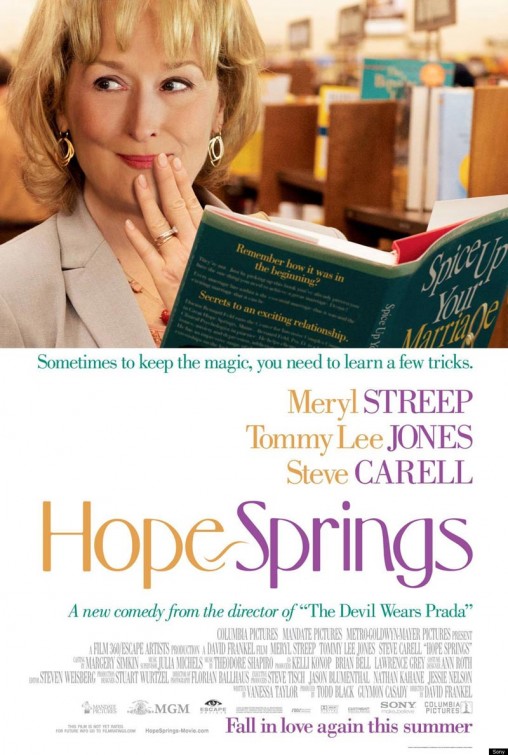 I may be 30 years removed from the target demographic, but I found the sexagenarian romance Hope Springs to be charming, insightful, and quite well developed. The idea of Meryl Streep getting her groove back and an older couple essentially learning how to be intimate again, physically and emotionally, sounds like a hard sell (no pun intended). The central couple has settled into the complacency of a long marriage, and little divisions have turned into routines. How can you bridge the divide? I was routinely surprised at how mature and thoughtful the movie was when it came to examining relationships. In between all these personal revelations of unhappiness is a curiously playful sex comedy, and you’ll see Streep engaging in certain acts you never thought becoming of the three-time Oscar-winner (no pun intended). Streep and her reserved husband, played by Tommy Lee Jones, are terrific, and their counseling scenes are the stuff of great drama, as two people who don’t really know how to communicate reveal their true feelings and problems. I’m making the movie sound like a chore but it’s really engaging and the stuffiness of Jones makes for some enjoyable comedy. This is a small movie, dealing with a weighty but recognizable subject that’s not often handled with this care and attention. Hope Springs is practically a Hollywood version of a Bergman film, and with these results, that’s not a bad thing. I foresee Hope Springs leading to a lot of patrons going home and having sex with their spouses. It’s like an AARP aphrodisiac. Good thing for menopause, or else Hope Springs would be responsible for a baby boom all its own.
Nate’s Grade: B+
Share this:

Margaret (2011)
 The behind-the-scenes story of Margaret could make for a compelling feature all its own. It began filming in 2005. Writer/director Kenneth Lonergan had spent two years on the script. It was the follow-up to his Oscar-nominated 2000 film, You Can Count on Me. The only requirement was that Lonergan turn in a cut of the movie that was under 150 minutes. His first cut was three hours. The producers paid their own editor to chop the film down to two hours. Then came the flurry of lawsuits and countersuits between the producers and Lonergan. No less a cinematic statesman than Martin Scorsese was asked to take a look at the movie and edit it down to 150 minutes (Lonergan labored on the script for Gangs of New York). Several protracted years later, Fox Searchlight dumped the 150-minute Scorsese cut in a handful of theaters. Then a funny thing happened. The rare critics who got a chance to see Margaret flipped for it. Lonergan’s initial three-hour cut is now available on Blu-ray. It’s a happier ending than any of the participants might have imagined only a couple years ago. I’ve been eager to see Margaret for myself, to see if all these arty critics were being a bit overzealous in their praise. Days later, I can’t get it out of my head and I’m sure others would suffer the same wonderful affliction.
Lisa Cohen (Anna Paquin) is a privileged New York City teenager who usually gets what she wants. She’s on the hunt for a cowboy hat when she spots a bus driver (Mark Ruffalo) with one. She runs alongside the bus, trying to ask him about the hat. It’s just enough to distract the driver. He runs a red light and plows into a pedestrian, Monica Patterson (Allison Janney). As a crowd forms and help is called for, Lisa holds the broken woman during her final, hellish moments. Afterwards, she lies to the police to protect the driver. The guilt eats away at her. She lashes out, she hurts others, she butts heads with her stage actress mother (J. Smith-Cameron), and she’s looking for anything to cope. Eventually Lisa decides to come clean and seek justice but it just might be too late.
 Margaret is a messy, imperfect film, over-indulgent and cluttered, but man does it stick with you. It sits in your stomach. You can’t shake it. You just keep thinking back on it. And after a while, the flaws itself start to transform into virtues themselves. The film is messy and all over the place but my God does it excel at recreating, in startling spasms of uncontrollable emotion, the life of an American teenager. There is no off switch when it comes to emotions, and when you’re young everything seems like the end of the world. Like Lisa, you alternate between self-involvement and idealism, and you haven’t hardened to the way the world works just yet. The movie, thematically, latches onto the same wavelength as its heroine. Lisa is a flawed creature, deeply hurting and trying to come to terms with her own responsibility and guilt for the accident. It just so happens that she makes mistakes trying to deal with that pain, and innocent people get hurt, and people we once thought were noble reveal their own impulses and vulnerabilities. Whether she’s sympathetic as a protagonist doesn’t matter, though even when she hurt others I never found her less than fascinating. She feels everything so intensely, and those intense feelings bleed into other areas of her life. She can be woefully self-involved and callous at times, but she can also be self-possessed and fearless in a moral quagmire. At one point, a character argues that teenagers would govern better than adults because teens are still idealistic and proactive, even if their actions are dismissed as naive. Lisa wants to find justice in the world somehow, so she can make sense of this random tragedy. She still clings to the belief, even as the film becomes a messy legal battle (one of its many genres Lonergan dabbled in).
There are plenty of storylines and themes and messages that Lonergan wishes to weave into a seamless patchwork version of our intolerable, detached, self-involved culture. The film is something of a time capsule, way back in 2005, and the post-9/11 anxieties and civil insecurity is also dealt with in interesting ways. Lisa’s social studies class repeatedly descends into shouting matches, debates that reduce the opposition in the simplest terms. After a while, all we’re doing is trying to out-shout the other and no one is listening anymore. Lisa comments that our culture feels so disconnected and that people have stopped relating to one another. Of course this also extends to her as well, as she confuses her feelings and those around her. The mother-daughter dynamics are a fascinating character insight and one of the better onscreen relationships I’ve seen in years. You can clearly see where Lisa gets some of her showboat tendencies. Both mother and daughter have stopped being able to relate to one another, and Lisa can wield sarcasm like a weapon, as teenagers are wont to do to their parents. Mom is dating a man she doesn’t particularly connect with, and yet she enjoys the company and the desire to be wanted. Is that enough to fulfill her gnawing sense of loneliness? Lisa’s father is the type to run from conflict, and yet the man is just as self-absorbed and hurtful as anyone else in the film. Except he’s an adult and, theoretically, should know better. In that regard, the movie reminds me of the excellent Little Children; this is a movie of mitigated personal responsibility from people of all ages. If this is the way the world works, then why not give teenagers a chance?
 The opera is a reoccurring motif for the film, and it’s a strong artistic association for the film because Lonergan sort of gives his characters arias with which to work. The emotions are sent to overdrive, the arguments are full-blast, and the dialogue lands in that articulate, hyper-verbal territory but isn’t self-consciously snappy. It’s hard to quantify but it’s dialogue that’s painful and revealing and, while beautifully crafted, can come across as genuine. The entire movie is the same way. This is a drama where, in Spinal Tap terms, the emotions go to eleven. It’s a big bleeding heart of a movie, but it’s not corny or maudlin or mawkish or TV movie sentimental. It’s fearlessly emotional and takes you on a journey with many stops. You’ll likely be horrified, thrilled, precarious, elated, angry, saddened, and frustrated.
It may be best described as a series of potent, powerful scenes rather than a traditional screenplay with a clear through line. The most memorable scene also happens to be the one that sets everything in motion – the accident. It is horrific and awful in ways that movies rarely deal with. The first image we see is a leg pinned under the bus. Oh no, we think. But then the camera continues to pan down and we see… the rest of her in a heap. Oh no, we say to ourselves again, even more aghast. We’re there for the harsh reality, the sad realization of Monica that she’s going to die (“Are my eyes open? I can’t see…”), and the shock and confusion of the situation. There’s blood shooting everywhere, no sign of help, and the woman is fading away, confusing Lisa with her deceased daughter of the same name. Lonergan makes us stay in this traumatic scene for a long time, an uncomfortable amount of time, enough that the horrible incident is burned into our memory as well, and when Lisa crusades for justice or looks for some physical or emotional escape from the trauma, we know why. It’s one of those one-scene marvels, a byproduct of near-perfection on every technical level.
This is pre-True Blood Paquin and boy does she deliver when it comes to the dramatic feats of her character. She’s convincing as a coy, too-smart-for-her-own-good teenager, she’s devastating as a lost, dour soul lashing out at the world, looking for anything to ease the pain, and even when she stumbles, she’s fascinating. Paquin goes through a variety of moods to suit the variety of tones and storylines for the film, and her performance never falters. I’m amazed at how fast she can spit out the verbiage, while crying her eyes out, and all without gasping for breath. She’s nothing short of amazing.
 The rest of the movie is filled with recognizable actors in small parts, from Matt Damon (The Adjustment Bureau) as a nice guy math teacher with his own weakness, Matthew Broderick (Election) as a pompous English teacher, Jean Reno (Couples Retreat) as the off kilter suitor to Lisa’s mother, Kieran Culkin (Scott Pilgrim vs. the World) as the bad boy druggie who deflowers Lisa, John Gallagher Jr. (TV’s The Newsroom) as the nice guy with the unrequited crush on Lisa, Rosemarie Dewitt (The Watch) as the bus driver’s wife, Lonergan himself as Lisa’s neglectful father, and the triumphant return to screen of Jeannie Berlin (The Heartbreak Kid) who hasn’t appeared in a movie since 1990. Berlin has the juiciest part as Monica’s closest friend and eventual confidant for Lisa. She takes on Lisa’s mission for justice, but she’s still wary of Lisa and her hyperbolic nature. She accuses Lisa of making up a garish detail (the Lisa name confusion in Monica’s last moments): “This isn’t an opera! And we are not all supporting characters to the drama of your amazing life!”
The title of the film comes from a poem called “Spring and Fall” by Gerard Manley Hopkins addressed to a grieving subject named Margret: “Ah! as the heart grows older/ it will come to such sights colder/… /It is the blight man was born for/ It is Margaret you mourn for.” When you come down to it, Lonergan’s film is about the awareness of mortality, the shock of death, the realization of the end, and our pitiful attempts to turn off the feelings more fully felt. Adults, Lonergan argues, have become hardened to the world to the frailty of life, and you question if that hardening, a natural process, is a good thing. Perhaps the dubious claim that teenagers should take a chance running the world is not without some sliver of merit. Margaret is a movie that’s hard to pin down; there’s so much going on, not all of it fully realized or satisfying I freely confess, but it’s a thrill to witness an artistic vision that’s bursting with things to say, so many things that life cannot contain them all. The 150-minute running time will be a stumbling block for some, but honestly I never felt the film drag like I do most Hollywood action thrillers of that length. When you step away, and take the film’s messiness into context, then Margaret stops being an ambitious but erratic artistic miscue and starts coalescing into something bolder, richer, and thought provoking. It took a long strange journey to get here but Margaret is a movie that deserves to be savored and debated.
Nate’s Grade: A-
Share this:

The Intouchables (2012)
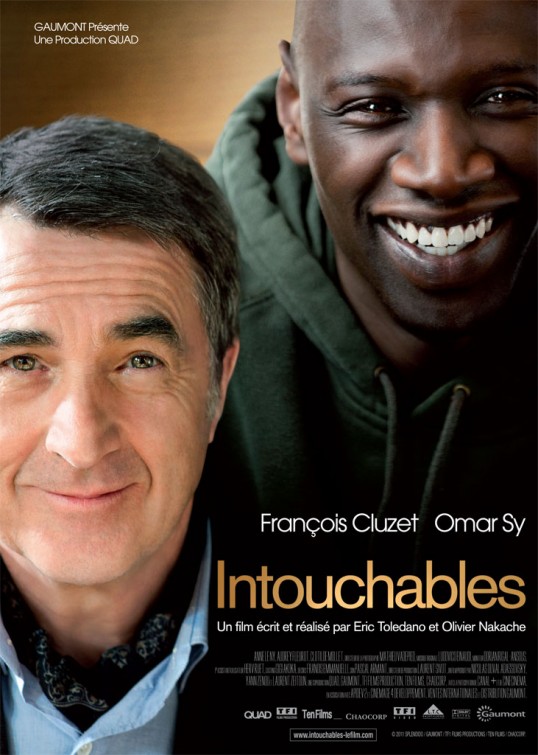 You’d never know it, but the highest-grossing film in Europe last year had nothing to do with super heroes, or sequels, or Hollywood itself. A small French film with the strange title of The Intouchablesmanages to break down just about every European box-office record last fall, sweeping across the continent and winning over hearts of numerous nationalities. The Weinstein Company bought the English-language adaptation rights, but before that gets underway they’re also releasing the original French movie to American audiences. Will subtitle-averse American audiences warm up to the little movie that has proven so hard to resist worldwide?
Philippe (Francois Cluzet) is rich quadriplegic and looking for a new caregiver to his many needs. In walks Driss (Omar Sy), a brash and headstrong man from a very different world: lower class, urban, and black. Philippe responds to the man’s irreverence and gumption and hires Driss on a trial basis. The upper-class lifestyle is like a fantasy to Driss, but the many responsibilities of caring for a man with no feeling below the neck are harder than anticipated. He objects at the very idea of having to manually evacuate the man’s… insides. The two opposites attract and the men become close friends and open one another up to new experiences.
 At its core, The Intouchables is the story of two men and their unlikely friendship. It’s told with enough weight, conviction, and character development that it’s easy to get wrapped up in the movie’s sweeping emotional tide. It’s a familiar tale, essentially that of the coming together of two people from distinctly different walks of life. You’ve seen this type of story before, where the upper class learns to cut loose and embrace life more fully, where the lower-class individual finds a path of dignity and responsibility. It’s been done before but rarely has it been done with such aplomb. Any storyline that involves a quadriplegic man and an inner city youth coming together sounds rife for after-school moralizing and sappy life-lessons. Thankfully, The Intouchables finds an angle that hits the emotional highpoints without tipping over into overt maudlin territory. Phillippe doesn’t want anyone’s pity. What is meant as good intentions can become another handicap; public perception of the individual’s limitations. Like The Diving Bell and the Butterfly, the 2007 inspirational French film about a significantly paralyzed man who could only move his left eye (what is it about French films and paralysis?), The Intouchables brings you into a world few glimpse and shows us what the perseverance of the human spirit can reap. Even a conversation that steers to sexuality can be illuminating and, for concerned male viewers, comforting that even if you can’t feel anything below the neck, the human body can adapt. In this regard, the film is a fascinating look into the life and care of a quadriplegic man (albeit an insanely wealthy one), and the fact that it’s also a moving and winning buddy comedy is yet another virtue. It’s like France’s version of a bromance.
It’s easy to see why The Intouchables has had runaway success in Europe, totaling over $300 million before ever opening in the States. This thing is a born crowd-pleaser. The characters are given room to roam, flesh out, and the interaction between two different men and their growing affection is a natural emotional foundation. We care about these characters, we smile and laugh with their interactions, the way that both men realize they need the other. It’s touching without being cloying and rich with emotional rewards by film’s end. Then there’s the fact that it’s also consistently funny without overplaying the class conflicts. There is an amusing subplot about the nebulous nature of modern art and what qualifies as “art”: the work or the knowledge that it’s from an “artist.” There’s a nice payoff with that one, but most of the humor is character-based, with the jovial Driss bouncing off the staid sarcasm of Philippe. There’s one comic subplot that seems to be hitting the same note time and again — Driss’ dogged romantic pursuit of Philippe’s assistant (Audrey Fleurot). It’s almost forgivable given the immense charms of Sy, but her character gets reduced to little more than a potential love match for Driss’ energetic libido. The humor, buoyant but also sensible, gives the film a defter touch when it comes to the more dramatic moments of loss and isolation and mourning. It’s easy to see why audiences have been falling in love with The Intouchables around the globe; they’re programmed to cry and laugh in equal measure.
And it’s that vague sense of programming that lingers. This is a film that knows exactly what chords to strike and how often. It can be accused of pandering and you’ll be able to guess every point of the plot. You think Driss will get Philippe to finally meet the woman he’s corresponding to for months? You think the upper crust will break from their immaculate stuffy prisons and learn to cut loose, spurned from Driss’ involvement? Do you think Philippe’s bratty teen daughter will learnt to shape up and fly right? Will Driss take a stand and stop his younger sibling from falling under the sway of criminal influences? Will the two men realize they truly need one another’s companionship? The answers are obvious; as are the plot turns and the happy ending, but The Intouchables goes about its business with such mass-appeal precision that you don’t really mind being manipulated. When someone can pull strings this skillfully, and quite transparently, almost daring the audience to resist, I almost admire the manipulation. Unlike Extremely Loud & Incredibly Close, another blatantly manipulative teary adult drama, at least this movie succeeds because we care about the characters rather than just bad things happening to people onscreen. The Intouchables isn’t subtle about its aims, but it is hard to resist a film this beguiling and tender and involving.
 Sy (Micmacs) is the breakout star of the movie. His gregarious, jubilant charisma instantly engenders the character of Driss to the audience. He’s constantly smiling, laughing, and cracking wise, and pushing others to be better. Sy brings such life to the movie that you instantly miss him when he’s gone. Cluzet (Tell No One), a dead ringer for Dustin Hoffman, has the more restrained role, no pun intended. His performance has to be very controlled yet believable, and Cluzet does an admirable job of building a character from the neck up. He’s a wounded man still recovering from the loss of his wife as well as his own crippling fears of loneliness. When these two are together onscreen, that’s when all the movie’s potential problems become a distant memory. The conviction in their big-hearted performances makes all the sentiment easy to swallow.
Several critics have accused the film of being borderline racist. I think the charge of racism is overdone. Just because Driss’ family lives in low-income housing doesn’t mean it’s making some blanket statement about the black experience in France. I suppose some chafe at the energetic, outspoken, and general virility of Driss. But I think critics looking for racist depictions of black males are overlooking the point that Driss had to be outspoken and energetic because Philippe is immobile and reticent. It’s in service of character contrast, not just recapitulating the figure of Loud Outspoken Black Male (a.k.a. the modern-equivalent of the age-old Noble Savage treatment). The significant part of Driss is that he has a sketchy past and comes from a low-income family struggling to get by. His race certainly plays up the contrast between the world of white privilege in France, but it’s not the central difference between these two men. Critics have also brought up the fact that the facts of the true-life story are different than what we see onscreen. Philippe’s caregiver, Abdell Sellou, was a Muslim man from Algeria, not a black man from Senegal. Does this truly bother anybody? Does the man’s heritage and ethnic background drastically alter the relationships formed or the earnest connections made? The movie doesn’t seem to think so and closes with the real-life figures onscreen, showing to each audience member the adaptation differences. Unlike something as racially questionable as The Blind Side, Driss is not rescued by saintly white people; he is an active member in his own self-actualization and not a passive receptor of the benefits of rich white people. With that said, there are still a few moments of ethnic depictions that might make you cringe, like Driss’ reaction to a night out at the hoity-toity opera.
During my viewing, I was reminded most of Scent of a Woman, another down-the-middle buddy comedy about a disabled man and his caregiver learning from one another and pushing beyond their comfort levels. It’s emotional without being too squishy and funny without going overboard, but make no mistake: The Intouchables is just as formulaic as a Hollywood production. The story and conflicts are familiar, the afflictions and backgrounds only differ. It’s feel-good, mass appeal comfort food, and when done this skillfully it’s hard to resist its call (I had a similar reaction to last year’s The Help). Its story of friendship, personal triumph, and all those happy things, but it’s also emotionally manipulative, littered with undeveloped subplots and a few uncomfortable moments of ethnic depictions. Fortunately the shining, vibrant performances from Sy and Cluzet, and their chemistry together, elevate the film’s softer and quasi-pandering sensibilities. It’s the story of two men, and by the end we greatly care for these two men, and their deep friendship and appreciation of one another. The Intouchables is a sly crowd-pleaser that dares you to defy its mass charms. And with actors this good, resistance is futile.
Nate’s Grade: B
Share this:

Beasts of the Southern Wild (2012)
 After months of rapturous praise from Sundance and Cannes, allow me to be the wet blanket of the critical community, because Beasts of the Southern Wild is one big helping of “meh.” I didn’t enjoy this movie at all and its mixture of strange fantasy elements and a hellish childhood reminded me of another misfire, 2009’s Where the Wild Things Are.
Six-year-old Hushpuppy (Quvenzhane Wallis) lives on a spit of land off New Orleans and below the levy. This tucked-away land is nicknamed by its colorful, besotted residents as the Bathtub. Hushpuppy lives with her father Wink (Dwight Henry) in large shacks elevated high off the ground. This comes in handy because after a disastrous flood, Hushpuppy and her father have to navigate the waters to find others and scramble for some return to their life and culture. The residents must also make sure to be cautious because the U.S. government, which is evacuating all flood-devastated areas, is looking for survivors to forcibly remove. Wink is sick and has to impart the ways of his family and culture to young Hushpuppy, who sees herself as one piece in a big puzzle.
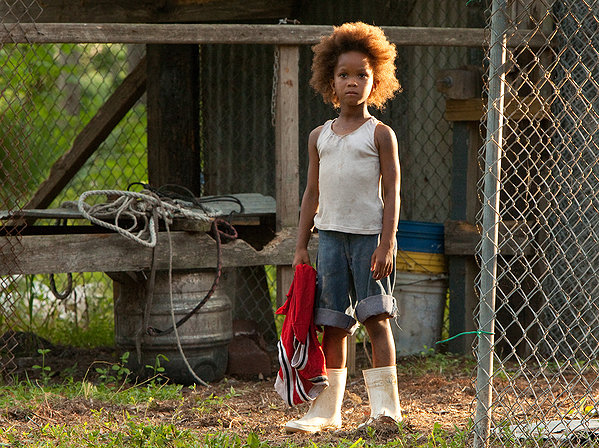 This movie is awash in all sorts of tones and storylines, failing to cohesively gel together or form some kind of meaningful message. I could have sworn that the fantasy elements, namely the giant thundering pack of large boars, were just going to be a visual metaphor for Hushpuppy’s journey. And then they actually show up and every person can see them. So, now what? The boars are one of many ideas that the movie just sort of toys around with before losing interest. This is not a film of magic realism. This is not a film about the escapes from a hard reality. In a way, this movie plays out like if Terrence Malick had made Gummo, and if you know me, you know I loathe both Gummo and Terrence Malick movies. Beasts constantly flirts with pseudo-intellectual pabulum, trying to reach something profound but instead settling for confounding. Hushpuppy’s curlicue unnatural narration talks about being a little piece in a big universe and the interconnectedness of all things, but by film’s end you get no dynamic sense of this. What I got was a little kid’s poor life getting worse, and that’s about it. If the film has anything larger to say about the world, Katrina, human connection, then I’m at a loss as to explain what that may be. Beasts offers half-formed ideas, strange, conflicting imagery, and characters that are rather thinly written and barely register. I never found Hushpuppy an engaging protagonist and felt like her very age and the heavy burdens she is forced to carry were manipulative substitutes for actual characterization. I cannot understand the love here.
The movie is something of a wild stew of Southern folklore and coming-of-age tropes and plenty of indie trappings, like weak political allegory, roaming handheld camerawork, and sacrificing story to the altar of realism. So much of this movie feels like it was made to give a sense of how an overlooked life in poverty is lived. From that standpoint the film does a commendable job of showing everyday life and the struggle to feed and survive. There’s a certain sense of ingenuity at work. But all of these setting details do not take the place of an involving story and characters we should care about. I felt sorry for the various residents of the Bathtub and their lot in life, but I never felt attached to any of them. That’s because, as mentioned before, they’re bland and simplistically drawn, but also because Beasts doesn’t bother to do anything else other than create its rich, tragic, harsh world. It’s authentic all right, but what does all that authenticity have to add to genuine character work? Artistic authenticity is not always synonymous with telling a good story. The Bathtub feels real, got it. So now what?
Hushpuppy lives in squalor and the movie has a disquieting romanticism of abject poverty. To the residents of the Bathtub, they are living in some forgotten paradise away from the concerns of the mainland. They refuse to leave their homes and their lives, even though there isn’t much of a home to call one’s own. We wade in this horrible existence and are meant to pretend like it’s an idyllic lifestyle, you know, with all the creature comforts of child abuse thrown in for extra measure. While Beasts looks entirely authentic with its impoverished, junkyard-esque production design, the overall mood and atmosphere hardly seems worth celebrating. Now, I’m not saying that characters can’t make the most of whatever life has given them and meet the implacable with fearless optimism. These characters would likely shun our pity; they reject any government assistance after the great flood and just want to sneak back to their simpler lives. This is not an enviable life, and the fact that the movie tries to romanticize it feels deeply irresponsible. At least with a film like Winter’s Bone, where you felt the crushing existence of systemic poverty, the filmmakers didn’t try and put a smile on all the drudgery. In that movie, you felt the trappings of poverty and how it can sink into your soul. On some level perseverance in the face of adversity is noble, but so would escaping poverty. Regardless, this is not worthy of romanticizing or fetishizing.
 Little Wallis is certainly getting her fair share of attention for anchoring the film. She’s six years old so it’s hard to assess her full acting potential, but the kid looks to have some fire in her. However, it is not a performance that leaves a lasting impression. I realized that much of her performance was long reaction shots and that ponderous voiceover narration. True, she does get some dramatic sequences and lets loose a few tears, but it feels like the movie didn’t want to push her too far and settled on a barrage of shots of Hushpuppy being stoic. I was more impressed with Henry, he too an acting novice making his debut. His character is more complex than an innocent naïf we have as our protagonist. He’s clearly dying and trying to quickly get his daughter prepared for a life of independence. He’s also quick to anger and you can feel the heavy weight of his life and his fledgling mission. In fact, I think Beasts would have been better if it had been told from the father’s perspective rather than our child trying to understand the great big scary world. There’s certainly a lot more drama and an easier route for sympathy, even if he could be accused of being cruel and neglectful.
I’ll admit that Beasts of the Southern Wild is different, daring, and fitfully imaginative, as well as benefiting from strong production design and special effects work. But “different” and “daring” doesn’t always mean good. I cannot in good faith say I enjoyed this movie, especially with its freeform plot, messages, tones, and occasional garish imagery. The plot seems desperate for some form of greater meaning, defaulting to ponderous poetry rather than supply a workable narrative and characters that are developed. Then there’s the whole romanticizing of systemic poverty that I find off-putting and wrongheaded. This is just a swampy mess of a movie, one that sinks under the weight of its own pretensions. It’s admirable from a technical standpoint but as a movie, Beasts of the Southern Wild is an exercise in eclectic navel-gazing.
Nate’s Grade: C+
Share this:

Rampart (2012)
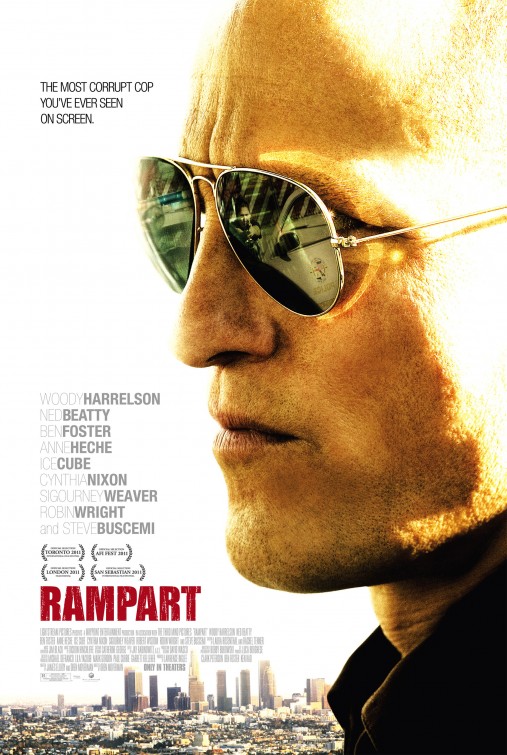 Stop me if you’ve heard this one before. A corrupt L.A. cop (Woody Harrelson) makes bad choices, alienated and frightens his family, and looks to be on the way out as a career of taking the law into his own hands is at long last catching up with him. Yeah, you probably stopped me after the third word in that sentence. This dour character-study showcases Harrelson nicely as a cocksure cop who’s so self-destructive and paranoid that he pushes everyone away. Co-written and directed by Oren Moverman, who made the terrific and searing drama The Messenger, this movie just about turns into high-gloss navel-gazing. The plot is quite loose and there’s very little traction. We get to see scene after scene of Harrelson behaving badly or violent, but what does it all add up to? We already know he’s a bad cop tortured by his own sins and the demands of the job. In a way, there’s an intriguing connection between law enforcement and soldiers who are often called to bear incredible burdens and just deal with it, forgotten by a public complacent with being safe. But really this movie is just one long trip with an angry man who keeps everyone, including the audience, pushed away. He’s complex but I can’t say we ever got to know him better. The film is well acted with plenty of recognizable stars, but why should I care? The central message about the prevailing influence of corruption is a bit heavy-handed as well; at one point Harreslon’s wife says, “You made us dirty.” Rampart is a disappointing venture for Moverman despite Harrelson’s best efforts. In the end, when you’re stuck with a dirty cop he better be worth the time.
Nate’s Grade: C
Share this:

We Need to Talk About Kevin (2011)
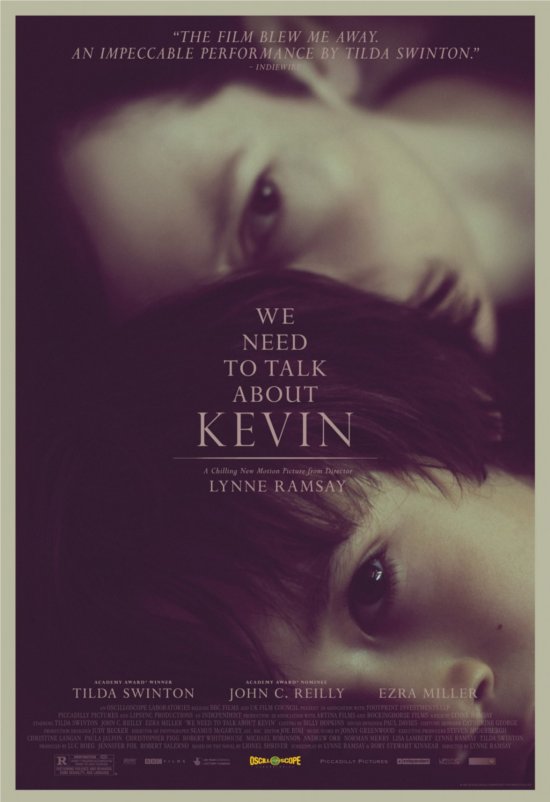 If you’re contemplating having children, then We Need to Talk About Kevin may not be the movie for you at this moment. It takes a stab at the nature/nurture debate and proposes that some children are just born broken and beyond the reach of even the most dedicated parent. It’s not exactly the cuddly message we get from most stories about the joys of parenting, but We Need to Talk About Kevin is a startling, provocative, and powerful portrait of grief, aggravation, and slowly dawning horror. Can even a mother love her monster?
Motherhood has not been the rewarding venture as promised for Eva (Tilda Swinton). Kevin (Jasper Newell at a child; Ezra Miller as a teen) wails so incessantly as a baby that she seeks out the sweet sounds of a jackhammer to drown out her shrieking babe. Even as a toddler, she knows there’s something just not right about her sullen, uncommunicative son. He seems to deprive her of any affection or attention she might find gratifying. Truly it seems much of Kevin’s motivation in life is to humiliate and torment his mother. It starts with being deliberately unresponsive as a child, and turning on a dime when in the presence of his father, then to delayed toilet training because he seems to enjoy making his mother clean up his mess (metaphor?), to the unexplainable massacre at her son’s hands. We Need to Talk About Kevin is an immersive experience, occasionally piling on how irredeemable Kevin is as a character. It also speaks to the unreliable nature of our shell-shocked point of view. It’s a disquieting film to say the least but I found it riveting and compelling at every second, artfully exploring a form of grief and social isolation that few will ever be able to fully understand.
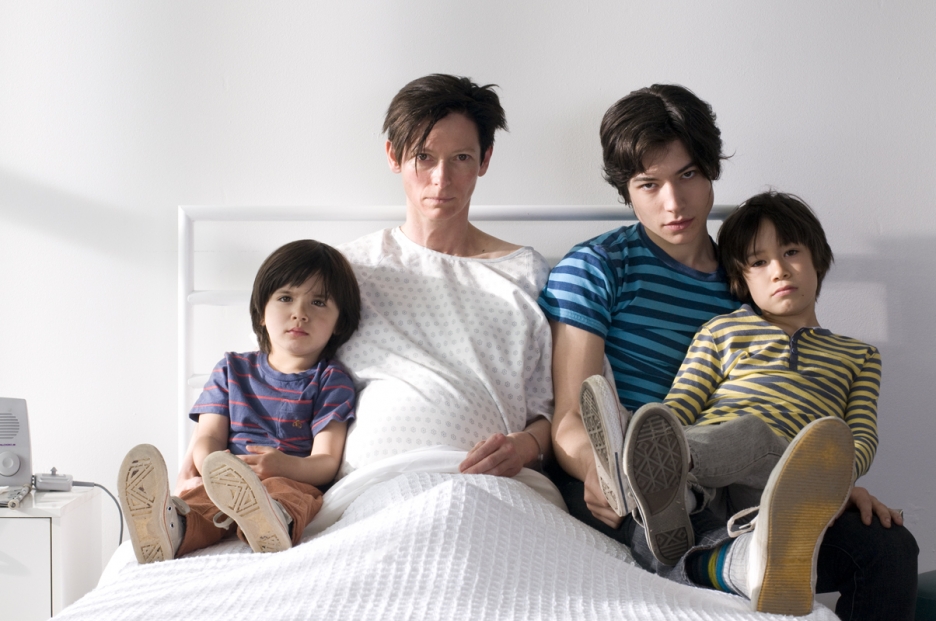 There’s tremendous psychological detail to this nightmarish parenting tale, and it’s those details that make the film feel eerily authentic and not exploitative. I found it fascinating to be drawn into this world, like I was watching an intimate, illustrated case study come alive. I found it very telling that after Eva accidentally injures her son in a fit of frustration, she apologizes but can only bring herself to do so under the shield of third person, saying, “Mommy shouldn’t have done that,” rather than, “I shouldn’t have done that.” And then when they get home, little Kevin unspools a perfectly believable story to cover-up what really happened. Even at six this kid is a shockingly adept liar, possibly because he’s a budding sociopath. Horror movies have been bringing us little pint-sized terrors for decades, from Bad Seed to the Village of the Damned, but those wicked kids seem like child’s play compared to Kevin, a startling, vacant child who is the scariest of the bunch exactly because he feels completely real. No Satanic imagery, glowing red eyes, or over-the-top associations needed; this is one messed up kid.
Watching this tumultuous and combative struggle for domination is equal turns compelling and terrifying. In many ways Eva adopts the role of Cassandra, the Greek figure cursed with visions of the future that nobody believed; Eva warns the people in her life that Kevin isn’t right, that he’s entirely capable of great evil, yet everyone ignores her dire warnings, and even Eva is culpable to some degree of enabling. Rather than discipline Kevin or stick to her principles, she passively accepts the situation and carries on with full knowledge that Kevin is going unchallenged. To everyone else he seems like a bright, helpful, normal teenage boy, which is why dear old dad (John C. Reilly) is so condescending and dismissive when Eva voices concern. Parenting is supposed to be instinctive, right? Eva feels like a failure, that this young soul has been steered to the dark side under her watch, and I think her hesitation to continue ringing alarm can be summed up by the fact that she’s just exhausted, tired of fighting a fight that everyone else ignores. I think she may also be desperately hopeful that she can ride this out, that it’s only a phase for her son, that somehow he’ll grow up to be a normal, loving child through some miracle, like a switch will be flipped. The only time Kevin ever shows his mother compassion is when she reads him a bedtime story involving archery, a hobby that would prove deadly.
The film is told non-linearly as we observe the fragmented memory of Eva. We have to pick up the pieces of life much like Eva recovering from her son’s destruction. It’s interesting to discover the symbolic connections between scenes, the connective tissue binding the memories together, and director/co-writer Lynne Ramsay (Ratcatcher) does an exceptional job of filling in key details to enrich this woman’s horrid life. The scenes don’t seem to last long, but Ramsay and her team provide all the meaning and weight we need so that the scenes matter. There’s a heavy amount of dread suffused into every scene in this movie, as the totality of events starts to become clear. The metaphors aren’t subtle but they are effective. Prepare for a lot of red in the color palate: squashed tomatoes, strawberry jam, splattered paint across Eva’s front porch as an act of vandalism. She spends the rest of the movie trying to clean away the red stains on her home (see what I mean about subtlety?). The splintered narrative also serves as a statement on Eva’s frame of mind, trying to move forward but haunted by a tragedy that goes down to the marrow.
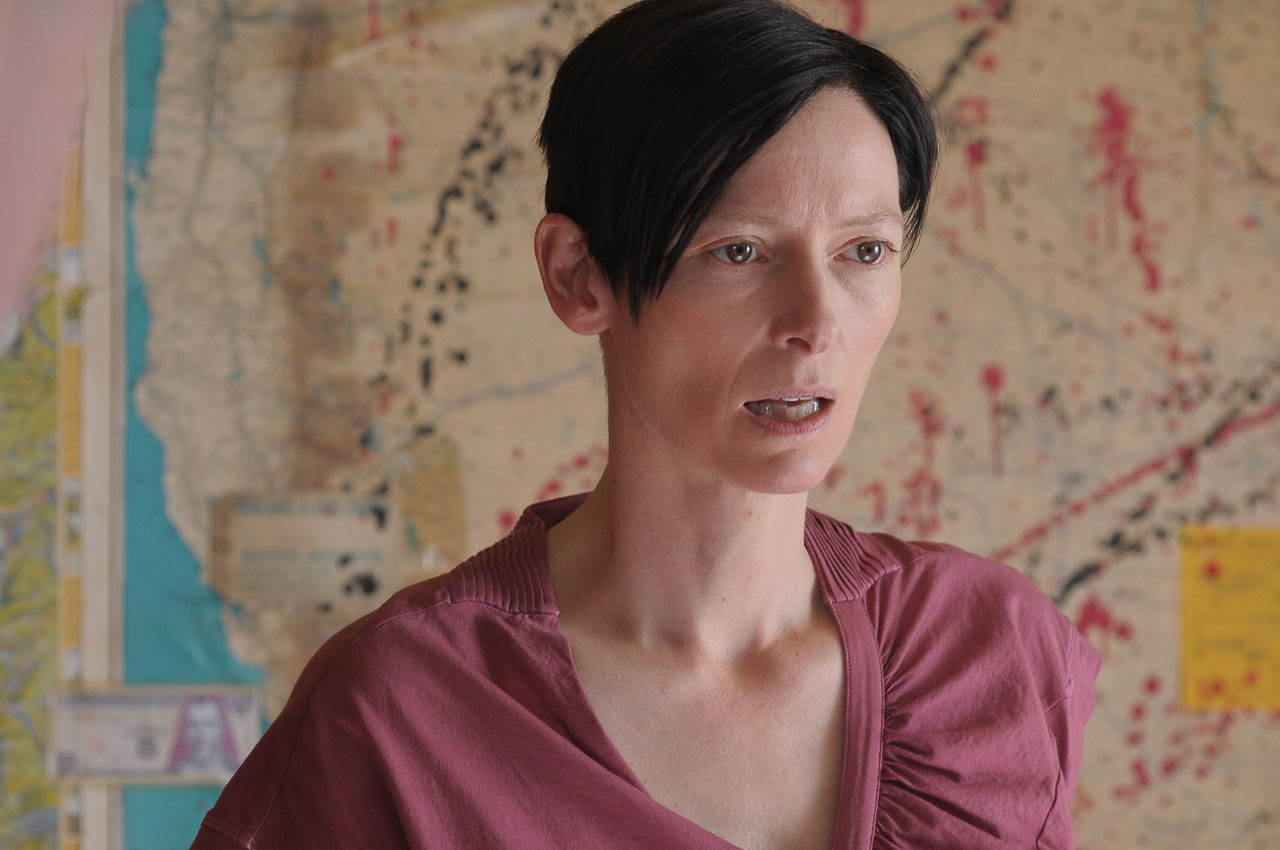 And of course all praise of the film needs to also be placed at he feet of versatile actress Tilda Swinton (Michael Clayton). She’s not given many lines of dialogue but what she is able to do to make her character feel fully lived-in is astonishing. There are so many different points of her life to play, from young exuberance to growing disdain to zombie-like pariah, and Swinton doesn’t strike one false note. Even during her grief and guilt she doesn’t go into hysterics. This is a woman that simply wants to waste away and be forgotten. Even when it looks like she might find some small measure of satisfaction or affection from another person, the movie sucker punches you. You realize that her son may be in jail but she’s serving a sentence all her own. Swinton is heartbreaking and subtle and nuanced even when it appears she’s simply staring off into space. You don’t really want to be in this woman’s head, and yet Swinton’s performance puts us there, hence all of my analytical assessment above. She’s a mixture of self-loathing, denial, bitterness, and penitence, and Swinton gives us telling glimpses of the storm below the surface. Her guilt is eating her away from the inside out. I’ll go on record and say it’s a crime that Swinton wasn’t nominated for a Best Actress Oscar (I personally apologize for not nominating her for the PSP Silver Cines).
I feel the need to talk and talk about We Need to Talk About Kevin, to sing its despairing praises, to encourage lovers of challenging, complex, and emotionally devastating film to experience this exceptional movie. It’s psychologically rich, bold, and revealing with even the smallest details to round out this hellish family scenario. It’s not an easy two hours to sit through, not by a long shot, but there are certain rewards for those who choose to wade through the darkness, Swinton’s haunting performance among them. This is a difficult subject and it’s produced a difficult film, but sometimes we need to be put in uncomfortable circumstances to get at a greater truth. What is the greater truth of the film? Maybe that parenting is really, when it’s all said and done, a leap of faith, maybe that avoidance of hard decisions is no solution, and maybe that some people are just beyond redemption. A movie that makes you think? Somebody ought to talk about this one.
Nate’s Grade: A
Share this:

The Five-Year Engagement (2012)
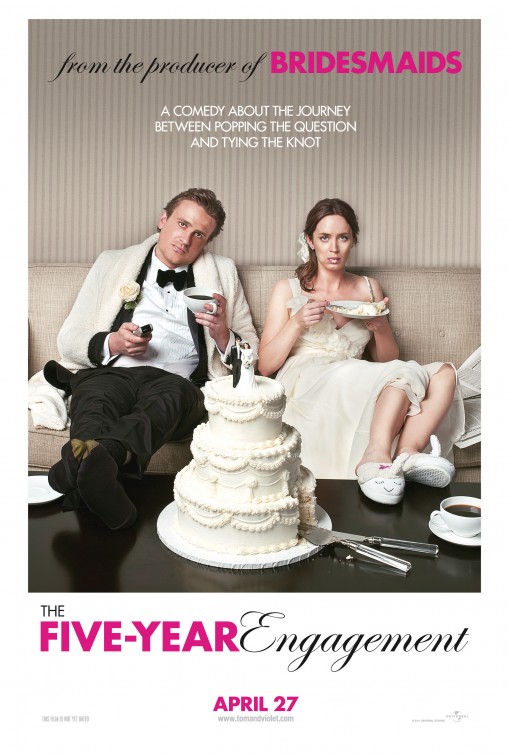 Relationships are serious business. In most Judd Apatow productions, they’re funny business. With The Five-Year Engagement, there’s romance to be found in surprising places, but the omnipresent feeling is one of dread. All those advertisements highlighting the comedy will start to melt away, and what you are left with is a funny, if bittersweet, anti-romantic comedy, more uncomfortable with hard-hitting truths than congenial laughs. My theater even had a few walkouts.
Tom (Jason Segel) and Violet (Emily Blunt) are happily in love. He’s a sous chef in a trendy San Francisco restaurant and she’s eager to gain a graduate fellowship at UC-Berkley in psychology. She doesn’t get accepted to Berkley, but the University of Michigan offers her a spot. Tom and Violet agree to put their wedding on hold and move to Michigan so that she can take advantage of an amazing opportunity. Michigan is not to Tom’s liking, especially since he can’t find a fulfilling job and settles with making sandwiches at a campus sub shop. It’s all just temporary, he keeps reminding himself. Then Violet’s two years gets extended, and Michigan isn’t just a temporary pit stop, it’s possibly home. Tom’s disappointment spirals, and he and Violet begin to drift apart, he resenting her for giving up his own dream to support hers. She begins getting emotionally attached to her Psychology professor, Dr. Childs (Rhys Ifans), in ways that straddle the mentor-student boundaries. Meanwhile, Violet’s sister, Suzie (Alison Brie), gets pregnant after a one-night stand with Alex (Chris Pratt), Tom’s best man and coworker, at the couple’s engagement party. They get married, have kids, and Tom and Violet are still stalling. This is the story of two people who deserve their happily ever after except life keeps putting obstacles in their path to the altar.
 You will be unprepared for how sobering The Five-Year Engagement can be. Some of these arguments between Tom and Violet cut right to the bone with an exacting level of painful authenticity. The level of uncomfortable intimacy can make the movie feel grueling. At the same time, I don’t want to give the impression that it’s some Apatow version of a John Cassavettes flick. There’s still plenty of comedy but the film is much more of a drama than any previous Apatow production. Part of the squirm factor comes in the very nature of the premise. The Five-Year Engagement picks up where most rom-coms end, with our happy couple together at last. We know these two are meant for one another; however, the majority of the screenplay involves watching two likeable, funny, loving people drift emotionally apart. Eventually they get back together in the end in a mad rush to staunch the gloom prevailing over the movie. It’s a hard act to watch people drift apart, losing the connections that once bound them together, and witnessing the glow of romance fade into complacency and resentment. Again, this is all handled in ways that find humor in uncomfortable places (like Tom, hopped up on painkillers, apologizing for smiling during sad news), but it can still be uncomfortable, and I don’t know if the ending, while happy, will justify the journey for many audience members.
I was shocked how much I found myself relating to the plight of the characters in The Five-Year Engagement, so much so that I simultaneously felt an extra level of engagement and discomfort. I will spare you the gory details, as I am a gentleman first and foremost, but relationships that just fizzle out rather than ending in some abrupt manner (infidelity, commitment issues, lack of availability, etc.) are not any more enviable. I related to the general sense of malaise that can plague a long-term relationship, the feeling of being forever a plus-one in your spouse’s circles, the resentment over the demands of a job or school, the small cracks that mask a lot of pain, the kind that is suffused with rationalization that to assert what you feel is to be selfish and inconsiderate, the loss of intimacy, physical and emotional, the guilt of being unhappy or making someone unhappy, and the sad realization that maybe love just wasn’t enough. What happens when nice people who are good for each other are just dealt rotten circumstances? Phew. I feel like I’m turning this into a therapy session. Let’s talk about something inappropriate in the next paragraph.
The biggest reason for sticking it out, both for Tom and Violet and the audience, is that Segel and Blunt have terrific chemistry together. Segel (Forgetting Sarah Marshall) is a big endearing lug of a man, and putting his career on hold to support his fiancé gives him an extra surplus of sympathy as we watch him spiral into despair and then resentment. He’s a funny, likeable guy, and we know he and Violet are meant for one another and we want them to get together, even as this looks less likely to come true after the circumstances that push them away. Granted, you must swallow the hard-to-believe reality that Tom couldn’t find a decent job in Ann Arbor, a college town that has to have some fine dining along the outskirts of town if not in the city. Blunt (The Adjustment Bureau) makes me fall in love with her yet again with a performance. Just like in 2011’s Bureau, she creates a charming, vibrant, luminescent portrayal of a person in love, so much so that I am envious of the man of her affections (her pantomime of “Circus Solei sex” made me feel all warm and fuzzy in multiple places). Violet has her own share of flaws but that just made her more relatable. I enjoy the way Segel, as a screenwriter (he co-wrote the movie with his regular collaborator, director Nicholas Stoller), is charitable with his characterization. He’s not afraid to make himself look mean and hurtful and wrong. He’s not afraid to make the girlfriends in his movies, even the ones who are about to dump him, justifiable in their decision-making. This is not a case of good guys and bad guys; it’s much more like life where everyone can draw good reasons, and the consequences just suck. Out of all of the Apatow films, Segel has done the best job of making his characters feel most like actual people than broad comedic types.
Luckily, the movie has its funny, peculiar little moments to make the drama bearable. I appreciate the little touches of comedy, which percolate through the heaviness. The wide supporting cast is peopled with the usual blend of oddballs and loudmouths. Pratt and Brie provide an ongoing foil as the couple who didn’t seem right for one another, made initial impulsive decisions, but have stuck it out and are happy; instead of waiting for the right time they embrace the mantra that there is no perfect time in life but the present. Pratt (TV’s Parks and Recreation) is great as a smart-aleck who grows into a responsible father. Brie adopts a British accent and becomes even more adorable, as all fans of Community would know. She’s quite funny as Violet’s sister and has a standout sequence where she and Violet have a very adult conversation in front of children so they disguise their voices as Cookie Monster and Elmo. The juxtaposition is a hoot and yet also a nice moment to add characterization. I also enjoyed seeing Chris Parnell (TV’s 30 Rock) as a sad sack faculty spouse stay-at-home father who clears his misery with kitting. There are some gory comedic set pieces around arrows being shot into legs and toes getting amputated, but the movie’s best comedy comes in the small moments, from Tom ‘s patchy “I’ve stopped caring” facial hair, to a self-described “pickle nerd” played by Brian Posehn, to the percentages of every undergrad named “Ashley” or “Zack,” to Tom’s hopelessly overmatched chase with Professor Childs, to a running gag about grandparents dying before Tom and Violet wed.
 I would like to take this time and observe that the University of Michigan, as well as its tenured professor, is responsible for the disruption of happiness between a young couple in love. How many other couples have you destroyed, U of M? When will your taste for suffering ever be quenched? And no, I’m not just saying this because I’m a diehard Ohio State Buckeyes fan, as well as a grad student. My point being: Michigan wants to kill Tom, Violet, and every person you hold dear (In short: Go Bucks).
You’d think with a title like The Five-Year Engagement they wouldn’t want to overstay their welcome, but like most Apatow productions, the film runs a bit on the long side. About 20 minutes into the movie, I felt the need to go to the bathroom. I rationalized staying put. Then about 90 minutes in, that urge became overwhelming but I reasoned the movie had to be over soon. And I kept telling myself that… for another 30 minutes. Then I just ran out and did my business, feeling the elation of relief. At over two hours, the movie feels excessive. Because of the drift away structure, the movie feels especially long in the second act, where we get hurtful scene after hurtful scene, and where Tom and Violet go their separate ways and start dating new people (the fact that Violet dates her smarmy professor feels realistic and yet also like a gut-punch to Tom). Some of the colorful characters that typical people Apatow productions feel more forced than usual, especially Violet’s collection of fellow psych grads played by the likes of Kevin Hart (Think Like a Man) and Mindy Kaling (TV’s The Office). They don’t seem well grafted to the story. The happy ending, while welcomed, also feels unlikely given the proceeding drama, and its brash adherence to rom-com conventions is a tad disappointing.
Watching the dissolution of a relationship is something of a hard sell to mainstream audiences, though Vince Vaughn was able to get audiences to see his anti-romantic comedy, 2006’s The Break-Up, which admittedly had bigger names and a lighter touch on the material. The Five-Year Engagement has its share of comedy but it’s pretty sublimated to the heavy drama of watching two people in love fall out of love and battle resentment, self-destruction, and apathy. Segel and Blunt are so good together we’re willing to give them a wider berth to stretch their wings, sow their oats, and eventually find one another again, falling back in love after a flurry of obstacles, realizing that finding and connecting with your right person is an ongoing process and not some prize to be awarded. I found myself connecting with the movie in several ways, so much so that it made me fee dour for the rest of the evening (you may feel differently). The movie gets so many subtle things right about how relationships can sour, and yet it still manages to overstay its welcome and fill its roly-poly narrative with annoying characters. At least the movie has helped me discover my perfect woman: Alison Brie with a British accent. However, Emily Blunt will also do in a pinch.
Nate’s Grade: B
Share this:

October Baby (2012)
 Abortion and the rights of choice are topics that inspire intense feelings on all sides. October Baby is the latest evangelical movie to be funded by Provident Films, who gave us Courageous and Fireproof. The directing tandem of Andrew and Jon Erwin take a more melodramatic approach, focusing on the aftereffects of not just abortion but also the aborted.
Hannah (Rachel Hendrix) is a 19-year-old college student who collapses during the opening night of her big play. She learns from her family doc that her parents (Jennifer Price, John Schneider) have been keeping some pretty major secrets from her. She was adopted. She was the survivor of a failed late-term abortion. Also, she had a twin brother who did not survive the abortion. Suddenly Hannah’s physical and mental maladies make sense, and she’s determined to seek out her biological mother and find out more about whom she is. Her lifelong best friend, Jason (Jason Burkey), invites her on a road trip to New Orleans, and the two of them veer off to Mobile, Alabama to look for her mother. Over the course of Hannah’s journey, she will come face-to-face with the mother that tried to abort her.
 Like other heavily funded Christian productions, this is more of a message than a movie, which is a shame because it had the potential to rise above. I guess there are no spoonfuls of sugar accountable when you’re dealing with a subject as painful and raw as abortion. I’ll give October Baby credit for being less interested in sermonizing. Oh sure, you’ll never doubt where the movie stands on the issue and where it wants its audience to go. The fact that a former clinic nurse can recall, in graphic detail, a procedure that was done over 20 years ago seems a tad suspicious, but credit actress Jasmine Guy (TV’s A Different World) for nailing this scene. The movie makes a more sincere, modest approach and sidesteps the overt proselytizing of the Kendrick brothers’ pictures like Fireproof and Courageous. It’s a fervent melodrama, yes, but it doesn’t push its message in your face. The issues of faith are seemingly kept to a minimum. Though soft-pedaling the admittedly traumatic story of abortion into a dewy coming-of-age movie seems like a disservice to the drama at play. This is more than one girl just finding out where she came from. This is more than just a routine road trip. This is more than tropes and clichés. This is about the pain of making agonizing decisions and living with them. What about Hannah’s biological mother? There’s a wealth of dramatic potential there as mother comes face-to-face with the teenage daughter she decided to abort. Just having her reject Hannah all over again to later cry against a doorway seems like a lousy use of screen time. Clearly this woman did not come to this decision impulsively. And yet, October Baby is less interested in exploring the realities of abortion than ascribing psychological torment to all parties (the mother, the baby, the nurse, etc.) and providing a clear, and somewhat contrived, road to redemption and forgiveness.
If we’re going to feel for these people, they need to feel like recognizable people and not as mouthpieces for message points. We’re told via Hannah’s journal that she’s deeply depressed and contemplating suicide. However, this mental misery does not match the Hannah we have seen on screen at all. I also find it really hard to believe some of her ailments. I’ll buy that she has long-lasting physical problems from the failed abortion, including asthma, seizures, and hip issues that require surgery. What I don’t buy is that somehow the act of abortion left a psychic scar on this girl and she has gone her entire life feeling unwanted, which is more than a little specious considering her adoptive parents have been unwavering in support and paid for all those costly operations. It’s not too long before we realize that Hannah is really just the formless mass of producer ideology. She makes weird decisions, like forcing her platonic friend to sleep on the floor when they have to share a hotel room, and then after blurting out, for no reason, that she is a virgin, she leaves the room that she paid for to sleep on a couch in the lobby. And her platonic friend joins her, so it’s acceptable for them to sleep side-by-side on a couch rather than a bed? That makes no sense. Hannah doesn’t feel like a person, more like a series of plot points in human form, and her ridiculously happy ending seems a tad disingenuous given the dramatic reveals this woman has endured. Her anger would feel more justifiable if she were more represented as a character.
Let me deal with the romantic relationship with Hannah and Jason. They’re life-long best friends and the movie even opens with them as smiling children, holding hands and racing to jump into a lake. You can only imagine where the two of them are destined to end up. He even has a standoffish girlfriend (Colleen Trusler) that doesn’t like the amount of time Jason spends with his “friend” Hannah. I believe that her resentment is well deserved considering how Jason dances around the truth of spending time with Hannah, often falling back on the shady vague rationalizations, “hanging with… a friend… doing… nothing.” As much as Hannah lacks proper characterization, besides being victimized, Jason is also every sweet, nice, good guy trope rolled into a human being. He’s less a person than a human-sized version of a loyal puppy ready to lap at her face. He never seems to have any interests or desires or goals other than being there for his dearest platonic pal, and even when she’s behaving like a mad woman, he sticks by her. Their eventual coupling is so chaste and passionless that, while inevitable from the opening image, makes little in the way of payoff. Both of these people are rather bland and nice, so why not be bland and nice together and have bland and nice children who will marry their spouses before they sleep in the same bed together (couches are another story). For a story about teenagers ignoring their parents’ wishes and getting into trouble with the law twice, including breaking and entering (because really abandoned hospitals leave behind all their patient info), there’s nary a hint of danger or excitement.
 October Baby looks a lot more professional than the other notable Christian releases that have found themselves in the mainstream marketplace. The photography is actually quite good, bathing Hannah’s journey in an amber, honeyed glow, and the Erwin brothers have a knack for visually pleasing compositions. Their background in music videos really shows, especially during the movie’s montage sequences. The music, on the other hand, is horribly redundant; lots of twinkling pianos and soft acoustic guitar. Former 2007 American Idol contestant Chris Sligh contributes several low-key tunes to the soundtrack and actually plays the overweight driver for the road trip. He’s fat, so you know he’s going to be a source of comedy, though you’ll be hard-pressed to realize it.
Acting-wise, October Baby is also a step up from what we’ve seen recently. Hendrix (Alumni), despite a somewhat surly characterization, is quite able to handle the many, many crying moments she’s run through. She’s got a fresh face and hopefully she’ll find her footing in the film world. She at least deserves to have as big a career as Kirk Cameron. Burkey (For the Glory) does earnest well and that’s about the only note he gets to play. Schneider (TV’s Dukes of Hazard) provides a calming presence, even though his beach bum haircut felt off-putting for a surgeon. I kept staring at Schneider onscreen and thinking how strangely he resembled Beau Bridges (The Descendants). The best actor in the movie is Hannah’s biological mother played by Shari Rigby (Easy Rider: The Ride Back). Sure she gets a crying jag all her own, but the actress underplays the mixed emotions upon the confrontation with her past. I wish the movie had concentrated more on this storyline, and more with this actress. The closing credits include a touching interview with Rigby where she confesses relating to her character and the abortion she had in her youth. Those brief couple minutes come across as more honest, engaging, and moving than any of the fictional drama that preceded it.
When the topic concerns abortion, it’s always going to be a controversial movie no matter the stance. October Baby is not exactly nuanced but it’s a lot gentler than I ever would have imagined. The entire movie takes a cue from its bland but pleasant leads and produces an overwhelmingly bland but pleasant enough experience. There’s no demonization of pro-choice people and few scenes of absolute sermonizing. Clearly the movie has an agenda but it doesn’t feel so overwhelmingly dogmatic. It’s not exactly going to make people rethink their political stances on a hot-button issue, but then again a rather humdrum story with characters that don’t feel recognizably human is only going to affect the audience members who are there for the message, not the movie.
Nate’s Grade: C


You must be logged in to post a comment.