Blog Archives
Miss Bala (2011)
 Miss Bala (Mexico’s foreign film entry for 2011) is an unwavering, startling, and deeply tense movie about one woman’s tragic and unwilling association with a powerful drug cartel. Laura (Stephanie Sigman) wants to be the next Miss Baja California, but she’s unwittingly pulled into a life of crime after she witnesses a gang hit. The cartel ensures that Laura wins the beauty pageant and becomes a courier for them. The movie takes a Lars von Trier approach to storytelling, putting its heroine through a torture chamber of anxiety and terror. This woman only wants to escape the hell she has accidentally found herself a part of, but every attempt to escape, be it going to the police or confessing assassination plots to the intended targets, gets her corralled back into the fray. For Laura, there is no escape. The movie packs a near-constant surge of paranoia, as we fear that at any time something awful will happen. In fact it’s usually only a matter of time. Laura is more a symbol of the collateral damage of Mexico’s billion-dollar drug war than a character, and she kind of becomes a numb zombie by the movie’s latter half, perhaps accepting her doomed fate. Director Gerado Naranjo favors long unwinding takes and handheld cameras, which add a gritty realism and sense of compounding dread to the picture. The movie has an unflinching level of realism to it that makes it all the more haunting, stripping the romanticism from a life of crime. Much like Italy’s heralded crime film Gomorrah, this bleak but impassioned movie shows the inescapable tentacles of organized crime and gives a face to innocents caught in the middle. Miss Bala is a testament to the hidden toll of a nation at war with itself.
Nate’s Grade: B+
Share this:

Jeff, Who Lives at Home (2012)
 This lumpy, amiable shaggy dog story from the Duplass brothers is another earnest, warm-hearted comedy that marries their signature family dysfunction, mumblecore quirk to a larger, more mainstream setting. The Jeff (Jason Segel) in question is a 30-year-old slacker, who indeed lives at home, and awaits signs from the universe to guide his decision-making. Incidentally, his favorite movie we learn in a monologue set on a commode, is Signs. His older brother, Pat (Ed Helms), is a selfish twit and embarks on a quest, with Jeff, to discover if his wife (Judy Greer) is cheating on him. The boys mother (Susan Sarandon) also has a nice storyline where an anonymous admirer is sending her flirty instant messages at work. Watching her face light up as she processes being wanted, it’s a thing of beauty. The characters are all flawed, and for some they may be too annoying to sit through. The film has been accused of being aimless, but I was engaged with its plot, which kept ping-ponging from one cause to another effect scenario. The movie is really more a drama with some comedic asides, mainly due to Jeff’s stoner zen and Pat’s aggressive dickishness. Greer has an outstanding moment where she lets her character’s deep reservoir of unhappiness come out in a blinding moment of honesty, and it rang true to my ears. In fact, the entire movie feels true enough. And then it appears destiny reveals its master plan with an ending that makes your heart warm all over, championing Jeff’s mantra of optimism and interconnectedness. The simple, good-natured, sweet little movie is worth checking out.
Nate’s Grade: B
Share this:

Courageous (2011)
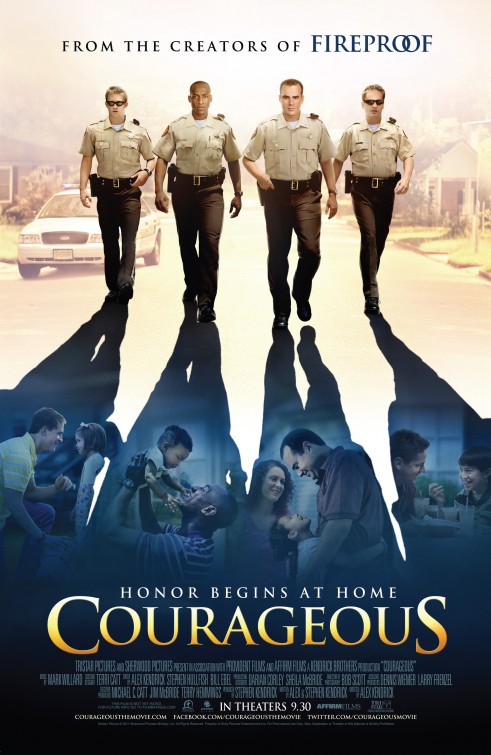 Last fall, Courageous opened to sellout crowds, but unless you or your family is plugged in to Christian media, you probably missed it (you know a movie’s got to be good when it has a quote from former football coach Tony Dungy). This is the latest film from the Kendrick brothers, a pair of pastors that started their own production company and have been making low-budget Christian-themed dramas that score big profits. What they really create, in my estimation, are two-hour film components to go along with a ready-made Bible study/lesson package (and you bet you can purchase your own Courageous companion book). As you’d expect, from an objective standpoint, these films, intended for a select audience of the converted, aren’t paragons of film artistry. And the Kendrick brothers’ last movie, 2008’s Kirk Cameron vehicle Fireproof, was awful on just about every level of filmmaking. Courageous is a better film on every front, but “better” and “good” are not interchangeable descriptions.
In the small town of Albany, Georgia, a group of police officers have al come to a personal crossroads concerning fatherhood. Adam (Alex Kendrick, director and co-writer) has recently lost his 11-year-old daughter in a tragic car accident. Nathan (Ken Bevel) is trying to come to terms to forgive the absent father he never knew. He also has to protect his teen daughter from going out with a young boy who happens to be part of a gang. David (Ben Davies) is the rookie in the group with a shameful secret of his own, namely that he has a small daughter he abandoned with her mother. Javier (Robert Amaya) is struggling to find a stable job to support his wife and children. His wife fears they’ll have no choice but to go back to their home country. Shane (Kevin Downes) is feeling the pressures of the job as well and making bad decisions that will catch up with him. The five gentlemen decide to make a public pledge and sign a written contract promising to be involved, loving, and responsible fathers for their families. But saying it and doing it is another matter.
 As with most of the Christian-funded film efforts, the movie is secondary to the message. Unlike Fireproof, the filmmakers package their wholesome message in a far more easily digestible package. There are moments in the movie that work really well and ring true, mostly the struggle of overcoming grief at the loss of a child. Adam is told that losing a child has been compared to losing a limb (look out if you lose a limb and a child). It’s not going to give Rabbit Hole a run for its money as far as psychological implications, but there are glimpses that feel like genuine and powerful drama. Whether Adam performing a dance with the memory of his deceased daughter is corny or emotional is up to you. Unfortunately, given the scatter-shot nature of the story, these moments only stay as moments, fleeting in their impact. But I was wholly surprised to even have anything genuine after the ridiculousness of Fireproof. Kendrick has improved as a filmmaker and his grasp on characterization is sharper; there are some nice moments of wry humor like when Adam keeps accidentally telling his chief he “loves him” (those declarations were intended for his wife on the other phone line). There’s an amusing bit akin to a “who’s on first?” routine as Adam mistakenly thinks Javier is another Javier he hired for some construction work. The struggle of an immigrant family hovering above the poverty line is a welcome storyline to a pretty middle-class point of view that dominates the story. I don’t know if the Javier character completely works in the context of this story, but he’s an amiable presence as he becomes an adopted member into the boys’ club. The opening even has a rather exciting flash of action with Nathan holding onto his carjacker from outside the speeding vehicle. There’s a foot chase that is crisply edited and filmed with a bit more flair than is normally accustomed to with these movies. It’s something of a small miracle that Courageous seems to exist in a modestly recognizable universe.
While being easily the best movie yet to bear the Kendrick name, Courageous still has enough faults to limit its execution, likely only reaching those already converted to its Christian values. Subtlety is rarely a tactic employed in Kendrick’s wheelhouse. As a result, everything can become rather ham-handed and message-laden. There are far too many different elements that just don’t jibe together to form a cohesive whole; the movie feels like a series of anecdotes that occasionally collide together. The narrative is stuffed with the death of a child, the struggle of immigrant workers to find a foothold, parental abandonment and reconciliation, gang recruitment, and police corruption (if you’re going to steal drugs from the evidence room, at least replace the weight value). They could have easily lost one of these guys from the plot, particularly the corrupt cop. There’s too much going on for real narrative momentum to get going. Structurally, most of the movies conflicts are resolved before we even get into the meat of Act Three, leaving the movie to finish with a hasty shootout with gang members that feels arbitrary. I suppose the Kendrick brothers might argue that the gang members represent the tragic results of boys raised without strong paternal role models, but that’s a rather simplified implication. And why does no one indignantly reject the idea that the death of a little girl was meant to prosper greater goodness in the world? I would imagine a grieving parent, no matter their closeness with God, would feel some modicum of anger at the idea that their daughter needed to die for them to be a better person. Kendrick is not nearly a strong enough actor to sell the various ups and down his lead character endures.
But the biggest problem I have with the movie is that it posits that “Christian values” and “ethics” are synonymous. I have no beef with any religious belief that people rely upon to choose to be better, more caring, conscientious, and active people. However, I bristle with the notion that ONLY religion can give people the tools to achieve these ethical realizations. The group of characters sits around a barbeque and talk about religion, parenting, their own negligent fathers, but they present religion, and specifically Christianity, as the only solution to being a better person. I would argue that mankind can realize moral good and hold to a code ethics without the direct tutelage of Christianity. If this was the case, would this logical argument not suggest that portions of the world that favor other religions are wayward in any sense of moral reasoning and value? What about before Christianity came into being, all that B.C. part of the timeline? Surely Jews would kvetch that they didn’t need Christianity to adhere to a moral order.
 The movie’s patriarchal insistence that men are the only guardians of their family seems ignorant. The women presented in Courageous are pretty much the doting types who wrap their arms around their husbands and remind them what good Godly men that are. The movie puts all the pressure onto the men, somehow missing the point that women can and should be a contributing force when it comes to rearing a family. While the Kendricks have plenty of statistics at hand about the significance of a father, the movie tacitly paints a portrait that a family is doomed when it falls under the complete stewardship of a mother. I’m not going to rip open a feminist rant because I don’t find anything in Courageous to be insidious or malicious, though its depiction of black gang members seems a bit sketchy. I just think the overemphasis on spurring men into taking responsibility doesn’t need to be at the expense of women giving up something. Parenting should be a shared responsibility and not something tagged to whomever holds the title of head of household. And as presented, the movie gives the fathers questionable levels of control. Nathan takes his teen daughter out to a fancy restaurant where he presents her with a fancy ring as a gift in exchange for dad being granted veto-power when it comes to potential boyfriends with no expiration date. I understand it’s meant as a father caring for his daughter, but buying her a ring to celebrate her chastity seems incredibly creepy.
Courageous is an improved effort from the Kendrick brothers and their Sherwood Pictures production house. The movies may improve but they still remain subservient to a message, and the ticket-buyers who look forward to a positive affirmation of that message have fewer demands when it comes to characters, plot, direction, etc. The core audience has a high demand when it comes to spirituality, but I wish they had just as high demands for artistic quality. Why can’t the faithful find inspiration from a movie that isn’t so on-the-nose? Are my only choices when it comes to depictions of spirituality the bludgeoning type (Fireproof, Left Behind, anything with Kirk Cameron really) or the esoteric (The Tree of Life)? Good intentions can only get you so far, and while its core message that men need to be responsible and step it up when it comes to parenting is valid, the rest of the movie jangles with some questionable representations and moral simplification. If people feel truly inspired by these movies to better themselves, then that’s a commendable effect but it doesn’t make the movie any better. At one point a character says that his father was “good enough.” Adam responds, “Well, I don’t want to be just a ‘good enough’ father.” Well, to many Courageous will be a “good enough” Christian drama. To me, mediocrity knows no one faith.
Nate’s Grade: C+
Share this:

A Separation (2011)
 When A Separation won the Best Foreign Film Award at the 2012 Oscars, its writer and director, Asghar Farhadi, gave a heartfelt speech where he accepted the award on behalf of a proud people who “respect all cultures,” a country that is much more than portrayed on the news as a Middle Eastern state of agitation and repression. Then the Iranian state-run TV used the opportunity to insult Israel, saying that the Academy “bowed before Iranian culture,” their movie “left behind” the Israeli nominee (Footnote) and “the beginning of the end” of Israel’s influence as it “beats the drums of war.” Sigh. Just when it looks like progress can be made to build cultural bridges. A Separation is a nuanced tale of struggle between tradition, morality, and personal choice. It’s a movie worth taking pride in.
Nader (Peyman Moadi) and Simin (Leila Hatami) are a married couple heading for a divorce. She wants to move to the West. He does not want to leave, especially since he must care for his elderly father who suffers from Alzheimer’s. Simin wants a better life for herself as well as their 11-year-old daughter, Termeh (Sarina Farhadi, the director’s own daughter). Simin does not want to leave without her daughter but cannot get the judge to give her custody without Nader’s approval. Simin has moved back in with her parents. Nader hires a working-class maid, Razieh (Sareh Bayet), to care for his father while he’s away at work. Razieh is working unbeknownst to her husband, who would disapprove but has been unemployed for nine months. Caring for the elderly man is a lot more than she bargained for. At one point, Razieh calls an imam to ask if it is a sin to change the elderly man’s soiled pants. Then one day Nader comes home to find hid father sprawled out on the floor, tied to his bed, and locked in the apartment. When Razieh comes back, she says she had an emergency and keeps it vague. Nader fires her, she demands payment for the day, and he pushes her outside his door. The repercussions of this action will be larger than either could have imagined. Razieh and her husband accuse Nader of intentionally pushing the woman, and when she fell she miscarried her baby. Nader is being tried for murder, but nothing is as clear-cut as what it seems.
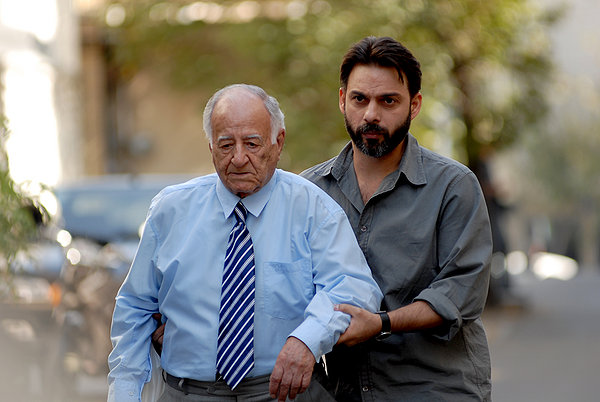 There’s so much to dissect in the intimate, thrilling, and observant little movie about imperfect people living under an imperfect system. It’s far more than the dissolution of a marriage and its impact that has on their family. It’s about the separation of moral relativism, compromises, cultural estrangement, and the concepts of justice in a world brokered by unjust forces. A Separation is really an ongoing court case that ensnares all the characters and brings them down in some degree. The more information we learn, the more we start questioning exactly what we knew about these characters and their circumstances. We’ll get speeches about doing the right thing in the face of opposition, and yet characters will routinely lie to save their own self-interest in the sacrifice of truth. You’re thrown into the middle of this drama and by the end you’ll likely feel exhausted by how emotionally charged the whole thing is. Lots of breathless arguing, lots of teary-eyed emotions, lots of unvarnished pain exposed, and very little in the way of resolution. This is an agonizing film that doesn’t feel the need to kowtow to the hopes of an audience for a happy ending. The lives of these characters are too complicated for tidy resolutions. The open ending, where Nader and Simin await their daughter’s decision over which parent she will live with, feels perfect considering that these people, due to circumstance both personal and political, are resigned to limitations on their happiness.
This is one of those movies where there are no real villains. You can see everybody’s plight and find some reasonable empathy for these people. Initially, the audience sympathy seems to be completely with Nader. He doesn’t want a divorce but feels indebted to taking care of his ailing father. He feels like he cannot abandon his father to live in the West. Simin is more vague about her rationale for wanting to leave the country, though one can only assume that her concern for her daughter is directly tied to the subjugated roles of women in Iran. Otherwise, her daughter is apart of a middle-class family where education is prized. Simin callously says that the old man is so far gone into dementia, why does it matter? The tension becomes whether Nader would rather care for his aged father or secure a brighter future for his daughter. After this opening marital clash in front of a judge, the film mostly follows Nader and his care of his father. When he confronts Razieh and is fuming about how he discovered his father, we’re there with him. Then when he’s accused of murder, a charge we know seems preposterous given what we’ve witnessed, our empathy further aligns with Nader, who we fill is wrongfully accused of something so serious it will wreck his life and family. Then when Simin reappears, and seemingly believes the worst of the story, it feels like she’s using the fraught circumstances to her advantage to force her daughter’s hand into deciding to leave Iran. But then the movie continues and you see that Simin has more at stake, Razieh is a sad woman penned in by circumstances, and Termeh is not the innocent child she appears to be. Your loyalties will be pulled in multiple directions until you ultimately conclude that these aren’t good people or bad people but merely people, fairly relatable and sympathetic.
 A Separation shows a different side to Iran, a side that most Americans don’t see given the news coverage. The Iran on display in the film is a world in conflict. There’s the emerging voice of women conflicting with the male sense of privilege, there’s the conflict between classes illustrated by the stark difference sin living conditions between Nader and Razieh, who must make lengthy commutes just to earn a pittance, the conflict between parents who say they want what is bets for their child but provide her with false choices and use her as a battering ram against the other side, the conflict between a justice system that must stick to the letter of the law and the cases that cannot be so simply defined, the conflict between allegiance and self-interest, the conflict between personal gain and the truth, the conflict of caring for the old versus establishing a life of opportunity for the young, and the conflict between religious faith and daily living. There’s so much going on in this movie that every detail feels telling, ever actor feels rooted is reality, and every new moment further complicates an already messy situation.
A Separation is the kind of meaty drama that Hollywood seems to have forgotten how to make anymore. It’s patient and uncompromising, trusting its audience to wade through nuance and ambiguity rather than be told explicitly how to feel. The complex character work, alarming intimacy, and observational details of a society in relatable turmoil build the foundation of one very enthralling, thrilling, deeply resonant piece of work. A Separation is an example of superior filmmaking and the idea that movies from around the globe, even places that our politicians demagogue as an “axis of evil,” can tell universally human stories. This is a movie that will spark discussion long after it’s over.
Nate’s Grade: A
Share this:

The Woman in Black (2012)
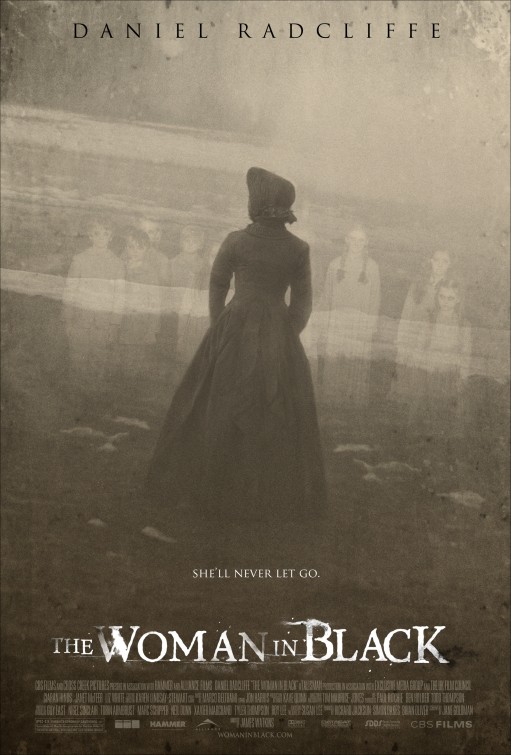 It’s got a decent ending but it’s a long, lumbering walk to get there. This handsomely mounted Hammer throwback involves Harry Potter himself, Daniel Radcliffe, slowly walking through a spooky old Victorian haunted house. And he slowly peeks around a door. And he slowly holds a candle. And I slowly go to sleep. There’s a 40-minute sequence where I swear only two things are spoken. Radcliffe plays a widowed father who has to investigate a haunted house to make ends meet. The movie has a few genuinely creepy moments, mostly owing to set design, but it gets hooked on jump scares and doesn’t know how to quit. The jump scares, accompanied by what sounds like an eagle screeching as music, happen at near two-minute intervals, like some sort of alarm the movie can’t turn off. Alas, The Woman in Black is a pretty staid ghost story where once again a restless spirit is terrorizing others and somebody takes it upon themselves to help that spirit find closure. The plot is so transparently predictable that it becomes fairly frustrating when the movie takes so long to get to its pre-designated stops. The pessimistic ending is weirdly given the most positive spin imaginable. For fans of this horror sub-genre, there may be enough going on to entertain. I just keep learning that ghosts are never grateful and satisfied even when you help them. Ghosts are jerks.
Nate’s Grade: C
Share this:

Chronicle (2012)
 I’ve learned a valuable lesson when it comes to genre movies – do not trust the marketing department of 20th Century Fox. Every promotional clip, trailer, TV spot, even the notion that people were flying around in cities as an attempt at viral marketing, it all coalesced into making me turn up my nose at Chronicle. It just looked like a bad movie. Then the critical reception was rather glowing and I took a chance, pleasantly surprised by the skill and execution of the flick. What made this thought-process notable was that it was almost an exact repeat of what I went through with Rise of the Planet of the Apes. Every piece of promotion stoked my disinterest into outright loathing, and then after the positive press I saw the movie, begrudgingly, and was floored. I guess when it comes to future 20th Century Fox genre releases, I’ll try and figure out my reaction and then turn that upside down. If a movie looks like utter crap, then under this new value system it must be good. I’m sure my new cinematic equation will prove me wrong as soon as the latest Eddie Murphy family vehicle terrorizes theaters (“This fall, Eddie Murphy is… The Governor. And his political opponent? His wife! Also played by Eddie Murphy”). In short, the marketing department at 20th Century Fox sucks but Chronicle does not.
Chronicle is the chronicle (heh) of three high-school friends who contract telekinetic powers. Andrew (Dane DeHaan) is a social outcast, determined to videotape his life as a means of escape from his ailing mother, his violent, alcoholic father (Michael Kelly), and the torment of school bullies. His cousin, Matt (Alex Russell), is trying to read up on philosophy to impress Casey (Ashley Hinshaw), a blogger/amateur documentary filmmaker. He’s more than some dumb jock. Steve (Michael B. Jordan) is the popular athlete planning to run for political office one day. The three guys discover what looks to be an alien craft underground. After coming into physical contact, the guys discover they suddenly have the ability to control objects with their minds. They test out their new powers in small ways at first, stopping speeding balls, assembling Legos. Matt insists they establish some system of rules to ensure they use their new powers for good. Andrew chafes at the idea of holding back, especially since he is by far the most powerful member of the group and eager to settle a few scores.
 Just as the found footage motif is starting to get old along comes a movie that makes creative and clever use of the narrative structure. Documenting one’s life, including the endless trivialities, has become normal habit for a younger generation accustomed to Twitter-style instantaneous information dissemination. Given that Andrew is abused and harassed, it makes sense for his character to use his camera as a means of security physical and emotional: the promise of being recorded should at least keep some of the bullying and physical abuse at bay, and it also provides a barrier for him and the real world, letting him stand outside himself. As John Malkovich said in Shadow of the Vampire, “If it isn’t in the frame, then it doesn’t exist.” This is one of the few found footage films where I didn’t feel constrained by the limitations of its concept. I suppose it helps when your main characters have super powers and can fly into the sky for a game of pigskin. The climactic battle is plenty thrilling but also subtly ingenuitous, as we cut back from various camera footage to piece together our super smackdown; we jump from security cameras, police dashboard cams, helicopter cameras, to even personal video cameras of people doing what people do… document the strange and unusual (I’m just curious who assembled the footage, though I have my theories).
The key to Chronicle’s success is that it’s a well-written, character-based piece that just so happens to morph into a superhero cautionary tale. Andrew has a pretty hard life and it’s easy to see why this insecure, neurotic, and angry young man takes his new-found gifts as a cosmic opportunity for retribution. In a way, Chronicle is like an all-male version of Carrie for the digital age; incidentally, Andrew was set to perform in a school talent show and I was cringing, saying to myself, “Oh no, here comes the Carrie moment.” He’s a tragic figure and you feel for the kid, which gives him a little more leeway when he starts to veer to the dark side. Until the very end, you can follow Andrew’s motivation for every action, so when he dresses up in his father’s firefighter outfit to shake down the neighborhood bullies, you can justify it to yourself, saying, “Well, he’s desperate and needs to pay for him mother’s super expensive medication. Oh, and those guys had it coming. Jerk.” The power of empathy is a mighty one, and writer Max Landis (son of director John Landis) takes a measured amount of time to connect everything back to the character. The best compliment I can give Landis is that nothing feels out of place. The characters behave in a relatively believable manner, the action intensifies at a natural incline, and the characters manage to have some brainy, existential debates about power and responsibility in between typical teenage pranks/antics (it’s only natural that teen boys would somehow use telekinesis to improve their sex life). Sure these characters aren’t terribly deep and the multitude of Andrew’s misery heaped upon misery almost seems ridiculous. In another universe, perhaps Andrew uses his powers to lash out at his tormentors at school, though that approach would questionably glamorize school shootings. However, by the time the big action hits, we’re emotionally invested in the characters and have watched Andrew’s long fuse finally blow.
The special effects are even more impressive given the low budget and the found footage gimmick. The camera makes some nifty telekinetic moves, floating around and giving the film a bigger space to play within. The flying effects are pretty convincing, especially when one of our guys ends up tumbling back to Earth in one tense sequence. Whether it’s floating Pringles or cars crushed inside out, the effects are smooth and well integrated, and any noticeable lack of polish just fits in with the fuzzy nature of our video recording as lone record of the events. There’s a notable solution for sub-par special effects in movies: blame the nature of the movie (Uwe Boll, that suggestion is free of charge).
 But the best special effect is young actor DeHaan (HBO’s first-rate show, In Treatment). Looking eerily like a young Leonardo DiCaprio, the guy manages to channel pent-up rage, frustration, and helplessness in a way that doesn’t feel histrionic or twerpy. His character is the point of view for our tale given that it is Andrew’s camera after all; we’re mostly locked into his perspective. Good thing that the character is interesting enough and so well played by DeHaan that I didn’t feel stuck with a loser. He reacts like most teenagers would react when bullied and harassed, trying to be aloof and ambivalent but only able to hide the pain and resentment for so long. When Andrew does start to give in to the allure of his powers, DeHaan seems practically seduced by his sense of superiority. There’s a dangerous look in his eyes that turns on that cues the audience for trouble to come. Russell is an amiable actor even if his character is bland and somewhat inconsistent as a foil to Andrew. Jordan (TV’s Friday Night Lights) is a charming guy who finds the right balance of exuberance and sarcasm with his character. Together, the threesome of guys has a winning chemistry and character dynamic. When they’re getting along and the good times are rolling, you feel part of the gang.
Being a super hero has become a dominant male fantasy as of late in the movies, so it’s invigorating to see a movie that puts a fresh spin on what seems ad infinitum. Chronicle is something of a small wonder, bringing new life to the found footage concept, making smart use of its narrative confines rather than chained by its limitations. The story is just as involving from a character standpoint as much as its sci-fi genre elements and superhero wish fulfillment. Landis and debut director Josh Trank are talents that I have no doubt Hollywood will snatch up. They’ve given the super hero genre a necessary human element, too often lost in the splashes of action and merchandising. Along with its engaging character-work, Chronicle also happens to be a clever action movie with some soaring thrills. Ignore the shoddy marketing and take a chance on Chronicle.
Nate’s Grade: B+
Share this:

A Dangerous Method (2011)
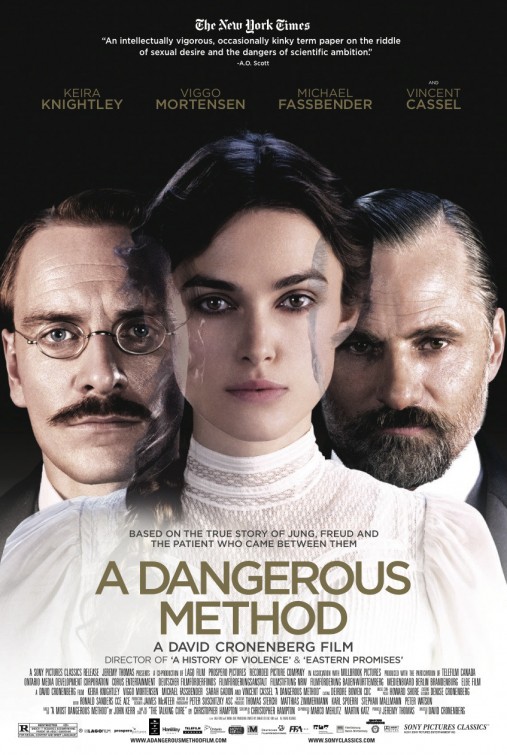 At first glance, the movie seems like an odd fit for director David Cronenberg, that is until you realize that, as Freud himself might approve, the entire movie is bubbling with sexual repression and kink. The movie showcases the friendship between the two titans of psychoanalysis, Sigmund Freud (Viggo Mortensen) and Carl Jung (Michael Fassbender), and the strange patient (Keira Knightley) who brought them together and tore them apart. This is a very intimate chamber drama, confined to lots of men in suits talking in great detail about psychology and philosophy and desire (there are three separate scenes of dream decoding and lots of letter correspondence voice over). Knightley is superb as a hysterical patient torn apart by her socially inappropriate desires. It may be a tic-heavy performance but my God can the woman act. She’s like a feral beast at points. The majority of the film follows Jung’s affair with Knightley and his friction with the single-minded Freud, who incidentally is never without a cigar clenched between his teeth. Jung wants to expand their field of study to include paranormal activities; Freud wanted to stay within the realms of science to give their movement credibility. Cronenberg’s period drama can be a bit too sedate at times given its aberrant sexuality. You don’t really empathize with either Freud or Jung, and thus the drama is a robust and intellectually stimulating exercise but only an exercise. For people who do not share an interest in psychoanalysis, they’re in for a long slog. A Dangerous Method is a rather short film, only 99 minutes, and would have benefited from being a bit more dangerous with its subdued subject matter.
Nate’s Grade: B+
Share this:

Extremely Loud & Incredibly Close (2011)
 The biggest surprise on the morning of the Academy Award nominations was the inclusion of Extremely Loud & Incredibly Close in the nine nominees for Best Picture. Critics have universally derided the 9/11 drama, becoming the lowest critically rated Best Picture nominee in the last 30 years, according to some awards pundits. The second lowest rated Best Picture nominee in that same span of time? The Reader, also directed by Stephen Daldry. Under new Academy voting rules, a nominee has to garner at least five percent of first place votes on members’ ballots. That means that at least 250 Academy members voted this crass, manipulative, off-putting, wrongheaded, exploitative movie as the best film of the year, thereby voluntarily divulging they must not have seen a single other movie for 2011.
Oskar Schell (Thomas Horn) was nine years old when his father, Thomas Schell (Tom Hanks), was killed on September 11, 2001. He was in one of the World Trade Center buildings and left six frantic phone messages before perishing. In the ensuing months after the disaster, Oskar is lashing out against his mother (Sandra Bullock) who spends all day in bed. Then one day he discovers a mysterious key in his father’s closet inside an envelope labeled “Black.” Oskar’s father used to send his son on a series of adventures around New York, looking for a fabled “sixth borough,” forcing Oskar to confront his numerous fears and insecurities. Oskar looks through the New York phone book and catalogs over 400 separate people with the last name of Black in the five boroughs. He’s convinced that his father has left one last hidden message somewhere in the city.
 My main sticking point was that I found Oskar to be an insufferable, bratty, little jerk. I understand he’s hurting and he’s trying to work through his pain. I understand he is gripped by irrational fears and has a hard time relating to others. I understand that Oskar’s father even tested him for Asperger’s, though the results were negative. Some people will try and explain away Oskar’s callous behavior in sweeping generalizations having to do with the ignorance of children or some undiagnosed medical problem. I’ve known people with Asperger’s syndrome and while Oskar fits a few of the superficial tics, being a jerk is not a symptom, sorry. He’s so mean to his grieving mother and indifferent about other people that I wanted to slap him. I found him to be unsympathetic and wholly irritating. I found his unsupervised journeys for cutesy quests throughout New York City to be dubious. His parents just let their ten-year-old socially awkward kid run around New York City by himself at all hours? The movie goes in a bad direction when it partners this talky nuisance up with a silent old man, played by the wonderful Max von Sydow (the movie’s only other Oscar nomination; another stretch I’d say).
Here’s a breakdown of my thought process: Oskar comes home on 9/11 to find the last recorded messages of his father, including an admission of love for his family. Oskar runs out and buys an identical answering machine and sneakily hides the original, denying his mother, a grieving widow, the chance to hear her husband’s voice one last time. Screw that kid. I’m sorry but that’s what went through my mind and to me he never recovered. His actions are inexcusable. Then he gets mad because his mom sleeps all day. She’s grieving you little snot! And then he has the gall to tell her, “I wish it was you instead!” It’s a moment intended to draw gasps, ripping the scab clear off whatever pretensions mother and son have with one another. But it just made me dislike the kid even more. The fact that even by the film’s ending emotional catharsis Oskar still hasn’t shared the answering machine messages with his mother is reprehensible.
The other factor that caused me to despise the main character was how Horn proves to be a dreadful actor. This is the first acting role for the former teen Jeopardy champ. He’s able to spit the rapid-fire, idiosyncratic dialogue burdened with cumbersome detail. However, Horn gives a terribly mannered performance. He has this annoying manner of over enunciating every single word, getting lost in a character affectation, always stagy and artificial. You combine a bad actor with an aggravating character and make them the lead of the story, and I’m already daydreaming possible murder scenarios (I don’t condone child murder mind you — I’d make it look like an accident). As for Oskar’s parents, Hanks is hardly in the movie and Bullock does shockingly well, nailing her most emotional moments. I’d rather see this movie from her point of view, trying to make sense of the insensible to her challenging son who hates her.
 Daldry wishes to use the backdrop of 9/11 to talk about important items. It’s too bad that his movie has nothing legitimate to say about healing. I was assuming that over the course of the film Oskar was going to run into a diverse collection of people, all healing, all with their own stories of pain, and then he would learn that the real treasure was the community of strangers he had brought together. Nope! Oskar runs into a gamut of fine actors, including Viola Davis, John Goodman, and Jeffrey Wright, but they all become mere baton-passers to a self-involved kid. They and their stories don’t matter. The lock to our missing key doesn’t matter. There’s a final revelation concerning Oskar’s mother and her activities to benefit her son that seems entirely implausible. Daldry and screenwriter Eric Roth (Forrest Gump, Curious Case of Benjamin Button) have transformed Jonathan Safran Foer’s novel about collective grief into a strangely myopic narrative given the scale of the suffering.
The movie is so transparently manipulative, shamelessly exploiting 9/11 anxieties and trauma to tell its intolerable little quest. In no way is 9/11 meaningfully connected with the overall story of loss. Oskar’s father could just have readily died in a war or had a brain aneurism. What 9/11 is used for, however, is an easy device to stir the audience’s emotions. Daldry will flash back to it at seemingly random moments in the narrative, to goose the audience into feeling gloomy. I’m sure many people will sit through this movie and feel moments of genuine sadness, but that’s because the filmmakers are shamelessly manipulating the raw feelings we have over a national tragedy. It’s hard not to feel a lump in your throat seeing the towers smoking, frantic calls to missing or doomed loved ones, and final recordings bearing the weight of compounded dread. It’s not too soon to talk about the psychic wounds of that terrible day but I strongly resent people who exploit those memories. There are moments that are so misguided and yet given the Hollywood gloss of an awards-bait picture. The very opening image is of Tom Hanks free-falling to his death. Oskar’s little picture book he constructs at the end of his journey includes a final page with the World Trade Center. And there’s a little slip that when pulled creates a picture of a man falling up back into the tower. What? Is that supposed to be a good thing?
Extremely Loud & Incredibly Close is such a misguided, crass venture that’s also extremely shameless and incredibly cloying. The main character is unlikable, exasperating, and portrayed by a rather amateurish child actor. Daldry’s hackneyed direction will settle on treacle and contrived sentiment whenever possible, but the emotions never feel properly earned. He’s pressing buttons and forcing tears, and several viewers will be unaware of how efficiently they were manipulated into having a moving experience at the theater. I know I can’t be alone is seeing through the manipulation and feeling indignant about the ordeal. I’m not against tackling the difficult subject of 9/11 in movies (I declared United 93 the best film of 2006). Here’s a good question for you filmgoers out there: is there that big of a difference between this movie and 2010’s unpleasant teen drama, Remember Me? Both use the 9/11 attacks to cover narrative and characterization deficiencies, vulgarly exploiting our feelings of the events to engender feeling, and both don’t belong anywhere near an awards stage.
Nate’s Grade: C-
Share this:

My Week with Marilyn (2011)
 In 1957, Marilyn Monroe (Michelle Williams) was the biggest star in the world but she wanted to be taken seriously as an actress. Laurence Olivier (Kenneth Branagh) was an award-winning thespian considered to be acting royalty, but he was looking to siphon some of Monroe’s fame and vigor. Monroe flew over to England to shoot the light comedy The Prince and the Showgirl, directed by and starring Olivier, and it was here that she changed the life of Colin Clark (Eddie Redmayne). Clark was an ambitious young chap who served as the third assistant director and Oliver’s personal assistant as well. He was mainly a glorified go-fer but the position allowed him to glimpse the world of Marilyn Monroe and her various handlers, Paula Strasberg (Zoe Wanamaker) and Milton Greene (Dominic Cooper). Monroe’s flighty behavior and struggles with acting drive the more professional Oliver stark raving mad. Monroe’s rocky marriage to playwright Arthur Miller (Dougray Scott) is causing her fits of depression. Who better to cheer her up than young Colin Clark? Over the course of nine days, the two become inseparable and Clark falls head over heels for the world’s most glamorous woman.
The character of Colin Clark seems to be stripped of all defining personality traits. He’s this bland kid caught in continual awe. He just seems to be smiling and twinkling those big, compassionate eyes of his, typifying the earnestness of young love. I think he’s been rendered into a cipher for the audience to put themselves in his shoes, becoming star struck with Monroe’s attention. The screenplay takes far too much time on showing Clark coming to the repetitive rescue. His romance with a costume girl (Emma Watson) is a nonstarter and the movie doesn’t even try and hide the fact. She’s the backup romantic option, so the fact that he goes back to her after being spurned by Monroe and we’re supposed to feel that this is growth seems disingenuous and a bit caddish. Perhaps she didn’t take it too hard; if you’re going to be dumped for anyone else, there’s no shame if it’s Marilyn Monroe. Judging by the movie’s depiction, Clark is a rather boring young man, and I didn’t buy for a second that Monroe would cling to him as her hero.
 My Week with Marilyn is really focused on the titular star. Clark is just out path to the real star. I doubt there’s anything particularly revelatory about Monroe here. She was plagued with insecurities, a need to be loved, and the fatigue of “playing” herself all the time, all hips swivels and winks. At one point Clark and Monroe are taking a walk and met with a group of fans. “Shall I be her?” she coyly asks Clark and then turns into the vampy goddess the public loved, striking poses and smiling wide. By the very constricted nature of the timeline, we’re not going to learn too much about the famous beauty. She flubbed her lines, she and Olivier didn’t get along, and a mini-entourage of sycophants who were meant to be a surrogate family for the troubled gal surrounded her. Was she a lonely gal crushed by the weight of stardom or a manipulative lady who knew how to get what she wanted? The movie doesn’t take a side, instead serving up all sides of Marilyn Monroe, including a few in the buff. The film has some enjoyable juicy bits, particularly the friction between Monroe and Olivier, but the movie ultimately becomes another fawning admirer of its star. There are a couple musical numbers with Monroe that feel clumsily reproduced and the tone seems too light too often for the dramatic moments to have any real bearing. It becomes another fan that celebrating her image and sponging off her fame and legacy.
While the film may not be revelatory, Williams (Blue Valentine) herself is the revelation. She’s not exactly a dead ringer for the curvaceous, buxom blonde beauty, but she inhabits the spirit of the woman rather than sticking to a breathy imitation. She doesn’t capture the baby-doll voice but the demeanor she has down pat; when she turns it on you can feel the screen light up with the luminescence of star power. There’s quite a difference between the sad, depressed, codependent Marilyn and the sexy pinup fantasy. It’s an incredible performance in an otherwise so-so movie, though I wish the screenplay had given her more complexity to work with. Branagh (Valkyrie) is great fun as the stuffy, overbearing Olivier who gets plenty of snappy lines to vent his frustration over Monroe’s antics (“Teaching Marilyn how to act is as useful as teaching Urdu to a badger!”). Both actors are so good, and so good together, that I wish we could just remove the “my week with” from the title and focus on the relationship between Monroe and Olivier.
Allow me to question the voracity of Clark’s account. He waited until 1995 to publish his film set diaries, and then after his first memoir of his time with Monroe sold well he published another one in 2000, this one filling in a nine-day gap he says was that fateful week with the sex icon of the twentieth century (eat it, Clara Bow!). The second memoir was written fifty years after the fact and from the nostalgic perspective of an old man looking back to his youth. I feel that the particulars have been smoothed over and romanticized. The fact that surviving actors from The Prince and the Showgirl cannot verify any sort of relationship, and that several sources say that Monroe and her new husband Miller were inseparable at the time, cause me to doubt the validity of this personal account. In his first memoir, Clark even criticizes Monroe’s physical appearance (“Nasty complexion, a lot of facial hair, shapeless figure and, when the glasses came off, a very vague look in her eye. No wonder she is so insecure.“). Yet in the second book he becomes her defender. So which is it? Who wouldn’t, with sixty years of hindsight and a best-selling first memoir, embellish their one-time dalliance with a star like Monroe? The most desired woman in the world and he, a 23-year-old nobody, was the one to become her confidant? Aren’t we full of ourselves? And he crawled into her bedroom and was asked to stay the night and didn’t consummate that relationship? In the book she offers and he declines. Talk about the biggest mistake of your life.
 If you’re going to embellish, then you might as well get some action out of it. Then again, maybe in the books Clark says that Monroe gave him a pity handjob and the filmmakers deleted this (I can hear him screaming from beyond the grave, “You fools! The handjob was a metaphor. The whole tale falls apart without it!”). If I ever had even a fighting chance of getting lucky with Marilyn Monroe, you’d best believe I would be telling that story so often that my grandkids would roll their eyes in disgust (“Geez, we get it grandpa. Marilyn gave you a handy once.”). The post-script tells us that after The Prince and the Showgirl, Monroe went on to Some Like it Hot and Olivier went back to the theater for some of his best-reviewed runs of his career. So clearly, these two stars owe all their good success to the heroics of Colin Clark, who nudged them from greatness to legendary. We have only Clark’s take since Monroe cannot dispute Clark’s claims so I feel like the memoir, and the film adaptation, is an exercise in serving Clark’s ego.
My Week with Marilyn is a light, weightless movie that retells the shooting of a light, weightless movie. Well done, everyone. The emphasis on this bland kid and his fairly unbelievable whirlwind romance of the twentieth century’s most iconic sex symbol makes the movie feel self-serving. Does anyone honestly believe the events of this story? Whatever the validity of the events, a movie should be entertaining on its own rights. My Week with Marilyn has its bouncier moments and is saved by stellar acting from Branagh and the radiant Williams. But even the best acting in the world can’t save a movie that feels like it’s completely some old man’s exaggerated, embellished, and somewhat boring fantasy. If this is the relaxed standard for getting a movie made, then I look forward to the eventual film adaptation of my soon-to-be-released novel titled, My 28 Hours of Incredible Sex with Angelina Jolie.
Nate’s Grade: B-
Share this:

Red Tails (2012)
 You’d think a big name like George Lucas would not have a problem getting a movie made. Lucas has been trying to get a movie about the Tuskegee Airmen made since the 1980s, but he says no studio would bite, concerned that American audiences would not be interested in a movie with an all-black cast. So Lucas just paid for the movie himself, forking over $50 million of his own money a.k.a. July’s paycheck from Star Wars toys, a.k.a. what Lucas just had in his pockets at the time. Even though only credited as an executive producer, it’s hard not to feel the Lucas imprint all over Red Tails. The emphasis is on the high-flying aerial combat, ladled heavily with CGI special effects work, rather than on a credible story and characters that we care about. Simply out, the Tuskegee Airmen deserve a better movie than this.
In 1944, the Tuskegee Airmen have been kept on the ground for most of the war. However, the bomber pilots need more protection. It seems that white pilots meant to provide protection of the bombers will easily get distracted, chasing after German fighter planes for a taste of glory. Colonel Bullard (Terrence Howard) and Major Stance (Cuba Gooding Jr.) have been notified that their unit of black pilots will finally get their shot. Marty “Easy” Julian (Nate Parker) leads the squad, followed by Joe “Lightening” Little (David Oyelowo) and Ray “Junior” Gannon (Tristan Wilds). They are to escort the bombers and stick to the bombers; the mission is paramount. The unit paints the tails of their planes a bright crimson to stand out from the pack. The Tuskegee Airmen keep to their creed, ensuring the bombers carry out their missions, and proving themselves every bit as courageous as capable as white servicemen.
 It’s like somebody transplanted a 1950s war film to present day but left every single hoary cliché imaginable. Just because African-American actors get to play the clichés doesn’t mean we’ve made progress. The Tuskegee Airmen are a historical account with enough real-life intrigue; Lucas and company didn’t need to create a fictional tale to illustrate their heroic deeds. The characters are all resoundingly one-note; the troubled leader with a drinking problem, the hotshot who doesn’t follow orders, the wisecracking pilot with a firm religious belief in “black Jesus,” the young guy trying to prove himself, and the guy who gets married and just wants to get back to his girl (guess what happens to him?). Let’s stop and analyze that plot point. Lightening first discovers his Italian beauty (NCIS: LA’s Daniela Ruah) waving while he’s zooming by in an airplane. Naturally he can find her home. After a series of strolls, Lightening asks her to be his wife, and eventually she accepts after some deliberation. Neither of them seems to find this interracial marriage concept a big deal, but in the 1940s, when the Army was still segregated and miscegenation was still illegal in certain states until 1967, you better believe it would be a big deal. Italy was no prejudice-free haven of tolerance, especially under Mussolini’s rule. And by the way, the portrayal of Italy in this movie looks like the war hasn’t even touched the land, physically and mentally. All those happy Italians just walking around smiling. And then there’s the white officers club where one of the black pilots visits and punches a guy after he calls him the N-word. In reality, this guy would have been beaten to an inch of his life. It’s even more bizarre then that, just after a month of flying missions, this say officer’s club greets the black pilots with open arms, fighting to by the guys rounds of drinks. Red Tails, at times, seems to exist in a different universe.
This has got to be the most boring part of a story you could tell about the Tuskegee Airmen. We watch the pilots escort the bombers and stick with the mission. While an interesting historical footnote, that’s about it. The story before the missions and after the missions is infinitely more interesting. I’d much rather see these brave heroes have to go back to a bitterly racist country, be declared honored men of valor by the government and then told they don’t deserve equal rights in the same breath. There’s so much more inherent drama in the conflict of going home to a segregationist country. Likewise, the Army was only integrated late into the war, meaning that African-American soldiers could not enter combat until 1944. Surely the journey these men took to enter the armed services is more compelling, and their experiences must have been even harder, battling the prejudices of their fellow brothers in arms. The early scenes in the film where Col. Bullard is fighting for respect and to get his men an actual mission, butting heads with brass who feel African-American soldiers are inferior, is far more gripping than anything that goes on in the air. The actual war part of this story is the least interesting part. If Lucas and company were so hell-bent on framing their story this way, they should have taken a cue from 1990’s Memphis Belle and stuck to a single mission being the majority of the plot. That would have kept the realism of the situation, ratcheted up suspense, and been a more natural way to get to know our characters.
While only thoroughly mediocre, Red Tails can have some pretty awful moments. The white bomber pilots provide, for lack of a better phrase, color commentary on the plot. Their dialogue is so on-the-nose and transparent, meant to lead an audience into some stilted realization that African-Americans are, gosh, not that different. The dialogue starts off with stuff like, “What? A colored man?! We’re done for,” then goes to, “Hey, these boys might actually be okay. I hope them Red Tails fly with us next time,” and then the movie might as well end on, “Wow, my altogether uninformed prejudices have been completely upended. I’m sorry I ever relied on such outdated notions of race that were completely ignorant. My paradigm has shifted and I’m going to look at people not as black or white anymore, but as people.” It’s so annoying and artificial. The dialogue is mostly cornball but the line that takes the cornball cake is after Lightening attacks a German munitions train, he shouts, “How you like that, Mr. Hitler?!” Really? “Mr. Hitler?” You’d think two African-American screenwriters (John Ridley and Boondocks creator Aaron McGruder) would have eschewed any phrases that could be racially loaded. Speaking of Germans, the movie has one German ace that keep reappearing again and again. Just so we understand that all those cockpit shots of ONE GERMAN are the same guy, the movie gives him a hideous scar along the side of his face. Being a scary scarred German fighter isn’t enough to convince us this man is a villain, so the movie also has him spout some pretty ludicrous racist dialogue, even for someone who may have believed wholeheartedly in the principles of an Aryan race. “Die you foolish, African,” he shouts at one point. Maybe he’s still steamed over that whole Jesse Owens thing.
 But the dumbest moment in a movie that will tax a minimal amount of brain cells is what happens to Junior after his plane goes down. He’s caught behind enemy lines and is thrown into a prisoner of war camp. But what luck, because it just so happens that these prisoners are planning an escape that very night (“At least they won’t see you at night,” one of the guys tells Junior). They’ve dug a tunnel beneath their barracks and Junior agrees to go first to be the lookout. He climbs out of the exit hole right in front of a forest clearing. When the next one in line pops out, however, a German guard has spotted them and turned his weapon on the American. Junior hops from behind a tree, waves his arms wildly to distract, and then runs off into the woods. Inexplicably, this is where the storyline concludes. You’re telling me that a German soldier with a gun isn’t going to give chase into the woods? These guys have the upper hand, plenty of armed men and dogs to track escaped prisoners. The rest of the American prisoners make it out to alive miraculously and one of the guys gives Junior’s dog tags to his unit. How did these prisoners, all escaping after the jig was up, get past everyone? And yet Junior does indeed live too and shows up just in time, in literally the last thirty seconds of the movie, to cut short everyone feeling sad about fallen soldiers. It’s like an angel just dropped him out of the sky. Junior’s escape and perilous journey back to American forces seems like a pretty good story worth telling. It has to be fraught with danger and thrills, but to just hastily end his storyline and magically zap him back to base isn’t just criminally lazy, it’s insulting.
The saving grace of Red Tails is its coterie of talented actors, doing the best they can with the wobbly material. This is a movie designed for the most mainstream of audiences, not for anybody who knows a whiff of history. The characters are one-note, the story is driven by every cliché imaginable, and the reality of the time period feels oddly glossed over at too many points, settling for safe rah-rah movie heroics. The aerial combat sequences can be exciting but they come across as weightless, with all the emotional investment of watching a video game. Credit Lucas giving this movie a decent-sized budget to pull off the special effects and involved combat sequences, but that money would have been better spent on a good script, not one just dusted off from the World War II era and the race of the characters altered. I find this kind of pandering mush to be insulting, especially the fact that the audience is supposed to feel grateful that black soldiers are finally getting the spotlight no matter the quality of film. The choice of “pandering mush” or nothing is a false choice. If giving black characters the chance to run through all the tired, hoary war clichés that went out of style decades ago is progress, then I shed a tear for this country.
Nate’s Grade: C


You must be logged in to post a comment.