Blog Archives
Whiplash (2014)
 Writer/director Damien Chazelle (Grand Piano) made quite a deal of noise at this year’s Sundance Film Festival with Whiplash, winning the top honors. Usually, the movies examine the angelic teachers, the ones we all remember fondly that broke through to us and cared enough to make a difference. This is not that movie.
Andrew (Miles Teller) is a second-year student at a prestigious New York City music conservatory. He drums and dreams of being plucked from his class to the jazz band of Fletcher (J.K. Simmons), a renowned jazz musician with a volatile temper. He verbally berates his students, antagonizes them, belittles them, throws chairs at them, brings them to tears, and harasses them, but all in the guise of pushing their talents, pushing them out of being so easily coddled by their parents and an “everyone’s a winner” society. Andrew is elated to be asked to be Fletcher’s newest drummer but the pressure to perform, and maintain that level of perfection, eats away at him. Andrew eats, sleeps, and obsesses over being the greatest drummer possible, a pupil in Fletcher’s image.
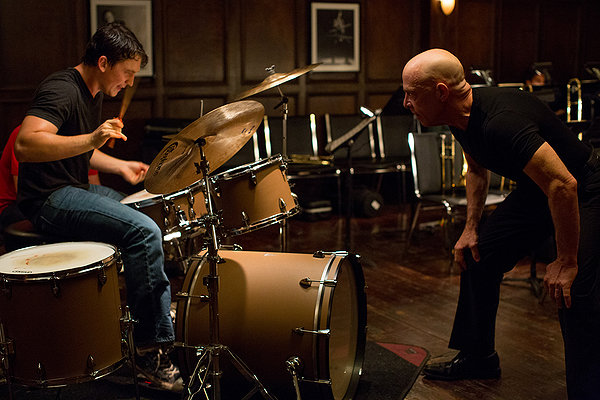 I know very little about music beyond a simple “I like this/I don’t like that” delineation, but I was enthralled from beginning to end with the sheer intensity of Whiplash. Even though the film is something of a cinematic crucible, a hellish musical boot camp, a Full Metal Jacket for Julliard, it’s not caught up in the half notes and technical elements; this is a movie about two powerful forces coming into direct conflict. It’s a battle of wills, a struggle for dominance, and a character study about the potential drive it takes to be considered one of the living legends. The emphasis is on the characters completely, and the movie never drags (or rushes) with its cleanly arranged plot points as it reaches its thrilling conclusion, a final act that completely takes the experience to another level. It keeps switching gears and defying our expectations in the best way. Chazelle always seems to be one step ahead of his audience. We know that Andrew is going to alienate his girlfriend (Glee’s Melissa Benoist), thus causing acrimony and resentment on both sides, leading to a breakup hinging upon some question of priorities. We suspect it’s coming and lie patiently in wait, dreading that this predictable subplot will take away the focus of the film. And then Chazelle has Andrew sit down and break up with his girlfriend right then and there, citing the exact same chain of foreseeable cause and effect. Andrew sees where this story will head and wants to prevent further heartbreak. He nips this relationship in the bud, and his girlfriend is simply stunned at his blunt assessment (“You think I would prevent you from being great?”). It was at this point I knew Chazelle was going to deliver something not just special but downright masterful.
At the start it looks like the film is going to be a student-mentor study, and it does become this, though in a fascinating yet psychologically disturbing manner. The fiery and all-consuming passion of Fletcher infects Andrew, as he wants to be great above all else, including meaningful human relationships. He’s always been something of a loner who has difficulty keeping friends, made all the more evident by his uncomfortable and snippy Thanksgiving dinner with his family. His ambition is to be the best and he’s willing to sacrifice everything else. This paves the way for a character study of obsession, as we watch Andrew become a slave to his ambition, to the drive to always be better. He drums until his hands are calloused and soaked in blood. He gets a mattress in a rehearsal space, spending all of his free time on his obsession. He’s also battling for validation from Fletcher, whose approval will make Andrew feel like all those blood, sweat, and tears were worth it. The film raises some very intriguing and open-ended questions over the self-destructive nature of ambition. In one perspective it’s a story of perseverance and utilizing every setback, every humbling humiliation to push oneself further then what was possibly known. On the other hand, it’s about a young man who struggles for the unforgiving tough love of an abusive father figure who molds him in his image. Chazelle’s explosive finale also sticks with the ambiguity. It is no doubt an ascendant moment for Andrew but the implications are left for you to interpret on your own.
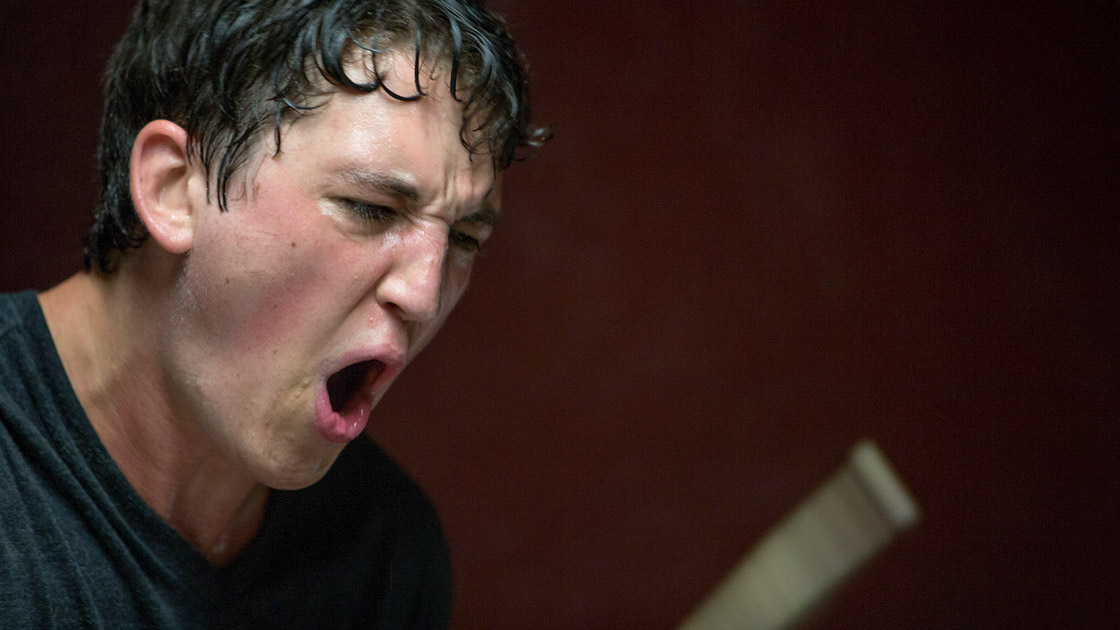 Primarily the story of two forces of nature, both Teller and Simmons, especially, give captivating performances that will blow you away. Simmons (TV’s The Closer) has been one of our best character actors for years on TV and film, but man does he just sink his teeth completely into his ferocious character. He’s truly terrifying to watch but you can’t take your eyes off him. Like the other characters, as soon as he enters a room you’re put on edge, wondering what he might say next, what might lead to the next tantrum of frustration and rage. Simmons is remarkable but especially in the way that he imbues his character with traces of sympathy (also thanked by Chazelle’s screenplay, naturally). Fletcher subscribes to the (arguably insane) philosophy that he has to constantly push his students or else they will persist on mediocrity. There is a method to his madness; he’s desperately looking for the next Charlie Parker, a legend in his midst that he can help mold thanks to his aggressive teaching techniques. He truly believes the ends justify the means and he is doing the world a favor. Likewise, Teller (The Spectacular Now, Divergent) is awestruck by his professor’s rep but then desperate to regain that hallowed approval. Their relationship becomes poisonous and antagonistic and Andrew seems to be exhausting himself simply to prove Fletcher wrong. Teller is one of the most exciting young actors in Hollywood and his commitment to the character and his physical endurance is impeccable. It cannot be understated how thrilling it is to watch Teller pound away on those drums, especially during the finale where the energy level might just exhaust the audience as well (you do feel spent afterwards, in a good way). Part of Teller’s performance has to be with his style and precision of drumming throughout, and it’s amazing that he is able to convey different emotional states through a musical instrument. Teller is an effortlessly intuitive actor and his instincts are rarely wrong.
Shot in only 19 days, Whiplash is a rare film that feels blisteringly vibrant, coursing with an insatiable energy, powered by performances of intense dedication and with a script packed with bubbling conflict. It’s a small movie that manages to knock you off your feet, from the caliber of the performances to the caliber of the musicianship. I didn’t know if this movie could live up to the hype post-Sundance, and I was a little apprehensive at first, but I fell completely under the sway of Chazelle and his storytelling. The smooth edits, the clean connect-the-dots plot points, the room for ambiguity and nuance, the stellar final act, it’s everything a movie lover could ask for while still never forgetting to entertain. This is a powerful movie that packs many a wallop but also raises interesting ethical questions about the drive for accomplishment, whether personal attachments are hindrances, and chiefly whether the ends justify the means, especially if those ends could be considered cruel and abusive. Whatever the ends may be, see this incredible film, which just happens to be one of the finest of the year.
Nate’s Grade: A
Share this:

Interstellar (2014)
 While arguably the industry’s most ambitious blockbuster filmmaker, Christopher Nolan hasn’t released a film to his name that I would call a misstep; even the weaker but still altogether thrilling Dark Knight Rises. Until now.
In the twenty-first century, food shortages and climate change will render Earth inhabitable. The planet is dying and the only hope is to find a new home in the stars. Conveniently, a wormhole near Saturn has opened and a secret NASA mission sent 12 brave astronauts through to send back information on the 12 potential worlds. Cooper (Matthew McConaughey) is the best pilot in the world, a former NASA employee, and trusted by the project’s leader (Michael Caine) to lead a team (Anne Hathaway, Wes Bentley, David Gyasi) to the other side of the universe. Cooper is hesitant to leave his children behind, particularly his ten-year-old daughter Murph (Mackenzie Foy), who says a peculiar ghost is haunting her in her room. The greater good wins out, and Cooper reluctantly blasts off into space to save his children and all Earth’s children.
Interstellar is clearly a personal film for Nolan. It’s about nobility, exploration, sacrifice, but really it’s about a father trying to get home to his daughter (the son doesn’t really seem to matter as much in the story). Nolan’s catalogue of films has been able to straddle the line between blockbuster and art, providing mass appeal with uncommon intelligence and nuance. However, I don’t think Interstellar is going to work for most audiences.
 Maybe I’m just too savvy for my own good having seen plenty of movies, but I could accurately predict every single plot turn and Nolan and his co-screenwriter brother Jonathan made it easy. When we’re told about a ghost within minutes and it’s a movie about space travel, you shouldn’t need any help. And then the ghost ends up speaking in Morse code and communicating, “stay,” that’s Nolan hitting you over the head with what to expect by the end (a conversation how parents are ghosts for their children is too much). You should also be able to figure out who Ellen Burstyn is going to be, and it’s not going to be Talking Head #3 in a television interview. Likewise, the illustrious astronaut Dr. Mann is referred to but purposely never shown, so you can assume it’s going to be a familiar face, which it is. Then once that A-list actor is onscreen you know there has to be more to this character because why would a movie star agree to play a part that amounts to merely, “Yeah, this planet is good. We’re done here”? Because of the slow nature of the film it makes the easily telegraphed plot turns more frustrating. The supporting characters are presented so incidentally, as if they didn’t merit extra time. Amelia (Hathaway) has one mushy monologue about the power of love, tipping the film’s philosophy, but that’s all there is to her character. The rest of the cast amounts to stuff like Black Guy on Ship and Bearded Wes Bentley. Nolan’s past work has been very generous to the characterization of his supporting players, especially with the Dark Knight trilogy. These people mattered. With Interstellar, their impact is purely in the name of plot and serving the father/daughter relationship.
And yet, the movie also precariously dips into the danger zone of boredom. Quantum physics isn’t going to be a popular conversation topic for your average moviegoer. There’s a reason that Back to the Future has a wider audience than Primer. By no means am I advocating for a lobotomized science-fiction experience, but Nolan seems to only have two modes when it comes to his characters and their dialogue here: treacle or science jargon exposition. I paid attention but it’s easy to zone out or just have your eyes glaze over as characters talk about the ins and outs of time travel, black holes, relativity, and gravity. The equally frustrating part is that all of the emphasis on science is thrown out the window for the film’s protracted resolution, offering a climax that intends to close a time loop but really only opens further questions when you know the identity of the “they” in question making all the plot mechanics happen. It all just ends up as a simple message to spend more time with your kids. The plot is dense without being particularly complex. The pre-space sequences take up far too much time and in general the Earth plots just don’t compare with the alien planet space exploration. When Cooper is venturing into a rocky alien world, I don’t want the film cutting back and forth between that struggle and his daughter on a dusty Earth. I wish all of the Earth sequences post-liftoff were jettisoned from the screenplay.
For a solid chunk in the middle, Interstellar becomes the exact film I wanted it to be. The crew has traveled through the wormhole to another galaxy and now has to deliberate. Which planets will be visited? What are the risks? Is data more important than human messages? Is returning home more important than fully exploring the worlds? What happened to the explorers? I could have dealt with the entire movie playing out this intriguing and conflict-driven scenario. You feel the immense magnitude of every one of their decisions. The future of humanity depends on them. Every planet provides a new mystery; what’s it like and what happened to the explorer? When you’re dealing with a finite supply of fuel and time dilation, there are debatable options as to what is best for the numbers. There’s always Operation Repopulate as well. If you have to start somewhere, McConaughey and Hathaway are not bad genetic pools. For this stretch, Interstellar is fabulous. It’s a shame then that the film then engineers a plot conflict that dominates the direction of the third act.
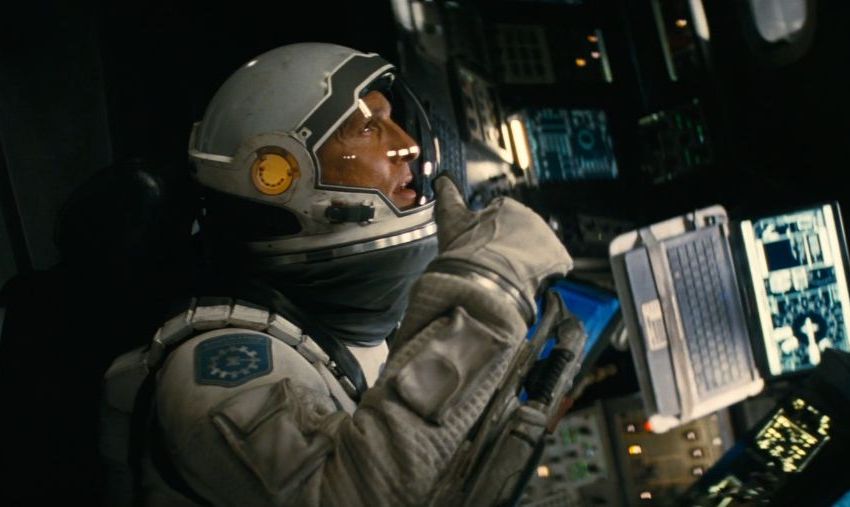 Nolan hasn’t lost his gift for crafting eye-popping visuals and bringing a rousing sense of scale to his movies. Interstellar is blessed with spectacular images of our universe, alien worlds, and mankind’s place in the whole realm of the cosmos. Nolan’s usual DP, Wally Phister, was unavailable, taking time to direct his own debut, Transcendence (probably the last film he directs as well, like Janusz Kaminski’s little-seen, little-remembered Lost Souls). The change of DP does Nolan good, giving the film a different, Earthier feel under Hoyte Van Hoytema (Her, Let the Right One In). Nolan isn’t the greatest stager of action but he is remarkable about putting together memorable set-pieces, and Interstellar has some standouts from the hostile alien environments to a thrilling space-station docking that is not for those susceptible to motion sickness. The special effects are terrific and the retro cubist robots are a fun addition. The only technical element I found lacking is the score by Nolan’s usual accompanist, Hans Zimmer. It’s bleating organ music intended to add a spiritual sense to the cosmic awe but it mostly becomes annoying. It sounds like a church organist died atop their instrument.
There is one great moment of acting in the film. Not to say there is an overabundance of bad acting, more like over emoting with a script and dialogue that do not deserve the waterworks. It involves Cooper after a mission, catching up on video messages sent from his children on Earth. In this very efficient scene, the magnitude of the consequences of Cooper’s decision is emotionally raw and he is overpowered with regret. McConaughey has been on a record-breaking tear of supreme acting performances, especially if you count his mesmerizing turn in HBO’s True Detective. Nolan allows the moment to play out, to sink in, without overdoing it, and it succeeds wildly. The other times Interstellar tries to wring out emotion feel too facile and maudlin to be effective.
This is my first real Nolan disappointment, a bloated film struggling to be important and say Important Things about the Human Condition but coming up short. It has its moments of excitement and awe but more so those moments are surrounded by too much dead space. The story is dense while still being undercooked, with too many listless supporting characters that amount to nothing, and easily telegraphed plot turns that are frustrating. Interstellar snuffs out all the intriguing possibilities it has to come back to its sappy father/daughter relationship that never truly feels earned. By no means is Interstellar, Nolan’s space travel opus/ode to Stanley Kubrick, a bad film. Unless you’re a sucker for easy sentiment, it will likely be a disappointment in some way, whether it’s too long, too boring with its science, too cloying with its emotional tugging, or just underdeveloped and overcooked at the same time. Interstellar is ambitious with its vision but seriously flawed and ultimately an obtusely personal sci-fi snoozer.
Nate’s Grade: C+
Share this:

Rampage: Capital Punishment (2014)
 Rampage was one of the better-received films from director Uwe Boll, with several critics and members of the public declaring it his best work, something that could actually be qualified as “good.” Despite tracking Boll from the beginning, I could not count myself amongst their numbers. I found Rampage to be a rather empty exercise in shock violence that grew tedious and misguided as it continued. A sequel to an intellectually empty and violent film minus meaningful subtext or commentary was not exactly what I would have requested.
Years after his murderous spree in a small town, Bill (Brendan Fletcher) is back with another “important” message to deliver to the masses. He storms a TV news station, rounds u a number of hostages after murdered an equal number, and appoints egotistical anchor Chip (Lochlyn Munro) as his go-between with the police. He insists his message must be heard. You can guess already whether it’s worth the fuss.
 Rampage 2: Capital Punishment is an exercise in testing your patience with its aimless nihilism. It’s a formless diatribe against all the world’s evils. Topics include the NSA and spying, the war in Iraq, Bush’s status as a war criminal, oil companies, drone strikes, Edward Snowden, Obamacare, the media, reality TV, global warming, Wall Street, and just about every other political target you can think of from an angry reactionary with a healthy sense of outrage. It’s not that these topics are beyond scrutinizing or that Bill might have some legitimate points as he’s skipping around from subject to subject, but he’s too scatterbrained, inarticulate, and just a poor mouthpiece for the revolution he wants to inspire. Bill is no different than your garden-variety college freshman that thinks they have suddenly come across amazing psychic insights into the rotten core of humanity after one political science class. I do find Bill’s moral championing of stricter gun control laws to be somewhat comically disingenuous. This is the problem with Bill as a character and his ongoing rampages. He’s all sputtering outrage without a filter and direction, without honing his fury. It’s easy to tune this guy out because he sounds no more particularly articulate than any other person who legitimately uses the word “manifesto” in daily life. Chances are if anyone in your life refers to something they wrote, un-ironically, as a “manifesto,” get a new friend pronto.
Here’s an example of the overall aimlessness of Bill’s indignation. One of his hostages is quivering in yoga pants. He asks if she does yoga and she nods her head. He demands she perform some yoga poses at gunpoint. “Yoga is not good for the world. It is gymnastics for the egocentric,” he argues. Then he shoots her. He shoots this woman just because she does yoga. Huh? It’s not like this character was going to have any semblance of a moral high ground considering he’s coming off a spree killing with over 100 victims in his wake, but it makes any political points he may attempt null and void. Want one more example of just how incoherently rambling Bill’s diatribes are? Amongst his targets is the 2012 film Lincoln and Steven Spielberg himself (really!). He declares that, “You think the Civil War happened to free the slaves and billionaire Spielberg makes you dumber. The reality is every war is about money, and the stupid people must die because the elite decided it.” I cannot believe this guy has the number of online devotee he has because he’s not charismatic, he’s not articulate, and he’s definitely not insightful. I got bored listening to him. Sadly, that’s what a good majority of the film ends up being: listening to this guy endlessly complain. It’s like the guy who yells on the street corner just got a bigger stage but his act is the same.
One of my major criticisms with Boll’s first Rampage was that it was too limited and without providing any relevant commentary to go with its violence. The sequel doesn’t make much progress. Every victim that Ben shoots has to be given a tighter slow-mo shot so we can better soak up the squib hit of his or her chest exploding with blood. At least Ben’s violence is channeled to a single source rather than unleashing it against the denizens of an entire town, but his message is a messy shotgun blast of social ills. It’s angry and nihilistic but without anything to add. If there is a cogent message it flies completely under the radar and gets lost in all the rambling rhetoric and macho posturing.
Let’s talk about the bait and switch nature of the movie’s title as well as the DVD cover advertising. When you see a masked gunman standing next to a burning Capital building and the title proclaims “Capital Punishment,” I think 99 out of 100 people would correctly assume the majority of the action takes place in D.C. and would be directed at elected officials. Oh how wrong those 99 people would be (the 100th was just dumb luck, so don’t get too smug). The entire plot revolves around Bill holding a TV station hostage. That’s it. No government building, no government officials, nothing even remotely related to Washington D.C., especially when the local gas stations are for “Canada Petrol.” Before viewing, I assumed that Rampage 2 was going to be a combination of the first film and Boll’s nearly good Assault on Wall Street, bringing a populist fury to the lawmakers in Washington. It seems like the next step on Boll’s populist journey. Instead, most of the film is a series of ugly vignettes of Bill terrorizing the frightened station employees by gunpoint, demanding his interview and an airing of his nihilistic rhetoric. Even at a little over 85 minutes, the film feels laboriously padded out and stretched thin. At one point, Chip accidentally breaks the DVD Bill demanded be broadcast. The movie literally spends almost eight minutes on this subject, like it’s a great uptick in suspense. “I’m sure he’s got another one,” a SWAT officer says. “He will not shoot you, trust me,” he says, unhelpfully. Lo and behold, he does have an additional DVD copy. “Always have a duplicate,” he says. Wasn’t that worth spending valuable time on?
 Fletcher (Freddy vs. Jason) returns to the completely underwritten role of Bill, more uncontrollable mouthpiece than anything resembling a person. He’s effectively peeved but he still doesn’t come across as that threatening a screen presence, which is saying something considered he’s carrying high-powered assault weapons. Munro (Scary Movie) feels like he just got the call minutes before filming. He seems like he’s constantly judging what he should be doing in every scene; perhaps that’s a beneficial sign of his performance since his man is playing it on the fly in a hostage situation. His long speech to the camera as a news anchor is tiresome, circuitous philosophical vomit, which also summarizes most of the dialogue. The one amusing aspect from casting is that Boll himself plays Chip’s advantageous and morally unscrupulous news director. He’s thrilled with the ratings and attention the station is getting. You decide if this is some sort of meta commentary on Boll and his penchant for rolling with the punches.
I fear Boll thinks that there is a level of audience attachment to his spree killer that simply doesn’t exist. He’s not an anti-hero, he’s not a revolutionary, he’s not even an engaging character by any generous metric and that’s because he’s just a stand-in for tedious ideology. He’s a mouth and a trigger finger, and that’s all Bill is, in no compelling manner. I worry that Boll will continue to insert Bill into new settings, have him round up some innocent people, and then we’ll watch him sputter for an hour about whatever cultural and political misdeeds are currently bugging Boll. I worry that the promise of “Capital Punishment” inherent in the title will really just lead to a third Rampage film with this promise actually, finally, followed through. Generally, I just worry that the world will have to suffer more abuse from further appearances by Bill, the world’s most irritating psychopath who loves to hear himself talk. The scariest part is that some people will actually think this is good. You might want to reconsider your friendship with these people too, especially if they also use the word “manifesto.”
Nate’s Grade: D
Share this:

Dear White People (2014)
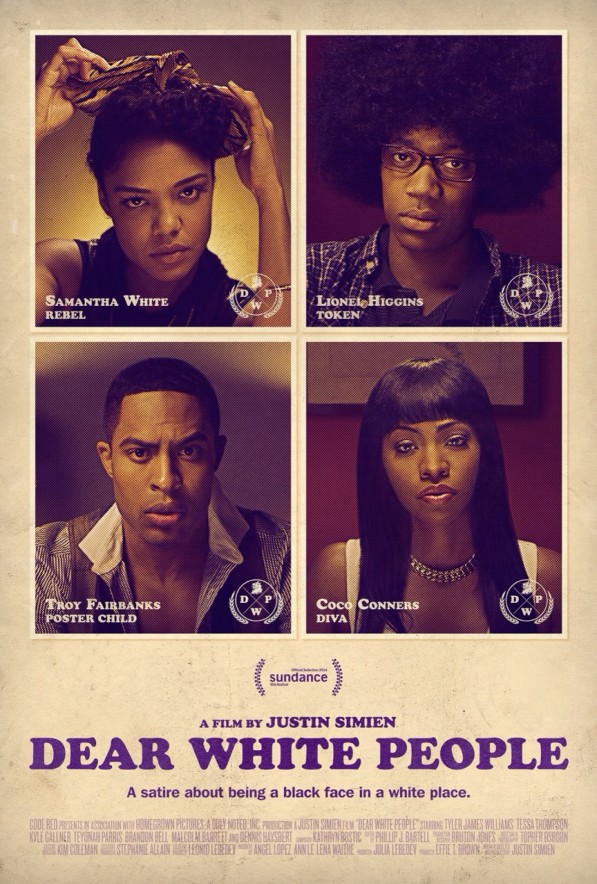 In an age where a vocal number of people believe racism died when Obama took office, or that the sins of the past are so old they have no more ramifications in today’s modern world, Dear White People is a blessed conversation-starter and a cogent argument to point to and enthusiastically say, “This!” Writer/director Justin Simien has put together a biting satire on modern race relations and the pressure to fit in where one can. This is more of a parable than a film, with some less than fully realized characters, but the commentary is rich and pointed enough that I was pinned to my seat. I wanted to hear what the characters would say next, and yes that’s also one of the film’s forgivable flaws, the fact that characters feel like they have speeches and political repartee rather than actual dialogue. In the fictional university of Winchester, every person is compromising who he or she is, pretending to be something they’re not, to fit an easily definable image. Everyone is using somebody for his or her own selfish gain. The storylines jostle around, relying on too many coincidences, but the actors are more than capable of drawing you in, especially the two leads played by Tessa Thompson (Selma, TV’s Copper) and Tyler James Williams (TV’s Everybody Hates Chris) as a gay journalist who doesn’t see himself fitting in with any of the established definitions of “black culture.” The commentary on reality TV and the media feels tacked on and undercooked, forgotten except that it lays a foundation to justify the film’s startling conclusion, a frat party where obnoxious white students dress up as grotesquely racist cartoons. Dear White People is a damning film that also plays it safe with its excoriating condemnations; it’s not as militantly ideological as some may fear or hope. This is no Bamboozled. And yet, it’s this middle approach that will make it more palatable for a mass audience. Oh, and did I mention it’s also funny? Whatever your color, take time to see this film.
Nate’s Grade: B+
Share this:

Fury (2014)
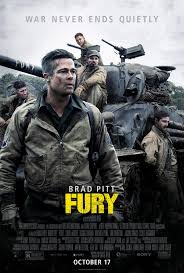 Why haven’t there been more tank movies? We have a slew of war films in all shapes and sizes and yet there are hardly any movies from the unique point of view of the battle-tested tank crew. Perhaps it’s the claustrophobic shooting conditions and limited breathing room, but then both of those are usually assets to the submarine sub-genre, and we got plenty of movies set primarily in less-than-spacious submarine quarters. Maybe it’s the sheer cost, since a submarine can be replicated with a model and a tank requires its own onset crew just to get exterior shots. Then there’s the issue of just watching close-ups of people looking through telescopes, squinting, and pulling triggers. I don’t really have a working hypothesis to explain the paucity of tank movies from Hollywood but now there’s at least one mainstream effort on the big board.
Fury follows the brave men of the titular tank that’s traveled from Northern Africa to France and now Germany in the dwindling days of World War II. Norman (Logan Lerman) is the new guy, replacing a fallen comrade on Don “Wardaddy” Collier’s (Brad Pitt) crew. The average life expectancy on a tank was only a handful of missions, but under Collier’s leadership his squad has defied the odds. Now the presence of a rookie puts all their lives in danger especially so close to the end of the war.
Writer/director David Ayer (End of Watch, Sabotage) delivers a meat-and-potatoes kind of war film, a movie that knows what it’s doing and how to satisfy its audience but rarely steps outside of this mission to resonate further. There’s a requisite pathos and air of contemplation to the proceedings, especially with the conflict of Norman’s innate goodness getting in the way of killing soldiers, armed and unarmed, in the line of duty. What does it take to be a soldier? Can you still recover as a man or does one have to shut off those elements of concern, the quibbles over moral actions that would otherwise haunt. In one sense, it’s a little contrived that the new recruit has to be so green to the battlefield that everything needs to be taught to him including the us vs. them mentality of war. On the other hand, it provides an ongoing source of conflict that leads to some striking moments, like when Collier literally forces Norman’s hand to get him his first kill. Much like Saving Private Ryan once it settles down, the movie progresses as a series of vignettes that showcase a variety of consequences and realities of the war. Naturally some are more engaging than others, but for the majority Fury holds your attention nicely. Ayer’s direction of action is astute and a tank-on-tank battle is wondrously taut thanks to the stubborn and fascinating tactics of tank warfare. I just don’t know how all these guys can make out whose order is for whom with all the other noise going on.
 It’s during the concluding act where the movie abandons most of its sense of realism to completely double down on exaggerated action movie heroics, and it’s unnecessary. Beforehand, we’ve been treated to this crew and their town-by-town escapades, watching them come together but also watching them deal with the vagaries and lasting traumas of war. And then it suddenly shifts gears and becomes a last stand movie where our small crew in one immobile tank has to take on, literally, 300 Nazi soldiers. Ayer makes a specific point of clarifying them as Nazi S.S. men and not your casual German soldier. Pitt and company all decide to stay and fight valiantly rather than hide, and so we’re treated to their preparations for what is sure to be an Alamo in a tank. It then just becomes a rote action movie where they fire into the smoke, more Germans keep coming, and we just patiently watch them run through their last remaining desperate options for defense. Ayer doesn’t falter with his depiction of the action or the logical nature of his plot beats, though I don’t know why they didn’t keep more of the gun ammo in the tank. There’s a repetition and expectation of casualties with this section, perhaps intended to magnify their sacrifice and heroism but it feels too forced. The movie was working perfectly fine prior to this new shift in tone. Now we have Germans that are plainly idiotic, with poor marksmanship, and who can’t just wait out the tank. They have rocket-propelled weapons and the tank only shoots in one direction. The ending action assault still works as an entertaining barrage of blood and violence, but if you were liking Fury for what it was then be prepared to be a little disappointed.
What really hooked me with the film was an extended sequence that doesn’t even involve the tank at all. Stopping to regroup with their company in a small, bombed-out German town, Collier and Norman enter the home of two women, Irma and Emma. Initially the scene plays out like they’re scouting for any hiding soldiers, so there’s an initial carryover of tension. Then the gentlemen stay and the scene transforms organically into something more interesting. The scene is allowed to linger, and we see a different side of Pitt’s tank captain. The women set up a dinner and there’s a moment of reserved calm. Norman and the youngest German woman get some privacy, much to the knowing approval of the other two older adults in the room. Then just as their little scene has reached serving time, the other members of the tank storm the room, drunk and confused. They came seeking to deflower Norman with an ugly prostitute they each had a turn with. Their eyes settle on the young, much prettier women, the food about to be served, and you can feel the resentment starting to build, the old conflicts and tensions sneaking back into the scene, particularly a sneering Jon Bernthal (Wolf of Wall Street), who relishes being hostile. You don’t know where this is going to go. Are they going to make a fuss? Will they mistreat the German civilians, maybe even assault them, and if so how will Collier and Norman respond? What will they say about the appearance of preference with these civilians than with their tank company? How far will this go? I am not kidding when I say that for a movie with plenty of war violence, this was the tensest scene in all of Fury. It plays out so naturally, leisurely, but every moment pushing forward and building in tension. It’s a shame then how Ayer decides to conclude this entire episode, glibly turning these women from characters into a cheap plot device. Until then, though, it’s a 12-minute oasis from the genre machinery of war movies.
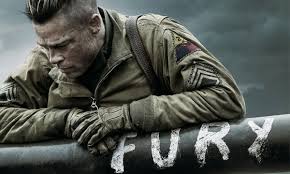 The other aspect where Fury falters is when it comes to fleshing out the characters in that dangerous tin can. With war movies the characterization can often get lost in the shuffle of violence and messages, so there’s something of a sliding scale; if you can get one good sequence, perhaps one solid insight into a character that opens them up as more than “Hispanic Gunner” or “Vaguely Southern Religious Marksman” then you call yourself fortunate. The characters don’t stray far from their archetypical orbits: the rookie, the hotheaded one, the Bible-quoting philosopher, the commander who hides his fear and… the Hispanic Gunner (sorry Michael Pena). The assembled actors do fine work with what they’re given, but so much of the part is reactionary to off-screen, out-of-the-tank action. Pitt (World War Z) has a stolid clam that commands leadership but boy does his character lack a personality. He’s just settled into that authority figure role. Shia LaBeouf (Nymphomaniac) gives a performance with enough edge, the emotions just peaking through during key moments, to leave you wanting more, both from the character and the actor. Lerman (Perks of Being a Wallflower) is suitably wide-eyed and out of his element early, finding his requisite spine and becoming a “man” over the course of the film. It works as a point of view entry into this world though his character can come across as naive and then later also unjustly criticized. After two hours with this crew, you won’t be fighting back too many emotions as they make their last stand and their numbers dwindle.
Fury is a fairly gritty, bloody, and sturdily entertaining World War II action thriller that is unwaveringly serious for a solid two acts until an all-out assault into over-the-top action movie land for its final, admittedly enjoyable, conclusion. It decides to just skimp out on the characterization so as to spend more time pumping up the virtues of tone and action. The film never bored me, and during stretches it was riveting with suspense and a gritty realism, all before retreating back to archetypes and Hollywood standoffs. For long stretches it’s a series of vignettes but there are moments that rise above, which cut through the carnage and stay with you. Ayer’s direction of action is rather impressive and this is easily the finest work behind the camera for the famous screenwriter. In many ways, Fury is a no-nonsense throwback to World War II war movies, with a similar no-nonsense pack of characters. An older audience will definitely find the movie appealing. It does more than enough well to recommend but just don’t expect the next Saving Private Ryan in terms of lasting impact. Still, give me more tank movies, Hollywood.
Nate’s Grade: B
Share this:

Annabelle (2014)
 The Conjuring was one of the breakout hits of 2013, so it’s no surprise that Hollywood fast-tracked a spin-off to take advantage of Conjurin’ fever. Enter John R. Leonetti, the accomplished cinematographer on The Conjuring and director of bad sequels like Butterfly Effect 2 and Mortal Kombat: Annihilation. Now in the spotlight, little Annabelle is proving to be a star of her own as far as box-office grosses are concerned. It’s too bad her new movie is about as lifeless as she is.
In the late 1960s, Mia (Annabelle Wallis) is pregnant with her first child when murderous cultists terrorize her home. They are dispatched but not before one young woman slices her own throat holding one of Mia’s expensive porcelain dolls, the Annabelle one. Her husband (Ward Horton, who looks like a living Ken doll) is afraid to leave her alone and reaches out to the church to help his wife. Strange things are going on in their home, mostly concerning the infamous Annabelle doll.
 The impact of Annabelle will depend directly upon your good will concerning The Conjuring and what your law of diminishing returns is with a creepy doll. To be abundantly clear, the Annabelle doll is one creepy looking thing. But how much can an audience take of a creepy looking doll that doesn’t have any articulation or expression? The character, and it feels like a stretch to label the doll as such, worked effectively as a prologue to The Conjuring due to the relative brief appearance. The doll was creepy enough for ten minutes and then the audience moved on. Now in a starring vehicle all to herself, Annabelle risks overexposure and the realization of just how limited this little demonic figure might be. A killer doll that comes to life is a genuinely unsettling proposition, one richly explored in a classic Twilight Zone episode that’s still spooky to this day. However, Annabelle doesn’t really do anything, and I suppose that’s the point. The doll is a conduit for the larger, invisible demonic force at play. We already know that it’s not the doll or a ghost but a demon posing as such. Ultimately, the doll isn’t anything more than a device to go back to again and again, a horror staple in place of true unnerving tension and dread. Hey, it’s hard to carefully manufacture and ratchet suspense, so why not just keep going back to a creepy looking doll instead?
With a lackluster antagonist, it’s no surprise then that Annabelle has to rely on all the hoary tropes of horror just to fill out its running time. The plot by writer Gary Dauberman plays out like the filmmakers watched Rosemary’s Baby, a documentary special on Sharon Tate, and said, “That’s it, we got out movie.” The Manson family-like cult is a plot element cast aside too quickly. They bring the demon to the doll, but the followers of this demonic presence never terrorize the couple again. It seems like one of many missed opportunities. Instead we get a slow series of events of the doll/demon messing around with Mia. There’s the kindly older priest that’s called into service, who does nothing. There’s a helpful neighbor mourning the loss of her own child who ends up an insulting plot device (more on this later with spoilers). And oh are there characters behaving stupidly, chief among them our heroine. She’s rather slow to realize the danger she is in and often leaves her baby alone to investigate said supernatural shenanigans. You know, the baby that is the object of desire for this demonic force. Rather than be proactive and have any sense of agency, Mia is that older type of horror heroine who runs around screaming and cowering in corners. It gets tired. There’s one scene where she’s trying to escape via an elevator that keeps opening on the same haunted floor. She literally hits the elevator button four times each time expecting something different, and the camera angle remains the same, leading to titters from my audience.
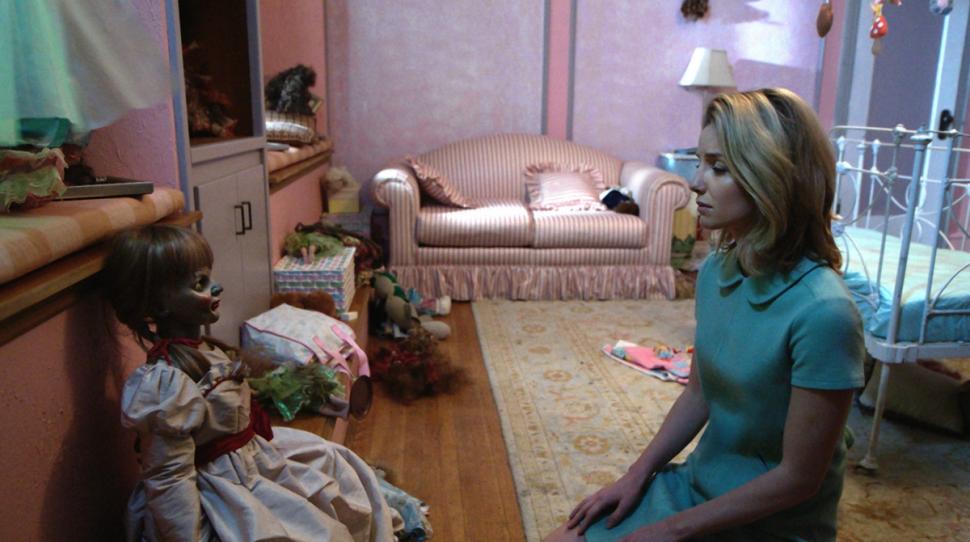 While The Conjuring certainly wasn’t a brave new direction in the realm of cinematic horror, it was skillfully executed and masterfully setup its scares. Annabelle does have a few decent boo moments, many of which were showcased in the trailer, but it cannot overcome the burden of all its clichés and wooden characters. Audiences are used to characters making poor decisions in horror films, but you still should have some level of believability or internal logic to their decision-making that doesn’t make your brain hurt. Sadly, Annabelle cannot rise above the limitations of its titular “monster” and so it has to rely upon an assemblage of familiar horror tropes to make due.
This paragraph is going into spoilers concerning the ending so I’d advise any reader wishing to remain pure to skip to the next paragraph. The great actress Alfre Woodard plays that grieving neighbor lady, the one who is joyously buying Mia baby clothes for her little one. During a climactic confrontation, Mia demands to know what the demon entity wants. It communicates via crayon scrawls on the ceiling: “Her soul.” One of the film’s creepier moments. Then the baby disappears and she wants to know what it will take to save her child. Mia looks to a window and written on it is, “Your soul,” just as it gently pushes itself open. Again, a creepy moment. I was starting to get the impression the film was picking up momentum. She’s about to sacrifice herself when she’s pulled back inside. This is where the film goes from bad to insultingly bad. I kept repeating under my breath, “Don’t do it, don’t do it,” and wouldn’t you know, they did it. Woodard realizes her purpose: she must sacrifice herself so this nice white couple will be safe. She dives out the window and evil is vanquished… sort of. It’s a stupid character arc made all the more unpleasant by the racial casting choices. I’d rather Woodard just save herself.
This small prequel has proven to be a smash at the box-office, so where does Annabelle go from here? Another prequel seems unlikely considering the events of this movie cover the birth of the demonic doll and lead directly to the prologue of The Conjuring, where this spunky little doll met her match with the married paranormal investigators played by Vera Farmiga and Patrick Wilson. The real Annabelle is encased in a glass prison. The only direction seems to be forward, with Annabelle breaking free of her prison and having a night on the town. Maybe she can locate Chucky and that Twilight Zone doll. I just hope future adventures with Annabelle, and its box-office grosses almost assure there will be, veer away from the overload of uninspired genre clichés. There’s not enough effort on display to warrant this solo side project for a creepy doll that mostly just remains creepy. Annabelle the film could have used less of Annabelle the doll. Then again an unblinking and silent doll was still the most interesting character on screen.
Nate’s Grade: C-
Share this:

The Equalizer (2014)
 If your idea of a fine time at the movies is watching Denzel Washington be a badass and murder people in grisly fashion for two hours, then The Equalizer is right up your alley. There’s not much to the plot of this loose remake of the 1980s TV show of the same name; Denzel plays a man with a mysterious past who works at a large Home Depot-esque hardware store. He sees injustice transpiring against his pals, and he fixes it in a violent fashion. The movie is two storylines that don’t converge until the final act, namely the Russian crime syndicate trying to ascertain who this vengeful badass just might be, and Denzel doing his episodic vigilante good deeds. The climactic act is a drawn out showdown where Denzel uses every part of the hardware store to deadly results. There’s definitely a pleasure in watching Denzel dispatch tough-talking baddies, and that’s what the film delivers, no more, no less. The confrontations are generally well written and ratchet tension nicely, especially when Denzel has some chilly conversations with his soon-to-be-victims before they inevitably make their bad decisions. The tense sit-downs were more entertaining for me than the bloody violence. Director Antoine Fuqua (Training Day, Olympus Has Fallen) goes about his business in a more than competent manner; the technical qualities are above average, though the film has moments where it seems too infatuated with its slick sense of style (slow-mo rain gun battles?). With a stream of bad guys to be toppled at a steady interval, The Equalizer can start to feel like an assembly line of cocksure carnage, a ready-made vehicle for audience blood lust. Still, watching Denzel be a badass and kill a whole lot of bad people is enough for a movie. Just don’t expect much more than that scenario and you may be satisfied if you’re not too squeamish when it comes to bloodshed.
Nate’s Grade: B
Share this:

Gone Girl (2014)
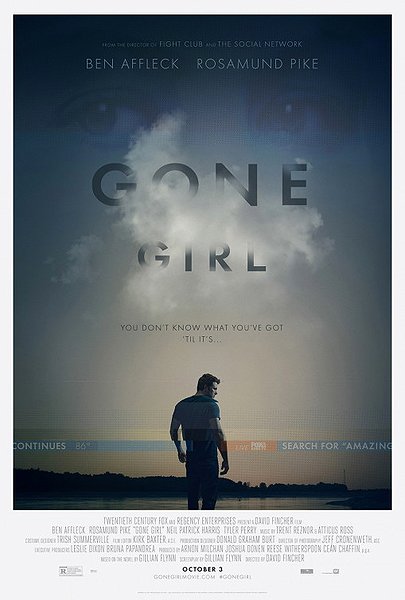 Rest easy fans of Gillian Flynn’s runaway bestseller, because Gone Girl the movie is pretty much exactly Gone Girl the novel. There were rumors that Flynn and director David Fincher had drastically retooled the controversial ending, but this was only premature speculation. Fun fact: it’s easy to tell the people who didn’t read the book in your audience because they will more than likely be the ones who groan once the end credits kick in. The fealty to the book is a relief because, as we book readers know from those late nights compulsively turning Flynn’s pages, the real star of the movie is the story, which was ready-made for a grand, pulpy thriller, and that is Gone Girl the movie. Whether it’s anything more than an exceptionally well made thriller is up for debate
Amy Dunne (Rosamund Pike) has gone missing from her supposedly perfect life. Her husband, Nick Dunne (Ben Affleck), starts off as the tortured, grieving husband. He comes home one day to find his home wrecked and his wife missing. The police (Kim Dickens, Patrick Fugit) are worrisome about Nick’s abnormal reaction to his wife’s disappearance. He doesn’t seem to know much about his wife. He seems like he’s hiding something. Even Nick’s twin sister Margo (Carrie Coon) has her doubts that Nick is telling the full truth. Amy’s diary paints a different portrait of her husband, a man prone to increasing anger, mostly stemming from the loss of his job and a relocation from New York City to Missouri. Most of Nick’s anger is focused squarely on Amy, enough that she fears for her life. As various clues keep piling up and Nick’s public behavior appears suspicious, the media spotlight transforms him from victim to prime suspect.
 No question having an artist of Fincher’s caliber raises the quality level to its highest degree, but it’s the perfect marriage of filmmaker and material that allows this movie to soar. Both Fincher and Flynn have a cold manipulative streak that twists an audience into knots. It’s a terrific whodunit with several booby-trapped surprises that only make you dig in more. It seems like every few minutes we’re learning more about Nick and what he’s been hiding from others. Flynn, who also adapted the screenplay, does a terrific job of playing with our loyalties, getting us to doubt what we see and who these people really are, and she does this even to the final minute, leaving us with no clear-cut answers to wash away our reservations. Flynn’s strengths as a writer are how she reveals her tale over time, how she makes us rethink the past and the characters and their sincerity. It’s a patient film, and just under two and a half hours perhaps too patient, but it’s not the least bit lackadaisical. Flynn’s story is wrapping a web around Nick and watching him get caught, and every perfectly timed reveal only widens that web. Gone Girl is a film bursting with intrigue. It snares you and then fiendishly plays with your expectations.
Affleck (Argo) was an obvious choice for the role of Nick Dunne, the charming man whose self-effacing smile rubs people the wrong way. He’s rarely been better onscreen, giving strong life to all the conflicting parts of Nick, from his calm aloofness at his wife’s disappearance to his cunning way with his own truths. He gets way in over his head, and watching Affleck navigate the tenuous situation is one of the film’s many twisted pleasures. Pike (The World’s End, Pride and Prejudice) is going to be an unfamiliar face to most American audiences but not for much longer. This is the biggest role of Pike’s career and much like Fincher’s other “find” Rooney Mara in Dragon Tattoo, she knocks it out of the park. In just a look she conveys Amy’s upper-class upbringing, her icy demeanor being interpreted as disdain. Through Amy’s journals, the character opens up to us, becoming better defined, making us fear for her, and Pike sells it. Hers is a performance of layers; it’s like she gets to play several Amy’s in this movie. Her demeanor is always so composed, so modulated and controlled, so the big moments that draw out her anger and horror register even more. It’s too early to determine what kind of awards buzz Gone Girl will have through the season, but if anyone has a chance, it’s her.
From top to bottom, the supporting cast adds great value to the film. Most surprising is Tyler Perry (yes, that Tyler Perry) as Nick’s high profile, slick, morally flexible defense attorney. It is no stretch to say this is Perry’s finest acting ever put to film, in or outside a dress. I wanted more of him, and that’s not something I’ve ever said before. Dickens (TV’s Treme, Footloose) would ordinarily be the best performance in most movies; smart, empathetic but no-nonsense, and wryly funny. In an ordinary crime thriller, she’d be our lead character. Coon (the breakout actress from HBO’s The Leftovers) is the audience’s voice of sanity, providing necessary gallows humor to punctuate all the discomforting dread. Casey Wilson (TV’s Marry Me) is a suburban housewife send-up and provides some laughs too. Even Emily Ratajkowski, otherwise known as one of the topless models in the “Blurred Lines” video, is pretty good as a naive coed. Thus is the power Fincher wields as a director of actors, a quality often overlooked by his technical prowess. The one casting question is Neill Patrick Harris (TV’s How I Met Your Mother) as Desi, Amy’s creepy ex-boyfriend who still very much clings to the notion they should be together. Harris tries too hard to be creepy, concentrating too much that his style becomes mannered and halting.
 With Fincher’s name attached it’s almost redundant to talk about the technical superlatives of the movie; it goes without saying. One of the finest visual stylists of his generation, Fincher impeccably composes his shots. The man finds a kindred spirit with Amy and her color-coded meticulous organization. The cinematography is crisp and suitably eerie and dreamlike (or nightmarish), the mood always pulsating with a beautiful dread to tap into the unsettling unease of Nick’s dire situation. The editing is rock-solid, keeping the audience guessing with the balance of Amy and Nick perspectives. There is a chilling sequence late that involves a mass amount of blood, but it’s made even more unnerving thanks to the judicious edits and fade outs, heightening the horror. The only technical aspect I found wanting is the same with Fincher’s Dragon Tattoo, namely the score by Atticus Ross and Trent Reznor. Twice now I’ve labored through musical scores of theirs that could best be described as ominous ambient noise. You keep expecting it to build but it doesn’t. Perhaps it’s just the change of material, as it’s also been two films in a row based upon dark and grisly crime paperbacks, but consider me disappointed yet again. There’s nothing memorable here and that’s a shame considering how buoyant their Oscar-winning score was for the still amazing Social Network.
But even with that Fincher polish and the sinister snap of Flynn’s plot, I can’t say that Gone Girl the movie rises to the level of its lofty ambitions. Much like Dragon Tattoo, this is a skillfully made crime thriller, but is it anything beyond that description? That’s not to say there’s anything particularly wrong with being a skillfully made thriller; Fincher’s Seven is one of my favorite films of all time, and yet despite its end-of-times philosophy about the dark hearts of man, it’s really nothing more than a exceptionally made thriller, and that’s fine because that movie is near perfect. With Gone Girl, the stabs at deeper analysis and social commentary feel just out of grasp. The tabloid news fixation, a landscape littered with missing wives and presumably guilty husbands, is ripe for satire, but it feels always on the peripheral, like Fincher is checking in to take the temperature and then going back to the muck. There’s much more that could have been done, but that’s fine. The larger missed commentary is with marital relationships. This is not, as some critics have labeled, a How We Live Now kind of film, a jarring wake-up call that human beings more or less suck. Nick and Amy are far from being relatable analogues for the masses, and that’s fine. They are allowed to just be interesting characters, which they are, rather than stand-ins for searing social commentary. The fact that five years into their marriage they’re both still strangers says something about them, but does it say something novel about marriage itself or human relationships in the twenty-first century? The idea of people wearing false masks isn’t exactly new. The average couple is not probably going to go to bed thinking, “Who is the real person I’m with?” The average couple is just going to go along for the ride and think, “Wow, these are some messed up characters.”
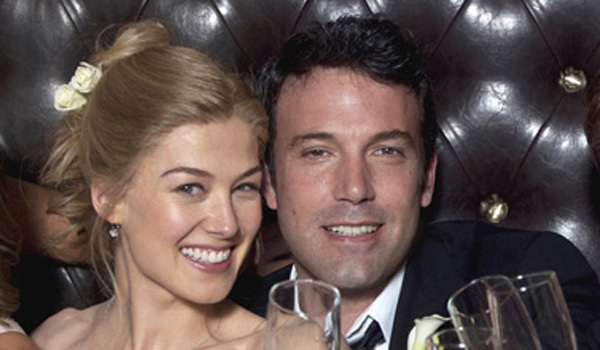 And now some spoilers as I delve into Gone Girl’s ending, so if you choose to remain clean please skip to the next paragraph. The ending is unsettling and disappointing for people because the only person who gets what she wants is our main antagonist, Amy. The final shot, a replay of the opening image but with clarifying context, is her triumph, staring coldly, head atop her husband, as if she were a cat purring. She has won. And this ending pisses people off. For my money, this is the absolute perfect ending for a story about toxic relationships and a morass of a marriage. Nick is rescued by Amy’s reappearance, engineered through some canny media manipulation by Nick, but now he’s stuck, and stuck with his lovely psychopathic wife. The police know she’s guilty but won’t proceed further thanks to looking inept on a national stage. Nick can’t leave because then his child will be raised by Amy, twisting him or her into mommy’s little psychopath. The only way he saves that child is by staying, by sacrificing his own freedom, to become prisoner to his wife, to play the part she has wanted him to play, and he does it. He is condemned. I find that to be poetic and darkly satisfying, and it’s very true tonally for this sort of sordid tale, but I understand why people hate it. I just think a happy ending or one where the villain is vanquished would feel trite.
Gone Girl is a toxic relationship movie, an involving and pulpy suspense thriller, a rewarding character study that plumbs some pretty dark depths, and most of all a sickly entertaining movie with excellent craftsmanship. It is everything fans of the novel could have hoped for with Fincher attached. As our tormented husband and wife, Affleck and Pike deliver career-best and career-making, in her case, performances. The ending will divide audiences sharply just as it did readers but I consider it the correct denouement. The movie doesn’t provide much in the way of stinging, applicable social commentary or media satire that hasn’t already been covered by the likes of Jon Stewart and Stephen Colbert. But does it have to be anything more than a terrific thriller? An exceptional thriller can be entertainment enough, and Gone Girl is definitely that.
Nate’s Grade: A-
Share this:

The Maze Runner (2014)
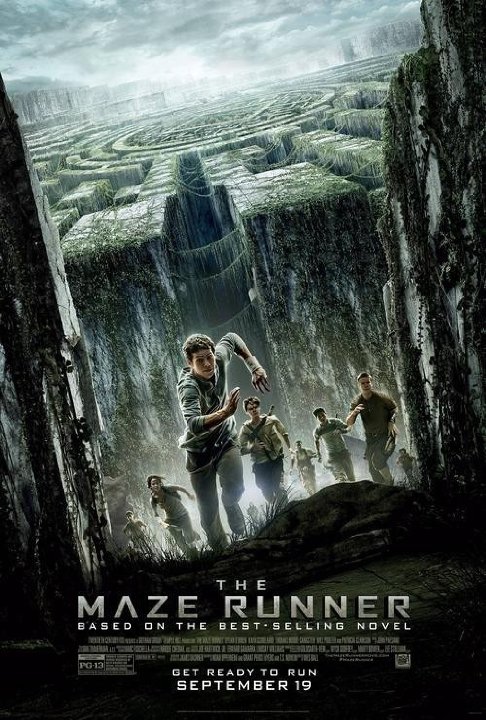 If anyone can reasonably explain to me the end of The Maze Runner in a way that makes some tangible amount of sense, I will give you money. The latest YA-franchise-in-the-making starts off with a storyline that reminded me of Rod Serling. We follow a group of teen boys, memories wiped, as they wake up in the center of a giant mechanical maze. Who put them there? Why? What’s on the other side? As long as the maze and the mystery of it are front and center, the film works, twisting in intrigue. However, when the story veers away to the characters, mostly flat archetypes, and their new society, that’s when I started getting sleepy. You got this awesome huge maze to explore, kids. The film ends up being an exercise in less-is-more restraint when it comes to sustaining a mystery and knowing what points to emphasize and which to skip over. There’s a girl brought into their camp, the first, which they say should be a big idea and change the social dynamics of a group of boys, but it doesn’t. There are silly mechanical spider monsters that scamper through the maze, as if the filmmakers felt a giant maze wasn’t a sufficient enough obstacle and selling point. Scattered flashbacks early on spoil who is responsible for the maze, but when we get to the actual ending, the rationale for who built this large contraption and for what purpose doesn’t add up, like, at all. An explanation wasn’t necessary, but if they needed a quick one I would have accepted, “Aliens did it because.” There’s already a planned sequel in the works. My idea: the kids escape the maze only to discover… they’ve just entered a larger maze. Then they escape that maze only to discover… you get the idea. The Maze Runner is moderately enjoyable. Just don’t expect to enjoy, understand, or even accept the ending and its implications.
Nate’s Grade: B-
Share this:

A Walk Among the Tombstones (2014)
 Scott Frank has only directed one movie, The Lookout, but as a screenwriter his fingerprints are everywhere in Hollywood. The man’s name is all over projects such as Out of Sight, Minority Report, Get Shorty, The Wolverine, Marley & Me, and those are just the ones that made it across the finish line. As any aspiring screenwriter knows, Hollywood is built upon an ever-amassing burial ground of unproduced screenplays. A Walk Among the Tombstones is only his second directing feature, which tells me it must have had significant personal value for this famous scribe. You can definitely tell Frank has an affinity for hard-boiled film noir of old, though the splashes of in-your-face sadism may be too much for certain audiences. It’s a genre movie all right, but it’s also a grisly one that bothers to take its time setting up character, plot, and resolution.
It’s New York City on the cusp of Y2K, and retired cop Matt Scudder (Liam Neeson) is just trying to enjoy his dinner. He’s pulled into a complex kidnapping scenario at the behest of one of his AA peers. Two men have been targeting the city’s drug traffickers, men with big pockets who cannot go to the police. These psychopaths enjoy abducting the trafficker’s wives, ransoming them for hundreds of thousands, and then slicing and dicing their victims anyway. Matt initially turns down the offer, working around the edges f the law, but the viciousness is too much to ignore. He reawakens his old detective habbits, falling back into a routine, and tracking down those responsible.
 Those expecting a regular Liam Neeson afternoon of top-draw face punching may be in for a slight disappointment, because A Walk Among the Tombstones is a gritty detective tale that swims amidst an ocean of moral decay and queasy sexual violence. It’s a detective yarn that unwinds at a casual pace but one that feels like a natural connecting of plot points. Thankfully, this isn’t a movie that treats the identity of the killers as a mystery that needs to be dragged out as long as possible, with the ultimate pained reveal being one of the otherwise harmless characters we’ve previously been introduced. We know who these two psychopaths are after about twenty minutes, so there’s no prolonged guessing game. Rather than linger on who they are we now await the ultimate satisfaction of Matt Scuder finally facing off against our two psychopathic killers, and they are indeed psychopaths. These two are very wicked men, gathering sadistic pleasure from torturing their captive women. The two men are kept as unsettling ciphers; we don’t know much about them except they have an addiction to killing. It’s not about the hundreds of thousands they scam from the drug traffickers; it’s really about the thrill of the hunt. While I wish there was more depth, they were menacing enough. I was itchy with anticipation for them to get some comeuppance. I’ve read reviews indicating that our two remorseless killers are a gay couple; if this is true it’s kept very vague for interpretation. In the age of equality, it could be homophobic to declare, in absolutes, that psychopathic killers couldn’t also be gay or lesbian. That would be… wrong?
With two strong villains, you need a strong hero to bring them down, and Neeson fits the part like a natural. To be fair, the role is somewhat stock from a passing description: the loner former cop with the tragic past, a drinking problem, the gruff style, the over-the-hill age, the man trying to adapt to a new and changing world, sometimes not for the better. It’s a role that feels ripped from the tropes of crime thrillers, a world we’ve also become accustomed to seeing Neeson. The detective role is familiar but, like most within Frank’s film, it’s given more time to breath and a surprising degree of attention. This doesn’t come close to last year’s Prisoners in the realm of character work, but it’s still an above-average entry for a genre too often ignored when it comes to realistic and satisfying characterization. Matt Scudder exists in a New York City that owes a debt to the pulpy noir page-turners of old, but it’s not exactly stylized, and neither is he. The man still uses microfilm and needs the assistance of a street-smart homeless teenager to assist him with this newfangled Internet thing. While it feels somewhat forced, the relationship with Matt Scuder and his young protégée is the strongest in the film, opening up the character’s redemptive arc. It’s always appreciated to watch Neeson get to flex his acting muscles rather than just being given action choreography and trite tough guy bravado.
There’s one other actor I’d like to single out, and I’ll thank my mother for this. Fans of Downton Abbey (like dear old mom) may recall Dan Stevens as the dashing and departed Matt Crawley, but he is almost unrecognizable as the grieving husband/drug trafficker that kicks off our story. For one, the guy lost a decent amount of weight and his gaunt face makes him seem all the more mercurial and intense. The characters plays against type with our expectations for a drug dealer, and you may find yourself, like I did, warming to him and yearning for the man’s vengeance for his wife.
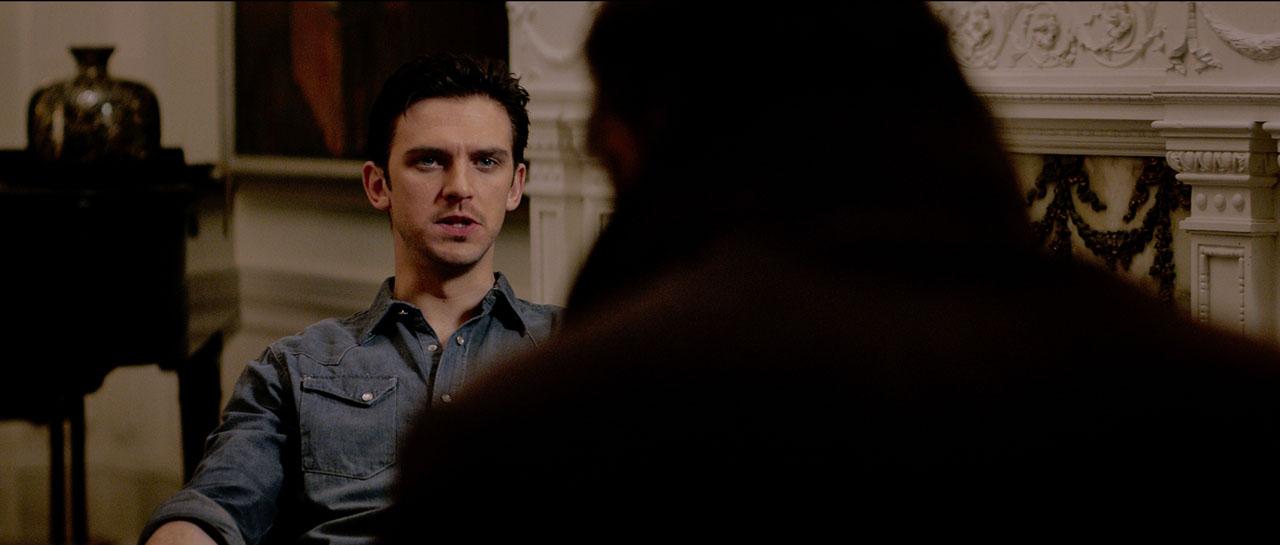 Frank’s direction is awash in the grime and seediness of New York City, with dark shadows washing over his troubled characters, and a sense of style that, while omnipresent in tone, doesn’t distract from the story. The rich cinematography by Mihai Malaimare Jr. (The Master, Tetro) is a great asset. The film noir elements are here in abundance and with due diligence. It rains in just about every scene. Why? All the better for a moody and eerier atmosphere, though the rain does actually factor into a character-based conflict for Matt’s protégée. It’s a moody thriller that is assuredly above average for its genre. Not everything quite works (the third act is too drawn out; a montage of AA 12 steps narration over sequences of violence is more than a little heavy-handed; the explicit Y2K setting doesn’t really have a purpose other than to limit certain technological advances not becoming of the genre) but Frank knows how to draw out the strengths of the genre.
A Walk Among the Tombstones is a gritty genre throwback, but what really jumped out to me was the hook of the premise. Neeson plays a man on the outer edges of the law but a man who still bends toward the justice system he once worked for. What makes this character unique, or at least the promise of, is that he ends up becoming the private detective for the criminal world, and that I find to be fascinating. We think of criminals, especially drug traffickers, are tough men who can handle their own problems with extreme authority. But they are also just people and can get in over their head as well, and when they need someone with private eye skills, who knows how to operate inside the bounds of the law and out of them, that’s where Neeson comes in. He does such a good job that he gets recommended around the New York ring of drug traffickers. He’s like a Michael Clayton-style fix-it guy but for the criminal underworld, and I think this concept it rife with juicy potential. Tombstones is based upon a series of books by Lawrence Block, so there could be further adventures, and I would welcome them, especially if the finished product is as entertaining as this first foray.
Nate’s Grade: B


You must be logged in to post a comment.