Blog Archives
The One I Love (2014)
 A simple yet high-concept sci-fi hook that’s nicely examined and developed for its duration, The One I Love is a relationship drama with a twist, one I won’t feel bad about spoiling considering it happens in the first 15 minutes. Mark Duplass and Elizabeth Moss play a married couple going through counseling to work out their trust issues. They head out to a resort home to spend a weekend getaway; however, whenever one of them enters the guesthouse, their spouse is magically there. Not just them but an idealized version of them, the best representation. The two explore what this means, establishing a series of rules of intimacy that of course will start to be ignored. The mystery of why this doppelganger honeymoon suite is happening is inconsequential. What matters is how our couple responds to it and the film thankfully allows this conflict to stew, maximizing its potential to explore the jealousies and insecurities of relationships. Duplass and Moss are terrific and have fun with their many iterations. The One I Love finds ways to continually surprise while still feeling grounded by its real-world application of its science fiction premise. The ending is a tad predictable but still satisfying, likely inspiring many conversations afterwards with would-be couples who watch the film. At its core, it’s an intriguing story that’s very well developed while never losing sight of its characters and their relatable nature. It’s smart, funny, and always interesting, and well worth exploring on your own when given the chance.
Nate’s Grade: B+
Share this:

Big Hero 6 (2014)
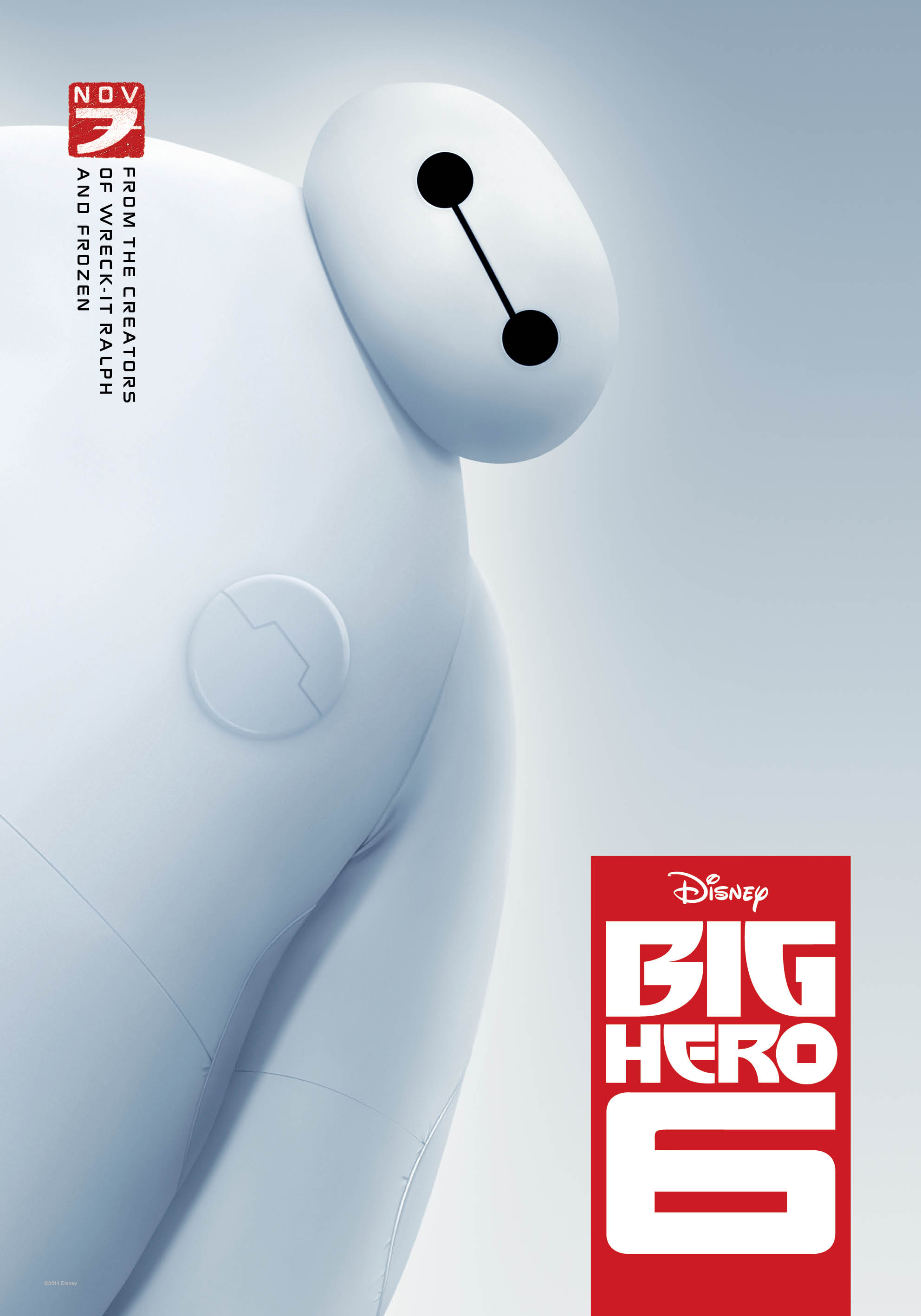 Disney’s first adaptation of a Marvel property, it’s essentially a superhero origin tale mixed in with the “boy and his robot” formula borrowed from The Iron Giant. The story is fairly predictable but charming and unafraid to deal with loss and grief. The real star, though, is the inflatable robot Betamax (voiced by Scott Adsit), whose unfailingly optimistic and helpful nature is a loveable addition to a genre plagued with doom and brooding. The action sequences are colorful and well developed and paced. It’s an agreeable pilot film for a new animated franchise, and the characters are likeable and fun while still having enough emotional resonance to make the hard choices of sacrifice hit you in the gut. It’s a welcome change of pace to have a character interested, first and foremost, in the mental health of others. You just want to hug Betamax (parents, your children will be begging for the toys). The plot does follow many similar plot beats of the superior Iron Giant but this film is still enjoyable enough on its own terms.
Nate’s Grade: B
Share this:

Locke (2014)
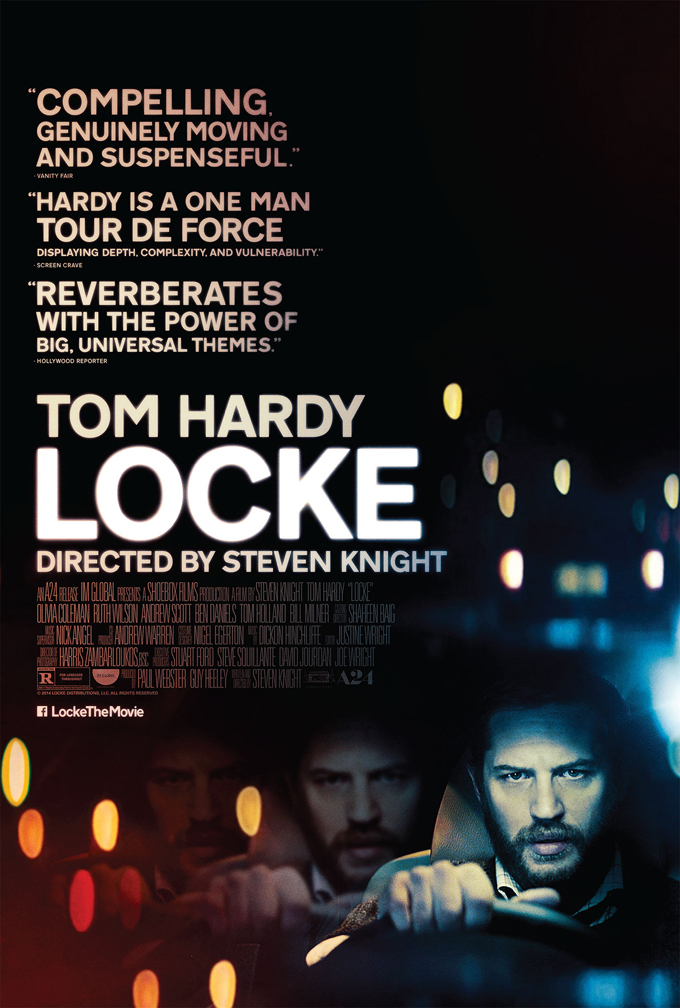 Essentially a one-man show, write/director Steven Knight’s film spends every one of its minutes inside a car with its titular star played by Tom Hardy. Over the course of one real-time late-night drive to London, our driver confronts a series of moral crossroads both personal and professional. It takes a while to get going but once the main conflicts are established, it’s a pleasure watching Hardy try and orchestrate all of them into complacency in the comfort of his car. I kept imagining how someone would translate this into an intimate stage show. The tension builds nicely as Locke has to come to terms with accepting he cannot fix his mistakes. The biggest drawback is that the film abruptly ends without much in the way of a payoff. The whole time Locke is on a mission, berating his invisible absentee father he envisions in his backseat, determined not to make the same mistakes, but then the movie just limps to a finish. It could have used another 10-15 minutes of resolution to feel more complete. Hardy is strong and keeps your attention, often offering glimpses of the complex emotions he’s trying to hide. An intriguing film experiment in minimalism, there are worse ways to spend 85 minutes than inside a car with Tom Hardy. However, there are also better ways.
Nate’s Grade: B
Share this:

Exodus: Gods and Kings (2014)
 Director Ridley Scott (Prometheus) is back to work some of his Gladiator magic on another sword-and-sandals epic, the classic story of Moses, this time played by an ever-bedraggled and bearded Christian Bale. It’s been a banner year for Christianity at the movies, though most of those films have been uninspiring save for Darren Arofonsoky’s radical and ambitious Noah. That movie did not go over well with many conservative ticket-buyers. That’s the danger of adapting the biblical epics; pleasing the core audience means not straying too far from the accepted renditions of the oft-told tales, no matter if those popular renditions are themselves inerrant. Exodus: Gods and Kings is an underwhelming translation that slogs through the miraculous. It’s empty CGI wonder in place of authentic storytelling and emotional resonance.
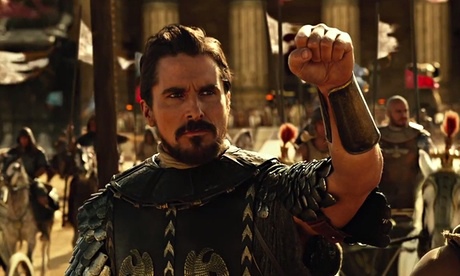 Exodus: Gods and Kings is a big-budget biblical epic that is startling in what it lacks, namely any amount of surprise or character development. The Moses story is oft told so I’m glad that Scott’s film skips ahead to when he’s already an adult. No basket in the reeds necessary. The brotherly conflict has little impact because, besides Moses, no other character is even given proper attention. Ramses (Joel Edgerton) is pretty much a thoughtless killer from the start, someone who ignores his advisers when it comes to political unrest and just slaughters his own starving people. He is by no means a dynamic villain in any shape, which is disappointing because the role has such dramatic potential. The 1998 animated film The Prince of Egypt did a better job exploring the relationship between Moses and Ramses, the pharaoh. In fact, that movie did just about everything better, and it had some pretty songs too. Stuck with a one-note villain, Exodus tries to round out Moses by making him a figure of doubt, providing an arc where he finds his voice when he finds his faith in Judaism. The film even sets it up so Moses has to go on his quest so he can just return home to his family. It’s a pretty strict hero’s journey storyline. Bale is plenty good. His character just isn’t that interesting nor is anyone else. Being stuck with this crew for 150 minutes can get to be rather tedious. That’s because the real emphasis has been put on the special effects and digital landscapes. The action is acceptable but little sticks in your memory. I’m starting to become numb to CGI spectacle. I’m starting to think back to the epics from the 1950s and 60s, when there was no such thing as computer effects. Every person assembled for those epic shots of huddled masses was a real human being, and that’s becoming more impressive with each and every CGI spectacle with copy-and-paste digital figurines.
Given the predictable nature of the plot, you try and find little moments or directions that stand out, something, anything to mark this newest Moses story as different from the numerous retellings of cinema’s past. Beyond the modern-day special effects and the strength of Scott as a visual artist, here is a short list of what you have to look forward to with Exodus: Gods and Kings.
1) An attempt to ground a biblical epic with realism. If conservative audiences were upset with Aronofsky’s portrayal of the Almighty in Noah, just wait till they see what Exodus does. It’s not that God has been removed from the tale, it’s just that God has been mitigated in a way as to provide a rational throughline to follow the supernatural events of the ten plagues and so on. There’s even the possibility that Moses is just seeing things in his head. Two different characters advise Moses that being hit on the head could be the real source for his visions of God. Joshua (Aaron Paul) spies on Moses at several points arguing with God but sees no one else. The plagues are presented in a cause and effect series of misfortunes, with the Nile being turned red due to a surge of crocodiles munching on all the fish. The polluted water then causes the frogs to leave en mass, which then causes them to die and bring about waves of flies, which bring disease to sicken the livestock as well as boils for the Egyptians. Some thought went into this, however, it’s all inconsequential with the Angel of Death killing the first-born sons. There’s no real skeptical or scientific method to explain away this one, as the biblical story relates, and so the grounded approach seems misplaced. It takes away the miraculous from the miracles. And yet, even the parting of the Red Sea is given this same approach, with it resembling low tides brought about by perhaps a meteor strike. The fantastical nature of the Moses story feels handicapped by going a more realistic route. This is not the biblical epic for realism.
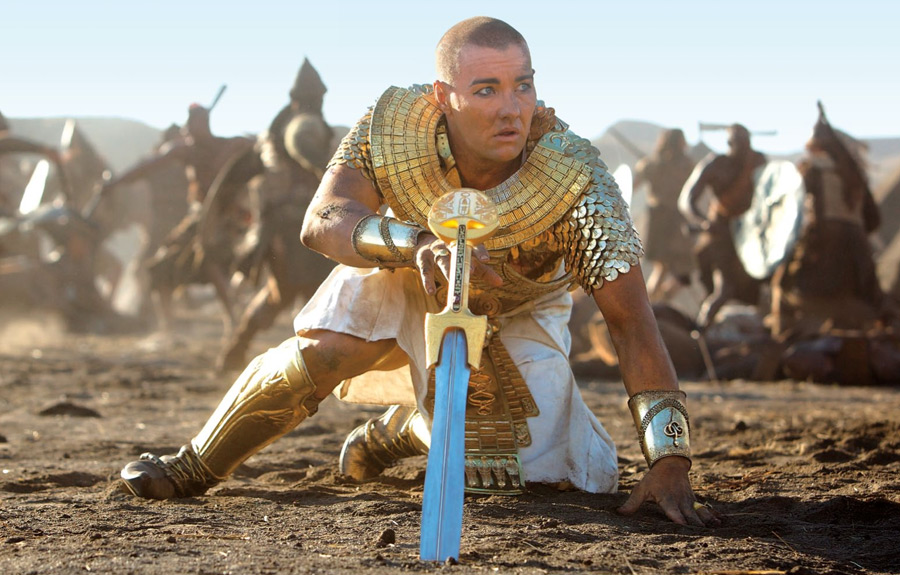 2) God is literally represented as a petulant child. When God does make Himself present for Moses, it’s in the form of a young child who is often mocking his servant. This is an angry often-bloodthirsty God who doesn’t appreciate being challenged. He complains how long Moses is taking with his war of attrition, and Moses says right back, “Impatient? You waited 400 years with ‘your people’ in slavery.” A fair complaint, and one that God does not answer.
3) Bad overall casting. Whitewashing isn’t exactly a new trend in Hollywood. It’s not like Charlton Heston looked particularly Middle Eastern. However, it’s rather distracting to watch a movie starring Egyptians and Middle Eastern Jews portrayed by a Welshman, an Australian, John Turturro, Sigoruney Weaver and Aaron Paul. I am a fan of each of these actors but they are just wrong for these parts. There are very little people of any color in the film despite the fact of its geographic location. Moses marries Zipporah, who several biblical scholars believe to be Ethiopian, which seems like a natural opportunity for some much-needed diversity in the cast. Just because you give Paul a bushy beard does not mean he suddenly resembles a Middle Eastern Jew. Same thing with adding eyeliner and bronzer to Edgerton. Then there’s the bizarre appearance of Scottish actor Ewen Bremner (The Rundown) as an adviser for the king. Taken as a whole, the whitewashing is a nagging distraction from a supposedly more grounded approach. To be fair, having relatively unknown (as far as the public is concerned) actors of appropriate ethnic background speaking in subtitled Hebrew and Egyptian sounds like a hard sell for a studio footing a $140 million dollar bill.
4) Lots of dead horses. This is not a friendly movie for our equine friends.
5) Moses sex. Well, sort of, because showing a husband and wife being physically intimate will still offend some of the more conservative ticket-buyers. So after Moses goes through his somewhat romantic question and answer ritual with his wife, the camera pans away from the disrobing couple and fades out. Classy. Now on to more CGI spectacle and carnage thank you very much.
I admire Noah more and more and think he successfully found a way to make a biblical epic accessible, challenging, and complex morally and psychologically without sparing the dark details. In essence he found a way to make a popular story new and interesting again. Scott’s Exodus just leaves me shrugging my shoulders. It’s by no means an appalling film. Beyond the big-budget modern-day spectacle, there isn’t enough going on in this movie to even justify all the expenses. The characters are too sketchy and given little to do, especially Ramses who pretty much just sneers and barks for 90 minutes. The costumes are fancy, the production design is lush, and all the technical elements are impeccable. It just falls woefully short on what should make you care. It feels like a product more than a film and a resonating story, and as such it’s delivered just in time for the Christmas shopping season for the masses. The film takes too long to get started and too long to conclude. It has some moments in the middle, especially when Moses is plotting his political insurrection, but as a whole Exodus is disappointingly lackluster. It ends up becoming empty and noisy CGI spectacle, with lots of yelling to compensate. It’s hard to find inspiration from the film when you’re checking your watch.
Nate’s Grade: C
Share this:

The Theory of Everything (2014)
 A biopic on the life of Stephen Hawking, arguably one of the most brilliant men in the world, stricken with ALS and given only two years to live, should be resolutely fascinating and inspirational. And it is at points, but there’s still a gnawing dissatisfaction with The Theory of Everything, a sense that there isn’t more to it, that it lacks a center, that, primarily, it should be better. The film follows Stephen (Eddie Redmayne) as a PhD student who immediately falls in love with Jane (Felicity Jones). Shortly after their courtship, he is diagnosed with ALS and rather than preparing for the end, he pushes forward to great intellectual discovery and achievement, though the hardships and care for his physical disability places tremendous strain on his marriage to Jane. The film does a nice job of examining how a relationship comes to an end and without having to cite one party or another as a villain. It’s so measured and understanding and empathetic, but it’s also somewhat docile and hesitant, keeping its distance when it could dive deeper into Hawking and his family. Theory is far too reliant upon the tropes of biopics, speeding through significant moments for Stephen and Jane with an almost comical degree (watch how quickly the kids multiply). The moments that stray from this formula are the ones that stick the most, like a shocking moment where Stephen exits his chair to pick up a fallen pencil, a striking and poignant moment so effectively communicating the desires of its character. The film needed more creative detours. Director James Marsh (Man on Wire) has a good command of his visuals but I was left wanting a more daring approach to a story of human endurance, like 2007’s Diving Bell and the Butterfly. The real reason to watch the film is the amazing performance by Redmayne (Les Miserables). The physical control he’s able to have over his body in the latter stages is astounding, but his performance is much more than just a collection of tics. There’s a moment late in the film where, even in his limited facial configuration, he breaks your heart with the richness of his acting. It’s such a great performance that you just wish the rest of The Theory of Everything could measure up.
Nate’s Grade: B-
Share this:

Kirk Cameron’s Saving Christmas (2014)
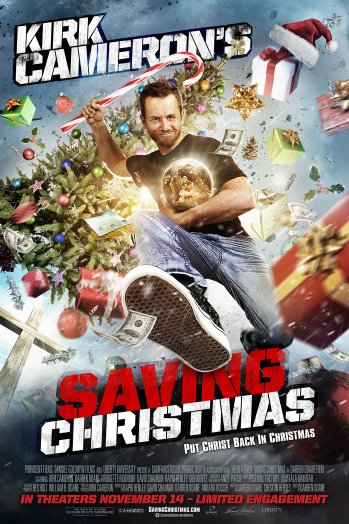
Given the title, Kirk Cameron’s prominent placement, and a poster involving Cameron with a background explosion of holiday paraphernalia, one would assume Saving Christmas would concern itself with the oft-repeated “War on Christmas.” I was expecting Cameron to lament our use of “Happy Holidays” and the like. Perplexingly, Cameron’s war is not with those outside Christianity but those within. Saving Christmas is a shoddy evangelical sermon with shoddier theology, straining to fill out a running time, and ultimately being pro-materialism and anti-empathy. Come again?
At Kirk’s (Cameron) family Christmas party, his brother-in-law Christian (Darren Doane) is a Grinch. He complains that Christmas has been co-opted by secularism. Santa Claus and other symbols with pagan origins dwarf the nativity and baby Jesus. Christian removes himself from the party and sits in his car. Kirk won’t allow this to stand. He gets inside the car and proceeds to explain why Christian is wrong about Christmas.
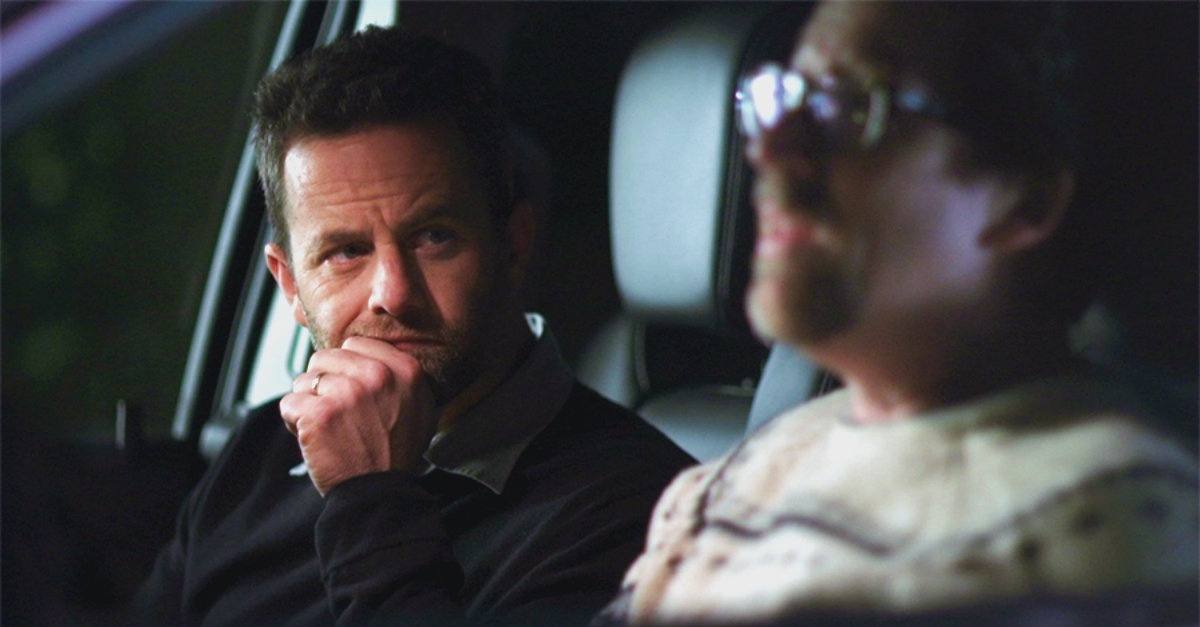
To call this a film is to be more charitable than perhaps even Jesus would be. Saving Christmas (or Kirk Cameron’s Saving Christmas as listed in certain places) is a smug sermon presented by Kirk Cameron lecturing his “bro”-in-law in a car. The majority of the film takes place in a parked car. If that sounds deeply cinematic to you, then stick with me. The film shambles its way to 80-minutes, exasperating to fill out a minimum feature-length running time. There’s about ten minutes of “hilarious” bloopers. There’s a five-minute opening where Cameron speaks directly into the camera and sips from his mug of hot chocolate three separate times. There’s a five-minute, though it feels tortuously endless, “hip hop Christmas dance” performance by a bunch of white people (it is powerfully uncoordinated, like you’re watching someone’s home movie of their kids). You do get to watch Cameron effectively do the Worm, though (his finest acting moment onscreen, in my humble opinion). There’s also the occasional, very tin-eared comedy break with supporting characters that skirt the line into stereotypes. When it all comes together, there’s maybe a total of 40 minutes of an actual movie here, laboriously stretched out. And when I say “movie” I mean Cameron and Christian talking back and forth in a stationary car. This is not a movie. At all.
Director and co-writer Doane is one of the most inept filmmakers I’ve observed. This is a horrible looking movie with many clueless edits and strange visual compositions. His onscreen wife is always seen looking wary and in slow motion, like her face has frozen. There’s also the annoying habit of not properly framing his subjects, who will get caught behind a pot of hot chocolate or some poinsettias. This is just bad filmmaking. The lighting is amateurish or overdone, like when Kirk spends about five minutes standing back-lit, as to communicate his inherently angelic nature. Doane will also keep focusing on repeating scenes like he’s filling time. The film has a very rushed and patched-together feel, as if they had a weekend to film it at Cameron’s place with his friends and family. The “comedy relief” is also terribly executed, with two characters having a conversation holding mugs to their face, the better to disguise the fact that one of them is not actually speaking his lines. The pacing is also dead. The movie keeps faking you out when it’s going to end but then continues on, overstaying its welcome so Cameron can have yet another victory lap to hear himself talk.
Cameron and his producers seem to subscribe to an all-or-nothing approach when it comes to recognizing the malleable symbolism of cultural artifacts. Is there any harm in acknowledging the past connections of certain ceremonial customs and artifacts we use today? While the origins of the Christmas tree can go back to the pagans, Cameron seems to forget to mention that it was Martin Luther who took the Christmas tree as a German holiday tradition and gave it a Christian spin. Of course acknowledging such would indicate that the Christmas tree wasn’t always the same symbol. But who cares? History is a melting pot as far as cultures are concerned, and we pick up many customs that become passed down for various reasons, often expanding and adapting. Is there any implicit harm in simply admitting that a Christmas tree has an origin that predates Christianity? Today it is a different symbol commemorating a different holiday. Just because we know history doesn’t somehow devalue our customs and traditions. Cameron and his cronies seem to disagree, which is why he presents flimsy arguments to reclaim historical authority. What he’s really doing is treating the symbols of the season as metaphors, applying deeper meaning to them. That’s fine and good. If Cameron wants to see the Christmas tree as a representation of the cross, or the trees of the Garden of Eden, that’s fine. But he shouldn’t pretend that this interpretation is gospel. That’s the thing about metaphors; they’re subjective and pliable. They are not absolute.
Amazingly, Saving Christmas ends up becoming a misguided and ludicrous defense of materialism and the commercialism attached to Christmas. In Cameron’s very narrow perspective, anything associated with the holiday has to be positive. Yes, Cameron literally argues that all the material excess and spending actually honors God. Instead of looking at the presents under the tree as just that, look at them as the outline of a skyline of a new Jerusalem, Cameron offers in one of the more head-scratching moments. He conflates the spending of money with celebration, admonishing people to buy “the biggest ham, the richest butter” as long as they just don’t “max out their credit cards.” That’s the limit he sets, so everything below that must be agreeable. Just to hammer the message home further, Cameron says that materialism is good because “Christ was made material.” That sure is a slippery slope of ethics there. It’s not much of a leap to then justify greed or to equate spending the most money with being the godliest. Why would any film, let alone a Christian one, choose to defend unchecked materialism?

I know Christian is more a foil for Cameron to helpfully inform, a straw man who cannot articulate his intellectual rationale, but Christian is the worst skeptic of all time. If he truly believed what he does then he should be able to provide evidence to support his stance. It wouldn’t be hard. The historical record is loaded with stuff ready-made to counter-argue Kirk’s cherry picking of relevant theology. The very concept of late December existing as a pagan holiday celebrating the winter solstice (Saturnalia) is backed up by a treasure-trove of sources, despite Cameron’s snide rejoinder that “last time I checked, God created the winter solstice.” The Romans would even exchange gifts on December 23 in celebration and feast. If Christian were a real skeptic, he’d at least have a cursory knowledge of this stuff before even approaching specifics. Instead he sputters and is proven to be a fraud, duped into believing these anti-Christmas thoughts. Every time Kirk finishes another of his rather unconvincing asides, Christian shakes his head, dumbfounded, and says he never looked at things like that. He is the most easily converted skeptic since the Spanish Inquisition.
I kept going back in my head to a vital point of Christian’s that is never referenced or challenged by Cameron: wouldn’t all this money better be spent helping the disadvantaged? Christian looks at the extravagant money spent on an ostentatious party and thinks of how many people could have been fed, how many wells could have been dug in villages. “You’re wrong,” Kirk says. “About everything. You’ve drunk the Kool-Aid.” Even as Cameron bends over backwards to defend materialism, he never addresses Christian’s fundamental point, which is that the money can be better spent elsewhere. To the movie’s worldview, Christian is a “jerk” and he’s “terrorizing” (I kid you not, they specifically use the word “terrorize”) his family with his negativity. This is a guy who wants to put the “Christ back in Christmas” and he’s setup as the bad guy. He’s not storming the party, aggressively challenging people, calling them names. He sits to himself, eventually leaving the space for his car. It doesn’t sound like he’s terrorizing anyone and is rather considerate of others. No matter, no one is allowed to have a different opinion than Kirk Cameron and so he will not allow one man’s empathy to bring everyone else down as they spend lavishly to celebrate the birth of a poor carpenter.
And that’s what’s most distressing for me when it comes to this poorly made and poorly reasoned movie; I’m concerned that others will use Cameron’s distorted teaching as a justification for excess over empathy. Cameron seems to use the film as a defense of his affluent privilege. He uses the Bible to back up his lifestyle and to defend materialism. Did we forget that part where Jesus said to sell all your possessions and help the poor? The film is packaged as a comedy and a family movie with a spiritually uplifting message, but what’s so uplifting about saying “SPEND SPEND SPEND” is how you show love? Just because Cameron says a nutcracker is representative of King Herod’s foot soldiers prowling Jerusalem for the baby Jesus doesn’t make it strictly so. To call this a movie would be too charitable and I am not in the season of giving. Saving Christmas is a lump of coal disguised as a open-hearted message. Skip this movie and donate your money instead to some charity. At least that will do some actual good.
Nate’s Grade: D
Share this:

Inherent Vice (2014)
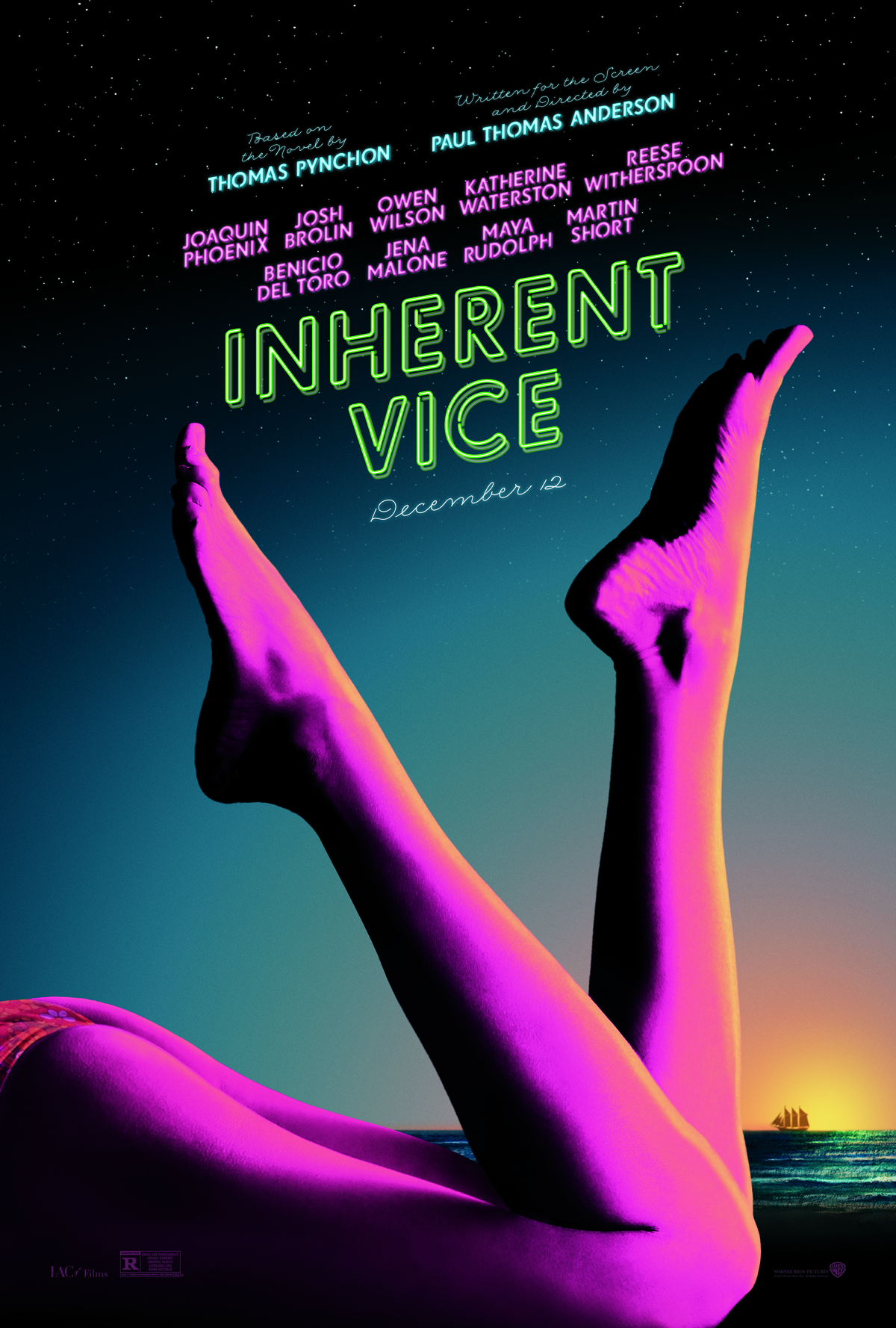 This is one of the most difficult reviews I’ve ever had to write. It’s not because I’m torn over the film; no, it’s because this review will also serve as my break-up letter. Paul Thomas Anderson (PTA), we’re just moving in two different directions. We met when we were both young and headstrong. I enjoyed your early works Paul, but then somewhere around There Will be Blood, things changed. You didn’t seem like the PTA I had known to love. You became someone else, and your films represented this change, becoming plotless and laborious centerpieces on self-destructive men. Others raved to the heavens over Blood but it left me cold. Maybe I’m missing something, I thought. Maybe the problem is me. Maybe it’s just a phase. Then in 2012 came The Master, a pretentious and ultimately futile exercise anchored by the wrong choice for a main character. When I saw the early advertisements for Inherent Vice I got my hopes up. It looked like a weird and silly throwback, a crime caper that didn’t take itself so seriously. At last, I thought, my PTA has returned to me. After watching Inherent Vice, I can no longer deny the reality I have been ducking. My PTA is gone and he’s not coming back. We’ll always have Boogie Nights, Paul. It will still be one of my favorite films no matter what.
 In the drug-fueled world of 1970 Los Angeles, stoner private eye Doc (Joaquin Phoenix) is visited by one of his ex-girlfriends, Shasta (Katherine Waterston). She’s in a bad place. The man she’s in love with, the wealthy real estate magnate Mickey Wolfmann (Eric Roberts) is going to be conned. Mickey’s wife, and her boyfriend, is going to commit the guy to a mental hospital ward and take control of his empire. Then Shasta and Mickey go missing. Doc asks around, from his police detective contact named Bigfoot (Josh Brolin), to an ex (Reese Witherspoon) who happens to be in the L.A. justice department, to a junkie (Jena Malone) with a fancy set of fake teeth thanks to a coked-out dentist (Martin Short) who may be a front for an Asian heroin cartel. Or maybe not. As more and more strange characters come into orbit, Doc’s life is placed in danger, and all he really wants to find out is whether his dear Shasta is safe or not.
Inherent Vice is a shaggy dog detective tale that is too long, too convoluted, too slow, too mumbly, too confusing, and not nearly funny or engaging enough. If it weren’t for the enduring pain that was The Master, this would qualify as Anderson’s worst picture.
One of my main complaints of Anderson’s last two movies has been the paucity of a strong narrative, especially with the plodding Master. It almost felt like Anderson was, subconsciously or consciously, evening the scales from his plot-heavy early works. Being plotless is not a charge one can levy against Inherent Vice. There is a story here with plenty of subplots and intrigue. The problem is that it’s almost never coherent, as if the audience is lost in the same pot haze as its loopy protagonist. The mystery barely develops before the movie starts heaping subplot upon subplot, each introducing more and more characters, before the audience has a chance to process. It’s difficult to keep all the characters and their relationships straight, and then just when you think you have everything settled, the film provides even more work. The characters just feel like they’re playing out in different movies (some I would prefer to be watching), with the occasional crossover. I literally gave up 45 minutes into the movie and accepted the fact that I’m not going to be able to follow it, so I might as well just watch and cope. This defeatist attitude did not enhance my viewing pleasure. The narrative is too cluttered with side characters and superfluous digressions.
The plot is overstuffed with characters, many of which will only appear for one sequence or even one scene, thus polluting a narrative already crammed to the seams with characters to keep track of. Did all of these characters need to be here and visited in such frequency? Doc makes for a fairly frustrating protagonist. He’s got little personality to him and few opportunities to flesh him out. Not having read Thomas Pynchon’s novel, I cannot say how complex the original character was that Anderson had to work with. Doc just seems like a placeholder for a character, a guy who bumbles about with a microphone, asking others questions and slowly unraveling a convoluted conspiracy. He’s more a figure to open other characters up than a character himself. The obvious comparison to the film and the protagonist is The Big Lebowski, a Coen brothers film I’m not even that fond over. However, with Lebowski, the Coens gave us memorable characters that separated themselves from the pack. The main character had a definite personality even if he was drunk or stoned for most of the film. Except for Short’s wonderfully debased and wily five minutes onscreen, every character just kind of washes in and out of your memory, only registering because of a famous face portraying him or her. Even in the closing minutes, the film is still introducing vital characters. The unnecessary narration by musician Joanna Newsome is also dripping with pretense.
 Another key factor that limits coherency is the fact that every damn character mumbles almost entirely through the entirety of the movie. And that entirety, by the way, is almost two and a half hours, a running time too long by at least 30 minutes, especially when Doc’s central mystery of what happened to Shasta is over before the two-hour mark. For whatever reason, it seems that Anderson has given an edict that no actor on set can talk above a certain decibel level or enunciate that clearly. This is a film that almost requires a subtitle feature. There are so many hushed or mumbled conversations, making it even harder to keep up with the convoluted narrative. Anderson’s camerawork can complicate the matter as well. Throughout the film, he’ll position his characters speaking and slowly, always so slowly, zoom in on them, as if we’re eavesdropping. David Fincher did something similar with his sound design on Social Network, amping up the ambient noise to force the audience to tune their ears and pay closer attention. However, he had Aaron Sorkin’s words to work with, which were quite worth our attention. With Inherent Vice, the characters talk in circles, tangents, and limp jokes. After a protracted setup, and listening to one superficially kooky character after another, you come to terms with the fact that while difficult to follow and hear, you’re probably not missing much.
Obviously, Inherent Vice is one detective mystery where the answers matter less than the journey and the various characters that emerge, but I just didn’t care, period. It started too slow, building a hazy atmosphere that just couldn’t sustain this amount of prolonged bloat and an overload of characters. Anderson needed to prune Pynchon’s novel further. What appears onscreen is just too difficult to follow along, and, more importantly, not engaging enough to justify the effort. The characters fall into this nether region between realism and broadly comic, which just makes them sort of unrealistic yet not funny enough. The story rambles and rambles, set to twee narration that feels like Newsome is just reading from the book, like Anderson could just not part with a handful of prose passages in his translation. Much like The Master, I know there will be champions of this movie, but I won’t be able to understand them. This isn’t a zany Chinatown meets Lewboswki. This isn’t some grand throwback to 1970s cinema. This isn’t even much in the way of a comedy, so be forewarned. Inherent Vice is the realization for me that the Paul Thomas Anderson I fell in love with is not coming back. And that’s okay. He’s allowed to peruse other movies just as I’m allowed to see other directors. I wish him well.
Nate’s Grade: C+
Share this:

Nightcrawler (2014)
 The surprise of Nightcrawler is that it works well on different levels: as a psychological descent with a deranged lead, as a media critique on sensationalism, and as a genre thriller. Jake Gyllenhaal (Prisoners) gives a truly transfixing performance as Leo Bloom, an ambitious sociopath who will stop at nothing to become the best at what he does. It so happens he films accident and crime footage to sell to the local news stations, and he’s not beyond getting his hands dirty if it means a better camera angle or a better payday. The actor reportedly lost 30 pounds and he appears otherworldly, his lanky frame and gaunt face making his bulging eyes pop. There’s a hypnotic intensity to his performance and a darkly comic irony that he speaks almost entirely in business buzzwords and jargon. The film chronicles his rise to power and how he uses his leverage to manipulate the people around him. The media satire is a little heavy-handed but still makes its points, especially in an age of scandal and hysteria. Rene Russo is also great as the desperate and bloodthirsty news producer who is charmed by Bloom but then gets too far in. Writer/director Dan Gilroy (brother of Tony) has crafted a haunting central figure that is morally repulsive yet entirely engaging, especially with a career-best performance from Gyllenhaal. He’s a fascinating psychological case, even if he remains relatively the same character from the start. He makes every moment an opportunity in suspense. Gilroy has a natural sense for visuals and especially how to pace his tension, drawing it out with precision in the final act as Bloom’s arrangements cause disaster. The nighttime Los Angeles setting and swirling tension remind me of Michael Mann’s Collateral. This is a movie that sticks with you long after thanks especially to the power of Gyllenhaal.
Nate’s Grade: B+
Share this:

Dom Hemingway (2014)
 Undeservingly lost in the shuffle, Dom Hemingway is a brash and wildly entertaining dark crime comedy. Jude Law is a sheer force of nature as the title character, a charismatic and garrulous criminal with no shortness of ego or volume. He’s just getting out of a 12-year jail sentence and taking stock of his life. His wife is dead, his grown-up daughter (Game of Thrones’ Emilia Clarke) hates him for his absence, and his bosses are ready to reward him for his long silence. The only person who could screw things is up is Dom, and he does, as he’s prone to impulsive fits, shouting matches, and oversized bravado. This is really a series of comic vignettes and vulgar monologues, but the writing by Richard Shepard (The Matador) is slyly hilarious, leaving me in stitches throughout (“I am not burying your body today! I didn’t bring the right shoes for it.”). The comic voice here is assured and finely attuned to the broad wavelengths the characters. It’s not exactly he colorful, cartoon criminal universe of early Guy Ritchie films, but there’s a definitely heightened atmosphere here that blends well with the manic nature of Dom. Law is bouncing off the walls; you may have to wash the spittle off your TV. But he’s compelling from his first minute onscreen to his last. The third act squeezes in a degree of emotions though by then we’ve been enjoying the depravity too much to switch focus. I don’t think the work has been put in to make Dom a three-dimensional character, but that won’t stop Dom’s film from being a blast of entertainment with swagger to spare.
Nate’s Grade: A-
Share this:

The Hunger Games: Mockingjay Part 1 (2014)
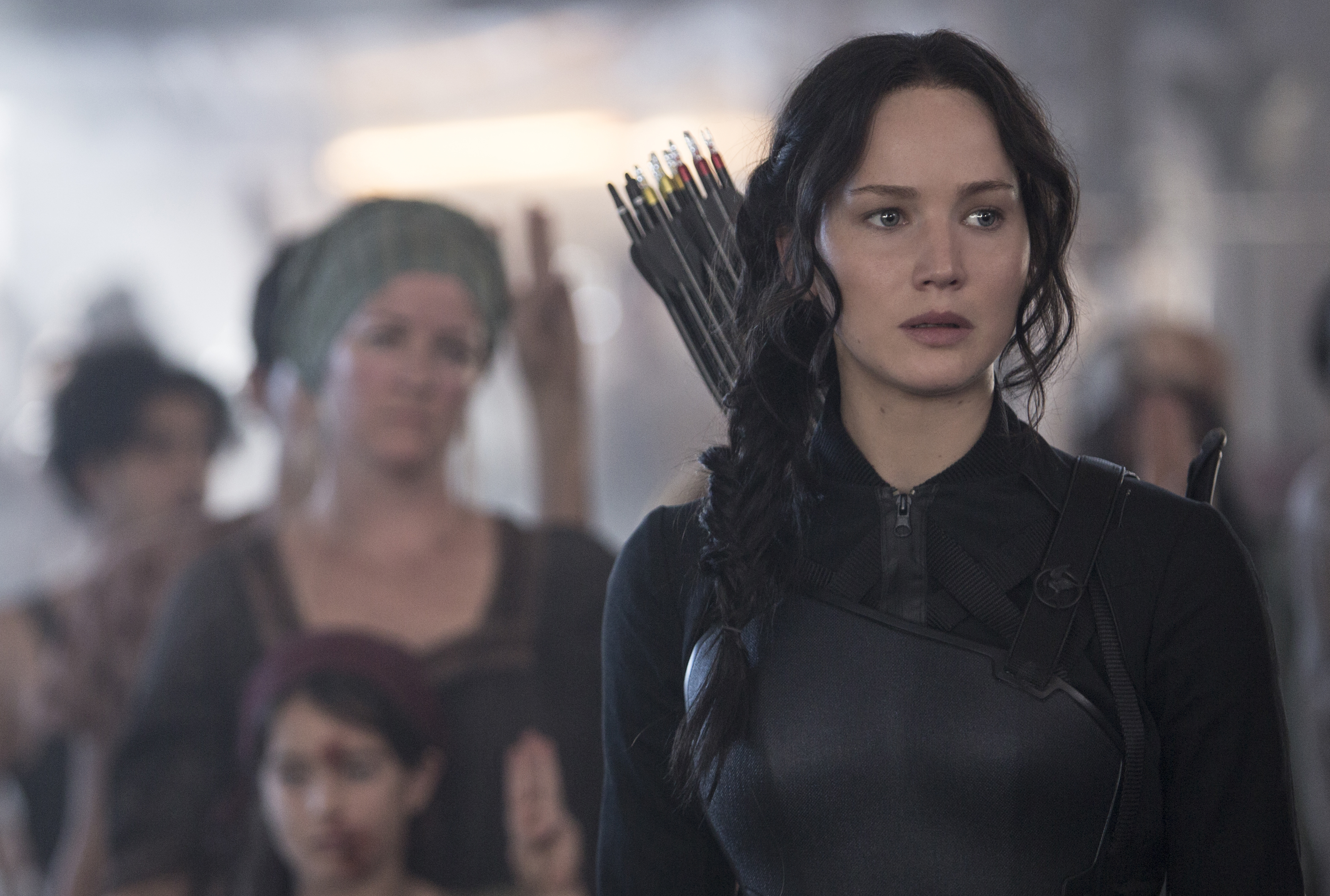
 Taking place immediately after Katniss (Jennifer Lawrence) was rescued from the events of Catching Fire, we find ourselves locked away underground with the residents of District 13. Long believed annihilated by the Capital, and its tyrannical leader President Snow (Donald Sutherland), the people rebuilt their society as one large series of underground bunkers, preparing for a day of revolt. The leader of District 13, Coin (Julianne Moore, under a thick grey wig), is wary of Katniss as the symbol of the revolution. She would rather fight the Captiol without her, but the people love her, and it is the common people that Coin and her team must struggle to unite and inspire. Katniss is not exactly in the inspirational mood. Her family was saved from District 12 before it was bombed but the Capital holds Peeta (Josh Hutcherson) as a high-profile captive, ready to denounce the latest aggressive acts of the rebels as foolish and dangerous. Katniss desperately wants to rescue Peeta but before she can she has to accept her fate and become the Mockingjay, the figure to rally the districts in war.
 The very title The Hunger Games: Mockingjay Part 1 both tells you everything and nothing. Firstly, there are no Hunger Games anymore. This is a full-on war film, and we’re finally getting to all the good stuff, the revolutions stirring all throughout Panem we heard about and caught glimpses of before the plot required a redo of the games, repeating the structure of the first film. It felt overly redundant, especially when the stuff outside of the games was far more interesting. That structure has been cast aside and Mockingjay is a completely different film than the ones before it, focusing much more on character and the politics of propaganda. In many ways, this is a quieter film that allows the characters to deal with the trauma of their experience in the deadly arena. Even though war is fermenting and people are being bombed into oblivion, there is considerably less urgency, especially less contrived urgency. This allows the characters and the plot to breathe, the calm before the storm. Much has changed and a measured amount of time to process this is a good move. This is no longer the Hunger Games. This is war. The subterranean District 13 is the major setting of our film, which gives Katniss time to reflect on how damaged she is and her guilt over what exactly the Capitol is doing to their promotional lapdog, Peeta. The movie opens with her muttering to herself, hiding from others due to a disturbing nightmare. The psychological well being of our heroine is a ripe topic. While the world is on fire, much is once again expected of Katniss, and we get to watch her transform, awkwardly, into the revolutionary figure others require of her. The political and media critiques add another level of entertainment, as each side spins and contorts to position themselves for the news cycle. This expose of media manipulation makes Mockingjay feel in part like a post-apocalyptic Wag the Dog. Credit co-screenwriter Danny Strong, he of HBO’s Recount and Game Change fame. This welcomed change of pace and structure allows the film to finally feel like the story we want to watch. And while I’m tip-toeing around spoilers, I’ll just say that the split occurs exactly where you think, book readers.
And secondly, the “Part 1” of the title is also what defines this 125-minute prelude to the concluding movie, a fact that becomes inescapable as it seems all the good stuff is being reserved for later. While the reflective plotting allows more space to breathe, it also becomes abundantly clear that this wasn’t exactly a story that needed to be told in two parts. From a financial standpoint, I can’t argue with the decision from Lionsgate. This is their once-in-a-lifetime franchise and elongating the final film in YA franchises has become de rigueur and a box-office no-brainer. Still, the overwhelming feeling is that this is all setup and the best stuff is just ahead, a tease that the franchise also toyed with during Catching Fire, as we were stuck in the games instead of the revolution. Mockingjay Part 1 is mostly buildup; it’s entertaining and more politically adroit than expected, but in the end it’s still a story stretched out. The intriguing supporting characters from Catching Fire are still mostly put on hold. The inclusion of Gale (Liam Hemsworth) still feels relatively pointless in the scheme of things, except for prolonging the love triangle, the weakest element of the story by far, and one that even author Suzanne Collins seems half-hearted about. When the world is falling apart, who cares which boy Katniss decides to kiss? Old favorites like Haymitch (Woody Harrelson) and Effie (Elizabeth Banks) get brief appearances but little else. There is a stark decrease in action with this movie, only two real sequences of suspense, and one of them proves to be false. Strangely enough, there’s a high-stakes nighttime raid that plays out unironically like a dystopian Zero Dark Thirty finale. I await others to make a similar comparison. It’s no surprise that Mockingjay becomes more suspenseful, engaging, and meaningful just as it’s ending, leaving less on a cliffhanger and more on a latent promise. Instead, this particular movie features a lot of speeches and hushed discussions in dank quarters (the photography is rather dimly lit and hard to decipher at times). It’s not exactly rollicking.
 Being a war film, atrocities are commonplace and examined openly, especially when Katniss visits the ruins of her home in District 12. Not once but twice does the camera slowly zoom out to allow the graveyard of charred skeletons to gets its thematic due. There’s only so far a mandated PG-13 rating can take you when it comes to illustrating the horrors of war, but I give Mockingjay credit for neither glossing over the loss of innocent life or glorify the leaders of this revolution, namely District 13. President Coin is shown to be a calculating and pragmatic leader who is concerned more about the big picture. She’s thankful for Katniss but just as ready to move onward and forget her. By the end of the movie, you don’t exactly have warm feelings for the people of District 13, who laid in wait, sowing seeds of rebellion with the other districts, all the while relying on their bunker for ultimate safety. The other districts are more vulnerable and more likely to feel the Capital’s wrath. Just ask the smoldering citizens of District 12.
Director Francis Lawrence (I Am Legend, Constantine) is the Hunger Games’ version of David Yates, the director who steered the concluding four Harry Potter films. Chris Columbus put that world together, but a better, more visually adept director saw Potter through to its end. Likewise, Lawrence has taken the world that the original Games director Gary Ross cultivated and given it the mood and visual heft needed for the franchise to feel properly and triumphantly cinematic. If it weren’t for this man’s visual talents, the many conversations in the dark would be even harder to watch. Lawrence has been a helpful addition to the franchise, especially as the world was starting to get more fleshed out. While I bemoan the overly gloomy cinematography (which was also an issue with Catching Fire), Lawrence has brought a necessary sense of gravitas to the series. The emotional pain and psychological torment registers, and his handling of his actors will often be overlooked thanks to the natural talent of his lead actress, but Lawrence has found a way to strike the right tone to make us care.
Speaking of the woman in question, Jennifer Lawrence (American Hustle) is already an Oscar-winning Hollywood star in her mid twenties, and she elevates these films even more. Her character is a reluctant figurehead, never having asked for such prominence, nor having asked to trigger a revolution with countless casualties. Without as much physical activity and arrow slinging, Lawrence gets greater opportunities to emote and show the fractured, conflicted feelings of the woman in the middle of the revolt. She’s not a natural when it comes to being on-camera, she cannot fake sincerity (even though she played up the whole “star-crossed lovers” angle in the first film as a means of survival, but whatever), and it’s somewhat funny watching skilled actors pretend to be bad actors. The emotions are on a hair trigger here, as rage boils over to fear and shock. Lawrence anchors the series with another surefooted, strong performance.
The real standout is Sutherland (The Italian Job). This is as much President Snow’s movie as it is Katniss Everdeen’s. Rather than plotting from the shadows, Snow gets to become the worthy villain the franchise has been waiting for. Sutherland relishes his retorts with Katniss and preying upon her. His broadcasting of an ever-increasingly frail Peeta is more meant as a crushing psychological blow, a reminder that his prized hostage will be punished for Katniss’s and the rebellion’s mounting successes. When they’re finally face-to-face once more, it’s the film’s most invigorating moment.
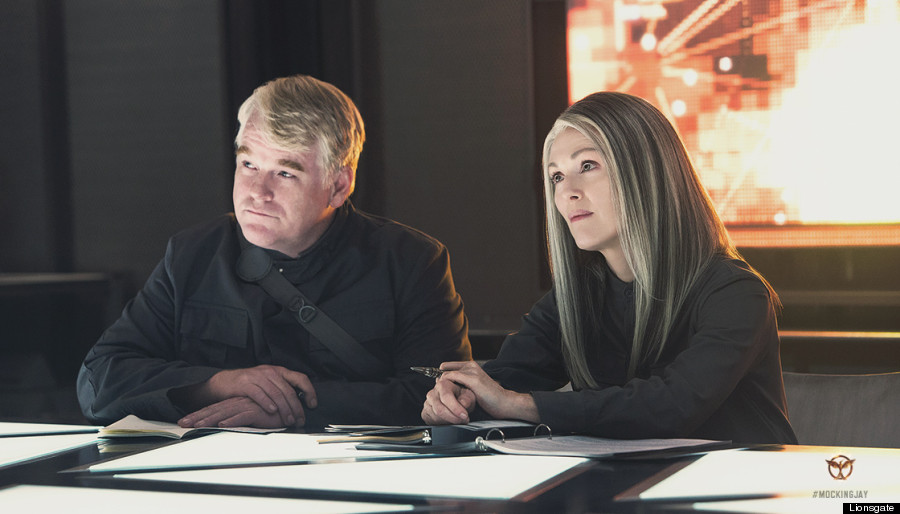 It’s also hard to watch the movie and not feel grief over the loss of actor Phillip Seymour Hoffman. Mockingjay Part 2 will officially be the actor’s last onscreen appearance. He’s good, though the part isn’t exactly challenging, but the real pang is the realization that we’ll never get another Hoffman performance. Once the final minute of Plutrarch Heavensbee is gone onscreen, so is the cinematic ghost of a ridiculously talented man who was taken from the world far too soon. In a nice gesture, Mockingjay Part 1 is dedicated to his memory.
Once more into the breach, dear friends, as Mockingjay Part 1 lays the way for the promise of an exciting and action-packed finale. The extra pause, the last breath before the melee, is both a blessing and a curse. It allows the film to break away from the plotting of the previous two entries and it provides a refreshingly reflective opportunity peppered with intelligent conversations about the political process and propaganda. It also stretches out a story that proves it did not have enough plot points to justify the expansion. No matter, the cash registers will ring loudly as the world’s hunger for the Hunger Games knows no limit. Lawrence and a team of great supporting actors help provide reasons to keep watching, as well as the increasingly dire circumstances of the war against the districts. This intermediary film serves as a bridge to the exciting conclusion, the assault on the Capitol. Let’s just hope that audiences don’t feel too stingy about paying to watch a two-hour trailer for another movie.
Nate’s Grade: B-


You must be logged in to post a comment.