Blog Archives
Black Mass (2015)
 For decades, James “Whitey” Bulger (Johnny Depp) was the most feared man in Boston. After being released from Alcatraz, he returned home to his Massachusetts roots and consolidated power with an iorn grip. He and his cronies ruled Boston’s criminal underworld and were given protection from none other than the FBI. Thanks to agent John Connolly (Joel Edgerton), a childhood pal of Bulger’s, his crimes were given an implicit blessing (as long as he didn’t go too far) as he served as an FBI informant. In reality he was just ratting out his competition and abusing his power. This charade lasted for decades until Bulger went on the run, not being caught until 2011.
Black Mass really suffers from its two core characters, Bulger and Connolly, who are just not that interesting, which is a great surprise for a true-story about corruption and murder. Crime drama have an allure to them and this is accentuated by their colorful and usually larger-than-life figures that we watch commit all those terrible yet cinematic acts of vicious violence. Being the inspiration for Jack Nicholson’s crime lord in The Departed, you’d assume that the real-life Bulger would have a menace and personality that fills up the big screen, leaving you asking for more. Shockingly, he doesn’t. He’s a mean guy and he has his moments of severe intimidation, but he’s also practically a 1990s action movie villain with a sneer and one-dimensional sense of posturing. He doesn’t come across as a character but more as a boogeyman. We see him help some old ladies in the neighborhood, but you never get a sense he has any care or loyalty for his old stomping grounds, especially as he pumps drugs into the impoverished community. We don’t get any sense about how his mind works or what motivates Bulger beyond unchecked greed. We don’t get a sense of any discernable personality. We don’t have any scene that feels tailored toward the character (even though I assume many are based on true events); instead, Bulger feels unmoored and generally unimportant to Black Mass because he could be replaced by any standard movie tough guy. How in the world has a movie about notorious criminal Whitey Bulger found a way to make him this boring?
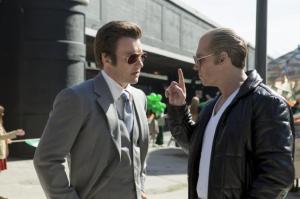 Then there are the underdeveloped supporting characters of Connolly and Bulger’s brother, Billy (Benedict Cumberbatch). The guy responsible for Bulger’s misdeeds getting the green light should be a far more important person in this story but he’s mostly portrayed as a stooge. He wants to look out for Bulger but despite one “you’ve changed” speech from his beleaguered wife, you don’t truly get any sense that Connolly has changed. You don’t get a sense of his moral dilemma or even his desperation as new leadership in the FBI starts to see through his poor obfuscations. He’s a stooge from the beginning and we feel nothing when his self-serving alliance comes to an unceremonious end. There is even less when it comes to Billy, a character that seems to pretend his brother is a different person. Billy works as a state senator. His political position must have supplied more inherent drama than what they movie affords. Black Mass is doomed when its three central characters are this dull.
Another problem is that the movie makes Bulger too protected for too long to the point it becomes comical. The script follows a routine where an associate of Bulger’s knows too much or is going to confess to the police, and within usually the next scene that character is easily dispatched, sometimes in broad daylight and with scores of witnesses. There are several recognizable actors who must have filmed for a weekend. I understand Connolly was protecting his meal ticket here with the Bureau, but Bulger is so brazen that we as an audience need more justification for how Connolly could cover for so long. It feels like Bulger has free reign and that extends into the screenplay as well. Without a stronger sense of opposition, or at least watching Bulger rise through the mob ranks, we’re left with a collection of scenes of the status quo being repeatedly reconfirmed.
I’ve figured out the way to revise Black Mass and make it far more entertaining. As stated above, Bulger is just too much a one-note boogeyman to deserve the screen time he’s given, and his onscreen dominance hampers what should be the movie’s true focus, Agent Connolly. Here is where the movie’s focal point should be because this is the transformation of a person. Bulger is the same from start to finish, only shifting in degrees of power, but it’s Connolly who goes on the moral descent. His is the more interesting journey, as he tries to use his childhood connections to get ahead in the FBI, but he consistently has to make compromise after compromise, and after awhile he’s gone too deep. Now he has to worry about being caught or being too expendable to Bulger. This character arc, given its proper due, would make for a terrific thriller that’s also churning with an intense moral ambiguity of a man trying to justify the choices he has made to stay ahead. It’s a more tragic hero sort of focus but one that has far more potential to illuminate the inner anxiety and psychological torment of the human heart rather than constantly going back to Buger to watch him whack another person. It’s far more interesting to watch a man sink into the mire he has knowingly constructed, and that’s why the narrative needed to shift its focus to Connolly to really succeed.
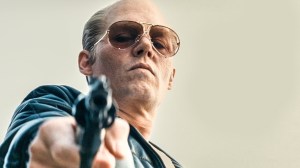 Depp (Pirates of the Caribbean) takes a few steps back from his more eccentric oddballs to portray the unnerving ferocity of Bulger, and he’s quite good at playing a human being again, though Bulger strains the definition of human. He underplays several scenes and his eyes burrow into you with such animosity that it might make you shudder. He’s a thoroughly convincing cold-blooded killer, though I wonder if part of my praise is grading Depp on a curve since Bulger is so unlike his recent parts. Regardless, Depp is the most enjoyable aspect of Black Mass and a reconfirmation that he can be a peerless actor when he sinks his teeth into a role rather than a series of tics. He also handles the Boston accent far better than his peers. Cumberbatch (The Imitation Game) and Edgerton (The Gift) are more than capable actors but oh boy do both flounder with their speaking voices. They are greatly miscast as two native Massachusetts sons.
If you’re a fan of crime thrillers steeped in true-life details of heinous men (it’s typically men) committing heinous acts, even you will likely be underwhelmed or marginally disappointed by Black Mass. There just isn’t enough going on here besides a series of bad events that don’t feel like they properly escalate, complicate, or alter our characters until the film’s very end when the plot requires it. The screenplay has propped up Bulger by his rep, told Depp to crank up his considerable glower, and called it a day. It’s a Boston mob story that needed more intensive attention to its characters to survive. Black Mass is a crime story that dissolves into its stock period details and genre trappings, becoming a good-looking but ultimately meaningless window into a hidden world.
Nate’s Grade: C+
Share this:

Bridge of Spies (2015)
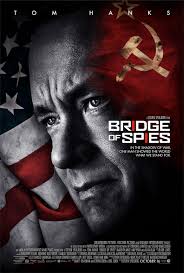 An intriguing behind-the-scenes negotiation during a heightened period of danger, Bridge of Spies relies upon its history to do the heavy lifting and it’s plenty enough for a handsomely made, reverent, and engaging legal procedural that’s also hard to muster great passion over. Tom Hanks is again a noble everyman, this time an insurance lawyer, James Donovan, called in to defend a mild-mannered Russian spy (Mark Rylance) captured during the Cold War. Things get even more complicated when spy pilot Francis Powers is shot down over Soviet airspace. The movie’s civil liberties arguments are pretty clear and still applicable to our modern era, but the movie becomes exponentially more interesting once Powers is captured and Donovan travels to Eastern Berlin to negotiate a prisoner swap while trying to work three sides, the Americans, the Russians, and the Eastern Germans who were hungry for legitimacy. It’s during these back-and-forth negotiations and posturing that the movie really hits its stride, pulling incredible facts together while forcing our protagonist to be the world’s greatest poker player. It’s the details of this story that makes it feel more fulfilling from spy techniques to the new life on the other side of the Berlin Wall. The acting is robust and Rylance (TV’s Wolf Hall) makes a strong impression in a role that requires him to be cagey to a fault. Hanks is his usual determined, inspirational self, which plays all the right emotions in a way that still feels expected and a little boring. Bridge of Spies is a slighter Steven Spielberg affair, a good story well told with good actors but a movie missing essential elements to plant itself in your memory. It’s a fine movie but sometimes fine is just not enough, and considering the talent involved in front of and behind the camera, I expect better.
Nate’s Grade: B
Share this:

The 33 (2015)
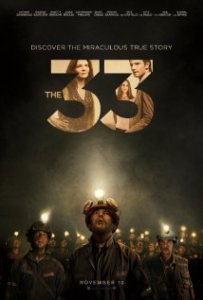 The problem with a rescue story is how to keep the audience engaged when the end seems obvious. A movie about the rescued miners in Chile seems like a no-brainer when it comes to cinematic storytelling. Survival stories are naturally rife with conflict and human triumph. But when everybody knows the ending how do you make it count? The 33, a would-be feel-good movie that aims to tug at your heartstrings, is not the answer.
In August of 2010, 33 men went over a thousand feet down into a gold mine in Chile. The mountain caved in on top of itself, trapping the men in a small refuge. They had enough food and water to last only so many days, let alone enough to subsist 33 people. Mario (Antonio Banderas) must keep his fellow miners from breaking into violence, while Lawrence (Rodrigo Santoro) must scramble the forces of the government to retrieve the miners with the pressure of the entire world watching. The men spent over 65 harrowing days trapped underground before finally reuniting with their loved ones.
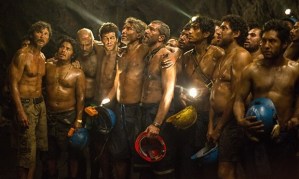 The 33 misses widely, relying on easy sentiment and generalities rather than exploring its entombed characters on more than a fundamental level. Just because certain plot turns are expected from a keen audience, whether the Titanic is going down or, say, in another survival story that James Franco is going to cut his arm off, it doesn’t mean that the proceeding time is merely setup for the predictable. Even plot turns that are predictable can be wholly satisfying if the storytelling earns the payoff. Therefore, while the world knows that the 33 miners will eventually be rescued relatively unscathed, that doesn’t mean that the movie is off the hook until that moment. It needs to make the scene count, and the best way to do so is to get us emotionally invested in these men as they struggle with their fears. That is the film’s biggest failing. It was expected that 33 characters would be a tad unwieldy as far as divvying up screen time, so we concentrate on about five or six actual “characters,” while the rest of the trapped miners are glorified extras (they’re even listed in the end credits as Miner #8, Miner #9, etc. rather than by their names). The characters fall into rather one-note territories, from the Guy Who Feels He’s Let Down His Miners, the Guy Who Feels Burdened as the Leader, the Comical Relief Guy, the Old Guy Close to Retirement, The Young Guy with a Baby on the Way, the Recovering Addict with Trust Issues, and the New Guy (a.k.a. The Bolivian). Even though the cave-in occurs about 15 minutes into the movie, we don’t really get to know any of these highlighted characters on a deeper level than the basic descriptions they’re categorized with. It’s as if The 33 expects us to be engaged in the survival struggle without people worth watching.
The script divides its focus among a few camps, which further makes the miners feel less developed. Garnering substantial screen time are the minister of mining and his team of engineers and Maria Segovia (Juliette Binoche), an empanada-vendor who becomes the face of the anguished family members. These factions vie for screen time but they never truly present much more than what is on the surface. It’s a lot of pacing and brow-wiping. I’m puzzled at how little the movie makes use of the miners’ family members. This seems like a story made for flashbacks to help tinge the struggle with heavier dramatic weight and irony. The problem with The 33 is that the rescue story isn’t as interesting from a conflict standpoint because it’s more a matter of a race against time than a matter of logistics. Digging through the bed of rock is arduous but it’s nothing terribly unexpected from a technology standpoint. It doesn’t help that The Martian is a recent hit film and a superior movie survival story, at least in its telling. The focus was tighter and Matt Damon’s character was beset with conflict after conflict. He was an active participant to lead to his survival. In contrast, the miners are left to hold onto their sanity and hopes while they wait for extrication. That struggle can be illuminating on the psyche and how people can pull together in times of extreme distress, but that’s not this movie. Sure, they pull together but it’s mostly the occasional inspirational speech from Mario and the reliance on the emotional push of James Horner’s score (his last in life). The movie relies on easy sentiment to fill the many gaps of its characterization.
There is one standout moment in the movie that gives you enough false hope about where The 33 could have gone with its storytelling. As the men pass around their daily ration, a squirt of water with some tuna inside it, the men fantasize a feast of their favorite foods delivered lovingly by their family members. It’s an exquisite visual detour that succinctly communicates the desires of the men and their mental defenses. It’s powered by a lilting musical score that makes it feel like a divine moment of relief for these weary men, and it’s visually playful without going over the top or losing the emotional truth. Then, just as succinctly, it transitions back to the dreary reality with as much skill as it began. It’s a terrific moment in an otherwise safe and sappy movie, and the artistry hints at the more visually poetic and psychologically probing movie that could have been. Going back to 127 Hours, Franco was literally stuck between a rock and a hard place but director Danny Boyle (Slumdog Millionaire) opened it up as a movie. The 33 is just too inert.
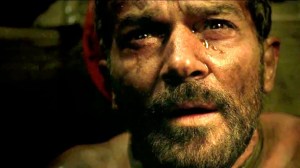 It may be slight but I can’t help but feel that the movie should have been told in Spanish rather than English. Now I know that English is going to greatly improve the movie’s mass appeal at the American box-office (though that didn’t seem to make a dent), but it harms the movie’s authenticity. On the contrary, I could forgive the white-washing of transforming the Spanish family into a white clan of Brits in the 2004 tsunami drama The Impossible but that was because their struggle was powerfully and universally felt and unrelated to ethnicity, which also assists in the argument of why change their ethnicity, but I digress. With The 33, the struggle is so specific to a nation and its people that there is some degree of authenticity lost in the actors speaking English in a multitude of accents meant to approximate Chilean. It’s also a bit strange to watch actors of varied backgrounds playing Chileans including a Frenchwoman (Binoche), an Irishman (Gabriel Byrne), and the warden from The Shawshank Redemption as the president of Chile. These are small things but when packaged together, and with the movie’s reliance on easy sentimentality, it’s hard not to feel like The 33 is a middling TV movie writ large.
The 33 is an acceptable story with a bevy of fine actors who give fine performances while we wait for the swell of the music to hit all the emotional highs. It’s effective at points and its heart seems to be in the right place, even giving each real-life member of the titular 33 a coda appearance before the credits (we’re told their lawsuit against the mining company apparently netted them zero money). The problem with The 33 is that it doesn’t make the men feel much more than a group of numbers, figures to eventually and predictably be saved, without giving us enough insight into their humanity. It feels like a disservice to their story and the compromises hobble its artistic latitude. It feels far too impersonal and rote, which are crippling attributes for a feel-good true story. It’s not fair but I fondly recall McFarland U.S.A. as a formulaic feel-good movie that nails its big moments while dropping its audience into a community of characters that feel fleshed out and given depth and relatability. If you want to know more about the Chilean miners, skip this movie and read the book. If you want a feel-good movie that genuinely makes you feel good, then skip The 33 and watch McFarland U.S.A instead.
Nate’s Grade: C+
Share this:

Spectre (2015)
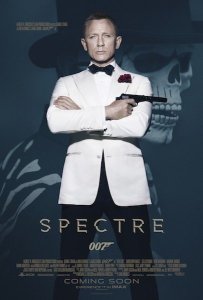 It’s hard to keep a franchise that can almost count its decades on one whole hand fresh and relevant, but Daniel Craig’s time as 007 has done just that. Starting with 2006’s magnificent Casino Royale, we got a grittier Bond, a man with a bruised psychology that was interested in more than just how many bad guys he could callously kill and sexy ladies he could securely seduce. It was a franchise that modeled itself more after the Jason Bourne films, and it worked tremendously, giving the 40-year-old franchise new relevancy for modern audiences that have grown up on the Bond canon. 2012’s Skyfall was the biggest bond hit of all time, grossing over a billion dollars worldwide. It was going to be a hard act to follow. Spectre, for all intents and purposes Craig’s franchise farewell, is a lousy swan song. It’s the weakest of the Daniel Craig Bond era but that claim would require me to rewatch 2008’s Quantum of Solace; however, just from memory, Solace had more engaging moments, stunts, and even a better theme song, so I’ll stick with my proclamation: Spectre is the most mediocre Craig Bond.
James Bond (Daniel Craig) is hunting the organization responsible for the deaths of those closest to him, namely Vesper (Eva Green) and the prior M (Judi Dench). His path has lead to the nefarious SPECTRE terrorist organization and its mysterious and feared leader (Christoph Waltz), who has his own personal reasons for causing Bond misery.
 The movie’s biggest mistake was its insistence that the audience will want to know how all the events tie together as a whole. Due to this position, it makes Spectre the awkward retcon exercise it is, trying to provide winks and nods to past Craig Bond outings while saying, “Oh yeah, all that evil stuff, well this guy is The Guy behind it all.” Adding an extra layer of a criminal conspiracy doesn’t somehow make those events more interesting or provide the need for conclusion; it piggybacks off the earlier movies and pretends it has shown its own work. Spectre thinks the accumulated plot events and deaths of three movies is the same as properly setting up a story and its villains, and that’s just not the case. The other problem with trying to connect the dots to three previous movies is that Spectre has even fewer chances to stand on its own merits, which are admittedly fewer. Lea Seydoux (Blue is the Warmest Color) is a bland addition as a Bond Girl, and oh does she pale in comparison to the capable and indispensable Rebecca Ferguson in the latest Mission: Impossible sequel. Their relationship is never as interesting or as properly developed as the film thinks. The stakes of the movie (surveillance abuse) feel too abstract and low-key, or at least poorly articulated, to feel important. If you’re going to turn the focus of the narrative on offering an apparent climax for multiple movies, it better deliver and feel like it was worth the effort, and Spectre just does not feel like that.
The other thing hat just doesn’t work is the bad guy, which is puzzling because Waltz was born to play a James Bond villain. The Craig Bonds have followed the more stripped down route even in their villains, once the parlance of the most colorful megalomaniacs that action cinema had to offer (and there’s also the eccentric henchmen). There’s a delayed buildup to revealing Waltz (Django Unchained) where other characters will talk in hushed whispers about just how dangerous and powerful the man in charge of Spectre is. A nagging problem is that we’re too often told these things without being shown them. A similar problem affected Skyfall where we spent half the film being told how dangerous and skillful its villain was, but at least Silva (Javier Bardem) lived up to the hype when he arrived, at least for a little while before degenerating into your standard psychopath. Waltz has exactly two sequences before the final showdown. That’s it, and for one of them he’s almost entirely in shadow at the end of a large table of shadowy figures. He’s not given a strong angle to play with his villain (spoilers) and his ultimate personal connection to our 007 agent feels far too forced and slight. Just like the rest of its hasty retconing, Waltz’s connection is meant to feel significant but its not dealt in any way like it should be significant. It’s almost a casual toss-off. It’s even worse when Waltz calls Bond his “cuckoo,” meant to be dark but is just really silly. Waltz is completely wasted in what is little more than a perturbed middle manager role. His climactic showdown with Bond feels impractical even for Bond movies. His downfall is even worse and made me laugh out loud how easily it all comes crashing down. If the emphasis of your movie is how the Big Bad is responsible for all the previous misfortune, then you better make sure the character was worth the wait.
 Sam Mendes (Skyfall, American Beauty) returned to the director’s chair and stages some nicely photographed sequences, but with the exception of a stirring opening sequence, the action of Spectre is quite tame and forgettable. The opening in Mexico City during the Day of the Dead celebrations has an interesting atmosphere and an ongoing tracking shot to pull us in from the start. From there, Bond has to take out a high-profile Spectre baddie and their struggle eventually carries over into a helicopter, both men punching wildly and trying to hold on for dear life as the copter whizzes upside down repeatedly. It’s a good set piece with some fun and unique aspects, like Bond escaping the crumbling wall of a building, but it’s the sheer thrill of watching the battle inside the helicopter that makes this opener a doozey. After that, I was sad to discover that nothing could measure up. Skyfall also peaked with its opening action caper but it still held my interest as it barreled toward its conclusion. I was resisting the urge to go to sleep with Spectre. An air chase over the trails of a mountain is interesting but doesn’t evolve, which is something vital to all exciting action sequences. If the action is static, it’s most often not going to be good after the initial rush wears off. There’s a decent car chase late at night in Rome but I got to think why Bond would be fleeing just one henchman even if that paid muscle were played by physical brute David Bautista (Guardians of the Galaxy). The film’s budget was reportedly $245 million and I just do not know where that money went.
The Craig era will be known for revitalizing the franchise, saving it from its self-parody excesses that were swallowing the series alive. We were watching Craig’s version of 007 become the hardened, quip-heavy, flippant killing machine and womanizer, except that he doesn’t feel like that character by the end of Spectre. If the course of four films was to bring the Bond we know into fruition, then it didn’t quite work, and that personally thrills me. Craig’s character is far more interesting, haunted by the people he couldn’t save, than the action hero Bond staple. However, while Craig’s character maintained a trajectory that staid true to its aim of bringing more depth to its central hero, the series was starting to hew closer to the classic Bond mode of empty bombast, and Spectre is the final proof of this. It’s getting closer to the crazy villains and spy hijinks of old territory. It’s a story that wants climax and resolution but cannot supply it without relying heavily upon the three previous movies to supply the weight this one lacks. It’s a rather lackluster farewell for Craig, an actor who deserved better. Judging by his interviews, I think he’s just happy to be out. He’ll be missed. Spectre will not. Now bring on Idris Elba please!
Nate’s Grade: C+
Share this:

Straight Outta Compton (2015)
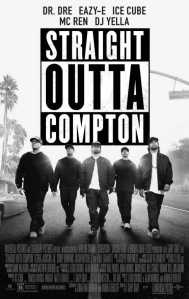 In 1987 in Compton, Eazy-E (Jason Mitchell) was selling drugs, Dr. Dre (Corey Hawkins) was spinning records in a club, and Ice Cube (O’Shea Jackson Jr.) is writing lyrics in the back of a school bus (the movie significantly downplays DJ Yella and MC Ren). The guys have grown up in an environment of suspicions and harassment by the Los Angeles police. Their response was to compose angry and defiant songs illuminating their world. After a few early performances, the group is approached by record producer Jerry Heller (Paul Giamatti) who wants to get them signed and touring. Their music and their perspective catches on and soon NWA is awash in big shows and groupies. Heller puts more of his efforts onto Eazy-E, and Dre and Cube feel marginalized and doubtful that Heller has their best interest at heart.
It’s hard to reconcile the brash and challenging men responsible for NWA and this sanitized and rather rote rags-to-riches biopic that asks curiously little of its subjects when it comes to depth or reflection. Not every biopic needs to be as faithful as the most excoriating documentary on its subject, but we have become accustomed over the last decade to the warts-and-all approach, where the central biographical figures are celebrated for their achievements but care is taken to tell their lives with measured accuracy, not to hide anything that challenges our concept of who these people were. Imagine if Walk the Line had sanitized its portrayal of Johnny Cash, or worse, devoted most of its running time to his stint as a revivalist Christian musician? What if Ray had eliminated his womanzing? What if The Aviator said that Howard Hughes was the model of human sanity? A biopic doesn’t need to tell us every facet of its subject’s life because that is an impossible demand that only the densest of books can truly achieve, however, a biopic must instill the spirit of its subject in an honest representation, because that’s at best what you’re going to get when you apply a human life to the realm of narrative. Straight Outta Compton comes across as far too gentle with its core subjects, portraying them as underdog anti-heroes who were pushed around by those trying to exploit them and their message. Of course this would be the approach when Dr. Dre, Ice Cube, and the widow of Eazy-E produce the film. At this point it’s about protecting the legacy, protecting the brand, and so the members of NWA become far less interesting.
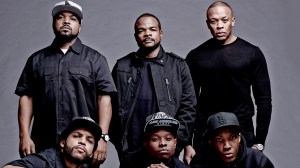 Nobody probably gets the biggest revision than Dr. Dre, especially his violent history with women. As depicted in the film, Dre is a talented and frustrated music producer who is trying to do his best to live up to his dreams but falling short and feeling the pressure of not being the support system for his brother, his girlfriend, his daughter. When the money starts rolling in, Dre embarks on a successful solo career and reconciles with Eazy-E. That’s about all there is to his character arc, a series of creative struggles and trusting the wrong people. There is one very brief moment that hints at Dre’s history with women, when his girlfriend expresses caution about getting too involved with Dre because she doesn’t want anything negative to happen to her young son. This woman doesn’t appear to be Michel’le Toussaint, a best-selling Ruthless Records artist who was with Dre for seven years and gave birth to their son in 1991. Toussaint has spoken about consistent physical abuse, including an incident where Dre shot at her through a bathroom door. Then there’s the glaring omission of Dee Barnes, a journalist who Dre brutally beat inside a nightclub in 1990 (Dre has finally come forward and apologized for this incident but only after the Apple overlords or Universal execs probably applied some pressure to make the bad PR from the press tamp down). Director F. Gary Gray (Friday, Law Abiding Citizen) has gone on record saying they had to focus on the “story that was pertinent to our main characters.” About that…
Straight Outta Compton has a renewed relevancy due to the increased attention in the news concerning police brutality, profiling, and harassment. It was from this combination of oppression and negativity that NWA honed their provocative message. The lyrics of gangster rap reflected the reality of their living conditions, and so they were bleak, angry, violent, and they spurred a sense of relatability across the country from others. It was a reaction against a system that had cataloged them as suspects from birth. The story structure of Straight Outta Compton shows the birth of gangster rap through a select sample of personal experiences. From there we see the rise, the backlash, and I suppose a “we told you so” moment with the aggravation over the Rodney King case turning into the volcanic anger and destruction of the L.A. riots. The aside highlighting the L.A. riots only really serves to underline the idea that NWA’s message of the beaten-down growing increasingly weary of their denigrated treatment. After that, the greater message of what NWA meant to the world of music and culture is lost midst the squabbles of the former friends. This is a missed opportunity at creating a stronger message and adding needed complexity to the main characters. What if Straight Outta Compton had explored the violent life of its stars after they had achieved their dreams? It creates a more damning theme about the consequences of a life under oppression; Dre grew up being harassed and antagonized, which is reflected in their music, but even when they escape that environment the consequences can still follow and entrap them. As it plays, the guys strike it rich, get waylaid by outsiders, and eventually find their footing again. It’s a narrative structure that places all the problems as external threats, be it Heller or Knight or HIV itself, and strips the main characters of their own agency. The movie doesn’t let them account for their own action and finds excuses when able. An incident where they brandish high-powered guns to chase off an angry boyfriend is treated as an unearned and questionable moment of levity. Gray said they could only focus on the “pertinent” stories, but I don’t see anything more pertinent than exploring the psychological trauma of brutality and oppression and how, even as an adult with seemingly the world at your fingertips, it still manifests in your life and personal relationships.
As a standard rags-to-riches biopic, Straight Outta Compton is consistently entertaining and well acted, though it can’t help but feel like we’re rushing through the events. A significant disappointment is the underdeveloped nature of the friendship of Dre, Eazy-E and Cube. There’s an early scene where they’re teasing one another and working out the beginnings of “Boys in the Hood” and this is the lone moment where we feel the dynamic of the trio. The early glimpse at the creative process is a high-point. After that, sadly, the only examination the movie affords on the relationships of the three is the jealousies and divisions. Strangely, the most interesting character relationship is between Eazy-E and Heller, which despite the predictable dissolution is the most heartfelt relationship on screen. Think about that: the most involving relationship depicted in the movie is between a former drug dealer-turned-musician and a Jewish music producer. It’s their opposites-attract dynamic that helps to make them so much more intriguing to watch.
 Straight Outta Compton treats Heller as a greedy predator who was cheating NWA out of their rightful earnings, though I’m still a bit skeptical as to these accusations. The movie even gives me a reason to support my skepticism. Once Cube goes solo, a record producer (Tate Ellington) promises to support him on his next record if the first is successful. Obviously Cube is a hit and he comes back to this producer, who explains that he can’t simply just write a check then and there and that it’s more complicated. Cube responds by trashing the guy’s office and the moment is treated as a strangely triumphant moment that the exec even awkwardly jokes about later when Cube returns. This moment made me think maybe, just maybe, the people in the industry weren’t explicitly cheating out NWA but the margins of the recording industry are a bit harder to explain.
While the characters themselves can be a tad boring, the actors do everything in their power to make them feel fully felt. The three lead actors impressed me. Mitchell especially wows in his greater emotional moments, like the discovery of being HIV-positive and only having a few reaming months to live. Jackson Jr. gives an eerily accurate portrayal of his father, and Hawkins (Non-Stop) hits his stride when Dre is most ambitious. The three of them have an easy-going camaraderie that adds to the authenticity. The actors are so good that the deficiencies in characterization are all the more frustrating. The talent was there but the characterization was not. I also want to single out R. Marcos Taylor for his strikingly imposing portrayal of Suge Knight. As soon as Taylor starts eating up more screen time, I couldn’t help but wish the movie’s focus jumped ship to the ruthless Death Row Records impresario.
Straight Outta Compton is already the highest-grossing musical biopic of all time, so surely the wider moviegoing public greeted its safe approach to its subjects with some level of approval. Enough time has passed to add a layer of nostalgia to the early days of gangster rap, as well as political relevancy with the increased media spotlight on overzealous police provocations and the growing Black Lives Matter movement. The time was ripe for this movie and it’s an undeniable hit. I was entertained throughout and found the performances to be involving, but I can’t shake off the feeling about what is being left out. It’s by no means a biopic’s requirement to include everything about its subject, but with the living members of NWA aboard and approving their movie versions, the sanitization of a complicated and contradictory reality is the best we’re going to get. The film doesn’t hold the band up for their behavior, whether it’s promiscuous sex that leads Eazy-E to getting infected (a plot point with no setup beyond some movie-friendly knowing coughs) or Dre’s violent history with women. The move doesn’t have to portray the members of NWA as villains but by treating them as misunderstood underdogs who were exploited by outside forces feels like a (forgive the term) cop-out. These guys didn’t ask to become spokemen for a generation of antagonized and discredited black men, but surely there’s something more interesting and deeper to explore than band in-fighting. Straight Outta Compton is a slick and entertaining film but ultimately just another product.
Nate’s Grade: B-
Share this:

The Martian (2015)
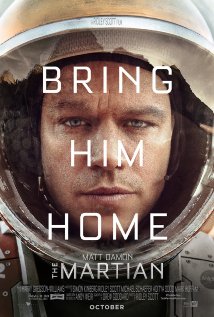 Based upon Andy Weir’s nuts-and-bolts scientific “what if” tale, The Martian is the movie equivalent of Apollo 13 crossed with Cast Away. Just far less personable volleyballs. But there are potatoes. Space potatoes.
After a powerful storm on Mars forces NASA’s crew to flee, astronaut Mark Watney (Matt Damon) is presumed dead and left behind. He wakes up hours later, shrapnel in his gut, and retreats back to the Mars mission base. He has to survive close to two years before he has any hope of being rescued on the hostile world. Before that, he has to establish some kind of communication with NASA, and even before that he has to somehow grow food in the arid Martian soil. Back at home, NASA is debating their limited options to bring back Watney and whether or not they should tell his crewmates that he survived.
In conversations with my friend and critical colleague Ben Bailey, he said that The Martian was the opposite of Gravity, a film he subsequently loathed, because it was smart people making smart decisions. There is an inherent enjoyment watching intelligent people tackle and persevere over daunting challenges, and this sets up The Martian for lots of payoffs and satisfaction. We see both sides of the problem and it provides even more opportunities for challenges and payoffs. Naturally the stuff on Mars is more compelling because of its extreme dangers and isolation, but the Earth scenes are also enjoyable as the NASA determines the soonest they might reach their lost astronaut. Just like the similarly themed Apollo 13, there are challenges to be overcome and the solutions are not without risk themselves. I enjoyed how the screenplay kept throwing out new obstacles; just when you think you can breath for a while the status quo is upset again. The slew of new obstacles doesn’t feel contrived either but rather realistic setbacks. It’s a wonderful storytelling structure that constantly keeps things moving forward and ramps up the urgency. As a result, we don’t ever feel safe right until the climax, and even then you’re still sweating it out because of all the complications and adjustments.
 It’s revitalizing to watch a movie that treats science with a sense of reverence. Mark Watney endures in the most hostile of environments through his ingenious use of the resources he has because of his understanding of science and math. Just as MacGyver proved there was something satisfying about watching a guy make a bomb out of a toilet paper tube, some chewing gum, and a bobby pin, it’s entirely enjoyable watching Watney think his way out of problems, and this starts early on. Watney’s first problem after he regains consciousness is to remove an embedded piece of shrapnel in his gut. The scene plays in a methodical fashion without any obtrusive edits, allowing the full task to settle in with the audience. The man has to perform surgery on himself and dig inside himself, and if he doesn’t get this done soon, sepsis might set in (no doctors without borders here). From there, the situation only gets more serious as Watney’s food supply, even when generously rationed, will only last a fraction of the time it would take NASA to send a rescue team. He has to grow food on an alien planet. That itself could be its own movie, a glossy crossover special from the SyFy Channel and the Home and Garden network. This is a survival story that doesn’t rely upon coincidence or some sort of divine intervention but on the understanding and admiration of science and its possibilities. Though America’s favorite astrophysicist Neil deGrasse Tyson says that in this movie universe, all the science decisions are being made by science professionals rather than, you know, politicians who adamantly open ignorant statements with, “I’m not a scientist.”
Another aspect I wasn’t quite expecting but took hold of me is how uplifting The Martian turns out to be. It’s a celebration of human endeavor and particularly cooperation, as the United States reaches out to other nations for assistance. Watching the determined souls risk their lives to retrieve one fallen man is the kind of thing that represents the best in us. Sure, there’s something to be said about the fact that it’s one prized American life that countries are spending billions of not trillions of dollars to rescue and perhaps that money would be better spent helping more lives on Earth. There’s also the curious fact that the world has spent a ton of money rescuing Matt Damon in movies. From Saving Private Ryan, to Interstellar, and now The Martian, we seem to value Damon above all else.
This isn’t exactly a one-man show with half of the running time flashing back to Earth but Damon’s star quality and acting chops makes it so you don’t mind being marooned with this man. Watney’s recorded messages are a slick way to deal with the internal thinking of its protagonist while giving the character more opportunities to charm thanks to a rich sense of gallows-level humor. At no point is Mark Watney flippant about his unique predicament but his sense of humor goes a long way to further engender the audience’s good will. He’s not moping and having existential crises; he’s getting to work, and it’s through the problem solving that we get to know this character, his ingenuity, his personality, his fears, and his distaste for disco music. Damon steers clear from playing the character too large and bearing his soul as the metaphorical representative for all of humanity and its place in the cosmos. He’s just one guy who happens to be lost millions of miles from his home planet, and he’s making the best of it.
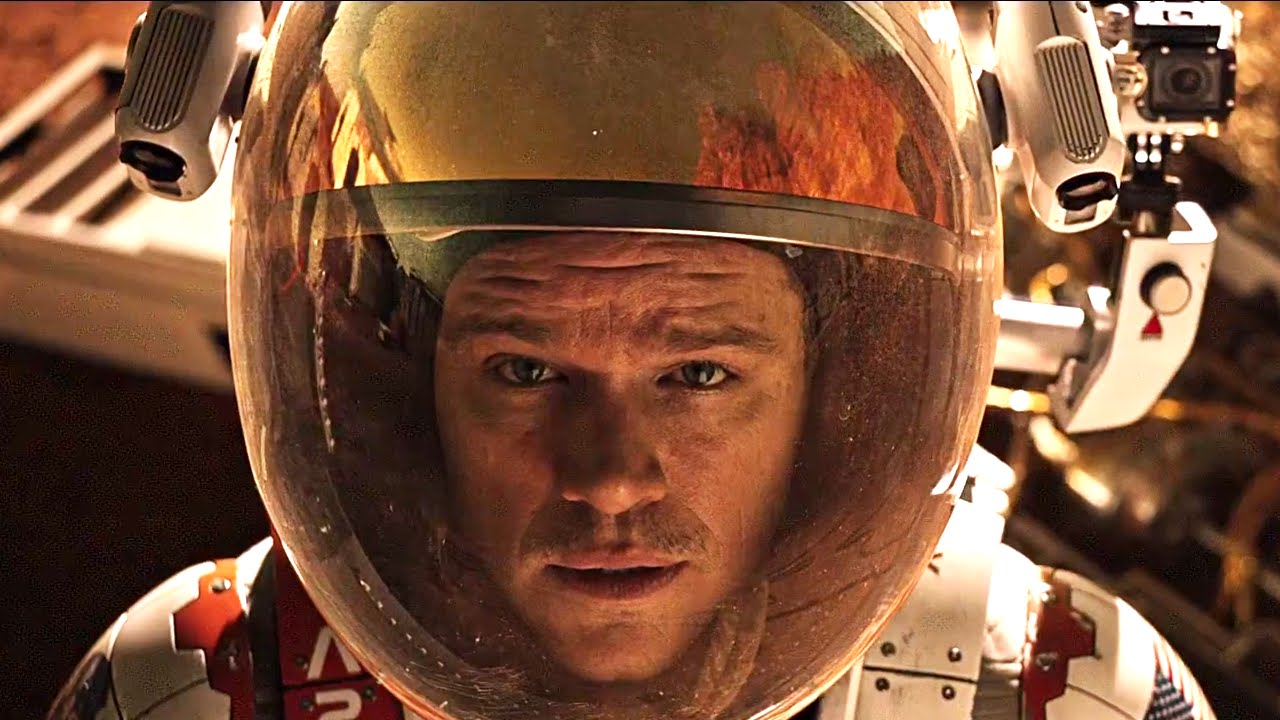 Being a Ridley Scott film, naturally the film is downright impeccable from a technical standpoint. The photography is great, communicating the frightening and awe-inspiring scope of the alien topography, especially when compared to maps for scale. The visuals find ways to further help communicate Watney’s dilemma and diminished resources. Scott’s visual sensibilities are so naturally attuned to developing tension. I was holding my breath at times from the suspense of certain sequences even though I long assumed that Watney would make it back home safe and sound. A scene with a desperate need for duct tape was a real nail-biter. There isn’t a bad performance among the star-studded cast of actors who must have been grateful for even a tiny morsel of screen time. I have no idea what Kirsten Wiig really does in this movie as the NASA PR person besides fold her arms in rooms, but hey, she’s there, along with Donald Glover as a socially awkward physicist. Jessica Chastain (Zero Dark Thirty) gets to pour over the regret of leaving a friend behind, Jeff Daniels gets to once more practice his skill of being an authoritarian blowhard he honed from The Newsroom, and I even was able to tolerate Kate Mara (Fantastic Four), so that’s something.
The Martian is a natural crowd-pleaser. It’s engineered from the start to engage an audience with its survival thrills, present a series of increasing payoffs with new challenges and solutions, and by the end of our journey we’re treated to a rousing finish that carries a poignancy and sense of inspiration about the best in all of us, what can be accomplished through grit and cooperation and sacrifice. It’s a movie that let’s the science of survival be the ultimate star, with Damon serving as a handsome host to guide us through the marvels of the universe and duct tape. When dealing with the vastness of space and the vulnerability of human life, it’s easy to feel insignificant in comparison, but that’s where the human will to endure and to work together comes in and reconfirms the possibilities of the collective inhabitants of this giant blue orb. The Martian is a sci-fi thriller, a potent human drama, and one of the best times you can have at the movies.
Nate’s Grade: A-
Share this:

Sicario (2015)
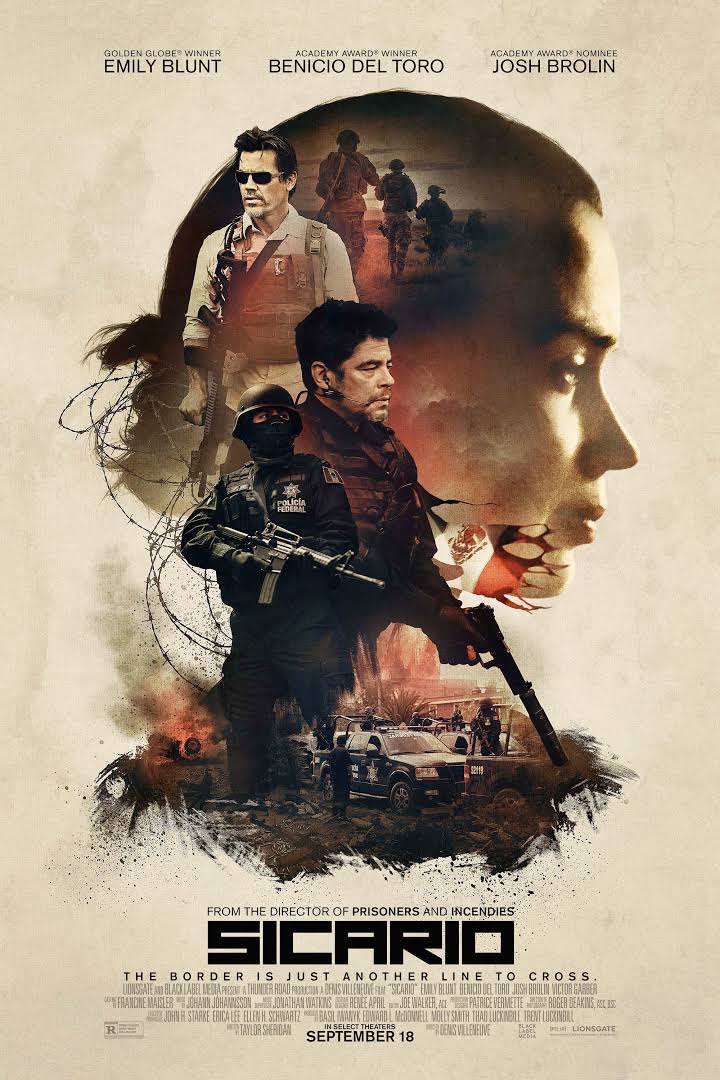 The word “sicario” is Spanish for hitman, we’re told in a helpful opening text. It’s a term that has greater meaning in the landscape of the war on drugs, a war that has ravaged Mexico and its citizens. Sicario, the film, is grim and gripping and director Denis Villeneuve doesn’t hold back from the brutality of its reality. Sicario is a flat-out tremendous film. It’s the most intense film I’ve sat through since 2012’s Zero Dark Thirty, so much so that for long stretches of the 121-minute film I was literally tearing my hair out with delicious anxiety.
Kate Mercer (Emily Blunt) is a Phoenix FBI Agent called in by her superiors with a very special offer. Matt (Josh Brolin), a government agent whose affiliation is classified, has a task force that he would like Kate to join. She’ll be taking it to the drug cartels by destabilizing their chain of power. Kate accepts the job. Alejandro (Benicio Del Toro) is a foreign agent in alliance with Matt, and he seems to be deeply knowledgeable of the cartel and their practices. As the chaos swirls and the team gets closer to the cartel bosses, Kate has to reckon with what she is part of.
Let Sicario be a blueprint for how to brilliantly develop suspense sequences in mainstream cinema. I’ve written about it before but the key to suspense and horror is simply characters we care about and the worry of what will happen next. Sicario places our characters in the middle of an ongoing battle and serves them up as the change agent, the proverbial stick rattling the hornet’s nest of deadly cartels. There’s a wonderful sequence when Kate joins up with the team for her first mission. She’s been told she’ll be based in El Paso but in reality she and a team of Army Rangers are venturing across the Mexican border into Juarez. They’re picking up a high-level cartel informant and transporting him back to American soil. The ride into the country sets the stage as the caravan of black SUVs tears through the streets of Jaurez, bracketed by Mexican state police vehicles. We’ve previously been told at what points a likely trap might be staged, and so we wait, taking in the terrain, the distance, the exits, the personnel. We’re already sizing up the Mexican state police cars; is that one on the take? It’s at the end that the scene coalesces into an even stronger whole, as we literally have a climax in traffic. The border entrance is backed up, and so Kate and our team wait, all the while identifying some suspicious armed men in traffic lanes parallel to their vehicles. They’re told they cannot fire until deadly force is used, and so they wait and we wait. It’s a top-notch sequence where you’re nervously waiting for the boil, waiting for the explosion.
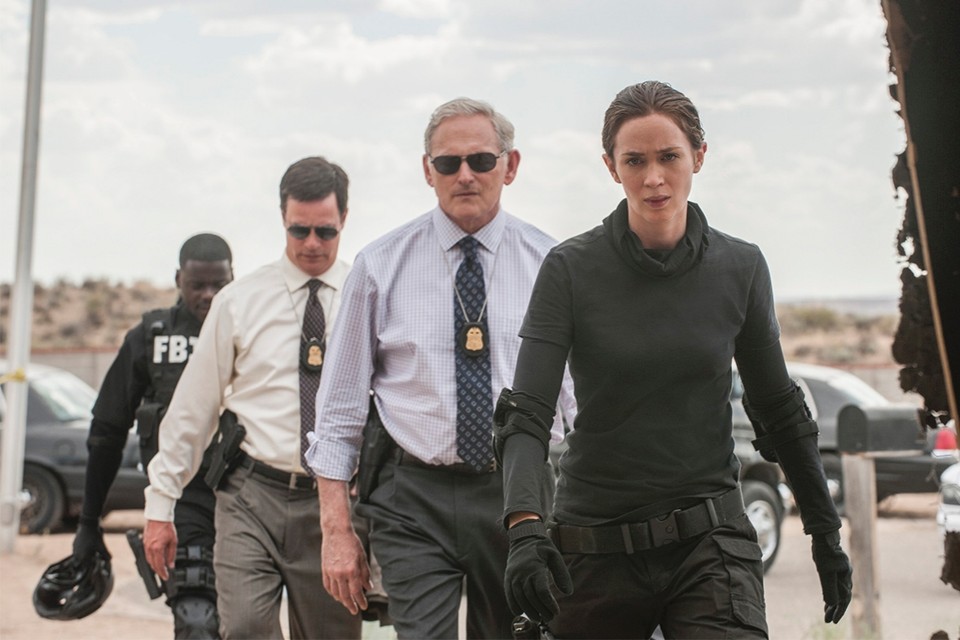 Writer Taylor Sheridan (best known as Deputy Chief Hale on Sons of Anarchy) has taken what could have been an empty Michael Bay-styled drug war thriller and given it a soul. Sheridan’s structure is ingeniously tied into his larger message about the moral futility of the escalating war on drugs. As Kate becomes more immersed into the costs of her new role, of the mounting ethical compromises and legal loopholes, she becomes a background player and Alejandro takes center stage. Rather than simply harden up and sacrifice her ideals for the sake of her mission, Kate holds true to her principles, even if she might be the only one continuing to stick to the rules and a need for oversight. It makes her a far more interesting character and it all comes to a terrific climactic scene that hinges upon two characters at a forceful crossroads, each with diametrically opposed viewpoints. For all the action, Sheridan has found a great way for his story to have a character-based climax that hits harder than simply killing the Worst Bad Guy. As we learn more about the reasons Kate was selected, her literal marginalization in the story makes thematic sense, especially as she’s unwilling to become a “wolf” in a “country of wolves.” Alejandro is that wolf, and in the last act he becomes the film’s focus as the pieces of their destabilization plan fall into place. There’s a scene with Alejandro that is so cold-blooded yet badass that it made my audience gasp. As the bodies drop and blood is shed, Sicario doesn’t lose sight of its characters even to the very end.
Sheridan’s script tackles its subject with a propensity for acknowledging the messy reality. There are no easy solutions and perhaps the best solution is really one that is at odds with conventional legality. The United States is losing the war on drugs, and innocents are suffering in droves. Matt’s cavalier attitude is in response to the overwhelming evidence that the war on drugs has done little except to enshrine certain violent elements into power. He’s trying to clear a path for Alejandro, but for what aim afterward is ethically questionable. When you’ve got nothing but bad solutions, perhaps the best option is still one that’s a step too far. Sicario tackles the harsh realities of the war on drugs without ever dragging out a soapbox. The messages and debates are suffused in every frame, every taut sequence, even pained expression. It’s a message movie where the morality and the escalating action go hand-in-hand.
With Prisoners and now Sicario, Villeneuve has proven to be one of our finest directors when it comes to making adult movies that get your palms sweaty. The execution of these suspense sequences left me breathless. Villeneuve uses long takes of aerial photography hovering over the topography of Mexico and the American southwest. It has the effect of feeling like you’re surveying an alien planet. Added with the ominous score by Johann Johannsson (The Theory of Everything), the tension can feel overwhelming at times. The menacing and percussion-heavy score makes it feel like an army is approaching. The movie also looks absolutely beautiful thanks to the cinematography from Roger Deakens. There are several lovely shots lit with the dying rays of sunlight, which I would admire further if my heart weren’t in my throat while watching. Villeneuve also knows when to pump the brakes, letting his film breathe, and letting his actors take center stage. There are several moments of restraint that allow the actors to flourish. From top to bottom, Sicario is a technical marvel that impresses as it continues to horrify.
Blunt as a badass is nothing new after her killer turn in last year’s vastly underrated Edge of Tomorrow, but there’s way more to her than being a superhero with a gun. She’s the moral conscience of the movie and you may discover, as she does, how irrelevant such a stance may be in this underground world. She’s trying to make sense of it all, trying to go along with what she thinks is right, or at least making a difference, and swallowing her frustrations. She saves the best for last in a finale scene that pushes her character to the breaking point of her ethics, and Blunt floors you. While Blunt is our entry point into this world, and Brolin is amusing as a cavalier rogue agent, this is very much Del Toro’s movie. Alejandro could easily be the slick movie-cool hitman, a soulless killing-machine, but he’s a haunted man who knows he’s damned and goes about his business with steely resolve. Benicio Del Toro can often be confused with doing little acting because he so naturally underplays his characters, but keep watch and you’ll see a man who inherently knows his character. There are subtle shifts and small reveals that open up Alejandro, who is so hardened that this will be all you get.

There have been some complaints citing the film’s lack of perspective from the Mexican side of the border, which is fair but also overlooking Sicario’s complexity. With its fear of cartel war violence spilling over into American neighborhoods, it’s not hard to see this film becoming supposed evidence in a xenophobic political campaign. Surely Donald Trump will be talking about Sicario. There is a small degree of representation with a minor character involved in the drug trade. The movie flashes back to him and his family a few times, setting us up to expect he’ll return at a pivotal moment later. He’s a completely unremarkable character and the brief scenes we spend with him made me anxious to get back to Kate and the main story. I didn’t care, and then he did reappear and I was quite surprised to find myself actively caring for this minor character’s well being. In a scenario where it seems like there’s a lack of vulnerability, this character provides it. He’s not a bad person per se as just another cog in a corrupt machine trying to provide for his loved ones. It’s a window into the larger ramifications of Kate and Matt’s actions. The very last bittersweet image doesn’t feel like victory, more like a warning of impending consequences that will befall innocents, and they aren’t Americans.
It’s rare to get a Hollywood thriller that excels at what it does and exceeds lofty expectations, but Sicario is that movie. Here is a thriller that excites, unnerves, provokes thought as well as terrible anxiety that you sweat in buckets over. The general feeling while watching Sicario is one of disquieting dread. The challenging and disturbing reality of the war on drugs blends with the brilliantly executed suspense sequences. The characters don’t get lost midst the clatter of violence, the direction enhances the actors and allows them to better inhabit their engaging characters, and the overall orchestration of all the many moving parts is so polished, so in tune, so electric that Sicario often does more than just entertain, it forces you to react. Leaving my theater was akin to coming down off an adrenaline high and I wanted to tell everyone I knew to see this movie. That’s the power of great cinema and Villeneuve has created a compelling feature that deserves to be soaked up and studied. This is exhilarating moviemaking, folks.
Nate’s Grade: A
Share this:

The Gift (2015)
 Reminiscent of adult thrillers that dominated the 1990s, Joel Edgerton’s The Gift is a slick and fiendishly enjoyable movie that unravels methodically and is comfortable dealing with moral ambiguity. Simon (Jason Bateman) and Robyn (Rebecca Hall) are transitioning to a new city and a new job when they meet an old high school acquaintance, Gordon (Edgerton). It seems at first like “Gordo” is going to be a scary stalker with boundary issues, but Edgerton, who also wrote and directed, keeps pushing his familiar narrative further, adding different shades to the trio of characters and allowing them to be flawed humans revealing their secrets. It’s a movie that’s not afraid to go dark and dwell in the unknown, especially with a note-perfect morally murky ending that leaves the viewer in the same wonderfully cruel sense of uncertainty and gnawing curiosity. Bateman pays against type as a rather strident character who definitely has issues with sticking to the full truth. Hall is more than a damsel in distress. She’s overcoming serious problems that she may or may not bear some culpability for, which makes her performance that much more interesting. Edgerton doesn’t overplay any off-kilter tics; his Gordo is a bit off, and always comes across like he’s holding back saying more, but his impression is a lot more wounded animal than psychopath. The screenplay is a model of efficiency and the secrets and reveals are evenly doled out. The Gift is an entertaining thriller with dark turns, deliberate pacing and structure, morally grey characters, comfort in ambiguity, and a healthy respect for its mature audience.
Nate’s Grade: B+
Share this:

The Last Five Years (2015)
 It’s a musical about the beginning and end of a five-year relationship, and each partner is starting at a different point and meeting in the middle. If that sounds confusing, The Last Five Years will do little to better orient you, the audience, on its criss-crossing narrative-leaping timeline. Anna Kendrick is Cathy, who is traveling from the breakup of her marriage to the moment she met her eventual husband. Jeremy Jordan is Jamie, who is traveling the more linear path of infatuation to marriage to his divorce from Cathy. Neither character is particularly that involving though their eventual conflicts that lead to their parting of ways are more relatable than I was expecting since Jamie becomes a publishing phenom. I was looking for parallels with the song pairings, since we switch from a Cathy song to Jamie song, but the more I listened the more the narrative structure felt like an unjustified gimmick. Director Richard LaGravenese (Beautiful Creatures) feels like he was rushed to complete this film because much of the camerawork feels lacking, losing track of the characters in their long takes. Could he afford to do more than one take? There isn’t so much a sense of style or expanding into the medium of film. It feels like LaGravense was grabbing what he could. But that’s not the biggest problem. The biggest problem is that for an entirely sung musical (there may be like two lines of spoken dialogue) none of the songs are particularly memorable. Even minutes after finishing the film, I could not for the life of me hum one tune. To be fair the music isn’t offensive to the ears, but it falls within this vanilla middle ground that plays like it should be background noise rather than featured music. Kendrick and Jordan do a serviceable job singing these bland songs, but when your movie is wall-to-wall with music that doesn’t engage or register, it’s the equivalent of a comedy being unfunny. The Last Five Years is a movie musical that is decidedly pleasant and deadly bland.
Nate’s Grade: C+
Share this:

Little Boy (2015)
 I was expecting to bury Little Boy in an avalanche of negativity once I found out a late plot point that made my jaw drop. This inspirational Christian independent film is set during World War II and features a pint-sized moppet, Pepper (Jakob Salvati), whose only real friend is his father (Michael Rapaport), who is now serving in the fight in the Pacific. He’s told that through the power of belief he can accomplish great things, and well, he really wants his dad to come home. So through the power of belief he causes… the dropping of the atomic bomb (WWII aficionados will recognize the nickname of the bomb). I was waiting for the moment and amping my sense of dread and moral outrage. A funny thing happened on the way to a nuclear bomb detonation, and that is that Little Boy is a fairly agreeable and effective family film that conveys a message with a welcomed degree of ambiguity and complexity and tolerance. This is a Christian-themed film about the power of belief but at no point does it make explicit whether it’s coincidence or the power of Pepper channeling God. Part of Pepper’s list of good deeds given to him by a priest (Tom Wilkinson) is to befriend a Japanese neighbor who returned home from an internment camp. The movie shows how casual these small-town folk indulge in racism and bullying. The Japanese man is also an atheist and I was legitimately astonished that the movie never makes a judgment about this. He’s treated as a complex man with his own system of thinking, and he’s not viewed as lesser or wayward because of his lack of belief in a higher power. Little Boy is no God’s Not Dead. The melodrama is well paced, the acting is solid if a bit heavy on long bouts of weeping, and the movie undercuts what normally would be the inspirational apexes with harsher reality. The bomb is dropped, and Pepper is initially celebrating until he discovers the total horror of Hiroshima. His “wish” may have even backfired with his father getting further punishment in a POW camp. While I still find the development tacky, I have to reluctantly credit the filmmakers for refusing to pander in a style that removes the complexity and ambiguity of real life. It’s still a movie and it still has a rather predictable albeit emotionally earned ending, but Little Boy might just be one of the biggest surprises of this year for me at the movies.
Nate’s Grade: C+


You must be logged in to post a comment.