Blog Archives
Shin Godzilla (2016)
 Shin Godzilla is unlike just about any monster movie you’ve ever seen, and I don’t know if that’s a good thing. The newest rebirth of the famous giant monster takes a new approach to large-scale destruction: bureaucratic minutia. This feels like a state department underling’s doctoral thesis that was adapted into a feature film. We get a team of different intelligent operatives talking Aaron Sorkin-level fast and trying to work through the red tape of government to address the pressing needs of a giant fire-breathing lizard. It’s like 80% government bureaucratic milieu and 20% monster movie. We get treated to just about every meeting room in Japan as the majority of scenes last a whopping 10-15 seconds. The pacing is so clipped, the satire is so understated, and the characters so numerous, that I was easily lost in the weeds and that was before Godzilla made its less than auspicious debut on screen. It’s nothing short of what one of my friends described as a “turkey snake,” and the googly eyes aren’t helping. I’ll make the same demand that I made with the 2014 American Godzilla movie: I need more Godzilla in my Godzilla movie, please. For fans of the series, they’ll likely connect more with the social conscience platform and political critiques, but I couldn’t engage at all. I was eagerly waiting for this movie to just be over so I could shake it from my head. It felt like being talked at in the corner of a party by someone who just read a book on a topic that you couldn’t care less about. I’ll grant the filmmakers credit for finding a different approach and one seeped in the realistic details of government disaster response coordination, but if you’re like me, by the fifteenth conference room your eyes will glaze over. I don’t think this was the best approach for a film narrative and it completely drains the fun from giant monsters.
Nate’s Grade: C
Share this:

The Birth of a Nation (2016)
 Sold for a record $17.5 million at the Sundance Film Festival, there were big expectations for the Nat Turner biopic, The Birth of a Nation. Writer/director/actor Nate Parker was the toast of the town and the studio had its sights set clearly for a fall release and a big Oscar push. Then came the revelation from Parker’s past linking him to an accusation of sexual assault (it should be noted he was acquitted of the charge, though it should also be noted the woman declined to continue pressing charges during the second trial). Suddenly the Oscar hopes for Birth of a Nation were put into a tailspin and journalists were wondering if this salient news would provide older Oscar voters just the excuse they needed not to watch the movie. After having finally seen the film for myself, I can attest that this movie wasn’t going to go far into the Oscar race anyway. My friend Ben Bailey said it best as we walked out of The Birth of a Nation, making an apt comparison to the 2013 Best Picture Winner: “12 Years a Slave was a better movie made from a less interesting story; and this is a more interesting story but given a much lesser movie.”
In 1830, Nat Turner (Parker) is earning extra money for his friendly slave owner (Armie Hammer) as a preacher, convincing slaves on other plantations to work harder and obey their cruel masters. He reaches a breaking point and organizes a revolt, violently killing the same plantation owners that kept them in bondage. Nat felt his revolt could be the catalyst for slaves all over, but it was put down by overwhelming forces two days later.
 Nat Turner is a historical figure extremely deserving of a big Hollywood spotlight. The problem is that Parker’s movie feels like the arthouse version of the Hollywood Martyr Blockbuster, a field popularized by director Edward Zwick (Glory, Blood Diamond). This thing checks just about all the formula boxes you’d expect by showing the arc of a character called into action, forced to take a stand against an exploited people and series of injustices, and the eventual death for the cause. It’s meant to be inspirational but that sense of inspiration can be capped when you see the machinations. All storytelling at some level is about pulling the strings of an audience, but the storyteller must do their best to make this as nonobservant as possible so as not to disturb the experience. Parker doesn’t have that skill quite yet, either as a director or as a screenwriter.
His movie kept my interest but I felt oddly removed from it, unable to fully absorb the characters, which should never happen in a revolt against slavery. Case in point, we know how the movie is going to end so Parker needs to engineer something of a win for Nat, and that’s where Raymond Cobb (Jackie Earle Haley), nasty slave catcher, comes in handy as a conquerable antagonist. He ends up being the man responsible for chasing Nat’s father away, so it’s even more personal. During their final fight, Cobb implausibly wrestles atop a struggling Nat (this guy has to be at least 60 years old and it’s Haley, not Stallone). Parker even includes the knife that’s just… out… of… reach. I rolled my eyes. Parker shouldn’t have to resort to these tactics to rouse his audience, and as stated above, they’re just too nakedly transparent in their formula machinations. I wanted more suspense sequences like during the opening when Nat’s grandmother has to think on her feet to conceal contraband, smart uses of dramatic irony and ratcheting up the tension. The movie is structured too narrowly as Nat’s call to action, but Parker seems preoccupied with hitting all these other checkmarks to fully open him up as a human being.
Structurally, this movie is amiss because we don’t need 90 minutes to justify why slaves would violently revolt against their masters. The best part of Birth of a Nation is its final act when the revolts come and the slave owners get what they have coming. Some will equivocate that not all slave owners abused and terrorized their slaves to the same degree of abject cruelty, but the very nature of owning another human being is an assault on fundamental morality. 12 Years a Slave had an excellent 15-minute section where it disproved the notion of the “good slave owner” with Benedict Cumberbatch’s character. Even he too was corrupted because the institution of slavery is a corrupting agency. What that movie was able to communicate in 15 minutes is what The Birth of a Nation takes 90 minutes to do the same. The entire movie should have been the slave revolts with some choice flashbacks interspersed to give the movie even better context for the personal animosities against specific slave owners. That way we can better explore the emotional side of Nat Turner and his company without resorting to extended degradation. Parker deserves some credit for being very tasteful in his depiction of the brutality against slaves and the heavy heart of aiding and abetting an unjust system. It doesn’t whitewash, so to speak, the horror of slavery but also refrains from exploiting tragedy for easy gains. With that being said, and I may be alone in this observation, but I found it a bit peculiar that the sexual violence committed against women seems to be primarily framed as how it impacts the male characters, making them sad or angry at the mistreatment of their women. I may be over-analyzing this but it happens twice and stuck out to me. The structure of the movie does a disservice to the emotional power it demands, and Parker should have shown us the bloody campaign rather than the lead-up to the campaign.
Parker also shows some noticeable shortcomings when it comes to directing his fellow actors. His performance is a highlight and his moments where he’s trying to hold back the tide of mixed emotions working for the slave owners and using Scripture to justify the worst of the worst. This is a great showcase for Parker as an actor of suitable range. It’s not a great showcase for any other actor. The performances are a bit big when needing restraint, and a bit broad when nuance would be required. There’s no character that even comes close to the deeply wounding impressions left by the brilliant Lupita Nyong’o and Michael Fassbender from 12 Years a Slave. Hammer (The Man from U.N.C.L.E.) is given one note to play after the first act and that is aspiring drunk. I don’t know if there’s a scene where he isn’t accompanied by some bottle. It’s meant to communicate his increasing sense of shame he has to excuse, but it’s also a fairly facile acting crutch. The women in the film come across as angelic (there’s even a vision of an actual angel in the film) or maternally strong as steel. The lack of variance becomes frustrating, as it seems that Nat Turner is the only character, and by extension actor, allowed depth. You’ll enjoy the actors on screen but be scratching your head to recall anything memorable.
 The Birth of a Nation is very purposely meant to evoke the title of the famous 1915 D.W. Griffith movie, the world’s first film blockbuster and also virulently racist to its core. It’s about the formation of the Klu Klux Klan in a Reconstruction era to save all the honorable white people from the new hordes of wanton free slaves. It’s deeply offensive though an undeniable touchstone in the history of narrative filmmaking. I was looking for some kind of larger thematic connection beyond slavery but it seems that Parker’s movie is meant to be a reclamation of the title. There’s a moment at the very end that made me think that there was another possibility (spoilers). As Nat Turner is executed, one of the last images is a close-up on the face of a young teenage slave who witnesses his death. The camera then pulls out and that boy has aged into a man and is fighting with a battalion of other black soldiers during the Civil War (the movie literally becomes Glory!). I was wondering if we were going to continue skipping forward in time, next to the Civil Rights marches, next to protests against police brutality in the modern era, so that Parker was drawing a direct line from the experiences of old and how they have shaped the America of today, the birth of our current national racial injustices. This doesn’t happen, unfortunately. The Civil War flash forward is the only jump in time.
I’ve been critiquing Nate Parker’s movie for the majority of this review and I don’t want to leave you, dear reader, with the false impression that this is a bad movie; overrated and slightly disappointing, yes, but not bad. If it didn’t sound like faint praise I would say that The Birth of a Nation is a perfectly fine movie. It held my attention though I kept thinking of other ways this movie could have improved, from a restructured plot that begins with the slave revolts, to more attention to the supporting characters, to less fidelity to the patented formula of the Great Martyr Biopic. This was a passion project for Parker and took him over six years to complete. Walking out of my theater, I simply didn’t feel like that same passion was evident on the screen.
Nate’s Grade: B-
Share this:

The Girl on the Train (2016)
 Consider it Gone Girl lite. The adaptation of the mega best-selling thriller The Girl on the Train seems to be on a runaway collision course with irony-free, amped-up melodrama and sundry “adult” sensuality reminiscent of the 90s boon of erotic thrillers like Jade and Sliver. The book by Paula Hawkins had three strong female lead characters each telling their own miserable worldview of trying to live up to social standards of motherhood and marriage. The movie seems to have shorn most of the focus on character and included every twist and turn, no matter how absurd. Take for instance just how insular this world is: Rachel (Emily Blunt) is the ex-wife to Tom (Justin Theroux) who left her for Anna (Rebecca Ferguson) who has a nubile nanny Megan (Haley Bennett) who is unhappy with her controlling husband Scott (Luke Evans), who happens to be the couple that Rachel voyeuristically observes and fantasizes domestic bliss. Megan goes missing and Rachel cannot account for her whereabouts because she has become a blackout drunk to kill her self-loathing and sense of internalized failure. The whodunit aspects of this movie can come across as rather hokey and overblown, but lacking the nasty nuance and subversive gender politics of the far superior Gone Girl. Every single person in the film has to come across like a suspect (Megan’s husband, Megan’s therapist, some guy in the road?) and talks in a curiously oblique style. The attempts at sexy lack heat but more than that they lack conviction. Director Tate Taylor (The Help) seems to think he’s directing a Hitchcockian thriller one minute and a tawdry art film the next. The screenplay is also unhelpfully nonlinear, frivolously jumping around in time and point of view and muddling the overall timeline. Anna and Megan are drastically underwritten; Megan is a sex kitten with a dark secret that’s trying too hard to be provocative, and Anna is an even more thankless role as the stand-in for Rachel’s swirling antipathy. The concluding moment of girl power feels unearned, and the answers to the mysteries leave a lot more lingering questions about train platform-sized plot gaps. The best thing this Girl has going for it is Emily Blunt, who delivers a better performance than the film deserves. She’s unrestrained, red-eyed, sloshing, and disturbing as a drunk. She’s wounded and lashing out ferociously at the world, at her self, and it’s fascinating and heartrending to watch. I bet it would be even better to read.
Nate’s Grade: C+
Share this:

Deepwater Horizon (2016)
 Peter Berg is becoming the go-to director for inspirational true-life thrillers following the heroic exploits of everyday Americans thrust into danger. It began with Lone Survivor, it will continue this year with the Boston bombing drama Patriot’s Day, and in between there is Deepwater Horizon about the oil rig drillers and the culminating explosion that lead to the worst environmental disaster in U.S. history. It’s a sober and reverent movie, with Berg and his screenwriters taking great care to educate the audience on the science of drilling, the technology, the geography of the floating rig, and just exactly why things went as badly as they did that fateful night. The windup lasts about half the movie but that’s because when the explosion hits there isn’t much plot left (the movie is barely 100 minutes). Deepwater Horizon becomes a full-tilt disaster movie by that point with Mark Wahlberg stalking hallways and looking for injured survivors. The tension prior to the blown pipeline can get genuinely powerful, and the action that follows is suitably rousing as the rig resembles a snapshot of hell. Flames and heat consume the rig and escape seems nigh impossible. The sound design is sensational. The characters are mostly stock roles, with Wahlberg as our blue-collar everyman, Kurt Russell as the irritable boss fighting for his workers, and John Malkovich as the villainous penny-pinching BP representative. Malkovich’s campy performance almost needs to be seen to be believed. It’s like he’s visiting from another planet, the garbled Cajun representative. The lack of politics and curiously narrow focus (nothing about Halliburton, nothing about BP consequences, no environmental effects) does hamper any greater impact the film could have had. It’s a respectful slice-of-life drama that humanizes some of the lives lost that day but only by keeping to formula and stock action character development. It’s like a Towering Inferno-style Hollywood disaster movie, except one that treats its subject with stiff-lipped seriousness. In this new docu-action sub-genre, Berg and Wahlberg are kings.
Nate’s Grade: B
Share this:

Snowden (2016)
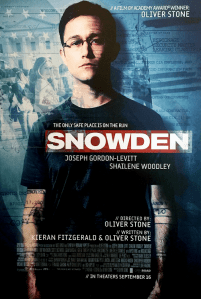 There’s quite a difference when director Oliver Stone actually gives a damn with a movie, and you can tell with Snowden that he is passionate about making a compelling and accessible movie for American audiences to understand why they should be angry. He wants to lead the righteous civil liberties mob against the right perpetrators while providing an appreciative moral context to the actions of Edward Snowden, America’s most famous fugitive. That sense of purpose and drive animates Stone in a way that his recent films have not, and even though it’s far less gonzo and experimental as Stone’s quintessential catalogue, the storytelling skill is still consistently engaging and the resulting 134 minutes inform as well as entertain.
Edward Snowden (Joseph Gordon-Levitt) wanted to serve his country and his expertise in computers landed him in various jobs working for U.S. agencies. He discovered the abuse of surveillance over everyday citizens rubber-stamped by a FISA court meant to provide oversight. Callous private contractors would surf through thousands of collected data points, and if pressed, could justify through terrorism connections, as it seems anyone in the world is perhaps three connections away from a person of interest (consider is the really unfortunate version of the Kevin Bacon game). Snowden risks everything to reach out to a team of journalists (Zachary Quinto, Melissa Leo, Tom Wilkinson) to tell his story and make sure the larger public will know these abuses of power.
 The best compliment I can give Stone as a screenwriter and director of Snowden is that he took a thoroughly challenging scenario with few cut-and-dry answers and made an accessible movie experience that effectively conveys moral outrage and dismay. It feels like Stone the educator is leading you by the hand, taking time out to explain some of the more delicate intricacies of the murky stuff that goes on behind closed doors. I won’t exactly declare it to be an intelligent examination on the moral implications of the material, but it’s certainly a movie that lands its goal of clarity. It produces a sense of clarity for the subject and a sense of clarity for why Snowden made the decisions he did. Gordon-Levitt delivers a steadily engrossing performance, even if it takes several minutes to adjust to his distracting speaking voice. Maybe my ears are just broken but it doesn’t sound like Snowden. Fortunately, my ears did adjust accordingly. Gordon-Levitt and Stone effectively kept my attention throughout the film. I was surprised how much I found myself enjoying long stretches of this movie, even if my own stance on Snowden is less clearly defined. He talks a good talk but the reality is messy.
Given Stone’s conspiratorial history, the plot definitely comes with a distinctive point of view over whether Snowden is a hero or a traitor. I don’t think inherent bias in a movie or the angle taken in storytelling is inherently misguided and that all stories should be as objective as possible. Sometimes the circumstances don’t permit objectivity. Stone’s film is clearly biased but it doesn’t fall into a hagiographical hero worship of its titular figure. This is a complicated subject and deserves a proper analysis to place the real-life people in the meaningful morally ambiguous context. Snowden ultimately makes the decision to become the world’s most famous whistle-blower for what he felt were systematic abuses of government surveillance, but before that climactic decision he comes across less than a spotless martyr. His character arc is a fairly recognizable awakening of alarm and horror at the great abuses of power in the name of security. He does start off as a lifelong Republican with family members who have served in the military and different governmental bodies. He’s devastated to be medically discharged from the Army and hungry to serve his country. He’s a patriot who becomes disillusioned with the system, but he’s also rather self-involved and excuses ego with civic duty. I didn’t know how gifted Snowden was in his field, and the movie has some amusement with the wunderkind training sequences where Snowden delivers shock and awe to his stunned superiors. However, the second act becomes more than a bit protracted because Snowden keeps quitting but eventually going back to government surveillance, whether CIA or private subcontracting. This is because of the pay, sure, but it’s mainly because nobody can do what he can do. He feels important. He feels needed. He convinces himself he’s making a difference in the War on Terror, but eventually the reality of the widening peripheral of the war zone is too much to ignore for him.
This is further epitomized through the romantic subplot with Lindsay Mills (Shailene Woodley), a liberal firebrand, photographer, and exotic exercise instructor. Woodley (The Fault in Our Stars) does her best infusing a warm personality into what is too often the underappreciated yet overly agreeable girlfriend role. It’s a storyline meant to further humanize Snowden as well as personalize the encroaching invasions of privacy and subsequent paranoia. After he discovers that the government can activate laptops and watch oblivious citizens through webcams, Snowden can’t help but stare down his open laptop during an almost laughably forced sex scene. My reaction as Lindsay climbed aboard Snowden was exactly this: “Oh, I guess this is happening now.” She would have a greater impact if the movie did more with her character, as she is the long-suffering girlfriend who keeps accommodating his life choices. They move three times across the country for his jobs and Snowden is always unable to fully explain why he feels the pull to these tech occupations, which further frustrates a woman who just wants trust and stability. There is one interesting conversation that Lindsay offers, typifying the blasé response to spying with a “well I have nothing to hide, so who cares” rationale. Snowden is quick to admonish this line of thinking, an opinion that many still share. The other regrettable reality is that the romance is inevitably going to be the least interesting facet of this story. By going behind the curtain of American secret surveillance, we’re indulging in our collective curiosity at how exactly all these moving parts operate. To then go home and watch a couple squabble is a consistent letdown of drama.
 There are a few other artistic miscues that weigh down Snowden, mostly Stone’s penchant for heavy-handed symbolism. The same instincts that allow Stone to carefully thread a knotty story are the same impulses that tell him that subtlety is for cowards. There doesn’t need to be a frame story here. I understand that select media outlets trying to break this story naturally allows for a question-and-answer framing system of flashbacks. However, very little is added besides a skeletal structure. The media members act as reactionary acolytes. It was all captured much more credibly in the Oscar-winning documentary, Citizenfour. There’s no earthly reason for Nicolas Cage to be in this movie except for drawing financing. He plays an old CIA code-breaker and admirer of outdated technology, but really he’s there to serve as an institutional nod to Snowden. At the conclusion, when Snowden’s identity and message becomes public, there’s a scene where Cage’s character literally toasts his pupil’s actions. I would say it’s a bit much but the character is a bit much for an actor that hasn’t generally been known for restraint. When Snowden is leaving the CIA offices in Hawaii for the last time, he steps out into the light (get it? get it?) and the scene is practically rendered in slow motion as the enveloping white light fills the screen and bathes Snowden (get it? get it?). He smiles bigger than we’ve ever seen. Lastly, Stone can’t just help himself during the very end and has Gordon-Levitt replaced with the actual Edward Snowden to deliver the closure of an interview. I don’t think we needed a reminder that Snowden is an actual living person.
Snowden the man, and Snowden the movie, wanted to shake up an ignorant and apathetic American public about the dangers of unchecked power in a surveillance state, but was the mission a qualified success? Years later and Snowden living in exile in Russia, the charitable answer would be inconclusive, though the pessimist in goes further. It very well seems that the majority of the American public simply doesn’t care (out of sight out of mind). The trial over whether Snowden is a patriot or a traitor seems a little moot perhaps when the larger public shrugs at the revelations of security overreach. Does a movie about a Great Man have as much resonant cultural cache if that defining act of greatness produces a shrug? I’m by no means saying we should apply a polling system to accurately measure a person’s value and accomplishments to the larger cultural and political landscape. Snowden wanted to wake the public up but we hit the snooze button. In the meantime, the movie about his exploits is fairly entertaining, so at least he has that.
Nate’s Grade: B
Share this:

The Magnificent Seven (2016)
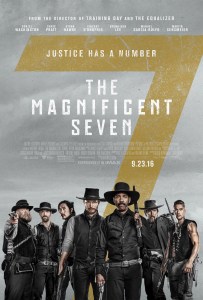 Obviously the new Magnificent Seven remake was never going to be as good a Western as the 1960 original, or as good an action movie as its source material, Akira Kurosawa’s legendary Seven Samurai. Once you accept that, the question becomes whether simply being an enjoyable Western action movie qualifies as a success given its storied pedigree. If you can’t do better than the original, why bother making it as my friend Ben Bailey would question. The answer is of course blunt (money) but the conundrum is how does one improve on classic film masterpieces? I think the new Magnificent Seven found its footing by accepting its unquestioned ceiling and instead going down a different path, instilling the essence of what made the older films so superb, and just trying to be the best B-student it can be with its new set of guidelines for broad entertainment.
The dusty town of Rose Creek falls under attack by ruthless industrialist Bartholomew Bogue (Peter Sarsgaard), who wants the land for his mining company. He installs loyal toadies as lawmen for the town and to ensure any troublemakers are put to “justice.” Emma Cullen (Haley Bennett) wishes to avenge her fallen husband and recruits a famous outlaw, Chisolm (Denzel Washington). He agrees to help and rustles up a powerful posse of gunslingers to defend the town from Bogue and his cruel forces.
There’s a reason this story still works as well as it does and that’s because the structure is ready-made for payoffs and audience satisfaction if the director and actors are capable. Act One establishes the threat and our two main roguish heroes, and then Act Two starts off with the gathering of the team, routinely one of the greatest sequences in screenwriting, and then the Act Two midpoint involves toppling the corrupt thugs controlling the town, and Act Three is the culmination between the forces of anti-hero good versus evil over the ultimate battle for the town. It’s an against-all-odds underdog tale with good but possibly doomed forces against a villain used to steamrolling through vulnerable citizens. I don’t care whom you are, that story structure worked then and it still works now. Fuqua and company don’t break a winning formula and know what strengths they have and how best to maximize them for top entertainment value.
 The biggest asset is this glorious cast, headlined by Washington and Chris Pratt (Guardians of the Galaxy). There isn’t admittedly much to these characters from a development standpoint. They’re given back-stories, though some of them are fairly airy and provide a bare minimum of effort. Red Harvest (Martin Sensmeier) in particular just kind of shows up and everybody shrugs and says, “Why not?” more or less. Also, while on this subject, it’s a bit contrived that when the bad side has their own villainous Native American that the script has to conspire for the only two Native Americans to face-off, especially when we’ve been given no history or connection between them prior to this climactic showdown. Back to the main cast, Washington settles into his suave badass persona we’ve come to expect from the man. He even fades into the background at times, ceding space for the other characters to have their moments. Make no mistake, though, because Washington’s character is a strong central anchor for this movie and even on autopilot this actor still produces attitude with style and gravitas. There’s also the simple pleasure of just watching Washington in a Western. The man was made for this setting of taciturn badasses. The brightest star of the picture is Pratt, expertly cast as a charming rogue with a big personality. What the characters lack in development they make up for in colorful personalities, which is acceptable in a genre that rewards memorably outsized figures of entertainment. Pratt is a fun rascal with a penchant for sarcasm and playing around with his prey. Every minute Pratt commanded the screen was a minute that captured my full attention.
The rest of the cast is solid and make the most of their screen time, putting in memorable supporting performances to compliment the stars. Vincent D’Onofrio (Jurassic World) is basically like a human equivalent of a bear or yeti. He’s this massive and animalistic creature and I appreciated D’Onofrio’s gusto in embracing the peculiarities. In a film of great casting and memorable characters, he nearly steals the movie. Ethan Hawke (Boyhood) has one of the more credible character arcs in the film as well as the best name (Goodnight Robicheaux). He’s haunted by a lifetime accumulation of killing. His flinty co-star Byung-hun Lee (RED 2) is the strong silent type and the two of them have a nice gunslinger chemistry, nicely contrasting but still a believable brotherhood in arms. Bennett (Hardcore Henry) is going to break out in a big way in 2016. She has a very arresting face (it’s her eyes) and an instant screen presence, which is hard to do with these guys soaking up much of the oxygen. She also gets to prove her mettle and not be treated as a romantic object, so hooray. My one concern with Bennett was that the costume designer had let her down, as it seemed the top of her gown was dangerously close to slipping off her shoulders at several key points. I understand this is designed to squeeze in a slight surge of sensuality for what is very much a PG-13 action flick but it became distracting with its obviousness. Bennett deserved better, though she might be another figure of T&A with her role in The Girl on the Train. We shall see (maybe much). The only sore spot is the villain, a wasted Sarsgaard (Black Mass) who never quite lives up to a diabolical nature worthy of the attention of our colorful cadre of anti-heroes. He’s a bully but he doesn’t seem formidable enough or that interesting.
 Fuqua (The Equalizer) hasn’t been the most consistent stager of action with his up-and-down career but he puts out all the stops with The Magnificent Seven to great effect. The action sequences are robust and shot with great attention to geography and escalation. I knew exactly what the stakes were with each sequence and gun battle, and I knew the different people and their placement and the goals. With a crew of seven and counting, it can be difficult to adequately find room for each of the fighters to be well utilized and have at least a moment that matters (just look at what happened with Suicide Squad). The second half of Act Two is our team plotting how to compensate for the overwhelming forces coming down their way, and the plotting produces plenty of opportunities as the audience watches the setups and waits for the payoff jamboree. There are little payoffs, big payoffs, crowd-pleasing payoffs, character arc pleasing payoffs; it’s an action movie that knows the climax should be the best part, and it doesn’t disappoint. The town may be in rubble and strewn with corpses by film’s end, but you’ll be happy and content from the wealth of tense and smartly directed action. Helping things along, Fuqua’s Wild West photography is often strikingly beautiful with its use of natural light.
The Magnificent Seven makes up for its lack of originality and rich characters in colorful personality and the sheer scope and intensity of its action. It can’t contend with John Sturgis and Akira Kurosawa, but what modern movie can? I don’t fault the movie for failing to live up to the standards of two classics in two different genres. I instead credit the movie for knowing its strengths and knowing how best to develop and deliver them for maximum mass appeal enjoyment. The cast is wonderfully selected and given fun characters to dig into, and the onscreen camaraderie of our seven might not rise to the level of magnificence but it’s pretty good by all accounts. That’s a rather keen summary of the movie writ large; with modestly recalculated expectations, the movie may not be magnificent but it’s plenty good and plenty entertaining. Washington and Pratt are stars making full use of their broad star appeal. The action sequences are well staged and peppered with payoffs, and it’s worth congratulating the team on having several parallel lines of action and keeping all of the shifting particulars understandable for its audience. The Magnificent Seven is about as good as I expected any remake to be, and while it doesn’t rise to those storied heights it does achieve its goals with vigor and style.
Nate’s Grade: B
Share this:

Sully (2016)
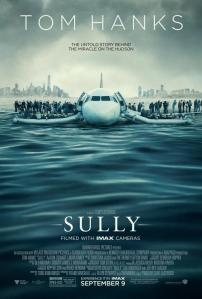 I think I had the same initial thought that most did when they saw the news that there was going to be a movie about the Miracle on the Hudson airline pilot: where exactly is the feature-length story? The flight itself lasted only about 200 seconds before landing on the river, and the sequence is thrillingly recreated and held off until halfway through the movie. The hero in the cockpit, Sully (Tom Hanks), is consumed with ensuring each and every last passenger is accounted for. When he gets the news that all survived, he can finally allow himself to breathe, to take in the full magnitude of the events, and it feels like a cleansing moment of deep emotional catharsis for him and the audience. But what’s the movie here? Apparently the NTSB and the airline insurance companies are disputing whether Sully could have safely landed the plane back at an airport instead. It’s exactly the kind of flimsy, manufactured conflict that sets itself up for moral grandstanding and a courtroom confrontation where our heroes will be vindicated, and we get all that. Sully’s unexpected spotlight wears on him as he feels like an ordinary citizen not worthy of the term “hero.” No other plane has successfully landed in water without a loss of life, so I’m sorry pal, but you’re a hero, even if you think you were just doing your job. Hanks is suitably low-key and humble and strong and emotionally resonant, though he was better on just about every front with Captain Phillips. The direction from Clint Eastwood is respectful without going into hagiography. The overall message is one of uplift, widening the focus from Sully to other heroes in New York City that day that came together to help others. It’s a moving message without having to resort to melodrama. At a mere 96 minutes, Sully gets you in and out and provides a solidly entertaining glimpse at the people who rose to the challenge when needed most. It’s a well-made movie that goes as far as it can without trying your patience.
Nate’s Grade: B+
Share this:

Bridget Jones’ Baby (2016)
 Coming 12 years after the last Bridget Jones outing, I was pleasantly surprised to discover how warm my feelings still were for this plucky, feisty heroine. Now in her mid/late 40s, Bridget is contemplating a life never becoming a mother when, surprise, she gets very pregnant and has two possible fathers: billionaire love guru Jack (Patrick Dempsey) or her newly available on-again off-again beau, Mark Darcy (Colin Firth). It’s a frothy plot contrivance but the screenwriters (including author Helen Fielding and co-star Emma Thompson) are able to produce fun comic scenarios that fully embrace the premise and its soapy conflicts. Bridget has two pretty appealing options, and when both men finally discover the possibility of the other, it becomes an entertaining game of one-upsmanship. The requisite romantic comedy elements don’t forget to be funny too, including an ending rush to the hospital that achieves some inspired slapstick. The film is swiftly paced and filled with zingers, and I just sat back for the two-plus hours and enjoyed the company of these silly yet realistic human beings. I enjoyed the adult humor and conversations that rarely get as much development in this genre. With all her self-sabotaging ways, you come to realize how much of a prize Miss Bridget is, and Zellweger slips right back into the role like no time has passed. However, plenty will grumble about Zellweger’s much-publicized plastic surgery, or the fact that she didn’t pack on the pounds for this picture, but I don’t see why any of that greatly matters in the interpretation of this character. The personality of Bridget is more than the alignment of her facial features. For fans of the series, Bridget Jones’ Baby is a welcomed return to form from 2004’s Edge of Reason and an extra dose of enjoyable fan service, tying up its tidy happy ending with a bow. Here’s something to chew over: my father had no prior knowledge of the Bridget Jones series, decided to see this movie, and enjoyed it thusly. Give Bridget Jones and her baby daddy drama a chance and you too may be surprised.
Nate’s Grade: B
Share this:

The Light Between Oceans (2016)
 A melodrama through and through, The Light Between Oceans is at its core a pretty-looking movie about pretty-looking people being sad. The premise almost seems like a parody of prestige indie filmmaking in the 1990s. Tom (Michael Fassbender) is a shell-shocked WWI vet-turned-lighthouse keeper in Australia who falls in love with mainland lady, Isabel (Alicia Vikander). They marry and have difficulty conceiving, with Isabel enduring two grueling miscarriages. Then one day a dingy washes ashore with a crying baby inside and a dead man. Rather than alert the proper authorities, they decided to bury the man and raise the child as their own. Years later, the couple discovers the girl’s real mother, Hannah (Rachel Weisz), who has been racked with unanswered grief ever since. The couple is then thrown into an emotional crucible testing their ethics and moral compromises and the question of ultimately what’s in the best interest of this little girl. It’s a movie that’s geared to put you through an emotional wringer, and the actors do their part. Vikander (Oscar winner for The Danish Girl) is downright luminescent and dives deep into all of her character’s varied and heightened emotions. The scenes of her dawning realization of the miscarriages and her helplessness are heartbreaking without being maudlin. Weisz is shaken to the core when her identity is robbed from her; she’s so fragile and holding on to hope so hard you might think she’ll collapse any moment. Fassbender internalizes the most and fully communicates the inner struggle of his character’s guilt. Director and chief adapter Derek Cianfrance (The Place Beyond the Pines) has made an intimate relationship drama in a beautiful, sea-swept location, and the kind of Big Feeling classy melodrama you came to expect from Anthony Minghella. The problem is that Cianfrance’s characters are held too much at arm’s length for resonance. We empathize but not nearly as deeply as we could, and by the end the movie washes away like the surf.
Nate’s Grade: B-
Share this:

The Neon Demon (2016)
 The prospect of a new Nicolas Winding Refn movie is akin to a trip to the dentist for me: long, painful, and full or regret over one’s life choices. The Neon Demon will not change this perception of mine. I hated this movie, and the more I think about it the more I hate it. Unlike Refn’s last film, the punishing, overwrought, and nihilistic Only God Forgives, there isn’t even a kernel of an idea of a movie here. I loathed Only God Forgives but I’ll at least credit Refn for crafting something with potential in its plot dynamics. In better hands, somebody could have done something with the setup for that movie. I don’t think anyone could work with what Refn offers in The Neon Demon because he offers nothing. That’s not entirely true. He offers pretty pictures and alluring shot compositions, bathing the screen in high-contrasting colors. What he fails to offer is a story, or characters, or any reason that this movie shouldn’t exist instead as a ten-minute short. Somebody enlighten me and tell me what exactly this vacuous and tedious art exercise offers.
Perhaps I’m being too cruel so allow me to explain the plot. Jesse (Elle Fanning) is a 16-year-old girl fresh off the bus to L.A. She gets hired at a modeling agency and makes friends with a makeup artist, Ruby (Jena Malone), who also works in a coroner’s office beautifying corpses. Jesse quickly rises through the ranks of the modeling world because of her fresh face and youthful, pure demeanor. She makes enemies with older models (Bella Heathcote, Abbey Lee) who feel threatened by her. And Keanu Reeves plays a sleazy motel owner who sticks a knife down Jesse’s throat for fun. Or that was a dream. I think. Then there’s a confrontation that includes necrophilia, murder, and cannibalism. And even after the cannibalism the movie still goes on for another fifteen minutes!
 There is not nearly enough plot or any substance to carry out Refn’s near two-hour running time, which becomes all the more obvious with one dreary, pretentious, artfully self-indulgent scene after another. There are long segments where I cannot even tell you from a literal level what is happening on screen. Is Jesse descending into madness? Is Jesse losing herself to the vanity of the industry in a heavy-handed visual metaphor? Does anything happening register with the slightest merit? Refn is possibly trying to tackle the same meandering dream logic that populates David Lynch’s more obtuse filmmaking entries, like Lost Highway and Mullholland Drive (recently voted the top film so far of the twenty-first century by the BBC). I’m not a fan of untethered David Lynch but he will at least keep things interesting. The Neon Demon is a powerfully boring enterprise in annihilating audience patience. There’s no there there.
Another problem I have with Refn’s movies is that he hangs much of his meandering on broad and obvious themes and assumes they’re revelatory. Only God Forgives was all about the pointless nature of vengeance and cyclical violence, and you felt the pointlessness with one grisly and uncomfortable moment after the next. With The Neon Demon, Refn falls back on the most general of broadsides against the fashion industry. Did you know that people working in a surface-level industry could be shallow? Did you know that young women are exploited for their beauty and then quickly cast aside? Did you know that succumbing to the appeals of vanity could be self-destructive? These are the most general themes and they are presented without able commentary. It’s like Refn thinks touching upon these shallow themes is enough substance to justify all the excesses.
This is borderline unwatchable cinema. The plot is like Showgirls without the camp but still following some of the basic plot beats. There is nothing interesting about these characters at all and that’s because they’re not people but robotic figurines at best. They’re dolls for Refn to pose and play around with his purple lights. It’s like watching two hours of somebody rearrange fancy-looking furniture. The characters are just as significant as the nearest love seat or coffee table. I’ve complained about all the empty space in Refn movies and The Neon Demon is no different. This movie is padded out exponentially to become Refn’s longest movie in his career. He cares far more about his shot compositions and cinematography than storytelling. At this point I don’t think Refn has any interest whatsoever in telling a story. He wants to construct a visually immersive film experience. The Neon Demon is little more than the misty atmosphere of the impermissible, the phantasmagorical. Refn deploys controversial imagery and plot elements but he deploys them in place of actual substance. Anybody can get a strong response by throwing in a necrophilia sex scene, but has that reaction been earned and has this moment been properly setup by careful development? Absolutely not. Things just happen.
 This was also billed as Refn’s horror movie but there’s nothing genuinely terrifying, at least from an intentional standpoint. You don’t feel any sense of danger or even a sense of uncertainty until the very end, and by then the movie has meandered far too much for the horror elements and gore to have an impact beyond lazy shock value. This is a movie where pretty people stand around and then, on the turn of a dime, do something outrageous. Refn hasn’t laid the groundwork for a descent into mental instability with our lead character, which seems like the most obvious solution. I could see a Black Swan-style psychosexual story about obsession with perfection and how this blinds one woman into making a multitude of sacrifices, driving her over the edge and into murder. Black Swan was a great, often brilliant movie. Go watch Black Swan instead, folks.
I think I have a solution that will benefit us all, dear reader. Nicolas Winding Refn should forgo the director’s chair and devote his career to being a cinematographer. He has an alluring eye for visual compositions and a great feel for atmospheric lighting, but with each passing movie I feel the man’s disdain for narrative filmmaking. His skill set is best utilized at making pretty pictures. Get him away from directing actors. Get him away from writing stories. Have adults in charge of the other aspects that help make a movie what a movie should be. The Neon Demon is a confounding, obnoxious, obtuse, intellectually destitute and monotonous movie experience. It’s frustrating to deal with the Cult of Refn in cinematic circles because I just cannot see what they see (I liked Drive well enough). The Neon Demon is too shallow and tortuous to be an insightful commentary on beauty, too oblique and maddeningly dreamlike to be an engaging story, and too devoid of interesting characters to hold your attention as they drift from one scene to the next. I’d be more forgiving of Refn’s indulgences if he was a short filmmaker. I’d allow more latitude for experimentation. The Neon Demon is not a movie. It’s a collection of half-formed, shallow ideas that Refn has thrown together, a whole lot of dead and empty space connecting them together, and an 80s synth score to underline the high-contrast colors. At this point I’d rather go back to the dentist than sit through another Refn film.
Nate’s Grade: D


You must be logged in to post a comment.