Blog Archives
Collateral Beauty (2016)/ Manchester by the Sea (2016)
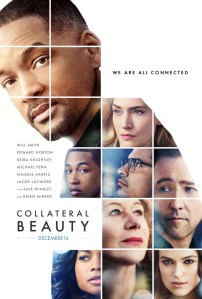 Trauma and grief are common colors in the palette of screenwriting. Wounded men and women overcoming loss and sorrow allow us all an opportunity to learn and heal through someone else’s personal pain and suffering. It’s the movie theater as therapist’s office with art serving as catalyzing event to help those in need. When 2006’s United 93 was released many critics thought it was too soon for a dramatic recreation of the events of 9/11. First, there’s never a right estimation for how long the world of art should wait to respond to shared tragedy, but I argued that United 93 could function as a facilitator for healing for select moviegoers. It helps to be able to live vicariously through fictional characters on screen, and it makes us smile when they overcome those obstacles and give hope to the rest of us. Two new movies have taken very different paths to explore responses to trauma onscreen. Collateral Beauty is a star-studded affair built from a screenplay that sold for an estimated three million dollars. Manchester by the Sea premiered at the Sundance film Festival and blew away audiences with its understated and unsentimental portrait of loss. One of these movies goes big and miscalculates badly and the other delivers one of the better, more emotionally involving films of the year. I think once you hear the premises it’ll be clear which is which.
In Collateral Beauty, Howard (Will Smith) is an advertising guru still reeling two years later from the unexpected death of his six-year-old daughter. He’s become a hermit who furiously rides his bicycle into traffic to tempt fate. He shuns his old friends and minority partners, Whit (Edward Norton), Claire (Kate Winslet), and Simon (Michael Pena). He also writes angry letters to the concepts of Death, Time, and Love to note his general displeasure. Major accounts are lost because of Howard’s seclusion and now it looks like the whole company might go under unless they accept a stock buyout. Howard refuses to sign off on the purchase, which forces his trio of friends to hire struggling actors to play “Death” (Helen Mirren), “Time” (Jacob Latimore), and “Love” (Keria Knightley). These three personified concepts will converse with Howard to provide an unorthodox therapeutic breakthrough. The actors will be paid handsomely and they relish the challenge. If that doesn’t work, they will record his public feuds with the actors, digitally erase the actors, and make it seem like he’s gone crazy with grief. Along the way, Howard gets closer and closer to talking about his loss in a support group run by the saintly Madeleine (Naomie Harris), a woman also suffering the loss of her child. If the universe is all about making connections, Howard is on a collision course with the fates.
Few films have dropped in estimation so precipitously in my mind as Collateral Beauty. To its credit, while you’re watching the movie you don’t notice as many of the misguided manipulations from prolific screenwriter Allan Loeb (Things We Lost in the Fire, Just Go with It). You’re aware of their presence but they don’t remove you from the movie, that is, until you extend further thought on the full implications. Allow me to simply vocalize in print the Christmas Carol-esque premise of this “feel good” holiday movie.
“A group of wealthy advertising executives scheme to get their grieving mentor and friend declared mentally incompetent so they can sell their company. They hire duplicitous actors to pose as metaphysical concepts, engage with Howard in public, and then they will digitally erase the presence of the actors, making it look like Howard fits the lazy man’s definition of crazy. And these people are the heroes.”
The characters give plenty of rationalizations for why they’re forced to set up their supposed friend, mostly about saving the company and saving jobs. Simon especially needs the money and medical insurance with where he’s headed. Howard is spiraling and they worry that he will take down everyone with him. That’s fine, but why do they resort to the outlandish and ethically dubious practices that they do? The hiring of actors seems like a helpful therapeutic exercise on the surface, unless you stop and think about a grieving man badgered by an antagonistic universe. Howard is already exemplifying mentally unsound behavior so I don’t know why the public spats are required. The digital erasure constitutes explicit fraud and it feels so much grosser. It’s an expensive step to provide visual evidence of a man having a nervous breakdown. They could have simply recorded Howard in his office for a week while he builds elaborate domino structures just to watch them topple (symbolism!). Even the characters call-out one another for this gaslighting trick. On another note, won’t Howard eventually find out? What if some enterprising digital effects editor has a moral crisis and confesses? This is the equivalent of false documents forged to push the rich old lady into the booby hatch so her scheming relatives could abscond with her vast fortune. It’s even more egregious when Collateral Beauty presents these characters as the heroes. Yes they have different degrees of guilt but that is tamped down by their moral relativism justifications. It makes it a little harder to swallow all that outpouring of cloying sentiment later. These murky and misguided manipulations will symbolize much that is wrong with the movie.
I hope the audience is prepared for Smith to be sidelined for much of the movie because Howard is more a supporting character in someone else’s story. Howard is really more a catalyst than a fully developed character. He grieves, he suffers, but his point is how his grief and suffering affect others, which is a strange tact to take. His journey is quite similar to Casey Affleck’s in Manchester by the Sea. He must come to terms with loss, accepting the cruelty of that reality in order to move forward and let others in. Moving on doesn’t mean we forget, especially when that trauma is a loved one’s loss, and Howard holds onto that pain for so long as a means to still feel his daughter’s presence. It’s an acceptable character conceit but it flounders in the movie because EVERYONE simply talks at Howard. Smith’s asked to be teary-eyed and mute for most of the picture. Any significant breakthroughs, developments, or even passing of information occurs from others applying meaning to this sad silent man who must not remain sad.
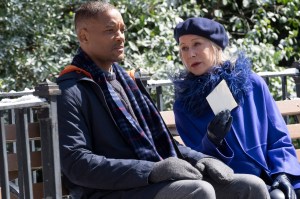 As a result, the movie pumps up the supporting characters and pairs them with one of the actors. “Death” relates with Simon for him to accept his declining health and to allow his family to know. “Time” relates with Claire over her worry that she’s sacrificed starting a family by prioritizing her career (this is another film world where nobody puts serious consideration into adoption). I need to stop and question this particular storyline. Doesn’t it feel a bit tacky and outdated? It’s also, by far, the storyline with the least attention; we literally see Claire glance at a sperm donor brochure and website for a scant few seconds and that’s it. Then there’s “Love” who relates with Whit to try and get him to repair his relationship with his rightfully angry young daughter after Whit cheated and broke up his marriage. “Love” literally just goads Whit to actually try being a parent and accept some responsibility for his failings. That’s it, and she has to use the incentive of a date to convince him to try and be a better father (Whit sloppily hitting on “Love” definitely lays a plausible peak into why exactly he’s divorced). “Death” and Simon play out the best mostly because Mirren is impishly amusing, and also benefits from naturally being Helen Mirren, and Pena’s character is given the most sincerity. He has the most at stake personally and setting things right for his family is taking a toll. Loeb has given each actor something to do, and the talents of the actors are enough that I was distracted from the overall machinations at least until the very end.
For most of its relatively brief running time, Collateral Beauty has kept to its own form of internal logic and avoided blatantly manipulative calculations for heightened drama. Sure Pena’s first instance of movie cough is an obvious telegraph to more astute members of the audience, but it makes some sense since this is less our real world and more the well-sculpted Movie World. Then the final ten minutes play out and the movie doesn’t just skid, it steers into this skid of counterfeit sentiment. I’ll refrain from spoiling both of the major reveals but they both serve to make you rethink everything. It’s not one of those eye-opening twists but more something my pal Eric and I were dreading in our seats, mumbling to ourselves, “Please please don’t.” These final two reveals are completely unnecessary. They disrupt the tenuous reality of the movie and the balance of tones becomes a mess. It also divulges how overly constructed the screenplay really was, designed to lead an audience to these chosen end points that don’t engender catharsis. It’s about pointing out how clever the screenplay was rather than the emotional journey, a movie in service of its twists. Neither twist serves strong narrative purpose other than to be out-of-the-blue surprises.
 Let’s get to that ungainly and clunky title. It’s a nonsense pairing of words that’s meant to sound profound but is really just confusing and remains so even though the characters repeat this clumsy phrase like eight times. There’s a conversation where it appears in every sentence, as if repetition alone can make this phrase/idea successfully stick. It doesn’t. I think I understand what it means, or at least what Loeb was going for, but I’m not sure. Madeleine talks about making sure to see all the collateral beauty in the universe, but is this merely a more obtuse way of restating Wes Bentley’s floating plastic bag declaration in American Beauty? Is it a more pretentious way of saying to stop and smell the roses? Here’s where I thought it was going with its meaning: “collateral” in this sense means accompanying and instead of accompanying damages we’re focused on the accompanying beauty, therefore a contemplation of the possible unintended helpful ramifications. This was going to make sense for Madeline since she uses her personal tragic experience to reach out and help others heal through their own tragedies. It’s the long ripples of human kindness reaching out far beyond our initial actions. And maybe, juts maybe, Howard and Madeleine would become romantically linked through coping with their similar heartache and find one another. However, the movie’s real ending torpedoes this interpretation. What we’re left with is a clunky pairing of words that still makes little sense by film’s end.
Collateral Beauty is probably the best-looking Hallmark movie you’ll see at the theaters this holiday season. It’s a gauzy and manipulative endeavor packed with movie stars doing their sad and redemptive best before hopefully cheering you up. There’s nothing that can’t be overcome with a good group of friends who only want what’s best for you while they take part in a criminal conspiracy to defraud you of your business stakes. That’s because even the most nefarious of behaviors can be forgiven with the right actor to provide a twinkle of the eye, a little swooning musical score to tell the audience how and when to feel, and the backdrop of lightly swirling snowfall. It’s a universe that refuses to allow Will Smith to stay sad and so it intervenes. Collateral Beauty has its draws, namely its core of great actors who each find some point of emotional grounding to their character’s plight. The finest actor in the movie is Harris (Moonlight) who radiates tremendous empathy and a bittersweet serenity. I’d watch the movie from her perspective. To Loeb’s credit, the movie is more grounded and less fanciful than its premise could have lead. It doesn’t sink to the depths of a Seven Pounds (“Do not touch the jellyfish”). Waterworks are shed all around, hugs are evenly distributed, and I’d be lying if I didn’t feel a lump or two in my throat by film’s end. However, its emotional journey doesn’t feel anywhere as revelatory as Manchester by the Sea.
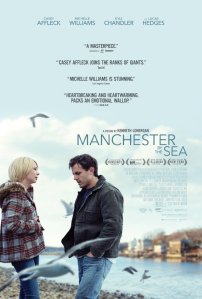 Lee Chandler (Casey Affleck) is living out an ordinary existence as a Boston apartment complex maintenance man. His routine is rudely interrupted when he receives news that his older brother Joe (Kyle Chandler) has fallen deathly ill. On the car ride north to Manchester, Joe passes away. Guardianship of Joe’s 16-year-old son Patrick (Lucas Hedges) is entrusted to Lee much to his shock. “I was just supposed to be the back-up,” he says to himself to little avail. Lee wants to move back to Boston with his new ward but Patrick refuses, pleading that he already has a life in town he enjoys. Lee is itchy to leave because of his painful associations with his hometown, tracing back several years to a fateful night of tragedy he shared with his current ex-wife, Randi (Michelle Williams). Lee takes on the mantle of parent while trying to ignore the trauma he’s doing his very best to ignore with every fiber of his working-class Bostonian being.
The first impression from writer/director Kenneth Lonergan’s movie is just how achingly authentic it feels. We drop in on the lives of these hardscrabble folks and glean important details as we progress, better forming a clear picture as to why they carry such pain with them as penance. In simplistic terms, it’s a two hour-plus journey to reach a point where the main character can openly cry. It’s also much more than that. It’s an incisive character piece on grief and tragedy, a surprisingly funny movie, and an effortlessly engaging movie that swallows you whole with its familiar rhythms of life. There is no formula here for Lonergan. Each fifteen-minute sequence opens the movie up again for further re-examination, especially a middle passage that is truly devastating. It provides compelling evidence why Lee has decided to become a recluse drifting through life. It’s not that Lee is lonely; he’s actively disengaged from all communities and connections. There are three different potential openings with women who seemed flirty and interested that Lee could have capitalized upon, or at least pursued, but he does not. A woman spills a beer on his shirt and squeezes closer to apologize, pleading to buy him a drink. He coolly looks away, ignoring her, and instead chooses to wait until closing time so he can get into a drunken fight instead. Lee would rather feel pain than momentary pleasure.
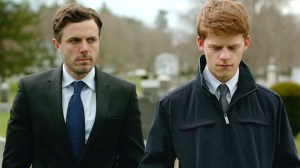 The movie is also a poignant father/son relationship told in waves, with as much humor as emotional breakdowns. Lee is trying to fix the situation the best way he can as if it was another clogged drain. He’s thrust into a parental position that he doesn’t feel fits. It’s not that he’s actively evading responsibility as he does try to accommodate his nephew, even driving him back and forth and covering for one of his two girlfriends to sleep over. Lee cannot work in his hometown because of his own lingering pain and also because nobody will give him a job thanks to the reputation he carries. For a long while it feels like Patrick isn’t even registering the death of his father except for his distress at the thought of his father’s body remaining in a freezer until the ground thaws for a burial. He’s trying to live a normal teenage life filled with activity like band practice, hockey practice, and juggling some alone time with his two girlfriends. He seems like a normal teenager with a normal teenage attitude, and that flies in the face of our expectations. Hedges (Kill the Messenger) provides a nice dose of awkward comedy to keep the movie from drowning in sadness. The burgeoning relationship between Lee and Patrick takes on new familial elements and dynamics and each is feeling out that new role. This movie is more than an elegant bummer.
Lonergan has only directed two movies prior to Manchester, both of them insightful, complex character studies with meaty parts for game actors. 2000’s You Can Count on Me cemented the wide appeal and remarkable talents of Laura Linney and Mark Ruffalo. Then his follow-up, the criminally underseen Margaret, ran afoul with producers who wanted to trim its near three-hour running time. It was kept in limbo for five long years until 2011 where it met with a degree of fervent critical fandom, including yours truly. Manchester began as a starring vehicle for producer Matt Damon, but when scheduling conflicts got in the way, the project was reworked with Affleck in the lead and Lonergan told the story his creative impulses desired without studio interference. As a big fan of his previous directorial outings, I’m not surprised by the gripping results. He lets an audience draw conclusions from the impressions and pieces he offers, notably with Patrick’s mother (Gretchen Mol) who he refers to as “not an alcoholic anymore.” There isn’t one big obvious scene but we’re given enough pointed clues about Patrick’s history with his mother and why Lee is adamant that his nephew does not live with his mother. The history of characters and their relationships follow this model, layering in further meaning as we continue at a safe distance in our seats. Things aren’t spelled out as they are allowed to breathe, the furtive connections becoming perceptible in time like a message written in the fog of a window. Lonergan has great affection for his characters and their flaws, insecurities, and struggles. This was evident in Margaret where the title character (vividly played by a pre-True Blood Anna Paquin) was a teenager exploding with emotions, opinions, and thoughts and Lonergan celebrated her for this fact. I appreciate Lonergan’s refusal to paint in broad strokes with all of his characters.
 This is Affleck’s (The Finest Hours) movie and while good the more extroverted performers around him overshadow him. Affleck can be a gifted actor as evidenced with The Assassination of Jesse James by the Coward Robert Ford. He has a quiet intensity and a habit of burrowing inside himself to discover something raw and different. His performance feels like he’s trapped in a PTSD shield that saps the life from him. He’s drifting through his life and waiting to die, simply put. Because of his taciturn nature he doesn’t garner any sizeable monologues to spill out all his feelings. He has to use little moments and the nuances of choosing his words carefully. When he tells Patrick “I can’t beat it” those words are loaded with meaning that he can only convey in subtext. When he stops to process that Randi has gotten pregnant from another man we notice the subtle registration of pain and regret, a twinge of memories he’s trying to hold back. Affleck’s performance is very subdued for most of the movie but it’s in the final act where he cannot maintain his well-manicured bubble of resistance to the outside world. When Lee does start to cry, it will earn every ounce of your sympathy.
Williams (My Week with Marilyn) is more presence than character in the movie, but when she does stay long enough she leaves an emotionally gut-wrenching impression. I understand that “gut-wrenching” is a pejorative term but it’s really one of the more uplifting moments in the movie. That’s because her character’s reunion with Lee isn’t one of enmity but reconciliation, allowing her to make amends and say plenty of things that she’s been holding back for years. It’s an unburdening and once Williams starts it’s hard not to feel the flow of tears coming from your own eyes. She is a one-scene wonder, reminiscent of Viola Daivs in 2008 for Doubt, nominated for Best Supporting Actress and well deserving a win for one brilliantly acted scene. Fitting then that Davis looks to be Williams’ chief competition for Supporting Actress this year. I invested even more in this scene because the power of Randi’s emotional honesty almost pulls Lee out. He’s shaking, his voice cracking, and trying to stick to saying the customary conversational tokens that have gotten him through to this point. He’s avoiding confronting reality but the sheer emotive force of Randi almost pushes him to that genuine breakthrough.
If there is one noticeable drawback to such an exquisitely rendered film, it’s that it follows the narrative structure of real life perhaps a bit too faithfully. Life doesn’t normally follow a three-act structure with clearly defined character arcs and a carefully orchestrated system of measured payoffs. While Manchester by the Sea isn’t exactly an automatic entry in mumblecore paint drying, it’s certainly less indebted to familiar story structure, which does affect the overall motor of the story. You don’t have a strong sense of its overall direction, an end point, and while the pacing isn’t glacial it can start to feel bogged down in those wonderful New England details of everyday mundane life (how many times do we need to see Lee driving?). There are also probably more flashbacks than necessary to flesh out the characters in an implicit manner. If the movie wasn’t 137 minutes I might accuse it of padding its running time. It doesn’t take away from the overall enjoyment of the film but you feel a certain loss of structure and payoff. In contrast, Collateral Beauty is entirely reliant upon plot machinations and a formula serving a very Hollywood-styled ending. Sometimes maybe an audience would prefer a little more of a driving force and a little more oomph for an ending. While certainly lacking in just about every factor, I’d say that Collateral Beauty does feel more climactic with its conclusion than Manchester, which sort of rolls to a close that makes you say, “Oh, I guess that’s it then.” Sometimes realism can profit from a judicious nudging. Then again with Manchester it’s more the journey and Collateral Beauty is all about the destination.
 While ostensibly being about two men overcoming the loss of someone close to them to function in everyday society once more with meaningful personal relationships, there’s quite a wide divide between Collateral Beauty and Manchester by the Sea. One represents a more calculated and morally dubious reflection of trauma as a theatrical game leading to Big Twists that are meant to leave an audience swooning from the magic of reconciliation. While fairly grounded on its own terms for a far majority of its time, Collateral Beauty can’t help itself and steers into a ditch of bad plotting, made even worse by the fact that it puts so much significance on its preposterous final destination. It manages to cheapen the movie as a whole in retrospect as an elaborate parlor trick that rivaled what the ethically challenged heroes of the tale were perpetrating. On the other side, Manchester by the Sea is a carefully observed and intimate portrait of grief and the consequences of self-destructive detachment from a larger world of compassion. The acting is terrific and lived in, authentic to its core and stuffed with meaningful details that Lonergan leaves to his audience to formulate. However, some of its indie auteur sensibilities do have a somewhat negative impact on the pacing and ultimate conclusive nature of the movie. It’s not that the film is open-ended; it’s just a “life goes on” kind of ending that doesn’t exactly inspire the strongest feelings of satisfaction. Grief will always be a topic that attracts filmmakers and especially actors because of its inescapable drama, stakes, and general relatabilty. I only implore any readers that if you’re trusting filmmakers with two hours of your emotion, make sure they earn that privilege.
Nate’s Grades:
Collateral Beauty: C
Manchester by the Sea: A-
Share this:

Jackie (2016)
 Jackie (Natalie Portman) is still reeling from the loss of her husband, President Kennedy (Caspar Phillipson). In the weeks that followed the assassination in 1963, her life was a whirlwind of change. She was leaving the White House while another administration took control of her husband’s office and agenda. She was leaving a life of glamour and privilege and it all came to a halt. Bobby Kennedy (Peter Sarsgaard) is worried about the Kennedy policies getting lost as well as his own potential presidential prospects. Lyndon Johnson (John Carrol Lynch) is worried about asserting his own control. While trying to work through her grief, Jackie must protect her husband’s legacy among all the well-wishers, political vultures, and craven opportunists.
We’re left with an immersive, impressionistic look at America’s most famous first lady since it’s hard to distinguish the layers of performance from the woman herself. She was used to adopting the façade of what the public expected of her, how her husband’s friends looks at her with desire and dismissiveness, and the differences between her private life and her public persona. It’s a fascinating glimpse into the interior space of a famous woman that so many people think they know well because of her glamour and television appearances, but do they really? Her identity is in free fall. She gave up everything for this man and now he is gone and her cherished position is gone. It’s said each first lady leaves her stamp on the office, and now Ladybird Johnson is already itching to undo that stamp, erasing Jackie’s presence and supplanting it. Will these last few days define her and will they define her husband? While dealing with raw grief, Jackie also takes the position of being the first to protect her husband’s legacy. While planning the particulars of the funeral march and exact burial site, she’s really framing his place in the greater annuls of history, tragically cut short and questionably memorable. His life has been taken from her and now the only thing she can do is protect his place in history. The funeral details and conflicts they consign the new Johnson administration to are interesting, as is Jackie’s simmering disdain for the Johnsons, but it’s more than just placation; Jackie has an underrated knack for theatrical optics. The country is in mourning, just like its (former) first lady, and she offers a spectacle as an outlet. Some term it vanity and even Jackie admits that many aspects were for her, for her grief, for her rage at the world and her doubters, for her wounded soul searching for meaning. She wanted the American public to see her in mourning but she wanted just as much to see them in mourning too.
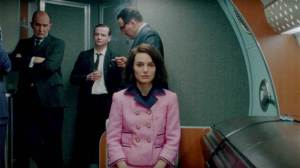 Eschewing the standard cradle-to-grave biopic, as well the noveau approach of using one clarifying moment to better examine and sum up the person (see: Selma, Steve Jobs), Noah Oppenheim’s script is a triptych, a hypnotic exploration that zips along non-linear but thematically-tethered memories. It’s a more interesting approach because we’re not locked into a linear progression of plot events, though the immediate aftermath and her interview with the Newsweek reporter (Billy Crudup) serve as the directional compass. It also provides a clever conceit for meta-textual levels. We have scenes that lay as direct conflict with the public Jackie and the private Jackie, and we have scenes that lay into the different levels of performance, from her show model tour of the White House furnishings and fixings to putting on the brave face to speak to her children. Director Pablo Larraine (No, Neruda) shoots the movie in a style reminiscent of its 1960s time period, with a film stock that blends the difference between documentary and recreation, further adding another stylistic level to the proceedings. The various threads of connectivity are so much more interesting to dissect with this storytelling approach and it makes the movie a much deeper and more contemplative experience to unpack.
There’s a scene in the middle of Jackie that stood out to me. During a night of drinking, Jackie puts on the record for the Broadway production of Camelot and wanders the large empty spaces of the people’s house. For my younger readers, the Kennedy administration was dubbed by many as “Camelot,” first coined by Jackie, out of a sense of its idealism, youth, and inspirational promise to change the world into a nobler place. It’s practically a mythical time and the real people get lost amidst the romantic spectacle. Nowadays, our presidents can often be the same mythical figures as the kings of old, figureheads whose humanity and details we iron out and soften as we eulogize and entomb them. The music echoes through the different chambers but there’s no one to hear it, no one to enjoy it, the vast emptiness communicating much of Jackie’s anguish. “There will be great presidents again but there will never be another Camelot,” she says. That moment is left as a passing memory, a picture of nostalgia that will only have its realism dampen in time as it becomes enshrined in American myth making. Amidst all her privilege and esteem, there is an existential sense of loss for Jackie and the nation as a whole into the turbulent 60s.
The other rich aspect is that we are watching a woman process her grief in real-time and it can often put a lump in your throat. I challenge anyone not to feel an outpouring of empathy when Jackie has to explain to her two very young children why daddy isn’t coming back from Dallas, having to explain something horrendous to those so innocent. In some scenes it feels like Jackie is numb to the world around her, focused on the little things as an escape from her horrible reality and its trauma. We do get a recreation of that fateful day in Dallas twice. The first is the immediate aftermath with Jackie bloodied and protected by the Secret Service, keeping her at a distance from us too in the audience. The next is a closer view inside the car as we’re with Jackie when the awful event happens, and the sudden shock of gore is still a disturbing gut-punch no matter how much you anticipate the moment. We watch her crazed instincts trying to collect the pieces of her beautiful and broken husband, stressing she was trying to keep everything together, figuratively and literally. The scene plays out longer and it serves as an emotional climax to the film, a frank reminder that for everything people believe they know about this woman, at heart, for all her riches and fame and privilege, she is simply a human being trying to make sense of death. It’s this final moment in the car that reminds us.
 This is an acting showcase and Portman (Black Swan) excels, delivering the best female performance I’ve seen this year at the movies. It’s an Oscar bait dream role and she nails it. She goes beyond mere imitation though Portman does an excellent job of that. Thanks to critic/blogger Jeffrey Wells for this great quote about the imitable real-life Jackie from author Tom Wolfe’s novel, The Right Stuff: “She had a certain Southern smile, which she had perhaps picked up at Foxcroft School, in Virginia, and her quiet voice, which came through her teeth, as revealed by the smile. She barely moved her lower jaw when she talked. The words seemed to slip between her teeth like exceedingly small slippery pearls.” Portman stunned me early with her exquisite recreation of Jackie and then she stunned me moments later with the depth of emotion she was able to convey in the scene where she stares into the Air Force One mirror, dabbing her husband’s blood from her face as her eyes are swollen with tears. Lorraine favors plenty of exacting close-ups to watch the array of emotions play across her face. She has moments of strength, moments of pettiness, moments of heart-tugging lows and weakness, and Portman is always fascinating, holding your attention rapt as you study her study. It’s a mesmerizing performance and one that deserves to earn Portman her second gold statue.
Jackie is a movie that has stayed with me for days after I’ve seen it. The exceptional and empathetic work by Portman is the first thing I recall, and then the thematic and symbolic relevance of the storylines as they fold on top of one another, providing a hypnotic and immersive portrait of a very famous woman who sought and spurned the spotlight. As far as I’m concerned this is the definitive film presentation of Jackie and Portman’s searing performance is the dazzling standard that won’t be beat. You walk away having additional appreciation for this woman but also further curiosity. The movie doesn’t expressly state who she is as a human being, providing a range of personas, some that conflict with one another, and allows you to put it all together for your interpretation. It’s a bold gambit and a fitting gesture for a woman defined by others’ perceptions.
Nate’s Grade: A-
Share this:

Miss Sloane (2016)
 Miss Sloane is an intelligent and exacting political thriller that should appease fans of the genre who enjoy a good arm-twisting from a powerful manipulator, in this instance the towering and intimidating full force of Jessica Chastain. She plays the titular Sloane, the best lobbyist inside the beltway, and a woman who leaves the comfort of her firm for the challenge of taking on the gun industry to help pass a reform bill. From there it’s an underdog tale powered by the winds of moral righteousness and given a tough-talking yet flawed hero that will burn down whatever she can, including her own reputation, to win. The biggest draw is the performance from Chastain (Zero Dark Thirty) as she gets to yell at people for approximately two hours and look good doing it. It’s a game of persuasion and leverage and D.C. voter politics, and she makes the constant stream of information accessible while providing a focal point for our interest. It’s a pretty information heavy film with a minimal of supporting characters that stand out (Gugu Mbatha-Raw as a school shooting survivor-turned-team member is the notable exception). With her victory never in doubt no matter the odds, the movie establishes that it exists in a parallel world where actual gun control reforms can be advanced. In the wake of doing nothing from Sandy Hook, this must be a fantasy world. Director John Madden (The Debt) keeps the tone as cool and calculated as his heroine. The script by Jonathan Perera is plenty smart though the final act relies upon some unbelievable shenanigans that betray its sense of pragmatic realism. Still, the cunning gamesmanship of a pro working the levers of power for a worthy cause allows for some liberal fantasy indulgence. Miss Sloane is a suitably entertaining thriller that whisks you away and says even “bad people” have a purpose in our broken political system.
Nate’s Grade: B
Share this:

Allied (2016)
 Forgive me the indulgence but please hear me out on this peculiar observation. In 2005, Brad Pitt stars in a movie where his onscreen wife may be a spy and he may need to kill her, and his marriage to Jennifer Aniston ended shortly thereafter. Flash forward over ten years and Pitt is starring in another movie where his onscreen wife may be a spy and he may need to kill her, and his marriage to Angelina Jolie is now coming to a reported end. Obviously there are extenuating circumstances in something so personal as relationships, but if I was Pitt’s agent, I think I might advise against all future projects that even come too close to this cursed storyline. Allied wasn’t worth it, pal.
In 1942, Max (Pitt) and Marianne (Marion Cotillard) are husband and wife and also spies for the British government. They’re enjoying life back home with their infant daughter Anna when Max gets some startling news. His superior officers are investigating whether Marianne is secretly a German spy. He is to learn for himself what is real and if she is indeed a spy Max is ordered to kill her or he himself will be executed for treason.
 Allied already starts dangerously when the majority of its opening act is set during WWII Casablanca, setting up an unwinnable comparison. We’re meant to watch these two secret agents go about their clandestine operation and fall in love. One of those things happens. Oh sure, for the purposes of the plot, Max and Marianne fall in love, but no member of the audience is going to believe what they see. Pitt and Cotillard have anemic chemistry together and their characters are too stilted to draw us in (rumors of an onset romance between the stars seem unfounded by the results on screen). They achieve their first act mission, get their kill, but they don’t really encounter complications. It all proceeds just a little too easily and we fail to get a sense of their capabilities as spies. They practice the cover of husband and wife but only in superficial appearances that come across more like Marianne chiding Max (“A real husband would offer his wife a cigarette first”). I recognize that these people are spies and thrown into danger but we need to invest in them as characters if the rest of the movie is supposed to matter, let alone their relationship together. There are no supporting characters of importance. Lizzy Caplan (Masters of Sex) pops up as Max’s lesbian sister and you’d swear she’d have some significance, but nope. When Max is investigating Marianne, it never feels like the pieces are coming together. Rather it feels like we’re just getting new pieces, some lucky and some less so. The plotting feels too disjointed and arbitrary. Screenwriter Steven Knight (Eastern Promises, Peaky Blinders) is one of the best working in the industry, especially when it comes to crime thrillers and naturally drawing out tension. I expected more from him with Allied, but then that will be a trend with several aspects of this mediocre movie.
Here’s the problem with this premise: it’s too limiting. Either Marianne is a spy or she isn’t, and if she isn’t that makes for boring drama. You’re stuck so more and more obstacles have to be put in place to merely delay the inevitable reveal because that’s all the movie had. A solution could have been an Act Two break that revealed Pitt’s character to be the real spy, allowing the audience to reflect back on his action with a new lens of understanding. The crux of Act Three would then be Max’s moral dilemma of whether he turns himself or whether he frames his wife and in doing so erases evidence against himself. It would be a far more challenging and ethically murky scenario than a rather rote finale where the characters follow their predestined paths. I also think summary execution of a spy is a waste considering the value of covert information or even posing as a triple agent. I think the entire story should be told from a different perspective (okay, now spoilers). Little Anna is far too young to know what happened to her mother and I imagine there will need to be a cover story even for the official cover story. My pitch would be tell this story in the mid 1960s when Anna is now in her early twenties and discovering the larger world. She starts to come across testimony or nagging pieces of evidence that contradict her father’s story of what happened to Marianne, and her death now seems very mysterious. As she uncovers the old evidence she learns that her own parents were spies, a truth that had been kept from her, and all the evidence points to dad being the killer. The Act Three confrontation between harried father and daughter would then reveal the actual truth and that Marianne took her own life out of guilt and a desire to spare her husband punishment from his remorseless superiors. The lie was meant to comfort but now it discombobulates a family and a woman’s understanding of her parents and her relationship to them (end spoilers). Doesn’t that sound like a better version of Allied, dear reader? I certainly think so.
Director Robert Zemeckis (Flight, The Walk) is such a skilled craftsmen but this movie just gets away from him. You sense his urge to insert effects sequences into what should be an ordinary period thriller, and so we get distracting sequences that either rip you from the reality of the movie or might make you titter unintentionally. Max and Marianne’s coupling scene involves having sex in the front seat of their stranded car in the middle of a sandstorm. It would have been far more effective and possibly erotic if the camera had merely stayed in that confined space and let the building passion bubble over, all while the light becomes more and more faint from the sand storm, adding all sorts of sensual lighting opportunities with obfuscation and shadows. Instead, Zemeckis has a rotating camera shot that goes on for about a minute steady without cuts and zooms in and out of the car, inside and outside the dusty sand storm. It stops any sensuality from building. Another example if that Anna is born during the Blitz, and yet again instead of being in a small space and leaving more up to the imagination, Zemeckis and his special effects team have to recreate the air assault which increases the melodrama in a bad direction. Zemeckis has never really done a straight thriller and I can feel his flagging interest as he searches for special effects sequences to hold onto as some sort of anchor. I don’t think his skillset was the right balance for this story and the execution it needed to prosper.
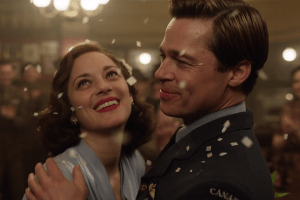 It really doesn’t feel like Pitt (The Big Short) wants to be in this movie at all. Rarely have I seen this lethargic a performance from usually one of the most reliable actors in Hollywood. Part of it is the withdrawn and conspicuous nature of his spy character but it’s more than that. I don’t know if he feels like he understands his character or is that committed to the script, and so it feels like he’s just coasting and waiting for the end. It reminded me of the disastrous Oscar hosting duties from a sleepy James Franco and an overcompensating Anne Hathaway. Cotilard’s character is the gregarious and charming one, and so it feels like she has to do all the heavy lifting to compensate for the dearth of Pitt’s performance. Cotillard can be a brilliant actress with powerful instincts down to her very marrow, as last evidenced in 2014’s devastating and humane drama of personal desperation and dignity, Two Days, One Night. She has to play the more active role, first as the charmer and then as the mystery. She works much better as the charmer. I don’t think either actor knew fully who their characters were and stumbled forward.
Allied is a strange movie where the director, the star, and the screenwriter each didn’t seem to know what movie they wanted to make. Each major participant, short of a game Cotillard, doesn’t even seem like they want to be here, as if this was a school assignment that they’re doing the minimal amount of work to fulfill a requirement. Allied just feels like one of those big studio misfires where nobody was on the same page. The story lacks characters to connect with and complications that feel connected to them and their circumstances. The plot follows the path of least resistance and arrives at its predetermined destination right on time, to the monotony of its audience. Pitt’s somnambulist acting makes the movie and his lead character harder to enjoy. There’s a definite lack of intrigue with this premise and its ultimate execution. I expect better from Zemeckis, Pitt, and Knight, and I’m sure they’ll deliver with their next projects. In the meantime, skip Allied since it certainly feels like the cast and crew weren’t in alliance.
Nate’s Grade: C
Share this:

Kubo and the Two Strings (2016)
 At this point the Laiki studio (ParaNorman, The Box Trolls) has earned as much good will and credibility as Pixar in their pre-Cars 2 prime. I almost was going to write off their latest, Kubo and the Two Strings. For the first forty minutes or so I was somewhat indifferent to it. Sure the stop-motion animation was stunningly realized and the creation of the environments was very meticulous, but I just couldn’t connect with the movie’s story of a young boy, Kubo, and his quest to claim magic items to thwart the advances of his dangerous and estranged mystical family. Then the first big set piece happened and then the next, and then the plot made some deft reveals and provided a strong emotional foundation, and I was hooked. This is Laika’s first real action film and the wide shots and long takes do plenty to serve the action and allow you to further marvel at the painstaking brilliance of these hard-working animators. It’s a full-fledged fantasy epic that tickles the imagination and provides a poignant undercurrent of emotion especially during the final act. As Kubo declares his real strength are his memories of loved ones past, I was starting to get teary. It’s a lovely message to top off an exciting and involving action movie with creepy villains and side characters that do more than throwaway one-liners. Art Parkinson (Game of Thrones) gives a very expressive and emotive performance as our lead. Charlize Theron is outstanding as Kubo’s maternal protector who just happens to be a monkey. Rooney Mara is also genuinely eerie as an ethereal pair of flying sisters trying to snatch Kubo. Matthew McConaughey isn’t the best vocal actor due to the limited range of his vocal register but he’s still enjoyably daft. The Japanese setting and culture are recreated with loving touches that celebrate rather than appropriate. I still regard the arch silliness of The Box Trolls as my favorite film but Kubo is more than a worthy follow-up. The slow start is worth it by film’s end, so stick with it if you start to doubt yourself, because the emotional wallop of Kubo and the Two Strings, not to mention its creative high points, is well worth the invested effort.
Nate’s Grade: A-
Share this:

Loving (2016)
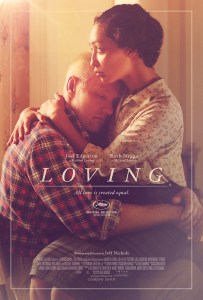 Richard (Joel Edgerton) and Mildred Loving (Ruth Negga) are a young couple deeply in love in the late 1950s. The only problem: he is white and she is black. The laws in their native Virginia forbid marriages to different races. The Lovings traveled to Washington D.C. to be married and then had to live as fugitives before ultimately getting caught and exiled under threat of jail time. Eventually an ambitious ACLU lawyer (Nick Kroll, broadening his range) challenges the legality of the miscegenation law, which will lead to the landmark 1967 Supreme Court ruling striking down laws barring interracial marriage.
The ordinariness of the Lovings betrays the kind of movie moments we expect from great historical turning points, namely moral grandstanding and stentorian speechifying. We’re so used to accentuated versions of history because, deep down, that’s what our storytelling impulses crave because the real thing is often less streamlined and usually more boring. We want Daniel Day-Lewis as President Lincoln admonishing his fellows with the power of his oratory. We don’t necessarily want to watch President Lincoln rewrite his speeches for grammatical mistakes. With all that being said, I appreciated the approach that writer/director Jeff Nichols took with Loving because the very point at the heart of the movie is just how powerfully ordinary Mildred and Richard Loving are. Their love is meant to be ordinary, their relationship relatable. They’re meant to be just like you or I. This thematically taps into the message of the movie about the fundamental human rights of American citizens to love who they love regardless of what others may think. There is nothing dangerous or subversive about their marriage. There is nothing radical. The rationale for why the state would care so much about a marriage can be flabbergasting, including one judge’s written opinion that God created separate races and placed them at separate points on the globe thereby never intending for them to mix. This was considered acceptable legal justification for discrimination in the 1960s and it’s absurd. The other argument against interracial marriage is that biracial children are a harm to larger society… somehow. It’s easy to look back to the past and shake our heads with a fury of moral indignation and say “How could they do that?” but some of these exact same legal arguments have been used in the twenty-first century to justify denying gay citizens the same equality. In that sense, Loving shows us how far we’ve come but also how far we have to go to make sure that human beings are simply considered human.
 If that wasn’t enough the movie also makes a powerfully compelling case about how the state’s miscegenation laws were an offense to human decency. The Lovings are given the legal ultimatum to separate or be exiled from the state, their families, and the home they were making for their family. They have been banished for loving the “wrong” person. Mildred and Richard try living out of the state in a D.C. suburb but it’s not the same; Mildred misses the quiet and relative safety of the country as well as the warmth of her immediate family. They decide to sneak back into Virginia and lay low, and you get a genuine sense of the day-to-day anxiety of having to constantly look over your shoulder and fly under the radar lest someone throw you in prison for loving another race. The degradation and dehumanizing effect of the miscegenation laws is on full display with how Mildred and Richard must act like criminals afraid of their country of laws. They may be used to the glares and hateful comments from intolerant onlookers but it’s another thing when the power of the state is employed to enforce that same hate. The wear and tear of their love perplexes some of the Loving friends and family. Mildred’s brother and sister each take turns blaming Richard for knowingly bringing this heap of trouble upon their beloved sister and for taking her from them. Her brother confesses he doesn’t know why he doesn’t just divorce her and stay together, satisfying the definition of the law. It’s a pertinent question that asks what is the value of marriage? He could readily be with Mildred and save themselves the persecution, but why should they have to settle for something less with their love? Why should they have to be second-class citizens?
This is very much a duet of a movie and Negga and Edgerton deliver admirable, understated work that cuts deeply. I was most impressed with Edgerton (The Gift) who has the more private and insular character. He’s not seeking the spotlight and doesn’t want to be a civil rights crusader. Richard Loving isn’t exactly a man prone to those speeches we crave and he’s certainly not a man to blurt out his feelings. Edgerton has to play within a tiny frame of emotional reference and he makes it work. When he does start to break down, his stoic defenses melting under the pressure and soul-killing compromises, the moments carry even greater emotional weight. Negga is the more emotive of the two but even much of her performance lies in her large, expressive eyes, taking in the collective injustices and triumphs. Using approximately the same Southern accent from her plucky performance on AMC’s Preacher, she radiates warmth and goodness and a sense of indomitable perseverance. It’s a performance that speaks in small gestures and small moments. Much of the film is Negga and Edgerton working together and each lifts the other up, providing the right space needed. There’s a physical intimacy that says much as each member of the relationship seeks out the other’s touch, grip, presence for comfort. It’s a delicate and understated duet of performances that bring the Lovings to faithful life.
 Nichols (Mud, Take Shelter) is the kind of filmmaker that astonishes me with every new movie. He reinvents himself with every picture and he takes genres and redefines them, shaping them to his needs, while never losing sight of tone and characters and narrative payoffs. He’s already delivered one of the best movies of the year with Midnight Special and now he impresses yet again, this time turning toward awards-friendly Important Stories of History. Nichols’ sense of place is implacable. He’s also superb at developing characters and giving them the time to properly breathe. He keeps the spirit of the story linked to his subjects, Richard and Mildred Loving, and makes sure we understand their plight and the larger issue at hand. This isn’t a film that’s going to hit you over the head with its message; in fact you could make a claim that perhaps the movie is too insular. As presented, the Lovings are relatable but we’re only given a fraction of insight into who they are as people and what makes them tick. There’s much subtext here to unpack. It does feel like we’re fighting through the defenses of Mildred and Richard to better know them. This specific approach allows the movie to keep in spirit with the ordinariness of the Lovings and their unknowing place in the history of civil rights, but it also caps the potential emotional impact. We’re invested in them as people but not as completely as characters. It’s a minor criticism perhaps but it’s really the only one I have for Nichols’ movie.
Given our recent turbulent political environment, Loving is an even more significant film. Jeff Nichols has crafted a poignant and affecting movie that passes over easy histrionics for a better representation of history and its characters. These people didn’t want to change the world; they just wanted to live out their lives. Mildred and Richard Loving are regular people living regular lives and that’s the ultimate message of the movie and their love. Having won their Supreme Court battle, the couple returns home to their original plot of land Richard bought in Virginia with the purpose of building his wife a house. Somber text appears in the sky to inform us that Richard would die in a car accident a mere six years later. It left me with a pall thinking about what a short span of time this man had to cherish the woman he loved without recriminations before it all came to a tragic end. It doesn’t seem fair, and I hope that’s a message other audiences take with them. When demagogues try and use religion in place of civil law to justify state-sponsored discrimination, saying the love others share is inferior and somehow a danger to their own lives, that’s when people need to remember the Lovings. This life is too short to harangue others about whom they choose to give their love to. Here is a beautiful, gentle, and restrained film that reminds us that the power of love is in its superhuman perseverance.
Nate’s Grade: B+
Share this:

Fantastic Beasts and Where to Find Them (2016)
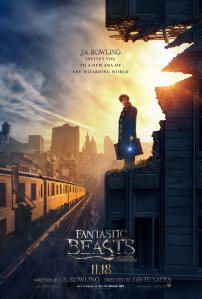 The Harry Potter publishing universe is almost twenty years old and has racked up more money than can be printed, so it was only a matter of time before some enterprising soul thought about expanding from author J.K. Rowling’s seven novels. I wasn’t anticipating that it would be Rowling as the one reopening her world for untapped franchise potential and financial windfalls.
Newt Scamander (Eddie Redmayne) is one of the world’s foremost experts on magical creatures and will one day write a definitive magizoology textbook for students to doodle inside while they sit bored in magic class. He’s traveled to New York City in 1926 and through a series of misunderstandings he exchanges briefcases with Jacob Kowalski (Dan Fogler), a factory drone trying to secure a loan to open a bakery. Inside Newt’s briefcase is a collection of colorful and unique magic creatures with goofy Dr. Suess-styled names, and they break free and need to be rounded up. Porpentina Goldstein (Katherine Waterston) is a disgraced magic authority agent who tries to regain her reputation by helping Newt gather his living contraband before they are discovered by muggles, or as the Americans refer to them, no-majs. Percival Graves (Colin Farrell) is a gravely serious magic official keeping a close watch on the alarming activity. He also has an unclear interest in a fringe political movement that believes witches are real and a real threat. If only they knew the full extent, as a mad wizard-supremacist is also on the loose.
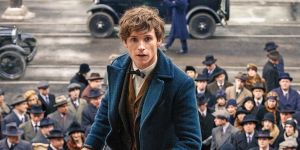 Fantastic Beasts and Where to Find Them is a better franchise catalyst than it is a movie, with several competing storylines that don’t really gel or feel properly developed. This feels like a series of set pieces in search of a movie to unify them. Much of the movie involves dueling storylines that dawdle until they are smashed together at the very end, much like Rowling’s storytelling habit of keeping so many characters and storylines on the fringes and simmering until they are called upon for revelatory disclosure. Storyline number one follows a daffy British magizoologist as he scours New York trying to retrieve his strange and adorable magical creatures. It’s relatively light and mostly fun. Storyline number two is a buddy movie with Newt and Jacob, which is also light and mostly fun. Then storyline number three is an abusive anti-magic movement that may be conspiring to kill wizards that stand in their way, revealing to the wider world the magical realm and the potential threat it poses. This storyline is much darker and adult and it contrasts sharply with scenes like Newt doing a silly dance to present himself for mating with a gigantic rhinoceros creature in heat. It’s hard to reconcile whimsical magic creatures one moment and stern child abuse the next. The varying tones don’t ever gel. The majority of the film is watching Newt scamper around trying to recapture his creatures and stumbling into bigger plot events that are kept on the edges of relevancy.
This movie is more about laying a foundation than telling a relatively complete and gratifying story. The narrative brick laying may be essential for future sequel success but it doesn’t make for the best experience in the theater. Rowling’s first crack at screenwriting has a few hallmarks of novelists-turned-screenwriters (cough, Cormac McCarthy, cough), namely the fuzzy narrative clarity and digressive asides that deter the film’s progressive momentum. It’s hard to critique certain themes and characters that feel useless (Jon Voight for starters) without knowing whether Rowling will decide they are secretly important three movies onward. I don’t know what this movie is about other than setting up lucrative sequels.
 Another area of concern is whom Rowling has decided to be the leader of this voyage back in time; Newt Scamander is quite a lackluster lead character for one movie, let alone the prospect of up to five of them. I found this protagonist rather boring. He’s a kind figure and cares for his exotic animals but the man is pretty much the exact same person by the end of the movie as he is at the start and with only passing hints at a secret tragic past as something to enliven what is assuredly a dull, mumbling character. I’m not against Rowling’s decision to catapult a mild-mannered, shy, polite man as her main character especially in the face of paranoia and fear mongering, but the guy has to at least be interesting. There is not one interesting thing about this character outside of his briefcase full of magical creatures. He is a void of character, a blank slate that isn’t any more filled in by the conclusion. The lack of substance also allows Redmayne to retreat into his actorly tics playing up Newt’s social anxiety, almost to a degree that seems recognizably autistic (at least it was with my friend who saw it with me who is on the spectrum). He feels sensitive to the point that his body is going to collapse inwardly upon itself. I saw the same impulses with his overrated, overly mannered performance in The Danish Girl. When lacking significant depth to his character, or at least something of significant interest, he overcompensates with what he’s given and that’s not usually for the best. Just see Jupiter Ascending if you’re truly brave enough or equipped with enough liquor.
I think the stronger lead character would have been Newt’s buddy, Fogler’s no-maj Jacob Kowalski. He’s already our entry point into this older time period so why not make him the focal point? Jacob is a far more interesting character and he’s actually astonished by the revelations of a magical world right under his nose, adding to the general sense of discovery for himself as well as the audience. He’s the more relatable character as he discovers the world of magic and develops fluttery feelings for a magical lass (Porpetina’s psychic sister, Queenie, played by Alison Sudol). The sweet and flirty stutter-stops of a possible romance with Jacob and Queenie are far more heartfelt and engaging than whatever the film tries to pretend has been set up for Newt and Porpentina. By the very end, the movie expects a few smiles and arbitrary sexual tension to compensate for the rest of the film’s 133 minutes that did not establish one passing moment of attraction. Sorry, Rowling, but cinematic romance doesn’t work in spontaneous vacuums. If you want us to fee for the characters and compel them to get together, we need to see your work if you want the coupling to be remotely satisfying.
The rest of the actors do what they can with the thin scraps of characterization that Rowling provides. Fogler (Fanboys) is a reliable source of comic relief. His sincere pleasure from the magical world and its inhabitants makes him endearing, seeing this world through necessary fresh eyes. Waterston (Inherent Vice) is a screen presence that stands out from the pack, though her character is too muted to leave the same impression. Her character’s goal is to clear her name but she seems to readily forget this motivation. Until writing this review I had no idea that Sudol (Transparent) was the songstress A Fine Frenzy, an artist I’ve enjoyed for a decade. Her acting isn’t quite as accomplished as her singing but Queenie is something of a walking ethereal, sad-eyed psychic kewpie doll. Rowling treats her more as a handy plot device when she needs some item explained or intuited. Queenie’s budding relationship with Jacob makes her more interesting. There are plenty of familiar faces that are stranded in underwritten and confusing roles. The likes of Colin Farrell, Samantha Morton, Ezra Miller, Zoe Kravitz, Carmen Ejogo, Jon Voight, and Ron Perlman, as a mo-cap goblin, must have simply been happy to participate, and I can’t blame them considering the fortunes that await this franchise.
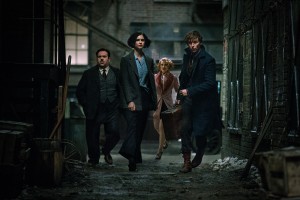 The world building is hazy yet the world of wizards in 1920s New York City is intriguing enough to keep me hopeful that a better movie could emerge later. We’ve never been stateside before in this universe so my first point of interest was the difference between the magical authorities from across the pond. Apparently the magic-inclined aren’t legally allowed to romantically mix with no-maj folks (call it muggle miscegenation laws). That’s interesting but we only get a glimpse. The Second Salem movement in the United States seems to believe that witches and real danger. They seem like a fringe political conservative movement. It’s interesting yet we only get another glimpse at best. Then there’s an evil wizard who wants to wipe the world of the unclean, surely a setup for You-Know-Who and his malevolent Death Eaters. He’s kept further to the background and only bookends the movie. I just looked it up and Voldermort was born in 1926, so expect even more foreshadowing in the future. I wanted to know more about the world inside the Magical Congress of the United States of America. Why do they have a killer magic tar pit and what does it really do to people? There are passing references to the pre-established Harry Potter universe, small morsels for the crowd to hold onto to get them through this muddled expository journey. Still, there is an undeniable entertainment value of seeing magic interact with a 1920s American landscape. A magic speakeasy is a delightful moment to open up this world in amusing historical ways. Newt’s suitcase and its vast interior world is also a great source of wonder and a potent highlight.
Fantastic Beasts doesn’t quite rise to the level of fantastic implied with its title, though if you’re a Potter fan it could be a welcomed and promising start. That’s really what this movie is, a start, and not so much a complete story. It’s a Potter prologue that provides just enough to get an audience interested but not enough to perhaps get them excited. The main character is a total washout and the varying tones and storylines fail to gel. Rowling has some screenwriting novice growing pains and her general world could use more texture amidst all the special effects sequences. Those magic critters are cute I’ll give them that. There just doesn’t seem like there’s enough here of genuine substance in any capacity, other than setting up a playpen for its four sequels. Director David Yates has shepherded the Potter universe for five movies now. The visual continuity from prequel to main story arc reminds me of Peter Jackson’s turn at reviving the Hobbit trilogy. Actually, Fantastic Beasts reminds me of the Hobbit films in more ways than one. They were both somewhat crass moneymaking ventures inarticulately stretched and padded to ensure more movies and more profits. They are also decidedly lesser than the main story arc. To my movie muggle tastes, Fantastic Beasts ranks toward the bottom of the Potter franchise, just a step above Half-Blood Prince. Too often it feels like textbook Potter stuff minus the character investments. It’s a series of set pieces and latent possibilities and less a full movie. Then again, take my so-so critique with a relative grain of salt, Potterheads.
Nate’s Grade: B-
Share this:

Noirvember: L.A. Confidential (1997)
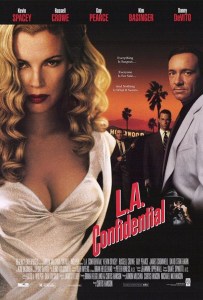 There was no stopping Titanic in 1997, iceberg be damned. James Cameron’s epic disaster movie had all the momentum of the times, and yet it’s a smaller movie that captured more of the critics and was far more deserving of the ultimate Oscar prizes that year. L.A. Confidential was based upon a James Ellroy novel that many argued was unfilmable. Enter journeyman director Curtis Hanson and novice screenwriter Brian Helgeland, and the pair stripped the book down from eight main characters to three, kept the spirit and essence of the book alive while rearranging the storylines for large-scale popcorn thrills. It’s been nearly twenty years since L.A. Confidential first seduced big screen audiences and its powers are still as alluring to this day. It’s a neo noir masterpiece.
In 1950s Los Angeles, not all is what it seems. The captain of the police, Dudley Smith (James Cromwell), is looking to keep the peace in the City of Angels as outside criminal elements are looking to fill the void from Mickey Cohen going to prison. Three police officers of very different stripes find themselves on the edges of a complicated murder case stemming from a massacre at the Nite Owl cafe. Ed Exley (Guy Pearce) is the son of a famous police captain and wants to rise up the ranks as quickly as possible. He’s a political animal and unafraid of ruffling feathers. Bud White (Russell Crowe) is a bruiser of a man who enforces his own level of justice when it comes to men who beat or harass women. Jack Vincennes (Kevin Spacey) is a happily shady officer who serves as a consultant for a hit TV police procedural. The Night Owl case takes them into many sordid corridors of sex, money, and power, including Lynn Bracken (Kim Basinger), part of Pierce Pratchett’s (David Strathairn) stable of prostitutes meant to look like movie stars, the mysterious self-serving sources to tabloid journalist Sid Hudgens (Danny DeVito), and good cops and bad cops on the controversial L.A. police force.
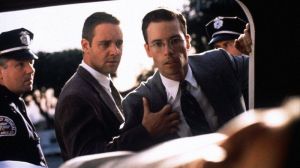 This movie is a master class in plotting and structure, enough that it should be taught in film schools. By nature noir plots are meant to be busy and mysterious, and a guarantee for mystery is a Byzantine plot full of plenty of suspects, dispirit elements, and strange coincidences that eventually coalesce into a larger picture. The beauty of what Hanson and Helgeland have done is that they have made the script complex yet accessible, able to lose one’s self in the tangled web of intrigue but still able to see how all the myriad pieces fit perfectly together by the conclusion. There is an efficiency to the screenwriting that is mesmerizing. It all seems so effortless when you’re with storytellers this gifted or who have a divine connection to the source material. Forgoing the customary slow builds of recent film noir like the oft-cited Chinatown, L.A. Confidential just moves from the opening narration. Within the first 25 minutes, the movie has expertly set up all three of its main characters, what defines them, their separate goals, the obstacles in place, and previews how they will intersect into one another’s orbit, and then the Nite Owl case explodes. Every scene drives this narrative forward. Every scene reveals a little more depth to our characters or fleshes out a superb supporting cast. Every scene cements that contradictory theme of the glitzy allure and unseemly darkness of the post-war City of Angels. My only quibble is that before the truncated third act the movie resorts to a few easy shortcuts but by that point Hanson and Helgeland had more than earned their paces. This is one of the greatest modern screenplays, period (WGA listed it as #60 all-time).
There are so many remarkably assured sequences but I want to emphasize one in particular – Exley’s interrogation of the three Nite Owl suspects. “Oh I’ll break him,” Exley promises his superior before entering into the first interrogation room. At first you’re with the other officers and morbidly curious with his arrogance. By the end, your jaw hangs in amazement at the intuitive pressure this man is expertly applying. It’s a terrific moment that allows Exley to masterfully manipulate three different men, taking pieces and running toward accurate insinuations, building momentum and clarity. Each man is different and each man offers a new piece of the overall puzzle. A slight reference by one unlocks another’s confession. An overheard sound byte pushes another into self-defense. I’m convinced it was this scene that ensured robust and thorough interrogation was a crucial element of the gameplay for the 2011 video game L.A. Noire, a noble misfire that definitely looked to replicate Hanson’s film as a user experience.
 Noir is one film genre with a visual code that can get the best of directors, but Hanson played this to his advantage. Classic noir is filled with criminal activity and the allure of sex and violence, typified perhaps best in the position of the untrustworthy but oh-so-sexy femme fatale. Yet the majority of film noir was produced in an era of censorship thanks to the implementation of the notorious Hayes Code, making sure that audiences didn’t enjoy the sordid elements too far. Free of these restrictions, some modern filmmakers take the opportunity to revisit the noir landscape and fill in the blanks of old, furnishing an outpouring of unrestrained exploitation elements. Brian DePalma’s 2006 film The Black Dahlia (also based on an Ellroy novel) gets drunk on this mission, though “restrained” has never been a word I would associate with DePalma’s filmmaking anyway. My point, dear reader, is that it’s easy to get lost in the superficial trappings of the genre: sexy dames, corrupt lawmen, temptation, shootouts, schemes, and chiaroscuro lighting. It’s easy to dabble in these elements because they’re so nostalgic and celebrated.
Hanson did something different with his 1997 masterpiece. He builds upon the audience expectations with noir but he doesn’t let his complex story and characters come second to the visual spectacle of the famous genre. L.A. Confidential is in many ways a movie that straddles lines; old and new, indie and Hollywood classicism, and film noir and drama. It’s an adult film that doesn’t downplay its darkness, brutality, and moral ambiguity, yet when it comes to those exploitation elements, especially sex, it’s almost chaste. The relationship between Lynn and Bud seems refreshingly square, like it was pulled from Old Hollywood. The entire movie feels that way, an artifact that could exist any decade.
Hanson was something of a journeyman for most of his career, directing competent thrillers like The Hand That Rocks the Cradle and The River Wild. As Variety film critic Owen Gleiberman wrote in his eulogy for Hanson (he died in September 2016, a fact I shamefully didn’t know until writing this review), after 25 years in the industry the man became an earth-rattling auteur after the age of 50. That is a rarity. Who knew the guy had something this singularly brilliant within his grasp his entire career? The care he puts into the screen is evident from the opening montage onward. There’s an elusive magic to the filmmaking on display, a bracingly divine sense of how to move the camera for best effect, how to escalate and deescalate audience nerves. He knows his story structure and characters inside and out, but he also knows how to play an audience. His time making serviceable studio thrillers certainly helps him during the film’s climax, a bloody shootout that’s also a mini-siege thriller.
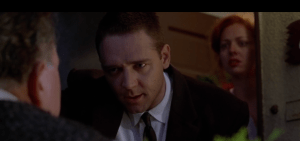 Hanson also assembled an incredible crew to enable his vision. The technical elements recreate the early 1950s L.A. time period with beguiling immediacy; the cinematography by Dante Spinotti (Heat) gives a sense of the darker elements just under the surface without having to overly rely upon the film language of staid noir visuals. Peter Honess’ sharp editing provides a downright Thelma Schoonmaker-esque musical orchestration to the proceedings, especially as the multiple storylines and developments spill onto one another. Speaking of music, the score by Jerry Goldsmith (Star Trek) is thick with the jazzy overtones of the genre. It’s a score that simmers with sexual tension and malevolence. The casting director deserves a lifetime free pass. There are a whopping 80 speaking parts in the movie, and each person is a great hire that builds a richer film.
While the plot of L.A. Confidential sucks you in right away, its characters take hold the strongest. Film noir is one genre that has a codified cheat sheet of character archetypes, and this movie fulfills and subverts them, finding surprising and gratifying ways to further round out these figures into complex and nuanced human beings. The three main characters all provide a different approach to law enforcement and when we see them start to work together it’s a wholly wonderful turn of events. Bud is the muscle, Exley is the brain, and Vincennes is the charm, and each one attacks the Nite Owl case and its subsequent leads from different angles that best apply to their set of skills. Each of the three characters discovers new pieces of evidence, new contacts and suspects, and when they start to work together it not only provides a payoff with the combined evidence but with the satisfying nature of their teamwork. That’s because they become better people when they work together and each moves closer to some moral redemption.
Bud is the loyal cop with a hair trigger and a penchant for being a white knight to abused women. His personal history of abuse makes him seek justice, often by his own fists. He has a rigid moral code of right and wrong and isn’t afraid to cross lines to achieve it. He’s also tired of being a bully and wants to be more than just the muscle. Exley is a straight arrow with a strong sense of moral righteousness and a mind for politics. He knows how to play sides for his own gain. He’s not afraid of making enemies within the department, and his opportunistic choices create many. He’s trying to forge his own path outside the shadow of his father, a famous lawman who was gunned down by a random purse-snatcher (“Rollo Tamassi”). He has to learn that he can’t do everything on his own. Finally, Vincennes is in many ways the face of the department as an ambassador to the world of TV and film. He’s succumbed fully to the glamour of Hollywood but he’s also full of profound self-loathing, trying to count how many compromises he’s made in life and where it’s gotten him. The appeal of the old life is crumbling and his detective instincts are reawakened, spurring Vincennes into the fray and surprising even himself. It’s extremely rare for any movie to successfully develop more than one protagonist, let alone three, and yet L.A. Confidential achieves this milestone so that when we alternate perspectives there isn’t a drop in viewer interest. Each man brings something different and interesting, each man reveals new hidden depths, and each character is fascinating to watch in this setting.
 The gifted actors take the already excellent written material and elevate it even further, turning an already sterling movie into one of the all-time greats. Almost twenty years later, it’s fun to see these famous actors when they were young and, arguably, in their prime. Spacey (House of Cards) was on a tear at this point in his career, between his two well-deserved Oscar wins, and having the time of his life in every role. His character seemingly has the least complexity, a man who knows he’s sold out but believes himself to be enjoying the ride, but Spacey offers poignant glimpses of the man behind all that oily charm and sly glances. There’s a scene where he stumbles across a mistake of his making and the subtle, haunted expression playing across his face is amazing. The man was capable of expressing so much, and still is. Crowe was still a couple years from his big breakout in 2000’s Gladiator but he put himself on the Hollywood map as Bud White. He’s a coil of anger and pain looking for an outlet, and Crowe is magnetic as hell. His glowers could burn right through you. Pearce (Memento) was another knockout that solidified leading man status thanks to his performance as the rigidly self-righteous Exley. He’s a character that thinks he’s above moral reproach, and his humbling is a necessary part of solving the case. Exley is constantly surprising his peers and it feels like Pearce does the same, showing exciting new capabilities from scene to scene, from his stirring hire-wire act with the interrogation scene to his understated glimmer of fear through a poker face. These three performances are golden.
Nobody better represents sleaze than Danny DeVito’s character and the man brings a merry lechery to his tabloid journalist/exposition device. His unquenchable thirst for the worst in humanity to sell more papers feels even more sadly relevant given the media climate that contributed to the recent presidential election. Kim Basinger (Batman) won an Oscar for her somber performance, which reinvigorated her career. She’s good but I can’t help but feel that she won the Oscar in a weak field (my choice would be Julianne Moore for Boogie Nights). David Strathairn (Good Night, and Good Luck) is enjoyably nonplussed as a man who specializes in delivering vice. James Cromwell used every bit of audience warmth associated as the loveable farmer from Babe and used that to his advantage. His pragmatic police captain is a father figure for Exley and the audience and perfectly sets up a turn that leaves the audience spinning even twenty years later.
There are little details the could go unnoticed but confirm for me just how much thought was put into L.A. Confidential. Exley is chided by his superiors for wearing glasses as they think it makes him look weak. As the film develops and he gets more immersed in the Nite Owl case, his compulsions against violence and rash judgment start to waver about the same time he stops wearing his glasses, a subtle symbol of his difficulty to see things for what they truly are. I enjoyed that our introduction to Lynn is in a liquor store and she’s wearing a winter cloak that strongly resembles a nun’s habit. It’s a memorable costuming choice and also suggest Lynn’s penchant for straddling the line of devotion. The Patchett “whatever your heart desires” line of high-class prostitutes has allusions to our current media culture of celebrity worship and personalized sexual fantasies. It naturally ties into the exploitation of the dream factory of Hollywood that takes young ingénues with dreams in their head and squashes them pitilessly. It’s not the first film to explore the darker side of the film industry but that doesn’t make its themes lesser.
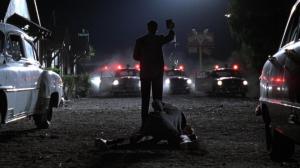 L.A. Confidential feels like the noir thrillers of old but stripped down to its essentials and given a new engine. It’s something that celebrates noir thrillers of old and Old Hollywood but it isn’t so lavish to either the genre or older time period that it loses sight of its own storytelling goals. The elaborate plot is complex and intensely engaging while still being accessible, populated with memorable and incredibly well developed characters, each given their own purpose and own insights that contribute to the larger whole. Hanson’s lasting accomplishment is a near-perfect masterpiece to the power of story structure and characterization. The three lead detectives are compelling on their own terms and the movie keeps them separate long enough that when they do come together it feels like a payoff all its own. Hanson recreates the world of classic film noir and makes it his own, using new Hollywood to lovingly recreate Old Hollywood. It’s the kind of movie I can watch again and again and discover new depths. It gave way to a wave of success for its participants. Hanson never quite delivered another movie on the level of L.A. Confidential, though I’ll posit that In Her Shoes is an underrated character piece. Helgeland has become a go-to screenwriter for many projects low (The Postman) and high (Mystic River) and became a director for A Knight’s Tale and 42. It’s a movie that plays just as strongly today as it did almost twenty years ago, and that’s the mesmerizing power of great storytelling and acting. L.A. Confidential is a lasting achievement that proves once more the power of our darker impulses. It’s stylish, seductive, smart, subversive, and everything you could ask for in a movie.
Nate’s Grade: A
Share this:

Arrival (2016)
 For the new sci-fi film Arrival, I felt that an unconventional review might be suitable considering that the movie is about communication. Therefore I sought out my pal Eric Muller to converse over the many qualities of this intelligent movie. Enjoy, dear reader.
General plot synopsis: a dozen mysterious alien ships hover above the ground across the globe. The government seeks out the assistance of Dr. Louise Banks (Amy Adams), an expert linguist, to try and establish a communication line with the aliens and determine whether they are friend or foe.
————————–
Nate Zoebl: So Eric, my good friend, let’s talk about our first impressions of director Denis Villenueve’s Arrival. I was really taken with just how cerebral it all was. Given the director’s pedigree (I absolutely loved Sicario), I was expecting an intelligent movie that wouldn’t follow the same blueprint as, say, Independence Day: Re-Something or Other Go Boom, but in many ways this movie feels like you’re studying for the SATs. I don’t mean that as an insult. It’s a rather highbrow movie that follows a team of smart people doing something incredibly hard with a level of precision that brings an intense sense of realism to the scenario. It made me think of Arthur C. Clarke science fiction where if first contact were to happen it might go very much like this. It’s a linguistics puzzle box and I found that to be fascinating. The movie delivers on that front. I’m sure the casual moviegoer will be bored by the lack of intensity for two acts of movie but I was delighted. You?
Eric Muller: My first thoughts were, “Wow, Hollywood made a first contact movie that looks like how the real first contact would go.” Unlike other Hollywood blockbusters, this movie is patient. The focus of the movie is not the actors or special effects like other contact movies, the focus of Arrival is the script. The movie is a love letter to language and communication. The director did an amazing job of telling the story and also flipping conventional storytelling.
 Nate Zoebl: We’ll get into more of the flipping the script, so to speak, in our spoiler section but I heartily agree. I’ll also admit that I feel much like Amy Adams as I await your next reply in this discussion (not to make any general comparisons to you and heptapod aliens). I think patience, as you cited, is one of the movie’s greatest virtues. It takes its time, it naturally develops, and this is definitely evident in the first act. The step-by-step process of Adams and Jeremy Renner and the other scientists being escorted to the alien ship, suiting up, being told the hazards and unknowns, and going inside, experiencing the different gravity, and coming up close to the giant white wall that promised so much on the other side, it’s teased out in a fashion that allows for anticipation to rack your nerves. The fear of what they’re stepping into really settles in.
Eric Muller: I’m okay with being compared to a heptapod. I appreciated the movie taking its time, allowing the audience to learn and discover at the same time as Amy Adams and Jeremy Renner. In other movies, learning the new language is usually done in a 15-minute montage. This movie is a Sci Fi movie dedicated to discovery, which is what science is.
Nate Zoebl: It’s definitely a movie of discovery and I appreciated that it doesn’t gloss over the challenges and details of that. It’s also a discovery of our heroine, but again we’ll save that discussion for a little bit. At its core, it’s a movie about language and communication. How are we able to connect and interpret others? If 12 giant alien ships, which kind of looked like Pringles chips, were to one day appear randomly across the globe, how do we interpret intent? That’s the movie’s ticking clock, uncovering the intent of the seven-legged squid-like aliens before the more alarmist elements of our society give in to paranoia and destruction. How would an alien species even begin to try and have another understand its language? That’s a fascinating starting point. I appreciated that the alien language was, indeed, alien. It’s made up primarily of inky pictographs, circles with slight variations. This movie must have been nirvana for a calligrapher.
Eric Muller: There are going to be a lot of tattoos based on heptapod language. But you said it; the language barrier would be the first and hardest barrier to overcome in this situation. And there is one scene that really illustrates that point. When Forrest Whittaker asks Amy Adams why she is showing the aliens just simple words. Adams breaks down why the question “What is your purpose here on Earth?” is such a complicated question. Especially to anyone who doesn’t understand English.
 Nate Zoebl: I think that’s such a smart scene because it opens up for us dumb-dumbs in the audience just how complicated language can be. He asks why teach them words and she says so that they have a vocabulary that they can answer back with. Arrival is kind of like the most intriguing ESL class you never took at the Learning Annex. What technical elements really stood out for you in the film?
Eric Muller: My favorite thing was them getting inside the spaceship. I know it was a simple camera trick with some CGI but it looked so good.
Nate Zoebl: Villenueve films are downright impeccable when it comes to their technical merits. Sicario was, top to bottom, a beautiful movie from looks to sounds to editing. The cinematography for Arrival was tremendous and really accentuated the overall eeriness. Also, the sound design deserves an Oscar. The sounds of the aliens as well as the disconcerting musical score kept me on the edge of my seat. The special effects were best used sparingly. The aliens themselves worked best when they were somewhat shadowed, allowing our imaginations to go into overdrive to fill in the rest.
Eric Muller: Was it just me or did the aliens looks like the final form of the Elcor species from Mass Effect? For a budget of only 47 million, Arrival looks better than a lot of movies made with three times that budget.
Nate Zoebl: My question for you: was this central mystery enough for you before the pieces fell into place in the third act and the movie’s larger end design was revealed? I think we’re getting close to talking about all that good spoiler stuff, but before we do I wanted to know if the central drive was enough for you and in particular if the characters worked well enough. We’re treated to a tragic series of flashbacks to provide some back-story to Adams, but I don’t know if I’d say the movie presents much in the way of characterization until the third act (promise, we’re getting there…). Hear me out, old friend: I almost think Renner’s character is the typical “girl” part that Hollywood fills in these kind of larger movies, the co-lead which is really meant to support the main character and, typically his, journey of self-actualization or healing or whatever. I think there might be some subtle gender politics being subverted there or maybe I’m reading too much into an underwritten character.
Eric Muller: The central mystery was more than enough to keep me interested. As I noted earlier, we were discovering the events just like Any Adams. And you are right that this movie feels like if it had been made 10-15 years ago the genders for the two main leads would have been swapped. Probably have had Keanu Reeves and Sandra Bullock.
Nate Zoebl: The natural sequel to The Bus That Couldn’t Slow Down. I suppose it’s here we should start getting into spoilers, so if anyone would like to remain pure, please come back later to read the rest of our conversation.
[WARNING: SPOILERS FROM HERE]
Nate Zoebl: It’s a movie about language and our interpretation of language and I think, very cleverly, Villenueve and the screenwriter play with the language of film storytelling. We’ve been assuming from the start that these snippets of sense memories from Adams were of her tragic past. Au contraire my friend, they are revealed to be not flashbacks but flash-forwards to a future she has yet to live. Rust Cohle was right; time is a flat circle.
Eric Muller: This movie is a classic twist on a golden age Sci Fi story. Amy Adams’ character arc could have been an episode of the Twilight Zone and been just as good.
 Nate Zoebl: I think the filmmakers make something we’ve seen before, and frankly have become somewhat trite, and subvert it while making the movie and the central protagonist far more interesting. We’ve seen the tragic character that has to overcome the grief over the death of a child before, even recently in 2013’s Gravity. We’re primed for that kind of familiar Hollywood back-story to provide a dollop of depth to the main character. And then when the reveal comes, it makes the scenes have even more emotional power. Adams knew that she would have a daughter who would ultimately die as a teenager of some sort of awful disease, and Adams chooses to go ahead with this future fully knowing the unbearable pain that waits. This revelation instantly makes her character so much more interesting and puts the audience in her place to ask whether we would do the same.
Eric Muller: It is a great twist on a story we have seen before. Also it puts her in the position of whether she tells her husband about their daughter’s future.
Nate Zoebl: And that philosophical divide is ultimately what dooms her marriage. Here’s my choice, and I’ll be interested if yours varies: I would have gone along with it too. Yes, knowing what is to come means that a child was brought into existence to die sadly as a teenager and will suffer, but she will also live and love and laugh for many days beforehand, and knowing the end provides a lens that incentivizes every moment spent together. Yes she will die eventually but any one of us could be snatched from the world at any moment. At least she got to know love and life for so many years before it was taken away from her. How would you choose in this scenario?
Eric Muller: I would let my wife know so we could enjoy every minute with our child.
Nate Zoebl: Let’s step away from the emotional aspects. The end reveal also provides a jolt of energy to the climax because now it becomes a race against time, but time is also forward and backwards. Amy Adams has to stop the Chinese military from striking the alien ships and she has to use information from events that have not happened to save the day in the past. It’s a heady moment of criss-crossing plot streams that really works.
Eric Muller: That reveal, that scene with Amy Adams with the Chinese general, was my favorite scene in the movie. The writing, the way it was shot, and the timing. The timing of that scene gave the audience a chance to breathe and fully take in the reveal.
 Nate Zoebl: The scene reminded me of Christopher Nolan’s Interstellar, a film I wasn’t that fond of beyond its second act planet-to-planet investigations. The screenwriter in me wants to criticize the use of the future to bail out the past because it feels a tad too easy. However, while it really irritated me in Interstellar (couldn’t you be a bit more helpfully specific, Future People?!) I didn’t have a problem with its use in Arrival. Maybe I’m a hypocrite but I feel like the execution is much more impactful here and it doesn’t undo the plotting from before. It doesn’t feel like a cheap trick. The heptapod aliens experience time as a circle rather than linearly, much like Dr. Manhattan crushing through the past, present, and future simultaneously. If we could see our future selves and the actions we make, and inform our current decision-making, I think that would probably bring about a rare world peace. Also, I really liked that the aliens weren’t just these benevolent gifters but had an agenda as well because they know humans will save them thousands of years in the future. It’s like they intervened so we could save ourselves.
Eric Muller: I also liked that the aliens said they will need us in 3,000 years. We never discover what the aliens need from us then. I think we went over this earlier, but Arrival is not a new story but just a great take and twist on that story.
Nate Zoebl: I liked that open-ended nature of the story. What if the aliens had come to Earth and spoke in nothing but emojis? Lots of pictures of eggplants and “A-ok” fingers and strangely anthropomorphic poop.
Eric Muller: Then we would use Amy Adams’ soon-to-be-dead daughter to solve the mystery.
Nate Zoebl: The aliens would essentially be modern teenagers (I’ll shake my old man fist at The Kids Today). The daughter would be all like, “Whatever mom.” And then we’d all be dead. Though the ending reveal raises the question of fate versus free will. Can these future events and memories be prevented? I don’t have an answer.
[END OF SPOILERS DISCUSSION]
Nate Zoebl: So Eric, what would you rate this movie?
Eric Muller: I have to go 5 out of 5 stars. One of the best movies I have seen this year. It was a better version of Contact. When you look at it versus Independence Day: Resurgence, it did everything right that ID4 2 failed at, like how you view Civil War versus BvS.
Nate Zoebl: Fair enough, though please don’t ever bring up BvS in polite conversation without first giving me plenty of advance warning. I’m still working through that one. I think I’d rate it an “A-” myself, and I might change that in time. I think the only thing that held me back from a full “A” is that it saves the emotional investment a bit too late to have the full wallop I think it intended.
 Eric Muller: I think saving the emotional investment was the wise choice. Cause we get it to start with the investment and then the ending flipflops it.
Nate Zoebl: Now, on a scale of eggplant emojis, how many eggplants are you giving this movie?
Eric Muller: Is this where I admit I’m too old to understand emojis?
Nate Zoebl: I’ll also admit that I don’t understand the appeal, especially conversations that are nothing but emojis. Fittingly, I’ll end this discussion with pictographs:
[Smiley face emoji + cat dancing emoji + little green alien with “we’re number one” foam finger emoji + movie theater emoji + eggplant emoji + “A-ok” fingers emoji]
Nate’s Grade: A-
Share this:

Hacksaw Ridge (2016)
 Mel Gibson needs to direct more movies. End of statement. It’s been a decade since Gibson last helmed a movie, 2006’s visceral art film for jocks, Apocalypto, and he’s been in “movie jail” ever since a string of controversial drunken statements. His new movie is a completely earnest, classical example of storytelling that you just as easily could see faces of old appear (say John Wayne in place of curmudgeonly Vince Vaughn), and Hacksaw Ridge is a stirring war movie and a stirring character study. Andrew Garfield plays Desmond Doss, a conscientious objector who wanted to go to war but refused to touch a gun. The first half of the movie is the U.S. Army trying to make sense of this inherent conflict, looking for ways to intimidate him, make him compromise, or kick him out of service. Yet, he endures, and it’s in the second half that Doss single-handedly saves 75 wounded men as a medic left alone on a deserted battlefield in the Pacific. Garfield (Amazing Spider-Man) is a solid lead performance, though his cornpone West Virginia accent irritated me… until the real Desmond Doss is showcased in archival footage and he sounds exactly alike. The supporting characters are rich and have more depth than I was expecting, including Hugo Weaving as Doss’ father, a drunken shell from his WWI survivor’s guilt. There’s much more complexity to what otherwise could be a hateful drunk and one-note character foil. The one miss I felt was the courtship between Doss and his future wife (Teresa Palmer). It felt like an outdated perspective where a man’s insistence overrode a woman’s agency and he was rewarded for it. Admittedly, that’s a modern perspective applied to a generational relationship from long ago. The movie is naturally graphic but the bloody violence is stylized in a way that communicates the ugliness and chaos of war. The action develops and is grisly and engaging without losing sense of the characters and without falling into redundancy. When Doss is rescuing survivors in the final act, the movie finds new challenges that he has to overcome to keep things interesting and raise the stakes. Gibson’s images can be frightfully beautiful; his command of visual storytelling and its evocative power is too good for only one movie a decade. It may be impossible to make an anti-war movie without in some way glamorizing war, so even though Hacksaw Ridge celebrates the heroism of one man’s anti-violence values it finds a mainstream sense of entertainment in the carnage. It’s like a tentpole Oscar movie and I hope I don’t have to wait until 2026 for the next Gibson-directed vehicle.
Nate’s Grade: B+


You must be logged in to post a comment.