Blog Archives
The Mummy (2017)
 In my many years as a film critic, it’s always interesting to discover when I veer from the critical herd, whether liking a movie others do not or having issues with a movie that others lionize like La La Land. After seeing an avalanche of bad reviews, I was fully prepared to dismiss Tom Cruise’s The Mummy as another example of Hollywood hubris, but as the movie continued I found myself enjoying the proceedings. I left the theater completely dumbfounded why my critical brethren disliked it so vehemently. One critic even said this was Tom Cruise’s worst movie of his career. I can’t understand the hate for what is essentially a fun B-movie, so my review is going to be a little different. I’ve read through a bevy of bad reviews and lifted the major criticisms leveled at the film. I’ll be addressing them one-by-one and why I disagree or think the broadsides are overblown.
Here’s a quick plot synopsis for some general context. Thousands of years ago, Ahmanet (Sofia Boutella) was next in line for the Egyptian throne, and then her pharaoh father had a son. Rather than be sidelined, Ahmanet made a deal with the god Set to kill her family with a magic knife and become an all-powerful being. She was thwarted in the middle of the human-sacrifice ritual and she’s sentenced to being buried alive. She was buried thousands of miles away and the magic jewel, needed to complete the magic knife, was buried in England in a Crusader’s crypt. In present-day Iraq, Nick Morton (Tom Cruise), his sidekick (Jake Johnson), and his love interest (Annabelle Wallis) stumble upon the tomb of Ahmanet. They’re transporting her sarcophagus back to England when a cloud of crows attacks their Army plane. The plane crashes, with Nick on it, but he awakens unscathed on a morgue slab. Apparently Nick is marked by Ahmanet as her chosen vessel.
 1) “Cinematic universe fatigue.”
This is the number one indictment in all the critiques but it feels more like critics just used The Mummy as a jumping off point to add to a thesis statement on the dearth of originality in a franchise-obsessed Hollywood. I get it. In the wake of the Marvel Cinematic Universe’s unparalleled run of success, it’s not just about franchises now but also about a series of inter-connected franchises forming a universe of stories. There is also DC’s failed efforts to try their own universe, a possible Hasbro Universe (Transformers, G.I. Joe), the ongoing and morphing X-Men universe, and now the emergence of the Dark Universe, a studio’s attempt to repackage the classic monster properties of old. When done poorly, the cinematic universes reek of nakedly obvious crass commercialism. However, just being opposed to these cinematic universes on principle alone feels misguided. It’s presumptuous. It all depends on whether or not the stories can exist on their own. Batman vs. Superman and Suicide Squad didn’t crash and burn merely because they were overextended by tie-ins to other movies. They failed because they were bad stories and were terribly executed, and yes being overextended was a component but not the only one by far. Movies still need to be good.
The Mummy only gives a sense of a larger universe through the appearances of Dr. Henry Jekyll (Russell Crowe) the leader of Prodigium, a S.H.I.E.L.D.-esque agency tasked with monitoring the world of “gods and monsters.” That’s about it, a preview of a larger world of monsters with some visual Easter eggs scattered here and there. The character of Jekyll is a learned scientist that can unload a larger picture, and his institution also provides a setup for false security. He is organically placed into the narrative and Prodigium actually supplies a credible reason why they don’t just smash the key crystal that Ahmanet needs for her resurrection purposes. Crowe (The Nice Guys) is one of the best parts of the movie, and when he gets to slip into Hyde mode the movie allows him to have a malicious sense of fun. I don’t think the visual element of Hyde quite works but it doesn’t sabotage the scenes. Not all of Crowe’s exposition is necessary, especially the opening sequence finding the buried Crusaders, but he provides a stable presence, until he also presents Prodigium as a pragmatic threat. This is why I think that the most critics are condemning the idea of the Dark Universe and what it stands for in broader terms and not on the actual merits of how it set up its larger universe.
 2) “Cruise is miscast as the lead.”
I’m a fan of Cruise as an actor and especially as the lead in action movies. The man is a natural movie star and he gives his all with every performance. As a paying moviegoer, I respect that work ethic. Having Cruise play a rakish surveyor of antiquities seems like a good fit for his abilities. He’s played charming, dangerous rogues before. Here’s the thing that critics don’t seem to be processing: Cruise’s character is meant to be a jerk. He’s self-centered and prone to making impulsive decisions, like shooting a rope keeping a sarcophagus suspended in liquid mercury. Plus if you don’t like Cruise as a person or an actor he’s routinely beaten up in the movie to fine comic results. His character arc is about him becoming the kind of person who’s willing to think about others and a greater good. It’s simple but it works. I do think The Mummy goes too far in trying to explain the signposts of his character arc. Occasionally they undercut the moment to great effect. There’s a scene where Wallis (Annabelle) tries to encourage Norton that she knows there’s a good man inside him. After all, he gave her the only parachute as the plane went down. He then sheepishly says, “I thought… there was another one.” I laughed out loud so hard. The movie does work a little too hard to announce Nick’s swaggering Lothario ways (“Me thinks the lady doth protest too much”), and there’s a 25-year age gap between Wallis and Cruise, but these aren’t faults invented by only this movie. Cruise was an enjoyable lead for me and his ease with comedy, action, and drama prevailed.
3) “Tone issues abound.”
Critics are lambasting the film for being too many things with too many tones, but much like cinematic universes, it all comes down to execution. The Mummy has elements of action, horror, especially its zombie-mummies, dark comedy, like Johnson showing back up as zombie comic relief a la An American Werewolf in London, and even some inspired slapstick. When Nick is fighting a batch of zombie-mummies, he thrusts his fist through one skull and hangs another sideways against a wall, and both keep on fighting. The different elements added to my entertainment rather than detracting from it. I enjoyed that the movie could be suspenseful or silly depending upon the scene. The action sequences are serviceable to good, the highlight being the zero gravity plummet within the body of the plane. Alex Kurtzman (a writer responsible for Star Trek, Transformers, and other big studio pictures) makes an adequate director without any distinguishing sense of style. I feel like the more memorable aspects of the action are from Kurtzman thinking as a writer. Take for instance a scene where Nick is swimming underwater and we watch subterranean tombs open. The zombie-mummy Crusaders then start swimming after Nick, providing a terrific visual. The action sequences vary and develop and make good use of their geography. I also appreciated that the third act does not fall into the superhero standard of CGI monster slugfest that loses perspective and scale (even Wonder Woman suffers from this). Also, apparently in the time since Stephen Sommers’ campy 1999 Mummy film, everyone championing that movie seems to have forgotten that it was a mess of tones as well. The Brendan Frasier mummy movies were a fun, spirited, winking big-budget B-movies with style and personality. I don’t think Cruise’s Mummy film reaches those same heights but there are enough positive similarities.
4) “Underwritten female characters.”
 This is a legitimate criticism when discussing Wallis’ character. She offers very little to the overall story except to verbally explain exposition or character beats. The fact that she needs rescuing is a given. It’s an underwritten role and clearly just an excuse for a good-looking actress to be at Cruise’s side during moments of peril and derring-do. However, this accusation overlooks Boutella’s character, Princess Ahmanet. Her very back-story involves a woman striking back against a patriarchy that wouldn’t value her unless it had no alternative. She’s a killer but she has her reasons, but more importantly she’s an interesting antagonist even if her overall goal is basic world conquering. Boutella (Star Trek Beyond) has a magnetic presence on screen and seems to enjoy stretching herself with different physicalities from an alien to a mummy to a blade-legged henchwoman. She enjoys playing kickass women who lead by example, and Ahmanet is no exception. I was pleased that Ahmanet was not going to be reserved as a strictly Act Three villain. She’s prominent throughout the narrative and burrowed inside her marked man’s head, leading to dessert flashbacks and a general repetition of Boutella’s partial nude scene. The filmmakers are getting the most out of one shadow-draped PG-13 nude scene.
Suffice to say, in my view The Mummy does not deserve its savaging by the critical community. I think too many critics are assailing larger points (Tom Cruise as a person, cinematic universes) and losing sight of the actual movie itself. The Mummy is not a perfect film by any stretch but it’s a movie that has a strong sense of its identity and how to meet its goals. The Mummy is a modest B-movie with a sense of fun that offers enough surprises, suspense and action sequences, and clever visuals to entertain. If this is the start to the Dark Universe then I feel optimistic about where else the newest creature features will lead. I recommend giving this one a chance once the dust settles. You may be just as surprised.
Nate’s Grade: B
Share this:

Raw (2017)
 Justine (Garance Marilliier, looking like a Gallic Rooney Mara) comes from a family of vegetarians and veterinarians. She’s entering a famed veterinary college as a legacy and her big sister, Alexia (Ella Rumpf), is already established among the school hierarchy. The incoming students are mercilessly hazed and Justine is forced to eat meat against her will. This moment unlocks a secret craving within her that consumes her. She starts looking at her fellow students less as dinner dates and more as dinner.
For the first half of Raw I thought I was watching a French nouveau version of Carrie. The first half of the movie is dominated by the pressures, and in particular, the cruel hazing from the upperclassmen at the college. The hazing is extreme, rampant, and omnipresent, with every older classmate throwing around his or her sense of privilege and bullying the freshmen candidates. It’s the kind of harassment and abuse we’ve seen in other stories relating to fraternities and sororities where institutions of power abuse others because they were abused and so on and so on, normalizing the cruelty. However, those are organizations that are elective and enclaves among a larger campus. With Raw, it appears that every upperclassman is part of this system of hazing, meaning there is no escape if the young candidates want to continue their education. The professors seem complicit in their negligence, and Justine even has one professor who hilariously criticizes her for doing too well in class. He says her good scores are depressing the other students, possibly making them become worse doctors. The overall impression of this scholarly environment is one of sickness and exploitation. There’s even a culminating “class picture” where they are bathed in buckets of (pig?) blood. With this sort of build-up, I was anticipating that when Justine got her crazy cravings that the movie was going to set up some tasty just desserts for these sadistic upperclassmen. I was looking forward to these mean people getting killed and eaten to service Justine. Perhaps that’s the American version of what this movie would become, or my own preferred version with the established first half, but that’s not the movie Raw ends up becoming.
 Stuck somewhere between body horror and weird compulsion, Raw falters trying to stake its own territory. It’s definitely structured like a coming-of-age/sexual awakening story except said awakening is connected with cannibalism. That’s an excellent starting point for some cringe horror but Raw gets too lost in its dreamlike atmospherics. We explore rave-like revelries, hedonistic escapades, and the allure of the unknown. The best part of the film is the deterioration of Justine’s inhibitions as she gives in to her inner carnivore. There’s an obvious carnality metaphor here (college is a time for experimentation) and there’s a clear entertainment factor in watching a meek character assert herself. Her character gets lost in the oblique mystery that leaves a lot of unanswered questions and unclear motivations. One minute our heroine is rejecting the pressure of her peers and the next she’s nibbling on a severed finger. Her downward spiral doesn’t feel adequately developed as she’s immediately caught in the swirl of campus hazing. The progression feels phony. Outrageous things happen without a tonal grounding, and so it feels more like David Lynch dream logic. I could better accept this drifting quality if the movie had more plot to offer. At the halfway mark, once big sis makes her major personal reveal, the movie generally stalls. The plot doesn’t advance, the characters don’t really deepen, and we’re getting variations on the same things from before. The body horror elements don’t fully feel integrated as well. Justine has breakouts of hives and rashes, presumably from eating meat, though this comes and goes. She doesn’t ever seem too fraught over what she may be becoming, but maybe that’s just being French.
Writer/director Julia Ducournau certainly has talent and a natural way of handling her actors, but her film debut is just trying too hard. The constant crimson color scheme is heavy-handed to convey the protagonist’s frayed state of mind. The symbolism is also just as obvious. The suppression of darker, more animalistic desires is an intriguing concept, except several of the jumps in character development, or debasement, happen while Justine is unconscious. This provides a “what did we do last night?” air of mystery but it also hinders the character growth on screen. It’s like the movie is trying to have Justine sleep through her character development. It’s too bad because there are fascinating pieces and ideas that emerge like flotsam in the wake of Ducournau’s tale. The second half has the potential to become a bizarre sisterly bonding story. How far is each sister willing to go to help the other and to cover up for her actions? Will there be a rivalry when they target the same man? These kinds of questions could have further explored their relationship, but alas it was not to be. You’ll never know how the sisters are supposed to feel for one another throughout the movie. The characters are pretty thin to begin with and then Ducournau introduces a new element to provide added dimension and then lets it slip away. Back to shock value and obvious metaphors.
 Here’s an example how Raw gets too caught up in the sensations of the moment, the allure of its images, which admittedly are a key part to horror. There’s a scene where Justine is dancing in front of a mirror. She’s wearing her sister’s clubbing dress, an article of clothing she had earlier been disdainful over. Now she sways to the beats of a rap song and applies lipstick to her pert lips. She then gazes lustfully at her reflection and leans into the mirror, kissing it and herself. And then she does this for another minute, going in for like four more kisses, as if one wasn’t sufficient. We get the idea pretty early, about Justine’s emerging new self, her carnal cravings, and yet Ducournau keeps going, convinced that redundancy is required to satisfactorily convey obsession.
Raw is also somewhat notorious on the festival circuit for its shock value. Reportedly people were fainting or leaving in droves from the content of the movie. I think this hyperbolic response is overblown. There is a fair bit of gore in the movie but it’s almost all animal related. If you’re an animal lover, watching corpse after corpse might be too much. I certainly averted my eyes more than once during a dog carcass autopsy. The human gore is surprisingly minimal though bloody. By far the most squirm-inducing part of Raw didn’t involve cannibalism at all but a homemade Brazilian wax that gets a little too close for comfort for all involved. At least I now know what my tolerance level will be like for the eventual European coming-of-age horror film set at a waxing station.
While watching Raw with my friend Ben Bailey, we would occasionally turn to each other after a shocking or gratuitously exploitative scene and say, “It is a French movie.” When characters strip for casual nudity, or start chowing down on human remains, or frolic in blood-soaked clothing, we’d say, “It is a French movie.” This turned into a game, ultimately with us imagining a climax involving a cannibalistic ménage à trios. “That,” we remarked, “would be the ultimate French movie.” Raw is a seductive and intriguing movie that has enough surface-level pleasures for devoted horror hounds. Unfortunately, it feels like the least interesting version of this story and premise. There are interesting pieces here to be certain. I just wish someone else had assembled them.
Nate’s Grade: C+
Share this:

Colossal (2017)
 Gloria (Anne Hathaway) has a monster of a problem. She’s lost her job, her boyfriend (Dan Stevens), and is forced to move back home to her parents’ empty house. She gets a job at her childhood friend Oscar’s (Jason Sudeikis) bar. Then one night the news is filled with a 100-foot tall lizard monster magically appearing in Seoul, South Korea. This lizard only seems to appear at a certain hour, and Gloria realizes that she is somehow connected to this giant beast and responsible for its movements. What’s a working girl to do?
Colossal is a different kind of monster movie, that’s for certain. It’s got a dynamite premise that allows for plenty of different tones. There’s an inherent wackiness in a party girl discovering that her actions have a very extreme set of consequences. For a while it’s a slice-of-life picture about coming home and readjusting to the rigors of adult life, something Gloria has been putting on hold while soaking up the pleasures of New York City and the patience of her live-in boyfriend. She’s picking up the pieces of her life and sometimes an acquisition of furniture like a futon can feel like a small triumph. There’s a simple rhythm to these early scenes and writer/director Nacho Vigilondo (Time Crimes) slowly reveals more and more about character histories and relationships, remarkably free of ungainly exposition. There is a remarkably accomplished and sly sense of discovery with the movie, first with the implications and abilities of Gloria’s monster avatar and with the movie itself. There’s a cheeky sense of fun watching Gloria discover her connections to the monster and the special effects are pretty good for such an odd indie film. What are the monster’s intentions? Where does it come from? Why is this patch of land and Gloria so special? Fortunately Vigilondo doesn’t stop there. From a rules standpoint, there’s only so much to learn through trial and error, but it gets even more complicated when Gloria decides to tell her buddies the news. Now it’s about keeping her secret and making sure these often drunk, often-misbehaving guys don’t cause an international incident.
 Hathaway (The Intern) is at turns hilarious and heartbreaking and she completely owns the movie, which she filmed while in her second trimester of pregnancy (explains the omnipresence of heavy coats). She has to play a woman who has self-absorbed and self-destructive qualities while not shutting out audience empathy. Hathaway brings out multiple dimensions in her flawed character. She can be cowed easily through guilt and intimidation, failing to meet up to her own standards she holds for herself, but she can also derive a quiet strength that pushes her to take a stand and make a change. Hathaway is apt at the blending of comedy and drama and she’s a star with genuine acting chops. Despite her struggles and setbacks, we want her to succeed and she feels all too human.
It’s midway through where Colossal makes a sharp turn into territory I didn’t see coming and reveals its true intentions, which are much darker and uncomfortable. Fair warning to readers, I’m going to try and avoid specific spoilers but even talking about the second half of the film serves as a spoiler in itself, so keep reading if you so choose. Beforehand, the movie has presented itself as a fun, slightly whimsical take on a down-on-her-luck party girl discovering a weird power. The monster serves as metaphor and I thought it was going to be a relatively obvious metaphor for alcoholism, something she had to work through and get her life back together, putting away childish things and integrating back to the world of responsible adults she’s been avoiding. Then the turn happens and you realize that the monster isn’t a metaphor for alcoholism but for abusive relationships. As you can imagine, this is more or less when the comedy slowly comes to a halt.
 It backdoors you into reconsidering everything that’s come before and ingeniously plays the charms of its actors against your preconceived notions. It’s a movie about abuse and manipulation and the capitulation to that abuse. Whether the source of that abuse is derived from alcoholism is up for debate, but I insist it’s a complicated mixture of substance abuse, unchecked entitlement, and toxic masculinity. Oscar becomes our villain, and it may feel like a sudden shift to many viewers, especially those who were expecting him and Gloria to end up romantically linked by film’s end. Colossal can be seen following a more familiar rom-com formula of the girl who goes home, reconnects with old friends, and becomes romantically linked, and the movie uses your expectations against you. Because of that, you may excuse Oscar’s behavior, downplay it, and rationalize that he, like Gloria, is trying to gather his bearings and grow up. That’s not the case. That’s not the case at all, and the movie explores this notion by giving a serial abuser new unfettered power to endanger a multitude of human lives, people who are invisible to his angry outbursts and thus made even more expendable in his mind.
This tonal turn dominates the second half and I can imagine many people will be put off and disappointed by how heavy and uncomfortable a giant monster movie has become. An emotionally abusive person will stop at any manipulation to keep people within his or her orbit so they constantly have targets for abuse. We get several scenes that examine this dynamic as Oscar tears apart his friends one veiled menacing monologue after another, pushing their insecurities and influencing control over them. He’s the “nice guy” who thinks the world owes him more than he’s ever gotten, but a choice reoccurring flashback reveals he’s always been this way. Oscar didn’t turn into a jerk, he was this way from the start, and he’s just gotten better at hiding his darker intentions, and he’ll likely always be this way without redemption. Sudeikis (We’re the Millers) digs into his character’s misanthropy without going overboard, which makes him a far more realistic depiction of an abuser taking advantage of other people’s good graces and chances.
 Colossal transformed into one of the more unexpected and surprisingly emotionally involving stories I’ve seen recently. I was set to enjoy the silly monster movie shenanigans being turned on their head with oblivious Americans unknowingly wrecking havoc on the Eastern world. Instead of global consumer commentary I got something much more personal and unexpected. I never knew where the movie was going to go next and found myself more and more intrigued by every scene. If the filmmakers could upend my expectations and keep me on the edge of my seat, then they did their jobs. The finale is magnificently executed as it employs just about all the rules we’ve learned concerning the monsters, space-time, and the sour relationship between Oscar and Gloria. It feels like a true culmination of events that is dramatically and emotionally cathartic.
Much more than advertised, Colossal is an exciting movie for how different it ends up becoming, and yet it’s still everything as advertised. Hathaway is highly enjoyable during her character’s various highs and lows trying to make sense of her life. Vigilondo shapes an unpredictable narrative that subverts and overcomes formula expectations and audience sympathies. It’s an involving and personal tale given an expansive scope and feel. Monster as metaphor is not a new concept. It’s an externalization of our fears and labors and an expression of their cataclysmic destructive power. It also provides a focal point for a hero to overcome, and Colossal feels like somebody took a slice-of-life indie mumblecore observational character piece and gave it a dash of fantastical genre elements. I want to watch it again to see if I can catch nuances I missed, especially relating to characterization and performance. If you can hang on after the movie makes its midway shift, I think Colossal is a unique filmgoing experience that sees its vision to the end.
Nate’s Grade: B+
Share this:

Ghost in the Shell (2017)
 When news broke that Hollywood was going to make a live-action version of the much-beloved 1995 anime Ghost in the Shell, fans were understandably nervous and excited. The original movie was a major hit that crossed over into the mainstream much like Akira, another movie Hollywood has long been trying to bring to life (run away, Jordan Peele!). People got extra worried when they heard that Scarlett Johansson was going to play the main character and cries of “whitewashing” were hurled across the chasm of the Interwebs. The “white washing” charge, which in context is possibly misapplied, might have been the smaller worry. The 2017 Ghost in the Shell remake is missing just about everything that made the original a standout. It’s a ghost, if you will, of its former, superior self.
In a cyberpunk future, Major (Scarlett Johansson) is an android fighter working for a special operations group tasked with taking down cyber criminals. The Major was injured in a terrorist attack and her brain was placed in a robotic shell (looking like ScarJo is one of the upgrade features). Every so often she gets hallucinations of events she cannot recall. After an encounter with the hacker criminal Kuze (Michael Pitt), a fellow android, she begins to doubt the true intentions of her superiors and what they have told her.
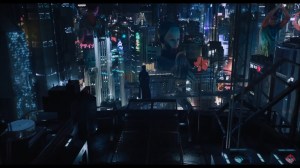 If you’re a fan of the original Ghost in the Shell, you might be depressed from what the live-action Hollywood adaptation does to its noteworthy source material. If you’ve never seen the anime, then you might find some scraps of entertainment to be had in what is essentially a drizzly cyberpunk product dumbed down for the largest mass audience that would be adrift with any minor hint of ambiguity. The 2017 Ghost in the Shell is not a good movie and it’s an even worse Ghost in the Shell movie. First off, we don’t need live-action versions of superior animated films just to have them, and this same statement goes for the equally underwhelming Beauty and the Beast remake. Just because a film lacks “real people” does not mean it is missing some crucial element, and I bristle at the notion that animated films are somehow inherently inferior or not “real movies.” With that being said, Ghost in the Shell will invariably disappoint fans of the original anime. There are visual signifiers and shots that it mimics with fealty; it’s just the overall story, characters, narrative complexity and mystery, and everything else that lacks that same level of fealty. Who cares if the main character is a shell of herself because, hey, they recreated this one shot fairly accurately, and that’s why we go to the movies, right?
Whereas the original was thoughtful and trusted the intelligence of an audience, the 2017 Ghost in the Shell resorts to explaining everything all the time, and even that it does badly. This is a muddled and frequently incoherent plotline, and the magnitude of its ineptitude is even higher considering how stupidly obvious the screenwriters make every twist and turn. This is the most obvious, simplistic conspiracy you could possible write. When Major wakes up in the opening scene and is being told what happened, the audience should already be alert with suspicion. This secret conspiracy goes in the most obvious direction (the good guys might not be the good guys after all) in a manner that should be transparently obvious to anyone except those unfortunate souls who have never seen another movie before in their lifetimes. So much of the plot is the untangling of this mystery, the Major’s real back-story, who the true villains are. To make it as obvious as possible and still devote so much time is not a good decision. The movie is constantly tagging characters to explain all exposition, leaving no subtleties to chance. The sadder part is that the plot is still muddled for long stretches even with all this handholding to straighten things out for the neediest.
 The world building and themes are kept at a distance, further denying the movie depth and substance. With any science fiction world, let alone one borrowed from other famous cinematic influences, it’s important for the viewer to get a sense of how the world operates. This can be done with small moments and larger moments, enough to properly contextualize this brave new world. With Ghost in the Shell, we’re told that mankind has become increasingly intertwined with machines and that cybernetic enhancements are en vogue. Except we never see this in the outside. We see loads of floating hologram advertisements, an overblown visual motif, but outside of our three main characters, this aspect that they felt merited inclusion in text before the movie gets underway is weirdly absent. It makes the characters feel less like they belong in an environment that makes sense. The larger themes of self-identity, the nature of humanity, and the questions over body autonomy are glossed over with the faintest of observations. Major is discovering her identity, but it leads her to what may be the most tired of conclusions. You would think having a robotic body would create some sort of existential reflection. You would be mistaken. Sure, Major feels unsure of herself and out of place, though why should she since we’re told man-robot hybrids are all the rage in this vague future landscape. I’m surprised someone didn’t just start explaining what the title meant at any given point.
The movie feels entirely surface-level and that’s where it has one redeeming value — its visual presentation. Director Rupert Sanders (Snow White and the Huntsman) is an above average visual stylist who benefits from strong production design and cinematography. At least the visual aesthetics could keep my attention, even if part of that attention was occupied in playing a compare-and-contrast game with certain scenes. The special effects are suitable and stylish enough, borrowing more than a few elements from the original. The action sequences are relatively muted, occurring in bursts but never really developing further. There’s an initial attack, then a response, and sometimes a chase, but that’s about it. The tech also doesn’t seem to factor in the combat. The strike team has the ability to communicate telepathically, but if they can do this why would they ever turn off this secret channel? It’s also lazy as it means we can just focus on filming scenes and record whatever dialogue we need later, as if the screenplay was incomplete.
 The 2017 Ghost in the Shell live-action version is a disappointing cyberpunk thriller that pays lip service to its source material, copying the movements but losing sense of the substance and soul. I’d advise people to merely watch the 1995 anime instead or the TV series that followed. It all feels like an expensive, slick, yet peculiarly ramshackle production that loses sight of the bigger picture by worrying at every turn whether a mainstream audience is going to need help understanding the most obvious. Johansson can be a great actress, which is important to remind yourself because she goes on kickass heroine autopilot with this movie. The action is short and inadequate, the visuals are impressive albeit derivative to the source material and its myriad influences, and the story has nuance, ambiguity, philosophy, reflection, and general substance replaced with a generic conspiracy structure that renders much uninteresting. The 2017 Ghost in the Shell doesn’t quite go to the insulting derisive lows of the Dragonball Z live-action remake, but it’s certainly not a good use of anyone’s time, and that includes you, the audience.
Nate’s Grade: C
Share this:

The Zookeeper’s Wife (2017)
 Antonina Zabinski (Jessica Chastain) and her husband Jan (Johan Heldenbergh) are the keepers of the Warsaw Zoo. Their lives are thrown into turmoil when Germany invades and occupies Poland. Their animals are slaughtered or moved to the Berlin Zoo, under the care of Nazi party member and amateur geneticist Lutz Heck (Daniel Bruhl). Feeling impotent to the horrors around them, Antonina and Jan risk everything to hide Jews in their zoo and eventually smuggle them out to safe houses.
The Zookeeper’s Wife is one of those slice-of-life stories about good people risking much to save lives during the Holocaust that come from obscurity to remind you that there are still fresh, invigorating stories from a topic that can feel tapped out after 70 years. However, it’s also an indication that you need the right handling to do it justice. The Holocaust is by nature such a horrific subject matter that it’s hard to do it justice with a PG-13 or below rating, but it can be done with the right amount of artistic restraint as long as the overall story doesn’t feel hobbled with limitations. Reluctantly, The Zookeeper’s Wife feels a bit too sanitized for the story it’s telling. When it comes to cruelty and human atrocity, you don’t need to shove the audience’s face in the mess to fully comprehend its distaste, but overly avoiding the reality can also be a detriment. The Zookeeper’s Wife, as a PG-13 movie, does not feel like the ideal way to tell this real-life story. It feels too restrained and some of those artistic compromises make for a movie that feels lacking and distracting at points. Fair warning: there are plenty of animal deaths in this movie, though they are all dealt with off-screen with implied violence. The edits to work around this can be jarring and would take me out of the picture. This is only one example of an element that, in order to maintain its dignified PG-13 rating, unfortunately undercuts the realism and power of its story.
 For a Holocaust story set in Poland, the stakes feel abnormally low. The zoo is a sanctuary compared to the Jewish ghettos. The danger of hiding over 300 Jewish people over the course of the entire war feels absent, which is strange considering it should be felt in just about every moment. There are a handful of scenes where we worry whether they will be caught but they’re defused so quickly and easily. After Antonina is caught talking to a very Jewish-looking “doctor” in her bedroom by the housekeeper, they just fire the housekeeper who leaves quietly and never comes back again. It’s a moment of tension that can be felt and it all goes away in a rush. This scene also stands out because the narrow escapes and close calls are surprisingly few and far between. Even when Antonina’s son commits stupid mistake after stupid mistake, including impulsively insulting a Nazi officer to his back, there’s little fear of some sort of retribution. The movie can also lack subtlety, like watching Heck say three times he’s a man of his word and will be trustworthy. We all know he’s going to fall short. There’s also a moment where Jan is literally loading children, who each raise their arms in anticipation, onto a train car. It’s like getting punched in the stomach with every child. Much of the time spent on the zoo is with the quiet moments trying to make the Jewish survivors feel like human beings again (the animals-in-cages metaphor is there). The details of the smuggling and hiding are interesting but cannot carry a movie without more.
The biggest reason to see this movie is the promise of another leading Chastain (Miss Sloane) performance. Ever since rocketing to prominence in 2011, Chastain has proven to be one of the most reliably excellent actors in the industry regardless of the quality of the film. She’s been dubbed a Streep in the making and Zookeeper’s Wife allows her to level up to her “Sophie’s Choice acting challenge stage” and try on that famous Slavic accent that turns all “ing” endings into “ink.” Chastain is terrific as a person trying to navigate their way through the unimaginable, calling upon reserves of courage when needed, and she’s at her best during the moments with Herr Heck. She has to play the dishonorable part of the possible lover, and Heck definitely has his heart set on Antonina. The scenes with the two of them draw out the most tension and afford Chastain a variety of emotions to play as she cycles through her masks. In some ways I wish the more of the movie was focused on this personal conflict and developed it even further.
There was a small practically incidental moment that got me thinking. As stated above, the film has a PG-13 rating and one of the reasons is for brief nudity from Chastain. Now the actress has gone nude before in other movies so that’s not much of a shocker, but it’s the context and execution that got me thinking. Antonina and Jan are lying together in bed after sex and Chastain does the usually Hollywood habit of the bed sheet being at her shoulders while it resides at the man’s waist (those typical L-shaped bed sheets). No big deal. Then, during their discussion over what to do, Antonina rolls over and exposes her breast for a second before she covers herself up again. The reason this stood out to me, beyond the prurient, is because it felt like a mistake. It seems obvious that Chastain was not intended to be seen naked in this intimate post-coital conversation but it was used in the final cut anyway, which made me wonder. Was the take so good, or so much better than the others, that director Niki Caro (Whale Rider, McFarland, USA) and Chastain said “the hell with it” and kept the briefly exposed breast? Did they enjoy the happily accidental casual nature to the nudity, creating a stronger sense of realism between the married couple? Or in the end was it just another selling point to help put butts in seats? I’m thinking best take is the answer. You decide.
 I am convinced one of the main reasons that Chastain wanted to do this movie, and I can’t really blame her, is because she would get to hold a bunch of adorable animals. Given the subject matter, I was prepared for a menagerie of cute little creatures, but I started noticing just how many of them Chastain is seen holding. She holds a rabbit for a monologue. She holds a lion cub. She holds a baby pig. She holds a monkey. She even kind of holds a rubbery baby elephant doll (talk about Save the Cat moment, this movie takes it even more literally). There may very well be animals I simply have forgotten she held. I would not be surprised if in her contract there was a rider that insisted that Ms. Chastain hold at least one small, adorable animal every third day of filming on set.
Stately and sincere, The Zookeeper’s Wife is an inherently interesting true story that should have more than enough elements to bring to life a compelling film experience. It’s an acceptable movie that’s well made but I can’t help but feel that there’s a better version of this story out there. It feels a tad too safe, a tad too sanitized, a tad too absent a sense of stakes, like it’s on awards-caliber autopilot. Chastain is good but her Polish accent becomes a near metaphor for the larger film: it’s polished and proper but you can’t help but feel like something is lacking and going through the motions of what is expected. This is a worthy story and I’m sure there are great moments of drama, but The Zookeeper’s Wife feels a bit too clipped and misshapen to do its story real justice.
Nate’s Grade: B-
Share this:

Kong: Skull Island (2017)
 Some of Hollywood’s most famous characters are its monsters, and no I’m not referring to studio executives. Kong was one of cinema’s first international stars, a stop-motion marvel in 1933 that had a hankering for blonde women. His legend has endured many different incarnations and once again the gigantic gorilla is given his close-up, in Kong: Skull Island, the second phase in a would-be MonsterVerse after 2014’s Godzilla. This time the monster comes through. Skull Island is a pleasing two hours spent with just enough style, thrills, and comedy to enjoyably pass the time best accompanied by a big bag of popcorn.
In 1973, a geological surveying team has discovered a heretofore-unknown island ominously shaped like a skull. Everyone is heading there for different reasons. Bill Randa (John Goodman) wants to prove the existence of monsters, and that he’s right. Preston Packard (Samuel L. Jackson) wants one last mission before returning home from the Vietnam War and its anticlimactic ending. James Conrad (Tom Hiddleston) is one of the world’s best big game trackers and wants a new challenge. Mason Weaver (Brie Larson) is an award-winning war photographer who wants a new scoop. Their plans are put on hold when a 100-foot tall ape, Kong, violently knocks their helicopters out of the sky. The survivors scramble to regroup and escape the hostile locals on Skull Island along with the aid of Hank Marow (John C. Reilly), a WWII fighter pilot who crashed on the island thirty years ago and might have a few screws loose from the experiences.
 Kong: Skull Island is a monster mash-up that knows how to entertain in grand smash-em-up style. It is not a remake of the original King Kong story, and being free of that “twas beauty killed the beast” narrative opens the movie to be its own thing, a high-concept action vehicle and clear Vietnam War parallel. It’s like someone watched Peter Jackson’s agreeable if bloated 2005 King Kong and said, “Hey, what if we shaved off the first hour and spent the whole time on Skull Island, the undisputed best part of the movie?” It’s the equivalent of an-all marshmallow box of Lucky Charms (Simpsons reference!). The unique environment boasts a retinue of fun surprises and a variety of action set pieces that keeps the movie from falling into a valley of repetition. It’s not just giant apes and dinosaurs, there’s also giant bulls, insects, and in one creepily terrifying moment a giant spider that uses its stalks of long legs to try and impale its prey down below. It’s a long lost world that allows for a constant sense of discovery that doesn’t get old. When the characters stumble upon a graveyard I wanted to soak up every detail of the spectacular collection of bones. I was grateful that Vogt-Roberts made fine use of his locations, real and computer enhanced, to build a sense of space and atmosphere.
One of the best aspects is that the producers have apparently learned from 2014’s Godzilla and elected not to play an elaborate game of hide and seek. My biggest complaint is that I wanted more Godzilla in my Godzilla movie. I was not content to settle for a shadowy impression or a glimpse of a tail here and a foot there. It was an artistic decision that toyed with audience anticipation but it also felt like we were being lead on. Too much teasing and not enough of the good stuff. This is not a problem with Kong: Skull Island; the title beast makes his presence known in spectacular fashion around the half-hour mark, and there’s no tiresome visual obfuscation to blunt the impact. You see Kong smash and it’s glorious carnage. He’s established as ornery protector, a sheriff of Skull Island keeping order with the fragile ecosystem. It makes the world of monsters seem much larger and more balanced. I wish there was more for Kong to do as a character but without his familiar arc he’s less character and more a testy god. There is a moment or two that hint at the soul inside the giant ape, but he’s mostly the physical embodiment of implacable force and the good and bad that goes with such power.
The Vietnam parallels are plentiful and provide a dollop of subtext to the conflicts, but this is a movie that doesn’t forget to have fun. The imagery can often fall into Apocalypse Now flashbacks and other war movie iconography, from the burnt orange sunsets casting dusky silhouette to the slow motion explosions trailing after teams of helicopters. The ever-present 70s rock soundtrack almost reaches Suicide Squad levels of needle-drop proportions in the first half, constantly reminding you of its time period. Skull Island isn’t a very deep movie but it does subvert some genre expectations at turns. A character given significant attention is taken out rather unceremoniously. An appeal to a greater sense of humanity is curtly brushed off. A lone heroic sacrifice that proves to be fruitless. Our more photographic heroes are evidently the worst, most useless characters (more on that below). For a movie that doesn’t strive for more than two hours of entertainment, it finds interesting sub routes.
 I’m shocked at what director Vogt-Roberts has proven capable of considering his only other film was the low-budget, rather unremarkable coming-of-age comedy The Kings of Summer. This is a Russo brothers-esque statement, a Colin Trevorrow-style jump from minor indie to full-blown big screen spectacle. Is Hollywood going to sign up Joe Swanberg or Shane Caruth to direct the next four-quadrant blockbuster based on a toy? He does an adept job of capturing the action with style, and his shot compositions are routinely visually pleasing, confidently guiding an audience’s eyeballs to key info within the frame. I loved Kong’s immediate introduction as the camera circled him in a 360-degree pan, stopping at points to slow down before ramping up once more. There are amusing angles that highlight the comedy or tension of a scene, and Vogt-Roberts’ sense of geography and scale enhances the destruction. The prologue even had me hooked, as we watch a pair of enemy WWII soldiers parachute on the beach and continue their fight on the new territory. It was such a slam-bang opener and Vogt-Roberts’ use of camera placement reminded me of Spielberg. The special effects are reliably terrific even if they don’t seem like leaps and bounds from Jackson’s Kong. The skull-faced lizard monsters are scary enough to be threatening while still cool. The monster mayhem is lovingly reproduced and in environments where an audience can see the spectacle.
Another improvement is that the human cast has just enough characterization to make me care. With the newest Godzilla, I didn’t care if the giant lizard stepped on any of them, short of maybe Bryan Cranston. However, in this film I wasn’t impatient for the monsters to return that much. The best characters are, ostensibly, the antagonists. Jackson (The Hateful Eight) who goes full on heart of darkness, obsessed with killing the mighty Kong, asserting man’s dominance, and winning a war that others tell him cannot be won. He’s still sore and frustrated from the Vietnam War’s conclusion. He’s convinced that brute force and intractable persistence will win out, and he’s trying to prove something to himself, to the brass in D.C., and perhaps to all the lives lost under his watch. It’s not subtle characterization by any means but neither is a movie with a giant ape fighting monsters. Goodman (10 Cloverfield Lane) uses any opportunity to prove his life’s research about the existence of ancient monsters who he claims are the ones who rightfully have dominion. He’s using the looming possibility of a threat, and the paranoia of the U.S. government in the Cold War, to his sneaky advantage. Watching Goodman and Jackson glare at each other, neither side refusing to back down in their stolid beliefs and personal, self-destructive obsessions, is the non-monkey highlight of the film.
The closest thing approaching human drama, and even tragedy, is Reilly’s distaff character, and I don’t know the last time that John C. Reilly was asked to be a movie’s human compass (Magnolia?). His out-of-time character has a definite degree of cabin fever wonkiness. Reilly excels at being the offbeat oddball and has some welcomed comic relief moments, but it’s the drama related to the character that stuck with me. With the appearance of new human faces, he can take stock just how much of his life he’s missed out on and the family he’s been absent for. His genuine melancholy provides a depth to a character that would ordinarily just be made fun of for being kooky. Still, he’s got some great gallows humor that keeps the movie alive comically while also reminding of the dangers at stake.
 The rest of the characters are rather interchangeable or curiously have little impact on the plot, and that unfortunately includes the headlining stars. Hiddleston (Thor) is a big game tracker and he’s the most useless character. Think about that. He’s supposed to be a wildlife expert and a tracker and he provides no real purpose other than he fills out a tight shirt nicely. Hiddleston is eye candy and little else, which is strange considering his skill set should have factored into the plot somehow. He points them in the direction of water and that’s about it. Larson (Room) is a recent Oscar-winner and has tremendous skill burrowing into her characters and finding a raw vulnerability. With Kong, her anti-war photographer gets off a few ideological shots with Jackson, but there’s little to separate her from the other diverse supporting castmates who are just bodies meant to be sacrificed. They’re all waiting to be eliminated in fantastic, gruesome, or unexpected ways. You won’t exactly be shedding a tear for these people when they become monster chow. Fun fact: ⅔ of the core cast of Straight Outta Compton are here (Corey Hawkins, Jason Mitchell), which apparently shows that Ice Cube isn’t a fan of long travel.
Enjoyably dumb at points and smart enough to know it, Kong: Skull Island is an admirably efficient monster movie that delivers its share of fun. Vogt-Roberts makes a major statement as a visual stylist and director of big-time smash-em-ups. The action is varied, intense, and vividly realized from carefully positioned camera angles and a team of high-class special effects wizards. Kong: Skull Island knows what an audience wants and happily delivers. The actors, for the most part, are enjoyable or enjoyably expendable. If this is the next step in the growing MonsterVerse, then I saw bring on the cataclysms and world-destruction. Friendly tip, stay for a post-credits scene that sets up future installments and try not to pump your fist in excitement. Kong: Skull Island is a boisterous B-movie that can make you feel like a kid again watching the amazing film feats of classic monsters.
Nate’s Grade: B+
Share this:

Logan (2017)
 The Wolverine solo films have not been good movies. The 2008 first film was widely lambasted and while it made its money it was an obvious artistic misfire. The second film, The Wolverine, directed by James Mangold was an improvement even though it had its silly moments and fell apart with a contrived final confrontation. The Wolverine movies were definitely the lesser, unworthy sidekick to the X-Men franchise, and this was a franchise that recently suffered from the near abysmal Apocalypse. Mangold returns for another Wolverine sequel but I was cautious. And then the cheerfully profane Deadpool broke box-office records and gave the Fox execs the latitude needed for a darker, bloodier, and more adult movie that’s more interested in character regrets than toy tie-ins. Thank goodness for the success of Deadpool because Logan is the X-Men movie, and in particular the Wolverine movie, I’ve been waiting for since the mutants burst onto the big screen some seventeen years ago. It is everything you could want in a Wolverine movie.
In the year 2029, mutants have become all but extinct. Logan (Jackman) is keeping a low profile as a limo driver and taking care of an ailing Charles Xavier (Patrick Stewart) south of the border. Xavier is losing his mind and a danger to others with his out-of-control psychic powers that need to be drugged. Caliban (Stephen Merchant) is also helping, a light-sensitive mutant with the ability to innately track people across the globe. Logan is ailing because his healing power is dwindling and he can’t keep up with the steady poison of his adamantium bones. A scared Mexican nurse tries to convince Logan to help out the little girl in her care, Laura (Dafne Keen, feral and a better non-verbal actor). She’s an angry, violent child and built from the DNA of Logan. She too has unbreakably sharp claws and a healing ability. Bounty hunter Pierce (Boyd Holbrook) is trying to recapture the runaway merchandise/science experiment, capturing Caliban and torturing him to track his prey. Logan goes on the run with Xavier and they try to make sense of what to do with Laura, a.k.a. X-23. They’re headed north to Eden, a hypothetical refuge for mutants to sneak over into freedom in Canada, and along the way are deadly hunters who aren’t afraid of leaving behind a trail of bodies to get their girl back.
 It feels like it shouldn’t haven taken Jackman’s reported final outing for the execs to realize that a guy with freaking knives attached to his hands might be a concept that would work in the more grisly, more adult territory an R-rating creatively affords. It’s about time this man got to fully use his claws, and it was a joyous explosion of violence and gore built up for fans such as myself for a long time coming. It feels like Fox has been planning for this event as well, as if they stationed a production lackey to devise all sorts of grotesquely fun ways that Wolverine might skewer his competition in bloody beauty (“Finally, your preparation will not be in vain, Ronald”). There’s one scene in particular where a bunch of armed henchmen are psychically frozen in place and Logan struggles to move past each, and we get to anticipate just how each one will be viciously stabbed. For a series that has shied away from overly gory violence, Logan certainly celebrates its new opportunities with bloody glee. The fact that the first word spoken is an f-bomb and there’s a gratuitous moment of drunken sorority girl boob flashing is like the producers trying to directly communicate to the millions of ticket buyers and saying, “Hey, we’re sorry it took so long. Hope it was worth the wait.” Oh dear reader, it was worth the wait.
It’s not just the action that’s invigorating but the emotional core of the film is deeper and more compelling and ruminative than ever before, and finally these great actors are given material to deliver great performances worthy of their talent. Stewart and Jackman have never been bad in their respective roles even if and when the movies have been. They just have never been called upon for much more than genre heroics, anguish, and pained moral dilemmas. With Logan, both actors are finally given meaty material that affords nuance and ambiguity, and they are excellent. Charles Xavier is losing his battle with Alzheimer’s and ALS, which is a major concern when his mind is considered a weapon of mass destruction by the government. He’s going through his own end of life deliberations (“You’re waiting for me to die,” he groans at Logan) and it brings out a far different Xavier than we’ve ever seen, even with the youthful cockiness from James McAvoy. This is a cranky, defiant, and doddering Xavier, someone who is barely outpacing his sense of grief, guilt, and depression. There’s a tragic back-story we only get a glimpse of but it’s suitably devastating for a man who has devoted his life to others. He’s looking for a few last moments of grace and looking to hold onto something by journey’s end.
 Thanks to his healing ability and the star wattage of Jackman, there was little fear that anything serious would ever befall Wolverine in his many previous film appearances. Sure bad things happened to him and he lost plenty of female love interests, but you never feared that he wouldn’t be able to ultimately handle himself. That’s not the case in Logan, which opens with a Wolverine who has clearly lost more than a step or two. He’s tired, rundown, and his adamantium skeleton is slowly poisoning his body. His healing powers are slowing down and he’s not as berserker fast and agile as he used to be. For once there’s an uncertainty attached to the character and a vulnerability. This turn greatly increases the intensity of the fight sequences and the greater stakes of the drama. The comparisons of the samurai were rife in The Wolverine and now the comparisons to the aging, lone gunslinger are ever-present in Logan. He’s drawn into a conflict that he was not seeking and he’s found a little bit of his remaining humanity and compassion to do right in the face of overwhelming odds and near certain destruction. There’s a subtle moment that the film doesn’t even dwell on that stuck with me. It’s after an accident, and in the thick of confusion, Logan is trying to save his mentor but he’s also worried that Xavier will think he betrayed him. “It wasn’t me,” he repeats over and over, not wanting this man to suffer more. It’s a small moment that doesn’t get much attention and yet it really spoke of their relationship and the depth of feeling during these fraught final days. This is the first Wolverine movie that feels like the characters matter as human beings just as much as purveyors of punching and kicking (now with gruesome slashing at no extra cost). Jackman showcases more than his impressive physique this go-round; he delivers a wounded performance that’s built upon generations of scars that he’s been ignoring. It’s the serious character examination we’ve been waiting for.
I also want to single out Merchant (Extras) who gives a performance I never would have anticipated from the awkwardly comedic beanpole. He even gets a badass moment and I never would have thought Stephen Merchant would ever have a badass moment in life.
Mangold’s film plays as a love letter to Western cinema and uses the genre trappings in ways to further comment on the characters and their plight. This is a bleak movie. It’s not a dystopia. In fact it resembles our own world pretty closely with a few technological additions; automated machines and trucks, the common knowledge that mutants have been wiped out like the measles. Knowing that it’s reportedly the end for Stewart and Jackman playing these characters, I was anticipating the film to strike an elegiac chord. His past and legacy are catching up with Logan. He becomes an unlikely guardian to Laura and explores a fatherhood dynamic that was never afforded to him before. The unlikely partnership, and it is a partnership as she’s a pint-sized chip off the block of her tempestuous father, blossoms along a cross-country road trip for a paradise that may or may not exist, while desperadoes and powerful black hat villains are out to impose their will upon the weak. This is explored in a leisurely pit stop with a working class family (welcome back, Eriq La Sale) that welcomes Logan and his posse into their home. We get a small respite and learn about greedy landowners trying to pressure them into giving up the family farm. It’s completely reminiscent of something you might see in a classic Western of old, just transported to a new setting. There’s even an extended bit where Laura watches 1953’s Shane on TV, and when those final words come back in expected yet clunky fashion, I’d be lying if they didn’t push the right emotions at the right time.
 But when it comes to action, Logan more than satisfies. The action is cleanly orchestrated by Mangold in fluid takes that allow the audience to readily engage. The film doesn’t go overboard on the Grand Guignol and lose sight of the key aspects of great action sequences. There’s a refreshing variety of the action and combat, and the action is framed tightly to the characters and their goals. It makes for an exhilarating viewing. If there is anything I would cite as a detriment for an otherwise incredible sendoff, I think the movie peaks too soon action-wise. The emotional climax is definitely where it ought to be (tears will be shed whether you like it or not) but the third act action doesn’t have quite the pop. Also, while Holbrook (Narcos) is an entertaining and slyly charismatic heavy, the villains in the movie are kept relatively vague as is their overall plan. The vacuum of villainy is kept more one-dimensional, which is fine as it allows more complexity and character moments to be doled out to our heroes, but it is a noticeable missing element.
One of the best attributes I cited from last year’s Captain America: Civil War is that the full weight of the character histories was felt, giving real emotional stakes to all the explosions and moralizing. When our characters went toe-to-toe, we felt a dozen films’ worth of setup that made the conflict matter. Logan carries that same emotional weight. We’ve been watching Wolverine and Professor Xavier for almost two decades and across nine films. These characters have gotten old, tired, and they carry their years like taciturn gunslingers looking for solitude and trying to justify the regrets of their lives. It’s a surprisingly emotional, serious, and altogether mature final chapter, one that provides just as many enjoyable character moments and stretches of ruminative silence as it does jolts of gritty, dirty, hard-charging action and bloody violence. It’s as much a character study as it is a superhero movie or Western. I cannot imagine this story as a watered down, PG-13 neutered version of what I saw on screen. This is a movie for adults and it pays great justice to the characters and the demands of the audience. The final image is note-perfect and can speak volumes about the ultimate legacy of Wolverine and by extension Xavier and his school for gifted youngsters. Logan is the second-best X-Men movie (First Class still rules the roost) and a thoughtful and poignant finish that left me dizzy with happiness, emotionally drained, and extremely satisfied as a longtime fan.
Nate’s Grade: A-
Share this:

50 Shades Darker (2017)
 I’ll admit not understanding the appeal of the 50 Shades of Grey phenomenon. The introduction into BDSM was a worldwide sensation and the 2015 first film made half a billion dollars, the kind of money usually reserved for movies featuring muscular men in rubber costumes that use whips and chains for different purposes. I happily watched the first film to get a sense of what the big deal was and was unmoved. For a film designed to be titillating and provocative, I came away wishing it had more action (of any sort). With great success, author E.L. James asserted more authority in the film series. Out went original director Sam Taylor-Johnson, who at least provided a sleek sheen to the final product and sexual tension where able, and in came new director, James Foley (Glengarry Glen Ross). Out went the original screenwriter Kelly Marcel and in came a new screenwriter, James own husband Niall Leonard, which could only mean the threat of the film hewing closer to the book was a guarantee. James is giving fans of her popular though critically savaged romance novels more of what they want, and I guess what they think they want are relatively bad movies, limp sex scenes, and an inert romance.
Anastasia Steele (Dakota Johnson) is trying to get back on her feet after leaving her ex, billionaire and bondage enthusiast Christian Grey (Jamie Dornan). He’s got serious issues but won’t stay out of her life. He has to have her back, and rather easily the on-again off-again couple is back on and back getting it on. However, their sex life is threatened with women from Christian’s past and the question of whether he can settle down for good with such a plain Jane submissive like Ana.
 There is a mystifying lack of conflict in the movie that makes 50 Shades Darker feel aimless. There are occasional bumps in the road in the form of old girlfriends still looking for their turn, and Ana’s aggressively inappropriate boss (Eric Johnson), but they’re dealt with almost immediately and without larger consequence. One of these antagonists is foiled by nothing more than a stiff drink to the face like a full-on Dynasty parody. Dealing with Christian’s past seems like natural territory for a sequel. A character as cold and self-serving as Christian could very likely attract a host of dangerous women. Stalkers who cannot let go would present an organic threat to their relationship and Ana’s literal life. A deranged former lover would provide a substantive question for Ana to deliberate. Is she doomed to the same fate? Bella Heathcote’s troubled character is begging for attention but she is so unceremoniously sidelined to the point of hilarity, and then she’s never seen again. Why should the story provide any question that these star-crossed lovers might not magically work out in the end? None of the mini-conflicts last longer than fifteen minutes before being effortlessly overcome, including a helicopter death scare. The shapeless plot structure is tediously airy, leaving too much space for characters and a world that doesn’t warrant the consideration. You would think the extra time would be spent with lengthy, over-the-top sex scenes stripping away all inhibitions and pushing the boundaries of cinematic good taste, but that’s not so much the case (more below). I knew we were in trouble when a sequence of Ana sailing Christian’s yacht was as long as one of the so-called outrageous sex scenes.
Here’s a prime example of just how poorly 50 Shades Darker is plotted. While dressing up for the masquerade, Christian admires Ana in lingerie. “You just going to stand there gawking?” she asks. “Yes,” he replies. Later, she walks in on him exercising shirtless and getting all sweaty while practicing for the Olympics on a pommel horse. It’s a flip of the male gaze, for once in the movie’s two hours. This is obviously a prime spot to repeat the dialogue exchange for a clever payoff, have Christian ask if she is going to just stand there gawking and her answer be in the affirmative. This movie cannot even do that! 50 Shades Darker doesn’t just fumble the big things, like plot and character and tone, it fails to even achieve modest, easily reachable payoffs that can be as ludicrously obvious.
Devoting more time with Ana and Christian outside of the bedroom is also best not advised. These one-dimensional characters are also barely removed archetypes from late night soft-core porn. Ana is an audience cipher but she’s also one incredibly dense human being. Forget the annoyingly mousey acting tics that Johnson (How to Be Single) is instructed to never abandon, this is a lady who just doesn’t get it. She’s had sex with her dude like minimum a dozen times and she’s never noticed the array of scars across his chest? After her boss tries to force himself on her, she fights back and runs into Christian’s arms, and he gets the guy fired (because a woman reporting a sexual assault on her own is not convincing enough?). Hearing the news, Ana acts deeply confused, as if she cannot understand why her boss is now not her boss. Did she just forget the upsetting assault? Every man in this universe seems to find Ana uncontrollably irresistible. She’s the ultimate prize to be owned. Even her own friend, who clearly has a crush on her, creepily makes her the centerpiece of his photography gallery show without her consent. She can huff and puff all she wants about agency but Ana is still a woman looking for her prince to sweep her away to a land of exotic privilege. Her reason for accepting a dinner date with Christian: she’s hungry. That’s fine, not every romance needs to be progressive or healthy, but when that guy is as controlling and worrisome as Christian Grey, then the romance starts to sour and become an exhibit of toxic misogyny. And that’s before Christian reveals that Ana, as well as his previous subs, looks like his dead mother.
 Christian is your dark, brooding, oh so attractive as the bad boy but he’s defanged, turned into proper boyfriend material, the kind of guy who would drop down for an old-fashioned proposal of a girl’s dreams. In other words, the movie makes him boring. He’s still problematic as a romantic partner. While he swears this time will be different and no finely worded legal contracts are necessary, he’s still a controlling jerk and a boor. Even during his “please take me back” dinner he’s attempting to order for Ana. He deposits money in her account despite her protests, he buys the publishing company she works for to become her ultimate boss even outside their relationship, and he’s constantly insisting she is his and his alone in the creepiest of declarations. The movie seems to think it’s found a palatable excuse to explain away his warning signs. His mother, depicted in a hilariously sad picture that looks like a Wal-Mart family photo from a refugee camp, died of a drug overdose at a young age and he was physically abused by his father. It’s a slapdash, simplistic cover for his bad behavior. Another strange discovery: the childhood bedroom of Christian Grey has a framed poster of 2004’s The Chronicles of Riddick. I know Universal is trying to play some studio synergy here, but come on. How old is Christian supposed to be? Also, HE HAS A FRAMED POSTER OF THE CHRONICLES OF RIDDICK.
All of this can be moderately forgivable if the movie more than makes up for where it counts with fans, namely steamy and scorching sex scenes that were the hallmark of the lurid book series. While the first film was far from perfect, or even adequate, let it be said it still could constitute an erotic charge when it desired. With the sequel, the sex is shockingly lackluster. There are only four full sex scenes and they start to become weirdly routine. You anticipate that Christian will spend a little time here doing this, and little time there doing that, and then as soon as would-be penetration comes into being they oddly jump forward and spare the audience the sight of sexual congress. It’s different minor tracks of foreplay and then the movie seems to shy away from the sex itself. For something this supposedly kinky it becomes strangely mechanical, predictable, and boring. Another irritating feature is that every sex scene is accompanied by a blaring rock or pop song. It announces itself with what I call “sex guitar music.” It blares over the scene and makes it difficult for the viewer to better immerse in the scene. Some of the music is downright nails-on-chalkboard awful from a tonal standpoint, creating its own source of comedy. The absolute most hilarious musical pairing is Van Morrison’s “Moondance” while Christian is fooling around surreptitiously with Ana in a crowded elevator. Go ahead and look up the song and come back to this review, I can wait. The jazz flute playing over the scene is certainly… different. It might be the worst sex scene song pairing since Leonard Cohen’s “Hallelujah” in Watchmen. I stayed until the end credits and counted 27 songs used in a 118-minute movie. Reportedly there’s a score by Danny Elfman in the film but I challenge you to find it (easiest paycheck of his career).
 If you’d like to be spared the turgid two-hour experience, I’ll spoil the specifics of the sex scenes in this paragraph so you can see how truly tame the movie is for something so reportedly transgressive and kinky. The first sex scene is their reunion as a couple and he undresses her, goes down on her, then climbs atop, then it’s over. The second involves him spanking her, upon her request, then he goes down on her, climbs atop her, then it’s over. The third sex scene involved Ben Wa balls as foreplay reminiscent of the superior and far more erotic Handmaiden (seriously see that Korean movie like 1,000 times before this), or was that the second sex scene? As I type this, it’s only been mere hours since I left my screening and I can’t recall the general details of the third sex scene, that’s how boring it was. The fourth is more montage but it’s an unleashed exuberance of sexual id. Christian dumps an entire bottle of massage oil onto Ana’s breasts, which seemed impatient and wasteful to me, but I’m not a billionaire. I cannot overstate just how dull and lazily staged the sex scenes are in the film, extinguishing any kind of titillation and strangely demurring once things get passionate. The nubile bodies are on display, Johnson’s in semi-permanent arched back, though Dornan is often coquettishly obscured (sorry again, ladies). The word that seems most appropriate for the sex scenes is “anticlimactic.” Ana jokes that she’s a vanilla girl and trapping Christian into a plain relationship, and their big screen sex life typifies this (anyone remember Ana’s question about what a butt plug was?). It’s a world of kink where nipple clamps are giggle-worthy accessories to the participants and the go-to sexual position is missionary. This movie is not the daring dip into untapped sensuality it’s been made out to be. It’s much more conservative at heart.
Ironically, 50 Shades Darker is a curiously reserved romance that lacks serious heat. The actors have very little chemistry and are fighting losing effort to convince you just how sexy they find one another. Dornan still seems like a dead-eyed shark to me. I know people aren’t going to this movie for the story, but some better effort could have been afforded rather than false conflicts that are arbitrarily resolved one after another. It’s an empty fantasy with boring characters and timid sex scenes that register as sub-soft-core eroticism. I wrote of the original film: “Surprisingly boring and rather tepid, 50 Shades of Grey feels too callow to be the provocative film experience it wants to be. It needs more of just about everything; more characterization, more organic coupling, more story, more romance, more kink. It is lacking in too many areas, though the production values are sleek, like it’s the most technically accomplished episode of Red Shoe Diaries.” Every criticism is still valid and even more so. Whereas the first film was about the flirtation and exploration of the coupling, the sequel inevitably treads the same ground, watching pretty dull people get dressed in pretty clothes and then take them off. For a book series so infamous for its tawdry smut, I was expecting more smut or at least better smut.
Nate’s Grade: C-
Share this:

The Founder (2016)
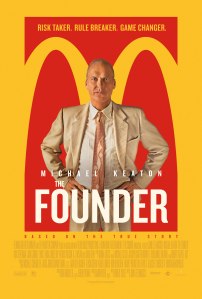 The Founder aims to be The Social Network of hamburgers and milkshakes, a warts-and-all biopic of a huckster who glommed onto other’s success and transformed it into an empire, a pragmatically ruthless entrepreneur run rampant with ambition and leaving behind a trail of lawsuits and disgruntled little people. Michael Keaton, on a roll since Birdman, teams up with screenwriter Robert Siegel (The Wrestler) and director John Lee Hancock (Saving Mr. Banks) to bring to life the story of the man behind the ubiquitous golden arches. The details are routinely fascinating and the movie presents a larger thesis on shifting and conflicting concepts of the American Dream and whether a ruthless yet victorious huckster is to be celebrated, pitied, scorned, or all of the above.
In the mid 1950s, Ray Kroc (Keaton) was a struggling milkshake mixer salesman striking out with just about every drive-in and dinner in the Midwest. His wife Ethel (Laura Dern) is exasperated by Kroc’s flights of fancy, shilling whatever new product might be his ticket to riches. His life changes thanks to one very efficient hamburger stand in San Bernardino, California. The McDonald brothers, Mac (John Caroll Lynch) and Dick (Nick Offerman), have ordered eight of Kroc’s milkshake mixers because they can barely keep up with demand. Kroc travels out West to see for himself and discovers a tasty and speedy hamburger assembly line that nobody else is doing. He pushes the McDonald brothers to franchise their model with him in the lead. They’re wary but agree with a strict contract that still gives full executive decision-making to the brothers. Kroc languishes at first but finds growing success, barely able to keep ahead with the mounting overhead costs. Kroc wants to keep going but the McDonald brothers are unyielding over their terms of business. Kroc schemes to push them out of their own business, establish himself as the founder, and take their very name for himself.
 Firstly, the story of the formation of McDonald’s is probably far less known than the formation of Facebook, and this provides plenty of opportunities for illumination. It is an inherently interesting story. There’s the invention of the modern-day fast food assembly line and the difficulty in perfecting this process and getting customers acquainted with the new reality. Initially, after years of drive-in service, customers are befuddled that they have to physically walk up to a window and order and throw away their own trash. The early history, hiccups, and adjustments are interesting, but it all gets more engrossing once Kroc comes aboard. It’s here where the film becomes very business-like in its examination of Kroc’s ruthless business tactics that lead to his ascent. Without Kroc’s intervention, perhaps the world would never have known the name McDonalds. He’s not an instant success either. He’s already middle-aged when he comes across the McDonald brothers. He’s not a brilliant salesman by nature. He’s cunning and doggedly persistent, the key he tells us since the world is rife with talented, educated, and good people who go nowhere. Kroc is a constant motor that can never be satisfied. Ethel asks him if anything will ever be enough, and after a short pause he replies without pretense, “Probably not.” He cannot enjoy success because he always feels he should be entitled to more. It’s the kind of unmoored ambition that leads him to throw his litigious weight around, knowingly breaking legal contracts and handshake deals to get exactly what he wants. Kroc’s business triumphs will remind certain viewers of Donald Trump, a man who uses similar advantages of wealth to exploit others and force them into advantageous deals. Even when explicitly in the wrong he just rolls along undeterred.
It is Keaton’s (Spotlight) movie and he more than delivers under pressure. Keaton adopts a speaking affect that makes the character weirdly magnetic without being wholly charming, an interesting combination that reflects the conflicted nature of Kroc. He’s a fast-talking salesman who enjoys the sound of his own voice but he doesn’t fool himself. He’s a man who knows what he wants and it just happens to be everything. He knows his limitations but he strides forward. He is bursting at the seams to get out from under the thumb of the McDonald brothers, who he sees as limiting the growth of a company that is more his than theirs. Kroc delights in being treated to the upper echelons of power. He loves having people proverbially kiss his ring and lavish his greatness. It’s the story of a man who scraped by his entire life until stumbling upon someone else’s genius idea. Keaton plays the man with a wily canniness that is always entertaining, channeling the actor’s natural oddball energy and style into a Midwestern McBeth. He says if he saw his competitor drowning he’d “shove a hose down his throat.” He’s generally cold but Keaton and Siegel don’t present him with a standard redemption arc. He’s kind of a hapless jerk at the start and becomes a powerful, egotistical jerk by the end. Keaton’s layered performance gives the film a solid anchor to keep viewers invested in the film.
 If only the other parts of The Founder had as much nuance and care as Keaton’s role. The supporting characters have flashes of interest but are too relegated to be much more than symbols or less developed foils to Kroc. The McDonald brothers have a poignant level of tenderness to them but they’re set up to be symbols of American values that will inevitably be trampled upon by Kroc’s corporatist version of the American Dream. Mac is the hopeful and trusting brother, Dick is the no-nonsense devote to quality and ethics, and together they could use additional ambiguity or depth. They’re meant to represent an older way of doing business, the familiar edict that hard work, dedication to customers, and quality will pay off. The brothers are successful and content at their level of success; they lack the naked ambition of Kroc and his disregard for the rules. They’re set up to be defeated and swindled and victims of Kroc’s tactics, which limits them as characters. There’s a sliver of detail with Dick’s concern for his brother’s diabetes threatening him, but the brothers are more martyrs than anything else. You anticipate their defeat with slight dread but more a sense of impending inevitability. Their good-natured values are no match for the winner-takes-all mentality of a man on a mendacious mission.
Similarly, Kroc’s wife is another figure set up from the start to be trampled upon. She’s supportive but not supportive enough Kroc feels. Like the McDonald brothers, she’s too content within her station and what she deems a good existence, a life of dinners at the club with a retinue of upper middle class friends. Ethel is a plain looking woman of simple pleasures. You already know that there’s a ticking clock before Kroc will trade up. With these expectations, more could have been done to establish her character. Too often Kroc’s selfish, indifferent, or casually hurtful broadsides are treated with silent suffering from Ethel. She’s set up as a walking pained reaction shot. It almost gets to comical levels as the pattern repeats itself and you anticipate a slightly elongated, wounded reaction shot. Kroc’s second wife, Joan Smith (Linda Cardellini), is a sweetly smiling prize but proves herself more than a pretty face. She shares Kroc’s ambitions and proposes swapping real milk for instant milk mix to save refrigeration costs. There’s obviously more to this woman, who we meet already married to a business associate of Kroc’s, but the movie keeps her as a mostly symbolic, almost Fitzgerald-esque trophy. The other side characters that come into Kroc’s orbit, B.J. Novak’s scheming real estate fixer, Kate Neeland’s esteemed secretary, Justin Randell Brooke’s loyal lieutenant, are clipped so that they only appear in the film when they offer some service or advice useful to Kroc. Perhaps there’s a meta level here exploring how Kroc views those seemingly closest to him in strict transactional terms, or perhaps I’m just reaching for more.
 The other liability from an otherwise still entertaining script is the director. Hancock is better known for softer, feel-good films about American values. The Founder is a story that subverts all of those notions and Hancock doesn’t seem to master the skills in order for the satirical and darker implications to land. The onscreen visuals seem to clash with the movie’s overall disquieting tone. The colors are bright and the musical score by Carter Burwell seems curiously jolly at points, confusing the tone of darker scenes. It just doesn’t feel like Hancock had a good feel for the material and how best to execute it. It feels like he’s missing the layers of potential with Siegel’s screenplay. I’ll readily credit Hancock for part of Keaton’s terrific performance but Hancock’s touches are best realized in the art direction details recreating a bygone era. I feel that somebody like a Steven Soderbergh would have tapped more into this story’s satirical potential.
The Founder is an entertaining biopic of a scoundrel who ran roughshod over others dreams and turned their success into his own. It’s anchored by a complex performance from Keaton. It’s a rags-to-riches story that doesn’t tell the audience how to think about its centerpiece character. He’s underhanded, sure, but he’s also got everything he wanted and his tactics proved successful. Is this an ends justify the means story to rationalize the power of avarice, or is this an exploration of the darker undercurrents of the passing American Dream usurping others’ dreams and accomplishments (closing text informs us that McDonald’s feeds one percent of the world’s population every day)? The movie doesn’t seem to take a stand, neither fully condemning nor excusing Kroc’s actions. The tale behind the worldwide fast food giant is full of supersized drama and interesting procedural details about the rise of the most recognizable name in burgers. It’s unfortunate then that the movie struggles to reach the same heights as Keaton. The supporting characters are tragically underdeveloped and kept as figures for comparison to chart Kroc’s ascendance. Director John Lee Hancock also feels like an poor fit for the material, his instincts seemingly at odds with the film’s tone and intentions. The Founder is an interesting movie with a strong central performance but it can’t help but feel like its destiny was far greater, that it’s not meeting the full potential of the material.
Nate’s Grade: B
Share this:

Elle (2016)

It’s been a long time since director Paul Verhoeven (Robocop, Starship Troopers) has directed a movie, a whopping nine years since Black Book (my favorite title is the original Dutch – Zwartboek). In fact Elle is only the second movie of Verhoeven’s since 2000’s Hollow Man. Cinema needs more movies from men like Verhoeven. He’s famous for his penchant for camp and over-the-top violence and sex, but it’s his subversive streak, dark satire, and willingness to push an audience into squirmy situations that are missed most. Elle is a hard movie to describe and a hard movie to sell. It’s an uncomfortable viewing and that’s much of the point that Verhoeven wants to push the viewer into an uncomfortable world of a woman who makes others uncomfortable.
Michele (Isabelle Huppert) is a middle-aged professional woman who, in the opening scene, is raped on the floor of her home by a masked intruder. She tries to brush off the attack, refusing to report it and go to the police. She returns to her normal routine, which involves berating the employees at the video game company she runs, having an affair with her best friend’s husband, and asserting barely passive-aggressive control over her ex-husband and her adult son. Once Michele starts receiving taunting messages from her assumed attacker, she assess who in her life’s orbit may have been her rapist and how best to unmask their identity. There’s also the matter of vengeance.

Elle starts as a sneaky who-dunnit mystery and then blossoms into an engaging character study. Our first image of Michele is lying on the floor and being sexually violated by her attacker. It’s harrowing and upsetting and your sympathy instantly allies with the victim. However, the rest of the movie does not portray Michele with even the faintest glow of a halo. She’s a venom-spewing bully who sabotages the happiness of others around her and is having an indifferent affair with the husband of her best friend. Michele also runs a video game company that profits from the exaggerated sexual violence of the video game industry. She even lectures a programmer that the distressed cries of a rape victim should be louder and more orgasmic. Everything after the initial rape scene makes us question whether this character is worthy of our sympathies, and then that makes us question whether we should be ashamed to deny a rape victim sympathy at even a basic human level of empathy. There’s a happy moment where everything appears relatively settled, and she just can’t help herself and has to sabotage it with real ramifications with someone she genuinely cares for. It’s just her nature. It’s a complex crucible of self-reflection and it makes the movie an intriguing a unique experience to sit through.
About the half-hour mark, Michele becomes even more absorbing, and that’s when it’s revealed she’s the daughter of a notorious serial killer. As a young girl, she “assisted” her maniac father dispose of bodies into a large fire, and a picture of her looking dead-eyed and covered in ash is famous in French culture. There’s a lingering question of what her culpability was. As soon as this connection was revealed, my interest in Elle increased two-fold. It explains why she felt she couldn’t go to the police because she didn’t want the exposure, and certainly there would be a bitter few saying she got some sort of cosmic justice. Her relationship with her elderly and ailing father becomes its own mystery, and I started looking for parallels between Michele’s relationship with her father and her relationship with her screw-up adult son. Was she manipulating him like her father had done to her? Is her son’s penchant for not fitting in the adult workforce a sign of something more troubling? Is his temper and possibility for violence a hidden bomb thanks to grandpa’s DNA? I was even more observant and looking for connections.
The problem Verhoeven’s movie is that its story engine only takes you about two acts forward. From early on, the two things hanging over Michele are the prospect of finally coming face-to-face with her father one last time and discovering the identity of her rapist. Verheoven plays into the mystery thriller elements by populating Michele’s world with suspects that could secretly be her attacker. There’s the guy at her job that seems to loathe her and find her unworthy of her position. There’s the guy at work that has a little too close of an affection for her. There’s her friend’s husband, angered by being rebuffed when Michele ends their unfulfilling affair. There’s her neighbor’s husband who Michele covets and fantasizes over, who seems aware of Michele’s feelings. As the plot progresses and her attacker sends more messages, we get clues to the identity and who among our band of suspects is eliminated from contention. Then we find out and the movie has like a solid half hour left. That’s because the movie goes in an unexpected direction but one that makes enough sense knowing Michele as a character. Not all of the storylines hold the same level of interest, like Vincent’s one-note baby mama (Alice Isaaz), though you do understand why he might be attracted to abrasive women. The same with Michele’s mother (Judtih Magre) who seems too comically wacky as a sugar momma. Not all of the characters in the story’s sphere are worthy of the attention they receive; however, how Michele responds to them is worth our attention. The other storyline, a sense of closure with her father, is resolved around the same time in another unexpected manner. It’s a bit deflating and after both mysteries are resolved the movie feels like it’s abandoned its sense of direction. You’re waiting for the film to wrap up any moment but it keeps going, a tad too long at 130 minutes. It’s a small grievance but I definitely started feeling a sense of impatience during the final twenty minutes.
There’s a surprising amount of dark humor to be had with Michelle’s caustic view of other people and her genial manipulation of others. There’s an awkward dark comedy that comes from the interactions, which seems counterproductive or downright tonally unforgivable given the above admission of how rape-y the film comes across. It’s a squirming comedy, the kind that makes you laugh under your breath to break the tension of people behaving badly. Even the prospect of laughing given the serious subject matter somehow makes the film even more uncomfortable. The older ladies behind me in my theater were already chattering about how Elle was not one of the better movies they’ve come to see. To be fair this was after like the fourth rape scene.
Huppert (Amour, The Piano Teacher) is in every scene of the movie and she unleashes a performance destined to leave you talking. She’s 63 playing 50, which is usually the opposite of how Hollywood movies operate (if the women are even allowed to get to 50). Michele is a beautifully flawed and complicated canvas and Huppert seems to relish in her brusquely dismissive demeanor. She’s constantly testing the people in her world, mostly men, and sizing up the women. There’s a reason that she seems to revel in stomping out the happiness of the men around her whether it be an ex-husband, her oafish son, the husband of her best friend she’s having an affair with. Michele refuses to be defined by her trauma but she is still processing that, and Huppert is agile at showing the cracks in Michele’s armor to provide clues as to what is most important. She doesn’t care what we think of her and that adds a thrilling quality to an already bracing performance.

Does the movie cross a line into being tawdry exploitation? Because of the nature of its storyline and the past films of its director, it would be easy to slap the title of high-dross exploitation film onto Elle, but I don’t know if it applies fully. I cannot think of a more rape-y movie that I have ever seen. Full trigger warning to those out there, there are like six different rape scenes in the movie, though some of them are fantasy and some of them are violent role-playing, but all of them are disturbing. At its core, Elle is about power and even though our opening impression of Michele is one of victim, it’s a title she does not want. She is seeking to punish her rapist, and when the identity is revealed, she transforms the power dynamic and reclaims a sense of her sexual autonomy. Does consenting to abuse and enjoying it undercut the abuser’s power or reconfirm it? I can’t say whether this is any less exploitative than say 1974’s The Night Porter, another movie about trauma where the victim and victimizer indulge in an unhealthy sexual relationship that blurs the lines between sadomasochistic role-playing and fetishizing personal abuse. I feel like there’s enough substance in the characterization and the wide berths that Verhoeven allows free of judgment to classify Elle as more than exploitation, or to classify it as a reclamation of the exploitation film, an exercise akin to what it feels like Michael Haneeke (The White Ribbon, Funny Games) does that I inevitably can’t stand.
I can’t quite grasp what about Elle spurred Verhoeven out of a nine-year absence from filmmaking (he experimented with a 53-minute farce in 2012 whose script was crowdsourced, so I’m discounting that). On the surface, I would make the connections to the film’s extreme sex and violence, staples of Verhoeven’s Hollywood career. But that’s too easy, and there’s no shortage of extreme sex and violence in other stories. What was it about Elle that drew the Dutch filmmaker out of seclusion? I think it was another opportunity to be subversive, this time in the realm of art-house French cinema. Verhoeven has always enjoyed proving people wrong, exploring our baser instincts, and telling damn fine entertaining movies for adults. His subversive streak is renewed with a rape thriller that also happens to be an incisive character study of a very nasty woman who had something very nasty done to her. Audience loyalties and sympathies are consistently in tumult, shifting and being tested by new information and the mounting evidence of Michele’s treatment of others. Huppert gives a calculated, fierce performance right down to the end, pushing the audience into more uncomfortable reflection and uncomfortable laughter in the face of despair. I think this is why Verhoeven hopped back into the director’s chair and even re-learned French so he could communicate with a French film crew. He wanted to push an audience, upending their expectations about power, sex, and subjugation. Elle is downright elegant as it goes about its business, the business of forcing viewers to think critically and question their personal discomfort. It’s not exactly an easy movie to watch at times but it is a hard movie to forget.
Nate’s Grade: B


You must be logged in to post a comment.