Blog Archives
The Current War (2019)
 The Current War has been on the shelf for two years and now finally getting a release, strangely subtitled “The Director’s Cut.” Can a movie that has never been released to the public, outside of some festival screenings, really declare its first impression a director’s cut? Aren’t these supposed to be different, and generally longer versions of the original edit? Regardless, the movie acts like a 19th century version of The Social Network with the battle over the nation’s electrical grid up for stakes between Thomas Edison (Benedict Cumberbatch) and George Westinghouse (Michael Shannon). You may think Nikola Tesla (Nicholas Hoult) is a big player in this game, but you’d be mistaken as he’s more a glorified cameo. I appreciated how the history came alive under director Alfonso Gomez-Rejon (Me, and Earl, and the Dying Girl) and his overwhelming sense of style. This is a period film that feels excitedly modern in its presentation, with lots of clever transitions, stylish camera angles, and wide angle photography to go along with a churning score that even reminded me of Trent Reznor and Atticus Ross’ Oscar-winning music. The characterization of these Great Men of Industry also finds ways to humanize them, especially Westinghouse who shuffled his employees into his burgeoning and debt-ridden electrical gambit so he wouldn’t have to fire anyone. Edison’s portrayal is decidedly charitable, positioning him as a principled family man who rebuffed a shameless J.P. Morgan (a great movie bastard) and easy money for military contracts because he refused to participate in any endeavor that would take life. There’s an ironic subplot where Edison, forced into desperation, cooperates with New York state’s implementation of a new “more humane” way of executing prisoners, and pinning the deadly results on Westinghouse’s alternating electrical current. This is certainly not the Edison of litigious infamy. I enjoyed immersing myself in this older world where the men of science and vision were akin to magicians creating miracles that dazzle. Their competitive race is doomed to be a bit one-sided if you know the history of AC versus DC (it’s hard to compete when one option is both better and cheaper) but I was still entertained by their tit-for-tat and how each man responded to pressure and expectations. The screenplay by Michael Mitnick is judicious with its information and very accessible for a lay person. The acting is solid even if many side characters are glorified extras (Tom Holland, Katherine Waterston, Tuppence Middleton). The Current War has been getting some pretty dim reviews, with even dimmer puns, and I don’t quite follow why critics are turning out the lights on this movie (sorry). It might not have the stuff of greatness but it’s a perfectly enjoyable period piece with attention to character and a panache of style to liven up the dustiest of history.
Nate’s Grade: B
Share this:

The Lighthouse (2019)
 If you’re writer/director Robert Eggers and just made a most delicious impression with your debut movie, 2016’s The Witch (or, stupidly, The VVitch), where do you go next? Apparently it was off the coast of Nova Scotia with Robert Pattinson, Willem Dafoe, and a sexy mermaid? The Lighthouse follows the story of two men, Thomas Wake (Dafoe) and Ephraim Winslow (Pattinson), as lighthouse keepers trapped during a torrential New England storm in the 1890s. This fraught relationship comes undone over the course of some very severe cabin fever. While The Lighthouse might not be as enjoyable as The Witch, nor the arthouse genre masterpiece some critics have been hailing, it is an exceptionally realized throwback with its own beguiling sense of peculiarity. They don’t really make them like this anymore, folks.
The Lighthouse feels exactly like somebody meticulously melded an episode of The Twilight Zone with an episode of Alfred Hitchcock Presents. The vision is so specific and so fine-tuned that it can be startling, like watching a high-wire act of an artist perform a feat and so well. Eggers is definitely a man with definite talent and here is a movie that serves as a strange, loving homage to an earlier age. The shooting style, camera equipment, lenses, and nearly 4:3 aspect ratio coalesce to make The Lighthouse feel like a forgotten curio of an older age. The very nature of the movie’s presentation adds to the enjoyment level of the two hours of madness. This is a highly impressive movie, first and foremost from its technical side. The black and white photography is rich and stunning, making elaborate and precise use of shadows and camera movement. You feel the grime and salt. Pattinson’s face is filmed with such heaviness, shadows draped over him, that he looks like he was carved from stone to resemble a modern-day Robert Mitchum. There are several moments that unveil themselves with startling meticulousness. There are several images that stick in my memory. There are moments of levity that had me snickering madly. Eggers has a terrific instinct when it comes to staging scenes and drawing out the suspense as well as the humor. Some scenes will cycle from horror to comedy and then back again, allowing the movie to continuously feel slippery in tone as well as effect. It’s such a handsomely mounted production that it’s easy to admire the dedication. The craft is remarkable. Eggers had a very exact style he was going for with his second film,and he commits fully to the process. Whatever you think of the lasting impression, the man achieved his vision to the bitter end.
 Being a two-hander, the entire movie is going to rest on the shoulders of our acting duo and what insights we can glean from them as they become combative and ultimately suspicious. There’s only one other credited actor for the entire film, Valeriia Karaman, as a lustful fantasy for Winslow, or maybe she’s not a fantasy? We’re stuck with two very capable thespians and they just dig into these meaty, hammy roles. The dialogue has a delightfully daffy out-of-time cadence and vernacular that adds authenticity as well as a sprinkle of approaching madness. Dafoe (Aquaman) is a delight as a soused old captain given to self-important and abrasive behavior. An insult over his cooking unleashes a ridiculous monologue where he lays out in great, poetic detail a curse, and like much in the movie, it goes from being funny to being serious to being outright impressive. It’s like watching actors get to play with Shakespeare, that’s how immensely pleasing it can be to listen to Dafoe and Pattinson deliver Eggers’ dialogue with great flourish. Pattinson (Good Time) has gotten a bad rap for being the Twilight pretty boy but he’s taken exciting chances on artistically daring and dangerous prospects (this is his SECOND 2019 indie thriller that prominently features his furious masturbation). Pattinson serves as our entry point into this secluded seaside shack, and it’s through him we watch the madness of the movie plant. He’s got a real fire he’s able to harness that makes him vulnerable, sympathetic, and dangerous. Should we root for Winslow? Being trapped alone with them never gets boring because of their characters, the revelation of secrets each man may or may not be embellishing, and their explosive confrontations.
This is also very funny movie. Eggers understands the thin line between madness and humor and uses this to his great advantage where the embrace of comedy enhances the overall feeling of WTF insanity. You’ll be forgiven for laughing but Eggers seems to invite it almost as a needed release. Much like Ari Aster did with Midsommar, the filmmaker is clearly playing with camp elements intentionally. It’s a tricky artistic maneuver to willingly invite camp and to make sure it doesn’t pervert the rest of the film and its ambitions, but I think Eggers pulls it off. There is literally an audible fart before the two main characters share a line of dialogue together. You’ll be surprised how much farting is actually in the movie (all added in post-production, the Internet trivia proudly crows, because I guess Dafoe didn’t want to go that far Method). There’s an exciting unpredictability to the movie even as it feels very much on a foreseeable collision course that you await.
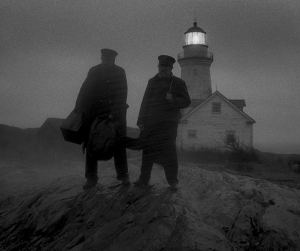 After all that artistic sturm und drang, I was left wondering what exactly there was to hold onto for clarity and substance. Firstly, the artistic exercise, dedication to a specific vision, and level of execution will likely be enough for a certain group of viewers, especially those titillated by old school horror peppered with David Lynch peculiarities. It’s a moody work of art with definite finesse but ultimately I don’t know how much there is to take away from it. The Lighthouse feels like a well-handled experiment that deserves your admiration but I don’t know what engagement exists beyond simply the experience and then the discussion it leads. There are plenty of movies that invite an active deconstruction and this interactive interpretation serves as a central selling point, but I was wondering what I should be thinking here. I don’t know if the movie is adopting Winslow’s point of view and I shouldn’t trust what I see onscreen, or I shouldn’t trust Thomas, or I shouldn’t trust either, or whether the movie was adopting either of their perspectives or neither. By the end, I don’t know what is supposed to be taken as legitimate, and this can work with plenty of movies but the majority doesn’t seem to operate on a dream-logic. It’s a dank, claustrophobic, paranoid thriller but it’s so dutiful to an older style of thriller that the eccentricities don’t take over and become the movie. It’s entirely a movie about men being stranded, going mad, and turning on one another, and that’s about it. There is a definite Promethean analogy with Winslow’s desire to “have the light” and the old man standing in his way (this is hit even harder in the very obvious, concluding image). If you cut out maybe 40 seconds of the movie it could have played on TV back in Hitchcock’s day and would fit.
It’s hard for me to articulate but The Lighthouse is an A-level execution of an idea that feels all too limited and small. It’s thrilling and accomplished and a fun movie to just get lost within and laugh at the screen when it goes overboard. I wouldn’t even mind taking another trip and getting lost in this sea-soaked curiosity. Maybe I’ll be able to impart more meaning, because while the technical craft and extraordinarily honed artistic vision shine through, the lasting power of the whole enterprise feels a bit too locked in place. It very much is a remnant of the past, a loving homage to old Hammer films and television anthologies and tales of men losing their minds when it comes to loneliness, desperation, and helplessness. There’s much to champion with The Lighthouse and I’ll assuredly be in line for whatever Eggers decides will be his next project (a quick search comes up with a tenth-century Viking revenge thriller starring Dafoe, Ana Taylor-Joy, two Skarsgards, and Nicole Kidman). When Eggers commits to a story and style, he commits completely and the results can be breath-taking. I hope he aims for more than A-level execution with his next movie and goes for an A-level story experience to match. Still, The Lighthouse is a fascinating and delightfully weird experience that will enchant and baffle.
Nate’s Grade: B+
Share this:

Dolemite is My Name (2019)
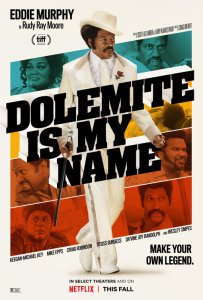 I’m a sucker for behind-the-scenes movies on scrappy genre indies, following a band of creatives come together, build camaraderie, and serve as the underdogs we root for as they put on their fun show, so Dolemite is My Name is right up my alley. It’s a biopic on Rudy Ray Moore (Eddie Murphy), who by the 1970s rebranded himself in his 40s when he began performing as an outrageous, rhyming pimp character named Dolemite. He recorded crude comedy albums, sold them out of the back of his trunk, and reached a new level of fame, but he sought a blaxploitation movie to get him to even further heights. This movie is akin to The Disaster Artist where we watch a lot of artists pull off a bad movie with little money, as well as 2004’s Baadasssss!, where Mario Van Peebles recreated the making of his father’s 1971 blaxploitation hit, Sweet Sweetback’s Baadasssss Song. Chances are, if you enjoyed either of those two movies, or the hilarious blaxploitation spoof Black Dynamite, you will be smiling aplenty with this new Netflix movie (given a short theatrical run and soon to be widely available via streaming). The movie belongs to Murphy, who hasn’t had a part in three years, and he comes roaring to life as Moore, a man who won’t let anything stand in the way of his dreams. Murphy is fully captivating in every scene as he turns the Dolemite persona on and off, sharing moments of personal insight and fear, like when he’s nervous over his physique with an upcoming sex scene for his movie. He’s a determined hustler and it’s hard not to fall for his grinning charm. The Dolemite movie has a special appeal because it was intended as a comedy, so the shoestring, scrappy nature of it works nicely with the good intentions of simply making a big, silly, kung-fu-filled action comedy with what audiences want. I’ll confess I never found any of Moore’s standup to be funny as the audiences at the time. However, the filmmakers have already answered this, as Moore and pals go see The Front Page, a movie dubbed by critics as a laugh-out-loud comedy, and the men sit stone-faced and confused throughout the pithy, erudite comedy that seems to be amusing the largely white, WASP-y crowd. Humor is subjective, but not only that it’s the kind of entertainment with the shortest shelf life. It’s naturally going to expire quickly. Comedy routines we found hilarious decades ago might not still be funny today, and that’s okay. Dolemite came out at the right time and influenced other artists and filmmakers. A behind-the-scenes film is destined to be a movie with a definite ceiling. Moore is an interesting success story but there’s only so much to be gleaned from this underdog tale. Thanks to writers Larry Karaszewski and Scott Alexander (Ed Wood, The People vs. O.J. Simpson) and the energy of Murphy, Dolemite is My Name is a fun two hours with a bunch of cut-ups.
Nate’s Grade: B
Share this:

Parasite (2019)
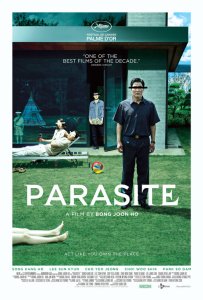 Parasite is the latest from award-winning South Korean filmmaker Bong Joon-ho (Snowpiercer, The Host, Okja) and it won the prestigious Palm D’or at the Cannes Film Festival. The filmmaker has never settled down in any genre and often goes for broke when it comes to embracing whatever genre he is dabbling in and then subverting, accelerating, and broadening that territory to show an audience what a master can do with these storytelling parameters. No movie under Bong Joon-ho’s guidance is ever limited by its genre. Needless to say, I’ve been highly anticipating Parasite, even more so since the critics started bandying about terms like “masterpiece.” Simply put, Parasite is a miraculous movie.
We follow the Kim family who live in a scummy basement apartment on a filthy street known for public urination. They scam free wi-fi off their neighbor and badly fold pizza boxes for little money. They’re barely hanging by on the outer edges of society when opportunity comes knocking. A rich family, the Parks, is in need of a new English tutor for their teenage daughter, and Ki-woo Kim (Choi Woo-sik) has the connection. He will pose as a college-educated English teacher, recommended from his friend, the departing tutor. He gets the job and sees further opportunity, eventually scheming to get each member of his family hired; sister Ki-jung Kim (Park So-dam) as an art therapist for the Park’s troubled son, father Ki-taek Kim (Song Kang-ho) as the personal driver to the family, and mother Shung-sook Kim (Jang Hye-jin) as the housekeeper and personal assistant for the family. The Kim family gains further leverage as they worm their way inside this house, but there are secrets that will force them to readjust how far they are willing to go to service this bourgeois family and keep their good lies rolling.
 Parasite just unfurls with such natural ease, building and developing outward, building its characters, their problems and deceptions, and then, like that, it effortlessly turns gears toward another tone, and you weren’t even aware it was happening until after the fact. Bong Joon-ho’s film is so exact and impeccable and calculated that the pieces are move in tandem like a well-oiled machine. The synchronicity is so amazing that I often had to acknowledge how effectively the movie had surprised or satisfied me. There isn’t a wasted moment in the 130 minutes here, which begins as a fun con game between one family of shady grifters working their way inside a rich family’s trust. From there, the movie gets even darker, more mysterious, outlandish, and even more mournful and delightful. There are moments of slapstick comedy that had me howling, divine sequences of tension that felt ready to explode, and regular emotional punches to the system that reminded you that despite everything these are still people capable of great suffering and great feeling. Parasite is a rare movie that works on near every level, each facet of filmmaking operating at such precision that it blends together to create a masterwork of tone and tenor that is universally accessible, brimming with menace and glee.
There’s a simple pleasure to be had watching a con artist at play, so there’s even more amusement when we’re watching a family of con artists all spinning lies in tandem. The process of escalation is so clean and believable in the world’s universe, with the first family member using their position of influence to manipulative the family into hiring the next family member, even if that means scheming to get rid of the Park family servant already occupying that desired position. The Park family matriarch is all about personal recommendations and using a tight circle of trust; however, the Kim family exploits the obvious loophole of what if the initial link in that chain is untrustworthy him or herself? Initially I thought the movie was going to be watching this one family worm their way into the lives of the rich and powerful and take over, and while that is true to a certain extent, the movie is thankfully even more than that. Still, the con aspect alone is highly entertaining and so naturally plotted, with each new addition feeling organic from the last. There are natural complications that provide new challenges for the family of con artists to maintain their shifting covers and having to think on their feet, and there isn’t a moment relating to these antics where Parasite is not completely compelling and darkly funny even as it veers into extremes.
 If you’re thinking that the Kim family is the obvious target of the movie’s parasitic titular allusion, slow down, my friend. While the Kim family is more obvious about their deceptions, the Park family too is filled with the deception of civility, kindness, and graciousness. At first, we laugh at them because of a general naivete that allows the Kims to flourish. As the Kims successfully roust different servants, they are routinely dismissed without much thought. Some of these people have been with the family for years and otherwise have spotless records, but all it takes is one whiff of impropriety and the Parks are already scrambling to cut them loose, usually very unceremoniously and immediately, with the misplaced idea that this will somehow be the “nice” and “respectful” way of handling a dismissal. They’re so quick to turn on people they feel are disloyal or incompetent, but really, it’s the disloyal aspect, that they can be manipulated so easily by the Kim family’s suggestions and assertions. Never once do Mr. and Mrs. Park ask for their servants’ side of the story; they accept the accusations with minimal evidence are gung-ho about removing their formally trusted help as if they have been waiting for these moments.
The movie becomes a parable of exploitation and the consequences of avarice, and I’m going to do my best to dance around some significant spoilers that reshape the film in its second half. At one point the Kims have all made themselves at home in the luxury of the Park estate while the family is away on a camping trip. It’s carefree wish fulfillment, lapping in the excess, and then over a drunken family dinner, Mrs. Kim says that if she had this kind of money that she would be as nice as Mrs. Park (appears). For her, money is like an iron and irons out all the problems of life, and as a family that has constantly been hustling for their next dollar, to be free of cares and worries would be the ultimate luxury. However, there is naturally more to this estate and the Park family, and the movie takes some dark turns into a battle over status and how far people will go to protect what they feel belongs to them. This is acted out in very personal ways and also in larger metaphorical waves, which adds to the overall class warfare satire. What starts off as a spiky little con comedy becomes something deeper and more challenging, expanding its targets to indict everyone jockeying for position in a system that seems corrupted to a fault.
 Even as the Kim family is scheming and conniving, there are still moments that remind you that they aren’t these smooth, amoral con men of the movies and are real human beings with real feelings and real insecurities. There’s one moment Mr. Kim overhears his boss casually talking about him, and it’s very complimentary except for one admission. Apparently, Mr. Kim has an odor to him that the rich man finds to be rather unpleasant (he describes it like an old radish). No matter the suits he puts on, no matter the politeness and charm he manifests, no matter his skills when it comes to being a dutiful driver, no matter the gaps that Mr. Kim feels he is surpassing, there will always be something innate to him that stops him from being accepted and integrated in this cherished, cordoned-off land of the rich. His very smell is offensive to the noses of the rich, and this is something so personal, so nasty, that it genuinely wounds the man and we feel for him. Bong Joon-ho asks his audience to embrace all sorts of uncomfortable positions, taking characters you found despicable and asking to see them as real human beings capable of great loss and shame. It stops the movie from feeling like it’s treading into cartoon territory even as its violence and physical comedy ramps up in the second half. It never loses a sense of its soul.
Ki-woo Kim asks his father, after several setbacks, what their plan is next, how they will persevere against the latest setback. Mr. Kim answers that his trick is to never have a plan, because plans will inevitably fail. This is a nice character moment but also an insight into a perspective that leads to what I would argue is the emotional climax of the movie, where Ki-woo pledges to save someone through an elaborate and years-in-the-making plan. In that moment, is he rejecting his father’s philosophy and driving forward on what will be at minimum years of hard work to reach his goal, which is motivated through reclamation and salvation rather than personal gain? Or is the very fact that he is committing such an elaborate plan an act of folly he knows will never materialize because that is the nature of plans? I love that the film leaves you, the viewer, to determine whether this assertion is optimistic or pessimistic and how that paints the film’s message.
 From a technical standpoint, the movie is another showcase of how Bong Joon-ho is brilliant at visually communicating his wonderful stories. The editing is so tightly precise to maximize tension and comedy, and sometimes both simultaneously. The photography is gorgeously composed with the use of space in the frame excellently communicating character relationships. The geography of the home is nicely utilized to ratchet up the tension of escaping around corners and hiding around furniture. There are moments that just made me want to applaud the filmmakers for their top-level craft.
Parasite is an effortlessly impressive movie that blends tones, insights, and entertainment to create one of the more unique and pleasing film experiences of the year. Bong Joon-ho once again shown himself to be a masterclass filmmaker who can tackle just about any subject and any genre and make it sing. I’d advise to avoid specific spoilers to maintain the surprise factor; however, this movie is so well executed, so astonishingly developed with precision and attention given to each of the characters and their individual whims and problems, that even knowing every single plot beat in this movie will not diminish the enjoyment factor. That’s because Parasite is a rare movie that is so sumptuously put together, so seamlessly calibrated, that to watch the movie is to simply sit in awe of how talented the filmmakers are at weaving their tale. Parasite is definitely one of the best films of 2019 and worth tracking down where able.
Nate’s Grade: A
Share this:

Joker (2019)
 There has been a lot of discussion over Joker, a new dark R-rated spinoff unrelated to other comic book movies and directed by the man who gave the world The Hangover films. Director/co-writer Todd Phillips desired to tell a character-driven drama that explored how Batman’s most notorious villain, and perhaps the most widely known villain of all pop culture, became exactly the clown he is. Some people said the Joker didn’t need a back-story, others said that Phillips had no place dabbling into the realm of superhero cinema, and there were plenty of others who expressed unease that the movie might inadvertently serve as an inspiration for disaffected loners looking for encouragement to make others feel their pain and suffering. After all those think pieces and cultural hand-wringing, Joker, as the actual movie, isn’t quite the transgressive experience that others feared and that the movie very much wants you to believe.
Arthur Fleck (Joaquin Phoenix) is a quiet, pathetic man who is being ground down by the forces in his life. He has a unique medical condition that causes him to break out in hysterical laughter when he’s nervous or upset, which only makes others feel nervous and upset. It’s hard for him to keep his job as a for-hire clown and his therapy and medicine are being eliminated thanks to budget cuts. He cares for his elderly mother (Frances Conroy), crushes on an attractive neighbor (Zazie Beetz), and dreams of being a stand-up comic who will one day grace the set of his favorite late-night talk show host, Murray Franklin (Robert De Niro). Arthur’s life changes from one night of extreme violence and how it shapes his concept of himself and society. He’s tired of feeling bad for who he is and he’s going to realize his true potential on the biggest stage.
 There’s something, excuse the modern parlance, quite “edgelord” about the film and its artistic approach. It’s very eager to be dangerous, edgy, disturbing, and there are certainly extended moments where it achieves these goals, notably thanks to Phoenix’s performance. However, I was cognizant of how eager the film was to be gritty, and dark, and different, to the point that it felt like the whole enterprise wasn’t just trying too hard to be different but wanted you to know it was trying. After a while, you just have to shrug and say, “Hey, movie, I get it.” This guy’s life ain’t too hot. The first 45 minutes could probably be condensed in half. The first two acts feel redundant as they establish the many trials and tribulations of this man on the edge of a broken society that has abandoned him. Because of this, Joker can be an entertaining experiment in solo superhero stories but there is a critical absence of depth that keeps the film from going beyond a stellar lead performance. It’s a Martin Scorsese hodgepodge, a cover song for a famous villain.
This is the kind of movie where subtlety is rarely used, which increases the sensation that it’s trying too hard because it seems like it’s saying all of its points with exclamation marks. Even in the opening minutes, while Arthur is applying his clownish makeup, we hear a voice over narration from a TV newscaster who is essentially screaming to the audience all of the important social contexts for the setting (Things are bad! People are mean! The economy is bad! People are getting desperate! What has the world come to?!). There’s a fantasy experience where the characters are just openly explaining their desires. The visual metaphors are pretty simple, like the idea of hiding behind a mask (don’t we all wear masks, man?) and the intimidating set of stairs ascending to Arthur’s apartment that he must climb. So many supporting characters act like mouthpieces for larger collective groups, like a paid therapist who tells Arthur that the people with money don’t care about her or Arthur, the little people caught in the machinery of runaway capitalism, or Thomas Wayne as the callous and cold business elite who seems disdainful about any sort of empathy for others that challenge his responsibility to a larger society. De Niro’s talk show host feels like an amalgamation of a lot of different themes, like daddy issues, the media, but also the representation of ridicule as comedy and mass entertainment. There aren’t so much supporting characters as there are ideas, and in a weird way this could have worked, as if each figure represents some different level of psychosis for Arthur, almost as if it was repeating the 2003 movie Identity and everyone really is a reflection of Arthur’s damaged personality. The inclusion of Beetz (Deadpool 2) is more a plot device meant to humanize Arthur, but the entire premise feels like it’s missing development to make it believable, and ultimately this is the point of her character but it’s a long wait for a reveal for a character that is superfluous at her core. It’s the kind of movie that thinks we need to yet again see the definitive formative act of every Batman movie.
 The movie does pick up a momentum when Arthur starts to get set on his way toward becoming the clown prince of crime. When the Joker gets his first taste of violence, in self-defense, the clown vigilante becomes a symbol for a reactionary contingent of Gotham’s lower classes. The groundswell of support provides a welcomed sense of community for a man who has been secluded for his idiosyncrasies, but it’s a celebration of a loss of morality, and so to fully embrace this tide of supporters he must give away the last of vestiges of his soul. This downfall allows for the movie to feel like it’s finally committed to something, where the setups are finally starting to coalesce around a character who is now driving his story rather than being the recipient of misfortune. The violence becomes more shocking and Arthur stops caring about hiding who he really is, and that’s when the movie becomes the full force it had been promising. I was tapping nervously throughout the final thirty minutes because I was anticipating bad things for anybody on screen. Phillips can use this anxious anticipation for unexpected comedy too, like where a character was trapped due to their unique circumstances and whether they too were in mortal peril. I wish Phillips had pulled back because there’s a perfect visual to conclude his movie, that brings the entire self-actualization and loss of morality full circle, and yet the movie gives us another two-minute coda.
Joker certainly feels like Phillips’ version of a Scorsese movie, for better and for worse. If you’re going to imitate anyone, it might as well be one of the greatest living filmmakers whose crime dramas have reshaped the very language of the movies and how we view violent crooks. The go-to response I’ve seen is that Joker is a combination of Taxi Driver and The King of Comedy. I’ll readily agree with the Taxi Driver comparisons. It’s everywhere. We have a disaffected loner who is turning sour on an increasingly hostile and unstable society he views as beyond repair. Even the shot selections, camera movements, and 1970s era set design evoke that influence. The King of Comedy is more a facile comparison, as Arthur is a disturbed man trying his luck at standup comedy, failing, and becoming more unhinged. The real reason reviewers seem to be making this connection is the inclusion of Robert De Niro, and it feels like that is the only reason he’s actually involved, to ping back to King of Comedy. The idea of a stiff actor like De Niro being a glib talk show host, even in the 1970s, seems like a bad fit. The other real film influence I don’t see getting as much recognition is Network. This is a tale of one man tapping into a vent of anger and starting a movement that ripples out beyond them into something uncontrollable.
 Phillips is best known for his comedy work but I could feel his leaning to do a straight genre picture. In other reviews, I’ve cited Phillips’ keen eye for noir-flavored visuals (think of the car traveling across the desert as seen through the reflection of sunglasses in The Hangover). He had the chops to tell a straight genre crime thriller, so it’s not surprising that Joker is a slickly made, unsettling, and effective movie when it counts. This is a grimy-looking New York City, I mean Gotham City, where the garbage piles high (another not so subtle visual metaphor) and the city feels like a maze all its own crushing our main character. The cinematography is great with several strong moments that amplify the mood of unrest and distaste. The crafty costumes by Mark Bridges (Phantom Thread) lend to the overall authenticity of the period. The cello-heavy score by Hidur Guonadottir (HBO’s Chernobyl) is very evocative and ominously conveys the turmoil bubbling below the surface in a manner that doesn’t feel like pandering. This is a good-looking production made by talented technicians and Phillips has enough skill to pull it all together, even if that aim is really to recreate a style of another filmmaker and the time and place of his films.
I’ve purposely saved the best for last, and that’s Phoenix as the titular character. He is mesmerizing as a broken man trying to find his place in society and flailing wildly. His uncontrollable cackling is so unsettling that when he broke into laughing fits, I could feel myself getting more and more unnerved. At first it was the awkward sympathy of watching a man struggle to get through his disability, trying to compose himself, and embarrassed for the discomfort he was projecting. The very sound of the cackling trying to be contained, as a friend and co-worker Jason credited, watching the laughter catch in his throat, it had such an immediate, almost physical reaction in me. Later in the movie, I cringed because it made me worry what was going to happen next because I know it’s a precursor to bad feelings. When he’s becoming more comfortable with his impulses and dark thoughts, you notice the cackling starts to ebb away. There’s a small moment that I loved where after he flees from his first murder he runs into a bathroom, and once his breathing calms, it’s almost like his body is commanded by some spiritual serenity as he begins to dance. Phillips allows the scene to breathe and play out, to invite the audience to join. This little motif probably appears a few too many times, but it’s a beautiful little moment of physicality that expresses the chaos becoming harmony within a man. Phoenix lost 50 pounds for the role and his gaunt, haunted frame reminds you how much of a shell of a human being this character feels like. He even tells his therapist that he questioned whether he was even a person or not. Phoenix burrows deep into the character and unleashes a committed intensity that is impressively communicated through his sad, reedy, sing-songy voice, his slippery stances and body language, and the madness that seems to resonate from his bulging eyes. Even when the movie is repeating its steps and tricks, it’s Phoenix that constantly gives back to the audience. It’s a performance certainly worthy of Oscar attention and plaudits, though in my mind it’s still a step or two below the instantly iconic, and Oscar-winning, performance from Heath Ledger.
 Joker is a movie and should not be held responsible for the actions of others and what they may read from the film. I don’t sense Phillips and his team condoning their protagonist’s lawless actions, and the violence is often undercut so that it feels more disturbing than triumphant and exhilarating. When Arthur does get his first kill, the audience has likely been silently rooting for him to fight back, to punish the wrongdoers, but the movie draws out the scene in a manner that’s akin to a wounded animal panicking as it scrambles for its life and a cold execution. It’s not meant to be cool. Phoenix’s performance elevates the entire enterprise and will unnerve as much as it ensnares. It’s not a subtle movie at all, and it hugs the works of Scorsese a little too closely, both in tone as well as visual symmetry. It’s trying very hard to be nihilistic, edgy, and provocative (this isn’t your “normal comic book movie” it wants to scream with every frame). Arthur just wanted to make people laugh, the movie tells us, but the joke was on him after all (subtlety). If anyone is inspired from this movie, I hope it’s to seek out other Scorsese movies.
Nate’s Grade: B
Share this:

Judy (2019)
 The real reason to watch Judy is the triumphant, blazing return of Renee Zellweger as the talent we’ve known her to be as an actress. She’s faded from the spotlight over the last decade, gotten a controversial face lift, and spent over a year prepping to play the role of the legendary Judy Garland during a 1969 British tour, what would prove to be the last months of her life. Zellweger disappears into the character, astonishingly recreating the mannerisms, posture, and vocal cadences of the famous Old Hollywood Wizard of Oz star. She’s tremendous and while clearly troubled and weathered, the film takes a remarkably sympathetic approach to its subject. Garland’s present-day alcoholism, pill popping, and narcissism can trace their roots to her young days as a teenage studio star where the powers that be, namely studio honcho Louis B. Mayer, would bully her, harass her, and molest her. The exploitation mechanisms of Old Hollywood made me wish that Judy was a more unconventional biopic, blending the past and present into a daring, metaphorical journey over the rainbow of a woman in the spotlight her entire life. Instead, we’re watching Garland stumble onto the stage, struggle to sleep and perform, and live a sad existence where she can be reminded, just every so often, the impact she can have, like a sweet impromptu home visit with a gay couple that is a miracle of tiny kindnesses. There’s not much plot here as the film, too, stumbles and shambles to its finale, with very little attention given to the supporting characters. Her whirlwind romance with a younger man (Finn Wittrock) fails to ignite much insight, and he’s named Mickey, so I was confusing him as an adult Mickey Rooney, who appears onscreen in flashbacks and was Judy’s first love (she asked if they were dating and Rooney said he would have to check with Mayer — every woman’s dream). Watching the movie made me feel like there was a stronger version of this story begging to be told. Regardless, Judy is a well made if conventional biopic with a real razzle-dazzle performance from Zellweger, who stunned me with her final singing number and the longing, remorseful, melancholy emotions she was able to dredge. Judy will be best remembered for her performance alone and that’s perfectly right.
Nate’s Grade: B
Share this:

Ad Astra (2019)
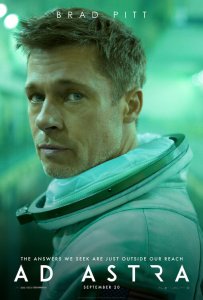 I knew early on when I was watching the advertisement for writer/director James Grey’s Ad Astra (Latin for “to the stars”) that this was going to be more a quiet, slower, contemplative movie than the ads were making it seem. Hey, I like quiet, slower, contemplative movies, but I like the ones where they give me an entry point, a reason to care, and a story with characters that make me feel compelled to watch what happens next. Ad Astra does not quite rise to that level.
Roy McBride (Brad Pitt) is an astronaut in a near future with a special mission: to find his father (Tommy Lee Jones). The father left Earth decades ago to search for intelligent life and develop an alternative energy source. His discovery has unleashed a series of destabilizing power surges across Earth. Roy is ordered to travel to the outer reaches of Neptune and discover what has happened to his father and his crew who have stopped communicating. If necessary, he is to use all options to correct the problem, including taking his dear deadbeat dad’s life.
 Ad Astra is probably the most realistic portrayal of what space travel cold be like in the near future. It’s a grounded approach that feels very detail-oriented without necessarily losing the audience in the schematic output of all those details. It reminded me a bit of a companion piece with last year’s First Man, where the audience saw all the ingenuity, as well as makeshift dangers, of early space flight. The interiors of these space ships and bases are far closer to resembling the plain days of early NASA than anything fancy and gleaming when it comes to futuristic science fiction. When Roy is walking around a giant tower reaching high into the atmosphere, it feels like you are there with him experiencing the dizzying heights, locked into his human-sized perspective of something so massive and intimidating, and it’s merely man-made. Wait until we get to the heavenly bodies. It’s an aesthetic choice that lends the film an authenticity as well as the amazing solar visuals from cinematographer Hoyte Van Hoytema (Interstellar). The scale of space is really felt as Roy keeps venturing further and further away from home, into the cold darkness of the unknown, towards that missing father and sense of resolution. The visuals and stately special effects are beautiful and given an additional level of ethereal glory from a score by Max Richter (The Leftovers). It’s a lovely movie to sit back and watch, and thanks to its episodic structure, it delivers something new every twenty minutes or less. The movie can feel more than a little tedious as it stretches out into the cosmos. There’s something to be said about a film that has the patience to take in the splendor of the universe, and there’s also something to be said about having a more significant story to pair with those awe-inspiring cosmic panoramas.
My issue with Ad Astra is that everything feels to be locked in at a very general level of substance. The story of a son voyaging to meet his absentee father and come to terms with that relationship is a fine starting point, except the movie doesn’t do much more. The idea of a main character living in his famous yet distant father’s shadows is a fine starting point, except the movie doesn’t do much more. The idea of exploring life in the universe is fine, except the movies doesn’t do so much with that either. It feels like you’re watching what must have amounted to twenty pages of script spread out over the course of two hours. If it’s going to be a character study, then I need more attention spent deepening Pitt’s character beyond the pretty rote daddy issues on display. If it’s going to be a contemplative exploration of man’s place in the universe, then I need more sides and angles of perspective throughout the movie. There are no real supporting characters in this movie outside of guest appearances (Hey, it’s Ruth Negga and Donald Sutherland). The father figure is kept more as looming idea or force of nature than human being. Roy’s wife (a barely there Liv Tyler) is more a recorded visual of regret to remind the audience of Roy’s loss and sacrifice, relating to his pursuit of his father. The entire film feels far too sketched in, archetypal, and generalized to noodle around with weighty ideas and concepts that it doesn’t seem fully committed to exploring in meaningful ways.
 The problem with a narrative that’s episodic is that not every episode is as interesting. Each Pitt stop (oh, you bet I’m intending that pun) allows a slightly different tale to emerge, but then it’s over and done and we’re moving onward. With Apocalypse Now, those episodes came together to tell a larger mosaic about the madness of the Vietnam War and the physical and psychological toll it was taking. I was not getting that same kind of cohesion with Ad Astra. The most exciting episode involves a lunar chase and shootout. It’s cleverly executed and makes strong use of the limitations of space, in particular the lack of sound. One second your co-pilot is at the wheel and the next he has a soundless bullet hole through the head. It was an intriguing segment because of the unique realities of staging its genre car chase that open up something familiar into something new. Unfortunately, many of these episodic segments just incrementally push the story along, pairing Roy with a new group of people that we’ll shed in fifteen minutes or so. Don’t get attached to anybody because the only characters that really matter in the universe of Ad Astra are Roy and his father. Every other character is merely a representation of some aspect of their relationship. It makes the smaller episodes feel a bit mundane unless they have something fresh, like that lunar chase. Otherwise, it’s more people we’ll be soon getting rid of doing inconsequential tasks.
Removing the dominant father/son relationship, Ad Astra is a movie about the search for meaning in life. Roy’s father has exclusively put that meaning upon the discovery of intelligent life in the universe. If human beings are all there is, he questions what’s the point of going on? First off, Mr. McBride is only exploring one portion of space and to paraphrase Billy Bob Thornton in Armageddon, there’s a “big-ass” amount of space. If the man fails to detect any signs of intelligent life, that doesn’t mean it isn’t out there, it only means it hasn’t been found where one person was looking (the Missing Keys Dilemma). On a philosophical note, even if humanity was all there was in the great wide expanse of space, that doesn’t make our existence any less remarkable. If we happen to be the lone representatives of intelligent life, born from heat and rock and millions of years of trial and error getting it just right, then that’s incredible. There are so many variables going against the existence of life on our tiny bubble of air out in the vast vacuum of space, and just because we lucked in and others have yet does not take away from the appreciation and majesty of humanity’s prized situation. Do we put our meaning outside of ourselves or develop our sense of meaning from within? I cannot say whether Ad Astra is keeping this storyline so vague and generalized so that is can stand-in for spirituality, the idea of looking for proof of a higher intelligence, a God, and finding meaning in a grander design rather than the chaos and luck of chemistry and evolution. Or does Roy’s father represent God and Roy is man confronting an absentee creator? Under that interpretation, the ending might make a little more sense, but again I’m doing the movie’s work for it by projecting meaning.
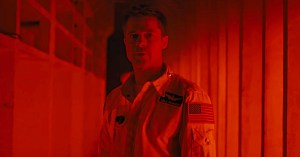 It’s pretty much a one man show and Pitt (Once Upon a Time… in Hollywood) is asked to do a lot without showing much. His character is a reserved man by nature, though that doesn’t stop him from explaining his inner thoughts through intrusive voice over narration, an addition that feels tacked-on after some test screening to better acquaint an audience that was having difficulty staying on board. Pitt is an actor capable of tremendous subtleties through his movie star good looks, and he has moments here where his eyes are telling the story that the movie doesn’t seem interested or committed to tell. If you were going to spend two hours in space with one actor, you could do far worse than someone like Pitt.
Ad Astra is more art film than thriller, more father-son reclamation than sci-fi, and more a drifting homage to Apocalypse Now in Space than something that can stand on its own merits. The expansive cosmic visuals are luxurious on the big screen, the level of detail toward the realities of space travel are appreciated, and Pitt is a sturdy anchor for the project, but what does it all come to? Everything is kept at such a generalized level that the movie feels like it’s skirting the surface and ignoring larger depth. It has a surfeit of directions and choices it can make for greater depth, but we have to keep on trucking, like a ticking clock, entirely constructed to serve one purpose, barreling toward the father/son confrontation and resolution. Except I didn’t care about Roy’s dad because I didn’t feel the impact he had on his son, I didn’t feel the need for some form of closure, the driving force of the movie’s big little universe. And yet we drift onward, like the boat in Apocalypse Now, heading for our destination because we’re told to do so. Ad Astra is an acceptable matinee with some well applied technical craft and a bleak sense of realism but it’s ultimately too empty of an experience to warrant any return trips of value.
Nate’s Grade: C+
Share this:

Hustlers (2019)
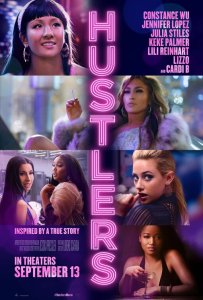 Think of it as a feminist companion piece to The Wolf of Wall Street or The Big Short. Inspired by a true story, Hustlers follows a diverse group of strippers who wine and dine Wall Street middlemen and execs, feeding off the spoils of their feeding frenzy, and then eventually upping their game, drugging them and fleecing them for one wild night that they’ll be too embarrassed to report that next morning. The story grabs you early on and is stuffed full of interesting details about the ins and outs of the stripping industry as well as how to service and manipulate the wealthier men who frequent said clubs. Hustlers becomes a combination of a crime caper, a con artist thriller, and a class-conscious drama about the haves and have nots, but it really becomes a showcase for the talents of one Jennifer Lopez, a woman who does not seem at all close to her fifty years on this planet (her introduction is quite the jaw-dropper). Lopez plays Ramona, the alpha leader of the group, a loving single mom with a healthy distaste for the hand she’s been dealt. She is sensational and delivers the best performance of her long career. Even when she’s doing bad things, even when she’s taking bold risks, there is a moral center to that woman, an unbreakable heart for the people she chooses to let into her life, and it does not budge, which was a poignant note. In many ways she is more the main character than Constance Wu (Crazy Rich Asians), a figure that serves as more entry point than fully-fleshed out character. I enjoyed learning the various tricks of the trade writer/director Lorene Scarfaria (Seeking a Friend for the End of the World) peppers throughout with her love of montage and stylish transitions, but it really picked up after the 2008 financial crash where the women cross over into direct criminality. At first they figure they’re just skipping ahead, drugging with MDMA rather than waiting for their marks to get drunk (“Drunk enough to order the bill but sober enough to sign the check,” Ramona cautions). Then things get escalated and sloppy and the women are in trouble. It’s a fun ride watching the ladies get theirs, and I was challenged to muster much of any sympathy for their Wall Street marks. Part of me wishes more women would be inspired by this movie and follow suit, fleecing the people who fleeced our economy. The movie rides that wave of the good times you know can’t last, prolonging the fall we’re all anticipating coming. The supporting characters can be a bit weak; several of the other girls involved in the scheme merit one note of description, and some of the humor feels a bit out of place, like a running joke where one of the women nervously vomits often (this is like her single character trait, and it’s weird). It’s also likely the stripper-centric movie with the least nudity I’ve ever seen, thanks to Scarfaria treating a sensational story with candor rather than exploitation. Hustlers is a glitzy drama that will entertain you with its flash and then surprise you with its edge. And all hail, Jennifer Lopez, ageless wonder and underrated actress getting her due.
Nate’s Grade: B
Share this:

It Chapter Two (2019)
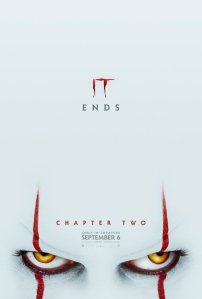 To be fair, It Chapter Two was always going to be the less interesting half. There’s a reason when they thought they would only get one movie that the producers and writers decided to focus entirely on the childhood storylines, and that’s because it’s the superior material. Director Andy Muschietti and most of the same team from the 2017 film return with a bigger budget, a bigger running time, and some new famous faces (not counting the cameos). At a whopping 169 minutes long, It Chapter Two rumbles into theaters as a big scary surefire hit, enough so that no other Hollywood studio scheduled a competitor during its release weekend. As anyone who saw the 1990 TV miniseries can attest, the adult half of Stephen King’s story is the harder slog, and Chapter Two makes it even sloggier (I’m making this a new word starting now).
The Losers Club from Derry, Maine have all grown up as 27 years have passed from that fateful day that they battled the evil Pennywise (Bill Skarsgard) and lived. Mike (Isaiah Mustafa) has stayed behind, cataloguing the events of the small town, waiting for the return of their nemesis. He alerts his old friends to once again return so they can take care of Pennywise as he feasts once again on the children and adults of Derry. Bill (James McAvoy) has become a famous and frustrated horror author. Beverly (Jessica Chastain) has married an abusive man. Richie (Bill Hader) has become a famous standup comic. Ben (Jay Ryan) has slimmed down and become a wealthy architect. Eddie (James Ransone) is with another overbearing woman and fraught with anxiety as an insurance risk assessor. Stanley (Andy Bean) is conflicted about returning as he views himself the weakest of the group. The old gang revisit the town of their youth and take turns remembering what they had selectively forgotten through the years. Only they can band together to stop Pennywise but they must all work together to survive yet again.
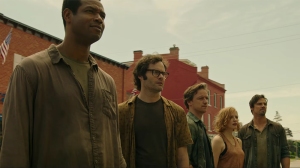 Every time It Chapter Two was cutting back to its numerous childhood flashbacks (more on that in a moment) I was reminded how magical this younger cast was together, how much more I cared, and I was secretly wishing the movie would just stay in the past for good. In short, the adult versions of these characters are pretty boring. They each only have like one note of added characterization for the ensuing 27 years after we’ve seen them, meaning I guess according to the movie that whomever you are in middle school is who you’ll be as a grown-up? That’s a scarier thought than anything Pennywise has to offer. It’s as if our understanding of them was put on hold for those 27 years as well, so there’s too little to unpack, or what’s there seems peculiar and unsatisfying. Richie’s big personal secret that Pennywise taunts him with seems decidedly less scandalous in our modern age. Bill has to suffer people telling him the ending to his book was unsatisfying. He also has survivor’s guilt over responsibility for the death of his little brother, Georgie. Beverly is with an abusive husband who she leaves in the opening scene. So that seems to be the end of that development. Ben is still nursing his crush from middle school on Beverly; the man hasn’t moved on from a middle school crush! He’s gotten rich, gotten in shape, and still waiting for this one girl to like him, which is a weird message. Maybe the movie is positing that all of the characters have been emotionally “on hold” since the childhood trauma they cannot remember, put in a stasis as much as Mike who elected to stay behind when the others wanted to get away. That feels like excuse-making to me. These versions of the characters just aren’t that compelling and given little to do and too much free time.
Structurally, this movie is a protracted muddle and could have sliced out a healthy 45 minutes. The first act checks in with each character for us to see where they are in life and then concludes with their reunion at a Chinese restaurant. The uncomfortably long second act follows each character wandering around the haunts of Derry and essentially having their memories activated. It follows a formula that gets to be rather redundant. The adult goes to a place, they have a scary flashback about that place as a child, then they have a scary moment as an adult. It means each character has two linked scary moments/set pieces to go through, and there are at least five characters to get through, which means this whole sequence takes up like an hour. Also trying your patience is the fact that there is no new information. You’re watching the characters try and remember things that you, the audience, already know, so it gets to be rather boring. Then there’s the extended ending that is undeserved for a two-part franchise. The ending gets drawn out so long, with so many little minor stops, that my father said, “It’s like everyone came up with a different ending scene, they voted and they all tied, so we got them all.” A Lord of the Rings-style sendoff was not needed for these characters. The misshapen and drawn out structure is a result of adapting a book where the narrative drive was from the childhood experiences using the adults more as a conduit to explore trauma and as a means to finally deliver a last confrontation. It’s hard to assemble a full movie out of that material but this doesn’t feel like it (pun intended?).
 It Chapter Two is also noticeably less scary than the original movie. Part of this is because we have a baseline of expectations from the childhood spooks, but it’s also because the horror doesn’t seem to have the same level of care and craft attached. Because of that formulaic middle, there’s less an anticipation for Pennywise’s big scares and more a resignation. It’s a skipping record of scares, waiting for the non-scary thing/person to become the scary Pennywise. With the 2017 It, the scares were able to develop in fun ways, playing upon their childhood fears, and were developed with careful craft to heighten the tension. Pennywise was genuinely terrifying. Now in the sequel, because the scares aren’t delivering the same impact, the movie veers too often into comedy, which only further de-fangs the power of its demonic clown. The 2017 It naturally understood that its horror would take steps into the goofy but that made it scarier. With the 2019 sequel, the human characters are calling out the horror tropes, which doesn’t work. This is even more noticeable and unhelpful when the big scary scenes all involve some CGI monster. There’s very little actual Pennywise in this movie and too many dull CGI monsters rambling about. Then there’s a terrible over-invested secondary villain with a childhood bully breaking out of a mental hospital and being instructed to kill the adult Losers. Every time the movie kept cutting to him, I sighed. He doesn’t deserve the amount of screen time and importance he seems to have been given. I don’t care about this guy and the movie shouldn’t waste time trying to make me care.
The returning assets are welcomed, providing a sense of continuity that helps carry over our good feelings and good times from the 2017 hit. Muschietti (Mama) is a talented director and an excellent mood setter, but he’s also excellent at directing child actors. There’s one standout scene in It Chapter Two that would rank with the quality of the previous film. There’s one scene that follows a little girl with a splotchy birth mark on her cheek as she follows a firefly under the bleachers at a high school baseball game. Waiting below in the shadows is Pennywise, who plays upon her insecurity of her facial deformity, and his own, to promise her a better life. It’s the one moment in the movie I actually felt something close to fear. Muschietti draws out the development organically and plays upon the mounting dread, holding onto a moment of Pennywise frozen, like the creature below the facade is trying to remember what to do next. It’s a stellar little moment, beautifully directed and written, and it’s almost completely superfluous to the main story. The child actors are all still outstanding, even if some of them get a slathering of de-aging CGI to make them look more like their pre-puberty selves (sorry Finn Wolfhard). Then there’s the breakout sensation Skarsgard (Assassination Nation) as our favorite dancing clown. He’s under served by the story problems and the hazy rules leading to his eventual confrontation. I enjoyed every actual appearance from the character and Skarsgard’s eerie command over his physicality, the way he can simply move through a scene or fixate his face, is astounding. The degree of his brilliance in this role will get downplayed because of of its genre but he is doing remarkable acting here.
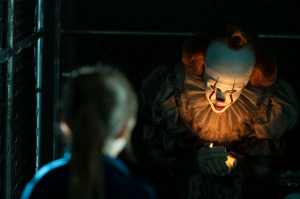 The adult actors all deliver capable and even great performances with what little they have. It doesn’t take a great actor to act scared, as judged by the litany of low-budget horror available, but it does take a great actor to try and funnel that into the narrow band of a character. Chastain (Dark Phoenix) is enjoyable, because she always will be, but her character is meant to sleepwalk through the movie, putting together the memories of old and becoming more aware. It makes for a restrained performance, which works for an adult woman raised with abusive men, but it can also mean that Chastain is given less material as an actor to work with. McAvoy (Glass) breaks into a childhood stutter when he’s really freaked out but even his character seems to vacillate between under-performing and over-performing, especially when he’s obsessed over saving one little neighborhood kid who probably views him as the real danger. His character was the unquestioned center of the 2017 It, but that center seems more with Richie with the 2019 It. Hader has taken a surprising and very affecting turn into darker dramatic work with HBO’s Barry, and his performance is the best of the adult Losers. He has his expected funny moments but it’s the sadness and anxiety that coats his words that Hader is able to bring out. His is the character that seems to open up the most through the second installment and Hader was a terrific choice to facilitate this.
It Chapter Two falters in comparison of the first film where the qualities all felt so wonderfully organic, arranged, and developed. It was a grade-A funhouse of goofy terrors. The sequel is far far too long, misshapen structurally, overextended, underdeveloped, lacking in sustainable tension, overusing CGI and comedy, and strands the talented actors with little to do. I heartily enjoyed the first chapter and that’s why I’m feeling as let down as I am for Chapter Two. It’s certainly not a bad movie. It still has enough slick technical skill and good acting to warrant a viewing if you’re a fan of King’s novel or the 2017 movie. Just be prepared for a longer, duller, and less satisfying concluding half that seems to be running on half the imagination. It might work well enough but it only makes me appreciate the charms of Chapter One even more.
Nate’s Grade: C+
Share this:

Don’t Let Go (2019)
 It’s a time-displaced mystery where two people, a police detective (David Oyelowo) and his teenage niece (Strom Reid), are trying to communicate across space and time to prevent a personal tragedy, namely the niece’s eventual murder. He’s two weeks ahead time-wise and making use of his advanced knowledge and her insider info to better understand what went wrong that fateful night. If it sounds a bit like 2000’s Frequency, featuring a father and son across the decades with a ham radio, that’s because it’s pretty much Frequency. No matter, this is the high-concept stuff of fun, clever structural gamesmanship, tapping into the past and future to solve a crime. Writer/director Jacob Estes (The Details) has a good first draft but the script needed more work. It starts off rather slow, takes more time than needed to establish its rules, and even after those rules are somewhat hazy, like when Oyelowo gets a download of new memories from his future self. To say the story gets a bit convoluted is an understatement, and the ending feels more like a rush to a finish rather than a carefully planned conclusion. The best asset the movie has is the relationship and performances from its stars. Oyelowo is a man rushed against an impossible task, and his fevered and harried performance does much to communicate the burden placed upon him. Reid (A Wrinkle in Time) is very good as an inquisitive teenager who has to process the looming danger that hangs over her head, plus just being a teen girl in L.A. Both of these actors are at their best when they’re together (via magic phone calls; are texts not magic?) and pushing each other to succeed. There’s great potential in the unlikely partner dynamic with them as well as a resonating personal motivation to drive the movie. I just wish Estes and the filmmakers had slowed things down and given their setup more thought and experimentation. It kind of goes in rather predictable and mundane directions, including having a super killer that seems anything but. Don’t Let Go (a painfully generic title destined to be forgotten) feels like it could have worked a limited run miniseries, or, barring that, a better paced and developed film.
Nate’s Grade: C+


 nathanzoebl
You must be logged in to post a comment.