Blog Archives
Adeline (2022)
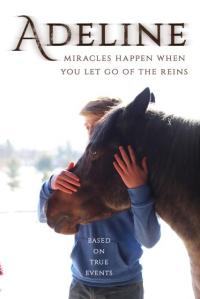 The story behind Greg James, the filmmaker from Ohio, is surprisingly tied to, of all things, dodgeball. In 2004, the movie Dodgeball: A True Underdog Story was released and grossed $168 million worldwide, but there were two legal challenges accusing copyright violation to writer/director Rawson Marshall Thurber, and both have central Ohio connections. The first was by writers Ernando Ashoka Thomas and David Price, a Bexley, Ohio native that put his own experiences as an adult dodgeball tournament organizer into the script. Where things get interesting is that this other script, entitled Dodgeball: The Movie, was passed along in March 2001 to Shaun Redick, who worked for an agency and was friends with Thurber. This was one month before Thurber finished and registered his draft of his dodgeball screenplay. During the copyright lawsuit in 2005, a judge determined that a jury might “reasonably infer” that Thurber had access to the other dodgeball screenplay via Redick. There were other similarities between the two scripts that appear to be more than just formula and genre trappings, like both featuring a wheelchair-bound former dodgeball champion who becomes a coach and dies in a freak accident midway through before the big game but then reappears as a ghost to cheer them on.
The second and lesser-known suit was for authorship of that other dodgeball script, and that’s where James comes in. He and Thomas worked together under the YNOT production company they founded. They directed and produced a movie in 2001, Raw Fish, that Thomas wrote. Afterwards, in 2001, Thomas was working on the dodgeball script and James claims he was a co-author (Price was not listed as co-author until 2004 in screenplay registration). Thomas listed himself as the sole author on all the drafts he copyrighted and shared, and because James did not assert his copyright dispute until 2005, the statute of limitations ran out. James said that Thomas removed James’ name from the cover page before submitting the draft but never inquired further because he trusted his would-be partner. Lacking proof of collusion, and beyond the three-year window, James’ case was dismissed. The suit with Thomas and Price against Fox was later settled for an undisclosed sum, and James was left with nothing.
 James returned to Columbus after 25 years in L.A. and was inspired to make a local story into a feel-good family film that could inspire others. Adeline is based on a horse at Serendipity Stables that provided therapeutic care for children with disabilities and those on the spectrum. In 2002, a tornado struck and Adeline reportedly held people against a barn wall to protect them rather than running away from danger. The horse’s bravery was rewarded by locals donating over $15,000 to allow Adeline to receive life-saving surgery (Adeline lived another three years). Adeline is James’ homecoming, and it’s sweet and slickly produced to look like any number of other faith-based inspirational family films, and that’s also its problem, if you find that to be a problem.
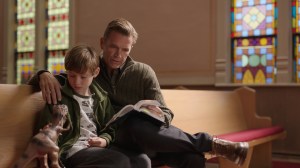
In a small Ohio town, Kay (Jane Mowder) moves onto a horse ranch and her presence changes everything. Bethany (Orli Gottesman) is running from foster home to foster home for setting fires, but one encounter with Adeline the horse and she’s rethinking her pyromania. The town preacher John (David Chokachi) and his wife Terry (Erin Bethea) have an autistic son who takes a shine to Adeline and actually speaks. John is skeptical and worries putting faith into Kay and her holistic solutions will lead to another disappointment. He challenges his parishioners to not lose sight of where to place their faith, and then the big tornado comes twistin’ through.
 If you’re fans of sweet feel-good movies, Adeline will likely hit most of what you’re looking for, but I found the central idea a little too simplistic to the point of incredulity. In short, this is a magic horse. This is the only conclusion I must derive from what I see onscreen. I love animals. I always have. As my fiancé would attest, they flock to me. With that being said, I have a problem with animal movies because too many of them feel lazily projected onto the animal as its symbol. I had this same feeling with the 2020 inexplicably Oscar-winning My Octopus Teacher: “Does this octopus really see this man in a snorkel as a friend or an ally? She reaches out a tentacle to touch the appendage of this underwater man, but what does that mean? Is this signaling a friendship or is it merely signaling an animal taking stock of its surroundings? I don’t know and depending upon your personal relationship with the animal world, you will either accept everything [this man] says at face value without skepticism or you will see him as a slightly foolish romantic.” Adeline is such a magic horse that all it takes is Bethany looking once into her eyes to break her free from her fire-setting impulses. Adeline is such a magic horse that all it takes is a couple of rides and the preacher’s autistic son is now talking. This horse is spoken about in such grandiose terms and yet the screenplay by Sam Lewis doesn’t make the horse a character, which can be done for animals (see: Seabiscuit). The problem is that if effort is not put into giving the horse something, then the horse is merely a plot device for easy miracles. It might as well have been a magic couch whereupon every sit heals thy sitter. Given this horse’s track record, I’m surprised the town didn’t trot Adeline into their office to fix any budget shortfall. I know this is based on a true story, and I’m being more than a little facetious, but we need more from the drama than “Person A nuzzles horse or rides horse. Person A is now better. Repeat.”
Where the movie seems to want to go is the idea of alternate routes of healing, and this has dramatic potential that’s never fully realized. Much of the conflict revolves around John being skeptical and unwilling to see the benefit of the horse. His job asks him to put his faith in God and not a horse. He’s also hurting because of the frustrations with raising a non-verbal autistic child that he has difficulty communicating and connecting with. At one point, he even says he blames God for cursing his family (yikes). It looks like Adeline is going to be a conflict between traditional faith and alternative healing, an Old School versus New Age kind of battle. It appears that John might even feel threatened by the horse, like his parishioners will start looking to the special horse for answers and healing rather than their local minister. Does he feel threatened? Does he think his authority is being challenged by the horse or by God? Had the script really explored this personal crisis it could have made for an interesting character study about belief systems in conflict. Instead, it mostly plays as John being the most stubborn man who has to be the last one to accept the gift of Adeline. Lacking that depth, it means we’re just waiting for John to finally come around to the obvious, and it can be a frustrating waiting game. Even after the horse protects a dozen people from a tornado, David still pushes back. He even lays out a theory that since the horse farm was the only one hit by the tornado that God must disapprove (people literally groan and walk out of church in disgust after he proposes this theory). I think re-centering the movie on one man’s crisis of faith, accelerated by already feeling shaken from his son’s diagnosis, would be the smarter storytelling foundation rather than making the horse the magic new neighbor.
 The story has too many characters and subplots that don’t get enough attention, but at the same time Adeline benefits from a pacing standpoint by having more stories to switch over. The Bethany storyline could have been its own movie but she feels more like Exhibit A for the miraculous potential of the horse. We’re told that she can’t stop starting fires and bounces from foster home to foster home, and all of a sudden Kay agrees to adopt her on the spot, and why not if all it takes is one encounter with Adeline to prove curative for Bethany’s troubles? Because this conflict is amazingly resolved so quickly, we have to add the extra conflict of the town teenagers bullying Bethany for her past, though this is comprised to one scene where the kid she may or may not have a crush on, Jason (Jake Satow), stands up for her and punches the lead bully. This is the end of Bethany being picked on for her past. Having an outcast character in a small town is a good viewpoint and a natural source of conflict going up against community expectations. Unfortunately, Bethany is just treated like a testimonial. Likewise, the autistic child is merely a plot device, and the script then transforms Terry into little more than a pleading support network. She wants her husband to acknowledge the healing power of the horse. That’s about it. She’s the sweetly smiling, eyes-glistening “why won’t you see?” figure in these kinds of movies. I think the character that suffers the most is Kay. She doesn’t feel like a person but yet more of a plot device. She stirs up the status quo, and she has a mysterious past, and yet she’s just deliverer of miracles without further dimension.
Even though its budget was half a million dollars, Adeline looks and sounds like a professional movie that would ably fill the scheduling slots of a Hallmark or Christian TV network. The cinematography by Dan Parsons (Treasure Lies) is rich and autumnal in its color palate, and the use of dappled lighting and depth of field visual arrangements helps add an extra pleasing cinematic quality to the movie. The score is also quite nice by Erik Schroeder, a man with over 100 scoring titles to his name. It’s pleasant and twinkly without overwhelming the emotions on screen. The special effects with the tornado and its destructive wake are quite good for the budget. The acting is above average too. Mowder (Foxcatcher) is dignified, Chokachi (Baywatch) is perfectly flummoxed, Bethea (Fireproof) is winsome, and Gottesman (1-800-HOT-NITE) has a natural presence that makes me think she has even bigger opportunities on the horizon. Plus, there’s the always enjoyable Ralph Scott (Double Walker) as John’s unflappable friend and soothing voice of reason.
 There is plenty to enjoy with Adeline. It’s a passion project where you can feel the affection of everyone, and James has an invisible ease behind the camera. The acting and technical merits are solid and the pacing keeps things moving smoothly. Where Adeline frustrated me is with its screenplay that settled too often on its staid formula. We’ve seen these kinds of movies before and Adeline rests upon that familiarity a little too often for me. Genre fans will find enough to satisfy them, and everything is kept at such a family-friendly level of nice (even the disagreements are short and never more than G-rated) that is wholesome without feeling overly maudlin. I think the screenplay could have done much more with its pieces, but my opinion is going to be a minority for the movie’s target audience. Adeline is a nice movie about good people experiencing good tidings and will leave many people feeling, mostly, good.
Nate’s Grade: C
Share this:

Persuasion (2022)
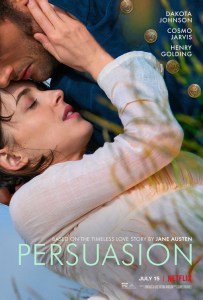 Jane Austen is one of those name brand institutions, and yet the pioneering author only has six actual titles to her name (a seventh was unfinished; two were published after her death, including Persuasion). There have been five previous adaptations of Persuasion, including one from 2021, so I wasn’t rankled when the early trailers for Netflix’s Persuasion took a chance with their adaptation. There are plentiful fourth wall breaks where our protagonist, Anne (Dakota Johnson), and handheld camerawork that makes it feel more faux documentary at points, and there is more modern jokes and modern rom-com sense and sensibilities, and judging by the social media response, there are a lot of angry Austen purists who loathe these changes (could this movie be more heretical than Pride and Prejudice and Zombies?). I found the 2022 Persuasion to be perfectly pleasant and easy to watch. Johnson is tailor-made for the headstrong, intelligent, yearning lead of an Austen movie, and with her directly speaking to the camera, I felt a kinship with her, and this stylistic choice also allowed the screenwriters to sneak in more of that flowery Austen prose. Some of the jokes are a little clunky but I laughed or smiled at most of the comedic elements, especially Richard E. Grant as Anne’s foppish and status-obsessed father. I enjoyed Henry Golding (Crazy Rich Asians) as the caddish Mr. Elliot, a man born with a Cheshire grin. I enjoyed plenty of this movie, including its racial diversity, and the staples of these Regency romances like the exquisite production design, costumes, and English countryside. I can understand some grumbling that this isn’t “their Persuasion,” but not every movie is for every person, and there’s nothing about the 2022 movie that retroactively cancels out other adaptations that fans would prefer. For 100 minutes, it felt like Austen had been re-framed as a rom-com blueprint, and Persuasion had renewed charm for me.
Nate’s Grade: B
Share this:

A Story for Winter (2021)
 Writer/director Nathan Weidner is a local teacher at Canal Winchester schools where he teaches video production and French. The 54-year-old has made two other movies before, both of which available on YouTube, but it’s clear that A Story for Winter is his passion project. The man wrote the first draft in 2009 and was rewriting it for over a decade. It’s inspired upon his own real-life family tragedy. Weidner’s daughter Meah was born in 1988 with cerebral palsy. She was non-verbal and Weidner said he always wondered what she could be imagining. The movie’s end is even dedicated to her with archival footage. Sadly, Meah was taken tragically when her mother’s new boyfriend shook her too violently (he is now serving a life sentence). In the summer of 2021, Weidner gathered former high school students, a budget of $3000, and his iPhone 12, and over the course of 15 August days he made his movie. Weidner was the photographer, editor, producer, and even wrote and performed a mournful song in the movie. A Story for Winter is currently available on Amazon and is a clear labor for love for Weidner and everyone involved wanting to see this through. Their intentions are pure and lovely. I wish the final movie was a bit more focused to better tap into its accessible emotions.
Dr. Owen Hughes (Adam Ashton Scott) is the new small-town Ohio doctor after his 80-year-old predecessor kicks the bucket. He’s chaffing under adapting to the new position, and he insists he will not see children for medical consultation. He freaks out when his newly eloped wife, Connie (Allison Kuck), even suggests they could have a child. His chilly stance begins to soften when he meets Winter (Chloe Gardner), an ailing child in town with cerebral palsy who was abandoned by her drug-addict parents. She’s being taken care of by the kindly Cora Preston (Cynthia Smith) who has opened her home to many foster children, most of whom have some form of special needs. She recognizes that Winter will not be long for this world but that doesn’t mean the life she has remaining cannot still have its rewards. As her condition worsens, Dr. Hughes opens himself up by telling allegorical fantasy stories to Winter about his own troubled family history.
 The first thing you have to acknowledge with A Story for Winter are its technical and professional limitations. It’s unfair to complain too much about obvious limitations of time and budget. You’ll notice that there is very little editing coverage or camera movement in the movie. Until the late narration-heavy fantasies, just about every shot is stationary. Characters will often talk directly in front of one another and the edits primarily feature a shot-reverse shot rhythm that feels born out of necessity than creative vision. The excuse of the newly moved couple explains the sparse nature of the home furnishings. However, there are some budgetary choices that made me scratch my head that could have been avoided. The setting is around Christmas to slot the movie as one of those feel-good holiday movies, a thriving industry unto itself. There are some references to Christmas as a theme of giving and blessings but it’s more a superficial connection, so I think the story could have stood on its own minus the holly jolly. Regardless, it’s a snowy Christmas season that keeps several characters housebound. Considering the budget and that it was filmed in the summer, I would avoid anything that would give away the unreality of the season. This movie disagrees. We see obvious green screen shots of Dr. Hughes driving in the snow. Even more befuddling, there is a plurality of exterior shots of the home except it has been rendered as a completely CGI model. It is not subtle. I kept wondering why even bother with these shots. Does it make the movie more seasonal? If so, why not use affordable stock footage or, failing that, wait until actual winter in Ohio and record thirty seconds of an establishing exterior shot of the same house but now with real snow? So even with being considerate to the limitations at hand, there are creative decisions that seem iffy.
I think many fans of sweet Hallmark movies will find A Story for Winter to be heartwarming and be inspired from its message. Characters talk about the value of human life as well as the prospect of human suffering in familiar Christian terminology. I’ve never been a big fan of “this person exists to teach you how to be a better person” as a plot device, but I can understand and sympathize with the human impulse to find larger meaning in personal tragedy. However, where the movie feels more complete, for me, on a message front is that even those who have limited times on this planet are still of value and our compassion. I’m reminded of 2016’s Arrival that hinged on a twist ending that the (six-year-old spoilers ahead) flashbacks were actually flash-forwards, and Amy Adams wasn’t mourning a past daughter but knew ahead of time that her eventual daughter would tragically die at a young age, and yet she chose to have her. For that review, I wrote, “Knowing what is to come means that a child was brought into existence to die sadly as a teenager and will suffer, but she will also live and love and laugh for many days beforehand, and knowing the end provides a lens that incentivizes every moment spent together. Yes, she will die eventually but any one of us could be snatched from the world at any moment. At least she got to know love and life for so many years before it was taken away from her.” I thought it was very nice when the movie gives Winter her voice, granted it’s through dream sequences, which means it’s Dr. Hughes’ conception of what that voice could be. I wish the movie had given her more time to express herself rather than utilize her as the key to getting Dr. Hughes to finally reveal his own family drama, though also through the lens of fantasy.
 My emotional investment was stalled because of two main factors: Dr. Hughes being a jerk and having far, far too many underdeveloped subplots competing for attention. Our protagonist is a prickly person, immediately dismissive and practically disdainful of his medical practice coworkers. He’s also a jerk to his wife and makes a snide comment whenever he feels she could have been doing more to settle their home. He keeps complaining about eating on disposable plates or Styrofoam containers. Hey, buddy, you can put dishes away too. They are recently married, eloped after a year of dating, and Connie’s extended family is not too happy about it. What better way to assure her than have her marital partner is the right person for her with him being a mean jerk? He’s also actively hiding his past and hastily establishes a cover story for not explaining to her that the town sheriff (Bryce Millikin) is his “uncle.” This should all be red flags to his wife, and how he treats her makes me dislike this man even more. For half of the movie, Dr. Hughes is a jerk, and then after the hour mark, he just spills his own personal history. There are short flashback clips peppered throughout of a young Owen with his distraught, inebriated, irritable mother and his younger sister suffering from an incurable illness. It’s enough to establish why a child with a terminal ailment would affect him so, never mind just general empathy. Now, beginning with a grumpy character and watching them transform is nothing new to storytelling. Ebenezer Scrooge wasn’t exactly a nice guy either, although we got glimpses of his past self so we knew there was a core of decency that could possibly return.
The movie cannot be a character study of Dr. Hughes finding his way back from his grief and grievance. The character doesn’t have enough dimension to him because the movie is divided with so many subplots. Namely, in our 100 minutes of movie, we have: 1) fitting into a new town and sliding into the shoes of a beloved predecessor, 2) being newlyweds with his wife and the strain of their marriage, 3) caring for Winter and opening up to her, 4) the many lives of Aubrey House, 5) Connie’s family unexpectedly coming over for a Christmas gathering, 6) Dr. Hughes explaining Winter’s past through a fantasy allegory, 7) Dr. Hughes communicating with Winter through his lucid dreams, 8) Dr. Hughes sharing his own family tragedy through a fantasy allegory, and 9) Dr. Hughes coming to terms with his relationship with his mother and forgiving her. There are more aspects to each of these, and some are more prominent than others, but that’s A Story for Winter. It’s easy to see the connected tracks but the narrative could have benefited with some careful pruning to better emphasize its most essential moments.
 I don’t think much is added by keeping Connie in the dark about her husband’s past. You can still dole out the truth over time, saving the full picture for the end of your movie. It’s not like she’s seriously second-guessing her marriage, or at least we are not given a scene that expresses this doubt. I also think little is gained through the first allegorical vehicle, using the realm of children’s fantasy to explain Winter’s own past to her. The character of Winter, again through the lens of Dr. Hughes’ subconscious mind, doesn’t seem too concerned about coming to terms with her own family’s faults. Perhaps she’s meant as the starter vehicle for Dr. Hughes to then come to terms, but why go through this process twice? Revealing Dr. Hughes’ backstory is also not a mystery that I was too desperate to uncover. The movie seems to think delaying the full information will provide more dramatic catharsis, but I’m not as certain. I think uncovering Winter’s past, then dealing with it through allegory, then doing the same with Dr. Hughes, is just making things too busy. Especially when Connie, her family, and everyone else is put on literal hold during these lengthy fantasy interludes, freezing them out from further development. The only two characters the movie really examines are Winter and Dr. Hughes, so why not consolidate? Too much feels ladled on to either pad the running time, make superficial connections to holiday film staples to satisfy its presumed audience, or reflect upon Owen’s emotional journey. If the world is cultivated to better bring one man to a change of heart, then let’s give enough room for that journey to feel well-developed and organic and satisfying.
The conclusion about acceptance and, more importantly, about forgiveness is sweet and still has some dramatic points that will hit plenty of viewers. Weidner knows how to craft a workable redemption story, though much of the comedy bits are a bit stale and hokey, though that could also be a selling point for fans of Hallmark movies that view hokey comedy as comfort food. My criticisms are directed at what could help make this the improved version of the screen story. Streamlining, being less precious with our protagonist back-story, and giving more consideration and depth to Connie would have benefited the overall emotional investment and uplift.
A Story for Winter is a nice movie made by people who really wanted to see the director’s vision become a reality, something so close to home and so personal. I won’t fault the limited budget, the bland editing and shot selections, or the amateur acting by the leads. However, creativity is not dependent on money. Even with its minuscule budget, I think Weidner could have made further judicious choices to maximize the characters and story he had on the page. There are interesting characters here but they are too defined by their circumstances, thus becoming static mouthpieces about their experiences and not enough about them in the present. Maybe I’m being a seasonal Grinch, as admittedly Christmas movies are not a salve for me, so take everything with whatever caution you’d heed. A Story for Winter feels a little too beholden to its message and its feel-good holiday genre trappings to really explore the human drama at its beating heart. It’s a commendable micro-budget DIY effort with all the right intentions, though some of its storytelling choices managed to hold back my full intrigue and investment.
Nate’s Grade: C
Share this:

Jerry & Marge Go Large (2022)
 It’s the lowest of low stakes movie but a simple story with agreeable actors and a sweet enough core can be enough to fulfill 90 minutes of entertainment. Jerry & Marge Go Large is inspired on a true story of a retired couple who figured out a flaw in their local lottery and brought in the whole town to make an eventual windfall of over $27 million large. The draw of the movie is its cast, including Bryan Cranston and Annette Benning as our titular couple, and watching them generally make one another smile. This would not be out of place on a Hallmark Channel rotation. It’s simple, it’s sweet, and the town is full of aw-shucks nice people who all band together without anything in the way of larger conflict or rivalry or disagreement. However, the movie is also so slight to the point that it feels like an extended news magazine piece. There’s no real tension until a smug Harvard math whiz discovers the same lottery flaw tries to apply pressure to good old Jerry to get out, a storyline that feels like a fictional inclusion to add some degree of opposition to what is otherwise a story about a smart guy discovering a loophole and winning big for his whole town. It’s an interesting story but the real emphasis could have been as a character study for Jerry, a man who studies numbers for hidden insights but has difficulty connecting with people including his own adult son. We get glimpses of this as Cranston monologues or looks askance, but all these personality conflicts are resolved so tidy to the point that it feels offhand. The details of the true story are interesting enough, and everyone is coasting on such a mild and mellow vibe, that it’s easy to just relax and find comfort with the film’s small comforts.
Nate’s Grade: B-
Share this:

Elvis (2022)
 Elvis the movie is exactly what I would have hoped for from a Baz Luhrmann film, which is an experience that no one else can provide, a messy, chaotic, crazy, sometimes tin-eared yet audacious and immersive kaleidoscope of sight and sound that feels like a theme park ride. As with all Luhrmann films, the first 20 minutes is a rush of tones, characters, and near constant frenetic movement; it’s so much to process before the movie eventually settles down, at least marginally, or the viewer becomes better acclimated to the madcap storytelling style of this mad Aussie. I feel completely certain that people will call Elvis brilliant, and people will deem Elvis to be ridiculous and campy, and I would say it defiantly manages to be all of these identities at once. It is ridiculous, it is campy, it is emotional and sincere, it is, at points, even brilliant, and in a way, this shambolic style perfectly symbolizes Elvis himself, a performer that seems to be anything that the viewer projects onto him, a trailblazer who suffered for his art before becoming an irreplaceable industry and edifice of pop-culture obsession unto himself.
We chart the rise of Elvis Presley (Austin Butler) from a young crooner in the 1950s to the best-selling solo artist in recording history. Colonel Tom Parker (Tom Hanks) discovers Presley, granted after he’s been a chart-topping local hit in the South, and sees a grand opportunity. With Elvis, there is no limit to where they both can go, and so Parker becomes Elvis’ manager for over twenty years for better and worse, engineering Elvis’ tour of duty in the military to take him away from negative headlines, only for him to meet and marry Priscilla (Olivia DeJonge), to locking him into a Vegas headlining gig to erase the mystery man’s heavy debts to the mob. Under Luhrmann’s guidance, you’ll experience it all and then some in the frenzied 160 minutes.
 Elvis was many things for many people. He was a smooth crooner, he was an electric live performer, he was the benefactor of being a white vessel for music that was built upon the less heralded work of black performers, he was a victim, he was selfish, he was devoted to his fans and the stage, he was… America. In 2022, I would have asked if contemporary culture even cared about Elvis anymore, a man who died over 40 years ago, and whether we even have a lens to appreciate the man. Was he simply coasting off the hard work of other black performers? Did he groom his eventual bride considering her age upon their meeting? Was Elvis too old fashioned to even be anything other than a musical touchstone that other artists have surpassed? Is he just a joke? Luhrmann does a fine job of re-contextualizing Elvis, what made him unique for his era, and what made him still captivating to watch to this day. Even the archival footage the closes the movie is a reminder of the unmitigated power the man put into his singing.
It wouldn’t be a Luhrmann movie without a narrator, and this time we get the story’s main antagonist as our prism to view Elvis, marking him chiefly as victim. Tom Parker is a cartoon of a character especially as portrayed by Hanks. I love me some Tom Hanks, the man is an American treasure, and I appreciate that the man is definitely going for broke, but I don’t know at all what he was going for with this performance (the makeup does him no favors also). Hanks is fascinating because he is playing a villainous character that is constantly trying to re-frame their villainy, telling his side of the story but being careful, though not that careful, to always have an answer for an accusation. It feels like Hanks has stepped off the wacky Moulin Rouge! stage and everyone else in the movie is playing things completely straight. The entire acting troupe is all playing under one direction, and then there’s Hanks in his fat suit, who is breaking through the fourth wall, compulsively narrating our story, and acting like a loquacious Loony Tunes figure any second away from his own song and dance. His repeated use of the term “snow job” and “snowman,” which he dubbed himself as a showman, is overused to the point of being a verbal crutch, reminiscent of how often Jay Gatsby had to say some variation of “ole sport” in the 2013 movie or else he might irrevocably burst into glitter (or so I assume). It’s such a bizarre performance of wild choices that I can subjectively say it might be Hanks’ worst and yet it also feels like Hanks is giving Luhrmann exactly what he wants. It’s such a bold move to essentially cede your famous biopic to the most ridiculous character to tell from their ridiculous perspective. Imagine I, Tonya being told from Paul Walter Hauser’s character or House of Gucci being told from Jared Leto’s character, and that’s what we have here. I almost kind of love it, and in doing so, we see from the manipulator how he worked his magic to keep financial control over Elvis. Even Elvis’ later years are provided with a perspective that re-frames the man as a victim of a moneymaking machine that wouldn’t stop until it had drained every last drop of blood from this hard-working man.
 I think this is smart because, on the surface, Elvis might not be the most complicated person to devote two hours to unpacking his character dimensions. He liked to sing, as it touched something deep inside him, and he wanted to be true to himself, but this framework isn’t any different from any number of famous musician biopics we’ve become more than accustomed to. He dealt with drug addiction and erratic behavior but, again, even this is musical biopic basics. Even his doomed relationship with Priscilla is familiar stuff, as she could rarely compete with the demands and the allure of the stage. I think Luhrmann and his co-writers wisely saw that the best storytelling avenue with Elvis is through the lesser-known Colonel, a bizarre and calculating figure cackling in the shadows. There are significant questions over who this proud huckster really is and what he did to bully and cajole Elvis into his favor. There’s inherent conflict there as well as an angle that I would argue most are unfamiliar with. I didn’t know much about the history of Elvis the man but I knew even less about this would-be Colonel.
The most Luhrmann of sequences is Elvis’ breakthrough live performance where it feels like every woman in attendance is catching a fever of combustible hormonal fury. The way the man shook his hips, moved his body, his gyrations that so many adults felt were dangerously subversive, were part and parcel of the younger Elvis. He really was a born performer, and even says he can’t sing if he isn’t allowed to move how he feels he must with the music. During this crazy sequence, Luhrmann’s camera is trained on the emotional response of the audience experiencing a sensation that cannot be contained, bubbling to the surface into tears, shrieks, and convulsions, and it moves through the crowd like waves. It’s such an enthusiastic experience that plays right into the stylistic and tonal wheelhouse of Luhrmann. It’s also an unsubtle reminder, not that much is subtle in a Luhrmann movie, that part of the man’s appeal was his raw sexual magnetism.
In a modern era, the condemnation of Elvis as a corrupting influence on the youth feels comically quaint, until you remember that all of this was also filtered through a very racist paranoia. Elvis was deemed a danger because he was an accessible introduction to music and culture that was associated with black people. The accusations of Elvis corrupting the youth are all tinged with racial implications about his source of inspiration, never mind that Elvis was also influenced by a religious revivalism. The movie doesn’t say that Elvis was a sham, only succeeding off the work of other esteemed yet unfairly unheralded black artists. With the many onscreen performances, he is clearly talented, and offers his own versions of others’ songs, but he’s also deferential to the people he grew up with and the music he clearly loves and wants to be a part of to the detriment of whatever Tom Parker and his handlers believe is commercially viable. B. B. King (Kelvin Harrison Jr.) even remarks about Elvis’ own privilege when he thinks about bucking politicians demanding that he perform safe songs without his signature dancing (“They’ll arrest me for just crossing the street. You are a famous white boy who makes them too much money.”).
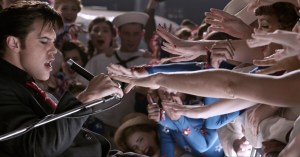 I’ve purposely delayed from discussing the best reason to go see all 160 ungainly minutes, and that is Butler’s glorious performance. The young man simply dissolves into the role and makes you forget you’re watching an actor. The way he captures the cadence, the drawl, the presence of Elvis, and not just his jerky movements, is phenomenal, and then you remember that it’s Butler doing all his own singing as well, and the spell is near complete. He is Elvis. It’s a performance guaranteed to win as many plaudits as awards season has to offer. Through Butler’s performance, a younger generation can understand what all the hubbub was about. The man brings the character to life but he especially brings Elvis the performer to startling life. Even if you hate Luhrmann’s other movies, and he is definitely divisive, and even if you couldn’t care less about Elvis in the year 2022, this movie is well worth watching for the sheer brilliance of Butler alone.
In some ways, Elvis the movie feels like a perfect assignment for director Baz Luhrmann. His unconventional stylistic approach livens up an otherwise conventional rise-and-fall tale, broadening the appeal of Elvis for an audience that might have otherwise shrugged at a movie chronicling the man’s exploits. The subject matter is also the squarest for Luhrmann, which makes it also the safest movie of his career, which is truly saying something considering some of the imaginative highs of this movie. There will be just as many people put off by the excessive, in-your-face style of the movie as drawn in by that Luhrmann razzle dazzle. Watching Elvis feels like you’re watching two movies simultaneously atop one another. Luhrmann can be exhausting even at his best but he’s also one of the few filmmakers that makes watching a movie such a textual experience, where sight and sound are layered in such meaningful and granular details to better immerse the viewer. The way even the sound designs ebbs and flows, braids musical notes and themes and older selections of influential resources as it all composes a wonderful soundscape. Few put this kind of thought into every nanosecond that Luhrmann does, himself a natural showman who cannot help himself. While plenty will wish for restraint, I say, much as others asked for restraint from Elvis’ gyrations, to let Baz be Baz, and he lets Elvis be Elvis to the giddy entertainment of the audience.
Nate’s Grade: B
Share this:

Men (2022)
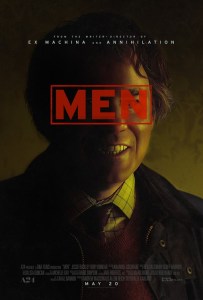 Longtime Hollywood go-to genre screenwriter Alex Garland has only directed two other movies, 2015’s Ex Machina and 2018’s Annihilation, both using the realm of science fiction to explore feminine trauma and the sea change of societies on a precipice. I loved Ex Machina and admired but didn’t fully enjoy Annihilation. His newest movie, a small-scale indie horror titled Men, lands somewhere in the middle. It’s in keeping with his other movies, following a woman named Harper (Jessie Buckley) dealing with trauma, and it’s atmospheric while still maintaining a clear point of view that could likely rub people the wrong way. It’s an uncomfortable nightmare of a horror movie and one that isn’t as deep as it appears to be.
Men accomplishes what I had been hoping with 2021’s Chaos Walking, namely portraying everyday life as a woman as a living horror movie. It’s a highly metaphorical and atmospheric movie but, at its core, it’s all about the danger, discomfort, and indignities that women endure on a near daily basis dealing with men. I don’t think the movie has as much to say on the topic or is as ambiguous as others are presenting (more on this later), but its central theme is so bracingly direct and deeply unsubtle but sometimes a sledgehammer is better than a scalpel. This is an intense movie from the start and a frequent reminder of the hazards of being female in a patriarchy. Each of the men that Harper encounters represents a different facet of toxic masculinity. The seemingly kindly priest, who places his hand on Harper’s thigh to “calm her,” is projecting guilt and blame onto her for the actions of men and views her femininity as a corrupting and tempting influence, very akin to Eve. The little boy, who likes wearing creepy masks, is a brat who refuses to accept no for an answer and turns on a dime into verbal attacks, much like the men of the Internet ready to flip at a moment’s notice. The police officer is dismissive of Harper’s account of being harassed and threatened, representing a legal arm that often downplays and diminishes women as victims. There’s even Geoffrey, who seems almost like the best man in town by default, is aloof, doesn’t understand boundaries, and is trying to present himself as a “nice guy” looking for his delayed dues. The only person in town that seems sympathetic to Harper is the one female police officer who takes her statement. Each man is played by Rory Kinnear (Our Flag Means Death) for thematic reasons. I’ve read people complain, “Why wouldn’t Harper realize this obvious similarity in the town’s men?” The answer is simple: it’s because the men do not literally all look the same. It’s meant to reflect Harper’s perspective, much like 2015’s Anomalisa where the protagonist viewed every person as looking and sounding like Tom Noonan until one unique voice cuts through the malaise and monotony. This movie is wall-to-wall with uncomfortable, seething misogyny in many forms, and given the times we live in, I wouldn’t blame any woman saying, “No thanks.” I’m glad I watched this one alone and without my now-fiance, as she would have brought this up forever as a “You made me watch…” tease.
 The flashbacks with Harper’s unstable ex-husband James (Paapa Essiedu) are the most personally illuminating and make up a significant portion of the narrative, as Harper is forced into her painful memories from her present encounters. Her husband showcases clear signs of being mentally ill and is also verbally and physically abusive to her. He greets her news about seeking a divorce by declaring that if she doesn’t take him back, he will kill himself. This emotional blackmail feels par for the course in this relationship and another sign why Harper would want out for her own well-being. The movie opens with Harper watching James fall to his death, and this trauma is what she’s processing through every male interaction. James is indicative of a kind of man that imposes demands on their partner without holding themselves to the same standards, but it goes beyond hypocrisy; it’s about a damaged person who holds another hostage with further threats of their damage. It’s a person who puts the entire onus of their existence onto another, removing their own personal responsibility, and thus blaming the convenient external party when something inevitably goes wrong. This central relationship is revisited in different ways throughout the movie, and you could even argue that Men is a metaphorical journey of Harper trying to shed herself from the weight of this disturbed dead man.
However, the real draw of Men is its allegorical nature and that is bound to rub plenty of viewers differently. The best comparison I can make is 2017’s mother!, a deeply polarizing movie from Darren Aronofsky (Black Swan, Requiem for a Dream) that completely existed as a none-too-subtle Biblical allegory as the primary plot. Usually, screenwriters will work with metaphor and allegory as subtext, adding extra depth and meaning to their storytelling. We don’t expect it to serve as the primary narrative. With Men, like mother!, it is indeed the primary narrative. I can reduce the plot down to this description: woman explores English countryside and is harassed by men of various forms. To be fair, Jaws could be reduced to “guys try to kill big shark,” so this is a little reductive. The emphasis is on exploring the experiences that Harper is enduring, her exploration of nature and seclusion that, at each turn, gets sabotaged by a man. If you’re not open to a narrative that is a little looser and more atmospheric, you’ll find the movie to be plodding and overwrought. When Act Three kicks in, the movie goes full-on into bonkers horror and isn’t even flirting with a direct correlation with reality any longer. I can safely say that some of the bizarre imagery is truly some of the strangest and grossest things I’ve ever seen in any movie. The chief symbol (toxic men begetting toxic men) is central to the icky body horror cavalcade.
 However, the movie’s allegory doesn’t lend itself to much in the way of interpretation. That’s not exactly a creative hindrance; stories can simply be what they are intended to be. Men is fairly obvious what it’s about even from the starting point of its one-word title. It’s a movie heavy in allegory but the allegory itself is also pretty unambiguous and straightforward. There may be interpretation for this symbol or that but Garland’s horror movie is pretty much thematically obvious. It all supports his theme about the horror of being a woman in modern society, magnified across a metaphorical horror movie canvas. I’m sure there will be others who go into great detail to dissect this movie but all of it seems to come to the same basic conclusion, and that’s fine.
Men is the kind of movie that almost wears out its welcome at 100 minutes. The technical merits are strong, the photography and imagery are lush and transporting, and Buckley (The Lost Daughter) is a great actress to hinge a story of mounting distress and terror. If you’re the kind of person that seeks out new cinematic avenues of nightmare fuel, then the final act and its chief monster with its distinct disfigurement will sate your morbid appetite. It’s an effective and evocative movie but it’s also the same thesis statement hammered again and again. While the movie has some perplexing moments, there isn’t much to unpack as far as meaning, and ultimately that can limit some of the play of a movie built on the engine of metaphor. It feels like a scream against the overwhelming and entrenched social forces of misogyny, and I cannot say whether it’s worth 100 minutes of squirm-inducing discomfort of art imitating all-too-real life.
Nate’s Grade: B-
Share this:

Crimes of the Future (2022)
 David Cronenberg returns to the thing David Cronenberg is best known for. It’s been twenty-plus years since the director has gone back to his body horror roots, and Crimes of the Future is certainly a gross gross movie. If that’s what you’re hoping for, then the discomfort and bizarre sexual analogies might be a selling point for you. For me, I just felt nauseated without an interesting core to keep my mind from drifting away. In the future, people have evolved (?) pain tolerance and infection rates, so our protagonist Saul (Viggo Mortsensen) turns surgery into public performance as his assistant/lover (Lea Seydoux) removes the vestigial organs his body produces. Kirsten Stewart’s antsy, horny character states that “surgery is the new sex,” and you’ll get plenty of parallels as we watch person after person get all squirmy while being cut open. My problem with the movie is that there isn’t anything beyond the shock value. The commentarry about body experimentation as a form of sensuality feels trite and more an opening for weird moments, like when Saul gets a zipper installed across his pelvis and his assistant decides to open it and somehow pleasure this… pouch? There’s a hint of an interesting movie here. Saul is being asked to serve as a confidential informant for the government hunting down an extremist group trying to kick-start evolution so that children will be able to consume plastics. That would have put our main character into a discovery role for this world that would have provided more than shock value. The movie begins, literally, with a child being suffocated by his mother, so that sets the tone as to where Cronenberg is headed. Crimes of the Future is essentially a geek show of a movie absent meaningful social/sexual commentary and interesting characters. It’s more a movie of pliable body parts.
Nate’s Grade: C
Share this:

Good Luck to You, Leo Grande (2022)/ Cha Cha Real Smooth (2022)
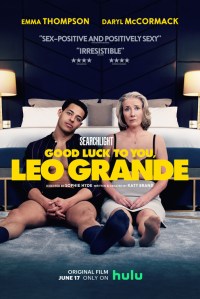 I was taken immediately and repeatedly by the many charms and intriguing personal details of Good Luck to You, Leo Grande (hence referred to as Leo Grande for the sake of my typing). This little indie played at the 2022 Sundance film festival and is primarily two people in one hotel room talking for the entirety of its 97-minute run time, and oh how early I was enraptured. This is a small-scale but laser-focused character-driven drama with edges of comedy and romance. It’s sex positive, very mature and tasteful given its subject matter, and the general awkwardness of watching two strangers combat sexual and personal hang-ups and vulnerabilities melted away thanks to the deftly superior acting, writing, and directing of those involved.
Emma Thompson plays Nancy Stokes (not her real name), a retired school teacher who worked for a parochial institution and taught Christian religion. Her husband has died and she reveals that, over the course of their thirty years together, she has never truly known physical pleasure. She seeks to change that by hiring a professional sex worker, Leo Grande (not his real name), played by Daryl McCormack. We will chart Nancy’s sexual awakening over four intimate encounters.
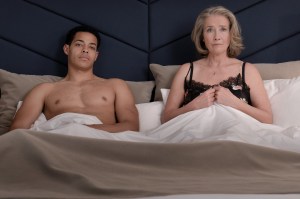 What stood out immediately to me was how well developed the story unfolds at such a natural pace. I’ve watched more than a few indies that simply don’t know what to do with their premise, that feel like they’re biding time to get to feature-length, and some that are likewise constrained to single or minimal locations but fail to secure the most essential need: providing a reason for the audience to care. Whether a movie takes place in one room or a hundred rooms, you have to make the time spent meaningful whether through compelling characters or a story that keeps you engaged and waiting for more. You need to connect to the characters or be intrigued by the revelations to come, and Leo Grande does both immediately. Its setup is rife with drama and conflict, two people navigating their relationship to physical intimacy, two people who have never met until now for a transactional evening. There are obvious, natural personal conflicts to be explored here, with the novice out of their depth in many senses. There are also plenty of intriguing possibilities, because as these two get to know one another so too are we getting to know each and getting glimpses of who each of them are outside of this room. Both people are putting on fronts of some sorts, trying to settle into a performance of who they could be, and peeling away the layers of this subterfuge becomes even more intimate and engaging. Writer Katy Brand, known for outrageous British sketch comedy, skillfully maps out the story so that each conversational stop, detour, and ramp-up feels organically composed. It takes a great writer to keep your attention from a movie about two people talking, and Brand is that good. The contrast between our characters and intimacy, from forced to unlocked, keep us glued intently.
I also think there’s an interesting generational character study here, though the film doesn’t ever make any grand pronouncements about the symbolic representation of its heroine. Nancy is over 60 and at a point where she’s used to compliments with the added qualifier of “for her age.” When she discusses her sexual history with her husband, it’s almost like a confession that she’s been unable to get off her chest for decades, an acknowledgement of her disappointment and longing. Her husband was the kind of man who would lie in bed, roll on top, and then a minute later roll off, mission accomplished (no wonder this woman has never experienced an orgasm). Talking through this embarrassment, it brings Nancy to tears, realizing she’s lived so much of her life without accessing physical pleasure, a joyful repose that so many others seem to revel in. This bold step, hiring a sex worker online, is her making a leap outside of her comfort zone, and the subsequent return engagements give her new opportunities that have eclipsed her for so long.
 In essence, this is woman who feels like she’s playing catch-up. Her character is from a generation where women didn’t make as much of a fuss about reciprocal pleasure. Her view of her aging body is one of general shame. She will repeatedly say she has no idea what she’s doing. Nancy feels like she’s been missing out for so long and wants what has been denied to her. However, she also has her own personal sexual hang-ups she’s pushing through, with decades of religious upbringing and enforcing moral codes with her students and their wardrobe choices. All of it adds up as far as her view on sex and her body. Leo asks her if she just wanted sex why not find a man in a pub and go from there, and she curtly says she doesn’t want an old man, an old man that will simply be another version of her husband, another disappointment in a lifetime of unrealized intimacy; she decidedly wants a young man. She’s indulging in her desire and a young man best represents a promise of sexual fulfillment (and she definitely doesn’t have any teacher/student fantasy, she will let you know). I think there are many more Nancy’s in the world, older women who soldiered through their lives, carrying the burdens of others while sacrificing their own pleasure, and are now at point in their lives where they are hearing more about body positivity, about female pleasure, and about being worthy of physical intimacy on their own terms and desires. Nancy is a character having a delayed sexual re-awakening; in her confession with Leo, she details her first impulse of desire when she was 17, a feeling that she hasn’t experienced as surely for the decades hence. While being a unique and well-rounded character, Nancy also serves as a representative of an older generation and perspective coming into conflict and revelation with a modern sense of intimacy and self.
Leo Grande is a smooth and charming man but one who doesn’t feel oily or like he’s obnoxiously masculine. With McCormack’s kind eyes and soothing Irish balm of a voice, it’s easy to see how this man could set others at ease. But then you also have to remember that Leo Grande is not who this man really is; it’s a character he’s playing, and as Nancy opens herself up to this man, she’s looking for him to do the same, for them to share something more special than a simple client-professional relationship. The more that Nancy pushes and pries, the more that Leo himself is pushed outside his own comfort zone. Leo is willing to talk about some things, like his frayed relationship with his mother, a point of unity with Nancy and her adult children, and his cover story of being away and working on an oil rig, an outlandish excuse that makes Nancy and eventually Leo break into laughter. By the nature of this character dynamic, Leo must be the more confident and assured participant to better contrast with Nancy’s personal and cultural insecurities. He’s the pro and she’s the novice. However, that doesn’t mean emotionally he’s as self-assured and without regret. Listening to these two characters bounce off one another and come in and out of intimate contact is fully entertaining.
I hope that Thompson (Cruella) gets nominated for an Oscar for her portrayal. She’s in just about every second of the movie and so much of it hinges upon her baring herself, physically and emotionally, to this man and us, the tacit observers. It’s a performance of radical self-love in so far as Nancy is reclaiming her body as a point of pride rather than as one of shame. In some ways, she’s shedding her past sins, easy judgement on the mores of others and their bodies. Thompson goes through such a wide range of emotion and gets to play so many different revealing sides to this woman putting herself in a most unfamiliar position. It’s Nancy coming to terms with her own disappointments, misgivings, and hypocrisy, and Thompson is splendid at every moment. She gives so much life to this character without sacrificing her complexity or occasional coldness. By the end, when her character hits her arc’s climax, it feels like a journey fully earned.
 Another 2022 Sundance indie, this recipient of the Audience Award and a plum Apple Plus streaming spotlight, feels less smooth despite its title. Cha Cha Real Smooth is from writer/director/star Cooper Raiff, the twenty-five-year-old up-and-coming filmmaker best known for 2020’s Shithouse, a talky and introspective movie about older teens trying to gravitate with the adult world they feel ill-equipped to handle. While I found some promise with Raiff’s naturalistic dialogue, I found the lead characters to be too dull to really care about. Enter Cha Cha (which will also, henceforth, be how I refer to the title) which benefits from deploying more recognizable rom-com and indie movie plot mechanics. Working from a more familiar movie template, it actually helps Raiff better temper his writing and focus his story. While I enjoyed the movie overall, I would say it still has not won me over to the charms of Raiff just yet.
Raiff plays Andrew, a recent college grad who is still very much trying to figure out his life. He knows he doesn’t like his mother’s (Leslie Mann) new husband (Brad Garrett). He also doesn’t like his job working at a mall food court. He’s also not happy that his ex-girlfriend broke things off before leaving for Barcelona. He’s struggling to plan his “what comes next” when he stumbles into a job being a “party starter” after his enthusiastic chaperoning of a local bar mitzvah. Soon the neighbors are all seeking Andrew’s party-starting ability to make their next bar or bot mitzvah a fun time. Andrew becomes attached to a thirty-something single mom, Domino (Dakota Johnson), and he autistic teen, Lola (Vanessa Burghardt), he persuades onto the dance floor to loosen up. Domino is intrigued by the younger man and asks him to babysit Lola, especially since the two have bonded and earned a trust. Andrew doesn’t know whether Domino is feeling the same level of attraction but someone who would not be happy is her fiancé, Joseph (Raul Castillo).
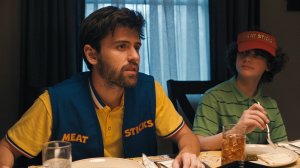 You spend a lot of time with Raiff as the lead, so your ultimate determination on Cha Cha will hinge on your perception of Andrew and as Raiff as a performer. He’s got an easy smile and his enthusiasm can be endearing at points, like he’s incapable of being still in thought. I found the scenes where he encourages little kids to be cute and easy to enjoy. He’s an infectious presence when he’s dealing with children. However, when Andrew is dealing with adults or people his own age, he seems to be out of his depths with arrested development. He’s rude and pissy with his stepfather for no real discernible reason given. He’s fairly thick-headed about romantic ideals about following his girlfriend to Spain, who declines his grand offer. Andrew’s uncertainty about charting his own path is a familiar story, and Raiff takes advantage of the overall coming-of-age blanket of tropes. The problem is that too many of them feel easily discarded. The only characters that seem to matter in Cha Cha are Andrew and Domino. Even Andrew’s younger brother (Evan Assante), who loves his big brother so much that he is constantly asking for advice on romancing a girl he likes, and the kid even cries at the prospect of his brother moving out of his room, is just another underwritten foil like Andrew’s mother, always supportive, and stepfather, always wary, and friend-with-benefits girl, always… there? These characters are meant to be reflections of our main character, serving to make him look charming or sincere or naïve or deluded but always serving Andrew. This can work in screenwriting but it helps if the characters don’t feel so obviously cultivated to make our hero look good.
I did find the central will-they-won’t-they relationship between Andrew and Domino to actually be entertaining. Much of this helps from Johnson sliding into a role that definitely fits her skill set. The role doesn’t even seem too different from her struggling thirty-something mother in The Lost Daughter. In the last few years, I have grown as a fan of Johnson with strong supporting turns in Bad Times at the El Royale, Peanut Butter Falcon, and as a dying mother in Our Friend. In each one of these roles, there is an inherent melancholy to her that she so effectively radiates. She has certainly broken free from the long shadow of the Fifty Shades franchise. Much of Domino feels from the point of view of a young man projecting onto her, and I think that is also Raiff’s larger thematic point. In Shithouse, a significant plot development is when Raiff’s central character has a different interpretation of a sexual encounter. He bombards the young woman with eager texts and is carried away with making an attachment, whereas she did not view their college hookup on the same terms. Although, this hard wisdom is undercut at the end of Shithouse by this same lady relenting and saying, “Yeah, okay, I’ll be your girlfriend.” To Andrew, Domino is a wounded soul looking for a rescue and he’s her dutiful man in shining armor. From his perspective, she is crying out for kind attention and support that he feels is being neglected. The learning curve for Andrew is that Domino can distinguish between a person who excites her and a person she can see herself settling down with. Their age discrepancy is never really addressed until the very end, though Johnson herself is only 32 years old, which doesn’t seem like an insurmountable gap though Domino’s age is kept purposely vague. I would have preferred the movie being told from her perspective as she had the most interesting role. Johnson and Raiff have an easy-going chemistry, with his overeager charmer meshing with her subdued, glassy-eyed, taking-it-all-in openness. She makes him feel a little more excited, but ultimately, that may not be as important as other more practical concerns.
 This leads to what seems like the lesson of Cha Cha, because for a movie that seems to operate on a powerful level of irony-free sincerity, the big life lesson it seems to impart is that becoming an adult is one about accepting compromise and disappointment. Sure, that’s an important lesson, to adapt as well as process personal reflections, but with Raiff’s movie, Domino’s lesson seems to be she’s accepted that her fiancé doesn’t make her feel all the things that young Andrew does but he will provide stability for her and her daughter and that means more at this point. I cannot say whether the movie is asserting that Dakota’s reasons are mature and something Andrew will come to understand in time when he gets a little older or whether we’re supposed to see her as someone willfully forgoing her personal happiness to settle for something less and that, to Raiff, is what adulthood means, settling for less. The way that writer/director Raiff could have shore his thematic intentions would be with the supporting characters, seeing this larger nugget of wisdom reflected in his own mother’s relationship with the stepdad who Andrew could attempt to understand better rather than view with contempt. This is where underwriting the supporting characters can also undermine the artistic aims of your movie. It appears like Raif, at 22, is saying that growing up means essentially giving up on some level, which is a strangely pessimistic lesson for a movie that trades in such earnestness and sunny go-go positivity.
I sound more negative with Cha Cha Real Smooth than I’m intending. It’s a relatively breezy movie to watch with fun exchanges, solid jokes, and characters that I found amusing and some of them even engaging. It has its charms and sweetness and I can completely understand falling under Raiff’s spell. This is definitely a step in the right direction for Raiff as a filmmaker after his 2020 debut, and I think he’s going to continue to grow and tell these personal, highly verbose little indie dramas with big feelings where whomever Cooper Raiff portrays learns some life lesson, likely from his interaction with the person of the opposite sex he desires. As such, every Raiff movie from here on out seems likely to rest upon your feelings about him. With Cha Cha, the sequences between Andrew and Domino or Lola were my favorite, so the film mostly worked.
Good Luck to You, Leo Grande and Cha Cha Real Smooth are both fine examples of indie filmmaking supporting distinct voices adding their stamp on the larger contours of the romantic comedy genre. Leo Grande is a grand example of character writing and it’s even poignant and a little sexy. It’s extremely tasteful and nuanced and even empowering for an entire movie about two strangers meeting in a hotel room for sex. Cha Cha is a fun and formulaic coming-of-age movie and with Dakota Johnson hitting her stride with a winning character with pools of depth. There are some writing and thematic shortcomings but it’s still a charming experience. Both movies can definitely brighten your mood and generate their share of smiles for 100 minutes.
Nate’s Grades:
Good Luck to You, Leo Grande: A-
Cha Cha Real Smooth: B-
Share this:

Father of the Bride (2022)
 Those familiar with the 1991 Steve Martin movie, or the 1950 original with Spencer Tracy, or even the 1949 novel by Edward Streeter, who was born in 1891, will understand that Father of the Bride is an old story that can still be relatable with new wrinkles and details. The core elements of the story, about the stress and chaos of wedding planning, or the pressure and patience of family, are still present with this new version where Andy Garcia and Gloria Estefan star as the parents of the bride (Adria Arjona). Garcia is a first-generation Cuban-American, a successful Floridian architect about celebrating old traditions, and a bridezilla of epic proportions terrorizing every soul in Miami. He is an awful person, holding to outdated and cringe-inducing misogyny and at several points making demands that because he is the father of the bride, he will be dictating exactly how his daughter’s wedding will proceed no matter the objections from the bride. Even when the groom’s wealthy Mexican family comes into the picture, neutralizing his power of the purse, Garcia’s bad dad just gets even more pushy and prissy. Ultimately, of course, he sees the error of his ways, the opulent wedding is nixed for something more spur of the moment combining traditions old and new, and everyone seems to get along by the end as one big happy family. I liked the added subplot of Garcia and Estefan hiding the fact that they are getting a divorce, which provides farcical potential. However, some of the subplots feel lightly developed, especially the other daughter being tasked with making all the bridal dresses for her sister. She wants to be a designer but cannot get a break, and yet the final reveal of the wedding gown is absent any drama, taking away from the relationship between the two sisters. Same with a friend who may or may not be queer and vibing for the bride’s sister. It’s strange that the two daughters get underdeveloped when they’re so essential to the wedding, and especially considering the movie is practically two hours long. I wish the filmmakers had trimmed some of the redundant “Andy Garcia is awful” moments and given more time to other supporting players. Father of the Bride is a chuckler of a movie, never netting bigger laughs but providing a few chuckles and smiles here and there. It’s a pleasant movie to watch, though I don’t think Garcia’s tyrannical father has earned his epiphany and forgiveness by the end. Given a Hispanic spin, the personal details and cultural authenticity allows an old story to feel fresh or at least fresher.
Nate’s Grade: B-
Share this:

Downton Abbey: A New Era (2022)
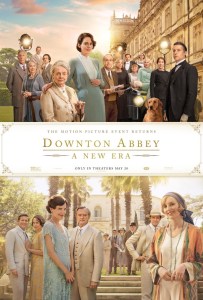 I have only watched the first movie, released in 2019, and know precious little about this widely successful BBC television series detailing the rich aristocrats and their plucky servants, so take my assessment with a whole serving tray of salt. The first Downton Abbey movie served as an epilogue for the series, providing extra resolution to several characters and coupling up others to provide a happy ending. Then it was wildly successful (a worldwide gross of almost $200 million) and so creator/writer Julian Fellowes (Gosford Park) got to come upon with yet another epilogue, this time finding even more happy endings and couplings for the those left out from the first cinematic victory lap. As someone new to this world, I was amused by its understated wit, puffery and pomp, and class conscious dramatics, plus it had a killer cast, most notably Maggie Smith as the tart-tongued Dowager Countess. The second cinematic offering is mostly more of the same, splitting the cast in two locations. One half are inspecting a picturesque villa in the south of France left to the Dowager, to the buttoned-up surprise of her son who questions what relationship his mother had with the former owner. The other half are stationed at the Downton estate while a Hollywood film crew decamps to make a movie. The inclusion of the movie-within-a-movie allows for some dishy moments, starstruck characters, and opportunities for a few Downton residents to make their mark in the pictures. These scenes are fun and provide some interesting conflict as the production has to quickly adapt from being a silent movie to one of them newfound all-the-rage talkies (with a lead actress better suited without sound). It’s a fluffy side story but allows many characters to shine. While the movie is mostly low-key and charming, much like its first big screen effort, by the end there might be some real tears, especially if you’ve been with these characters from the start. If you’re a Downton fan, you’ll eat this all up. I did have two questions that lingered: 1) where is this baby that was the entire story line for Edith in the first movie?, and 2) where in the world is Lady Mary’s husband (Matthew Goode) by the end when he should definitely be in attendance? My pitch for Downtown Abbey 3: Stiff Upper Lip begins with Lady Mary divorcing her racecar-obsessed hubby and moving to Hollywood for a new adventure.
Nate’s Grade: B


 nathanzoebl
You must be logged in to post a comment.