Blog Archives
65 (2023)
 It’s a movie about Adam Driver as a spaceman fighting dinosaurs. What could go wrong? 65 (as in 65 million Years Ago) is a sci-fi action thriller with a ripe concept overworked by blockheaded studio notes that mitigate its potential and engagement. I was initially intrigued because it was the directorial debut of the writers of A Quiet Place, Scott Beck and Bryan Woods. That 2018 movie was a masterful genre exercise, though director John Krasinski was also a key contributor and rewrote their initial script. First off, I don’t know why this movie makes the decision to have Driver from an advanced alien species that crash lands on a prehistoric Earth unless it was related to the eventual development of humans on this planet. The opening segment explains in text and then a “Dad, don’t go” flashback before jumping into the action of the crashing spaceship. Even the dramatically protracted title reveal (65…………. MILLION YEARS AGO!) makes little sense considering the timeline was conveyed earlier. It makes me think about studio execs questioning whether audiences would get it, so what follows is mostly a survivor story of surrogate father and surrogate daughter (Arianna Greenblatt). A lot of our emotional involvement hinges on this relationship and I don’t think it carries the film. There’s a language barrier with the little kid, which is an interesting complication for their cooperation, but it also means Driver’s absent father is projecting a whole lot onto this little kid as if she were his daughter. The central relationship is serviceable but unremarkable, which could also suffice for discussing 65 as a whole. Driver trying to escape from a dinosaur territory dispute could have been plenty for survivor thrills, plus with little Predator-style advanced weapons to even the playing field of man and beast. What I didn’t need was a literal apocalyptic final act where Driver and the kid must not only survive dinosaurs but get off-planet before the big dinosaur-killing meteor strikes. It’s excessive bombast that feels tacked-on, like studio execs worried that dinosaurs by themselves would be boring. 65 is loud and obvious and only 90 minutes, and that can be enough for escapist entertainment, but it squanders its bigger concept.
Nate’s Grade: C+
Share this:

Tetris (2023)
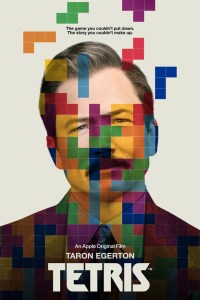 The “real” story behind the addictive puzzle game is an engaging tale of underdogs and corporate intrigue that might prove surprisingly fun and complicated for such a simplistic and straightforward game. We zoom back to the late 1980s and two converging storylines: the rise of handheld gaming and the decline of the Soviet Union. Taron Egerton (Rocketman) plays Herk Rogers, an American businessman living in Tokyo with his wife and family who has put all his hopes on the Japanese license rights of a small little game made in Russia. What follows is one man trying to finagle a system of questionable IP rights between scheming businessmen and Soviet KGB agents. The numerous players fighting for dominance over the course of legal copy, meeting rooms, and offers and counter offers was, for me, the most entertaining part of the movie, and the version that felt the most tethered to reality. There are some Hollywood exaggerations in this retelling, especially in the final act where the movie takes a cue from Argo and has its heroes in a careening car chase to get to the Moscow airport and eave the country (externalizing the internal feelings, much like Argo). Since we all know that the game ultimately ends up as one of the best-selling and most iconic, and packaged with the launch of Nintendo’s GameBoy, the appeal of the behind-the-scenes story is the struggle that our heroes overcome, and Tetris succeeds through its accessible but ever-moving plot mosaic that feels like legal knots trying to come undone. I think the movie gets even better when Herk becomes friends with Alexey, the state worker who created the game in his spare time and is hassled by KGB agents for the game harming national productivity. There are a few too many cutesy touches the movie could do without, like the inclusion of 8-bit sprites as visual transitions, something that is layered over the climactic car chase making it look much duller. I also feel like the honeypot twist feels a little too overinflated Hollywood drama for its own sake. There’s already plenty of drama here that didn’t need the help. Regardless, Tetris is a solid drama that stacks up.
Nate’s Grade: B
Share this:

80 For Brady (2023)
 I did some minor research and yes, three out of the four actresses of 80 for Brady are indeed in their 80s, with Rita Moreno in her 90s, so there is some truth in advertising still. Speaking of that, this geriatric comedy is about everything you would expect from its very basic premise. Inspired by a true story, four lifelong friends (Moreno, Jane Fonda, Sally Field, Lily Tomlin) are diehard New England Patriots fans and more so fans of the team’s famous quarterback, Mr. Tom Brady (playing himself). They’re determined to make one last big trip to support their team at the 2017 Super Bowl, as Tomlin is afraid she doesn’t have much time left. What follows is standard road trip hi-jinks and celebrity cameos the likes of which from Billy Porter and Guy Fieri and Patton Oswalt. Most of the jokes are mild and easily telegraphed, and the formula hews very close to other studio entries in the “old people still got it” ensemble comedy subgenre (Last Vegas, Book Club, The Bucket List, Going in Style, Best Exotic Marigold Hotel, Calendar Girls, etc.). The target audience is looking for something nice and reassuring with familiar faces. To that end, 80 for Brady mostly succeeds, but for anyone else outside it’s older demographic, it will be a middling and hokey comedy. I laughed out loud at the assertion that the Pats comeback from a 28-3 deficit versus the Atlanta Falcons was the result of one very determined, yet also obsessive to the point of hallucinating, elderly fan giving Brady a special pep talk that motivated him to try harder at winning. The movie isn’t meant to elicit big laughs, more pleasant smiles, and to that end it’s agreeably inoffensive right down to its predictability and easy conclusions. Entirely skippable if you’re under the age of 50.
Nate’s Grade: C
Share this:

Empire of Light (2022)
 I was recovering from the flu while watching Empire of Light, which probably hindered my entertainment experience somewhat, but I was astounded at how a movie with this pedigree could be this boring and adrift. It’s directed by Sam Mendes, photographed by Roger Deakins, starring Olivia Colman and Colin Firth, and it’s all about running a movie theater in England in the early 1980s, so you would expect it to be nostalgic catnip for any cinephile. Not so. For the first hour, it feels more like a series of moments that feel pressed under glass, all the air and life removed in the presentation. It doesn’t work as a celebration of art and the power of movies, though it tries at points. It doesn’t work as a character examination because so many of the characters are kept surface-level, shallow, or boring. Colman is our main character and having an unfulfilling affair with her boss (Firth) and then she starts a friendship with a new, younger co-worker that transforms into its own romance. Given that setup, you would think you would care about their burgeoning relationship, but I didn’t (I was more amused at all the places beside an actual bed that people are seen having sex). That’s because this movie feels so poorly paced and passionless. Colman gets her showdown with her bad boss and I thought, “Well, we’re wrapping things up,” and then I discovered that, amazingly, there was still 50 minutes left. “How?!” I shouted at my TV screen. Ah, you see that’s when the movie throws out a mental illness subplot that feels entirely too late and awkwardly handled to count for much else than a delay tactic. I wish Empire of Light had just been one of those adorable British small-town comedies with oddballs running a movie theater in the past, either leaning into it as a workplace comedy or a romantic ode to cinema. It’s a lot of missed potential and middling artistic elements without a clear vision to steer them. There are moments that stand out, especially the racist ones, but it’s a too-long movie missing interesting characters and an accessible and engaging story that exists beyond the (assumed) ephemeral memory of Mendes.
Nate’s Grade: C
Share this:

Babylon (2022)
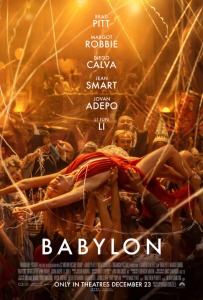 I completely understand how Babylon is such a divisive movie, and this seems entirely the point of writer/director Damien Chazelle (Whiplash, La La Land). It’s over three hours long, it’s got a budget of around $100 million dollars, and the entire enterprise just shouts artistic hubris, at best, and petulantly self-indulgent miasma at worst. Any movie that literally opens with a sequence that includes shots of an elephant defecating and a prostitute urinating on her giggling john is clearly trying to provoke a very strong response, and Chazelle’s expose on the early romanticized days of Old Hollywood is, chiefly, intended to revile and disgust. Chazelle’s mission is to rip apart the cozy nostalgia and hazy romance of the dawning of the film industry, to proclaim that Hollywood has always been a cesspool of exploitation and misogyny and racism and greed. The movie wallows in giddy exploitation but also hijacks the illusion of achieving stardom and asks whether or not the lasting art is worth all of the horror and ugliness of the systems that produce it. Babylon is a wild party of a movie with multiple sequences brimming with pure brilliant filmmaking bravura, and it also ends in a way that just might collapse Chazelle’s righteous fury and contempt.
Within the first half-hour, we are introduced to the three main characters we’ll be charting over many years. Nellie LaRoy (Margot Robbie) crashes a big house party that would make Gatsby jealous. She’s come to California to follow her acting dreams, which her family and small-town peers would sneer at, and she is faking it until she makes it with her boisterous personality. Manny Torres (Diego Calva) is a Mexican-American just trying to get his big break in Hollywood and willing to do whatever it takes to pal around with those in the movies (he is one of our primary elephant wranglers). Jack Conrad (Brad Pitt) is the highest-paid silent movie star famous for his sweeping epics as well as his drinking and multiple broken marriages. Over the next few years, as the industry transitions into the precarious era of sound, each of these three will experience their own rise and fall as they struggle to hold onto their dreams despite the many personal compromises and risks they have to endure to cling to that glitz and glamor.
 If Baz Luhrrman’s Great Gatsby and The Wolf of Wall Street had an illicit baby, and then it was raised by Boogie Nights-era Paul Thomas Anderson, you might get Babylon. It is a big movie founded on the principle of grandiose excess in all capacities. First off, it’s three hours long though this might be some of the fastest-paced three hours, albeit twenty minutes could have been trimmed here and there. I was never bored once, partly because the structure of the movie is episodic in nature, boasting varied sequences that run the gamut from brilliant to ridiculous to brilliantly ridiculous. From an overall thematic standpoint, there isn’t really any subtlety or nuance. The movie is like having the director screaming in your face. Chazelle’s depiction of Old Hollywood is one of direct shame and wanton hedonism, and beyond the obvious “It was always this bad” moralizing there isn’t much more that Chazelle has to articulate, except for a strangely misguided and arguably antithetical coda (more on this later). For almost three hours, Chazelle holds the industry accountable on their buzzy, boozy wavelength of high energy and thrills.
Babylon is presented as a big raucous party where you’re happy to be a guest but also glad you can go home to your own bed. This isn’t a movie that excuses the misdeeds of its degenerates and hangers-on and the systems of power that enshrined the horrible to be even more horrible. Babylon pushes its many characters into uncomfortable questions of what they’re willing to compromise for fame. It’s a process of assimilation and people cutting free their identity, which can be liberating for some and lacerating for others. A significant supporting character is a black jazz musician who begins to find success in the pictures. Then the producers want the man to blacken his face even further, and the ensuing anguish and rage is so palpable that it’s hard to think Chazelle has anything but seething contempt for the sordid history of his own industry. Babylon yearns to be shocking, to be provocative, and it does so easily, sometimes too easily. It’s exceptionally gratuitous to a fault, cavorting with topless women, drug binges, abrupt and callous violence, and all sorts of lewd bacchanalia. Chazelle is demystifying Hollywood’s self-serious fable, and he’s doing so by boldly leaving no bodily fluid untapped and un-splattered.
 This movie is a lot, and it’s also offering very little on a thematic level, so I can understand why plenty of people would hold their repulsed noses and say, “Not for me.” I get it. Not everyone is going to want to watch Nellie projectile vomit onto a hoity-toity snob during a party where she’s trying to re-frame her coarse, lower class identity to be accepted by the brain-dead social elites. Hollywood is presented as a vehicle for self-actualization, but the system is relentless and unforgiving, and even those who achieve success are never afforded a secure perch. The careless regard for safety in Old Hollywood is highlighted by memorable moments, like when a Medieval war epic is halted as a dead extra has a spear sticking straight up in his gut. The crew argue that the man was known as a drinker and therefore it must have been an accident of his own doing. And then the movie skips back to filming, this man’s passing given no more passing thought. And yet there are thousands arriving every year to work themselves senselessly to be the next awaiting sacrifice for this town. It’s an industry built upon human suffering and I can see how many viewers would view the many examples as wallowing in the muck for titillation. The difference for me is that I don’t feel like Chazelle is glorifying any of these antics…
…With the exception of the ending, of which I will discuss more in depth because I find it to be wholly curious and in conflict with every fiber of the movie up until this very final point. I don’t think much of this would spoil the movie for you, but if you wish to avoid my discussion of the conclusion, then skip to the next paragraph, dear reader. The film has a very definitive perspective on the movie industry’s sadistic history and yet in the last five minutes, Manny is subjected to a montage of cinematic high points, zooming ahead into history to include such movies as Terminator 2, Titanic, The Matrix, and Avatar, and he weeps. For 170 minutes, Chazelle has taken us along the road of perdition of Hollywood exploitation and degradation, complete with a skin-crawling trip through hell with Tobey Maguire. And then in the final ten minutes, Chazelle says, yeah, but maybe all of that exploitation and death and disaster was all worth it because we now have movies like… Avatar. It’s the conclusion where Chazelle, as my pal Ben Bailey would say, reveals himself as an art maximalist, that only the art remains and only the art shall matter, arguing that all the vile behavior we’ve endured has meant nothing. It’s the opposite of what the rest of the movie has been purporting, and it’s strangely sentimental for an unsentimental film. It feels like a misguided misstep that concludes with excuse-making and moral relativism, which is far queasier than any of the gratuitous sequences of nudity, drugs, vomit, piss, and rat-eating.
 The technical qualities of Babylon are outstanding, and when working in such symbiotic symphony, they can be absolutely thrilling to exhibit. The sterling production design, extravagant costuming, and swinging cinematography work with the fevered editing and pumping score, and expertly recreate this era with amazing scope and lived-in period detail. I’m still humming the score’s memorable, jazzy, percussive leitmotifs days later. There are sequences that are simply stunning, such as the first day on a movie set for Nelly and Manny, both of them making names for themselves through problem-solving and scene-stealing, and the revelations and race-against-time brinkmanship are electric. The introduction of sound also creates many complications, brilliantly encapsulated in a comedic sequence where Nellie is trying to adjust to this new reality on a soundstage. It’s a comedy of errors cracked up to a hallucinatory madness by the end. Chazelle also delivers one of the best fart jokes in film history, where Conrad is in a bathroom questioning the appeal of sound and why audiences would want to hear, and as punchline, a giant fart erupts from one of the bathroom stalls. The parties are ribald, with the opening making use of an elephant as a literal distraction stomping through a mansion, and a latter one that ends in a frenzied man-to-snake fight. The entire sequence with Maguire is best left as a stupefying surprise, a sequence that reminded me of the dread-fueled Wonderland scene in Boogie Nights. In my view, even if you found the movie was thematically shallow, the individual sequences are so entertaining and so technically executed that the movie demands to be seen.
I’ve noticed some complaints that Chazelle’s messy opus could have pulled from actual Hollywood scandals, that he didn’t need to make up characters and fictional scenarios. That’s fair, but Chazelle wants to impart an impression rather than a case-by-case history of literal bad men. There are characters meant to resemble clear inspirations, like Fatty Arbuckle (who was innocent, by the way) and the affair of Greta Garbo and Marlene Dietrich or Errol Fylnn’s penchant for underage girls, but I don’t think the movie loses its spirit or bite because it’s not strictly recreating existing historical scandals. It’s still an expose on Old Hollywood without the names.
 Babylon is a rip-roaring experience that condemns the history of cinema through the expansive art of cinema, and it’s a wild party populated by sleazy provocateurs and capitalists. Even some of the criticisms of Babylon I can find artistic explanations for, from its gratuitous nature to even the sidelining of its minority and queer stories, perspectives themselves cruelly sidelined and erased from the studio system of Hollywood. Even its overwhelming explicit nature is partly the point, as characters spin round and round, indulging in every debauchery to avoid the march of mortality. Robbie’s high-energy performance is like if a bag of cocaine became a sentient human being. It’s all about sensation and distraction and the many willing to give everything to be part of that, and for almost three hours, Chazelle makes the manic chaos absorbing and horrifying before going soft in the end and arguing that maybe it’s all worth it. Babylon is dazzling filmmaking that will exhaust and nauseate as many as it potentially thrills. I’m glad Chazelle decided to use much of his carefully built artistic cache to make something this extravagantly divisive and ambitious.
Nate’s Grade: A
Share this:

The Whale (2022)
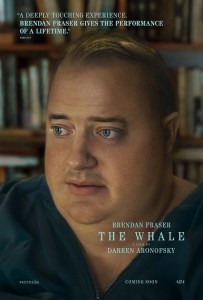 Much has been written about Brendan Fraser’s comeback role and the mountain of prosthetics he was buried under to portray a self-loathing 600-pound man in director Darren Aronofsky’s The Whale. The concern was that the movie would stigmatize overweight people as disgusting and treat fatness like a moral indictment, condemning their lifestyles as slovenly and doomed to misery. I watched the film ready to cringe at a moment’s notice with the hyped portrayal that earned such livid and divisive reactions. I found The Whale to be deeply empathetic but I’m uncertain about whether or not it was fully compassionate, and it’s that artistic distinction that I’m trying to square as I analyze Aronofsky’s melodramatic yet flawed character study.
Charlie (Fraser) is a morbidly obese English teacher who keeps his camera off during his online classes. The closest relationships he has is with his nurse, Liz (Hong Chau), who checks on him regularly with alarm and concern, as she’s also the sister of Charlie’s deceased partner. The movie chronicles one eventful week in Charlie’s life as he tries to make the most of his dwindling time and reconnect with his estranged teenage daughter, Ellie (Sadie Sink).
 For me, Charlie is less a clinical case of what being morbidly obese can do to a person and he’s more a case study of self-destruction. In 1995’s Leaving Las Vegas, Nicholas Cage won an Oscar playing a man determined to drink himself to death over the course of one eventful weekend in Vegas, and I saw more parallels with his character and Charlie, a man who turned to eating as his source of grief that then became his vehicle for self-destruction. The movie is not casting judgment that all fat people, even those approaching the size of Charlie, are destined for eternal loneliness or crying out for help. However, this specific man is using his increasing weight as a form of suicide. This facet makes Charlie interesting but also increasingly confounding as well. He seems genuinely remorseful about the time he’s missed from his now-teen daughter’s life. He’s saved up his life’s money and plans to give it to her, but I kept wondering why, exactly, he had to die for this? He won’t take care of himself because any medical cost could take away from the handsome sum he plans to leave, in full, to Ellie. He apologizes for being absent but seems unable to see an alternative where he can be present. After so many years apart, maybe she would actually prefer having her dad back in her life? Charlie stubbornly holds to an all-or-nothing ideal, like some kind of fumbling romantic gesture, but he doesn’t have to die for his daughter to live her best life. She doesn’t even get a say. It’s his inability to see through this false choice he’s determined is the best outcome that makes the character frustrating. He only views his death, and I’m sure the insurance to go with it, as his biggest reward that he can offer his estranged daughter, and that makes it even more frustrating at the very end, where he’s trying to prove something to her but is also likely traumatizing her for life. That love he proclaims so readily for his daughter seems questionable when he prefers a misguidedly noble demise to getting to know her and allowing her to choose for herself. The character seems so frustratingly myopic about his own life and its value only being its end.
Complicating this matter is the reality that Ellie is, quite clearly, a horrible person. She’s angry at the world and trained her ire on her absentee father, who she believes left her and her mom to pursue an illicit affair with one of his male students (the reality is a bit more complicated). She is well and truly awful. Ellie insults her father repeatedly. She yells that she wants him to die and that she would be better off. She agrees to spend time with him for a hefty price. She even takes pictures of him and posts them online for social media derision. She’s detestable, and yet the screenplay by Samuel D. Hunter (Baskets), adapted from his play, wants me to yearn for a hopeful father/daughter reconciliation. There isn’t a hidden pool of depth with this character, a brilliance that we know just needs to be nurtured and that Ellie can tap back into. She’s just the unrepentant worst. I think The Whale errs by placing so much of its dramatic foundation on this pairing. It made me question why this man is literally killing himself for this bratty teen. The late reveal for Charlie’s essay that he often quotes like a religious mantra is obvious and still doesn’t open up Ellie as a character. There’s a brief tear-stricken moment at the end that I guess is meant to represent Ellie with her guard down, but I didn’t buy it, and I found her to be a thinly written archetype that is unwinnable. She’s more of a plot device to motivate a redemption arc. Maybe the point is she’s undeserving of her father’s graceful overtures but I guess that’s parenting, folks.
 Charlie says he’s always been a bigger guy but his weight got away from him after the loss of his partner, and it’s this unfathomable grief that caused Charlie to go on feeding binges. He sought comfort in the immediate appeal of food, and plenty of people can relate to stress eating or eating their feelings when times are turbulent. I don’t think the movie is setting Charlie up as a cautionary tale to avoid. Charlie’s grief is tied to religious intolerance and its own trauma. He opened himself to another person and then had his new sliver of happiness dashed away directly related to a religious intolerant mindset that his partner was unable to break free from. He’s a victim who saw no way out including a heavenly reward supposedly denied to him. It’s not this dead man’s fault that he was raised in a diseased environment that viewed his own identity as an illness, and it’s not worth blaming this man for being unable to break free from this mentality. It’s the intolerance that has contributed to Charlie’s weight gain and his fatalistic sense of self. Heartbroken, Charlie has retreated from the world, and it’s the guise of spiritual salvation that proves alluring to the determined young missionary, Thomas (Ty Simpkins, Jurassic World). He sees the flesh as the prison for the soul, and he tries to sell Charlie on a salvation that asserts itself as liberation from his body, which the young man views with horror. Charlie doesn’t want the spiritual guidance, especially from the same community that poisoned the mind of his late partner. Like the Ellie character, I don’t think we gain much with this storyline and the amount of time that the screenplay gives Thomas. I guess we’re meant to see him as another wayward soul trying to live authentically, but he’s another underwritten archetype given misplaced emphasis.
The best reason to sit through The Whale are the performances from Fraser and Chau. We’ve never seen Fraser in a movie quite like this, a man best known for broad slapstick comedies (George of the Jungle, Furry Vengeance) or dashing action-adventure movies (The Mummy films), and he’s great. His performance is less mannered than you would assume for an actor undergoing such a physical transformation. In fact, his vocal range makes Charlie often sound anesthetized, like he’s already given up moving out of a comfortable yet limited range of emotional output. It’s kind of heartbreaking but he’s also got a gentle heart that chooses to see the best in people, even when they might not be there. Fraser is compelling in every moment and disappears into the role of Charlie. His best scene partner is Chau (The Menu), and the movie is at its best when they’re sharing the screen. Liz is the closest friend Charlie has, and they have a shared special kind of pain relating to the loss of Liz’s brother. She’s also enabling his self-destructive impulses and is devastated that Charlie is accepting a doomed fate rather than letting her take him to a costly hospital. Chau is heartbreaking as you feel her fear and guilt, afraid of losing another person so dear to her but also severing another connection to her brother.
 The Whale is an experience that makes me wonder about its best artistic intentions. Even the title of the movie feels like a glancing blow; what other analogy are you supposed to make other than Charlie as our very own Moby Dick? The critical essay he keeps reciting takes a sympathetic view of the marine animal and posits the fruitless efforts of those who wish to cruelly hunt it down and how this will not provide personal fulfillment (it shouldn’t be too hard to figure out who represents who in this dramatic dynamic). It’s also the least distinguishable Aronofsky film of his provocative career, confined to a single location and devoid of the director’s usual vision and verve. It feels like a challenge in restraint for Aronofsky, almost like he’s approaching theater and just wanting to get transfixed by the dramatic surges of the actor’s interactions. I found the central character to be interesting but confounding, not that human beings are ever so clearly understandable in every facet of their being. I don’t think the supporting characters really added much, with the exception of Hong Chau, and I wish the daughter plot had been scrapped. But if you’re sitting down to watch The Whale, you’re doing so to experience Fraser’s career-best performance where he reveals layers to his acting that you never knew were possible. He can still lean into his innate generous spirit and charm to get you to root for Charlie to find some peace. For Fraser alone, The Whale is worth watching and might open some hearts.
Nate’s Grade: B-
Share this:

All Quiet on the Western Front (2022)
 The surprise surge of the Oscar season is a German-language remake of the 1929 Best Picture winner, and after watching all 140 minutes, it’s easy to see how it would have made such an impact with modern Academy voters. All Quiet on the Western Front is still a relevant story even more than 100 years after its events. It’s a shattering anti-war movie that continuously and furiously reminds you what a terrible waste of life that four-year battle over meters of territory turned out to be, claiming over 17 million casualties. I’ve read the 1928 German novel by Erich Remarque and the new movie is faithful in spirit and still breathes new life into an old story. We follow idealistic young men eager to experience the glory of war and quickly learn that the horror of modern combat isn’t so glorious. There are sequences in this movie that are stunning, like following the history of a coat from being lifted off a dead soldier in the muck, to being reworked at a seamstress station, to being commissioned to a new recruit who questions why someone else’s name is in his jacket. It’s a simple yet evocative moment that sells the despairing reality. The movie doesn’t skimp on carnage as well, as long stretches will often play out like a horror movie where you’ll fear the monsters awaiting in the smoke and that nowhere is safe for long. And yet, where the movie hits the hardest isn’t depicting the trenchant terror but with the little pieces of humanity that shine through the darkness. There’s a small moment in a crater shared by two enemies where one of them is dying, and these final moments of recognizing the same beleaguered helpless and frightened humanity of “their enemy” are poignant. Make no mistake, All Quiet is a condemnation on the systems of war where old pompous generals send young men to needlessly die for outdated and absurd reasons like the concept of “maintaining national honor.” A significant new subplot involves Daniel Bruhl (Captain America: Civil War) as a representative of the German government trying to negotiate an armistice when the French representatives are looking for punishment. It allows us to take a larger view of the politics that doomed so many and laying the foundation for so many more doomed lives. The ending of this movie is a nihilist gut punch. The production values are impressive and elevate the artistry of every moment. The sound design is terrific, the cinematography is alternatingly beautiful and horrifying, and the production design is startlingly detailed and authentic; it’s easy to see how this movie could have earned nine Oscar nominations. All Quiet on the Western Front is a warning, a eulogy, and a powerful reminder that even older stories can still be relevant and resonant.
Nate’s Grade: B+
Share this:

The Outfit (2022)

What a disarmingly suspenseful movie this was. The Outfit flew under the radar when it was released in the early months of 2022, but it deserves better and is genuinely one of the best films of that year. It’s structured much like a stage play, based in one location with a group of characters under great duress. Set in 1956 Chicago, the movie takes place entirely within the tailor shop of Leonard (Mark Rylance), an expat from Britain’s famed Savoy Road who has a special arrangement with local gangsters. He lets them use his shop for their business and doesn’t ask questions. Then one fateful night a job goes wrong and the surviving criminals hide out in the shop, suspecting one among them is a traitor. Written and directed by Graham Moore (Oscar-winner for 2014’s The Imitation Game), the movie is an ever-shifting game of constant suspense, with new characters coming into the fray and with every person holding their own secrets. I was impressed with how the movie kept upending my expectations while holding onto clarity, as each new combination of characters onscreen meant a different dynamic of who knows what and what angle they’re gunning for. Rylance is our anchor of this shifting game and it’s an open question whether he is hapless victim or manipulative schemer. The writing is so sharp and the ensemble are so refined each in their role (Dylan O’Brien, Zoey Deutch, Simon Russell Beale) that you ignore the rather pedestrian direction by Moore. This little movie is such a sly surprise that can pack a wallop while keeping you entertained and duly satisfied by the end. The Outfit is is a well-made yet familiar story but told with pristine craftsmanship.
Nate’s Grade: A-
Share this:

Corsage (2022)
 Corsage aims to loosen the stuffy costume drama with a dose of feminist upheaval and irreverence, but ultimately I felt like I was spending my time with a bored woman trying and failing to conquer her boredom. After turning 40, the Empress Elisabeth of Austria (Vicky Krieps) has a midlife crisis. She’s been renowned for her beauty, as that was her primary function for her husband the Emperor (Florian Teichmeister, an actor literally on trial for child pornography), and has become obsessed with her weight. Every person she meets seems to remark that she’s much thinner than her paintings. Now that she’s beyond her child-rearing age, she is languishing with how to spend her copious amounts of time in fabulous luxury. She goes horseback riding. She visits her cousin, and tries to have an affair with him. She gets to experiment with an early film camera. She gets prescribed morphine for her melancholy. She visits wounded soldiers and women locked away in sanitariums. She even gets a tattoo on vacation with her best friend. I thought the movie was going to be either more of an expose on yet another woman suffering from the oppression of her gilded cage, and Corsage glances at this topic, or a fictional account of a rebellious woman pushing against the patriarchal powers that be. The movie doesn’t really feature either approach. There aren’t enough tweaks to its genre to qualify as satire. It’s a character study of a supremely bored wealthy woman missing out on any passion in her life, whether that’s from lovers or political causes or even good company. Krieps (Phantom Thread) is the best reason to keep watching, but as the movie chugged along, it felt like I was watching a depressed character go through the motions looking for anything to possibly spark joy. The movie felt rather rudderless and I don’t feel like the totality of the scenes added up to a multi-dimensional portrait of our lead. I wish the movie had more attitude or more irreverence or even reverence, something to stir the nascent passions of those watching and waiting for more.
Nate’s Grade: C+
Share this:

Argentina 1985 (2022)
 How does one adjudicate a country’s own nightmare and find justice? That was the situation Argentina found itself in after returning to a democratic state following seven years under a military junta that kidnapped, tortured, interrogated, and killed thousands of its own citizens in the guise of “stopping radical communists.” Argentina 1985 gives you its setting in the title but it’s really about the chief prosecutor (Ricardo Darin) trying to hold the top generals accountable for their crimes against humanity. There is a lot riding on this case and plenty going against him, including near-constant death threats for he and his supportive family. There are some very harrowing personal accounts in the movie, but it’s set up almost like an underdog courtroom drama conceived by Aaron Sorkin, and much is made about putting together the young hotshot team and seizing the day. The movie is swiftly paced for being over two hours and has notable comic relief to keep things from getting too overwhelmingly gloomy given the subject matter. However, Argentina 1985 never loses its focus on making the powerful account for their sins. It’s a rousing courtroom drama with piercing details, engrossing human stories, and the temerity of history. In the light of rising authoritarian movements around the world and even in the U.S., this movie has even more urgent political relevancy about making sure the crimes of government officials are accounted for and that justice is served. It’s a testament to the heroism of everyday citizens and it makes for an invigorating drama that doesn’t lose sight of the big picture amidst the plethora of procedural details.
Nate’s Grade: B+


You must be logged in to post a comment.