Blog Archives
American Haunting (2006)
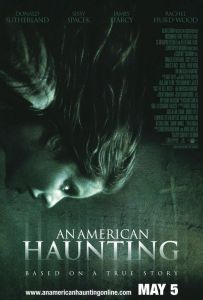 Courtney Solomon made one of the worst movies I have ever seen, 2000’s abomination Dungeons and Dragons. It is bad on a rarely seen cataclysmic scale. The shot selections were awkward, the handling of the actors was cringe-worthy, the story lightweight but ridiculously stupid, and the special effects were like something a third grade diorama contest could best. Dungeons and Dragons holds my record, in all the many films I’ve seen, as having the worst line readings of all time. Fortunately, the film is one of those so-bad-it’s-hilarious entries to stop it from being an absolute wash. Now six years later Solomon is back with An American Haunting. Normally his name alone attached to a movie would guarantee my avoidance, but I checked this out for you, dear readers. Let’s just say Solomon has a looooooong way to go before he even reaches the competence of Uwe Boll
In 1818 Tennessee, the Bell family moves into a new residence. John Bell (Donald Sutherland) has cheated an outcast woman on her land loan. This woman, branded a “witch,” curses the Bell family. Things are fine for a while, but then young Betsy Bell (Rachel Hurd-Wood) is being attacked by an invisible spirit night after night. Her father and mother, Lucy Bell (Sissy Spacek), are powerless to stop the haunting. Before you can ask, “Why don’t they let their daughter sleep in a different room?” they’ve reached out to a preacher and schoolteacher (James D’Arcy) romantically curious with Betsy. No one can stop this haunting and John Bell searches to gain atonement for his sins to spare his family.
 So, let’s get this whole thing straight, spoilers be damned. An American Haunting is marketing itself as a film based on the only medically credited murder to a ghost. Never mind how you verify that, just go with it for a second. This couldn’t be any more wrong. We learn at the end (“learn” wouldn’t be the right word since the film requires voice over to explain itself) that Betsy had been raped by her father. But wait, it gets better. Betsy had subconsciously developed a protector spirit to guard off further molestation and to punish her father. So right there the ghost in An American Haunting isn’t even a ghost, just the angry manifestation of an abused girl. There is one death accredited to the ghost, that of John Bell. However, the movie presents his wife poisoning him, not the ghost. So then the murderous ghost is neither. Plus, one has to wonder how shocking John’s loss is if he was willing to kill himself to lift the curse from his family. How believable is a “true account” of a medically documented haunting death when people were blaming demons for things for ages? I mean, there must be written accords from medical professionals of the day attributing the Black Plague to man’s sins. Just because an official said so centuries in the past does not make it medically sound today. If that were true no one would last through puberty without flogging themselves to death (and I did NOT mean it like that). An American Haunting is not true, is not about a ghost, and isn’t about a ghost committing murder.
Writer/director Solomon has made some strides in his filmmaking, but the results are still laughably the same. He’s gotten a better feel for actors and … that’s about it as far as improvement goes. An American Haunting is a creaky old timey ghost story that couldn’t scare a soul. It feels more attune to a 1970s made-for-TV flick. Solomon cribs all his scare tactics from Spook 101, which means lots of stagy jumps and creaky noises. The most annoying decision Solomon makes is that when he wants to convey the point of view of our ghost, he quickly swoops the camera down and up, spinning around the room like a paper airplane. I’m surprised more ghosts don’t get motion sickness if this is how they roll. You’ll either grab your stomach from the camerawork or the story.
 Solomon’s story is just painfully uninteresting. Some good actors do their best to liven up a pretty run-of-the-mill haunting tale. An American Haunting is insufferably boring and lame. The first half is also exceedingly repetitive, as we watch the spirit creep into Betsy’s room and beat the daylights out of her. I don’t know how many times Solomon expects us to still be entertained, let alone scared, by just repeating this scene verbatim. Apparently, if a ghost keeps smacking you it won’t wake up the people sleeping right beside you. I always did wonder. An American Haunting is lackluster and boring, but it’s the arbitrary current day scenes that open and close the film that makes it truly awful. A modern-day mommy discovers Richard’s diary of the haunting and sits herself down for a good read. Then once she gets to the end she sends her little daughter off to spend time with her ex-husband/daughter’s father. And then Betsy’s protector spirit pops up in the car, looking very sad as she’s driven away. An American Haunting is trying to make us connect that the modern-day woman’s husband is molesting her daughter, but the movie expects you to make a lot of jumps to get there. I don’t think “spirit pointing” will hold up in the court of law. And truly, if the Betsy protector spirit was really trying to be helpful, shouldn’t it be less vague and just spell it out? These modern segments feel tacked on and needless if the whole of the film is spent on the 19th century ghost story. An American Haunting requires gobs of text at its conclusion to explain that it was, technically, a ghost story by its new and expanded definition.
The only nod I can give Solomon and his tale is that they cover my number one complaint of all haunted house movies: why the hell don’t the people just leave? Your house is haunted with the spirits of the damned, so you’re just going to wait it out? MOVE people. Find another place to live! An American Haunting features a spirit that can travel outside the bounds of its house and attack carriages, no less.
An American Haunting is marketed as a true-life ghost story, the only in our nation’s history where a murder was credited to a spirit. However, this movie doesn’t have the foggiest idea how to scare an audience beyond stagy high school theatrics. It’s not a ghost story, unless you swallow whole the film’s flimsy recanting of what a ghost is, it doesn’t feature a murder by haunting, and it isn’t even true, unless you can additionally swallow ye olde folksy, biased medical accounts. I’m sorry, but I don’t buy this. This movie isn’t so bad that it’s funny; it’s just boring. People as a whole should steer clear from this dull, amateurish fright flick. The only screams you’ll hear during An American Haunting are unintentional laughter.
Nate’s Grade: D
Share this:

An Unfinished Life (2005)
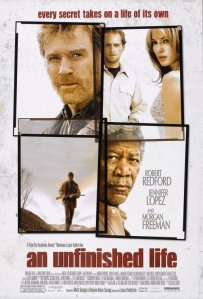 Einar (Robert Redford) is a gruff rancher living with his long-time friend and ranch hand, Mitch (Morgan Freeman), who has been recovering from a bear mauling. Jean (Jennifer Lopez) and her young daughter (Becca Gardner) have run away from her abusive boyfriend and seeking temporary refuge with Einar. There’s still a lot of tension and unspoken anger between the two. Einar blames Jean for the death of his son from a car accident. As their stay continues each member imparts wisdom to the other, hard exteriors get warmed, and lessons about forgiveness are learned.
This is melodrama with a capital M. An Unfinished Life is clunky, the movie hasn’t the foggiest idea when it comes to subtlety, the characters all shout out their feelings all the time, and worse yet, it’s also incredibly transparent. A scene where Lopez breaks a dish and Redford goes nuts is just too much. Of course they’re talking about his dead son but the moment is played to the hilt that I half expected every line to end in a wink (“It’s just a dish” wink “Maybe it’s more than a dish to me!” wink “Maybe that was my favorite dish!” wink). Honestly, it was at this point that the film lost me. The metaphors are another symptom of the film’s overly ramped-up obviousness; Redford might as well be pointing at the bear to pantomime that it?s supposed to represent his pain and anger. And Freeman’s eventual forgiveness of his attacker is meant to encroach upon Redford to do likewise to the source of his pain, and many other moviegoers, Jennifer Lopez. I cannot find a movie emotionally involving when it doesn’t even bother to mask its grand statements.
Seriously, this movie is brimming with sprawling earnestness meant to cover the narrative shortcomings. This is a simple tale that could have suckered the audience in with its framework to showcase complex characters and their personal interactions, like a Million Dollar Baby, but even though An Unfinished Life is simplistic it still manages to beat you over the head. Every line of significance is underlined so you get it. It’s like director Lasse Hallstrom was making a seething parody of these overarching, small-town, large cast, homesy feel-good flicks he’s specialized in for a decade.
The acting is all fine. Redford is fun to watch and get his Jeremiah Johnson back on. Lopez makes you forget how much you hate her in other movies. Freeman is settling into a weird groove as a disfigured narrator. The acting of the ensemble really isn’t the issue with An Unfinished Life.
Despite all its earnest intentions and lush scenery, An Unfinished Life is too much melodrama squeezed into such a small space. It’s an old fashioned tale that feels too convenient, too simplistic, too perfunctory, and too unhappy with being any of those things. This feels like a Hallmark card turned into a movie by someone who has no grasp for human emotion. Everything is shouted when it needs to be a whisper and explained when it needs to just be experienced. And yet there will be an audience for this slow burn small-town tale of forgiveness and accountability. It may please people immensely, but I prefer a little subtlety to my drama. I won’t say the film is bad but I’ll never say An Unfinished Life is particularly good, even as melodrama.
Nate’s Grade: C
Share this:

Stay (2005)
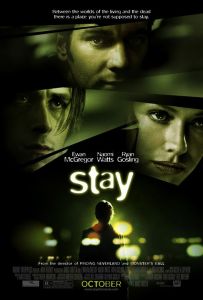 This is a movie that piles on the mystery and clues but once the finish does arrive I was left saying, “That’s all there is?” There’s so little to this film that, in retrospect, it’s simply blowing off the dust on An Occurrence at Owl Creek (I may have said too much). The trickery Stay throws at you is slightly intriguing but mostly confounding and, once the reveal tidies everything up, wholly unsatisfying. Part of the problem is that I didn’t care about any of the characters, so I didn’t really care about their plight. Yes I get it that there is a reason for how shallow they are, but the only thing Stay had to keep me going was my waning interest in what the hell is going on with everything. I’m not the biggest fan of Marc Forster (Finding Neverland) as a director, and he serves Stay to good and harmful effect. Forster gooses the film with all sorts of visual trickery like jump cuts, using twins and triplets as extras in backgrounds, repeating scenes, playing around with blocking, and lots and lots of spiral staircases (hello, Vertigo). And you do realize that most of these disorienting stylistic decisions have a seemingly coherent reason in retrospect, but it also effectively pushes the audience away from the story, aided by the fact that no one can get into the characters. The entire affair seems pointless and empty but it is pretty to look at. I’m sure I’d garner more from a second look, but I really just don’t want to see Stay again.
Nate’s Grade: C+
Share this:

Howl’s Moving Castle (2005)
 The flick is wonderfully imaginative, as to be expected from Miyazaki. The Pixar people really do an excellent job of bringing these films to an American audience and treat the English dubs with reverence. I’m not someone who’ll bemoan an English dub when it comes to anime but it’s nice to see effort and respect. The story is a bit similar to Princess Mononoke with the warring factions, the mystic and the industrial, and Miyazaki’s refusal to paint in black and white. There are so many delightful touches here from the fire demon to the door portal to one segment that just involves two old ladies ascending stairs for three minutes. And yet it’s the spirit Miyazaki infuses and the attention to story and character that sets his films apart. There’s a genuine sense of magic while watching his films and Howl is no different. The only bit of contention I had with the movie is how abrupt the ending is. Howl’s Moving Castle is a bit soaked with confusion and some narrative cop-outs (“Surprise! I’m the prince responsible for the war!”). I would have loved another 30 minutes in this world as well as a better opportunity for Miyazaki to bring his story down with a smoother landing. Still, saying this is a slightly lesser Miyazaki film is like saying a million dollars is less awesome than 2 million dollars. Howl’s Moving Castle is another sterling addition to a master storyteller.
Nate’s Grade: A-
Share this:

United 93 (2006)
 I’ve heard a lot of talk about whether America was ready for United 93. Almost every magazine or newspaper article you’d read about director Paul Greengrass’ real time account of 9/11 began with the question, “Is it too soon?” That’s mostly a personal decision. My response: of course not. They were making World War II movies while Europe was still burning and while Pearl Harbor was still recovering. Speaking of which, doesn’t anyone feel that a 9/11 movie would be much more powerful and respectful now, five years removed from one of the worst days in American history? We can still remember that awful day, and most importantly, we can use art as a means of catharsis when the subject remains relevant. Does anyone seriously want to wait 20 years down the pipe for a 9/11 movie to be produced by Jerry Bruckheimer? Was 2001’s Pearl Harbor the kind of movie we’ll get when it’s “not too soon?” While I’d never insist people see United 93 if they weren’t ready, I will say it’s definitely a movie that demands to be seen sooner rather than later.
On September 11, 2001, four planes were hijacked in the sky by members of the terrorist group Al-Quaeda. Two crashed into New York’s World Trade Center building. Another crashed into the Pentagon in Washington, D.C. A fourth plane, United 93, was delayed on its initial takeoff, meaning the four hijackers on board were already behind schedule. After the hijackers had taken control of the plane and turned it back around, presumably headed toward the White House, the passengers started making phone calls from the flight and piecing together the scenario. They weren’t going to land at any airport; they were a bomb on wings. The passengers came together with a heroic plan to take back the plane and use a fellow passenger, with flying experience, to help them land. Their valiant effort ended in United 93 crashing in Shanksville, Pennsylvania.
 United 93 is one of the most nerve-racking movie going experiences I have ever seen. Because of our prior knowledge of the events, every little thing carries so much dread, from a man who just makes the plane to simple phone calls, unknowingly their last, that end so regularly in “I love you.” Hitchcock said tension was watching a happy couple unaware of a ticking bomb below their picnic table, and he was right. United 93 is grueling to sit through, but that doesn’t mean the film isn’t rewarding. We’re going through the same situation and harrowing steps of realization as the passengers. The final phone calls on board may be the most emotionally wrenching thing I’ve seen in a movie since 2000’s Requiem for a Dream. The final 30-minutes of the film, concentrating on the passengers retaking the plane, is some of the most intense cinema I’ve seen in years. My heart was beating outside of my chest and I was shaking, even after I got out of the theater. I spent the next hour at my house walking around trying to shake it off but I couldn’t. This is an incredibly powerful and sobering film that will stay with you like a bad dream.
Witnessing the unfolding events of United 93, a spellbinding example of you-are-there cinema verite, you really feel like you’re watching a living documentary. There’s nothing sensational or overly political that happens within United 93. Greengrass even has the temerity to present the hijackers as human beings, granted human beings capable of ferocious acts of horror. The first moments of the movie are the hijackers preparing, praying, reciting the Koran, and going about their plot. You see them sweat, get antsy, and the lead hijacker evens seems a bit hesitant about following through, especially since this coordinated attack was botched by United 93’s delay on the tarmac. Some would call such a portrayal ludicrous, citing a scene where a hijacker calls his girlfriend to say his last “I love you” as apologetic claptrap. Some would take offense that the hijackers are not demonized, have horns sprouting from their heads, or laugh maniacally at spilled blood. But just like Spielberg’s portrayal of Palestinians in Munich, human evil is much more nuanced than simply painting a mustache on. United 93 shows every side to 9/11 like what a good documentary should do. This isn’t propaganda, this isn’t exploitation, this is respectful filmmaking. Yes, we?ll never know what happened on flight 93, and much of the film is speculation, but it’s speculation built around research and reverence.
 Greengrass is in fine form, recreating the same sense of building desperation and terror that he so elegantly assembled in 2002’s Bloody Sunday. The antic handheld camerawork may give people some headaches, but no filmmaker does a better job of putting you in the moment than Greengrass. His decision to use real people portraying themselves, like FAA head Ben Sliney, creates a greater feel for authenticity, even having the film’s stewardesses played by real United stewardesses. None of it feels gimmicky, nor is Greengrass interested in telling a jingoistic, hyperbolic action adventure. The famous “Let’s roll” line is just another line said amongst many in the planning process for taking back the flight. The violence is sudden and shocking but never sensationalized. United 93 ends exactly as it should too. You?ll probably hear sobbing in your theater at that point; I did.
There have been complaints that the character development in United 93 is lacking. But really this is a story about 2 hours on one morning, told in real time, and how much talking do strangers do on a flight? Some, sure, but not a lot. To answer critics, if we’d gotten to know these characters extensively it would either break the fabric of reality and turn these people into eagerly sharing, easily emotive figures, not people, or would require extensive flashbacks which would remove us from the visceral feeling of the story. That’s why Greengrass cuts back to NORAD and the FAA, because there’s stuff happening there; the slow realization of fright, the disbelief, the staggering amount of confusion and miscommunication. They can’t even get anyone from the White House on the phone to even establish a chain of command. If we had staid onboard we would be watching people read magazines or eat peanuts for 30 minutes. I never once felt less for these people because of the characterization concerns.
 The “ordinariness” of the passengers is what works best, because it just as easily could have been you or me, but would we have reacted the same? Had it been “Tom Cruise starring in United 93″ then it never would have worked. This excels on how realistic everything comes across, and any Hollywood moment that would shatter that realism is absent (thank God there’s no product placement). One of the more amazing aspects of United 93‘s conclusion is just how fast everything came about. These people had little time to act, much less take stock of the waking nightmare the day was turning into and formulate a plan. The movie is a touching tribute to a group of ordinary people that became something more on one of our darkest days.
Naturally, United 93 is not going to be a film for everyone. It’s unflinching, grueling, and altogether hard to sit through. It does a stupendous job of recreating that tragic day and allowing our own knowledge of the events to build an overwhelming sense of dread. Greengrass excels in this arena of storytelling and he’s worked his docu-drama magic once more, painstakingly allowing the viewer feel like they are a participant, to the point where we even get a rush of hope that maybe the passengers could take back their plane and save themselves. The question of whether it’s too soon for a major 9/11 movie has to be decided on an individual level. I don’t recall anyone griping about the thousands of documentaries and the A&E Flight 93 TV movie, all of which, yes, made money off 9/11 too. I think for us as a society, we need this movie to remind ourselves of the heroism and sacrifice of a few. It’s very easy to get lulled back to complacency, but the masterful United 93 will not allow that. This is a powerful story told without a hint of melodrama and it will be guaranteed to be near my Best of the Year list when 2006 rolls to a close.
Nate’s Grade: A
Share this:

Thank You for Smoking (2006)
 As soon as I saw a trailer for Thank You for Smoking I was in love. I found the book for cheap and read it with months to spare before the film reached my local theater. Admittedly, my expectations were high because the book was wonderful, and Thank You for Smoking as a movie is equally wonderful and a very good film adaptation.
This is a wickedly funny satire that skewers all sides in the political debate about Big Tobacco, and the film doesn’t take a stand, which is refreshing. It has a firm grip on its humor and gleefully gives its finger to political correctness. There?s a lunch group called the M.O.D. (Merchants of Death) squad where reps for Alcohol, Firearms, and Tobacco, of course, argue over whose product is harder to spin. It’s likely the snort-because-you-can’t-believe-they-said-that movie of the year. The tar-black humor in Thank You for Smoking rolls off so casually. This is a comedy that respects the intelligence of its audience and doesn’t dumb down its barbs or its satire. Aaron Eckhart was born to play the role of Nick Naylor, tobacco’s master spin artist and public charlatan. Naylor is conniving, slippery, and yet immensely likable not in spite of these traits but because of them. Eckhart is downright charming and you can see how he could dupe a nation, even if he’s only doing it for the challenge. Thank You for Smoking has one of the finest assembled casts in a long time, and every member fires on all cylinders. This is a film brimming with confidence and it’s evident with every frame. You almost might feel guilty for wanting to capture a contact buzz from how polished, assured and witty the flick is.
I never thought I’d say so but it sure looks like adapter/director Jason Reitman has a far more promising future right now than his dad, Ivan. Jason, the son, keeps the movie brisk, packed with characters, subplots, jokes, and a visual whimsy. This is a terrific adaptation of a terrific book, and Reitman really hones in on the mechanics of debate and lobbyist practices with aplomb. A scene where Nick teaches his adoring son the tricks of debate with ice cream is outstanding. Thank You for Smoking crackles with dialogue to die for, like Nick’s boss BR (J.K. Simmons) saying, “We sell cigarettes. They’re cool, and addictive, and available — the job is practically done for us.” My only complaints with the film, besides that it’s too short at just 90 minutes, is the manufactured danger seems a bit too slight and too easily overcome. Nick quite simply vanquishes whatever threat his reporter sex buddy Heather (Katie Holmes) posed. Otherwise, Thank You for Smoking is a superb movie all around and there’s no reason you shouldn’t see it. Take the hit.
Nate’s Grade: A
Share this:

V for Vendetta (2006)
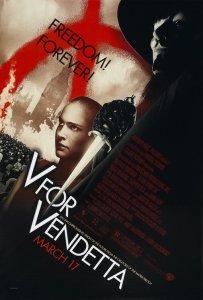 Legendary comics author Alan Moore has a particular disdain for Hollywood adaptations. They just haven’t gone so well for this scribble scribe. There was 2001’s From Hell (I may be the only one in the world that actually likes it, Heather Graham’s atrocious cockney accent aside) and 2003’s The League of Extraordinary Gentleman. Moore is even responsible for the creation of the John Constantine character, who had his own 2005 big screen venture. I suppose you could see why he has certain contempt for the movie versions of his much-heralded stories. Now comes V for Vendetta, based on Moore’s 1988 comic and adapted into a screenplay by the Wachoswki brothers. While I may have no idea how close V for Vendetta is to Moore’s graphic novel, I can say that the movie is a smart, superb thriller that dares you to think while you?re stuffing popcorn into your mouth.
“Remember, remember, the fifth of November, gunpowder treason and plot. I see no reason why the gunpowder treason should ever be forgot”
In the future, America has lost its super power status after overextending itself in war. Britain has turned into a hostile totalitarian government, led by chancellor Sutler (John Hurt). Evey (Natalie Portman) works for the state-controlled TV station. One night, while walking out past curfew, Evey is attacked by some undercover cops looking for a good time. A mysterious masked man named V (Hugo Weaving) comes to her rescue. His grinning, bearded mask resembles Guy Fawkes, a revolutionary that tried to blow up the British Parliament 400 years ago on November 5th. V starts taking out high profile government figures and then infiltrates the government airwaves, asking others to rise up against the corruption they see around them. He promises to blow up parliament one year to the day of this message. Finch (Stephen Rea, so expressive with his hangdog demeanor) is assigned to find out who this V is and how to deal with him. In reality, Finch discovers a lot more troubling information about his own government. Evey is linked with V and tracked down for interrogation and potential execution. As the date approaches, Evey must battle her own loyalties and strike out against what she feels is right and just.
 What makes V for Vendetta so exciting is its playground of ideas. This is a dynamically intelligent, complex movie but it never lets the smarts get in the way of a rousing good time. This is a very political movie that’s very relevant today, like the exchange of freedom for security and the use of fear mongering to serve an agenda. I love that the government’s leaders were a rogue?s gallery of corruptible figures; the Bill O’Riley-like TV pundit blowhard, the church leader who just happens to be a pedophile, the scientist whose good intentions justify the worst in human experimentation. V for Vendetta is a thinking man?s comic book movie, one that actually has actual respect for its audience and refuses to dumb down its message. The movie starts at a gallop and never lets up intellectually, and that’s so wonderfully refreshing from a film of any stripes. While I would not classify myself in the camp that views V for Vendetta as an anti-Bush administration screed, I’d have to say the movie does stir people out of a sense of apathy. I was even moved by the film’s hopeful conclusion, which is more than I can say about any other comic book movie (yes, even Elektra).
Director James McTeigue has previously served as the Wachoswki brothers’ assistant director. V for Vendetta is his debut as a director and what an auspicious debut it is. The movie is visually lush thanks to Aliens cinematographer Adrian Biddle (sadly, he died December 2005), but the smartest notion McTeigue accomplishes is putting story above special effects (ahem, George Lucas?). The command McTeigue has as a first-time director is impressive; how many people would be this restrained with all the fancy tools Hollywood has to offer? It’s his restraint and priorities that allow V for Vendetta to excel. And when the film does call for action, McTeigue judiciously uses visual trickery to enhance the scene. A late scene involving slow-mo V taking out a cadre of soldiers while they reload is amazing both in its “hey, look at this!” visual acuity and that it fits perfectly within the narrative. Nothing is self-consciously showy for the sake of wowing an audience, and every beat of action feels organic to the storyline. V for Vendetta is a terrific debut with some great set pieces.
Weaving is awesome as our hero. Since at no point does V ever take off his mask, it wouldn’t have been unheard of to simply hire a stunt guy to play the part and dub Weaving’s voice in later. But no, Weaving decided to be the part and adds so much to the character. He knows when to turn his head, nod, lean to a side, just like a silent film star interpreting the moment through action; it sounds ridiculous but it definitely helps paint a clearer picture of V. Then there’s Weaving’s incredible voice, making V sound like the world’s craziest, coolest Shakespearean lit professor.
Portman has finally made me appreciate her as an actress. She had a long winter between 1994’s The Professional and her 2004 one-two punch of Garden State and Closer, but I now finally see that Portman is a fine actress and not just a promising talent. She’s the heart of the film, the focal point for the audience to journey along, and she’s excellent at every point. I also give her props for having her head shaved on camera (I can only imagine what the eventual porn version will do with this scene).
 I’m left in the cold by this over inflated discussion on how “daring” V for Vendetta is by having the hero of a major Hollywood movie be a terrorist, one that says things like, “Violence can be used for good,” and, “Sometimes blowing up buildings can change the world.” Yeah, sure, but it’s a well-mannered, well-read, cultured terrorist versus a giant evil totalitarian government that kidnaps people, strips them of their rights, and enforces cruelty and prejudice. So exactly how daring is that? Of course audience sympathy is going to fall to the little guy, in this case a terrorist, which is the only hope of shaking things up and righting wrongs in the system. That doesn’t exactly strike me as subversive. This movie isn’t promoting terrorism any more than Munich was when Spielberg allowed the Palestinians to have a voice. The movie is anti-oppression if anything.
My only complaints are minor. The movie gets a bit repetitious in its windup to the climax (oh look, we’ve cut again to the Big Brother round table), and that somewhere along the middle V for Vendetta gets log-jammed with subplots. Everyone has a story to tell in V for Vendetta and we see every personal tale, and after a while it kind of grinds the flow of the story down. However, this problem is sidestepped after awhile and V for Vendetta gets back on track, driving full-force toward its conclusion like a runaway train.
What sounds on paper as something incredibly silly, including a kissing scene involving a motionless clay mask, V for Vendetta plays out with such excitement, visual prowess, and vibrant intelligence; this is a very political movie that?s very relevant today and I loved it all the more for it, but V never forgets to be entertaining at the same time. McTeigue has fashioned together a stirring and fascinating directorial debut, and even though the Wachowski brothers have their fingerprints all over this film, the pretension is kept to a minimum. V for Vendetta is exactly what the Matrix sequels should have been: a pulpy mix of brains and action, not a snore-fest that beats you down before putting on a show. It’s a shame Moore didn’t want his name attached to the finished product, because V for Vendetta is 2006’s first great movie of the year.
Nate’s Grade: A-
Share this:

16 Blocks (2006)
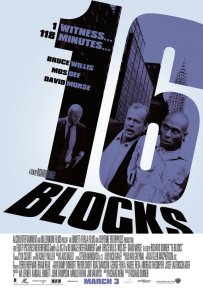 If you think you’ve heard of 16 Blocks before, you may just be correct. There was a 1977 Clint Eastwood movie called The Guantlet where he was transporting a prostitute/mob witness on a bus, and hordes of dirty cops and mob enforcers are trying to eliminate this witness. So the bus gets shot up beyond all imaginable repair and something of a standoff occurs. If you’d rather rent The Guantlet than pay full price for 16 Blocks I can understand that, but 16 Blocks is an adequately entertaining return to form for director Richard Donner (The Goonies, Lethal Weapon).
Officer Jack Mosley (Bruce Willis) is the kind of New York cop that, when stationed at a crime scene, raids a drug dealer?s cabinet and helps himself to some booze. Jack is like a walking zombie, trudging from assignment to assignment. He’s stuck with one more assignment, transporting Eddie (Mos Def), a key witness in a government trial just 16 blocks away. Everything seems so routine, but then Jack thwarts an attempt to murder Eddie. He reports the attack and takes a breather in a bar. Shortly after, he’s greeted by his old partner, Frank (David Morse), who is ominously familiarity with Eddie. Seems Eddie saw something he shouldn’t have, and now a whole slew of dirty cops are going to go down if he testifies. Frank would appreciate it if Jack stepped aside, gave up Eddie, and everything would be square again. All he has to do is make sure Eddie misses his testimony deadline in an hour, dead or alive. A sudden conscience gives Jack a new life, and he?s determined to escort Eddie to the courthouse, no matter the cost. Frank is willing to stop this, no matter the cost. Let the countdown begin.
 16 Blocks is a solid genre picture up until a bus standoff lets all the air out and kills the film’s jumpy momentum. Yes, it’s assembled out of worn clichés and plot elements from other flicks, but this cut-and-paste action flick is a cut above out of its determination. When 16 Blocks is cooking, and it does for stretches, the movie seems to be moving forward by sheer force of will. It’s somewhat admirable, and I’m convinced Donner is responsible for this as he settles into familiar territory. 16 Blocks successfully introduces obstacles and then lets our heroes find believable and entertaining ways to skirt past the danger and into the next obstacle. New York City really feels like its own integral character that’s central to the unfolding plot. 16 Blocks is nothing spectacular but it’s proficiently fun, that is, until that protracted bus standoff gums up the film’s flow. The contrivances become too glaring and 16 Blocks settles into an overly redemptive finish. 16 Blocks succeeds as long as it can, which is surprisingly longer than I would have estimated, but it eventually winds down with too much time left on the clock.
What the hell is up with Mos Def’s voice in this movie? I don’t know if he was trying to stretch his thespian wings, but going the entire film sounding like you’re a cartoon is not helpful (unless you’re Joey Lauren Adams). I seriously expected a tank of helium to be connected. It’s so mannered, so annoying, and so purposely “different” that you’re almost glad he may die in the film’s opening minutes. However, if this was Donner’s attempt to put the audience in Jack’s place, make us just as bedraggled and frustrated, then well done sire. It’s still not forgivable but at least I may understand.
Willis comes across perhaps a bit too realistic as a doughy, down-on-his-luck cop. It’s getting all too natural to see Willis wearing a badge, or at least holstering a weapon, so at least it’s nice to know he changes it up every once and a while. In 16 Blocks he’s overweight, over the hill, and even sports a limp; not exactly action star material unless you still consider your dad the Strongest Person in the World. It adds an interesting, gritty charm to the picture and Willis coasts on our goodwill. 16 Blocks tries to do too much with his character towards the end, encasing him in a crusade to better himself. There just isn’t that much substance there, folks.
I don’t understand why Jack or Eddie doesn’t phone the media as soon as they know the trigger-happy cops are gunning for them. Seriously, you’d think one call to the press and they’d be swarmed with TV cameras, and as a rule the more TV cameras pointed around you, the less likely someone is going to shoot you. This seems like a no brainier to me, as well as an opportunity to put the media in the cross hairs of danger; it’s win-win.
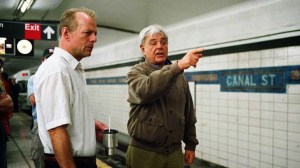 There are some moments in 16 Blocks that are perfect indicators about how familiar a movie like this has become. First, the “gotcha” edit. We see two sequences of action, Group A in a fixed location and Group B quickly descending toward that location when “voila” we’ve been had. The film reveals Group A has already left. I usually enjoy this bit of action sleight-of-hand, but when a movie has to pull the “gotcha” edit twice, then it’s a little like the boy who cried wolf. There’s also some stupid character slips meant to squeeze in tension. At the film’s sleepy climax, Jack is surrounded by men with their guns trained on him. He says he has a key piece of evidence is tucked away inside his coat pocket… and then he reaches in to grab it. Now wouldn’t an astute individual, let alone an experienced man of the law, just ask someone to grab it from him instead of reaching inside and giving people a reason to shoot? 16 Blocks has moments like these because the characters are all stock, so what does it matter if they alternate between brainy one second and bone-headed the next?
16 Blocks is an enjoyably retro genre flick, pasted together with stock characters, contrivances, and cliches, and yet the entire project nearly makes it to the finish line by sheer force of will. Despite the well-worn territory, Donner’s precision and some clever obstacle/resolution conflict keeps 16 Blocks passably entertaining. Willis and Def lack any real camaraderie, and you may want to strangle Def after listening to five seconds of his cartoonish voice, but it doesn’t matter because this film is about the journey, not the journeymen. 16 Blocks loses its way when it forgets this, spending the last act focusing on character dreams, morals, and redemption. 16 Blocks is a redemption of sorts for Donner; the man can still make nervy action sequences and keep an audience entertained, if even for only two acts. That’s worth a walk to the movie theater for most.
Nate’s Grade: C+
Share this:

Match Point (2005)
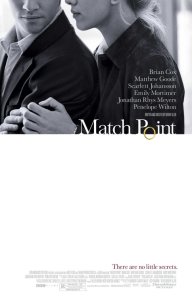 This is an excellent return to form for Woody Allen and his best film since 1987’s Crimes and Misdemeanors. The first half is deliberately slow, yes, but it is justified by the second half which more than makes up for it. The first half needed to be as slow as it is to set up the incredible minutia of this rich, elite world that former tennis pro Chris (Jonathon Rhys-Myers) has been adopted into. We need to see how comfortable this life is to understand why he doesn’t want to give it up and why he goes through the machinations he does in the second half. The characters and dialogue are spot-on and Allen has transported his world of the upper crust New York elite so well over to London, and the change of scenery has reawakened his writing. Allen knows the privileged world very well and their disconnected view point. However, he rightly centers his film not on the neurotic upper crust but on his social climbers Chris and Nola (Scarlett Johansson), a beauty engaged to Chris’ prospective brother-in-law. It is the second half of Match Point that makes it great. Allen tightens the screws on his social climbers and the tension is superbly taut. The dark turns and in the final act are greatly entertaining, as Allen delves further into his look at a universe built around chance and disorder. The returning imagery of the ball hitting the tennis net elicited gasps from my audience, and I was one of them. I love that Allen lets his story continue to unfold after the dark twists. The film’s biggest flaw is anchoring the entire point of view on Rhys-Myers, a somewhat limited actor that reminded me of Jude Law’s character in Closer. Johansson is an excellent noir femme fatale, her husky voice perfectly suited. Frankly, if ever there was a Scarlett Johansson nude scene, this movie was crying out for it. She has her tawdry affair with Chris and there’s even a sequence where we see her laying on her stomach nude while he applies baby oil to her. Their sex is supposed to be so impassioned and carnal, in contrast to his boring but stable relationship with Chloe (Emily Mortimer). And yet no nudity? Woody Allen, you’ve let me down. Your film, on the other hand, is intelligent, sharp, dark, taut, and wonderfully entertaining.
Nate’s Grade: A
Share this:

Freedomland (2006)
 There’s one thing I’m going to remember about Freedomland more than anything — seeing this movie cost me about $300. Allow me to explain. Upon returning home from seeing this terrible film, I received an e-mail from a friend alerting me that a secret code had been floating around the Internet. This code was to be used at Amazon.com, and when punched in at the check-out, your order would be free as long as it totaled over 80 dollars. Just as I was about to check out with over $300 of goods the window closed and the code was no longer working. If I had not seen Freedomland then I would have gotten this news earlier and would have been able to obtain my booty. Alas, I did see Freedomland, a drama that attempts to shed light on racial woes. Movie mogul Joe Roth, the head of Revolutions Studios, doesn’t direct movies fairly often and when he does they’re not great (America’s Sweethearts, Christmas with the Kranks). I knew exactly what I was getting into when I entered the theater; I just didn’t know it was going to cost me $300.
In 1999 New Jersey , Brenda (Julianne Moore) walked dazed and bloodies through an urban neighborhood to a hospital. She tells detective Lorenzo Council (Samuel L. Jackson) that she was the victim of a car jacking while she was traveling through an urban area. She says a black man threw her from her car and drove off. Brenda’s four-year-old son Cody is still in the car. This sets the neighboring communities abuzz. Brenda’s hot-headed cop brother (Ron Eldard) is ready to turn the black projects and high rises upside down, unafraid of whom he may harass. The black community is in an uproar over the treatment, succinctly pointing out that many black children go missing but the news vans and police cars only come out when the missing happens to be white (for further proof, look to the still ongoing coverage of Natalee Halloway). Karen (Edie Falco) runs a team of mothers who volunteer nationwide to help find missing children. Lorenzo has his own doubts about Brenda and the details of her story.
 Plain and simple, Freedomland just does not have enough story to justify its existence. It goes nowhere and practically drifts to its long-awaited conclusion. You’ll see the light at the end of the tunnel around the halfway mark, and then Freedomland limps to its foreseeable ending, devoid of any twists and turns that aren’t telegraphed a mile away. It got so pathetic that I was actually hoping, against all odds, there’d be some gonzo M. Night Shyamalan-esque twist at the very end to jar me out of my complacency. No such luck. The marketing folks of Freedomland seemed to advertise a twist ending, which is hard to believe since everything plays out exactly like you?d first suspect. Moore’s overacting hysteria makes the audience doubt her from the start; plus the fact that Brenda’s like, “Oh yeah, I almost forgot, my SON is in the hijacked car.”
This is a movie so mishandled by Roth that every moment feels false, and when it doesn’t feel false it feels trite and awkward. Take a moment when Lorenzo takes Brenda to an empty urban high-rise. He?s got her pinned in a corner, very literally, and is pressing to know if she killed her kid. The framing of the scene would almost suggest something quasi-romantic, with Lorenzo leaning very closely into Brenda and his arm against the wall beside her. At the very least, it?s really intrusive. And then at the end of Brenda’s “he was all I got” monologue the two actors seem to just stare at each other, like they’re mentally waiting to hear the word “Cut.” The weird framing and the editing make the scene feel amateurish.
But Roth doesn’t stop there. Freedomland itself is a gigantic mislead, and the old abandoned building has about five minutes of total screen time. It’s not enough to even qualify as a red herring, let alone justify it as a movie title. Apparently, this building has been rotting in the woods for decades, and yet Lorenzo lets a large volunteer search party just trounce around inside. I’m pretty sure any policeman worth their salt would need to get a team to make sure the building was structurally sound before letting civilians snoop around in a potential crime scene. That’s not enough stupidity. Later while the people are exploring the Freedomland building, Karen says the floorboards may give way at any moment, and then she leaves Brenda by herself with said unreliable floorboards. Do these people even understand what they’re doing?
Freedomland seems so message-hungry and preoccupied with making some Big Statement that it forgets to be entertaining. Roth is clueless how to juggle all his plot elements, letting the racial tensions turn both sides into offensive stereotypes. The white cops have short fuses and have no hesitation to assault innocent black people (they’d be suspended and then reviewed). The black community in Freedomland, while seeming to have nothing better to do than assemble and shout at the police, stir up their community ills whenever the plot deems it necessary. Some black people are seen setting the community’s own property on fire, swept up in the rising air of a riot. Rafik, a youth given a lot of foreshadowing, instigates the riot and an entire wall of angry black faces proceeds, never mind that this brash decision results in many innocent people being beaten. The movie seems to say that all blacks are victims or instigators. Freedomland is so earnest to be earnest that it misses the mark when it comes to all the details. How else to explain why the film is inexplicably set in 1999. Someone didn’t tell the film’s costume designer, because Rafik is wearing a “G-Unit” shirt, a rap group that didn’t come into light until after 50 Cent’s commercial rise in 2003.
 Perhaps the film’s ending is Roth?s biggest misfire. Lorenzo visits Cody?s shallow grave, now festooned with flowers and personal messages. He reads one that says, basically, “Cody’s death made us all look beyond our differences and realize what we have in common, the ability to feel sad.” What? Is Roth actually justifying the death of a child and subsequent racial fallout as being medicine for society’s ills? This seems ridiculous to me, especially after sitting through two hours of a movie where no one came together, unless you’re talking about the human connection of fist-to-face.
The acting in Freedomland is so unrestrained and shows another of Roth?s directorial weaknesses. Moore, always so reliable a performer, goes out of her mind and gives what should be the worst performance of her career. She’s so over the top, so Looney tunes, so wildly out of control with no bearing, she’s practically bouncing off the walls; it’s kind of embarrassing to watch. Her hysterical theatrics provide several moments of unintentional laughter, particularly a moment where Lorenzo is interrogating her and she just blurts out, “I love you.” Freedomland does her no service by handing her some dreadful dialogue and drawn out monologues. I think it may be time for Moore to star in something a little happier instead of more movies where she’s predominantly crying or grieving. And is it me, or does it seem like Moore has a habit of losing her kids in movies (maybe she should start tethering them to her waist)? Note to Julianne Moore: just because you get to cry and scream doesn’t mean you should take the role. Did you actually read the script to Freedomland?
Jackson, left directionless with an underdeveloped character, reverts to his standard operating procedure when it comes to authority figures … namely staring and yelling. Lorenzo has some character traits (asthma, a son in prison) that are either dropped or have no payoff or insight toward his character. He?s a cop in the middle of it all, and yet Freedomland feels like just having Jackson as an actor should cover the characterization part. At this point, Jackson can do these roles in his sleep.
Falco, far more subdued than everyone else in a very yell-heavy movie, leaves the biggest impression and gives the movie life when she’s onscreen. Falco’s character is what Freedomland should have been based around, not Moore’s shrieking loon of a mother. Falco has the film’s only great moment, effortlessly shifting a story about her own loss and need for closure back to Brenda. The patience and control Falco has in that scene only reminds me how much I need The Sopranos back on the air.
Freedomland is so starved to say something grandiose about racial tensions that it neglects being entertaining. When the movie is entertaining, it’s mainly because of the wild, embarrassing overacting and the nonsensical human behavior. At its worst, Freedomland is offensive to cops and blacks and moviegoers in general with working grey matter, at its best Freedomland is a muddled, incompetently directed movie that drifts unchallenged toward its expected and welcomed end. Roth should leave directing to people that have a better feel for taking control of actors, material, and editing. For those that said the racially-charged Crash lacked tact, I invite them to take a trip to Freedomland. It’s trite, it’s dull, it’s funny when it’s not meant to be, and it’s one of the worst films of 2006.
Nate’s Grade: D+


You must be logged in to post a comment.