Blog Archives
Atonement (2007)
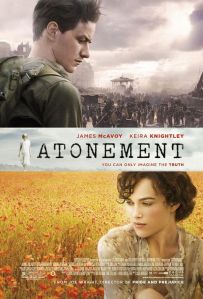 No film this awards season seems to have been kicked and beaten more than the sweeping period romance, Atonement. This poor movie has a strong stable of well-respected British thespians, a red-hot young director in Joe Wright (2005’s Pride and Prejudice), plenty of lofty, top-notch production values, and the whole enterprise is based off a highly acclaimed novel by author Ian McEwan. Where did all the hate come from? I think it has something to do with the fact that somewhere along the line Atonement became, on paper, the presumptive favorite to win Best Picture. Then reality hit and it hit hard. Atonement wasn’t even nominated by the Writer’s Guild, the Producer’s Guild, or the Director’s Guild and yet the film still managed to eek out a Best Picture nomination for 2007. I became suspicious that Atonement would turn out to be this year’s Dreamgirls, namely a presumptive front-runner that was too calculating and self-conscious and ultimately free of substance to make its mark. While Atonement is perfunctory and nothing altogether special, the film still succeeds as a worthy piece of entertainment that doesn’t deserve to be dragged through the mud.
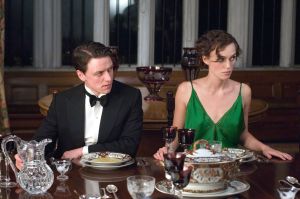 In the mid 1930s, Robbie (James McAvoy) works as a housekeeper’s son on a lovely English estate. He has his eye on Celia (Keira Knightley) and puts his burning passion to paper, typing two very different notes. The first one is blunt (and features a naughty word that rhymes with “blunt”) and the second one is more of a poetic declaration of his affections. Robbie has instructed Celia’s younger sister, Briony (Saoirse Ronan), to pass his love letter to the rightful party. He realizes too late that he sent her off with the wrong letter and Briony reads it herself, dumbfounded at the message and terminology. Briony is a bright child that fancies herself a playwright, but she’s still a child that cannot fully grasp the meaning of Robbie’s advancements. When she intrudes on Robbie and Celia having spontaneous sex against a library wall, she can only assume that Robbie is attacking her older sister (stupidly, neither says anything to clear up the awkwardness and just leaves the scene wordless). That same night Briony discovers her cousin being attacked and she’s certain that Robbie is the culprit, or is she? Her false confession sends Robbie to jail and alters lives forever.
Flash ahead to World War II, and Robbie has joined the Army to be released from jail, Celia reunites with him for the first time in years, and a now 18-year-old Briony (Romola Garai) realizes her foolishness as a child and tries expunging her overwhelming feelings of guilt by working as a nurse and tending to the ghastly numbers of wounded soldiers.
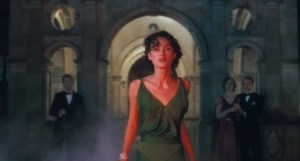
Atonement is visually ravishing to watch. The cinematography by Seamus McGarvey is lushly colorful and blends light and shadow to an extraordinarily effective degree, draping the performers in contrasting colors that pop. Wright’s camera always seems to be perfectly located to discover beautiful compositions indoors and out; the movie is just visually pleasing on all fronts, like seeing Knightley in her dark green dress bathed in the glow of police lights at night. At several points, however, the film’s look does get overly soft and glossy, like the cameraman smeared gobs of Vaseline over the lens. The period costumes and production design are agreeably period-y. The musical score has moments of great lyrical poignancy and then it shatters when the score resorts to integrating the sound of a clacking typewriter as a percussive instrument. I wanted to beat my head against a typewriter to make it stop.
 There’s a vague mechanical air over the entire two hours, like the filmmakers felt that merely assembling all the right pieces and having the right, awards-friendly pedigree would be enough. The five-minute uninterrupted tracking shot along the Dunkirk beach epitomizes this flawed belief. This superfluous shot wanders around soldiers stationed on a beach, winds around the outskirts of the bombed out city, and finally rests in a pub crawling with Brits, but nothing is added by the shot continuing uninterrupted and the staging fails to illuminate anything remarkable about the expensive set. The shot exists simply to call attention to its self and to serve as another bragging point for the filmmakers. The Dunkirk shot adds little to the atmosphere of the film because the scene barely flirts with giving a bigger picture of what is happening. Instead, that shot, like the movie, while well composed and entertaining, is an exercise in self-congratulation.
The film loses serious momentum as it transitions into war and its period of titular atoning. The movie just isn’t as compelling watching Robbie shuffle around at war. Rarely is he in any danger and he just seems to be biding time. Atonement is a tad too prim, a tad too demure to really go deep enough. The romance is intended to be of the unrequited variety but it feels malnourished even at an unrequited level, which is truly saying something. There is so much more beneath the surface but the film never wants to push too far for whatever reason. Knightley and McAvoy have a nice workable chemistry and that’s part of what makes the first half of Atonement the better half. So much of the story involves internal struggle but the movie doesn’t wish to invest the time needed to explore serious psychological wounds. Atonement never capitalizes on the intriguing if melodramatic opening of the film. This is by no means a love story, no matter what the marketers wish to convince otherwise. The romance between Celia and Robbie has little setup to seem believable or worthwhile. This is a movie about the power of words, which naturally is a topic that functions better in books.
After Kinsey and now Atonement, Vanessa Redgrave seems to have found a contemporary niche or her talents: she shows up in the final minutes to give a monologue that demands that the audience reflect from a fresh perspective. Redgrave plays an older adult Briony who has written several best selling books and is being interviewed for television. The ending is designed to be more devastating in print form, and it wants to call into question the nature of fiction and whether or not one lie and be absolved by another. But in the medium of film, the shockwaves are minimal because the language of film is visual. The stutter-step plot structure, which occasionally bends backwards to replay an event from an alternative perspective, is an extraneous annoyance that’s finally justified by Redgrave’s late appearance. What is the true cost for a “happy” ending?
 While Knightley and McAvoy get all the attention and cause teen girls to swoon uncontrollably, the real star of Atonement is 13-year-old Ronan. The young actress is a revelation as a sophisticated girl entering the earliest stages of womanhood. She’s nursing some serious puppy love on Robbie and his disinterest fuels her false confession; she means to punish him. Ronan is eloquently precocious at the start, acting wise beyond her years, but when she steels a glimpse at Robbie’s unfortunate letter, she drops her older pretensions and presents the spirited and unrestrained eagerness of a girl that’s madly curious and madly in love. Ronan effortlessly switches between the two sides of Briony, playing the astute, proper young lady or the nervy, confused girl trying to make sense of her budding sexuality. Kudos to the casting director as well for casting an older actress to play the 18-year-old Briony that genuinely looks like a grown-up Ronan.
Naysayers dismissing Atonement as outdated rubbish are diluted; it’s a well-crafted movie from considerably all angles. Then again, those that champion the film as a testament to bravura filmmaking are also diluted; the film is good, yes, but entirely unexceptional. Atonement is a fine film that takes a reportedly unfilmable novel and gives it a good attempt.
Nate’s Grade: B
Share this:

Crazy Love (2007)
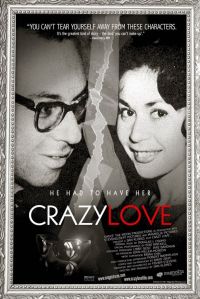 A fine documentary subject and intriguing characters, but this film doesn’t feel like it has any reason for being as long as it is or even existing outside the realm of a TV special. Constructed mostly from interviews, there’s not much in the way of visual representation, and after a while the subject (boy meets girl, boy must have girl, boy hires man to toss acid in girl’s face, girl eventually goes back to boy?) starts to peter out of material. There’s definite shock and puzzlement to this bizarre tale of so-called love, and a whole lot of psychological disorders and dependencies, but there isn’t too much of a full-blown movie here. The material could have been adequately covered as a special on the History Channel of some other cable outlet.
Nate’s Grade: B-
Share this:

The Fountain (2006)
 After six years of anticipation, I cannot escape my crushing disappointment with writer/director Darren Aronofsky’s long-awaited follow-up to one of my favorite films, Requiem for a Dream. While the film manages to be visually resplendent, there is no emotional involvement at all because of how abbreviated the story is. This thing barely covers 90 scant minutes and, this may be the first time I’ve ever said this, but The Fountain needed to be an hour longer, minimum. The separate time frames bleed into each other and there’s a lot of repetition, but then we discover that the cutaways to the 16th century and the visions of the LSD-heavy future are simply side trips detailed in a book. The real meat of the story is on one man losing the love of his life to illness and how they come to grips with eventual loss; however, I can’t feel as much empathy when the movie fails to take any time to set up characters. Aronofsky keeps things interesting, and rather weird, but this romantic fable ends up being nothing more than a misguided folly thanks to a total lack of breathing room for the characters to live. This was probably my single biggest disappointment of all the 2006 movies.
Nate’s Grade: C
Share this:

Away From Her (2007)
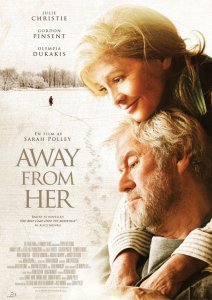 Actress Sarah Polley makes a remarkable directorial/screenwriting debut telling the story of a couple going through the late stages of Alzheimer’s. This is a truly adult tale that deals in the heartbreak of losing a loved one gradually and slowly. The film centers on a long-standing marriage that endures the hardships of becoming a victim in your own mind, first forgetting small things and then finally shutting down completely. While plenty of films have articulately dealt with the point of view of the afflicted, I feel Away from Her is one of the better perspectives on seeing the devastating effects of the illness from the spouse. The movie deals with its real world dilemmas in a respectful and realistic manner and Polley has put herself on the map as a thoughtful, mature, and engrossing talent to watch whenever she hops behind the camera.
Nate’s Grade: B+
Share this:

Little Children (2006)
 Director Todd Field (In the Bedroom) and author Tom Perotta (Election) have created the most incisive, mordant, and entertaining peek into suburban life since 1999’s American Beauty. You really feel the carnal yearning that Kate Winslet and Patrick Wilson have as they inch their way to an affair. I’ve never felt the raw appeal of an affair perhaps like this before. Even more amazing, the film explores an entire neighborhood of characters and breathes life into them. Little Children feels like a great novel, with a scalpel-sharp narrator offering glimpses into the inner workings of these people. You get a great sense of worth in the film and it’s easy to fall under its spell. Little Children is a wonderful movie that looks at the complexities of people without judgment but with plenty of sly humor. It’s a fine work of satire and sensuality, and Winslet is becoming so good at delivering powerful performances that she’s being taken for granted as perhaps the best actress of her generation.
Nate?s Grade: A
Share this:

The Break-Up (2006)
 Real-life couples have a rocky track record when they star together. Sure, for every Mr. and Mrs. Smith there’s also a Proof of Life, Vanilla Sky, or, God help us, a Gigli. The trouble is that what captures the fancies of two actors rarely translates to the big screen. Was anyone more the wiser why Jennifer Lopez and Ben Affleck got together on the set of Gigli? Now here comes The Break-Up, an anti-romantic comedy starring Vince Vaughn and Jennifer Aniston. They’ve been playing a coy game with the media about whether they’ve been dating since the movie wrapped a year ago. Audiences will have difficulty seeing whatever magic the two felt, because The Break-Up isn’t romantic in any sense of the word.
Gary (Vaughn) and Brooke (Aniston) meet cute at a Chicago Cubs game and begin a two-year relationship. Then one evening, after a terribly uncomfortable dinner between their folks, both decide to call off their romantic entanglement. Neither is willing to leave the condo they co-own, so each engages in a battle to convince the other to leave. Gary wardens off the living room as his space. Fine, Brooke invites her brother’s glee-club to perform in her area. He gets the pool table they had talked about waiting to purchase. She throws his clothes into the hall listening to Alanis Morissette. She invites dates over. He has a night of strip poker with actual strippers. At the same time, Brooke is questioning whether she can save their relationship and work things out.
 Audiences expecting a cheeky romantic comedy will be soundly disappointed. The Universal marketing weasels have lied to you! After the 30-minute mark, The Break-Up doesn’t have much comedy, let alone romance. This is really more of a gutsy mainstream drama that prefers to exist in a world similar to ours where heartbreak and yearning are often unresolved. This is a respectably good, if flawed, relationship drama that doesn’t pull its punches. The Break-Up has a very Chasing Amy air to it; both films present atypical Hollywood relationships and both seem to sense a happy ending would just be insulting. Actually, in another similarity, both The Break-Up and Chasing Amy have their comedy completely dissolve by film’s end.
The biggest flaw The Break-Up has is that we don?t generally care if Brooke and Gary get back together. The only good times of yesterday we see are via photographs that are shown during the opening credits. Beyond this brief photo collage, we?re basically starting at the end of their union. There’s a fair amount of gender stereotypes to go along with the characters and their behaviors (men are from Mars, women from Venus?), though it didn’t bother me as much as it would have in a typical romantic comedy. Brooke is a bit of a nag but an altogether good person who just goes about her reconciliation plans in the wrong manner (push him away to have him come back, make him jealous, the famous double-speak). Gary, on the other hand, is pretty much a jerk. The tagline for The Break-Up says, “Pick a side,” but the movie already picks for us. Gary is a lazy, egotistical, unappreciative, selfish jackass and you’re really puzzled why Brooke would keep trying to resuscitate their relationship. Again, part of this is because The Break-Up doesn’t ever show us a moment of these two crazy kids in love. We really have no interest in seeing these unhappy people be unhappy with each other for a longer period of time.
The Break-Up has a lot of intentionally pained awkwardness to it, partly because good portions of the movie is about voyeuristically watching an unhappy couple argue. The Break-Up‘s relatability, something nearly unheard of in the overly saccharine, simplistic world of romantic comedies, is a double-edged sword. Couples may wince and pass knowing looks, thinking, “We’ve had that fight. I too crossed the line like that. I too went about that the wrong way.” Audiences will see pieces of themselves onscreen, but do mainstream audiences really want to see pieces of themselves screaming at each other for a whole movie? I doubt it. I think displeased moviegoers are going to tell their friends to stay away in droves, unless they’re avid tabloid followers.

Vaughn continues his motor mouth lout shtick, though it’s somewhat impressive that he willingly puts himself in such an unflattering light. He’s also a bit puffy in the movie. Aniston is an actress I haven’t been overly enthusiastic with, to say the least, but she’s a winning personality even if she’s replaceable. She seems to be in a frazzled rut. Despite whatever real-life passion the filming ignited, the leads have little chemistry together onscreen. This would be a bigger concern if the film was starting at the end of their relationship, though. The supporting cast of Vaughn’s friends and co-workers is rich with talent. A late scene between Vaughn and Favreau about hiring a hitman to take out Brooke’s supposed new beaux is solid gold. The wonderful John Michael Higgins (Arrested Development), as Brooke’s socially inept brother, provides the biggest laughs. And for those wondering what ever happened to Ralphie from A Christmas Story, here he is all growed up and emasculated by Joey Lauren Adams.
Director Peyton Reed (Bring it On, Down with Love) has a good feel for human comedy and interesting shot selections. He normally keeps his movies brisk and airy. The dialogue is above average and feels naturalistic. I am surprised that I have heard so little about Aniston’s brief nude scene. Then again, I don?t watch that recycled Entertainment Tonight TV vomit. It’s kind of neat to note that there was a 1998 movie itself called The Break Up; they just didn’t have the hyphen. Remember that hyphen in a few months when you’re at your local video store [Author’s note: R.I.P. video stores].
I give Vaughn and the filmmakers credit for trying something challenging and attempting to have a mainstream audience go along. The Break-Up is uncomfortable in how painfully awkward and relatable it is. Whether audiences want to flock to a movie about unhappy people who don’t belong together is a good question. This isn’t as nasty a comedy as The War of the Roses; no, this film is kind of stuck in a thematic middle ground of a gutsy, if flawed, relationship drama. Those expecting promises of comedy and romance might feel cheated. The Break-Up is like a real-life experience: it’s somewhat painful, somewhat expected, and perhaps better once it’s finally over.
Nate’s Grade: B-
Share this:

Brokeback Mountain (2005)
 Go ahead and work the snickers out of your system. Brokeback Mountain has been dubbed “that gay cowboy movie,” and been condemned by certain fundamentalist Christian organizations as “a very dangerous and insidious message to America.” But what message is Ang Lee’s film even putting out there? It seems to me that Brokeback Mountain is putting a human face on a slur, making homosexuals look like you or me. For some that prospect may be terrifying. The movie is playing well on the blue-state coasts, expectedly, but it’s also surprisingly playing well in America’s heartland. It seems that people are lining up all over to see a movie about two gay cowboys in love. And perhaps the more people that witness Brokeback Mountain, the harder it will be to listen to those so-called family advocacy groups with their sterling Christian morals. Maybe people will really see what’s behind many of the words of outcry – hate and ignorance (I am in no way insinuating that disliking the flick means you are homophobic). Despite all this political talk, Brokeback Mountain is by no means a political movie. It’s a love story, above all, and it’s a doozy.
In the summer of 1963, Ennis Del Mar (Heath Ledger) is a quiet man looking for work in rustic Wyoming. He finds a job as a sheep herder working atop the canyons and mountains of Brokeback. Working alongside Ennis is Jack Twist (Jake Gyllenhaal), a charismatic rodeo rider. The weeks are long and Ennis and Jack are all the company they have, excluding the hundreds of sheep they tend. Eventually, the more taciturn Ennis finally opens up and bonds with his herding partner. “That’s more words than you’ve spoken in two weeks,” Jack says. “Hell,” Ennis adds, “That’s the most I’ve spoken in a year.” The rules have been laid out: every night one man sleeps in a tent campsite, the other sleeps next to the sheep to guard them. Well one night Ennis has had too much whisky and cannot make it back to the sheep. Jack invites him to sleep in the tent instead of freezing outside. Then something surprising takes place – both men have an alcohol-fueled bout of rough sex. The next morning both men stress they “ain’t queer,” but they have a hard time fighting their feelings inside. Ennis warns that, “If this thing, it grabs hold of us again… at the wrong place… at the wrong time… and we’re dead.” He recounts a childhood memory where his father showed him the corpse of an older homosexual man, brutally beaten and mutilated. For them, their love must stay on Brokeback Mountain.
 The men part ways. Ennis marries Alma (Michelle Williams), a quiet woman after his own heart, and fathers two daughters. In Texas, Jack meets fellow rodeo rider Lureen (Anne Hathaway) and gets involved in a relationship with her, fathering a son of his own. But Jack still thinks of his Brokeback pal and sends him a postcard. Ennis nearly lights up at the returned sight of Jack and the two passionately embrace. He tells Alma that Jack is an old “fishing buddy” and they sneak away every few months for a fishing getaway. Really the men are returning to the countryside to rekindle the love that they haven’t left behind. But can they keep their love a secret, and should they even have to?
I wonder if Lee would ever have directed this if 2003’s Hulk didn’t bomb so badly. Lucky for us, he’s taken the Brokeback helm and infuses lots of emotion into the story. The Wyoming countryside (actually Canada, but it’s all close enough) is gorgeous, and the film has a great earthy feel. Best of all, Lee allows his love story to breathe and go at its own pace, never cutting corners or rushing an emotion. There’s a lovely, lilting feel to the film, and Lee’s guided hand allows the story to play out to its grand promise. Based on Pulitzer Prize winner Anne Proulx’s 11-page short story, screenwriters Diana Ossana and Larry McMurtry (Lonesome Dove, The Last Picture Show) have given incredible depth and subtext to the tale. McMurtry, in particular, has great knowledge of the West and the cowboy lifestyle, and the screenplay gives you an idea of small-town Western life. There are a few moments at bars, social scenes, stores, but they brilliantly give you every detail you’d need to know about this way of life. I even loved how the people of Wyoming wore fashions that were five years removed from their height of popularity, which is exactly how fashion moves around to the smaller parts of America. Ossana and McMurtry are also commended for presenting their characters as people first and never as agenda bulletins. All three lend a level of authenticity that makes the story feel organic and never trite.
In films about forbidden desire and heartbreak, the acting is the cornerstone for how powerful the tale resonates. The acting in Brokeback Mountain is phenomenal. Ledger is the breakout star and the majority of the film’s focus. He gives the performance of his life. Ledger is outstanding as the reserved, taciturn Ennis, brought to believe that queers were something sub-human and now he wrestles with his own identity. He may be a restrained man of few words but you see every emotion bubble under the surface, every conflict played out in his eyes. Ledger’s few violent or emotional outbursts are startling because they show an uncontrollable feeling, one even he can’t withhold 24/7.
Gyllenhaal has the showier role but masterfully displays the frustration of forbidden love. He’s willing to sacrifice everything for Ennis, and the fact that Ennis won’t do likewise tears him apart. Isn’t love enough, he wonders. There’s a moment in the film that so sharply displays Jack and Gyllenhaal as an actor. It involves two different shots in a moving truck. The first is Jack headed to Ennis’ ranch, singing, bouncing, and with a wall-to-wall smile. The second is Jack driving away from the ranch unfulfilled, sullen, broken, and seemingly unable to cry another tear. It’s two small moments and they sum up Jack and Gyllenhaal perfectly. The only thing unsettling about Gyllenhaal’s performance is his late 70s porn star ‘stach. With his tremendous work in Jarhead and now Brokeback Mountian, Gyllenhaal is in class all his own (he’s got the dreamiest doe-eyes in Hollywood).
The ladies of Brokeback Mountain have less screen time to play with but they each deliver fine performances. Williams is a silent, put-upon mother and is shattered when she discovers her husband’s secret love. She just crumbles. She’s never the same and Williams showcases her character’s distress and mounting bitterness. One of the film’s highpoints is her confrontation with Ennis, many years later, finally sharing all that she knows. Me thinks an Oscar nod is headed in her post-Dawson’s Creek future. Hathaway plays quite an opposite character. She begins as a wild, headstrong cowgirl with a healthy sexual appetite, something perhaps Jack sees as a reflection of his self. Then their love dies at some point and she pours herself into work, but Hathaway illuminates every step along the way. Her small smile during a scene where Jack finally browbeats her obnoxious father is terrific.
This is an elegiac, engrossing love story. Brokeback Mountain is not necessarily a “gay thing,” more so it’s a story about forbidden love and about the consequences of moving forward without ever letting go. That sounds universal, right? Nothing “gay” about that. Brokeback Mountain explores the force of love and shows how uncontrollable and unpredictable it is. Jack and Ennis are just as surprised by their feelings and their rough night of passion as the audience, but the happiness they share is hard to argue.
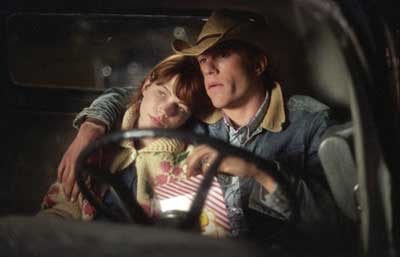 Because of the film’s gentle pace, and Lee’s loose control, we really immerse ourselves in their relationship as they frit away the hours looking after sheep. There was a woman in my theater (I won’t name names, partly because I don’t know hers) who felt that Brokeback Mountain was far too slow and could have been put to better use by cutting 2 hours out. The film’s placid pace is integral to the story’s success; you need to see how expansive that countryside is to feel alone, you need to have the many small conversations to draw out a closer camaraderie, you need the added time to open up to these men, and then once you have –BAM! — they turn their worlds upside down. This buildup is necessary for our connection to the characters but it’s also essential so we can understand what happens. Yes, the film portrays love as it truly is: an all-encompassing emotion that can be as maddening as it is passionate. But Brokeback Mountain doesn’t dare introduce a gay romance, something so dangerous in this land, all lickity-split. It’s supposed to be a surprise to these men, grown up with John Wayne movies and strong, silent role models. The movie enjoyably takes its time to seduce an audience with its tale before choking out every last tear in the end.
The tragedy of Lee’s film is that these men have each found the love of their life but, because of society’s prejudices, are not allowed to act. As a result, each man puts on a different face and pretends they’re a happy heterosexual Western buck for the public, but each is being eaten away inside. Ennis drinks a lot and is full of self-loathing. Jack is less publicly reserved about his feelings and finds momentary comfort with other warm bodies, mostly through silent nods with other closeted gay men. I’m reminded of a line in Paul Thomas Anderson’s Magnolia: “I have a lot of love to give; I just don’t know where to put it.” Ennis and Jack cannot quit each other but they also tragically can never fully commit to one another, at least without any threat of ostracism or death. That’s the power of Brokeback, that it shows you these simple men, shows you their love, and then won’t let that happy ending ever manifest that we yearn for. When we reach our somber, haunting conclusion there weren’t many dry eyes in the theater, mine included. Brokeback Mountain is a love story that won’t let itself be happy, and that’s what provides all the kicks to the gut and lumps in your throat.
I think some of the more hostile criticism of Brokeback Mountain is because of how normal Jack and Ennis are presented. Neither is a swishy stereotype, neither is any less of a man, and that notion probably terrifies the homophobes: “Well, they look normal, and if they get gay then maybe I will too!” That’s a shame really, because those ignorant few will miss out on a powerful, sweeping, complex, aching love story with fantastic acting. Ledger and Gyllenhaal will make you feel every moment of joy, every moment of pain, and every lingering conflict on what makes them whom they are. Lee stressed that he wanted to show the world a love story where you really felt that love was an uncontrollable force. His heartfelt, touching film is a revolution for being a normal love story, albeit with two classic Marlboro men. There is no propaganda, no gay agenda, but perhaps the film will open people’s eyes and strip away any narrow definitions we have toward the ownership of love. Brokeback Mountain set out to merely tell a good story, not change the world. It’s accomplished the first part and maybe, just maybe, it’ll spark discussion, debate, and lasting memories to lay groundwork for the second.
Share this:

King Kong (2005)
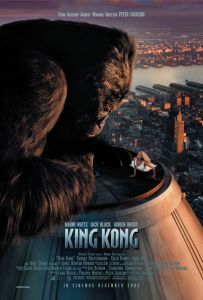 Has there been any movie this year that’s had a bigger hype machine than Peter Jackson’s King Kong? Coming after his Lord of the Rings trilogy, about two billion in revenue and a slew of Oscars in tow, Jackson decided to recreate the movie that captured his imagination as a child. It was King Kong that made Jackson want to become a filmmaker, so now he is returning the favor. Universal ponied up a staggering 200 million dollars for a budget and paid Jackson a record 20 million to sit in the director’s chair. Like his Rings series, this Kong clocks in at a gargantuan 3-hour running time. Will audiences share Jackson’s adoration with the story of a woman, a big ape, and a bigger building?
Carl Denham (Jack Black) is a filmmaker feeling studio pressure. The suits want to reel him in before he even starts shooting his next picture. Carl scrambles to get his crew and equipment onto a boat before the studio can shut him down. He?s on the prowl for a new lead actress and spots Ann Darrow (Naomi Watts), a hungry out of work vaudeville actress. He quickly convinces her to be apart of his movie and hurries her aboard, the selling point being that Jack Driscoll (Adrien Brody) has written the story. Carl practically kidnaps Jack and they all set a course for the mysterious Skull Island, a place only rumored to exist. The ship’s captain and crew are wary but sure enough their vessel washes ashore on an exotic island. But this is no sunny getaway, as the crew is immediately besieged by hostile natives and Ann is taken prisoner and offered as a sacrifice to Kong, a 25-foot gorilla. Jack leads an expedition to retrieve Ann, who begins to bond with her hairy captor (Stockholm syndrome, anybody?). Kong rescues Ann from dangers, be it bug or dinosaur, but flies into a vicious rage when she’s plucked away from him. Carl realizes an even bigger attraction: a giant ape to headline Broadway and line his own pockets. His schemes come true as Kong is knocked out and transported back to New York City. However, no stage is too great for Kong, as he busts free and looks all over for the love of his life, Ann.
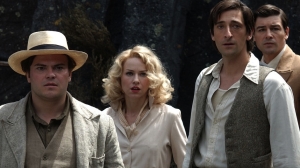 The sweet love story gives Jackson’s update a surprising emotional richness. In the 1933 original, Fay Wray never stopped shrieking until the big guy toppled off the Empire State building. She had no emotional connection to her furry captor and his unrequited love. In the 2005 King Kong, the strength of the movie is the relationship between Ann and Kong. Jackson of course stacks the deck of his story to all but guarantee an audience will fall in love with the big brute (he appreciates sunsets, how romantic!). There?s not much choice whether or not to sympathize with Kong, especially those moments where we stare into his soulful eyes welling up with emotion. King Kong has always been a tale of exploitation with man as the true monster. By administering time to fully develop a convincing relationship between beauty and beast, it makes the later scenes of exploitation have a larger sense of tragedy. Immense credit goes to Watts for selling this relationship and spurring our sympathy for Kong, instead of making their bond something for snickers and eye-rolling. Poor Adrien Brody though. It’s pretty bad in a romantic triangle when you’d rather pick a giant primate than Brody.
The performances go a long way to adding to the enjoyment of King Kong. Watts is a luminous actress and a natural beauty. It’s because of her that the second half of the movie has a beating heart and some kicks to the gut. Brody is ho-hum but given little to work with as a, wait for it, second banana. Black works wonders to make his villainous role so charismatic. Denham is a huckster that would step over his dying mother to make a buck, and yet Black’s charming and funny even at his most dastardly and cowardly. I don’t think King Kong would have worked the same with different actors; few could bring the heart and emotion Watts emotes, and few could bring Black’s comic virtuosity that makes it plausible why others would follow his showman character. Colin Hanks (also along side Black in Orange County), as Denham’s assistant, imparts a favorable impression. I’d like to see him paired up with Topher Grace sometime. Give it some consideration, Hollywood.
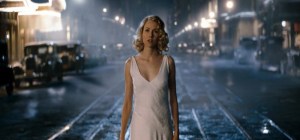 King Kong is a spectacular vision by one of cinema’s greatest visionaries. Jackson has lavishly recreated the excitement of his youth, bringing the story of Kong into the modern age with studly panache. The film is marvelously beautiful to take in and has plenty of moments that will reawaken the child within you, transporting you to an age when movies truly seemed larger than life. During the epic battle between Kong and the T. Rexes, I knew the exact curiosity and excitement Jackson felt when he saw the 1933 original. The action is intense and rarely lets up once our adventurers reach Skull Island. The special effects are some of the best movies have ever seen. Kong moves with expressive accuracy that goes a long way toward expressing his humanity, whether it is in a sigh or a tantrum. Andy Serkis has yet again brought life to another entirely CGI character. King Kong is well worth the price of admission just to sneak a peek at the Jackson’s limitless imagination.
With Jackson’s beefed-up recreation, he has also brought with him a terrible amount of bloat. This King Kong runs a frightful 3-hours plus, and most viewers will just feel exhausted by the time the lights go back up in their theater. Jackson’s love affair with his material is indisputable but it also seems to cloud his judgment as far as pacing is concerned. Numerous scenes seem to stretch longer than necessary and lose their point of interest, the first hour seems too drawn out and prosaic, and the movie haphazardly mixes in the serious with the soapy (Kong on ice?). Some scenes lose their sense of believability the longer they stretch on, even in a movie filled with giant monsters. Certain subplots have set-up but no follow-through, like all the added attention to Jimmy (Jamie Bell), the ship’s teen that wants to experience danger too. Jackson even makes sure we catch that he’s reading Heart of Darkness. So where does this character go? Nowhere and very slowly at that. The character has no bearing on anything that happens with the plot and is dropped entirely once they leave the island. There’s no point. Did something get cut from the inevitable 8-hour extended edition DVD that will prove how pivotal Jimmy really was? I doubt it.
 Some nipping and tucking and a comprehensive editing overhaul would certainly make King Kong a better movie, but it would lose its sense of spectacle. I can’t complain about length too much since Jackson packs such a wallop of entertainment like few others, so while King Kong certainly is a bloated and exhaustive film, it’s also an artistically bloated, exhaustive film. Jackson sure does have reverence for his source material (some lines and scenes are directly lifted), though he may have overlooked the 1933 King Kong‘s 100-minute running time.
Peter Jackson’s King Kong is an epic, epically grandiose, epically imaginative, epically action-packed, and epically bloated. The update is a bit exhausting but Jackson packs more entertainment per minute than few others in the film business, even if he has too many minutes to work with. Watts really sells her tender relationship with Kong and gives the film a surprising emotional heft absent from the 1933 original. Because of our emotional investment the film has a greater sense of sadness and tragedy as it plays out. King Kong was the 800-pound gorilla of the movie year and Jackson knows how to deliver a visual epic, even if he tiptoes into self-indulgence. While I can protest the length, pacing, and some subplots that go nowhere or strain credibility, it’s hard to argue that King Kong is the popcorn spectacle of the year. Your bladder may hate you by the end of it but you won’t want to miss a second.
Nate’s Grade: B
Share this:

The Jacket (2005)
 In The Jacket, Adrien Brody plays a mentally disturbed soldier sentenced to spend his days in a treatment facility. He gets strapped into a straight jacket and locked inside a morgue drawer as part of his “therapy.” Inside these closed quarters, for whatever unexplained reason, Brody has the ability to travel through time. This got me thinking about some other weird/lame ways people travel through time in films. In 2004’s The Butterfly Effect a bearded Ashton Kutcher is able to jump through time by reading his childhood journals. Sure this is weird, and may give false hope to a nation of gloomy journal-scribbling teenagers, but when it comes to incompetent time travel techniques, 1980’s Somewhere in Time is number one with a bullet. Christopher Reeve’s character desperately wants to travel back to 1912. So he removed all modern furniture, clothing, and anything post-1912. Then he lies down on his hotel bed and keeps repeating to himself that he’s living in 1912. Somehow this works and Reeve gets to embark on romance, 1912-style y’all.
Jack Starks (Brody) is a helpful and well-meaning guy that just can’t catch a break. As a soldier in the 1991 Gulf War, an Iraqi kid he was trying to befriend shoots him in the head. When he returns home he starts a long trek through the Northeast. Starks helps out a mother and daughter whose car has stalled. He befriends the non-gun wielding little girl, Jackie, but her drunken mom nearly accosts Starks and they drive away. Then he gets a ride with a drifter (Brad Renfro). They get pulled over by a cop. The drifter kills the cop; Starks gets knocked out and framed for the murder. He’s sentenced to spend the rest of his days in a clinic for the mentally disturbed. And you thought you were having a bad day.
 The operator of the clinic (Kris Kristofferson) has some unconventional methods of therapy, like locking Starks in a straight jacket and sliding him into a morgue drawer. Inside this confined space Starks can zip through time to 2007. In the future he goes home with an angsty young woman (Keira Knightley) who, surprise, ends up being an adult Jackie, the girl he helped at the side of the road. They’re both confused and freaked out, but what spooks Starks even more is the knowledge that he dies on New Year’s Day, 1993. Starks must now get into that jacket so he can visit 2007 some more, fall in love with Jackie, and piece together clues to prevent his soon-to-be death.
Brody seems to be having as much bad luck post-Oscar as Halle Berry and Nicole Kidman. He’s in some funk playing glum character after glum character. Brody and his gaunt figure do have a natural haunted quality and he does excel at emoting grief and horror (hence the 2002 Best Actor Oscar for The Pianist). Brody gives the film more intensity than it deserves.
Knightley is a decent actress but has little to work with. Her role is wrapped in a slab of Gothic traits posing as characterization. When she talks it sounds like she has a cold. I don’t know if this is because of her attempted American accent, the glum character, or maybe she just had a cold from all that outdoor shooting in the snow.
Director John Maybury has the irritating habit of filming scenes entirely in jagged close-ups. Two people will be talking and then -WAM!- huge close-up of an eyeball. Then -POW!- giant mouth filling up the screen. Then -WAM! (again)- more of the same. This editing decision is a distraction but it also lacks purpose. It doesn’t effectively communicate character emotion or scene tension; it just annoys the crap out of you.
 The Jacket is fairly interesting for a good while. The premise is almost ingenious: a man must travel to the future to collect information to prevent his mysterious death in the past. The Jacket adds further intrigue with the question of whether Starks really is traveling through time. Maybe he truly is disturbed and this is all in his head. Sadly, but as expected, The Jacket disproves this tantalizing possibility after an hour of tease.
When the film does transition into its final half, the possibility it showcased seems to go slack. The answers seem either overly tidy or simply anticlimactic, like the truth behind Starks’ death. The Jacket opens strong and strings us along with some intriguing prospects but the end results merely peter out the film’s potential until The Jacket seems completely drained of blood.
Their relationship also has some unexpected creepy moments. Starks, in 1992, visits the little girl he will eventually have sex with in 2007. Yes she’s an adult when they take their tussle in the sheets, but having him later visit her when she’s a child is just plain cre-eeeee-py.
For a while, The Jacket aims to be an intelligent mind-bender but the film squanders its potential. The answers don’t seem nearly as thought-out as the film’s initially intriguing questions. Brody gives the movie more brooding intensity than it deserves. The Jacket is irritatingly directed, alternating between pale shots of white wilderness, extreme close-ups, and overkill on style. The Jacket seems like a nice fit for a while but becomes too frayed to be memorable.
Nate’s Grade: C+
Share this:

Closer (2004)
 A funny thing happened to me when I sat in a theater to see Closer. It was packed, surely due to the film’s heavy star power. As the film played out I began to notice that my audience was laughing consistently, at moments that weren’t necessarily meant for humor. I don’t think they were laughing at the film, instead I think it was a defense. You see, I’m sure the majority of those couples read Closer to be a much different film than it is. They saw the pretty faces of Jude Law, Natalie Portman, and America’s sweetheart Julia Roberts. They were expecting something, let’s say, lighter than the cruel savagery of Closer. When America’s sweetheart Julia Roberts compares the taste of two men’s semen, you know this isn’t any Gary Marshall movie (forgetting Exit to Eden, and please do).
Dan (Jude Law) is an obituary writer planning to pen a novel one of these days. He locks his eyes on Alice (Natalie Portman), a stripper from the States, while walking one day. She gets hit by a car and Dan takes her to a hospital. Flash forward and Dan and Alice are dating but his eyes are already wandering. During a photography session with Anna (Julia Roberts) he kisses her but is spurned. He takes his revenge on some soul in cyberspace, pretending to be Anna and arranging a meeting. That sap turns out to be Larry (Clive Owen), and they actually do start dating. Then things get messy. Couples leave one another, get back together, swap lovers, and come crawling and begging for forgiveness or punishment. The rest of Closer is like a long game of relationship Red Rover.
 Director Mike Nichols has a definite affinity for his four actors (they are the only ones in the film with speaking parts). He shoots Closer as an actor’s showcase, with constant close-ups and no handheld camerawork. He places the emphasis on his actors. The results are more familiar to Nichols’ early films like Who’s Afraid of Virginia Woolf? and Carnal Knowledge. However, Closer isn’t as insightful as it thinks it is. It presents cruel characters doing dastardly acts, but this is stuff that wouldn’t impress Neil LaBute (In the Company of Men). There is intelligence to the film?s dialogue but it’s wasted on a ramshackle story.
The acting of Closer both helps and hurts the film. It seems that the two primarily wronged characters (Larry, Alice) give the better performances.
Owen is the standout performer of the ensemble. Playing the Dan role onstage has given him an intimate feel for the story’s characters. He’s the most decent of all four until the weight of circumstances finally pushes him to the limit. He’s the character the audience sees themselves in, so it helps that Owen gives a great performance of quiet dignity and slow self-destruction. He expresses more emotional turmoil in his eyes than most actors do with their whole body. Portman is having a breakthrough year for herself. First she showed pluck and grace in Garden State, and now with Closer she has graduated to the adult table. She radiates a fragility that makes you want to hug her. Portman will probably always look like a little doll (which works for her role as a stripper).
The beauty of Roberts and Law hurts the ugliness of their characters. I make no bones about my general dislike of Roberts as an actress. Her acting in Closer is like a soft-spoken, pouty child. She jumps from man to man, looking sullen or pensive, but comes off more petulant. Law is better, but his handsome devil is not in the details. Dan is a womanizing cad but we never get any understanding for why he acts as he does. Law can be hypnotizing, but like Roberts, his pretty facade takes away from the impact of Dan’s ugly behavior.
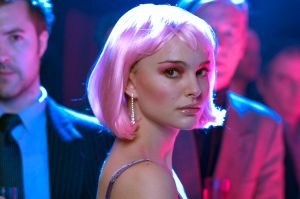 Despite the title, you get no closer to getting to know or understand the characters. It’s really almost a stretch to call them characters because they’re more accurately different positions in an argument. The only characterization Closer has to offer is suffering and inflicting suffering. Closer really has one voice coming out of the mouths of different pretty actors.
The film has the annoying habit of skipping ahead in time and not telling the audience. We’re left to catch verbal asides that time has passed. After a while you’ll get the hang of it simply by assuming that the beginning of every new scene is the start of a new date in time. Closer is nothing but a string of uncollected scenes, usually involving people leaving a lover or starting a new fling. The actors come on, do their part, then they leave and we move on to a different scene. This is not staged as a movie.
The trouble with Closer is that it never really feels like it’s going anywhere. There’s no progression. Sure, couples swap, people get revenge, but the connection of sequences is lacking. The way it is, Closer could have gone on forever. It’s a series of scenes smashed together, not a story that rises and falls and builds to a climax.
Closer is an exploration into the darkness of human behavior starring some of the prettiest actors Hollywood can spare. The story goes nowhere, the ending doesn’t accomplish much, the characters lack convincing depth, but some of the acting is good and there is a ray of intelligence to the film. Fans of the above-the-title actors should enter Closer with caution. It’s a dark film with little to feel good about. Closer is brooding, moody, and probably the first and last time we?ll hear Julia Roberts talk about the taste of semen. Unless, of course, Gary Marshall starts pre-production on Exit to Eden 2: Rosie O’Donnell’s Bondage Boogaloo.
Nate’s Grade: C+


 nathanzoebl
You must be logged in to post a comment.