Blog Archives
Constraint (2019) [PART ONE]
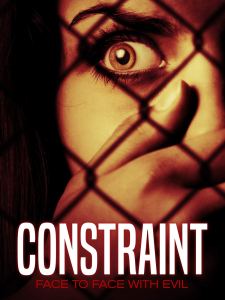 A most unusual thing happened when I was watching the Ohio-made indie Constraint on Amazon Prime; I was so bewildered by the filmmaking choices that I had to stop and begin writing my thoughts immediately on the movie even as it continued playing. This is a rarity, a movie that causes such confusion that I feel compelled to articulate my thoughts in the moment rather than, as I normally do, assessing them upon completion. I wasn’t expecting any of this. Constraint has a very serious subject, sex trafficking, and filmed in my hometown of Columbus, Ohio, which has itself a very serious problem with sex trafficking networks. It starred familiar faces from my other Ohio indie viewings of recent. But then within only three minutes, I had to pause at several points, walk around my room muttering questions to myself, and couldn’t go much further in the movie without repeating this process. So, dear reader, I am going to take you live through this very intellectual and artistic assessment as I continue to watch Constraint.
The plot revolves around Oracabessa (Brooklyn Sabino Smith), a young cellist, who becomes entangled in a web of human traffickers, led by Tuco (Ralph Scott). Other characters will come and go into her orbit but Oracabessa is our guiding point.
Within minutes, I was already starting to question decisions, or practical limitations, exhibited by writer/director/editor/cinematogpraher Richard A. Nelson (The Endangered). Even the opening credits are strange with listing an assistant director before blocks of cast names and then zipping by in a blink as to render their inclusion seemingly moot. Then there was the realization that all of the dialogue sounded like it had been ADR, meaning recorded later and indoors. Not just outdoors scenes, which can be notorious for wind and auxiliary noise, but also indoor settings. Honestly, it made me immediately think of the notorious Mystery Science Theater 3000 high point/low point, Manos: The Hands of Fate, a movie from 1966 where every line of dialogue was recorded after filming and, what sounds like, in a bathroom, and sometimes with one actor providing both voices to a conversation of two characters. Immediately, my mind starts going into formulating some kind of explanation why this might be, what could have led to this, and I’ll fully admit to striking some of my criticisms if they vanish later in the film.
 The editing choices can be jarring and forced me to stop the movie at several points. An early scene, at the four-and-a-half-minute mark, has our lead Oracabessa visiting her boyfriend, Nicolas (Aaron Geib). The camera moves to a wide angle as they settle at a kitchen table. Within seconds there are two jump cuts but they eliminate mere seconds or fractions of seconds of footage. Then there’s a quick cut to an exterior of the apartment, presumably to “clear the edit” and allow a passage of time or at least a new camera angle. Nope, we come right back to the same shot. Why? Why not just start with the shot from after the exterior cut of her passing her drink to him? Why did the previous moments need to be seen? What then follows is a close-up of the food, fully prepared, and the boyfriend has his line entirely off screen. This is the stilted dialogue that follows:
Him: “It’s a peace offering? What are we, at war?”
Her: “Man and woman in any kind of relationship are always at war. It’s just a matter of what degree.”
She then passes by him and it jump cuts (same camera angle) to him responding, then it pans over to her at the other end of a doorway, and then after her line it literally cuts back to his position on the doorway (same camera angle) to walk over to her. What? Why not just pan both ways? She responds and then we have ANOTHER JUMP CUT (SAME CAMERA ANGLE) and then ANOTHER JUMP CUT (YOU GET IT) of her a step forward walking past him, and then ANOTHER JUMP CUT (YOU KNOW IT) of him looking off screen at her. The camera angle then changes, mercifully, to a medium shot (with her head cut off) of her pulling off her ring followed by a different medium shot (with her head now visible) of her placing it atop a bookshelf. We then cut back to the EXACT SAME previous shot of the guy still looking off screen in response. There’s a couple more cuts as she leaves and then the movie jumps into a bizarre montage of images as she’s riding on her moped with a fixed handlebar-POV shot, a closeup in slow motion, and black and white inserts of her presumably as a child.
Ladies and gentlemen, I have no idea what to tell you beyond watch the segment (5:30-6:30) for yourself and join in my mounting alarm and confusion. Even if the production was stuck with minimal camera setups, why jump so haphazardly from moment to moment with jump cuts? Why use pans so sparingly when they could keep an audience in the moment? If the point of the scene is to impart a distance, a lack of engagement in this couple’s relationship, the staging and editing could have better communicated this without resorting to off-putting decisions.
The next moment of curiosity occurs seconds later as Oracabessa attends a very sparsely populated college lecture (I literally counted 12 people in a hall that likely seats 200). Again, the noticeable ADR sound, again the annoying jump cuts, and again confusing choices about the staging of the scene. The professor is arguing over reparations and there’s a moment where it cuts to a black and white still image of the professor and then cuts back to her talking. Is this an Oliver Stone movie? A (white male) college student protests he shouldn’t have to pay for his ancestors’ bad deeds and gets into a fight with another student, but the majority of the crowd shots are taken from one very wide angle. When the students confront one another, the camera doesn’t move, doesn’t get us closer, and they just occupy a small portion of our screen, which then cuts to another exterior shot and back to the same interior angle again. I’ll accept that the professor, and the older man monitoring her teaching, were filmed at a separate time and cut to look together with the crowd of students. I get scheduling shortfalls, but why make it all the more apparent to your viewer? Why film in a way that highlights how empty the space of this lecture hall is? Why shoot with such static angles? And why again do we get so much weird edits that break up the flow of the scene? Reader, I am only eight minutes in.
I just counted six edits and three different camera angles just to capture Oracabessa copying a paper on a copy machine. It’s a twelve-second scene which raises the question why multiple camera angles were needed to simply convey she copies something and why we needed twelve seconds on this task. I am just completely bewildered by the editing choices of this.
Credit where its due, the investigation scene of Oracabessa looking through old microfilm at the library on missing person reports is the place where jump cuts and rapid edits are beneficial. The black and white flashback is confusing though whether it constitutes the events that actually happened, seeing a young woman and little boy somehow separately being stalked by an unseen driver in a car regardless of the fact that they’re walking in opposite directions, or whether it’s Oracabessa’s imagination playing out over what might have taken place.
The movie then seems to transition its protagonist, switching to Alice (Maya Sayre), the mother of the missing boy, who is identified via a subtitle at the bottom as if this was a documentary subject. She seems to be sitting in a coffee shop with a stack of missing fliers and… signing them? I don’t know. There are more quick cuts of things like a closeup of a teacup and then Alice sitting alone at a park. The trees all around her have missing posters of her son tacked on, which starts to beg the question of why put it on twelve trees in close vicinity to one another unless Alice has an endless supply of disposable money for unlimited copies or really hates trees. She is literally posting the same flier within mere feet of one another.
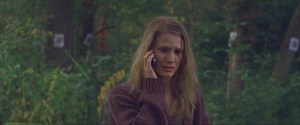 Here, finally, is an example I can praise for its filmmaking choices. Alice is postering the neighborhood when the bad trafficker Tuco then pulls up to her in his car and says, “Oh, your son is missing?” As he asks about her circumstances, the camera hangs on Sayre (One Dollar) to deliver the moment with her performance and it works. It works because the camera allows us to stay in the scene and because of the trust in the actors. She’s heartbroken but still unable to fully articulate her grief, and it’s a beautifully acted moment of desperation. She even looks like Jessica Chastain in certain angles, especially profile. When Tuco walks up to her, the camera angle remains the same but to the benefit of the scene this time, as his size towers over her, dwarfing her, his head cut out of the frame, his arm thrown around her shoulder, providing potential comfort or potential constraint, and we already fear for her safety. She invites him into her home and they have a nice talk, with Alice lamenting how people are no longer kind. The irony seems to be building, and finally Constraint feels like a movie with purpose.
This is legitimately a good scene as Tuco vacillates over what to do with Alice. Her dubbing him a gentleman seems to dial up his sense of shame and he leaves for another room where we see him take out his gun and then put it back. Will his compromised sense of morality win out? Even the clipped framing helps this case by placing the emphasis on Scott’s hands and the gun. Their conversation lingers and the camera continues running, and that’s how to drive tension. Unfortunately, her horny desperation to get him to stay and the weird song that plays in the background as if they were trapped in an elevator undermine the scene’s suspense.
More bizarre editing choices as the scene of Tuco talking with a crony literally jumps from a super wide shot to a closer shot as they trade lines. It makes me think of the Sesame Street bit where Elmo demonstrates near and far. After several more erratic edits, the film leaps to a shot of Tuco waiting in his car, but it’s being filmed from an angle where a pole or pillar is obscuring his very face from being seen on camera. Why choose an obstructed view of this? Even more baffling, a minute later the movie indicates Oracabessa is observing Tuco kidnap another young woman and throw her in his car and drive off. And. Oracabessa. Does. Nothing. Not even call the police, try and yell back and create attention, even jot down a license plate number. Perhaps she wasn’t literally viewing this spectacle, but when you cut to her walking in what looks like the same setting as this is going down, then you’re going to convey this interpretation to your audience.
A stranger who has been hardcore eyeballing Oracabessa as she played cello for some little ballet dancers stops her on the street. He compliments her playing and then leans a hand out and says, “May I?” and then bizarrely strokes the side of her face. “Your face is flawless,” he says in an accent that invites imitation, all while gripping her face. “It is like glass. Like caramel-colored glass.” Why is she allowing this creeper to continue doing this? This is even before he says he’s a music school bigwig and think she has real talent. Does this woman have any sense of self-preservation? The characterization for her doesn’t make any sense from scene to scene.
 There’s another flashback where she recognizes Callie (Jennifer Ann Hickey), the female partner for Tuco, and that she had the missing boy beside her in the same car Tuco was driving. Again, is she imagining this and trying to connect mental dots (it’s played in a kind of black and white) or did this happen, which means that yet again she should have recognized Tuco as he was abducting a new girl in front of her. Then I laughed out loud when the camera does a sudden zoom into Tuco’s car followed by a close-up of Callie turning to face the camera and glaring. I thought Tarantino’s Kill Bill music was going to commence. Does Callie somehow recognize Oracabessa too? She starts running away, and again this is an opportunity for Oracabessa to call the police or write down Tuco’s license plate number, and she does nothing, eventually fleeing herself.
The editing proceeds as follows: Oracabessa is on the run. We hear a classical music piece to note the tension. We then see Tuco’s car trailing Oracabessa. Inside Tuco’s car, the same classical music piece is playing but noticeably softer, trying to imply the music is diagetic to the car radio? Then we cut to a hand on an acoustic guitar and a young woman singing at a party, which also seems kind of like an attention-grabbing thing to do unless the party is centered upon your performance. It’s only revealed later that Oracabessa is at this party. The same professor from earlier asks to dance with Oracabessa and literally holds her hands and barely sways, like a child’s idea of what slow dancing would be. This same professor then admits to inviting Oracabessa’s ex Nicolas and then says to dance with her. All of this is the same shot too. Nicolas then hovers over Oracabessa, butts into her dance, and then they awkwardly stand next to one another without saying a word for thirty seconds, and then the other dancee comes back. What?
The movie jumps perspective again, this time following the ex Nicolas, who goes home and sits on the bed he and Oracabessa used to occupy. There’s a post-coital flashback, which features Smith nude, and I felt protective of the actress, like she shouldn’t have to get naked for this. There’s even more stilted dialogue between the pair:
Him: “In every great love affair, you gotta have a nickname. Yeah, I gotta come up with a nickname for you.”
Her: “I detest nicknames. They’re arbitrary.”
Him: “Naw, your birth name is given before your personality has time to develop. A nickname is usually based on a personal trait.”Her: “It’s an intimate thing naming a person.”
Him: “Well… I think you’re a… ‘Saffron.’’Her: “Why Saffron?”
Him: “It’s got a malevolous ring to it. And you with your angular edges. I gotta name you something pleasant, right?”
Oh my God, people do not talk like this, at least the people of Earth. This scene could have been cute and a snapshot of their better times as a couple but now it just makes whatever they had feel even more bizarre. The dialogue is very unnatural throughout Constraint and reminiscent of something I would find in a Neil Breen movie, and it pains me to make that comparison.
 Another guy, Derrick (Kenyatta Foster), is also interested in Oracabessa and having a flashback of falling for her, and why am I seeing any of this? Her anecdote about “sympathetic vibrations” from a cello is actually a well written aside that she can explain her dating goals with, but it’s hobbled by the guy just leering over her: “I can give that to you baby, you just have to see.” He goes for the kiss and she consents, which makes me question whether she cheated on her now-ex-boyfriend or what the timeline was for this, or even whether this might just be in his head. I do like that it cuts from him kissing Oracabessa to him kissing the professor, and he’s clearly not into her. That’s an honest-to-God clever editing choice and better conveys the character’s response.
So many jump cuts, so much day-for-night shooting, so many confusing geographies, so many quick exterior shots after spending time indoors just to cut back to the same indoors, and now even more nudity from our lead actress with a gratuitous shower scene. This woman deserves better.
Tuco has somehow tracked her though we have no idea how and hidden in her closet. Instead of killing her when she was in the shower, to avoid the Psycho homage I suppose, he waits until she’s performing her cello. They fight and she beats him with her cello and uses the bow like a riding crop. Yet she doesn’t call the police after nearly being stabbed by an intruder, when the assailant’s weapon is still there, as well as his blood, for physical evidence. Tuco comes back but she has a few intimidating dudes standing around as a posse. Then we cut to ballet! Why? Is the threat over? Why does this guy even see Oracabessa as a threat considering she’s never reported him? How did he find out where she lived? Her apartment looks like the interior of a school. How is any of this adding up to the larger narrative? I am just so lost with the creative choices here.
I’m actually going to turn this review into a multi-part series to make it more digestible for you, dear reader, so thus concludes PART ONE. Read PART TWO.
Share this:

Among Them (2019)
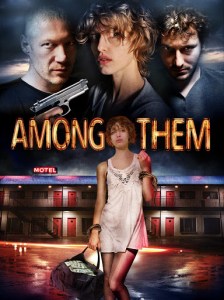
Among Them was described in its advertising as “Tarantino meets Bad Times at the El Royale,” and ignoring the fact that Bad Times is itself a colorful Tarantino-styled homage, what I was really reminded of was Waiting for Godot. For those unfamiliar with Samuel Beckett’s existential play, it follows two gentlemen who do nothing much more than waiting for a man named Godot who never shows up. They get involved in philosophical discussions, and many have intuited that Godot is a representation of God, to Beckett’s dismay, but it’s really a two-act play that involves a whole lot of waiting and the question over why. This is the extent of Among Them’s 90-minute total – a lot of waiting and a lot of questions over why bother.
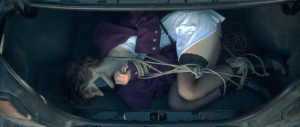
Two bank robbers, Mick (Dan Liebman) and Harry (Jonathan Thomson), are hiding out in a motel room off the coast. Their bank heist has gone wrong and they’re awaiting the proper papers to escape overseas under new identities. They also discover a woman, bound and gagged, inside the trunk of their getaway car assigned to them from their bosses. Syd (Evalena Marie) could be a liability and they need to make sure she doesn’t get them caught.
The problem with the screenplay by director Kevin James Barry (Serena and the Ratts) and co-star Marie (Dark Haul) is that it has conflated being vague with the idea of being mysterious. There’s far too little going on in this story and far too little that makes much sense. Our criminal duo is following instructions to lie low at a motel. That’s it. They don’t really know who they’re working for, what those plans might include, and so they wait for some unknown source to finally give them their new passports to escape from the police. Being kept in the dark with your characters can be a benefit for storytelling because you are forced to think things through at the character’s level, which works nicely for paranoia thrillers and mysteries. However, when you don’t put in the necessary work, it just makes the story feel unfinished and pointlessly protracted.
I can clearly see the Tarantino elements that the filmmakers attach to Among Them, the bank robbers hiding after a job gone wrong, the kidnapped character becoming part of the team, the motel that might not be all that it appears to be, but these are just elements. What’s desperately missing from Among Them is the intricate plotting and superb characterization one comes to expect from a QT joint. If we’re going to be stuck with these characters in a confined setting, then we need either intriguing developments or engaging personalities that draw us in. Well, considering the story involves characters just waiting around a motel room and seeing weird ghostly visions, plot development isn’t going to be the winner. This is really where Among Them creates an artistic ceiling for itself with its bland characters who we’re stuck hanging around with. Neither Mick nor Harry are charismatic, interesting, or even that dangerous. There aren’t even that many differences between them. If you’re keeping characters cooped up, it would be smart to have some sort of interpersonal conflict that threatens to boil over and ruin things. Think about From Dusk ‘til Dawn and Tarantino’s character and his creepy fixation on an underage hostage, or the different agendas in Bad Times. Just because the characters are seemingly losing their minds doesn’t replace dynamic and necessary characterization.
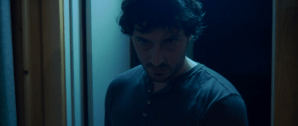
This brings me to the character of Syd, whom I do not understand at all. She’s discovered in the trunk of a car that was designated for our bank robbers. You would naturally think this woman either means something important enough to be captured or presents an intriguing enigma. This is another consequence of keeping everything so overwhelmingly vague. The characters don’t seem too bothered to learn more about her and why she was placed in the trunk of their car, which just seems like a criminal lack of curiosity on their part. Even worse, Syd doesn’t seem too interested herself why she ended up in somebody’s trunk. I figured she would want to run away at the first opportunity, but she doesn’t, and instead just hangs around with the guys, eagerly volunteering to help on their “spy missions.” If her perspective was going to be off kilter, then this could have opened up the character more, making her a wildcard who could take things too far, perhaps provide a dangerous threat to the characters achieving their goal, something. The fact that a bound stranger is gifted to them and they don’t have to thwart her from escaping feels bizarrely wasted. Why even bother with this scenario if nothing is to be done with it after twenty minutes?
Among Them fills its meandering runtime with unexplained supernatural imagery and dream sequences, which don’t so much convey the unique emotional trauma of the characters as it does serve up conventional spooky imagery and pad the running time. I held on waiting to see if there would be a viable explanation for everything, and I was left waiting unfulfilled, much like the main characters. I think the filmmakers were trying to get the audience to doubt what they watched, and show the characters are descending into madness, but it also doesn’t quite work. There isn’t an escalation for them. They don’t seem more unbound as things progress. These eerie visions don’t lead them to make drastic choices, though the movie comes close. Therefore, it just feels like a supernatural presence is messing around with people in a vague and unsatisfying manner because it, too, must be bored. It feels like weird things are happening to goose up a narrative that doesn’t have enough conflict or engaging characters.

From a production standpoint, Among Them looks relatively solid for a low-budget thriller. Having a limited location works for an indie production and the director seems to use every part of his space to keep things from getting visually dull. The acting is overall decent with the standout being Marie as a frightened victim who becomes the most interesting character among the three. Another actor worthy of note is Michael Reed (Chupacabra Territory) as the creepy motel clerk who is, from the get-go, clearly hiding something nefarious about his intentions.
Among Them is a fairly pedestrian thriller that had potential to be something more but is trapped by a stunning lack of imagination and intrigue. There are questions to be had and mysteries to be uncovered, but the subsequent supernatural twists and turns amount to distractions. The screenplay is absent memorable characters with complexity, conflict, and even colorful personalities to make spending all this free time with them something other than a chore. I never really knew what was happening and the characters didn’t seem too eager to find out either. Among Them is more a listless experience than a painful one, a tale that doesn’t ever seem to get started despite some surefire story elements just sitting there. If you’ve ever wanted to watch a disappointing 90s indie crime version of Waiting for Godot, then Among Them is chief among them.
Nate’s Grade: D+
Share this:

The Gentlemen (2020)
 I’ve been hoping, wishing, praying for Guy Ritchie to return back to his screwball Cockney crime pictures of his splashy beginning, but the further and further I get from 2001’s Snatch, the more I think it’s a luxuriously madcap exception. The Gentlemen is a closer return to form than 2008’s RocknRolla, but it’s still a long way off from early Ritchie. The recognizable elements are there, from the convoluted story with twists and turns, the non-linear storytelling lapping and overlapping itself, the comical brushes with sudden violence, the colorful array of criminal characters, and a sense of style that seems all over the place. We follow Matthew McConaughey as a marijuana titan looking to get out of the business, though there are threats old, new, and “just business” that are trying to take his empire from him before his exit. The biggest problem with The Gentlemen is how clever it feels like it needs to be and how few characters there are to find interesting. Snatch, by contrast, forever contrast, was practically a Dick Tracy rogues gallery of all its memorable and unpredictable characters. These feel pretty rote, even our heroes, and the minority characters get even shorter shrift. The plot is also more complicated than it needs to be with an extended meta-textual layer of a lecherous Hugh Grant tabloid journalist pitching the story like it was a movie (irony: it is a movie!). It took maybe 45 minutes before I felt like the story was finally picking up momentum and stakes, and by the end, it felt like Ritchie was just extending his story with another twist and wrap-up, and then another twist and wrap-up, like the outer edges of the movie cannot be contained and somehow it’s still even going. It’s like Ritchie doesn’t know when to walk away from his own party. Because of these things the pacing is wonky and there are more than a few tedious stretches. Colin Farrell has some amusing moments but should have been the main character as a boxing trainer who takes a shine to try and reform local hoodlums. McConaughey’s character is too boring and always wins too easily, which makes him more boring. The Gentlemen is a C-level rendition of Ritchie’s best material, and Snatch only shines even brighter with each new miss.
Nate’s Grade: C+
Share this:

Les Miserables (2019)
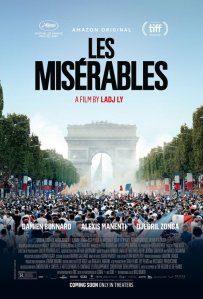 I can’t help but feel that France made a mistake when they selected their official entry for the 2019 Oscars. Les Miserables is a perfectly fine, if not good, cop thriller with a social urgency bubbling under the surface to provide added depth, but it’s no Portrait of a Lady on Fire, which was sumptuous and one of the best films of the year. Regardless, this movie follows a new officer on his first day transferred to his new unit in the ghettos of Paris where his experienced partners have harassed the mostly Muslim immigrants to the point of simmering community resentment. Then, in the middle of a pitched crowd of kids fighting the officers, an accident happens, the incident is recorded via a drone camera, and different factions are racing to get a hold of that footage and its inherent leverage. Les Miserables has a docu-drama cinema verite visual approach and plenty of authenticity in its details of beat cops, a minority community under surveillance and mistrust, and the corrupting influence of power. It’s an efficiently made thriller with some potent drama. However, it takes way too long to get going. That drone incident doesn’t happen until an hour into the running time, beyond the halfway point. Until then it’s setting up the various characters and grievances and starting to test our new transfer with how comfortable he will be accepting the borderline behavior of his fellow officers. I really felt like once the drone incident hit the rest of the movie would be off like a shot, a race to the finish, and it’s just not. It concludes too quickly and then introduces a revenge assault that made me yell loudly, and profanely, at my TV when it faded to black without any legitimate ending. I think writer/director Ladj Ly is going for the ambiguity of whether or not these characters are in their “corrupt” and “lost” boxes that society has forced them into, whether they will have their humanity stripped away to become another statistic in an ongoing struggle, but I don’t think a non-ending helps his cause. It makes the movie, already feeling misshapen in structure, feel incomplete. Ending on a quote by Victor Hugo is not the same. Les Miserables is a finely made thriller but at least Hugo’s version had an actual ending.
Nate’s Grade: B-
Share this:

She’s Just a Shadow (2019)
 Film is a powerful medium but it’s also one where it seems an infinite number of people are ready and willing to debase themselves just to be part of a production, just like there seems to be an infinite amount of people ready and willing to use their perch as filmmaker to exploit, particularly, young women that normally wouldn’t give them the time of day. I don’t dislike exploitation cinema on its face. I enjoy crazy movies, bad movies, and movies replete with sex, drugs, and violence as much as the next guy. The problem is when the exploitation is for its own shallow sake. Such is the case with the repellent She’s Just a Shadow from writer/director/producer Adam Sherman, whose scuzzy aim seems to be a lower-rent Harmony Korine, who is a lower-rent Larry Clark, all face down in the trough of skeevy exploitation cinema runoff. This may be the kind of movie only a disaffected 12-year-old kid would love but you wouldn’t want to get to know that child.
Set amid the glamour and grime of Tokyo, we follow Irene (Tao Okamoto, The Wolverine), who informs us in her opening narration, “It was kind of confusing how I took over the black market and sex trade of the whole city.” So, off to a good start. She’s married to Red Hot (Kentez Asaka) who is looking to gain new turf for his drug empire and stomp the competition, which happens to be a grade school friend of Irene’s that causes him intense jealousy. Gaven (J-pop star Kihiro) is tired of his rich gangster playboy life and torn between his feelings for two prostitutes, Tanya (Karuka Abe, Kiss Me First) and Beth (Mercedes Maxwell, Marfa Girl). He wants to run away with Tanya but just can’t leave his cushy lifestyle. Really, the plot of this movie is: whatever character does copious amount of some drug while naked women cavort in foreground or background. Plus there’s a serial killer. That’s it.
 The opening sequence sets the tone for this repulsive TWO-HOUR experience. A woman is hogtied, naked, and laid onto train tracks. Her abductor records her panicked muffled cries as one of Japan’s bullet trains approaches. Yes, it’s a twenty-first century film where a villain straps women to railroad tracks. However, that’s not edgy enough, so the abductor proceeds to masturbate to the woman’s terror and climaxes on her, which we see, before she gets smacked by a train. It’s a gross, sleazy, and gratuitous opening, and it sets the tone for a movie that never challenges itself to be anything more than the world’s most boring exploitation film.
You can clearly see Sherman’s interests in exploitation film staples and Japanese culture, but getting to play with your kinks and getting dozens of women naked does not a movie make. It feels like I’m watching some strange and off-putting project that’s a combination of a rambling, incoherent student film and personal pornography. I’m a red-blooded heterosexual male who enjoys nudity but She’s Just a Shadow is excessive to the point of boredom. The movie is almost two hours and I can literally count on my two hands the number of minutes that did not include some naked woman. Scene to scene, naked women will just bounce around, or sometimes they just lay around while other characters talk, serving as literal scene decorations. There’s a big glitter orgy and visuals of writhing, tawny nude bodies. There’s a full-frontal photo shoot that just goes on and on. There are multiple trips to a strip club. The gang of prostitutes are dressed in chunky Alice in Wonderland-style Gothic dresses and wigs and jewels glued to their faces. I looked it up and several of the minor Japanese actresses are real porn stars (no judgement). The objectification of the women is just so overpowering. It’s not that you can’t tell a compelling story with sex workers as the primary stars/perspectives. Sherman has not provided them the material because they aren’t characters; they’re barely people (more on that below) in this realm. They’re disposable fetish figurines meant for posing. This is like some horny teenage boy’s fantasy of having enough power to get a bunch of women to frolic to his specific demands. I counted the number of actresses listed under “prostitute” in the end credits and it’s 32!
 Exploitation movies trade in base behavior, memorably outrageous characters, and fans celebrate them for it, but they still need to provide an entry point for an audience. She’s Just a Shadow is trying so hard to be edgy in every scene that it reeks of tragic desperation. It’s unrepentantly misogynistic and trashy and ugly and cruel for its own stupid sake. There are no characters of interest, no recognizable people to follow and empathize with, and Sherman’s idea of a Strong Woman amounts to an abused woman forced to do awful things to fit in or rise above awful people. Crime movies and exploitation cinema is rife with immoral characters but the filmmakers know well enough to make them worth watching. With She’s Just a Shadow, one of the biggest character’s entire arc is that he keeps saying, “Man, I can’t party anymore.” He has a life of empty luxury and he says he can’t handle it any longer, and yet he stays. The lead characters are supposed to be ferocious criminal leaders but they act like self-involved morons or cartoons. They have (nick?) names like Red Hot, Knockout, and the competing gangster, Blue Sky. There is one moment that is so incomprehensible in its insane nihilism that I was gob smacked. In the span of ten seconds, a character roundhouse kicks a kid in a wheelchair across his face, then punts his dog over a fence, and then gets plowed into by a speeding truck. If you needed confirmation, here it is that Sherman has contempt for his unfortunate characters.
The heavy-handed nihilism is so tiresome and is its only trick. Sherman is forced to resort to repetitive shock theatrics to jolt life into his movie because it’s such a floundering story. There’s one scene where Tanya is eating an ice cream cone, digresses about how her drunk father was so poor he could not even afford an ice cream cone, then discusses how she was possibly molested and raped by that same father, and now he’s dead, mom too, and then she smears the vanilla ice creams over her face and asks, “Will you lick the ice cream off my face?” Then there are close-ups of Gavin’s tongue lapping every morsel. What the hell is this scene even doing?
The lingering serial killer is the biggest symptom of this diseased thinking. The “Train Track Killer” is seen murdering a half a dozen naked women in his signature over-the-top style, and why do we need to see this half a dozen times? Are we gaining any further insights about this man? The police can’t seem to determine the identity of the culprit, but in this universe not a single train employee or passenger records evidence of a weird man standing beside a dead body. The serial killer poses as a cop but most of his screen time is spent spying on Irene’s prostitutes, and hacking into their electronic devices, and masturbating furiously. I suppose there’s a mystery of whom he is, not that his identity matters, but it does matter to Irene and her girls who are at risk. Halfway through the movie, Irene knows who this guy is and… she… does… nothing. Why? Eventually, at the very end of the movie, she does take a stand, but why didn’t she take the initiative an hour earlier? There are more women dead because she chose not to act. The “Train Track Killer” adds nothing of genuine value to this story. He’s a slipshod antagonist kept along the periphery, called upon to do something horrible at random times, yet his actions have no impact on the characters he targets. Under Sherman’s guise, the women are all disposable. This is a stupid character that has nothing to do except provide work for the newscasters (who report with the same microphone and obliviously within feet of speeding trains). Let this terrible man’s spiteful ejaculation in the opening scene serve as a metaphor for the entire enterprise.
 She’s Just a Shadow has so many bizarre, ineffective, and pathetic examples of headache-inducing dialogue that I had to assemble my favorites. I asked my friends on social media what the best-worst example of dialogue is, and by a close margin they went with the first selection. The candidates for Worst Line of Movie Dialogue of 2019 are the following:
1) “Women! No matter how human they seem, they are just shadows. But on the other hand, aren’t we all?”
2) “This sandwich is cold and raw AND SO ARE YOU!” *hangs up phone*
3) “There’s two kinds of love: strawberry love and Twinkie love. A Twinkie can sit there for decades and still be sweet. A strawberry is juicy and sweet but if you leave it out it will rot in just a couple of days.”
“Only a prostitute would say that.”
4) “Everything goes away in the end. Love goes away in the middle.”
“Love is a thing with feathers.”
5) “You’re a man whore. A prosti-dude.”
The production has some merit when it comes to its Grand Guignol primary-color drenched photography, but anything of technical value is quickly extinguished by Sherman’s unrestrained penchant for gratuity. Even if you enjoy some of the visual arrangements, there will be scenes where it feels like they were running out of time and just threw a camera onto a tripod and got the first take. Even if you like some of the style, Sherman will indulge to the point of self-parody. There’s one moment where Irene’s girl gang and a rival gang standoff and Sherman has 14 seconds of shots of characters just drawing their guns (I actually counted) and no seconds of watching the actual shootout (the camera frustratingly pans away to hear the off-screen gunfire). Let that be an example of Sherman’s predilections and priorities, featuring women posturing in his fetish gear but, when it comes time for there to be stakes and story significance, the movie cowardly retreats. I haven’t even talked about the numerous other awkward moments. Red Hot rapes Irene twice, once after spanking her/beating her with a laptop, and a second time after stabbing her in the thigh. Gaven badgers a dying and profusely bleeding prostitute (it’s like the floor is painted in gory gallons) about whether or not she can see God in her final moments, and she requests a kiss that is followed through with a string of bloody saliva between their lips. The earlier shot didn’t even have this string of saliva, but then Sherman shows another take immediately after, because he definitely wants this string of saliva seen and processed. It means something. Or nothing.
 To say She’s Just a Shadow is in bad taste or a waste of anyone’s time is an obvious understatement. This is a bottom-scraping bad time of a movie, soaked in various bodily fluids, gruesome for the sake of being cool, smothered by its wanton excess, and supported by one-dimensional ideas of characters that are really just opposable bodies miming the exploitation influences for Sherman. He feels disdain for all of these characters but especially the women who are fetishized, objectified, abused and harassed, and made to sadistically suffer. I felt bad for every person, especially the women, involved in what feels like Sherman’s student film project where he gets to tickle every personal fetish he’s ever had. Even watching the stream of flesh and violence grows utterly tiresome without variance or reasons. At one point, a call girl stumbles into a double suicide, blood splattered against the walls, and seems to be talking directly to the audience when she huffs, “This is the stupidest fucking thing I’ve ever seen.” You said it, sister.
Nate’s Grade: D
Share this:

Queen & Slim (2019)
 It’s been a couple weeks since I watched Queen & Slim and I can’t get it out of my mind. It’s billed as a modern-day Bonnie and Clyde, and while that description is technically apt, it’s more a frighteningly relevant thriller about police brutality, the skewed criminal justice system, and the hairpin-turning horror of daily life as a black person in America. A first date between Queen (Jodie Turner-Smith) and Slim (Daniel Kaluuya) goes awry when they’re pulled over by a racist trigger-happy cop and, in the ensuring struggle, Slim shoots and kills the officer in self-defense. They go on the run trying to escape one setup after another, all the while during this hellish ordeal the characters are growing closer out of reliance and a budding sense of romance. This is a powerfully intense movie with several supremely suspenseful sequences where I worried deeply whether or not the titular pair would be found out, could escape out of a jam, and all the while the authorities are getting closer and closer. They become folk heroes for a community familiar with the oppressive day-to-day of always being seen as a suspect, as “up to no good,” as presumed guilty and dangerous. There are a couple questionable moments later in the film involving the pair as inspiration where I wish the film had perhaps been a little less ambiguous over what I’m supposed to draw. The screenplay by Lena Waithe (The Chi, Boomerang) is cannily crafted with a strong sense of how to develop its premise, deepen it with larger themes, and throw organic obstacles at the characters. I was impressed with how quickly the movie would crank up the tension of a moment, but these thriller aspects never felt cheap or superfluous. The characters do not get lost to the overall plotting machinations and the performances from Turner-Smith and Kaluuya are terrific. Director Melina Matsoukas (Insecure, the soon-to-be release Y comic adaptation) has such an affecting manner with her camera and, in particular, the moody lighting that can express a range of feelings from anxiety or sensuality. The ending of this tale might be expected but that doesn’t take away any of its inordinate power, an ending that has stayed with me and shaken me for days. Queen & Slim is a character-driven chase film that manages to also touch upon powerful social themes, taking a mythic story and making it personal, relevant, and, in a new manner, timeless.
Nate’s Grade: A-
Share this:

The Irishman (2019)
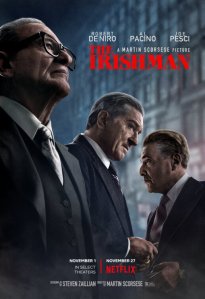 In 2018, Netflix crashed through Oscar biases with Alfonso Cuaron’s personal epic Roma and this year they have their sights set on even bigger prizes. The streaming service has built an empire of original content (and debt) and put up the $150 million budget for Martin Scorsese’s decades-spanning crime drama, The Irishman. It’s a fitting reunion for Joe Pesci, Robert De Niro, and Scorsese, and then to add Al Pacino on top, well it all makes for one supremely entertaining and occasionally striking movie experience. However, I think some critics are getting a bit too carried away with their plaudits. While entertaining throughout its mammoth 3.5 hours, this is much more Casino than Goodfellas.
We follow the life of Frank Sheeran (De Niro), a Philadelphia-based truck driver who rose to be a Teamster union rep and, reportedly, a prolific hired gun for the local mob, headed by Russell Bufalino (Pesci). Sheeran is tasked with helping Jimmy Hoffa (Pacino) with his business, which helps the larger contingent of organized crime that used the Teamsters multi-million-dollar pension as their own slush fund to pay for projects and schemes. After he loses his leadership position, Hoffa begins to think of himself on the same level as the tough guys and just as protected. Sheeran tries to turn his friend back from the self-destructive path he seems destined for, and ultimately, it’s Frank Sheeran who says he pulled the trigger killing Hoffa (is this a spoiler?).
 There are moments that just sing in this movie, buoyed by a wonderful film alchemy of the actors, the storytelling, the skill of Scorsese and his longtime collaborators like editor Thelma Schoonmaker, and it can feel exhilarating. There’s a rich world of day-to-day detail from the character interactions and mob politics, and once Hoffa comes onscreen the movie becomes something more and better. It’s just as much Jimmy Hoffa’s movie as it is Frank Sheeran’s. Here is a live-wire character bursting with unpredictability, later to his great deficit, and who pushes the other characters around in a way that creates instant tension and realignment. Considering the selling point of the movie is its perspective from the claimed killer of Hoffa, it only makes sense that these moments are allowed the most attention. Hoffa sees himself as a champion of the little guy, as an ideologue trying to make life better, never mind his own extravagance, ego, and inability to let go of grievances. Hoffa was the head of the Teamsters union for twenty years and was a well-known public figure, somebody people like Peggy Sheeran (Anna Paquin) could idolize unlike her father and his other cohorts she despised. He’s a larger-than-life figure and those theatrics find a perfect match with Pacino and his bombastic nature. It’s no wonder he steals the movie. Pacino is terrific and has the clearest arc of any character onscreen, a meaty role that gives Pacino new life. I predict he’s the front-runner for supporting Oscar gold. I was transfixed by the amount of details that Scorsese and screenwriter Steve Zallian (The Girl with the Dragon Tattoo) imbue in every scene, propelled by Frank’s narration and a dark sense of humor. It’s very easy to get immersed in this criminal underworld and its many machinations, which provides a steady stream of information points to tantalize. If one scene isn’t working, just give the movie a few minutes and another avenue might open to prove newly fascinating. It makes a difference on its running time, making 3.5 hours feel more mercifully like 2.5 hours. Of course, once it’s released onto Netflix, I feel like its size and scope will become less unwieldy for viewers.
Because of that surfeit of detail, I think The Irishman would have better benefited from being adapted into a miniseries than as a single movie that happens to be 15 minutes longer than Titanic. The finished film feels rather episodic, like three movies attached into one; the introduction into a life of crime and rising in the mob, the friendship and fall of Hoffa, and the finale as an old man. All of these segments have genuine interest and compelling drama but I think they would have been even more compelling with a larger narrative canvas to play out upon. That way each episode could have its own beginning/middle/end and play its part adding to the larger whole, which is essentially what scenes should be doing anyway for a story. The problem is that The Irishman gets a little lost in its own minutia in the middle and the plot stalls. It feels a little too taken with itself. It feels like we’re experiencing the same information just in more settings. How many moments do we need to show Hoffa pushing away sound advice, making enemies of allies, and dooming himself? Admittedly, the Hoffa portion of the movie is the most compelling, and longest, segment of the movie. It’s the best because of Pacino’s spotlight and from the personal involvement in Sheeran, pushing his loyalties to the test when he genuinely grows close to Hoffa and realizes he’ll be the one that has to eliminate his friend. It’s the most dramatic and harrowing and most interesting part of the movie (and no, not the somber final 30 minutes). I think it would have had even more punch over the course of multiple episodes of material and momentum. By going the miniseries route, the film could have also stripped its second and entirely unnecessary framing device, having the men drive their wives across the Midwest to attend Bill Bufalino’s (Ray Romano) wedding. The short scenes fail to lead to any import until it’s revealed late what also happened during this fateful weekend. It’s a long wait to justify its placement, and even after that it doesn’t feel like the occasional road trip updates were worthwhile.
 Much has been made from several dazzled film critics and online pundits about the movie’s concluding half hour, which follows the “after” of a mafioso’s life. We got a taste of this in the conclusion of Goodfellas after Henry Hill and family were relocated to schlubby mundanity through witness protection, implying the boring life that awaited, but The Irishman dedicates its conclusion to demystifying these mob men. Few of them live to old age, so already Sheeran is the exception (he died at age 83 in 2003) but he’s also incapable of introspection. That gives the final half hour a change of pace and an air of contemplation but it’s stagnated. Frank’s family wants nothing to do with him, everyone from his earlier life has passed away, and he shows little regret for his life’s actions, shocking a priest, his only regular visitor. I suppose one could surmise the self-deluded and sad existence of this man who refuses to accept accountability, but I found this final thirty minutes to be interesting, yes, but far from revelatory. I think critics are doing a fair amount of projection by searching for some kind of tidy, accumulative meaning, as if Scorsese is providing some wise, decades-earned statement on his own famed works highlighting the flashy lives of very bad people doing very bad things. People are a little too desperate for The Irishman to provide that neat hook, that definitive statement, and it’s just not there. It may have been too “movie land convenient” but I was begging for a final confrontation from Peggy.
The de-aging CGI is the source of much of the film’s gargantuan budget, which was why studios balked before Netflix welcomed Scorsese with eager arms. The first display of the de-aging effect is jarring and jarringly bad. We see Pesci and De Niro as 40-year-old men and it’s initially horrifying. The effect looks wrong, like somebody drew over their faces to provide some degree of cell-shaded dimension (think of the video game Borderlands). There are also elements that will just never look right, namely the elasticity of the skin, which looks overly smooth and polished, reminding me of the doll faces of the stop-motion film, Anomalisa. It gets better from there. Interiors and lower-light environments are better at masking the unreality. After a while you simply grow accustomed to it and the characters are aging anyway, which means the effect is rarely used after the first half of The Irishman. It’s impressive at parts but even with the digital facelift, these are still 70-year-old men moving their 70-year-old bodies with new shiny faces. There’s a moment when a younger Sheeran beats and stomps on a grocer and it reminded me of professional wrestling with the stiff movements of one participant followed by the extravagant physical overreaction of the recipient. Captain Marvel is still the champ at actor de-aging.
 There’s also the fairly strong possibility that Sheeran made all of this up. Well into his twilight years, he reportedly recounted his amazing tale to a medical malpractice lawyer before he died, and that became the 2003 book, I Heard You Paint Houses. An August 2019 article by Slate.com writer Bill Tonelli (“The Lies of the Irishman”) gives a pretty thorough rundown of the facts of the case, which align in one direction. All of the FBI agents during Sheeran’s time, as well as the local officials, and surviving criminal actors, all come to the same conclusion that Sheeran has grossly overstated his role in mob matters and outright fabricated his most sensational claims. According to Tonelli: “Most amazingly, Sheeran did all that without ever being arrested, charged, or even suspected of those crimes by any law enforcement agency, even though officials were presumably watching him for most of his adult life. To call him the Forrest Gump of organized crime scarcely does him justice. In all the history of the mafia in America or anywhere else, really, nobody even comes close.” It does seem far-fetched, but the next question is whether the enjoyment of the movie matters at all if the story it’s based upon is ninety-nine percent hooey? While I think the impact of the movie is slightly blunted with a fictional account, it plays larger into a self-aggrandizing theme and the first framing device of the movie, having Sheeran narrate his life experiences as an old man, left to rot in a nursing home. Perhaps he’s exaggerating to make himself feel more important and grant himself something of a legacy that is denied to him by a lifetime of self-serving choices that have left him abandoned by family. In this regard, there’s a strange meta-textual level that even helps support the larger tragedy and loneliness of these men, in case you needed it underlined.
There’s a delightful feeling of getting the gang back together for Scorsese’s massive, ambitious, and thrilling return to the world of gangster cinema. There are so many characters that it can be hard to keep things straight as we zip through decades, de-aging, framing devices, Boardwalk Empire supporting actors, prison time, nursing homes, and Jim Norton as a young Don Rickles. I wish the story had been parlayed into an epic miniseries rather than a movie. The finished film is certainly long and imposing but also compelling and entertaining. The personalities don’t have quite the pop as Pacino, a rollicking screen presence relishing the spotlight, but the rock star bravado has been replaced with a somber reality of self-cultivated isolation. Pesci is terrific in what might be his most nuanced, insular, and quiet role of his career. I wish he would continue acting. De Niro is suitably gruff and has a few scenes of trying to hold back a cascade of emotions, but he’s more our impassive face into a world of crime and vengeance. I don’t think the final conclusion has the power that others have claimed and is a result of projection. The Irishman is an entertaining deep dive that I only wish could have gone even deeper.
Nate’s Grade: B+
Share this:

Hustlers (2019)
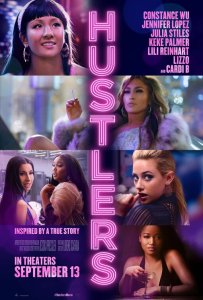 Think of it as a feminist companion piece to The Wolf of Wall Street or The Big Short. Inspired by a true story, Hustlers follows a diverse group of strippers who wine and dine Wall Street middlemen and execs, feeding off the spoils of their feeding frenzy, and then eventually upping their game, drugging them and fleecing them for one wild night that they’ll be too embarrassed to report that next morning. The story grabs you early on and is stuffed full of interesting details about the ins and outs of the stripping industry as well as how to service and manipulate the wealthier men who frequent said clubs. Hustlers becomes a combination of a crime caper, a con artist thriller, and a class-conscious drama about the haves and have nots, but it really becomes a showcase for the talents of one Jennifer Lopez, a woman who does not seem at all close to her fifty years on this planet (her introduction is quite the jaw-dropper). Lopez plays Ramona, the alpha leader of the group, a loving single mom with a healthy distaste for the hand she’s been dealt. She is sensational and delivers the best performance of her long career. Even when she’s doing bad things, even when she’s taking bold risks, there is a moral center to that woman, an unbreakable heart for the people she chooses to let into her life, and it does not budge, which was a poignant note. In many ways she is more the main character than Constance Wu (Crazy Rich Asians), a figure that serves as more entry point than fully-fleshed out character. I enjoyed learning the various tricks of the trade writer/director Lorene Scarfaria (Seeking a Friend for the End of the World) peppers throughout with her love of montage and stylish transitions, but it really picked up after the 2008 financial crash where the women cross over into direct criminality. At first they figure they’re just skipping ahead, drugging with MDMA rather than waiting for their marks to get drunk (“Drunk enough to order the bill but sober enough to sign the check,” Ramona cautions). Then things get escalated and sloppy and the women are in trouble. It’s a fun ride watching the ladies get theirs, and I was challenged to muster much of any sympathy for their Wall Street marks. Part of me wishes more women would be inspired by this movie and follow suit, fleecing the people who fleeced our economy. The movie rides that wave of the good times you know can’t last, prolonging the fall we’re all anticipating coming. The supporting characters can be a bit weak; several of the other girls involved in the scheme merit one note of description, and some of the humor feels a bit out of place, like a running joke where one of the women nervously vomits often (this is like her single character trait, and it’s weird). It’s also likely the stripper-centric movie with the least nudity I’ve ever seen, thanks to Scarfaria treating a sensational story with candor rather than exploitation. Hustlers is a glitzy drama that will entertain you with its flash and then surprise you with its edge. And all hail, Jennifer Lopez, ageless wonder and underrated actress getting her due.
Nate’s Grade: B
Share this:

The Kitchen (2019)
 Mob movies are culturally beloved. I could watch Goodfellas every time I see it on TV. We know these movies, we know this lifestyle, in so much as it’s been demonstrated in our art. A feminine perspective is often the dame, the moll, the panicked wife who worries her husband will never come home and see his bratty kids again. Rarely in mob movies are there roles for women that can be considered three-dimensional. Even Diane Keaton gets shortchanged in The Godfather series. In comes Oscar-nominated Straight Outta Compton screenwriter Andrea Berlof, tackling her directorial debut and adapting a graphic novel about three mob wives fighting the system. It’s about time this under-represented perspective in some of our favorite movies got its due spotlight. It’s too bad then that The Kitchen finds ways to still leave the women behind where it counts.
Set in the Hell’s Kitchen neighborhood of New York City in the late 70s, three mobsters get arrested one evening by the FBI and sent to prison. Their wives are now left alone to raise their families, struggle for employment, and to not be forgotten with the new pecking order of those mobsters left behind. Ruby (Tiffany Haddish) and Kathy (Melissa McCarthy) think they should take over their husband’s rackets while their men are indisposed. Claire (Elisabeth Moss) is more worried about what will happen when her abusive husband comes back from prison. The three women work together to make a stake at their own claim, butting heads against the existing power structure of dismissive men who don’t think organized crime is any place for a woman.
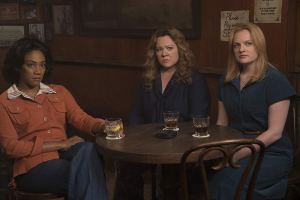 The Kitchen has such potential but it’s too often running off the fumes of other mob movies. Beyond the obvious similarities with last year’s more refined and polished Widows, this is a movie that gobbles its mafia movie clichés like a heaping helping of pasta (more clichés!). The characters aren’t terribly well defined and the story oddly moves in starts and stops, with moments either feeling too long or too short, and especially abruptly transposed, using montage to hurdle through what should have been needed onscreen development. People rightfully complained about the final season of Game of Thrones skipping over needed steps along a character’s journey to get to its intended destination, and The Kitchen is deserving of the same charge. We want to see these women in charge and others afraid, except the movie doesn’t show me any reason why these women would rise in power and what sets them apart from their steely competition. I get that they’re underestimated and they are determined, and that works in a general sense, but by the half-hour mark they’re already successful mobster entrepreneurs and I’m unsure how. Even after their rise, there is little that seems to deter them. Every new obstacle is comically taken care of in such casual fashion that you never worry for their well-being. It feels like Berloff wants to skip through all the hard work and just get to the enjoyable desserts or a life of crime, but moving up the ladder is an essential part of any power struggle story. As a result of the sloppy plotting and pacing, there is an over-reliance on clichés to stand in place, relying upon the audience’s warm understanding of the genre territory and what to expect to relieve the movie from having to do more work. It’s all telling and hardly any show.
The characters are kept as archetypes as well, at least 2/3 of the leads. Both McCarthy and Haddish seem miscast for their roles. Both are splendid comic actresses and have dramatic capabilities beyond what they get credit for, but they seem to rely upon comic instincts to get through their underwritten scenes, which further hampers the lack of tension. Each actress gets one solid scene to open up their character but it’s just so little. Ruby has a sit down where her mom credits beating the “soft” out of her daughter for Ruby’s success. That little glimpse into her past and her fraught relationship with her mother served as a tantalizing hint at what could be explored further with the Ruby character. The same with the fact that she’s a black woman who married into a very rigid Irish-American family set in their prejudices. There’s such dramatic potential to be had there. Alas, she’s tasked with being a hardass and that’s all The Kitchen asks of Haddish, treating her more as symbol than person. For McCarthy, there’s a late scene where another character tries to soft-peddle her involvement in crime, saying she did what she had to for her children, and Kathy corrects, saying, no, she did it all for her. She was tired of being a deferential doormat and wanted to feel important. That degree of self-empowerment through selfishness could be a fascinating character angle to explore, but we don’t get that. She clarifies the lens for us to view her with but by that point it’s far too late. The film is top-heavy with underwritten women and that’s a shame.
 The most interesting character by far is Moss’ abused wife-turned-budding killer. Claire is the one starting at the lowest point and the one who takes to the life of crime as means of salvation. These characters are doing some pretty heinous acts but with Claire I felt the most empathy for her plight, bullied by her husband and feeling trapped, more worried about the impending release and her return to being the scared woman cowering in the corner again. She doesn’t want to go back to that life and I believed every moment of Moss blurting out her despair and desperation. That’s why her relationship with another oddball killer played by Domhnall Gleeson (The Last Jedi) was what I cared about most in the movie. You watch them grow together, him mentoring her on how to cut up a body and dispose of it down river, and you watch how each of these two people finds something missing in the other. They may not even be good for one another, enabling their darker impulses and past a point of no return, but it’s the only evolving relationship we were given an entry point to empathize with fully. This segment is also criminally underwritten but it’s clearly where the focal point of the movie should have been. This was the perspective the movie should have been locked into and the character’s journey we follow through every step.
The Kitchen isn’t a bad movie at all. The production design and period appropriate costumes are to die for. There’s always going to be a visceral enjoyment watching the underdogs move ahead and topple their doubters and competition. The ensemble doesn’t have a bad actor in the bunch. Bill Camp (Molly’s Game) shows up with a real sense of veiled menace as a Brooklyn mobster both irritated and impressed by the ladies’ advancement. The soundtrack is packed with Scorsese-riff-approved tunes, including three instances of Fleetwood Mac. There are pleasures to be had. It’s just that the ingredients to a better movie were all there, plain as day. If you’re a fan of mob movies in general, you may find enough to satisfy with The Kitchen, which has its moments but ultimately feels too much like an under-cooked dish you’ve had one too many times before (metaphors!).
Nate’s Grade: C+
Share this:

John Wick: Chapter 3 (2019)
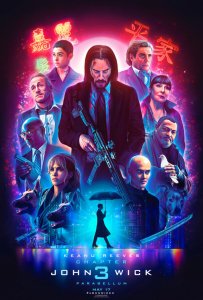 When we last left human killing machine John Wick (Keanu Reeves) he was on the run. He had just committed the cardinal sin in this world of professional hired guns — killing a protected man on safe ground. As a result, The High Table, which governs this ordered realm of trained assassins, has excommunicated Mr. Wick and placed a $15 million dollar bounty on his head. John is desperate for an exit and leans on old pals (Angelica Huston, Halle Berry) before coming home once again to face off against all the gun-toting wrath The High Table can offer.
Plenty of Hollywood action movies can elicit cheers and thrills, and John Wick 3 is definitely in that mix, but what sets it apart is the sheer number of “Oooo”s, “Oww”s, and, “Holy shit”s. Most other action movies have one or two moments that make you wince or make you shake your head in astonishment of something intense, gnarly, or self-evidently awesome. John Wick 3 is packed with these moments. There are numerous examples just in the opening action sequence. There’s one long extended fight where John uses whatever is at his disposal, including knives and shards of broken glass and mirror, to take down his mounting enemies, and then he pulls these deadly projectiles out of their bodies to use again in a pinch. By the end of this action sequence, my preview audience burst into applause. I can’t think of another movie where this happened especially in Act One. The movie has lots of standout action sequences and the good sense to let the audience enjoy the disciplined, imaginative fight choreography in full with long expansive takes. There are moments that are just incredible to witness, like John Wick utilizing a kicking horse to his advantage, or seeing the full take-down effect of whirling attack dogs in combat, and a two-on-one fight where every glass cage in sight must be smashed to bits. For action fans, the John Wick series is a simplified adrenaline shot where the director and star are working in unison to compose goose bump-triggering action cinema for the masses.
 Another hallmark of the series is its sense of macabre humor and the world building peculiarities. Amidst the wild carnage and bloodshed, there are moments that shocked me with how funny they were. I was almost in tears toward one baffling moment toward the very end. I loved that the chief antagonist, a samurai sword-wielding Zero (Mark Dacascos), can also be a fanboy. During a rare moment of downtime, he gets to gush and freak out that he’s actually interacting with the John Wick. There’s a new character played by Asia Kate Dillion (TV’s Billions, Orange is the New Black) who behaves like a peeved middle manager trying to get back on the next red-eye home. She’s the best new addition in Chapter Three. Don’t expect much from high-profile new faces like Angelica Huston and Halle Berry as their screen time is brokered into short segments. There’s a sequence where John combats trained soldiers in body armor, and so he has to constantly be reloading because it takes multiple precise shots to down the bad guys. It’s a smart way to escalate the stakes of the scene while staying true to its world, because who wouldn’t wear everything and the kitchen sink when being tasked with killing John Wick? I laughed out loud when Wick returned to an armory perturbed that he had to reload so soon, muttering to himself in agitation.
The action is relentless and all kinds of fun to watch but the movie starts to lose its momentum by the conclusion. Part of this is by the sense of lowered emotional stakes in its finale (more on that below) and another factor is its general plot-less nature. The entire story of John Wick 3 is the title character trying to outrun the people set out to kill him, jumping from one supposed safe landing spot to another. This works for a frenetic sense of pacing, knowing that any lag time will be minimal before the next kickass brawl. Because the movie rarely catches its collective breath, it can also feel like a mindless video game, with each new location a new level and with innumerable, faceless cohorts rushing in to be battled. The violence can be brutal but also feel a bit programmed, lacking some of the visceral dynamic realism of The Raid movies, the closest equivalent action franchise I can think of. There’s nothing here that challenges the brilliant set pieces and organic complications from the last Mission: Impossible movie. It’s a fun action franchise but it runs the risk of resting on its (considerable) laurels, feeling too same-y, and that can prove deadly. The clever fight choreography, sense of humor, and conviction of Reeves does enough to mask the negative effects of this artistic choice. This may affect people differently especially fans of the series, as lavishly produced action can be rewarding enough to ignore other pressing faults. For me, I was feeling as gassed as John Wick by the end.
 The further and further we get from the events of the original John Wick, the less emotional involvement the series seems to ingratiate, especially with its central baddies onscreen. Every dog-loving audience member was wiling Wick to get his vengeance in the first movie. We wanted him to get the bad guy in the sequel. Now it’s basically wave after wave of hired guns that he has to defeat, and without a better connection to that opposing force, the movie franchise runs the risk of losing any longstanding personal stakes. The bad guys are just interchangeable and only present to be dispatched. There’s no emotional victory or satisfaction for the audience if Bad Guy #12 gets toppled by the climax. The John Wick franchise is magnifying this accelerating problem; by making the conflict carry over into an additional movie, and now into another additional movie, the audience is getting further and further distance from the origin of this conflict, and thus its resolution becomes less of a desirable and satisfying goal and more a perfunctory endpoint. I would recommend the John Wick team review 2008’s Quantum of Solace to see a recent example of a big action movie hampered by overextending a thin storyline.
If you’re coming to John Wick 3 for another heaping of high-quality action, you won’t leave disappointed on that front. If you’re looking for signature moves, dark humor, and lots and lots of casual headshots, then you won’t leave disappointed. If you’re looking for a thrilling good time at the movies, you won’t leave disappointed. As a fan of the series, this was the movie I was wanting from the first sequel, dealing with the larger consequences of his rule-breaking life-and-death decision. As the third act ramped up for John Wick 3, I turned to my friend and said, “If this was the second movie, it would end right here.” Perhaps if you watch John Wick 2 and the third movie in short succession some of the problems would be smoothed out, namely a depleted sense of personal stakes and too little plot stretched over multiple movies and counting. I’ll happily continue watching further adventures of John Wick, though I’d be just as interested in an exploration of the world without its titular star. At some point it may be necessary to retire John Wick (Reeves seems to have lost a step, but he’s still like a hundred steps beyond most of us) and when they do, I hope this interesting and peculiar world is allowed to house further weird and exciting adventures. In the meantime, John Wick 3 will more than delight those action urges and sate the action appetites of its fans.
Nate’s Grade: B


 nathanzoebl
You must be logged in to post a comment.