Blog Archives
Elemental (2023)
 The joke is how Pixar has taken its storytelling motif of examining The Secret Life Of [Blank] and showing what happens in our world when we just aren’t paying attention. We’ve had toys with emotions, bugs with emotions, fish with emotion, cars with emotion, robots with emotion, rats with emotion, and even emotions with emotions, so why not break things down to their basics and give the elements of carbon-based life their own emotions too?
In Element City, Ember (voiced by Leah Lewis) belongs to the fire community living on the outskirts of town, as the big city wasn’t built for their kind. The earth people, and water people, and air people go about their business while the fire people form their own thriving offshoot. Her father and mother came across the sea to give their baby a new life, and the family shop will pass over to Ember’s management when her traditionalist father thinks she’s ready. Her whole life has been about serving her family and trying to live up to their hopes and dreams. This gets more complicated when Wade (voiced by Mamoudou Athie), a water person and a health inspector, has to report her family’s shop for code violations. They work together to save the shop and also learn from one another’s cultures and differing perspectives, and then this unexpected friendship becomes an even more unexpected romance, but can elements so different stay together?
 I was pleasantly surprised at how enjoyable Elemental is to experience and how wondrous its visual presentation is to watch. It is a certifiable treat for the eyes, with so many dazzling colors and quirky but easily readable character designs. There’s a mixture of hand-drawn animation used as Spider-Verse-style accents that provides a pleasing element that allows the images to pop even more. I was never bored looking at a single second of this movie, and even with my theater’s 3-D presentation, the glasses didn’t darken the screen and lessen my overall enjoyment. By existing within a fantasy universe, it allows for every scene and every location to better inform you about this new world and its rules and highlights (fire baby carriages that are barbecue grills). This is a bright, colorful, and supremely enchanting movie to watch because, at least visually, it feels very well developed as far as its world building and atmosphere. What would a community of fire people tend to look like? What would their jobs be? What would their celebrations be like? Their heritage from the Old Country? Naturally, with any fantasy universe, you can nit-pick it to death with questions, such as why do people even bother wearing clothes in this world? What part of the exposed fire or water is observed as obscene? How exactly do these different communities have their offspring? What does air exactly eat for food?
Where Elemental really takes off is with its charming and affecting romance. It’s been a while since romance was at the forefront for a Pixar movie, since 2008’s WALL-E (a.k.a. the greatest Pixar movie). Now there are themes and resonance that go beyond the romance and also enrich it, like Ember’s personal conflict of being a first-generation immigrant daughter and upholding the traditions and wishes of her family at the expense of her personal desires, but the core of this movie is on the burgeoning feelings between Ember and Wade. The movie begins with them butting heads as two elements seemingly in conflict but it doesn’t exactly follow an enemies-to-lovers path. She runs hot and explosive with trying to keep things under control whereas he is deeply empathetic of others and wants to help them become their best selves. He accepts who he is, and the movie doesn’t equate his full-bodied embrace of big feelings as some point of weakness. It brings about laughs from exaggeration, the streaming rivers that burst forth from his eyes upon crying, but it’s his compassion and acceptance that challenges Ember for the better and helps her assert her sense of self. They’re good together, and Wade helps serve as a guide to the wider world for Ember as she’s been isolated her whole life. Their interactions are cute and heartwarming and elevated by pleasant vocal performances. I was drawn into their story and cared about their well-being, enough that I don’t mind sharing that I shed some water myself by the end (I guess this could also make some people mistake that I peed my pants, and I assure you that was not the case, dear reader).
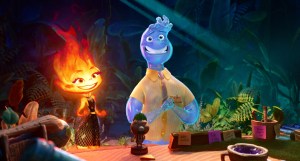 While the core relationships are poignant and winning, the world building and metaphorical allegories feel half-finished and a tad confusing. The movie also goes surprisingly soft exploring its miscegenation metaphor of two elements being forbidden to mix romantically. This universe has four communities of living elements, though air is represented as clouds and those are, literally, water vapor, and the xenophobia and discrimination that the fire people endure feels like a direct parallel to a disadvantaged minority group. However, this isn’t explored in any satisfying depth. We’re told that fire people aren’t really wanted in the city, and the city isn’t really built for them, which is typified by a rail line that splashes water discharge. There’s a lot more that could have gone into this including a more elaborate examination of the harm of red-lining and restricting the economic mobility of one group for bigoted reasons (I know, I can already hear people scolding me for even asking for such socio-political commentary in a family film). However, this metaphor gets a little murky when you take into account the literal danger that living fire exudes. Yes, you can drown, and you can get crushed under earth, but these creatures aren’t walking incendiary devices. This doesn’t translate directly to people, and thus applying class metaphors to actual races can be circumspect. Ember’s worry is that she’ll explode if she gets too angry, and this causes literal physical destruction around her. You can say it’s meant to represent when hurt, angry people lash out that they can inadvertently harm others, but not everyone can incinerate a block because they lose their temper. This kind of undercuts the lesson on misplaced fear.
Also, so much of the external story consists of bad public planning and everyone’s lackadaisical attitude toward fixing this infrastructure miscue. Again, if the larger point was a society that is actively hostile to the fire people, then the ignorant city planning that actively harms a disenfranchised group of people makes sense, but without that larger underlying conflict, it all seems so strangely forgotten. Much of this conflict is on the structure of a wall against a coming buildup of water, something possibly deadly to the fire community, so you would think this community would be a lot more concerned about this looming conflict. You might think that others would organize to provide better safeguards or maybe they would get the city’s attention. That this threat goes unreported and is played at such low stakes makes it all feel forced and manufactured. If the characters don’t seem to think it’s a big deal, then who are we to worry as well? And I can hear some of you trying to branch this out into, say, a metaphor for larger problems that go ignored, like climate change or societal inequalities, but that’s giving Elemental too much credit.
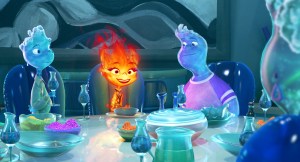 Elemental reminds me of 2020’s Onward, coincidentally one of the last movies I saw in theaters before the pandemic shutdown. I was worried that the core story looked weak but it was actually the world-building that was a bit hazy and under-developed and the emotional core was strong and authentic. It’s the same with Elemental, and while I can quibble about its dropped potential and misshapen world, it has a strong foundation that matters more. The relationships between Wade and Ember and Ember and her family are what makes the movie work and ultimately what made me smile and tear up. It’s an emotional nourishment that makes the movie feel satisfying and worthwhile no matter the lingering questions for this bizarre world. It’s also one of Pixar’s best looking movies, fully deserving of being seen on a large screen for added impact. Elemental has the right DNA for a charming and enjoyable family film for everyone.
Nate’s Grade: B
Share this:

The Super Mario Bros. Movie (2023)
 Colorful and eminently pleasant, The Super Mario Bros. Movie is about everything you would expect from an Illumination project. To begin with, there’s not a lot of story in the 30-plus years of Mario video games, so it’s not surprising that the story is kept relatively familiar with characters each inhabiting simple motivation (Mario wants to impress his dad, Luigi wants to be brave, Peach wants to protect her people, Bowser wants to be accepted by his unrequited love). Much of the movie is establishing a new location and giving some moment of fan service before moving on, like an extensive Mario Kart Rainbow Road sequence or Mario meeting Donkey Kong. It feels like the risk-averse creative process started with a list of characters, levels, and references and then how to squeeze them in. This is a movie kept at a kiddie level, which is fine even for adults to enjoy, but it means there is a lowered ceiling of ambition (so… many…. needle-drop song selections…). Much of the movie is fleeting and fine, with highlights including Jack Black’s performance as the love-struck Bowser, the training sequences making use of the bizarre physics and accoutrements of the Mushroom Kingdom, and a delightfully nihilistic little blue star with a cheery child’s voice. The movie is earnest to the point of being a little corny, which might be refreshing for parents and children used to a recent slate of overly glib kid’s movies trying to act smarter than they are. This movie is cute and harmless and a sugar rush to be forgotten after it wears off. Now re-watch the 1993 version that attempted to take the same source material and make a parallel world Blade Runner with Dennis Hopper as King Koopa. There’s also one hundred percent less Chris Pratt.
Nate’s Grade: B-
Share this:

Ghosted (2023)

Have you ever watched a movie that felt like it was created by soulless robots? That was the overwhelming feeling I had with Ghosted, a supposed “romantic” “comedy” and spy thriller debuting on Apple Plus with big stars and a big budget and lacking anything that feels recognizably human. 2023 has been a year of exciting and precarious technological advances, and the emergence of A.I.-assisted chat and performative generators, from art to stories, is a Pandora’s Box that will not go away, especially for an industry looking to cut corners wherever possible to save a buck. Super producer Joe Russo has bleakly predicted it’s only a matter of time before studios lean into A.I. programs to help them write bankable screenplays. When that dark day arrives, if we haven’t already crossed that Rubicon, I imagine those A.I. ghostwritten scripts will feel a lot like Ghosted, a movie that feels like it was constructed from imperfect observers.
It all begins when boy meets girl at a farmer’s market. Cole (Chris Evans) refuses to sell a potted plant to Sadie (Ana de Armas) because her job keeps her away for up to months at a time. He cannot, in good conscience, sell this woman a plant he knows will be neglected. From there, they spend a whirlwind first date getting to know one another in and out of the bedroom. Then Sadie never returns Cole’s messages and calls again. He frets that he’s yet another modern dating victim of being ghosted when strange men kidnap him and ask him scary questions about things he has no clue about. He’s rescued from this interrogation by none other than a gun-toting Sadie. She reveals she’s really a secret C.I.A. agent and somehow her enemies have mistaken Cole for “The Tax Man,” a dangerous and mysterious assassin that’s actually Sadie. Now they’re on the run and Cole has to learn the ropes of spy business or else, and maybe he can get a second date while he’s at it.

The premise alone is a workable high-concept we’ve seen comedy variations of before, from Charade to Knight and Day to The Spy Who Dumped Me (remember that movie, anyone?). It’s the perspective of the novice being plunged into the chaotic and overwhelming world of spy-craft and having to rapidly adjust to a world they thought was just the stuff of movies and beach reads. It’s the kind of story that pokes fun at spy movies while embracing them as well, and it posits what would happen if one of us normies ever accidentally found ourselves in this high-stakes world. Where Ghosted doesn’t work is that the characters are both awful versions of the Novice and the Expert. There’s a slight amusement watching Evans plays out of his depth in action contexts, running counter to a decade of Marvel heroics, but this is short-lived. He eventually begins to be a capable partner for Sadie as she learns to trust another, which is the most expected and basic character arc for each of these people. However, Sadie is also boring, and even when the truth about her profession is revealed, it doesn’t make her that much more interesting. I was already doubtful when we opened with her talking to her therapist over her car’s phone and this was the first scene. She’s been slotted as Killing Machine with Trust Issues, and he’s been slotted as Too Afraid to Seek His Dreams, and so their conclusions are predictable and bland. There’s even a lack of a technique that Sadie teaches Cole that comes into play at a pivotal moment. That’s the most basic thing and they miss that.
There is also a notable absence of chemistry between the leads. While de Armas and Evans have co-starred in two prior films, they were opposed in 2019’s Knives Out and 2022’s The Grey Man. Actor chemistry is one of those ineffable qualities that you can tell pretty quickly whether it’s evident or lacking, and within minutes of the tortured house plant meet-cute, I sensed a gaping black hole of palpable chemistry. It’s even more obnoxious when MULTIPLE characters in MULTIPLE scenes implore the two to “get a room” because their supposed sexual tension is off the charts. Sure thing, movie.
Another quality that becomes very apparent is how forced everything in Ghosted feels. The romance feels forced but the comedy especially feels forced. The four screenwriters include the writers behind the Deadpool, Zombieland, Ant-Man, Spider-Man, and recent Jumanji movies, so we know these credited writers have a keen understanding of comedy. It makes the results on screen all the more mystifying and disappointing. The jokes generally feel off (“He expected a hottie not Mata Hari,” womp womp), the rhythm and tone feel a little too much, too forced, like the actors are desperately trying to compensate. It comes across like they were instructed to speak at a more fast-paced and clipped rate to attempt to emulate screwball comedy patter, but the material isn’t there to match the hyperactive verbal presentation. The music is also another factor in trying to better compensate. It’s trying to provide a jaunty, breezy energy level that isn’t sustained in the movie by its comedy, action, or romance. The number of needle drop song selections can also be insufferable and dumbfounding. The characters will start a gun fight and then “My Sharona” will crank up or, even more inexplicably, “Uptown Funk.” The relentless fallback of familiar pop and rock ditties intruding over the action doesn’t so much elevate the moment as make you realize just what would be missing without the song. I’m all for the clever use of music to jazz up a scene, but the final action sequence shouldn’t have to rely on Bruno Mars for any nascent fun.

There are a handful of moments and ideas here that could have worked in a better movie. I enjoyed a stretch in the middle where Sadie and Cole are ambushed by one bounty hunter with an absurd name after another, and each is a cameo from a familiar face and each gets dispatched swiftly. The movie also takes pains to make fun of Cole’s smothering qualities, including his snapping a picture of Sadie while she slept in his arms post-coitus and unaware. I wish this line of criticism would pick up more momentum but there’s only so much heat that Cole will take when he still needs to be the handsome and appealing lead. I also liked the idea of a villain, played by Adrien Brody like his copy of the screenplay didn’t have a single joke inside it, who is simply trying not to be revealed to be incompetent. I think there was especially more room to mine with the confusion over which character was the infamous Tax Man. The assumption that it must be a man could have opened up a broader and interesting subplot over sexist gender assumptions, with nobody believing that a g-g-g-girl could be such an accomplished trained killer (alas, the “girls can do it too” message seems to be all the movie offers in response).
Ghosted is not a good action movie, as it’s poorly sourced and edited, it’s not a good comedy, as the jokes are iffy and delivered in such an exaggerated and clunky manner, and it’s not a good romance, with two bland and under-developed genre character cliches portrayed by two actors who have a startling lack of chemistry together. The music is obnoxious and trying to compensate for the flagging energy level and forced comedy, the movie runs too long at almost two hours, and director Dexter Fletcher (Rocketman) has no feel for action or romance. It’s the comedy that made me most depressed, as no character talked like a semblance of a real human being, nor was their fast-paced, quippy dialogue truly zingy and entertaining. t was like watching a desperate person try and prove they are not, in fact desperate, but with every word only proving more and more their desperation. I’m sure some people out there will find this movie passably breezy or charming or at least inoffensive for two hours of inattention. It all felt so forced and inauthentic and tired to me. It’s best to just ghost this film in real life.
Nate’s Grade: C-
Share this:

Dungeons & Dragons: Honor Among Thieves (2023)
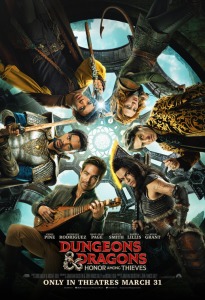 As required for every film critic before discussing the new Dungeons and Dragons movie, subtitled Honor Among Thieves, I must tell you my personal history with the seminal tabletop game. Well, I don’t think D&D is for me. Many of my friends are heavily involved in D&D, several as the quest-fashioning dungeon masters, and I’ve even sat in for a few games, but there’s something about the group improv experience that I never feel comfortable while playing, like my mind just runs into imagination roadblocks trying to come up with options in a near limitless space. Plus I think character creation is one of my lesser storytelling skills; I typically build characters more out of plot and concept and theme. Also, the demanding time commitment to play a game that can take possibly months or years to conclude makes me hesitant. I already think Monopoly lasts too long and has a habit of ruining friendships (if I was ever paid to write a Monopoly movie, that would be my starting point, not bringing to life Mr. Moneybags).
Anyway, D&D has had something of a cultural renaissance the last decade, reaching new levels of wider acceptance partly thanks to its prominent placement in Stranger Things. Pretty good for an ever-evolving 50-year-old game system that was at one point blamed for luring impressionable youth into the ways of Satanism and insanity (see the ridiculous 1982 movie Mazes and Monsters starring a young Tom Hanks as a student who cannot distinguish between reality and the game world to murderous effect). It’s such a substantial fantasy property that it was only a matter of time for movies to follow. There was an abysmal D&D movie from 2000 co-starring Thora Birch and a go-for-broke Jeremy Irons that isn’t worth your time. I wasn’t excited for a new Dungeons and Dragons movie until I saw that its directors and co-writers were Jonathan Goldstein and John Francis Daley. I was a big fan of 2018’s Game Night, their last directing effort, and they’ve been a dependable comedic writing duo. It was with them that I placed my faith and that faith was fully rewarded when my wife and I watched Honor Among Thieves and had a delightful time. This is a wildly fun D&D movie for every viewer.
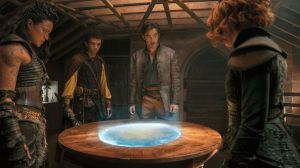 In the world of owl bears and sorcerers, Edgin (Chris Pine) and his trusted partner, Holga (Michelle Rodriguez), are looking to settle the score. They’ve broken out of prison and are trying to gather their old team back together but everyone has a grudge. Forge (Hugh Grant) has betrayed the group for power and especially riches, serving as the city’s reigning lord. He’s recommissioned a gathering of games and sport, drawing crowds back to the city, and with games comes betting and with betting come large sums of money from the rich. Edgin plans to rob from the treasure hold for the games and with that score he can regain his daughter and possibly reclaim a magical totem that can bring his dearly departed wife back.
I have no prior understanding of anything relating to the world and lore of D&D, and I found it to be extremely accessible and engaging. That’s because Goldstein and Daley have put the emphasis of their movie not on its lore or history or locations but on its characters. I appreciate that here is a major work of IP for a studio that is attempting to tell one very good and accessible story for the masses rather than set up a cinematic universe and ready it for possible sequel bait. Get the movie right and have that make me desire more movies rather than establishing a world that has potential but otherwise goes unfulfilled. The very concept of Honor Among Thieves helps to keep things light-hearted and moving. My pal Ben Bailey and I have been clamoring for years for a heist movie set within a fantasy world. It was ready-made to satisfy with the genre structure of heists, and putting a team together that rolls with unexpected adversity, and the cleverness of incorporating fantasy abilities and elements into heist genre familiarities. Thankfully, Goldstein and Daley realized how entertainingly plentiful this combo can prove.
The fun characters are what help to make the movie so enchanting. Rather than settling on a subsection of class representation (one dwarf, one elf, one wizard, etc.), the characters are more about what they bring to the team and what motivates them for character arcs. We have a shapeshifter (Sophia Lillis) who is trying to protect the kingdom’s encroachment on her kind. We have a shaky wizard (Justice Smith) who is battling for his own self-confidence and respect. Nobody feels like a token appointment. Even characters that would seem like a D&D player’s dream, a powerful paladin played by the dashing Rege-Jean Page (Bridgerton), are given more purpose. He serves as a contrast to our hero’s journey back to respectability, and the character is so noble and serious that it’s yet another shade of comedy to explore. His obliviousness to irony and sarcasm reminded me of the very literal-minded Drax (Guardians of the Galaxy). This is a character that would appear in standard fantasy epics, and yet he’s played for laughs just through sheer juxtaposition without ever mocking the reality of this world. At no point will characters condescend to their reality, saying self-aware critiques like, “Well that’s a very inconvenient and stupid place to put a castle,” etc. There is a cameo where the gag is that this person is much smaller. The appearance is played for goofy laughs and yet it’s also shocking in its emotional sincerity. If you removed the size differential, this would be a dramatic and eventful scene (I did enjoy the unspoken preference of this individual when it comes to a romantic partner). The movie is very funny and very skilled at being funny without reliance upon meta genre riffs.
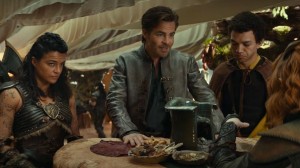 Elevating an already great movie, Pine (Don’t Worry Darling) is robustly charming as a bard/secret agent. He secured my loyalty within two minutes of the movie when he gave up on his prison knitting project and said, summarily, “I’m just gonna make a mitten. Who am I trying to impress?” Pine has long been one of our most effortlessly charming leading men, and playing a rakish heist leader who also sings will only magnify the man’s innate appeal to the masses. He works even better alongside Rodriguez (any Fast and Furious movie after 6) who becomes the real physical presence. This is a career-best performance with Rodriguez sliding right into exactly the comedy wavelength she’s needed for – the gruff and cynical worldview of the weary warrior. They make for a great bantering lead duo.
The set pieces are also tailored to the character arcs while still being memorable and entertaining. This is a movie that doesn’t get complacent over its 134 minutes. Each sequence must stand out, whether it’s because of creative and intuitive fight choreography that makes keen use of geography and circumstance, or a graveyard Q&A with very constrained magical rules to follow that leads to a lot of digging to find the right corpse with the right information, or escaping from an obese dragon (with its “widdle wings”) that resembles a chonky cat, or a dangerous trip through a maze that abruptly reconfigures itself, or a prison escape that doesn’t quite go as you expect, nor at the characters expect. Every scene has a purpose. Every magical item has a specific use, and every set piece sets itself apart visually and from a story standpoint.
Goldstein and Daley have excelled as writers, but they’re also proving to be visually adept directors. With the emphasis on characters, it’s not CGI spectacle for spectacle’s sake. There’s a pleasing physicality to this world. The budget is in the $150-million range, which is quite a show of confidence for the directors, but the emphasis is on what best elevates the moment. There’s a thrilling escape performed as a tracking shot with a zooming camera tracing the escape of our shapeshifter from harm, and there’s fantastic visual inventiveness with a magic portal and its application for the film’s equivalent of a rollicking stagecoach robbery. There’s a noted intention here with the shots and scenes and visual arrangements, so Honor Among Thieves feels like a studio film with vision.
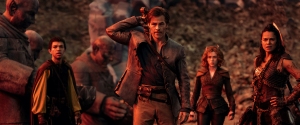 Allow me to take one very fleeting moment to digress just how much care Goldstein and Daley put into even the smallest of details. After we’ve met the last core member of our crew, he confidently leans backwards and falls into a pit leading to an underground cavern. The rest of the crew creep toward the opening and stare down below with trepidation. Simon then says, “I’m going last.” We then cut to the group at the bottom of the cavern. It’s such a small detail, but the previous scene ends on a character-appropriate punchline for Simon reconfirming his squeamishness, but then by transitioning to the entire collected crew together, we know he was last and so we’re ready to move forward. Again, it’s a small detail but it’s a microscopic example that proves, to me, how much thought and care the directors have given.
As a novice to the famous role-playing world, I found Dungeons & Dragons: Honor Among Thieves to be an exhilarating and highly entertaining fantasy adventure where fun is the chief priority. It’s not at the expense of great characters, good humor, and satisfying payoffs with well-developed setups strewn throughout. It’s a reminder how enjoyable and escapist blockbusters can be when you have the right artists using the expansive box of paints. It’s great for all ages and families too. I don’t have any personal connection to this sword-and-sorcery universe but now I want many more adventures if this is kind of quality they’re offering.
Nate’s Grade: A-
Share this:

Shazam! Fury of the Gods (2023)
 I enjoyed 2019’s Shazam! because it felt like a breath of fresh air, a lighter story compared to the relentless gloom and doom of the DCU. It was more a silly Big-style body swap movie than a super hero romp, tapping into childhood wish fulfillment of getting to transform not just as an adult but as a super-powered adult on a whim. It was funny, sweet, and different. The 2023 sequel, Shazam! Fury of the Gods, feels like the definition of a sequel for the sake of a sequel. It is thoroughly mediocre and lacking the charm and heart of the original. I’ll try and deduce why this super-charged sequel feels so lacking and why the fun feels so forced.
Billy Batson (Asher Angel) can turn into Shazam (Zachary Levi) by uttering the magic name, and now his foster family share his same super abilities. They’re trying to adjust back to “normal life” when the Daughters of Atlas, Hespera (Helen Mirren) and Kalypso (Luicy Lui), arrive with a vengeance. Turns out Shazam’s powers were stolen from the Greek gods, and now they want them back, and if they don’t reclaim their power, the gods will destroy the world of man.
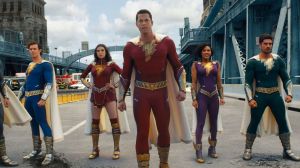 I think one of the most lacking elements of Fury of the Gods is that it loses its core appeal. The first movie was about a child fulfilling their adult dreams and leaping into maturity before their time. Levi (Apollo 10 1/2) was goofy and enjoyable in his broadly comical fish-out-of-water portrayal as a kid in an adult’s body. Now, the growing pains of being an adult, and a superhero, have been eclipsed. In fact, the amount of time we spend with Billy is pretty sparing. It’s all Shazam all the time, and this hurts presenting a worthwhile contrast between the mythic and the recognizably human. You forget the initial dynamic of this kid pretending to be an adult and what advantages this affords. At this point, being an adult is the same as being Billy Batson, who is approaching 18 and will age out of the foster system. This reality creates an existential crisis for Billy, as he’s afraid his family will move on so he’s eager to keep them together all the time, trying to maintain control. It’s about fear of change; however, I never fully understood why Billy was so worried. He’s already found a home with a loving mother, father, and extended clan of siblings, so why does aging out matter? He’s not going to be removed from his home. His siblings also aren’t talking about shipping out to the different corners of the world to begin careers or higher education. It’s a forced conflict to make the character uneasy about growing up. If the first movie was about a kid coming to terms with himself and letting others in, then this movie is all about a kid worrying his relationships will arbitrarily evaporate. This anxiety over losing something meaningful could have been an interesting storyline, but it’s all so contrived, and the whole body swap dynamic, the selling point of the first film, feels strangely absent.
Likewise, the villains have questionable motivation and character development. The movie begins with cloaked and masked figures wreaking havoc in a museum, and then it makes a big deal that these figures happen to be… women (also middle-aged and older at that). The opening is meant to be surprising in a way that feels out of date (what… g-g-girls can be powerful too?). It’s a strange point considering we’ve already had Wonder Woman. This same easily-satisfied, lowest common denominator plotting is disappointingly prevalent. These powerful gods want their father’s powers back but they already seem pretty powerful, so the movie lacks a fitting explanation of why these extra powers are worth all this effort. I suppose there’s a general revenge and righting of wrongs but the characters don’t play their parts too scorned. They’re more annoyed and tired, which doesn’t make for the most compelling villains. Another Daughter of Atlas has the power to mix and match the world like a volatile Rubix cube, but what is this power? It’s virtual obstacle-making but it feels arbitrary too in the world of superpowers. The ultimate scheme to conquer the world is as flimsy as the reasons it’s ultimately defeated.
 Let me dissect that part for a few words, the solutions to overcoming our vengeful gods. They raise an army of mythical creatures to destroy Philadelphia and it’s Ray Harryhausen character designs with cyclops and unicorns and the like. The way to reach through to the monsters and bring them on your side is to offer them a gift of “ambrosia,” some tasteful bounty that they can’t help but fall in love with. So what is the solution to this? One of the kids literally drops a handful of Skittles onto the street and the unicorn happily snarfs them down. Yes, through the power of Skittles-brand candy the heroes are able to save the day. There’s even a moment where the kid is riding the unicorns into battle and screams, “Taste the rainbow,” before the movie cheekily cuts her off before she can unleash an added “MF-er.” What is this? I’m usually agnostic on product placement in movies; characters have to eat and drink, etc. But when it’s egregiously transparent and played as the key to victory against all odds, that’s a bit much. If the joke is that contemporary food is a blast of flavor that nobody would have been prepared for thousands of years ago with their palettes, then any modern food could have worked. It didn’t have to be a brand-name candy with its brand-name slogan screamed in battle. This is but the first of several contrived and unsatisfying deus ex machina solutions that erase consequences.
Even with returning director David F. Sandberg (Lights Out), the enterprise feels like an empty retread relying too much on rote spectacle and missing the heart and perspective of its predecessor. There is an action sequence atop a collapsing suspension bridge and the song “Holding Out for a Hero” plays, and then we have a character comment on it, and it all seems like a desperate attempt to add some energy or style or fun to the sequence that is absent. The action relies on a lot of watching characters zip pedestrians to safety, but it’s the end result we see, not the whoosh and flurry of the arduous mission. The whole sequence feels like it’s going through the motions, as much of the movie does, falling back on a formula of superhero blockbuster autopilot. The CGI army of villains, the face-offs between characters shooting magic beams at one another, the overly quippy and tiresome dialogue and mugging cranked up to overdrive, the world-saving stakes feeling so minor. I was longing for some of the ’80s Amblin tone of the original, which got surprisingly dark. With Fury of the Gods, everything feels so safe and settled, with the stakes feeling inauthentic and the action reinforcing this with effects sequences that feel like Saturday morning cartoon filler.
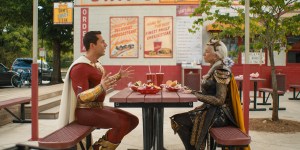 There’s a strange question with the family powers. The extended brothers and sisters can utter “Shazam” and turn into adult alter egos, but the character of Mary (Grace Caroline Currey, Fall) now transforms into a super suited version of herself with slightly different hair. In 2019, she transformed into actress Michelle Borth (Hawaii 5-0). Mary is the oldest sibling, and we’ve undergone a time jump of years to account for the ages of the kid actors, so does this mean that as the kids get older they will just turn into versions of themselves? Does this mean that the Zachary Levi-persona is set to expire once Billy turns legally an adult at 18? The implications of this casting choice made me question the very reality of the Shazam universe’s mechanics.
I can see certain audiences enjoying the slapstick and gee-whiz goofiness of Shazam! Fury of the Gods, and I have no doubt that the people making the movie wanted to tap into that childlike wonder of magic and myth. The problem is that this feels like the most inessential of the dozen DCU movies, going through the motions rather than exploring cogent and potent drama. Just take the character of Pedro (Jovan Armand) who is unhappy with his larger body and transforms into a handsome, slim, musclebound version of himself as a fantasy. That’s an interesting psychological exploration for the character, on top of his own self acceptance on a whole other front. Or take the sidekick from the first movie, Freddy (Jack Dylan Grazer), and his Romeo and Juliet-esque romance of a super-powered being from the other side of the conflict. There’s some drama there as well as his understanding of who the good and bad guys can be. Or simply take the perspectives of the parents trying to raise a household of kids who can transform at whim and what worries and joys this can offer. There’s material here to be finely explored, fun dynamics going beyond just repeating the Big-style body swap hi-jinks. Unfortunately, this is a sequel that feels like what made the original special has been replaced by blockbuster status quo.
Nate’s Grade: C
Share this:

80 For Brady (2023)
 I did some minor research and yes, three out of the four actresses of 80 for Brady are indeed in their 80s, with Rita Moreno in her 90s, so there is some truth in advertising still. Speaking of that, this geriatric comedy is about everything you would expect from its very basic premise. Inspired by a true story, four lifelong friends (Moreno, Jane Fonda, Sally Field, Lily Tomlin) are diehard New England Patriots fans and more so fans of the team’s famous quarterback, Mr. Tom Brady (playing himself). They’re determined to make one last big trip to support their team at the 2017 Super Bowl, as Tomlin is afraid she doesn’t have much time left. What follows is standard road trip hi-jinks and celebrity cameos the likes of which from Billy Porter and Guy Fieri and Patton Oswalt. Most of the jokes are mild and easily telegraphed, and the formula hews very close to other studio entries in the “old people still got it” ensemble comedy subgenre (Last Vegas, Book Club, The Bucket List, Going in Style, Best Exotic Marigold Hotel, Calendar Girls, etc.). The target audience is looking for something nice and reassuring with familiar faces. To that end, 80 for Brady mostly succeeds, but for anyone else outside it’s older demographic, it will be a middling and hokey comedy. I laughed out loud at the assertion that the Pats comeback from a 28-3 deficit versus the Atlanta Falcons was the result of one very determined, yet also obsessive to the point of hallucinating, elderly fan giving Brady a special pep talk that motivated him to try harder at winning. The movie isn’t meant to elicit big laughs, more pleasant smiles, and to that end it’s agreeably inoffensive right down to its predictability and easy conclusions. Entirely skippable if you’re under the age of 50.
Nate’s Grade: C
Share this:

Puss in Boots: The Last Wish (2022)
 Puss in Boots: The Last Wish is, surprisingly, genuinely great. No kidding. It’s very very good. It’s been eleven years since the first Puss in Boots spinoff, and that itself was seven years after the character was introduced in 2004’s Shrek 2, and there hasn’t been a Shrek movie since the franchise-killing Forever After in 2010. I would have assumed that Dreamworks had just moved on from this character in the ensuing years, especially as How to Train Your Dragon became their big new commercial franchise, until they too ran that into the ground with 2019’s disappointing third film. I had little expectations of greatness once I heard there was a new Puss in Boots feature, even after I started hearing the growing critical consensus. Early in, only mere minutes, I realized that a Puss in Boots sequel was one of the best movies of 2022 and an exciting and heartfelt sequel that proves that with the right artists and storytellers, any old character can still have vibrant relevance. It’s a children’s movie that can appeal to everyone.
Puss (voiced by Antonio Banderas) is a famous adventurer, sword fighter, and lover of women, but he’s also nearing the end of a long journey. He’s used up his eight lives and is now on his ninth and last, and to escape Death, he sets out on a quest to retrieve a fallen star that will grant one person a wish. It just so happens there are a lot of other characters in this fairy tale kingdom that want to get there too.

It is amazing how hard this movie goes. In its opening sequence, it establishes its bold artistic style that enlivens every second onscreen, it establishes its caliber of exciting action that feels akin to wild comic books and anime, and an emphasis on mortality that provides a sense of danger and emotional foundation for what could have been just another shoddy animated sequel drafting off brand recognition. Let’s just focus on the animation style to begin with. I was expecting the same old CGI that has dominated the world of animation for twenty years, but The Last Wish has been clearly inspired by the greatness of 2018’s Into the Spider-Verse. There is a distinct 2D edge given to the designs, accenting the imagery, and during bouts of action they will lower the frame frate, making the movements much more stark and pronounced. Add to this a lovely, painterly watercolor visual style, more emphasis on the overall impression than finite definition, and the movie is a consistent feast for the eyes. There are stylized sequences that communicate fear and desperation, as well as sequences that exemplify the kinetic movement of superhuman action, smartly altering its visual appearance to better serve whatever emotion it wants you to feel. I hope more and more animation companies continue this magical hybrid of CGI and traditional animation techniques, as also seen in 2021’s The Mitchells vs. the Machines. It’s a great step forward combining the old and the new into a stylized look that allows the creators to make the best of both animation worlds.
The action is also satisfying and surprisingly well developed. The opening sequence involves Puss awakening a giant behemoth and it made me think of the exaggerated and intense action of anime series with giant kaiju monsters like in Attack on Titan. The camera will freely circle and zoom around the theater of action, heightened with exaggerated motion lines and split screens and POV swaps. I also love that the filmmakers understand the inherent qualities of what makes for good action, incorporating the personality of the characters into the situations, providing organic consequences, tailoring to the geography, and providing clear mini-goals. After introducing the secondary antagonist of greedy Jack Horner (John Mulaney), as well as Goldilocks (Florence Pugh) and the three bears (Ray Winstone, Olivia Coleman, Samson Kayo) “crimin’” gang, the movie transforms into a delightful and unexpected fantasy version of Midnight Run. There are multiple groups racing against one another to a destination, all the while jostling for supremacy and bumbling into one another’s way. It makes for a fun series of events as every group has their own reasons for gaining the wishing star. Because of this, their behavior feels in-character and the cross-purpose motivation allows for fun combinations of characters getting in the way of one another and utilizing the specifics of their fantasy character details. There was a midpoint sequence combining all sides in a colorful brawl, including unicorn horns exploding into confetti upon contact, and I just felt a surge of pure incandescent joy.

In yet another of the movie’s pleasant surprises, it has one of the best villains of the year as it deals with the concept of mortality with actual nuance. The main antagonist is literally Death itself, personified as a red-eyed, grinning bounty hunter wolf and voiced by Narcos’ Pablo Escobar, Wagner Moura with a menacing purr. This Wolf is after Puss because he’s now on his last life and the Wolf is personally offended at the idea of having multiple lives. Their first encounter makes Puss feel fear for perhaps the first time in his nine lives. In a morbidly amusing montage, we zip through Puss’ previous eight lives and specifically the moments leading to their comical end. He’s flippant with an unchecked ego, and Death seriously humbles him, being the first to ever land a blade on Puss in Boots, a detail he’d been bragging about even in song. From here, Puss is deathly afraid and the hairs of his body will stick up whenever he suspects the return of the Wolf, who certainly enjoys terrorizing his targets with an ominous whistle to announce his presence. So at a moment’s notice, the crazy and colorful hijinks can stop from hearing that familiar yet eerie whistle. In some ways, it’s a family-friendly depiction of working through trauma. The larger theme is Puss acknowledging his moral shortcomings with his many lives, the time wasted on frivolity and ego, and making the most of the time he has left. The need to re-up his lives is a fine starting motivation based upon fear, personified as trying to literally escape the scary wolf, but it’s also what makes Puss confront his own behavior and want to change as well as hold himself accountable.
The heartfelt portion of the movie is its emphasis on found families, and it was done so well that I actually teared up at points. Yes, dear reader, Puss in Boots 2 had me on the verge of tears more than once. Goldilocks is the leader of her gang of squabbling thieves, but she still views herself as an orphan first, whereas the bears view her as an equal and valued member of the family and crime gang. Even her character arc comes to a poignant conclusion where she realizes that her real family isn’t the one she comes from but the one who makes her feel that she belongs. This theme is also demonstrated with little Perrito (Harvey Guillen, What We Do in the Shadows TV series) as the adorable and undying optimist puppy sidekick. His selfless vantage point contrasts with Puss, and greatly annoys him, but Perrito also has his own goal. He wants to be a comfort dog, and one of the sweetest moments of the movie involves him helping Puss come back from a traumatic response through a shared moment. Even typing these words makes me tear up. The screenplay knows how to develop characters that can grow as friends and family and the drama is directly connected to well-honed characters and thoughtful story without being overly sentimental and maudlin, a slippery slope to doom many child-friendly animated efforts with messages.

Puss in Boots: The Last Wish does everything well. It’s funny and colorful and exciting and meaningful and heartfelt and everything you would want in any movie, let alone one featuring a talking cat swashbuckler in tiny boots. No matter your mixed feelings on Dreamworks animated movies, or their iffy sequels, or even children’s movies as a whole, I whole-heartedly recommend that everyone give this magical movie a fighting chance. The animation is gorgeous and vibrant and colorful, the vocal performances are terrific, the action is fun and well-developed, and the themes and character arcs have substance to provide meaningful layers and emotional heft. This is superior entertainment and all in about 90-some minutes. While I’d slot it below Guillermo del Toro’s masterful stop-motion Pinocchio, this is a wonderful movie and one of the best to ever bear the Dreamworks mantle. It’s the 2022 sequel you never knew that you needed but will be oh so happy that it rightly does.
Nate’s Grade: A-
Share this:

Marcel the Shell with Shoes On (2022)
 The feature-length movie based upon the short stop-motion films about a mollusk in sneakers, Marcel the Shell with Shoes On might just be the most precious movie of the year. It’s set like a faux documentary where a lonely filmmaker discovers a magical inhabitant in his Air B&B, a very soft-spoken little guy with a heart much bigger than his actual size. Marcel (voiced by co-creator Jenny Slate) is looking for his lost family who were unknowingly absconded when the original couple who lived in the house broke up and gathered their things quickly before storming off. Dean (Dean Flesicher-Camp, also the movie’s director) records Marcel and his innocent little observations on life and the bigger world and posts the videos online, and Marcel becomes Internet famous, for good and bad. The plot of the movie is less important than its overall gentle nature. There’s not a lot that happens in the movie, but you dont mind because it’s really an 80-minute sit-down with Marcel. The entire movie is just so sweetly innocent that it’s hard to resist. It also has some bigger things to say about our place in the world as well as mortality. Marcel has a loving yet ailing grandmother shell (voiced by Isabella Rossellini) who is beginning to lose her lucidity, and it will hit home for anyone who has watching a loved one suffer from mental decline. Marcel the Shell with Shoes On is a perfect little antidote for our modern cynical lives. It’s overwhelmingly adorable and wholesome and winsome and just plain cute.
Nate’s Grade: B
Share this:

Amsterdam (2022)

It’s been seven long years since writer/director David O. Russell made a movie. He was prolific from 2010-2015, making four movies, which were nominated for a slew of Oscars, especially in multiple acting categories. Three were also nominated for Best Picture and Russell was nominated for Best Director three times as well. It was quite a vaunted run of mainstream and critical success, with devoted actors like Christian Bale and Jennifer Lawrence eager to sign up for Russell’s quirky ensembles (it helps when both won Oscars playing Russell roles).
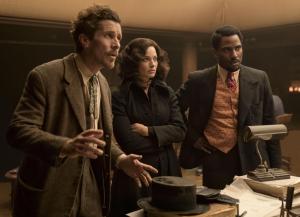
It’s natural to want to take some time off after such a busy creative period, but as the years stretched on, and after the Me Too accountability movement, Russell’s on and off-set behavior gathered more scrutiny and rebuke. His volatility had been known, like his screaming fit he had on the 2004 I Heart Huckabees set with Lily Tomlin. Even George Clooney recounts stepping up to Russell’s bully behavior on the set of 1999’s Three Kings (rumor has it Clooney was the one who released the Huckabees footage). On 2013’s American Hustle, Amy Adams said she cried repeatedly from Russell’s bullying and felt intimidated and isolated. Then there were the renewed revelations from Russell’s own niece who had been transitioning and accused Russell of inappropriate touching when it came to her changing body. Russell even admits to this, though he defends his actions by saying he was given tacit permission, or so he says. With all of this controversy and harassment swirling around Russell, it’s a wonder who would want to continue working with this kind of person. I guess as long as he was producing at his peak level, studio execs would excuse his bad behavior and keep funding his ballooning budgets. Well Amsterdam might just be the end of Russell’s star-studded big studio ride.
In 1933 New York, Burt Berendsen (Bale) is a WW1 veteran making ends meet as a doctor who specializes in veteran care. He and his best friend Harold Woodman (John David Washington) are framed for a murder and on the run, and the only way to clear their good names is to uncover a conspiracy that leads to a possible government coup. Helping the fellas out is Valerie Voze (Margot Robbie), a nurse who makes art from the shrapnel she recovers from inside war vets, and a wealthy socialite who also happens to be in love with Harold. Together, the three friends bumble their way through danger and mystery and crazy mishaps.
This is a mess of a movie, a waste of its top talent, and an excess of Russell’s excesses. The director has established a certain style since 2012’s Silver Linings Playbook, a movie I still to this day genuinely love (it was my top movie for that year). It’s a style that communicates mania, a nervous energy, and it made sense for Silver Linings Playbook as the movie was following a bipolar protagonist given to uncompromising bouts of mania. It makes less sense with each additional movie, but this improv-heavy, experimental, loose sensibility has become the default style for the director, and it feels misapplied. It leads to Russell bombarding his actors with questions or different requests in the moment, keeping them guessing, and actors have gone forward saying they never knew what they were shooting on the day and the shooting never stopped. This indulgence leads to stories that feel like a lot of elements are sloppily thrown together with the undying hope that somehow it will all come together in the end. With Amsterdam, it doesn’t.
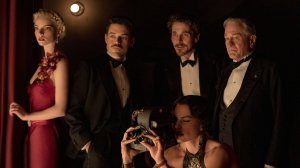
It’s not a great sign when I can say that the entire first hour could be jettisoned. There’s little sense of urgency for far too long, and what is presented feels almost comically unrelated, like even Russell can’t believe his silly characters are in real danger. The uneven pacing creates many dead spaces that feel like an awkward improv detour that you wish could have been avoided. We’re introduced to Bert as a drug addict, and then as a World War One veteran helping other veterans with facial scars and wounds, Bert’s relationship with his pal Harold, then their history in France during the war, then their introduction to Valerie and their kinship, then we have a mysterious death that also leads to a secondary love interest, which requires more setting up of the first love interest and her disapproving family, and then we get police investigating and warning about the first death and then a second murder, this time blamed on our characters, and they’re off to clear their names by… reuniting with Valerie and then bumbling through more characters before, finally the movie presents what it’s actually about well after a full hour-to-80 minutes of movie. It is exhausting and feels like a meandering alternative story that was clumsily grafted onto the Business Plot of 1933. The first half of the movie feels like a slipshod screwball comedy, and then once the particulars of a fascist conspiracy to overthrow the president are introduced, it’s like watching Looney Tunes characters try and foil Adolf Hitler. It just does not tonally work.
The Business Plot is a lesser known event in history, glossed over by the fact that the chief perpetrators more or less got away with their insurrectionist planning. They never did succeed in overthrowing FDR and installing their puppet, but they also did not get prosecuted in the end and most of the media dismissed the scheme as hogwash. It’s undetermined how advanced this plot eventually got but a coup was discussed by a consortium of business leaders. It feels like Russell is applying what he learned from 2013’s American Hustle, which introduced a crazy group of fictional criminals and then, in its last hour, explored the real Abscam criminal sting of the 1980s. I can see themes that Russell thinks are still prescient today, like a dark element desiring to overthrow the U.S. government because it didn’t get its way, as well as the collusion of big business in political king-making, seeking shells that will do what their benefactors demand. The problem is the themes behind this scheme are too serious for Russell’s trifling antics. Think about retelling the insurrection on January 6th but for the first hour it’s two bumbling bank robbers who keep finding themselves in the worst possible situations, ending at the U.S. Capitol. If you’re going to treat the rise of fascism, assisted by corporate overlords, as a serious threat, and something relevant for today, then maybe don’t have most of the movie be wacky nonsense.
Russell’s past films have often glided on energy and in-character authenticity, but this one feels so grasping and desperate. When the master plan to reveal the conspiracy and its shadowy participants is throwing together a big veteran’s show, I was reminded of the movies of young Mickey Rooney and Judy Garland where the solution to any dilemma was to put on a show. Then at one point the literal Nazis are singing loudly in German and are being confronted by our characters and the good patriotic Americans counter by singing “America (My Country ‘Tis of Thee)” and I had to stop the movie and just let out a deep sigh. I think Russell was going for the famous reference in Casablanca, also against Nazis, but it just flounders into unintentional comedy, accentuated by the antsy energy that treats it like camp. There are a couple of spots that I laughed out loud, though I doubt that was the intended response, like watching Taylor Swift abruptly run over by a car. The attempts at actual humor are winding and often lead to little, and the characters feel like more of a collection of quirks than firmly established personalities and perspectives to anchor a movie. What does Bert having a false eye add besides something for Bale to fidget with? What does Chris Rock have to do here? What does Anya Taylor-Joy have to do here? Most egregiously, what does John David Washington have to do here? It feels like Russell just wanted a character for Bert to talk to. The screenplay is overstuffed and polluted with all these minor and underwritten characters that could have been better consolidated.

I suppose you can still have fun with Amsterdam and engage with it on a light-hearted level, smiling as you watch the many big stars having a good time messing around with accents, props, and wacky character traits and tics, like a bunch of kids with a dresser of costumes (maybe it is a throwback to those corny Rooney/Garland kids pictures after all). With other Russell movies, I’ve felt invigorated by the energy and artistry, encouraged to sit a little closer and be more attentive of the character turns, and dig into the actors making three-course meals of their roles. With Amsterdam, I felt the desperation to recreate the success of old patterns but the creeping realization that it wasn’t going to materialize. It’s just a big mess of a movie, not without interesting ideas or moments or good acting, but too much feels resoundingly and frustratingly frivolous. You could ditch entire characters, entire subplots, even entire hours of this movie. Amsterdam cost Disney/Fox $80 million dollars, the biggest of Russell’s career, and only earned a pittance, so I think there is a retraction in due order. Begin with not watching Amsterdam yourself.
Nate’s Grade: C
Share this:

Rosaline (2022)
 Rosaline is a new romantic comedy in the vein of the meta Rosencratz and Guildenstern are Dead, playfully re-imagining Shakespeare’s doomed romance in a much more light-hearted rom-com tone. For you see, dear reader, Rosaline (Kaitlyn Dever) was the young woman who Romeo (Kyle Allen) was infatuated with… until he met Juliet (Isabela Merched), and then it was all Juliet 24/7. Rosaline is the spurned lover trying to regain her former boyfriend with the help of a handsome suitor and her gay best friend, Paris (yes, the one supposed to marry Juliet away from Romeo in the end). Rosaline is a delight for several reasons, chief among them the quick-witted screenplay by the Oscar-nominated pair Scott Neustadter and Michael H. Weber (The Disaster Artist, 500 Days of Summer) and the eminent charms of Dever as a forward-thinking, snarky, exasperated woman bumping against her society’s demands. Dever makes every joke that much better and is so charmingly diffident. We may know the story of Romeo and Juliet, but the fun of the movie is how it subverts our expectations or presents goofy answers around the peripheral of the main story, like how Rosaline was manipulating actions from afar, sometimes unintentionally. The tragic tone is replaced with something much more cheery and amusing, and that might irk diehard fans of the Bard. I found it to be a winning and irreverent low-stakes re-invention of a literary classic, elevated by charming performances and a beguiling and clever screenplay (I’m giving credit more to the screenwriters than the source material novel, as it had many one-star reviews on Good Reads). For fans of Shakespeare adaptations with a feminist twist, check out Rosaline and fall under its star-crossed spell.
Nate’s Grade: B


 nathanzoebl
You must be logged in to post a comment.