Blog Archives
Freaky (2020)
 A body swap movie set in a slasher universe, Freaky is a fun and gory romp that still feels like it could have been even more entertaining with the possibility of its premise. A masked serial killer (Vince Vaughn) stabs a teenage girl (Kathryn Newton) with a magic Mayan knife and they swap places and must learn to cope in their new bodies and roles. The teen-in-adult body is wonderfully played by Vaughn, who seems to be really enjoying himself with a silly role that pushes him outside his smooth-talking leading man roles. He might be playing up the girlishness and higher-pitched voice but his energy level is high and provides plenty of entertainment with the absurdity. There are a few inspired moments developed from the crazy premise, like when Vaughn has a heart-to-heart with his/her mother at work, able to offer insight into the daughter she feels she is failing, and the mother becomes romantically intrigued by this mysterious man. There is a first kiss sequence in the backseat of a car that is so awkward but owns its outrageous quality. I wish the movie from co-writer/director Christopher Landon (Happy Death Day) made better use of its fruitful premise. There are so many more bizarre scenarios that could be gleaned here, especially if the masked serial killer had more of a personality. Clearly modeled after the silent stalkers like Michael Myers and Jason Voorhees, this makes the film feel too one-sided with ideas. Sure the teenage girl is now to be feared, dresses sharper, and kills her high school annoyances, but it doesn’t make for much of a creative cat-and-mouse game when it comes to outsmarting the original owner of this new body. I will also champion the gory kill scenes as above average in their conception and execution. It’s really over-the-top and memorable and I wish there had been even more wild splatter. Freaky is a decidedly fun movie from the Blumhouse assembly line but I can’t help wishing it was a little bit funnier, a little bit weirder, and little bit more imaginative. The parts were there to make this hilarious and brilliantly creative, and settling for chuckles and disposable entertainment feels like a nagging compromise.
Nate’s Grade: B
Share this:

Super Intelligence (2020)
 Given the sad and off-putting output from Melissa McCarthy and her husband Ben Falcone when they collaborate, it’s a small victory that Super Intelligence is only really super bland and forgettable. McCarthy stars as an everywoman picked by a highly intelligent A.I. to be the test subject for whether or not humanity should be saved or wiped out of existence. It sounds like an amusing premise but what it becomes is just a boring romantic comedy. The super A.I. (voiced by James Corden) becomes more or less a magic genie, and now our heroine has all her wishes granted. She has a huge new bank account, a new car, a new luxury condo, and all to impress the guy she let get away played by Bobby Canavale. That’s right, the super A.I., meant to test and judge mankind, is really just the world’s most advanced wingman and trying to get his human pal some love. As far as tests go this seems a bit weak. This mighty A.I. should be working against our protagonist, throwing increasing obstacles that push her out of her comfort zone, rather than just handing her everything and looking from afar with approval. The comedy is resolutely flat save for the inherent charms of McCarthy, who doesn’t seem challenged by anything in the movie. Much of the film is watching McCarthy talking into high angle CCTV cameras. Visually, it’s quite boring. Super Intelligence feels like an interesting idea that can’t be bothered to find anything interesting in execution. It’s standard rom-com fluff but the two characters aren’t even appealing together. I found Canavale’s character to be far more annoying than endearing. I’ve found that Falcone is a bad director for his wife. He encourages her worst onscreen habits and doesn’t have the presence or vision to be able to assert restraint or imagination. If Falcone is attached as director, you know you’re getting McCarthy doing her familiar shtick with little self-control. She’s still a highly appealing comedian, and an underrated dramatic actor, but the only super intelligence here are the people who avoid this film.
Nate’s Grade: C
Share this:

Happiest Season (2020)
 It’s about time that gay people were better represented in holiday rom-coms (according to my girlfriend, 2020 was the first year Hallmark featured a gay protagonist in a Christmas movie, which is astounding). Why shouldn’t queer people be able to enjoy cute, low-key holiday fluff that also better represents their stories and perspectives? That’s the goal of Happiest Season, written and directed by Clea DuVall, an actress best known for her 90s output like The Faculty and But I’m a Cheerleader who has transitioned behind the camera. The story follows a lesbian couple, Abby (Kristen Stewart) and Harper (Mackenzie Davis), celebrating their first Christmas together. Harper invites her girlfriend to meet her family, however, she hasn’t come out to her conservative parents and sisters. Abby will have to pretend to only be the “roommate” and from there the movie sets us up farcical misunderstandings and comic mishap. The problem with Happiest Season is that everyone is a big jerk. Harper’s parents are jerks. Her overly competitive sister played by Alison Brie is a jerk. Even her young niece and nephew are jerks. Why would it be such a big deal for a conservative politician’s daughter to be gay… in 2020? Hell, Dick Cheney has a gay daughter and he’s done okay for himself. Why would Harper want her girlfriend to spend upwards of five days with these awful people and under the guise of having to hide who she is and their relationship? I think it’s because Harper is also a jerk. She dismisses Abby’s feelings and misgivings, ditches her to hang out with an old boyfriend, and doesn’t seem to recognize how uncomfortable any of this is making the woman she reportedly loves. And then it’s revealed that Harper outed her high school girlfriend (Aubrey Plaza) and said she was obsessed with her in an effort to not be seen as gay when she was younger. That’s not endearing. This person doesn’t deserve Abby, and that’s the problem because when the happy ending and sweet kisses fortuitously come I wasn’t feeling joy but contempt. I kept yelling at turn after turn for Abby to leave this family to their own miserable devices. I wanted the movie to somehow transform into a separate story about the only people I genuinely liked, Dan Levy as Abby’s friend and Mary Holland as the youngest daughter, a sweet goofball, the only one in Harper’s family with a soul. The comedy bits run the gamut between cute and clumsy, though the escalations don’t rise to the farcical levels you would expect from compounded misunderstandings and secret-keeping. Happiest Season is an adequate holiday movie, and a boon for greater representation even in a genre with a low bar, but it would have been even better with characters you actually liked and wanted to spend the yuletide season with.
Nate’s Grade: B-
Share this:

Kajillionaire (2020)
 If you’re not familiar with quirky writer/director/performance artist Miranda July, she specializes in a special kind of weird that borders on surreal and also a surprising emotional poignancy. It’s been 9 years since her last feature film, The Future, and she’s back with what might be her most narratively focused and accessible yet still wonderfully weird movie yet. We follow a family of grifters (Richard Jenkins and Debra Winger as the parents) and their day-to-day struggle to con, skim, or steal enough money to get by to the next day. Old Dolio (Evan Rachel Wood) is their only child, and her role in the family is thrown into question when a new member joins their team. Melanie (Gina Rodriguez) has connections to a raft of senior citizens so desperate for attention that, if they all pose as Melanie’s family, they should be able to con these old folks of possessions they can resell. From there, the movie becomes a push-and-pull relationship between Old Dolio and the influence of her shifty family, and she questions her place in this fringe unit and whether her parents actually love her or see her as another means to get a score. Kajillionaire is loose in plot but populated with interesting characters who feel fully realized by July’s writing. She’s so good at studying human behavior and capturing it that the quirky details all feel so genuine and meaningful. Even Old Dolio’s name is a reminder of her parents’ opportunism and problematic parenting skills. She was named after a homeless man who won the lottery under the hopes that he would be grateful and put her in his will (he ended up spending his fortune on experimental cancer drugs). That’s the difference with July. A silly name could just be a disposable oddity, but for her it’s a reflection of a character’s worth and history. There are moments in the movie that achieve a level of artistic transcendence where every piece is humming beautifully together, like one moment where a dying elderly man off-screen directs the grifter family to pretend to be like his own flesh-and-blood family. They play pretend at domesticity, each assuming a doting role, and the tranquil scene of a fake family feels beautifully attuned. The moments stand out more than the whole but July’s empathetic appreciation of human fallibility keeps her from ever condemning Old Dolio’s scheming parents too much. Even the very end finds a way to turn betrayal into a message of humility. Wood (Westworld) drops her voice several octaves, wears baggy clothing, and looks extremely awkward when it comes to human contact. Rodriguez (Annihilation) is the voice of the audience and her test of how far she’s willing to excuse the selfish behavior of this clan of cons. Her burgeoning friendship and maybe more with Old Dolio is a rewarding enterprise for the characters and the audience. Kajillionaire is a gentle little movie that plays at a low-key range of human emotions yet it can still be deftly funny and surprising and heartfelt on its own unique terms. With Miranda July, she makes weird entrancing and human.
Nate’s Grade: B+
Share this:

Worst. Christmas. Ever. (2020)
 I implore all filmmakers to be cautious about titling your movies. When you use absolutes in your titles, it’s laying forth a claim that you better be able to back up, and when you also present easy-to-apply summations of your movie in the title, it’s another dare I hope you’re capable of meeting. Nobody should name their movie Waste of Time and make a pointless and lazy movie because you can already see the summary blurb that awaits. In the case of the new low-budget Ohio-made comedy Worst. Christmas. Ever., you better be plenty funny to avoid the obvious put-down, “Worst. Christmas. Movie. Ever.” Unfortunately, while this low-budget movie has energy and bad taste to spare, it’s woefully short on ideas, jokes, characterization, and fun.
It’s Christmas Eve in East Jesus, Ohio and Sophia (Raychael Lane) has learned that she is pregnant. Her loser boyfriend Trey (Leonardo Mancini) is the father, though he doesn’t seem like a good prospective parent as he’s shiftless and cheating on her with Madison Fatcheck (KateLynn Newberry). Sophia doesn’t know what to do and definitely can’t tell her mom and stepdad. We interact with different bizarre locals, drug dealers, trigger-happy cops, crazy relatives, and an ex-con mall Santa (Craig Brophy) who breaks into homes. Over the course of one long crazy night, Sophia must decide what she wants to do with her life and the possible new life inside her.
 There is a grand tradition of the irreverent anti-Christmas comedy, a holiday setting brimming with sentimentality. Whether it’s A Christmas Story or Gremlins or Bad Santa, there’s something appealing about undercutting all that holiday good cheer with a little irreverent fun. The problem with Worst. Christmas. Ever. is that writer/director Johnny Chechitelli (a credited writer for FOX Sports and UFC fights) settles too often on the easiest joke, that is, when there are jokes. Sometimes it feels like the film has just gone on auto-pilot, like an improv session gone awry. That drifting, directionless feel pertains especially to the characters, which are uniformly boring. There are some strong archetypes that have potential, especially a lecherous Santa up to no good. There are just too many disposable characters cluttering this narrative that seem to exist in their own alternate universe movies with too few jokes. The world of East Jesus, Ohio feels wacky but without forethought. This is the kind of movie where a former overweight girl has the last name Fatcheck, and apparently this factor is what defines her character. There are small moments of satire but they’re never really honed into a more coherent or clever message. The stepfather plays a violent video game as an armed Jesus shooting Santa Claus to death. A rap song about a bad Santa seems to revel in gaudy cliches without providing commentary or entertaining contrasts. The treatment of African-American characters seems to play tragedy as cheap comedy, setting them up for traumatic police encounters that lack commentary on racism or ignorance. Sophia goes off on a team of carolers for their religious beliefs, but the movie seems too timid to go further with mocking Christmas rituals or religious hypocrisy. There are ideas here, not all of them good, but rarely do the ideas evolve into sustained plot beats or jokes.
Let’s analyze one scene in particular and why it doesn’t work from a comedy standpoint and what could have been done with a little more attention. Sophia and her pal Noah (Chase Crawford) go to her boyfriend’s house. Sophia is defending him but Noah says he’s likely just sitting around and getting high. When they peek through the window, they find Trey sitting around with marijuana, and Sophia tries to excuse it, not wanting to admit that Noah’s negative characterization was correct. Then he smokes a pipe and a scantily clad Madison Fatcheck comes in and nuzzles up beside him. Trey sees Sophia watching and freaks out. I ask you, dear reader, where was the joke? The fact that Trey is a loser is already assumed, so that reveal isn’t enough. What could have happened was Sophia’s pained attempts to continue denying the obvious reality. Rather than catch her bad boyfriend with drugs and then a new girl, this scene could have been extended to make things even more ridiculous. He had drugs, but Sophia was saying maybe he was just sorting it, and then he’s using the drugs, and Sophia says well at least it’s not hard stuff, and then he breaks out a hypodermic needle and she says, well maybe he just needs an insulin shot. It’s a comedy scenario that prospers from escalating desperation and absurdity. It could have been funny. Instead, we’re given maybe one joke, which is obvious, and little else. There is a lack of creativity when it comes to the comedy construction throughout Worst. Christmas. Ever.
 There is a difference between a gross-out gag and something that is simply gross. Making your audience experience discomfort can be a useful resource for comedy, but you have to be aware of what the returns are for the indulgence. I’m reminded of a scene in Seth MacFarlane’s A Million Days to Die in the West where Neil Patrick Harris defecates into a cowboy boot. He’s humiliated, it’s extended, and the joke lands, but then McFarlane cannot help himself and has to show a two-second insert shot of the messy feces inside the boot. The joke would have worked best without literally getting into the muck. Think back on Dumb and Dumber with Jeff Daniels and his epic diarrhea sequence atop that unfortunate toilet. It’s all in the performance and the cascading and noxious sound effects. The Farrelly Brothers didn’t need to put us in the bowl. This brings me to our Worst. Christmas. Ever. because I think its uses gross shock humor to cover for its poor comedy efforts. This happens early with Sophia throwing up in a Salvation Army collection bucket. That alone works as a joke, but then the director puts us in the vomit and uses this image to put his credit onscreen. There it is, he seems to say, I’m the guy responsible for this mess. There’s another scene where a character pees into a toilet and we just watch multiple seconds of a stream of urine and then on the floor as well. I kept thinking that maybe the movie would come back to this, that taking so much time to set up pee on the floor would lead to an accident later, but nothing happened. I guess just the sight of urine was supposed to be funny, just like the sight of vomit in a bucket was supposed to be funny. This lazy ethos pervades the movie and is dispiriting.
There are crude animated sequences in Act One that I initially had hopes for. It’s a stylistic touch to separate the movie but it could also have been a smart way around larger set pieces that would have been too expensive. These are mostly confined to Sophia’s flashbacks about her dead father and then this device is never seen again after the 20-minute mark. The six-minute segment about her bad drug addict father using the last of his money on drugs, then robbing a convenience store to also use on drugs is simply not a story demanding six minutes of our time. It’s not funny and it’s not informative and it gets tiresome and repetitive. This same information could have been conveyed with Sophia through a monologue of why she hates the holidays and it would have had a more immediate and lasting emotional impact than an animated interlude. The animated segments reminded me of MS Paint but with more detail. The style is fine but the purpose is questionable. The story we get through the animation isn’t necessary other than it provides an additional six-plus minutes of running time to desperately get us to a feature-length.
 This brings me to the fact that this 80-minute movie is really only a scant 63 minutes long. The end credits begin shortly after the one-hour mark and from there we’re treated to short additional scenes for resolution and then bloopers and then an extended music video of our rapping Santa. The actual credits move at a snail’s pace to reach that magical 80-minute runtime. This is the problem with a scattershot narrative that doesn’t seem like it’s going anywhere. One could argue that Worst. Christmas. Ever. is not the kind of movie beholden to character arcs and great strides in personal growth but you still need to do something with the time you have as a storyteller. For a comedy, we need more escalation than some dead bodies by the end. There needs to be amusing complications, there needs to be struggles, and there needs to be variation. Worst. Christmas. Ever. has the feeling of watching several short films that have been stitched together with minimal care. The consequences feel as throwaway as everything else in this movie. There is a dearth of satisfaction by the end because it’s missing all the important things like clear goals, meaningful character development, and culminating gags built around careful setups and escalation. I was a bit flabbergasted by the movie essentially giving up at 63 minutes but also grateful for the end.
It’s my duty to find some highlights to praise for Worst. Christmas. Ever. and I think the cast is generally a strong asset. Given the low-budget nature, not everyone is quite so polished, but the amateurism actually adds an authenticity to the proceedings of making a real small-town indie in Youngstown, Ohio. Lane (To See the Moon in the Morning Sky) has a wholesome appeal as our protagonist. Brophy creates a welcomed impression as a sleazy Santa, and his rap skills aren’t too shabby either. The entire rap video sequence is actually one of the best in the film. The song production is more accomplished than I would have expected given the low-budget. By far the actor I enjoyed the most was Wantatah (The Con) as the stepfather. His performance is the one where the actor melts into the character and you see the least amount of “acting.” He just is, and it’s entertaining to watch his grumpy incredulity and then inebriated disasters. I hope Wantatah can get even more work from here that takes advantage of his fine comedy instincts and commitment.
 I’m not going to lie, Worst. Christmas. Ever. was a difficult movie for me to watch. Even at little over an hour, I struggled to keep my attention and I rarely laughed. More often I was befuddled at the sloppy attempts at comedy that too often settled on shock value and bad taste because it couldn’t be bothered to actually think about jokes. There’s a difference where poop is a funny joke and when it’s just gross, and this movie doesn’t quite comprehend that distinction. Frankly, there just isn’t enough going on here to merit your time. From a comedy standpoint, there’s little to leave you satisfied. I laughed more from Killer Raccoons 2. From a character standpoint, there are weirdos who get their individual scenes but the main character’s unplanned pregnancy feels like an afterthought for how little it pushes the other characters. Imagine Juno if nobody paid attention to Juno’s pregnancy. From a production standpoint, there are definitely limitations given the lower budget and the wintry Midwestern climate but this doesn’t lead to necessary creative ingenuity. This is more a premise and an attitude than it is a full-fledged movie. Worst. Christmas. Ever. peaks at its poster.
Nate’s Grade: D
Share this:

Charlie’s Angels (2000) [Review Re-View]
 Originally released November 3, 2000:
These angels aren’t exactly what your father was enjoying when your mother was away fulfilling errands. These angels aren’t delegated as mere sex objects running around providing the jiggle entertainment that is (or was) supplied by today’s Baywatch. The 90s is a different decade after our minority movements and today’s woman is just as apt to do a flying kung-fu face plant into a baddie as any man. The angels of the film are action heroes for an armada of small girls needing some female empowerment when their only other choices consist of a barely clothed Britney or a barely covered Christina. These angels aren’t just the sex objects that the classic assortment of angelic 70s stars were; these angels are also tough-as-nails, resourceful, and not afraid to tussle or tango. Now that this exposition is out I can concentrate on the scattershot film Charlie’s Angels.
The film has been rumored to have at a minimum of 17 writers who tried shaping a story for Cameron Diaz, Drew Barrymore, and Lucy Lui. The story is pretty much shelved toward the back so the forefront is our trio of ladies kicking ass then shaking it with zig-zaggy and wild camera movements from debut filmmaker and video director McG.
Charlie’s Angels is whiz-bang dumb fun. The overall feel of the film is something more difficult to get a grasp on. At times it shows itself as tongue-in-cheek and satirical but then at other times it seems overly serious or overly dumb. The characters are non-existent and basically only discernible by hair color. The characters are very wooden and I actually found more enjoyment watching the villains and seeing more of them; call it the Austin Powers dilemma. Diaz makes the only notable attempt as her goofy and light-hearted angel connects with the audience best. Lui plays a techno-babe dominatrix but is easy to see that she was the last angel chosen and doesn’t exactly gel with the others as much as she could have.
 Charlie’s Angels is best when the action is pumping. The scenes are cut together in a jam-packing sequential way adding distinct flavor and style. McG is a true surprise in the effectiveness he can orchestrate his action motifs even if the Matrix effects and moves make absolutely no sense in the real world.
Crispin Glover shows himself as a silent assassin nicknamed “the thin creepy man.” Glover is so suave and slick in his role of the non-verbal Oddjob henchman role that he exhilarated me with every presence he made on screen. Goodness, he was too cool in this film and everyone gets brownie points for allowing him. He has such energy and charisma that I wanted the film to veer off into him and desert our angels. Seeing our ageless McFly perform action scenes and choreographed fights is something I will be pleased with until my grave. seeing Crispin in the excellent Nurse Betty and now huge exposure in this is a true joy. And man… he smokes a cigarette way too cool every time he’s in this film. Some people can smoke cool some of the time but Crispin does it all of the time. His mere presence almost cancels out the annoyance of Barrymore.
The line is drawn with Charlie’s Angels in that it’s sex-kitten jiggle and an acrobatic arrangement of (light) feminism and humor. These gals know they’re sex objects and they’ll use it to their advantage delighting in every second of it. Therefore, you could argue successfully that Angels is exploitation hiding as meaningful but hell… why think about this stuff? The movie rolls along at a fast pace where you don’t keep track of these issues. It’s just an easy sit down.
The gigantic success of Charlie’s Angels makes sequels and a possible franchise all but certain. I’d be happy for McG to hop back in his directorial chair but have a unique idea for Angels 2: Bigger, Longer, and Uncut… it involves Glover kicking a lot of ass really cool like.
Nate’s Grade: B-
——————————————————
WRITER REFLECTIONS 20 YEARS LATER

The 2000 Charlie’s Angels seems to understand that nobody should take this seriously. It even opens with an in-joke of T.J. Hooker: The Movie being inflight entertainment and an undercover character lamenting how bankrupt Hollywood is when it comes to recycling old TV shows. From there, our undercover angel literally exits with her target in the middle of the air and plummets to the water below, safely landing via parachute with a team meeting via helicopter aerial hook-up and a speedboat below. Why any of this? What sense does any of it make? It doesn’t matter in the slightest, and from the opening scene onward the movie lives by this credo, doing its best to be silly and have fun and just not care about the rest, and it shows. Twenty years ago, I think Charlie’s Angels benefited from low expectations as I recall mostly enjoying it. Now, having re-watched the movie for the first time in ages, I will say the fizzy appeal seems to be diluted. It’s still got energy to spare, though it feels a little too antic, a little too episodic and slipshod, and a little too proudly shallow, and that’s before you re-examine its depiction of the angels.
It took 17 writers and considering every under-30 actress in Hollywood to put together Charlie’s Angels. Drew Barrymore had bought the remake rights and wanted to make a big screen splash with a trio of kick-ass heroines that could better relate to the culture of the new century. I understand that Barrymore and her team wanted the angels to be sexy, yes, but also smart and funny and goofy and fearsome and all the things that little girls should believe possible. That’s commendable from a positive representation, but then so much emphasis is placed on their bodies and their off-the-charts sex appeal to bamboozle men that the goal becomes eclipsed. One could argue that Barrymore, Cameron Diaz, and Lucy Lui are embracing their sexuality, and that taking control of this is empowering, and if you feel empowered by Charlie’s Angels, by all right enjoy that and bless you. However, twenty years later, this feels less like the girls are in charge are more like they’re just being exploited in a manner we’re being sold as new feminism.
 There are so many examples where the angels are in skimpy clothing or objectified. There was an entire clip of Diaz dancing in her underwear that I remember Harry Knowles of the early 2000s mainstay Ain’t It Cool News devoted a gross drooling essay to his obsession (“But to sum up, Cameron Diaz’s Swirling Ass is one of the greatest images and objects in the whole of human existence.”). Barrymore’s character is constantly getting undressed and using her body to disarm men. Again, duping men through their hormones can be a key asset as a spy, but it’s happening in every scene and at her disservice as well. She tumbles down a ravine naked in a last-second escape, and the movie treats it as cheeky comedy (no pun intended). Lui adopts a series of disguises that routinely sexualize her, from a masseuse to the most overt, a domineering corporate boss that resembles a dominatrix. They’re straight fetish roles. I’m surprised a Catholic schoolgirl outfit wasn’t adopted as a disguise. The movie’s depiction of its female stars and the emphasis on their bodies feels retrograde for its ideals. I know they wanted to improve upon the portrayals from the 1970s but we still got problems. McG’s stylish direction prioritizes the angels’ sexuality. They can be smart and kick ass but also in a sexy way, the movie is telling you. Thandie Newton was supposed to be an angel but schedule overruns from Mission: Impossible II got in the way, and later she admitted she had strong misgivings because her character was going to be introduced with a closeup of her denim-clad butt. No one is arguing that women should be barred from taking ownership of their sensuality, but the lens Charlie’s Angels utilizes is strictly a male gaze, and these women are repeatedly objectified.
As a result, the movie has a new sheen of discomfort during all the silly, sudsy spy missions and wardrobe changes. Before you might think, “Oh look, they’re dressing up as Japanese geisha girls, what fun,” and now you’re like, “Oh, somebody at the studio was getting off on this.” Before you might think, “Oh look, they’re dressing up as Middle Eastern belly dancers, what fun,” and now you’re like, “Oh, somebody at the studio was getting off on this.” There are a lot of ethnic disguises that would likely get axed today as cultural appropriation. The carefree, frivolous attitude of the movie is meant to be charming and low stakes, but when it’s applied to the exploitative nature of how the women are depicted, it all becomes a bit dodgier to accept.
 This was the first real blockbuster after The Matrix reshaped action cinema and the stylish choices can run the gamut between exciting and cool to dated and shallow. Twenty years later, it’s just not as impressive that they used wires to swing their actors around for stunt choreography, or that they replicated key Matrix touches like bullet time. The fighting sequences are often choppy in editing and some of the moves meant to demonstrate the power of the angels just feel silly, like a moment where Diaz went full Lui Kang with her flying kicking feet. It’s moments like that where the style gets away from McG. The tonal trick is finding a balance between goofy and cool, exciting and cheesy, and I don’t think the movie achieves this with its action. The set pieces feel built around “cool moments” rather than using geography, organic complications, and escalation. It means that Charlie’s Angels has its share of cool moments but then they are fleeting and ultimately meaningless because they don’t better connect to character, story, or even simply their own satisfying action compositions. It’s like immediately disintegrating cotton candy. The dozens and dozens and dozens of needle-drop music cues feel like another potent example of this charge as well as some anticipated attempt to distract from its shallow and diverting design.
I was dreading revisiting my original review as an 18-year-old because I was convinced my younger self was going to conflate the portrayal of the women as taking ownership. I just knew this would be something I had bought into in 2000, and yet it wasn’t quite so: “The line is drawn with Charlie’s Angels in that it’s sex-kitten jiggle and an acrobatic arrangement of (light) feminism and humor. These gals know they’re sex objects and they’ll use it to their advantage delighting in every second of it. Therefore, you could argue successfully that Angels is exploitation hiding as meaningful but hell… why think about this stuff? The movie rolls along at a fast pace where you don’t keep track of these issues. It’s just an easy sit down.” Hooray for my younger self seeing through this movie’s sheen of empowerment. At the time, it bothered me less because the movie was dumb fun, and now it just seems less fun and also dumber. I was so taken with Crispin Glover (Back to the Future) and his creepy cool style, much of which was Glover’s doing. His character was supposed to have dialogue except he hated the lines and asked to be silent. That’s one way out of memorizing, and it worked because he was a breakout and appeared in the 2003 sequel. Sam Rockwell (Three Billboards) was also a fun discovery though he only gets good once he’s revealed as a baddie. He would reuse those dancing moves for Iron Man 2.
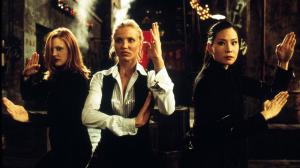 By the time 2003’s sequel Full Throttle rolled out, the appeal was gone. In my own brief review, I summarized, “It all seems so ho-hum and excessive at the same time. Quite an accomplishment. No more please.” I feel like the 2000 film also falls into this summary. It’s clearly not intending to be anything more than a goofy action movie, and I suppose the right person could still likely turn off the necessary parts of their brain to enjoy the rush of sights, sounds, and cleavage. There shouldn’t be a “wrong kind of feminism” so if this works for you, great. Many years later I felt that the male gaze was more ogling the women in the name of celebrating them. And yet Sony still felt there was material to be mined when they tried again with a failed 2019 reboot. The original Charlie’s Angels film is a cocktail of style with a creeping hangover right behind.
Re-Veiw Grade: C
Share this:

Love and Monsters (2020)
 Imaginative, quirky, and monstrously fun, Love and Monsters is a winning sci-fi monster movie and more evidence to the unique amusements provided in full from a Brian Duffield (Spontaneous, The Babysitter) story. In the near future, after blowing up a world-threatening asteroid, the ensuing chemical debris causes many lizards and insects to grow to world-threatening sizes, killing a majority of the population, and forcing the survivors to live underground in vaults. Our hero is Joel (Dylan O’Brien), a very Jessie Eisenberg-esque guy who isn’t so good at survival skills in this new world. His group looks at him like he’s a helpless kid who can’t defend himself. Joel discovers that his teenage crush, the girl he’s been writing letters to, is alive and he pledges to make the 80-mile trip on the surface to reunite with her. The resulting journey can be episodic but each section is impactful, each monster encounter is different and contributes to a fuller understanding to the world, and the character arc finds ways to surprise you, like when it acknowledges that Joel’s foolhardy romantic gesture is exactly that, him not fully accepting how the world has changed both he and the object of his desire. That sparkling creative voice of Duffield’s is alive and well throughout. His worlds feel well thought out, lived in, crazy but with purpose, and his characters are often teenagers with pointed attitude but they feel like characters rather than mouthpieces for overt stylized dialogue and pithy banter. O’Brien (The Maze Runner) is an interesting choice and gets to be far more neurotic and physically comedic than I’ve ever seen him. He’s an underdog that’s easy to root for. There are moments of wonder, moments of unexpected empathy, moments of suspense and terror, and plenty of moments of comic bemusement in the face of this crazy world. Joel befriends a very Woody Harreslon-esque father (Michael Rooker) with an adopted daughter in tow (the Zombieland character dynamics are pretty apparent but not a major detraction) and they form an enjoyable fractured family to help Joel become a better survivalist. I loved a small moment with a beaten down robot helper that manages to be sentimental as well as subverting sentimentality. The conclusion feels like a Walking Dead episode but it brings together many of the dangling storylines and proves satisfying for the character’s arc, a better understanding of the creatures in this world, and for Joel’s sense of self and community. The special effects are amazing for a movie that shockingly only had a tiny $28 million budget. Love and Monsters is a movie that makes the most of its time and money to tell a bigger story but one with enough wit, heart, and personality to draw you in and leave you happy for more post-apocalyptic monster adventures. All hail Duffield, king of spry and accessible quirk within the Hollywood system.
Nate’s Grade: B+
Share this:

Vampires vs. The Bronx (2020)
 Take Attack the Block and mix with The Lost Boys and you get a perfectly enjoyable B- kind of fun B-movie about a group of Bronx tweens combating blood-suckers gentrifying their neighborhood, and vampires too. It’s a pleasant experience that hankers back to enjoyable 80s ensembles and it maintains a sweetness without being sappy and an edge that feels appropriate for its age-range without getting too heavy or too simplistic. We follow our core characters as they investigate the would-be vampires, uncover their real estate schemes for the neighborhood, and then plan how best to thwart them. It’s a reliable formula but it works. I enjoyed Shea Whigham (Kong: Skull Island) as the vampire middleman, and I enjoyed how his own character arc as a subservient villain is tied into another teen’s arc about not following in the steps of his criminal older brother and rejecting people who only want to use you. That’s smart writing, finding room to draw parallels and connect the personal to the thematic. The lead kids all have their own personalities and problems and I enjoyed spending time with them as they bonded, bickered, and bandied together as a team. Their chemistry made them feel like real friends. The horror doesn’t really ever approach being scary or intense; when the vampires are in full teeth-baring mode, they seem more like the goofy, cheesy, cloaked figures from the TV soap Dark Shadows. It also feels like the movie runs a bit out of steam as it carries on into its final attack/assault on the vampire’s nest. Still, Vampires vs. The Bronx is a funny and light-hearted 90 minutes with likeable characters and an enjoyably relaxed supernatural caper. It’s not going to be too deep but you can tell the filmmakers care about these characters, the film’s genre influences, and telling an accessible adventure to kids.
Nate’s Grade: B-
Share this:

Bill and Ted Face the Music (2020)
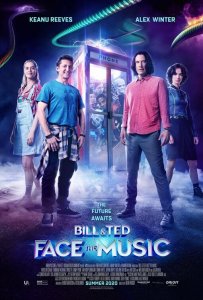 Bill and Ted might be one of the most inexplicable franchises in Hollywood. It began as a riff on 80s high school movies by writers Ed Solomon and Chris Matheson, taking the California surfer/stoner goofball supporting character staple and saying, “What if people deeply uninformed about history traveled through time?” 1989’s Bill and Ted’s Excellent Adventure movie was a comic delight, and Bill and Ted became unexpected icons, action figures, and even a Saturday morning cartoon. The 1991 sequel could have easily repackaged another escapade through time but instead it went a completely different, darker, and weirder direction. Bill and Ted’s Bogus Journey followed its characters through death, hell, heaven, and back again. It’s been almost thirty years since Bill and Ted left the pop-culture spotlight behind. What more challenges could you present? Bill and Ted Face the Music is a sweet sequel that explores the, dare I even utter the word, legacy of these cheery doofuses, and while it’s not at the same level as its clever predecessors, I was more than happy to take one last trip with these gents. Most excellent.
It’s been decades since Bill S. Preston Esquire (Alex Winter) and Ted Theodore Logan (Keanu Reeves) hit the big time with their band Wyld Stallyns but life hasn’t quite worked out how they imagined. They had been told their music would bring peace to the world, but they’re in their 50s now, fame now behind them, and they have yet to live up to those heavy expectations. Bill and Ted are struggling to still write that perfect, magical song, the one they were destined for, but both men have growing doubts over whether or not they can make it happen. Their adult daughters (Samara Weaving, Brigette Lundy-Paine) want to help and take the ole phone booth time machine for a spin, collecting famous great musicians throughout time to help collaborate with their dear old dude dads before all of reality unravels if that fabled song cannot be written.
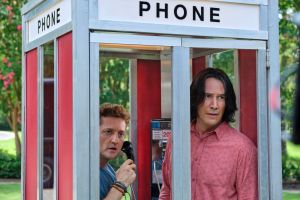 Just as Bogus Journey rejected being a lazy reprise, Face the Music inclines to chart its own path as a sequel rather than replicating the hits of old while also staying reverent to why people loved the originals. This is more a time travel movie, and the daughters even go on their own Excellent Adventure rounding up famous musicians through history as a B-story, but the main story is squarely on Bill and Ted facing off against themselves and their collective insecurities. When challenged, the Bill and Ted of present-day figure that they can skip ahead to the future and simply take the world-saving song from their future selves, who obviously would have written it by then. It’s a move the franchise has used before, relying upon future actions to take care of present problems, so it’s fitting for the characters but this is the first film to explore this as a negative. Bill and Ted are desperate and looking for an easy solution and skipping to the end will do that. However, their future selves are pathetic has-beens who have yet to write the ultimate song, and they resent their past selves for setting them up for failure. There are many face-to-face meetings between present and further future versions of Bill and Ted and their interactions become an adversarial tit-for-tat. I looked forward to each new pit stop with future Bill and Ted to see how their lives were and if they were still trying to set up the past Bill and Ted for a long-simmering retribution. The fact that this storyline has a genuinely sweet and even poignant reconciliation is a joyous addition.
Thankfully, Bill and Ted are still the same lovable, affable, and relentlessly positive dudes we’ve known and loved since the 1980s. I appreciate over three movies how much these guys legitimately appreciate and love each other. That’s one reason why it’s so enjoyable to hang out with these guys regardless of what their adventures entail. It would be easy for Bill and Ted to have become jaded in their old age, cynical from not fulfilling their hallowed destiny. They could have some animosity between the two of them that need to be buried in order to work together, rekindle that old magic, and save the world. But the screenwriters know who these characters are. Even when things aren’t going their way, they stay who they are, hopeful and supportive. I also appreciated how this translates to their relationships with their daughters, who clearly love their fathers and want to follow in their footsteps. They even refer to them as “dads” rather than “dad.” The conclusion rests on the daughters and fathers working together, and the positivity that radiates through their relationships allows the ending to reach a surprisingly emotional high for a family of good-natured goofballs.
 Face the Music is a bit overstuffed with subplots and characters, and I do wish there could have been some careful pruning to allow more room for the daughters. Bill and Ted’s wives, the princesses from Medieval England, have been recast again (Erinn Hayes, Jayma Mayes), and once again they are barely featured. There is an early conflict between the wives and husbands, and the prospect of losing them motivates Bill and Ted to save their marriages, but this conflict is entirely sidelined after the “end of the world” dilemma overtakes the plot. The wives are in their own subplot and also traveling through time or to parallel dimensions, though we never spend any time with them. There must be entirely cut scenes with them. Their perspectives could have been a whole other movie but they’re only an afterthought, as these characters have always been. Kristen Schaal (My Spy) appears as the daughter to Rufus (the late George Carlin), and we’re introduced to her mother, a deadly robot (Barry’s Anthony Carrigan) set to kill Bill and Ted for questionable reasons, the return of the Grim Reaper (William Sadler), plus all the assembled historical figures with the daughters. Also, just about every supporting family character makes an appearance too. It feels like too much, like the movie is constantly racing forward, juggling people and stories, when we didn’t need it all.
The daughters are more reflections of their fathers than independent characters. Each character, Thea and Billie, is a younger impression of their father and little else. They like the same music their dads like. They have the same goals their dads have. They have the same personalities their dads have. Both actresses are fun and Brigette Lundy-Paine (Netflix’s Atypical) does a wicked impression of a young Reeves, including adopting his sway-heavy gait, but I wish they had more to chew over. It seems cliché to make the central conflict of a third Bill and Ted movie an inter-generational one, where the fathers cannot relate to their daughters, and the four of them go on a fantastic journey that helps to bridge their differences and allow each side to better understand and relate. It might sound cliché but it could also have been compelling as well, and it would have elevated the daughters and their relationship into a primal position, rather than using the relationship with the near non-existent wives as the throwaway motivation for their call to action.
 It’s been quite a while since Winter and Reeves have played these parts, and while they both have clear affection for their characters, it’s not quite a seamless relaunch. Reeves (John Wick) has been playing hardass action heroes for so long that it feels like he can’t easily recapture goofball energy. His line deliveries can feel far more stilted and low-energy. Winter hasn’t acted onscreen since 2013 and has transitioned into being a documentary director. He delivers a more spirited performance and hits the comedy notes more effortlessly than Reeves, but the time apart from acting shows. Watching both men imitate their younger selves and going through the same shtick can have a different impact on the viewer. Hearing the same catch-phrases but with deeper, gravely voices isn’t quite the same thing and serves as a warning of the enterprise living in its own shadow. My pal Ben Bailey found an old Bill and Ted to be rather sad. I think that’s part of what Face the Music leans into (including its knowing title). They haven’t succeeded like they wanted. That weighs on them. Neither character is about to contemplate suicide but there is a sense of disappointment about how their careers turned out that they’re barely staying ahead of, which adds a melancholy dimension to these characters still falling back on what they know because it’s all that they know how to do. It’s not overpowering but it’s an acknowledgement of the loss of time.
Bill and Ted Face the Music is a charming, likable, and sweet-natured sequel that wraps up the franchise well, reminding fans why the Bill and Ted characters were so enjoyable from the start. In our COVID times, I’m finding it easier to shrug away some of the movie’s flaws, like its low-budget being noticeable, chintzy CGI special effects, and too many supporting characters on top of not integrating the daughters into the main action in a more significant fashion. It’s 90 minutes of laid back, light-hearted fun with actors and filmmakers who clearly love this franchise, and the screenwriters could have merely coasted and did no such thing. We didn’t need a third Bill and Ted big screen adventure but I’m happy that it still feels, even thirty years later, remarkably like Bill and Ted.
Nate’s Grade: B
Share this:

An American Pickle (2020)
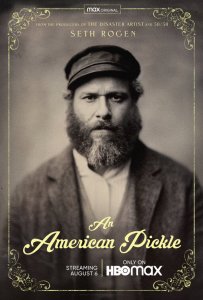 Delightfully droll and surprisingly poignant, An American Pickle is a light-hearted fable elevated by a terrific dual performance from Seth Rogen. He plays Herschel Greenbaum (Rogen), an immigrant from Easter Europe seeking a new life with his pregnant wife Sarah (Sarah Snook). Due to an accident at the pickle factory, Herschel is locked in a vat and kept in stasis for 100 years, brined for the future. His only living relative is a great-grandson, Ben (Rogen), a struggling app developer who is equal parts fascinated and annoyed by his long-lost family member. Right away I knew this was a movie with its sense of tone locked firmly in place. The opening few minutes establish the heightened, comically depressing life in the Old Country (“Her parents murdered by Cossacks. My parents murdered by Cossacks!”) and courtship where Sarah dreams of being rich enough to own her own gravestone. Then after Herschel is resurrected and the news media is obviously doubtful, a doctor explains and the narration goes, “A doctor explains. It is good. Everyone accepts,” and the same doubtful reporters now nod in approval. The movie knows its ridiculous but asking you to simply go along. By then I knew this was the movie for me. The first half of this relatively brisk comedy is where it’s at its best. Rogen does an exceptional job portraying Herschel, a man out of time trying to reconcile the life and loved ones lost. There are genuinely emotional moments that affected me, and Rogen doesn’t even try to undercut them with a wink or a nod. Beyond the technical ingenuity of playing identical roles in the same space, Rogen imbues each Greenbaum as a distinct character. Herschel is easily the more compelling character and Ben can be quite annoying, especially in the latter half as he tries to sabotage his great-grandfather through a series of petty recriminations. The last half hour can become a bit too episodic, repeating the escalating family feud without feeling like we’re getting much further narratively. It feels like a series of shorts more than a sustained storyline, like the first half. Yet I laughed repeatedly from writer Simon Rich’s (Miracle Workers) clever and aloof storytelling voice. This is a first-caliber chuckler of a movie, with a few hearty guffaws here and there. Top it off with a surprising veneer of emotional reflection and a fabulous performance from Rogen in comedy and drama, and I would cite An American Pickle as one of the more charming, diverting, and enjoyable comedies of the year. In a pandemic-ravaged year of anxiety, we need a little sweetness with a dash of tart, and that’s what Pickle packs.
Nate’s Grade: B+


 nathanzoebl
You must be logged in to post a comment.