Blog Archives
The New World (2005)
 I’m not a Terrence Malick fan. There, I’ve said it. I think he’s got a great eye for visuals, however, I’ve never been impressed by any of his films. I hated 1998’s The Thin Red Line and its exhausting supply of narrators so much that I wanted to walk out of the theater. The only other movie I felt the same impulse, at the time, was Lost in Space. As you can see, not good company. It’s been a long time since that nightmare so I figured it would only be kind to give Malick another chance. His new film, The New World, looks to deconstruct the mythic relationship between settler John Smith and Native American princess, Pocahontas (perhaps best known for painting with the colors of the wind, or so Disney would have me believe). To my non-surprise, The New World is everything I thought it would be, namely ponderous, pretentious, and quite bad.
It’s 1606, and the world is about to change forever. A cadre of ships bound from England ground ashore on the Virginia coast in search of a settlement and, hopefully, a vibrant colony. The Captain (Christopher Plummer) warns that his men must treat the “naturals” with care; after all, this is their homeland. The Native American inhabitants treat the new settlers with curiosity, poking them, smelling them, and then tolerating their existence … for now. John Smith (Colin Farrell) comes to America in chains, the result of an ill-fated mutiny, but the Captain gives him new life. He commissions Smith to send an envoy deep into the Native American village to seek trading partners. Along the way he is captured and about to be executed when he’s saved by a young girl (Q’Orianka Kilcher), a.k.a. Pocahontas though the name is never spoken once. Smith is allowed to stay with the tribe and he deeply grows fond of Pocahontas. The two are blocked by culture and language, but their feelings persist. Smith is ordered to go back to his people. If they do not leave the land there will be war. The two civilizations are set to butt heads, and the love between Smith and Pocahontas is precariously trapped between.
 Oh yeah, and after Smith leaves to go on an exploratory mission for the king, John Rolfe (Christian Bale) comes to the Jamestown settlement to woo Pocahontas himself.
Let’s get this bit of semantics out of the way. Terrence Malick doesn’t make movies, he makes nature documentaries. He doesn’t so much involve a plot as he does a large open space for his characters to pontificate about the world around them, mostly through whispery voice over. Malick fans will take in his artistic capture of sight and sound, but the rest of us out there will be scratching our heads, that is, when we’re not falling asleep. Seriously, how do you edit something like this? How does Malick know that THIS shot of a tree blowing in the wind needs to be slotted here, while this OTHER shot of a tree blowing in the wind needs to definitely come later? Malick is a stubborn mystery. He’s less interested in crafting a good movie than he is breaking the rules of what film can be. That’s all well and dandy when you put out an entertaining product. The only way I think The New World could be entertaining is if: 1) you adore long, poetic scenes of nature, or 2) you hate yourself.
It seems needless to talk about the acting. Farrell (Daredevil, Minority Report) seems like a good choice for a hardluck man overwhelmed by his new environment. Kilcher could be a fine actress, she certainly is rather beautiful, but the jury’s still out on her emoting. Plummer is so good that you’ll miss him dearly when he’s gone. Most of the acting revolves around silence and reactions, which is not the most captivating material.
The cinematography by Emmanuel Lubezki (Sleepy Hollow, Lemony Snicket) is obviously beautiful, taking great pains to showcase Virginia in a near mythic quality. But a film built around pretty pictures and idling characters can only go so far. Your attention span is so strained you may start doing your checkbook in your head. Oh ye God is The New World’s score terrible. It’s like James Horner collapsed on his keyboard, they recorded it, looped it, and just made it get louder and louder.
 It seems like Malick wrote his story on the back of his hand. So very little happens. I’m not as distraught about the immense lack of dialogue, because venturing into a foreign land with foreign people likely doesn’t produce a lot of conversation when no one can understand you. However, the only things we have to push the story forward are some repetitive, junior high-esque poetry disguised as introspective voice over. Pocahontas keeps waving her arms about like she’s directing airplanes, and then she ponders, “Mother, are you there? Are you in the wind?” She even hugs a tree at one point, perhaps thinking it’s her mother. What do you want; she’s the baby of like 100 kids. Malick is so frustrating and pretentious that he will bludgeon to death an audience rather than invite them into his artistic world. He definitely doesn’t make it easy or rewarding.
As far as romance is concerned, the relationship between John Smith and Pocahontas is curiously platonic. Both fall hard for the other but nothing ever dares to rock the PG-13 rating. The furthest these crazy kids get in expressing their love is hugging. I realize that Kilcher was only 14 years old when this was shot, but that doesn’t stop Malick from turning her into pseudo-artistic jailbait. When he’s not filming nature he spends an awful long time on Kilcher prancing around; the camera is practically fawning over her. I get it; we’re supposed to feel the spirit of this girl and her connection with the world around her. That’s why John Smith falls for her. But then nothing seems to happen in their puppy love courtship. It’s all too chaste to be epic or even slightly memorable. Then at the start of the third act Farrell leaves and in pops Bale, and the audience is going, “Oh, c’mon, we have to go through all that again?!” Sure enough, The New World starts all over and another man goes through the same courtship steps with Pocahontas. They touch the grass. They share looks. They talk to the wind. They murder my patience. The New World is a love story suffocated by hesitation and Malick’s own disinterest.
The New World is emblematic of why I’ll never be a Terrence Malick fan: it’s long, drifting, unfocused, ponderous over entertaining, and just plain friggin’ boring! If you’re a scenery buff you’ll garner some enjoyment from Malick’s images, but people looking for story, character, and any sort of movement will be lost with this 135-minute rumination on man, nature, and man touching nature …. very…. slowly. If this is all you are going to do then stop making movies and just make nature specials, Malick. The New World is pretentious, dull, and stubborn down to its very last second. It once took Malick 20 years in between movies. I wouldn’t mind if he took another 20-year hiatus.
Nate’s Grade: C
Share this:

Batman Begins (2005)
 I have been a Batman fan since I was old enough to wear footy pajamas. I watched the campy Adam West TV show all the time, getting sucked into the lead balloon adventures. Tim Burton’s 1989 Batman was the first PG-13 film I ever saw, and I watched it so many times on video that I have practically worn out my copy. Batman Returns was my then most eagerly anticipated movie of my life, and even though it went overboard with the dark vision, I still loved it. Then things got dicey when Warner Brothers decided Batman needed to lighten up. I was only a teenager at the time, but I distinctly remember thinking, “You’re telling the Dark Knight to lighten up?” Director Joel Schumacher’s high-gloss, highly stupid turn with Batman Forever pushed the franchise in a different direction, and then effectively killed it with 1997’s abomination, Batman and Robin. I mean these films were more worried about one-liners and nipples on the Bat suits. Nipples on the Bat suits, people! Is Batman really going, “Man, you know, I’d really like to fight crime today but, whoooo, my nipples are so chaffed. I’m gonna sit this one out”?
For years Batman languished in development hell. Warner Bothers licked their wounds and tried restarting their franchise again and again, only to put it back down. Then around 2003 things got exciting. Writer/director Christopher Nolan was announced to direct. Nolan would also have creative control. Surely, Warner Brothers was looking at what happened when Columbia hired Sam Raimi (most known for low-budget splatterhouse horror) for Spider-Man and got out of his way. After Memento (My #1 movie of 2001) and Insomnia (My #5 movie of 2002), Nolan tackles the Dark Night and creates a Batman film that’s so brilliant that I’ve seen it three times and am itching to go again.
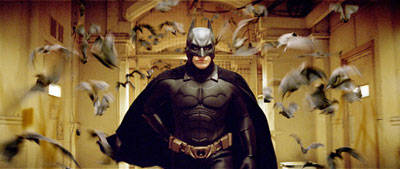 The film opens with a youthful Bruce Wayne (Christian Bale) in a Tibetan prison. He’s living amongst the criminal element searching for something within himself. Henri Ducard (Liam Neeson) offers Bruce the chance to be taught under the guidance of the mysterious Ra’s Al Ghul (Ken Watanabe), the leader of the equally mysterious warrior clan, The League of Shadows. Under Ducard’s direction, Bruce confronts his feelings of guilt and anger over his parents’ murder and his subsequent flee from his hometown, Gotham City. He masters his training and learns how to confront fear and turn it to his advantage. However, Bruce learns that the League of Shadows has its judicial eyes set on a crime ridden Gotham, with intentions to destroy the city for the betterment of the world. Bruce rebels and escapes the Tibetan camp and returns to Gotham with his own plans of saving his city.
With the help of his trusted butler Alfred (Michael Caine), Bruce sets out to regain his footing with his family’s company, Wayne Enterprises. The company is now under the lead of an ethically shady man (Rutger Hauer) with the intentions of turning the company public. Bruce befriends Lucius Fox (Morgan Freeman), the company’s gadget guru banished to the lower levels of the basement for raising his voice. Bruce gradually refines his crime fighting efforts and becomes the hero he’s been planning on since arriving home.
Gotham is in bad shape too. Rachel Dawes (Katie Holmes), a childhood friend to Bruce, is a prosecutor who can’t get anywhere when crime lords like Falcone (Tom Wilkinson) are controlling behind the scenes. Most of the police have been bought off, but Detective Gordon (Gary Oldman) is the possibly the city’s last honest cop, and he sees that Batman is a figure trying to help. Dr. Crane (Cillian Murphy) is a clinical psychologist in cahoots with Falcone. Together they’re bringing in drug shipments for a nefarious plot by The Scarecrow, a villain that uses a hallucinogen to paralyze his victims with vivid accounts of their own worst fears. Bruce is the only one who can unravel the pieces of this plot and save the people of Gotham City.
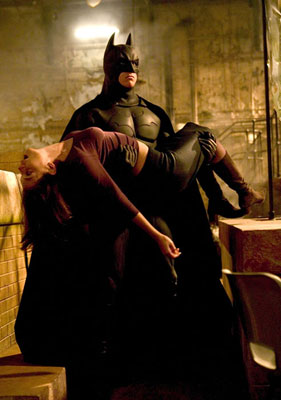 Nolan has done nothing short of resurrecting a franchise. Previous films never treated Batman as an extraordinary character; he was normal in an extraordinary world. Batman Begins places the character in a relatively normal environment. This is a brooding, intelligent approach that all but erases the atrocities of previous Batman incarnations. Nolan presents Bruce Wayne’s story in his typical nonlinear fashion, but really gets to the meat and bone of the character, opening up the hero to new insights and emotions, like his suffocating guilt over his parents murder.
Nolan and co-writer David S. Goyer (the Blade trilogy) really strip away the decadence of the character and present him as a troubled being riddled with guilt and anger. Batman Begins is a character piece first and an action movie second. The film is unique amongst comic book flicks for the amount of detail and attention it pays to characterization, even among the whole sprawling cast. Nolan has assembled an incredible cast and his direction is swimming in confidence. He’s a man that definitely knows what he’s doing, and boy oh boy, is he doing it right. Batman Begins is like a franchise colonic.
This is truly one of the finest casts ever assembled. Bale makes an excellent gloomy hero and really transforms into something almost monstrous when he’s taking out the bad guys. He’s got great presence but also a succinct intensity to nail the quieter moments where Bruce Wayne battles his inner demons. Caine (The Cider House Rules, The Quiet American) is incomparable and a joy to watch, and his scenes with the young Bruce actually had me close to tears. This is by far the first time a comic book movie even had me feeling something so raw and anything close to emotional. Neeson excels in another tough but fair mentor role, which he seems to be playing quite a lot of lately (Kingdom of Heaven, Star Wars Episode One). Freeman steals every scene he’s in as the affable trouble causer at Wayne Enterprises, and he also gets many of the film’s best lines. Oldman (The Fifth Element, Harry Potter and the Prisoner of Azkaban) disappears into his role as Gotham’s last good cop. If ever there was a chameleon (and their name wasn’t Benicio del Toro), it is Oldman. Holmes works to the best of her abilities, which means she’s “okay.”
The cast of villains are uniformly excellent, with Wilkinson’s (In the Bedroom) sardonic Chicagah accented mob boss, to Murphy’s (28 Days Later…) chilling scientific approach to villainy, to Watanabe’s (The Last Samurai) cold silent stares. Even Rutger Hauer (a man experiencing a career renaissance of his own) gives a great performance. Seriously, for a comic book movie this is one of the better acted films of the year. And that’s saying a lot.
Batman Begins is such a serious film that it almost seems a disservice to call it a “comic book movie.” There are no floating sound effects cards and no nipples on the Bat suits. Nolan really goes about answering the tricky question, “What kind of man would become a crime-fightin’ super hero?” Batman Begins answers all kinds of questions about the minutia of the Dark Knight in fascinating ways, yet the film remains grounded in reality. The Schumacher Batmans (and God save us from them) were one large, glitzy, empty-headed Las Vegas entertainment show. No explanation was given to characters or their abilities. Likewise, the Gothic and opulent Burton Batmans had their regrettable leaps of logic as well. It’s hard not to laugh at the end of Batman Returns when Oswald Cobblepot (a.k.a. The Penguin) gets a funeral march from actors in emperor penguin suits. March of the Penguins it ain’t. Nolan’s Batman is the dead-serious affair comic book lovers have been holding their breath for.
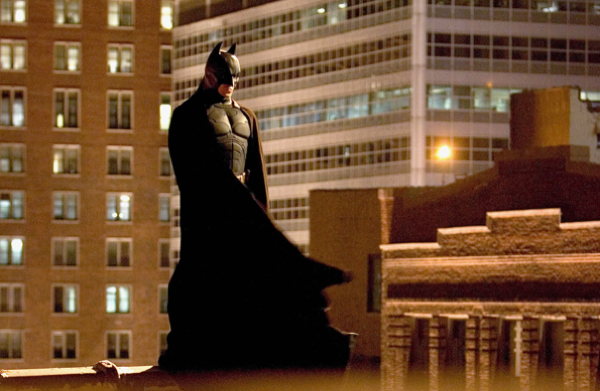 The action is secondary to the story, but Batman Begins still has some great action sequences. Most memorable is a chase sequence between Gotham police and the Batmobile which goes from rooftop to rooftop at one point. Nolan even punctuates the sequence with some fun humor from the police (“It’s a black … tank.”). The climactic action sequence between good guy and bad guy is dutifully thrilling and grandiose in scope. Nolan even squeezes in some horror elements into the film. Batman’s first emergence is played like a horror film, with the caped crusader always around another turn. The Scarecrow’s hallucinogen produces some creepy images, like a face covered in maggots or a demonic bat person.
There are only a handful of flaws that make Batman Begins short of being the best comic book movie ever. The action is too overly edited to see what’s happening. Whenever Batman gets into a fight all you can see are quick cuts of limbs flailing. My cousin Jennifer got so frustrated with the oblique action sequences that she just waited until they were over to see who won (“Oh, Batman won again. There you go.”). Nolan’s editing is usually one of his strong suits; much of Memento’s success was built around its airtight edits. He needs to pull the camera back and let the audience see what’s going on when Batman gets physical.
Another issue is how much plot Batman Begins has to establish. This is the first Batman film to focus solely on Batman and not some colorful villain. Batman doesn’t even show up well into an hour into the movie. As a result, Batman Begins perfects the tortured psychology of Bruce Wayne but leaves little time for villains. The film plays a shell game with its multiple villains, which is fun for awhile. The Scarecrow is really an intriguing character and played to gruesome effect by the brilliant Cillian Murphy. It’s a shame Batman Begins doesn’t have much time to develop and then play with such an intriguing bad guy.
Batman Begins is a reboot for the film franchise. Nolan digs deep at the tortured psyche of Bruce Wayne and come up with a treasure trove of fascinating, exciting, and genuinely engrossing characters. Nolan’s film has a handful of flaws, most notably its oblique editing and limited handling of villains, but Batman Begins excels in storytelling and crafts a superbly intelligent, satisfying, riveting comic book movie. The best bit of praise I can give Batman Begins is that I want everyone responsible to return immediately and start making a host of sequels. This is a franchise reborn and I cannot wait for more of it.
Nate’s Grade: A
Share this:

Captain Corelli’s Mandolin (2001)
 We open on an island on the offshoot of Greece in the start of the 1940s. The waters are blue, the sand is white, the people are happily ethnic, and it’s basically a postcard. The island is overpopulated with idyllic beauties and friendly people and then evil evil war had to come and steal the innocence. Cruz plays a woman who has a first name that I have no clue of or remotely how to pronounce it, but I am certain it began with a P. Cruz is studying to be a doctor under the tutelage of her wise old customed father (John Hurt). She’s engaged to be wed to hunky fisherman Mandras (Christian Bale) until the war threatens their peaceful isolated world. Mandras feels the patriotic urge to go to war and thwart the advancing Italians and Cruz pines for his safe return writing letter after letter with no answer to only fear the worst.
 As the war continues the Italians do advance further and take occupation of the Greek island. Captain Antonio Corelli (Nicolas Cage) is amongst the divisions assembled to this Mediterranean isle. He is agreed to stay in Cruz’s home and, as always, begins to develop feelings for Cruz. She feels some as well but is torn on what her actions should be. Corelli, it turns out, is far more a singer than a fighter. He has a battalion of men he dubs his “opera” and they break into frequent song and an overall zeal for life. They run around drinking and singing on the beaches complete with topless women making this Italian occupation seem like summer camp.
The good times don’t last of course and the war rages closer and closer. Soon the Italian army surrenders and then the Germans come in to retake occupation of the Greek island. Corelli must decide to go home or help fight amongst the guerrillas and native people to keep their beautiful land away from Nazi hands.
Penelope Cruz seems to be heavily pushed on me by Hollywood. She is too mute at times and the emotions that we should see tearing her up are simply dampened by her staring downcast or biting her lip.
Cage is an Italian-American and yet his Italian accent is atrociously comical. His performance is like the Joker doing an Italian accent. He also kisses like he is trying to swallow poor Penelope’s tiny head. Somehow beyond my reasoning the talented Christian Bale got in this movie. He’s about as convincing as a Greek as Laurence Olivier was as a Moor. The rest of the cast is filled with Greek people portraying Greek people.
The love story of Captain Corelli’s Mandolin is a mishmash of un-involving war violence and a cloying romance that never gets into the proper gear. There are elements of guilt and affection, but they aren’t transcendent of any reality. The first time Corelli tells Cruz he loves her they have sex in a field that very moment. There is not enough groundwork laid to produce a decent romance. So the supposed “smolder” between Cruz and Cage is thematically unbelievable, and kind of a bit creepy.
 Corelli suffers from A.I. syndrome in that it desperately needed to end twenty minutes earlier than it did. The fact that Cage survives a machine gun execution because a SINGLE PERSON stood in front of him is bad, but it gets even worse for the inhabitants of the Greek island. Some get hung by their own people, some get shot in the face from Germans, and then everyone must suffer after the war by having an earthquake level half of their town. This stretch of film goes from pointless to comically absurd. It’s like John Madden fell asleep in his director’s chair and someone thought, “Well, let’s model the last act of the film after a Universal tram ride. Hey, can we have Jaws pop out of the water at some point?” Corelli has failed as a romance and during its end stretch it completely fails as any kind of cogent drama.
The direction is adequate by Madden but the script just doesn’t cut the mustard. In the end they rely on the old Hollywood principal of Nazis being pure evil, so much so they might as well have mustaches to twirl. I thought at one moment they were going to tie Cruz to a railroad track and would have preferred it if they had. This is a film caught between romance and war, and it does a disservice to both. The war is a naive afterthought and the romance lacks any credibility. The scenery sure looks nice though. In the end, Captain Corelli’s Mandolin is a film desperately out of tune.
Nate’s Grade: C-
Share this:

Shaft (2000)
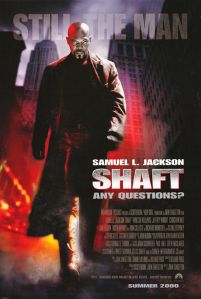 Samuel L. Jackson takes on director John Singleton’s remake – shut you mouth! I mean “newer” Shaft and spins it with effortless style and some surprising scenes of wit and even suspense. Shaft used to be a landmark in cinema, and for the black community as well, as it went full forward smashing taboos. It was more of a statement than good art because it wasn’t really art (the character in the novel was white, by the way). Jackson’s Shaft is more of a thug then the kinder gentler lady pleasure that was Richard Roundtree. This Shaft is never once preoccupied with being any landmark but doesn’t strive to be anything more then entertaining fun. The story is what surprised me most because it actually had interesting people and a well told tale. Taking a cue from the Batman franchise the villains are far more interesting and luminous then anyone else, and Christian Bale and a star-making performance by the always talented Jeffrey Wright end up making each of them a wonder on screen. Their chemistry together is worth the price of admission alone, even if you are tired of Bale playing white-collar pretty boys now (he still murders in each though!). Shaft is a loud and fast breath of summer but it’s one that surprising and very entertaining.
Nate’s Grade: B
Share this:

American Psycho (2000)
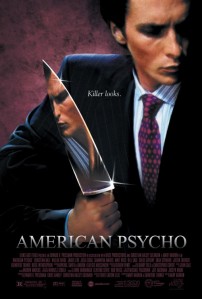 American Psycho is based on the controversial 1991 best seller by Bret Ellis though it got old fast. One can easily grasp how the lead connects with brand names on page one, but repeat it for 300 more and you’re tempted to add the book to your collection of firewood. Ellis’ novel was sadistically perverse, but director Mary Haron (I Shot Andy Warhol) has somehow managed to pull out an entertaining social satire from the pages of blood and name brands.
Christian Bale, mainly known as the boy-next-door in period piece films, plays Patrick Bateman with ferocious malevolence and vigorous life. Teen scream Leo was once considered for the part but after seeing Bale’s startling performance it should prove why he’s on screen and Leo’s swimming in The Beach. Bateman is an up-and-up Wall Street yuppie who glosses over appearance more than anything else. The only outlet it appears for our sinister shark from the soulless decade is by random acts of gruesome violence.
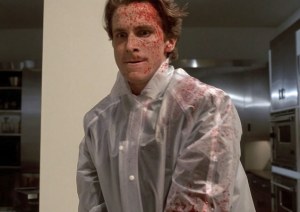 If Bateman blows off steam by blowing off companion’s heads than it only becomes more frustrating when no one believes his random confessions. Haron takes the grisly material of Ellis’ novel and mines it for pure 80s pulp. It only gets better the further it gets as you have so many points to discuss: Is Bateman acting out to prove his existence in a world that doesn’t humor him or others? Is he acting out deep-seeded rage from the actions of the decade on its people? Is he desensitized and so jaded that death does not even fracture him anymore? The questions are boundless.
The hit list of stars in Psycho includes Chloe Sevigny as a nailed home addition, Willem Dafoe as an investigative detective, Jared Leto as an axed co-worker, and sweet Reese Witherspoon as the apple of Bateman’s twisted eye. Everyone has fun in their tongue-in-cheek nostalgia romp through the absurd.
American Psycho should not be confused with the successful teen sex farce American Pie. The only desserts in this film are just, and they’re usually left of the mayonnaise and behind the frozen head in the refrigerator. American Psycho is the thinking man’s slasher movie. A flick that slices, dices, and always entices. It only gets better after you’ve seen it. One of the best films of 2000 for now.
Nate’s Grade: A
Reviewed 20 years later as part of the “Reviews Re-View: 2000” article.


You must be logged in to post a comment.