Blog Archives
Thank You for Smoking (2006)
 As soon as I saw a trailer for Thank You for Smoking I was in love. I found the book for cheap and read it with months to spare before the film reached my local theater. Admittedly, my expectations were high because the book was wonderful, and Thank You for Smoking as a movie is equally wonderful and a very good film adaptation.
This is a wickedly funny satire that skewers all sides in the political debate about Big Tobacco, and the film doesn’t take a stand, which is refreshing. It has a firm grip on its humor and gleefully gives its finger to political correctness. There?s a lunch group called the M.O.D. (Merchants of Death) squad where reps for Alcohol, Firearms, and Tobacco, of course, argue over whose product is harder to spin. It’s likely the snort-because-you-can’t-believe-they-said-that movie of the year. The tar-black humor in Thank You for Smoking rolls off so casually. This is a comedy that respects the intelligence of its audience and doesn’t dumb down its barbs or its satire. Aaron Eckhart was born to play the role of Nick Naylor, tobacco’s master spin artist and public charlatan. Naylor is conniving, slippery, and yet immensely likable not in spite of these traits but because of them. Eckhart is downright charming and you can see how he could dupe a nation, even if he’s only doing it for the challenge. Thank You for Smoking has one of the finest assembled casts in a long time, and every member fires on all cylinders. This is a film brimming with confidence and it’s evident with every frame. You almost might feel guilty for wanting to capture a contact buzz from how polished, assured and witty the flick is.
I never thought I’d say so but it sure looks like adapter/director Jason Reitman has a far more promising future right now than his dad, Ivan. Jason, the son, keeps the movie brisk, packed with characters, subplots, jokes, and a visual whimsy. This is a terrific adaptation of a terrific book, and Reitman really hones in on the mechanics of debate and lobbyist practices with aplomb. A scene where Nick teaches his adoring son the tricks of debate with ice cream is outstanding. Thank You for Smoking crackles with dialogue to die for, like Nick’s boss BR (J.K. Simmons) saying, “We sell cigarettes. They’re cool, and addictive, and available — the job is practically done for us.” My only complaints with the film, besides that it’s too short at just 90 minutes, is the manufactured danger seems a bit too slight and too easily overcome. Nick quite simply vanquishes whatever threat his reporter sex buddy Heather (Katie Holmes) posed. Otherwise, Thank You for Smoking is a superb movie all around and there’s no reason you shouldn’t see it. Take the hit.
Nate’s Grade: A
Share this:

Freedomland (2006)
 There’s one thing I’m going to remember about Freedomland more than anything — seeing this movie cost me about $300. Allow me to explain. Upon returning home from seeing this terrible film, I received an e-mail from a friend alerting me that a secret code had been floating around the Internet. This code was to be used at Amazon.com, and when punched in at the check-out, your order would be free as long as it totaled over 80 dollars. Just as I was about to check out with over $300 of goods the window closed and the code was no longer working. If I had not seen Freedomland then I would have gotten this news earlier and would have been able to obtain my booty. Alas, I did see Freedomland, a drama that attempts to shed light on racial woes. Movie mogul Joe Roth, the head of Revolutions Studios, doesn’t direct movies fairly often and when he does they’re not great (America’s Sweethearts, Christmas with the Kranks). I knew exactly what I was getting into when I entered the theater; I just didn’t know it was going to cost me $300.
In 1999 New Jersey , Brenda (Julianne Moore) walked dazed and bloodies through an urban neighborhood to a hospital. She tells detective Lorenzo Council (Samuel L. Jackson) that she was the victim of a car jacking while she was traveling through an urban area. She says a black man threw her from her car and drove off. Brenda’s four-year-old son Cody is still in the car. This sets the neighboring communities abuzz. Brenda’s hot-headed cop brother (Ron Eldard) is ready to turn the black projects and high rises upside down, unafraid of whom he may harass. The black community is in an uproar over the treatment, succinctly pointing out that many black children go missing but the news vans and police cars only come out when the missing happens to be white (for further proof, look to the still ongoing coverage of Natalee Halloway). Karen (Edie Falco) runs a team of mothers who volunteer nationwide to help find missing children. Lorenzo has his own doubts about Brenda and the details of her story.
 Plain and simple, Freedomland just does not have enough story to justify its existence. It goes nowhere and practically drifts to its long-awaited conclusion. You’ll see the light at the end of the tunnel around the halfway mark, and then Freedomland limps to its foreseeable ending, devoid of any twists and turns that aren’t telegraphed a mile away. It got so pathetic that I was actually hoping, against all odds, there’d be some gonzo M. Night Shyamalan-esque twist at the very end to jar me out of my complacency. No such luck. The marketing folks of Freedomland seemed to advertise a twist ending, which is hard to believe since everything plays out exactly like you?d first suspect. Moore’s overacting hysteria makes the audience doubt her from the start; plus the fact that Brenda’s like, “Oh yeah, I almost forgot, my SON is in the hijacked car.”
This is a movie so mishandled by Roth that every moment feels false, and when it doesn’t feel false it feels trite and awkward. Take a moment when Lorenzo takes Brenda to an empty urban high-rise. He?s got her pinned in a corner, very literally, and is pressing to know if she killed her kid. The framing of the scene would almost suggest something quasi-romantic, with Lorenzo leaning very closely into Brenda and his arm against the wall beside her. At the very least, it?s really intrusive. And then at the end of Brenda’s “he was all I got” monologue the two actors seem to just stare at each other, like they’re mentally waiting to hear the word “Cut.” The weird framing and the editing make the scene feel amateurish.
But Roth doesn’t stop there. Freedomland itself is a gigantic mislead, and the old abandoned building has about five minutes of total screen time. It’s not enough to even qualify as a red herring, let alone justify it as a movie title. Apparently, this building has been rotting in the woods for decades, and yet Lorenzo lets a large volunteer search party just trounce around inside. I’m pretty sure any policeman worth their salt would need to get a team to make sure the building was structurally sound before letting civilians snoop around in a potential crime scene. That’s not enough stupidity. Later while the people are exploring the Freedomland building, Karen says the floorboards may give way at any moment, and then she leaves Brenda by herself with said unreliable floorboards. Do these people even understand what they’re doing?
Freedomland seems so message-hungry and preoccupied with making some Big Statement that it forgets to be entertaining. Roth is clueless how to juggle all his plot elements, letting the racial tensions turn both sides into offensive stereotypes. The white cops have short fuses and have no hesitation to assault innocent black people (they’d be suspended and then reviewed). The black community in Freedomland, while seeming to have nothing better to do than assemble and shout at the police, stir up their community ills whenever the plot deems it necessary. Some black people are seen setting the community’s own property on fire, swept up in the rising air of a riot. Rafik, a youth given a lot of foreshadowing, instigates the riot and an entire wall of angry black faces proceeds, never mind that this brash decision results in many innocent people being beaten. The movie seems to say that all blacks are victims or instigators. Freedomland is so earnest to be earnest that it misses the mark when it comes to all the details. How else to explain why the film is inexplicably set in 1999. Someone didn’t tell the film’s costume designer, because Rafik is wearing a “G-Unit” shirt, a rap group that didn’t come into light until after 50 Cent’s commercial rise in 2003.
 Perhaps the film’s ending is Roth?s biggest misfire. Lorenzo visits Cody?s shallow grave, now festooned with flowers and personal messages. He reads one that says, basically, “Cody’s death made us all look beyond our differences and realize what we have in common, the ability to feel sad.” What? Is Roth actually justifying the death of a child and subsequent racial fallout as being medicine for society’s ills? This seems ridiculous to me, especially after sitting through two hours of a movie where no one came together, unless you’re talking about the human connection of fist-to-face.
The acting in Freedomland is so unrestrained and shows another of Roth?s directorial weaknesses. Moore, always so reliable a performer, goes out of her mind and gives what should be the worst performance of her career. She’s so over the top, so Looney tunes, so wildly out of control with no bearing, she’s practically bouncing off the walls; it’s kind of embarrassing to watch. Her hysterical theatrics provide several moments of unintentional laughter, particularly a moment where Lorenzo is interrogating her and she just blurts out, “I love you.” Freedomland does her no service by handing her some dreadful dialogue and drawn out monologues. I think it may be time for Moore to star in something a little happier instead of more movies where she’s predominantly crying or grieving. And is it me, or does it seem like Moore has a habit of losing her kids in movies (maybe she should start tethering them to her waist)? Note to Julianne Moore: just because you get to cry and scream doesn’t mean you should take the role. Did you actually read the script to Freedomland?
Jackson, left directionless with an underdeveloped character, reverts to his standard operating procedure when it comes to authority figures … namely staring and yelling. Lorenzo has some character traits (asthma, a son in prison) that are either dropped or have no payoff or insight toward his character. He?s a cop in the middle of it all, and yet Freedomland feels like just having Jackson as an actor should cover the characterization part. At this point, Jackson can do these roles in his sleep.
Falco, far more subdued than everyone else in a very yell-heavy movie, leaves the biggest impression and gives the movie life when she’s onscreen. Falco’s character is what Freedomland should have been based around, not Moore’s shrieking loon of a mother. Falco has the film’s only great moment, effortlessly shifting a story about her own loss and need for closure back to Brenda. The patience and control Falco has in that scene only reminds me how much I need The Sopranos back on the air.
Freedomland is so starved to say something grandiose about racial tensions that it neglects being entertaining. When the movie is entertaining, it’s mainly because of the wild, embarrassing overacting and the nonsensical human behavior. At its worst, Freedomland is offensive to cops and blacks and moviegoers in general with working grey matter, at its best Freedomland is a muddled, incompetently directed movie that drifts unchallenged toward its expected and welcomed end. Roth should leave directing to people that have a better feel for taking control of actors, material, and editing. For those that said the racially-charged Crash lacked tact, I invite them to take a trip to Freedomland. It’s trite, it’s dull, it’s funny when it’s not meant to be, and it’s one of the worst films of 2006.
Nate’s Grade: D+
Share this:

Charlie and the Chocolate Factory (2005)
 The visuals by Tim Burton are suitably lavish but it’s missing the heart of the 1971 film. I never thought I’d say a movie worked despite Johnny Depp’s performance, but that’s the case here. It was far too off. Whereas Gene Wilder had the dichotomy of warmth and madness, Depp was just the kooky Michael Jackson-esque weirdo in a bobbed haircut (I thought Neverland had been found). Perhaps the added Michael Jackson vibe makes the premise a lot darker, what with luring children into a chocolate factory. Charlie is a really boring character lacking definition beyond his “goodness.” Once they get to the factory he?s basically wallpaper, watching his peers fall one by one to their vices. I’m not sold on a Wonka back-story. I don?t need to know why he is as he is; I need no tormented childhood and daddy issues. This new film has more polish but the old film has more togetherness and lasting power.
Nate’s Grade: B-
Share this:

Brokeback Mountain (2005)
 Go ahead and work the snickers out of your system. Brokeback Mountain has been dubbed “that gay cowboy movie,” and been condemned by certain fundamentalist Christian organizations as “a very dangerous and insidious message to America.” But what message is Ang Lee’s film even putting out there? It seems to me that Brokeback Mountain is putting a human face on a slur, making homosexuals look like you or me. For some that prospect may be terrifying. The movie is playing well on the blue-state coasts, expectedly, but it’s also surprisingly playing well in America’s heartland. It seems that people are lining up all over to see a movie about two gay cowboys in love. And perhaps the more people that witness Brokeback Mountain, the harder it will be to listen to those so-called family advocacy groups with their sterling Christian morals. Maybe people will really see what’s behind many of the words of outcry – hate and ignorance (I am in no way insinuating that disliking the flick means you are homophobic). Despite all this political talk, Brokeback Mountain is by no means a political movie. It’s a love story, above all, and it’s a doozy.
In the summer of 1963, Ennis Del Mar (Heath Ledger) is a quiet man looking for work in rustic Wyoming. He finds a job as a sheep herder working atop the canyons and mountains of Brokeback. Working alongside Ennis is Jack Twist (Jake Gyllenhaal), a charismatic rodeo rider. The weeks are long and Ennis and Jack are all the company they have, excluding the hundreds of sheep they tend. Eventually, the more taciturn Ennis finally opens up and bonds with his herding partner. “That’s more words than you’ve spoken in two weeks,” Jack says. “Hell,” Ennis adds, “That’s the most I’ve spoken in a year.” The rules have been laid out: every night one man sleeps in a tent campsite, the other sleeps next to the sheep to guard them. Well one night Ennis has had too much whisky and cannot make it back to the sheep. Jack invites him to sleep in the tent instead of freezing outside. Then something surprising takes place – both men have an alcohol-fueled bout of rough sex. The next morning both men stress they “ain’t queer,” but they have a hard time fighting their feelings inside. Ennis warns that, “If this thing, it grabs hold of us again… at the wrong place… at the wrong time… and we’re dead.” He recounts a childhood memory where his father showed him the corpse of an older homosexual man, brutally beaten and mutilated. For them, their love must stay on Brokeback Mountain.
 The men part ways. Ennis marries Alma (Michelle Williams), a quiet woman after his own heart, and fathers two daughters. In Texas, Jack meets fellow rodeo rider Lureen (Anne Hathaway) and gets involved in a relationship with her, fathering a son of his own. But Jack still thinks of his Brokeback pal and sends him a postcard. Ennis nearly lights up at the returned sight of Jack and the two passionately embrace. He tells Alma that Jack is an old “fishing buddy” and they sneak away every few months for a fishing getaway. Really the men are returning to the countryside to rekindle the love that they haven’t left behind. But can they keep their love a secret, and should they even have to?
I wonder if Lee would ever have directed this if 2003’s Hulk didn’t bomb so badly. Lucky for us, he’s taken the Brokeback helm and infuses lots of emotion into the story. The Wyoming countryside (actually Canada, but it’s all close enough) is gorgeous, and the film has a great earthy feel. Best of all, Lee allows his love story to breathe and go at its own pace, never cutting corners or rushing an emotion. There’s a lovely, lilting feel to the film, and Lee’s guided hand allows the story to play out to its grand promise. Based on Pulitzer Prize winner Anne Proulx’s 11-page short story, screenwriters Diana Ossana and Larry McMurtry (Lonesome Dove, The Last Picture Show) have given incredible depth and subtext to the tale. McMurtry, in particular, has great knowledge of the West and the cowboy lifestyle, and the screenplay gives you an idea of small-town Western life. There are a few moments at bars, social scenes, stores, but they brilliantly give you every detail you’d need to know about this way of life. I even loved how the people of Wyoming wore fashions that were five years removed from their height of popularity, which is exactly how fashion moves around to the smaller parts of America. Ossana and McMurtry are also commended for presenting their characters as people first and never as agenda bulletins. All three lend a level of authenticity that makes the story feel organic and never trite.
In films about forbidden desire and heartbreak, the acting is the cornerstone for how powerful the tale resonates. The acting in Brokeback Mountain is phenomenal. Ledger is the breakout star and the majority of the film’s focus. He gives the performance of his life. Ledger is outstanding as the reserved, taciturn Ennis, brought to believe that queers were something sub-human and now he wrestles with his own identity. He may be a restrained man of few words but you see every emotion bubble under the surface, every conflict played out in his eyes. Ledger’s few violent or emotional outbursts are startling because they show an uncontrollable feeling, one even he can’t withhold 24/7.
Gyllenhaal has the showier role but masterfully displays the frustration of forbidden love. He’s willing to sacrifice everything for Ennis, and the fact that Ennis won’t do likewise tears him apart. Isn’t love enough, he wonders. There’s a moment in the film that so sharply displays Jack and Gyllenhaal as an actor. It involves two different shots in a moving truck. The first is Jack headed to Ennis’ ranch, singing, bouncing, and with a wall-to-wall smile. The second is Jack driving away from the ranch unfulfilled, sullen, broken, and seemingly unable to cry another tear. It’s two small moments and they sum up Jack and Gyllenhaal perfectly. The only thing unsettling about Gyllenhaal’s performance is his late 70s porn star ‘stach. With his tremendous work in Jarhead and now Brokeback Mountian, Gyllenhaal is in class all his own (he’s got the dreamiest doe-eyes in Hollywood).
The ladies of Brokeback Mountain have less screen time to play with but they each deliver fine performances. Williams is a silent, put-upon mother and is shattered when she discovers her husband’s secret love. She just crumbles. She’s never the same and Williams showcases her character’s distress and mounting bitterness. One of the film’s highpoints is her confrontation with Ennis, many years later, finally sharing all that she knows. Me thinks an Oscar nod is headed in her post-Dawson’s Creek future. Hathaway plays quite an opposite character. She begins as a wild, headstrong cowgirl with a healthy sexual appetite, something perhaps Jack sees as a reflection of his self. Then their love dies at some point and she pours herself into work, but Hathaway illuminates every step along the way. Her small smile during a scene where Jack finally browbeats her obnoxious father is terrific.
This is an elegiac, engrossing love story. Brokeback Mountain is not necessarily a “gay thing,” more so it’s a story about forbidden love and about the consequences of moving forward without ever letting go. That sounds universal, right? Nothing “gay” about that. Brokeback Mountain explores the force of love and shows how uncontrollable and unpredictable it is. Jack and Ennis are just as surprised by their feelings and their rough night of passion as the audience, but the happiness they share is hard to argue.
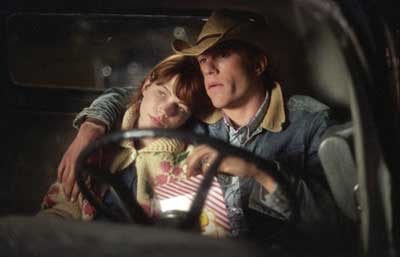 Because of the film’s gentle pace, and Lee’s loose control, we really immerse ourselves in their relationship as they frit away the hours looking after sheep. There was a woman in my theater (I won’t name names, partly because I don’t know hers) who felt that Brokeback Mountain was far too slow and could have been put to better use by cutting 2 hours out. The film’s placid pace is integral to the story’s success; you need to see how expansive that countryside is to feel alone, you need to have the many small conversations to draw out a closer camaraderie, you need the added time to open up to these men, and then once you have –BAM! — they turn their worlds upside down. This buildup is necessary for our connection to the characters but it’s also essential so we can understand what happens. Yes, the film portrays love as it truly is: an all-encompassing emotion that can be as maddening as it is passionate. But Brokeback Mountain doesn’t dare introduce a gay romance, something so dangerous in this land, all lickity-split. It’s supposed to be a surprise to these men, grown up with John Wayne movies and strong, silent role models. The movie enjoyably takes its time to seduce an audience with its tale before choking out every last tear in the end.
The tragedy of Lee’s film is that these men have each found the love of their life but, because of society’s prejudices, are not allowed to act. As a result, each man puts on a different face and pretends they’re a happy heterosexual Western buck for the public, but each is being eaten away inside. Ennis drinks a lot and is full of self-loathing. Jack is less publicly reserved about his feelings and finds momentary comfort with other warm bodies, mostly through silent nods with other closeted gay men. I’m reminded of a line in Paul Thomas Anderson’s Magnolia: “I have a lot of love to give; I just don’t know where to put it.” Ennis and Jack cannot quit each other but they also tragically can never fully commit to one another, at least without any threat of ostracism or death. That’s the power of Brokeback, that it shows you these simple men, shows you their love, and then won’t let that happy ending ever manifest that we yearn for. When we reach our somber, haunting conclusion there weren’t many dry eyes in the theater, mine included. Brokeback Mountain is a love story that won’t let itself be happy, and that’s what provides all the kicks to the gut and lumps in your throat.
I think some of the more hostile criticism of Brokeback Mountain is because of how normal Jack and Ennis are presented. Neither is a swishy stereotype, neither is any less of a man, and that notion probably terrifies the homophobes: “Well, they look normal, and if they get gay then maybe I will too!” That’s a shame really, because those ignorant few will miss out on a powerful, sweeping, complex, aching love story with fantastic acting. Ledger and Gyllenhaal will make you feel every moment of joy, every moment of pain, and every lingering conflict on what makes them whom they are. Lee stressed that he wanted to show the world a love story where you really felt that love was an uncontrollable force. His heartfelt, touching film is a revolution for being a normal love story, albeit with two classic Marlboro men. There is no propaganda, no gay agenda, but perhaps the film will open people’s eyes and strip away any narrow definitions we have toward the ownership of love. Brokeback Mountain set out to merely tell a good story, not change the world. It’s accomplished the first part and maybe, just maybe, it’ll spark discussion, debate, and lasting memories to lay groundwork for the second.
Share this:

The Chronicles of Narnia: The Lion, the Witch, and the Wardrobe (2005)
 I have never read one single word from C.S. Lewis’ classic children?s tales, The Chronicles of Narnia. I have never read one word from J.R.R. Tolkien’s Lord of the Rings tomes either. I read five pages in Dune and returned it to the library (50-page glossary of vernacular my ass!). I have also never read one word of any Harry Potter book, and I’m quite all right with that. I have several friends that were consumed by Lewis’ series in their childhoods and now are consumed by J.K. Rowling’s series. I don’t confess to be geek-free; I read the Shanara series by Terry Brooks when I was in junior high. I collected comic books, I watched cartoons, I still do both to an extent, but I suppose I left the fantasy genre with my appreciation for flannel all the way back in junior high (I also discovered women). Whenever I enter a fantasy film I bring with me no baggage. And so I strolled into The Chronicles of Narnia: The Lion, the Witch, and the Wardrobe ready to be entertained by a good story, whether Lewis, a big Christian theologian and author, was advancing some kind of Christian allegory or not. After seeing all 125 minutes, it’s safe to say I’ll be in line for any potential sequels.
In the heat of WWII, the Pevensie children are being transported out of London to live with a kindly professor (Jim Broadbent) on a safe rural farm. Peter (William Moseley) is the oldest and assumes the leader position vacated by their departed father. Susan (Anna Popplewell) is the brainiest, Edmund (Skandar Keynes) is the moodiest, and little Lucy (Georgie Henley) is the precocious true believer.
 One day during a game of hide and seek Lucy hides in an upstairs wardrobe. To her delight and amazement, she is transported to a magical, snow-covered realm known as Narnia. She encounters a faun, half man-half hoofed animal, named Mr. Tumnus (James McAvoy). He’s shocked to see a live human girl before his eyes and invites her for tea. There’s an old prophecy that says when two Sons of Adam and two Daughters of Eve arrive then the 100-year winter will end. The evil White Witch (Tilda Swinton), the one ruling Narnia with an icy fist, wants the humans captured and dead so she can rule forever. Lucy tells her siblings about her amazing adventures but they don?t believer her, that is, until they all tumble forth into the land of Narnia. The older kids mostly want to return home, but Edmund has sold them out by aligning with the White Witch. Now they’re on the run from her pack of wolves and the Pevensie children must seek out the powerful Aslan (voiced by Liam Neeson), a heroic lion who is all that stands in the way of the White Witch.
I declare my undying love for Tilda Swinton, truly the best character actress we have working today. Swinton already gave one bizarre yet outstanding performance this year as the androgynous angel Gabriel in Constantine (Swinton does androgyny better than anyone else; hell, she was convincing as a man and a woman in Orlando). In Narnia, Swinton exhumes a chilly command that could make you stand at attention. She’s such a hostile, icy, stone-faced villain, and Swinton has such calm confidence the whole time. She preens like a rock star and has the oversized ego to boot. She’s the kind of bad girl you could really fall in love with, especially if you have monstrous maternal issues.
The rest of the actors are mostly good. Henley steals every scene she’s in, and I’m not talking about the added attention of her suitable British choppers (my apologies to U.K. readership). Neeson seems a little bored with yet another wise teacher role just this year. I would be more interested in hearing the original voice of Aslan, the stupendous Brian Cox (Troy). McAvoy has a gentle sweetness to him.
Director Andrew Adamson integrates the flashy computer effects with surgical-like precision. Adamson?s experience as co-director for the Shrek films has given him the know-how to coordinate massive effects sight unseen and still coherently direct his live-action actors (ahem, George Lucas, ahem). The special effects in Narnia are outstanding. The characters move and behave with staggering authenticity (I know most of these creatures are mythical and have no comparison). The vistas and landscapes are beautiful, particularly the winter wonderland of Narnia. Adamson has a keen eye for visuals and lavishly recreates his visions; the climactic battle is bloodless but no less exciting.
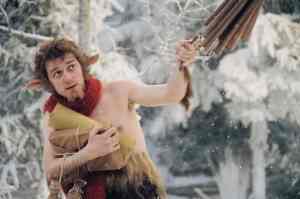 Most of the story flaws come from the source material. Narnia lacks the epic scope of the Lord of the Rings movies as well as the seriousness. As a result, no one feels very much in danger even during the more harrowing moments of battle. Lucy’s gift of “resurrection juice” kind of let’s the air out of the tension balloon. What suspense is there if a character has a magical healing elixir they can just whip out? The two girls are removed from the final battle and have little impact on its outcome. The White Witch’s tactic of freezing her enemies instead of killing them seems to be foolish, especially when they can be thawed at inopportune times. A major character’s sacrifice seems a tad superfluous if he can just reappear, lickity split like he had an extra life. Lots of secondary characters get the shrift when it comes to characterization, so you feel less than you should when something happens to them; this is even further hampered by Lucy’s Jesus Juice.
There’s a real genial sense of magic to Narnia. When little Lucy first transports to this magic realm, her face lights up in that adorable cherubic way, she wafts through the falling snow, catching it with her hands. Her moments with Mr. Tumnus are note-perfect from the dialogue, to the vocal inflections, to where the scene leads. Their relationship is very tender and provides some of the film’s best moments. Looking back, I can pick apart the movie, but while I was sitting in my theater I was deeply surprised how affected I was. I felt their fear, I felt their sorrow, and most of all I felt some sense of magic. The logic part of my brain was telling me how silly it was to see Santa Claus, let alone witness jolly ole Saint Nick handing out weapons for all the little good girls and boys (“Ho ho ho, kill ’em good for Santa.”). Yet while I watched I never questioned these things. The power of Narnia had taken full hold of me and I was swallowed whole by its tale.
Narnia is a good entry point for children in the world of fantasy. It’s suspenseful without being scary, and familiar without being too simplistic. Unlike Tolkien’s complicated worlds and heavy tales, Narnia is more a children’s story, what with the inclusion of unicorns, centaurs, fauns, and a menagerie of talking animals. There’s the suitable kid fantasy, like becoming king and fighting monsters, but there’s also a focus on family reconciliation and being accountable for your own actions. This isn’t a story that will overwhelm its audience but will leave them hungry for more adventures. The characters are mostly sketches (the leader who doesn’t want to be a leader, the overly logical one, the disaffected youth constrained by too much discipline, the little believer in the unknown), so it’s a testament to the filmmakers that the story and the characters have as much resonance as they do. The Lion, the Witch, and the Wardrobe sets up the parameters of the Narnia universe and its inhabitants and now future sequels can add meat to this bare skeleton. Narnia is a fantasy film the whole family can enjoy.
 The Christian allegories and metaphors mostly fly under the radar, with the exception of one extremely obvious scene that might make Mel Gibson wince. I even think Narnia is better enjoyed as a straight-up story than as an elaborate series of codes and messages harkening toward Christianity. If you view Narnia with the intent to break down its meaning and supplant connection to the Bible, then you’re really missing out on some great storytelling. And Narnia isn’t outwardly religious; it’s mostly a film preaching good values rather than simply good Christian values. Most of the lessons and values taught within Narnia are universally applicable to all people.
The Chronicles of Narnia: The Lion, the Witch, and the Wardrobe is a superbly entertaining retelling of C.S. Lewis’ classic children’s series. Adamson connects all the expected fantasy dots while seamlessly incorporating awe-inspiring special effects. The bountiful imagination up onscreen is the film’s biggest charm, rendering a divine touch of magic to the finished proceedings. Despite any better judgment pointing out the simplicity of the tale and characters, the production is first class and compelling. I was completely surprised how affecting I found the film and how immersed I became. This is great storytelling aided by gifted storytellers. Narnia is bigger than a family film, more accessible than a “Christian movie,” and more entertaining and endearing than most films released this year by Hollywood.
Nate’s Grade: B
Share this:

Capote (2005)
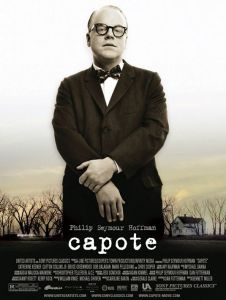 This is a really solid, probing movie about human relationships and the oversized personality of famous author Truman Capote. It’s a very illuminating character piece on its titular star. We see many different facets of his character; part of the connection is because Phillip Seymour Hoffman is so flat-out brilliant in his portrayal of Capote. He’s got that unmistakable nasal voice down, but Hoffman excels at the little things of character, his command of a crowd, his inflections, his physical movements, his ability to look exhausted and pained but embarrassed and prideful at the same time. Capote shows you why everyone wanted to rub elbows with him with how he tells a story and whips up an audience. This is another in the trend of warts-and-all biopics, and you see how calculating he is (he says he never lies). Every confession he offers is manipulative and meant for self-gain, like when he tries to get a witness to talk or get the Kansas P.I. to show him the murder photos. You see how the wheels work within this character. And then Capote shifts as he delves further into the case into his unlikely relationship with Perry Smith. Capote keeps them alive by providing money for their attorneys so he can get more for his book. But there can be only one ending to provide closure to his book — their death. There are several wonderful exchanges of dialogue between Smith and Capote and their quiet, smiling lies they give each other. All we see of Smith is the polite man who draws and read poetry in his jail cell, and the bond growing between him and Capote. The film’s climax eradicates any sympathy built and we see the unpredictable, unmerciful nature of violence. Capote really hammers home the dichotomy of persona, with each side playing the other. The cast is splendid and everyone makes their small roles click, particularly Catherine Keener as novelist Harper Lee and Chris Cooper as the Kansas P.I. What’s even more surprising is that Capote was even better the second time I saw it. There’s so much to find in this excellent character piece.
Nate’s Grade: A
Share this:

The Ice Harvest (2005)
 Imagine my surprise when I found out that a small crime novel I read years ago was getting the big Hollywood treatment. I read Scott Phillips’ The Ice Storm in one sitting back in 2003 during a plane trip from Ohio to San Diego. It was deliciously dark down to the very last page and I loved it, but then I am a sucker for a good crime story (check out Jason Starr’s Tough Luck and Hard Feelings if you are the same). The movie looked to be on the right track with names like John Cusack to star and Harold Ramis to direct. Ramis is responsible for starring, writing, or acting in or directing some of the most beloved comedies of the last 25 years including Ghostbusters, Groundhog Day, Stripes, and National Lampoon’s Vacation. That’s one illustrious comedic pedigree. So how could the movie go wrong?
It’s Christmas Eve and Charlie Arglist (John Cusack) is a self-loathing attorney that works for some of the shadiest folks in Wichita, Kansas. One of those bad customers is mob boss Bill Guerrard (Randy Quaid) whom Charlie and his partner Vic (Billy Bob Thornton) have just swindled over $2 million from. Unfortunately for them, Wichita is hit by an ice storm that makes the roads haphazard to travel. The two will wait until the morning thaw and then hit the road with their booty. Vic reassures Charlie to just, “act normal.” This means many ventures to some of Wichita’s finest strip clubs with alluring names like Sweet Cage and Tease-O-Rama. Charlie has a sweet spot for Renatta (Connie Nielsen), a bombshell and the operator of the Sweet Cage. He’ll also have to drive his plastered friend Phil (Oliver Platt) around, who is regretting having married Charlie’s cold ex-wife. Charlie would love to sail off into the sunset with Renatta by his side but first he’ll have to survive the night and a mob enforcer (Mike Starr) is already on his trail.
 The Ice Harvest feels like an episodic collection of ideas, too many of which have too little significance. The titular ice storm seems all but forgotten, only serving as a cheap plot device to keep our characters bottled up in the city. It has no bearing elsewhere on the plot. The reoccurring “As Wichita falls” passage has no payoff. The nosy police officer plotline looks like it might be building to something important but then is quickly disposed of. The Christmas setting has little impact except for giving the strippers something to complain about. The Ice Harvest wants to benefit from the juxtaposition of Christmas cheer with all these tawdry, violent asides and it just seems small and shallow. The movie also shifts the story’s time from 1979 to modern day one suspects just for the cheap out of cell phones.
Credit goes to Cusack for making his character as likable as he is. His character is a mob lawyer, a deadbeat dad, an increasingly drunk driver, and a man with his nose in whole lot of sleazy ventures, and yet you still pull for him to somehow succeed. Cusack, forever youthful, seems overly numb to all the horror around him and downplays the danger to a negative degree. Charlie seems like he’s in the wrong movie. Thornton plays yet another hedonistic louse and is quite good though not at his Bad Santa apex. He seems the most at ease with the physical comedy. Nielsen plays your typical femme fatale with a Veronica Lake haircut and breezy voice, which should both be instant red flags for students of film noir. The two men that steal the show are Platt and Quaid. Platt gives a brilliant uninhibited performance as quite possibly the drunkest man in movie history. Quaid is an honest surprise as a menacing mobster ruing the day he chose a criminal enterprise in Kansas. He chomps scenery with a violent exasperation that truly seems larger than life. This is a bad guy to fear and Quaid makes the most of his very limited screen time.
Ramis is out of his league here. The man cannot competently direct tension or action. Ramis doesn’t let the audience build suspicion because he’d much rather have characters just point-blank say, “Don’t trust this person” instead. He doesn’t give us time to piece clues of betrayal together so instead characters just keep running forward until they get smacked in the face by something made obvious. Ramis’ mishandling of tone really sinks the movie. The Ice Harvest doesn’t know whether it wants to be a thriller of a dark comedy and therefore just really sputters at both. The comedic elements and the thriller elements butt heads; because of the comedy the character never feel in danger, and because of the thriller/noir elements the characters and their situations never really seem funny. The Ice Harvest turns into some kind of two-headed beast that snaps at itself. I think maybe Ramis was watching Blood Simple and taking notes and then he accidentally taped over it with a Charles in Charge marathon and was at a loss.
P art of this problem is that the screenwriters don’t fully commit to the nastiness. Phillips’ novel is unrelentingly dark, cynical, and unsentimental and doesn’t give a damn if you like its characters. The movie, on the other hand, wants to get its hands dirty but is more interested in playing it safe. The film seriously reminded me of last year’s Surviving Christmas, another movie that wanted to be sweet and nasty and wound up just being really bad. You can feel The Ice Harvest reeling back several times to set up Charlie as a likable lad in over his head, going so far as a slightly contrived yet predictable finale. At least Bad Santa had the gusto to approach a happy ending on its own crude, unsentimental terms. Ramis needs to stick to broad comedies and leave the bleak neo-noir humor to the Coen brothers.
There are some plot elements from the book that just don?t work with this half-hearted adaptation. (Spoilers to follow for paragraph) At the very end of the movie Charlie has left the city with all the money and stops along the road to help a stalled camper. In the book, the camper backs up over him and kills him, thus ending with the ringing endorsement that crime doesn’t pay. It made sense, especially for a book that was dark to the very end. In the movie, the camper backs up and knocks him to the ground but doesn’t run him over. Charlie dusts himself off and that’s that. The scene feels pointless without fulfilling the end of the book. It doesn’t provide any last-second tension. Charlie just hops back in his car, dear hung over Phil pops up, and the two are set for one most excellent adventure. Unearned and misplaced happy ending? No thank you.
The Ice Harvest is only a mere 88 minutes long and yet the film still feels padded and draggy. The drunken Oliver Platt-heavy middle is a generously paced muddle, and though it’s rather funny it’s also rather extraneous. The Ice Harvest is really a handful of great moments that don?t add up to a satisfying whole. The movie is really episodic and too many of those episodes have little bearing on the plot. Character betrayals are spelled out to us and Ramis seems to lose interest in his own film as it slides further and further into dangerous territory. The Ice Harvest can’t commit to whatever it wants to be and the audience is the one to suffer. Read the book instead. It’s only 224 pages.
Nate’s Grade: C
Share this:

Zathura (2005)
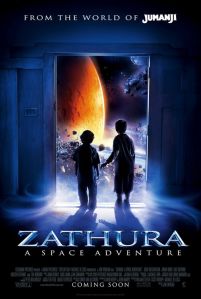 I’m kind of perturbed at how Zathura is being dismissed by the movie going public as, “Jumanji in space.” Seriously folks, does Jumanji hold that big of a place in our collective hearts as a nation? The only thing the two films have in common is that they’re both based on books by noted children’s author/illustrator Chris Van Allsburg (The Polar Express) and that they both involve board games coming to life. That?s it. Do we say that Titanic is ?Romeo and Juliet on a boat” because they both involve doomed lovers? Do we say that Jaws is “Moby Dick with a shark?” Or that Blade: Trinity is “The Hunger minus lesbians”? Or that The Island is “Parts: The Clonus Wars with a budget?” Okay, maybe the last one is accurate, but Zathura is a fabulous family film that has little comparison.
Danny (Jonah Bobo) and Walter (Josh Hutcherson) are brothers that have little in common. Ten-year-old Walter loves sports and isn’t too interested in the “kiddy” things his six-year-old brother likes. Danny himself is battling his own fears and feels left out by his older brother. Their big sister (Kristen Stewart) just wants both of them out of her hair. The family is visiting their dad’s (Tim Robbins) new house. While dad’s out to get some work done, Danny and Walter are antagonizing each other. Walter sends his little brother to the scary basement where Danny finds an old, dusty board game called Zathura. He sets up the tin game board beside his brother and starts playing. Small rockets on poles lurch across the board according to a spinning number. Then a card pops out and says, “Meteor showers,” and sure enough their living room is deluged with fiery meteors (Danny yells to take “erasive action”). Walter is shocked to open the front door and discover their house isn’t parked neatly in the neighborhood but orbiting through the vastness of space. To get back home the squabbling brothers must complete the game, and along the way they’ll encounter giant robots, a lost astronaut (Dax Shepard), and the Zorgons, a race of aliens hungry for some warmth and some fresh meat.
 The child acting is rather outstanding. The interaction between Bobo and Hutcherson (Kicking & Screaming) is great. Each really defines and shapes their character well, from Bobo’s whiny insecurity to Hutcherson’s disinterested anger and overt competitiveness. Stewart (Panic Room) leaves a very sizable impression as the agitated older sister. She has the looks and talent to explode in Hollywood in a few years, a la Rachel McAdams. Dax Shepard (Without a Paddle) is the biggest acting surprise. He gives a weighty and endearing performance as a father figure in the film, and he’s totally on the same wavelength with the movie’s tone.
Yes, Zathura gets a bit more conventional with its story as it draws toward the conclusion (trials of courage, learning from past mistakes, reconciliation), but there’s really only one kind of ending for this film. What did you expect from a 30-something page children’s book, half of which are drawings? Zathura may be predictable but it’s got a loose energy, a comedic zest, and a sense of wonder that elevate the familiar.
Smart family films are about as rare as they come. Zathura breaks the template of what “family film” means nowadays; it doesn’t go for cheap, tasteless jokes, it doesn’t hurl scattershot pop-culture references (seriously Shark Tale, are children going to be amused by a Scarface reference?). Refreshingly, the movie doesn’t have a single joke revolving around flatulence or someone getting hit in the nuts. This is a smart, good-natured family film that will thrill adults and children alike. John Favreau (Elf) is carving a really nice niche for himself directing these high quality family films that are in short supply. His direction is focused and his decisions are right on the money. He doesn’t overwhelm the film with an orgy of special effects. He gets the tone of this movie and never panders to his audience, but he keeps the pace bouncy and the tension racked. I was rapt in suspense during the Zorgon docking sequence, and yet Favreau can also illuminate the tensions of our childhood fears, like a dark basement. Favreau is proving himself to be a dynamite artist behind a lens.
 Isolating the action inside the house definitely helps build the film’s drama. Instead of unleashing the crazy world of the jungle and watching it wreck havoc, Zathura keeps everything bottled up. This decision does wonders for the film’s suspense by giving a claustrophobic overtone. This is a movie more concerned with storytelling than loud special effects. In short, Zathura is light years beyond Jumanji.
The family dynamic feels exceptionally realistic, and the film has a terrific sense of humor. Siblings do behave this way, and Zathura captures their everyday conflicts in a meaningful way. The dialogue has a real zest to it but never feels trite or inauthentic. Mark my words, “Get me a juice box, biyatch,” will be the best movie line you hear all year. Zathura really soars because of its rib-tickling sense of humor. This isn’t Man Drops Banana Peel followed by Man Falls Down. No I?m talking about a consistent tone that’s sly and whimsical, complete with comedic payoffs for even inanimate objects. The various story elements really come together nicely. Zathura is a blast that will hard to beat this holiday season and beyond.
Favreau has directed yet another family film destined to become a classic. The thrills are thrilling, the comedy is whimsical and smart, the storytelling is careful and focused, the special effects are great, the acting is superb, and even the score really soars. This is just a delightful movie of all stripes and should please adventure-seekers of all ages. I was laughing and cheering from beginning to end and so was my theater. It’s a family film that proudly and refreshingly reminds us the possibilities of family films. Zathura is tremendous fun and one adventure that will suck you in instead of just sucking.
Nate’s Grade: B+
Share this:

Jarhead (2005)
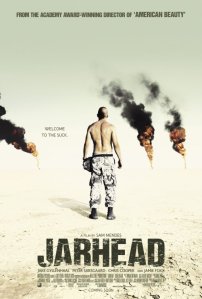 The controversy surrounding Jarhead, a hotly anticipated movie dealing with the 1991 Gulf War, seems rather misplaced. Some argued it would be anti-American, anti-war, anti-Marines, and on the other side of the coin, some even argued that it would be pro-war and pro-aggression. Now the movie seems to be taking flak for not being too political. Director Sam Mendes (American Beauty, Road to Perdition) is interested in crafting a movie about the soldiers, a true first-person war. I was actually very pleased, and somewhat relieved, that Jarhead didn’t try to bend over backwards and make any forced parallels to our current Gulf War conundrum. When you’re arguing about whether a movie leans right or left then perhaps the movie stands tall on its own, and Jarhead stands very tall indeed.
Anthony Swofford (Jake Gyllenhaal) is a “jarhead” the nickname for Marines because of what their heads resemble after their sheering, but it’s also indicative of a vessel, ready to be filled with knowledge. Swofford says he entered the corps because he “got lost on the way to college.” He’s humiliated, beaten, and looking for a way out when Staff Sergeant Sykes (Jamie Foxx) offers (more like orders him) to try out for the elite position of Marine snipers. It’s during this new training regiment that Swofford becomes “hooked” on being all he can be. He’s partnered with his barrack buddy Troy (Peter Sarsgaard), who serves as Swofford’s moral anchor. The boys get their hopes up when they catch the news that Iraq has invaded Kuwait. They’re shipped out to the action and are finally going to get a taste of combat … or so they think. They spend months in the Saudi desert amongst 114 degree heat and interminable boredom. They drink water, they play football in their gas suits for the cameras, they goof off, but mostly they wait. And wait. And wait. When the war does finally come into being, any action is short-lived: “Four days, four hours, one minute. That was my war.” Swofford, Troy, and his fellow Marines are aching for some kind of combat, any kind of violence that they’re physically and mentally breaking down in the monotony.
 Even the safety nets in previous war films, like the chickadee at home waiting for you, are ripped away in Jarhead. Usually the life at home is a source of release for movie soldiers, but in Jarhead it’s just one more source of mounting anxiety. The men have a Wall of Shame with pictures of ex-wives and girlfriends who have left them or cheated on them.
The acting on display is tremendous. Gyllenhaal (The Day After Tomorrow[) gives a sensational performance that should turn him into a bona fide, A-list leading man. All at once he can display fraternal bravado, closeted fear, confusion, and dulled horror. His show stopping moment is when he’s amidst a mental breakdown and turns a rifle on a comrade and then on himself, pleading that a shot be taken. The scene is a powder keg of intensity and Gyllenhaal is utterly captivating, startling, and horrifying with every teeth-grinding second. What?’ even better is that his performance doesn’t stop when the camera isn’t centered on his beautiful baby-eyes. He draws stronger performances out of those around him, and he does it quietly with confidence. He masks his fear and does so in fascinating, layered ways. Performances like this are what Oscars are for. And for any Jake fans out there, yes he does show a good bit of flesh in the film.
Foxx (Ray) breathes fiery life into what otherwise could have been a stock character, the tough love drill sergeant. He’s given much more screen time than I had ever thought and makes the most of it. Sarsgaard (Garden State) is a steely, dependable shoulder of support in the film, and his own big breakdown scene is amazing to witness. He?s so close to a kill but is overruled by the military brass, and Sarsgaard just lets everything go. It’s incredible. Chris Cooper (Adaptation) and even Dennis Haysbert, 24‘s president Palmer himself, have brief but very memorable small turns.
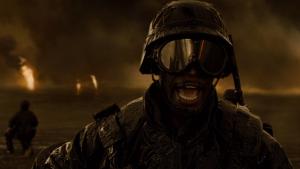 The cinematography by Roger Deakins (replacing Mendes previous Oscar-winning collaborator, the late great Conrad Hall) is gorgeous and uses light and shadow in remarkable ways to convey the turmoil of the soldiers and the other-worldliness of the desert. There are scenes amongst the lit oil fields that look like some alien world. It’s a perfect visual representation of how alone these men are and how ill-equipped they are for that scenario. The camerawork beautifully echoes the emptiness of their surroundings. Jarhead should easily score a much-deserved Oscar nomination for Deakins (House of Sand and Fog).
Jarhead is really an analysis of the psychology of what it takes to go to war. There is a transformation process, where young boys get stripped down and turned into killing machines. Jarhead poses a central question: what happens when you create the ultimate killing machine and give it nothing to do? Essentially, these men are breaking down in the tedium and many will be broken for the rest of their lives. A very poignant scene comes late in the film during their triumphant bus ride home. A Vietnam vet hops on to cheer his fellow Marines and in his hazy jingoism, you see how haunted and broken this man is from his own war experiences decades past. The future is staring them right in the face. Swofford opens and closes the film with narration explaining that once a man holds a rifle in combat, no matter what else he does in his life his hands will feel that rifle. These are men trained for war and adjusting to everyday life where the only war resides inside. Jarhead is a monstrously powerful study on the lasting effects of turning young men into monsters of combat.
Jarhead‘s inherently anticlimactic nature works against it, which will cause some level of disconnect with an audience. This is a very loosely structured flick about delayed gratification with no payoff. That’s not exactly a recipe for success. Jarhead is essentially the Waiting for Godot of war movies. The film is about monotony, about inaction, and the movie achieves a surprising yet palpable tension simply from drawing the viewer along for so far. In lesser hands a movie about boredom would still be boring, but Mendes brings an unprecedented art to it. Mendes has a confidant vision and the technical skill to bring out the drama of boredom. Jarhead has a deadpan sense of humor and some very sobering moments, like when Swofford comes across the remains of a traffic jam caught in napalm. These killing machines are getting rusty and will come back home without ever getting to pull a trigger, and what does that do to a man? These are important questions and Mendes is interested in answering them at a pace that still serves his characters. I love that Mendes has directed three films that are wildly different from one another. In my view, this guy is three-for-three.
 Jarhead is no Full Metal Jacket and yet Mendes gives passing nods to Vietnam and how our culture has shaped its history. The Marines watch Apocalypse Now and cheer as helicopters mow down villages set to a thundering soundtrack by Wagner. They’ve completely missed the point of one of the most anti-war films ever, transforming it into a bloodlust ritual. When Mendes reaches the desert then Jarhead becomes a war movie unlike any other. It’s a war movie without a war, sort of. All wee see are the results, both external and internal.
In a way, Jarhead is all about transformations and transitions, one of which is the Gulf War itself. This was arguably the first made-for-TV war and viewers were amazed at the green-tinted images of explosions and military might. War had been brought into the video game age where what once took months on the ground could be accomplished by pushing a button. Jarhead shows you the side of the Desert Shield/Storm that never made it to the cameras. The movie also presents some of the more obscured details of the war, like the care for and disposal of human waste from outhouses. That stuff never made CNN. Jarhead shows, very quietly and somberly, that sometimes the soldiers who return home have still been left behind.
Jarhead is an intense, sobering, evocative, and deeply contemplative film about the psychology of turning young men into killers and then leaving them with nothing to do. The inherent anticlimactic nature will likely push some audiences away while others will simply find it tedious. Mendes’ direction is strong and confidant and able to squeeze drama and tension from inaction, crafting an existential war movie that feels relevant and profound. Gyllenhaal is amazing and utterly captivating; you can’t take your eyes off him and, for many out there, a certain strategically located Santa hat. This movie isn’t anti-America, anti-troops, or even anti-war for that matter. Jarhead tells us that all wars are different and all wars are the same. We know war is hell, but for some, the absence of war is an even greater hell.
Nate’s Grade: B+
Share this:

A Sound of Thunder (2005)
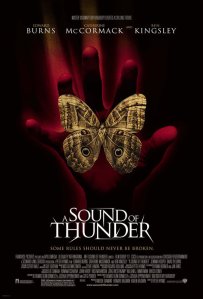 A Sound of Thunder, based on the classic short story by Ray Bradbury, is a movie that no one is going to see by design. It was shot way back in 2002, traded directors when Renny Harlin left to make Mindhunters and Peter Hyams (End of Days, The Relic) stepped in, sat on a shelf for two years, and now is being released without a peep. I have not seen a single TV ad, a single trailer, and until a few days ago I hadn’t even seen a poster for the film. It’s like the studio doesn’t want anyone to know that A Sound of Thunder exists and that they?re responsible. With zero advertising, the only people who are going to pay to see this are those familiar with Bradbury’s story. A Sound of Thunder will be gone in the blink of an eye. It doesn’t help that the movie is awful.
In the year 2055, time travel is here and available to those with deep pockets. Charles Hatton (Ben Kingsley) runs a service that allows rich people to travel back millions of years for the ultimate big game hunt — dinosaurs. The time squad is led by Travis Ryer (Edward Burns), a brilliant scientist biding his time working for the man. The time travel inventor (Catherine McCormack) warns about the dangers with playing around in the past. The tiniest alteration could drastically change the future. Hatton assures everything is safe; they hunt the same dinosaur that is just about to be destroyed and touch nothing else. Of course something does go wrong. On one hunt the clients run off the safe path and accidentally step on a butterfly. This causes “time waves” to sweep the present-day Earth and kick start some evolutionary changes. Travis is left to figure out what went wrong and fix it before humankind is wiped off the planet with the next wave.
 The movie pretends to play with brainy sci-fi principles, but A Sound of Thunder is really an empty vacuum of logic. As a precautionary measure, the team only travels back in time and hunts the same damned dinosaur. This dinosaur is special because it’s minutes away from getting stuck in a tar pit and then being obliterated by an exploding volcano. The team picks this dinosaur because hunting it won’t disrupt the fabric of time. Gotcha, but then why does stepping on a butterfly even matter? Is a butterfly seriously going to survive the oncoming volcanic blast and wall of ash? If the butterfly is just moments away from it too being destroyed, then why does killing it seconds earlier affect all of evolution? And how come these changes in time are always disastrous? Can’t someone just as reasonably step on a butterfly and wipe out cancer?
Let’s talk about A Sound of Thunder‘s alternate evolutionary timeline. In this world, because of our infamous butterfly stomping, apes and dinosaurs have inexplicably become linked. They’ve evolved into some weird hybrid, with a baboon head and the body of a dinosaur. This seems entirely implausible to me that two very different creatures would just blend together. At least A Sound of Thunder could have gone all out and had other animal mash-ups, like a whale/hummingbird or a walrus/cheetah. A Sound of Thunder could be rivaled by The Wuzzles in evolutionary theory (please tell me I’m not the only one who remembers The Wuzzles). I would have been more interested if A Sound of Thunder presented the future dinosaurs as fully evolved after an additional 65 million years. Let’s see dinos with industry, tools, community, language, and maybe even popular culture. It sure would be more interesting and imaginative than big dumb monsters.
A Sound of Thunder isn’t a sci-fi puzzler; it’s really a monster movie in disguise. After the evolutionary wrench, the film descends into a banal series of chase scenes, with our characters being plucked one-by-one by different monsters. The characters still manage to spout sci-fi dribble while on the run. Of course the characters can’t stop themselves from doing stupid things. A guy warns our team to be quiet lest they awaken the hordes of sleeping baboon-dinos hanging overhead. So what do they do? They make sure to shine their flashlights repeatedly in the creatures? faces. A Sound of Thunder is more preoccupied with what can go bump in the night than sci-fi brainteasers.

Not how evolution works.
A Sound of Thunder has some of the worst special effects I have ever seen. I’m talking about effects that would be shown up by some half-baked video game from the mid ’90s. It’s really hard to fully explain how profoundly bad the effects are. The green screen work is ugly and painful, with characters surrounded by halos and walking on invisible treadmills. The future’s boxy cars look like they were assembled by Lego. The look of the dinosaur is curiously retro, all sleek, entirely green or brown, and lacking definition. It looks like what people in the 1950s thought dinosaurs looked like. In the wake of Jurassic Park, a less realistic, more reptilian dinosaur is not the way to go. The film tries to save money by using the same dinosaur and repeating the scene with diminishing returns. Every special effect in A Sound of Thunder comes across as flimsy from the wildlife, to the skyscrapers, to the dinosaurs, to even a subway car and rising water. Every effect is so terribly obvious and obviously terrible.
The film’s acting is expectantly dull. Kingsley hams it up and has great fun as his money-grubbing business tycoon. He adds a zest to his lines. Burns plays every role so dead-panned that I doubt I will ever see an emotion from him that isn’t accompanied by a smirk. The rest of the actors couldn’t find their way with an industrial flashlight to shine in a monkey-dino’s eyes.
A Sound of Thunder is an inept sci-fi flick more concerned with hungry monsters than ideas. The special effects are abysmal, the acting is wooden, the plot holes are glaring, and the atmosphere is laughable. This giant schlockfest is so bad that it achieves a fun campy value, destined to become a drinking game for science fiction nerds. Only Ray Bradbury fans will be at the theater to see A Sound of Thunder, so in turn that means only Ray Bradbury fans will be disappointed with how terrible the film adaptation is. Everyone else will be at home scratching their heads; certain that a film called A Sound of Thunder never existed. Just like the studio wants.
Nate’s Grade: D-


You must be logged in to post a comment.