Blog Archives
War of the Worlds (2005)
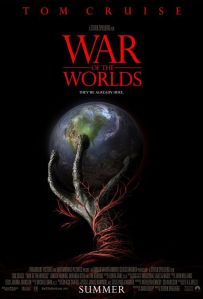 Steven Spielberg is America’s favorite director. He’s made films about alien encounters before (hell, it was most of the title of one movie), but Spielberg has never tackled evil aliens. Alien movies either involve cuddly little green men or the kind that want to destroy our planet. The latter is usually more interesting and finally Spielberg takes the trip with War of the Worlds.
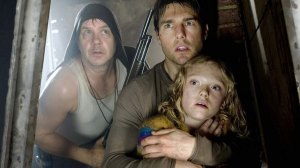
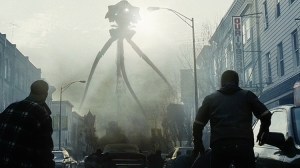
Instead of focusing on high-ranking government officials, War of the Worlds concentrates on an everyday man just trying to save his family. Ray (Tom Cruise) is a New Jersey dock worker and a divorced pop. His ex-wife (Miranda Otto) has dropped off the kids (Dakota Fanning, Justin Chatwin) for the weekend. Ray isn’t exactly father of the year and his sullen kids remind him of this fact. Meanwhile, there seems to be a series of lightning storms hitting the world that then leave an electronic magnetic field that eliminates all the electricity in the area. A storm hovers over New Jersey and lightning strikes not once but over twenty times in the same spot. Ray goes to investigate the site. The ground beneath trembles and caves in. A giant machine with three tentacle-like legs emerges from the earth and starts zapping any humans it can find. Ray escapes, packs up the kids in the only working car in town, and runs, runs, runs, all with the aliens just a step behind ready and waiting for a people zappin’.
 There are three things an audience will have to put behind them in order to enjoy what War of the Worlds has to offer.
1) The film has no plot. War of the Worlds spends the first 15 minutes setting up its handful of characters and their misery with each other. After that, it’s nothing but all-out alien attacks. That’s really it. Ray and the kids run to one place and think they’re safe. The aliens come and attack. Ray and the kids escape to a new place. The aliens come and attack. Lather, rinse, repeat. There is little more to War of the Worlds.
2) Spielberg has pretty much forgotten how to make good endings. I think A.I. was the nail in the coffin. Routinely Spielberg films seem to run out of gas or end rather anticlimactically, but A.I. really cemented the glaring fact that Spielberg cannot sit still with an unhappy ending. So, yes, War of the Worlds both ends anticlimactically and with an abrupt happy ending. Of course the H.G. Wells novel ends in the same fashion so there’s less to gripe about, until, that is, until you reach the implausible reunion. Spielberg can’t keep well enough alone and forces the story to be even happier at the cost of logic.
3) Ignore whatever feelings you hold about Tom Cruise. Off-screen, many feel that Cruise is becoming an obnoxious, pampered, self-involved, couch-jumping cretin. No matter what your feelings about Cruise and his self-taught knowledge about the history of psychiatry, that is not who is in War of the Worlds. He is playing a character. I never understood the argument that because you dislike an actor as a person it invalidates all their acting. I’ve read magazines that actually say people are staying away from Cinderella Man because people think Russell Crowe is a grump. In War of the Worlds, Cruise plays a deadbeat dad who finds his paternal instincts during the end of the world. The character isn’t deep and acts as a cipher for the audience to put themselves in the scary story. Plus it’s not like Cruise is a bad actor; he has been nominated for three Oscars.
 Since this is a large Hollywood horror film, the acting consists mainly or healthy lungs and frightful, big-eyed expressions. So it seems natural that little Dakota Fanning would play the role of Child in Danger. Cruise somehow finds some points in the story to exhibit good acting. There’s a moment right after Ray and his kids escape to their mother’s home. He tries making them food out of whatever they saved which amounts to little more than condiments and bread. His kids rebuff his offer and he throws the sandwiches against a window and repeats to himself to breathe. In lesser hands this moment would just be some light comedy, but Cruise turns it into an opportunity to see the character’s desperation. Tim Robbins shows up late playing a nutball going through some self-induced cabin fever.
War of the Worlds, at its core, is a post-9/11 horror film on a mass scale. Spielberg plays with our paranoia and anxiety and creates a movie that is fraught with tension and an overriding sense of inevitable annihilation. The aliens are so advanced and so powerful. The deck definitely seems to be stacked against Earth. I felt great amounts of dread throughout the film knowing that the aliens will find you, they will get you, and it’s only a matter of time. And that’s the recipe for a perfectly moody horror film. War of the Worlds is chilling in its depiction of worldly destruction, and yet it becomes even more terrifying by how realistic everything seems as the world falls apart when its under attack. The introduction of huge, human-zapping aliens is expected to be scary, but who knew human beings at their wit?s end could be just as scary? A crowd of people turns into a violent mob fighting for any last bit of space in Ray’s working car. A man sitting on top of the hood is actually ripping away chunks of windshield with his bare, bloody hands.
War of the Worlds really benefits from awesome special effects. As stated before, we live in a jaded age where most special effects have lost feeling special. Computer advancements have also created a more advanced audience able to point out the big screen fakery at a faster pace. If you don’t believe me, look back at some movies from 1995 or so and see if you’re still wowed. War of the Worlds marvelously displays destruction on such an incredible scale. City streets ripped apart, houses blown up, cars flipping through the air, ferries plunged into the water, and it all looks as real as can be. There are moments I know that have to be computer assisted, like seeing miles and miles of stranded vehicles and people on the side, but it looks like they filmed it for real. The only thing that seemed hokey was people being vaporized by alien ray guns and having their clothes remain. I don’t know if Spielberg was going for a veiled Schindler’s List reference or they thought anything more grim could rock their PG-13 rating.
 Due to all of this realism, War of the Worlds is not a film to take young children to see. The startling realism and suffocating sense of dread will keep kids up for weeks with nightmares, maybe some adults too. There’s more than a passing reference to 9/11, and that may be a wound too fresh for some. Thousands of people walk the streets as homeless refugees. There are large tack boards with hopeful missing fliers of relatives. One of the most horrifying images consists of a flowing river filled with floating corpses. There’s also a grand set built around the remains of a downed airplane. When Ray is trying to explain the situation at first, his son interjects, “Were they terrorists?” Spielberg calculatingly uses our memories of 9/11 to create a true-to-life horror story that doesn’t feel exploitative. “War” implies some kind of even ground. This is a massacre, and one parents should be wise not to bring youngsters to.
With War of the Worlds, Spielberg has crafted a chilling, realistic, post-9/11 horror movie. The action is big, the destruction is bigger, and the dread is at a near breaking point. Sure the movie is plotless and the ending is anticlimactic and forcibly happy, but War of the Worlds should appeal to those looking for the safe way to witness the end of the world. Spielberg invented the big summer movie and War of the Worlds is a taught return to form. It’s not much more than watching aliens destroy things but for many that will be plenty for a summer movie.
Nate’s Grade: B
Share this:

The Sisterhood of the Traveling Pants (2005)
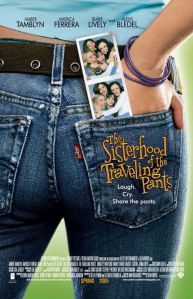 I had no real intention of ever seeing The Sisterhood of the Traveling Pants. It looked to be a competent movie, horrifically clunky title aside, but I really didn’t have any interest in seeing another movie where four young girls become four young women. Then my then-girlfriend says she wants to see it. I think we all know what happens next. Even though I was the only male in my theater (I kind of expected this), I found Sisterhood to be a sweet and heartfelt film I was glad I experienced. It had far more emotional truth to it than I ever would have expected.
Four very close friends are about to depart for the summer. Bridget (Blake Lively) is the confidant sports star and going off to soccer camp in Mexico. Lana (Alexis Bledel) is the demure artist and is going to visit her grandparents in Greece. Carmen (America Ferrera), a bigger girl with big ambitions, is traveling to South Carolina to spend time with her long-absent father (Bradley Whitford). It seems the only one staying put is Tibby (Amber Tamblyn), an angsty nonconformist stuck stocking shelves at a Wal-Mart-esque store and working on her documentary, which she has deemed a “suckumentary.”
Before they set off on their adventures the girls discover a magical pair of pants. It seems that this one pair of jeans fits each to a T, even the curvier Carmen. The girls form a sisterhood around these magically one-size-fits-all pants. They promise to send them back and forth to each other all summer and write down any luck the jeans have imbued them with.
 In Mexico, Bridget sets her sights on a hunky soccer coach (Mike Vogel). She’s brimming with confidence and flirts like a champ. Overseas in Greece, Lana meets Kostas (Michael Rady), a hunky fisherman attending university in Greece. Sparks fly but Lana’s grandmother forbids her to see Kostas. Carmen is shocked to discover that her father is planning on getting remarried to Wasp-y Lydia (Nancy Travis). It seems dear old dad has not told her everything. And Tibby is befriended by a dogged and precocious 12-year-old, Bailey (Jenna Boyd), who wants to be her assistant on the “suckumentary.”
The best part of Sisterhood is the excellence of the lead actresses. All four give well-rounded, warm, enlightened, and exquisitely affecting performances. They each get a good weepy scene and each actress nails it. Bledel has mastered the nervous stammer. She’s adorable as we witness her wallflower character coming out of her shell. Tamblyn mopes and sneers but grows the most thanks to the intervention of Bailey (Boyd is a scene-stealer if ever there were one). Ferrera was a terrific find in Real Women Have Curves, yet another intelligent and charming teen movie. In Sisterhood she gets to display tremendous anger and heartache and she sells every second of it. She is going to be a lovely actress to watch in the future. Lively is a newcomer to film even though she looks like Kate Hudson’s lankier cousin. She’s a girl that knows what she wants but doesn’t necessarily know why she wants it.
One of the smartest things director Ken Kwapis does is to keep the different story threads together. I first thought that Sisterhood would become a vignette movie, meaning that we’d get like a half hour of each girl’s adventure and then we’d travel to the next. It would have worked. But by keeping the girls’ stories intertwined we’re reminded of their bond and we can connect with them all. Kwapis even fits in some nifty scene transitions in his mostly unobtrusive direction. He lets the film’s focus rest on the characters and the performances, which are the strengths of Sisterhood.
The film seems to diverge into two storylines: the summer romances (Bridget and Lana) and the more dramatic (Carmen and Tibby). The summer romances are fun but the real meat of the movie is in Carmen and Tibby’s teary adventures. Carmen is devastated to feel that she’s been replaced and forgotten by her father. It all comes to head in a marvelous scene where Carmen cannot fit into a bridesmaid dress that fits Lydia’s rail thin daughter. She explodes in anger and pain against her father’s new family and runs off. Tibby, on the other hand, is your typical dour and rebellious teen (though in PG-land that means nose ring, colored hair, and thrift store attire). Her relationship with Bailey opens her up and the audience falls in love with both of them. The last half hour of Sisterhood hits an emotional crescendo with both storylines that will leave plenty reaching for the Kleenex.
 Sisterhood sure doesn’t lack melodrama but the film is played so earnestly that you really won’t mind. In other teen girl films, the inclusion of dramatic elements like suicide, abandonment, and even leukemia might cause the casual rolling of eyes. The difference is that Sisterhood respects both its characters and its audience. This is a sincere, unpretentious movie that has a genuine sweetness that won?t give you a toothache. In fact, the most unbelievable moment of the movie is that a pair of pants would fit them all. Again, pretty good for a flick rife with melodrama.
Sisterhood is unabashedly sentimental but it walks a fine line without ever getting truly sappy like some Nicholas Sparks tale (A Walk to Remember). Usually movies of this ilk whitewash over reality and oversimplify complex issues and emotions. Not so with Sisterhood, which deals with tough issues in an admittedly soap operish way but also forces its characters to endure tough resolutions. I am clearly not the intended audience for The Sisterhood of the Traveling Pants (I do by all accounts have a Y chromosome) but I enjoyed it all the same.
The Sisterhood of the Traveling Pants is an old fashioned, good-hearted family film that won?t make you cringe. It’s respectful of its audience and doesn’t take easy shortcuts with its story. It’s also respectful of teenagers and their experiences. The acting by our four leading ladies is uniformly outstanding. In a summer fueled by male-driven high-octane action flicks, something a little low key and sweet is always appealing when done right. This won’t exactly be a movie that will appeal to everyone, but Sisterhood is an above average and earnest take at all-too-familiar territory. Despite the clunky title, this teen-targeted weepie is a good fit for any audience wanting to feel good.
Nate’s Grade: B
Share this:

The Hitchhiker’s Guide to the Galaxy (2005)
 I’m a big fan of the late Douglas Adams’ series, so going in I had a slate of expectations but also a working knowledge of this kooky universe. I really don’t think this film will work for anyone but the fans. The movie isn’t even structured like a screenplay, it has more of the novel’s loose loopy feel. Some things work wonderful, like the Vogons, giant marvelous looking puppets made by Jim Henson’s studio. The cast is mostly excellent (Alan Rickman steals the show as the voice of Marvin, a very depressed robot). The animated guide entries in the Hitchhiker’s book are colorful, stylistic, and witty. Somethings, however, don’t work at all. The additions to the story, an increased romantic angle between our lead Arthur Dent (Martin Freeman) and Trillian (Zooey Descehanel) as well as a flat happy ending that rewrites all the opening danger. The Hitchhiker’s Guide to the Galaxy occasionally serves up some juicy bits of wacky humor or visual fantasy (John Malkovich’s bit part is weird) but unless you were a fan of the book series, you’re really not going to be able to follow along or have any interest in keeping up.
Nate’s Grade: C+
Share this:

Hostage (2005)
 A tense thriller that turns the hostage genre on its ear with a brilliant personal twist. Not only must the sheriff (Bruce Willis) try and talk a group of disturbed kids (led by the freaky Ben Foster) out of holding a mob accountant and his family hostage, but he must also try and recover soemthing inside the barricaded house because HIS family is being held hostage by the mob. It makes for some gripping decisions, as every move has two to three intentions, and Willis looks like he’s being put through the wringer. The movie is a great modern turn on the genre, until, that is, it all goes to crap in a preposterously violent showdown. Still, Hostage is a nice turn for Willis and a smart turn for the thriller genre.
Nate’s Grade: B
Share this:

Bridget Jones: The Edge of Reason (2004)
 You don’t see too many sequels to romantic comedies, and that?s practically by design. Most romantic comedies consist of keeping the leads apart as long as possible, and then in that final climactic moment they connect, embrace, kiss, usually while a camera pans around them and some up-tempo Top 40 songs swells on the soundtrack. Then we end, our story finished. You see, romantic comedies are essentially modern fairy tales, and they end on the “happily ever after” moment, the most joyous moment. We don?t think about what their lives could be afterwards. I doubt few in the audience are biting their nails to know who does the dishes or if their sex life diminishes.
So for all of these stated reasons, sequels to romantic comedies are rare, unless, of course, they’re based on a book series that’s a cash cow of chick lit. Thus, America, we are given Bridget Jones: The Edge of Reason, the sequel to the smash 2001 film Bridget Jones’s Diary.
 The movie takes place four weeks after Bridget (Renee Zellweger) and Mark Darcy (Colin Firth) cuddling in the falling snow. Their relationship is all lovey-dovey, until Bridget starts reconsidering if she made the right choice of men. Her former boss, Daniel (Hugh Grant) has gone on to fame as a travel correspondent for TV news. He’s a bad boy, for sure, but sparks flew with him. Bridget also suspects Mark of cheating on her with a leggy colleague (whose final plot revelation is quite dumb). Bridget tries her best to fit in with Mark’s upper crust society, but is starting to feel unaccepted. Then she becomes a partner to Daniel on his travel reports, and the two visit exotic locales and sparks begin once more.
Edge of Reason feels like a poor slapdash grab at money. The film lifts entire scenes from the first Bridget Jones movie and tries reworking them for similar effect. Watching Firth and Grant sissy fight each other is amusing … the first time I saw it in 2001. For the most part, it seems like the filmmakers behind Edge of Reason were straining to come up with things after that “happily ever after” moment. What other reason can there be for some of the disastrous plot turns in Edge of Reason? The revolving door of writers (including author Helen Fielding herself) manufacture petty and foolish nitpicks for Bridget that she treats as life or death. It’s hard to feel concern for her. When you strand your main character -in a romantic comedy, no less- in a Thailand prison because she was caught smuggling drugs -in a romantic comedy, remember- then you have some giant plot issues.
The wit and biting commentary from Bridget seem to be stripped away. She only makes two journal entries, which open and close the film, and they were responsible for some of the greatest comedy bits in the original movie. She no longer comes across as a snappy, ordinary girl with a big heart and some big neuroses (did I mention the Thailand prison?). The Bridget of Edge of Reason seems a bit obnoxious at times. The comedy of Edge of Reason doesn’t generally rise above slapstick. Watch Bridget parachute into a dung field (Ha!), watch Bridget ski backwards down a slalom (Hilarious!), watch Bridget get stoned from magic mushrooms (You’re killing me!), and don?t forget to watch her fall down, like, a lot (R.I.P. Nate; cause of death: laughing too hard). The makers of Edge of Reason are just trying too damn hard.
It’s a wonder that Edge of Reason does work at times, and that reason is because of the acting of our romantic trio. Zellweger is still incredibly charming despite some of the things she’s forced to do. She’s never looked better than when she has her Bridget Jones physique; she’s practically glowing. Grant is at his best when he’s a cad, and once again he gets the best lines, especially when he’s undressing Bridget during a work trip. The movie comes alive when he and Zellweger start their flirtatious battle. Firth adds shades of humanity and adoration to his fuddy-duddy role. He’s got a great everyman appeal even when he’s being a twit.
Edge of Reason also seems to flog whatever it feels is funny. If Bridget saying something inappropriate in front of a group of dignitaries and ambassadors is funny, then expect it to happen again five or six times. And it does, sadly. Edge of Reason is almost a wall-to-wall torture chamber of public embarrassment for Bridget, and if the filmmakers thought that would endear her to audiences they were wrong. We were endeared already by her wit and charm, but I guess the people behind Edge of Reason thought we didn’t want more of that. I miss you old Bridget Jones, wherever you are.
 The first Bridget Jones movie was directed by Sharon Maguire, a personal friend of Fielding. Maguire was close enough to know how to adapt the story and retain the elements that made Bridget Jones entertaining. Edge of Reason‘s director Beeban Kidron seems to be assembling a Bridget Jones movie for a focus group. We lose the personality of Bridget and get an accident-prone buffoon. All that’s missing are the banana peels.
Everything about Edge of Reason screams laziness. A great example of this is the film’s choice for music. The songs are so obvious, from “All By Myself” to “I’m Not in Love” to songs that simply have “love” in their title, like “I Believe in a Thing Called Love” to Beyonce’s “Crazy in Love.” Chances are, if your band ever released a song with “love” in the title, the music director of Edge of Reason considered using it.
Bridget Jones: The Edge of Reason will likely entertain its core audience (there were very few men unaccompanied by women in my theater). The cast makes this stilted sequel worth watching. If you really liked Bridget Jones’s Diary, you’ll probably be intermittently amused with Edge of Reason, because it’s the same meal, only reheated with a bit of a chill. Let this be an example of why Hollywood doesn’t make sequels to romantic comedies. We’re happy enough with “happily ever after.”
Nate’s Grade: C+
Share this:

The Door in the Floor (2004)
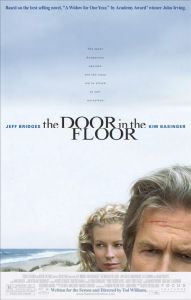 John Irving is one of the most accomplished and popular fiction writers of our times. His pulpy, unconventional, and compassionate novels have translated into many films with varying degrees of quality (World According to Garp, good; Cider House Rules, okay; Simon Birch, dreadful). The Door in the Floor is an adaptation of his novel, A Widow for One Year, but it only adapts the first third of the novel. This time around will the absence of quantity directly shape the quality of an Irving adaptation?
The plot for The Door in the Floor almost sounds like something you’d see late at night on Cinemax. Eddie (Jon Foster) is a teenager learning what it takes to be a writer. He becomes an assistant to Ted Cole (Jeff Bridges), a giant in the world of childrens literature but a playboy at home. Eddie spends the summer at Ted’s quaint cottage and is instantly smitten with Ted’s estranged wife, Marion (Kim Basinger). Theirs has been a loveless marriage ever since a tragic accident killed their two sons. Both are handling the grief in their own ways. Ted has become bitter and takes his anger out on his manipulation of other women, notably a neighbor (Mimi Rogers) who poses nude for his paintings. Marion has become insular and turns into a stone whenever the accident is mentioned.
 Eddie tires of his glorified chauffeuring duties for Ted and his mistress. He spends his lonely days fantasizing about Marion, including masturbating to the image of her clothes. When Marion accidentally stumbles into this embarrassing situation, she not only calmly apologizes but lays out additional pairs of clothing for Eddie to get his kink. This opens the door for Eddie to engage his fantasy, and embark on a deflowering tryst with Marion. Ted’s reaction isn’t one of anger or resentment but more of a job well done. It is around this time when we realize that Eddie looks remarkably like her two lost sons.
The film’s best moments are not the colorless, tepid tryst between Eddie and Marion, or the broader comic moments with Teds assault on tact; oh no, the best moments are when anyone onscreen shares time with Ruth (Elle Fanning), Ted and Marion’s precocious 4-year-old daughter. She’s a tad demanding, like insisting to know where every picture of her family remains, but comes across as adorable without stepping over into cloying. Her interaction with Bridges is wonderful, her wide-eyed questioning is sweet, and her acting is much more authentic than her sister, the more seasoned Dakota Fanning (Man on Fire). Hopefully the Fanning family has learned some dos and donts from the Culkin family.
Bridges performance is amazing. He bares more than just his backside in this film. The role of Ted is very meaty, and Bridges is the perfect actor to sink his teeth right into it. Bridges is alarmingly coy, blending a disarmingly comic roly-poly ability, as well as a brooding, stinging anger barely masked by ego and affability. I cannot imagine anyone else stepping into Ted’s shoes and delivering a better performance. Bridges’ tortured and droll work may be Oscar material.
 Basinger’s performance is equally amazing. Amazingly bad, that is. Her character is supposed to be shattered by the loss of her sons, but Basinger plays the role so heavily intoxicated by grief that Marion becomes nothing more than a walking ghost. She’s so zombie-like for the entire film, that her performance could be rivaled by a coma patient. For some reason unbeknownst to me, ever since winning a Best Supporting Actress Oscar in 1997, Basinger has yet to follow with a really good performance.
The Door in the Floor is Jon Foster’s real big break as a young actor. His previous roles amount to little, including Kevin Costner’s son in 13 Days and the vitally integral Gas Station Cashier in Terminator 3. Some awkwardness is apparent in his rise to larger material, but Fosters apprehension serves his character best, like a dinner scene between him and Marion where he tells a bad joke to break the ice. Foster’s performance is a bit bland, but that’s because his character is more of a transparent adolescent fantasy.
Poor Mimi Rogers, a.k.a. Mrs. Tom Cruise Number One. She’s a capable actress, and a fine-looking woman, but she’s been given such a small one-note character that it seems almost exploitative that such a well-known actress spends the majority of her time with her robe around her ankles. A late scene involving her violent hysteria at being dumped by Ted and it is meant to be comic but it seems more like a fizzy tantrum. All this and she gets the dubious notoriety of having a drawing of the most sensitive part of her anatomy projected in glorious widescreen.
By now an audience is more or less used to Irvings mix of slapstick and grief, of pathos and situational humor. The Door in the Floor follows this tried-and-true recipe and provides a healthy amount of entertainment for an audience. It can effectively make an audience laugh and supply knots in their throat at separate turns; however, in the harsh light of day, if you strip away at The Door in the Floor you’ll find that most every character is self-involved, curt, closed off, and just plain unlikable. Ted is a jerk. Marion is a zombie, and not so great a mother. Eddie is bland. The only real character worthy of empathy is Ruth.
 Now, movies dont necessarily all have to have likable characters, and in fact some of the most interesting and memorable characters are unlikable, but for a family melodrama its important to feel for their grief instead of feeling their grief. If you cant feel for the characters then youre just watching without any baited interest. Many films can make you feel bad by watching someone on hard times, but it’s a true accomplishment if you feel the character’s personal pains (and somehow the films of Lars von Trier accomplish both). Theres little investment beyond the surface level of amusement. So, The Door in the Floor is amusing,but it struggles to be anything beyond because of the limitations of its characters. For some, a movie that provides surface-level amusement from polished actors is good enough, and in some instances Id agree.
Director Tod Williams (The Adventures of Sebastian Cole) also served as the adapter of Irvings dense work. Williams knows a thing or two about family melodrama and the denial of guilt, and he keeps the pacing brisk and the laughs at an even pace. Williams’ best decisions are on the small visual notes he hangs on, like a stunning, visually alluring final image. The story is a bit uneven in tone, thanks to Irving’s eccentric source, but Williams saves his narrative whammy for the very end, and Bridges brilliantly delivers the backstory we’ve been holding our breath for.
The Door in the Floor is a solid, if surface-level enterprise in the exploration of guilt and mourning in a family setting. Bridges gives an amazing and memorable performance that helps make you forget about the rest of the films somewhat lackluster acting. Fans of Irving’s works will likely be taken back in pleasure, and fans of adult melodrama will not likely walk out disappointed. The Door in the Floor has glimpses of something more but settles for being a well-acted, nondescript affair.
Nate’s Grade: B-
Share this:

I, Robot (2004)
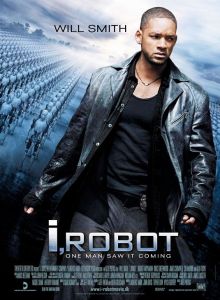 No doubt about it, Will Smith is the best hope our planet has in the face of adversity. He’s taken down aliens three times, foiled one conspiracy, stopped the South from rising again, and the man still finds the time to help Matt Damon with his golf swing. I fear we almost may be taking Smith’s world-saving exploits for granted. Smith’s newest chance to save the world arrives in I, Robot. Can Big Willie save the world yet again, or has he punched his time card one too many times?
In 2035, man has a new class of immigrants to do all the menial tasks no one wants to do – robots that look like crash test dummies. U.S. Robotics (USR) wants to push their new fall line of robots and make sure every happy home has a happy robot. Del Spooner (Will Smith) is a detective wary of our robotic friends. His colleagues laugh at his paranoia, remarking that no robot has ever committed a crime. This is thanks to the three laws hard-wired into every robot: 1) A robot cannot harm a human being, 2) A robot must obey a human beings order as long as it does not conflict with Law #1, and 3) A robot can do whatever to survive as long as this does not conflict with the other laws.
 This sounds great, except the robot creator (James Cromwell, always there if you need an old guy role) has apparently plummeted to his death from his USR office and the circumstances involving his demise are dubious at best. Spooner works alongside a robot technician/shrink (Bridget Moynahan) to find out more about what exactly is going on within USR and its suspicious CEO (the always shady Bruce Greenwood). Spooner discovers that a robot, who wishes to go by the name of Sonny, may have sent his creator to his death and may also be the first step toward uncovering the truth behind a grim conspiracy.
Smith has never really been a great actor but he is likable and charming enough, so that gets him through the day. The problem is that when hes saving the world in summer blockbusters he has a tendency to go into Will Smith Mode, which plays out like hes on auto-pilot. His stares, awkward mannerisms and aw shucks humor seem to be the same in every film. This isn’t to say that Smith cannot be a capable actor, but it seems that when a movies budget goes over a certain amount he resorts to playing Will Smith: World Saver and not so much a character of real value.
The other actors are more so playing vague archetypes than they are anything else. Greenwood is the sneaky, oily executive; Moynahan is the cold scientist learning how to be human once more; the invaluable Chi McBride is the no-nonsense police chief who rolls his eyes at Spooner’s crazy theories; and Shia LeBeof actually shows up for all of three minutes playing some kind of juvenile delinquent that is wholly unnecessary to the film.
The movie’s greatest accomplishment is the character of Sonny, modeled after a physical performance by actor Alan Tudyk. Sonny’s calm line readings, bursts of emotion, and questions on humanity make him a character the audience connects with, especially with the detached nature of Smith and Moynahan’s acting. Bet you never would have guessed this is from the same guy who played Steve the Pirate in Dodgeball.
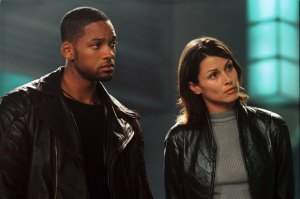 I, Robot isn’t exactly going to establish new ground in the world of science fiction. Its mostly a detective story with some twinges of sci-fi philosophy. As a detective story it adheres to the laws of detective movies, like how NO ONE ever believes the hero on his hypothetical assumptions and paranoia, which will of course always be right, and how the hero can only solve the case after he is thrown off it and gives up his badge. For two thirds of I, Robot we get an amiable, if average, detective story set in the future. Then we get a slightly incoherent final act where robots go all-out crazy.
Director Alex Proyas takes a step back from the grim, noir-ish worlds he worked with so effectively in The Crow and Dark City, and presents a cleaner and more sterilized world. His technical elements, like cinematography and musical score, are still well above par for the summer blockbuster. Proyas is a gifted visual tactician that knows how to wow an audience.
The sleek production design, fancy special effects, and strong visionary directing help lift an average story. Some of the story elements may not all work -like Spooner’s flimsy reason he hates all robots, and Moynahan’s character being very cold because she works around robots (get it? get it?)- but the professionalism of the people behind the scenes help make a rather exciting and occasionally thoughtful movie. Sonny’s questions about life and death as hes near termination are a nice addition to add something more to a summer blockbuster than explosions and car chases. Of course I, Robot also has some exciting car chases and action sequences. Certainly other, better sci-fi movies have dealt with these issues much deeper, and I, Robot seems to only skim the surface of intellectual debate, but at least it’s something (though this sounds really defeatist).
Bearing little resemblance to Asimovs collection of short stories, I, Robot is more a stream-lined sci-fi action flick, but its still a satisfying and stylishly entertaining diversion. Sci-fi fans may grumble at the notion of transforming a complex novel into a watered down action film, but I, Robot is a crowd pleaser that delivers the thrills when it needs to. If Will Smith keeps up this world saving pace he may get a little haggard and start turning into Danny Glover’s Lethal Weapon character: I’m getting too old for this aliens/robots/other aliens/more aliens/giant mechanical spiders shit. Well, at least Smith’s good at it.
Nate’s Grade: B
Share this:

Harry Potter and the Prisoner of Azkaban (2004)
 The first two film adaptations were huge hits, but were derided by some as being too loyal to the books that it stifled the creativity. Now, Harry Potter and the Prisoner of Azkaban is out and its the first film to deviate from the books. How will Potter nation take the news?
Harry Potter (Daniel Radcliffe) is entering his third year at Hogwart’s School of Witchcraft and Wizardry. Harry is also getting older, getting angrier, and learning more and more about his parents. Hes on alert that the murderer, Sirius Black (played the fabulous Gary Oldman), has escaped from Azkaban prison and is out to get Harry. Black had a hand in the deaths of Harrys parents, and now it seems hes looking to finish what he started as a follower of Lord Voldemort. Harry relies on his friends, Ron (Rupert Grint), Hermione (Emma Watson), and a kindly new Defense Against the Dark Arts teacher named Lupin (David Thewlis) to conquer his fears, his burgeoning hormones, and to face Black when the time comes.
The best decision the Harry Potter producers made for this chapter of the series was in getting a new director. Alfonso Cuaron finally infuses the Potter series with a sense of visual life. Instead of Chris Columbus’ stubborn admiration of his fake opulent world, Cuaron keeps things fluid with a constantly roving camera and long takes. For the first time in the series, you can argue that this Harry Potter film looks and feels like its own actual movie. Gone is Columbus annoying penchant for displaying everything in close-ups. The film also benefits from some new realistic exteriors and dressed-down attire, ditching the school uniforms. Theres also a new cinematographer, so instead of Columbus dull amber glow, the series takes a gratifying turn toward the menacing, with an emphasis on dreary blacks and silvers.
 The best improvement of all, however, was in getting away from the apparent slavish loyalty to the books. The third book is the longest of the three but the third film is the shortest; 15 minutes shorter than Sorcerer’s Stone, and 25 minutes shorter than Chamber of Secrets. Thank God. At the rate they were going I thought the next book, Goblet of Fire (700-some pages), was going to be like 9 hours.
So, under Cuaron’s guidance, Prisoner of Azkaban eschews the unnecessary plot elements and details fans will grumble over but moviegoers couldnt care less over (Quidditch?). Cuaron’s film may be heavy with exposition, but it never talks down to its audience. The result is a movie trying to be a movie and not trying to cram in as many details of the world as possible so fans wont have their feathers ruffled.
The young actors of Hogwarts have definitely been struck by puberty, and it has done their acting a world of good. Radcliffe will never be an exceptional actor but here he presents new and interesting dimensions to Harry demonstrating his arrogance and tempestuous anger. Tom Felton, who plays the snarky blonde-haired Draco Malfoy, appears to be maturing into a ganglier Macaulay Culkin. The one actor that truly seems to have a bright future, though, is Emma Watson. You cannot help but love her whenever she’s on screen and she seems to be developing into a fine actress.
The most notable addition to the adult staff in the film is Michael Gambon, replacing the late Richard Harris as Hogwarts headmaster, Dumbledore. Gambon turns the character from a kind-hearted grandfather type to more of an aging hippie but it works. Emma Thomson also appears as some sort of psychic professor, teaching students to read tea leaves; however, her entire role seems superfluous unless it impacts future installments (I have not read a single book). Once again, Alan Rickman rules all and needs to get more time in these movies. I don’t know how, but it needs to happen. Thewlis is the most welcomed addition in his pivotal role as Professor Lupin and delivers some of the more dramatic scenes of the film with radiance and ease. He creates a lovely father-son relationship with Harry that supplies Azkaban with a nice sense of compassion. Oldman is similarly great but unfortunately he shows up so late into the film that he seems terribly underused. There is a scene late into the film, where Thewlis, Oldman, Rickman, and the great character actor Timothy Spall share a scene. I never thought it would be a children’s fantasy series that would finally unite all these talented British stage actors but I’m thankful for it nonetheless.
 Prisoner of Azkaban is the darkest tale yet, and Harry Potter works best when things get scary. The nightmarish element design creates a wonderful sense of dread, and Cuaron deftly handles his young characters dealing with rage and death and, scariest of all, budding hormones. Theres even a sly nod to Cuaron’s steamy coming-of-age film, Y Tu Mama Tambien (it involves a three-way hug between our trio of kids).
he effects of the film are beautiful and greatly add to the entertainment value of the film. The Dementors, cloaked flying guards of Azkaban prison, are terrifying to look at, and their leitmotif of chilling the air when they are near makes for some great visuals and ominous moments. I got actual goosebumps the first time they arrived on-screen, and then when I saw this film a second time, fully knowing the story, my skin still crawled when they arrived. Perhaps the greatest addition to Harry Potter‘s special effects bestiary is the Hippogriff, which resembles a combination between an eagle and a horse. It is a gorgeous creation and worlds better looking than the three-headed dog from the original film. It also provides one of the more breath-taking moments of the film, when Harry goes soaring across a lake on the back of the Hippogriff.
Having said all this, yes Prisoner of Azkaban is the most exciting and visually alluring film of the series, also its darkest, but I couldn’t help feeling disappointed with the central storyline. Most people will love it, especially fans of the books, but after walking out of the theater I could not help but wonder if the film had a climax at all? It really kind of didn’t. There was no sense of real story momentum and the middle had some definite moments of drag. The last act of Prisoner of Azkaban is exactly like Back to the Future Part 2: time-travel, correcting the future, not running into your past selves. This is not a good comparison. So while the characters are getting more interesting as they get older, this plot doesn’t really hold up very well. It almost feels like a preface of whatever events will come in the fourth film.
Prisoner of Azkaban is an interesting watch. I am told it deviates the most from the book and it manages to generate a considerably darker and scarier atmosphere than its predecessors. For my money, any changes are good, as films are about ADAPTATION and not copying, so dispensing with subplots and details is A-Ok with me. But how will the die-hards react? Im sure youll hear plenty of grumbling all over, but Cuaron has injected needed life into this series and presented an idea of what it can grow to be. So, while I think Prisoner of Azkaban has a superior visual sense, pacing, and adaptation; I also feel the story may be the weakest we have been told. I can only imagine what the outcry will be among the fan base when Goblet of Fire is released November 2005 as one film.
Nate’s Grade: B+
Share this:

Confessions of a Teenage Drama Queen (2004)
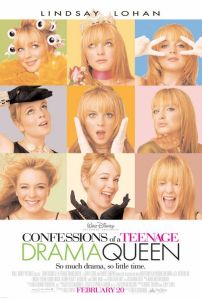 There was a glut of teen-oriented princess fantasy films in 2004 but none seemed as artificial, as simplistic, as transparent, and as dull as Confessions of a Teenage Drama Queen. Lindsey Lohan played Lola, a flamboyant new girl at school trying to fit in and find her way. This Disney confection aggressively spoon feeds its life lessons. You can successfully guess the entire plot of this trifle from the first second on. Confessions of a Teenage Drama Queen has a prolonged musical climax that’s a shameless ploy to set up Lohan as a pop singer and ensnare preteens into buying the soundtrack. When you get down to it and count the life lessons, simplicity, costume changes, and musical numbers, Confessions of a Teenage Drama Queen isn’t a movie, it’s an awards show patting itself on the back.
Nate’s Grade: C-
Share this:

Cold Mountain (2003)

Cold Mountain (2003)
Premise: At the end of the Civil War, Inman (Jude Law, scruffy) deserts the Confederate lines to journey back home to Ada (Nicole Kidman), the love of his life he’s spent a combined 10 minutes with.
Results: Terribly uneven, Cold Mountain‘s drama is shackled by a love story that doesn’t register the faintest of heartbeats. Kidman is wildly miscast, as she was in The Human Stain, and her beauty betrays her character. She also can’t really do a Southern accent to save her life (I’m starting to believe the only accent she can do is faux British). Law’s ever-changing beard is even more interesting than her prissy character. Renee Zellweger, as a no-nonsense Ma Clampett get-your-hands-dirty type, is a breath of fresh air in an overly stuffy film; however, her acting is quite transparent in an, “Aw sucks, give me one ‘dem Oscars, ya”ll'” way.
Nate’’s Grade: C


You must be logged in to post a comment.