Blog Archives
Elle (2016)

It’s been a long time since director Paul Verhoeven (Robocop, Starship Troopers) has directed a movie, a whopping nine years since Black Book (my favorite title is the original Dutch – Zwartboek). In fact Elle is only the second movie of Verhoeven’s since 2000’s Hollow Man. Cinema needs more movies from men like Verhoeven. He’s famous for his penchant for camp and over-the-top violence and sex, but it’s his subversive streak, dark satire, and willingness to push an audience into squirmy situations that are missed most. Elle is a hard movie to describe and a hard movie to sell. It’s an uncomfortable viewing and that’s much of the point that Verhoeven wants to push the viewer into an uncomfortable world of a woman who makes others uncomfortable.
Michele (Isabelle Huppert) is a middle-aged professional woman who, in the opening scene, is raped on the floor of her home by a masked intruder. She tries to brush off the attack, refusing to report it and go to the police. She returns to her normal routine, which involves berating the employees at the video game company she runs, having an affair with her best friend’s husband, and asserting barely passive-aggressive control over her ex-husband and her adult son. Once Michele starts receiving taunting messages from her assumed attacker, she assess who in her life’s orbit may have been her rapist and how best to unmask their identity. There’s also the matter of vengeance.

Elle starts as a sneaky who-dunnit mystery and then blossoms into an engaging character study. Our first image of Michele is lying on the floor and being sexually violated by her attacker. It’s harrowing and upsetting and your sympathy instantly allies with the victim. However, the rest of the movie does not portray Michele with even the faintest glow of a halo. She’s a venom-spewing bully who sabotages the happiness of others around her and is having an indifferent affair with the husband of her best friend. Michele also runs a video game company that profits from the exaggerated sexual violence of the video game industry. She even lectures a programmer that the distressed cries of a rape victim should be louder and more orgasmic. Everything after the initial rape scene makes us question whether this character is worthy of our sympathies, and then that makes us question whether we should be ashamed to deny a rape victim sympathy at even a basic human level of empathy. There’s a happy moment where everything appears relatively settled, and she just can’t help herself and has to sabotage it with real ramifications with someone she genuinely cares for. It’s just her nature. It’s a complex crucible of self-reflection and it makes the movie an intriguing a unique experience to sit through.
About the half-hour mark, Michele becomes even more absorbing, and that’s when it’s revealed she’s the daughter of a notorious serial killer. As a young girl, she “assisted” her maniac father dispose of bodies into a large fire, and a picture of her looking dead-eyed and covered in ash is famous in French culture. There’s a lingering question of what her culpability was. As soon as this connection was revealed, my interest in Elle increased two-fold. It explains why she felt she couldn’t go to the police because she didn’t want the exposure, and certainly there would be a bitter few saying she got some sort of cosmic justice. Her relationship with her elderly and ailing father becomes its own mystery, and I started looking for parallels between Michele’s relationship with her father and her relationship with her screw-up adult son. Was she manipulating him like her father had done to her? Is her son’s penchant for not fitting in the adult workforce a sign of something more troubling? Is his temper and possibility for violence a hidden bomb thanks to grandpa’s DNA? I was even more observant and looking for connections.
The problem Verhoeven’s movie is that its story engine only takes you about two acts forward. From early on, the two things hanging over Michele are the prospect of finally coming face-to-face with her father one last time and discovering the identity of her rapist. Verheoven plays into the mystery thriller elements by populating Michele’s world with suspects that could secretly be her attacker. There’s the guy at her job that seems to loathe her and find her unworthy of her position. There’s the guy at work that has a little too close of an affection for her. There’s her friend’s husband, angered by being rebuffed when Michele ends their unfulfilling affair. There’s her neighbor’s husband who Michele covets and fantasizes over, who seems aware of Michele’s feelings. As the plot progresses and her attacker sends more messages, we get clues to the identity and who among our band of suspects is eliminated from contention. Then we find out and the movie has like a solid half hour left. That’s because the movie goes in an unexpected direction but one that makes enough sense knowing Michele as a character. Not all of the storylines hold the same level of interest, like Vincent’s one-note baby mama (Alice Isaaz), though you do understand why he might be attracted to abrasive women. The same with Michele’s mother (Judtih Magre) who seems too comically wacky as a sugar momma. Not all of the characters in the story’s sphere are worthy of the attention they receive; however, how Michele responds to them is worth our attention. The other storyline, a sense of closure with her father, is resolved around the same time in another unexpected manner. It’s a bit deflating and after both mysteries are resolved the movie feels like it’s abandoned its sense of direction. You’re waiting for the film to wrap up any moment but it keeps going, a tad too long at 130 minutes. It’s a small grievance but I definitely started feeling a sense of impatience during the final twenty minutes.
There’s a surprising amount of dark humor to be had with Michelle’s caustic view of other people and her genial manipulation of others. There’s an awkward dark comedy that comes from the interactions, which seems counterproductive or downright tonally unforgivable given the above admission of how rape-y the film comes across. It’s a squirming comedy, the kind that makes you laugh under your breath to break the tension of people behaving badly. Even the prospect of laughing given the serious subject matter somehow makes the film even more uncomfortable. The older ladies behind me in my theater were already chattering about how Elle was not one of the better movies they’ve come to see. To be fair this was after like the fourth rape scene.
Huppert (Amour, The Piano Teacher) is in every scene of the movie and she unleashes a performance destined to leave you talking. She’s 63 playing 50, which is usually the opposite of how Hollywood movies operate (if the women are even allowed to get to 50). Michele is a beautifully flawed and complicated canvas and Huppert seems to relish in her brusquely dismissive demeanor. She’s constantly testing the people in her world, mostly men, and sizing up the women. There’s a reason that she seems to revel in stomping out the happiness of the men around her whether it be an ex-husband, her oafish son, the husband of her best friend she’s having an affair with. Michele refuses to be defined by her trauma but she is still processing that, and Huppert is agile at showing the cracks in Michele’s armor to provide clues as to what is most important. She doesn’t care what we think of her and that adds a thrilling quality to an already bracing performance.

Does the movie cross a line into being tawdry exploitation? Because of the nature of its storyline and the past films of its director, it would be easy to slap the title of high-dross exploitation film onto Elle, but I don’t know if it applies fully. I cannot think of a more rape-y movie that I have ever seen. Full trigger warning to those out there, there are like six different rape scenes in the movie, though some of them are fantasy and some of them are violent role-playing, but all of them are disturbing. At its core, Elle is about power and even though our opening impression of Michele is one of victim, it’s a title she does not want. She is seeking to punish her rapist, and when the identity is revealed, she transforms the power dynamic and reclaims a sense of her sexual autonomy. Does consenting to abuse and enjoying it undercut the abuser’s power or reconfirm it? I can’t say whether this is any less exploitative than say 1974’s The Night Porter, another movie about trauma where the victim and victimizer indulge in an unhealthy sexual relationship that blurs the lines between sadomasochistic role-playing and fetishizing personal abuse. I feel like there’s enough substance in the characterization and the wide berths that Verhoeven allows free of judgment to classify Elle as more than exploitation, or to classify it as a reclamation of the exploitation film, an exercise akin to what it feels like Michael Haneeke (The White Ribbon, Funny Games) does that I inevitably can’t stand.
I can’t quite grasp what about Elle spurred Verhoeven out of a nine-year absence from filmmaking (he experimented with a 53-minute farce in 2012 whose script was crowdsourced, so I’m discounting that). On the surface, I would make the connections to the film’s extreme sex and violence, staples of Verhoeven’s Hollywood career. But that’s too easy, and there’s no shortage of extreme sex and violence in other stories. What was it about Elle that drew the Dutch filmmaker out of seclusion? I think it was another opportunity to be subversive, this time in the realm of art-house French cinema. Verhoeven has always enjoyed proving people wrong, exploring our baser instincts, and telling damn fine entertaining movies for adults. His subversive streak is renewed with a rape thriller that also happens to be an incisive character study of a very nasty woman who had something very nasty done to her. Audience loyalties and sympathies are consistently in tumult, shifting and being tested by new information and the mounting evidence of Michele’s treatment of others. Huppert gives a calculated, fierce performance right down to the end, pushing the audience into more uncomfortable reflection and uncomfortable laughter in the face of despair. I think this is why Verhoeven hopped back into the director’s chair and even re-learned French so he could communicate with a French film crew. He wanted to push an audience, upending their expectations about power, sex, and subjugation. Elle is downright elegant as it goes about its business, the business of forcing viewers to think critically and question their personal discomfort. It’s not exactly an easy movie to watch at times but it is a hard movie to forget.
Nate’s Grade: B
Share this:

The Handmaiden (2016)
 I’m glad there’s still a filmmaker at the talent level of director Park Chan-wook (Oldboy) dedicated to making genuine Gothic romance with style and reverence. The Handmaiden is a ravishing, enrapturing, and momentously engaging movie with dark delights, startling depths, palpable romance, simmering tension, and high-wire twists and turns that keep redefining the story. The absurdly talented filmmaker takes a novel set in Victorian England and adapts the setting to 1930s Korea during the time of Japanese occupation, a fascinating and little-known time period for a Western audience. A poor orphan Sook-Hee (Tae-ri Kim) is pressured into a scheme to trick the wealthy Lady Hideko (Min-hee Kim) into being admitted to an insane asylum, her family riches sold. From the opening minutes, The Handmaiden produces immersive drama that pushes the central characters into consistent conflict to achieve their varying goals. They’re constantly at odds with one another and themselves. There’s even tension between those who hold onto their Korean culture and those who adopt the culture of their oppressors, namely Lady Hideko’s perverse and treacherous uncle. Sook-Hee grows an unexpected affection for her mistress, and this includes a burgeoning attraction that the movie communicates with serious sensuality. The passionate lesbian sex scenes are, if anything, a tad restrained from what I was expecting from Chan-wook, and they’re definitely far more restrained and absent the male gaze than the still excellent Blue is the Warmest Color. I felt the same carnal desire the characters were discovering, a feat worth celebrating for still staying true tonally without veering into tawdry exploitation. More than the sex or the top-notch technical aspects, it was the characters that hooked me and refuse to relinquish. The deepening relationships and the subtle shifts of loyalty, perception, and desire make what is essentially a twisty and twisted chamber-play into world-class drama. You think it’s one kind of movie, and then it flips the script, and then it does it again, each time opening wider this mysterious, dangerous, and invigorating world. My one quibble is that the final twenty minutes feels unnecessary and self-indulgent, Chan-wook finally scratching a few violent tendencies he had been keeping as veiled up to that point. The Handmaiden is a ridiculously entertaining movie that is handsomely mounted, wonderfully acted by its leading ladies, and a romance worth losing your self over. Plus, there’s also the sex.
Nate’s Grade: A-
Share this:

Nocturnal Animals (2016)
 Fashion designer Tom Ford made a big splash with his debut film, 2009’s A Single Man. It was a gentle and introspective character study of a middle-aged gay professor determined to end his own life. It was lush, full of feeling, and anchored by a deeply humane performance from Colin Firth. In short, it is everything that his follow-up Nocturnal Animals is not. This is a movie overflowing with vacant artifice that is mistaken for profundity.
Susan (Amy Adams) is an art gallery owner and living a posh life with her second husband, Hutton Morrow (Armie Hammer). She gets an unexpected present in the mail from her ex-husband Edward Sheffield (Jake Gyllenhaal). He’s sent her his newest manuscript, a departure from his usual works. It’s dedicated to Susan. With Hutton away on business, and philandering with a mistress, she dives into the story. It tells the story of Tony Hastings (also Gyllenhaal) and his wife (Isla Fisher) and teen daughter (Ellie Bamber) traveling through west Texas. They run afoul of some contemptuous locals lead by the sadistic Ray (Aaron Taylor-Johnson), who kidnaps Tony’s wife and daughter. Left for dead, Tony teams up with a terminally ill police officer, Bobby Andes (Michael Shannon), to hunt down Ray and make him suffer for his crimes. As Susan continues reading, she goes through a mixture of emotions trying to determine what her ex-husband is trying to communicate to her within the subtext and metaphor of his sordid story.
 I grew increasingly restless with Nocturnal Animals because it failed to justify its excessive dawdling and vapid artistic pretensions. This is a movie that doesn’t really know what it wants to be so it dabbles in many different genres, none of them fully convincing or worth the effort. It’s a high-gloss erotic thriller, it’s a gritty exploitation film, it’s a morally compromised revenge thriller, and it’s a subtle relationship drama amidst the upper crust of the L.A. art scene. It’s none of these. It’s two primary stories, neither of which justifies the amount of time spent on what amounts to so little. The worst offender is the frame story with Susan, which amounts to watching Amy Adams read for two hours. She takes a lot of baths and showers in response (symbolism!) but most of the cutaways and time spent with Adams is to merely watch her react. It’s like she’s a nascent studio audience handcuffed to tell us how to feel with her reactions. Would you have known that you should feel bad during onscreen death if we didn’t cut back to Susan also feeling bad and concerned? It amounts to emotional handholding and it’s grating, also because Susan is an terrible character. She’s conceited and thinks she is owed better, which is why her mother successfully pressured her to dump Edward, a man well below her self-styled station in life. Her second marriage is crumbling apart and part of her sees Edward’s out-of-the-blue note as a potential romantic rekindling. That’s right, this is a person who reads a revenge opus that may be all about seeking cosmic vengeance against her, and she thinks to herself, “Ooo, I think he like likes me after all.” Her self-involvement is rewarded in the end but the ambiguous ending is more just missing in action. Ford’s film just peters out and leaves you hanging, just like its heroine.
Edward’s manuscript is easily the best story and even that is only by default. It’s an easier story to get involved with because of the simple story elements that naturally draw an audience in, namely a revenge fable. The initial altercation with the family and Ray’s crew lasts almost a half hour. Specifically the roadside confrontation itself is a solid ten minutes and it just goes round and round, repeating its overdone sense of menace. I wasn’t dreading the horror to come but more so getting impatient for it to be over. Without depth to the characters or escalating stakes and complications, it all just amounts to a Texas hillbilly repeatedly threatening a cowering family for ten solid minutes. The vengeance in the second half of the movie is just as predictable and too drawn out. Edward schemes with Bobby Andes to take justice into his own hands, but the movie takes far too long to reach its predictable conclusion, which still manages to be so drawn out that I was screaming at the screen for the inevitable to finally happen. When the movie ended I felt a rush of relief to go along with my general sense of perplexity.
Nocturnal Animals has the illusion of highbrow art mixing with lowbrow thrillers but it lacks the substance of the former and the courage of its convictions for the latter. Ford’s mercurial taste in costuming and set design shows in every moment with Susan, as the sets feel exquisitely designed and the cinematography designed to encapsulate this. It’s a good-looking movie but there’s not enough under the surface. It’s all empty window dressing to disguise the vapid whole at its center. Let’s tackle the opening credits, which will most certainly capture your undivided attention. It’s a foursome of overweight women dancing naked and in slow motion, their large bodies bouncing and jiggling to the self-serious musical score. Eventually it’s revealed that these women are part of an installation exhibit in Susan’s art gallery, and that’s when you get a tip-off just how hollow and attention seeking the movie will be. The gallery consists of overweight women lying face down on raised platforms. That’s it. No wonder her gallery isn’t doing that well (note: not a fat-shaming comment but more a comment on the lazy application of its sense of “art”). You get a sense that Ford comes most alive in the scenes where he can arrange figures and images, not so much the demands of storytelling.
 I can already hear supporters saying I just don’t get it; no, I got it because there’s very little to understand with Nocturnal Animals. It’s a story-within-a-story so we’re already training our brains to look for parallels but they aren’t obvious so they’ll be more metaphorical. I kept waiting for it all to tie together in a substantial way by film’s end, and sorry but it just doesn’t (spoilers ahead). Edward has a whammy of a day when he discovers 1) his wife is pregnant, 2) she’s aborted his child, and 3) she’s in the arms of her new boyfriend, and he discovers all of this standing in the rain for further symbolism. He has a grievance against Susan, though we’ve been suspecting it for some time. His manuscript is a revenge thriller about a family murdered and how a weak man finds the strength to seek justice and retribution. The parallels are fairly obvious there, and the fact that there are only so many characters in the story-within-a-story means there are few options to play the analogue guessing game. I’ll just claim that Ray is meant to represent Susan since he/she is the murderer of Tony/Edward’s family. There’s a reason that Tony’s family all share Susan’s red hair. He dedicated the book to her, after all, and said she was who made it all possible. From there you could argue whether Tony represents Edward’s real past, weak and remorseful, whereas Bobby Andes is meant to represent how he wishes he could be, decisive and strong (end spoilers). That’s about all the parallels you’re going to find because the story-within-a-story only involves a very tiny number of characters. There just isn’t much to go on here and yet Ford’s movie stretches and drags and just keeps going until it reaches its predictable destination. There isn’t any more depth here than straightforward avatars and even those are lean.
I was debating a question with my friend Ben Bailey while we watched this movie, and that’s whether the stakes are removed somewhat when you know that a storyline within a movie is fictitious. Knowing that Tony is a pretend person, does that eliminate some of the tension and investment in his storyline? I recognize this is a distinctly meta question considering that a majority of film characters are fictitious by nature, but I do think there’s a different set of standards for the people of the story-within-a-story. I don’t remember feeling less for the characters in A Princess Bride, The NeverEnding Story, or Adaptation. My only conclusion is that I just did not care a lick for any of the characters in Nocturnal Animals, whether they were fictional or twice fictional. They didn’t deserve my attention just because pretty people were playing them. They didn’t deserve my attention because Big Bad Things caused them to experience Big Emotions. Combined with the ponderous plot and the emaciated substance, the dull characters and the overwrought acting they inspire are a recipe for audience detachment. I can’t help but shake my head as other critics trip over themselves to shower this film with overly enthusiastic plaudits. Nocturnal Animals is a tiresome exercise in lazy symbolism, patience-demolishing pretension, and emptiness masquerading as contemplation.
Nate’s Grade: C-
Share this:

A Monster Calls (2016)
 A young mother (Felicity Jones) is dying from a terminal illness. Her son Conor (Lewis MacDougall) escapes into the world of his art and imagination to cope. This includes envisioning a giant living tree voiced by Liam Neeson who visits Conor to tell him three stories, and in the end he demands one from Conor. It’s a Hollywood cancer weepie with stylistic fantasy elements, kind of a Lifetime TV approach to Pan’s Labyrinth, and I must say I was rather unmoved through every drop of treacle. Part of my problem was that Conor has this larger-than-life fantasy creature… who only tells him stories, which lead to extended animated sequences that are beautifully rendered in watercolor paints. What’s the point of having a giant monster if all it does is tell you stories? He might as well be anything and any size then. The plot also follows a very familiar path as Conor must confront his grief and anger as his mother, one of those regular movie characters who become heavenly and wise when stricken with cancer, declines in health. I felt removed too often and kept at the fringes. Rarely did I care about these characters and that’s because the movie didn’t give me a reason to. Yes she’s dying, and yes he’s sad and troubled, but so what? A Monster Calls needed to lay more foundation with these characters who come across very thin. The ultimate purpose of the monster is a rather pat revelation and the emotional climax felt undeserving of all the swelling strings on the musical score. There just isn’t anything in A Monster Calls that separates it from a pack of maudlin imitators. The actors all do pleasant work but they aren’t given more than the barest characters to work with, which forces an audience to feel things simply by grief association. Coming from director J.A. Bayona, a visonary who startled and amazed with The Orphanage and The Impossible, I’m even more confused and let down that a man this talented would choose this. Also, at no point does a CGI tree monster Liam Neeson utilize any specific plant-based set of skills.
Nate’s Grade: C+
Share this:

Kubo and the Two Strings (2016)
 At this point the Laiki studio (ParaNorman, The Box Trolls) has earned as much good will and credibility as Pixar in their pre-Cars 2 prime. I almost was going to write off their latest, Kubo and the Two Strings. For the first forty minutes or so I was somewhat indifferent to it. Sure the stop-motion animation was stunningly realized and the creation of the environments was very meticulous, but I just couldn’t connect with the movie’s story of a young boy, Kubo, and his quest to claim magic items to thwart the advances of his dangerous and estranged mystical family. Then the first big set piece happened and then the next, and then the plot made some deft reveals and provided a strong emotional foundation, and I was hooked. This is Laika’s first real action film and the wide shots and long takes do plenty to serve the action and allow you to further marvel at the painstaking brilliance of these hard-working animators. It’s a full-fledged fantasy epic that tickles the imagination and provides a poignant undercurrent of emotion especially during the final act. As Kubo declares his real strength are his memories of loved ones past, I was starting to get teary. It’s a lovely message to top off an exciting and involving action movie with creepy villains and side characters that do more than throwaway one-liners. Art Parkinson (Game of Thrones) gives a very expressive and emotive performance as our lead. Charlize Theron is outstanding as Kubo’s maternal protector who just happens to be a monkey. Rooney Mara is also genuinely eerie as an ethereal pair of flying sisters trying to snatch Kubo. Matthew McConaughey isn’t the best vocal actor due to the limited range of his vocal register but he’s still enjoyably daft. The Japanese setting and culture are recreated with loving touches that celebrate rather than appropriate. I still regard the arch silliness of The Box Trolls as my favorite film but Kubo is more than a worthy follow-up. The slow start is worth it by film’s end, so stick with it if you start to doubt yourself, because the emotional wallop of Kubo and the Two Strings, not to mention its creative high points, is well worth the invested effort.
Nate’s Grade: A-
Share this:

Inferno (2016)
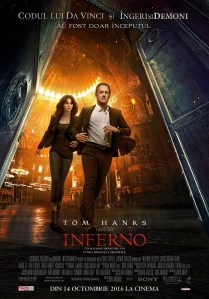 You know it’s a bad sign when the best part of your movie is the scenery. Inferno is the third in the Robert Langden series where Tom Hanks stars as the world’s foremost symbologist that traverses old European museums and cathedrals to solve mysterious puzzles. The Da Vinci Code was pretty bad, its sequel Angels & Demons was a marked improvement, and now Inferno is a depressing step backwards. Langden has to stop a madman (Ben Foster) from releasing a super virus that will kill half the world’s population. The villain’s plan requires him to wait and he has no reason to do so. Waiting only needlessly delays his goal and makes it more likely for him to get caught or fail. His plan is stupidly convoluted, but I didn’t expect that the good guys’ plan was also stupidly convoluted, relying upon fake blood squibs and disguises and for what? There are three competing, stupidly convoluted storylines that smash together. I simply could not engage with what was happening and felt I had little reason to care. The mystery aspect is pretty tame and the thriller set pieces are unmemorable save for a climax that at least feels like the highpoint. There was one interesting aspect that never fully gets developed and that’s the idea that Langden can’t trust his senses. He’s a man who relies on his arcane intellect and to turn that against him, as well as possibly draw in hallucinatory visions, was a smart move. It’s only more disappointing when they fail to do anything with this possibility. The myriad plot holes were clearer to me than the hackneyed plot itself. Inferno has some very nice footage as Hanks and Felicity Jones scamper from one Florence site to another and that’s the best thing I can offer about this mess.
Nate’s Grade: C-
Share this:

Miss Peregrine’s Home for Peculiar Children (2016)
 Miss Peregrine’s Home for Peculiar Children feels like Tim Burton’s X-Men franchise, and it’s just as awesome as that sounds. Burton has always had an interest in the outcasts and misfits of society and now he has his chance to leave an imprint on the ever-present superhero phenomenon. His own personal group of gifted youngsters is looking to form a funky family and fight against fearful forces that have their sights set on exploiting these special children or worse. It’s a natural fit for a man who has become a Gothic industry unto himself over three decades of peculiar and spooky filmmaking. This is Burton’s chance to flex franchise tentpole muscles with a subject matter perfectly attuned to his offbeat sensibilities, and watching the fabulous final product is akin to watching a master musician dive into Beethoven’s Fifth. This movie was flat-out delightful.
Jake (Asa Butterfield) is reeling from his beloved grandfather’s (Terrence Stamp) mysterious death. The old man loved sharing his stories about tending to the shape-shifting Ymbryne Miss Peregrine (Eva Green) and her wards, a group of children with special abilities including starting fires, controlling plants, invisibility, and being able to float lighter than air. On a trip to Wales to investigate grandpa’s stories, Jake discovers a time portal and is taken back to the WWII era where Miss Peregrine is waiting for him. She and her children relive the same day and will never age. They’re hiding from Barron (Samuel L. Jackson) and his group of scientists who wish to hunt the children. Jake is tasked with being the new protector, as he is the only one that can see an invisible band of slender monsters known as hollows that feast on the children.
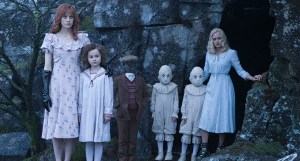 There’s a whimsical nature to the dark elements, and the script is rife with enjoyable payoffs and fun moments that cry out for a full visual immersion. This is Burton’s best film since 2007’s Sweeney Todd (I have a soft spot for that macabre musical), arguably best since 2003’s Big Fish, and maybe his most fun movie since his 90s heyday. If you’re a Burton fan, you’ll be tickled by all the imagination and humor. I grew up on the cinema of Beetlejuice and Edward Scissorhands and The Nightmare Before Christmas (yes, directed by stop-motion maven Henry Selick but still very much a Burton film), so I’ll admit that seeing Burton in high form once again warmed my little mischievous heart.
You get a sense just how involved Burton was in the filmmaking and its details, the degree of passion and involvement, and also his commitment to being a dark movie intended for peculiar children and adults with macabre interests all over the world. I kept thinking that the 12-year-old version of myself would have adored this movie, never mind the 34-year-old version of myself who greatly enjoyed it too. This feels like a natural evolutionary step for children and adolescents who gorged themselves on the works of Edward Gorey and R. L. Stine. It’s not a significant spoiler but it’s something I feel you, dear reader, need to know in order to properly assess just how wonderfully morbid the movie can come across. There is an entire visual feast of a group of villains dining upon the delicacy of… children’s eyeballs. You read that right. It’s a silver platter piled high with severed eyeballs, and they get slurped down like it’s spaghetti. I could only cackle to myself at the audacity of the movie to embrace the fun of the darkness rather than hiding from it, mitigating it, trying to be delicate with tone. The villains want to return to a normal state that can only be achieved by consuming the eyeballs of peculiar children, and so they are hunted not for sport or prejudice but for eyeballs. That’s wonderfully squirmy, and it definitely affected me, an avowed cinema patron who gets extra squirmy with any onscreen eye trauma. There are other creepy and memorable moments, like a dead child being used as a ventriloquist doll and the slenderman-styled hallows creatures. The moments are plenty but they don’t choke the story’s momentum, which hums along with great imagination and lucidity.
There’s a lot going on with Miss Peregrine, and Jane Goldman’s (Kingsmen) screenplay juggles a lot of rules and world building without losing momentum. I was intrigued early and the movie would widen its focus, providing more texture and connection to the world in calculated doses. It was enough that I always felt like I was learning something while still being able to see how the pieces snapped together in retrospect. There’s time travel that has to be done at a very specific point, the rules of who can travel back in time to these bubbles of safety, the history of this specific day stuck in time, the non-linear history of the protectors, the fact that the bubbles are also teleportation hotspots, the history with Jake’s grandfather, the history of the Ymbryne and their powers, the powers of all the peculiars, dream prophecy, mad scientists and their peculiar ailments, the differences between the hallows and the predatory scientists, and also establishing the character dynamics of several lost children and a budding YA romance. It’s amazing that Goldman’s script is as understandable as it is considering all that heavy lifting. It’s not completely free of muddled plot points and some hazy explanations, but those instances are a clear minority to what works so effectively. I wanted to know more about this world, and once they added time travel and teleportation, I was hooked. I enjoyed the movie so much that I’m considering reading the additional books for my next freaky fix.
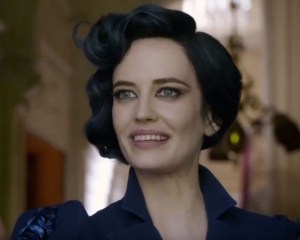 The acting ensemble is full of bright spots and none brighter than the new queen of genre gusto, Eva Green. I raved about Green’s magnetic performance in the considerably lesser 300 sequel. She was easily the best part of that movie and it suffered whenever she wasn’t on the screen. The same can be said for the too-long-in-the-making Sin City sequel. She was the best thing in Burton’s otherwise forgettable Dark Shadows feature. In short, this woman is incredible, and she digs into the vampy and ridiculous with the right degree of malevolence and glee. Green is a wonderful hostess into this magical world, and her foreknowledge gives her a caffeinated energy that makes her even a tad more peculiar. Her children are all fine actors who have uneven parts thanks to the unfair distribution of their powers. Not everyone gets super useful abilities. I felt sorry for the kid who projected his dreams from his eyeball especially during the third act scuffles. A mouth in the back of the head doesn’t seem very useful either. I enjoyed the idea that the invisible kid needs to be fully naked to be fully invisible, and everyone acknowledges this reoccurring fact with shoulder-shrug nonchalance. The standout amongst the peculiars is Ella Purnell as the winsome girl who will float away. She has an innocent and yearning quality that doesn’t sink her character. She’s more than just a love interest to Jake and Purnell helps channel great affection. Jackson (The Hateful Eight) is expectantly highly entertaining as the lead villain and Butterfield (Ender’s Game) is perfectly acceptable as an audience surrogate into this wild world.
I was duly impressed with just about every element, from the structure of the screenplay and its precision with information and intrigue, to the level of acting, to the dark and whimsical tone, to Burton’s own peculiar particulars that fill out the film with adoration. It may sound corny but there is an affection woven throughout the film, for its dispirit outcasts, for their strangeness, for the ardor of telling a spooky story that can appeal to children without pushing away adults. There’s a care that’s been absent Burton’s other recent films, especially Dark Shadows, which left me bewildered whether Burton had any genuine fondness for the source material. Miss Peregrine’s Home for Peculiar Children is a haven for fans of the peculiar, Burton’s oeuvre, and those looking for a quality children’s film that has some bite. I can only hope for more fantastical adventures.
Nate’s Grade: A-
Share this:

The Girl on the Train (2016)
 Consider it Gone Girl lite. The adaptation of the mega best-selling thriller The Girl on the Train seems to be on a runaway collision course with irony-free, amped-up melodrama and sundry “adult” sensuality reminiscent of the 90s boon of erotic thrillers like Jade and Sliver. The book by Paula Hawkins had three strong female lead characters each telling their own miserable worldview of trying to live up to social standards of motherhood and marriage. The movie seems to have shorn most of the focus on character and included every twist and turn, no matter how absurd. Take for instance just how insular this world is: Rachel (Emily Blunt) is the ex-wife to Tom (Justin Theroux) who left her for Anna (Rebecca Ferguson) who has a nubile nanny Megan (Haley Bennett) who is unhappy with her controlling husband Scott (Luke Evans), who happens to be the couple that Rachel voyeuristically observes and fantasizes domestic bliss. Megan goes missing and Rachel cannot account for her whereabouts because she has become a blackout drunk to kill her self-loathing and sense of internalized failure. The whodunit aspects of this movie can come across as rather hokey and overblown, but lacking the nasty nuance and subversive gender politics of the far superior Gone Girl. Every single person in the film has to come across like a suspect (Megan’s husband, Megan’s therapist, some guy in the road?) and talks in a curiously oblique style. The attempts at sexy lack heat but more than that they lack conviction. Director Tate Taylor (The Help) seems to think he’s directing a Hitchcockian thriller one minute and a tawdry art film the next. The screenplay is also unhelpfully nonlinear, frivolously jumping around in time and point of view and muddling the overall timeline. Anna and Megan are drastically underwritten; Megan is a sex kitten with a dark secret that’s trying too hard to be provocative, and Anna is an even more thankless role as the stand-in for Rachel’s swirling antipathy. The concluding moment of girl power feels unearned, and the answers to the mysteries leave a lot more lingering questions about train platform-sized plot gaps. The best thing this Girl has going for it is Emily Blunt, who delivers a better performance than the film deserves. She’s unrestrained, red-eyed, sloshing, and disturbing as a drunk. She’s wounded and lashing out ferociously at the world, at her self, and it’s fascinating and heartrending to watch. I bet it would be even better to read.
Nate’s Grade: C+
Share this:

The Light Between Oceans (2016)
 A melodrama through and through, The Light Between Oceans is at its core a pretty-looking movie about pretty-looking people being sad. The premise almost seems like a parody of prestige indie filmmaking in the 1990s. Tom (Michael Fassbender) is a shell-shocked WWI vet-turned-lighthouse keeper in Australia who falls in love with mainland lady, Isabel (Alicia Vikander). They marry and have difficulty conceiving, with Isabel enduring two grueling miscarriages. Then one day a dingy washes ashore with a crying baby inside and a dead man. Rather than alert the proper authorities, they decided to bury the man and raise the child as their own. Years later, the couple discovers the girl’s real mother, Hannah (Rachel Weisz), who has been racked with unanswered grief ever since. The couple is then thrown into an emotional crucible testing their ethics and moral compromises and the question of ultimately what’s in the best interest of this little girl. It’s a movie that’s geared to put you through an emotional wringer, and the actors do their part. Vikander (Oscar winner for The Danish Girl) is downright luminescent and dives deep into all of her character’s varied and heightened emotions. The scenes of her dawning realization of the miscarriages and her helplessness are heartbreaking without being maudlin. Weisz is shaken to the core when her identity is robbed from her; she’s so fragile and holding on to hope so hard you might think she’ll collapse any moment. Fassbender internalizes the most and fully communicates the inner struggle of his character’s guilt. Director and chief adapter Derek Cianfrance (The Place Beyond the Pines) has made an intimate relationship drama in a beautiful, sea-swept location, and the kind of Big Feeling classy melodrama you came to expect from Anthony Minghella. The problem is that Cianfrance’s characters are held too much at arm’s length for resonance. We empathize but not nearly as deeply as we could, and by the end the movie washes away like the surf.
Nate’s Grade: B-
Share this:

The Infiltrator (2016)
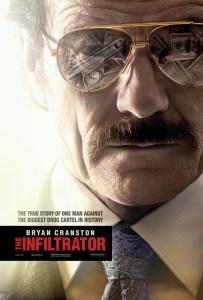 In the mid 1980s, Pablo Escobar and his cartel were responsible for billions of dollars worth of narcotics filtering into the United States. It’s the kind of work that can fill up Robert Mazur’s (Bryan Cranston) career. He works as a Florida Customs agent but his specialty is going undercover for his assignments. He’s called out of retirement with the promise of striking high in the ranks of Escobar’s ring of lieutenants. Mazur’s partner, Emir (John Leguizamo), uses an unreliable informant to start the new identity, and so Mazur poses as a money laundering expert who offers his sundry services to the Colombian cartel. After blurting out that he has a fiancé in lieu of accepting a prostitute’s services as a very 80s way of saying “thank you,” the agency must now provide him with a fake wife, played by rookie agent Kathy Ertz (Diane Kruger). The two have to rely upon one another in a world of criminals and murderers who would have no gutting them.
My main feeling once The Infiltrator had come to its natural conclusion was that everything about this movie should have been better. It’s a terrific premise as we follow the undercover travails of a man trying to stay one step ahead and keep his dual lives separated, invariably having them bleed into one another especially as danger escalates and his cover may be blown. Then you add an untrained partner and the conflict magnifies from there. Then you have Mazur work his way up the food chain to the major lieutenants of Pablo Escobar. This movie should be exploding with dramatic irony, weighty decisions, and magnificent suspense, but it’s really not. So why not?
 One reason is that the movie whiffs with its modest ambitions, namely in its shallow character study of Mazur and the lingering effects of pretending to be a very bad man. Going undercover has to be one of the most stressful jobs in law enforcement, and living two different lives has to have a noticeable psychological impact, eating away at our protagonist and affecting his relationships and sense of self. That doesn’t happen with The Infiltrator as the few glimpses we get of Mazur’s home life are mostly harmless check-ins. A red light is installed in his home to mean a secret special phone line. You would assume that some family situation has to draw out conflict from this scenario, maybe Mazur’s little girl answering the phone before he can reach it. Nothing of consequence happens with daddy’s special red light phone. The family, absent anything important to do but wait at home, becomes a drag on the narrative and doesn’t even fulfill what you would assume would be its primary service: contrast. In the world of The Infiltrator, sex, money, and drugs are rampant, but our protagonist is unaffected. He remains the same character from the beginning of the story to the end. We don’t really learn more about him other than he is skilled at going undercover. We don’t see any particular toll on him psychologically. We don’t feel the threat of what he’s going through because the movie doesn’t pretend it matters enough.
Going undercover with the Medellin Cartel should provide endless suspense scenarios. This movie should be rife with conflict, and yet it consistently finds deflating, coincidental outs to save its characters. As a good screenwriting rue of thumb, it’s acceptable to use coincidence to put your character into greater danger. It’s not a smart idea to use coincidence to save your character from danger. Example: in Donnie Brasco, a man approaches Johnny Depp’s character and clearly refers to him by his agency name, implying working together with the FBI. That’s a good use of coincidence. With The Infiltrator, Mazur’s secret recording in his briefcase is discovered by a mid-level cartel operative, for once it feels like Mazur is vulnerable. Then the movie quickly dispatches with this guy for a rash explanation and so he takes his secret to his grave. There’s another moment where Emir’s informant is about to squeal to some very bad people, with Emir in the room sweating bullets, and he too is wiped out before sharing his privileged information. The movie is filled with these frustrating solutions just when it seems like tensions is developed. The entire appeal of the undercover mob movie is the twists and turns to hide the real identity and make it out alive. I’m genuinely dumbfounded how much of this movie just skates by with little regard to drawing out effective tension.
I think I can crystallize just how poorly The Infiltrator handles its many threads of conflict with one great example. Kathy and Robert Mazur are fake getting married according o their cover stories, so what else does a fake bride-to-be do but seek out her fake husband’s tuxedo that he wore decades prior upon his real wedding to his real wife? Why does Robert need to wear the exact same tuxedo? Can his office not afford to rent a new one that likely more accurately represents his fitting size? Even if this cost-cutting measure was plausible, why must Kathy be the one to pick it up, and from Mrs. Mazur? It’s contrived and forced conflict to shove these two characters together, so that Mrs. Mazur can ask pointedly, “Are you sleeping with him?” Rather than say nothing, or dismiss the assertion, Kathy provides what has to be the most irritating and obfuscating answer: “I think you know the answer to that.” Does she? The film seems to think there is a simmering sexual tension between Kathy and Robert Mazur, but it never materializes. I guess we’re just supposed to assume a sexual tension. This scene is a pristine example of characters operating at a sub-level of intelligence because the movie wants to force contrived drama when there is already plenty of organic drama being ignored.
The last third of the movie is built around the relationship that Mazur and Kathy form with Robert Alcaino (Benjamin Bratt). With an actor of Bratt’s stature, you’d be lead to assume his character will have a significant amount of screen time; however, The Infiltrator also boasts blink-and-you’ll-miss-them performances from Amy Ryan and Jason Isaacs, so maybe not. Bratt’s character is a family man and we’re treated to several scenes with him and his wife. It’s meant to engender sympathy so that when the end comes around we can feel some conflicted emotions. Except this is another area where the screenplay cannot live up to its aims. At no point did I feel sympathy for this mobster. He’s a “family man” and we even see him with his daughter… in one scene who asks to sleep over at a friend’s. Robert preaches about the importance of trust and family in that typical way that all thinly veiled mobsters do in movies, and he even cooks, which is another personality trait I’m sure we’ve never seen in a film about mobsters. The entire last act is predicated on our undercover duo feeling guilt over setting up Robert and his family in an eventual sting, and this guilt feels entirely manufactured.
 Cranston (Trumbo) is the real draw here and it’s easy enough to see how alluring the undercover gig is for an actor of immense talents. In the opening scene we get a sense of Mazur on the job, digging deep into a seedy drug dealer lounging in a bowling alley and making passes at the waitresses. It’s a meaty introduction that whets your appetites for the different personalities that Cranston will have to draw from on his next assignment. Cranston is routinely entertaining to watch but I couldn’t help but feel underwhelmed at what the film was asking him to do and what I fully know he’s capable of delivering. It’s like hiring a world famous chef and asking him to fix your plumbing. The other actors don’t distinguish themselves in their fleeting scenes except for Kruger (Inglorious Basterds) and Joseph Gilgun (TV’s Preacher) as a convict that Mazur likes to have pose as his driver/muscle. In the case of both actors, you wish that more had been made with their dynamic to the mission.
The Infiltrator is based on a true story and I assume that what I see on screen closely echoes Mazur’s real exploits and predicaments, but somewhere along the way the filmmakers lost track on what made this story tick. The psychological aspects are barely touched upon, the family conflicts are given careless lip service, the suspense sequences are clipped, under developed, and often solved by convenient coincidence, and the characters are too shallow to grow out from their stock roles. I know these are real human beings for the most part but they don’t feel anything more than genre archetypes. The Infiltrator does enough at a serviceable level of entertainment that it might pass some viewers’ lower threshold to fill an empty two-hour window. With all of its ready-made suspense possibilities and internal and external conflicts, this real-life story should be far more compelling than the one we’re given, which settles too often. It’s a genre movie masquerading as a character study except it’s blown its cover.
Nate’s Grade: C


You must be logged in to post a comment.