Blog Archives
Stronger (2017)
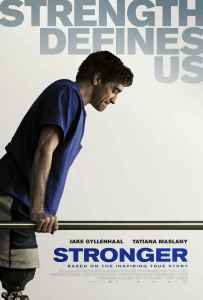 An inspiring true-life story that still manages to stay grounded on its own terms, Stronger is an emotionally affecting movie buoyed by two sensational performances. Jake Gyllenhaal plays Jeff Bauman, an ordinary guy who is present at the 2013 Boston Marathon bombing and loses his legs in the attack. He was there to support his on-again off-again girlfriend, Erin (Tatiana Maslany). Needless to say, his whole world changes and he has to adjust to a new life, a new identity, and the hardships placed upon others within his family sphere, especially Erin. This is a very solid meat and potatoes kind of drama. It’s not flashy or inventive but it has serious human drama and it treats it as such. I was on the verge of tears for a solid thirty minutes. Gyllenhaal delivers yet another Oscar-worthy performance, burrowing into an average screw-up thrust into the national limelight. Everyone tells him he’s a hero, but he doesn’t feel it. Everyone wants a piece of him and his doting mother (Miranda Richardson) often blurs the line between pride in her son and exploitation. The colorful, coarse, dysfunctional family dynamic will remind many of 2010’s The Fighter. I greatly appreciated that even after the terrorist attack Jake is not canonized. He’s no saint just because something terrible happened to him. Director David Gordon Green (Pineapple Express) takes great care to keep the movie grounded even as it hits the standard inspirational notes, finding moments of grace in unexpected places and people. The backbone of Stronger is the thoroughly moving relationship between Jake and Erin. They have exchanges of both ferocious anger and deep tenderness. A post-amputation sex scene between them is so intimately filmed by Green that you almost feel like you’re intruding. Maslany (Orphan Black) can break your heart or make it melt just with an expression. The non-verbal acting in this movie is truly exceptional. Stronger is a strongly developed drama with characters that earn every one of your hard-fought tears.
Nate’s Grade: B+
Share this:

It (2017)
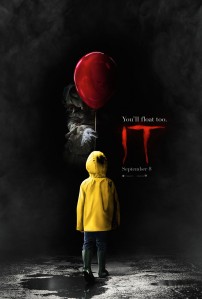 Stephen King movies have had a spotty track record at best. For every Shawshank Redemption or The Shining, there’s an overwhelming multitude of disappointments and dreck, including this summer’s long gestating and prophetically disappointing Dark Tower adaptation. The two-part It mini-series came out in 1990 and is best known for Tim Curry’s unnerving performance. Otherwise, it wasn’t that great itself but, grading upon a steep King curve, it comes out as perfectly tolerable. Hollywood has been trying to get a new It movie in development for years, and I mostly just shrugged at the idea. Did we really need another version? After seeing the 135-minute finished film, I can say that the answer to that is a definitive and enthusiastic yes. It is a fiendishly fun horror movie with rapturously composed visuals, an affecting emotional core, and impressive craftsmanship. It’s easily already in the top echelon of King adaptations.
Back in 1989, children have been mysteriously disappearing from the small town of Derry, Maine. Bill (Jaeden Lieberher) is still recovering from his younger brother who went missing one fateful rainy day. Bill holds onto the hope that somehow his brother is still alive, washed away through Derry’s series of sewers. He and his group of friends, affectionately nick-named The Losers, are being hunted and haunted by a strange clown who calls himself Pennywise (Bill Skarsgard). This evil clown feasts on the children’s fears and has been frightening Derry every 27 years, snatching children to consume, including Bill’s lost little brother. The Losers band together to stop this clown menace.
 Director Andy Muschietti (Mama) brilliantly brings to life a dynamic funhouse of scares, suspense, and big screen delights that will leave you howling for more. Much like James Wan’s Conjuring films, Muschietti doesn’t present anything radically new into the world of horror, but he takes older, sustained horror techniques and executes them to near perfection. The greatness of horror is when you simmer in that delicious sense of tension nervously awaiting what’s to come next. For this effect to have any punch, a filmmaker needs to lay a deliberate foundation to then twist and manipulate. Muschietti is amazing at heightening the atmosphere of dread and drawing it out. There are scares in It that are textbook in their masterful orchestration. Take for instance a scene with Ben (Jeremy Ray Taylor) in the basement of a library. He looks over his shoulder to see an ashen child’s body standing on the stairs. Given the lowered camera angle, the top of the ceiling cuts off the ashen kid’s head. Then as he stumbles down the stairs it’s revealed… he has no head. It’s a startling reveal and it carries on from there. Pennywise coming through a haunted slideshow of Derry was another creepy highlight. The red balloon of Pennywise transforms into an alarming totem for the audience, a signal to begin your nervous anticipation. The movie keeps finding new ways to creep you out until the very end. It’s movies like It that can remind you what tremendous fun horror movies can achieve.
Let’s get straight to the clown, the star of so many nightmares. Curry is the reason why anyone remembers the 1990 TV mini-series. Fortunately, Skarsgard (Atomic Blonde) goes in his own direction for his own personal interpretation of the character. There are similar tics, in particular the lisp, but Skarsgard makes it his own and he is wonderful. His command over his body is incredible and it magnifies the creepiness of every appearance. He holds his cheeks together in a rictus grin that looks downright painful, and he’ll lock into expressions and just let dribbles of saliva drip off his chin. Even while playing this big, broad, malicious character with a penchant for theatricality, Skarsgard can find little touches to create an even more unsettling impression. I’ve never been impressed by Skarsgard’s performances before, mostly amounting to my unchecked hatred of his awful Netflix TV series, Hemlock Grove. He impressed the hell out of me in It. This is a Pennywise that has such loose, alarming contortion over his body. When he pulls his face back revealing row after row of sharp teeth, it’s almost a relief from the more horrifying human version of Skarsgard’s outsized antics. Tim Curry owned his character’s sense of campiness. In contrast, Skarsgard feels deliberately more unhinged and also a creature in complete revelry of being so deranged. If you have a fear of clowns, I would advise that you simply never watch this movie in your entire life.
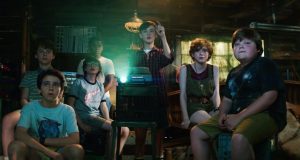 While I was expecting the big top entertainment from Pennywise, I was surprised at how involving and relatable the teenage drama can be. The screenwriters have done an admirable job at taking time to establish the characters and their relationships to one another. The town of Derry is a world of criminally neglectful adults. Everyone in this town seems to be an asshole; even the librarian chides Ben for the indecency of looking at books in a library during the summer (do your job, lady!). It’s a world where grownups disappoint and where adulthood is just a miserly existence of abuses. Beverly’s father lecherously takes ownership over his daughter’s body. Eddie’s (Jack Dylan Grazer) hypochondriac mother tries to lock her son away from the larger world, not out of protection but out of her own selfish comfort. These are the kind of people that look the other way while the local town bullies are literally carving initials into a child’s flesh. With all of this awfulness, the coming together of the Losers and their unified friendship provides a lifeline of support. They’re relatable, realistic, and heart-warming in their affection for one another. They talk and act like authentic kids, which also means they make dumb decisions out of curiosity. The movie stops to share little coming-of-age moments that ring true, like Beverly’s (Sophia Lillis) awkwardness at shopping for her first tampons or the boys trying to act cool in front of a girl. As he did with Mama, Muschietti is super-humanly adept at directing child actors. Seriously, he might have to direct all child performances from here on. The young actors do fine work at building out their characters, though some are expectedly underwritten. Special notice should go to Lieberher (Midnight Special) as the stuttering Bill still trying to grasp his brother’s death.
Given the childish nature of the fears and the theatricality of its villain, the movie is inevitably going to skid into goofy territory, but instead of rejecting this It swerves into the skid and becomes even better. When you deal with a killer shape-shifting clown who hides in the sewers and lives upon the fear of children, things can get silly and pretending otherwise is a waste of time and energy. Muschietti and company acknowledge the otherworldly with proud panache, making the goofiness part of the fun and ultimately part of the terror. Skarsgard is tremendous at turning on a dime, having his lisping, big grinned clown go from broad and ridiculous to terrifying, and he can do it with just a look. It happens even in his earliest big screen appearance. This is a Pennywise who feels like an alien’s idea of a party clown; the original elements are there but connect wrong or are amped up. There are a couple instances where Pennywise dances, and I absolutely adored each. His malevolent gesticulations felt like an exaggerated cartoon given unholy life, which seemed more than fitting. You may laugh at points and then gasp the next, and I’m fully convinced that’s the intended response. The childhood fears are much improved from the classic Universal monsters from the original novel (I’m sorry, nobody is afraid of mothballed versions of Dracula or Frankenstein in this day and age). Seeing them manifested as misaligned phantoms is far worse, even if the effect might not be as jarring without the accompanying music and sound design.
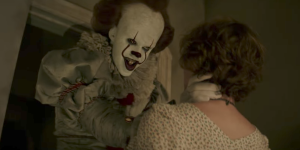 The only structural problem I would cite is that It has a little too much fun with its scary set pieces and starts to feel redundant in the middle. It becomes a figurative funhouse (before the literal haunted house) of set pieces with each one of the Losers being tormented by our clownish friend multiple times. There are seven of them after all. We could have probably done with one or two fewer of these encounters. You’re having so much fun waiting with anticipation for each encounter that I can’t complain too hard. It’s difficult to push yourself away from the funhouse and get back on track to a narrative conclusion meant to cleave a 1000-page book into a workable satisfying endpoint. I thought the bully character featured considerably throughout the story was going to become an increasingly significant antagonist into Act Three. That didn’t quite happen. The ending scene bonding the children together also seems to exist in such an earnest tone, and yet the amount of blood onscreen for their bloody hand-holding ritual is comically excessive, which caused me to giggle. I choose to believe it was Muschietti undercutting the feel-good triumphant moments with some darkly macabre touches, to remind the viewer that while our characters have survived they are still forever distorted.
Let’s also discuss the most controversial aspect of the original novel that so many people seem to have conveniently forgotten and for good reason. Spoilers follow, though they do not pertain to this adaptation, because nobody in their right mind would ever include this. At the end of the childhood section, as the kids defeat Pennywise, they’re all coming down from facing the living embodiment of their fears. So what do you do next? Well if your answer is “have a child orgy,” then you’re correct, and also likely sick in the head. The kids all start having group sex, in the dank sewers mind you, with Beverly, the only girl, being the recipient of much of it. It’s an out-of-nowhere plot development that serves no justifiable artistic purpose and feels so wrong-headed that it’s hard to believe. But it’s real, folks. King won’t admit what seems the most obvious culprit (he was on a lot of drugs in the 1980s), and instead has offered some strange rationale saying the act was a connection between childhood and adulthood and… I don’t know. This narrative choice also grossly mistreats Beverly. It seems like an obvious and baffling misstep to have a pre-teen girl suffer viciously demeaning sexual rumors, the very real sexual abuse from her father, and then decide her ultimate gift to the group of boys that accepted her is to let them all have their way with her (excuse me while I vomit). Stephen King, just admit you were on drugs and this was a weird, lamentable mistake. It’s that easy, man.
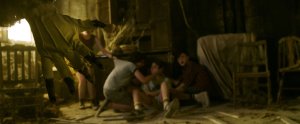 The newest incarnation of It is a glorious chiller with top-notch acting, directing, cinematography, production design, sound design, and just about all the elements that suffered from the lackluster 1990 TV mini-series. The 2017 movie is top-notch nightmarish mayhem treated as a marquee thrill ride. You strap yourself in and wait for the carefully calibrated scares and suspense and payoffs. However, the human element is not lost amidst the ride, and the children and their bond forms an emotional anchor. Muschietti demonstrates a consistent mastery of classic horror techniques. He allows scenes to build, to surprise, to startle in uncomfortable ways. Having such a talent at the helm, I was pinned to my seat and lapping up every moment of wonderful unease. The It mini-series was split into two stores, one focusing on the characters as children and another as middle-aged adults (the childhood stuff was, without question, superior material). The movie ends with the title “Chapter One” and the promise that, if the box office gods deliver, there will be a second chapter transporting us to the present. I was indifferent before but not longer. Muschietti has made me a believer. Give me more of It.
Nate’s Grade: A-
Share this:

The Dark Tower (2017)
 I have never read any of Stephen King’s popular fantasy series, The Dark Tower, so I walked into the long-awaited film adaptation with no investment. I walked out with very little investment. The film peaked at its casting, with Idris Elba as the mythic Gunslinger hunting down a notorious evil sorcerer, The Man in Black (Matthew McConaughey), a.k.a. Randall Flagg. For the first fifteen minutes or so, the world building is pretty straightforward and accessible. The Man in Black is looking across universes for special psychic children whose abilities he can focus to destroy the titular Dark Tower, a monument protecting the stability of all universes. A young kid is having prophetic dreams but appears emotionally disturbed to his family. Before a group of rat people hiding behind human masks can kidnap him, he runs away, finding a portal to Midworld, and into the path of the Gunslinger, who seeks personal vengeance against the Man in Black. From there the movie gets pretty hazy with its rules and lore. The production design of this alien world is a bit bare. The characters stay in an archetypal range and don’t give you much reason to care. The action is serviceable but unmemorable, the Gunslinger credo is rather cheesy especially when repeated with such self-seriousness, and sometimes it feels like McConaughey is in a different movie altogether. If you’re a fan of the series, I have to imagine you’ll be processing some level of disappointment by the end of the film. If you’re a franchise novice, like me, you may find some stray things to enjoy in the moment, but the film evaporates from your mind immediately after leaving the theater, banished to the dustbin of bland sci-fi action.
Nate’s Grade: C
Share this:

Lady Macbeth (2017)
 Cool, calculating, impassioned, and razor-sharp in its shrewd storytelling, the period film Lady Macbeth is worthy of the title of Shakespeare’s manipulative anti-heroine. Katherine (newcomer Florence Pugh) is recently married and expected to fulfill her wifely duties. Except her husband demands she stay inside and he also wants nothing to do with her physically. While away, she strikes up an affair with Sebastian (Cosmo Jarvis), one of the servants hired to tend the estate. She finally feels desired but also free, able to do what she wants and without the stifling control of patriarchal forces. There are three impediments to Katherine continuing to enjoy her status and relationship, and each one requires another step into moral turpitude. Lady Macbeth does a very effective job of developing taut tension born out of its premise. Every plot point naturally leads to another, creating more frisson and conflict. It pushes an audience into an uncomfortable position of deciding how far their sympathies will align with our put-upon protagonist. The ending is fitting but will likely produce a lot of heavy sighs and foot shuffling out of the theater. Pugh delivers a star-making performance in a role we’ve seen often in nineteenth century literature, the oppressed woman yearning for autonomy of body and mind. However, this isn’t an unrequited romance of furtive glances and pearl clutching, this is a meaty psychological thriller seeped in murder. Pugh expertly portrays a fascinating figure, a woman capable of cruelty to stake her claim in a cruel world. She commands the screen. A great reoccurring image is Katherine sitting on a settee and going through breathing exercises, as if to get into character for what she must do. Lady Macbeth (based upon the Russian novel Lady Macbeth of Mtsensk) is a tightly wound psychological thriller that brings a darker, absorbing carnality to the bonnet drama.
Nate’s Grade: B+
Share this:

Their Finest (2017)
 Their Finest (not to be confused with Their Finest Hours, even though this is based on a book called Their Finest Hour and a Half) is a disarmingly sweet and poignant true story that resonates with empowerment and the power of creativity. Set at the start of WWII, the British film industry is trying to make ends meet as well as provide morale boosts to the public. Catrin Cole (Gemma Arterton, her best performance yet) goes in for a copywriting job and walks out a hired screenwriter, pegged to write the “women’s parts.” Thanks to the depleted workforce, Catrin has an opportunity she never would have otherwise and she blossoms under the crucible of creative collaboration. This was one aspect of the movie that I was very taken with, as a writer and screenwriter myself, the natural progression of creativity, solving a problem, finding a solution, and the elation that follows. The complications keep coming, first from the British film office who need the movie to be inspirational, then from the divergences from the true story of a pair of French girls who stole their uncle’s boat to rescue soldiers at Dunkirk, then from working with American producers who insist on an American hero who can’t act, and then from natural calamities of scheduling, casting, and oh yeah, the bombing and blitzes that could obliterate everyone. The movie is alive with conflict and feeling and the sweet story of a woman finding her sense of empowerment in the arts. The movie-within-the-movie is filmed to period appropriate techniques, and Bill Nighy is effortlessly amusing as an aging actor still fighting for some scrap of respect in an industry ready to forget him. The insights into the different stages of film production were fun and illuminating. I appreciated that the war isn’t just something in the background but a constant. It upsets the order, takes lives, and is a striking reminder why these people are doing what they’re doing. The film also rhapsodizes the power of the arts, and in particular cinema, in a way that feels reverent without being overly sentimental or self-congratulatory. A great collection of characters is assembled as a ramshackle sort of family with a mission, and the movie drives right into one payoff after another, lifting your spirits and warming your heart. There is a sudden plot turn that will likely disappoint many in the audience eager for a simple happy ending, but I almost view it as industry satire on the difference between American and European cinema tastes. Their Finest is a small gem with sympathetic characters trying their finest and achieving something great. It’s a rich story that deserves its moment in the spotlight and I’d advise seeking it out if possible.
Nate’s Grade: B+
Share this:

Ghost in the Shell (2017)
 When news broke that Hollywood was going to make a live-action version of the much-beloved 1995 anime Ghost in the Shell, fans were understandably nervous and excited. The original movie was a major hit that crossed over into the mainstream much like Akira, another movie Hollywood has long been trying to bring to life (run away, Jordan Peele!). People got extra worried when they heard that Scarlett Johansson was going to play the main character and cries of “whitewashing” were hurled across the chasm of the Interwebs. The “white washing” charge, which in context is possibly misapplied, might have been the smaller worry. The 2017 Ghost in the Shell remake is missing just about everything that made the original a standout. It’s a ghost, if you will, of its former, superior self.
In a cyberpunk future, Major (Scarlett Johansson) is an android fighter working for a special operations group tasked with taking down cyber criminals. The Major was injured in a terrorist attack and her brain was placed in a robotic shell (looking like ScarJo is one of the upgrade features). Every so often she gets hallucinations of events she cannot recall. After an encounter with the hacker criminal Kuze (Michael Pitt), a fellow android, she begins to doubt the true intentions of her superiors and what they have told her.
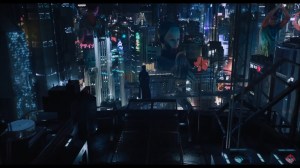 If you’re a fan of the original Ghost in the Shell, you might be depressed from what the live-action Hollywood adaptation does to its noteworthy source material. If you’ve never seen the anime, then you might find some scraps of entertainment to be had in what is essentially a drizzly cyberpunk product dumbed down for the largest mass audience that would be adrift with any minor hint of ambiguity. The 2017 Ghost in the Shell is not a good movie and it’s an even worse Ghost in the Shell movie. First off, we don’t need live-action versions of superior animated films just to have them, and this same statement goes for the equally underwhelming Beauty and the Beast remake. Just because a film lacks “real people” does not mean it is missing some crucial element, and I bristle at the notion that animated films are somehow inherently inferior or not “real movies.” With that being said, Ghost in the Shell will invariably disappoint fans of the original anime. There are visual signifiers and shots that it mimics with fealty; it’s just the overall story, characters, narrative complexity and mystery, and everything else that lacks that same level of fealty. Who cares if the main character is a shell of herself because, hey, they recreated this one shot fairly accurately, and that’s why we go to the movies, right?
Whereas the original was thoughtful and trusted the intelligence of an audience, the 2017 Ghost in the Shell resorts to explaining everything all the time, and even that it does badly. This is a muddled and frequently incoherent plotline, and the magnitude of its ineptitude is even higher considering how stupidly obvious the screenwriters make every twist and turn. This is the most obvious, simplistic conspiracy you could possible write. When Major wakes up in the opening scene and is being told what happened, the audience should already be alert with suspicion. This secret conspiracy goes in the most obvious direction (the good guys might not be the good guys after all) in a manner that should be transparently obvious to anyone except those unfortunate souls who have never seen another movie before in their lifetimes. So much of the plot is the untangling of this mystery, the Major’s real back-story, who the true villains are. To make it as obvious as possible and still devote so much time is not a good decision. The movie is constantly tagging characters to explain all exposition, leaving no subtleties to chance. The sadder part is that the plot is still muddled for long stretches even with all this handholding to straighten things out for the neediest.
 The world building and themes are kept at a distance, further denying the movie depth and substance. With any science fiction world, let alone one borrowed from other famous cinematic influences, it’s important for the viewer to get a sense of how the world operates. This can be done with small moments and larger moments, enough to properly contextualize this brave new world. With Ghost in the Shell, we’re told that mankind has become increasingly intertwined with machines and that cybernetic enhancements are en vogue. Except we never see this in the outside. We see loads of floating hologram advertisements, an overblown visual motif, but outside of our three main characters, this aspect that they felt merited inclusion in text before the movie gets underway is weirdly absent. It makes the characters feel less like they belong in an environment that makes sense. The larger themes of self-identity, the nature of humanity, and the questions over body autonomy are glossed over with the faintest of observations. Major is discovering her identity, but it leads her to what may be the most tired of conclusions. You would think having a robotic body would create some sort of existential reflection. You would be mistaken. Sure, Major feels unsure of herself and out of place, though why should she since we’re told man-robot hybrids are all the rage in this vague future landscape. I’m surprised someone didn’t just start explaining what the title meant at any given point.
The movie feels entirely surface-level and that’s where it has one redeeming value — its visual presentation. Director Rupert Sanders (Snow White and the Huntsman) is an above average visual stylist who benefits from strong production design and cinematography. At least the visual aesthetics could keep my attention, even if part of that attention was occupied in playing a compare-and-contrast game with certain scenes. The special effects are suitable and stylish enough, borrowing more than a few elements from the original. The action sequences are relatively muted, occurring in bursts but never really developing further. There’s an initial attack, then a response, and sometimes a chase, but that’s about it. The tech also doesn’t seem to factor in the combat. The strike team has the ability to communicate telepathically, but if they can do this why would they ever turn off this secret channel? It’s also lazy as it means we can just focus on filming scenes and record whatever dialogue we need later, as if the screenplay was incomplete.
 The 2017 Ghost in the Shell live-action version is a disappointing cyberpunk thriller that pays lip service to its source material, copying the movements but losing sense of the substance and soul. I’d advise people to merely watch the 1995 anime instead or the TV series that followed. It all feels like an expensive, slick, yet peculiarly ramshackle production that loses sight of the bigger picture by worrying at every turn whether a mainstream audience is going to need help understanding the most obvious. Johansson can be a great actress, which is important to remind yourself because she goes on kickass heroine autopilot with this movie. The action is short and inadequate, the visuals are impressive albeit derivative to the source material and its myriad influences, and the story has nuance, ambiguity, philosophy, reflection, and general substance replaced with a generic conspiracy structure that renders much uninteresting. The 2017 Ghost in the Shell doesn’t quite go to the insulting derisive lows of the Dragonball Z live-action remake, but it’s certainly not a good use of anyone’s time, and that includes you, the audience.
Nate’s Grade: C
Share this:

The Zookeeper’s Wife (2017)
 Antonina Zabinski (Jessica Chastain) and her husband Jan (Johan Heldenbergh) are the keepers of the Warsaw Zoo. Their lives are thrown into turmoil when Germany invades and occupies Poland. Their animals are slaughtered or moved to the Berlin Zoo, under the care of Nazi party member and amateur geneticist Lutz Heck (Daniel Bruhl). Feeling impotent to the horrors around them, Antonina and Jan risk everything to hide Jews in their zoo and eventually smuggle them out to safe houses.
The Zookeeper’s Wife is one of those slice-of-life stories about good people risking much to save lives during the Holocaust that come from obscurity to remind you that there are still fresh, invigorating stories from a topic that can feel tapped out after 70 years. However, it’s also an indication that you need the right handling to do it justice. The Holocaust is by nature such a horrific subject matter that it’s hard to do it justice with a PG-13 or below rating, but it can be done with the right amount of artistic restraint as long as the overall story doesn’t feel hobbled with limitations. Reluctantly, The Zookeeper’s Wife feels a bit too sanitized for the story it’s telling. When it comes to cruelty and human atrocity, you don’t need to shove the audience’s face in the mess to fully comprehend its distaste, but overly avoiding the reality can also be a detriment. The Zookeeper’s Wife, as a PG-13 movie, does not feel like the ideal way to tell this real-life story. It feels too restrained and some of those artistic compromises make for a movie that feels lacking and distracting at points. Fair warning: there are plenty of animal deaths in this movie, though they are all dealt with off-screen with implied violence. The edits to work around this can be jarring and would take me out of the picture. This is only one example of an element that, in order to maintain its dignified PG-13 rating, unfortunately undercuts the realism and power of its story.
 For a Holocaust story set in Poland, the stakes feel abnormally low. The zoo is a sanctuary compared to the Jewish ghettos. The danger of hiding over 300 Jewish people over the course of the entire war feels absent, which is strange considering it should be felt in just about every moment. There are a handful of scenes where we worry whether they will be caught but they’re defused so quickly and easily. After Antonina is caught talking to a very Jewish-looking “doctor” in her bedroom by the housekeeper, they just fire the housekeeper who leaves quietly and never comes back again. It’s a moment of tension that can be felt and it all goes away in a rush. This scene also stands out because the narrow escapes and close calls are surprisingly few and far between. Even when Antonina’s son commits stupid mistake after stupid mistake, including impulsively insulting a Nazi officer to his back, there’s little fear of some sort of retribution. The movie can also lack subtlety, like watching Heck say three times he’s a man of his word and will be trustworthy. We all know he’s going to fall short. There’s also a moment where Jan is literally loading children, who each raise their arms in anticipation, onto a train car. It’s like getting punched in the stomach with every child. Much of the time spent on the zoo is with the quiet moments trying to make the Jewish survivors feel like human beings again (the animals-in-cages metaphor is there). The details of the smuggling and hiding are interesting but cannot carry a movie without more.
The biggest reason to see this movie is the promise of another leading Chastain (Miss Sloane) performance. Ever since rocketing to prominence in 2011, Chastain has proven to be one of the most reliably excellent actors in the industry regardless of the quality of the film. She’s been dubbed a Streep in the making and Zookeeper’s Wife allows her to level up to her “Sophie’s Choice acting challenge stage” and try on that famous Slavic accent that turns all “ing” endings into “ink.” Chastain is terrific as a person trying to navigate their way through the unimaginable, calling upon reserves of courage when needed, and she’s at her best during the moments with Herr Heck. She has to play the dishonorable part of the possible lover, and Heck definitely has his heart set on Antonina. The scenes with the two of them draw out the most tension and afford Chastain a variety of emotions to play as she cycles through her masks. In some ways I wish the more of the movie was focused on this personal conflict and developed it even further.
There was a small practically incidental moment that got me thinking. As stated above, the film has a PG-13 rating and one of the reasons is for brief nudity from Chastain. Now the actress has gone nude before in other movies so that’s not much of a shocker, but it’s the context and execution that got me thinking. Antonina and Jan are lying together in bed after sex and Chastain does the usually Hollywood habit of the bed sheet being at her shoulders while it resides at the man’s waist (those typical L-shaped bed sheets). No big deal. Then, during their discussion over what to do, Antonina rolls over and exposes her breast for a second before she covers herself up again. The reason this stood out to me, beyond the prurient, is because it felt like a mistake. It seems obvious that Chastain was not intended to be seen naked in this intimate post-coital conversation but it was used in the final cut anyway, which made me wonder. Was the take so good, or so much better than the others, that director Niki Caro (Whale Rider, McFarland, USA) and Chastain said “the hell with it” and kept the briefly exposed breast? Did they enjoy the happily accidental casual nature to the nudity, creating a stronger sense of realism between the married couple? Or in the end was it just another selling point to help put butts in seats? I’m thinking best take is the answer. You decide.
 I am convinced one of the main reasons that Chastain wanted to do this movie, and I can’t really blame her, is because she would get to hold a bunch of adorable animals. Given the subject matter, I was prepared for a menagerie of cute little creatures, but I started noticing just how many of them Chastain is seen holding. She holds a rabbit for a monologue. She holds a lion cub. She holds a baby pig. She holds a monkey. She even kind of holds a rubbery baby elephant doll (talk about Save the Cat moment, this movie takes it even more literally). There may very well be animals I simply have forgotten she held. I would not be surprised if in her contract there was a rider that insisted that Ms. Chastain hold at least one small, adorable animal every third day of filming on set.
Stately and sincere, The Zookeeper’s Wife is an inherently interesting true story that should have more than enough elements to bring to life a compelling film experience. It’s an acceptable movie that’s well made but I can’t help but feel that there’s a better version of this story out there. It feels a tad too safe, a tad too sanitized, a tad too absent a sense of stakes, like it’s on awards-caliber autopilot. Chastain is good but her Polish accent becomes a near metaphor for the larger film: it’s polished and proper but you can’t help but feel like something is lacking and going through the motions of what is expected. This is a worthy story and I’m sure there are great moments of drama, but The Zookeeper’s Wife feels a bit too clipped and misshapen to do its story real justice.
Nate’s Grade: B-
Share this:

The Shack (2017)
 When it comes to faith-based movies, especially those based on best-selling books, you know that they’re going to be preaching to the choir and more determined to give its intended audience the message it wants first; everything else is secondary. With The Shack, I got the start of an interesting film scenario and then it became the most boring, laborious, and theologically trite Ted Talk ever. I was fighting to stay awake and it was a battle that I was losing. The opening twenty minutes presents a story with dramatic possibility: Mack (Sam Worthington) is a family man who is grieving the loss of his youngest daughter. On a camping trip, she was abducted by a pedophilic murderer and killed in a shack in the woods. Mack is a shell of himself and his family doesn’t know how to reach him. He gets a mysterious invitation from “Papa,” his wife’s nickname for God, inviting him to the murder shack. So far so good. There’s even a fairly interesting back-story for Mack about his alcoholic and abusive father. Young Mack eventually poisoned his bad dad’s drinks with hazardous chemicals to protect he and his mother. However, all remote sense of entertainment is snuffed out once Mack enters the confines of the titular shack. Inside are human avatars for the Holy Trinity of Christianity, with Oscar-winner Octavia Spencer serving as a homespun “Papa.” The next 100 minutes is a series of talk show interview segments with each person to engage in full on flimsy spiritual psycho-babble to explain why God lets bad things happen and forgiveness is key. The movie stops being a dialogue and becomes a lecture series, and each one just kept going on and on. The characters stop being characters and become different mouthpieces for the spiritual cliches. It’s like the filmmakers threw up their hands and gave up. This is not a movie. It’s a inspirational exam told by the most cloying professors. The lessons learned feel trite (who are you to judge, God is with you through good times and bad) and the movie curiously leaves a lot of dramatic implications unresolved. Did Mack kill his father with the poisoned drink? Did this killer pedophile ever get caught, and if not doesn’t that mean other children are at risk? It’s like once Mack enters that mystical murder cabin, the movie loses any sense of structure, pacing, stakes, and dramatic propulsion, and that’s before the silly race across the water with Jesus. I would also say Worthington (Avatar) is not the best choice as the lead actor due to his limited dramatic range and growl-pitched voice. Other movies have dealt with heavy loss but rarely has one felt so detached from making that loss personable and empathetic. The Shack is a maudlin fable that wants to make people feel good even during the dark times. That’s admirable but it doesn’t make this 135-minute sermon any more of a worthwhile movie to watch.
Nate’s Grade: C-
Share this:

50 Shades Darker (2017)
 I’ll admit not understanding the appeal of the 50 Shades of Grey phenomenon. The introduction into BDSM was a worldwide sensation and the 2015 first film made half a billion dollars, the kind of money usually reserved for movies featuring muscular men in rubber costumes that use whips and chains for different purposes. I happily watched the first film to get a sense of what the big deal was and was unmoved. For a film designed to be titillating and provocative, I came away wishing it had more action (of any sort). With great success, author E.L. James asserted more authority in the film series. Out went original director Sam Taylor-Johnson, who at least provided a sleek sheen to the final product and sexual tension where able, and in came new director, James Foley (Glengarry Glen Ross). Out went the original screenwriter Kelly Marcel and in came a new screenwriter, James own husband Niall Leonard, which could only mean the threat of the film hewing closer to the book was a guarantee. James is giving fans of her popular though critically savaged romance novels more of what they want, and I guess what they think they want are relatively bad movies, limp sex scenes, and an inert romance.
Anastasia Steele (Dakota Johnson) is trying to get back on her feet after leaving her ex, billionaire and bondage enthusiast Christian Grey (Jamie Dornan). He’s got serious issues but won’t stay out of her life. He has to have her back, and rather easily the on-again off-again couple is back on and back getting it on. However, their sex life is threatened with women from Christian’s past and the question of whether he can settle down for good with such a plain Jane submissive like Ana.
 There is a mystifying lack of conflict in the movie that makes 50 Shades Darker feel aimless. There are occasional bumps in the road in the form of old girlfriends still looking for their turn, and Ana’s aggressively inappropriate boss (Eric Johnson), but they’re dealt with almost immediately and without larger consequence. One of these antagonists is foiled by nothing more than a stiff drink to the face like a full-on Dynasty parody. Dealing with Christian’s past seems like natural territory for a sequel. A character as cold and self-serving as Christian could very likely attract a host of dangerous women. Stalkers who cannot let go would present an organic threat to their relationship and Ana’s literal life. A deranged former lover would provide a substantive question for Ana to deliberate. Is she doomed to the same fate? Bella Heathcote’s troubled character is begging for attention but she is so unceremoniously sidelined to the point of hilarity, and then she’s never seen again. Why should the story provide any question that these star-crossed lovers might not magically work out in the end? None of the mini-conflicts last longer than fifteen minutes before being effortlessly overcome, including a helicopter death scare. The shapeless plot structure is tediously airy, leaving too much space for characters and a world that doesn’t warrant the consideration. You would think the extra time would be spent with lengthy, over-the-top sex scenes stripping away all inhibitions and pushing the boundaries of cinematic good taste, but that’s not so much the case (more below). I knew we were in trouble when a sequence of Ana sailing Christian’s yacht was as long as one of the so-called outrageous sex scenes.
Here’s a prime example of just how poorly 50 Shades Darker is plotted. While dressing up for the masquerade, Christian admires Ana in lingerie. “You just going to stand there gawking?” she asks. “Yes,” he replies. Later, she walks in on him exercising shirtless and getting all sweaty while practicing for the Olympics on a pommel horse. It’s a flip of the male gaze, for once in the movie’s two hours. This is obviously a prime spot to repeat the dialogue exchange for a clever payoff, have Christian ask if she is going to just stand there gawking and her answer be in the affirmative. This movie cannot even do that! 50 Shades Darker doesn’t just fumble the big things, like plot and character and tone, it fails to even achieve modest, easily reachable payoffs that can be as ludicrously obvious.
Devoting more time with Ana and Christian outside of the bedroom is also best not advised. These one-dimensional characters are also barely removed archetypes from late night soft-core porn. Ana is an audience cipher but she’s also one incredibly dense human being. Forget the annoyingly mousey acting tics that Johnson (How to Be Single) is instructed to never abandon, this is a lady who just doesn’t get it. She’s had sex with her dude like minimum a dozen times and she’s never noticed the array of scars across his chest? After her boss tries to force himself on her, she fights back and runs into Christian’s arms, and he gets the guy fired (because a woman reporting a sexual assault on her own is not convincing enough?). Hearing the news, Ana acts deeply confused, as if she cannot understand why her boss is now not her boss. Did she just forget the upsetting assault? Every man in this universe seems to find Ana uncontrollably irresistible. She’s the ultimate prize to be owned. Even her own friend, who clearly has a crush on her, creepily makes her the centerpiece of his photography gallery show without her consent. She can huff and puff all she wants about agency but Ana is still a woman looking for her prince to sweep her away to a land of exotic privilege. Her reason for accepting a dinner date with Christian: she’s hungry. That’s fine, not every romance needs to be progressive or healthy, but when that guy is as controlling and worrisome as Christian Grey, then the romance starts to sour and become an exhibit of toxic misogyny. And that’s before Christian reveals that Ana, as well as his previous subs, looks like his dead mother.
 Christian is your dark, brooding, oh so attractive as the bad boy but he’s defanged, turned into proper boyfriend material, the kind of guy who would drop down for an old-fashioned proposal of a girl’s dreams. In other words, the movie makes him boring. He’s still problematic as a romantic partner. While he swears this time will be different and no finely worded legal contracts are necessary, he’s still a controlling jerk and a boor. Even during his “please take me back” dinner he’s attempting to order for Ana. He deposits money in her account despite her protests, he buys the publishing company she works for to become her ultimate boss even outside their relationship, and he’s constantly insisting she is his and his alone in the creepiest of declarations. The movie seems to think it’s found a palatable excuse to explain away his warning signs. His mother, depicted in a hilariously sad picture that looks like a Wal-Mart family photo from a refugee camp, died of a drug overdose at a young age and he was physically abused by his father. It’s a slapdash, simplistic cover for his bad behavior. Another strange discovery: the childhood bedroom of Christian Grey has a framed poster of 2004’s The Chronicles of Riddick. I know Universal is trying to play some studio synergy here, but come on. How old is Christian supposed to be? Also, HE HAS A FRAMED POSTER OF THE CHRONICLES OF RIDDICK.
All of this can be moderately forgivable if the movie more than makes up for where it counts with fans, namely steamy and scorching sex scenes that were the hallmark of the lurid book series. While the first film was far from perfect, or even adequate, let it be said it still could constitute an erotic charge when it desired. With the sequel, the sex is shockingly lackluster. There are only four full sex scenes and they start to become weirdly routine. You anticipate that Christian will spend a little time here doing this, and little time there doing that, and then as soon as would-be penetration comes into being they oddly jump forward and spare the audience the sight of sexual congress. It’s different minor tracks of foreplay and then the movie seems to shy away from the sex itself. For something this supposedly kinky it becomes strangely mechanical, predictable, and boring. Another irritating feature is that every sex scene is accompanied by a blaring rock or pop song. It announces itself with what I call “sex guitar music.” It blares over the scene and makes it difficult for the viewer to better immerse in the scene. Some of the music is downright nails-on-chalkboard awful from a tonal standpoint, creating its own source of comedy. The absolute most hilarious musical pairing is Van Morrison’s “Moondance” while Christian is fooling around surreptitiously with Ana in a crowded elevator. Go ahead and look up the song and come back to this review, I can wait. The jazz flute playing over the scene is certainly… different. It might be the worst sex scene song pairing since Leonard Cohen’s “Hallelujah” in Watchmen. I stayed until the end credits and counted 27 songs used in a 118-minute movie. Reportedly there’s a score by Danny Elfman in the film but I challenge you to find it (easiest paycheck of his career).
 If you’d like to be spared the turgid two-hour experience, I’ll spoil the specifics of the sex scenes in this paragraph so you can see how truly tame the movie is for something so reportedly transgressive and kinky. The first sex scene is their reunion as a couple and he undresses her, goes down on her, then climbs atop, then it’s over. The second involves him spanking her, upon her request, then he goes down on her, climbs atop her, then it’s over. The third sex scene involved Ben Wa balls as foreplay reminiscent of the superior and far more erotic Handmaiden (seriously see that Korean movie like 1,000 times before this), or was that the second sex scene? As I type this, it’s only been mere hours since I left my screening and I can’t recall the general details of the third sex scene, that’s how boring it was. The fourth is more montage but it’s an unleashed exuberance of sexual id. Christian dumps an entire bottle of massage oil onto Ana’s breasts, which seemed impatient and wasteful to me, but I’m not a billionaire. I cannot overstate just how dull and lazily staged the sex scenes are in the film, extinguishing any kind of titillation and strangely demurring once things get passionate. The nubile bodies are on display, Johnson’s in semi-permanent arched back, though Dornan is often coquettishly obscured (sorry again, ladies). The word that seems most appropriate for the sex scenes is “anticlimactic.” Ana jokes that she’s a vanilla girl and trapping Christian into a plain relationship, and their big screen sex life typifies this (anyone remember Ana’s question about what a butt plug was?). It’s a world of kink where nipple clamps are giggle-worthy accessories to the participants and the go-to sexual position is missionary. This movie is not the daring dip into untapped sensuality it’s been made out to be. It’s much more conservative at heart.
Ironically, 50 Shades Darker is a curiously reserved romance that lacks serious heat. The actors have very little chemistry and are fighting losing effort to convince you just how sexy they find one another. Dornan still seems like a dead-eyed shark to me. I know people aren’t going to this movie for the story, but some better effort could have been afforded rather than false conflicts that are arbitrarily resolved one after another. It’s an empty fantasy with boring characters and timid sex scenes that register as sub-soft-core eroticism. I wrote of the original film: “Surprisingly boring and rather tepid, 50 Shades of Grey feels too callow to be the provocative film experience it wants to be. It needs more of just about everything; more characterization, more organic coupling, more story, more romance, more kink. It is lacking in too many areas, though the production values are sleek, like it’s the most technically accomplished episode of Red Shoe Diaries.” Every criticism is still valid and even more so. Whereas the first film was about the flirtation and exploration of the coupling, the sequel inevitably treads the same ground, watching pretty dull people get dressed in pretty clothes and then take them off. For a book series so infamous for its tawdry smut, I was expecting more smut or at least better smut.
Nate’s Grade: C-
Share this:

Noirvember: Double Indemnity (1944)
 Billy Wilder’s Double Indemnity is a classic film noir and a classic crime drama about bad people doing bad things and doing them badly. It’s a rich narrative environment that has been explored in droves before and after. Double Indemnity was a box-office sensation, critical hit that was nominated for seven Oscars, and solidified Wilder as one of the most creative and daring writing and directing voices in cinema. This was only his third directing effort and it provided the freedom to make his own way through Hollywood. There’s a certain danger in going back to cinematic classics. It’s easy to see their influence in a sea of imitators and sometimes the accomplishments can be taken for granted just because the viewer is too removed from the initial splash the film made. Double Indemnity is a sharp, surefooted, and highly influential film that still resonates with suspense and intrigue. The formula was refined with Wilder at the helm and his genius can be readily recognized.
Walter Neff (Fred MacMurray) is a mid 30s insurance salesman in Los Angeles. He gets into some big trouble when a prospective client, Phyllis Dietrichson (Barbara Stanwyck), intimates that she would like to bump off her husband and profit from the act. Walter is appalled but also intrigued, drawn to the charms of the sexy Mrs. Dietrichson. He agrees and says they’re going to do it right. She takes out a hefty insurance policy on her husband that pays double for rare accidents, which spurs Neff to stage a phony accident where the injured Mr. Dietrichson (Tom Powers) fell to his death off a train. The scheme is elaborate, with alibis, swapped identities, hiding places, and a minimal of public interactions. It seems perfectly executed that is until Neff’s boss, Barton Keyes (Edward G. Robinson), starts inspecting closer feeling something is amiss. Neff must outwit his boss and co-workers and keep the scheme from getting further out of control.
“I killed him for money – and a woman – and I didn’t get the money and I didn’t get the woman.”
 Thanks to the morally and creatively restrictive Hays Code, it’s easy to see all the roadblocks that could have sabotaged the movie from getting made, let alone becoming a great film. It’s a movie not just about adulterers but they’re also murderers, and the script places you in their perspective, clinging to hope they might succeed in their scheme. Admittedly, the characters are punished for their misdeeds by the film’s end as the Hays Code would demand, but the film experience was different, and Wilder made it so early on. Within minutes, as Walter Neff dictates his confession in his boss’ empty office, he admits to being a killer, to killing Mr. Dietrichson, and in doing so out of a desire for Mrs. Dietrichson. By the very fact that he’s slumped over, panting heavily, and confessing in sordid detail, we can rightfully assume that he did not get away with it. What’s left for the audience to discover? Wilder has already established the major turns of his story for his audience and seemingly robbed us of any notion of surprise. But that’s where Wilder’s storytelling prowess emerges, because it’s not so much a story of whether something was done or would be done, it’s a story of how and how to elude capture.
We’re locked into Neff’s perspective, and with it as an experienced insurance salesman, he knows the proper way to stage a murder, make it look like an accident, and not get caught. It’s in the details that Wilder hooks us, and as we watch the trap unravel, the movie becomes an exercise in nervous tension wondering what will trip up our lovers. An audience generally gravitates to smart characters trying to outwit others, appreciating the wiles but also, perhaps, wanting to see if the scheme can be accomplished. It pushes the audience into an interesting position of rooting for our murderer. There’s a wonderful scene right after Neff and Phyllis have deposited the body of her dead husband. They’ve hopped in her car and are ready to flee the scene of the crime, and that’s when her car won’t start. Wilder simmers in the moment, luxuriating in the encroaching panic as key turn after key turn only results in the sounds of a stalled engine. Finally, it starts, but during the sequence you empathize with the killers and their panic. Wilder and company have done their job and at least some part of the audience is pushing for them to escape. What happens later tests audience loyalty, but we’re still firmly in the perspective and in the shoes of the film’s killer, the only killer in the picture at that. He’s our man.
“I think you’re rotten.”
“I think you’re swell – so long as I’m not your husband.”
 The staples of noir cinema really came alive with Wilder’s excellent crime drama. The visual signifiers we associate with the genre are all here in accordance, like the chiaroscuro lighting that bathed the actors in swaths of invading darkness. The lighting does a great job of reflecting the sordid schemes of our lovers. As soon as Walter accepts, the lighting changes drastically and the layers of dark creep in on the actors’ faces. The dialogue by Wilder and Raymond Chandler (his first screenwriting gig in Hollywood) has that robust rat-a-tat rhythms of hardboiled genre fiction that we love. The twists and turns keep an audience glued even though we have already been told the major plot particulars. The inclusion of Mr. Dietrich’s twenty-something daughter Lola (Jean Heather) from his previous marriage presents an intriguing complication. She suspects her wicked stepmother might have something to do with her father’s death as well as her mother’s death. Walter Neff keeps tabs on her as a means of trying to dissuade whom she tells her suspicions to, as a means of manipulating her, but then when Lola reveals that her ex-boyfriend has been seeing Phyllis on a nightly basis, we don’t know what to think. Is Phyllis setting up her own scheme to kill Neff? Is Lola knowingly manipulating Neff to enact vengeance against her hated stepmother? Is there anyone a guy can trust? It’s a fine character and played sincerely by Heather (Going My Way) almost to the point of ache. She stopped acting altogether in 1949, to the detriment of us all.
But the ultimate femme fatale is Stanwyck (The Lady Eve). I think what makes her work is the fact that she doesn’t immediately leap to mind as a femme fatale. She’s not the most gorgeous actress in Hollywood, though clearly still an attractive woman. The stiff blonde wig they saddled her with doesn’t help on that front. She’s a temptress that doesn’t sizzle off the screen so much as step from the mind because she feels more realistic. Working within the repressive confines of the Hays Code, Stanwyck still knows how to provide a sexy smirk to things left unsaid with her character. There are a few looks she employs that could make you melt. A standout scene focuses entirely on her face. Her husband is being murdered just off screen. That violent act is left to our morbid imaginations while we watch Stanwyck’s subtle expression of satisfaction cross her face only to dissolve when she knows better. I wish MacMurray (The Absentminded Professor) was a better scene partner with her. He seems overly stiff like he’s trying harder to get out the stylized dialogue in the tone the director wants. Wilder finds ways to subvert the actor’s tendencies but I feel like he’s at best a likable but limited dolt of an actor.
“You’re not smarter, Walter… you’re just a little taller.”
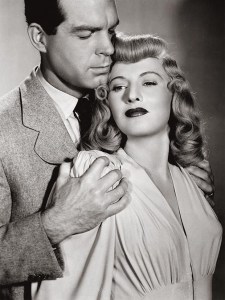 Phyllis is a classic femme fatale figure and Stanwyck plays her with a beautifully controlled sense of menace, but I want to offer a different theory as to what kind of twisted love story inhabits Double Indemnity. I think Walter Neff was never in love with Phyllis, though he acknowledged her beauty and general seductive effect. This much is clear from his first meeting with her where the insurance veteran can’t help himself with how forward and transparent his flirting is. He’s interested, though he’s also interested in getting a sale, and then when she floats the idea of life insurance, his tone immediately changes. The flirting stops cold and he promptly sees himself out. But he can’t stop thinking it over. I propose he isn’t drawn to Phyllis so much as he’s drawn to the intellectual challenge of pulling off the “perfect crime.” He considers himself a clever man and this would put all his skills to the test. He knows what agents look for to suss out foul play. He knows what the police ask about. Now he gets to see if he can fool them all. In this interpretation of mine it’s not Neff’s love for the dame that gets him but his love of his ego. There’s a cold manner in how often he calls Phyllis “baby,” lacking apparent affection and instead seemingly turning the pet name into something dutiful. Oh, but you’ll argue, his voice over goes into great detail about the magnetic and sexual appeal of Mrs. Dietrichson, and that’s the point to remember, that it’s his voice over. Neff is retelling this story, knowingly dictating his confession, and perhaps he’s playing into a narrative that removes some of the emphasis from his true intentions. I propose Neff is an unreliable narrator. Since it’s from his perspective, his words are all we know about Phyllis and her assumed seductress ways. Having the final word on his story would provide a perfect opportunity for Walter to alter the story as best he sees fit, shifting some blame onto the woman who done him wrong. I believe that in the end it was Walter Neff’s desire to prove he could outsmart the world of law enforcement and get away with murder that drove him onto this wayward path and not a woman as fetching as Stanwyck and her anklet may have been.
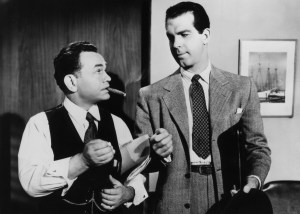 There’s a very unexpected emotional current that surfaces fully by the conclusion of Double Indemnity. Edward G. Robinson was at a transitional point in his career, having been the lead in a slew of older crime pictures. An audience was prepped from association to consider Robinson a disreputable character, just as they had prepped to consider MacMurray’s character a likeable fellow from his previous comedic roles. Wilder’s film flips audience expectations to great effect. MacMurray is the cunning murderer and Robinson is the moral center. Keyes is exceptionally skilled at insurance fraud and it naturally should be him that unknowingly tightens the noose around his beloved employee as he gets closer and closer to the truth. He just can’t see it; Walter Neff is so close he inhabits a blind spot. When Keyes does discover the truth, his crushing sense of disappointment he tries to hold back is an emotional moment that hits hard. It’s the professional and loving relationship between these men that helps to add something more to Double Indemnity; it’s got the noir staples we come to expect nowadays but it also has a surprisingly sweet and affecting father/son relationship between mentor and student. Robinson is terrific in the bravado moments like when he unleashes a torrent of statistical categories on suicide types and methods and he also sells the quiet hurt of a proud man who must admit he placed his trust in the wrong recipient.
“I couldn’t hear my own footsteps. It was the walk of a dead man.”
Double Indemnity is a film classic that holds up thanks to deft plotting that puts the audience in the place of the killers, solid twists and turns, and a clear understanding of the strengths of the genre. It’s a standout film noir that still stands rather tall. It’s always reassuring when the great pieces of art can still transport, still excite, and still resonate with the same feeling that communicates why they deserve their decades of plaudits and acclaim. Wilder was one of Hollywood’s greatest storytellers who could hop genres like few others. His foray into noir cinema left a long lasting legacy for the genre and its fans to follow, and Double Indemnity is still the crackling crime thriller it was under the Hays Code. Perhaps the scrutiny of censorship forced Wilder and Chandler to get more creative, and the finished product is a taut and stylish imprint that others eagerly copied. There’s just something inherently interesting about bad people doing bad things badly no matter the best intentions of the moral crusaders of its day.
Nate’s Grade: A


You must be logged in to post a comment.