Blog Archives
Batman Begins (2005) [Review Re-View]
 Originally released June 15, 2005:
I have been a Batman fan since I was old enough to wear footy pajamas. I watched the campy Adam West TV show all the time, getting sucked into the lead balloon adventures. Tim Burton’s 1989 Batman was the first PG-13 film I ever saw, and I watched it so many times on video that I have practically worn out my copy. Batman Returns was my then most eagerly anticipated movie of my life, and even though it went overboard with the dark vision, I still loved it. Then things got dicey when Warner Brothers decided Batman needed to lighten up. I was only a teenager at the time, but I distinctly remember thinking, “You’re telling the Dark Knight to lighten up?” Director Joel Schumacher’s high-gloss, highly stupid turn with Batman Forever pushed the franchise in a different direction, and then effectively killed it with 1997’s abomination, Batman and Robin. I mean these films were more worried about one-liners and nipples on the Bat suits. Nipples on the Bat suits, people! Is Batman really going, “Man, you know, I’d really like to fight crime today but, whoooo, my nipples are so chaffed. I’m gonna sit this one out”?
For years Batman languished in development hell. Warner Bothers licked their wounds and tried restarting their franchise again and again, only to put it back down. Then around 2003 things got exciting. Writer/director Christopher Nolan was announced to direct. Nolan would also have creative control. Surely, Warner Brothers was looking at what happened when Columbia hired Sam Raimi (most known for low-budget splatterhouse horror) for Spider-Man and got out of his way. After Memento (My #1 movie of 2001) and Insomnia (My #5 movie of 2002), Nolan tackles the Dark Night and creates a Batman film that’s so brilliant that I’ve seen it three times and am itching to go again.
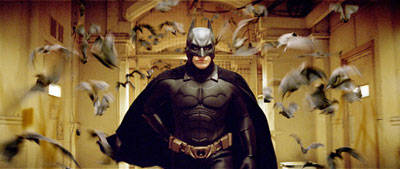 The film opens with a youthful Bruce Wayne (Christian Bale) in a Tibetan prison. He’s living amongst the criminal element searching for something within himself. Henri Ducard (Liam Neeson) offers Bruce the chance to be taught under the guidance of the mysterious Ra’s Al Ghul (Ken Watanabe), the leader of the equally mysterious warrior clan, The League of Shadows. Under Ducard’s direction, Bruce confronts his feelings of guilt and anger over his parents’ murder and his subsequent flee from his hometown, Gotham City. He masters his training and learns how to confront fear and turn it to his advantage. However, Bruce learns that the League of Shadows has its judicial eyes set on a crime ridden Gotham, with intentions to destroy the city for the betterment of the world. Bruce rebels and escapes the Tibetan camp and returns to Gotham with his own plans of saving his city.
With the help of his trusted butler Alfred (Michael Caine), Bruce sets out to regain his footing with his family’s company, Wayne Enterprises. The company is now under the lead of an ethically shady man (Rutger Hauer) with the intentions of turning the company public. Bruce befriends Lucius Fox (Morgan Freeman), the company’s gadget guru banished to the lower levels of the basement for raising his voice. Bruce gradually refines his crime fighting efforts and becomes the hero he’s been planning on since arriving home.
Gotham is in bad shape too. Rachel Dawes (Katie Holmes), a childhood friend to Bruce, is a prosecutor who can’t get anywhere when crime lords like Falcone (Tom Wilkinson) are controlling behind the scenes. Most of the police have been bought off, but Detective Gordon (Gary Oldman) is the possibly the city’s last honest cop, and he sees that Batman is a figure trying to help. Dr. Crane (Cillian Murphy) is a clinical psychologist in cahoots with Falcone. Together they’re bringing in drug shipments for a nefarious plot by The Scarecrow, a villain that uses a hallucinogen to paralyze his victims with vivid accounts of their own worst fears. Bruce is the only one who can unravel the pieces of this plot and save the people of Gotham City.
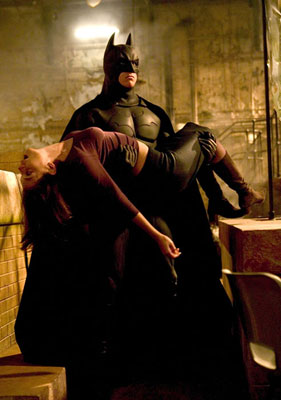 Nolan has done nothing short of resurrecting a franchise. Previous films never treated Batman as an extraordinary character; he was normal in an extraordinary world. Batman Begins places the character in a relatively normal environment. This is a brooding, intelligent approach that all but erases the atrocities of previous Batman incarnations. Nolan presents Bruce Wayne’s story in his typical nonlinear fashion, but really gets to the meat and bone of the character, opening up the hero to new insights and emotions, like his suffocating guilt over his parents murder.
Nolan and co-writer David S. Goyer (the Blade trilogy) really strip away the decadence of the character and present him as a troubled being riddled with guilt and anger. Batman Begins is a character piece first and an action movie second. The film is unique amongst comic book flicks for the amount of detail and attention it pays to characterization, even among the whole sprawling cast. Nolan has assembled an incredible cast and his direction is swimming in confidence. He’s a man that definitely knows what he’s doing, and boy oh boy, is he doing it right. Batman Begins is like a franchise colonic.
This is truly one of the finest casts ever assembled. Bale makes an excellent gloomy hero and really transforms into something almost monstrous when he’s taking out the bad guys. He’s got great presence but also a succinct intensity to nail the quieter moments where Bruce Wayne battles his inner demons. Caine (The Cider House Rules, The Quiet American) is incomparable and a joy to watch, and his scenes with the young Bruce actually had me close to tears. This is by far the first time a comic book movie even had me feeling something so raw and anything close to emotional. Neeson excels in another tough but fair mentor role, which he seems to be playing quite a lot of lately (Kingdom of Heaven, Star Wars Episode One). Freeman steals every scene he’s in as the affable trouble causer at Wayne Enterprises, and he also gets many of the film’s best lines. Oldman (The Fifth Element, Harry Potter and the Prisoner of Azkaban) disappears into his role as Gotham’s last good cop. If ever there was a chameleon (and their name wasn’t Benicio del Toro), it is Oldman. Holmes works to the best of her abilities, which means she’s “okay.”
The cast of villains are uniformly excellent, with Wilkinson’s (In the Bedroom) sardonic Chicagah accented mob boss, to Murphy’s (28 Days Later…) chilling scientific approach to villainy, to Watanabe’s (The Last Samurai) cold silent stares. Even Rutger Hauer (a man experiencing a career renaissance of his own) gives a great performance. Seriously, for a comic book movie this is one of the better acted films of the year. And that’s saying a lot.
Batman Begins is such a serious film that it almost seems a disservice to call it a “comic book movie.” There are no floating sound effects cards and no nipples on the Bat suits. Nolan really goes about answering the tricky question, “What kind of man would become a crime-fightin’ super hero?” Batman Begins answers all kinds of questions about the minutia of the Dark Knight in fascinating ways, yet the film remains grounded in reality. The Schumacher Batmans (and God save us from them) were one large, glitzy, empty-headed Las Vegas entertainment show. No explanation was given to characters or their abilities. Likewise, the Gothic and opulent Burton Batmans had their regrettable leaps of logic as well. It’s hard not to laugh at the end of Batman Returns when Oswald Cobblepot (a.k.a. The Penguin) gets a funeral march from actors in emperor penguin suits. March of the Penguins it ain’t. Nolan’s Batman is the dead-serious affair comic book lovers have been holding their breath for.
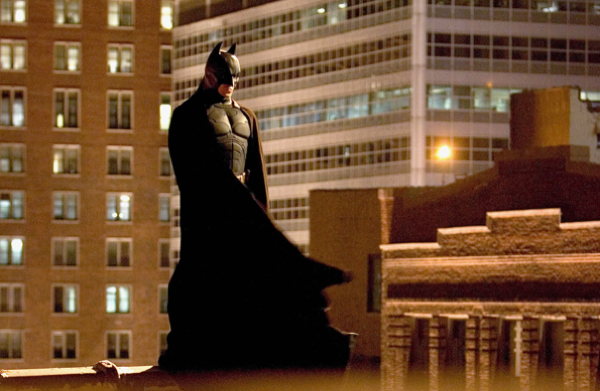 The action is secondary to the story, but Batman Begins still has some great action sequences. Most memorable is a chase sequence between Gotham police and the Batmobile which goes from rooftop to rooftop at one point. Nolan even punctuates the sequence with some fun humor from the police (“It’s a black … tank.”). The climactic action sequence between good guy and bad guy is dutifully thrilling and grandiose in scope. Nolan even squeezes in some horror elements into the film. Batman’s first emergence is played like a horror film, with the caped crusader always around another turn. The Scarecrow’s hallucinogen produces some creepy images, like a face covered in maggots or a demonic bat person.
There are only a handful of flaws that make Batman Begins short of being the best comic book movie ever. The action is too overly edited to see what’s happening. Whenever Batman gets into a fight all you can see are quick cuts of limbs flailing. My cousin Jennifer got so frustrated with the oblique action sequences that she just waited until they were over to see who won (“Oh, Batman won again. There you go.”). Nolan’s editing is usually one of his strong suits; much of Memento’s success was built around its airtight edits. He needs to pull the camera back and let the audience see what’s going on when Batman gets physical.
Another issue is how much plot Batman Begins has to establish. This is the first Batman film to focus solely on Batman and not some colorful villain. Batman doesn’t even show up well into an hour into the movie. As a result, Batman Begins perfects the tortured psychology of Bruce Wayne but leaves little time for villains. The film plays a shell game with its multiple villains, which is fun for awhile. The Scarecrow is really an intriguing character and played to gruesome effect by the brilliant Cillian Murphy. It’s a shame Batman Begins doesn’t have much time to develop and then play with such an intriguing bad guy.
Batman Begins is a reboot for the film franchise. Nolan digs deep at the tortured psyche of Bruce Wayne and come up with a treasure trove of fascinating, exciting, and genuinely engrossing characters. Nolan’s film has a handful of flaws, most notably its oblique editing and limited handling of villains, but Batman Begins excels in storytelling and crafts a superbly intelligent, satisfying, riveting comic book movie. The best bit of praise I can give Batman Begins is that I want everyone responsible to return immediately and start making a host of sequels. This is a franchise reborn and I cannot wait for more of it.
Nate’s Grade: A
——————————————————
WRITER REFLECTIONS 20 YEARS LATER
Batman Begins could have also been subtitled, Christopher Nolan Begins. The eponymous writer/director, who has defined the twenty-first century in the realm of artful blockbusters perhaps more than anyone, had made three movies prior to this big moment. He began with 1998’s Following, but it was 2001’s Memento that got everyone’s attention. His immediate follow-up, 2002’s Insomnia, is a very good movie, and actually a better version than the Nordic original, but it was really proof for Warner Brothers that this clever indie guy could handle a larger studio project. In the early 2000s, Warner Brothers was desperate to relaunch Batman after the demise of the franchise with 1997’s ultra campy Batman & Robin, and many filmmakers were courted to relaunch the Dark Knight. It was literally a month after rejecting Joss Whedon’s reboot pitch that in January 2003, the studio announced Nolan was attached and writing the screenplay with David S. Goyer, who was hot off the Blade movies and seemed to have cracked the code for making more mature comic book movie adaptations. What followed was a dramatic reworking of Batman, grounding him and his world in realism and opening Bruce Wayne up for a closer psychological examination, giving the man behind the mask an opportunity to be the actual focus for once. The results reinvigorated the dormant franchise, provided a path for superhero reboots in a post-9/11 landscape, and launched Nolan on his ascendant trajectory to being the biggest blockbuster voice of the modern era.
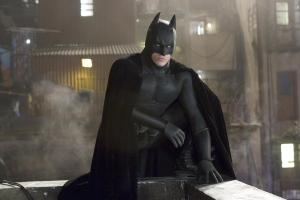 Batman was a popular character in DC comics (note: DC stands for “Detective Comics,” so saying, “DC comics” is like saying, “Detective Comics comics,” much like the way the “Sahara” means “desert”) from his inception in in 1939, but he was always well behind Superman, the golden boy. The campy Adam West TV series was popular, and actually saved the comic from being discontinued, but it wasn’t until 1989 that Batman became the most popular superhero. The darkness and edge of Batman was more appealing for the modern masses, and paired with Tim Burton, it proved the new levels of studio blockbusters after the steep decline from the Christopher Reeve Superman movies. Ever since, we’ve had over ten live-action headlining Batman movies and only four Superman live-action movies, now five thanks to James Gunn’s recent high-flying addition. Much as the Burton 1989 Batman brought the character to an even bigger height of modern stardom, it was Nolan who likewise took the character and made it an even bigger spectacle that also steered the zeitgeist of what superhero movies could be.
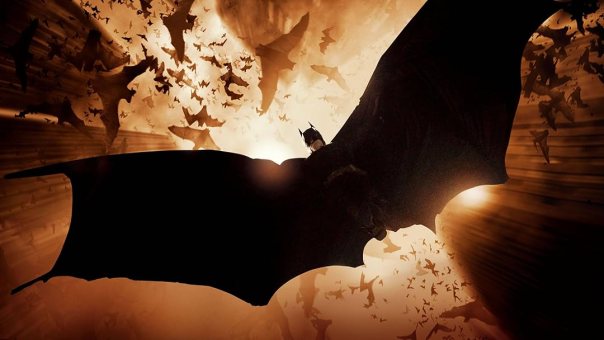
While 2008’s The Dark Knight is widely regarded as Nolan’s best movie in his trilogy, I actually consider Batman Begins his best. That is no insult to The Dark Knight, a wildly entertaining movie that is something truly special every second Heath Ledger is onscreen with his magnetic portrayal of the Joker, a modern-day anarchist seeking validation from the costumed crusader who “changed all the rules.” It’s a good movie with some wonky plotting you don’t think of as long as Ledger is lighting it up, but that first movie was a proof of concept that Batman can carry his own movie. It humanizes the character and strips him down before gradually putting him back together, explaining how this character assembles the tools of his trade and the allies that help support his mission. It’s a satisfying series of trial and error that proves entertaining as we watch the myth of Batman take shape. This first movie is about the formation of Batman, whereas the second is about the escalating consequences of introducing a well-armed vigilante into the bloodstream of organized crime. The first film is the most complete movie, and while it has some flights of fancy like a secret ninja conspiracy, it still works on a relatively grounded level. For the first time in perhaps the character’s film history, you will find yourself caring about the character. That is an accomplishment, and you can feel it when Bruce Wayne (Christian Bale) merely standing amidst a swarm of bats is played as a turning point of self-actualization. And it works. This is Nolan’s best Batman.
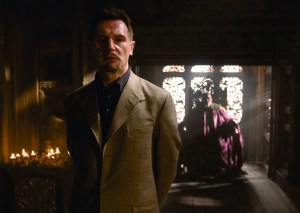 We don’t even get our first glimpse of Batman as we know him until halfway through the movie. That’s a lot of waiting for a movie with “Batman” as the first word of its title. Even twenty years later, I find the build-up satisfying, watching Bruce Wayne put together the pieces that we associate with Batman, from his cowl to his cape to his suit to the Batmobile, which is practically an all-terrain tank. Finding interesting ways to generate these familiar parts, iconography, and allies makes an invigorating drama that is better than the more action-heavy second half of the movie. It’s still fun and enjoyable how Nolan is able to bring together so many elements with payoffs. This is Nolan’s first blockbuster and he proves that he has an innate feel for popcorn entertainment, knowing how to structure and pace the action and intrigue and laying in those setups and payoffs along with winning character beats and themes. He shows how he can make the moments matter to form an even greater whole. That’s the lasting impact of Batman Begins, where every moment helps to build the mystique of the superhero but also the psychology of Wayne and what motivates a man to dress up and punch dudes for a living.
It also helps that this movie is perfectly cast from top to bottom. Bale was as sturdy a center as you could get. He only went on to be nominated for four Oscars, winning once for 2010’s The Fighter (and should have won in 2018 as Dick Cheney in Vice). He’s long been known for transforming himself completely with his roles. Between 2004’s The Machinist and Batman Begins, there’s a 100-pound difference in Bale’s physique. His performances can get too easily overlooked because of the gimmicky body transformations, but Bale has been one of our most consistent and interesting actors for these last twenty years. Getting Michael Caine (Oscar winner), Morgan Freeman (Oscar winner), Gary Oldman (future Oscar winner), Cillian Murphy (future Oscar winner), Tom Wilkinson (future Oscar nominee), Neeson, Wantanabe, and even Rutger Hauer to be in your movie is obviously a setup for greatness. Nolan and company even get the smallest roles right, like hiring Rade Serbedzija (Snatch, Eyes Wide Shut) just as a homeless man Bruce gives his coat to. He’s only in two scenes for maybe thirty seconds but you got this actor for that part. The odd one out is Katie Holmes as Bruce’s childhood friend who becomes a crusading prosecutor. It’s not a knock on Holmes but simply her character’s role in the story. There’s also the knowledge that this role was recast with Maggie Gyllenhaal in the 2008 sequel, so one wonders what Gyllenhaal would have been like here. I like Holmes as an actress but Maggie Gyllenhaal is a definite upgrade.
 Allow me to question the mission of the League of Shadows and good ole Ra’s al Ghul (Ken Wantanabe, but really Liam Neeson). They are a secret order of ninjas trained to fight injustice through extreme measures. They’ve been in existence for hundreds of years, maybe thousands, and claim to have contributed to the destruction of such empires as Rome and Constantinople when they became breeding grounds of injustice. Their next target is Gotham and they become our returning antagonists for the climax, Batman having to take down his mentor. This philosophy purports to link criminality with borders, alleging that criminals are only encouraged by the corrupt institutions of the city. If Rome can no longer support a thriving criminal network, the assumption is that crime goes away. You take away the platform and, voila, injustice and criminality are gone. That’s quite an oversimplification. You could make the argument that destroying a corrupt city makes it harder for criminals to find footing, but does it eliminate crime or just force it to migrate elsewhere? This also assumes that only cities are cesspools for criminality and corruption; look into the Sackler-lead network of pill mills dotting rural America. I guess drug and sex trafficking only exist in urban America, right? The League of Shadows have a bad idea forming a bad philosophy that is being applied badly, and I just wanted to point this out.
The legacy of the Nolan Batman trilogy carries on twenty years later. They are considered some of the biggest blockbusters of the twenty-first century, but it’s also the beginning of the meteoric ascent of Nolan. 2006’s The Prestige, likely his most underrated film, is the last of the Before Movies. Ever since, every Nolan movie has been an event, even ones that step back into more personal and cerebral spaces, like 2023’s runaway Oscar juggernaut, the billion-dollar three-hour biopic, Oppenheimer. He’s become one of a very select few filmmakers whose very name is a selling point to the general public regardless of whatever the project might be (joining Spielberg, Tarantino, James Cameron, and maybe Jordan Peele at this point). I agree with my 2005 criticisms that Nolan is not an expert handler of action. He’s tremendous at atmosphere, with judicious editing and eye-popping visuals, but action construction is not his forte, even after several more action movies to his name. I was much more entertained by the horror sequences from the Scarecrow fear toxin than I was by the straight action. I do wish the villains had more time, especially the Scarecrow, but it’s a result of having so much more plot to do, and centering around Bruce Wayne and his personal journey to superhero-dom means everything serves this streamlined goal.
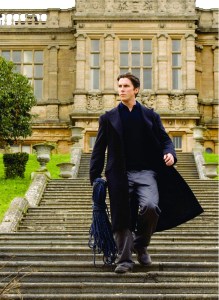 I saw Batman Begins three times in the theater back in 2005. As a longtime Batman fan, a kid whose first VHS tape was the 89 Batman, who obsessed over every detail for the Batman Returns release, who religiously watched the excellent 90s animated series, I felt a sense of elation that this was a movie that got it. Nolan and his team got Batman and did him justice that had been denied for years. We now likely live in a universe where we’ll never be more than four years away from another live-action Batman movie or appearance. I enjoy the Matt Reeves’ Batman era we’re currently living through, another gritty take favoring realism and depth of character to comic book pulp heroics. The Nolan movies walked so that the Reeves films could fly. If you’re a fan of Batman in the real world, then these last twenty years have been resplendent (Ben Affleck was the highlight of Batman vs. Superman – no joke). It’s interesting to see that convergent point in 2005, where Nolan re-imagined the character for today, and also where Christopher Nolan became the signature blockbuster filmmaker we now freely associate him to be. Batman Begins is a comic book movie that feels so well-suited for the times as well as all time. It’s still smashing.
Re-Review Grade: A
Share this:

The Flash (2023)/ Spider-Man: Across the Spider-Verse (2023)
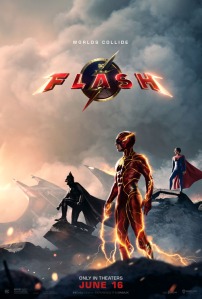
Released within two weeks of one another, two big summer movies take the concept of a multiverse, now becoming the norm in comic book cinema, and explore the imaginative possibilities and wish-fulfillment that it proposes, but only one of them does it well. Spider-Man: Across the Spider-Verse is the sequel to the Oscar-winning 2018 revolutionary animated film, and it’s a glorious and thrilling and visually sumptuous experience, whereas DC’s much-hyped and much-troubled movie The Flash feels like a deflated project running in place and coming apart. Let this be a lesson to any studio executive, that multiverses are harder than they look.
Barry Allen (Ezra Miller) has the ability to travel at fantastic speeds as his superhero alter ego, The Flash. He’s tired of being the Justice League’s errand boy and still fighting to prove his father is innocent of the crime of killing Barry’s mother. Then Barry discovers he can run fast enough to actually travel back in time, so he returns with the intention of trying to save his mother. Except now he’s an extra Flash and has to train his alternate self (also Miller) how to control his powers. In this different timeline, there is no Justice League to combat General Zod (Michael Shannon, so thoroughly bored) from destroying the planet for Kryptonians.
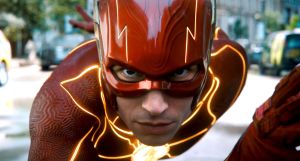
This is the first big screen solo outing for The Flash, and after none other than Tom Cruise, Stephen King, and James Gunn calling it one of the best superhero movies of all time, it’s hard to square how trifling and mediocre so much plays out as an example of a creative enterprise being pulled in too many directions. Miller was cast as the speedster almost ten years ago, and this tale has gone through so much tortured development, leaping through numerous filmmakers and writers, that its purpose has now gone from being a pillar of the expanding DC cinematic universe began with Zack Snyder’s Man of Steel in 2013 to becoming the Snyderverse’s death knell. The premise of traveling back in time is meant for Barry to learn important lessons about grief and responsibility and the limits of his powers, but it’s also intended as the reboot option for the future of these cross-connected comic franchises. It allows Gunn, now the co-head of the new way forward for DC movies and TV, to keep what they want (presumably Margot Robbie and Jason Momoa) and ditch the rest (Henry Cavill, Ben Affleck, Black Adam, Shazam, and Zack Snyder’s overall creative influence). So reviewing The Flash as only a movie is inadequate; it’s also a larger ploy by its corporate overlords to reset their comic book universe. In that regard, the quality level of the movie is secondary to its mission of wiping the creative slate clean.
Where the movie works best is with its personal stakes and the strange but appealing chemistry between the two Millers. It’s an easy starting point to understand why Barry does what he does, to save his mother. This provides a sturdy foundation to build a character arc, with Barry coming to terms with accepting his grief rather than trying to eradicate it. That stuff works, and the final talk he has to wrap up this storyline has an emotional pull that none of the other DCU movies have exhibited. Who wouldn’t want one last conversation with a departed loved one, one last opportunity to say how you feel or to even tell them goodbye? This search for closure is a relatable and an effective vehicle for Barry to learn, and it’s through his tutelage of the other Barry that he gets to see beyond himself. The movie is at its best not with all its assorted cameos and goofy action (more on both later) but when it’s a buddy comedy between the two Barrys. The older Barry becomes a mentor to himself and has to teach this inexperienced version how to hone and control his powers as well as their limits. It puts the hyper-charged character into a teaching position where he has to deal with a student just like him (or just him). It serves as a soft re-education for the audience alongside the other Barry without being a full origin story. The impetuous young Barry wanting to have everything, and the elation he feels about his powers, can be fun, but it’s even more fun with the older Barry having to corral his pupil. It also allows the character an interactive checkpoint for his own maturity and mental growth. Miller’s exuberant performances are quite entertaining and never fail to hit the comedy beats.
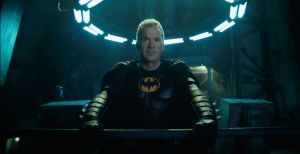
The problem is that the movie puts so much emphasis on too many things outside of its titular hero. Much was made of bringing back Keaton to reprise his Batman after 30 years. I just wish he came back for a better reason and had legitimate things to add. His role is that of the retired gunslinger being called back into action, and there’s an innate understanding with Barry wanting to go back in time and save his family, but too much of this character’s inclusion feels like a stab at stoking audience nostalgia (the callback lines all made me groan). I highly enjoyed Keaton as Batman and appreciated how weird he could make the billionaire-turned-vigilante, but he’s no more formed here than a hologram. The same thing happens with the inclusion of Super Girl a.k.a. Kara Zor-El (Sasha Callie). In this universe, there is no Superman, so she’s our requisite super-powered alien that Zod is hunting to complete his plans for terraforming Earth. She’s an intriguing character as a tortured refugee who has lingering doubts about whether humanity is worth the sacrifice, but much of her usage is meant only to make us think about Superman. She’s not given material to make her own impression, so she simply becomes the imitation of the familiar, the shadow to the archetype already being left behind. But these character additions aren’t even the worst of the nostalgia nods, as the final climactic sequence involves a collision of worlds that harkens to just about every iteration of the famous DC heroes, resurrecting several with dodgy CGI and uncomfortable implications (spoilers… the inclusion of George Reeves, when he felt so typecast as TV’s Superman that he supposedly killed himself because he thought his acting career was over, can be galling).
The action of The Flash is mostly fine but with one exceptional example that boggles my mind. In the opening sequence, no less, Barry is trying to help clean up a crumbling hospital when it collapses and literally sends a reign of babies falling through the air. I was beside myself when this happened, horrified and then stupefied that this absurd action sequence was actually happening. Barry goes into super speed to save the day, which more or less reverts the world into super slow-mo, though he needs to power up first, so we get a quick edit of him stuffing food into his face to load up on calories. We go from Barry breaking into a falling vending machine, stuffing himself in the face with snacks, getting the green light from his suit which I guess measures his caloric intake, and then grab a baby and literally put it in a microwave to shield it from danger. Just describing this event makes me feel insane. I figure the filmmakers were going for an over-the-top approach that also provides light-hearted goofiness to separate the movie from the oppressively dark grist of Snyder’s movies. However, this goes so far into the direction of absurdity that it destroys its credibility. It’s hard for me to fathom many watching this misguided and horrifying CGI baby-juggling sequence and say, “Yes, more please,” rather than scoff and shake their head. It’s not like the rest of the movie keeps to this tone either, which makes the sequence all the more baffling. There are Flash rules that are inconsistently applied to the action; Barry’s caloric intake is never a worry again, and the effects of moving a person during super speed don’t ever seem to be a problem except for one spewing gross-out gag.
While not being an unmitigated disaster, it’s hard for me to see the movie that got so many figures in the entertainment industry raving. The Flash has some notable emotional stakes, some amusing buddy comedy, and some goofy special effects sequences that run the gamut from amusing to confounding, but it’s also quite a mess of a movie, and too many of its nods to the fandom feel like empty gestures of nostalgia compensating for imagination. For all it gets right, or at least keeps interesting, it seems like another cog in a multi-billion-dollar machine, a stopping point also intended to be a reset and starting point. It feels like the character wasn’t trusted enough by the studio to lead his own solo movie even after years of buildup with Miller, nine seasons of the popular TV series, and 80-plus years of prominent placement in DC comics.
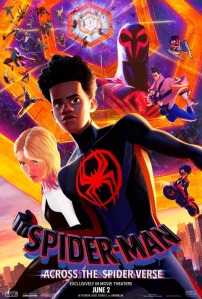
Conversely, Across the Spider-Verse is a sequel that expands an already stuffed story but knows what stories and themes to elevate so they don’t get lost amidst the fast-paced lunacy. Taking place a year later, Miles Morales (voiced by Shameik Moore) has grown into his role as the new Spider-Man for his world. He strains to meet the expectations of his parents, and keep up his grades, while fulfilling the duties of a superhero jumping into danger. When Gwen Stacey (voiced by Hailee Steinfeld) reappears to discuss joining the multiverse police, Miles jumps at the chance, having genuinely missed his other Spider friends, especially Gwen. There are countless Spider people in countless worlds, even including a Spider-T. Rex and a Spider-Car (Peter Parked Car, I believe the name was). Miguel O’Hara (voiced by Oscar Isaac) is the Spider-Man tasked with keeping order across the many interconnected multiverses, and he insists that sacrifice is essential to maintain balance, one that hits too close to home for Miles to abide.
The 2018 original is a hard act to follow, and while Across the Spider-Verse doesn’t quite overrule its predecessor it is a more than worthy sequel that has everything fans loved about the first trip. The visual inventiveness has been taken even higher, with the mixture of even more different animation and art styles. I loved seeing each Spider person and how they fit into their unique art style of their world, like the living water colors of Gwen’s world and the punky paper collage style of Spider-Punk (voiced by Daniel Kaluuya). There’s a villain that comes from a paper universe, so he resembles a three-dimensional paper construction with hand-scribbled notes appearing around him like Da Vinci’s commentary. There is something to dazzle your senses in every second of this movie. The visuals are colorful, creative, and groundbreaking with the level of detail and development. There’s probably even too much to fully take in with just one viewing. I want to see the movie again not just because it’s outstanding but so I can catch the split-second vernacular asterisk boxes that pop up throughout the movie. Going further into living comic book aesthetics, new characters will be introduced with boxes citing their comics issue reference point, and certain names and vocab will get their own citations as well. These are split-second additions, nothing meant to distract from the larger narrative. Simply put, this is one of the most gorgeous looking movies of all time, animated or live action. It’s bursting, thrumming, nearly vibrating with life and love stuffed into every nook and cranny, and it’s exhilarating to just experience a vivid, thriving world with animators operating at peak talent.
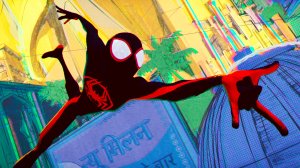
However, the movie has an engrossing story to better position all those eye-popping visuals. The worry with any modern multiverse story is that the unlimited possibilities of variations and opportunities for characters to do just about anything will overwhelm a narrative, or like The Flash, become a checklist of overburdened and empty fan service. The screenplay by Phil Lord, Christopher Miller, and Dave Callaham is all about relationships. If Miles’ relationship with his stern police lieutenant father (voiced by Brian Tyree Henry) wasn’t such an important focal point, then the emotional stakes of the movie would be meaningless. We see a relatable struggle from both sides, the parents trying to connect with their growing child and give him enough space to find himself, and the child who clearly loves his parents but doesn’t fully appreciate or understand their concerns. They worry about Miles leaving them and whether others will love and support him like his parents. Miles has to experience a wider world of possibility, but these experiences make him appreciate what he has at home, and what could be permanently lost. I don’t mind saying there were more than a few moments that caused me to tear up. I found Gwen’s storyline equally compelling, and her turmoil over keeping her secret identity and then coming out to her father was rather moving. The family bond resurfacing will get me every time, and the simple action of a hug can be as heartwarming and fulfilling as any romantic ode. Across the Spider-Verse makes sure we care about the characters and their personal journeys.
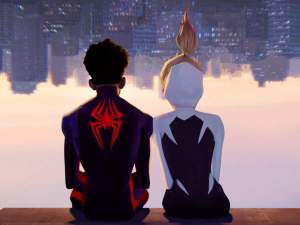
At a towering 140 minutes, this is the longest (American) animated movie ever, and it’s still only one half of a larger story. I knew ahead of time this was only the first part so as soon as we entered Act Three I kept gearing up for the cliffhanger ending. Every five or so minutes I thought, “Okay, this is going to be the end,” and then it kept going, and I was relieved. Not just because I got to spend more time in this unique universe but each new moment added even more to raise the stakes, twist the intrigue, and make me excited for what could happen next. I was shaking in my seat at different points, from the excitement of different sequences to the emotional catharsis of other moments. I cannot wait to experience this same feeling when the story picks back up reportedly in March 2024, though I fear it will get delayed to late 2024.
Even with the unlimited possibility of jokes and silly mayhem, the filmmakers keenly understand that it doesn’t matter unless we care about the characters and their fates. I am shocked that a goofy character I thought was going to be a one-scene joke, The Spot (voiced by Jason Schwartzman), could end up becoming the ultimate destroyer of worlds. I think this reflection nicely summarizes the impeccable artistry of Across the Spider-Verse, where even the moments or characters misjudged as fleeting or inconsequential can be of great power. It’s a movie that is full of surprises and thrills and laughs, all in equal measure, and a blessed experience for a movie fan. In the crush of comic book multiverse madness, Across the Spider-Verse is a refreshing and rejuvenating creative enterprise, one that builds off the formidable talent of its predecessor and carries it even further into artistic excellence that reminds us how transporting movies can be. If you see one superhero multiverse movie this summer, the choice should be as obvious as an inter-dimensional spider bite.
Nate’s Grades:
The Flash: C
Across the Spider-Verse: A
Share this:

Alternate Opinion: Zack Snyder’s Justice League Guest Essay
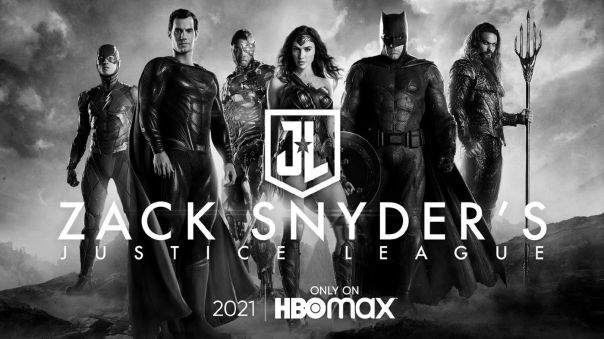
My friend and writing partner Ben Bailey asked me to host an extensive essay he was compelled to write after watching the four-hour Snyder cut of Justice League. I’ve never featured anyone else’s words or opinions on this review blog before, but it’s been so long since he really devoted himself to an artistic analysis, and with such detail, that I felt compelled to publish it on my personal review platform. Behold, a guest essay on the nature of Art, Ayn Rand’s Objectivist theory, super heroes and their appeal, Zack Snyder as a filmmaker and philosopher, and capitalism.
____________________________________________________________
“Zack Snyder’s Justice League and The Virtue of Shallowness: An Essay In Search of a Point” By Ben Bailey
All Art is self-indulgent, but not all self-indulgence is Art.
Back in 2010, legendary film critic Roger Ebert famously groused that video games could never be Art. His reasoning was largely an attempt to grasp at the essential definition of what Art is, and how it can and cannot be applied to various artistic mediums in order to claim supremacy for his preferred medium, cinema, over one he pompously scorned. At the time, as a 25-year-old man-baby gamer, I objected strenuously to his argument but not in a way that I could articulate with the same thoughtful presentation with which he made his case. I just instinctively rebelled against the notion that a thing I loved in the same way Ebert loved movies could not be Art like movies clearly are because smart people like Ebert said so. I was still struggling with what Ebert struggled with in his piece, as I hadn’t yet developed a working definition of what Art actually was. Unlike Ebert, who never settles on a definition and just decides to declare himself right, I have since found one that at least works for me, and now in the cold hard light of 2021, I’m forced to conclude that Ebert was sort of correct but not for the reason he thought he was. The vast majority of video games are not Art, just like the vast majority of movies, TV shows, and books are not Art, because Art is something special and pretty hard to achieve in a capitalist society designed to stifle creativity at the altar of marketability.
For me at least, Art has a practical and a poetic definition. The practical one can best be distilled as, “Deliberate creative expression done for its own sake.” Artistic Intent is everything. It has to be something done on purpose, not something retroactively defined as Art by someone experiencing it separate from the Artist. It has to be a creative expression, which is to say something done to reflect the internal life or point of view of the Artist as opposed to something a craftsmen might build to be functional but not intellectually or emotionally inspired (All Art is craft, but not all craft is Art). And most importantly, it has to be done for its own sake, free of any creative compromise. For something to be Art, the Artist has to do it because it is something they simply must do, because it is born inside of them and must be birthed through the process of creative expression so that it isn’t left stillborn inside their soul to rot and kill its host. If it is done for any other motive, for profit or to cater to the whims of a prospective audience, it ceases to be Art and becomes Commerce, a commodity that belongs to the world and no longer to the Artist.
 The poetic definition is a bit looser as you might expect: “Art is the process of making your dreams come true.” It is how we physically manifest our imagination into literal reality, recreating what is inside of us to bare our souls to the world, not because it matters what the world might think of them or who might want to buy or sell the product of their representation, but simply because the soul of an Artist burns bright and the fire has to go somewhere. Many things are mistaken for Art because they are created with the same tools through the same mediums. A really entertaining movie you love might seem like Art to you, but chances are, just given the realities of how movies are made in the studio system, it wasn’t created by an Artist or group of Artists collaborating to bring something beautiful into the world from their own minds. It may have started out that way, or that may have been the hope at the outset, but inevitably to get the thing made, money people began to influence what it should be, and test audiences and marketing algorithms ultimately dictated its form. A spatula might be used to make pancakes or spank your lover, but that doesn’t make your breakfast foreplay.
You might have noticed by now that my conception of Art is marked by an almost Platonic ideal of the Artist as Rugged Individualist, perhaps an expansive application of Auteur Theory that would mean almost nothing could be Art if it involves any kind of collaboration. That’s not entirely untrue, as I am trying to say that Art is a very rare and exclusive thing, at least when it comes to the kind of creative works we are typically exposed to in a society built on commercial industry. But to clarify, multiple Artists working together on a shared vision like a film or video game, while always more difficult to coalesce than one person articulating a singular vision like a painting or novel, can still be Art as long as the intent remains pure, or if the idea of purity sounds a bit fishy to you, at least free of external influences from non-Artists. Still, it’s just easier to conceptualize the Auteur as Artist for the purposes of discussing artistic intent, eschewing the messiness of multiple Artists trying to figure out the workable common denominator of their unique perspectives. If Art is a person making their dreams come true, the fact that it is their dream and no one else’s would seem to be the pertinent factor in assessing whether it is true to what it is. You might call it the Virtue of Selfishness. And that is where Zack Snyder comes in.
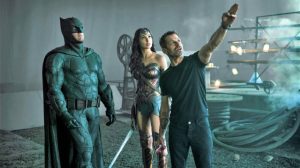
 At this point, I don’t think I need to provide too much on the history surrounding the supposed epic tragedy of behind-the-scenes studio machinations that was the 2017 Justice League film. Suffice it to say if you don’t know, the theatrically released version of the movie was a sort of Frankenstein’s monster of two competing visions, one the culmination of original director Zack Snyder’s bleak, realistic take on DC superheroes introduced in two previous films, and the other a studio-mandated effort to re-shape the project to dilute Snyder’s influence and better ape the success of the Marvel Cinematic Universe (MCU) through the inclusion of re-shoots, re-edits, and post production work provided by the MCU’s most notable director at the time, famed garbage person Joss Whedon. The result was widely regarded as mediocre at best, a mishmash of clashing ideas and tones representing diametrically opposing perspectives on what a superhero movie should be. It was assumed at the time that the relative critical and commercial failure of the film meant that it and the cinematic universe it spearheaded was, much like Snyder’s conception of the DC Universe, completely hopeless. And then some weird stuff happened.
A strange confluence of circumstances involving the changing nature of our engagement with modern media, the increasing ubiquity of streaming platforms challenging and possibly supplanting the theatrical model of film distribution, and also a freaking pandemic, led to Snyder getting an incredibly rare second bite at the apple in the form of the Snyder cut. A long fabled, often dismissed as mythical truer version of Snyder’s masterpiece, the Snyder cut had been cruelly torn from him and mutilated beyond recognition by shortsighted naysayers who just didn’t understand the deep and profound things the director of Sucker Punch was trying to say in the movie where Lex Luthor apparently pees in a jar to make a point to a senator before killing her. Or I don’t know, maybe he got his assistant to do it before sending her to die in the explosion he didn’t tell her about? Okay, that’s not the point, but Batman V. Superman is still really stupid. The point is, fans demanded it, and Warner Bros.’ long history of poor decision-making led them to provide a whopping 70 million dollars, roughly the budget of an entire year’s worth of quality Blumhouse movies, to complete a thing that was supposedly already basically done. And now it’s here.
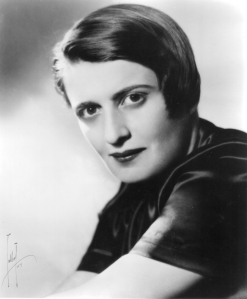
Author Ayn Rand
If you didn’t pick up on my reference earlier to the Virtue of Selfishness, consider yourself lucky to have never been exposed to any kind of deep dive into the nonsense of Objectivist “philosopher” Ayn (rhymes with “whine”) Rand. I use “philosopher” in quotes because Rand famously rejected all philosophers post-Aristotle other than herself, most likely because all of modern philosophy might as well be collected with the subtitle: “Why Ayn Rand Is An Idiot,” so her rejection of them was likely a preemptive strike done with the same degree of defensive self-awareness that led her to rail against government hand-outs her whole life only to accept Social Security and Medicare in her autumn years. The Virtue of Selfishness refers specifically to a collection of essays encapsulating Rand’s ethical vacuousness better than I could with any description, so I would say you should just read it, though you really shouldn’t. You could also check out her much more popular and well known novels, the CEO’s on strike fantasy Atlas Shrugged, or The Fountainhead, about a self-described brilliant artist who would rather see his greatest work destroyed than allow it to be altered by the people with the moral temerity to think they had the right to dictate what it should be just because they paid for it. Coincidentally, Zack Snyder has been trying to make that book into a film for years.
Snyder is, by his own admission, a devotee of Ayn Rand and a committed Objectivist, and despite my already established aversion to this worldview, I want to state clearly here that I don’t bring this up to say that Zack Snyder believes in something I find ridiculous and is therefore a ridiculous person. I might think that if I got to know him, but that isn’t the point I’m making here. I have no reason to think that Snyder isn’t a perfectly nice, intelligent person as an individual, at least by the standards that we might judge those things in the abstract. I don’t know the man personally, so I don’t know for a fact that his love of a philosopher who said we owe nothing to each other means he believes the same thing wholeheartedly, and I have no way of knowing how he might translate his conception of Objectivism into his daily interactions with other people. He may be a sweetheart or a total bastard for all I know. As a filmmaker, however, I feel like I can say with some degree of certainty that his Randian worldview is at the forefront of his creative vision. If his movies are any indication of his artistic intent (as one assumes they should be), the Artist’s fire that burns in his soul is one that seeks to burn down the liberal social order predicated on the notion that our success as a civilization requires that we care about each other.
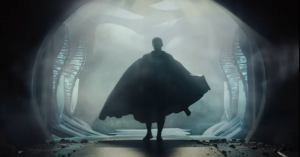 I would submit that the reason Zack Snyder’s approach to superhero movies feels so strange and off putting to so many people, whether or not they can articulate why, is because it lacks empathy. That isn’t to say that a movie or even a work of Art requires empathy, but its absence always feels wrong because art is the language of the soul, and having no interest in appealing to our shared humanity is the spiritual equivalent of gibberish. It feels especially wrong in superhero fiction because empathy is the basis for all superheroes on a fundamental conceptual level. The thing that makes them heroes is that they care about other people and, because of that, dedicate their lives to helping others. The people with similar powers who only use them for personal gain or to hurt other people, because they don’t believe we owe anything to one another, are the bad guys. So when Snyder, a filmmaker who views the world and the worlds he creates through the literal and figurative lens of Randian self-interest, tries to realize the characters of Superman, Batman, or Wonder Woman, it does not occur to him that anyone like them would ever sublimate their own selfish interests for the good of humanity. He has no frame of reference for altruism, so he can’t relate to characters designed to be the personification of it.
Snyder’s Superman spends almost the entirely of Man Of Steel rejecting the idea that he should use his amazing powers to help anyone, and only begrudgingly takes on the threat of General Zod when he is personally threatened and it is in his interest to fight, famously failing to even try to save Metropolis from the destruction wrought by his battle because civilian casualties were immaterial to him. In the sequel Batman vs Superman: Dawn Of Justice, the idea that all of this superheroic carnage has any real toll on real people that we should care about is addressed almost as a petty response to the backlash Man Of Steel faced for its callous depiction of the character, with Batman representing the side that at least cares enough to seek revenge, only to be revealed as short sighted in his zeal to defend humanity from this all-powerful alien god after a few common enemies and a coincidence involving their mothers’ names causes him to see the monster as a misunderstood hero. In between this convoluted arc, we have a montage of Superman saving lives that is one of the most morose series of images ever put to film, suggesting its the last thing he wants to spend his time doing. We see Wonder Woman coming out of hiding after decades of refusing to use her powers for the good of anyone, and we also find out that Batman, the billionaire who spent his life and vast wealth defending the innocent from evil, has since broken his oath never to kill and seemingly delights in sending criminals to prison branded with a symbol that almost assuredly marks them as targets for rape and murder.
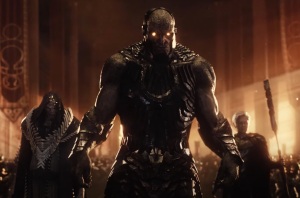 Back in 2019, Snyder directly addressed the criticism of his dark, “realistic” approach to superheroes, and specifically the idea that Batman would kill, by saying “It’s a cool point of view to be like, ‘My heroes are still innocent. My heroes didn’t fucking lie to America. My heroes didn’t embezzle money from their corporations. My heroes didn’t commit any atrocities.’ That’s cool. But you’re living in a fucking dream world.” And you know what, he’s absolutely right. It’s a dream world called comic books. You could say the same thing about something like Star Trek, the idea that we could all give up on greed and completely restructure society around the idea of helping each other is pretty naive and will probably never happen, but that’s not the point. The point is to imagine a world where it could happen, compare that imaginary world to our own, and think about what we might need to do to bridge the gap between them. Fantasies aren’t supposed to be realistic, they are supposed to be inspirational and aspirational. Most billionaires do probably embezzle money, and most people given the powers of a god would probably be corrupted by that power and commit atrocities. But what if they didn’t? What if those people were innocent do-gooders who helped other people instead? That would be super, and pretty heroic at that.
Of course, Snyder is in no way obligated to like or care about what superheroes are traditionally meant to represent in order to make movies about them, but it begs the question of why he would want to spend so much of his time and effort crafting an entire series of superhero movies if he doesn’t. A cynical approach to answering that question might start with the dumptruck of money Warner Bros presumably wheeled to his home, and might even posit a sort of trollish pleasure in taking down something he clearly detested through creative deconstruction a la Rian Johnson’s The Last Jedi. Or perhaps his motives were even more insidious. Perhaps he hates the very idea of altruistic superheroes and altruism in general so much that he dedicated an entire film franchise to subverting our love of superheroism so that we would lose hope in the empathetic message they are meant to inspire, and with nothing else left to cling to, fully embrace our Randian dark sides. For the record, I don’t think it’s any of those things, but any one of them would be more interesting that what I think the actually answer is, which gets me to my biggest problem with Snyder’s work overall, and especially his latest magnum opus, the Justice League Snyder cut.
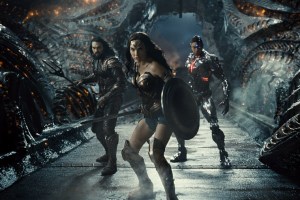 Every single movie Snyder has ever made has been at its core a parable extolling the virtue of selfishness, but none of them were intended to be that because they were never intended to be anything. If Snyder were a political or philosophical polemicist for Objectivism or any ideology, I would at least respect the intellectual exercise even if I couldn’t appreciate the end result, but that’s not what Snyder does. While his visual style is marked by hyper-realism, all slow-motion grandiosity, his storytelling is focused on reflecting the real world as he sees it, and his point of view just happens to be skewed the way it is. Remember, he doesn’t want to live in a dream world of his own making, he wants everything to be like the real world, which he just happens to see as one where nobody cares about or likes each other. Beyond that, there’s no inherent meaning in anything he does, which is insane considering how skilled he is at creating visuals meant to evoke the feeling of deeper meaning. When Aquaman stands on that pier with waves crashing over him and “There Is A King” playing in the background, it certainly feels like its saying something, but what? He’s sad? Angry? Symbolic of… anything? When Superman poses like Jesus, he’s clearly not meant to represent any form of Christ narrative I’ve ever read, but the image is iconic and memorable and just feels important somehow, and that’s all that matters.
Snyder’s shallowness is not in and of itself a problem, even if given his talents it represents a crushing waste of potential. The problem is that when your movie is four hours long and serves as a once-in-a-lifetime opportunity to rectify the injustice of studio meddling as a battle cry for every artist who ever had their work stolen from them, not having anything of importance to say and adding literally nothing of substance to the two-hour studio cut everyone hated is maybe the most disappointing thing you could have done. Obviously, the tragic circumstances surrounding his leaving the project in 2017 and the seemingly shady way Whedon was brought onto the project do not make Warner Bros look good, but if I’m supposed to believe this narrative that Snyder was betrayed and his dream project was bastardized by philistines, I shouldn’t be coming away from his original vision with so much more respect for the mediocre hatchet job. I know the prevailing critical consensus coming out of this is that whatever you may think of Snyder’s version, it’s at least better than the Joss Whedon version, but these people are just wrong.
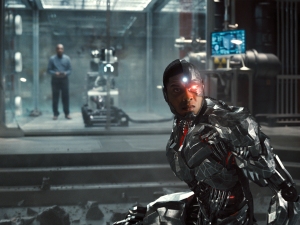 Comparing the two cuts is apples and oranges. One of them is a movie, created under the auspices of a studio director’s responsibilities to their contract, and the other is a vanity project with no such restrictions. Whedon completed a film that was palatable to a wide audience and within a reasonable running time to be shown in theaters, which is presumably what the studio thought Snyder was going to do too. If we are to believe that what we have now is Snyder’s true, uncompromised vision for it, then what was he going to do when they told him you can’t put a four-hour movie in theaters? What would he have cut to get it to two hours? If I had to guess, I’d say probably almost everything Whedon did, since the stories are so similar that its clear the content Snyder put back in was largely superfluous to the narrative. Most of what Whedon cut was unnecessary slow-mo, call backs to movies we wanted to forget, and setups for movies nobody wanted, and redundant moments already covered elsewhere. All the action scenes are present between the two cuts, except for the completely pointless Flash sequence, but in the Snyder cut they’re all twice as long. Same beats, same information conveyed to get the point across, just longer and less well paced than in the theatrical version.
Is Steppenwolf a more interesting villain now that we know he serves Darkseid because of some past mistake we don’t know about, rather than just assuming he does it because he’s from Darkseid’s totalitarian world where everyone serves him? Does Darksied’s comical incompetence as a despot make him a more enticing prospect for a sequel, somehow forgetting that the thing he devoted his life to searching for was on the one planet he failed to conquer, which just so happens to be the one planet where they left behind all those doomsday devices waiting centuries to be easily activated? We’re told it’s such a shame that we missed out on the great character of Cyborg, and now we finally get to see what could have been, but to quote the black clad Superman at the end of the Snyder cut, I’m not impressed. What more did we learn to deepen his story? Daddy never came to his football games but he still misses him when he’s dead? Riveting! Did we need a six-minute excursion into his mind palace with a voice over explaining all of his powers like we’re children when the original just demonstrated all of them by showing them to us? And what does it all amount to? In the end, he gets to ascend to his rightful place as the least interesting mopey superhero who hates being a superhero with all the other mopey self-hating superheroes. Hooray?
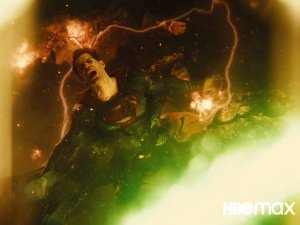 Naturally, you’re probably thinking, it wasn’t all just cuts, what about all that stuff Whedon added in? “What about brunch?” you say. Sure, I’m not going to defend everything Whedon did to make his version work. You’re mileage may vary; I would say about half of his new additions worked for me and half were cringe worthy, but the good half seems even more vital now than it did when we didn’t know the alternative. The brighter color palette alone is a welcome change from the dreary, washed out look of the Snyder cut, and for every bit where Flash wedges his face in Wonder Woman’s cleavage, we get one like Cyborg laughing about his injuries after stopping the mother box, the only moment in either version where he resembles the fun, lighthearted character from the comics and TV shows. The Flash never gets his hot dog-strewn first meeting with Iris West, but he gets a heart-to-heart with Batman about how being a real hero means saving people one at a time that speaks to the greatness of both characters in a way nothing in the Snyder cut does. When Superman smiles in Joss’ version, it’s because he’s saving lives and he’s happy when he gets to do that. When he smiles in the Snyder cut, it’s a menacing sneer because he’s about to lay the smack down on a weaker opponent to show him who’s boss. And then we get that delightful Russian family.
Yeah, I know, you hate the Russian family, and I get it. I hated the Russian family when I first saw the 2017 cut. Why would they waste time showing these characters who don’t seem to have any bearing on the story? The thing is, we only thought that because we were treating this superhero movie like a superhero movie, where we don’t necessarily need to be reminded that superheroes save lives as long as that’s a base-level assumption. But in Snyder’s world, it isn’t. In his cut, there’s no family to save because who cares about saving families? The stakes in the Whedon cut are clear and personal, real people will be hurt if they fail. We are them and they are us. It’s not subtle but neither is anything Snyder has ever done in his life. In the Snyder cut, we know that the Earth is doomed, but it’s all theoretical, our entire planet reduced to the same collateral damage that Metropolis became in Man Of Steel, where the people are there, we assume, but they don’t matter enough to be our focus. And in the end (of the Whedon cut anyway) the villain is defeated by his own fear, because the fear he represents cannot stand up against what the heroes represent in opposition to him: love, for each other and for the world they fight for. In the Snyder cut, they just savagely whale on him, stab him, and cut his head off with terrifying glee in their eyes, and then we cut to a flash-forward into a future world seemingly based on the Injustice video game series where we find out they failed to save the planet anyway.
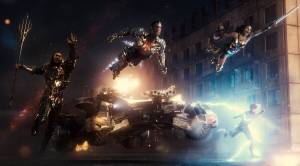 Again, I would like to stress that I am not making a one-to-one connection between filmmaking style and personal character. I’m not saying that Zack Snyder the person doesn’t care about people, and I know Joss Whedon doesn’t. I assume that before he shot those Russian family scenes, he made sure to make some of his female employees feel like dirt because making women cry is the only thing that gives Whedon an erection. But the real-life context matters. You might be asking why I keep bringing up the Ayn Rand stuff even though I don’t even think he’s intentionally injecting it into his movies. It’s because when I saw the original 2017 cut, I was disappointed but I didn’t hate it. When I saw this new cut, I was incensed, and I couldn’t quite figure out why until that side of it clicked for me. I went through something similar with Quentin Tarantino’s Once Upon a Time… In Hollywood. Everybody was loving it but I couldn’t explain quite why I didn’t until it dawned on me that it wasn’t anything about the filmmaking but the larger context, a director who made millions working with Harvey Weinstien, making a love letter to old Hollywood in the wake of the Me Too movement centered around the exploitation of an actress and making the story about two clueless men. It just felt wrong, and I’m finally to the same point with Snyder’s movies.
The 2017 cut of Justice League came out shortly after the election of our fascist, white supremacist, and eventually traitorous former president Donald Trump, a man so comically evil that he literally served as one of the inspirations for Lex Luthor when he was transformed from a mad scientist into an 80’s-style corporate tyrant. His rise to power, or rather the lie he tells people about being a self-made man and not a trustfund baby, is basically a Randian Horatio Alger story, and not just because both men were fabulists rumored to be pedophiles. You might even call him a Randian Superman, and the line from Randian Self-Interest to CEO worshiping Social Darwinism to Trumpian fascist strongman politics is undeniable. This new Justice League, where Zack Snyder tries to turn all my favorites superheroes into fascist action figures, comes out only a few months after a bunch of traitorous right-wing scumbags tried to raid our nation’s Capitol to usurp our democracy at the whims of a would-be king. One technically doesn’t have anything to do with the other, but the images are iconic and the connection just feels like there’s something meaningful there, even if it’s unintentional. I just can’t treat Snyder’s bad politics as just some interesting facet of his directing style anymore. I don’t want it in my polity, I don’t want it in my entertainment, and I sure as hell don’t want it in my superheroes.
So what was the point of any of this? Why start with that long boring excursion into the definition of Art? And what’s more, if Art is the one place where the Virtue of Selfishness makes sense, where does any audience or any would-be critic like myself have any place to question an Artist like Zack Snyder? Why write 20-plus long paragraphs, the Snyder cut of Snyder cut hot take think pieces, if an Artist should never care about what anyone thinks of what they create? That’s where I’ve been the last few days. As you might guess, I find the whole notion of Art criticism to be utterly worthless and without merit. The entitlement that audiences have surrounding the Art they consume is equally abhorrent to me, as if what they think of something should have any bearing on the form it should take. So where does that leave me? Feeling like a hypocritical piece of garbage.
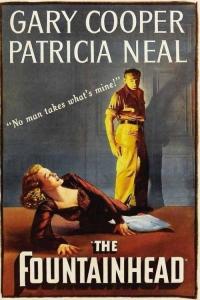 I keep coming back to The Fountainhead (as a metaphor, not the actual book, because I read it once in college and that was enough). The protagonist Roark was hired to design a building and insisted he could blow the thing up if they didn’t let him build it the way he wanted, and when he does, he goes to trial, and makes a passionate plea in defense of his own rights over his creation that wins over all the doubters who couldn’t force him to conform to tradition. I keep wanting to force this narrative where Snyder is Roark and the saga of the Snyder cut is his quest to finally build that eyesore upon the skyline the way he always wanted, but it just doesn’t work for me. Art is deliberate creative expression for its own sake. The Snyder cut is certainly deliberate, and while it was made at the behest of the studio for a profit and an audience, I’m even willing to give Snyder the benefit of the doubt that he didn’t care about either of those things and really did set out to make it for its own sake. But then there’s that middle part, creative expression, something that reflects the internal life or point of the view of the artist. What if there’s nothing interesting about the internal life to reflect, and any apparent point of view is accidental and despicable at that? Is Zack Snyder the architect Frank Gehry, building beautiful sculptures people just happen to live and work in, or is that just who he thinks he is and who we want him to be, and really he’s just a very skilled craftsmen with nothing to say? How boring and uninspired can a work of Art get before it ceases to be Art at all from the sheer weight of its pointlessness?
Roger Ebert tried to say that video games could not be Art, but really he just didn’t understand them or like them, and for years, similar charges have been leveled at comic books and comic book movies. Whatever I might feel about Snyder or his work, he has been instrumental in lending a degree of legitimacy to comic book storytelling in the minds of a lot of people who otherwise dismissed it. Maybe not as much as the MCU has, but he’s still a part of it, and as a lifelong comic book fan, I can’t ignore that. I feel like I should be right there with everyone else, if not loving the Snyder cut, then at least loving what it represents, that for once the little guy won over the big guy, even if the little guy is usually on the side of the big guy unless he’s the one getting screwed, and he didn’t really win so much as reveal his limitations and give me a reason to say “I have more respect for Joss Whedon as an artist” which is something I never wanted to say again. But I’m not there, and I don’t think that’s what this represents, and really, I just wish that someone else, or really anyone else could have gotten the opportunity that Snyder did. Maybe this release makes that more likely in the future, but I don’t have much hope for that. I don’t have much hope for anything left in me anymore because I just watched a four-hour Zack Snyder movie and I’m pretty sure our future is going to be a Randian dystopian Knightmare. Release the David Ayer cut! Release the Gareth Edwards cut! Release the Lord and Miller cut! Release the Michael Cimino cut! Release all the cuts!
Just try to keep them under two hours, please.
Share this:

Zack Snyder’s Justice League (2021)
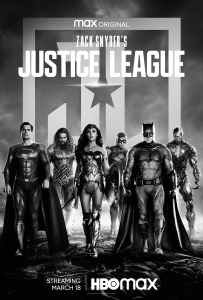
Zack Snyder had a unique situation that many filmmakers would never get close to fulfilling. He departed the 2017 Justice League movie in the wake of a family tragedy, Joss Whedon was hired to direct and rewrite extensive reshoots that totaled an estimated additional $30 million dollars, and the world was given the strange amalgamation of two different filmmakers, along with the nightmare-inducing CGI baby lip to replace actor Henry Cavill’s mustache. The 2017 theatrical release of Justice League was meant to be a significant milestone for the DCU, launching an all-star assembly of superheroes and setting up future solo adventures and franchises. It was meant to be a major kickoff and it was simply a major shrug. The general public was indifferent to the 2017 League, and it seems like the DC brass is positioning for a cinematic universe do-over, retaining the elements they liked (Jason Momoa, Gal Gadot) and jettisoning the other pieces to start anew. In the ensuing years, fans have been petitioning for the fabled “Snyder Cut,” a theoretical version of Justice League that was closer to Snyder’s original artistic vision before the studio intervention and interloping of Whedon. It became a joke on social media and then one day it became real. Warner executives, seeing opportunity with the rabid fanbase, decided to give Snyder an additional $70 million to finish his version of Justice League. It would be an exclusive to their new streaming platform, HBO MAX, and Snyder could complete his version without artistic compromise. The resulting four-hour version, titled Zack Snyder’s Justice League, is less a movie than a mini-series, and a rare chance for a director to complete the story they wanted to tell without artistic compromise. After having watched the full four hours, along with re-watching the 2017 version again for comparison, The Snyder Cut just feels like the original version only longer. I would actually advise people that if they haven’t watched either Justice League to simply catch the 2017 version. At least its mediocrity is half your time investment.
Once again, months (?) after the death of Superman (Cavill), Bruce Wayne (Ben Affleck) is traveling the world and recruiting a very specific group of job candidates. He needs serious help to combat an oncoming alien adversary, Steppenwolf (voiced by Cirian Hinds). The cosmic Big Bad is looking for three special boxes, a.k.a. mother boxes, to destroy the world and make way for his master, Darkseid. Wonder Woman (Gal Gadot) helps Batman convince the half-man/half-machine hybrid Cyborg (Ray Fisher), underwater dweller Aquaman (Jason Momoa), and hyperactive speedster Flash (Ezra Miller) to form a league of sorts to thwart Steppenwolf.
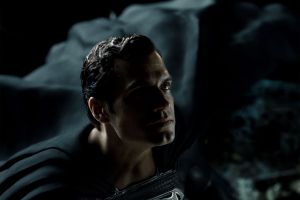
I think it’s unfair to judge the 2017 film to the Snyder Cut as a movie simply because this version never would have been released in theaters. No studio would have released a four-hour version. The two edicts that Whedon was given by the studio when coming aboard the project was that it could not be over two hours and to lighten it up. Imagine what the 2021 Snyder Cut would look like if Snyder was then tasked to cut it down to a more manageable two-hour running length. I predict many of the same scenes being eliminated or dramatically trimmed down. That’s the main takeaway from the Snyder Cut, that there is more room for everything, and quite often too much room. I swear a full hour of this movie might be ponderous slow-motion sequences. Plot-wise, Zack Snyder’s Justice League is pretty close to what was released in theaters in 2017. The action sequences are extended longer (Steppenwolf’s attack on the Amazons has increased from six minutes to a whopping twelve minutes) but I don’t know if they’re dramatically improved. Instead of two punches there’s four; instead of one chase, there’s two. It’s that kind of stuff, filling out the sequences but not really elaborating on them in an exciting fashion that reorients the moment. I liked some additions, like the inclusion of blood during the underwater Atlantis fight because it added a neat visual flair, but the added action is often obscured by visual decisions that dis-empower the experience (more on that later). I found myself growing restless with the movie. All that added time allows some sequences and plot beats to breathe better, but it also allows Snyder to meander to his greater indulgence (more on that later as well, notably on the multiple epilogues). The four hours feel like Snyder’s kitchen sink approach, and with the benefit of years of hindsight from the critical and fan reception of the 2017 version, he’s able to spend tens of millions to correct mistakes and improve a flawed film.
I hate how this movie looks for multiple reasons. The most obvious difference is that the aspect ratio has been altered to a 4:3 ratio more reminiscent of pre-widescreen television. Why is this the case? Snyder has said he cropped his movie to this boxy format so that it could be played on IMAX screens. That’s fine, but why crop your movie now months if not possible years before it will ever play on IMAX screens? When it comes time to adjust for the IMAX screen, adjust then. Why must every viewer see this limited version now on their widescreen televisions at home? It’s just so bizarre to me. It would be like if Quentin Tarantino reasoned that his movies will eventually play on airplanes, so he better get ready and cut back his widescreen into a flat, pan-and-scan mode, and he might as well include alternate takes and scenes to cover for those that would be deemed too profane or intense for the all-ages captive audience of an airplane, and then that version was the one he released to all audiences and we were stuck with it. Snyder had millions of dollars to reshoot his epic and he lopped off the edges, meaning you’re getting more movie but also less (at least the footage predating the new reshoots) in every second because of the framing. The grandeur of the superhero saga is also extremely hampered by the drab color palette. Snyder has always preferred muted colors to his movies but his Justice League drains all life and vibrancy. Everything is literal shades of grey. Color is not allowed to exist in this universe. A sunset is almost comical. Apparently, there’s going to be an official black-and-white version but we’re already practically there. Some could argue the oppressive grey is meant to evoke the grief and heaviness of the picture, and I’ll give you some leeway with that, but the drab colors also nullify the visuals. It’s simply harder to see everything that’s happening even during the daytime, and then you tack on the ugly CGI that makes everything look like a fuzzy video game. For a movie that has cost potentially over $350 million dollars combined, Justice League looks so phony. Maybe that’s part of Snyder’s overall stylized look, he’s never really been one to visually ground his operatic action spectacles, but I feel like the aspect ratio and color palate just make it worse. For those four hours, this is often a very visually unappealing movie to watch.
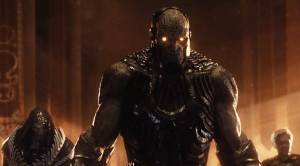
With the added time, there are definite benefits and characters that are lifted by the extra attention. Chief among them is Cyborg, a character that felt like a Swiss army knife in the original who was just there to perform whatever techno jazz the movie required at a moment’s notice. With the Snyder Cut, the character becomes more engaging and given a fuller arc relating to the relationship between father and son. The father’s placement in the story actually matters and Cyborg has more of a personal journey coming to terms with his new abilities. There is a back-story with his frayed relationship with his father, his accident that caused him to become the creature he is, and a reoccurring theme of a son blaming his father and the father trying to reconnect with the son he refused to part with. I still think Cyborg ranks low on the list of superheroes, but the additional scenes give the character more weight, more tragedy, and more intrigue. Another added benefit is that Steppenwolf’s motivation is improved as well as his look. He’s now outfitted with a herring-bone armor that twitches over his body. It’s a more intimidating look than what he had going on in 2017. I also appreciated that he now has more motivation other than “conquer the universe” because now it’s “conquer the universe to get back in the good graces of the boss.” Steppenwolf is trying to repay a debt and make amends, and that makes him slightly more interesting than his generic motivation in the original theatrical cut.
However, not all the new editions are as smooth or as helpful. The added time with the rest of the Justice League doesn’t seem to have added anything to their characters. Each one’s arc is more or less the same from the 2017 version, except now we have even more scenes of Wonder Woman wondering whether she needs to get off the sidelines and be more involved (the events of WW84 conflict with this timeline) and Aquaman rejecting his call to adventure from the Atlanians. Neither is a richer portrayal and the scenes are redundant. Take Wonder Woman finding out about Steppenwolf’s attack. In the 2017 version, her mother lights an arrow and it sails into Greek ruins, signaling her daughter, who knows what this means. In the Snyder cut, the arrow still lights the Greek ruins, but now Wonder Woman visits the ruins, she gathers a stick, she wraps a cloth around it, she dips it in kerosene, she lights it on fire, she enters a secret room because of the arrow, she jumps down a cliff, she finds a hidden temple with hieroglyphics warning about Steppenwolf and the mother boxes and Darkseid. Even if you really wanted the end where she sees those hieroglyphic warnings, why did we need these many steps to get there? The opening hostage/bank heist scene is given far more attention, with multiple scenes of hostages being terrorized, and then Wonder Woman literally vaporizes the chief terrorist. A little girl looks at her, likely traumatized for life by the whole experience, and says wistfully, “I want to be like you when I grow up.” She wants to be a murderer? In Snyder’s universe, Superman kills people, Batman kills people, so why not Wonder Woman too?
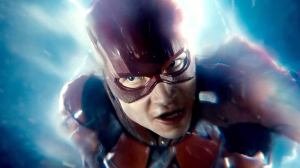
The revised introduction of Barry Allen is also regrettable. He’s applying for a dog walking job and a car accident occurs and he saves the day, but not before slowing down time in a frustrating manner. This is because he seems to be dawdling while the rest of the world is frozen, which makes the event seem less special. His movements seem less urgent than Quicksilver in the X-Men films when he would perform the same memorable slow-mo set pieces. I disliked that the Flash’s big involvement in the final showdown was literally running around in a circle, a repeat of what he had done prior. Also making the slow-mo save introduction less special is the fact that the Flash picks up a hotdog floating in midair for silly reasons. It’s drawn out with interminable slow-motion and the song choice is baffling, a common theme throughout Snyder’s movies. I think he’s been smarting ever since he painfully paired Leonard Cohen’s “Hallelujah” with a sex scene in 2009’s Watchmen, and now we must al endure similar awkward auditory pairings. Every song inclusion just feels wrong here. As Aquaman is drinking and walking along a pier, in slow motion, we hear “There is a Kingdom” by Nick Cave, and it just doesn’t pair right, especially in contrast with the hard-rocking guitar riffs from The White Stripes in the 2017 version. For good measure, Snyder even includes another “Hallelujah” cover by the end for good measure, as if he’s still fighting this same battle over musical taste.
And then there’s the barrage of epilogues, each the start of a story never to be continued, and it approaches the realm of self-parody (spoilers to follow). We get three endings, the first an extension of the post-credit scene from the 2017 version where Lex Luthor (Jessie Eisenberg) suggests the formation of a Legion of Doom for villains. He even shares with Deathstroke (Joe Manganiello) that Bruce Wayne is Batman. Well, that could be an interesting next step, but we know it’s not to be so it becomes just a teasing preview. The next ending cuts forward in time to the dusty, apocalyptic vision that Batman had in Batman vs. Superman, and he’s got a crew including an older Flash, Meera (Amber Heard, why does she have a British accent now?), and even Jared Leto’s Joker. They’re facing off against a villainous Superman who has been driven mad by the death of Lois Lane (Amy Adams), which is pretty much the plot of the Injustice games. The Joker is antagonizing Batman with some references to killing someone close to the Dark Knight, and this whole sequence amounts to Snyder basically saying, “Hey, here’s where I wanted to go with things but you’ll never see it.” Then there’s a third ending, because the second is revealed to be another dream/vision for Batman, where he meets Martian Manhunter, a character that, other than diehard comic aficionados, no one cares about and has been given any reason to care about. The guy just introduces himself and Batman is like, “Oh, cool,” and that’s the ending Snyder decides to close his four hours with. There is a literal half-hour of epilogues and false endings to finish with and I was exhausted. I owe Peter Jackson an apology.
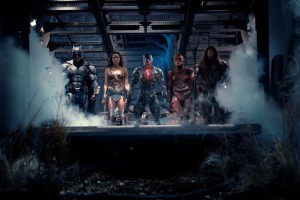
In my original review of the 2017 Justice League, I wrote, “I think I might have actually preferred Joss Whedon not being involved and simply releasing the full Zack Snyder cut. It would have been stylistically more coherent. Much of the Whedon reshoots do not feel like they are for the better. To be fair, he came in late and this franchise behemoth had already gone too far to fully alter its fate. There are small moments that work but the big moments are what fail. This movie is missing setups, payoffs, and character arcs. It’s missing pathos and emotion. It’s missing memorable action sequences that are exciting and varied. It’s missing basic internal logic. It’s missing a greater relevance.” Some of those issues are resolved with the four-hour Snyder cut and too many others still remain. At the end of the day, this is still just a longer, bloodier version of a mediocre superhero movie, except now we get stuff like Batman saying the F-word, so I guess that’s cool. I have more of an artistic appreciation for what Whedon had to pull off to even wrangle this beast into two hours. I’m happy Snyder was able to fulfill his complete vision and that HBO MAX offered a platform that would provide such a rare opportunity of expensive art unencumbered by studio meddling. I can’t say it’s worth your four hours, nor can I say it’s dramatically better than the 2017 version because whatever benefits it offers are weighed down by the extraneous, the redundancies, and the length. As it stands, I feel I have no choice but to grade Zack Snyder’s Justice League the same as the 2017 Justice League.
Nate’s Grade: C
Share this:

The Lego Movie 2: The Second Part (2019)
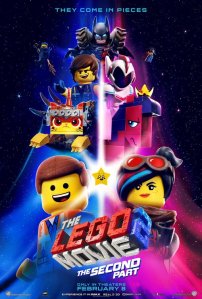 Everything might not be awesome but it’s still pretty great for this creative, heartfelt, and hyperactive family franchise that is better than it has any right to be thanks in part to returning writers Phil Lord and Chris Miller. It’s not quite as fresh and clever as the first go-round but it manages to better its predecessor in some key ways. Now that we know the colorful and zany antics of the animated Lego characters are also simultaneously the imaginative play of a real-world family, it provides a deeper thematic subtext with the unseen nature of siblings in conflict. I remember my own younger sister wanting to play with me and my toys, and me rebuffing her, and the film struck home some key emotional points about the inclusion of cooperative play. The different styles of play are on display as our characters are abducted by a shape-shifting space queen (voiced by Tiffany Haddish) who is determined to marry Batman and possibly rule the universe. A fantastic running joke is how transparently malevolent the queen is, which leads to an even better payoff. There are more songs and each is pretty well constructed, relevant to the story, and assuredly catchy, like “Catchy Song” used to brainwash people through pop, and a mournful version of “Everything’s Not Awesome” that becomes genuinely inspirational and uplifting by its climax. The life lessons are easily digestible and the sense of breezy fun is still alive and well. I was laughing throughout, sometimes quite hard, and the brother/sister subtext had me wondering if I owed my younger sister a decades-late apology for my behavior (sorry, Natalie). Lego Movie 2 is a worthy sequel that finds new and interesting ways to build off the irreverent original’s model. Bring on the Toy Story 3-style ending where our grown-up owner says goodbye to his childhood toys and friends. At this point, Lord and Miller can do anything and imbue it with wild wit, whimsy, and unparalleled mass entertainment (except Star Wars, I suppose).
Nate’s Grade: B+
Share this:

Justice League (2017)
 The story behind the Justice League movie is one of turmoil and turnover. Zack Snyder has been the cinematic voice for the DC film universe (DCU) and, if you listen to enough critics and fans, the weight holding down the franchise. Justice League began filming in the spring of 2016, which means they had a considerable lead time before release. Either they went into production with a script they were unhappy with or they learned it. A year later, in the spring of 2017, Snyder bowed out of his directorial duties to spend more time with his family in the aftermath of his daughter’s suicide. Enter Joss Whedon, the wunderkind behind Marvel’s record-breaking Avengers. The studio was unhappy with Snyder’s rough-cut, deeming the footage “useable,” and tapped Whedon to make drastic reshoots. He rewrote the film enough to earn a writing credit from the WGA. Complicating the already pricey reshoots was star Henry Cavill’s mustache, a holdover from the filming of Mission: Impossible 6. He wasn’t permitted to shave his ‘stach, and so Warner Bros. was forced to pay likely millions… to digitally erase Cavill’s facial hair (DCU is 0-2 when it comes to mustaches this year). The final product is being met with great fanfare, hope, and curiosity. If anybody could save this project it’s Whedon, right? Well Justice League could have been renamed Super Hero Fatigue: The Movie.
Months (?) after the death of Superman (Cavill), Bruce Wayne (Ben Affleck) is traveling the world and recruiting a very specific group of job candidates. He needs serious help to combat an oncoming alien adversary, Steppenwolf (voiced by Cirian Hinds). The cosmic Big Bad is looking for three special boxes, a.k.a. mother boxes, to destroy the world. Wonder Woman (Gal Gadot) helps Batman convince the half-man/half-machine hybrid Cyborg (Ray Fisher), underwater dweller Aquaman (Jason Momoa), and hyperactive speedster Flash (Ezra Miller) to form a league of sorts to thwart Steppenwolf.
 Aggressively bland, lazy, and unmemorable, I was genuinely left questioning whether Justice League was somehow worse because it wasn’t worse. It’s not the aggravating stew that was Batman vs. Superman or Suicide Squad, but those weren’t exactly difficult hurdles to clear. To put it in another colorful analogy: while it may not be a flaming dumpster fire, it’s just a dumpster, something you wouldn’t give any mind to because, hey, it’s just a normal dumpster, and why would you even want to spend time looking at that anyway? That’s Justice League for you, a DCU super hero film that’s better by default and still disappointing to the point that you wish it would be mercy killed to spare us a prolonged death rattle. This movie is ground down to the raw pulp of a super hero movie. It lacks personality. Stop me if you’ve heard this one before from a modern super hero film. An ensemble of poorly developed characters must band together to stop a dumb villain from world annihilation with a giant energy portal in the sky. There have been now five DCU films in this sputtering cinematic universe and three movies fit that formulaic description. Even the 2015 Fantastic Four remake followed this. The draw of this film is its mythical heroes, yet they are so lazily developed that we rarely feel any sense of awe or reverence with them. The cast chemistry is relatively strong and the actors have been well chosen, but let’s go person-by-person in this league to determine just how poorly the story serves them.
Batman has become the Nick Fury of this new post-Superman world, taking charge assembling a team to combat a more dire, powerful alien threat. He’s the least super in many regards and has fleeting moments contemplating his mortality, but just when you think they might give the older Batman some depth, they pull back. His biggest relationship is with Wonder Woman and their central conflict feels contrived. He’s angry at her for not getting more involved (hey, Wonder Woman, you got out there for WWI but sat out the Holocaust?). It feels like a strange managerial tiff. Affleck (Live by Night) seems to have gotten more growly and smug. Gadot (Keeping Up with the Joneses) scowls and scoffs. Considering they’ve each lead a DCU movie, we should be more attached to them in this story. He’s not fun to be around and neither is she. The new members have some degree of promise.
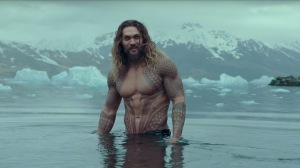 Aquaman is a gruff, shaggy, tattooed loner embodied by Jason Momoa, and his performance works better than the character does. Momoa (Game of Thrones) is charismatic as a wild man but he comes across as a fraternity jock. His cocky, carefree persona and aesthetic are trying too hard to re-imagine Aquaman as a sexy superhero for today. The underwater action scene in Atlantis is so cumbersomely filmed and staged that I think I realized, in that moment, how visually dreary underwater fight scenes are. There goes any last shred of interest in the solo Aquaman film coming in 2018. Cyborg is basically a modern Frankenstein story and should have had affecting characterization about the battle over reclaiming his humanity. Instead he becomes the plot equivalent of a Swiss army knife, able to open any locked device or technological obstacle.
The Flash/Barry Allen is the best part of the film by default (a familiar term in this review). Miller’s (Perks of Being a Wallflower) extra jubilant performance feels like a course correction from the criticism of how unflinchingly gloomy BvS was. He’s the stars-in-his-eyes rookie who is also a fanboy first, geeking out about getting to work with legends. It’s not just that the fanboy-as-hero angle was already tackled better by Marvel in Tom Holland’s newest edition of Spider-Man, it’s also that the film doesn’t know when to stop. Barry Allen has to quip for every occasion. While some belie his insecurity and nervousness about being promoted to the front lines of hero work, several are forced. The coolest thing he can do is run so fast time slows down, yet we’ve already seen this displayed better and with more witty panache in the recent X-Men films with Quicksilver. Flash is the only character with anything resembling an arc, and this amounts to little more than not being as terrible at fighting and getting a job. He makes his dad proud… by getting a job, and this is sadly the best example of a character arc in Justice League.
Another course correction was ditching overly complicated plotting for simplification, which can be a virtue. With Justice League, simplicity gives way to a dispirited lack of ambition and effort. The plot is thusly: Batman has to recruit a team to stop a Big Bad from getting three boxes buried around the world. Perhaps some will characterize this as a facetious oversimplification, but that’s really all that’s going on for two hours. The only other significant plot turn is the resurrection of Superman. The concluding image of BvS was the dirt hovering over Clark Kent’s casket, heavily implying he was coming back, so this really shouldn’t be a spoiler. The heroes suddenly decide the mother boxes can bring Superman back, and they know how to do it, and then just do it, without any setup. If it had been Cyborg who came up with this plan since he shares the alien technology that could have made some degree of sense. No, it’s Bruce Wayne who comes up with this idea, a man with no experience with alien technology. The heroes use one of the magic mother boxes to bring Superman back from the dead and then, inexplicably, leave it behind for our villain to capture. Literally the characters look over their shoulders and, whoops, a giant energy vortex has sucked up the final item needed to destroy the world. Maybe one of you should have had somebody watching that important thing.
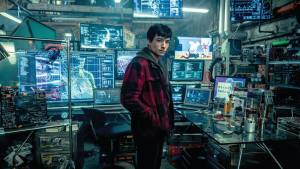 There are other moments that speak to the troubles of simplicity leading to laziness. The opening sequence with Wonder Woman involves a group of criminals taking hostages in a bank. Oh, these are sophisticated bank robbers you might guess. No, these are, in their own outlandish words, “reactionary terrorists,” and they’re here to set off a bomb. Why did you have to enter the bank, let alone take hostages, and call attention to yourselves then? Would a bevy of car bombs not get the job done? These guys are on screen just to be dispatched by Wonder Woman, but at least put some effort into them. Here’s another example of the effects of oversimplification. Steppenwolf’s base of operations is an Eastern European/Russian bloc city in the wake of an abandoned nuclear facility. We see one desperate family fret over the flying Steppenwolf hench-demons and barricade themselves in their home. We then keep cutting back to them again and again. Will they have a greater importance? Is the final mother box to be found underneath their home? No, they are merely an on-the-ground a perspective and offer no insights, complications, or interest. We just keep checking in with them as if they are the most irrelevant war correspondent. When the climactic battle ensues, they’re the sole lives we see in danger from the epic fighting.
The villain is also a severe liability, as Steppenwolf feels plucked from a mid 2000s video game. He feels like a mini-boss from a God of War game. Not a boss battle, a mini-boss. His entire character design is ugly and resembls a goat. He may be twelve feet tall or whatever he is but he is completely unremarkable and nonthreatening. He wants to bring about the end of the world by collecting his three world-destroying MacGuffins and making them cross the streams. His back-story happens midway through the film and is shockingly a rip-off of the Cate Blanchett-narrated prologue from The Lord of the Rings. All the races of the world and beyond teamed up against this dumb dude and then they took possession of his source of power, the three boxes to rule them all, and divided them up among the different races for safety. They’re even dressed like Middle Earth fantasy characters. They foolishly split up the boxes in a way that the bad guy would know exactly where they are if he ever came back. This lame villain is also hampered with a lame back-story. I don’t understand what about this character makes him invincible in the first half and what changes to make him beatable in the second half. His powers and potential weaknesses are ill defined and you too will struggle to work up any interest for what may be one of the most boring and useless villains in super hero film history. According to my pal Ben Bailey, Steppenwolf makes Malakeith (Christopher Eccleston) of Thor 2 look like Loki (Tom Hiddelston) in Thor 2.
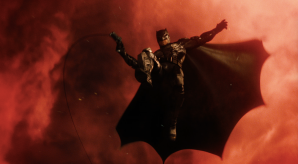 Justice League feels like two movies indelicately grafted together, and if you have a trained eye for cinematography you’ll easily be able to spot the difference between the Snyder parts and the Whedon parts (final product looks 70 percent Snyder, 30 percent Whedon). Snyder is much more the visual stylist so his camera arrangements are far more dynamic, and his cinematography also makes more use of space within the frame, especially from the foreground and background. His scenes also have a more crisp, filmic look. By contrast, the Whedon scenes feel overly clumsy and with too much strained humor. The Whedon humor holds on a beat longer, as if it’s waiting for a canned laughter response to clear. Lois Lane (Amy Adams) remarks about how Superman smells, Martha Kent (Diane Lane) drops a malapropism about her son calling Lois the “thirstiest reporter,” Barry Allen’s inability to grasp what is brunch, which is the only thing shoehorned into the middle of Snyder footage. Then the brunch joke is brought up again in the first post-credit scene, which had me convinced that Whedon was going to produce some sort of meta moment with the Justice League final post-credit scene mirroring The Avengers, with the team out enjoying a casual meal together. Not only do I think I enjoyed the Snyder parts better but I think I also enjoyed the humor of the Snyder parts better.
The color correction is also completely different. Check out the Justice League trailers and you’ll see two different climaxes, one before Whedon that takes place in Snyder’s typical landscape of diluted grays and blues, and another after Whedon that looks to be set on Mars. An unintended consequence of altering the color correction so decisively is that the costumes suffer. These outfits were clearly designed for the landscape of colors for Snyder’s darker vision. Whedon’s brightening up makes the costumes look like discount cosplay. It’s not that the Snyder parts are that much better, it’s that the Whedon parts aren’t that great.
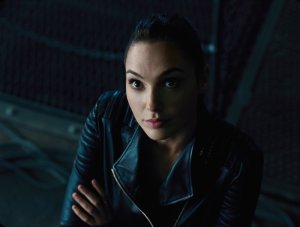 The action sequences are just as unmemorable as the rest of the movie. Action sequences need variation, they need mini-goals, and they need multiple points of action. There’s a reason many film climaxes involve different pairs or groups fighting different villains. It keeps the action fresh, involves all of the characters in meaningful ways, and provides more payoffs. The action becomes more dynamic and complex and simply entertaining. The action in Justice League is thoroughly underwhelming. With the exception of Cyborg being a hacker plot device, none of the characters use their powers in integral ways. All they do is punch and jump. When that happens the heroes are too interchangeable. They also don’t seem to do anything different in the third act nor does the climax require them to do anything different, so their victory as a team feels perfunctory and arbitrary. The special effects feel unfinished and unpolished for a $300 million movie. A sequence set on Wonder Woman’s home island looks like it was taken from a cheesy Dynasty Warriors video game. A montage during the conclusion has shockingly bad CGI of the Flash running in a goofy, gangly, leg-failing way that made me doubt Whedon’s eyesight. The most hilarious special effect, possibly of all time, is the fake Superman upper lip. It kept me analyzing every Cavill mouth I saw. His upper lip looked too waxy with shine and indented too widely. We are not there yet my friends for realistic mustache removal technology. We’ll just have to go back to old-fashioned razors and rue this primitive existence of ours.
Batman vs. Superman and Suicide Squad have already conditioned audiences to expect the worst, and the fact that Justice League is better may make some mistakenly believe this is a good super hero adventure. It’s not. While not the spectacular failure of its predecessors, this is extraordinarily forgettable and thoroughly underwhelming from top to bottom. I think I might have actually preferred Joss Whedon not being involved and simply releasing the full Zack Snyder cut. It would have been stylistically more coherent. Much of the Whedon reshoots do not feel like they are for the better. To be fair, he came in late and this franchise behemoth had already gone too far to fully alter its fate. There are small moments that work but the big moments are what fail. This movie is missing setups, payoffs, and character arcs. It’s missing pathos and emotion. It’s missing memorable action sequences that are exciting and varied. It’s missing basic internal logic. It’s missing a greater relevance. The villain is just an obstacle to be overcome without any larger thematic relevance. I struggled to care about what was happening. Ultimately, the finished product feels like Zack Snyder’s garage sale (“Here’s all the stuff you’re used to and maybe you’re tired of but I’m not gonna put that much effort into this so maybe we can haggle”). And then Joss Whedon bought it all, repackaged it, and sold it back to you, America. As dreadful as the previous movies were they at least had moments that stood out, many of them for the wrong reasons, admittedly. Justice League isn’t as bad and yet is paradoxically less watchable.
Nate’s Grade: C
Share this:

The Lego Batman Movie (2017)
 The Lego Batman Movie intends to expand the world of a movie that was designed to sell toys and was far better than anyone ever imagined. It’s frenetic, silly, and paced at spoof level speed with genial gags flying fast every ten seconds or so. It’s also flat, and while intermittently amusing I only chuckled, at best, a handful of times. Will Arnett’s self-involved Batman was a fun side character in the original Lego Movie but there’s not exactly enough there for his own starring vehicle (Jack Sparrow Syndrome). He’s saddled with a weak plot about letting others get closer and not having to be a loner. Besides a brief comedy bit about a cataclysm, the movie could have just been a broad Batman movie. It doesn’t really utilize the landscape of a Lego universe in any way. While many of the jokes didn’t work for me, I knew another one was mere seconds later, so I shrugged off the misfires. The final act of the movie involves a separate league of villains, all conveniently connected to other Warner Brothers properties. Lego Batman wore me down after the opening sequence where Batman battles his entire rogues gallery. It was high-energy but its aim was just too low for my tastes, and the results made me appreciate even more the cleverness and plain comedic accomplishments of the original Lego movie. There aren’t any memorable moments or jokes and there’s far too much Batman rapping. It’s colorful, it’s wacky, it’s filled with fine vocal actors with very little to do other than Arnett and an amusingly awed Michael Cera as The Boy Wonder himself, adopted sidekick Robin. It’s an acceptable albeit numbing experience that I wanted to enjoy more. I don’t know if this is the start of Lego spin-off movies but if it is I hope others do better with their own building blocks.
Nate’s Grade: C+
Share this:

Batman vs. Superman: Dawn of Justice (2016)
 Batman and Superman have been a collision course for a while. The two most famous superheroes were once scheduled to combat in 2003. Then the budget got a tad too high for Warner Brothers’ liking and it was scrapped. Flash forward a decade and now it seems that money is no longer a stumbling point, especially as Batman vs. Superman: Dawn of Justice cost an estimated $250 million dollars. I wasn’t a fan of director Zack Snyder’s first take on Superman, 2013’s Man of Steel, so I was tremendously wary when he was already tapped to direct its follow-up, as well as the inevitable follow-up follow-up with 2017’s Justice League. You see DC has epic plans to create its own universe of interlocked comics franchises patterned after Marvel’s runaway success. Instead of building to the super team-up, they’re starting with it and hoping one movie can kick off possibly half a dozen franchises. There’s a lot at stake here for a lot of people. That’s what make the end results all the more truly shocking. Batman vs. Superman isn’t just a bad movie, and I never thought I’d type these words, it’s worse than Batman and Robin.
Eighteen months after the cataclysmic events of Man of Steel, Metropolis is rebuilding and has an uneasy relationship with its alien visitor, Superman (Henry Cavill). Billionaire Bruce Wayne (Ben Affleck) is convinced that an all-powerful alien is a threat to mankind, especially in the wake of the dead and injured in Metropolis. But how does man kill a god? Enter additional billionaire Lex Luthor (Jessie Eisenberg) and his acquisition of a giant hunk of kryptonite. Bruce runs into a mysterious woman (Gail Gadot a.k.a. Wonder Woman) also looking into the secrets held within Luthor’s vaults. Clark Kent is pressing Wayne for comment on this bat vigilante trampling on civil liberties in nearby Gotham City, and Wayne is annoyed at the news media’s fawning treatment over an unchecked all-powerful alien. The U.S. Senate is holding hearings on what responsibilities should be applied to Superman. Lois Lane (Amy Adams) is worried that her boyfriend is getting too caught up in the wrong things. Lex Luthor is scheming in the shadows to set up one final confrontation that will eliminate either Batman or Superman, and if that doesn’t work he’s got a backup plan that could spell their doom.
 I think it’s only fitting to tackle each of the particular heavyweights in this huge showdown and devote time to dressing down why exactly the movie fails them.
Let’s start with Batman because quite frankly he’s the character that the American culture prefers (his name even comes first in the title for a Superman sequel). Ben Affleck (Gone Girl) was at the bad end of unrelenting Internet fanboy-fueled scorn when the news came out that he was going to play the Caped Crusader, but he’s one of the best parts of this movie, or perhaps the better phrasing would be one of the least bad parts. He’s a much better Bruce Wayne than Batman but we don’t really get much of either in this movie from a character standpoint. There isn’t much room for character development of any sort with a plot as busy and incomprehensible as Batman vs. Superman, and so the movie often just relies upon the outsized symbolism of its mythic characters. We have a Batman who is Tough and Dark and Traumatized and looking for (Vigilante) Justice. We only really get a handful of scenes with Batman in action, and while there’s a certain entertainment factor to watching an older, more brutal Batman who has clearly given up the whole ethical resolve to avoid killing the bad guys, under Snyder’s attention, the character is lost in the action. The opening credits once again explain Batman’s origin story, a tale that should be burned into the consciousness of every consumer. We don’t need it, yet Snyder feels indebted to what he thinks a Batman movie requires. So he’s gruff, and single-minded, and angry, but he’s never complex and often he’s crudely rendered into the Sad Man Lashing Out. He’s coming to the end of his career in tights and he knows it, and he’s thinking about his ultimate legacy. That’s a great starting point that the multitude of live-action Batman cinema has yet to explore, but that vulnerability is replaced with resoluteness. He’s determined to kill Superman because Superman is dangerous, and also I guess because the Metropolis collateral damage crushed a security officer’s legs, a guy he’s never met before. The destructive orgy of Metropolis is an excellent starting point to explain Bruce Wayne’s fear and fury. I don’t know then why the movie treats Wayne as an extremist. I don’t really understand why there’s a memorial for the thousands who lost their lives in the Metropolis brawl that includes a statue of Superman. Isn’t that akin to the Vietnam Wall erecting a giant statue of a Vietcong soldier stabbing an American GI with a bayonet? This may be the most boring Batman has ever been onscreen, and I repeat, Ben Affleck is easily one of the best parts of this woefully begotten mess.
Next let’s look at the other titular superhero of the title, the Boy Scout in blue, Superman. The power of Superman lies with his earnest idealism, a factor that has always made him a tougher sell than the gloomy Batman. With Man of Steel, Warner Brothers tried making Superman more like Batman, which meant he was darker, mopey, theoretically more grounded, and adopted the same spirit of being crushed by the weight of expectations and being unable to meet them. Cavill (The Man from U.N.C.L.E.) was a Superman who didn’t want to be Superman, where dear old Pa Kent advocated letting children drown rather than revealing his powers (Father’s Day must have been real awkward in the Kent household). It wasn’t a great step and I wrote extensively about it with Man of Steel. The problem is that Superman and Batman are supposed to be contradictory and not complimentary figures. If one is brooding and the other is slightly more brooding, that doesn’t exactly create a lot of personal and philosophical conflicts now does it? It clearly feels that Snyder and everybody really wanted to make a Batman movie and Superman just tagged along. Superman clearly doesn’t even want to be Superman in the Superman sequel, often looking at saving others with a sigh-inducing sense of duty. He’s still working as a journalist and making moral arguments about the role of the media, which seems like a really lost storyline considering the emphasis on blood and destruction. He wants Superman to be seen as a force of good even if others deify him. That’s a powerfully interesting angle that’s merely given lip service, the concept of what Superman’s impact has on theology and mankind’s relationship to the universe and its sense of self. Imagine the tectonic shifts acknowledging not only are we not alone but we are the inferior race. We get a slew of truly surprising cameos for a superhero movie arguing this debate (Andrew Sullivan?) but then like most else it’s dropped. Clark is trying to reconcile his place in the world but he’s really just another plot device, this time a one-man investigation into this bat vigilante guy. The other problem with a Batman v. Superman showdown is that Superman is obviously the superior and would have to hold back to make it thrilling. We already know this Superman isn’t exactly timid about killing. The climax hinges on a Batman/Superman connection that feels so trite as to be comical, and yet Snyder and company don’t trust the audience enough to even piece that together and resort to a reconfirming flashback.
 Arguably the most problematic area of a movie overwhelmed with problems and eyesores, Eisenberg’s (Now You See Me) version of Lex Luthor is a complete non-starter. He is essentially playing his Mark Zuckerberg character but with all the social tics cranked higher. His socially awkward mad genius character feels like he’s been patched in from a different movie (Snyder’s Social Network?) and his motivation is kept murky. Why does he want to pit Batman and Superman against each other? It seems he has something of a god complex because of a nasty father. He is just substantially disappointing as a character, and his final scheme, complete with the use of an egg timer for wicked purposes, is so hokey that it made me wince. If you’re going with this approach for Lex then embrace it and make it make sense. Late in the movie, Lex Luthor comes across a treasure-trove of invaluable information, and yet he does nothing substantive with this except create a monster that needs a super team-up to take down (this plot point was already spoiled by the film’s marketing department, so I don’t feel guilty about referring to it). If you’re working with crafty Lex, he doesn’t just gain leverage and instantly attack. This is a guy who should be intricately plotting as if he was the John Doe killer in Seven. This is a guy who uses his intelligence to bend others to his will. This Lex Luthor throws around his ego, nattering social skills, and force-feeds people Jolly Ranchers. This is simply a colossal miscalculation that’s badly executed from the second he steps onscreen. The movie ends up being a 150-minute origin story for how Lex Luthor loses his hair.
The one character that somewhat works is Wonder Woman and this may be entirely due to the fact that her character is in the movie for approximately twenty minutes. Like Lois, she has little bearing on the overall plot, but at least she gets to punch things. I was skeptical of Gadot (Triple 9) when she was hired for the role that should have gone to her Furious 6 co-star, Gina Carano (Deadpool). She didn’t exactly impress me but I’ll admit I dropped much of my skepticism. I’m interested in a Wonder Woman movie, especially if, as reported, the majority is set during World War I. There is a definite thrill of seeing the character in action for the first time, even if she’s bathed in Snyder’s desaturated color-corrected palate of gloom. Realistically, Wonder Woman is here to introduce her franchise, to setup the Justice League movies, and as a tether to the other meta-humans who each have a solo film project on the calendar for the next four years. Wonder Woman gets to play coy and mysterious and then extremely capable and fierce during the finale. One of the movie’s biggest moments of enjoyment for me was when Wonder Woman takes a punch and her response is to smile. I look forward to seeing more of her in action and I hope the good vibes I have with the character, and Gadot, carry onward.
 The last act of this movie is Snyder pummeling the audience into submission, and it’s here where I just gave up and waited for the cinematic torment to cease. The action up to this point had been rather mediocre, save for that one Batman fight, and I think with each additional movie I’m coming to the conclusion that Snyder is a first-class visual stylist but a terrible action director. The story has lacked greater psychological insights or well-rounded characters, so it’s no surprise that the final act is meant to be the gladiatorial combat Lex has hyped, the epic showdown between gods. In essence, superheroes have taken a mythic property in our pop-culture, and Batman and Superman are our modern Mt. Olympus stalwarts. This showdown should be everything. The operatic heaviness of the battle at least matches with the overwrought tone of the entire movie. It’s too bad then that the titular bout between Batman and Superman lasts a whole ten minutes long. That’s it, folks, because then they have to forget their differences to tackle a larger enemy, the exact outcome that every single human being on the planet anticipated. I’m not even upset that the film ends in this direction, as it was fated. What I am upset about is a climax that feels less than satisfyingly climactic and more like punishment, as well as a conclusion that no single human being on the planet will believe. Snyder’s visual style can be an assault on the senses but what it really does is break you down. The end fight is an incoherent visual mess with the screen often a Where’s Waldo? pastiche of electricity, debris, smoke, fire, explosions, and an assortment of other elements. It’s a thick soup of CGI muck that pays no mind to geography or pacing. It’s like Michael Bay got drunk on Michael Bay-filmmaking. What the hell is the point of filming this movie in IMAX when the visual sequences are either too hard to decipher or something unworthy of the IMAX treatment? Do we need an entire close-up of a shell hitting the ground in glorious IMAX? The Doomsday character looks like a big grey baby before he grows his spikes. I was shocked at how bad the special effects looked for a movie that cost this much money, as if ILM or WETA said, “Good enough.” Once it was all over, I sat and reflected and I think even Snyder’s Sucker Punch had better action.
Another problem is that there are just way too many moments that don’t belong in a 150-minute movie. There’s an entire contrivance of Lois disposing of a valuable tool and then having to go back and retrieve it that made me roll my eyes furiously. It’s an inept way of keeping Lois involved in the action. How does Lois even know the relevancy of this weapon against its new enemy? Then there’s her rescue, which means that even when the movie shoehorns Lois into the action to make her relevant, she still manages to become a damsel in needing of saving. She feels shoehorned in general with the screenplay, zipping from location to location really as a means of uncovering exposition. Then there’s the fact that there is a staggering THREE superfluous dream sequences, and we actually get a flashback to one of those dumb dream sequences. The most extended dream sequence is a nightmarish apocalyptic world where Batman rebels against a world overrun by Superman and his thugs. There’s a strange warning that comes with this extended sequence of future action but it doesn’t involve this movie. Batman vs. Superman suffers from the same sense of over-extension that plagued Age of Ultron. It’s trying to set up so many more movies and potential franchises that it gets lost trying to simply make a good movie rather than Step One in a ten-step film release. In the age of super franchises that are intertwined with super monetary investments, these pilot movies feel more like delivery systems than rewarding storytelling. Payoffs are sacrificed for the promise of future payoffs, and frankly DC hasn’t earned the benefit of the doubt here.
 I must return to my central, headline-grabbing statement and explain how Batman vs. Superman is a worse movie than the infamous Batman and Robin. I understand how loaded that declaration is so allow me to unpack it. This is a bad movie, and with that I have no doubt. It’s plodding, incoherent, tiresome, dreary, poorly developed, and so self-serious and overwrought to the point that every ounce of fun is relinquished. It feels more like punishment than entertainment, a joyless 150-minute exercise in product launching. By the end of the movie I sat in my chair, defeated and weary. Here is the most insidious part. Batman vs. Superman: Dawn of Justice obliterates any hope I had for the larger DC universe, let alone building anything on par with what Marvel has put together. If this is the direction they’re going, the style, the tone, then I don’t see how any of these will work. What’s to like here? “Fun” is not a dirty word. Fun does not mean insubstantial nor does it mean that larger pathos is mitigated. If you’re going to have a movie about Batman and Superman duking it out, it better damn well be entertaining, and yes fun. It’s not a Lars von Trier movie. The Marvel movies are knocked for not being serious, but they take their worlds and characters seriously enough. They don’t need to treat everything like a funeral dirge, which is what Batman vs. Superman feels like (it even opens and closes on funerals). This movie confirms all the worst impulses that Man of Steel began, and because it gutted all hope I have for the future of these oncoming superhero flicks, I can’t help but lower its final grade. Batman and Robin almost killed its franchise but it was in decline at the time. As campy and innocuous as it was, Batman vs. Superman goes all the way in the other direction to the extreme, leaving a lumbering movie that consumes your hopes. The novelty of the premise and seeing its famous characters standing side-by-side will be enough for some audience members. For everyone else, commence mourning.
Nate’s Grade: D
Share this:

The Dark Knight Rises (2012)
 Let’s be honest, The Dark Knight Rises movie was never going to meet fan expectations after the high-water mark between superhero movie and crafty crime thriller that was the pop-art masterpiece, The Dark Knight. Whatever director/co-writer Christopher Nolan put together was fated not to match the pulpy big blockbuster alchemy that he worked so well in 2008. Minus Heath Ledger’s instantly iconic performance, a role that set the film on fire whenever he was onscreen, there is going to be a certain void to this capper to the trilogy. Now having seen the movie twice, including once in sphincter-rattling IMAX, I feel that I can truthfully state the most obvious: The Dark Knight Rises is not as good as the previous movies. While a fine finale for an ambitious series, this is definitely the weakest movie of the trilogy.
It’s been eight years since Gotham City last saw the likes of Batman. Bruce Wayne (Christian Bale) is an older man, hobbled by age, and living as a recluse in his mansion. His trusted friend and butler Alfred (Michael Caine) keeps encouraging Bruce to seek a life outside that of Batman. In those eight years, Gotham’s police have cracked down on organized crime thanks to the Dent Act, a law named after the late district attorney Harvey Dent (a fallen idol that only a handful know the real truth about). Commissioner Gordon (Gary Oldman) is growing sick with the secret of Harvey Dent and looks to retire from the force. Miranda Tate (Marion Cotillard) is a businesswoman eager to restart Wayne’s clean energy project, and a woman interesting in getting Bruce back on his feet. There’s also Selina Kyle (Anne Hathaway), a.k.a. Catwoman, a master thief who gives Bruce a new challenge. But then along comes Bane (Tom Hardy), a master terrorist and figure of brute strength. His goal is to fulfill the League of Shadows’ plan and destroy Gotham City and expose its rampant corruption. He sidelines Batman and takes over the city, unleashing criminals and hordes of the downtrodden upon the wealthy. There is no escape from Bane’s plan, his wrath, but Bruce Wayne must rise to the occasion and be ready to sacrifice the last of himself for the people of Gotham.
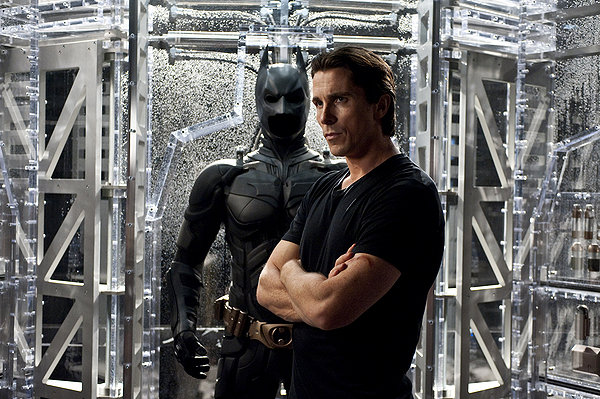 Firstly, Bane is no Joker. The bad guy lacks the fiendish charisma of Ledger’s Joker and he’s not as well integrated thematically into the movie. The Joker was an anarchist that wanted to tear down the pretensions of society and watch people “eat each other.” And we watched a city come unglued. We explore the notion of escalation and what the blowback would be for a man fighting crime in a costume. With Dark Knight Rises, Bane wants to take up the mantle of Ra’s Al Ghul (Liam Neeson) and wipe Gotham off the map. He’s got moments of being a master planner but really he’s just a big heavy. He’s the big tough guy that beats up old man Bruce Wayne, and Bane is continuously diminished in the film as it goes. A late revelation with the character completely diminishes his role and turns him into the equivalent of a mean junkyard dog. His big plan is simply to rile up the masses and wait for the inevitable. Hardy (Bronson) is a great actor prone to mesmerizing performances. This isn’t one of them. He’s super beefy but the facial mask, looking like some sea urchin, obscures half his face. It’s all physicality and eyes for his performance, along with very amped-up dialogue that you can tell was rerecorded after filming. Every time Bane speaks it’s like he has a speaker system installed in his face. And then there’s the matter of his sticky accent, which to me sounds like German mad scientist but to my friends sounded like drunken Sean Connery.
Bane keeps espousing about the corruption of Gotham but you really never get a strong sense of what that corruption has lead to. Catwoman talks about the Gotham elites living large while the rest of the city struggles; but rarely do you get a sense of this. So when Bane flips the tables, and the elite and wealthy are stripped of their decadence and put on trial by mobs, it feels improperly set up. Just because you have characters talk about wealth disparity and the city’s corrupting influence doesn’t mean it’s been established. Nolan’s Batman movies are a reflection of our modern-day anxieties in a post-9/11 world, so I wasn’t surprised to see a society rotting away from the sociopathic greed and wanton excess of the 1%. But rather than serve up a wealth disparity parable of class conflict, the movie simply turns to mob rule, a far less nuanced and interesting dissection of current events and fears. It’s like the French revolution took a trip to Gotham City (Gordon even quotes from A Tale of Two Cities). It’s a society built upon a central lie, the idol of Harvey Dent, but the movie fails to make the corruption felt. In the end, this is all pretty weak social allegory. And would it have killed Bane to be a little more brutal to stock exchange short-sellers?
 Then there’s the typical Nolan origami plot with the myriad of subplots intersecting. This is the first time in the series where the plots felt poorly developed. Rewatch Batman Begins or The Dark Knight, as I recently did, and you’ll see there is not an ounce of fat in those movies, not one wasted scene or one wasted line. Sure they got secret super ninjas and Katie Holmes, but those movies were well built blockbusters. I could have done without Bane entirely and certainly would have loved more of Catwoman. Hathaway (Alice in Wonderland) is terrific in the antihero role and brings a very interesting dynamic relationship with Batman. She may be the only person who understands him. I wanted more Catwoman, the movie needed more Catwoman, but alas she is just a plot device to connect Wayne to Bane. She has a larger role in the concluding melee but essentially becomes Batman’s reluctant wingman. The whole theme of the 99% vs. the 1% could have been generously explored with this character, and her spark and charisma would certainly be enough to get Bruce Wayne out of bed again. Then there’s the regular cop (Joseph Gordon-Levitt) doing the unheralded good deeds that so easily get overlooked. Here is an interesting character that, due to some leaps in logic, connects with Bruce Wayne on a unique level. He presents a counterbalance to all the souped-up superheroes, a recognizably regular human trying to do good. It’s then a shame that he gets entirely relegated during the third act so that the superheroes and their super toys can make some noise.
For a Batman movie there’s hardly any Batman in it. The caped crusader has been in retirement for eight years, so it takes some time before Bruce puts the suit back on. But then he’s also sidelined for a good third of the movie, stowed away in a far-off prison. The entire Indian prison sequence really could have been exorcised. It essentially becomes a Rocky training moment for Bruce Wayne to recover and a plot device to explain why there needs to be a time gap in the story. But this part of the movie just feels like it goes on forever, and we all know where it will go so we just keep waiting for the movie to get there. No one wants a Batman movie where Batman sits the middle out. The end feels relatively fitting but any fan of The Iron Giant will recognize some similar key elements.
And while I’m on the subject, let me do some estimates here. The timeline between Batman Begins and The Dark Knight is about a year, as the Joker notes to a congregation of mobsters. I’ll be generous and say that the events of The Dark Knight last two months. We learn that Batman never appeared again after the death of Harvey Dent, and now we flash to eight years later with The Dark Knight Rises. So you’re telling me that we only really got a solid year of Batman being Batman? That over the course of nine years he was Batman for only one of them? That’s very little Batman-ing for a Batman franchise.
But even with these flaws in tow, The Dark Knight Rises is still an exciting, stimulating, and mostly satisfying close to a trilogy of unprecedented ambition and scope for a modern blockbuster. The action sequences in this movie are huge and exhilarating. I loved Bane turning Batman’s armada of weapons against him. The Bat fighter plane is a nice addition that gets plenty of solid screen time. The sheer scope of what Nolan produces is epic; from a plane being hijacked in mid-flight and torn apart, to a city being leveled by explosives, to a face-off between a bevy of armored Batmobiles and the Bat plane through the streets of Gotham, the movie does not disappoint when it comes to explosive, large-scale action set pieces. This is also the first Batman movie where the climax is the best part of the film. The last half hour is solid action but also a fitting sendoff for a beloved character. Some will grumble with certain hat-tipping moments at the end, but I found it entirely satisfying. It all comes back to the central thesis of Nolan’s Batman films about becoming something more than just a man, becoming a symbol, and that symbol is meant to inspire others. By the end, you feel that the inspiration has been earned as so has our conclusion.
 I want to single out Caine (Harry Brown) who has very few scenes but absolutely kills them. He’s the emotional core of the movie, perhaps even the series, and has always been hoping that his charge, Bruce Wayne, would never return to Gotham. He’s the voice of reason in the movie, the man that reminds Bruce about the costs of a life spent seeking vengeance and sacrificing his body. I wish Caine was in the movie longer but his scenes are pivotal to the plot, as is his absence.
The Dark Knight Rises doesn’t rise to the level of artistic excellence of its predecessors, but it’s certainly a strong summer blockbuster that works as an agreeable finale to the premier franchise of the era. It’s not quite the knockout we were expecting from Nolan but it still delivers where it counts. I wish it had give a fuller, richer portrait of a city corrupt from the inside out, a society rotting away and ready for revolution, and plus I also wish we had plenty more Catwoman and plenty more shots of Anne Hathaway in her Catwoman cat suit (Michelle Pfeiffer still has nothing to fear), but these are the things of dreams. Nolan’s aim has always been to place Batman in a world that is recognizably our own, and with that comes the responsibility of bringing a stolid sense of realism with all the blockbuster pyrotechnics. This artistic ethos has given us some extraordinary movies, though some Batman purists would object that Nolan’s hyper-realism is not the Batman they grew up with. It’s hard to really get a sense of the accomplishments that Nolan and his team has been able to pull off over the course of three bladder-unfriendly movies and seven years. He’s taken the superhero movie and redefined it, brought it unparalleled psychological depth and philosophical analysis, and given a human quality to what normally gets dismissed as escapism. The Dark Knight Rises isn’t as revelatory as its previous entry but it sticks the landing and puts to rest what is indisputably the greatest superhero trilogy of all time.
Now get ready for the reboot in three years.
Nate’s Grade: B
Share this:

The Dark Knight (2008)
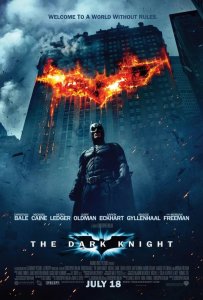 In 2005, Christopher Nolan’s reboot of the Batman series was a critical and commercial success. Gone were the campy and opulent sequences of old and the nipples on the Batsuit felt simply like a bad dream. Nolan served as director and screenwriter and brought serious psychological depth to his story and characters. As a life-long Batman fan, I loved it and wanted a sequel immediately with the exact same people responsible. The Dark Knight has been overshadowed by the passing of actor Heath Ledger, a gifted young actor nominated for a Best Actor Oscar for 2005’s Brokeback Mountain. He’s gone from gay cowboy to the criminally insane, and it’s all anyone can talk about. The buzz on Ledger and The Dark Knight is deafening and I am about to join that joyous chorus. This is a movie for grown-ups and makes lesser super hero adventures look downright stupid.
Bruce Wayne (Christian Bale) is dealing with the repercussions of his choice to assume the masked identity of Batman. He’s cracked down on Gotham City’s mobsters, and in their desperation they have turned to a crazed anarchist that likes to wear strange makeup. The Joker (Ledger) promises to return Gotham back to its old ways but even he knows this isn’t possible. “You’ve changed things,” he tells Batman. “There’s no going back.” The Joker wants to break the will of Batman and Gotham City and sets up elaborate and disturbing moral dilemmas that push many to the edge. His purpose is chaos, which isn’t exactly what the Mob had in mind when they subcontracted his services. Bruce must rely on his trusted butler Alfred (Michael Caine) and company tech guru Lucius Fox (Morgan Freeman) to help him combat a man that “just wants to watch the world burn.” Gotham also has a new district attorney, Harvey Dent (Aaron Eckhart), who is willing to put his name on the line to clean up the city. He’s butting heads with Lt. Gordon (Gary Oldman) because of Gordon’s secrecy and his reliance on Batman to do the things the law won’t allow. Dent wants to prosecute mobsters and is willing to put himself in jeopardy. He believes Batman is waiting for men like him to take the baton. Bruce’s old squeeze Rachel Dawes (Maggie Gyllenhaal replacing Katie Holmes — upgrade) has fallen for Dent. He’s an emotionally available man who wants to do good. Naturally, Dent and Rachel will becomes targets of the Joker.
 First off, believe the hype because everything you’ve read and heard about Ledger’s performance is the gospel truth. The actor vanishes completely underneath the gnarly latex scars, stringy hair, and smeared makeup. He transforms into this menacing figure and he makes Jack Nicholson look like a circus clown in comparison. He’s creepy and funny in a totally demented and spooky way, but he almost comes across like a feral creature that enjoys toying with his prey. Ledger fully inhabits his character and brings a snarling ferocity to the role. The Joker is given no back-story and he takes a macabre delight in crafting differing versions of his sordid past depending upon the audience. Ledger’s Joker is like a mixture of sadist and intellectual, of Alex from A Clockwork Orange and Hannibal Lector; he finds a way to get inside your mind and unleashes torment. There’s a great scene where he’s left alone in a holding cell with a police officer. The Joker taunts the man, getting little reaction from the trained lawman, but then he hits a nerve. The Joker asks how many of his friends, his fellow officers has he murdered. He then rhapsodizes the finer points of using knives instead of guns because guns are too quick. With knives he can see who people truly are in the final moments of existence. “So in a way, I know your friends better than you ever did,” he tells the officer. “Would you like to know which of them are cowards?” This triggers the officer to break his protocol and play into the Joker’s scheme. I’m not ready to say Ledger’s performance overtakes Javier Bardem’s Anton Chigurh (No Country for Old Men) as the most menacing villain of late, but Ledger certainly will make your skin do more than crawl.
Ledger gives a performance worthy of posthumous Oscar consideration. Toward the end of the film I found myself lingering on sadness that, well, this was it. This is all we are ever going to get of the Joker, such a fabulous character, but even more, this was the last full performance we are ever going to get from Ledger. His unnerving performance will stand the test of time when it comes to haunting screen villains, and I’m sure the actor had many more incredibly performances left in him before he passed away.
 The Dark Knight has less in common with other superhero series and should be considered a modern crime drama. It has more in common with Heat than with Spider-Man. Even compared to Nolan’s excellent Batman Begins, this is the first Batman film that feels like it occurs in a real city in our own reality. In Batman Begins, we had the CGI ghetto that happened to be conveniently where all the city’s scum lived, an ancient league of ninjas that wanted to wipe an entire modern city off the map, and then a super microwave that zapped water molecules in the air. Even though it was the most realistic Batman yet, it still had some fantastic elements that kept it from feeling fully believable. This newest Batman adventure feels more like a real city and a city that is being torn apart. You get to see a lot of Gotham City’s moving parts and different social circles and then see the Joker tear them apart. The knotty screenplay by Christopher Nolan and his brother Jonathon is dense and packed with subtext and ambiguity not seen in the likes of other spandex-clad super hero movies. This isn’t a super hero movie so much as an enthralling crime thriller with better gadgets.
Whereas Batman Begins focused on the psychology of a man that dresses up in a costume and fights crime, now the attention turns into examining the impact of Batman. There has been escalation, just as Gordon hinted at the close of the last film. Batman has stepped up law enforcement and now Gotham’s criminal element has placed their trust in a psychopath that promises results. This is a movie about symbols and ideals and about the tenets of civilization. The movie presents an arsenal of mature questions and rarely gives absolute answers. Batman I supposed to be a hero but does he play by the law? Can he make decisions that no one else can? Batman believes in the goodness of others and serves as a symbol for the city to stand up against corruption, but can Batman be corruptible? Does he have a breaking point? Is implanting hidden surveillance and spying on 30 million people in the name of security overstepping? Is it acceptable to cross a line if your enemy crossed it first? The Joker lives at the other ideological end and believes that human beings are selfish and will eat each other when the chips are down. He devises disturbing social experiments that test the limits of ordinary citizens and how far they are willing to go out of self-interest. The Joker is an anarchic force that seeks to tear down civilization itself, and that is a far more interesting and devastating plot than vaporizing water molecules with ninjas. When the movie covers the tired “we’re one in the same” territory that most super hero flicks hit (the Joker responds to Batman with, “I don’t want to kill you. What would I do without you? You complete me.”), it even makes sense given the psychological and philosophical complexity at root.
And oh boy, is The Dark Knight dark. This flick racks up a body count that could compete with movies usually involving some cataclysmic act of nature. The Joker’s unpredictable nature, and the dark twists the film plumbs, creates an atmosphere where you dread anything happening at any time, and mostly bad things happen. Batman must come face to face with his limitations and the realization that his actions, no matter how altruistic, will have negative consequences. This is not a movie for young children. If any parent buys their child a Joker doll and takes them to see this movie then expect years of therapy bills down the line. Much of the violence is implied but the overall effect is still chilling. It’s difficult to call The Dark Knight a “fun” movie. Batman Begins was fun as we followed Bruce Wayne tinker and become his crime-fighting avenger. This movie watches much of what he built get taken away. The movie makes gutsy decisions and for a super hero movie, let alone a summer blockbuster, and this is one decidedly dour flick where no character ends in a particularly pleasant place, especially poor Harvey Dent.
 Speaking of Mr. Dent, while Ledger is deservedly getting all the buzz and plaudits, Eckhart’s excellent performance is going unnoticed. Dent gets just as much screen time as Batman and is the white knight of Gotham, the man unwilling to break the boundaries of the law to merit out justice. Like Batman, he serves as a symbol for Gotham City and its resurrection from the stranglehold of crime. Batman fights in the shadows and serves as an anonymous vigilante but Dent is the face that can inspire the city. That’s what makes his transformation into Two-Face all the more tragic. You really do care about the characters in this movie, so when Dent turns on his principles and seeks out vengeance you feel a weighted sense of sorrow for the demise of a truly decent man. Eckhart and his lantern jaw easily sell Dent’s idealism and courage. After his horrific transformation, Eckhart burrows deep enough to show the intense hatred and mistrust he has even in fate. He gives a terrific performance that plays a variety of emotions and does justice to them all.
The rest of the cast, just to be mentioned, is excellent yet again.
Nolan has also stepped up his directing skills and delivered some high-intensity action. His first foray with Batman had some dicey action sequences that suffered from choppy editing, but he pulls back his camera lens and lets the audience see the action in The Dark Knight. The explosive high point is a long car chase where the Joker tries to attack an armored police car via an 18-wheeler truck. The police look for safe detours to escape the Joker’s line of fire, and when Batman surfaces with the sleek Batpod motorcycle thing get even cooler. What makes the sequence even better is that all of the peripheral characters behave in semi-logical ways, meaning that your secondary cop characters are respectable decision makers. Nolan also shot several sections of the film in IMAX, which boasts the highest resolution possible for film stock. The panoramic views of Batman atop buildings are breathtaking and may strike vertigo in some moviegoers. The movie looks great and it delivers the action goods but it’s really more of a tense thriller with more tiny moments of unease than an out-and-out action flick with gargantuan explosions and blanket gunfire.
Despite the undeniable brilliance of The Dark Knight, the movie is rather exhausting. After a decent 45 minutes of establishing the characters and setting up the stakes, the movie is essentially two hours of climax after climax, and you will be perched on the edge of your seat and tense until the end credits crash onto the screen. It’s exciting and overwhelming but you will feel wiped out by the end of the movie. There are a lot of characters and a lot of subplots and while I’m thrilled the movie has so much intricacy it also makes it hard for the film to come to a stop. The climax with Two-Face and Gordon’s family also feels misplaced. At a tremendous 2 hours and 30 minute running time, The Dark Knight will test your endurance skills in the best way.
 I honestly have no idea where Nolan and crew can take the story now. The Dark Knight seems unlikely to be topped. This is an intense, epic crime thriller with a labyrinthine plot that is packed with emotion, subtext, philosophy, penetrating open-ended questions, and genuine nerve-racking tension. It’s hard for me even to think of this movie as a super hero flick despite that fact that it’s about a billionaire in a rubber suit. This is an engrossing modern crime drama that just so happens to have people in weird costumes. Nolan and his brother have crafted a stirring addition to, not just the Batman canon, but to cinema as a whole. Ledger’s character is the driving force behind the film, the man that makes everyone else react, and his incredibly daring and haunting performance will stand as a last reminder of what talent was lost to the world when he passed away. I for one will be amongst the throng crying out for Oscar recognition but not just for Ledger, for The Dark Knight in general. And I may not be alone. The Dark Knight is currently breaking every box-office record imaginable and seems destined to finish as the number two highest grossing movie of all time, steadily behind James Cameron’s Titanic. If the Academy is looking for a way to shore in better ratings for the Oscars, it might seriously consider nominating The Dark Knight in some key races. It certainly deserves recognition.
Nate’s Grade: A


 nathanzoebl
You must be logged in to post a comment.