Blog Archives
The Brutalist (2024)

The indie sensation of the season is an ambitious throwback to meaty movie-going of the auteur 1970s, telling an immigrant’s expansive tale, and at an epic length of 3 hours and 30 minutes, and an attempt to tell The Immigrant Story, and by that we mean The American Story. It’s a lot for any movie to do, and while The Brutalist didn’t quite rise to the capital-M “masterpiece” experience so many of my critical brethren have been singing, it’s still a very handsomely made, thoughtfully reflective, and extremely well-acted movie following one man trying to start his life over. Adrien Brody plays Laszlo Toth, A Jewish-Hungarian survivor of the Holocaust who relocates to Pennsylvania in 1947. He starts work delivering furniture before getting a big break redesigning a rich man’s library as a surprise birthday gift that doesn’t go over well. Years later, that same rich man, Harrison Lee (Guy Pearce), wants to seek out Laszlo because his library has become a celebrated example of modern architecture. He proposes Laszlo design a grandiose assembly that will serve as a community center, chapel, library, gymnasium, and everything to everyone, standing atop a hill like a beacon of twentieth-century civilization. Everything I’ve just written is merely the first half of this massive movie, complete with an old-fashioned fifteen-minute intermission.
The second half is about crises professional and personal for Laszlo; the meddling and compromises and shortfalls of his big architectural project under the thumb of Harrison, and finding and bringing his estranged wife (Felicity Jones) to America and dealing with the aftermath of their mutual trauma. I was never bored with writer/director Brady Crobett’s (Vox Lux) movie, which is saying something considering its significant length. The scenes just breathe at a relaxed pace that feels more like real life captured on film. The confidence and vision of the movie becomes very clear, as Corbett painstakingly takes his time to tell his sprawling story on his terms. I can appreciate that go-for-broke spirit, and The Brutalist has an equal number of moments that are despairing as they are enlightening. I was more interested in Laszlo’s relationship with his wife, now confined to a wheelchair. There are clear emotional chasms between them to work through, having been separated at a concentration camp, but there is a real desire to reconnect, to heal, and to confront one another’s challenges. It’s touching and the real heart of the movie, and it easily could have been the whole movie. The rest, with Laszlo butting heads against moneymen to secure the integrity of his vision, is an obvious allegory for filmmaking or really any artist attempt to realize a dream amidst the naysayers. The acting is terrific across the board, with Brody returning to a form he hasn’t met in decades. Maybe his career struggles since winning the Best Actor Oscar in 2003 have only helped imbue this performance with a lived-in quality of a soul-searching artist. Pearce is commanding and infuriating as the symbol of America’s ego and sense of superiority. The musical score is unorthodox but picks up a real sense of momentum like a locomotive, thrumming along at a building pace of progress. The only real misstep is an unnecessary epilogue that spells out exactly how you should feel about the movie rather than continuing the same respect and trust for its patient audience. The Brutalist is an intimidating movie and one best to chew over or debate its portrayal of the American Dream, and while not all of its artistic swings connect, the sheer ambition, fortitude, and confident execution of the personal and the grandiose is worth celebrating and elevating.
Nate’s Grade: B
Share this:

The Village (2004) [Review Re-View]
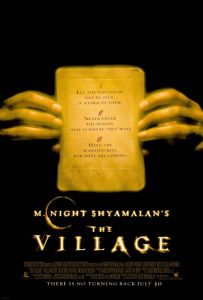 Originally released July 30, 2004:
When saying director names you can play a fun little game of word association. Someone says, “George Lucas,” and things like big-budget effects, empty storytelling, and wooden dialogue come to mind. Someone says, “David Lynch,” and weird, abstract, therapy sessions dance in your head. The behemoth of word association is M. Night Shyamalan. He burst onto the scene with 1999’s blockbuster, The Sixth Sense, a crafty, moody, intelligent thriller with a knock-out final twist. Now, though, it seems more and more evident that while The Sixth Sense was the making of M. Night Shyamalan, it also appears to be his undoing. His follow-up films, Unbreakable and Signs, have suffered by comparison, but what seems to be hampering Shyamalan’s growth as a writer is the tightening noose of audience expectation that he kowtows to.
With this in mind, we have Shyamalan’s newest cinematic offering, The Village. Set in 1897, we follow the simple, agrarian lives of the people that inhabit a small secluded hamlet. The town is isolated because of a surrounding dense forest. Mythical creatures referred to as Those We Dont Speak Of populate the woods. An uneasy truce has been agreed upon between the creatures and the villagers, as long as neither camp ventures over into the others territory. When someone does enter the woods, foreboding signs arise. Animals are found skinned, red marks are found on doors, and people worry that the truce may be over. Within this setting, we follow the ordinary lives of the townsfolk. Ivy Walker (Bryce Dallas Howard) is the daughter of the towns self-appointed mayor (William Hurt), and doesn’t let a little thing like being blind get in the way of her happiness. She is smitten with Lucius (Joaquin Phoenix), a soft-spoken loner. Noah (Adrien Brody), a mentally challenged man, also has feelings for Ivy, which cause greater conflict.
 Arguably, the best thing about The Village is the discovery of Howard. She proves herself to be an acting revelation that will have future success long after The Village is forgotten. Her winsome presence, wide radiant smile, and uncanny ability to quickly endear the character of Ivy to the audience. She is the only one onscreen with genuine personality and charisma, and when shes flirting and being cute about it you cannot help but fall in love with her. And when she is being torn up inside, the audience feels the same emotional turmoil. I am convinced that this is more so from Howard’s acting than from the writing of Shyamalan. She reminds me of a young Cate Blanchett, both in features and talent.
It seems to me that Shyamalan’s directing is getting better with every movie while his writing is getting proportionately worse. He has a masterful sense of pacing and mood, creating long takes that give the viewer a sense of unease. The first arrival of the creatures is an expertly handled scene that delivers plenty of suspense, and a slow-motion capper, with music swelling, that caused me to pump my fist. The cinematography by Roger Deakins is beautifully elegant. Even the violin-heavy score by James Newton Howard is a great asset to the film’s disposition.
So where does the film go wrong and the entertainment get sucked out?
What kills is its incongruous ending. Beforehand, Shyamalan has built a somewhat unsettling tale, but when he finally lays out all his cards, the whole is most certainly not more than the sum of its parts. In fact, the ending is so illogical, and raises infinitely more questions than feeble answers, that it undermines the rest of the film. Unlike The Sixth Sense, the twist of The Village does not get better with increased thought.
Shyamalan’s sense of timing with his story revelations is maddening. He drops one twist with 30 minutes left in the film, but what’s even more frustrating is he situates a character into supposed danger that the audience knows doesn’t exist anymore with this new knowledge. The audience has already been told the truth, and it deflates nearly all the tension. It’s as if Shyamalan reveals a twist and then tells the audience to immediately forget about it.
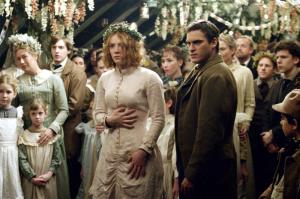 Shyamalan also exhibits a problem fully rendering his characters. They are so understated that they don’t ever really jump from the screen. The dialogue is very stilted and flat, as Shyamalan tries to stubbornly fit his message to ye olde English vernacular (which brings about a whole other question when the film’s final shoe is dropped). Shyamalan also seems to strand his characters into soap opera-ish subplots involving forbidden or unrequited love. For a good hour or so, minus one sequence, The Village is really a Jane Austin story with the occasional monster.
The rest of the villagers don’t come away looking as good as Howard. Phoenix’s taciturn delivery seems to suit the brooding Lucius, but at other times he can give the impression of dead space. Hurt is a sturdy actor but can’t find a good balance between his solemn village leader and caring if sneaky father. Sigourney Weaver just seems adrift like she’s looking for butter to churn. Brody is given the worst to work with. His mentally-challenged character is a terrible one-note plot device. He seems to inexplicably become clever when needed.
The Village is a disappointment when the weight of the talent involved is accounted for. Shyamalan crafts an interesting premise, a portent sense of dread, and about two thirds of a decent-to-good movie, but as Brian Cox said in Adaptation, ”The last act makes the film. Wow them in the end, and you’ve got a hit. You can have flaws and problems, but wow them in the end, and you’ve got a hit.” It’s not that the final twists and revelations are bad; it’s that they paint everything that came before them in a worse light. An audience going into The Village wanting to be scared will likely not be pleased, and only Shyamalan’s core followers will walk away fully appreciating the movie. In the end, it may take a village to get Shyamalan to break his writing rut.
Nate’s Grade: C+
——————————————————
WRITER REFLECTIONS 20 YEARS LATER
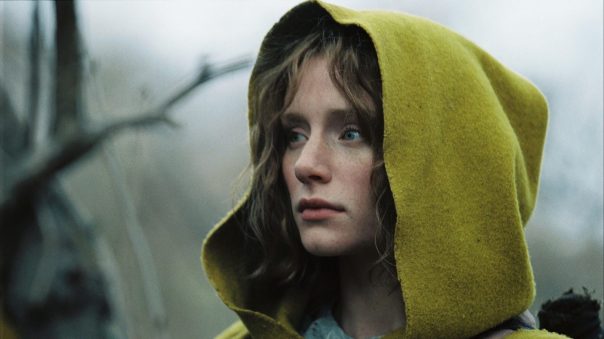
Usually in the M. Night Shyamalan narratives, 2004’s The Village is where the cracks first started to show in the filmmaker’s game. While 2000’s Unbreakable didn’t exactly reach the box-office successes of The Sixth Sense and Signs, it still earned $250 million worldwide and was definitely ahead of the cultural curve, introducing a grounded superhero story before the oncoming wave of superhero cinema. No, it was The Village that started the questioning over whether Shyamalan’s need for big twist endings was hampering his creativity. While still earning almost the exact same box-office as Unbreakable, The Village was seen with more hesitation, a cautionary tale about a filmmaker, as Matt Singer recently put it, flying a little too close to the sun. From here, Shyamalan entered his down period, from 2006’s Lady in the Water, to 2008’s The Happening, and the big-budget sci-fi misfits of 2010’s Last Airbender and 2013’s After Earth. This was the beginning of the general public becoming wise to Shyamalan’s tricks.
The real kicker is that, twenty years later, it’s clear to me that The Village is two-thirds of a good-to-great movie, ultimately undone by the unyielding desire to juice up the proceedings with an outlandish twist ending. For that first hour, Shyamalan has done a fine job of dropping us into this outdated community, learning their rules and restrictions, and gradually feeling the dread that the old ways might not protect them from the monsters just along the boundaries. There’s an efficiency and confidence to that first hour, with carefully planned shots that establish key points of information, like little girls panicking at the sight of a red flower and burying it in the ground before going back to their chores. The cinematography is elegant and moody, and the violin-soaring score by James Newton Hoard is a consistent emotive strength. The first encounter with the monsters roaming around the town is fraught with tension, especially as our one character holds out her hand waiting for her friend/love interest to return. The cloaked monsters are also just a cool design, with their long claws and porcupine-like frills extending from their hides.
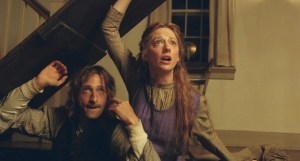 The greatest strength is Bryce Dallas Howard (Jurassic World) as our surprise protagonist, Ivy, daughter of the community founder, Edward Walker (William Hurt). Howard had made small cameo roles in her father’s films, but she was cast by Shyamalan after he watched her perform on stage. She is spellbinding as Ivy, a woman of great vulnerability and strength, of integrity and charisma. The scene where she sits down on the porch beside Lucius (Joaquin Phoenix) and dance around the edges of flirting is sensational, and when she talks about seeing people’s colors, or auras, and then smirkingly whispers, “No, I will not tell you your color, stop asking,” in the same breath, I defy anyone not to fall in love with her like poor Lucius. This simple love story actually works well. Lucius is an introverted man given to great emotions he doesn’t know how to fully express, which pairs nicely with the chatty and ebullient Ivy. The protagonist shift works wonderfully as well. For the first hour we believe we’re following Lucius as our main character, especially since at this point Phoenix’s star power was rising and Howard had none. Then, with the sudden sticking of a knife, Lucius is taken down and the movie becomes Ivy’s story and her quest to save her beloved. Her cry of not being able to see Lucius’ color is a well-coordinated punch to the gut. This is an example of a rug pull that really works, elevating the stakes and presenting the real star, the girl so many have overlooked for one reason or another, who will be our hero when we need her most.
But then it all falls apart for me once Shyamalan reveals two twists: 1) the monsters are not real, merely costumes the adults wear to enforce their rules through fear, 2) the setting of this village is not 1897 but modern-day, with the villagers living in a secluded nature preserve. Apparently, Edward was able to gather enough violent crime victim relatives to begin this experiment in “returning to our roots.” He served as an American History professor, so who better than to create a thriving community? You know how to establish safe drinking water there, my guy? How about cabin-building? I assume one of the elders must have had some wealth as it’s revealed later, via Shyamalan’s onscreen cameo role, that the government got paid off to stop having airplanes fly over the nature preserve. I actually kind of hate this twist. It feels the most superfluous of all Shyamalan’s fabled twist endings. I was genuinely enjoying the movie and how it was spinning up until this point, but Shyamalan cannot leave well enough alone. I get that Shyamalan is crafting an allegory for the War on Terror and the constant anxiety of post-9/11 America, replete with color codes meant to serve as warning signs. I get that we’re meant to find the town elders as villains, keeping their community repressed through the fear of convenient monsters. The lessons are there to dissect, but I’m disappointed because I was enjoying the allegory on its literal level more than its intended themes. It’s also because I feel like the twists overburden the movie’s charms.
 Another reason the twist really falters is that it creates all sorts of nagging questions that sabotage whatever internal logic had been earlier accepted. Adults deciding to break free from modern society so they can start their own secluded LARP community can work as a premise, but it requires a lot more examination that cannot happen when it’s slotted as a concluding twist. Imagine the kind of determination it would take to retreat from modern society and rekindle an agrarian life from hundreds of years ago. That means abandoning all your family, friends, the comforts of modern-day, and the sacrifices could have been explored, but again, it’s just a twist. There are present-day communities, most famously the Amish, that shun the technological advances of modern society to retain an outdated sense of homespun culture and religious community, but often the members have grown up in this culture already. Regardless, retreating into the woods to start your own 18th century cosplay is a commitment, but when you know all the adults are in on this secret, why are they staying in character at all times? When it’s just two adults talking to one another, why are they keeping to their “characters” and talking in that antiquated jargon and syntax? Is it collective Method acting? Is it a sign they’ve ref-ramed what they consider normal? Have they gone so deep that their muscle memory is to say “thee” and “thou” vernacular in the mirror? They went through this elaborate facade because they lost people in the “real world,” but human impulses, violence, and accidents can occur in any community, no matter if you got cell phones or pitchforks. It starts to gnaw away at the tenuous reality of the scenario, a reality I was accepting until the late rug pull.
It also eliminates some of the stakes of Act Three when Ivy travels beyond the boundaries and may face the wrath of the monsters. It’s maddening that Shyamalan reveals the monsters are not real, mere tools to scare the children into obedience, and then has a supposed suspense sequence where Ivy stumbles upon a thicket of red flowers, the dreaded color the monsters hate. But wait, you might recall, there are no monsters, so then why does it matter? When you realize that her dad could just have taken a hike and driven to a drug store to gather medical supplies, without the supernatural threat keeping them confined, it kind of seems silly. Here you were, worried about the fate of this blind girl, when there’s no reason she had to even venture into this danger because one of the adults could have performed the same task without risking their big secret. I know they think Ivy’s blindness might uphold their secret, but why even risk her possible danger from falling down a hill she couldn’t see or a rock that twists her ankle? Her dad would rather have his blind daughter venture into the woods than do this trek “to the next town” himself. At the same time, her personal journey outside the community is robbed of the supernatural danger and it also re-frames the father as someone burdening his blind daughter with a task he could have achieved. He says she has the power of love and that will guide here, but you know a compass could also help. You could make the argument that maybe his guilt was eating away at upholding such a big secret, maybe he wanted to get caught, but I don’t buy it. Edward argues with his fellow elders that it is the next generation that will keep hold to their traditions and ways of life, and they must ensure this survival. That doesn’t sound like the perspective of a man wishing to break apart the close-knit community he helped build.
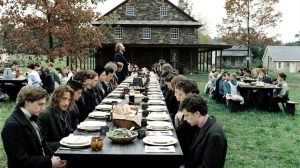 What to make of Adrien Brody’s mentally challenged character, Noah? He’s living in a time that doesn’t know how to handle his condition, but he’s also set up as a quasi-villain. He’s the one who stabs Lucius out of jealousy that Ivy favors him. He’s the one who breaks free, steals a monster get-up, and antagonizes Ivy in the woods. He also falls into a pit and dies alone. I don’t really know how to feel about this character because I don’t think Shyamalan exactly knows what to do with him.
Having recently re-read my original 2004 review, I’m amazed that I am sharing almost the exact same response as I did with my younger self. Even some of the critical points have similar wording. My concluding summation still rings true for me: “It’s not that the final twists and revelations are bad; it’s that they paint everything that came before them in a worse light.” You can rightly tell an allegorical story about people rejecting modern society and living a secluded and hidden life. You can rightly tell a story about adults posing as monsters to keep their children in line and obedient. However, if you’re going to be telling me that story, don’t supply an hour’s worth of setup that will be damaged from these revelations. After The Village, it was a steady decline for the filmmaker once dubbed “the next Spielberg” until 2017’s stripped down thriller Split, anchored by a tour de force performance from James McAvoy. It’s frustrating to watch The Village because it has so much good to offer but ultimately feels constrained by the man’s need to follow a formula that had defined him as a mass market storyteller. This was a turning point for Shyamaln’s fortunes, but the quality of The Village has me pleading that he could have shook off the need for ruinous twists and just accepted the potency of what was already working so well.
Re-View Grade: B-
Share this:

Fool’s Paradise (2023)
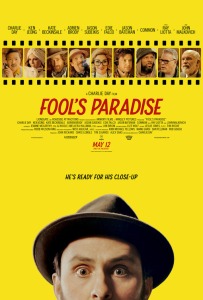 Charlie Day is a very funny guy who works with lots of funny people, so why isn’t his directorial debut, Fool’s Paradise, well, funnier? It’s about a mute simpleton (Day) with the intelligence of a five-year-old, or a Labrador retriever we’re told, who is mistaken for an acting savant. The intended joke is that this industry projects what it wants to see and is full of shallow, insecure, greedy idiots chasing anything that might be popular or career advancing. That’s a fine start but there is a shocking lack of jokes and funny scenarios to be had here, so the 93 minutes just creaks on by in protracted and pained awkward silence. It was a mistake to have Day, a comedian with such a distinct voice and often prone to hilarious outbursts, play a character who doesn’t talk at all. It’s not just that, he kind of shrugs or raises his eyebrows in response, and every time the camera cuts to him for a reaction shot, I was left wondering if this is all the movie had. This passive character, mistakenly named “Latte Pronto” by a director who finds him as a replacement for a prima donna Method actor (also Day), is just a miss. He’s not interesting, and what her reveals about the people around him is even less interesting and just as obvious and tiresome. It’s a movie about non-stop mugging to the camera and hoping to evoke some overly generous pity laughs. It’s attitude over wit. The jaunty score tries hard to make you feel the missing levity from scene to scene. It’s not convincing. The movie is chock full of stars, many of them friends and colleagues that Day has accumulated over a decade in comedy, but nobody has anything funny to do. It’s just all so confounding. Clearly the inspiration owes a debt to 1979’s Being There, a gentle political and social satire where everyone projects what they want to see on one middle-aged gardener raised on TV (I recently watched that movie and felt it was rather dated and quaint). At least that movie had a larger point. There’s just so little to hold onto with Fool’s Paradise, with a boring nothing of a character that never seems to uncover or reveal anything on a tour through Day’s many famous friends. Even the physical comedy is an afterthought. This is no charming Little Tramp. Do yourself a favor and watch any 90 minutes of 2022’s Babylon and you’ll see a funnier and more excoriating satire on Hollywood than the collective shrug that is Fool’s Paradise.
Nate’s Grade: C-
Share this:

Asteroid City (2023)
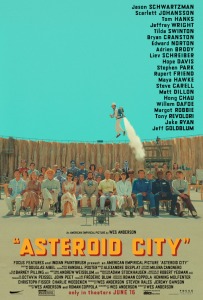 It’s not a good sign that a week after watching a movie I was racking my brain to try and remember what I had watched, and it’s even worse when it’s a movie by Wes Anderson, a filmmaker with such a distinct sense of intricate style it’s now become a go-to A.I. test for untalented people. Asteroid City has the makings of an appealing comic escapade set in a Southwest small town known for its tiny asteroid, and once aliens make their presence known, the entire town and its tourists and wanderers and scientists are quarantined. The problem comes almost immediately, as the movie is presented through several added layers of obfuscating framing devices. The story itself is a play, and we’re watching a movie version, but then also the play of the movie, and the behind the scenes of its now-deceased playwright toiling with his authorial messages and stubborn actors, and it feels like two different movies at odds with one another. The Asteroid City sequence is the more engaging, with some sweet storylines like Jason Schwartzman as a widower processing loss with his family, including his father-in-law (Tom Hanks) who never liked him, while beginning to find a possible romantic kinship with a struggling actress and single mom (Scarlett Johansson). I enjoyed weird little asides about the history of this little town, like a vending machine for land ownership, and s science fair with brainy whiz kids finding their own comradery. There’s even a nice moment in the meta-textual framing where the Schwartzman actor recites an exorcised dialogue scene with the actress who played his deceased wife in the play. It’s elegantly heartfelt. However, the added layers don’t really add extra insight or intrigue but serve as muddy trappings, making meaning less likely rather than more. It feels like Anderson didn’t have enough material with the central story so he added on the meta to make up the difference. There are too many moving pieces and too many characters, and versions of characters, here to settle into something grander. The whimsy and visual style of Anderson is still evident throughout every highly-crafted and pristine arrangement in the movie, so if you’re an Anderson diehard, he still has his charms. This is two Anderson movies in a row that felt disorganized, distracted, and chiefly under-developed, and I’m starting to worry that the form has taken over the function as storyteller.
Nate’s Grade: C+
Share this:

Ghosted (2023)
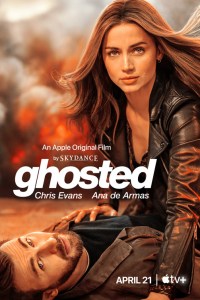
Have you ever watched a movie that felt like it was created by soulless robots? That was the overwhelming feeling I had with Ghosted, a supposed “romantic” “comedy” and spy thriller debuting on Apple Plus with big stars and a big budget and lacking anything that feels recognizably human. 2023 has been a year of exciting and precarious technological advances, and the emergence of A.I.-assisted chat and performative generators, from art to stories, is a Pandora’s Box that will not go away, especially for an industry looking to cut corners wherever possible to save a buck. Super producer Joe Russo has bleakly predicted it’s only a matter of time before studios lean into A.I. programs to help them write bankable screenplays. When that dark day arrives, if we haven’t already crossed that Rubicon, I imagine those A.I. ghostwritten scripts will feel a lot like Ghosted, a movie that feels like it was constructed from imperfect observers.
It all begins when boy meets girl at a farmer’s market. Cole (Chris Evans) refuses to sell a potted plant to Sadie (Ana de Armas) because her job keeps her away for up to months at a time. He cannot, in good conscience, sell this woman a plant he knows will be neglected. From there, they spend a whirlwind first date getting to know one another in and out of the bedroom. Then Sadie never returns Cole’s messages and calls again. He frets that he’s yet another modern dating victim of being ghosted when strange men kidnap him and ask him scary questions about things he has no clue about. He’s rescued from this interrogation by none other than a gun-toting Sadie. She reveals she’s really a secret C.I.A. agent and somehow her enemies have mistaken Cole for “The Tax Man,” a dangerous and mysterious assassin that’s actually Sadie. Now they’re on the run and Cole has to learn the ropes of spy business or else, and maybe he can get a second date while he’s at it.

The premise alone is a workable high-concept we’ve seen comedy variations of before, from Charade to Knight and Day to The Spy Who Dumped Me (remember that movie, anyone?). It’s the perspective of the novice being plunged into the chaotic and overwhelming world of spy-craft and having to rapidly adjust to a world they thought was just the stuff of movies and beach reads. It’s the kind of story that pokes fun at spy movies while embracing them as well, and it posits what would happen if one of us normies ever accidentally found ourselves in this high-stakes world. Where Ghosted doesn’t work is that the characters are both awful versions of the Novice and the Expert. There’s a slight amusement watching Evans plays out of his depth in action contexts, running counter to a decade of Marvel heroics, but this is short-lived. He eventually begins to be a capable partner for Sadie as she learns to trust another, which is the most expected and basic character arc for each of these people. However, Sadie is also boring, and even when the truth about her profession is revealed, it doesn’t make her that much more interesting. I was already doubtful when we opened with her talking to her therapist over her car’s phone and this was the first scene. She’s been slotted as Killing Machine with Trust Issues, and he’s been slotted as Too Afraid to Seek His Dreams, and so their conclusions are predictable and bland. There’s even a lack of a technique that Sadie teaches Cole that comes into play at a pivotal moment. That’s the most basic thing and they miss that.
There is also a notable absence of chemistry between the leads. While de Armas and Evans have co-starred in two prior films, they were opposed in 2019’s Knives Out and 2022’s The Grey Man. Actor chemistry is one of those ineffable qualities that you can tell pretty quickly whether it’s evident or lacking, and within minutes of the tortured house plant meet-cute, I sensed a gaping black hole of palpable chemistry. It’s even more obnoxious when MULTIPLE characters in MULTIPLE scenes implore the two to “get a room” because their supposed sexual tension is off the charts. Sure thing, movie.
Another quality that becomes very apparent is how forced everything in Ghosted feels. The romance feels forced but the comedy especially feels forced. The four screenwriters include the writers behind the Deadpool, Zombieland, Ant-Man, Spider-Man, and recent Jumanji movies, so we know these credited writers have a keen understanding of comedy. It makes the results on screen all the more mystifying and disappointing. The jokes generally feel off (“He expected a hottie not Mata Hari,” womp womp), the rhythm and tone feel a little too much, too forced, like the actors are desperately trying to compensate. It comes across like they were instructed to speak at a more fast-paced and clipped rate to attempt to emulate screwball comedy patter, but the material isn’t there to match the hyperactive verbal presentation. The music is also another factor in trying to better compensate. It’s trying to provide a jaunty, breezy energy level that isn’t sustained in the movie by its comedy, action, or romance. The number of needle drop song selections can also be insufferable and dumbfounding. The characters will start a gun fight and then “My Sharona” will crank up or, even more inexplicably, “Uptown Funk.” The relentless fallback of familiar pop and rock ditties intruding over the action doesn’t so much elevate the moment as make you realize just what would be missing without the song. I’m all for the clever use of music to jazz up a scene, but the final action sequence shouldn’t have to rely on Bruno Mars for any nascent fun.

There are a handful of moments and ideas here that could have worked in a better movie. I enjoyed a stretch in the middle where Sadie and Cole are ambushed by one bounty hunter with an absurd name after another, and each is a cameo from a familiar face and each gets dispatched swiftly. The movie also takes pains to make fun of Cole’s smothering qualities, including his snapping a picture of Sadie while she slept in his arms post-coitus and unaware. I wish this line of criticism would pick up more momentum but there’s only so much heat that Cole will take when he still needs to be the handsome and appealing lead. I also liked the idea of a villain, played by Adrien Brody like his copy of the screenplay didn’t have a single joke inside it, who is simply trying not to be revealed to be incompetent. I think there was especially more room to mine with the confusion over which character was the infamous Tax Man. The assumption that it must be a man could have opened up a broader and interesting subplot over sexist gender assumptions, with nobody believing that a g-g-g-girl could be such an accomplished trained killer (alas, the “girls can do it too” message seems to be all the movie offers in response).
Ghosted is not a good action movie, as it’s poorly sourced and edited, it’s not a good comedy, as the jokes are iffy and delivered in such an exaggerated and clunky manner, and it’s not a good romance, with two bland and under-developed genre character cliches portrayed by two actors who have a startling lack of chemistry together. The music is obnoxious and trying to compensate for the flagging energy level and forced comedy, the movie runs too long at almost two hours, and director Dexter Fletcher (Rocketman) has no feel for action or romance. It’s the comedy that made me most depressed, as no character talked like a semblance of a real human being, nor was their fast-paced, quippy dialogue truly zingy and entertaining. t was like watching a desperate person try and prove they are not, in fact desperate, but with every word only proving more and more their desperation. I’m sure some people out there will find this movie passably breezy or charming or at least inoffensive for two hours of inattention. It all felt so forced and inauthentic and tired to me. It’s best to just ghost this film in real life.
Nate’s Grade: C-
Share this:

Blonde (2022)
 After receiving such blistering and excoriating responses, I went into writer/director Andrew Dominik’s Blonde with great trepidation. The near-three-hour biopic on the iconic Marilyn Monroe, played by Ana de Armas, is the first movie to earn an NC-17 rating since 2011’s Killer Joe, and as such, there’s a natural curiosity factor to any movie receiving such hostile reactions. Fans and critics have called the movie exploitative, navel-gazing, misogynistic, and redundant misery porn. One critic even said Blonde was “the worst movie Netflix has ever made.” I was a major fan of Dominik’s verbosely titled 2007 film, The Assassination of Jesse James by the Coward Robert Ford, and less so 2012’s Killing Them Softly, though I recognized sparing artistic merit. It’s been ten years since Dominik has directed a movie, so surely Blonde, based upon the novel by Joyce Carol Oates, had to have some merit beyond all its hype and criticism, right? Well, no. I processed my general disgust for Dominik’s three-hour slow-mo car crash. This movie is so stupendously misguided and cruel and filled with bizarre, outlandish, and maddening artistic decisions. For my movie review, I felt I needed to break my standard formula, so I decided to give voice to my analysis and criticisms by writing a pretend conversation between Dominik and a stand-in for the Netflix production. Enjoy, dear reader, and beware.
Andrew Dominick sits in front of the desk of a very concerned Netflix Producer, who fidgets uncomfortably in his seat and shuffles papers in his hands.
Netflix Producer: So, thanks, Andrew for making time for this meeting. We’ve seen your full movie and we have some… well, concerns.
Andrew Dominik: That’s life, man. You can’t tell stories without risk. Break a few eggs.
Netflix Producer: Yes, sure, but, well, I guess one of our biggest questions is why did you need almost three hours to devote entirely to the lengthy suffering of Marilyn Monroe? This is supposed to be a biopic, but all we get, scene after scene, to a fault, is a moment of Marilyn being abused, or crying, or being generally exploited. It’s… a lot to take in, Andrew.
 Andrew Dominik: Hey man, that was her life. She was this glamorous star, but behind the glamor is a lot more dirt and grime. Everyone wanted to be her, and I wanted to show the world how wrong that would be. This is a woman who was desired by the world and she was still a victim in the Old Hollywood system, which was a rape factory. I was just being honest, man.
Netflix Producer: I get that principle, but it really feels like the only version of Marilyn we get in this movie is the role of a long-suffering victim. It’s practically a passion play: The Passion of Marilyn Monroe. You’re cheapening her real-life suffering by making it so redundant to the point of self-parody, and also, if you were so concerned about creating an honest portrayal of what this woman went through, then why are you also making things up to add to her legitimate suffering?
Andrew Dominik: What d’ya mean? I adapted the book.
Netflix Producer: Yes, but you do know that Oates’ book is explicitly fictitious, right? It’s made up. Marilyn never had a throuple relationship with Charlie Chaplain Jr. and Edward G Robinson Jr. Marilyn had a positive relationship with her mother. Even worse, you’re adding fictitious suffering, like her relationship with her mother, or Marilyn being raped during an audition.
Andrew Dominik: Yeah, that might never have happened, but the rape represents the-
Netflix Producer: I’m gonna stop you there. You should refrain from sentences that include the phrase, “The rape represents [blank].” We don’t need literal sexual violence, of which we return to time and again, to stand in for a larger thematic message. Also, it’s quite disingenuous to add extra traumatic experiences when you’re purporting to tell this woman’s real trauma and conflict.
Andrew Dominik: Agree to disagree, then.
Netflix Producer: No, not really, but, okay, Andrew, can you tell me any personable impression you get of Marilyn from this movie? And-and you cannot say “victim.”
 Andrew Dominik: She was…….
Netflix Producer: …Yes?
Andrew Dominik: Sexy?
Netflix Producer: Okay, sex symbol for nearly 60 years after her death, sure. What else?
Andrew Dominik: She was…. Um…. Uh… Can I look this up on my phone?
Netflix Producer: See, Andrew, this is our problem-
Andrew Dominik: Oh, she has daddy issues! There. That.
Netflix Producer: And for an hour you have her referring to all the men in her life as “daddy,” which is very uncomfortable especially when those men are literally abusing her.
Andrew Dominik: But, y’see, she calls ‘em all “daddy” because she has-
Netflix Producer: Oh, we get it. Thank you. You have 160 minutes and you keep hitting the same point over and over, bludgeoning the viewer into submission. It’s more than a bit gratuitous, especially when you factor that you’re adding even more trauma.
Andrew Dominik: What d’ya mean by “gratuitous?”
Netflix Producer: I have prepared several examples. For starters, it might be a bit much within the first twenty minutes of your movie to subject your audience to a mother trying to drown her child in the bathtub and Marilyn being sexually assaulted at one of her first auditions.
Andrew Dominik: Okay. Okay. I get that.
Netflix Producer: Then there’s the ghastly POV shot from inside Marilyn’s vagina, which by God happens twice, and both times it’s during forced abortions. Did we really need that queasy angle that is literally invading her body against her will to accomplish what exactly?
Andrew Dominik: The purpose of any true artist is to go deeper-
 Netflix Producer: I’m gonna stop you there again. It’s just bad taste, Andrew. Also, speaking of bad taste, maybe we don’t need the entire sequence where JFK rapes her and then hires government goons to abduct her and force Marilyn into an abortion. And then, on top of all that, she hears the pleas of her first aborted fetus calling back to her. Yikes. Can you at any point step outside of your position, Andrew, and realize how shockingly gratuitous all of that can be?
Andrew Dominik: It’s all designed to separate the person from the icon. Marilyn Monroe never really existed beyond the fantasies of the public, man. It’s about bringing back her humanity.
Netflix Producer: Separating the legend from the person would be a natural artistic angle, but that means spending time establishing the person, building her up through multiple dimensions, multiple opportunities to flesh her out. You only spend time seeing her as a victim, that is when we’re not meant to partake in the same sexualization of her that you seem to be criticizing. I mean the 1996 HBO TV movie managed by having two different actresses portray her, with Naomi Judd as Norma Jean and Mira Sorvino as Marilyn. That literalized the differences and even had Marilyn converse with her former persona as a plot device. You have none of that.
Andrew Dominik: I might not have that, but my movie has a cross dissolve that goes from Marilyn getting banged to the literal crest line of Niagara Falls.
Netflix Producer: I don’t think that really makes up for a lack of character substance.
Andrew Dominik: Agree to disagree, man.
Netflix Producer: You really can’t keep using that as a defense.
Andrew Dominik: Agree to disagree, man.
Netflix Producer: Your horror show of relentless trauma and bad taste might undercut your stated goal of humanizing this woman. She’s not a character but a symbol of abject suffering, a martyr, and you increase her suffering, and sometimes in grating, absurdly grotesque ways. Do you even care about this woman? You’ve devoted three hours to reanimating her as a powerless punching bag.
Andrew Dominik: Well, I did say Gentlemen Prefer Blondes is about “well-dressed whores” and that Blonde is “just another movie about Marilyn Monroe. And there will be others.” I also said that the most important part of her life was that she killed herself.
 Netflix Producer: Exactly. That makes us question whether you have the passion and sensitivity for this project. Why does this movie even have to be NC-17? Will your three hour torture chamber be bereft of meaning if the audience doesn’t see two inner vaginal camera angles?
Andrew Dominik: How dare you even question my artistic integrity. If you remove those shots, you might as well be removing the soul of this movie. Why even tell this story?
Netflix Producer: Yes, why indeed?
Andrew Dominik: It’s meant to be disorienting.
Netflix Producer: Congrats.
The Netflix producer leans back in his chair and releases an extended, wearying sigh.
Andrew Dominik: So… after everything…. Are you going to make me cut anything?
Netflix Producer: Please. We’re so hungry for Oscar recognition, we don’t care. Go for it.
I want to cite de Armas’ (The Gray Man) performance as one of the few attributes to the movie. It’s hard to watch this woman suffer and cry in literally every scene, but I also just felt so sad for not just her character but for de Armas as an actress herself. She shouldn’t have to endure everything that she does to play this character. She is undercut by Dominik’s artistic antics and avarice at every turn, like the story jumping around incoherently so every scene fails to build upon one another. There is no genuine character exploration to be found here. It’s a cycle of suffering, and the movie wants to rub your nose in the exploitation of Monroe while simultaneously exploiting her. De Armas deserves better. Marilyn Monroe deserves better. Every viewer deserves better. Spare yourself three awful hours of pointless suffering in the name of misapplied art.
Nate’s Grade: F
Share this:

The French Dispatch (2021)
 Wes Anderson’s latest quirk-fest is his usual cavalcade of straight-laced absurdity, exquisite dollhouse-level production design, famous faces popping in for droll deadpans, and the overall air of not fully getting it. The French Dispatch is structured like you’re watching the issue of a news magazine come to visual life, meaning that the two-hour movie is comprised of mainly three lengthy vignettes and a couple of short asides. This narrative decision limits the emotional involvement and I found myself growing restless with each of the three segments. I was amused throughout but each felt like a short film that had been pushed beyond its breaking point. Perhaps that is Anderson’s wry, subtle point considering the entire journalistic voice of the movie feels like somebody made a movie in the style of one of those esoteric, supposedly “funny” New Yorker cartoons. It’s occasionally so arch and droll that it feels too removed from actual comedy. This is not the most accessible Anderson movie for a newbie; it’s very bourgeois in the kinds of people it follows, the stories it pursues, and the intellectual and political conflicts it demonstrates. The first and best segment follows Tilda Swinton discussing a heralded but imprisoned experimental artist (Benicio del Toro) who is dealing with the pressure to produce. The second segment follows Frances McDormand as she investigates a Parisian student union revolting against the ignorant powers that be. The third segment follows Jeffrey Wright recounting an assignment where he investigated a master police chef (not “chief”) and gets in the middle of a wacky hostage negotiation. Each of them has the requisite charm and random asides we’ve come to expect from Anderson, including a leotard-wearing strongman that is called upon by the police to help during the hostage crisis, but it felt more like a collection of overlong short films than a cohesive whole. If you’re already a fan, by all means, step into The French Dispatch. If you’re new to the idiosyncratic world of indie film’s most precise curator, then I’d advise starting with a more digestible and earlier Anderson entry. I enjoyed myself during stretches, was getting frustrated during other stretches, and I hope Anderson focuses more on the big picture of his next picture.
Nate’s Grade: C+
Share this:

Third Person (2014)
 Paul Haggis is the Oscar-winning writer/director of Crash, so a man not known for subtlety. And that can be fine, but with his latest effort, Haggis wastes his time on a sluggish triptych that doesn’t come together in any satisfying or clever manner. Like Crash, we follow multiple storylines that we expect to intersect or crisscross. Liam Neeson plays an arrogant author checked into a French hotel trying to write his next novel. He engages in a series of cruel and flirty games with his mistress (Olivia Wilde). Adrien Brody plays a fashion spy in Italy who grows a conscience to help an immigrant regain her daughter. Mila Kunis is a New York actress struggling to get her life in order so she can regain some measure of custody for her son. Right away, the characters are rather bland and remote, refusing to provide much depth or development. Then there’s the fact that the plot requires so little of them, falling into a deadly lethargy that it can’t shake free from. You keep waiting for something more significant to take place but the characters just dawdle, spouting dialogue that never feels authentic. I kept waiting for the twist spoiled by the trailer for Third Person, and by the time two hours passed, I had to note that it was not a mid-movie twist spoiled by the trailer, it was the twist ending. Did the marketing department watch their own movie? I’ve never seen that before; late plot developments, yes, but never the twist ending. There is a reason why these characters are so poorly developed but it’s still not a satisfying reason to watch blasé people blunder around with little direction for over two hours, especially when they have no discernible connection to one another beyond heavy-handed linked themes. Hey, at least Third Person has a favorable amount of Olivia Wilde nudity to keep your interest. After that’s done, though, you can check out just like this array of substandard and morose characters.
Nate’s Grade: C
Share this:

The Grand Budapest Hotel (2014)
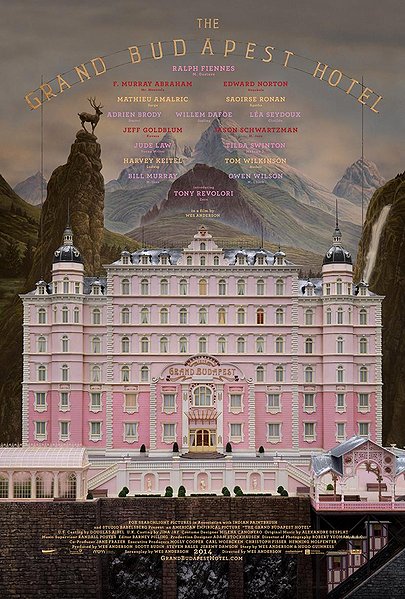 Wes Anderson is a filmmaker whose very name is a brand itself. There are a small number of filmmakers who have an audience that will pay to see their next film regardless of whatever the hell it may be about. Steven Spielberg is the world’s most successful director but just having his name attached to a movie, is that enough to make you seek it out and assume quality? If so, I imagine there were more than a few disappointed with War Horse and Kingdom of the Crystal Skull. But Wes Anderson has gotten to that height of audience loyalty after only seven movies, mostly because there are expectations of what an Anderson film will deliver. And deliver is what the quirky, fast-paced, darkly comic, and overall delightful Grand Budapest Hotel does.
In the far-off country of Zubrowka, there lays the famous hotel known the world over, the Grand Budapest. The head of the hotel, the concierge, is Gustave (Ralph Fiennes), a highly mannered Renaissance man who caters to the every whim of his cliental. Zero (Tony Revolori), an orphaned refugee, is Mr. Gustave’s apprentice, a lobby boy in training learning from the master in the ways of hospitality. Gustave likes to leave people satisfied, including the wealthy dowagers that come from far just for him (Gustave: “She was dynamite in the sack,” Zero: “She was… 84,” Gustave: “I’ve had older.”). One of these very old, very rich ladies is found murdered and in her rewritten will, the old bitty had left a priceless portrait to Gustave. Her scheming family, lead by a combustible Adrien Brody, plots to regain the painting, which Gustave and Zero have absconded with.
 For Wes Anderson fans, they’ll be in heaven. I recently climbed back aboard the bandwagon after the charming and accessible Moonrise Kingdom, and Grand Budapest is an excellent use of the man’s many idiosyncratic skills. The dollhouse meticulous art design is present, as well as the supercharged sense of cock-eyed whimsy, but it’s a rush for Anderson to pair a story that fits snuggly with his sensibilities. The movie is a series of elaborate chases, all coordinated with the flair of a great caper, and the result is a movie over pouring with entertainment. Just when you think you have the film nailed down, Anderson introduces another conflict, another element, another spinning plate to his narrative trickery, and the whimsy and the stakes get taken up another notch. The point of contention I have with the Anderson films I dislike (Life Aquatic, Darjeeling Limited) is the superficial nature of the films. As I said in my review for Darjeeling, Anderson was coming across like a man “more interested in showing off his highly elaborate production design than crafting interesting things for his characters to do inside those complex sets.” With this film, he hones his central character relationships down to Gustave and Zero, and he can’t stop giving them things to do. Thankfully, those things have merit, they impact the story rather than serving as curlicue diversions. We get an art heist, a prison break, a ski chase, a murderous Willem Dafoe leaving behind a trail of bodies, not to mention several other perilous escapes. This is a film packed with fast-paced plot, with interesting actions for his actors, maybe even too packed, opening with three relatively unnecessary frame stories, jumping from modern-day, to the 1980s, back to the 1960s, and finally settling into the 1930s in our fictional Eastern European country.
The other issue with Anderson’s past films, when they have underachieved, is that the flights of whimsy come into conflict with the reality of the characters. That is not to say you cannot have a mix of pathos and the fantastical, but it needs to be a healthy combination, one where the reality of the creation goes undisturbed. With Grand Budapest, Anderson has concocted his best character since Rushmore’s Max Fisher. Gustave is another overachieving, highly literate, forward-driving charmer that casually collects admirers into his orbit, but he’s also a man putting on a performance for others. As the head of the Grand Budapest, he must keep the illusion of refinement, the erudite and all-knowing face of the luxurious respite for the many moneyed guests. He has to conceal all the sweat and labor to fulfill this image, and so he is a character with two faces. His officiously courtly manner of speaking can be quite comical, but it’s also an insightful indication that he is a man of the Old World, a nostalgic European realm of class and civilization on the way out with looming war and brutality. And as played by the effortlessly charming Fiennes (Skyfall), Gustave is a scoundrel that the audience roots for, sympathizes with, scolds, but secretly desire his approval, much like Zero. It is a magnificent performance that stands as one of the best in any Anderson film.
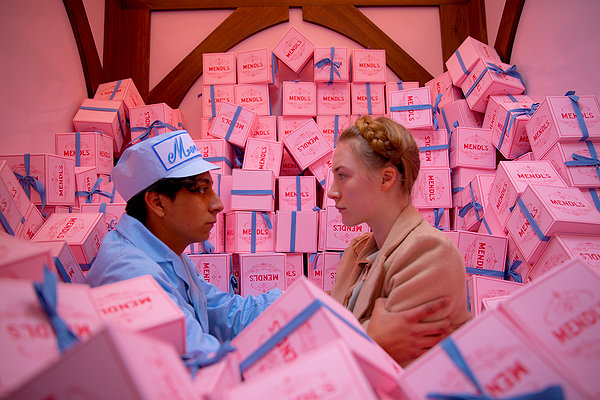 The fun of a Wes Anderson movie is the zany surprises played with deadpan sincerity, and there is plenty in Grand Budapest to produce smiles and laughter. It’s hard to describe exactly which jokes land the best in a Wes Anderson film because they form a patchwork that elevates the entire movie, building an odd world where oddballs can fit right in. It was under a minute before I laughed, and I smiled through just about every remaining minute of the film. I enjoyed a joke involving a dead cat that just kept being carried from scene to scene. I enjoyed a sexually graphic painting that just happened to be lying around. I enjoyed the fact that Zero draws on a mustache every morning to better fit in with the men of his day. But mostly I just enjoyed the characters interacting with one another, especially Gustave and Zero, which forms into the emotional core of the film. It begins as a zany chase film and matures as it continues, tugging at your feelings with the father/son relationship (there’s also a subtly sweet romance for Zero and a pastry girl played by Saoirse Ronan). One of the big surprises is the splash of dark violence that grounds the whimsy, reminding you of the reality of death as war and fascism creep on the periphery. In fact, the movie is rather matter-of-fact about human capacity for cruelty, so much so that significant characters will be bumped off (mostly off screen) in a style that might seem disarming and unsatisfying. It’s the mixture of the melancholy and the whimsy that transforms Grand Budapest into a macabre fairy tale of grand proportions.
The only warning I have is that many of the star-studded cast members have very brief time on screen. It’s certainly Fiennes and Revolori’s show, but familiar names like Bill Murray, Tilda Swinton, Tom Wilkinson, Jeff Goldblum, Lea Seydoux, Jude Law, Harvey Keitel, Jason Schwartzman, Owen Wilson, F. Murray Abraham, and Bob Balaban are in the film for perhaps two scenes apiece, no more than three minutes of screen time apiece. Norton, Brody, and Dafoe have the most screen time of the supporting cast. Though how does Revolori age into the very non-ethnic Abraham? It reminded me of Street Fighter: The Legend of Chun-Li (here me out) where, as she ages, Chun-Li becomes less and less Chinese in her facial appearance. Anyway, the brevity of cast screen time is not detrimental to the enjoyment of the film, considering all the plot elements being juggled, but I would have liked even more with the dispirit array of fun characters.
The Grand Budapest Hotel is Wes Anderson at his best, pared down into a quirky crime caper anchored by a hilariously verbose scoundrel and his protégé. Naturally, the technical merits of the film are outstanding, from the intricate art direction and set dressing, to the period appropriate costumes, to the camerawork by longtime cinematographer Robert Yeoman. The movie is a visually lavish and handcrafted biosphere, a living dollhouse whose central setting ends up becoming a character itself. The trademark fanciful artifice is alive and well but this time populated with interesting characters, a sense of agency, and an accessible emotional core. The faults in Anderson’s lesser films have been fine-tuned and fixed here, and the high-speed plotting and crazy characters that continually collide left me amused and excited. If you’re looking for a pair of films to introduce neophytes into the magical world of Wes Anderson, you may want to consider Grand Budapest with Moonrise Kingdom (Royal Tenenbaums if they need bigger names). In the end, I think Anderson more than identifies with his main character, Gustave, a man enchanted in a world of his own creation, a world better than the real one. Who needs the real world when you’ve got The Grand Budapest Hotel?
Nate’s Grade: A
Share this:

InAPPropriate Comedy (2013)
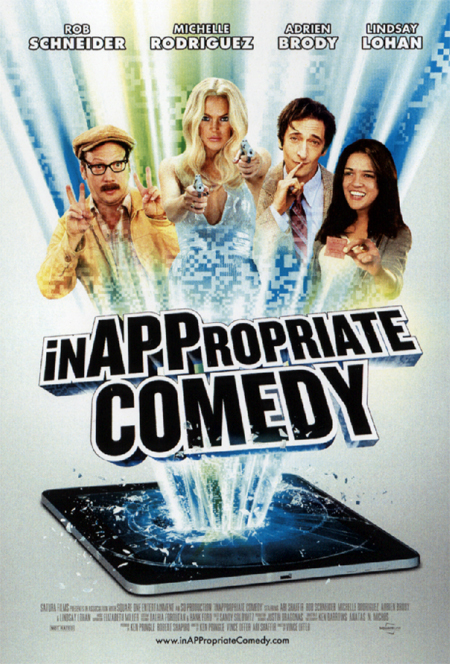 Vince Offer is best known as the successful pitchman for infomercial products like the Sham Wow and the Slap Chop. He’s less known as an amateur comedian. In 1999, he co-wrote and directed The Underground Comedy Movie, pooling all the favors he must have accrued with celebrities and struggling L.A. comics. You’d think after one resounding dud people would know better, but alas Offer and his friends have funded another sketch comedy movie, InAPPropriate Comedy. You see the title refers to the joke delivery system, namely Offer’s finger hitting apps on a tablet to start sketches. And if that inept setup doesn’t seem like a insightful indicator for the misery that is to follow, then allow me to confirm that InAPPropriate Comedy may be the least funny comedy I’ve ever seen.
I’m not saying that ALL people who find some measurable level of enjoyment from InAPPropriate Comedy are racist, homophobic, and sexist, but chances are, if you are all three things, you’ll probably enjoy the comedic abyss that is InAPPropriate Comedy. For the purposes of truly showcasing how comically bankrupt this enterprise is, overdosing on witless shock value and groan-worthy stereotypes, I will quickly dictate exactly what you get in this movie, sketch-wise. It’s really only about four reoccurring segments.
-Before the meat of the comedy begins we’re treated to the lamest, more obvious 127 Hours parody and the sight of tough-guy bikers riding around on bicycles. Does that mental image automatically make you laugh? If so, you’re in luck.
 -A parody of Dirty Harry called “Flirty Harry” where Oscar-winner Adrien Brody is a cop who speaks in nothing but overblown gay-centric double entendres (GAY JOKE #1). Is that half-assed twist on the name worth an entire ongoing series? It’s like you took one of the parody names from MAD magazine and then just called it a day. The second time around, Flirty Harry stops a robber and we see him in pink pants. He’s wearing pink pants. How could that not be hysterical? (GAY JOKE #2) The third segment doesn’t want to waste any time, so now Flirty Harry is getting his nails done at an Asian salon. You better believe these women are portrayed as nattering, horrendous, screeching caricatures (GAY JOKE #3, RACIST JOKE #1, SEXIST JOKE #1). Then Harry shoots a guy in the ass (GAY JOKE #4). Adrien Brody, why?
-The next ongoing sketch is a parody of MTV’s Jackass, and this one, with about as much wit as you’d expect, is called Blackass. It’s about a group of obnoxious, ignorant, lazy, foul-mouthed, angry black males engaging in rude and offensive behavior. These segments may be the most offensive in the whole movie because it is wall-to-wall negative stereotypes; the joke is that black men are not to be trusted and will harass white people, especially white women. The first time we see Blackass it has our characters running from the police. One of them even has a giant boombox over his shoulder because people still do that, right? (RACIST JOKE #2). These guys dress and behave exactly like the harmful misrepresentation your elderly grandmother has about black people. The sad part is that the festering stereotype of the black male up to no good can have serious and tragic consequences, coloring people’s judgments and assumptions.
Stepping down from the soapbox, the first segment involves the Blackass crew falling into a vat of raw sewage. The second segment involves them playing joust in shopping carts with lances made to resemble giant black penises (RACIST JOKE #3). The third involves the Blackass crew as the world’s worst babysitters, threatening a white woman in the process (RACIST JOKE #4). You see black people are terrible fathers, so this movie would argue. They talk about welfare checks and carry around 40s of malt liquor. The fourth segment has one of the Blackass guys and his white girlfriend antagonizing another couple in a hot tub before having anal sex (RACIST JOKE #5, SEXIST JOKE #2). The fifth segment has one of the Blackass guys in an abortion clinic waiting room. He harasses a young couple and offers to abort their pregnancy for cheap with a coat hanger (RACIST JOKE #6). The last segment involves the gang trying to lure a mouse by putting cheese on one of their penises. While it’s the closest in conception to an actual Jackass stunt, it’s still unfunny and much of the humor seems to rest on the enormous size of African-American phalluses (RACIST JOKE #7). Crap, I forgot about another segment where the guys blindfold a dude and have him get run over by a rhino. I don’t even get this one.
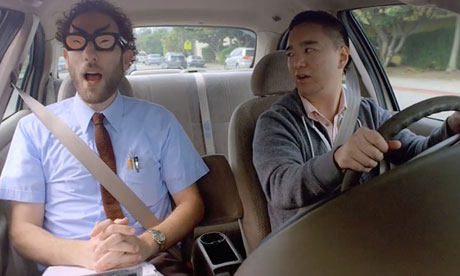
 -The longest and most painful of the reoccurring sketches is a parody of The Amazing Race dubbed The Amazing Racist. You might expect it to have something to do with the popular reality TV competition, perhaps people competing to see who is the bigger racist, racism across color, or even forcing two racists of different ethnicity to team up in competitions. Nope. It’s just co-writer Ari Shaffir and his unending improvisation. The first segment has him rant in front of the U.S.-Mexico border, and then he harangues a gas station owner and assumes any Hispanic present is an illegal alien (RACIST JOKE #8). The next involves him as an insulting driving instructor for Asian drivers (RACIST JOKE #9). The next involves him wandering a predominantly Jewish supermarket trying to gather signatures to apologize for killing Jesus (RACIST JOKE #10). The next segment involves Shaffir entreating black passerbyes on a beach to take a boat ride back to Africa (RACIST JOKE #11). Finally, Shaffir is abandoned in a Middle Eastern territory with armed Arabs. I guess it’s supposed to count as comeuppance but it sure doesn’t feel it. There’s a post-credit sequence where Shaffir is trying to lure Jews into a box to ship to Hitler from the future (RACIST JOKE #12). I later learned that the hidden camera aspect of Shaffir’s bits is another fallacy. The people onscreen are all actors, which makes The Amazing Racist even less amazing. It feels like Offer and Shaffir watched Borat and thought they could replicate what they saw.
-The only other repeating segment is a pair of film critics that specialize in reviewing pornography. The idea on itself actually has the most potential out of everything Offer throws onscreen. It’s got recognizable faces; Michelle Rodriguez and Rob Schneider are the critics. Their reviews, however, are just another excuse to make more racist and gay jokes. A porn they review is called “Sushi Mama” and it features two Asians engaging in over-the-top, badly dubbed sex (RACIST JOKE #13). Another porn they review is weirdly a parody of Swan Lake, with guys dancing around in tutus and eventually humping and ejaculating on a helpless victim (GAY JOKE #5).
There are two other sketches that have the luxury of not being repeat offenders, so to speak. Lord knows what Offer and company saw in the others. One involves Schneider as a sleazy therapist aroused by his client’s vigorous sexual history (SEXIST JOKE #3). Another is called “Things You’ll Never See” and purports that hot ladies would never date someone poor because all good-looking women care about is money (SEXIST JOKE #4). I haven’t even mentioned how all of these sketches are supposed to take place, literally, inside Lindsay Lohan’s vagina (SEXIST JOKE #5). It’s a nonsensical framing device. We zoom out in the end, meaning that Lohan has a treasure trove of unfunny sketches stuffed in her special place. She should probably consult an OBGYN.
And that’s it! That’s the movie, all 75 wretched, horrendous, soul-draining minutes. Did any of that, on the surface, seem funny to you, or, like most people with active senses of humor, did it seem overwhelmingly lazy and poorly thought out? The biggest problem with InAPPropriate Comedy is that it’s trying to be more inappropriate than funny. It’s confused shock value for actual humor. Having a troika of irresponsible black males playing into demoralizing stereotypes and fears isn’t comedy. Having a guy make fun of Asian drivers isn’t a sketch. Having a gay cop make forced double entendres isn’t a sketch. There’s no development here, no escalation, no twisting of the premise, no nothing. All Offer and his motley crew of comedic imbeciles do is take a one-joke premise and pummel it into submission, making the laborious sketches feel even longer. It just so happens that most of their one-joke ideas aren’t even ideas so much as mean slights against minorities, women, and gay people. There is no ironic distance to the joke telling; they are merely just being crushingly racist, sexist, and homophobic.
 I am by no means a comedy prude. I love a terrific vulgar joke as much as the next guy. I think when comedy is concerned that nothing is off limits. You can make anything, no matter how horrific and offensive, funny under the right circumstances, but it takes work and able skill. The problem with Offer’s movie is that there is no consideration to context, setup, developments, let alone surprise. You’ll see every dreadful joke coming before it arrives. That’s because all this movie does is trade in pained, outdated stereotypes. The scenes themselves feel like improv jags that just go on endlessly, like Offer was trying to replicate the process of a Judd Apatow comedy. His faulty reasoning may have been if people just say enough offensive things long enough, then something has to arrive at funny. Comedy doesn’t work like that, and as a comedy writer I find it personally insulting. This is just rampant and pointless vulgarity without any parameters, no point of view, nothing to mask the fact that it’s just cheap shock value. What are the jokes here? Asians are bad drivers? Black men are reckless? Women are superficial? Do these sound like jokes or merely groundless insults? If you removed all the ostensibly offensive elements, there would be nothing to this movie whatsoever.
As a longtime detractor of the duo Friedberg and Seltzer, the men responsible for cinematic crimes against humanity like Epic Movie (my worst film of 2007) and Meet the Spartans (my worst film of 2008), I’m torn. Friedberg/Seltzer don’t so much create jokes as they do lame pop-culture references with built-in expiration dates (go on, try and watch one of their past movies and see if you recall everything). Whatever jokes they do foster are mostly broad slapstick, but it could be classified, no matter how charitably, as a joke. After watching Offer’s InAPPropriate Comedy, I may have second thoughts about the intensity of my screeds against Friedberg and Seltzer. Their movies are still terrible, still the cannibalistic, cinematic watery discharge I dubbed them, but Offer’s comedy may even be worse. There’s no way any of InAPPropriate Comedy could ever be funny. It’s so obvious and desperate that it confuses offense for smashing taboos. This is a black hole of funny, where funny cannot escape and instead gets smashed down to an atomic level. How could anyone making this find it even remotely funny? If I see a worse movie in 2013 than InAPPropriate Comedy, it will make me reevaluate the existence of a loving God.
Nate’s Grade: F


 nathanzoebl
You must be logged in to post a comment.