Blog Archives
Cop Out (2010)
 As an avid Kevin Smith fan, it pains me to say this but Cop Out might be one of the least funny movies of the year. Sure it made me chuckle here and there, but mostly I sat staring slack-jawed, yawning, and wondering how this movie went so completely wrong. Smith is known without exception as a talent behind the typewriter, not the camera. He’s an ingeniously crass playwright in a filmmaker’s body. To hire Smith solely as director/visual storyteller is like hiring Picasso to mow your lawn — not the best use of his talents. To Smith’s credit, the film has a much stronger visual pulse than anything he’s ever committed to celluloid before, however, it still only looks like a marginal, mediocre Hollywood movie. Is that considered a success? The movie wants to parody the buddy cop action films of the 1980s. One of the more amusing additions is that Harold Faltermeyer (Beverly Hills Cop, Top Gun) fashions a brand new 80s style synth and guitar styled score. It’s the best and funniest part of the movie. Cop Out spends an inordinate amount of time and attention to a tortuous plot that nobody should care about. Another miscalculation is that the tone never really settles and often Smith and company attempt a light touch when it comes to parody, which makes the film just look like an incompetent retread of 80s action movies. Just because we’re familiar with stuff doesn’t mean it can be funny without comment. The movie looks even shabbier in comparison with Will Ferrell’s similarly aimed The Other Guys, a far more winning and funnier venture. I wanted to laugh; I strained to find something to appreciate, which was especially hard as the movie tilts more toward action in the final 20 minutes. The slack pacing, lame dialogue, poor chemistry between lead cops Bruce Willis and Tracy Morgan (who just comes off as an unfunny idiot with a loudspeaker for a mouth), disjointed tonality, and ill-conceived comic setups (car chase in a cemetery leads to? nothing? Morgan chases a suspect while he wears a cell phone costume … *crickets*) all take their toll and make me seriously question what drew the interest of so many, otherwise, talented people. Smith got hours of stories after shooting a small role alongside Willis for Die Hard 4. I hope Smith can justify this load with a few more hours of entertaining and juvenile stories for his road shows and podcasts. If that sounds like a faint attempt to find a silver lining for what is otherwise a tremendously botched comedy, then let it be seen as such.
Nate’s Grade: C-
Share this:

R.E.D. (2010)
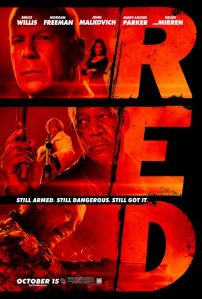 I can watch Helen Mirren fire high-powered weapons all day. RED is a jaunt throwaway that manages to be far more entertaining than it has any right to be. This isn’t excess on the level of The A-Team, nor is it all cynical and emotionless like Wanted. RED is the film that The Expendables could have been with a bit more polish and a little less muscle flexing. The premise almost seems worn out by this point in 2010: retired CIA agents are being hunted down and killed for some mysterious reason. Thus Bruce Willis must travel across the country and recruit his former spooks like Morgan Freeman, a daffy John Malkovich, and dame Mirren. He also gets a rather charming romance with Mary-Louise Parker (TV’s Weeds) as a pension customer service rep that Willis dials up for small talk. She gets whisked along this madcap adventure and enjoys it for the ride that it is. And I think that’s the best summation of the film. What other movie of this sort has actors of this caliber? Four Oscar winners, one nominee, plus solid work from Karl Urban (Star Trek) and beloved character actor Brian Cox to boot. The film definitely has a style, slick enough to please without being heavy-handed to rip you out of the film. The plot may be full of holes, the characters aren’t fully drawn, and certain action sequences are derivative, but thanks to the charms of its golden cast, RED is fun while it lasts.
Nate’s Grade: B
Share this:

Robin Hood (2010)
 So what happens when you make a Robin Hood movie that doesn’t have any Robin Hood? What’s the point of revisiting the legend when you don’t even bother incorporating the elements that made it legendary to begin with? It’s not like they sacrificed familiarity for historical accuracy. Director Ridley Scott’s film spends more time setting up the various pieces of a Robin Hood tale; it’s a prequel at best. This is mostly a historical drama about the English faring off French invasions (the opening text also identifies the setting as the wrong century). The film still manages to be relatively entertaining. The production design and cinematography are top-notch, the acting is robust, Russell Crowe makes a good, if aged, Hood, and the action sequences are thrilling and visually striking. The problem is that there are few action sequences and way too much yakking about foreign policy and Medieval politics and debt. I don’t think people were clamoring for a big-budget Robin Hood revival that explores in depth the financial consequences of an overextended military on the English treasury. This is just not an appealing origin story. The movie resorts to having Hood pose as Maid Marion’s (Cate Blanchett) husband, and it’s as eye-rollingly contrived as any sitcom setup. Originally, the film was designed so that Crowe would play both Hood and the villainous Sheriff of Nottingham (barely seen in the movie). While that is a terrible and senseless idea, at least it would have made the film worth watching from morbid curiosity. Robin Hood isn’t a bad film, but it barely ranks as a Hood outing, and it’s steps behind the delightfully cheesy Kevin Costner version.
Nate’s Grade: B-
Share this:

Scott Pilgrim vs. the World (2010)
 What happens when the millennial generation gets its own (attempted) seminal movie? It stays home and plays video games, letting the film, Scott Pilgrim vs. the World, languish at the box-office. I guess that’s what happens when you finance a movie whose target demographic will just as readily download the movie for free off the Internet.
Scott Pilgrim (Michael Cera) is a 22-year-old Toronto slacker. He?s the bass player for the band Sex Bob-Omb, along with lead singer Stephen Stills (Mark Webber) and acerbic drummer Kim (Alison Pill), a former ex-girlfriend of Scott’s from high school. The band’s biggest fan is 17-year-old Knives Chau (Ellen Wong), who also happens to be Scott?s new girlfriend. The world of Scott Pilgrim is abuzz with this scandal, especially Scott’s gay roommate Wallace (Kieran Culkin) and Scott?s younger sister (Anna Kendrick). Scott insists it’s all on the level and he has no ulterior motives for dating a high schooler. Then he sees the mysterious and alluring Ramona Flowers (Mary Elizabeth Winstead) who?s new to the area and American. Scott rabidly pursues her in what could best be described as stalking, eventually getting her to agree to date him. Trouble is, he hasn’t broken up with Knives just yet before starting this new venture. Scott is then confronted at the Battle of the Bands concert by a man who comes bursting out from the ceiling. He is the first of Ramona’s seven evil exes and Scott must defeat them all in order to earn the right to the violet-haired beauty. “Everybody has baggage,” Ramona says. “Yeah, but my baggage doesn’t try and kill me,” Scott wearily replies.
 Visually, this movie showcases director Edgar Wright (Hot Fuzz, Shaun of the Dead) using every crayon in the Crayola box. This is a visually resplendent film where every scene seems crammed with details to delight the eyes and light up the senses. It’s a rush to watch the kaleidoscope of colors and motions. The Scott Pilgrim universe clearly differs from our own. This is a realm that borrows heavily from old school video games, where people burst into coins when vanquished, where life-decisions are met with “leveling up,” where people have onscreen pee bars that will deplete after a trip to a urinal. Sound effects will routinely be verbalized on screen, everything from a “RIIIIIIIIIIING” of a telephone to the “Ding Dong” of a door. It’s amusing, though also easily overused. Jobs and stuff like that are for the real world, hence too square to be depicted. It’s this entire idiosyncratic comic book world treated like everyday reality.
The enormous display of style is impossible to ignore. Scott Pilgrim is a slick, flashy piece of entertainment that is riddled with nostalgic references for a select crowd. I appreciated how a nice walk was accompanied by the theme song from The Legend of Zelda, or that sound effects and onscreen graphics echoed the fights from Street Fighter II (don’t ask me which of the 800 versions). Scott Pilgrim is an excellent pop pastiche of a specific culture, namely a slacker, hipster, amiable, comics and gamer group. I myself was an avid Nintendo gamer back in my day, but I admit to waning interest when the games got too complicated and grisly (“Back in my day we had two buttons to push, one to jump and the other to shoot, and that’s how we liked it!”). The movie is an explosion of color, light, and (lo-fi garage rock) sound, which also might sound like the description of a seizure or a stroke to some. Like those ailments, Scott Pilgrim will be seen by some as an infliction. It’s hyperactivity and eagerness to please via nostalgic reference points will be what drives people to this film and what drives them away in equal measure.
The Scott Pilgrim graphic novels total six volumes and approximately 1200 pages, which means it?s not the easiest fit for a two-hour window. It also hurts that the Pilgrim books have a wide supporting cast of characters to tussle with, plus there?s the whole seven deadly exes thing which means the movie has to provide about a solid 20 minutes of set-up before finding enough time for seven antagonists (or boss battles, following gamer parlance) and a reasonable amount of resolution. Add on top of this the fact that Wright keeps the movie moving at an outrageous, ADD-addled pace, like the plot conveyor belt lever got broken and the scenes speed one after another. Everything about this movie feels fast and over caffeinated. The editing in particular has characters holding conversations where every line is in a new location, implying an added sense of movement. So you shouldn’t be too surprised when the Scott Pilgrim film feels like a whole lot of a little; it’s moving at the speed of light to entertain.
 Because of the plot mechanics and oversized cast of characters, Pilgrim can give off the impression of shallowness. It seems like all style and little substance and that’s because the movie attempts to cram an entire series of stories, back-stories, and conflict into two hours. The film version only has enough time to attempt to give Scott and Ramona characterization, though both come across as weak-willed, tentative, and less than charismatic, wondering if either party is worth the trouble. The movie tries to paint over these differences through distraction and force of will. The large cast of supporting players all elbows each other just to be mouthpieces for one-liners. Knives actually comes across as the most complete character, consumed by her infatuation, heartbreak, and then quest for misguided vengeance. She’s somewhat dismissed and yet she is the most developed person on screen thanks to Wong’s endearing and relatable performance. The entire experience of Scott Pilgrim vs. the World can be somewhat fatiguing when there’s little evidence presented for emotional investment. The books supplied the reasons for caring besides the whole underdog angle.
The movie aims to be a battle over love, but it’s not entirely convincing. Scott appreciates Knives because she’s simple, a relationship he doesn’t have to invest much within, something casual and enjoyable while it lasts or until it becomes too taxing. Then he goes ga-ga for Ramona and stalks her, wearing down her defenses. He’s purely smitten with her and willing to do whatever it takes to earn her affections, though he can?t explain why he feels this way. Here’s a note to screenwriters: when characters are asked why they love somebody, do not have them say, “I don’t know.” But for Ramona, Scott is her Knives. He’s something easy that won?t break her heart, an escape from the jerks she’s been dating before. He?s low maintenance. He’s something to pass the time. There’s an interesting dynamic here, made even more complicated by the fact that Scott’s time with Knives blended with his time with Ramona. There was not a clear end point. The movie takes a literal approach to the idea of love being a destructive force of nature. Scott is punished throughout because of his infatuation with Ramona, but he persists despite the bruises. And he doesn’t even really know much about her. There’s an interesting statement somewhere there about the punishment we endure, sometimes foolishly, over the affections of people we may love, or convince ourselves of, but not even like.
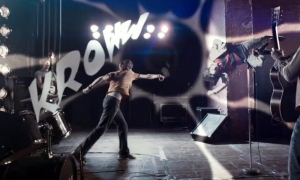 It may sound peculiar but I’m paying Michael Cera a compliment by saying his performance in Scott Pilgrim is the least Michael Cera the actor has ever been on screen. Gone is his gawky, awkward, ironic shtick that has fast become the Cera persona in films like Superbad and Year One. Scott is unjustifiably confident in his life’s pursuits, and Cera gets to act cocky and quippy, even if it?s done with a wink. He?s an unlikely kung-fu star but then again he?s also an unlikely leading man. Winstead (Live Free or Die Hard) is cute but plays her part a bit too toned down, like Ramona’s still searching for the right medication combination. Culkin and Pill are both scene-stealers of the first order, doing so with unabashed and flippant sarcasm. Every scene is made better by their presence. Among the evil exes, Brandon Routh (Superman Returns) has plenty of fun as a dim-witted super-powered Vegan bassist (“Vegans are just better than other people”), and Jason Schwartzman epitomizes hipster snark with such relish. The film is exceedingly well cast from top to bottom.
I’ve read some reviews positing that Scott Pilgrim vs. the World is an elaborate fantasy taking place in the mind of its titular hero, that he blends his knowledge of comics and video games to help make sense of the troubled waters of relationships and lingering hurt from the demise of love. I think that’s a nice explanation but perhaps trying too hard to frame this film as some form of psychoanalytical commentary on modern youth’s interpersonal relationships and the value of love. Scott Pilgrim vs. the World is really just a spastic, hip, clever wank that, as presented, gives little room or emotional investment. It?s a blurry, messy, prankish good time at the cinema that doesn’t translate into much more than the equivalent of sensory button mashing (video game reference). It’s fun while it lasts but it doesn’t have much beyond those astounding visuals to make it feel lasting, and I say this as a genuine fan of the graphic novels by Bryan Lee O’Malley. Alas, heavier discussions about the thorny, maddening issues of love are better left to more dramatic, and romantic, movies like Brokeback Mountain, Eternal Sunshine of the Spotless Mind, and even WALL-E. This movie is more preoccupied with spinning as fast as it can and then vomiting.
Nate’s Grade: B
Share this:

The Expendables (2010)
 Casting can make or break a movie, and occasionally the cast is the only advertised reason why the public should give a damn about a movie. Ocean’s Eleven wasn’t sold on its craft plot or cool director, it was the George Clooney, Brad Pitt, Matt Damon, Julia Roberts movie. Sylvester Stallone is an actor who?s had some lengthy dry spells but he redeemed his legacy a bit with the modestly affecting Rocky Balboa and his ultra-violent modern Rambo. Now he has set his sights on co-writing and directing The Expendables, a film that gathers as many action movie stars together as possible and dares you not to buy a ticket. There?s Stallone, Jason Statham (Transporter), Jet Li (Unleashed), Dolph Lundgren (Masters of the Universe), Mickey Rourke (The Wrestler), Terry Crews (Gamer), Eric Roberts (The Dark Knight), along with wrestler Steve Austin, mixed martial arts champ Randy Couture, and direct-to-video kickboxing ace Gary Daniels. It?s a smorgasbord of testosterone, a group of guys whose median age qualifies them for an AARP membership. The selling point of The Expendables is the cast and the cast alone. The story about some military general (Dexter”s David Zayas) is completely incidental. These men are here to inflict punishment.
The Expendables is ridiculous with a capital R. Whether it’s punching guys in the face while they’re on fire, breaking necks through kickboxing, or, my favorite, hurling an ammunition shell like a shot-put and shooting it in the air, The Expendables exists in that 1980s world of brute and mostly brainless action. It’s a throwback to those halcyon days for the majority of the cast members, back when men were men, women were damsels or temptresses, and action heroes didn’t have to have more than one dimension, and usually that dimension was muscle. The Expendables is enjoyable but much of that enjoyment is because it’s simply enjoyably bad. I have to assume that Stallone had his tongue firmly in cheek when he was designing and executing this film. How else to explain the bizarre moments of action overkill described above, the premise of saving a single girl from a small Latin American military, the fact that the sleazy CIA villain takes off with the damsel, for no personal gain whatsoever, and even gets to deliver the all-important, “You and I are alike” speech villains are always fond of giving.
I was laughing throughout the movie from its excesses and logistical and narrative shortcomings. This is the kind of movie where characters make veiled comments about a family but then we never see the family. This is the kind of movie where the good guys have perfect aim and it never matters how many bad guys there are because they never know how to wield a firearm. This is the kind of movie where Statham’s ex-girlfriend (Charisma Carpenter) gets beat up by her new dude, so Statham goes to confront the guy at a basketball court with all his friends. But the weird part is that the guy’s posse of friends shows no regret that their dude struck a woman. They all rally behind the domestic abuser, and Statham promptly hands them their asses. Just look at the character names: Ying Yang, Lee Christmas, Gunner Jensen, Tool, Barney Ross, James Munroe (no relation to the fifth president), Toll Road, Hale Caesar. Those aren’t cagey nick-names, those are the characters honest-to-God real names. You can?t help watching The Expendables without the impression that the whole movie is one big joke. However, I cannot rationalize that Stallone spent time and money to make a satire of the burly action genre.
 Throughout The Expendables you quickly realize why these guys are men of action and not men of debate. Their speaking voices are terrible. Some are marble-mouthed mumblers, like Stallone and Rourke. Some are just hard to understand, like Lundgren. Some have pretty bad English, like Li. Some are weirdly whisper-quiet in their intensity, like Statham. And others are just plainly bad actors, like Austin and Couture. The characters they?re given to play are pretty thin, defined by a quirk or two but not much else. Statham’s character is away from his girl too often, that’s why she becomes an ex. The film is basically a contest of machismo. Everyone tries to out-do the competition in glaring and teeth grinding. Also, given the title, (semi-spoiler) is it a little much to think that Stallone’s entire wrecking crew can escape death, even the guy that gets shot inches above his heart? These are men you want to see doing things, preferably painful plural things, and speaking at a minimum. Only Crews seems capable of doing both acting and action. Too bad he gets short supply when it comes to screen time.
And that’s certainly another problem when the selling point of the movie is an all-star collection of action movie badasses — screen time. Everybody has to be juggled around and fight for screen time. As you’d assume, Stallone and Statham rise into the upper character branch while everybody else must be content for a series of moments and one-liners. Part of the fun of seeing this group of actors together is seeing this group of actors together, which is in relatively short supply save for an all-out assault climax. There’s a scene with some great cameos, ruined through TV advertising, where Bruce Willis and Arnold Schwarzenegger appear on screen and playfully jab at one another. For some, it will be a movie moment decades in the making. My response: “Oh my God! The founders of Planet Hollywood are finally together again (minus Demi Moore).”
On the subject of action, the film presents plenty of bloody, macho men-on-a-mission mayhem, but Stallone edits the sequences too quickly. It becomes a rush of images that the brain barely has time to process before moving on to another location and fight. There are a handful of gory money shots to the R-rated spectacle, but I just wish I was able to understand what was happening. I know Stallone was not trying to emulate the hyper-kinetic verite editing style of the Bourne movies, which have influenced much of action cinema for the last five years. Perhaps given the realities of shooting fight sequences around aging superstars, Stallone was forced to rely on quick edits to mask the illusion that these geriatric men are still capable of intense beat downs. The editing is occasionally disorienting but even worse it?s distracting. It’s harder to enjoy the action. Nor are the action sequences really well thought-out or specific to their location. It’s mostly the guys with guns chase other guys with guns variety. There are some impressive knife fights and brawls, but the concluding 30-minutes consists mostly of action chaos. Men with guns run, get shot, people hurl grenades (why does a martial arts guru like Li forced to use guns most of the time?), explosions occur, rather, rinse, repeat. From a fighting standpoint, there are six good guys and three bad guys, though t?s hard to take Roberts seriously. That’s not a good ratio for battles. There needs to be more colorful henchmen.
 My friend Eric Muller and I came to an intriguing ending that would have made The Expendables legendary. After the film’s mission is complete, the gang collects back at Rourke’s tattoo parlor/clubhouse. Instead of palling around and talking shop, the gang all of a sudden starts having a giant orgy, and then Stallone looks directly into the camera and says, “It was always leading up to this. You just never wanted to admit it, audience!” The movie is awash in testosterone and nostalgia, naturally gathering an older male audience. Would it not be hilarious to instantaneously make all those men uncomfortable? They love their masculine superheroes when it comes to death but love is too out of bounds. It would be the greatest piece of performance art ever and certainly gives people something to think about (now that you mention it, those character names sound like porn names anyway).
The Expendables is pretty clear in its intentions. It wants to be a gritty, bloody, hard-edged action movie throwback to the 1980s when the world was simpler and all you needed was one man with a gun running through the jungle to solve political disputes. The film’s entire selling point is its cast of action stalwarts from past and present, though many are beefcake past their prime (Statham is only 37, though). The movie works as a casting gimmick but it doesn’t work as a movie. I’d be lying if I said The Expendables wasn’t entertaining and with its moments of silly, mindless fun, but clearly this could have been a much sharper action movie. At times it feels like a winking satire of the genre that helped make these men stars, but perhaps that’s just me projecting onto the film. Perhaps I’m trying to make it more self-aware to excuse its various shortcomings. This is a fairly mediocre action product despite the all-star reunion. Given the film’s relatively warm reception by its core audience, I await future installments of the Equally Expendables to feature Kurt Russell, Wesley Snipes, Rutger Hauer, Patrick Swayze (composed of archival footage), Steven Seagal, Hulk Hogan, Mr. T, and, naturally, the biggest badass of them all Chuck Norris. As long as Norris roundhouse kicks a live ammunition shell, consider my ticket bought and my sense of dignity put on review.
Nate’s Grade: C+
Share this:

The Other Guys (2010)
 Surprisingly consistent in its belly laughs, The Other Guys proves that Will Ferrell is at his best when he re-teams with his greatest collaborator, co-writer and director Adam McKay (Anchorman, Step Brothers). The duo takes on the cop genre with a loving parody that manages to send up the genre while celebrating its excesses. Ferrell and his partner (Mark Wahlberg) stumble onto a mostly convoluted financial scam with banks, traders, and the police. The movie takes scene after scene and gives it a little twist for the self-aware characters to comment, usually to great comedic effect. There were some stretches that I was near tears from laughing so hard (the tuna vs. lion argument is an instant classic). I expected to be amused by the movie since nobody does silly smarter than Ferrell with McKay, but I was not prepared for how much I genuinely liked this movie. From scene to scene, I found something different to laugh at. There’s an undercurrent of rage from McKay concerning the economic stickup Wall Street got away with in 2008. The end credits are an animated statistics presentation on how large Wall Street firms screwed over the American public and are still profiting off of pubic misery. It’s a bit odd tonally to cover at the end of the film, like McKay wanted his legions of fans to get some morsel of education by the end of a film with goofy action and juvenile sex gags. The joke is on us all.
Nate’s Grade: B+
Share this:

Date Night (2010)
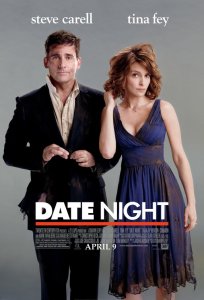 Here is a classic example of two game comedians elevating substandard material. The contrived premise revolves around an ordinary if somewhat bored married couple (Steve Carell, Tina Fey) being chased all over New York City in an extreme case of mistaken identity. Carell and Fey have a terrific comedic dynamic and watching them play and riff is when the movie feels sharp and alive. Sadly, this is another action comedy that thinks people will lap up action that’s slightly skewed. Note to filmmakers: most action sequences are not inherently funny without effort made via context and surprise (see: Cop Out, Bounty Hunter, Killers, or better yet, don’t). The more bad action comedies I see from 2010, the better The Other Guys keeps looking to me in the rear view mirror of memory. When Carell and Fey switch into action mode is when the comedy takes a back seat to lame mayhem. When the movie manages to squeeze in small moments where the actors have space to breathe and the banter is amusing. At best, Date Night is an amusing excursion when it lets the adults get to behave. When they have to go bug-eyed and yell at all the noise, then the movie just becomes exasperating. Good enough for a rainy day, with some lowered expectations, but this movie wouldn’t be nearly worth watching without the resolute comedic efforts of the two leads.
Nate’s Grade: C+
Share this:

Clash of the Titans (2010)
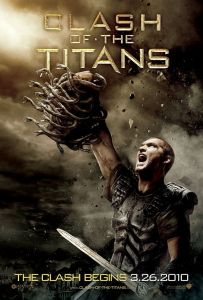 Rather unremarkable and rather dingy, a big-budget remake of Clash of the Titans removes all the fun from the campy 1981 original. Stop-motion is replaced with the sheen of super CGI, but the whole souped-up production feels hollow and overly serious for a movie involving fantastical creatures and Liam Neeson as Zeus. The original film was by no means a classic but it had an enjoyable retro spirit thanks to effects by Ray Harryhausen. The gods are trivialized and hardly in the movie, which is a shame. Danny Huston, as Poseidon, gets one single line in the film. Worse, Perseus (Sam Worthington) is given the motivation of revenge, instead of love, seeking to stand up to the gods who have left man to stew in despair. He blames the treacherous Hades (Ralph Fiennes) for the death of his father. And so the epic adventure is for vengeance, which gives everything a somewhat nasty pall. Who wants to watch a story about Greek mythology where the main character wants to rid the world of the gods? Why would Zeus go along with this? For a fairly straight forward plot, the movie frantically rushes from scene to scene. The action sequences are a particular letdown for director Louis Leterrier (Transporter). The CGI effects, mostly efficient, are like quick blurs and whooshes. You can?t tell what’s happening or you just don’t care. The movie has no character development and I’m not even certain I liked Perseus. Worthington?s scowling and howling is starting to get old after three high-profile action roles in an 18-month window. Would you believe that there isn’t even a titan to be clashed?
Nate’s Grade: C
Share this:

Salt (2010)
 Congrats to the Columbia marketing team for what is by far the most imaginative advertising campaign ever. Weeks before Salt was going to open nationwide, the most bizarre story broke this summer. A dozen American citizens were revealed to be deep cover Russian agents. Apparently, their purpose, as given in the mid-to-late 1980s, was to infiltrate American society and get cozy with policy makers (and yet not one became a lobbyist). Instead they mostly raised families and lived in the suburbs of New Jersey. It’s unclear exactly what they accomplished. This hearkens back to a simpler age where we had clearly identifiable “enemies” that existed as nation states. Things are just too complicated in the post-9/11 age of the War on Terrorism. The dozen Russian spies were deported to Russian in an exchange for three American spies. I feel somewhat sad for these dozen Russian spies, especially Anna Chapman, the red-haired femme fatale that became the face of the scandal. These people grew up in the United States and for many that’s all that they know, and now they have to live in picturesque Russia. I wonder how long before they themselves defect back to the States.
Evelyn Salt (Angelina Jolie) is a CIA agent who?s just about to go home after a long night of CIA stuff. An old Russian agent has defected, and Salt is the best interrogator they have to separate the real from the nutso. As she?s about to leave, the Russian talks about a plot to assassinate the Russian president, and the killer will be a Russian spy posing as an American, Evelyn Salt. Her superior (Liev Schreiber) wants to clear things up with nervous government officials, but Salt bails. She’s concerned that her German national husband (August Diehl from Inglorious Basterds) has been abducted. She races to find her husband, outrun U.S. agencies on her trail, and maybe assassinate the Russian president as foretold.
 Believability is a fluid reality. When it comes to action thrillers, if they’re hitting the right numbers hen you give them a bit of a pass. What might normally kill a mortal can merely incur a flesh wound. Salt is packed with thriller absurdities, especially toward the end, but I posit that this movie is no less believable than most of what we see in the Bourne trilogy. The trick with Salt is that the pacing doesn’t ever let up; as soon as she?s slotted as a potential Ruskie spy, she goes on the run and the movie doesn’t slow down. It hops from action sequence to chase sequence to real-life Frogger sequence on a busy highway, all the while Evelyn performs miraculous feats of derring-do, impervious to normal rigors that would severely injure the rest of humanity. But you see, she’s a trained spy, and therefore can handle it all with aplomb. She can create her own missile thanks to an office desk and a fire extinguisher and some ordinary household chemicals (don’t try this at home, kids). In the opening seconds of the movie, Evelyn is being harshly tortured and interrogated in a North Korean prison (in her bra and panties for extra exploitation value). If she can survive that, surely this Superwoman Spy could survive escaping a batch of really lousy guards and National Security agents who seem bewildered by such art of deception like the masterful Putting on a Hat, or the more dangerous Dying One’s Hair a Darker Color (that can stain, you know).
Let?s briefly talk about the entire premise of Salt. Before this summer, naturally, this Cold War holdover plot device would seem ludicrous. Such deep cover Manchurian Candidate-like operations that take decades upon decades of time seem like a crapshoot. As proven by this summer’s most bizarre story, people who go deep under cover for extended periods of time are rarely able to snake their way into the corridors of power. It’s not like these people are planted to marry ambassadors or up-and-coming politicians. It’s essentially like a horse race, except you have to bet on which pony 25 years down the line will be the winner or spawn the winner. The odds of success seem remote at best and a waste of resources. This Cold War program also stipulates that these sleeper agents would still hold allegiance to Mother Russia nearly 20 years after the dissolution of the U.S.S.R. It’s this same mistaken idea of delayed national allegiance that surfaces when Chinese politicians try and justify how they will solve the guy/girl population disparity in their country. The Chinese politicians feel that the men of their country will come to America and find all those Chinese orphans that were adopted by American parents. Somehow these former Chinese orphans who have grown up in a different culture, in a different family, and with different gender rights and freedoms, will suddenly say, “Of course I will go back to the country that gave me up as valueless!” It’s this same basis at work for the Russian sleeper agent plan. But yet these super sleeper agents have miraculously found their ways in high positions of power. Maybe that’s the secret to educational reform. Students are more likely to be self-starters when they’re determined to bring down the infrastructure of another country.
What saves Salt is that the action sequences are good. Director Phillip Noyce has extensive experience in Hollywood and working with large stars. Noyce directed the stellar Jack Ryan thrillers Patriot Games and Clear and Present Danger; he even has experience with Jolie, having helmed 1999?s boring Bone Collector. Noyce has a great presence of mind and knows how to fill the frame up to please the senses. He knows how to compose a nice action sequence and, here?s the shocker given modern action cinema, allows the audience to fully understand what is going on. The chases have genuine excitement and the escapes come across as organic instead of contrived, which is something of a compliment for a spy film. Evelyn Salt hopping from car to car across a highway is cut together into one smooth sequence to rattle the nerves. There are some spectacular car crash images in the film, particularly when Salt escapes from police custody by driving off an overpass. Noyce finds a way to make the screen both frenetic and oddly pretty, without being self-conscious about its popcorn purposes.
 Jolie has proven herself to be more than capable when it comes to handling action. She doesn’t look as spookily thin as she did in 2008’s Wanted, which is good when you want to believe that she can be a world-class brawler. She’s tough as nails and plenty easy on the eyes. The role doesn’t require much of Jolie’s exceptional sex appeal. In fact, she’s rather maternal and her driving motivation is to rescue her husband. There are all sorts of needless flashbacks to her wedding day, little snippets to remind you that she loves her husband, in case you forgot. Jolie’s character is a bit of an enigma by design. Obviously given the star power and the fact that it?s a summer movie, you expect Jolie and her character to be in the right by the time the end credits roll. And yet the movie and screenwriter Kurt Wimmer (Thomas Crown Affair, Equilibrium) spends about half of its running time letting you fully believe that Evelyn is a turncoat (though if she was originally Russian, would she be a turncoat?). The most interesting aspect for me regarding Salt’s character was when we flashed back to the 11-year-old version (Cassidy Hinkle) of her after a car accident. Her head is bandaged, and because the girl is the younger version of Jolie, her lips look like those wax novelty lips to match Jolie’s signature pillowy pout.
Salt is a rather nuts-and-bolts thriller that balances absurdities with efficient action. With pacing so swift, you don?t have time to start nit-picking the small things, and the big things you just swallow as part of the overall package. Salt needs you to be caught up in the moment, in the chase, and not second-guessing all the plot fallacies. The film pretty much follows Jolie’s lead and is straight-faced nerve. It provides the thrills you’d want in a summer popcorn blockbuster without getting too serious. As a spy thriller it goes down like a shamelessly entertaining beach read. After all, what are the odds that your friends and neighbors of twenty years could actually be decades-in-the-making Russian sleeper agents? Well, do they look like Anna Chapman?
Nate’s Grade: B
Share this:

Inception (2010)
 Without a doubt, no movie has piqued curiosity like Christopher Nolan’s Inception. After breaking all sorts of box-office records with The Dark Knight, Nolan earned some capital. He wanted to make an expensive, intellectually demanding, high-concept movie that takes place mostly in the realm of dreams. The studio said yes, anything to keep their golden goose happy before a third Batman can roll out. Nolan has been tinkering with the script for Inception for almost ten years, trying to scale it down but never being content. This is a story that called for the biggest stage, which required a heavy price tag, and could only be fulfilled once Nolan was an established hit-maker. Early images of shifting gravity and folding cityscapes got people buzzing but then the concern was whether Inception would be too smart for audiences to embrace. You know, the same public that made two Alvin and the Chipmunks films blockbusters. Two weeks running, Inception has made a sizeable portion of money and become the “must-see” movie of the summer. Score one for the public.
Dom Cobb (Leonardo DiCaprio) is an expert extractor. He can sneak into your dreams and discover whatever secret you’re hiding from your self, your wife, even your shrink. All for a tidy sum, of course. He’s on the run from U.S. authorities because they believe he killed his wife Mal (Marion Cotillard). A rich businessman, Seito (Ken Watanabe), promises to clear away the pending charges if Cobb can perform one important job. Instead of stealing an idea, Cobb will have to plant an idea, known as inception. A young upstart (Cillian Murphy) will inherit his dying father?s empire, and Seito wants the guy to break up that empire and sell it off. Cobb enlists the help of a skilled team to pull off what is believed to be impossible; Arthur (Joseph Gordon-Levitt) as the point man, Ariadne (Ellen Page), as the architect of the dream world, Eames (Tom Hardy), a forger who can convince the mark he?s other identities, and Yusuf (Dileep Rao), a chemist that creates a compound to put the team under a deep sleep. They’ll need it because Cobb plans to go three levels deep, a dream within a dream within a dream in order for inception to take root. The only way out is a “kick,” the sensation of falling that will awaken the dreamer. The team is under great risk not just from the dream world, but also from Cobb. He?s been secretly keeping memories of his dead wife alive and she keeps intruding into shared dreaming, causing havoc, relying on the same info that Cobb knows. The deeper they go into the dream the deeper they also go into Cobb’s memories.
 Inception can be many things to many people, as is the nature of dreams. I found the movie to be a master class mousetrap. Watching Nolan and his origami-like script fold and bend and connect is a true pleasure. However, the movie is not a great character piece. Cobb is the only person on the entire team allowed any sort of back-story or inner lives or even personality traits. What do we know about Arthur, Ariadne, Eames? Nothing. They are all members of the team, but it is Cobb who is the only one allowed to have supporting details. Despite Cobb’s tragic past with his wife, emotionally the movie can best be described as a bit distant (not cold, distant). Nor does Inception deal with the psychology of dreams or the interpretation of the subconscious and its links to our own reality; this movie does not have Freudian psychoanalysis in mind. What Inception does deliver is a brilliantly staged heist that takes place in the realm of dreams, and if that doesn’t sound like a fun concept then I don?t know what does. To get to that heist, the audience must slosh through about 90 minutes of solid set-up and exposition (Pages character is essentially an exposition device). There are a lot of rules to digest in order for the final hour to have the impact that it does. If you nod off for a portion of that time, like my father, you will be lost as to why anything is exactly happening. Having seen the film a second time, I can say that once the hyperactive “Oh my gosh, this is awesome!” haze of newness wears off you do realize that the pre-heist portion of the movie can be a bit slow. I think that for future DVD-viewings I will skip to the start of the heist and sit back and relax (much like skipping the first hour of King Kong).
After talking about what Inception is not, let’s focus on what Inception is. It is a massively entertaining, brain-tickling thriller with eye-popping visuals that verge toward the iconic. Nolan isn’t the greatest orchestrator of action (a foot chase in Mombassa is pretty lackluster short of a narrow alleyway) but the man knows how to put together tremendously memorable set pieces. From Paris folding upon itself to a fistfight in a revolving hallway, Inception is packed with stimuli to ignite the senses. It’s the first movie in years that I walked out and thought, “How did they do that?” It renewed my sense of mystery and wonder with the movies. And the last hour is ridiculously fraught with tension as the movie descends level after level of subconscious, juggling four separate action set pieces with mounting climaxes. The revolving hallway fight is perhaps my favorite action scene in years. I still got goose bumps the second time. Gordon-Levitt hops from ceiling to floor like he’s Spiderman, or Gene Kelly, all while the camera remains fixed. Gordon-Levitt gets a lot of zero gravity experience in this movie. He might have qualified for a free ride on the space shuttle.
Like the alternate reality of The Matrix, people can manipulate the world of dreams, which allows for some imaginative visuals. Aside from the dreams-within-dreams impacting one another, there aren’t really playful distortions of reality. There?s a few M. C. Escher-inspired staircases but nothing too out of bounds. Nolan devises a reason for this since the dreamers do not want to call attention to altering the dream. They want to hide among the subconscious projections; get in and get out without being noticed. You do wish that Nolan played to the potential of his flexible reality, but on the other hand, it’s still fairly mind-bending to reach inside a magician?s hat into another magician?s hat and so on. I wonder if there was another story that could have succeeded in this setting, namely competing thieves that have to race against time within the world of dreams. Think about it next time, Nolan. That one?s on me.
 But the most exciting aspect of the movie is how intellectually stimulating it is. The movie is jam-packed with ideas like Nolan’s other works, so much that it’s hard to fully process everything the film offers in one sitting. The pieces do fit together and the movie follows its own internal logic, so if you didn’t skip out on any bathroom breaks, you should be able to follow along reasonably. On first viewing, Inception is bristling with intelligence and narrative complexity, and it rarely stops to pander to an audience. It expects you to keep up for the rewards that will follow, and they are indeed rewarding. The movie isn’t as complicated to follow but it can definitely get complicated when you try and explain action beyond a literal level. Nolan laces all sorts of narrative stops and peculiarities that can be targeted for an alternative thesis statement on the ending. The very ending shot is ambiguous perfection. It keeps the mystery of what constitutes reality while providing an out for people that want to formulate a happy ending. There’s plenty of room for interpretation and analysis but it doesn’t get in the way of telling a good story. Hollywood is pretty risk averse when it comes to anything that makes people think, let along anything expensive that requires active synapses. Nolan has long been a filmmaker of intellectual heft and non-linear narratives. His narratives are complex puzzles that snap together with airtight precision. The joy of a Nolan film is surrendering yourself to his narrative origami and waiting to see the Big Picture. There are new insights to discover with every viewing. Nolan may not be the second-coming of God, as those frothing at the mouth on Internet message boards proclaim, but I can think of no other director working today who harnesses Big Ideas on such a big stage.
Inception is a $160-million dollar studio film with substance, but it also looks like money well spent. The film looks amazing. The cinematography by Wall Pfister (Dark Knight) is gorgeous without being self-consciously arty, pleasing the senses without drawing too much attention away from the story. But with a screenplay that makes all kinds of leaps, you need the help of a good editor to guide the proceedings. Lee Smith (Truman Show, Master and Commander) is that man. While the repeated cutbacks to the van falling in slow motion can be giggle-inducing, Smith gamely holds everything together thanks to his skill in juggling all the parallel storylines/dreamscapes. Finally, the score by Hans Zimmer (The Lion King, Gladiator) is full of ominous, blaring horns that send shivers and get your blood pumping. Johnny Marr (The Smiths, Modest Mouse) even added an assist by strumming the guitar licks on the score. Apparently Zimmer’s key score themes are actually the tune “Non, Je Ne Regrette Rien,” the Edith Piaf signature song used to signal “kicks,” played at a slowed speed. At the risk of sounding like one of those frothing from the mouth on the Internet, that’s insanely cool.
 The acting is uniformly good with a few bumps. DiCaprio (Shutter Island) might need to do something light after continuous roles where he inhabits mean weighed down by guilt and dead wives (three in a row for those counting). He’s a good emotional anchor. Watching the star of 500 Days of Summer and Brick as a suave, cool-as-can-be action star is improbably awesome. Hardy (Bronson) is a scene-stealer mostly because he?s the only member of the team that has a sense of humor. Cotillard (Nine, Public Enemies) who won an Oscar playing Edith Piaf in 2007’s La vie en Rose, gets her best part since then. She gets to do many things as Mal, a projection of a character. This means that she must be limited in how she fills out the character because she is defined by Cobb’s fading memory. Yet she can be malicious, playful, spiteful, loving, vulnerable, and more. Cotillard and her big, glassy eyes do a great service in selling a romance we only see after the fact. Page (Juno) just feels out of place. She seems like the kid among a group of adults. And while the elfin actress will always look youthful until she applies for an AARP card, Page just seems in over her head. Her performance is fine if a bit mealy-mouthed but she still feels miscast.
Inception. Expect it to become a fanboy religion in a matter of weeks. It wears its influences on its sleeve, from The Matrix to Abre Los Ojos (or the American remake, Vanilla Sky). Thrilling, stimulating on different levels, and supremely engrossing, Inception is just about everything you could wish for in a summer blockbuster, except when it can also feel mechanical, distant, and free of emotion and character development save DiCaprio (perhaps this is further evidence that it was all a dream?). Regardless, Inception is easily the brainiest movie of the year, and usually those don?t get packaged as big-budget Hollywood spectacle. Just make sure to bring your totem the second time you watch the movie.
Nate’s Grade: A


 nathanzoebl
You must be logged in to post a comment.