Blog Archives
The Hobbit: An Unexpected Journey (2012)
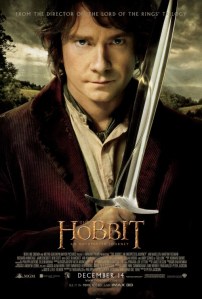 I would argue that Peter Jackson’s Lord of the Rings epic has left the biggest impact on the world of popular culture over the past decade. It’s hard to remember a time when the multi-billion dollar trilogy, and winner of just about every Oscar dreamt up, was seen as a risky proposition. Would there be an audience for this kind of movie, let alone three of them? Well, ten years later, and mountains of money still being counted, this question has been put to rest. And so the discussion naturally veered to that other J.R.R. Tolkien book, the first one, The Hobbit. The production of it was held up for years with legal battles over who owned the rights and then with MGM’s bankruptcy. Everyone wanted a piece of the pie at this point. They knew the fortunes that would come. Jackson returned to direct The Hobbit, which was designed to be two movies but then late into filming was transformed into a trilogy. Now we have three Hobbit films because, quite simply, three movies equal more money. Everyone’s doing the whole elongated film franchise now, from Harry Potter to Twilight to The Hunger Games. Why give up the cash cow so easily? The first chapter, An Unexpected Journey, arrives this year, and you’ll probably relive whatever feelings were felt for Lord of the Rings. I know I did.
Sixty years before the events of The Lord of the Rings, young Bilbo Baggins (Martin Freeman) is a fastidious hobbit keeping to himself. Then one day the wizard Gandalf (Ian McKellen) visits and brings with him a dozen dwarf guests. The dwarves, lead by Thorin Oakensheild (Richard Armitage), are looking to reclaim their ancestral home, the Misty Mountain. The greedy dragon Smaug overtook the mountain many years ago (did you know dragons apparently lust for treasure like pirates?). The group needs a burglar, and hobbits are small and make minimal sound, making Bilbo an ideal candidate. Naturally Bilbo refuses the notion of a dangerous adventure, but then he changes his mind (what? It’s not going to be 8 more hours of Bilbo doing housework). Bilbo and the dwarves encounter elves, orcs, trolls, wizards, and all sorts of creatures as they make their way across Middle Earth to the Misty Mountain.
 I was more excited for the Hobbit films when they were initially going to be directed by Guillermo del Toro (Pan’s Labyrinth). I thought that master of creepy crawlies would come up with something decidedly different, but alas it was not meant to be. Jackson hopped back in the director’s chair and provides a nice sense of continuity between the film franchises. The man knows this world like the back of his hand. He still has his great sense of visual grandeur, and often the movie is gorgeous to behold. The locations give the realm of Middle Earth such a better tangible feel than had he gone the George Lucas route and spent all his time with green screens. Even the more heavily-effects-laden sequences, like the underground orc lair, are rich, dense, terrific film locations you want to get lost in, absorbing every detail. From a technical standpoint, the film is never less than beautiful. Jackson also maintains a superior handling of action, knowing how to extend a set piece and build tension. The villains in The Hobbit might not be as meaty or memorable as they are in Lord of the Rings (a testy, one-handed albino orc feels like a lackluster heavy) but they provide enough credible danger. If you loved the Lord of the Rings films, and their fans are legion, then you’ll likely enjoy the first part of the prequel trilogy. If I had to rate the first chapter of The Hobbit, I’d say it’s closer to 2002’s Two Towers in overall quality, the film I liked the least in the Rings trilogy.
Now that we know there’s a healthy audience for these movies, I worry that Jackson has lost his sense of objectivity. There is no reason this movie needed to be as long as it is. There’s certainly no reason that a 300-page book, primarily aimed at children, needs to be padded out into three movies, each promising to be close to three hours in length (9 hours out of 300 pages = 1.8 pages per minute). Instead of the Jackson who nipped and tucked Tolkien’s gargantuan tomes, removing Tom Bombadill, now we have a Jackson who adds lengthy appearances of characters only briefly mentioned before in the book (kooky naturist wizard Radagast). There are also cameos from the Lord of the Rings cast to provide some further connective tissue. Now we have Bilbo and his gang visiting just about every single gnarly creature in Middle Earth, or so it seems. Now we have a quest that doesn’t even begin until close to an hour into the film. And that quest seems a lot less urgent; rather than, you know, saving the world, our characters are out to… reclaim a mountain for the dwarves. The drop in urgency makes the tale and its detours feel like dawdling. The concluding hour is fairly well paced, especially once Gollum shows his ugly mug, but the movie feels like it has precious little forward momentum. I don’t have high hopes for the future films. Fans of Tolkien’s works will likely just be thrilled to see every facet of their favorite story brought to startling life, so they won’t care about lag. At the conclusion of this movie, as our characters are dropped off by giant eagles, they look in the distance and see the Misty Mountain, their hope renewed. However I was yelling, “Get those eagles back! Why do you have to walk the whole way there?” Looks like even more long movies of walking lie ahead (cue Clerks II Rings vs. Star Wars clip).
 This is also a far different film than the Lord of the Rings epics when it comes to tone. It’s far more childish and filled with comedy, also aimed at children. I don’t mean the term “childish” to see like a negative broadside, though that’s the connotation. The world of Middle Earth isn’t ensnared in the perils of Sauron just yet, so even though we got trolls and dragons and the like, the temperament is chippier. There are a lot more comic escapades here and it’s easier to accept when, you know, the world isn’t being threatened with an eternally evil malevolence. There’s a lot of bumbling and physical comedy at play, especially when the dwarves take over poor Bilbo’s home. Later on, there’s an orc king who has what is unmistakably a pair of testicles hanging below his chin. I mean you cannot possibly look at the image and interpret it as anything differently. You probably would never see something like that, for better or worse, in the Lord of the Rings films.
The biggest news for me with The Hobbit was Jackson filming at 48 frames per second (fps). It’s twice the rate of how we’ve perceived movies since the 1920s. It is a brave leap forward in technology. I was worried I wouldn’t be able to have the opportunity to view The Hobbit in this exciting new format. Having come through the 48 fps experience, I’ll say that it has its pros and cons. On the negative side, it certainly breaks with the standard filmic look we’re so accustomed to, that dream-like state that’s removed from reality. Often the picture looks like it was recorded on video, giving the movie a stagy BBC feel to it. For some, this change will seem cheap or less grand. The biggest piece to get used to is that at 48 frames, everyone’s movements seem overly exaggerated. Everyone moves like they’ve had eight cups of coffee. It’s these hyper movements that make me think of that horrible TV feature on some HD TVs that plays down judder by amplifying movement, so everything looks like a video game cut scene. Your eyes may feel a bit more strained, as mine did after the three hours, trying to capture all the jostling movement. The 48 fps also has a tendency to blur quick motion, making it harder to pay attention to the particulars of action sequences.
Now, with that being said, I personally feel that the benefits far outweigh the detractions. The level of detail and clarity is outstanding. I felt immersed in this world. And with the 48 fps, it’s also the greatest theatrical 3D experience I’ve ever had. You feel like you’re literally inside the movie. When things fly at the screen you may just duck your head on instinct. The movie worked best when it could explore the different physical realms of Middle Earth. The underground orc world was magnificent to explore. There were several moments that made me gasp, taking my breath away at the level of detail. It takes a while to get used to and for your eyes to adjust, but I think the awkwardness dissipates and you’re left to gawk in awe with the effects and presentation. I doubt we’ll be seeing too many other films presented in this manner. Firstly, I think half the public is going to hate it. 48 fps really only works for films that necessitate a big canvas. You need a world that you want to be a part of, something to dazzle the senses, which means it will probably be best utilized with sci-fi and fantasy films. Hitchcock at 48 fps would certainly not be worth the extra frames.
 Freeman (BBC’s brilliant Sherlock, The Hitchhiker’s Guide to the Galaxy) is a perfectly enjoyable lead. Bilbo is much more of that classic British nattering type, more comedic in nature than the sad burden of Frodo, and Freeman is naturally a skilled comedic actor. He doesn’t overdo any sort of hobbity nebbishness either, and when it comes to the dramatic parts he can sell those just as well. McKellen (X-Men) is as wonderful as ever as the wise yet playful wizard. The real breakout star of the movie is Armitage (BBC’s Robin Hood) as Thorin Oakensheild. The man has such gravitas to him, a commanding screen presence, and it helps when he has a completely badass slow-mo strut that burns into your memory how awesome the actor and character are (fun observation: at 48 fps, slow motion looks almost like “normal” movie speed). I anticipate Armitage to give the squealing fans of Aragorn (Viggo Mortensen) a new heartthrob to declare their loyalty.
Jackson’s return to The Hobbit: An Unexpected Journey is pretty much more of the same, though with a less urgent plot, a broader scope of comedy, and some extra technical wizardry. Watching it will pretty much rekindle whatever feelings you had for the duration of the Lord of the Rings pictures. If you know this stuff verbatim, you’ll happily take every second of detail. If you’re like me and enjoyed the films but didn’t tattoo them in your memory, then you’ll likely have a pleasant if occasionally tedious experience with The Hobbit. I’m fairly certain that Jackson could have judiciously sliced a solid 20-30 minutes out of this unexpected journey; maybe they have fewer journeys with every magical being this side of Middle Earth. Still, the film is grand and sprawling and spectacular to witness. If you were interested in the 48 fps presentation, I’d recommend it but know what you’re going in for. It will be a very different experience and one that you’ll need some adjustment time to properly attune to. Unless you’re a techie, I’d advise watching the movie in a standard 24 frame presentation and then seeking out the high frame rate for a second helping, already knowing what to expect from the plot. I plan on seeing the next two Hobbit films in the 48 fps presentation. Hopefully by that time, come December 2013, my eyes will have recovered.
Nate’s Grade: B
Share this:

Rise of the Guardians (2012)
 Dreamworks animation has long existed in the mighty shadow of Pixar, but as of late the studios might be at a creative crossroads. After the excellent Kung Fu Panda films and How to Train Your Dragon, suddenly Dreamworks animated movies matured beyond feverish, pop-culture explosions and into character-driven, colorful, and genuinely heartfelt family films. I don’t think we’ll be getting something as dismal as Shark Tale again with the current path the studio is blazing. Rise of the Guardians looks like the pilot for a new lucrative Dreamworks family franchise. It’s easy to see the appeal for a superhero assembly of fantasy figures, though is every region going to have working knowledge of the Tooth Fairy? The movie just looked too silly to function for me, but I was optimistic after raves from a few trusted friends. Perhaps my own childlike sense of wonder is permanently replaced with a heart of stone, but I found Rise of the Guardians to be a somewhat entertaining but mostly stilted, intellectually and emotionally, journey.
The guardians are an ancient group of holiday-themed characters entrusted with keeping the sense of wonder alive in children. There’s Santa Claus, a.k.a. North (voiced by Alec Baldwin), and his army of yetti workers, the tooth Fairy (Isla Fisher), and her own collection agency of tooth-gathering fairies, the Sandman, in charge of the sweet dreams of children, and the Easter Bunny (Hugh Jackman), an Australian jack rabbit with a bit of a chip on his bunny shoulder. The world is threatened by Pitch (Jude Law), a bogeyman who desperately desires children to fear him again, because belief is what powers the Guardians. To stop Pitch and his array of nightmare creatures, the Guardians must add another member to their outlet, Jack Frost (Chris Pine). Except Jack has no interest in joining this fuddy-duddy group and would rather do his own thing, which usually involves wrecking havoc. Jack’s desperate to find out his past and figure out why he was chosen for his immortal role and what it will take to make kids believe in him.
 Ultimately, I just couldn’t really get into this movie. It’s set up like an Avengers team of children’s fantasy figures, but I felt like the movie failed to make me emotionally connect with their plights. The Jack Frost protagonist was another tired variation on the selfish, plays-by-his-own-rules cowboy character that needs to learn a dash of personal responsibility and putting others first. But his goal is essentially to be… seen. He’s worried kids will never see him because they won’t ever believe in him. That’s a fairly abstract existential crisis for your main character to have, and one that I found too odd to care about. The entire core of the movie revolves around children’s sense of belief, and unless you’re twisting this into some general statement about the purpose of faith (the Man in the Moon = God?), then I find it all to be silly considering we’re talking about the Tooth Fairy and Easter Bunny. I mean, the main kid (Dakota Goyo) has to be eight or nine years old and still fervently believes in these mythical creatures, to the point that he is literally the only person on the planet who believes at one dour point (sheesh, talk about how easily disillusioned kids can get these days). We’re celebrating a kid going into adolescence believing in these things. That just smacks me as a little weird if you stop and think about the film’s implications. This kid is going to grow up socially warped. Then again his beliefs are proven right, so maybe it’s just the rest of us cynical bastards out there who need to adapt. I guess I’m going to go accept my fate and be a crotchety old man now.
The plot feels too airy for my liking, too frenetic to get to the next set piece or chase sequence. It doesn’t feel like it ever takes the time to settle down and develop its characters or story. As a result, we’re left with a fairly middling backstory for Jack Frost that should be easy to figure out, but we’re also stuck in a world that doesn’t feel like the rules have been sufficiently explained. Case in point: the Tooth Fairy keeps all those baby teeth in one huge archive because, you see, the teeth hold memories. I guess. But then Jack’s after his own teeth to retrieve his forgotten past (yes folks, we have an amnesiac protagonist). I’m okay with this so far though it’s a tad forced, but when Jack does get those teeth, he’s presented with memories at the age of 18. I know people suffered through poor dental hygiene hundreds of years ago, but you cannot expect me to believe that Jack is still losing baby teeth. This is just one example where the movie didn’t come across as fully formed. The Guardians all seem to possess different super powers involving space-time travel, but then they don’t seem to do anything with these abilities that matters by the final battle. Pitch has the ability to craft nightmare creatures and all he does is end up making wispy evil-looking horses. That seems like a waste. There are not enough payoffs here with all the imaginative possibilities.
Rise of the Guardians has some enjoyable moments but it practically relies upon you to supply all the work as far as character empathy. We’re familiar with these magical figures, and so the movie gets by because we put in the emotional connection to Santa and the Easter Bunny, but the characters just don’t register on the page, at least with this story. I don’t know if David Lindsay-Abaire (Rabbithole, Inkheart) was the best candidate for the job, but he doesn’t give me enough reasons to engage with the movie. The characters are lackluster, their conflicts feel too abstract, the conclusion feels superfluous, and the world feels poorly defined, developed, and unsatisfying.
 I like Chris Pine (Unstoppable) as an actor, but the man brings absolutely nothing to the table when it comes to voice acting. Baldwin (Rock of Ages) and Jackman’s (Real Steel) performances are defined by their respective accents. I feel like Hollywood needs some sort of seminal moment to go back to genuine voice artists rather than hiring whatever celebrity. Yes we all enjoyed Robin Williams as the Genie in Aladdin, but are you going to tell me that Pine’s vocal work was so exceptional he had to be cast? It’s like having celebrities provide the voices for the helium-sounding Chipmunks. The best voice actor in the film is clearly Law (Sherlock Holmes) who does such a good job I felt more sympathy for him than I did Jack Frost. I know it’s commonplace in movies for the hero and the villain to have some duality, but I wasn’t probably supposed to jump ship as far as loyalty. Maybe I just found the actual kids in the movie to be annoying so I didn’t mind a magical creature preying upon their collective childhood fear. It reminded me of the space cloud villain from 2011’s Green Lantern flop, where I wondered if this fear-sucking cloud sought out the delicacy of children’s fears first.
To top it all off, I found myself left rather cold by the visual aesthetics of the movie. It has this overly androgynous, big-eyed anime feel, and I kept getting the sense that the whole movie looked like an extended video game cut scene. This movie even had Guillermo del Toro (Hellboy) and the brilliant cinematographer Roger Deakens (Skyfall) as producers or visual consultants, so I’m even more baffled at how visually poor I found the movie. The colors are so muddy and the visuals felt so limited for me, especially considering the imaginative parameters of the characters and their respective worlds. I thought Pitch seemed oddly similar in visual approach to Hades in Disney’s underrated Hercules. The action sequences had some nice visual panache to them as far as choreography, but I couldn’t stop thinking how cruddy and dreary everything looked.
Rise of the Guardians is based upon a series of yet-to-be published books by famed author William Joyce, who won an Oscar himself the previous year for the animated short, The Fantastic Flying Books of Mr. Morris Lessmore. I feel like that short was a better representation of magic and imagination than this film. The humor, the life lessons, the character development, it all felt so stilted to me. I thought the conflicts were too abstract and hard to care about (oh no, people have stopped believing in the Tooth Fairy!) and the world and rules felt too amorphous, poorly explained and creatively handicapped. If you’re going for a fantasy setting with larger-than-life figures, each with certain gifts and powers, hen I want the promise of that setup to be fulfilled. Rise of the Guardians isn’t a bad movie by any means but it left me cold and indifferent. It’s meant to strike at my childish sense of wonder, but I felt too often like a cynical adult, picking apart the frailties of its storytelling and muddy visual designs. It felt like it was missing the best magic of all: gifted storytelling. You’ll probably have more fun than I did, but that’s just because I probably have no soul.
Nate’s Grade: B-
Share this:

The Man with the Iron Fists (2012)
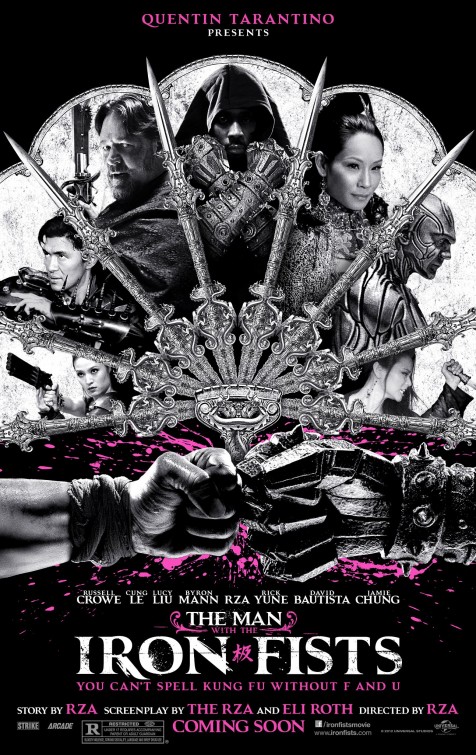 In my lifetime, I’ve developed a fine taste for schlock cinema. I appreciate a jolly good bad movie that knows what it is. With that said, when you’re bad at being bad, then that’s a special case of bad, and such is the case of the hip-hop martial arts junk that is The Man with the Iron Fists. It looks like the kind of campy schlock I’d eat up, and with Russell Crowe as a murderous lascivious scoundrel to boot. The problem with this movie is that it has hip-hop artist RZA as a writer and director. It’s not horribly directed but RZA doesn’t have a firm grasp on action, relying too heavily on wires and spurts of graphic blood. But where the movie completely misfires is with a script that feels cobbled together with subplots belonging to other movies. There’s a basic vengeance storyline, but the first hour of this mess is awash in confusion with a flurry of characters and storylines that fail to coalesce. It feels like everything is just rattling around waiting to be given greater significance. It has a few memorable moments but just as many tacky eye-rollers, like Crowe pulling out anal beads with his teeth. The Man with the Iron Fists just feels so flat overall, lacking a jocular tone or a distinct personality that would have given it a little life. I appreciate the detail that RZA put into his violent world, but I’d appreciate it more if he worked harder at developing a clear story that also was engaging. For all its exploitation elements and fantastic characters, the ultimate sin of The Man with the Iron Fists is that it’s just too boring for too long.
Nate’s Grade: C-
Share this:

Skyfall (2012)
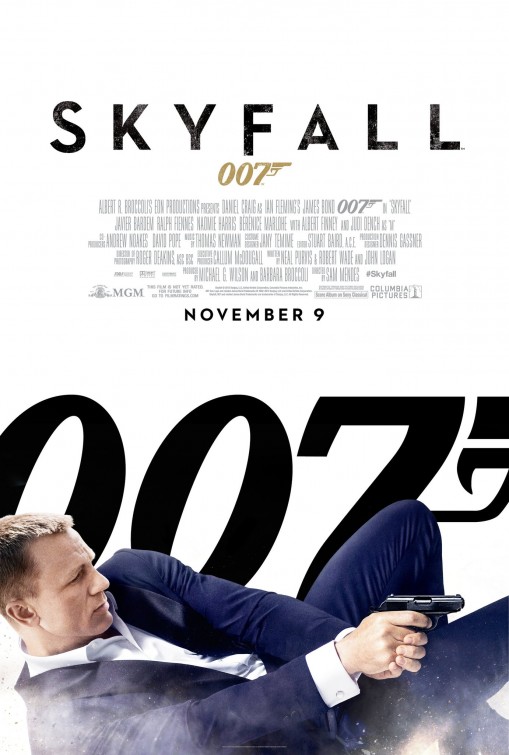 The James Bond franchise, one of the most enduring of all time, has been open to criticism since it came back in a big way with 2006’s Casino Royale. Fans have started to whine that the Bond movies are no longer the Bond they remember, and they’re probably right. In 2006, the producers decided to go back, reboot the series, and introduce a more grounded Bond, a man with more demons than quips. This backlash to a successful reboot seems so funny to me, especially considering the dubious nature of these older Bond movies. Can we all just take a moment and objectively admit that half of the Bond movies are absolutely awful? Skyfall is the third in the new Daniel Craig Bond era, and it’s received universally ecstatic reviews. It’s a fine work, surprising and satisfying in equal measure, but it’s no Casino Royale for me, but what can be?
James Bond (Craig) is recovering from a serious injury after a fellow agent, Eve (Naomie Harris), accidentally shoots Agent 007. In her defense, he was atop a speeding train battling a baddie and her boss, M (Judi Dench), ordered her to fire. In the weeks that follow, Bond is struggling to adapt. He’s lost a step physically and now has to deal with his own doubts. Naturally, this isn’t the most opportune time for crises of faith. MI6 is under attack by one of their own, a former agent turned powerful techno-terrorist named Silva (Javier Bardem). The man has a serious grudge against M and is exposing MI6 undercover agents to punish her. After an attack at MI6 HQ, the agency is left scrambling and sends Bond out to nab Silva, even if Bond isn’t physically ready to return to field duty. Silva is determined to kill M and destroy the agency that left him for dead.
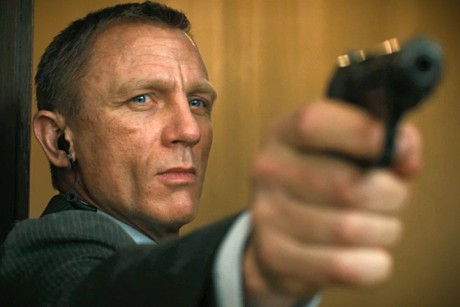 While Skyfall is indeed a good Bond movie and worlds better than 2008’s Quantum of Solace, it still cannot meet the rapturous applause it’s receiving among critical circles. It starts off strong with a nifty action sequence in Istanbul (the go-to action setting for 2012). Bond is chasing a bad guy, and we go from foot chase to car chase to rumbling on top of a speeding train. And there are natural complications that take advantage of geography! When Bond hops on the train, he climbs into a construction crane to fight back, smashing open the back of the train car. It’s a terrific opener that gets things starts briskly, and the sexual chemistry between Craig and Harris (28 Days Later) is palpable. Then the movie pretty much deflates in the second half. There’s a build-up to the villain and his master plot, but once that plot is revealed the film can’t live up to the hype. There are enough plot elements that feel important but eventually get discarded. Here’s a minor example: Bond is given a handgun programmed to his palm print, so it will only fire with Bond wielding it. It’s the only gadget in the movie, so you’d expect it to be utilized in a significant way. One nameless thug uses it then gets eaten by a Komodo dragon. That is it. Seems like an awful waste of funds for it to be thrown away so casually.
The last act has a protracted finale in Scotland, exploring Bond’s ancestral home and his tragic backstory. I’d like to think the insights we’re offered are important but I don’t believe they are. Bond was an orphan (the best recruits, says M) and Albert Finney (Big Fish) was his quasi-father figure/caretaker. It’s not enough to compensate for the slack pacing and encroaching boredom present. The good guys are holed up in an estate, waiting. And that’s what you want in a Bond movie, let alone any action film, for the heroes to sit and wait. An action movie should be building to a climax of intensity, thematically as well as plot-wise. Skyfall is that rare Bond film that flirts with coming undone; each passing action sequence seems less interesting than the one before.
With Mendes directing and Roger Deakens, the greatest working cinematographer, at his disposal, this has to be the best looking Bond movie. The shot compositions are often stunning, making fine use of the visual space and the balance of light and shadow. There are even some shots that might remind you of Mendes previous films like American Beauty or Road to Perdition. Added with some above average action, it makes the thrills an even better sight. There was a fight sequence in a Chinese high-rise almost completely in unbroken silhouette, with the neon tentacles of advertisements dancing in the background. It’s a wonderful image. Even when the movie was losing me at points, I could at least admire the visuals. I was worried that Mendes would not have a deft feel for action. After all, another indie director mostly known for dramatic work, Marc Foster, helmed Solace. That selection did not work out so well, though the script was notably weak. Mendes, on the other hand, can stage some pretty exciting action sequences with judicious editing, allowing the audience to follow along with ease. He’s not exactly a knockout when it comes to constructing action sequences, but the results are more than adequate for a guy whose last two movies were Away We Go and Revolutionary Road.
For the previous Craig entries, it feels like the movies have borrowed more from Jason Bourne than Bond. They’ve gone for a grittier, darker, more realistic portrayal. Skyfall takes a very interesting angle with the character, showing a Bond coming to terms with his physical limitations. It’s a Bond that has to confront his most nefarious foe: aging. Mallory (Ralph Fiennes) tells the agent that the whole spy business is “a young man’s game.” In the old days, you needed men with lairs in volcanoes and giant doomsday lasers. Now you can send the world into irreversible chaos with a laptop. Skyfall is at its most engaging when it confronts the old world of spies and the scary new world of technology. Can the Queen and MI6 compete or will they be left behind? Bond and his organization must confront their limitations and mortality, and this added dimension of vulnerability makes the series far more emotionally resonant.
 Here’s my main problem with the villain: it’s a bait and switch affair that leads to unfulfilled potential. Silva has been spoken of with such awe, a man who could bring governments to their knees with the click of a button. He’s made out to be this dangerous cyber-terrorist genius. So what happens for the second half of the movie? He chases people around and shoots guns. It’s like Skyfall completely forgets what made their villain special. Bardem gives a flamboyant performance with an extra dash of actorly nuttiness, but it’s nowhere near the memorable menace of 2007’s No Country for Old Men. That’s an unfair comparison, I know, but where the movie really starts losing it is when Silva loses it. He becomes just another garden variety psychopath, though one with a creepy oedipal complex. Psychopaths do not work in the James Bond universe. Agent 007 needs a foil that is smart, not crazy and a mad genius rather than mad. I recognize that Silva’s psychological shambles is meant to be a sign of the potential fate of all agents, let alone agents that are given up by M. That doesn’t mean you abandon all the traits that make the villain who he is. The problem with Silva, despite a rather jarring monologue about the effects of surviving a cyanide capsule, peaks with his first appearance. He has a grand entrance and places Bond in a very precarious position, forcing him to confront his physical failures. That’s the villain I want to see. And the awkward handsiness of Silva will also lead many to question whether he’s gay, which wouldn’t matter if the movie wasn’t so clunky.
It also feels like Skyfall may be the conclusion to this incarnation of Bond. I know Craig has been signed for two more films, and that’s great news as he’s fully made the character his own at this point, but the movie seems to setup the Bond we’re better acquainted with. We started from scratch with Casino Royale and now the familiar world, with the reemergence of familiar characters, is coming into focus. The scenes with the new Q (Ben Wishaw), a gangly whiz kid, are enjoyable and they contribute thematically to the old vs. new/age vs. youth conflict at heart. This feels like a transition film, meant to pass from the bruising realism into the polished pyrotechnics of the franchise’s past. There’s a reason the famous gun barrel shot happens to conclude the movie, because by the end of those 142 minutes, it now feels like the formation of James Bond has completed. There are also plenty of in-jokes and references for Bond aficionados to lap up. Even the (lackluster) title song by Adele is in the vein of the old Shirley Bassey numbers.
While not living up to the exultant hype machine, Skyfall is certainly a good Bond movie, though not nearly good enough to be in the conversation of the best. The action starts strong but is prone to diminishing returns especially as the movie transforms into a more ordinary action thriller. The most memorable sequence is in the opening, which isn’t a very good sign for the rest of the movie. It’s still a suitable action movie, and one that pays closer attention at character for a character that’s lived for 50 years in various film incarnations, but just because it pays more attention to character doesn’t mean it does it well. Perhaps I’ve just become spoiled after the artistic and commercial heights of Casino Royale. This is still an entertaining movie that often looks great and has some great actors doing suitable work. We’re still far and away from the loonier Pierce Brosnan episodes, so there is that. I imagine audiences will be more favorable than I am and make Skyfall the most successful James Bond film in history. That’s fine because it feels like, with everything established, that we’re about to hit a new and exciting phase with Craig’s version of the character, and that will leave me shaken and stirred.
Nate’s Grade: B
Share this:

Seven Psychopaths (2012)
 Writer/director Martin McDonagh only has one movie to his name but the man has already accrued legendary status in some circles. The 2008 dark comedy In Bruges didn’t create much of a blip at the box-office, but its blend of absurdist comedy, dark drama, shocking violence, and languid contemplation found a rabid cult following. I have several friends who regard In Bruges as the best film of 2008 (WALL-E still reigns supreme for me but I quite enjoyed In Bruges).McDonuagh’s latest, Seven Psychopaths, reminds me of Barton Fink: both are about struggling writers, both are satires of the film industry, and both have sudden splashes of violence and a serial killer who pushes the protagonist to artistic completion. In other words, Seven Psychopaths is a fun film and a great time at the movies.
Marty (Colin Farrell) is experiencing some killer writer’s block. He’s stuck on his new screenplay titled “Seven Psychopaths.” His buddy Billy (Sam Rockwell) is eager to help out. The guys run afoul of another psychopath, mob boss Charlie (Woody Harrelson), due to Billy’s side business. He kidnaps rich people’s dogs and then his partner, Hans (Christopher Walken), returns them and collects a reward. Billy and Hans have kidnapped the wrong shih tzu, and now Charlie and his muscle is going to make them pay.
 The refreshing thing about the bloody, wickedly entertaining Seven Psychopaths is that it constantly surprises you. This is such a rarity with modern movies, particularly Hollywood movies that attract as notable a cast as this one. McDonagh is wonderfully adept at throwing narrative curveballs. There were a few surprises where I literally jumped in my seat. You constantly think you have the movie figured out, and then it goes down a different alley and becomes more interesting. One of the pleasures of having psychopathic lead characters is that they are impulsive and do not have to follow the normal purview of logical decision making. They might just call the bad guys and divulge where they are hiding. They can do anything at any moment, and part of that unpredictability is what makes the movie feel so electric, so creatively alive. I must stress that McDonagh surprises in ways that feel satisfying and yet believable given the world he’s concocted. Part of the fun in the first half is just figuring out who the seven psychopaths will be. It’s not like it’s some laconic chamber piece mystery but the psychopaths are an eclectic mix from the real to the fictional to real characters doubling as inspiration for fictional ones. I think in the end there may only be six psychopaths, unless McDonagh is counting himself amongst the numbers.
McDonagh also has a blast deconstructing the very kind of movie that he’s providing. Marty bemoans writing another rote psychopathic killer movie where the violence is fetishized and the bad guys are mythologized into idols. You think the film is headed in one direction, in the Guy Ritchie-style standoffs and shootouts, and then it takes a less traveled path, one where it criticizes these sorts of movies and ponders existential questions about the nature of self-expression and death. It began as a care-free movie about thugs and writers and transformed into a movie that manages to have something to say about life, philosophy, and the cyclical nature of vengeance. Two of our three main protagonists are pacifists and remain so to their imperilment. At one point, a character narrates how this story as a proper movie would end, and it covers all the nihilistic clichés of vengeance and epic body counts. But then Marty, and McDonagh as well, wants to turn away from the expected, from violence for the sake of violence, from the exploitation of stylized suffering. McDonagh doesn’t forget to entertain while he’s making you think in between those handfuls of popcorn. The female characters in the movie (Abbie Cornish, Olga Kurylenko) are generally wasted, in different senses, but McDonagh uses this as another charge against this type of film (a boy’s night out of carnage). This is an accessible movie that can be enjoyed on a whole other meta level. I loved the various gear changes. For me it took the pulpy action material and elevated it to another level of genius.
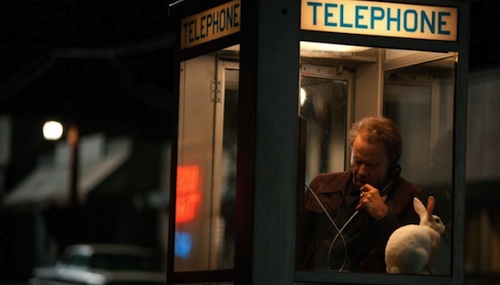 McDonagh still maintains his darkly sardonic streak of humor that made In Bruges such a riot. I was laughing throughout Seven Psychopaths; chortles, snorts, giggles, big belly laughs. With its heedless violence, obviously this will not be a film that runs on every person’s wavelength of funny. The very opening involves two mafia hitman debating whether shooting somebody in the eye takes actual precision or just dumb luck. It’s the sort of mundane conversation you’d see in a Quentin Tarantino movie, and also the precursor to something nasty and ironic. McDonagh’s sense of humor is similar to Ritchie or the Coen brothers, but the man establishes his own sense of wicked whimsy. The absurdist dialogue is always a hoot and can generate serious malice, especially when delivered by stern psychopaths. Rockwell (Moon) in particular is outstanding and delivers a virtuoso performance of the unhinged. The man just radiates energy. You’ll feel jacked up just watching him. I keep waiting for this underrated actor to break out with each star-making turn, and his comedic zing is played to perfection in Seven Psychopaths. In contrast, Walken (Hairspray) is rather reserved as he underplays his character, one of the saner men he’s played. It feels like the passing of the torch from the older generation of psychopath to the newer generation.
Being a colorful movie about colorful bad guys, and girls, you’d expect there to be some grade-A oddballs, and McDonagh does not disappoint. Some of the psychopaths in question have little bearing on the story plot-wise. There’s Zachariah played by the impeccable Tom Waits (The Imaginarium of Doctor Parnassus). He answers an ad that Billy set up for psychopaths to share their stories to Marty. His tale involves cross-country spree killing of serial killers, rabbit petting, and the love of his life, and partner in crime, leaving him. As far as plot, this little aside has little significance to the plot other than setting up a superb joke to end the movie with. But the character is so interesting, multidimensional, and played with equal parts aloofness and sincerity by Waits, that you can’t imagine the movie without him. Several of these psychopaths could have been the stars of their own movie, from the vigilante killing mob thugs to the tale of one father’s long path to vengeance. Even the fictional psychopath, the Vietnamese man (Long Nguyen) seeking vengeance against G.I.’s, could have enough weight to carry a feature film. The amazing part of the movie is that you don’t feel like any of these characters are shortchanged. McDonagh finds ways to emotionally ground his characters, allowing the audience to empathize amidst the bloodshed and loony characters. We care about Hans and his ailing wife; we care about the friendship between Marty and Billy. It’s real for these characters and so it feels real to us, despite the hyper-real flourishes of the movie.
If you’re a fan of In Bruges, or just dark comedies mixed with sudden violence, then you’ll probably find something to enjoy with Seven Psychopaths. You don’t have to be nuts but it helps. McDonagh has crafted another winner with sharp dialogue, a twisty plot full of surprises, incisive commentary on movies and movie expectations, as well as some sincere soul-searching and poignancy. This baby has it all, folks. Above all else, it’s just a blast of fun. the actors all seem to be having the times of their lives, notably Rockwell, and the morbid laughs and off-kilter thrills should cement another McDonaugh film for cult status. Seven Psychopaths is a palyful movie along the lines of Kiss Kiss Bang Bang and even Adaptation. It’s bursting with ideas and comments and jokes. when you leave the theater you almost want to get back in line and start the ride all over again.
Nate’s Grade: A-
Share this:

Taken 2 (2012)
 Taken 2 (no, Taken Again, or The Retakening?) follows the all-too familiar path for action movies when sequel digits get added to titles. They attempt to redo the original premise, but bigger and better, but rarely does it succeed unless there’s a fresh take. Taken 2 is reheated leftovers. The first film was a pleasurably surprising action film, led by a steely performance from Liam Neeson. Now Bryan Mills and his family are vacationing in Istanbul and they all get taken… again (or retakened). But what really kills this movie, besides the compilation of genre clichés, is that these are the dumbest bad guys I’ve seen in some time. If I were hiring these goons I’d want to see where their class rank was at Goon University, or if they actually completed their goon studies. These guys give new meaning to the term incompetent. They don’t search Bryan’s person, they leave him unguarded and alone, and naturally they even poke their heads through bullet holes in the wall, only to be shot in the face. When the bad guys are this inept, it removes all danger. Part of the enjoyment of Taken was watching Bryan work up the food chain to rescue his daughter. Now we just get Neeson too easily taking out the bad guys. The action is a bit too hectic and doesn’t have the same crackle that helped the first film.Then there’s the dumb plot, which is best exemplified by the rooftop grenade sequence. Bryan’s daughter (Maggie Grace) is running across rooftops and just randomly tossing grenades (vacation grenades?), so Bryan can hear the sounds of explosions and note how close she is. Except she never looks where she’s tossing, so she’s indiscriminately tossing live explosive devices on the innocent civilians of Istanbul. If there’s a Taken 3, I think one of these innocent Turkish families should seek vengeance. Oh but there’s more stupidity, like Bryan killing a corrupt Turkish cop and having no ramifications for this whatsoever. It’s never spoken of again. Or Bryan and his daughter crashing through the U.S. embassy’s gates in a car, and two minutes later he’s walking the streets with no hassle. To sum up: Bryan and family murder a police officer, throw grenades into the city streets, and crash into the U.S. embassy.Taken 2 is a classic example of sequel-itis, and while it tries to make you remember the parts you liked in the first film (Neeson on a paternal rampage, his speech), I just kept remembering how much better Taken was the first takening.
Nate’s Grade: C
Share this:

Looper (2012)
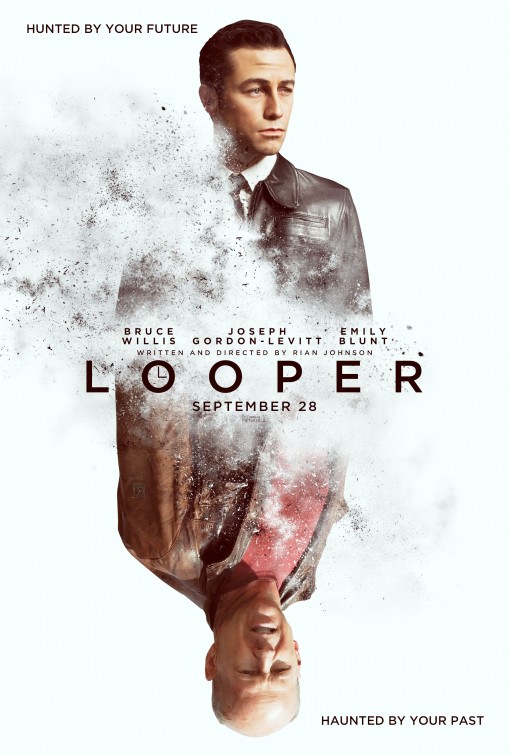 I became a Rian Johnson disciple the second that 2006’s Brick ended. I was floored by the originality, the artistic vision, the intelligence, and the creative voice. This was a unique filmmaker and I instantly knew this writer/director would be a man worth following. His follow-up, 2009’s The Brothers Bloom, was three fourths of a great movie, but a bit of an overdose on whimsy. Then I read that Johnson was next going to try his hand at time travel, and I could not contain my excitement. One of my favorite film genres and one of my favorite up-and-coming indie filmmakers together. I was expecting Johnson to do for time travel what he did with film noir (Brick) and the con movie (Brothers Bloom). How could Looper disappoint? Well, sadly, the movie found a way. It feels like Johnson smashed two halves of two different movies together, one good and one not so good.
In 2072, time travel is invented but instantly made illegal. The only people who have access to time travel are the mob. They have a surplus of dead bodies that need to disappear, so the mob sends them back 30 years. In 2042, Joe (Joseph Gordon-Levitt) is employed as a looper. He kills the guys the mob sends back in time and then disposes of the bodies. He’s paid well, and he and his fellow loopers live it up as privileged members of the Kansas City social sphere. Abe (Jeff Daniels) runs the show in town; he’s a mob guy from the future. There’s a catch to all the looper riches. The mob also wants to protect them in the future, so they send back the looper’s future self to be executed. It’s called closing the loop. And if you don’t kill your future self, bad things will definitely happen, just ask Seth (Paul Dano), a looper hacked apart to lure his future self back.
 The day comes where Joe is tasked with executing his future self, Old Joe (Bruce Willis). Old Joe escapes and goes on the run. Younger Joe is now under extreme pressure to kill his guy, or else the mob might just find him and start slicing body appendages. Old Joe is looking for the Rainmaker, who in 30 years will become a criminal tyrant responsible for much death. But in 2042, he’s only a child. Old Joe’s mission is to kill the child before he becomes the Rainmaker, and before he murders Old Joe’s eventual wife. While fleeing the mob, Joe takes refuge on a farm outside of the city. Sara (Emily Blunt) and her young son Cid (Pierce Gagnon) warily take in Joe but they’re also hiding a secret, that Cid has powerful telekinetic powers that can be put to great damage.
The film’s premise is compelling and allows for plenty of mind-bending possibilities, and Johnson has a fresh take on the sci-fi genre. Hunting down your future self is a grabber of a concept and I loved the scenes where Joe and Old Joe would sit down and converse. There’s the natural tension of Joe’s mission to eliminate his future self, but there’s also a flurry of ideas, ones that make the film better developed. Old Joe has an edge in foreknowledge but Joe has his own edge. He can change Old Joe’s memories by choosing different actions. He swears if he ever sees a picture of Old Joe’s wife that he’ll do everything in his path to alter fate, to make it so he never finds her. As a result, Old Joe is hobbled by headaches and fuzzy memories because the order of events is no longer concrete. “This time travel stuff fries my brain like an egg,” Old Joe admits. That, my friends, is a fascinating struggle for dominance and a refreshing take on time travel. Then you throw in the mob chasing after both Joes and you got an extra sense of urgency. Looper is playfully heady but easy enough to follow. It’s a thriller that doesn’t get bogged down in time travel logistics but it doesn’t pander to its audience either. If it did, I’m fairly certain Joe (addict, criminal, selfish) and Old Joe (eventual child slayer) would have taken turns to be more likeable. For a solid hour, Looper is alive with narrative jujitsu, a nice balance of action, drama, dark humor, intelligent plotting, stylish direction, the occasional startling visual, and strong acting from Gordon-Levitt and Willis.
And then the Looper becomes a completely different movie. Once the action shifts to Sara’s farm is where this movie completely unravels. I just couldn’t believe what was happening. The first half was so intriguing, intellectually stimulating, and thrilling, and then I got stuck on a farm and the movie turned into a lame version of Children of the Damned. I didn’t come for a telekinetic kid movie; I came for a time travel movie. The second half of this movie is practically wall-to-wall telekinetic kid stuff. The action slows down to a crawl and the flurry of ideas turns to a trickle as we introduce Strong Single Mom and Weird Son. I may have a cold heart but I didn’t care about these characters. I found the romance forced and Sara to be poorly developed. I found the kid annoying, and when he got mad and made his stupid mad face, it irritated me. Mostly I was irritated that the promise of the first half of the film had stalled out, and that this was where the movie was choosing to spend its dwindling time. It’s like the movie has been swallowed inside out by this stupid telekinetic subplot. The climax is fine but why did we have to travel through Dumb Farm Rest Stop to get there? Is it so that Joe can learn to be a better person? I didn’t buy that growth, especially with a kid as annoying and obviously dangerous as Cid. I suppose one night of sex with Emily Blunt (The Adjustment Bureau) could do the trick.
Besides the whole farm deal, there are other nagging questions I have that devalue Looper in my eyes.
 1) So in the future the mob is the only entity with access to time travel, but all they use it for is to dispose of bodies? That’s it? Biff Tanner used a sports almanac from the future to become king of the world. Are you telling me an organization that has historically profited from gambling would make no use of foreknowledge for personal gain?
2) Why would the mob have the loopers kill their older versions of themselves? This seems like a natural conflict of interest that could readily be avoided. Instead of having that particular looper kill his future self, thus closing the loop, why not assign that future version to a different looper? That way you don’t have to run the risk of the past looper letting his future self go. Or you could just never tell them what happened. For that matter, why does the mob have to send the guys back alive? Could they not simply just kill them and send the dead bodies 30 years back in time? This seems like an easier solution that also minimizes risk.
3) If you’ve just uncovered the power of time travel, why are you even bothering to send back your dead bodies 30 years into the past? Why not send your dead bodies back BILLIONS of years where the Earth is still forming, hot, and uninhabitable? I find this to be a better solution (I also wrote this solution in my own time travel screenplay, so there’s that too). Why can’t the mob feed dead bodies to dinosaurs? I’d love to see that.
4) You have a mob guy from the future, and you do nothing with that? Abe has one wisecrack about being from the future, and it’s a good one, but otherwise this guy could have just been from the present. The movie does nothing with the juicy element of a mob boss from the future. Maybe he doesn’t do as he’s told and arranges for his own rule. Or maybe he utilizes a sports almanac and makes some prescient bets, huh?
5) The movie takes place almost entirely around the confines of Kansas City. I find it hard to believe that a criminal organization would be sending all its bodies to Kansas City. Perhaps the mob also sends people across space and time, otherwise this means that we’re only following the future evil masterwork of the Kansas City mob.
6) I suppose you have to ask at what point do you really start to nitpick the whole butterfly effect of cause and effect paradoxes. With all time travel movies, there’s going to be some degree of suspension of disbelief, because changing one action can have wide-ranging consequences. However, with Looper there are several instances that gave me pause. Firstly, there’s the central idea of killing the Rainmaker as a child, which would negate the killing of the loopers, which would negate Old Joe seeking out the Rainmaker to kill. I’ll look beyond that. So Old Seth, in the film’s most horrifying sequence, starts noticing his fingers are disappearing, then his nose, and then his legs, etc. The mob is torturing young Seth to lure back the missing target. It’s an amazing visual sequence, but are you telling me that cutting off young Seth’s body parts would not have altered his future to a greater degree? I’m fairly certain when you start removing fingers and legs that Old Seth’s timeline would have been dramatically altered and he would cease to exist or follow the exact path to wind up in the past again. For that matter, why even bother luring the older Seth back? Could they not just take care of him by killing young Seth? What are they going to do with young Seth? If they’re just going to kill him then they should have just done that to begin with.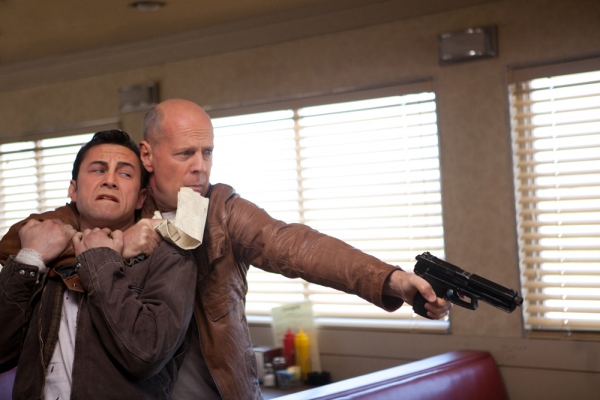
Johnson has plenty of thought-provoking questions he’d like to address within the bounds of a sci-fi action thriller. Would you kill a child if that kid were going to grow up and be a monster? Is redemption possible after doing horrible things? Could you kill your future version of yourself? Would you sacrifice everything to prevent future misery? These are legitimate questions and Looper deserves credit for spending time to ponder them, but I just wish Johnson could have gone back in time and chosen a different path.
Coming off of the stupendous Brick and the perfectly enjoyable Brothers Bloom, my expectations for Johnson’s third film were astronomical, especially given this crafty man’s take on time travel. I love the premise, love the actors involved, and love the ideas toyed around with, but the movie completely falls apart at the halfway mark. The pacing gets slack, the story becomes forced, and Looper transforms into a different, unwelcome movie. I can’t help but feel disappointed, partly from my expectations but also from the knowledge that Johnson could do better. The story just isn’t as well developed as it carries on, and the telekinetic subplot feels like a dull leftover from another movie. After an invigorating first half, Looper crumbles under the weight of a weak subplot that consumes the movie. There’s a good amount of thrills and intellectual stimulation aboard, but it’s all concentrated in the first half of the movie. I can’t recommend one half of a movie. I’ll still eagerly anticipate Johnson’s next project, but Looper is a sci-fi thriller that unravels at an alarming rate, turning a possibly great movie into a mediocre one.
Nate’s Grade: C+
Share this:

Dredd (2012)
 In 1995, Sylvester Stallone starred in Judge Dredd as the titular law enforcer. This big budget sci-fi action flick was goofy and violent and had the added punishment of Rob Schneider as pained comic relief. No wonder it failed at the box-office. I was never a fan of the comics so I can’t say how close the movie was to the source material, but given the presence of Rob Schneider, I’d say it’s doubtful. Because the 1995 film was such a flop, nobody wanted the rights to the character when they went back up for sale. That’s what allowed screenwriter Alex Garland (28 Days Later) to swoop in and write a new version. Dredd is an attempt to resuscitate a franchise that never got started. I don’t know if it’s particularly a good Judge Dredd movie, but as an action film it’s viciously entertaining and it has 100 percent less Rob Schneider.
Dredd (Karl Urban) works for the police of Mega City 1, one of the last metropolises of the irradiated waste land that is the United States. Crime has taken over and crime lords rule neighborhoods. Ma-Ma (Lena Headey) is the leader of a gang pushing Slo-Mo, wa drug that alters people’s perception of time. She controls the 20-story high rise that serves as her base of operations. Dredd is partnered with a young cadet, Anderson (Olivia Thirlby), who also has psychic abilities. She could be an asset to the force, but first she needs to be field tested. They get called to arrest Ma-Ma, but this prostitute-turned-ruthless drug kingpin isn’t going quietly. She locks Dredd and Anderson inside her high rise and orders her inhabitants to take care of the pesky officers.
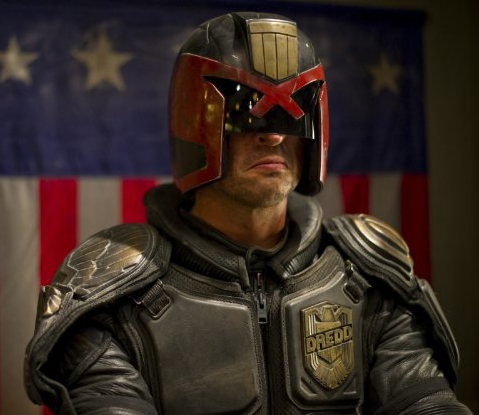 I had my doubts, but when it comes to action Dredd delivers. As soon as I saw the trailer, I screamed that this film was little more than a Hollywood remake of the awesome action film from Indonesia, The Raid: Redemption. The plots are identical but I’ll give Garland the benefit of the doubt that he came to his story independently. Whereas The Raid was heavy on martial arts and different fighting styles, and creative weapons, Dredd is really all about the firepower, the gunplay, the blowing up of material, the riddling of bodies with bullets. Each floor presents a new challenge and gives another opportunity for Dredd to outgun or outsmart the competition. This plot model feels like a video game come to life, clearing stage after stage, awaiting boss battles, collecting power ups. Readers will know I am not a strong believer that video games will ever give birth to a solid movie, but I’m ready to concede that this specific plot structure can allow for kickass action. The plot is simple but when given enough attention to geography and organic consequences, then great action can be unleashed, and Dredd is great action unleashed. It looks great, it’s constantly offering something new, raising the stakes, bringing in new elements to contend with, and it’s more than just things going boom. There are some genuinely suspenseful sequences to go along with all the stylish shoot-em-ups.
And the gunplay is vicious and bloody, reveling in the gory display of bodies being blown apart. There are slow-mo bullets traveling through people’s faces, all the better to see the care CGI artists put in to the gore. The ruthless violence is practically casual, and we’ll just see character walk by and fire into the backs of downed characters, giving us another explosion of blood to marvel upon. It would be really easy to call this movie sick, except it works so effectively as an action thriller that the bloody violence feels like a constant jolt. Our introduction to Ma-Ma is her hurling three men off the roof of her 2000-foot high penthouse, watching them splatter below. These are some nasty people and Dredd is dispelling some nasty justice, but because we recognize the antagonists are ruthless, and a real threat, then the violent dispatching of them doesn’t feel exploitative. It feels like keeping pace with some bad folk. Maybe that’s just a contrived way for me to justify that I found the brutish violence entertaining. Simple pleasures.
As far as a Judge Dredd adaptation, the Dredd elements almost feel grafted on, inconsequential. The screenplay could have been completely wiped of the Dredd elements and the plot would essentially be the same. It’s a dystopian world where crime has run amok and the police have resorted to become ruthless enforcers of justice. Dredd as a character, his worldview, his rookie partner who needs to prove herself on the mean streets, all of this is boilerplate cop movie stuff. It has some sci-fi stylizing but the content is still the same. I enjoyed the advanced gun that follows voice commands but nothing in the plot hinged on this element. Dredd just as easily could have been Cop #1 running from room to room, floor to floor, taking out the bad guys. So in this regard, Dredd works really well as a confined action movie but it’s questionable whether this is an effective adaptation of the comics.
 I’m surprised that with a drug called Slo-Mo that the movie didn’t make more use of this plot device. We get sequences of people blissfully on the Slo-Mo; the world looking like it was filmed through a glistening soap bubble. It’s neat but it can really become something cool for the sake of cool, ultimately superfluous except for a snazzy visual that plays into the 3D. It doesn’t appear like the drug lasts long either. But if time slows down for the people on this drug then wouldn’t you think somebody would want to make use of this when fighting Dredd? Perhaps it would sharpen their reaction time by making the world seem to slow to a crawl. However, if this is just an altered state of the drug, I think there could have been a fun moment where a Slo-Mo user tried to take on Dredd and we get differing points of view. For the user, time seems slow and they seem at an advantage. For Dredd, the user would just be acting slow and stupid. It’d punctuate the illusion of the reality-altering drug and explain why none of these gang members spark up before battle.
The acting in Dredd is competent and hardly dreadful (forgive me, it had to be done). Urban (Star Trek) goes the entire movie with his helmet screwed on. You never see the top half of the man’s face, presenting an interesting acting challenge (just ask Tom Hardy how tricky it is to act with your face obscured). The man has a permanent grimace carved into his face, grumbling his line throughout. Dredd is supposed to be a grim, no-nonsense enforcer. He’s not exactly got a lot of dimension to him. Urban inhabits the role well but you get the impression anybody could have been in that suit and the film would roughly be the same. Dredd also answers the question of what Olivia Thirlby (Juno) has been up to since 2008. She acquits herself well in all the bloody business and she’s not a bad blonde either. Headey has got the sneering villain act down cold thanks to TV’s Game of Thrones.
Dredd is your best bet when it comes to action movies right now. You’ll get the biggest bang for your buck. The action is brutish and routinely entertaining. It pulls no punches and the bloody melee is full of beautiful carnage. It’s a simple story with pretty simple characters and relatively shallow depth, but where Dredd succeeds is in execution. The emphasis is spent on constructing thrilling actions sequences that build, that change, that impress. It’s not for the faint of heart but for those hungry for a hard-R, bloody, sci-fi thriller, the likes of Paul Verhouven, then I suggest checking out Dredd. And you better hurry, because this version of Judge Dredd is also failing at the box office. Maybe Rob Schneider has been vindicated after all.
Nate’s Grade: B
Share this:

The Expendables 2 (2012)
 The Expendables was a surprise hit two years ago. Sylvester Stallone collected an all-star team of aging AARP action stars and they kicked ass, took names, and didn’t apologize. It was a fitfully amusing throwback to the burly, macho action movies of the 1980s and the early 90s, a time where many of these men were kings. The nostalgia trip worked box-office magic for Stallone. A sequel was commissioned and these men of action were put back to work. There was already preliminary talk about the possible stars that could sign up for a third Expendables (Nicolas Cage and Clint Eastwood are on a wish list). Maybe people should see The Expendables 2 before getting too excited plotting out the future of this franchise. This is not a good movie even by Stallone’s standards.
Barney Ross (Stallone) is back with the best team money can hire. No, not the A-Team, the Expendables. There are also the preposterously named team members Lee Christmas (Jason Statham), Ying Yang (Jet Li), Gunner Jensen (Dolph Lundgren), Toll Road (Randy Couture), and Hale Caesar (Terry Crews). The over-the-hill gang also has some new blood, namely Bill(y) the Kid (The Hunger Games’ Liam Hemsworth). The gang runs afoul with Vilain (Jean Claude Van Damme), a terrorist mining for plutonium to sell to the highest bidder. Barney swears to thwart Vilain and calls in help from other living action legends like Chuck Norris, Bruce Willis, and Arnold Schwarzenegger.
 What made the first Expendables enjoyable, at least for sustainable spurts, was its over-the-top nature comingled with a lack of irony. The movie felt often like a satire of the genre but you knew that Stallone was never winking at the camera. Stallone was never in on the joke. That changes with The Expendables 2, which often resorts to self-aware humor to poke fun at itself. This approach simply does not work. There’s an entire sequence where Chuck Norris even makes a Chuck Norris Internet joke, merging reality with irony. The bad guys are lousy shots and the good guys are the world’s greatest marksmen, but I don’t even know if this is intentionally self-aware or just par for the genre. Having Arnold repeat other people’s famous one-liners and quips (“Who’s next? Rambo?”) are not funny. The self-awareness never rises to the level of commentary or intentional satire, like say the underrated Last Action Hero. It’s just the same mindless violence but with the slightest of nods, the bare minimum to say, “Hey, we get it.” Except the movie feels shackled to this flawed approach and often the action fails to gestate into something larger than old guys shoot guns and make occasional wisecracks. The action sequences are really disappointing here. Little attention is given to geography, short of a climax set amidst an abandoned airport. I kept hoping for more of the gonzo, hyperbolic touches that the first film had in abundance. The best ridiculous moments this go-round are Van Damme roundhouse kicking a knife into a guy’s heart, and the piece de résistance, Norris shooting a guy onto an airport security conveyer belt where we then see the body full of lead on the x-ray machine.
Most of the Expendables teammates simply have nothing to do. Granted with a large cast the ratios of screen time are not going to be equal across the board, but I’d expect that Stallone and crew would at least give these people some reason to exist in the plot. Jet Li vanishes after the twenty minute mark and never returns. There’s truly no reason that Randy Couture and the great Terry Crews couldn’t have been Guy #5 and Guy #6. Lundgren is setup to be a chemistry genius, and then when trapped inside a mine, it looks like he’s about to utilize his chemistry knowledge to save the day. Nope. Then why would you even set this ability up if you weren’t going to do anything? Even Statham is pretty mitigated and he’s the number two guy. If you’re going to have a team-oriented action movie, then make use of the team and their unique skills. Part of the joy of these kinds of movies is watching the crew work together, like in The Avengers. With this film, we just get rapid-fire shots of the good guys shooting the bad guys, sometimes separately, sometimes together. It gets boring plenty quick.
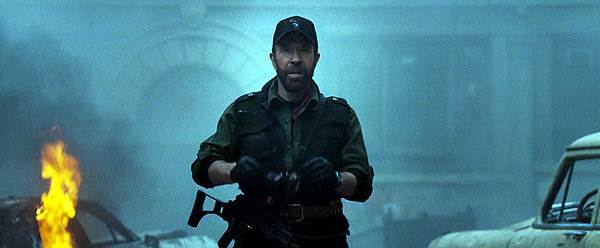 The plot is fairly bare-bones even more an action movie. It’s a rote revenge movie where Stallone and the boys are out to get Van Dame after he killed one of their guys (the only expendable Expendable, it seems). The plot never gets much more complicated than that. The gang encounters a group of terrorized villagers who want to rescue their husbands from Van Damme’s forced labor. Our bad guy even has a name that is a single letter away from spelling “villain” in case you needed the help. You know how he’s one evil man? He wears his sunglasses at all times even underground inside a mine. Of course this may also be a stylistic choice to hide Van Damme’s horribly Botoxed face. The Muscles from Brussels is actually the second best actor in the movie (Crews easily remains the best), good enough that I wouldn’t mind seeing the older Van Damme in more movies. Sadly his big showdown with Stallone is pretty short, with Van Damme resorting to the same roundhouse kicks before being subdued.
Stallone sat out the director’s chair and instead Simon West (The Mechanic ) takes the reins. I suppose this freed up Stallone to… focus more attention on the script? Emoting more? The visuals are fairly muddy and lack the polish of West’s other hyperactive action movies like Con Air. The opening assault sequence, where Barney and the Expendables roll through an enemy compound, literally busting through walls, is the visual highpoint for the movie. I credit the filmmakers for sticking with the R-rating and not toning down their violence. It would seem like hypocrisy to have a movie about a bunch of crusty old-timers lamenting how soft the world has gotten and then wuss out to a bloodless PG-13 rating. At least this wrecking crew doesn’t hold back when it comes to their specialty: mayhem.
The Expendables 2 should have been more than just Stallone and his peers patting themselves on the back. I’m glad Willis and Schwarzenegger graduated from cameos to supporting roles, but I wish the movie just had something for these men of action to do. There’s far too much repetition with its action, which becomes a formless montage of people shooting guns in slightly varying locations. The self-aware humor kills the development of the action and it’s simply not funny enough. It’s the kind of sad humor of old men trying to still look hip, like they’re in on the joke. Hey, they can make fun of themselves too. It’s just not a fun movie. There are only so many tried wisecracks you can endure, only so much redundant action, plotless excess, and crowbarred cameos. The Expendables 2 takes the little merits of the first film and completely loses touch, all to try and make a joke. In the end, the real joke is still on Stallone and the filmmakers. They wanted to make a movie that knew it was stupid. Instead they just made a stupid movie.
Nate’s Grade: C-
Share this:

Hit and Run (2012)
 Hit and Run was a labor of love for actor Dax Shephard (TV’s Parenthood). He wrote the script, co-directed the film, did plenty of his own car stunts, edited the film, and got his longtime girlfriend, the irascible Kristen Bell (Forgetting Sarah Marshall) to co-star as his love interest. I just wish the movie were better. It’s something of a strange mix, a road chase that zips along to loping comedic rhythms, spending as much time having characters engage in self-aware conversations about a variety of topics. It’s like a rom-com with car chases. Shepard and Bell are terrific together and have a natural comedic chemistry to them, an ease that befits both of their acting styles. Then there’s some of the more troubling comedic moments, like when the villainous Bradley Cooper (The Hangover) literally ties a leash around a black man and forces him to eat dog food. It’s one uncomfortable scene to watch. Then there are sudden bursts of violence and nudity, to go along with the bizarre conversational tangents. The plot is a loose collection of near-misses and digressive asides. It wants to be one of those 70s car chase comedies, something along the likes of a raunchier Smokey and the Bandit. This movie does keep you guessing, but it rarely adds up to anything worth all the trouble. Car enthusiasts will probably enjoy all the vehicular eye candy, and I’m happy to see Bell tackle a meatier role than she seems to be offered at this time, but I can’t work up more than a half-hearted shrug for Hit and Run. It looks good but just has nowhere to go.
Nate’s Grade: C+


 nathanzoebl
You must be logged in to post a comment.