Blog Archives
Iron Man 3 (2013)
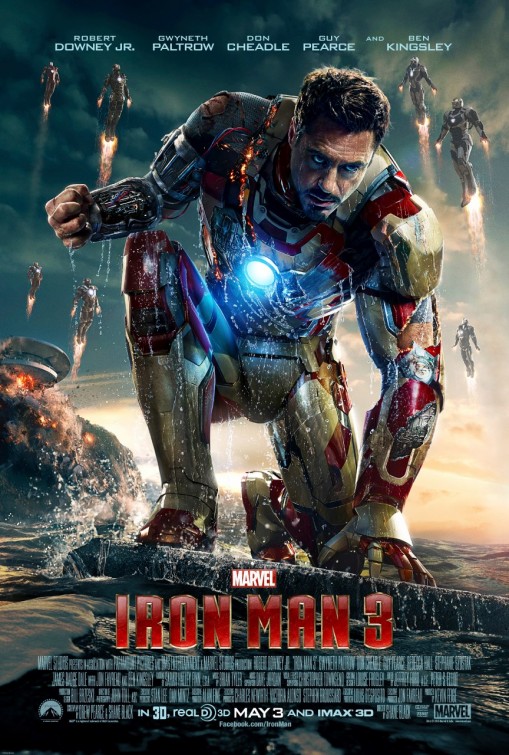 Third movies in superhero franchises always seem to be a precarious proposition; X-Men 3, Spider-Man 3, Superman 3, all graveyards of rushed productions, artistic compromises, and general complacency. Usually the third movie is when the hero has what he or she (but mostly he) has built up stripped down. It’s the same case with Iron Man 3, which short of a noisy finale has a surprisingly small amount of actual Iron Man, much like the scant amount of Batman in last year’s The Dark Knight Rises. That’s fine with me because the appeal of this franchise has been Tony Stark the character, not the mechanical heroics. Iron Man 3 is co-written and directed by super Hollywood scribe Shane Black, the man who gave us Lethal Weapon, The Last Boy Scout, The Long Kiss Goodnight, and the 2005 gem that resuscitated Robert Downey Jr.’s career, Kiss Kiss Bang Bang. It was this fact alone, especially after how disappointing Iron Man 2 was, that got me jazzed about a third outing. Black’s characteristic sense of humor, genre blending, and mass appeal thrills helps to make Iron Man 3 an enjoyable if flawed movie-going experience and a suitable kickoff to the summer movie season.
Tony Stark (Downey Jr.) is having trouble sleeping, haunted by the near world-ending events in New York City from his time with the Avengers. Pepper Potts (Gwyneth Paltrow), head of Stark Industries and Tony’s main squeeze, wants her man to take a mental health break. He’s spending as much time as possible in his lab, concocting a whole army of different Iron Man suits. His latest invention allows him to control a suit prototype with his body, compelling pieces of his amour to his person with a wave of his arms. He’ll need the help because the Mandarin (Ben Kingsley), a fearful terrorist leader, is staging a series of bombings around the United States, leaving behind videos taunting his foes. After an attack that hits close to home, Stark challenges the Mandarin and the bad guy brings the fight to the man of iron, decimating his home and forcing Stark to flee. In Tennessee, Stark unravels the mystery behind the Mandarin, which involves a brilliant scientist (Rebecca Hall), a nefarious biotechnology businessman (Guy Pearce), and even the president of the United States himself.
 The best part of the first film was watching a brilliant guy become Iron Man; sure the superhero stuff was fun but it wasn’t what made the movie special. Downey Jr. as a charismatic, egotistical, self-involved but ultimately redeemable middle-aged playboy is what made the movie special. With Iron Man 3, he has to rely on his wits for large portions, which are still considerable. It’s a clever way to make a billionaire playboy with out-of-this-world technology empathetic. He’s never going to be an everyman but that doesn’t mean we can’t empathize. With that said, I still find his whole PTSD ordeal after events from The Avengers to be shaky. He’s already had near death experiences before so unless we get a bigger explanation (proof of alien existence and superiority? Knowing a return is inevitable?) I find it hard to fathom that a guy as outwardly unflappable as Tony Stark would be hobbled by his super team-up activities. Also, now that we exist in a post-Avengers universe, wouldn’t the ongoing attacks by the Mandarin warrant some sort of S.H.I.E.L.D. response or monitoring?
Likewise, I really appreciated how Black developed his action sequences, routinely giving Stark limitations. The concept of a suit that can assemble by itself and fly hundreds of miles is silly, sure, but it also opens up fun possibilities and questions of identity. At one point, Stark has one arm and one leg of his suit, allowing him to fight back but having to get creative with his moves. A fight while he’s handcuffed also provides enjoyable thrills. During the home attack, Stark’s suit is a prototype and will not allow him to fly, so he has to get inventive, literally shooting a grand piano at a helicopter. The best action scene is when Iron Man has to save a dozen people from plummeting to their deaths after being sucked out of Air Force One in midair. I wish the solution hadn’t been so quick but it’s a thrilling sequence with terrific aerial photography.
Until the finale, which is all-robot action, you could accuse the film of being too shrift in its action sequences, rarely lasting longer than a few brief minutes. They’re still quite entertaining, and well directed, with Black nicely drawing out organic complications and making good use of geography. We know that Black can write a glorious action sequence, but unless you were one of the lucky souls who saw Kiss Kiss Bang Bang, it’s a surprise that the man can direct one so well. There’s a nice sense of style on display but it never becomes overpowering, and thankfully it’s presented in a manner that you can, shocker, tell what is happening onscreen. Black definitely has a good eye for visuals and scene compositions but he also knows how to deliver great crowd-pleasing moments that we want in our summer movies. The climax is pretty busy with lots of keen Iron Man suits that you just know are there to be purchasable toys first and foremost. The sustained action is pretty involving, and Black is an expert at establishing mini-goals and developing naturally. Even as it starts to devolve into a hectic video game-like frenzy, there are enough changing goals and reversals to keep you satisfied for the long haul.
The movie’s villains are somewhat nebulous and employ an Evil Plot that is too convoluted by half. The Mandarin is an intriguing figure but undergoes some changes that will surely leave fans of the comic steaming mad. I accept that movies are an adaptation from the source material, and have no real personal affinity for Iron Man or his rogues’ gallery, so I wasn’t bothered by the notable change. It fits the tone of the movie as well as becomes another plot point in a convoluted Evil Plot. I will agree with detractors on this point: after the invasion in The Avengers, alien technology, the source of the Mandarin’s powers in the comic, is credible. I don’t really understand the political commentary at play with the Mandarin either. More so, and I’m trying to be delicate with spoilers, Iron Man 3 is really a movie about Tony Stark versus… lava people. Sure they have superhuman brains that provide regeneration and superior human ability. It just seems that all these super humans decide to do is… heat things up. They glow red, melt through walls, and are essentially lava creatures. Apparently Tony Stark needs to take some cues from that old U.S. Marines ad where the guy fights a giant lava monster (“Have you been attacked by a lava monster recently? No? You’re welcome – signed, the Marines”). The villains, while weak, are still probably the best in the series. It’s been a fairly weak franchise for antagonists.
 Coming from Black, you’d expect an increase in the implementation of comedy, though Iron Man 3 probably walks just up to the line. It almost gets too jokey but pulls back enough. Adam Pally’s (TV’s criminally underseen Happy Endings) small bit as an obsessed fan of Stark is probably the testing point. Tony Stark has issues sure, especially if Disney will ever let the movies explore his history with alcoholism, but the man is never going to challenge Bruce Wayne for the brooding loner throne. Stark is a quipper, a loudmouth who uses humor as a weapon and a shield, and brought to vivid life by Downey Jr., the man will always be a comedian. That’s not to say that the drama lacks proper seriousness. However, Black pushes a lot more comedy into the film than we’ve seen in the earlier installments. Most of it is welcome and even when the movie goes into mass appeal mode, especially in Act Two when a plucky kid aids Stark, Black covers the familiar without losing his edge. You’ll likely recognize the buddy cop patter from Black’s other movies but it still works. There are several setups that look like we’re getting Big Hero Moments, and then Black decides to undercut them for a good laugh. Iron Man 3’s consistent sense of humor makes the movie feel even faster paced.
Downey Jr. (The Avengers) is still the MVP of the modern Marvel-verse in my eyes, and even two years removed from 50, he’s still got enough energy to power a small army. He’s still pulling the same schtick so to speak, which may wear thin for others after four starring appearances as Tony Stark, but I still find him naturally appealing. Paltrow (Contagion) gets a chance to do more than the standard damsel in distress that the women function in these movies. I regret that after being given a tantalizing new direction the movie reverts her back to standard damsel sidekick so speedily. Ho hum. Kingsley (Hugo) just seemed wrong for the part from the start, never mind the nebulous ethnicity issues. His vocal fluctuations and strange emphasis proved too distracting for me. However, he proves to be a better match after the Mandarin’s twist. Pearce (Lawless) is a pretty solid, smarmy bad guy and man has he got an impressive physique going on. It’s just nice to see great character actors from Hall (The Town) to Miguel Ferrer (Traffic) to Dale Dickey (Winter’s Bone) in a high-profile mega blockbuster. Even little Ty Simpkins (Insidious) is pretty good as the kid who helps out Stark. My tolerance for child acting has gone downhill as I have gotten older, but the kid is genuinely good without falling into the common trappings of being cloying or overly precocious.
Iron Man 3 is a definite improvement over the overstuffed, undernourished 2010 sequel. It ends on a moment that feels like something close to closure, but you know, as the credits helpfully indicate, that Tony Stark will appear again, at least in 2015’s Avengers 2. The bigger question is can this franchise exist without the participation of Downey Jr.? I’m sure we’ll all find out eventually considering the character is too profitable to simply retire once Downey Jr. decides he’s had enough. We’ve had five Batmans after all, not counting Adam West. However, never has a character seemed so intrinsically linked with an actor before. Downey Jr. just is Tony Stark, and while some capable young male lead out there in Hollywood will put up a valiant effort, it will never be the same. Iron Man 3 is further proof that the appeal of the franchise is not the explosions and action set pieces, which it does a fine job with; it’s the man inside the suit and the formidable actor that gives this franchise its juice. Spending more time with Stark is a bonus, and Black’s zippy sense of comedy and acute knowledge of the architecture of popcorn thrills allows the movie to fly by with ease. While the first film reigns supreme, Iron Man 3 is a fitting and pleasurable enough blockbuster that reminds you why we still love this guy.
Nate’s Grade: B
Share this:

Pain & Gain (2013)
 I think the audience for Pain and Gain is going to know exactly who they are, and I count myself amongst that number. The latest from director Michael Bay, often treated tantamount to Satan in many critical circles, has the based-on-a-true-story hook but really it’s the big stars, stylish violence, peculiar criminal antics, and overall overflowing machismo of the picture that will draw its audience. I knew after one watch of the trailer that I wanted to see it, though I was somewhat ashamed of the level of my interest (don’t want to taint your critical credentials with too much sympathy for the devil, after all). Pain and Gain is a trashy and entertaining jaunt, just as I hoped it would be, but it overstays its welcome and may leave you fatigued and possibly dejected (so… a typical Michael Bay movie? Still got it).
In 1995, three Miami, Florida goons enacted one of the most bizarre and sordid criminal schemes, a story that could supply a tabloid with enough juicy exposes for a year. Daniel Lugo (Mark Wahlberg) and his co-worker Adrian Doorbal (Anthony Mackie) are personal trainers at Sun Gym. Their days consist of pumping iron and hitting on ladies. One of Lugo’s clients is Victor Kershaw (Tony Shalhoub), a wealthy businessman with a nasty temper. Lugo and Doorbal, with the help of an ex-con and ex-junkie (Dwayne “The Rock” Johnson), kidnap Kershaw, hold him hostage for weeks, torture him, and eventually get him to sign over his assets to them. Afterwards they try to stage his “accidental” death, though like most things, it does not go according to plan. Penniless and broken, Kershaw seeks out help from a retired private eye, ED DuBois (Ed Harris), to provide validation for his case. The Miami police are laughing off his claims. Kershaw is concerned that the Sun Gym gang will strike again when their lavish lifestyle dips, and he’s right. Lugo and company get into even more trouble and the body count rises.
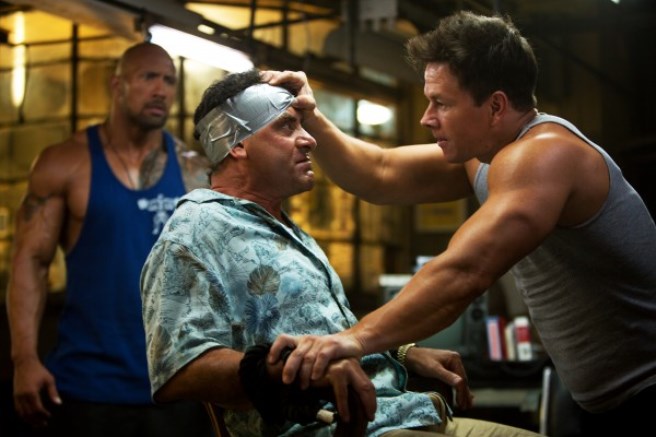 The results on screen are often entertaining in an over-the-top fashion, sustaining a rubbernecking captivation much like a horrendous car wreck. You just have to see how much crazier this thing gets, all the while muttering to yourself, “This was a true story?” It even gets to the point where the movie will remind you, via onscreen text as a man barbecues a batch of severed hands, that yes this is still a true story. Naturally there have been fictional inventions, character composites, and some details have been dropped to fit into the confines of a film narrative, but online research shows me that most of the larger plot beats are accurate, thus making the film even more compelling and disturbing. When the film is on, it feels manically alive with intrigue and absurdity. The problem is that it cannot keep this manic tone alive forever especially when actual innocent bodies start piling up (more on that later). There’s a certain uncomfortable tonal incongruity as the film develops and the comedy picks up a distasteful resonance. I love a well-executed dark comedy but just because something is macabre or unexpected does not automatically make it funny. Still, the movie has enough high-energy antisocial antics to keep you planted in your seat, laughing through bafflement.
Pain and Gain isn’t subtle in the slightest and yet it’s easily the most nuanced film of Bay’s career. Of course there are still the sleek cars, sexy babes, emphasis on style, and wanton destruction that are hallmarks of the man’s career, but the perspective is given a satirical prism, dropping us into the deluded, sub-American Psycho perspective of Lugo, a man with a very cracked view of the American Dream. The moral message reminds me of Marge Gunderson’s concluding musing in Fargo, telling a captured criminal, “There’s more to life than a little money, you know.” There’s some slight social commentary on wealth and the dirty tricks of capitalism, but really it’s the narcissistic delusions of a jacked-up criminal who believes he can succeed because he’s “seen a lot of movies.” You may even find yourself sympathizing with some of these knuckleheads, that is, until things get way out of hand. The screenplay by Christopher Markus and Stephen McFeely (Captain America: The First Avenger) is briskly paced and packed with bizarre details and even jumps into six different characters for voice over (Wahlberg, Johnson, Mackie, Shalhoub, Harris, and Bar Paly). For some characters it works as a great insight into their twisted logic but for others it’s just an easy set up for ridicule. The juvenile humor (did we really need a visual pubic hair joke?), candy-coated film palate, and sugar-rush, roid-rage plotting feel like a suitable match for the talents of the bombastic Bay.
The last thirty minutes of the movie will test your sensibilities of good taste. I’m all for having unlikable central characters just as long as the writer makes them interesting (what good is likeable but boring, the “friend zone” of characterization?). Some of movie history’s most fascinating characters have been scumbags and psychos. However, with that being said, I need my unlikeable characters to at least progress. When I’m stuck with a bad dude who keeps making the same bad mistakes, it can grow tiresome, and that’s where Pain and Gain ultimately lost me. Bay can’t quite keep up the charade of ironic bemusement forever, and a saggy second half starts to tread water, forcing the characters to act even more outlandish and inept. Did we need The Rock losing his big toe and then inexplicably giving it to a dog? It feels like the movie is filling time until the accidental murders come into being, raising the stakes. For a movie that’s 130 minutes, there should not be any need to fill time. During that long sad stretch, you start to feel disquiet, like the movie has lost its sense of perspective and the jokes have gotten too mean, too ugly, too outlandish. It doesn’t feel funny any more, and maybe that’s ultimately the point, but by the end Pain and Gain has soured. It overstays its welcome and then some.
 Its tone and connection to the real world raises an interesting and thorny question over whether something like this is appropriate. Should a story that involved the murders of innocent people end up becoming an over-the-top, stylized, lavishly glamorized Hollywood crime comedy? It has been over 15 years since the events of the Sun Gym gang, but is there a statue of limitations on good taste? Are we eventually destined for a vulgar film tackling the poor lives of the victims of 9/11? The answer is almost certain. What is off limits, or more pressingly, should anything be off limits to a comedic narrative? Is anyone really furious with Trey Parker and Matt Stone over their first film, Cannibal the Musical, transforming nineteenth century murder into song and dance? I doubt it, and yet there was something very off-putting about 2011’s 30 Minutes or Less, an unfunny comedy based around the true story of a pizza guy strapped with a bomb and ordered to rob a bank. The guy was blown to bits in real life (ha ha?). I guess I, as well as audiences, would have been more forgiving if the movie had been funny. I’m sure there would be fewer objections if Bay’s film had been more of a sober, contemplative drama on the sad acts of a bunch of desperate criminals, but with all the hyperbolic elements, machismo, and so-crazy-it-must-be-true plot turns, how could you turn this story into a serious drama? Not from the perspective of the nitwit criminals, at least. I don’t think the movie is ever positioning these guys as anti-heroes or excuses their excess.
Wahlberg (Ted) broke out as an actor thanks to a similar role as a wannabe star whose ambitions exceeded his grasp, and the man does dumb as good as just about anyone in Hollywood. It’s a specific kind of dumb, the angry, arrogant, pissy, self-involved kind of dumb that makes it acceptable to ridicule his character to no end. Johnson (G.I. Joe: Retaliation) gets to explore some interesting range as an actor, pacing around the demons of his character before just going hog-wild with the excess. Mackie (Gangster Squad) is arguable the most sympathetic of the group but also with the most to lose. Compared to his peers, he’s practically mild-mannered even though he takes injections into his penis. Shalhoub (TV’s Monk) is amusingly apoplectic and just enough of a jerk that you excuse his misfortune, at least for a little while. Ken Jeong (The Hangover) and Israeli model-turned-actor Bar Paly give the exact performances you would expect them to deliver. The best actor in the whole movie, though truth be told there isn’t a stinker in the bunch, is Emily Rutherford (Elizabethtown, TV’s The New Adventures of Old Christine) who plays Dubois’ wife. She has this calming, down-to-earth presence that seems to bring a small sense of peace to the madcap antics. She doesn’t have a lot of screen time but you’ll wish she had lots more.
Perhaps I’m being unfair to a movie that clearly isn’t intending to be anything but naughty, tacky, and gleefully excessive. In a way Pain and Gain reminds me of Tony Scott’s Domino, loosely based upon a true story but crushed to death by narrative kabuki and Scott’s characteristic excess. If I wanted to defend the much maligned Michael Bay, I’d argue what the real difference is between his excess and the excess of the more critically lauded Scott? Bay doesn’t have a slate of movies to his credit the likes of Top Gun, Crimson Tide, or True Romance. But isn’t flashy, artistic excess all the same when in the name of empty storytelling? Domino is also an apt comparison because it’s ultimately tiresome and far overstays its welcome, losing its audience with an endless array of odd sidesteps and moronic, deviant characters. While Pain and Gain has enough quirk and style to justify consideration, you may not respect yourself once it’s over.
Nate’s Grade: C+
Share this:

Oblivion (2013)
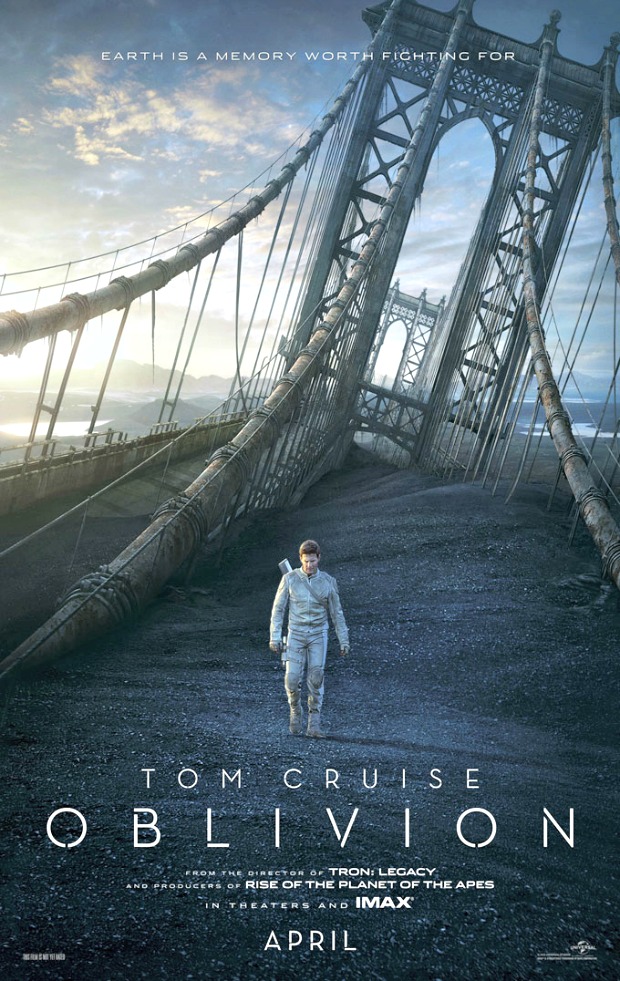 It’s late in the twenty-first century, decades after humanity battled an alien species in a war for the planet, and while humanity won the war Earth is desolate. The moon destroyed. The remaining members of humanity live on a starship around Saturn’s moon, Titan, and the oceans of Earth provide the energy resource. Jack (Tom Cruise) and Victoria (Andrea Riseborough) are the team stationed with repairing drones, the flying machines that protect the energy plants. There are still pockets of alien scavengers that need to be dealt with. Jack and Victoria make a great team, and dip into romantic companionship, until Jack meets a mysterious woman (Olga Kurylenko) professing to be his wife. Jack begins to doubt the purpose of his mission and wonder if the alien scavengers are the enemy.
If you’ve been keeping up with sci-fi cinema in the last couple decades, you’ll likely recognize more than a few elements with Oblivion. From its themes to its plot points to its revelations, there’s little here to designate as original. So the real question remains how derivative can we take? I think when the execution is nimble then it’s one of the easiest sins to remember. Especially in the realm of sci-fi cinema, it’s hard to put together a new story, let alone one set up as a Hollywood star vehicle, without borrowing from other established movies. This in itself is not an issue. Tarantino is a master borrower but he always recontextualizes his artistic influences into something new and different, and while we critics lament his less original career path of late, the man’s box-office profits have never been better in his career. I think when we feel like we’re getting a good story we don’t care when that story has been told before in other manners. Star Wars, after all, has many cultural fathers, but it was a rollicking good time with characters we cared about, so nobody seemed to mind. Likewise, Oblivion has many forbearers from Independence Day to I Am Legend to 2001 to an indie film from a few years ago I shall refrain from mentioning because even the very mention will spoil key plot points. Some will decry the film as a rip-off of superior, headier fare, but I never minded. I was having too good of a time and found the movie too satisfying to quibble.
 I won’t say the movie is smart per se but it’s far more measured than I would have expected. The advertising makes it look like Cruise fights a bunch of aliens and robots, and while there is that aspect, it’s almost an afterthought to a slow-burning mystery that patiently parcels out its revelations, even to the very end of the film. I’m trying to be cagey about certain plot points to avoid spoilers. It’s a film that has more on its mind than explosions, but when it goes into explosion mode, director Joseph Kosinski (TRON: Legacy) makes it count. The larger action elements are well staged and polished with some above average special effects. The sight of the moon dashed across the sky is definitely an evocative image. I love the overall look of the film, Kosinki’s clean, spare, bubbly Apple-esque aesthetics. The drones themselves manage to have personality even with a limited, streamlined design and some choice sound design. The man knows how to hold onto an image and when to keep pushing. The action is suitably thrilling and the drama suitably suspenseful. Actually, better than suitably. I enjoyed the details of this world. It’s probably the spiffiest post-apocalyptic landscape you’ll ever see. This is an entertaining movie that finds nice ways to satisfy, and given the particulars of its sci-fi plot, finds a way to have its cake and eat it too. As a result, Oblivion is a sci-fi flick that offers enough to engage the mind and audience demands for big effects and big thrills.
 I’ve never been a Cruise hater. I even thought the man tried his damndest to make a movie like Rock of Ages worth watching (a valiant effort but not enough). His character is pretty affable at first and we get to watch as everything he knows comes undone. It’s a role that would lead to overacting, but Cruise underplays the part, more alarmed naïf than flinty action hero. I’m not expecting Oscar-caliber performances in every role but Cruise does a fine job of anchoring the audience and selling his character’s journey. He also has good chemistry with not one but two ladies. Kurylenko (Seven Psychopaths, To the Wonder) is an actress of great beauty and questionable talent, but perhaps being paired up with a genuine star like Cruise brings out the best in her. They’re good together, though my preference was for Riseborough (W.E., Never Let Me Go), an actress who brings a tremulous vulnerability to an otherwise underwritten and confused character that’s more a plot device. Riseborough makes the character so much more than she is on the page. She’s still a relatively new actress so I look forward to her future performances. There are other familiar faces, like Morgan Freeman and an especially unsettling Melissa Leo, but it’s really a three-person acting exercise.
Oblivion is a visually alluring sci-fi thriller that also manages to have enough heart and smarts to leave a satisfying impression. The pacing is more deliberate but offers plenty rewards, doling out revelations up until the end, unpacking its mystery with finesse. The first twenty minutes or so, establishing the particulars of this world and the routine of our protagonists, is downright exceptional. The rest of the film doesn’t quite live up to that start but it continues to be an engaging and entertaining movie with some top-notch visuals. The musical score by electronic band M83 also provides a stirring counterpoint to the glossy, clean visuals (the band’s song “Outro” was also very effectively used in that lovely five-minute trailer for Cloud Atlas). You may figure things out as you watch, but you won’t mind, at least I didn’t. The more I step away the more I think back with renewed enthusiasm for the film. It’s smarter, slicker, and just a more satisfying film than we’re accustomed to with this kind of budget and from Hollywood.
Nate’s Grade: B
Share this:

Olympus Has Fallen (2013)
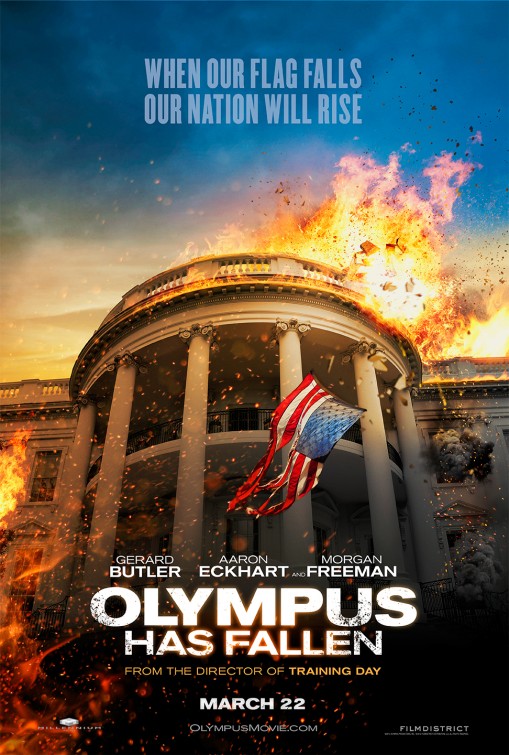 Remember in the late 90s when studios seemed to develop similar projects every few months? In 1997, we had two volcano movies (Volcano, Dante’s Peak), and in 1998 we had two animated bug films (Antz, A Bug’s Life) and two asteroid action flicks (Deep Impact, Armageddon). With the wealth of unproduced screenplays, there’s definite merit to different writers coming up with similar concepts independent of one another. Now in 2013 we have two action movies that, boiled down, are essentially Die Hard in the White House. The first out of the gate, Olympus Has Fallen, is an entertaining action vehicle that reminds me of the 90s Jerry Bruckheimer era of big explosions, big body counts, and irony-free pleasures.
Mike Banning (Gerard Butler) is a top Secret Service agent still reeling from his inability to save the President (Aaron Eckhart)’s wife (Ashley Judd) in a freak accident. He now provides security at the nearby Treasury Department, the President afraid to see Mike’s face and be reminded of his loss. Then one sunny day, a cargo plane fires on D.C. citizens, armed terrorists assault the White House, and North Korean nationalist Yang (Rick Yune) has taken the President and his cabinet members hostage. The Speaker of the House, Trumbull (Morgan Freeman), has ascended to America’s Commander in Chief and he has to navigate tricky issues like how to save the president. Luckily, they have a man on the inside. During the firefight, Mike scrapped his way inside the White House. Now it’s one man versus a bevy of terrorists and nationalists.
 The overall execution reminds me of the heyday of mid 90s action cinema, with its mixture of the ridiculous played completely sincere. It doesn’t really matter that North Korean terrorists are able to take down the White House so easily. Sure we can nitpick the very prospect of a large foreign aircraft getting so close to D.C. before getting intercepted, and only with two fighters at that. But if you can tuck away that nagging voice reminding you of the implausible nature of everything, then Olympus Has Fallen is a serviceable action thriller. Every fifteen minutes or so our hero has a new mini-goal to accomplish. It keeps things fresh and holds your attention away from analyzing the sillier elements (Gatling guns atop the White House?). The debut script by screenwriters Creighton Rothenberger and Katrin Benedikt follows the Hollywood blockbuster blueprint down to the smallest detail. Of course there’s another blueprint it mirrors, namely that of Die Hard. Beyond the premise of one man left to his wits in a hostage standoff, there’s also the moment where the bad guy poses as a good guy to the ignorance of our hero, there’s the failed outside tactical use of force, and the bond forged between the man on the inside and the link outside, whom isn’t given the level of respect deserved. That’s not just an application of the Die Hard premise to a new setting (like Air Force One or Under Siege), but a sampling of the very plot beats from Die Hard. Then again if you’re going to steal then steal from the best.
There’s a certain throwback bravado vibe going on here that makes it all easier to swallow. It’s got big silly action sequences and some in-your-face jingoism (a character, when faced with the notion of execution, literally starts reciting the Pledge of Allegiance), enough that Michael Bay would be misty-eyed, but treating the subject matter with such thoughtless swagger makes the reality easier to accept. Having D.C. attacked, civilians mowed down, national monuments crumbled, and the White House in ashes, well you’d naturally think back to the very real horrors of 9/11, and you may shudder. By embracing the implausible nature of the action and achieving a tone that prioritizes popcorn thrills, Olympus Has Fallen dances around pitfalls of exploitation and simply becomes another big, dumb, but enjoyable action movie. I say this without a hint of derision or irony.
I haven’t been a fan of Antoine Fuqua as a director. He can compose a good looking movie, but Shooter, Tears of the Sun, and King Arthur were enough to convince me the man could not properly stage exciting action. I think perhaps the limitations of the setup brought out the best in him because there are some genuinely gripping action sequences on display here. Also, the man does a fine job of establishing the geography of his action and presenting a surprising variety. Fuqua, aided with the shifting script, makes sure that the audience never gets bored. Sure there are storylines that don’t exactly work, like Mike finding the First Son, a character never heard from again, but the movie keeps changing shape, getting bigger, and finding enough satisfying payoffs. This is an effective, serviceable “turn off your brain” action movie, and it does enough right that you don’t fret about turning that brain back on until the end credits. The R-rating also ups the ante, providing bloodier and brutal escalation to what should be life-and-death stakes. If you’re going to give me “Die Hard in a…” then you best make sure your movie doesn’t wuss out. You’ll recognize plenty of action movie tropes and clichés, but the action is worthwhile and the plot constantly moving that you simply don’t mind.
 It’s nice to see Butler (Playing for Keeps) find a role that plays to his, admittedly limited, strengths. His character is your standard tough guy with a tragic past, haunted by the life he couldn’t save, looking to make amends and forgive himself. It’s probably the fact that the role has so little to it that Butler is able to slide effortlessly into gruff action star mode, a preferential place (though I prefer the man to be bearded as well). The rest of the movie benefits from actors who are far better than the material: Freeman, Eckhart, Melissa Leo, Radha Mitchell, and Angela Bassett. They all provide better-than-average performances for this type of movie. Even Dylan McDermott (TV’s American Horror Story) gets room to shine. Rick Yune (Ninja Assassin, The Man with the Iron Fists) makes for a very sinister bad guy. The part is Generic Antagonist #301, but Yune finds fun ways to enjoy the menace, soak it up without hamming it up. He transforms a generic villain into a dude you want to see righteously toppled.
After last fall’s updated Red Dawn (scrubbed free of invading Chinese forces) and now this, I must ask if North Korea has become the go-to military enemy for American action movies. Olympus Has Fallen takes the added step of never having the government of North Korea involved or approve, like the terrorists are acting on their own. We wouldn’t want to upset the government of North Korea; that’s what Red Dawn is for. But does anyone really view North Korea as a credible military threat? They are seen as a rogue nation, yes, and they claim to have nuclear arms, so they should be taken seriously, but does anyone realistically think we’ll wake up tomorrow and be conquered by North Korea? I suppose this criticism lies more with Red Dawn than Olympus Has Fallen, a movie that only needs a handful of dedicated foot soldiers rather than an invading army. I also find it laughable that the only thing holding back North and South Korea from war, in this fictional scenario, is the presence of about 28,000 U.S. troops. Also, if these events played out as they do, who doesn’t think that the U.S. would respond with military action against North Korea? We started a war with Iraq and they weren’t even responsible for the actions of a handful of terrorists. I guess the North Koreans are the new Hollywood Boogeymen.
With a hook of a premise, some exciting action, and more than a few borrowed plot beats from Die Hard, it’s still a pleasant surprise at how entertaining Olympus Has Fallen works. It’s a movie that simply does enough right to justify watching. Its action is good enough, its plot is familiar enough but offers enough forward momentum, its actors are good enough, and it does enough right to quell potential boredom. I appreciated its throwback feel to the mid-90s action movie, a time of elevated popcorn thrills and powerful bravado, all without a hint of irony no matter how ridiculous things got. It lands on shakier ground when it tries to become a rah-rah kind of patriotic rally, but I’d be lying if I denied the certain pleasures of watching a Secret Service agent take out the bad guys on his turf. Time will tell how the second Die-Hard-in-the-White-House movie will fare, but if you’re looking for big and dumb but enjoyable, Olympus Has Fallen is like a summer popcorn film only in March.
Nate’s Grade: B
Share this:

Oz the Great and Powerful (2013)
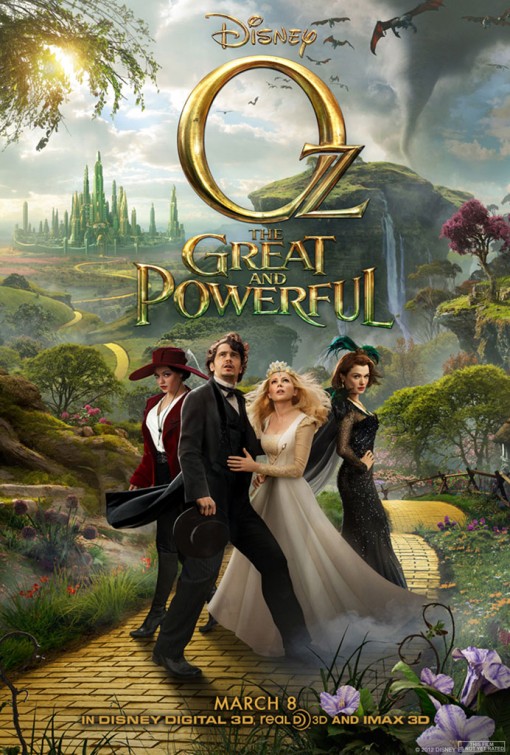 Usually when I’m watching a bad movie I have to stop and think where did things go so wrong, where did the wheels fall off, what choice lead to the disaster I am watching play out onscreen. In the case of Disney’s Oz the Great and Powerful, a Wizard of Oz prequel that pretty much hovers over the cusp of bad for its entire 130 minutes, I have to stop and think, “How could this movie ever have gone right?” I don’t think it could have, at least not with this script, this cast, and the edict from the Mouse House to keep things safe and homogenized, smothered in CGI gumbo and scrubbed clean of any real sense of venerable movie magic.
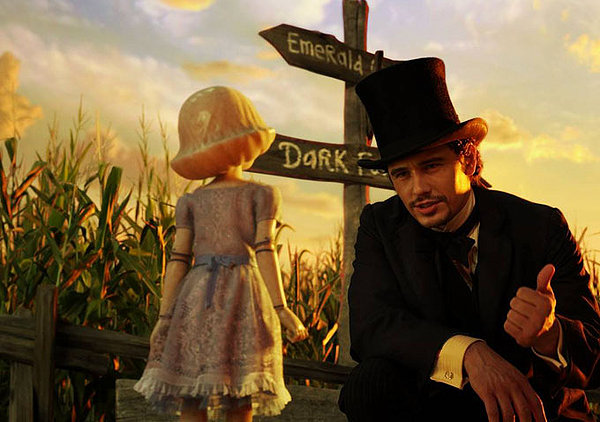
In 1905 Kansas, the magician Oz (James Franco) is used to bilking country folk out of their meager earnings. He’s a con man and runs afoul with a strong man in his own traveling circus. He makes a hasty escape in a hot air balloon and, thanks to a coincidental tornado, is whisked away to the Land of Oz. The people have long been told that a wizard would come and rescue them from the tyranny of the wicked witch. Theodora (Mila Kunis) and Evanora (Rachel Weisz), sisters controlling the Emerald City, task Oz with killing the other witch, Glinda (Michelle Williams). If he succeeds, Oz will become king and riches will be his. Along his journey he collects a band of cuddly sidekicks (flying monkey, China doll, munchkin) and learns that he may indeed be the hero that Oz needs to save the day.
 Oz the Great and Powerful is really just 2010’s Alice in Wonderland slapped together with a fresh coat of paint and some extra dwarves. I say this because, like Alice, this movie suffers from a plot that feebly sticks to the most generic of all fantasy storylines – the Great prophecy speaks about a Great savior who will save us from the Great evil. Naturally, the so-called chosen one has internal doubts about the burden they face, initially ducking out before finding that inner strength they had all long to prove they were indeed the one prophesized. It even got to the point where I was noticing some of the same plot beats between the two movies, like how last in the second act we spend time with a woman dressed all in white who we’ve been told is the villain but who is really the good guy. Then there’s the now-routine rounding up of magical creatures to combat the evil hordes in a big battle. Considering Alice was billion-dollar hit for Disney, it’s no surprise they would try and apply its formula to another magical universe hoping for the same results. Well I thought Alice was weak but Oz is even weaker. However, at least nobody absurdly starts breakdancing by the end. Small victories, people.
Beyond the formula that dictates the plot, the characters are poorly developed and broach some off-putting gender stereotypes. The character of Oz is portrayed as a scoundrel who eventually learns to be selfless, but I never really bought the major turning points for his character arc. Do all major characters need to be flawed men in need of redemption in magical worlds? I understand what they were doing with his character but I don’t think it ever worked, and certainly Franco’s performance is at fault as well (more on that later). The ladies of Oz, however, just about constitute every female stereotype we can expect in traditional movies. One of them is conniving but given no reason for why this is. One of them is pure and motherly. And then one of them gets lovesick so easily, falling head over heels for a boy in a matter of hours that she’s willing to throw her life away in spite. And all of these witches, who can actually perform magic unlike the charlatan Oz, sure seem like they don’t need a man to run the kingdom for them and tell them what to do. It’s sad that a conflict that involves feudal power grabs should devolve into a misconstrued love triangle. Then there’s the role of the little China Girl (voiced by Joey King) who adds absolutely nothing to the story except as another female in need of assistance and doting, except when she inexplicably behaves like a surly teenager in a tone-breaking head-turning moment. Oz keeps resting the very breakable doll on his shoulder, like a parrot. I suppose it’s better than tucking her in his pants.
The movie is also tonally all over the place. It wants to be scary but not too scary. Personally, I always found the talking trees to be spookier than the flying monkeys but that’s my own cross to bear. It wants to be funny but often stoops to lame slapstick and Zach Braff (Garden State) as a goofy flying monkey sidekick. It wants to be exciting but it never takes a step beyond initial menace. Its big climactic battle is more like a children’s version of something you’d see in the Lord of the Rings. The movie fails to satisfyingly congeal and so every set piece feels like it could be from a different movie.
 Some notable casting misfires also serve to doom the project. I like Franco (Rise of the Planet of the Apes) as an actor, I do, but he is grossly miscast here. He does not have the innate charm to pull off a huckster like Oz. Franco usually has an off kilter vibe to him, one that’s even present in this film, that gives him a certain mysterious draw, but he does not work as an overblown man of theatricality. Combined with lackluster character, it makes for one very bland performance that everyone keeps marveling over. It’s like all the supporting characters, in their fawning praise, are meant to subconsciously convince you that Franco is actually succeeding. Kunis (Friends with Benefits) is also a victim of bad casting. She can do the innocent ingénue stuff but when she (spoiler alert) turns mean and green it just does not work. When she goes bad she looks like Shrek’s daughter and she sounds like a pissy version of her character from Family Guy, which is ineffectual to begin with. Kunis cannot believably portray maniacal evil; sultry evil, a corrupting influence like in Black Swan, most definitely, but not this. There are lines where she screeches at the top of her lungs and it just made me snicker (“CUUUUUURSE YOOOOOOU!”).
I had faith that a director as imaginative as Sam Raimi (Spider-Man, Drag Me to Hell) would be a stolid shepherd for a fantasy-rich project such as Oz. I never got any sense of Raimi in this movie. It felt like he too was smothered completely by the overabundance of special effects. It’s a common complaint that modern movies are buried under an avalanche of soulless computer effects, but usually I find this bromide to be overstated. Having seen Oz, I can think of no more accurate description than “soulless computer effects overload.” At no point in the movie does any special effect come close to feeling real. At no point do you feel immersed in this world, awed by its unique landscapes and inhabitants (it feels often more like the land of Dr. Seuss than Oz). I chose to see the film in good ole standard 2D, though the 3D eye-popping elements are always quite noticeable. At no point do you feel any sense of magic, the most damming charge of all considering the legacy of Oz. The original Wizard of Oz holds a special place in many a heart. We recall feeling that sense of wonder and magic when we watched it as a child, the idea that movies could be limitless and transporting. While watching Raimi’s trip to Oz, I only felt an overwhelming sense of apathy that grew disquieting.
Then there’s the matter of the questionable messages that the movie posits. It celebrates the power of belief, which is admirable, but it’s belief in a lie. Oz is a fake, yet the movie wants to say that faith in false idols is something worth celebrating. Oz and his cohorts put together a deception to fool the denizens of the world into a false sense of security. Everyone believes in the Wizard of Oz so he has power but it’s all a sham. We’re supposed to feel good that these people have been fooled. Didn’t The Dark Knight Rises basically showcase what ultimately happens when a society’s safety is based around a lie and false idols? I understand that as a prequel one of its duties is to set up things for when Dorothy comes knocking, but do I have to be force-fed disingenuous moral messages?
Oz the Great and Powerful is a wannabe franchise-starter that feels like it never really gets started. There’s a generic hero’s journey, some underwritten characters, mixed messages, and poor casting choices, namely Franco and Kunis. The sense of movie magic is absent and replaced with special attention to marketing opportunities and merchandizing (get your own China Girl, kids). It feels more like the movie is following a pre-planned checklist of stops, cribbing from Alice in Wonderland playbook, and trying to exploit any nostalgia we have for this world and its characters. Except we love Dorothy, the Scarecrow, the Tin Man, the cowardly Lion, and Toto. I don’t think anyone really had any strong affection for Glinda or the Wizard. Just because we’re in the same land with familiar elements doesn’t mean our interest has been satiated. The Wizard of Oz backstory has already been done and quite well by the Broadway show Wicked, based upon the novels by Gregory Maguire. That show succeeded because it focused on the characters and their relationships (extra points for a complicated and positive female friendship dynamic). We cared. That’s the biggest fault in Raimi’s Oz, that amidst all the swirling special effects and fanciful imagination, you watch it without ever truly engaging with it. You may start to wonder if your childlike sense of wonder is dead. It’s not; it’s just that you’re old enough to see a bad movie for what it is.
Nate’s Grade: C
Share this:

The Watch (2012)
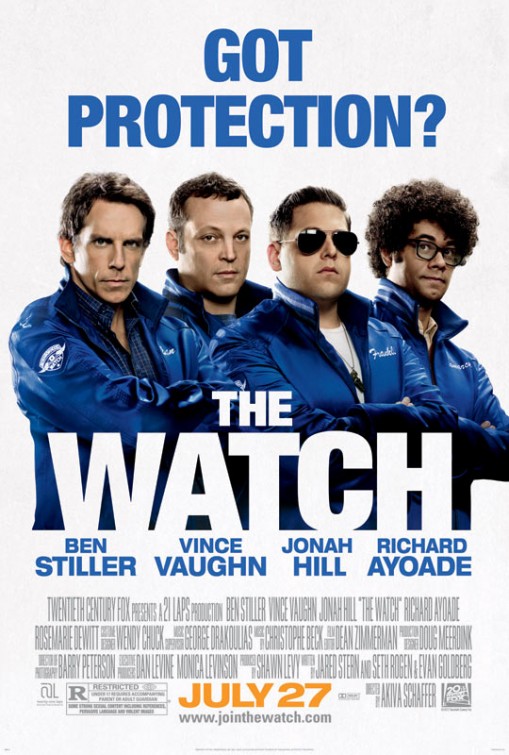 If scientists could take time away from, you know, curing diseases, and craft the perfect blend of “meh” in a lab, it would be The Watch. It’s not particularly offensive or terrible but it’s certainly not good. The humor of boys misbehaving and talking tough doesn’t ever seem to get further than the initial concept. The movie ends up becoming a more crass version of Ghostbusters, with a special fascination for the male member. This is a very penis-obsessive movie. Usually guy-centric sex raunchy comedies will definitely feature strong discussion/comedy revolving around male genitalia, but this is one of the few movies where complete storylines hinge upon penises (weird imagery, I’ll admit). Ben Stiller, Vince Vaughn, and Jonah Hill are more annoying than anything else. Poor Rosemarie DeWitt as the underwritten wife role in what is essentially a boys-behaving-badly movie (also her second 2012 movie where she’s trying to get pregnant). When the movie goes full-force into action mode, it loses just about any semblance of comedy. I laughed about three times, and that was thanks to Richard Ayoade (TV’s The IT Crowd) and, believe it or not, Will Forte (MacGruber). Sitting through 105 minutes with little laughs, irritating characters, and poorly conceived action in place of genuine comedic payoffs, well it’s not exactly a recipe for a successful summer comedy. And yet, with all its obvious faults, I couldn’t hate the movie as others have. It’s certainly not likeable but it does go about its business with a certain swagger, albeit misguided. Cocky loudmouths failing at entertainment are still marginally better than artists who don’t even try. It sounds like I’m reaching, and I am, but The Watch, certainly a bad comedy, may eventually be worth a watch when, you know, it’s on TV and you can half-heartedly pay attention to it while you go about your day.
Nate’s Grade: C-
Share this:

A Good Day to Die Hard (2013)
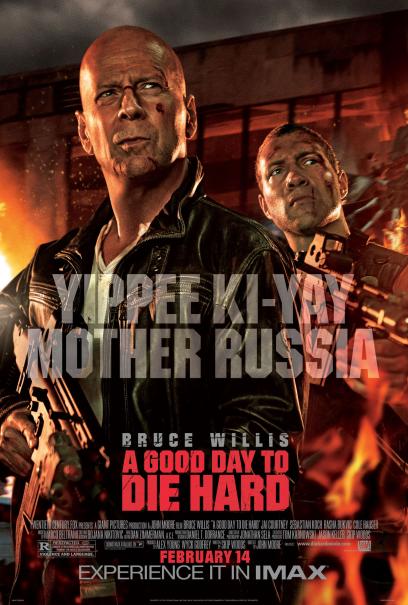 A Good Day to Die Hard, the fifth entry in the series, is clearly, on all fronts, the worst movie in the franchise. I suppose this shouldn’t come as that big of a surprise. Most fifth movies are not seen as peaks in creative achievement (I will go to my grave singing the praises of Saw 6, one of the few late sequel successes). I’m sad to report but Die Hard 5 is just a lousy action movie trying to get by on the good will of its famous heritage.
John McClane (Bruce Willis) is visiting Russia to find and help his estranged son, Jack (Jai Courtney). Dad thinks his boy is in trouble with the law but really Jack is a CIA agent working undercover to prevent a nuclear arms sale. A Russian political figure is promising to go public with his findings of corruption, and the man falls under the protection of John and Jack McClane. Father and son must dodge all sorts of danger and maybe, just maybe, they’ll bond over the experience of shared peril.
All of the story and character problems would have been forgivable, or at least mitigated, if this movie actually delivered the goods when it came to its action sequences. Sadly, Die Hard 5 is just thundering mediocre from start to finish. No, I take that back. In the last five minutes of the movie, it has one action development that is unexpected and interesting and different, and that’s when John McClane drives a truck out of the back of a helicopter to drag down the chopper. I repeat, this lone moment of action interest occurs with about five minutes left until the end credits roll. That’s a whole lot of gristle to get to something good. Until this point, Die Hard 5 is replete with car crashes and explosions and noisy exchanges of gunfire, but what does it all add up to? It’s like it has familiar action elements we’d expect in this sort of adventure, but it never seems to know what to do with them. Great action takes advantage of geography, moves the story forward, and escalates with natural complications. Most of Die Hard 5 is repetitious fights or shootouts in lazy locations (oh look, another warehouse-type building!). There’s a car chase through the streets of Moscow that should be exiting, but instead it just stays the same as it began. It’s two cars smashing into others. The final action takes place at the Chernobyl nuclear site, and yet it could have been just any other unwatched warehouse. I never thought I’d ever go to a movie with “Die Hard” in its title and be bored… by the action.
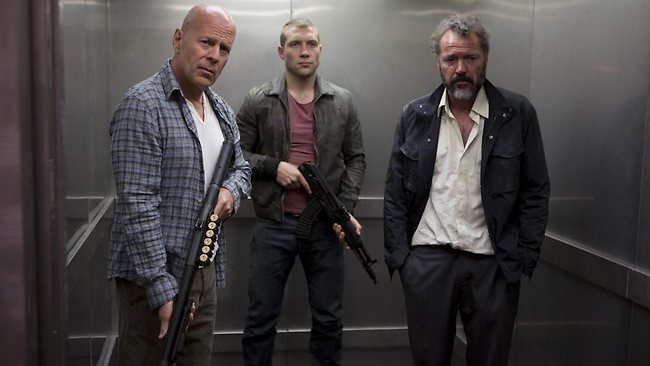 Here’s the deal: if you’re going to produce action sequences that don’t just stretch believability, they throttle it, then you better produce some memorable material. I long for the simply days of the original Die Hard where John McClane was a mere crafty mortal, confined to one location, using his wits, training, and stealth to turn the tables on the bad guys. He was an ordinary cop and that made him even easier to root for. Now he’s graduated to the Table of Indestructible Action Stars, men who can survive any scrape with barely a scratch no matter how improbably or death defying. I accept this change, but if you’re going to present larger-than-life action, you have an obligation as a filmmaker to make it entertaining. Die Harder had the man ejecting himself out an exploding airplane, and that was cool. Live Free or Die Hard had McClane driving an 18-wheeler along a collapsing highway, finally jumping onto a downed fighter jet. It’s completely over-the-top but it’s memorable and entertaining and, yes, cool.
The more I think back, the better 2007’s Live Free or Die Hard looks. It worked surprisingly well, well enough that I claim it as my favorite Die Hard sequel. First off, that movie had memorable action exchanges; I can still recount four or five sequences off the top of my head years later. Even if it was a standard fight between two characters, it found ways to make it interesting, like a fight between McClane and Maggie Q (TV’s La Femme Nikita) that extended into an elevator shaft and a falling auto. While Timothy Olyphant (TV’s Justified) couldn’t hold a candle to Alan Rickman (Harry Potter franchise) as far as movie villainy, the man was tremendously better than the pitiful bad guys in Die Hard 5. You have to let your villains have opportunities to be villainous, but they also have to be competent at what they do or else the movie is too obviously one-sided. Look we all know the hero will prevail but we like to see an even match for most of the running time. The Russian bad guys in this movie just suck. They suck and characters and they suck as bad guys and throwing twisty double-crosses and triple-crosses, just to keep an audience awake, make their master plan seem even more convoluted and implausible. All of this chaos is over a file whose possession, if I’m not mistaken by the needless confusion of the twists, resides with the villains for a good period of time. Why are they still going through this whole charade? Also, they suck.
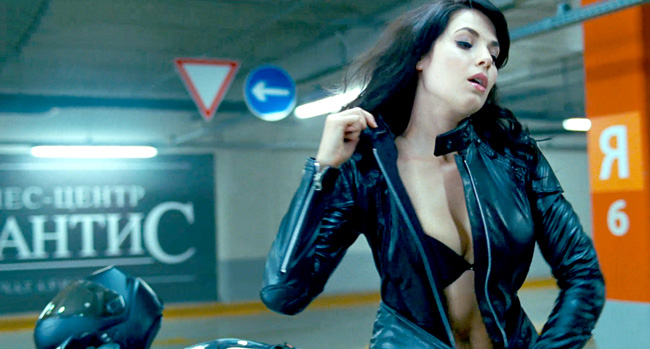
The idea of tagging McClane with his son seems like a weak attempt to extend the franchise beyond the ownership of an aging Willis. I don’t care about John McClane’s kid. This isn’t Roots. I don’t come to these movies to check up on the guy’s brood of feisty kids, which by the way, Die Hard 4 did this same storyline much better with his daughter, Lucy (Mary Elizabeth-Winstead). Jack McClane is a thickheaded dolt of a son, and as far as a charismatic action figure capable of taking over a franchise, don’t hold your breath. The father/son dynamic is so poorly developed. They mostly just grunt at one another and we call it characterization. Pairing McClane up with a sidekick has worked before but only when the characters are vastly different from the central man of action, like Samuel L. Jackson and Justin Long’s more comedic characters. They provided contrast and conflict and brought out different sides of the John McClane character. When you pair John McClane up with his son, who happens to be a younger version of his dad, you get nothing. I already got one John McClane onscreen; I didn’t need a watered-down, charisma-free clone. If they’re going to continue the franchise with one of John McClane’s kids, I pray that it’s the more assertive and capable Lucy.
A Good Day to Die Hard is just not a good movie at all, and it’s an even worse sequel. The fact that I endured 97 minutes of a Die Hard movie and had to scramble for anything positive to say about the action should say more than the problems with logic, plot, character, pacing, and overall production. Willis doesn’t even look like he’s enjoying himself any more. The film never grabs you, never bothers to show you something different, and after a while it simply just beats you into submission with its video game-like artificiality and redundancy. I demand more attention and care put toward my action sequences rather than treating them like a tossed salad. Sure the right elements are there but they’ve been given no thought or care. I was literally battling sleep during long portions of this awful movie. For fans of the series and Willis, it’s hard to settle on any other conclusion but one of disappointment. The story is muddled and generic, the villains are muddled and generic, the action is muddled and generic. You get the idea, and Die Hard 5 is routine to the point of autopilot, a soulless cartoon of careening bodies and speeding bullets. The only reasonable excuse I can give for seeing this movie, lowered expectations and all, is just to see how low the Die Hard franchise has fallen.
Nate’s Grade: C-
Share this:

Gangster Squad (2013)
 It’s hard to mention the action thriller Gangster Squad without a passing reference to the Aurora, Colorado movie theater shooting in the summer of 2012, the reason for the film’s five-month delay and reshot action sequence. Gone is a shootout at the movies and now we have a confrontation in the streets of Chinatown. I wish they hadn’t stopped there. If given the opportunity, and remember they did have an additional five months, I would have scrapped Gangster Squad almost completely and started fresh.
In 1949, former boxer Mickey Cohen (Sean Penn) has seized control of Los Angeles organized crime. His influence extends even into a police, which forces Chief Parker (Nick Nolte) to go to desperate measures. He asks Sgt. John O’Mara (Josh Brolin) to assemble a team of enforcers to fight back. They won’t have badges but they will be pushed to use whatever means necessary to carry out their mission, which means blurring the line between what is considered lawful. O’Mara assembles a super group of former officers and one of them, Sgt. Jerry Wooters (Ryan Gosling) gets into even deeper danger when he starts seeing Mickey Cohen’s main squeeze, Grace Faraday (Emma Stone).
This movie is like if The Untouchables and L.A. Confidential had an illegitimate child and then abandoned it in a sewer where degenerate hobos raised it. Gangster Squad rips off other gangster movies with liberal abandon that I can’t even begin to list the lifts. I’d be less offended if I felt that the movie had more on its mind than just replicating the tone and look of noir cinema. Actually, it feels more like what they want to replicate is the tone or style of the video game L.A. Noir.
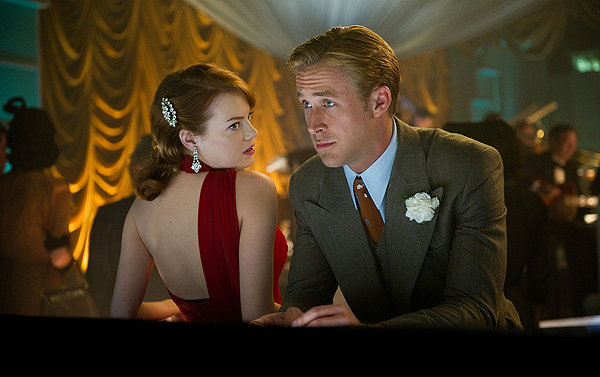 The main problem is that Gangster Squad really only has the skeletal outline of a plot. It’s missing any essential character and plot development. Here, I’ll summarize the barebones plot for you: Mickey Cohen is a bad guy. O’Mara forms a team. They have a montage taking out bad guys. Mickey takes out one of them. They have a showdown. That, ladies and gents, is it. There really aren’t any scenes that diverge from those scant descriptions. It felt like only five minutes passed from one of O’Mara’s guys getting killed (and just like The Untouchables, it’s the nerdy one) to them descending on Cohen’s headquarters and duking it out. Why does the film introduce the conflict of Wooters seeing Cohen’s girl if he never finds out? There isn’t even one scene presented to take advantage of this conflict. It just ends up being another half-baked plotline. It feels like the only development we get with Gangster Squad is through montages. What is also apparent is that O’Mara and his team really don’t have anything resembling the faintest notion of a plan. We watch them take out some bad guys via fights and shootouts but there’s no higher plotting to it. You get a sense that these former cops are just playing it by ear, looking for a fight every night. It’s hard to imagine that these people, even with their law enforcement and war experience, could be effective in the long term. Without any formative organization or greater planning, these guys just seem like dull bruisers bouncing from fight to fight with no sense of direction.
Then there’s the paucity of character work, relying solely on genre archetypes to do its work for the movie. O’Mara is the determined family man but his team can best be described by one-word classifications: The Black Guy (Anthony Mackie), The Nerdy Guy (Giovanni Ribisi), The Mexican Guy (Michael Pena), The Young Guy (Gosling), The Old Guy (Robert Patrick). That’s about it, though I suppose they do have different weapon preferences meant to supply all that missing characterization. Oh look, Officer Harris (Mackie) brings a knife to gunfights. That’s pretty much the beginning and end of his character. Wooters is so lackadaisical he feels like he’s on drugs, and Gosling’s soft-spoken, mealy-mouthed line delivery only adds to the effect. It feels like Gosling, in a stretch to find something interesting out of the mundane, said to himself, “I wonder if I could give a whole performance where I only speak under a certain vocal register.” Then there’s the woefully miscast Stone (The Amazing Spider-Man) as the femme fatale/mol to Mickey. I love Stone as an actress, but man-eater she is not and sultry seductress doesn’t fit her well either. Perhaps with the aid of a sharper script and a greater depth of character she could rise to the challenge. At no point does Gangster Squad really even attempt to make these people multi-dimensional. They never reflect on the moral turpitude of their own vigilante justice or the ramifications of their actions. There’s no room for ambiguity here.
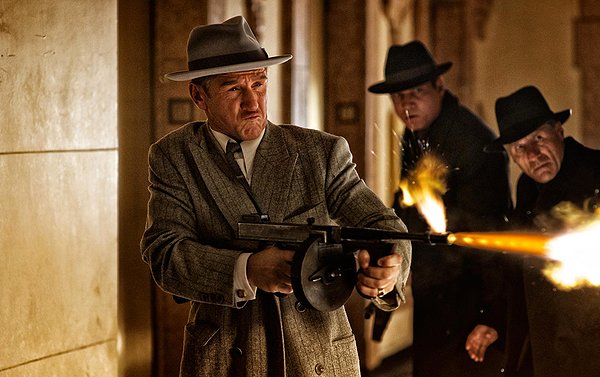 Finally, we must speak of Mr. Sean Penn (Milk). The man’s actorly gumbo goes into campy overdrive. In these rare circumstances, you aren’t watching Sean Penn Esteemed Actor so much as Sean Penn Human Vortex of Overacting. Normally I would criticize Penn for going over the top but over the course of 110 minutes, he single-handedly becomes the only entertaining thing in the movie. He’s chewing scenery up a storm, yes, but at least he’s channeling the pulpy silliness of the whole movie. I came to enjoy his antics and outbursts and thus became more empathetic of Mickey Cohen and his efforts than I did with O’Mara. Such is the danger screenwriters run when they spend more time crafting an interesting villain than a hero.
Gangster Squad is what happens when a movie is sold on title and genre elements. To be fair, it’s a bang-up title. The plot is half-baked at best, really only serving as a thin outline of a gangster movie, but instead of adding complexity and intrigue and characterization, they just ran with it. The actors are either camping it up or out of their element, the action and shootouts are pretty mundane, and the story is just uninvolving, even for fans of film noir like myself. It’s a good-looking film from a technical standpoint, but that’s as far as I’ll go in my recommendation (it could be an odd pairing with Milk considering the two shared actors). It feels like it just wants the setting elements of film noir, the atmosphere, and then figures just having good guys and bad guys shoot it out will suffice. That glossy, high-sheen period look just seems like a cool façade, and a cool façade seems like the only ambition of Gangster Squad. I can’t really recall any signature action sequence, snappy quote, plot development, or peculiarity worthy of remembering. It may be one of the most forgettable gangster movies Hollywood has produced.
Nate’s Grade: C
Share this:

Jack Reacher (2012)
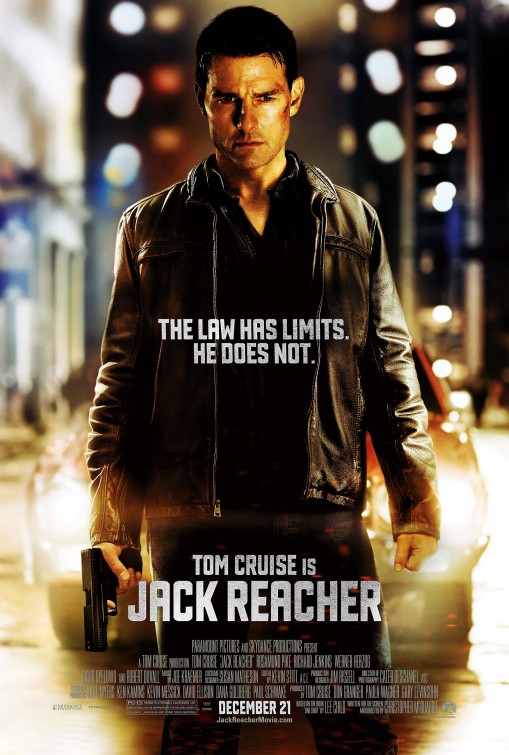 The Jack Reacher of the best-selling novels is a hulking, blonde haired, blue-eyed, 6’4” man of flinty justice. The Jack Reacher of the film of the same name is played by Tom Cruise, an actor who fits none of those descriptions. He is a movie star, however, and those are in short supply. The character is a former MP who operates like a drifter, leaving little trace, and inserting himself as needed to dispense his own sense of justice. The plot of the movie involves Reacher looking for a sniper responsible for a massacre, and hey is that German filmmaker Werner Herzog as the arch villain? Why yes it is. It’s a pretty standard mystery/investigation, complete with crooked cops and inept crooks. What elevates the movie is Cruise’s lone wolf intensity and writer/director Christopher McQuarie’s (The Way of the Gun) ingenuity with clichés. You’ve probably seen this sort of movie before, but McQuarie finds creative and clever ways to stand out, delivering a nifty car chase and a nifty escape as well. It’s just fun watching Cruise outfox his adversaries, via his wits or his fists. Where the movie becomes annoying is how it consistently has to remind you just how badass Jack Reacher is. At every turn, someone will say what kind of exceptional man he is, how he follows his own rules, etc. Reacher even gets the requisite “I’m not a hero so be afraid” speech. After a while, it just feels like the movie is overcompensating, trying to quell the irate fans of Lee Child’s novels who probably envisioned The Rock in Reacher’s shoes. Unlike Reacher the character, Jack Reacher the movie is not the best at what it does, but with a charismatic Cruise in control, it’s at least good enough to see once.
Nate’s Grade: B-
Share this:

Django Unchained (2012)
 It’s an understatement that no one makes films like Quentin Tarantino, though after Pulp Fiction it seemed like everyone was trying. The famous writer/director is an audacious filmic DJ, taking samples from all genres and mixing and matching them into a new and elevated form of art; he takes low-grade B-movie concepts and genres and turns them into highly literate A-class films. My only quibble is that, while I heartily enjoy the man’s unique efforts, I don’t know if we’re ever going to see a different Tarantino anymore. Since 1997’s Jackie Brown, he seems intent on re-imagining exploitation films and B-movies and putting his articulate spin on them. I have yet to dislike a Tarantino film (I rate Jackie Brown the lowest but that’s still an A-) and I’ll be first in line for anything the man attaches himself to as writer/director. Django Unchained is Tarantino’s ode to spaghetti Westerns, and it’s every bit as violent and tense and entertaining as you’d hope it to be.
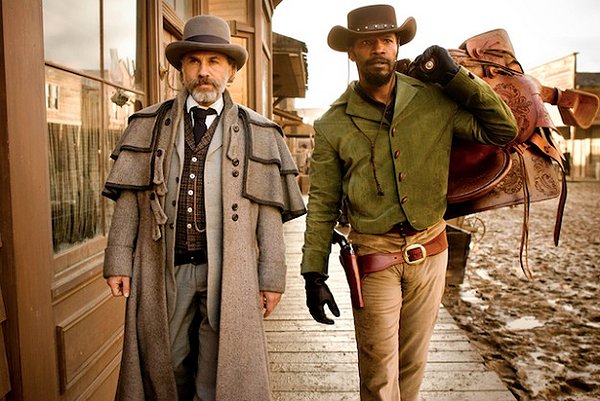
In 1858 Texas, an abolitionist bounty hunter, Dr. King Shultz (Christoph Waltz) frees a slave named Django (Jamie Foxx) and enlists his help in tracking down a team of outlaws. They strike up a mentorship, gunning down outlaws for money. “Kill white folk and they pay you for it? What’s not to like?” Django reasons. After a successful season nabbing bad guys and training Django in the ways of shooting, the men come to a crossroads. Django is looking for his wife Broomhilda (Kerry Washington). She was torn away from him and sold off to wealthy Mississippi plantation owner Calvin Candie (Leonardo DiCaprio). Schultz and Django cook up a scheme to rescue Broomhilda. Schultz will pose as a rich power player wanting to enter the “mandingo fighting” game (think savage gladiatorial combat). Django will play a black slaver, and expert when it comes to picking out prized fighters. With a generous offer, the two get invited to Candie’s family plantation, dubbed Candieland. Standing in the way of their plan is Stephen (Samuel L. Jackson), Candie’s head of the house. Stephen is deeply suspicious of their guests and ready to expose them for who they truly are.
 I’ve been dragging my feet writing a review of Django Unchained and I’m trying to determine why that is. Just after typing that sentence I spent 30 minutes checking my e-mail. I’m an avid Tarantino fan, so I’m left wondering what my hesitation is about. I certainly enjoyed the film, thoroughly, but perhaps my question is whether I should have enjoyed the film as much as I did given the historical reality of slavery. No movie will ever approach the true horrors of slavery; even the very act of owning another human is a detestable and crushing reality. Of course I’m coming at this movie from the perspective of a white male, so I feel like aspects of my commentary can only be minor. Is the backdrop of slavery too horrific for Tarantino to stage his spin on a revenge-filled Western? Spike Lee seems to think so via his critical public remarks. Tarantino has great glee in reveling in over-the-top movie violence, the kind that audiences (at least mine) cheer for. I guess the questionable angle is marrying the two realities and tones. You don’t want to take away from the brutality of slavery and at the same time you want to tell a compelling revenge-soaked thriller that satisfies with its buckets of blood. I’d say Django Unchained mostly finds the right balance to hit you in the gut one minute and the next have you clapping along.
It seems like the media is pressing every black celebrity for his or her personal thoughts on Django and especially Tarantino’s copious use of the N-word. Tarantino has gotten into hot water before with his penchant for the N-word, notably his own sequence in Pulp Fiction, but the N-word is entirely period appropriate for Django. Let’s face it, a majority of Americans, let alone Southerners, had really one word for slaves, and it wasn’t kind. This is the word that would have been uttered. However, after seeing the film a second time, I can see the complaints about the overwhelming use of the N-word. If you were to turn this into an awful and disrespectful drinking game, you’d probably pass out before DiCaprio even steps onscreen.
Like Inglourious Basterds, this movie is really a series of sit-downs that simmer with tension. The man has gotten so good with establishing the particulars of a scene, what the characters desire, and to push it to its breaking point when it comes to tension. While I don’t think anything approaches the highpoints of Basterds, this is still a movie that luxuriates in beautifully played tension and the danger lurking underneath Tarantino’s finely crafted words. And let’s talk about those wonderful words of Tarantino talk, the kind that seem so effortless to build sensationally interesting characters. The man sure enjoys writing his umpteenth variances on badasses engaging in verbal pissing contests (the literal kind are far less entertaining, at least for me). When you have character this sharply developed with such counter objectives, I could watch them duke it out all day. There are some pacing concerns with the movie, particularly once we get to Candieland, but when I’m engaged this much in a movie, I’d rather it go overboard than scrimp. Tarantino’s signature cool/funny/funny cool dialogue is alive and well. Every scene advances the plot, pushes it toward its bloody conclusion where bodies explode with sprays of red mist. It’s completely over-the-top in the Kill Bill vein, enough to draw snickers and laughter from a crowd, but Tarantino knows how to serve up a satisfying ending even with a body count to rival Hamlet.
 I don’t want to give the wrong impression that Django Unchained is deadly serious given the subject matter and historical context. I don’t think it disrespectfully sanitizes the horrors of slavery, but Tarantino’s brand of humor finds opportune moments to poke through. There’s a sequence with an early version of the KKK, a group of Southerners on horses arguing over whether they need to wear the ill-fitting bags on their head they prepared (plus Jonah Hill cameo). I was laughing so hard I thought people around me were going to shush me. It may well be the funniest thing Tarantino has ever written. There’s also natural humor to be had in the awkward handling of race relations, something that hasn’t exactly been perfectly ironed out to this day. A wealthy plantation owner (Don Johnson) struggles to explain how his slaves should treat Django, presented as a freeman by Schultz. “You want me to treat him like white people?” someone asks. This is followed promptly with a curt, “No.” There’s also plenty of gallows humor to be had with the over-the-top violence that pervades in the finale. It’s all key moments to blow off steam, so to speak, and make the film more bearable.
Django Unchained follows a traditional Western plot; in fact I’d say what we watch is essentially Tarantino’s whacked out spin on The Count of Monte Cristo (Alexander Dumas is even referenced in the film by name). Our lead character, Django, is in the Clint Eastwood mode of the strong and silent type. Schultz is the one who does all the talking while Django learns and glowers. They make a terrific buddy team and you almost wish that Tarantino had just diverged his story and allowed them to keep doing their bounty business. But Django’s wife needs some saving and that’s where the movie slows down. I wish Broomhilda had been given more character development. She’s pretty much the princess that needs saving, much like the German folk tale we learn is where Broomhilda gets her uncommon name. My sister described Django Unchained as a love story and I think that’s being a little generous (Tarantino did cut much of her torture, physical and sexual, from his script). We certainly feel Django’s desire to rescue her, and we worry about all the plot machinations and masks the characters must wear to accomplish this feat. With that said, the movie still has plenty of sucker punch surprises, much like Basterds, where violence erupts and despicable characters are given arias to illuminate the depths of their depraved worldviews.
I do wish that Tarantino had been a bit more judicious with his editing (the first without longtime editor Sally Menke who died in 2010) and curtailed all his self-indulgent meta film homage nods. We get stuff like Amber Tamblyn (The Sisterhood of the Traveling Pants) in one shot. Why you ask? See her father also stars in the movie in a small role, and he once played a character titled “Son of a Gunfighter.” So in his own credits, Tarantino lists him as “Son of a Gunfighter” and his daughter as, what else, “Daughter of a Son of a Gunfighter.” When all of that contorting is for an end credits gag and one shot in the whole movie, you feel like it was strictly masturbatory. Then there’s the original Django, Franco Nero, asking Foxx how to spell his name. Old Django asking new Django how to spell his name. I guess it’s supposed to be like a cinematic passing of the torch but it’s another moment that feels superfluous in a 165-minute movie. The movie can get a tad exhausting. The final 15 minutes, while still smartly written and boasting some terrific bloody comeuppance, feels like an add-on that wasn’t needed. It does manage to tie some elements back together but at this point the audience is ready for Django to ride off into the sunset, not have another obstacle to overcome in improbable yet badass fashion. At my first viewing, the kid behind me kept complaining to his parents that the movie had failed to end (“This is still going? It’s already been two hours!”). I also understand the fruitless and ironic nature of asking Tarantino to reign in his self-indulgences; that is, after all, what makes him who he is.
As expected from Westerns, the movie is a boy’s show. Foxx (Ray) has a steely screen presence that works very effectively for the character. The man’s quiet confidence and growing insolence play well, as he burrows into a role that boosts his confidence and assertiveness. Foxx’s journey from beleaguered and shell-shocked slave to mighty walking vengeance is definitely a full performance and one that Foxx delivers without any winks to the camera. Waltz (Carnage) will be dinged for playing a character similar to his Oscar-winning role in Basterds, but he’s still joyously entertaining, with that strange speech pattern of his that he plays like a musical instrument. He has a lot to say with plenty of theatrical flourishes, but that’s what makes him so entrancing. Simply put, Waltz and Tarantino are a match made in heaven.
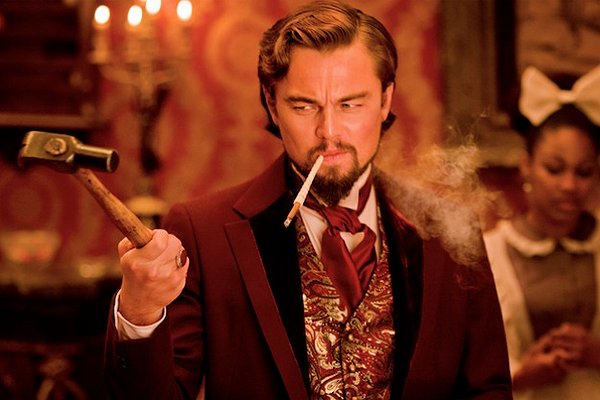
 DiCaprio (Inception) doesn’t appear until over an hour into the film but he’s worth the wait. At my first screening, I thought DiCaprio was good but was unimpressed. Upon a second viewing, I must say my appreciation grew for the man’s performance. Calvin Candie is certainly a vile man and DiCaprio is able to give him such an intriguing brio; he’s not the magnetic source of evil that Waltz was in Basterds, a man able to stay two steps ahead of his prey. Candie is easily taken for a fool. He’s not the smartest guy in the room but he can work up a pretty sizable fury; DiCaprio actually cuts open his hand during a confrontation and remains in character, undeterred. But the best actor in the movie is Jackson (The Avengers). There are far more layers to his head house slave than meets the eyes. It sure seems like he’s really the fist behind the glove. He may put on an act for company, but the man is far more calculating and sinister than anyone else in the film. You know he’s a good villain when the audience cheers the loudest at his demise (don’t act surprised, spoiler-phobes). I wouldn’t be surprised if Waltz, DiCaprio, or even Jackson get nominated for supporting Oscars.
It seems like Tarantino has also stumbled into a hidden lucrative subgenre at the box-office, namely the historical revenge film. Who doesn’t want to see a group historically shafted get some sweet revenge, the bad guys punished, and all with sparkling dialogue? In 2009, Tarantino went on a Nazi scalping spree and got to shoot Hitler in the face. With Django, a brutalized slave becomes the hero of his own story and kills some vile slave owners and traders. It’s essentially a Nat Turner-style rebellion from history, albeit with some harebrained scams and colorful characters. Following this lucrative model, Tarantino could take other maligned minorities and give them cinematic justice. Sadly, there are too many examples to count where Tarantino can take inspiration.
Django Unchained is a bloody, rollicking, talky, messy, exciting, surprising, uncomfortable yet satisfying movie and probably one of the oddest crowd-pleasers in recent memory. I saw it on Christmas day and my theater was a sell out. They loved it, soaking up every minute, laughing at the funny parts and wincing at the gruesome violence. I couldn’t think of a better way to celebrate the birth of baby Jesus. It doesn’t whitewash the evils and viciousness of slavery, but at the same time Tarantino knows how to serve an audience and their demands for big characters, big set pieces, and big vengeance. Django is a sturdy Western/blaxploitation film, and whatever other genres Tarantino feels like tossing into his cinematic blender. Whatever you classify it as, Django Unchained is another Tarantino original specialty and his tremendous talent comes through loud and clear, even with a few false endings and self-indulgences at play. It looks great, has a great soundtrack, and presents great acting talent reciting Tarantino’s great words like they were prized possessions. It’s a bit long and a bit overdone, but when you’re enjoying yourself, who wants to leave the party early?
Nate’s Grade: A


 nathanzoebl
You must be logged in to post a comment.