Blog Archives
Jason Bourne (2016)
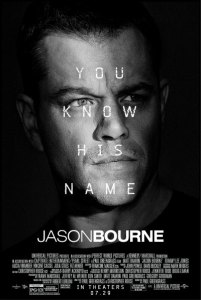 After the indifferent reception of its 2012 spin-off, original super spy Jason Bourne (Matt Damon) and director Paul Greengrass (Captain Phillips) are back and it feels like everyone is falling into familiar paces. The titular fourth film in the franchise (excluding Bourne Legacy) is easily the weakest (excluding Bourne Legacy) and the seams of the formula are starting to show. Once again an ally has intel to expose some sort of secret and illegal government conspiracy that ties into a revelation about Bourne’s past, and once again this ally is killed as the Act One break to spurn Bourne onward, and once again there’s a secondary assassin working for the morally murky government agency head, and once again there’s a signature car chase sequence, and once again there’s a final choice Bourne needs to make about what kind of person he wants to be given his new perspective on his old killin’ ways. The frantic Greengrass staple camerawork and editing can make just about anything bristle with some energy and suspense, but rarely was I fully feeling what was happening onscreen (except for the caveat of admiring how attractive Alicia Vikander’s face looks on the big screen). Short of the final car chase through Vegas with a SWAT truck barreling through traffic, the action sequences are pretty routine and unmemorable. The foot chases and fisticuffs, a hallmark of the franchise, feel slightly blasé in their development. The action isn’t bad but it feels more than a bit staid. The stakes aren’t as high and maybe that’s because it feels like there is little more to reveal about our hero’s hidden past. Is the next movie going to divulge the long lost secret that he never paid a parking ticket? Tommy Lee Jones makes an enjoyably crusty adversary. Vikander has just enough of an angle to provide more substance as a character than the typical agency analyst reciting exposition. The film ends with some promise of looking forward rather than back, and I hope that further adventures with Jason Bourne (excluding Bourne Legacy) stray a little more from the well-worn formula and provide better reasons for this spy to come out of his hiding.
Nate’s Grade: B-
Share this:

Ghostbusters (2016)
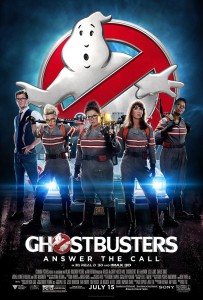 Growing up in the 80s, other kids had Transformers, or G.I. Joe, or He-Man, but I was a Ghostbusters kid. I fell in love with the 1984 original movie, slept below the poster for most of my childhood, and obsessively collected all of the action figures, watched with glee the animated TV series, and hold the world and its characters in a special personal place. The 1984 movie is such a perfect blend of buddy comedy, the supernatural, and action that nobody has really been able to fully replicate this special film alchemy as well since, including director Ivan Reitman (he tried in vain with Evolution). When the word broke that there was going to be a new Ghostbusters remake, some trepidation from fans could be expected. It’s sacred ground to many. Director Paul Feig (Bridesmaids) insisted that he wanted to have an all-female team of Ghostbusters, and that’s when the Internet lost its collective mind. The movie and its stars have been beset with hateful misogynistic (and, in the case of Leslie Jones, racist) harassment. The Internet didn’t want smelly girls playing with its toys. It became part of a larger war between feminists and retrograde men’s rights activist crybabies. Some people wanted it to be succeed just because of he gender of its leads, and others wanted it to fail for the very reasons. I just wanted a good Ghostbusters movie regardless of what bathroom the busters utilize.
Erin (Kristen Wiig) is an esteemed science academic trying to turn the page on her past. Her friend and fringe scientist Abby (Melissa McCarthy) has republished the book about paranormal they wrote together, which ruins Erin’s chance at tenure from her colleagues. Her ire is short-lived as Erin, Abby and her wacky nuclear scientist associate Jillian Holtzmann (Kate McKinnon) experience a real dead ghost. Their slime-filled encounter with the undead reawakens Erin’s love of the paranormal and the three of them join forces. Patti (Jones) is an MTA worker who leaves her job and joins the gals after her own experience with a ghost in the New York subway. Somebody is trying to open a portal between the living and the dead, and these Ghostbusters gotta bust some ghosts.
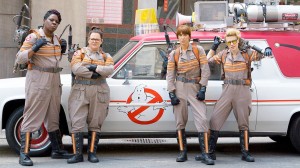 My initial apprehension melted away within the movie’s first twenty seconds when it already had me laugh out loud twice (“anti-Irish fence”). There’s a consistent genial absurdity that kept me engaged and entertained, and this is typified by the strong comic camaraderie of the four leads. I enjoyed spending time with these ladies and I enjoyed their interactions, so when scenes could creep up on overstaying their welcome from a pacing standpoint, something of a Feig staple, I gave them more leeway and felt my patience rewarded. I don’t know how to make it plainer than this: I am not a Leslie Jones fan and I liked Leslie Jones in this movie. I have found Jones to be all-too often on Saturday Night Live a one-note comic presence, always loud and brash and hitting the same joke again and again with little variation. With Ghostbusters, she actually plays a character, capable in her own right, and a straight man for the other characters. These women were goofy, gross (a queef joke within Holtzmann’s first appearance), but they also enjoyed one another’s company. There are internal conflicts, sure, but their enjoyment of working together, of displaying their know-how, of the joys of discovering the realm of the paranormal create a bond that helps seal the characters with the audience. Whatever the scenario, I was confident I would laugh from these characters, and I did.
There is a lightness to the movie that makes it all the more appealing, settling into pleasurable summer fare. This story is as much about the formation of the Ghostbusters as anything else. In the original film they just sort of have their ghost-busting gear all of a sudden. With the remake we watch the trial and error process of bringing all that tech to life. It’s a fun process to see their business from the ground floor, so to speak, and their fight for larger credibility. Murray himself even shows up as a paranormal debunker who scoffs at their claims. The ladies are the lovable underdogs in this world.
The real reason that Feig’s movies work is the interaction of his boisterous and often brilliant casts, and Ghostbusters is another example. Wiig and McCarthy have a natural chemistry together honed from Bridesmaids, and their back-and-forth banter will often find punch lines in odd places. McCarthy has always been her best under Feig’s direction (seriously go watch Spy if you haven’t). While Abby is a less outspoken character than we’re accustomed to from her, McCarthy still has a commanding presence and is the one who lassos the other funny characters back into a sustainable orbit (“You spell ‘science’ with a Y, and I don’t think you know that that’s wrong”). I’ve stated above my positive feelings on Jones. She brings a welcomed perspective to the team and often serves as the voice of the audience, like a moment where she looks inside a room filled with mannequins, calls it “nightmare stuff,” and wisely keeps walking. McKinnon is the true breakout star, going for broke in a deadpan, anarchic silliness that is Murray-esque. She also displays a funky, near pansexual sense of excitement with the world around her. She licks the radioactive barrels of her proton pack in jubilation. McKinnon is a constant source of mirth in the movie and has some of the best one-liners (“It’s 2040. Our president is a plant!”). Another breakout might be Chris Hemsworth in comedy. His dimwitted and inept receptionist is perhaps too dumb to even function. Hemsworth just commits to his character’s straight-faced stupidity and it produces big laughs.
Not everything in the movie works as well together as the ensemble. The movie’s tone takes a giant leap once the third act commences with its apocalyptic ghost showdowns. You can sense that Feig isn’t nearly as passionate about action heroics and CGI. Example: the movie sets up a large-scale dance sequence and we never see it until the scene appears during the end credits. That seems like a waste. The character arc between Abby and Erin isn’t quite as developed as the movie needs for the emotional re-connection at the very end to hit. As much as I loved McKinnon in the movie, her character is more a collection of quirks than a person. The cameos from the original cast are mostly awful and kill amusement. Watching Dan Akroyd as a cab driver say he “ain’t afraid of no ghosts” made me roll my eyes and wish I could delete this from my memory. The less obvious nods are better fan service, like a character referencing “mass hysteria” or Erin frantically pressing her body against a restaurant’s large glass window. The Stay Puft marshmallow man as a parade float is a nice touch, though. The main villain is feeble but I can see how a dude with a grievous sense of entitlement could itself be a feminist statement on the hostility that women face in today’s world. There are some logical consistency issues when the busters go from trapping ghosts to shooting them and blowing them up, but it wasn’t enough to derail my sense of fun. The worst thing about this Ghostbusters is the new theme song from Fall Out Boy and Missy Elliot.
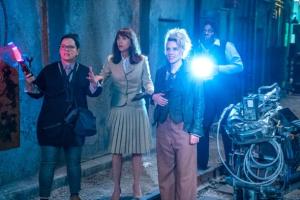 Is the new Ghostbusters a significant step in terms of feminism or is it overblown as some critics contend? The topic is unavoidable given the spirited furor over this remake; it has the most disliked trailer in YouTube history, though to be fair that was not a good trailer. First I’ll acknowledge that the world doesn’t need the opinion of a heterosexual white male on the topic of inclusion, but I’d like to say that there is something about positive representation. It’s the same reason I approve of Sulu being gay in the newest Star Trek. It’s not for me to say what is and is not empowering for a group of people who often lack positive representation in media. Nor am I arguing that every representation of a group needs to be positive; that swings in a direction where well intentioned “protection” becomes condescending. People can be good. People can be bad. People can be brilliant. People can be dumb. No one pool of DNA has ownership over these human traits. However, the reality of Hollywood is that it is often a poor representation of diversity. It is because of this that I say Ghostbusters deserves some praise for portraying a plot around four women that doesn’t involve boyfriends, weddings, marriages, pregnancies, any sort of romantic coupling, and doesn’t pit them against one another. This is an action movie with a female ensemble, three of whom are in their 40s, and all of whom don’t exactly fit with Hollywood’s standard conception of the attractive female lead. They don’t dress provocatively for the male gaze (the default setting for “strong heroine” in Hollywood is often “sexy deadly”). They don’t make fun of one another’s body types. They stand up for one another when people in power attack. They love what they do. I think there will be a swath of the public that recognizes themselves on screen, maybe for the first time, and I think there is genuine merit to this.
Somewhere amidst all the hype and hate, the new Ghostbusters emerges as a pleasant and enjoyably silly summer comedy. Feig’s movie pays homage to the original, including borrowing many of the general plot beats Force Awakens-style, but steps out onto its own territory. The 2016 Ghostbusters is not slavish to the original but recreates what made it work, a strong core group that meets the experimental and outlandish with droll irony. I think I laughed more with the 2016 Ghostbusters than the 1984 Ghostbusters. It has some flaws and some pacing issues but I was enjoying these characters so much to mind. As a lifelong Ghostbusters fan, I would gladly watch a sequel with these characters and this world once more. This won’t replace the fond feelings I have for the original, nor was it ever supposed to. This all-female Ghostbusters doesn’t take away what fans have loved. It simply adds another chapter with a new batch of entertaining characters, and if a part of the audience can better imagine themselves strapping on the proton packs and going along for the ride, then I don’t see what the harm lies with representation.
Nate’s Grade: B
Share this:

The Purge: Election Year (2016)
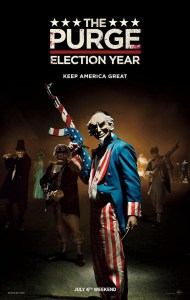 What once seemed like a premise fit for ridicule has become a franchise I actively look forward to now and swallow whole any incredulity. The Purge: Election Year is something of a lateral move from its predecessor, Anarchy, as it’s not an improvement but it’s still a fun and thrilling entry that provides just enough satisfying gonzo political commentary to temper its action. Finally with the second movie I got the Purge movie I wanted, experiencing the event itself outdoors, and Election Year continues this trend. We follow a small group of minority characters trying to survive the night, escaping from one location to another as they encounter a menagerie of weird, murderous citizens trying to make America great again. A presidential candidate (Elizabeth Mitchell) wants to do away with the barbarous Purge practice, and so this makes her a top target during that 12-hour free-for-all. Her head of security, and lone source of protection after an ambush, is played by Frank Grillio, returning from Anarchy and reminding you early and often just what a great action hero he can be. I enjoyed the ongoing shaping and texture of writer/director James DeMonaco’s kill crazy world, whether it was “murder tourists” coming over to America to experience consequences-free killing, the idea of a religious ceremony deifying purging, and even stuff I know is pure trailer candy, like an all-girl gang dressed in creepy masks, princess dresses, and chainsaws. There is some seriously unsettling imagery and moments, though the presence of a white supremacist hit squad dilutes some of the film’s tension simply by being a constant antagonist chasing down our heroes. There aren’t as many new set pieces to further illuminate the depravity of this world as there was with Anarchy. Still, there’s more than enough nasty bite in this franchise. How is this franchise not been turned into an open world survival video game yet? I wonder why everybody just automatically wants to murder during the Purge. I would just probably cheat on my taxes (don’t audit me IRS for this statement!).
Nate’s Grade: B
Share this:

Independence Day: Resurgence (2016)
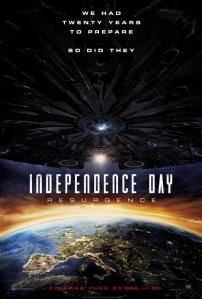 I can recall actively counting down the days until Independence Day was released in 1996, gobbling up every newspaper clipping and magazine article I could. I was a big fan of director Roland Emmerich’s Stargate, which is still a terrific movie, and I was eager to watch the end of the world, as we know it, in the privacy of my local theater. It was a blast, no pun intended, and one of the biggest box-office successes at the time. Surely there would be a sequel, especially after it helped launch Will Smith into another level of stardom. Flash forward twenty years, and here comes Independence Day: Resurgence, a sequel that misses what marked the original as escapist entertainment.
Twenty years later, human beings have been planning for the eventual return of their intergalactic invaders. Former president Whitmore (Bill Pullman) and CIA director David Levinson (Jeff Goldblum) have been trying to get the world prepared and studying our alien enemy. A psychic link is still formed from Whitmore’s brief bond in the first movie, and he keeps drawing mysterious symbols. Whitmore’s daughter, Patricia (Maika Munroe), is a former fighter pilot who works for the current president (Sela Ward). Patricia’s boyfriend and fellow fighter pilot, Jake Morrison (Liam Hemsworth), is stationed on the moon building a defense system. Then the aliens come back and pick up where they left off, annihilating Earth’s landmarks and population centers. It seems that their spaceship is going to suck out the Earth’s molten core, and by all accounts, that’s bad. Our ragtag group of characters must come together and overcome substantial odds once more to save the Earth from certain doom.
So where exactly did things go wrong? I’m not one to simply state that the filmmakers missed their window of making a quality sequel. While twenty years is a long time in between outings, it doesn’t mean that you will fail to come up with a compelling movie. Mad Max was 30 years between movies and this didn’t stop Fury Road from being a masterpiece. By most accounts, yes, there is certainly less of an appetite for an Independence Day sequel in 2016 than there would have been in 1998, but the first film is still fondly remembered and a worthy sequel would be welcomed regardless.
 I think one of the bigger causes to Resurgence not working is the fact that the rest of the moviegoing world has caught up when it comes to big screen spectacle, therefore spectacle by itself is not enough without a zeitgeist edge. In 1996, cutting-edge special effects-laden destruction on a global scale was reason enough to buy a ticket and the largest tub of popcorn. In the ensuring two decades, large-scale cataclysm has become commonplace on the big screen; just about every climax of a Marvel movie involves some world-devastating threat. What once quickened pulses has now become ho-hum. Emmerich himself has become a modern-day Irwin Allen since the first Independence Day, almost specifically focused on global disaster movies. I honestly don’t think there’s a better director working in Hollywood for that gig (his next movie is about the moon crashing into the Earth, so “familiar” territory). I think Emmerich’s skill and vision for big screen spectacle goes unheralded too often and he gets lumped in with empty visual stylists like Zack Snyder and Michael Bay. He’s better than that. However, the tide has turned, and audiences have become sated from empty spectacle. They need something more, or at least something compelling, and Resurgence struggles to achieve this. It feels like the aliens are back and they’re bigger, and that’s about it, folks.
Disaster movies are generally judged by their set pieces, and what is most surprising about Resurgence is that it really doesn’t have action set pieces as it does skirmishes. The movie is only two hours long, which seems like a rarity nowadays, but this is one of the few movies I think could have benefited from some extra breathing room. It feels too rushed, its internal logic often forcibly contrived, and this is evident most in its action sequences. A better term would be “skirmishes” because the sequences themselves are so curiously brief save for the climactic fight during the third act. We’ll get bursts of intensity or dread that comes to a head with violence, but then that’s it and the movie moves along. It’s usually mere moments of brief alien destruction. The action lacks proper development. One of the keys to great action sequences is naturally complicating and developing the events. Resurgence doesn’t even change gears. It provides exactly what you expect, and then it’s over, the surprise being how unsatisfying and short the unimaginative experience was for all parties. It’s a long wait until the third act where the alien queen comes outside to play. The movie shifts into a giant monster melee and it’s the one time where Resurgence feels most lively. It still follows a contrived logic (the Queen has a shield… now she doesn’t…) but I’ll credit the movie with at least saving the best for last and finally letting the action expand. I had enough fun with the final act of Resurgence that I was able to forgive some of its early transgressions.
The first Independence Day wasn’t by any means a cinematic milestone but it was fun and had a clean enough throughline. We spent the first hour in typical Emmerich fashion being introduced to the different characters and then watching the dispirit elements come together. The mystery of what was out there was intriguing and it became a step-by-step process of deducing how mankind should respond. When their hostile intent was revealed, it then became a learning experience as to how to fight back. Aerial dogfights won’t work. Nuclear weapons won’t work. It was a simplistic examination of the threat. While the solution of giving an alien operating system a virus is still a head-scratcher, at that point the movie had earned its ham-fisted solution because it had followed a logically satisfying path of discovery and response from the moment of first contact. Resurgence lacks any real internal logic. Things just sort of happen when the plot requires them and then don’t. If you’re establishing a science-fiction landscape, establishing the rules of what is possible and allowable is essential to the audience’s understanding and enjoyment. Otherwise it feels arbitrary, much like Judd Hirsch driving a school bus of children across the salt flats into danger. This literally happens in Resurgence.
Also fighting for time is a slew of new characters that are charisma-free and contribute little to nothing to the larger story. The biggest offender may be Dylan Hiller (Jessie T. Usher), the son of Will Smith’s character. What does Dylan offer as a character? His entire characterization is, and I kid you not, that he’s upset with Jake over a training accident. He punches Jake in the first act and then… he just sort of pilots ships and shoots things in the sky. That’s it. He doesn’t feel the burden of living up to his father’s reputation, or trying to make his own name for himself. He just has a quarrel to settle and does and then he still just sort of exists in the movie and the screenwriters were like, “Oh right, he’s still here. Well, have him fly something.” Jake and the rest of the young pilots don’t fare that much better as characters. Besides superficial distinguishing characteristics, they’re all variations on the same person. They’re a multi-ethnic collection of vacuous character placeholders; it’s like you took Randy Quaid’s kids from the first movie and made them on par with Smith and Goldblum. These bland characters inspire little love and are often boring with little investment. If the next movie started with them in a car and a giant pillar crushing it, I would not mourn their cinematic loss.
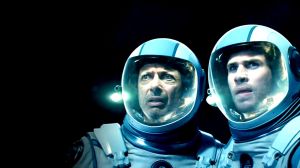 There are some familiar faces returning but none of them are able to compensate for the deficit of charisma and screen presence that is Will Smith. Goldblum is on autopilot and doing his stare off into the distance and talk deadly serious thing. Pullman shows up again as a warning of what was coming, though a superfluous one at that. The biggest screen presence from the first movie belongs to Brent Spiner (TV’s Star Trek) as the Area 51 scientist who conveniently has also been in a coma for twenty years. Some of his comic relief is rather labored and cheesy, but it’s at least something. Charlotte Gainsbourg (Nymphomaniac) collects a check as a psychiatrist who has little bearing other than to be Goldblum’s ex. The most interesting new character feels like he stepped out of a Street Fighter arcade game; he’s an African warlord (Deobia Oparei) who likes to use a pair of machetes to kill the aliens. “You have to get them from behind,” he keeps insisting, and I keep snickering. There’s also that Emmerich staple of an officious government weakling who comically grows a spine. It just so happens this part is played by one of the screenwriters of Resurgence, Nicolas Wright. He studied, apparently.
The best thing Resurgence has going for it is the expansive world building, one of the few aspects of the movie that shows actual thought and care. This is one of the few movies I can recall where people actually try and use the technology of their defeated invaders. Rather than just throwing all those dead spaceships on a junk pile, mankind has decided to backwards engineer technological advancements. As a result, the contemporary feels like a sci-fi hybrid of humanity and the alien technology. It’s interesting to see what advancements have been made and how these have been integrated into regular society. I do question why we only have one defensive weapon/colony on the moon when there’s also one as far as Saturn. I wanted a bit more of a sociological examination on what life post-War of 1996 means. Life would be so fundamentally altered by the realization we are not alone in the universe, and not only that but that we need to play catch up fast to survive. The assumption would be that they will be back. The threat of annihilation unifies the world but what are those consequences? What are the consequences of living in a permanent military state of readiness and anxiety, wondering is it all going to be enough?
If you have fond feelings for the original Independence Day, there may be enough good will with the sequel to appease your demands, though probably only barely. Resurgence suffers from CGI-heavy spectacle that has long lost its appeal without supplying helpful additions like characters to care about, exciting action sequences that develop and impact the plot, meaningful plot turns, and a story that follows some form of logic. It’s not a disaster in all senses of the word. In a summer that’s already building a reputation for its mediocrity, I think there may be enough that Independence Day: Resurgence has to offer that select moviegoers will walk away feeling momentary entertainment. It’s not that the first film was intellectually rigorous sci-fi, but it went about its destructive business with a satisfying precision. This movie all too often just feels like things happening, then not happening, and with characters that are there but without any compelling reason beyond survival. The end of the movie sets up an intended sequel and possible extended franchise of sequels with a larger galactic war against the alien invaders. It’s both hopeful and naïve, dangling the promise of another tantalizing humans vs. aliens throwdown. It’s also a bit aggravating because the premise of the hypothetical sequel (I’m going on record saying it won’t come to fruition for another 20 years) is much better than the “they came back again” sequel we get with Resurgence. Don’t make me pay my money and then tease me with a better movie down the road. Nothing should be taken for granted. Independence Day: Resurgence takes too much for granted, and that’s likely why this resurgence will stop with one entry.
Nate’s Grade: C
Share this:

Now You See Me 2 (2016)
 The first Now You See Me was a pleasant surprise that took a simple concept (magician heist) and injected enough sly fun, style, and humor and made a memorable action thriller. As success demands, a sequel was commanded, but I had hopes considering the blueprint of its success could be repeated because those core elements were strong. We all love heist movies, we all love to be fooled, we all love to watch a smart people befuddle those in power, and the reveals made it even more enjoyable. I wasn’t expecting Now You See Me 2 to drop much of what made the first film appealing and shamble through its set pieces with a disinterested sense of sequel duty. The magic is gone.
The Four Horsemen magic act (Jessie Eisenberg, Woody Harrelson, Dave Franco, Lizzy Caplan) has made quite a few enemies. They’re a group that attacks the fraud, exploitation, and greed of those rich and powerful who feel untouchable. This merry band of Robin Hoods is transported against their will to Macau, China by Walter Mabry (Daniel Radcliffe). Walter lost a lot of money from the Horsemen’s antics in the first film and demands they steal a super microchip that will allow him to erase his identity and stay private permanently. Meanwhile, the Horsemen’s handler, Agent Dylan Rhodes (Mark Ruffalo), is blackmailed by famous and currently incarcerated Thaddeus Bradley (Morgan Freeman). Bradley has a score to settle with the Horsemen and uses Rhodes to escape from prison. All forces are headed to Macau and much more will be learned of the Horsemen’s behind-the-scene organization, The Eye.
 It feels like the filmmakers aren’t even trying to keep one foot in reality this time. It’s not like the first Now You See Me was a deeply grounded movie but it took pains to at least offer varying explanations for how these illusions were accomplished. Some of the answers were clever and some were preposterous, but at least they tried to show you their work, which made the Horsemen even cleverer, in my book. Understanding the preparation for the illusions and the execution of them adds to their impressive aura. The characters in the sequel don’t even attempt to explain the far majority of their tricks, and it’s simply not as fun. The opening job is a fun refresher because we see the different characters working together but also because we can see how they’re getting away with their shenanigans. As the movie continues, those magic acts get bigger and bigger and more ludicrous and harder to explain and then the movie just stops trying to explain. At this point magic might as well be real and the Horsemen are wizards. There’s suspension of belief and then there’s simply obliterating all connections to reality. When Eisenberg can control the direction of rain itself without any explanation, it cheapens the thrill. Because if there isn’t some level of limitations, requiring the tricks to be based in reality, then the on screen efforts lose their appeal because it doesn’t matter. It’s like haphazardly just writing, “The Horsemen do some magic junk and get away.” It’s just not as satisfying when it feels like the trick is ultimately on the audience.
Another complaint I have is that the scattered script seems littered with missed opportunities. One of the bigger misses that comes to mind is Harrelson’s twin brother, an obvious Matthew McConaughey impression from his True Detective costar. The character isn’t nearly as funny as Harrelson or the producers believe. He isn’t particularly memorable or necessary to the plot at all, but that’s not even his biggest offense. In a movie about magicians playing sleight-of-hand trickery, how in the world do we not have a switcheroo with the twins? That would justify his existence for the plot. I was shocked this never happened because it seemed so obvious. Why is he a twin? What does being a brother to Harrelson have to do with anything related to the plot? The script also gets overcrowded with antagonists, introducing Radcliffe and then bringing back Michael Caine and Morgan Freeman. The characters don’t so much compete with one another as they operate in separate spheres until a “twist” reveals more about their connections. Their agendas are too opaque. Radcliffe wants them to steal a super microchip so he can fully be “off the grid.” A man of his means shouldn’t have a problem with this. It’s not like he’s hiding out from the law for some kind of corporate espionage. It’s a convoluted reason to bring the Horsemen to his hiding spot in Macau. It’s just one in a long line of ideas that never feel fully developed. Even the magic set pieces don’t feel as fun. Seriously, one of the climactic magic set pieces is a human game of three-card Monty.
 Director John M. Chu (G.I. Joe: Retaliation, Jem and the Holograms) has worked with action before and certainly knows his way around choreography, but he feels too hesitant this time. The action scenes are rare and the chase sequences are muted. Outside of the tricks, there isn’t a standout action scene in the whole movie. In the first film we had a pretty fun magic fight that was wild and surprising and loaded with small payoffs. In this movie we have a motorcycle chase that plays out as expected. We have a foot chase that plays out as expected. You have professional illusionists at your disposal; action set pieces should not play out as expected. The most fun sequence is fairly straightforward but easily the best developed, and that’s the Mission: Impossible-esque heist of the microchip that is outfitted onto a playing card. It’s also clearly the most visually inventive sequence as the Horsemen play a game of keep away and the camera literally at times tumbles into their clothes. I think what makes this easily the best sequence in the movie is because it’s moderately grounded, the stakes are explained, and the audience is in on the trick, enjoying all the flimflam obfuscation. It also means when there are complications to the plan the sequence generates suspense. When you don’t know what’s going on and don’t know when things are going wrong, or how they could go wrong, it’s hard to generate genuine suspense. Being involved in the action is much more fun.
The actors all seem on autopilot, falling back to the broader descriptions for their characters. Eisenberg is a smug and cocky. Harrelson is smooth and shrewd. Franco is awkward and insecure. Isla Fisher is replaced by the capable Lizzy Caplan (TV’s Masters of Sex) as the requisite Female Horsemen. She makes a good impression but part of it is that Capaln seems to be the only member allowed to be comedic. It feels like there are three straight guys to her comedy cut-up. She’s good but without variation it also starts to lose its appeal when only one character seems to be trying. Ruffalo (Spotlight) seems too often unrelated the Horsemen story as he discovers more info about his father. He’s the only character that actually has something of a storyline, though his playing of both sides and attempts to hide his role to the FBI is just another ludicrous element. I miss Melanie Laurent too.
Now You See Me 2 (how could this not be called Now You Don’t?) is a lackluster sequel that seems to have forgotten what made the first film the enjoyable caper that it was.
Nate’s Grade: C+
Share this:

Warcraft (2016)
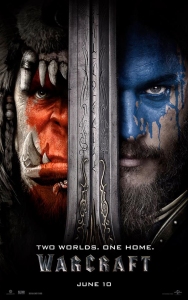 It’s been a long five years since we last saw a movie directed under the name Duncan Jones. He’s not just the son of David Bowie (R.I.P.) but also a talented and nimble director of science fiction thrillers with a rewarding intelligence and visual acumen. Moon and Source Code are two strong entries for anybody’s resume. After flirting with Hollywood franchises for a while, Jones latched onto a personal project, spearheading a Warcraft film adaptation based upon the popular online multi-player role-playing game that boasts over 12 million subscribers. Jones has gone on record saying he is a Warcraft player himself. He co-wrote the script and embarked on a long development process working with heavy use of special effects and actors in motion capture to bring to life the otherworldly fantasy races. It’s been a tumultuous road for the expensive final product, and Warcraft, as a movie, is proof that some concepts are best left to your home computer.
The orc race is in need of a new home because their old world is dying. Their leader, a wizard named Gul’dan (Daniel Wu), uses magic to open a portal to the peaceful world of Azeroth. The orcs invade and plunder although one orc, Daruton (Tony Kebbel), is wary of the motives of his leaders. He’s looking for stability rather than constant conquering. He finds an unlikely ally with Anduin Lothar (Travis Fimmel), a human warrior serving King Wrynn (Dominic Cooper) and his sister, Lady Taria (Ruth Negga). The humans seek help from their own wizard, the Guardian Medvih (Ben Foster). Someone must be collaborating with the orcs to allow the inter-dimensional portal to open. Medvih’s apprentice, the mage Khadgar (Ben Schentzer), teams up with Lothar to investigate and find a way to thwart the oncoming orc invaders.
 Unless you are a fan well versed in the lore and characters of the popular online game, Warcraft will leave you sputtering to construct cohesion from what seems like a lot of incidents without explanation, connective tissue, and a compelling reason to engage with this fantasy trope mess. It felt like every third page of the screenplay was ripped out of the shooting script; things merely just happen without proper setup and development. All of a sudden this character will be evil, or that character will have some prized piece of knowledge, or these two characters will be a romantic item. Things just happen in this movie and they are far too rarely given the context necessary to matter. This is less a story than a collection of ideas scattered onscreen. Take for instance our protagonists, or what you would assume are the protagonists, a pair of capable warriors trying to prevent mass causalities on both sides of the human/orc war. Except the orc character never really translates as an effective parallel to his human counterpart. You would naturally think they would be equal in significance as they try and steer their two warring sides to making less destructive decisions. I can’t tell you anything about the worlds we’re spirited to and from. We got elves and dwarves and mages and wizards and portals and dark magic and good magic and guns that feel entirely out of place in this universe and all sorts of names we’re expected to keep up with. There is little that leaves an impact, and after a while the movie ends up becoming the metaphorical equivalent of cartoon characters that run in place while the interchangeable backgrounds alternate behind them. Besides the fact that sometimes a guy wears a crown to help you realize he’s king, or a guy flashes a ball of energy in his hand, you’re left on your own to interpret the characters and why they are meaningful. The plot is simple, orcs versus humans and bad warmongering leaders at fault, but it’s the deluge of underdeveloped characters, subplots, and world building that make what was once simple hard to understand. I couldn’t tell you why anything was happening. There is no way the casual moviegoer will be able to keep up with the speed that Warcraft hurls information at them without careful setup and meaning. You need an instruction guide to make this stuff accessible.
Fantasy is a naturally transporting genre of storytelling but unless you actually develop and explain the worlds, the inhabitants, and perhaps some of the cultures, you’re destined to feel like a stranger bumbling through a most foreign and unfriendly place. Warcraft does a terrible job of making its worlds feel lived in, never mind accessible. Every new location should tell us more about the world and its characters, their interactions and conflicts, differences and similarities. This is just bad storytelling, people. Ultimately, it doesn’t matter where any of these locations are because they don’t impact the plot. The only story is about the conflict between the orcs and humans, but this could happen anywhere. There are some “important” characters on both sides of this battle but good luck trying to engage with any of these characters. The human characters are bland. I didn’t care about anyone and gave up trying. Cooper and Negga are both considerably more entertaining and effectively utilized on AMC’s Preacher. It takes an hour just for Warcraft to finally establish the relationships between its various stock characters.
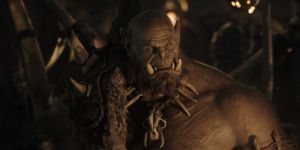
It’s the orc characters that showcase the most humanity, and credit goes more to the special effects artists and motion capture actors than the screenwriting. I appreciate how the movie devotes time to both sides of the conflict and finds figures of honor, and its best representation is Durotan. Kebbell seems like an actor who really feels a sense of freedom with mo-cap performances (he was excellent as the simian villain Koba in Dawn of the Planet of the Apes). I initially thought the creature design of the orc, what with their hulking underbites, was going to be hard to render emotive performances, but there were glimmers where you could witness the shadings of the actors beneath the underbites. It’s an impressive technical feat considering the obstacles that all parties had to overcome. Sadly, this only further exposes just how shoddy the storytelling is considering the technology was capable. Darotan is a loving husband and father who is leery of his leaders intentions, but this too is just a means to serve the ultimate ends of the plot. There isn’t a thoughtful moral anti-war argument to be had here. As a whole, the orcs are a rather personality-free race of creatures. Sure they talk a big game and have some curious decorative flourishes (tusk piercings!), but to this Warcraft layman, they come across like any other barbarian group. Early on I was mentally thinking of the Klingons from Star Trek and then I concluded that this was an inappropriate comparison because Klingons have memorable personality and culture.
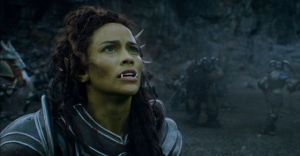 The actor who gets my greatest sympathy is Paula Patton (Baggage Claim) as the half-orc/half-human outcast, Garona. First of all, given the immense physicality of the orcs, I imagine any form of fornication with a human would prove highly fatal. It would be like an elephant mating with a labradoodle. Trapped between the two groups, Patton is painted green and given a lesser underbite that is reminiscent of snake fangs. When realized on an actual person, as opposed to a creation from the realm of computer effects, it’s not terribly convincing. Patton tries her best to speak all her gobbledygook lines of dialogue but the reverse vampire fangs make it awfully difficult for her to properly enunciate. She looks too ridiculous to be an effective character, and the fact that she is pushed into a romance with a human without any sense of setup beyond the universal law that pretty people should be together with pretty people is deflating. Why does the only female character of significance have to be shoved into a romantic subplot? Your poor poor jaw muscles, Paula Patton. At least you didn’t have to wear a metal bikini. Yet.
With all of this stated, Warcraft is not a horrible movie, and credit for that should go to Jones as a director. In the same token, Jones is also the co-writer so I guess he also deserves blame for the storytelling shortcomings. Jones very smartly limits his camera movements. Character will move within the frame but usually the camera point is fixed, which allows the focus to be more attuned to what exists within the frame. This is especially helpful during battles and with the multitude of CGI elements. This stylistic choice allows the film to be more visually immersive. The fighting sequences do get a tad repetitive as one guy with a sword or club runs at another guy. I saw Warcraft in 3D at my screening and I might actually recommend people see it this way, which is something I hardly ever do. It’s not that the 3D elements will compare to the experiences of modern standard-bearers like Life of Pi or Gravity, but it’s a pleasurable experience and the presentation of the visuals is crisp. I was worried about the usual effect of the glasses darkening the onscreen image and this was not the case at all. From a purely visual standpoint, Warcraft is worth watching at least once. The special effects vary between photo-realism and extended video game cut scene, but overall the visuals are colorful and fun and easy to discern. When the action heats up, you’ll be able to cleanly follow what is happening to whom. If only this same clean precision had been applied to the half-baked screenplay.
I will admit I have never played a single minute of the Warcraft game. I am not familiar with any of the worlds, characters, or races beyond what I have watched from other more popular fantasy films and series. I am not coming at this movie from the perspective of a fan who has been eagerly awaiting the holy grail of video game movies. If you’re willing to look past its flaws, mainly its bereft characterization and haphazard plotting, then I’m sure there is a forgivable and sporadically entertaining movie here. As a man who has reviewed over 20 films directed by notorious video game adapter Uwe Boll, this is no unbridled suckfest. However, it’s still too limited for its own good. The visuals can be immersive but the story is certainly not, and there are numerous points where the movie just actively forgets that an audience requires servicing. You need to introduce us to the characters, allow us to get a sense of who they are, their internal and external battles, their relationships with one another, their significance to the plot, and relevant history and culture as it relates to the larger story. In a rush to visit all the different game settings, the movie’s screenplay zips along when it should be building its narrative. At times it feels like a travelogue with very exotic locals. Warcraft is a repository of incidents and events, almost as if it were awaiting a user to plug in and control the storyline and provide the meaning. It’s no unmitigated disaster but I don’t believe this was worth the five-year price for Jones.
Nate’s Grade: C
Share this:

X-Men: Apocalypse (2016)
 “We all know the third movie is the worst,” says young Jean Grey (Sophie Turner) in a curious moment that is too meta for its own good. It’s meant to be an in-joke, and possible a jab at 2006’s heavily derided X-Men: The Last Stand, but it ends up summarizing more than one X-Men movie. Easily the weakest of the prequel series, X-Men: Apocalypse is a muddled super hero movie that marginalizes its interesting characters, lacks a thematic linchpin, pushes a new batch of boring and often superfluous new mutants, and feels like everyone is running through the paces of what they think an X-Men movie should be. It’s not Last Stand, the near franchise-killer that Days of Future Past had to wipe out of existence, but this movie is a dull and clear example of the lousy mediocrity of compounded missed chances suffered at the expense of loyalty to formula.
In 1983, Charles Xavier (James McAvoy) is running his school for gifted youngsters, a.k.a. mutants, and has a new class of students including Jean Grey, Scott “Cyclops” Summers (Tye Sheridan), Kurt “Nightcrawler” Wagner (Kodi Smit-McPhee). Magneto (Michael Fassbender) is trying to live a simple life and exclude himself from a larger fight between humans and mutants. Mystique (Jennifer Lawrence) is crossing the globe and discovering new mutants to rescue. Everything changes when an ancient mutant is awakened in Egypt. Apocalypse (Oscar Isaac) is thousands of years old and is rumored to be the first mutant. He collects four mutant helpers he deems his Horsemen, and in 1983 it happens to be a young Storm (Alexandra Shipp), Psylocke (Olivia Munn), Archangel (Ben Hardy), and Magneto. Apocalypse promises a world built for only the strongest mutants and will wipe the planet with those found lesser.
 Let’s start with the empty void that is the titular super villain; Apocalypse is a complete waste and a complete bore. Oscar Isaac is a terrific and soulful actor who can be so malleable to roles as diverse as misanthropic Llewyn Davis to dreamy X-wing pilot Poe Damaron. He is buried under pounds of purple makeup that limit his expression, coupled with a heavy costume that also limits his movement. Apocalypse should have probably been a motion capture performance. Andy Serkis has proven that mo-cap performances can exhibit tremendous emotive qualities and the technology can support it. Mo-cap would have been better than staring at Ivan Ooze lumbering around. Then there’s his haphazard characterization. Apocalypse is both too all-powerful and shackled with powers that are too vaguely ill defined. He doesn’t seem like the kind of guy that needs an entourage for support despite the whole snazzy “Four Horsemen” backing band name. Apocalypse should be the solo act; he doesn’t need a backup band. You could have written Storm and Psylocke out entirely and had no impact on the plot whatsoever. My pal Eric Muller even jokes that Psylocke literally walks off the movie. Allow me to indulge my X-Men fandom a moment and just say how Apocalypse is my favorite X-Men villain and Psylocke was one of my favorite X-Men way back when I was reading the comics consistently in the 90s. I loved the psychic blade of Psylocke, though in this movie it’s pretty much just a laser arm sword, which is a underwhelming. Seeing both of these characters completely wasted is particularly disappointing to 90s me.
But back to Apocalypse, he seems too powerful to need to seek out a select group of super lieutenants and part of this is also because of how poorly the movie explains the specifics or limitations of his powers. He absorbs the powers of his host mutants but what are those powers exactly? The movie never specifies beyond the weird shifting-humans-into-walls thing that looks a bit too silly to be truly terrifying. Every time he displays a new fancy power we just have to accept it, but if he keeps unleashing powers we never know about then why does he even need assistance? We already see Apocalypse turning the world into dust clouds, so why does he need Magneto to, I believe, rip the metal core out of the Earth? It’s not like he has a meaningful relationship with Magneto, the only Horseman who truly matters. Apocalypse should be the mutant equivalent of a god, and credit to my pal Ben Bailey on this assertion, and the world of mutants should be forced to make a choice to follow this god who genuinely wants a new world consisting only of his “children.” Instead he’s just a bloviating and boring demagogue that makes a terrible lead villain. For a guy who might be the “first mutant” and inspire the Bible, it sure seems like squandered potential.
 The trio of the core characters of the prequels (Professor X, Magneto, Mystique) is largely sidelined and you can certainly tell that the actors are eyeing the exit door, no more than Lawrence. These are the characters we’ve gotten to know and the ones we’ve built up an emotional attachment to, so why not just push them to the outer edges of your story and shove some new even younger X kids in place to dominate the narrative? Lawrence and Fassbender especially are given the least to do. When Mystique has to become a de facto X-Men leader and teacher, you can feel like everyone is just going through the motions. They just look bored or at least unable to hide their ambivalence with the muddled screenplay. The new X kids are also fairly bland with little charisma. I think there’s an actual scene where Nightcrawler is walking around a mall in plain sight. The X kids are here to take over for the Magneto/Xavier/Mystique unit and provide a bridge to the original X-Men series. It is here where I must now gripe because First Class was set in 1961 and Apocalypse is set in 1983 and nobody looks like they’ve aged. Maybe that’s a mutant ability plot device but then Rose Byrne’s human character hasn’t aged much either. Her character is also completely pointless in this movie. She might not be as badly shoehorned into the action as Lois Lane was in Batman vs. Superman, but then again there still isn’t anything as terrible as anything in BvS.
The X-Men franchise from the beginning has been a super hero saga with subtext and social commentary. It might not be completely subtle but it was effective and brings greater relevance and emotional power to the struggles of our mutant heroes. The first prequel was about a core philosophical divide between Xavier and Magneto; the second movie was about the individual versus society and was personally exemplified by the moral crisis of Mystique’s hunt for vengeance that would lead to the downfall of humanity. This third movie has none of that. Magneto is suffering from a personal tragedy caused by prejudice and fear but the basic theme is the same from First Class just not nearly as well articulated. Here it’s more just blunt “kill ‘em all” vengeance, and he’s made to be a practically mute cipher until called upon at the very end for some tidy plot work. I haven’t even talked about the tacky return to a concentration camp. The characters are either fighting the bad guy or fighting with the bad guy. That’s it. There isn’t any major personal or philosophical conflict that is highlighted by the subtext of the plot. It’s all just more grist for world-ending CGI nonsense.
Apocalypse at best is a series of moments, and the overall quality level rarely rises beyond competently acceptable, not exactly a ringing endorsement. The movie’s action sequences are rather dull and visually repetitive, making poor use of geography and development. The entire third act is a blandly extended action sequence in the dusty ruins of Cairo. Things just sort of happen and then more things just sort of happen. The opening action sequence in Days of Future Past is better than 99% of the scenes in this movie. The clear highlight that everyone will rightly cite is Quicksilver (Evan Peters) showcasing the amazing potential of his super speedy powers, but even this is a repeat of a highlight from a previous movie. It’s like the producers decided to take the moment everybody loved and do it bigger and better. It was a real fun surprise in the first time, and now it’s become the newest part of the X-Men formula. Still, it’s a fantastic sequence with great visual panache and a lively sense of humor. When the world slows down and Quicksilver steps into the frame, it’s almost like a hero moment for the audience to cheer. He saves a school of mutants, and a dog, from a colossal explosion, but it too is just another moment that could have been cut from the movie entirely. It’s a fantastic moment, the obvious highpoint, and yet it’s still superfluous. The other highpoint is an extended cameo at Alkali Lake, and again it is superfluous and calls into question greater franchise continuity.
 Speaking of continuity, there are some major events in Days of Future Past but especially Apocalypse that make me question how the events in the 2000s X-Men still stand. According to the events of the prequels, Mystique “outed” herself to the world and proved the existence of mutants to the wider public when she tried killing Boliver Trask (Peter Dinklage) and infiltrated the Nixon White House. Cut to 1983 and Apocalypse broadcasts a message to every human and mutant on the planet. He launches the world’s entire arsenal of nuclear weapons into space. That seems like a big deal, the kind of deal that would dramatically alter the events in the 2000s to the point that a mutant registration act would seem hilariously quaint and far too late. The character relationships in the first X-Men movie must also be reassessed with the events of Alkali Lake. It’s hard for me to reconcile the earlier films matching up with these prequels at this point.
The studio execs and producers behind the X-Men series have already gone on record speculating that their next movie will take place in the 1990s and have Mr. Sinister as its chief villain. I think they’re getting a little too ahead of themselves with the larger franchise vision much like what happened to Sony after their 2012 Amazing Spider-Man reboot. They started plotting two sequels, a spin-off, and lost sight of simply making a good movie with characters you care about and memorable action sequences. They lost track and had to reboot their Spider-Man franchise yet again, this time with an assist from the Marvel bigwigs. I don’t need an X-Men-a-decade adventure. I just want good movies. Out of six movies, half of them are great and the rest are acceptable to terrible. Apocalypse won’t kill its franchise but I think the negative and indifferent response from the public, as well as less-than-robust box-office returns, will give the studio caution. Don’t just throw out an X-Men movie in order to lay the tracks for the next two X-Men movies. Make a compelling and entertaining X-Men film that stands on its own. If you can’t do that, then there won’t be too many more X adventures, period.
Nate’s Grade: C
Share this:

The Nice Guys (2016)
 Ever since I heard about its production, and especially after watching the first trailer, I have been intensely anticipating The Nice Guys, mostly because of my fervent and undying love for 2005’s Kiss Kiss Bang Bang. That gem was writer/director Shane Black’s manic and deliriously entertaining comedy noir that reinvigorated star Robert Downey Jr.’s career. The Nice Guys looked very much like a spiritual successor or predecessor given its swanky 1970s setting. While an enjoyable and funny caper, there is a significant gap between KKBB’s genius and the altogether amusing though lesser escapades of The Nice Guys. Perhaps it’s unfair of me to have had my expectations too high, to be hoping for another magical onscreen alchemy like KKBB. Whatever the case, I was slightly let down by The Nice Guys around the time I realized that the best jokes were in the trailer. They are admittedly great jokes but what was left too often hit lower registers of funny. Ryan Gosling and Russell Crowe have great chemistry together and Gosling especially showcases a talent for physical comedy that has been underutilized. When the movie finds ways to undercut detective movie tropes, like Gosling cutting his hand badly after a failed attempt to break into a locked window, that is when it feels most alive and fun. The action elements don’t feel as significantly connected, like a bunch of washout villains like a hitman named John Boy who has no memorable personality. The shaggy dog mystery has some entertaining detours but once again the real draw is the comic interplay of the two male leads and Black’s razor-sharp dialogue. The man perfected the buddy cop interplay at some point, and often the casual conversations and one-liners are more highlights than the set pieces. The Nice Guys is a funny, smart, and diverting detective action-comedy that is a solid effort from everyone involved. It’s just that I was hoping for a touch of the divine again and had to come back to Earth.
Nate’s Grade: B
Share this:

Captain America: Civil War (2016)
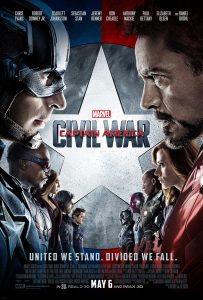 Think you were disappointed by last summer’s Avengers: Age of Ultron? The pressure-packed experience broke writer/director Joss Whedon who swore off being the creative shepherd of the Marvel cinematic Universe (MCU). Enter the Russo brothers, a pair who were widely known for their work in eclectic TV comedies like Community and Arrested Development before blowing away all modest expectations with 2014’s Captain America: Winter Soldier. I can say that the Russos are more than capable for the challenge. My simplistic blurb for Captain America: Civil War is thus: everything Batman vs. Superman did wrong this movie does right.
After the cataclysmic events of multiple movie climaxes, the world governments are wary of the power wielded by the Avengers. Secretary Ross (William Hurt, the lone returning element from 2008’s Incredible Hulk) is pushing the superheroes to sign the Sokovia Accords, which would put them under the control of a U.N. joint panel. This panel would decide when and where to deploy the Avengers. Captain America, a.k.a. Steve Rogers (Chris Evans), is worried about a group of people taking away their choice. Iron Man, a.k.a. Tony Stark (Robert Downey Jr.), believes that they need to accept limitations and that agreeing to these terms staves off something worse later. This division becomes even more pronounced when Rogers’ old friend the Winter Soldier, a.k.a. Bucky Barnes (Sebastian Stan), reappears as the chief suspect in a U.N. bombing. Black Panther, a.k.a. T’Challa (Chadwick Boseman), swears vengeance against Barnes for the bombing. As the assembly of heroes squares off over the fate of the Winter Soldier, Baron Zemo (Daniel Bruhl) is tracking down classified Hydra documents to uncover pertinent information that will topple an empire.
 While I don’t want to turn every new film review as an opportunity to beat a dead horse, I cannot help but draw immediate and stark comparisons between Civil War and the earlier titanic superhero slugfest, Batman vs. Superman: Dawn of Justice. Let’s take this case point by point so there is no reasonable doubt left for the jury of ticket-buyers.
“Batman vs. Superman doesn’t set up its conflicts with enough time to develop them and it lacks real emotional stakes.”
With BvS (I’m saving my fingertips some drudgery), we hadn’t known these characters for more than one movie at best, and in the case of Bruce Wayne less than one. When they fought there wasn’t any real stakes despite the apoplectic marketing because we hadn’t built relationships with these characters. In the case of Henry Cavill’s Superman, many were turned off entirely by the guy (not necessarily by Cavill’s physique, though). Did anyone really care who won? The filmmakers relied on the audience to supply their pop-culture good will for the characters instead of proper characterization and development. In the case of Civil War, we’re dealing with the cumulative effect of having twelve movies to build up storylines and character relationships. We’re invested in these characters and their friendships, so when they fight it actually does matter. You feel for both sides and multiple characters and the movie does a good job of providing each side a credible motivation. It’s a political thorny issue but it’s kept very streamlined, focusing more on the characters. If the MCU has had one nagging problem throughout its history it has been a dearth of good villains. There’s Loki and… Loki. One solution is to just pit the heroes against each other and this produces as many fist-bumps as winces. My audience was gasping at reveals and twists and turns. They weren’t doing that with BvS. And wouldn’t you know Civil War actually has a climax that’s more than just an increasing series of punches and kicks (though plenty of those are featured); the climax is an emotionally grounded confrontation that cuts to the core of the group. The events of this movie matter and while obviously it can’t follow its divisions to an irrevocable end, I appreciated that not everything is resolved. These storylines and the conflicts between characters will carry onward when we pick up the pieces in 2018.
“Batman vs. Superman is too burdened with setting up an array of other film franchises that it loses badly needed focus and momentum.”
 To be fair, this charge can also be laid at the feet of Age of Ultron, which buckled under the heavy weight of setting up multiple other future movies rather than telling a completely satisfying movie in its own right. Once the franchises gave birth to mega-franchises, the wheels-within-wheels of moneymaking, now the studios require a lot of heavy lifting from our entertainment. They’re investments in futures and if done improperly can easily crumble under the failed execution like the Amazing Spider-Man series (R.I.P. 2012-2014). Miraculously, Civil War finds ways to involve every member of a large ensemble cast into the story in ways that matter. The movie finds small character moments that make them feel better rounded, like Vision (Paul Bettany) and Scarlet Witch (Elizabeth Olsen), and it introduces featured supporting players with great care. Black Panther is a terrific addition and brings a quieter intensity that contrasts nicely with the more colorful characters. Hawkeye (Jeremy Renner) introduces himself and Black Panther curtly says, “I don’t care” and goes back to fighting. Boseman (ageless I tell you!) is smooth and magnetic. Then there’s everyone’s favorite neighborhood Spider-Man (Tom Holland), or whom I’m already referring to my pals as “best Spider-Man.” It’s another incarnation of Peter Parker but the first that feels like an actual teenager, a bundle of adolescent energy and excitement. He’s the voice of the fans and during the big battle he can’t help but gush that he gets to be involved alongside the big names. Spidey’s a fanboy too. He also has a few choice meta one-liners that had me cackling. Holland (The Impossible) makes an immediate impact and, unlike BvS, finds new ways to make us care. I’m genuinely excited for solo Black Panther and Spider-Man adventures with these characters. Even the more traditional villain of Civil War, Baron Zemo, is handled in a way that provides an emotional motivation for his character that is sincere rather than mustache-twirling villainy. In a lot of ways this feels like a third Avengers film just with the size and scope alone. The dozen characters are juggled skillfully but the emphasis is always on Rogers and Stark and their significant personal conflicts.
“Batman vs. Superman’s action sequences are repetitive, joyless, and dank.”
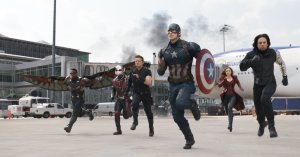
I challenge some enterprising soul to even try and decipher what is happening during the climactic three-on-one monster battle in BvS. I was sitting in the theater and just gave up. I wasn’t having any fun and I couldn’t even literally tell what was happening onscreen with all the confusing CGI obfuscation. The action droned on and on with little variation and was at pains to include certain members and storylines (Lois, maybe don’t get so hasty with that kryptonite spear). It was all just one big overwrought mess that made you question whether anybody on that film production actually liked these superheroes. With Civil War, the action sequences are smartly conceived and choreographed, making excellent use of geography and adding organic complications. The standout is the 20-minute superhero-on-superhero brawl at the Leipzig airport. It is nothing short of nerd nirvana. The characters use their powers together in exciting ways and it further helps them feel like an actual team taking proper advantage of their resources. It’s the culmination of a child’s imagination at play, the living embodiment of smashing action figures against one another and flying around the room. I was thrilled that the Russo brothers found ways to incorporate all the heroes into the action. The specific powers are taken advantage of in fun and surprising ways. The action changes as the stakes keep getting more complicated as more heroes enter the fray. It’s a set piece that will become legendary within film geek circles and it provides payoff after glorious payoff.
“Batman vs. Superman is devoid of all fun and takes itself far too seriously. You feel beaten down, exhausted, and punished by film’s end.”
 The Marvel movies have earned a reputation for their brisk and breezy nature, which has unfairly been labeled as “weightless” and “silly.” I challenge someone to watch Civil War and tell me just how weightless and silly it is. The Russo brothers and the screenwriters take these characters seriously and their care shows. While there can be plenty of rapid-fire quips and one-liners, the movie’s sense of humor does not detract from the emotional weight of its dramatic shifts. There are political and thematic overtones, mostly the costs of vengeance and culpability, that provide extra depth to the onscreen derring-do. However, Civil War understands that an audience wants to be entertained as well with their heavy-handed messianic imagery. There are payoffs galore in this movie. Some are several movies deep from set up. It all comes together to make a thrilling and highly enjoyable movie experience that plays to its audience in the best way possible. It’s an expert summer blockbuster that packs its own punch. There’s a reason I have already seen Civil War three times already. There is so much to enjoy and it’s so tightly packed and structured that you can jump right in and go for the ride. This is the movie fans were hoping for. This is the movie that washes out the bad taste of the dreadful BvS. If one of my lasting disappointments with BvS was how it made me lose hope for future DC movies, Civil War has cemented my anticipation. The future creative direction of the MCU is in good hands with the Russo brothers. This is the movie that reminds you just how damn good superhero movies can be when they’re at the top of their game. I’d place Civil War right up there at the top of the MCU, though at this time I’m still holding Guardians of the Galaxy as the apex. They’re still achieving this high level of quality after a dozen movies, people. I would not have thought that Captain America would become the gold standard of the MCU but there it is. I felt beaten down by the merciless end of BvS. I felt the elation of an adrenaline-rush from Civil War.
I’ll conclude this unorthodox film review with my in-summary blurb: everything Batman vs. Superman did wrong Captain America: Civil War does right. Do yourself a favor and start the healing process from BvS and enjoy Marvel’s latest cinematic gift to its fans.
Nate’s Grade: A
Share this:

Keanu (2016)
 Jordan Peele and Keegan Michael-Key are gifted comedic performers, as often evidenced from their often-brilliant sketch comedy show Key & Peele. It was only a matter of time before they made the leap to feature-film players, and Keanu is a suitable springboard for the gents that portends to even better future results. Relying upon mistaken identity bluffs, Peele and Key play a pair of relatively straight-laced men who pretend to be violent gangsters in order to retrieve Peele’s stolen kitten. Fortunately, the movie doesn’t feel like an overextended sketch though it does have its narrative detours that dawdle (a celebrity drug deal is padded out with far too few jokes), running jokes that hold on for a beat too long and then some (the George Michael fascination culminates in a drug sequence that does absolutely nothing), and there are missed opportunities that seem obvious (Key using his new gangster friends to intimidate a man making advances on his wife). Will Forte’s hip-hop loving drug dealer feels like a character nobody knew what to do with, including Forte. What doesn’t disappoint is the natural comic chemistry of its leads as well as the movie’s ability to surprise, zigging rather than zagging, and finding small jokes just as satisfying as larger set pieces. I enjoyed when the guys’ insecurity butted against their bravado, like when Peele is trying to deflect credit for helping his new pal to do some very bad things. The onscreen action is somewhere between the wackier world of 21 Jump Street and the grisly, unfunny world of Pineapple Express but at least the filmmakers realize that an action-comedy still needs to present its action through a comic lens. I was laughing consistently throughout though it was mostly at a chuckle level, if I were to be honest. Keanu is a fairly fun comedy that you can’t help but think could have been more refined during its structureless periods, but then another joke appears and it’s hard to get too upset with the final enterprise. Keanu is funny enough but you sense that a better vehicle is on the horizon for these two gifted comedians. Oh and the cat is powerfully adorable.
Nate’s Grade: B-


 nathanzoebl
You must be logged in to post a comment.