Malignant (2021)

Thank goodness for James Wan. The horror hit-maker has earned enough creative cache in the industry after fostering three separate horror franchises (totaling near two billion dollars), plus two other high-profile action superhero blockbusters, that he can do whatever he wants and thankfully what Wan wants to do is make really weird movies that take tremendous risks. Malignant is a movie that starts slow, appearing to be another in the line of horror thrillers about a psychic connection between a troubled soul and the imaginary friend that seems to be coming back. The movie begins feeling like high-end camp in a flashback, takes a very serious and uncomfortable turn into domestic violence and miscarriages, and then builds into a psychic serial killer investigation where our main character (Annabelle Wallis) is having creepy visions of the killer exacting bloody revenge. For the first half of the movie, there’s a lot to keep up with and it’s easy to get confused with bland characters, their often baffling actions and decisions, and then it plops you down for heavy exposition via asylum VHS tapes. However, from that point forward, Wan lays out all his cards and it’s so absurd, so entrancingly weird, and so enthusiastic about all of it, that you may burst out laughing in the best possible way. Before its drunken rampage of schlocky delight, Malignant is a horror mystery and stylishly directed with some bravura shots and angles. It’s worth your time, but everything is in service to setting up the final act where it gets so much bigger, more bonkers, and deliriously more entertaining. Wan is clearly going for messy giallo horror camp and gives the audience permission to laugh along with the insanity. It acknowledges how goofy looking and bizarre its eventual monster looks, let alone the logistics and circumstances involved, and it all veers into that. Whereas Old felt like M. Night Shyamalan was trying to escape camp and kept falling back into its morass, Malignant feels expressly like the movie James Wan wishes to make. There’s even a spooky abandoned child experiment-heavy hospital on a cliff, and rather than have something spooky happen, the character then safely arrives back home with an armload of incriminating medical VHS tapes. The deliberate asides, misdirects, and eventual revelations feel so purposeful to yank around the audience and deliver a frantic and unpredictable ride of a movie that leaves the audience screaming and howling with laughter. I can understand people hating Malignant. I can understand people loving Malignant. I can understand people having trouble even making sense of Malignant. However, you cannot watch this movie and have a passive response. I wish I could have seen this in a packed theater pre-COVID. I think I figured out my inexpensive Halloween costume for 2021.
Nate’s Grade: B+
Share this:

Misha and the Wolves (2021)
 The Sundance documentary Misha and the Wolves, now available on Netflix streaming, is a movie about trauma, lies, and ultimately proves to be unfulfilling due to the circumstances of its own narrative limitations, both in subject and approach. It’s worth watching at only 90 interview-packed minutes, but it’s also a case of a movie that could have gone much deeper into a troubled subject that demanded more scrutiny and psychological examination than what the film has to offer.
Misha Defonseca was an elderly Belgian immigrant living in a small Pennsylvania town when she decided to share her personal story of survival one day at her community synagogue. When she was seven years old, her parents were taken by Nazis during the Holocaust. She was living with a Catholic family and hiding her real identity but she wanted to be with her parents, so she set out on foot across the country to find them, and in the process stumbled upon a pack of wolves who grew to accept her as one of their own. Misha’s story was immediately engaging, and a local publisher snapped up the rights to sell her story. Oprah’s talk show wanted to make Misha’s story their next book club selection. Disney wanted to buy the film rights. This story was going to be huge, but then Misha backed down from both media suitors. It picked up in Europe where Misha traveled and gave lectures on her spellbinding experience and they made it into a French movie in 2008. It is a truly remarkable story. The problem is that her unbelievable true story wasn’t actually true.
 It’s a story that even one interview subject admits sounded “too fantastic to be true,” and in hindsight it’s one of those stories that I’m sure many would feel foolish for believing – a little girl at the age of seven trekking hundreds of miles, on her own, through the war, in enemy territory, and then accepted by a friendly wolf pack. It definitely beggars belief but nobody wants to think skeptically of someone who claims to be a Holocaust survivor. I wouldn’t want to assume the worst of anyone’s personal experiences during such a hellish time. The primary interview subject is Misha’s first publisher she sued who is the one that first started investigating the voracity of this amazing tale. She relates how disgusted she felt doing what she did, suspecting the worst in someone who had experienced her own set of traumas. She says she felt like a villain in a story that she didn’t sign up for. Admittedly, she could have researched Misha’s claims early on to verify her account but chose not to because she was thinking of how much money she could make. However, there have been so many amazing tales of survival from the atrocities of the Holocaust so maybe Misha could have been accepted by a pack of wolves and offered protection. Maybe she did stab and kill a Nazi as a child like she said. Maybe. That need to believe survivors and the fear of calling out the storyteller for their accompanying proof is what Misha exploited to continue spinning her phony story. She exploited the good will of being a survivor and the communal sympathies of others. Why she did what she did is another matter that frustratingly goes unexplored.
There is one big narrative twist that I was predicting early on and that I think most viewers will be able to anticipate once they start asking their own questions, but for the sake of spoilers I’ll caution that this paragraph is going to talk about this gambit because I don’t know how to discuss the implications and how it dulls the movie without being specific. With that being said, early in the movie we have Misha being interviewed but there are limits to what she is responding to, limits that become more notable as her story continues at points that you’re positive a documentary filmmaker would want their subject’s direct personal input rather than having others speak for them. That’s when I began suspecting that the Misha on camera was going to be revealed to be an actor, and two-thirds of the way through the film that is exactly what happens. Our fake Misha pulls off a wig and peels off the elaborate makeup. Aha, a story about a phony Holocaust survivor has itself made use of fictitious representations. I can understand some viewers feeling hoodwinked and perhaps a little angry from this deception. I can also understand why the filmmakers elected to go this route thematically so that they could replicate the feel of what Misha’s friends and neighbors and supporters may have felt. There’s also the very pragmatic issue of not having access to the subject of your documentary. It’s a missing hole that seriously hobbles the impact and reach of the movie, and that’s where Misha and the Wolves starts to disappoint. It’s understandable to supply your own stand-in version of Misha to respond to the claims and accusations. It’s a necessary perspective. Once the jig is up, and you know for certain that Misha will not be available to explain anything, then you realize the movie is a whodunnit where it would have been far more engrossing as a whytheydunnit. There are questions we want answered for such a heinous fabrication, and I wish the film had been structured not in the details of uncovering Misha’s false identity but in trying to explain why someone would do such a thing. The movie is lacking psychological insight and without that it becomes any other well-made but disposable episode of ordinary true crime television.
 It begs the question that I wish the documentary would have gone much deeper into, namely why would anyone fashion a Holocaust story for themselves? Defonseca is far from the only person who fabricated a story about their Holocaust history. Rosemarie Kocz was an artist who said she escaped from two concentration camps and whose art hung in museums around the world including Yad Vashem in Israel. She was a fraud. Herman Rosenblat embellished his own Holocaust survival with a love story of reconnecting with the young girl who gave him apples in the camp and that was completely made up. Joseph Hirt said he met Dr. Mengele and then, upon confrontation, said he had lied to “keep the memories alive” about Holocaust history. That justification offends me and likely should offend you too, dear reader. The numerous dead do not need the stories of phony victims to keep their memories alive. When people greedily co-opt another human’s tragedy as their own, they are knowingly diminishing it by trying to transform this horror into something appealing about their own life story and experiences. If anything, these stories are making it more likely for pernicious Holocaust denial to spread, with deniers pointing to these phony personal accounts and saying, “See.” It dishonors the dead and their memory.
The story behind Misha and the Wolves is interesting and inflammatory but also very surface-level in substance ultimately, about uncovering the truth behind a liar’s lies. There is a certain level of interest in watching how the investigation picks up momentum and makes the necessary connections to finally reveal the disappointing truth, but then the movie doesn’t go a step further. It’s about how a liar’s story fell apart but there seems more potential with exploring why people falsify such stories of real-life trauma. For Misha, her own personal experiences involved tragedy at the hands of Nazis, so why was that not enough? Misha said that her story might not be reality but it is her reality. I don’t fully understand her position, but I will likely never understand why someone like Misha Defonseca does what they do. I suppose there’s an inherent attention-seeking intent. Maybe a projection of pretending to be someone else, a person who has survived amazing ordeals and come out the other side. One of the film’s subjects, Evelyn Haendel, a Holocaust survivor and investigator, declares Misha both a victim and a villain, but she dismisses the idea of these fabrications as acceptable outlets for troubled souls. In an era of increasing Holocaust denialism, these phony accounts are unfortunate fuel and are even more incendiary. Misha and the Wolves is an okay documentary on a topic that demands more attention.
Nate’s Grade: B-
Share this:

Old (2021)

Old, M. Night Shyamalan’s latest thriller, seems ripe for parody, perhaps even upon delivery in theaters. The “can’t even” bizarre energy of this movie is off the charts and bounces back and forth between hilarious camp and head-scratching seriousness with several frustrating and absurd artistic decisions by Shyamalan. If you viewed this movie as a strange comedy, then you would be right. If you viewed it as an existential horror movie, then you would be right. If you viewed it as a heightened satire on high-concept Twilight Zone parables, then you would be right.
We follow a family on a vacation to a Caribbean resort. Guy (Gael Garcia Bernal) and Prisca (Vicky Krieps) are keeping secrets from their two children, six-year-old Trent (Nolan River) and eleven-year-old Maddox (Alexa Swinton). The parents are planning on separating and Prisca has a tumor, though benign for the time being. The hotel manager offers an exclusive secluded beach for those who would really enjoy this special experience. Guy, Prisca, and their kids join another family with a six-year-old daughter, a married couple, and an old lady with her dog, and they drive off into the jungle. Except this beach is not what it appears to be. There are strange artifacts of past visitors, and every time people try and pass back through the path to leave, they pass out. Also, everyone is aging rapidly, about one year for every 30 minutes elapsed. The children become adults, the elderly succumb first, and everyone worries they may not ever leave.
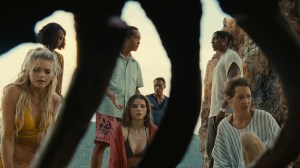
Old is not one of Shyamalan’s worst movies but it’s hard to classify it as good without attaching conditional modifiers. It might be good, if you enjoy movies that are campy and schlocky. It might be good, if you enjoy movies that throw anything and everything out there just because. It might be good, if you enjoy movies that produce a supernatural concept, drop rules established whenever convenient, and then try to wrap everything up neatly with an absurdly thorough explanation for everything. It might be good, if you think Shyamalan peaked with 2006’s Lady in the Water. This is going to be a polarizing experience. I think Shyamalan doesn’t fully understand what tone he’s going for and how best to develop his crazy storyline in a way that makes it meaningful beyond the general WTF curiosity. Even when it goes off the rails, Old is entertaining but some of that is unintentional. There are points where it feels like Shyamalan is trying for camp and other points where it feels like he is aiming for something higher and just can’t help but stumble, Sisyphean-style, back again into the pit of camp absurdity.
The premise is a grabber and takes the contained thriller conceit that Hollywood loves for its cheap cost and applies a supernatural sheen. It’s based upon a French graphic novel, Sandcastle by Pierre-Oscar Levy and Frederik Peeters, though Shyamalan has taken several creative liberties. It’s an intriguing idea of rapid aging being the real trap, and it forces many characters to confront their own fears of mortality and aging but also parental failures. Every parent likely thinks with some degree of regret about how quickly their little ones grow up. These adults have to watch their children rapidly age in only hours and not have any way to stop the relentless speed of time. The extra level of fear is produced by the fact that mentally the children are still where they began that morning. Even as Trent ages into the body of a teenager, he still has the mind of a six-year-old, and that is a horror unto itself. As his body rapidly changes, his parents are helpless to stop this terrifying jolt into adulthood and unable to shield their child from the terror of physical maturation but being trapped in the mindset of a child who cannot keep up with their mutating body. There are definite body horror and existential dread potential here, though Shyamalan veers too often into lesser schlocky thriller territory. For him, it’s more the mystery or the foiled escape attempts than actually dwelling on the emotional anxiety of the unique predicament. There’s enough born from this premise that it keeps you watching to the end, even as you might be questioning the actions of the characters, their ability to somehow miraculously guess the right answers as a group about what is happening, and the inconsistency of the rules about what can and cannot happen on this accursed beach.

There is one sequence that deserves its own detailed analysis for just how truly bizarre and avoidable it could have been, and to do so I will need to invoke the warning of spoilers for this paragraph. One of the other six-year-olds, Kara, gets a whole traumatic experience all her own that is morally and artistically questionable. Midway through the movie, Kara (Eliza Scanlan) and Trent (Alex Wolff) come back from a jaunt off screen together and they’re older and Kara is clearly pregnant. Given the rules that were established, that means that these six-year-old children experimented with their newly adult bodies to the point of fertilization (oh God, writing this makes me wince). I must reiterate that these characters are still six-years-old. Before you start realizing the gross implications, Kara is quickly entering labor and within seconds the baby is suddenly born and within seconds the baby just as suddenly dies silently from, what we’re told, was a lack of attention. What he hell, Shyamalan? Did you have to throw a dead baby into your movie to make us feel the visceral horror of the situation? It feels tacky and needlessly triggering for some moviegoers. This entire sequence doesn’t impact the plot in any meaningful way. Kara could have died in childbirth because of the circumstances of the beach. That would be tragic but matter. Just having her get suddenly pregnant and then suddenly the recipient of a deceased child seems needlessly cruel and misguided. And then, in the aftereffect of this trauma, Kara’s mom tearfully recounts her first love, a man she still thinks about to this day but doesn’t understand why. What does this have to do with anything? Re-read this entire scenario and let it sink in how truly uncomfortable and gross it comes across. It could have been avoided, it could have even been better applied to the characters and themes of the story, but it’s empty, callous shock value.
Another hindrance of Old is that the characters lack significant development and nobody ever talks like a recognizable human being. As Shyamalan has embraced being more and more an unabashedly genre filmmaker, he’s lost sight on how to write realistic people. You see this throughout 2008’s The Happening with its curious line readings and clunky, inauthentic dialogue being legendary and unintentionally hilarious (“You should be more interested in science, Jake. You know why? Because your face is perfect.”). I feel like Old is the most reminiscent of The Happening, the last time Shyamalan went for broke with ecological horror. The way these characters talk, it sounds like their dialogue was generated by an A.I. instead. “You have a beautiful voice. I can’t wait to hear it when you’re older,” Prisca says, which is a strange way for a parent to say, “I like what you have but wishing it was better.” She also has the line to her husband, “When you talk about the future, I don’t feel seen.” There’s also a running theme of characters just blurting out their occupations as introductions, “I’m a doctor,” followed by, “I’m a nurse,” like it’s career day on the beach. Frustratingly, all the characterization ends once the people wind up on this fated beach. Many of these characters are simply defined by their maladies and professions. This character has seizures. This character has a blood disorder. This character has a tumor. This character has MS. Noticing a pattern? You would expect that with such a unique and challenging conflict that it would better reveal these people, push them to make changes, especially as change is thrust upon them whether they like it or not. Imagine your uncle being cursed with rapid aging but all he does is still complain about his lousy neighbor. That limited tunnel vision is what Old struggles with. And one of the characters is a famous rapper named Mid-Sized Sedan but without a hint or irony or showbiz satire. Mid-Sized Sedan!

The way Shyamalan shoots this movie also greatly increases its camp appeal. This movie is coursing with energy and contrarianism. Shyamalan is often moving his camera in swooping pans and finding visual arrangements that can be frustrating and obtuse. Sometimes it works, like when we have the child characters with their backs to the camera and we’re anticipating how they have changed and what they might look like. Too often, it feels like Shyamalan trying to interject something more into a scene like he’s unsure that the dramatic tension of the writing is enough. There are scenes where what’s important almost seems incidental to the visual arrangement of the shot. Some of the sudden push-ins and arrangements made me laugh because it took me out of the moment by making the moment feel even more ridiculous. This heightened mood to the point of hilarity is the essence of camp and that’s why it feels like Shyamalan can’t help himself. If he’s trying to dig for something deeper and more profound, it’s not happening with his exaggerated and mannered stylistic choices being a distraction.
The ending, which I will not spoil, tries to do too much in clearing up the central mysteries. It feels overburdened to the point of self-parody, having characters pout expository explanations for all that came before and supplying motivation as to what was happening. Still, Shyamalan cannot keep things alone, and he keeps extending his conclusion with more and more false endings to complicate matters; the more he attempts to tidy up the less interesting the movie becomes. I would have been happy to accept no explanation whatsoever for why the beach behaves as it does. The best Twilight Zone episodes succeed from the mystery and development rather than the eventual explanation (“Oh, it was all a social experiment/nightmare/whatever”). Once you begin to pick apart the explanation with pesky questions, the illusion of its believability melts away. I had the same issue with 2019’s Us. The more Jordan Peele tried to find a way to explain his underground doppelganger plot, the more incredulous and sillier it became.
Old is a Shyamalan movie for all good and bad. It’s got a strong central premise and some memorable moments but those memorable moments are also both good and bad. Some of the moments have to be seen to be believed, and some of those moments are simply the odd choices that Shyamalan makes as a filmmaker as well as a screenwriter. It’s hard to say whether the movie’s weirdness will be appealing or revolting to the individual viewer. It feels like camp without intentionally going for camp. Rather, Shyamalan seems to be going for B-movie schlock whereas his older movies took B-movie premises and attempted to elevate them with themes, well-rounded characters, and moving conclusions (don’t forget the requisite twist endings). The worst sin a movie can commit is being boring, and Old is rarely that. I can’t say it’s good for the entire duration of its overextended 100 minutes but it does not prove boring.
Nate’s Grade: C-
Share this:

Glitter (2001) [Review Re-View]

Originally released September 21, 2001:
It must be seen to be believed. A new college crap-fest drinking game has begun. Begin the Glitter midnight shows! A new age is upon us! Here are a few handful of Glitter‘s bon-mots it serves up to its audience:
-Mariah Carey is shown leaving her real mom at age 8 with her kitten. Somewhere through Glitter she has a fight with her boyfriend and takes her cat (yes the very same immortal cat that must have been pushing 20) and leaves.
-She has a fight with said boyfriend and they both try and write a love song to show their remorse. Except they BOTH come up with the EXACT same song word for word, note for note, and NO ONE thinks this is the creepiest thing ever.
-The movie freakin’ ends with Carey’s boyfriend getting shot and killed. Yes, this is truly how the thing ends. Oh, like any of you cared about plot spoilers anyway.
-Da Brat is in it for “comic relief.”
-The movie is inexplicably set in the 1980s for no reason.
Anyone would have to be crazy thinking Glitter ever remotely resembled art. It’s so bad it’s awesome to watch. Bring some friends over, open up some alcohol, and let the fun times begin.
Nate’s Grade: F, like it matters though
——————————————————
WRITER REFLECTIONS 20 YEARS LATER

Apologies to Mariah Carey, but it’s impossible for me to think about Glitter without thinking about 9/11. I’m not intending to make some snide, crass joke about Carey’s film debut/vanity project bombing so spectacularly considering the tragic terrorist attack that changed everything occurred the week prior to its release. 9/11 was the seminal event of the twenty-first century and a “where were you on that day?” question for Millennials and older generations. As we approach twenty years since that fateful day, it’s hard not to reminisce and pontificate about tragedy, art, and possible catharsis, and yes, eventually Glitter will factor into this prosaic essay too.
Every person has a story. I was a sophomore in college, walking to the campus center to collect a copy of The New York Times, a subscription had been a requirement of my Political Science 101 class. I grabbed my day’s edition and another student said, “Hey, did you hear? Planes hit the World Trade Center.” I remember it not really processing for me and wondering what he was talking about. I went back to my dorm, turned on the news, and was quickly dumbstruck. I eventually wandered into my friend Amanda Hickey’s dorm and we stared glued at the TV as the towers fell and I remember the news people trying to square what was happening. It wasn’t just the south wall coming down, it was the entire building. As the day continued, and more attacks commenced, I remember one girl shaking saying she had just been to the Trade Center (over six months ago, so not exactly like a near miss), and another girl scared that our Jewish-heavy suburb could be the next target. To be fair, it was an alarming time, and nobody quite knew how many more potential planes were to be hijacked next. Nobody quite knew how many potential targets there would be. The federal buildings across the country were shut down. Parents pulled their kids out of school. We all felt vulnerable. Some of us more than others. I had a friend at school, Gavin, who was from New York and whose mother worked in the Trade Center. He was wrecked trying to get a hold of her, and fortunately she did make it out of the second tower and survived. I remember the numbness and feeling like you were watching a movie, like it wasn’t really happening, it was only special effects. It couldn’t possibly be real.

In the weeks and months to come from 9/11, America was looking for an outlet, looking for some kind of unifying force to heal, and that reluctant recipient ended up being Glitter. The movie was clearly intended to be a vehicle for Carey to stretch herself as an actress. It didn’t turn out that way for her though Carey did a more measured (and less glamorous! they always wanted us to know for publicity) supporting turn later in 2009’s Precious. Glitter was a project Carey had been working towards for years. At the start of 2001, Carey signed a $100-million-dollar contract for five albums for Virgin Records. She left her first husband, the controlling music exec Tommy Mottola, in 1998, left Columbia Records, and felt the pressure to deliver. She was one of the best-selling, most successful artists of the 1990s and was declared Billboard’s Artist of the Decade. From July 2001, Carey began behaving erratically. In promotion on MTV’s Total Request Live, she appeared with an ice cream cart, performed an awkward strip tease, and was shortly after hospitalized for a breakdown. On her website she posted: “I’m trying to understand things in life right now and so I really don’t feel that I should be doing music right now… All I really want is [to] just be me and that’s what I should have done in the first place … I don’t say this much but guess what, I don’t take care of myself.” She did not promote Glitter. The soundtrack was released on… September 11 and was also Carey’s lowest-selling album of her career. The movie was released on September 21 and grossed only four million. In 2002, Virgin bought out her $100-million contract for only $28 million.
With the wounds of 9/11 so fresh, it was easy to pile onto Glitter, the first new Hollywood release, as the bad movie that the nation needed right now to hate watch to feel better about itself. The New York Times said it was “an unintentionally hilarious compendium of time-tested cinematic cliches.” Variety said, “as phony a vehicle as one could concoct for a wannabe movie star.” The Village Voice said, “A heart-wrenching debacle from the start of the gun.” The Miami Herald said, “The kind of movie only 11-year-old girls who dot their I’s with hearts would find bearable.” Roger Ebert said the film lacked joy. The New York Daily News said it was “the worst performance by a pop star in a dramatic role since Madonna suited up for Shanghai Surprise.” The Washington Post said the movie was more a showcase for Carey’s breasts. The film appeared on numerous Worst of the Year lists and was nominated for 6 Razzies including Worst Film, with Carey winning the ignoble Worst Actress Award (over fellow nominees, and future Academy nominees, Penelope Cruz, Charlize Theron, and Angelina Jolie).

My review was among that throng so eager to find an outlet for our pain, a needed distraction from the harsh reality of wall-to-wall news. I gave the movie a failing grade and declared, “It must be seen to be believed. A new college crap-fest drinking game has begun. Begin the Glitter midnight shows! A new age is upon us!” Suffice to say, Glitter never entered the holy circuit of so-bad-it’s-good movies. I’ve never watched it again in the ensuring twenty years, and upon finally coming back to Glitter in 2021, I have concluded that it’s just thoroughly mediocre and dull. It’s not a good movie. It’s a limp retelling of A Star is Born with a weak romance between Carey’s character Billie Frank and her music producer boyfriend Julian who eventually dies, killed by none other than Terrence Howard (Iron Man), playing a scornful competing music producer who demanded money for “leasing” Billie from his employ as a backup singer. It’s just so thoroughly dull. It’s filled with listless songs from Carey, tracks she had reportedly been working on for years beforehand, and the rise to stardom is absent anything engaging. There are a handful of quirks, like the fact that Billie’s cat seems to be immortal and that she and her boyfriend, separated after a fight, both pen the exact same makeup song. These are fleeting moments but only moments of bizarre fascination. The movie is just an earnest, cloying, and altogether boring retelling of a formula you’ve seen in a thousand other dull movies. It’s not even great at being bad. Everything about Glitter is dull, middling, and not worth your time. Freddy Got Fingered was clearly the worst film of 2001 and still resonates as one of the worst films.
So why did everyone delight in ripping apart this mediocre movie from a troubled pop star? Maybe some were looking for a scapegoat for derision, something to feel superior to at a time where political upheaval made many of us feel like we were plummeting and lost. Maybe it was simply a distraction at a point of feeling overwhelmed by the elevated seriousness of the world, of the news, of our post-9/11 reality and its implications. In some way, Glitter was the first step in the process of art as processing for trauma. I’m not being hyperbolic. We needed Glitter.
In the years to come, a question emerged whether American audiences would want to see movies examining 9/11 and the subsequent War in Iraq. In 2006, Paul Greengrass directed a stirring recreation of the events of Flight 93 on 9/11, the one plane that crashed before its intended target, believed to be the U.S. Capitol. It was my top film of 2006, and Greengrass was nominated for Best Director at the Academy Awards. I remember a conversation where the other person argued it was “too soon” for these kinds of movies. That was the criticism you heard repeated, “too soon,” though that determination will always be different for everyone. Some may find the act of viewership with drama as a therapeutic exercise that can help process complex feelings from trauma. Storytelling can lead people to potential catharsis, a release of heavy emotions, and maybe even a sense of clarity or closure. I remember being an emotional wreck during my 2006 screening and listening to the handful of other people in the theater openly sob. How does one eat a bucket of popcorn to such a movie? The same could be said of a movie about the Holocaust, or slavery, or any of the horrors of history depicted on screen. Storytelling is how we process, learn, and relate to history and its numerous dicey moments. With art, we can possibly achieve catharsis through recognition. Again, not everyone will follow the same therapeutic path. I can completely understand if a person declares they never need to see a movie about the Holocaust, but I would lament that they will miss out on some of cinema’s masterpieces of drama. Art allows us to better know ourselves and to heal and better ourselves under the right context.

If Glitter had come out in 2002, I doubt it would have received the intensity of the critical drubbing it did in the week after 9/11. It’s not a good movie today. It will never be a good movie, but it’s not one of the worst movies of all time, or even of 2001, and the community went overboard because we needed an escape and a collective joke that we could all be amused from amidst the grind of tragedy and tumult. I think even the scathing and sexist critiques of Carey at the time would be pulled back for sensitivity of a woman clearly going through mental health issues. The Razzies nominated Carey’s breasts for Worst Onscreen Pair, a strange and icky joke that I still don’t even know is intended to be defamatory or gross admiration. With twenty years of hindsight, as we approach the anniversary of 9/11, I’ve become less hostile to Glitter. It came out during a time of national psychological need and served a purpose, entertainment even if it was misidentified as so-bad-it’s-good in the zeal to find a powerful escape. The history of Glitter will always be tied to a national tragedy but, oddly enough, its legacy shouldn’t be about Carey’s faulty acting career, or personal troubles, but as the healing nature of art itself. Take that for what it’s worth as you’re doing the math to figure out how old Billie’s cat is.
Re-Review Grade: C-
Share this:

Shang-Chi and the Legend of the Ten Rings (2021)
 After dominating the cinemas for over the last decade, Marvel took 2020 off thanks to that great menace even its own superheroes couldn’t overpower. Now in 2021, we’re eager for those big popcorn thrills of old, of a time before lockdowns and denials and vaccine misinformation. There’s a gauntlet of Marvel Cinematic Universe (MCU) movies coming down the chute, including The Eternals (November), Spider-Man 3 (December), Doctor Strange 2 (March), Thor 4 (May), Black Panther 2 (July), and Captain Marvel 2 (November). That’s eight movies from July 2021 to November 2022, and Shang-Chi and the Legend of the Ten Rings might just be the one that has the least recognition with the general public (I had never heard of him, sorry). And yet, I entered a theater for the first time in two months to see Marvel’s latest superhero blockbuster on the big screen, and as the MCU’s first foray into the fantastical world of martial arts epics, Shang-Chi is a mostly agreeable success in the realm of expert face punching.
Shang-Chi (Simu Lei) is the son of a very dangerous and powerful man, Xu Wenwu (Tony Leung), who has lived for thousands of years thanks to the power of ten magic rings that give him tremendous power to annihilate armies. Shang-Chi ran away as a teenager, leaving his sister Xialing (Meng-er Zhang) behind. She sends word requesting her brother’s assistance; dear old dad is on the warpath, and the two siblings might be the only ones who can stop him. Shang-Chi, living as Shawn in San Francisco, is trying to avoid larger responsibility as a valet with his good pal Katy (Awkwafina). However, he cannot ignore the assassins his father has sent, and so he and Katy travel back to China to regroup with Shang-Chi’s sister and face his destiny.
 This is the most fantasy-heavy movie of a universe that previously defined the magic from the Thor universe as just another advanced form of science. The entire third act looks like it’s taking place in Narnia itself; legitimately, the color palate and overly lit, CGI-assisted green landscapes reminded me so much of the 2005 adaptation of C.S. Lewis’ novel. Within the extended prologue over the history of the ten rings, the movie is acclimating you toward its larger-than-life universe that it treats with sincerity and graceful appreciation. The courtship of Shang-Chi’s parents is handled in that flirt-fight style reminiscent in classic martial arts films, and the balletic wire work and dreamy slow-motion, set to the soothing flute-heavy musical score, evokes romantic memories of Crouching Tiger, Hidden Dragon. Very early on, the work goes into convincing you that Marvel is taking this assignment seriously, and I appreciated that assurance and the follow-through. From a pure filmmaking standpoint, Shang-Chi works as a martial arts action film because it’s filmed and edited like one should be. The camerawork is vividly fluid and consistently roaming around the space of battle to better showcase the choreography and effort of the performers. The editing is also likewise very smooth and patient, with lots of longer takes blending together so that we can see multiple moves and counter moves, and if there are throws, we’ll travel with the fighters to continue the fight. I enjoyed a fight taking place on multiple levels of scaffolding. It all made my girlfriend nauseated in our theater, so you might be affected as well if you have a susceptibility to cinematic motion sickness. This movie allows you in on the martial arts fun.
I wasn’t expecting this kind of leap from co-writer/director Destin Daniel Cretton. This man was responsible for one of the best films of 2013, and the 2010s-decade, Short Term 12, which starred (drumroll please) future Oscar-winner Brie Larson, future Oscar-winner Rami Malek, future Oscar-nominee LaKeith Stanfield, Kaitlyn Dever (Booksmart), Stephanie Beatriz (Brooklyn 99, In the Heights) and the best-known actor at the time of release, John Gallagher Jr. (HBO’s The Newsroom). Wow that cast is an all-timer. This is like the Millennial Outsiders with a cast of up-and-coming actors who have gone on to ascendant and award-winning careers. It’s also a hard-hitting, deeply emotional and upending movie worth your time. Cretton has stuck to adult dramas based upon real stories of people struggling through the justice system (Just Mercy) and parental dysfunction (The Glass Castle). A big-budget martial arts epic I wasn’t expecting, and perhaps the Marvel Machine makes it easy for indie auteurs to plug right in, but it feels like Cretton clearly has an affection and at least a tacit understanding of favorable stylistic genre choices. At this point I shouldn’t discount what filmmakers can make those big artistic leaps with a studio project. James Gunn can go from Super to the Guardians of the Galaxy, and so Cretton can go from Short Term 12 to helming a large-scale, CGI-heavy martial arts fantasy.
 Another aspect I found pleasantly surprising was the amount of work put into its primary villain and the ensuring father/son dynamic. I’m not going to say that Xu Wenwu, a.k.a. The Real Mandarin, is one of the more complicated or nuanced villains in MCU history, but he’s given more dimension than a simple “destroy and/or conquer the world” motivation. In fact, that was the motivation for the man before he met Jiang Li (Fela Chen), Shang-Chi’s eventual mother. Real Mandarin (or RN as I’ll refer to him because I’m lazy) was going about the whole conquer and raze kingdoms thing for thousands of years, establishing another one of those all-powerful yet still clandestine and very vague shadow societies pulling the levers of power. He found a person who made him want to reform, to put his old ways of violence behind, and it’s her death that spurs him back to his views of power absolving all conflicts, so the most powerful is the one who can have the most say and protect the people close to him or her. If he had the full power of those ten rings, ordinary gangsters wouldn’t have dared to threaten or harm his loved ones. He trained his son to follow by example, and despite the fact that he sent trained killers after his son rather than a more constructive and clearer message, RN declares his love for his children. He is moving forward to return his beloved back to the land of the living. Being motivated by grief and wanting to see a departed loved one no matter the cost is a relatable struggle and one that brings degrees of nuance that Leung can imbue with his great pained, hangdog expressions. Having a father be the villain but still love his children and be primarily motivated by bringing back his dead wife and honestly assessing how she made him a better person is a breath of fresh-ish air.
Liu (Kim’s Convenience) is easily charming and demonstrates a sharp affinity for the martial arts training and choreography. With the longer takes and clean edits, it’s clear that Liu is performing many of the moves, and he moves with great skill and balance to believably crack some skulls. A fight aboard a city bus is our real intro into seeing this man as he’s avoided, as a well-trained fighting machine, the identity of his father that he’s been attempting to run away from. Liu has a self-effacing charm to him that doesn’t cross over into smug. Awkwafina (The Farewell) is her reliable comic relief asset, though too often the movie resorts to just spotlighting her for a riff or one-liner when the context doesn’t provide the opportunity. It’s rather mystifying why her supporting character, a normal human, would accompany her pal into the word of underground martial arts ninja conspiracy fantasy, let alone that she could take up a bow and arrow and becomes a valuable member of a fighting force. Leung (2046, The Grandmaster) is just movie royalty, so getting him to read the phone book would have been an acceptable start. He sits out for long periods and his absence is noted. He brings such a heaviness, a quiet yet dignified despondency to the character, and there are several instances where he undersells his character’s danger and power, which just makes him so much more intimidating. I feel like Leung is finding connections with the somber, brooding heartache of his War Kong Wai roles, and yes film nerds, I just made that connection for a Marvel movie.
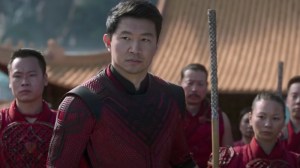 Not everything quite works in this MCU outing. There are several jumps in the screenplay that feel like further revision or clarity were necessary. I don’t really know why Shang-Chi is finally able to take on his father at the end except for some abstract concept of, I guess, believing in himself more. The power of the rings feels a little too unexplored for deserving of the movie’s subtitle. The rings come almost as an afterthought for much of the movie. There are a few moments where I was trying to connect how characters understood what they were supposed to do in any given moment, and I just gave up, which is kind of what the film also feels like it’s doing. There are clear characters included with the sole decision to sell merchandise. I don’t know if the nation’s children will be screaming for a faceless winged furry ottoman but that’s the gamble Marvel execs took and by God, you’re going to get many appearances. The sister addition to the movie feels decidedly undernourished, like she’s drafting from the father/son relationship that’s getting all the narrative attention. It feels like occasionally the movie pans to her to nod and go, “Oh yeah, me too.” The visual color palate is so brightly colored for so long, and then once the big splashy Act Three battle commences between CGI good and CGI evil, the visuals become so grey and murky and definitely hard to keep track of in the scrum. I wish the fantasy rules were more streamlined and explored rather than feeling grafted on when needed and forgotten when inconvenient, but this is their first foray into this sub-genre of action and while Marvel doesn’t need a sliding scale at this point, it’s still a moderate achievement.
Look, this isn’t exactly The Raid or Ip Man or anything that will challenge the most heart-pounding, intense, acrobatic heights of the crossover martial arts epic. Consider it a solid effort at watering down a Hero or House of Flying Daggers and switching over to the typical Marvel formula final act complete with onslaught of weightless CGI. Shang-Chi and the Legend of the Ten Rings is a fun action movie that does just enough right to land it in the cushy middle-of-the-middle for the annuls of the MCU (I would rank it around the level of Black Panther). The fight choreography and presentation, as well as the exploration of the father/son dynamics, are surprisingly refined, which is good considering one provides the entertainment value for the eyes and the other the emotional connection for everything to matter more than flashes of punches and kicks and fireballs. It doesn’t transcend its genre or the tried-and-true Marvel formula, but it’s packed with enough to even keep a casual fan entertained for most of its 130 minutes. It’s more of a one-off that doesn’t require extensive knowledge of the two dozen other MCU titles, so Shang-Chi might be just the right Saturday morning cartoon of a movie to introduce new people to the larger world of Marvel movies.
Nate’s Grade: B
Share this:

Cinderella (2021)
 Do we need another rendition of good ole’ Cinderella, especially only a few years after the Disney live-action version? The new Cinderella starring pop star Camila Cabello is a surprise jukebox musical, and it’s irreverent where it should be and progressive where social critiques are warranted with the source and historical context. In short, it’s a fleeting but fun experience that’s a winning 100 minutes for families with young children and adults who enjoy a peppy, self-referential musical. Written and directed by Kay Cannon (Pitch Perfect), this movie is packed with singing and dancing to the point that the talking only makes up perhaps twenty percent of the movie. This choice proves to be a durable source of energy and keeps the pacing running smooth. It’s also convenient because we don’t need extra time explaining the setup and character dynamics that we’re all so familiar with at this point thanks to the umpteenth renditions. The mash-up of popular songs kept me amused and guessing what would appear next, and the original songs contributed by Cabello have a nice soaring uplift to them as well as memorable hooks. There’s a “What a Man”/”Seven Nation Army” mashup at a ball that gave me strong Moulin Rouge vibes, especially with all that chaotic sashaying petticoat editing. The movie is also funnier than I expected, with consistent wise-cracking and one-liners that had me laughing and critiques about the patriarchal system from a progressive, feminist perspective. The evil stepmother, played by Idina Menzel (Frozen), is even given her own song detailing her tragic history of being a musical prodigy who had to give it all up in a society that only valued her as marriage material. Even she gets consideration and empathy. The winking feminist criticisms won’t be new to anyone over the age of twelve, but it’s still welcomed even as the film skates over the discordant plot elements to keep things light. The film delivers some bon mots of political thought to go along with its sugary sweetness of a contemporary sing-a-long musical that is easy to digest. Cabello has a natural charisma to her and is surprisingly adept with comedy, able to turn on a dime and deliver a hilarious self-effacing remark. She’s far better at acting than you might believe. If you have no interest in another version of Cinderella, I understand the fatigue with the property. However, this Cinderella understands your fatigue, provides something light and airy, with actors who seem to be legitimately having fun, and it’s got a consistent feminist perspective that chides the prevalent problems with the source material. It works as a family film and even as a diverting jukebox musical for adults whose tastes run a little sweet and a little tart.
Nate’s Grade: B
Share this:

He’s All That (2021)
 I’m sure there aren’t too many who consider 1999’s She’s All That a great film, or even a great high school comedy film, but I know there are fans and I know nobody was clamoring for a Netflix gender-swap remake starring one of Tik Tok’s most famous users. We didn’t need the original but it was a mildly amusing version of My Fair Lady, or its older inspiration Pygmalion, set in the superficial class system of an American education system. It came out during the heyday of 90s teen cinema remaking older literary concepts (Ten Things I Hate About You) and made short-lived careers for stars Freddie Prinze Jr. and Rachel Leigh Cook. My amazement is Netflix rehiring the same writer, R. Lee Fleming Jr., now 50-something, and asking him to remake his twenty-year-old hit for the voice of Generation Z (It’s not even like “all that” has held up in slang parlance). This movie feels every bit the dismal corporate-sponsored, cash-grabbing, star vehicle that it is. Nobody in Generation Z cared about She’s All That, and now very few will really care about He’s All That.
This time we follow Padgett Sawyer played by Tik Tok star Addison Rae (83 million followers in real life!). Padgett is a high school senior who has millions of online followers who hang onto her every word of advice. She uses her position as an influencer to even help pay the bills at home to relieve her overworked mom (Rachel Leigh Cook, not the same character) and maybe pay for her college. She live streams catching her boyfriend cheating, loses her cool, and becomes a meme thanks to an unfortunately timed snot bubble. Now she has to earn back those lost followers and her respect or else she might not still maintain her ascendant social media standing and pay for school. Her catty friend challenges her to makeover a loser guy at school and the hopeless case ends up being Cameron Kweller (Tanner Buchanan), a sarcastic, arty loner who wears a beanie and has long hair (a wig) and rides horses and practices karate. What a loser. She buddies up to Cameron and through that friendship she starts to question her own sense of self and learns what’s really important as she physically changes this guy to be more acceptable to a mainstream opinion of people she’ll never meet in real life. Or something like that.
 The inordinate influence of social media is a very worthwhile avenue to explore for modern satire as a means of separating this He’s All That from its predecessor and making it relevant. The problem with He’s All That is that the movie refuses to go very deep or hard-hitting with this topic because it’s also meant to be a vehicle for fame to launch the feature acting career of Rae. I’ll fully admit, dear reader, that I had no idea who Rae was until watching this movie and I don’t really get the appeal (more on her acting ability later). In this movie, Padgett is obsessed with maintaining her carefully curated online image, a ruse that relies upon a fantasy that no human being could adequately maintain. She wakes up and goes through an entire routine of makeup and hair styling before she records herself “just waking up.” It reminded me of a joke from the fabulous TV series The Marvelous Mrs. Maisel where the title character makes sure her husband never fully sees her in the morning how she actually looks. It was funny then because it commented on the pressure of wives in the 1950s, let alone those from Jewish families, to live up to an impossible beauty standard to appeal to the man’s comforts and desires. With He’s All That, it really becomes the last joke at the expense of our main character. The movie is too afraid to delve any deeper for fear of directing negative attention toward its star and her influencer ilk. It even conveniently sets up the good of her position, what with her able to pay some bills. She can’t be all bad, you’ll say, because she’s helping her mom. I guess we like social media facades now.
Padgett’s plight really doesn’t make much sense in the context of the movie. She’s dropped perhaps a fifth of her many followers after the embarrassment of her public breakup with her louche of a boyfriend, a wannabe recording artist. First off, I don’t know why this personal incident would be so detrimental to her character. Her boyfriend was clearly bad, she stood up for herself, and I would think that would only make people like her more and draw more followers to her brand. The only reason she has to worry is because we’ve awkwardly included Kourtney Kardashian and an even bigger social media influencer. I don’t know why we have a Kardashian here, and I don’t know why she doesn’t merely play herself, unless that too would be another example of striking too close to home with the satirical depictions. Regardless, Padgett is worried she’ll have to, gasp, potentially take out student loans for college. She believes that picking someone to grant a makeover would get back lost followers, which makes some sense, but then her friend also elects to make a personal bet about selecting some campus schlub and turning them into a heartthrob. Why does our main character need two motivating forces for why she agrees to participate in this bet? It’s needlessly extra for a movie with so little else going on.
 Another fault is that there is no chemistry between our leads, which kills the investment in any romantic comedy. The two actors are not a good fit from the beginning, and this comes down to two factors, the underwritten characterization and the limited acting ability of Rae. It was a joke in Not Another Teen Movie, a not-so-great spoof over those popular 90s/early 2000s teen comedies, that the thing separating the obviously beautiful girl from “plain Jane” territory was merely glasses and a ponytail. Cameron is already an appealing guy so when he gets his big physical transformation it’s really just scrubbing off stubble dust and removing the beanie. His character, a self-described outsider, would be unlikely to be seduced by the wiles of popularity. There’s also precious little to be uncovered with the character of Padgett, so the movie can’t even have Cameron fall for Padgett as he realizes she isn’t like his preconceived notions. There’s no heat or sizzle or any point of intrigue between these two that would compel an audience to root for their eventual coupling. Cameron, we’re told, like “Kurosawa, Kubrick, and kung-fu movies,” and he’s basically the gender reverse of a shallow rendition of a manic pixie dream girl who is ultimately just there to get the protagonist to stop and appreciate life and then sublimate their own interests and desires to that of the protagonist. This is a romance where you root for irrevocable heartbreak.
Rae might be an overall pleasant presence but she’s not quite there in the acting department yet. Her limited range really dampers many of the dramatic moments. Her line readings are extremely monotone. There are moments where I thought she was just going to smile her way through a scene. There were several scenes where I was convinced they could only have filmed two takes because this had to be the best one by default. I don’t want to pile on Rae. I don’t know the woman and she’s only twenty years old and this is only one role. Except He’s All That has also clearly been tailored for her and she cannot live up to these standards at this time. There’s an egregiously long dance battle at the prom that goes on forever just to take advantage of Rae’s dance skills from her Tik Tok dances. It’s the same kind of contortion done to make room for Buchanan’s (Cobra Kai) martial arts skills with a silly fight with Padgett’s ex-boyfriend.
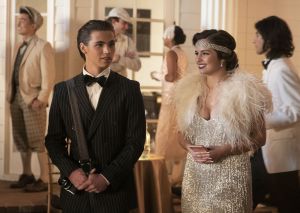 If I was overly cynical, I would estimate that the producers of He’s All That sought an older IP that might still have some pull with an older audience that could be stripped down to its parts and slapped together with a formula that could platform its young stars while also barely hitting that 80-minute feature running time requirement. Except that sounds exactly like what’s happened with He’s All That as well as the preponderance of product placement. This entire movie is a cynical enterprise. It’s not funny at all. It feels completely inauthentic with its portrayal of modern teenagers and social media lifestyles and even the appeal provided by a social media following of fans giving instant validation to every coordinated effort to be your phony best self. The director is Mark Waters, a man who helmed Mean Girls, the 2003 Freaky Friday, and the dark indie comedy The House of Yes. He has talent. He knows how to shoot a comedy. He knows that not every scene needs to be overly lit like night and shadow have no meaning and it all looks so cheap. While watching He’s All That, you’re left with the strong impression that everyone should know better, and you should know better than spending 80 tepid minutes of your time watching this cynical exercise.
Nate’s Grade: D
Share this:

The Green Knight (2021)

The Green Knight is an indie drama heavy on atmosphere and mood and a little lax on pacing, falling into yet another A24 discrepancy between critics and audiences. Much like the contentious differences of opinion over It Comes at Night and Hereditary, it seems like general audiences are a little more indifferent to hostile for this arty release than the critics. Maybe they were expecting something more conventional, which is a mistake considering it’s written and directed by David Lowery, who has dabbled in a studio sphere (Pete’s Dragon, the upcoming Disney Peter Pan remake) but seems more at home with introspective, quiet, occasionally overly obtuse art-house pictures, the kind like 2016’s A Ghost Story where Rooney Mara eats a pie for ten minutes (I will never forget this puzzling movie moment). It’s not surprising then that The Green Knight would be a polarizing film of differing expectations. It’s got good graces, an artistic vision, and a preponderance on atmosphere that can feel a little strained at points.
Gawain (Dev Patel) is the nephew to the King of England (Sean Harris). He longs to be accepted as a respected knight but he has no adventures to his name. Then one Christmas, a Green Knight (Ralph Ineson) enters the kingdom and challenges any daring knight to a game. That knight can inflict whatever blow or mark upon him, but then the Green Knight will return the exact favor in one year’s time. Full of bravado, Gawain takes mighty Excalibur and decapitates the Green Knight. Turns out the knight is not dead. He only picks up his fallen head and promises that in one year, he’ll deliver the same to Gawain. The months pass and Gawain is drinking and sleeping away his last remaining time before finally accepting to meet his fate. He rides out of Camelot in search of the Green Knight and perhaps a solution out of his predicament.
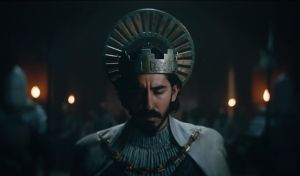
Where The Green Knight excels is with the distillation of mood and myth-making while not losing sight on its own sense of humanity. This is an Arthurian legend that is potentially a thousand years old, and when it comes to big screen adventures steeped in the mythology of cultures, it’s easy to get swept up in the fantasy spectacle of monsters and heroism. The vulnerability of the heroes is often cast aside to provide further attention to the grandiosity of the experience and entertainment. Lowery positions his movie from the perspective of an eager naïf yearning for a proper adventure to bring him respect and legacy, but he’s also a scared young man who is dreading the worst possible outcome that could be his only outcome. As Gawain sets off on his quest, he sets off proud, striding along his horse, not looking back at his home as he rides off to face his destiny, and then he’s immediately beset by treachery that removes the pristine shine off the tales of old. He’s taken advantage of by highway robbers and placed at an even greater risk of failure. As the movie progresses, Gawain becomes more and more anxious about the potential of getting himself out of his predicament. It truly seems like he’s marching off to meet his executioner, and that realization forces him to quickly adapt into the heroic mold he’s been aspiring for, the legendary knight, bold and brave and meeting death square in the eye. That sounds good in theory but it’s a lot harder to realize in real life. If any one of us, dear reader, knew that our lives were coming to an end with certainty, summoning the courage to meet that would be a herculean effort, and many of us would crumble under the pressure. It all doesn’t seem like enough time. This is what I appreciated throughout The Green Knight. It has its weird, atmospheric mythology and fantasy elements, but it also grounds the drama in relatable and nervous human emotions.
Where the movie goes astray, at least for me, is the time it devotes to achieving its poetic atmosphere. This is a two hour-plus movie that feels every bit of it, even if you’re enraptured by all the pretty style and ponderous pontificating. That’s because the movie is very episodic by nature, which at least breaks it up into manageable chunks each with something new to draw our attention, but it also makes it feel like less is being earned or amassed. In one segment, Gawain rescues the head of a ghostly woman (Erin Kellyman). In another segment, this one quite awkward to experience, he is tempted by both the lord (Joel Edgerton) and lady (Alicia Vikander) of a household, keeping his vow while something most distracting is taking place simultaneously. Another segment has Gawain interacting with giants, including one breastfeeding a little giant. There’s also a fox who occasionally talks and tries to plead with Gawain to turn away from meeting the Green Knight. I suppose if you’re being charitable you could surmise each of these stops is like a test of his skills of knighthood, from compassion to chastity to dedication, but it feels less like an accumulation and more like Lowery is simply finding time to explore other weird offshoots of this crazy fantasy medieval world.

A term I first used describing the films of Nicolas Winding Refn (Neon Demon), a filmmaker I’m not particularly fond of, is the use of empty space, where the narrative feels stretched out and the audience is intended to provide that extra level of meaning for the dead air. To me, it’s narrative forfeiture. The Green Knight could have been trimmed down, it could have been reordered, it could have been given more specific meaning, but that would potentially detract from its tone poem qualities. If that cinematic sensation works for you, and you fall under the film’s sway, then congrats. If you’re looking for more or at least more meaning in the plot and chain of events, then you’re going to be left grasping for more significance. Sometimes things just feel put into the movie because, beyond all else, it’s simply cool. That’s fine, though I found too many of the asides to be lacking once the initial obstacle was established. Lowery has a larger thesis under the surface about environmental awareness considering the Green Knight is literally made of wood and plants, he goes out to the forest to live on his throne amongst the wilderness, and there’s even an extended fiery monologue by Vikander about the enduring power of “green” and how it will outlive us all and grow over our corpses (if you were being pedantic, you could argue that all color will outlive us as I doubt there will be a nightmare future without, say, the color orange). The larger thesis, however, doesn’t feel supported by the asides and episodes of Gawain. I guess it’s about thinking of the consequences of our actions and, in a way, proportionality or response. Maybe more people would reconsider their carbon footprint if nature was going to cut off their heads as a consequence of using too many plastic straws. Maybe.
Where Lowery’s plot and ambition do come together, thankfully, is with his conclusion, which I will spoil in the following two paragraphs. In the original Medieval legend, Gawain meets the Green Knight who proves to be the lord of the manor in disguise. The man playfully chides Gawain for flinching and wearing a sash he felt would spare him of harm. He then says Gawain is “the most blameless knight in all the land,” which makes little sense, and then Gawain joins the other knights, and they all have a big laugh about the jape played on Gawain. That’s not exactly a satisfying ending and takes away any personal growth Gawain might have earned. In the movie, the Green Knight is for real. Gawain initially lowers his head, trying to summon the courage to meet his death, but he flees and apologizes, escaping the Knight’s retribution.

In a nearly wordless epilogue, we watch Gawain’s life over the course of decades, inheriting the throne, siring an heir, abandoning the mother, leading his people to war, losing his son, and eventually being such a disliked leader that his own people revolt including his own family members. All the while he wears that magical sash to thwart his own demise. This epilogue is revealed to be a flash forward for Gawain, who returns to the moment of consequence with the Green Knight. Rather than flee his fate, he now chooses to accept it, to avoid this future where Gawain goes down a path of corruption and neglect. Better to die now than become a cruel despot that will harm others. He even removes the sash. It is here where the Green Knight finally acknowledges Gawain with respect. It’s this ending that really hits home the themes and the character arc for Gawain. He’s become a knight worthy of legend but has no audience, and is choosing to have no audience, to die alone rather than live in infamy. He’s found his sense of bravery at long last because of his fear of what avoiding his fate will cost. It’s an ending that feels earned and when the Green Knight is giving him an “atta boy” you want to join in.
The Green Knight is going to be a different experience for each viewer depending upon your patience for ambiguity and pacing. I found myself at points marveling over the mood and visual style of Lowery’s vision, and at other points I found myself getting restless with the episodic side quests and the stalled character development. It all comes together by the end with a finale that really cements Lowery’s big ideas and drives homes the personal journey of Gawain. It’s all a mixture of bold and beautiful and a little bit boring.
Nate’s Grade: B
Share this:

Reminiscence (2021)

Reminiscent of other moody sci-fi/noir mashups like Dark City and The Thirteenth Floor (oh the 1990s), I mostly wish that Reminiscence had been less devoted to film noir trappings and explored more of its intriguing sci-fi setting and implications. Set in a future where seas have covered much of Miami, Hugh Jackman plays a memory specialist who helps clients/nostalgia addicts find peace by reliving their past experiences through tech tanks. It’s an interesting start and of course, as per noir rules, he’ll stumble across a mysterious woman (Rebecca Ferguson) with a troubled past that he can’t help but fall in love with even as it becomes clear she had ulterior motives for meeting our hero. There’s an obvious and potent commentary at play about worshiping the past at the expense of the future and the consequences of our actions, played on a personal level and a larger ecological warning. The problem is that it takes far too long for me to care about the movie. As expected, the mysterious woman vanishes, and Jackman is determined to find her, but I didn’t care about their relationship nor find this woman charming or anything other than a plot catalyst. We needed a more urgent sense of stakes to increase audience engagement. It wasn’t like she framed Jackman who then had a certain amount of time to clear his name with bad people or the police. There’s no real reason to root for Jackman to find this missing woman besides that he’s sad. This Chinatown-meets-The Cell movie is written and directed by Lisa Joy (co-creator of HBO’s Westworld), and there are interesting ideas to go along with its near-future world, and yet it all feels like a few drafts away from honing its real potential. I feel that the noir trappings strangle the storyline as far as what its ultimate imagination can be as it tries to fit into a familiar formula. Jumping into people’s memories as an investigation seems far more exciting than pounding the flooded pavement for answers. Reminiscence is a bit more conceptional than what it can deliver. It’s not terrible but it’s not terribly interesting either. Why isn’t there more with the police utilizing this technology to solve crimes or invade people’s privacy? That seems like a better starting point for conflict than “mysterious woman comes into shop.” There are some stunning visuals and points of excitement, like a fistfight that tumbles into a sunken concert hall. The ending is fitting and slightly poetic though heavily predictable given the preoccupation with repeating select conversations about the tragic nature of love stories. The problem with Reminiscence is it’s too reminiscent of too many other genre influences without providing enough of a story or characters or mystery or world to stand apart. If you’re a fan of Dark City, you might want to check out another stylish sci-fi/noir mashup, or you could just re-watch Dark City.
Nate’s Grade: C+
Share this:

Jay and Silent Bob Strike Back (2001) [Review Re-View]
 Originally released August 22, 2001:
Kevin Smith returns back to his comedy roots. No more movies with a message (Chasing Amy and Dogma) it’s back to good ole’ snowballing and stink palming. His latest, Jay and Silent Bob Strike Back, is like a giant thank-you card to all his fans that have made the man who he is today. It ties up the entire View Askew universe so Kevin can drift off into uncharted ventures of film making and not have to keep referencing the same damn characters. Plus there’s plenty of good-natured vulgarity to go around.
 The plot of Jay and Silent Bob is nothing too heavy but seems to keep the film on a continuous pace, unlike the sometimes stagnant feel Mallrats had (what, they’re in one location for 90 minutes). It seems that after getting a restraining order at the Quick Stop on them, Jay and Silent Bob learn that Miramax is making a movie from a comic book that is in fact based off of them. Learned of the riches they could make they seek out the comic’s author Holden McNeil (Ben Affleck’s first appearance in the film) and demand a piece of the pie. Holden tells them that he long ago sold his right to his partner Banky Edwards (Jason Lee, in his second appearance in the film) and that there’s nothing they can do to stop the film. Jay suddenly gets the idea that if they stop the movie from ever getting made then they don’t have to worry. So off go our stoner duo on a mission to sabotage and satirize Hollywood.
Along the way are a hitch-hiker (George Carlin) advising the best way to get a ride is to go down in your morals, a confused nun (Carrie Fisher), the cast of Scooby Doo offering a ride (which will be 100x funnier than the feature film coming out next summer), a beautiful band of international diamond thieves (Eliza Dusku, Ali Larter, Jennifer Swalbach-Smith, Shannon Elizabeth), a rescued chimpanzee, a dogged Wildlife agent (Will Ferrell), and a full barrage of hilarity once Hollywood is finally hit.
 The best barbs are laid out by Ben Affleck and Matt Damon bickering about the other’s film choices on the set of Good Will Hunting 2: Hunting Season. This moment is truly inspired and full of great humor from Gus van Sant too busy counting his money to yell action to Damon turning into a vigilante hero. I almost fell on the floor laughing during this sequence.
When Jay and Silent Bob hit Hollywood is when the comedy starts hitting its stride as this Jersey Greek chorus interacts with the Hollywood life and encounters many a celebrity. The jokes are usually right on target except for Chris Rock’s performance of a racism obsessed film director. Rock’s portrayal becomes grating to the moviegoer far before it’s over, though he does get a few choice lines.
Smith as a director has finally elevated his visual art into something that can sustain itself instead of his earlier just-hold-the-camera-and-shoot movies. There are pans, zooms, quick cuts, cranes, action sequences, and even CGI. Smith is evolving as an artist but still staying his “dick and fart joke” self, and Jay and Silent Bob Strike Back is evidence. And that’s fine by me.
Nate’s Grade: B
——————————————————
WRITER REFLECTIONS 20 YEARS LATER
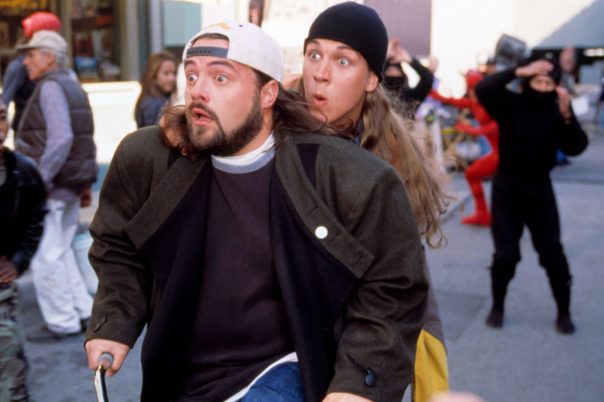
This was the one movie I was dreading more than any others on my 2001 re-watch. I’ve been a Kevin Smith fan since my teenage years and the man’s brilliantly vulgar movies had a formative effect on shaping my love of comedy, cinema, and even language itself. I don’t know if I can say I’ve been a fan of Smith as a filmmaker for some time. He took a more schlocky genre-based turn the last decade to diminished results; I enjoyed the change of pace from 2011’s Red State but found my interest deflating with 2014’s Tusk and 2016’s Yoga Hosiers. It wasn’t until 2019’s Jay and Silent Bob Reboot that my worry was unable to be suppressed. Had the filmmaker stopped growing or had I simply outgrown the filmmaker? The old jokes and self-serving references felt too labored, too stagnant, and like an old man repeating the hits for the same group of fans to laugh at the same recognizable and tired punchlines. By nature, comedy has the shortest shelf life of entertainment, and I was dreading that the original Jay and Silent Bob big screen adventure was going to feel so outdated and pitiful, especially since it’s the least substantial of all of Smith’s early films and was intended as a silly crowd-pleasing romp for his fandom. In 2001, I was a big participant of that group. In 2021, I don’t know if I still am.
This 2001 movie was always intended to be rather insular, pitched to the diehards who would understand references to chocolate-covered pretzels and the backseats of Volkswagens, but the star-studded affair was also intended to close the book on the View Askewniverse, the interconnected world comprising the first five films of Smith’s career. Smith had intended to move on and tell new stories unbound by the confines of his continuity and the demands fans would have that the new stuff tonally aligned with the old stuff. This never really happened. Smith tried something different with 2004’s father/daughter dramedy Jersey Girl and upon its theatrical demise retreated back to the safety of his View Askew universe. To be fair, he has branched out with bold experiments in horror, some of them rather successful, but it always feels like Smith is too afraid to move too far ahead of the fandom he credits so much for his success. Hey, people go to concerts and they want to hear the hits. I understand the appeal. I chuckled at points of familiarity in Jay and Silent Bob Reboot, and also Strike Back upon re-watch, but when you’re talking storytelling and comedy, stagnation isn’t growth. It’s a self-imposed ceiling.
 It was very early that my sinking feeling for Strike Back became my default setting. The characters of Jay and Silent Bob are not built to carry an entire movie, especially when one of them is mostly mute. It becomes the Jay (Jason Mewes) show and he overstays his welcome. There are definite limitations to these two stoners being the primary characters, and that’s why Jay seems to vary from scene-to-scene for the sake of comedy. In some scenes he’ll be clever, in others powerfully stupid, and in others so specific, like when he’s referencing Prince Valiant or rhapsodizing a Planet of the Apes apocalyptic fantasy that is too involved to come from the mind of this dumb stoner. This is the same guy who didn’t know you had to pay to ride a bus. The character unpredictability would be more acceptable if those leaps lead to worthwhile comedy bits that couldn’t otherwise be bridged by the operating persona of the long-haired foul-mouthed horndog. Therein lies the issue. The humor of Strike Back is too scattershot and too obvious to really land consistently. The fourth-wall breaks are painful and plentiful. The constant exclamation of “bong” is never funny. The random inclusion of the Mystery Machine, with a Velma openly lusting after women, is lazy. The fact that people are fighting with bong lightsabers and dildos is lazy. The joke that everyone on the Internet complaining about pop culture is just a teen dweeb is lazy and almost Aaron Sorkin-esque in its snide broad-brush painting of technology and youth. As I said in my review of Reboot: “Smith has never been one to hinge on set pieces and more on character interactions, usually profane conversations with the occasional slapstick element. This is one reason why the original Jay and Silent Bob Strikes Back suffers in comparison to his more character-driven comedies.” This movie is wall-to-wall wacky slapstick and road trip pieces that fail to transcend their cultural references.
And the comedy aspect that has aged the worse, by far, is the rampant gay jokes. At the time of its theatrical release, G.L.A.A.D. was openly decrying the film for its copious jokes at the expense of being mistaken as gay. I’m all but certain that 2001 me would have voiced the opinion that this was absurd, that of course Smith isn’t a homophobe, and he’s merely satirizing homophobia. The problem is that being gay is such a repeated joke of derision and hysteria. Wildlife Marshal Willenholly (Will Ferrell, one of the better reasons to still watch) admits he’s only a man on the outside, and I guess that’s a joke? Gay jokes are definitely one of the kinds of comedy that has aged the worst in the ensuing twenty years. Think back to 2005’s extended riff-fest between Seth Rogen and Paul Rudd in The 40-Year-Old Virgin where they try to top one another how they know the other is really gay. That would never happen in a studio comedy today. Times change and so do the mores of comedy. Things we thought were funny decades ago we might not feel the same way. That’s the nature of comedy. The overall comedy of Jay and Silent Bob Strike Back feels tacky and dated, so the onslaught of gay panic and derision only makes the rest of the comedy feel just as sad and pitiful.
 There are two hooks to this movie, the relationship that forms between Jay and Justice (Shannon Elizabeth), one of the members of a girl gang of jewel thieves, and the havoc and industry satire of the guys running through the Miramax studio lot. Heather Graham reportedly turned down the role of Justice because she could not understand what woman would fall in love with Jay, and she’s completely right. The girl gang seems included because it felt like the hot thing to do at the time after Charlie’s Angels, to include some sexy ladies in cat suits, give them slow-motion scenes where they wink at the camera about how sexy they must look in magazine cover poses, and seem to be in on the joke while just objectifying these one-note characters with air quotes. Just because Smith later has the girl gang underline their cliché nature doesn’t make them any less of a cliché, and their entire inclusion feels like fulfilling a personal demand for Smith rather than satirizing the shallow depiction of “strong action heroine” in Hollywood blockbusters. The other hook is the actual industry satire, strictly under the guidance of lampooning Miramax and their hits and indie darling culture, all of which has the pall of Harvey Weinstein cast over it. The industry jokes aren’t exactly very cutting. It’s difficult to even label this as satire. It’s more a madcap chase that resembles a crude version of Pee Wee Herman’s studio escapades. It too feels predicated on fulfilling personal demands for Smith, like literally fighting Luke Skywalker in a lightsaber duel. I’ll agree with my 2001 self that the comedy is on stronger footing during this final act, but that’s not exactly a ringing endorsement for the rest of the movie. Strike Back doesn’t strike hard enough.
There is one reason to watch this movie and it has always been the unique fascination of Jason Mewes as a performer. He was not even an actor when Smith put him in his indie breakout film, 1994’s Clerks. He has such an unpolished appeal and there were several line readings where he took a bizarre, immediately intriguing angle, something that made the line funny because of his delivery and conviction. Mewes is a genuinely underrated comic actor. He was also battling heroin withdrawal throughout the production and turned to getting drunk as a backup coping mechanism. As soon as filming was done, he began using drugs again and eventually Smith would drive his buddy to rehab and offer a place in his home if it meant he had someone to make sure he stayed sober. The friendship between Mewes and Smith, and the hell they’ve gone through together from his addiction, is truly heartwarming and would genuinely make an interesting movie all its own.
 I come back to my review for Jay and Silent Bob Reboot because I wrestled with these same feelings back then, and re-watching Strike Back only provided disappointing confirmation. As I said in 2019, “The highly verbose filmmaker has been a favorite of mine since I discovered a VHS copy of Clerks in the late 90s. I will always have a special place reserved for the man and see any of his movies, even if I’m discovering that maybe some of the appeal is starting to fade… As a storyteller, I’ll always be front and center for this gregarious and generous man. As a filmmaker, I’ll always be thankful for his impact he had on my fledgling ideas of indie cinema and comedy, even if that means an inevitable parting of ways as he charts a well-trod familiar path.” Going back to the crude comedies of Kevin Smith feels like meeting old friends and realizing how little you might have in common now, and that’s okay. They still were important, they won’t be forgotten, but some things just aren’t built to last, especially comedy. I guess don’t be sad because it’s over but smile because it happened, including the many, many dick and fart jokes.
Re-View Grade: C


 nathanzoebl
You must be logged in to post a comment.