The Jacket (2005)
 In The Jacket, Adrien Brody plays a mentally disturbed soldier sentenced to spend his days in a treatment facility. He gets strapped into a straight jacket and locked inside a morgue drawer as part of his “therapy.” Inside these closed quarters, for whatever unexplained reason, Brody has the ability to travel through time. This got me thinking about some other weird/lame ways people travel through time in films. In 2004’s The Butterfly Effect a bearded Ashton Kutcher is able to jump through time by reading his childhood journals. Sure this is weird, and may give false hope to a nation of gloomy journal-scribbling teenagers, but when it comes to incompetent time travel techniques, 1980’s Somewhere in Time is number one with a bullet. Christopher Reeve’s character desperately wants to travel back to 1912. So he removed all modern furniture, clothing, and anything post-1912. Then he lies down on his hotel bed and keeps repeating to himself that he’s living in 1912. Somehow this works and Reeve gets to embark on romance, 1912-style y’all.
Jack Starks (Brody) is a helpful and well-meaning guy that just can’t catch a break. As a soldier in the 1991 Gulf War, an Iraqi kid he was trying to befriend shoots him in the head. When he returns home he starts a long trek through the Northeast. Starks helps out a mother and daughter whose car has stalled. He befriends the non-gun wielding little girl, Jackie, but her drunken mom nearly accosts Starks and they drive away. Then he gets a ride with a drifter (Brad Renfro). They get pulled over by a cop. The drifter kills the cop; Starks gets knocked out and framed for the murder. He’s sentenced to spend the rest of his days in a clinic for the mentally disturbed. And you thought you were having a bad day.
 The operator of the clinic (Kris Kristofferson) has some unconventional methods of therapy, like locking Starks in a straight jacket and sliding him into a morgue drawer. Inside this confined space Starks can zip through time to 2007. In the future he goes home with an angsty young woman (Keira Knightley) who, surprise, ends up being an adult Jackie, the girl he helped at the side of the road. They’re both confused and freaked out, but what spooks Starks even more is the knowledge that he dies on New Year’s Day, 1993. Starks must now get into that jacket so he can visit 2007 some more, fall in love with Jackie, and piece together clues to prevent his soon-to-be death.
Brody seems to be having as much bad luck post-Oscar as Halle Berry and Nicole Kidman. He’s in some funk playing glum character after glum character. Brody and his gaunt figure do have a natural haunted quality and he does excel at emoting grief and horror (hence the 2002 Best Actor Oscar for The Pianist). Brody gives the film more intensity than it deserves.
Knightley is a decent actress but has little to work with. Her role is wrapped in a slab of Gothic traits posing as characterization. When she talks it sounds like she has a cold. I don’t know if this is because of her attempted American accent, the glum character, or maybe she just had a cold from all that outdoor shooting in the snow.
Director John Maybury has the irritating habit of filming scenes entirely in jagged close-ups. Two people will be talking and then -WAM!- huge close-up of an eyeball. Then -POW!- giant mouth filling up the screen. Then -WAM! (again)- more of the same. This editing decision is a distraction but it also lacks purpose. It doesn’t effectively communicate character emotion or scene tension; it just annoys the crap out of you.
 The Jacket is fairly interesting for a good while. The premise is almost ingenious: a man must travel to the future to collect information to prevent his mysterious death in the past. The Jacket adds further intrigue with the question of whether Starks really is traveling through time. Maybe he truly is disturbed and this is all in his head. Sadly, but as expected, The Jacket disproves this tantalizing possibility after an hour of tease.
When the film does transition into its final half, the possibility it showcased seems to go slack. The answers seem either overly tidy or simply anticlimactic, like the truth behind Starks’ death. The Jacket opens strong and strings us along with some intriguing prospects but the end results merely peter out the film’s potential until The Jacket seems completely drained of blood.
Their relationship also has some unexpected creepy moments. Starks, in 1992, visits the little girl he will eventually have sex with in 2007. Yes she’s an adult when they take their tussle in the sheets, but having him later visit her when she’s a child is just plain cre-eeeee-py.
For a while, The Jacket aims to be an intelligent mind-bender but the film squanders its potential. The answers don’t seem nearly as thought-out as the film’s initially intriguing questions. Brody gives the movie more brooding intensity than it deserves. The Jacket is irritatingly directed, alternating between pale shots of white wilderness, extreme close-ups, and overkill on style. The Jacket seems like a nice fit for a while but becomes too frayed to be memorable.
Nate’s Grade: C+
Share this:

Constantine (2005)
 I’ll admit it; I’m a sucker for Christian mythology played against thriller and action settings. I may be the only person to have watched all of The Prophecy flicks, and probably the only person that eagerly chows down on the cheesy sequels to The Substitute, yet shy away from seeing the first film. I’m captivated by the imagery, the discussion of Heaven and Hell and its mythical logistics, and just the psychology of supernatural biblical beings. With this in mind, I was strongly anticipating the release of Constantine. What I got wasn’t exactly what I expected but I’d be lying if I said I wasn’t entertained.
John Constantine (Keanu Reeves) is a very troubled man. Since his youth he’s had to live with his gift that allows him to see through earthy disguises and witness angels and monstrous demons walking among us. He’s parlayed this ability into a modest side job of exorcising demons and sending them back to Hell. Constantine figures his loyal service should grant him passage into the pearly gates, but Archangel Gabriel (Tilda Swinton) reminds him that that’s not how it works. Constantine is doomed to go to Hell because he tried taking his own life, and if that’s not enough he also has terminal lung cancer from smoking like a chimney. “In other words, you’re f***ed,” Gabriel confides to Constantine.
 Police detective Angela Dodson (Rachel Weisz) is investigating the suicide of her twin sister (also Weisz). She swears her mentally disturbed sis wouldn’t do such a thing, and she seeks out the help of Constantine. He challenges her beliefs, stating that God and the Devil (Peter Stormare) have a wager over the souls of mankind but cannot directly interfere. But now something is breaking this rule and it looks like demons may be getting closer to entering our plane, and it looks like Angela’s dead sister may have known more than people would have thought.
The plot of Constantine is rife with contrivances, aborted subplots, underwritten and nearly forgotten supporting characters, and sketchy logic (staring at a cat can transport you to Hell? No wonder I’m a dog person). Often the film feels overwhelmed by good special effects, as they seem to be the crux of the film?s purpose of being and not, on the other hand, a theological playground of ideas. Constantine gives veiled glimpses of something smart, but routinely shuts that door to focus more on annoying jump scares.
In fact, Constantine seems rather old-fashioned with its theology, still clinging to the Roman Catholic belief that suicide is a one-way ticket to the fiery abyss. I understand its use as motivation for our lead, but will progressive audiences accept something they may find archaic? I suppose it could be worse. Constantine could have briefly gone to Hell for eating meat on a Friday.
It’s interesting that after spending two years making The Matrix sequels, Reeves would choose to attach himself to another big-budget theological action flick. His acting never really rises beyond morose loner but somehow he does make for a satisfying, brooding hero. Reeves? low-key monotone speaking voice allows him to spout cheesy dialogue with a straight face and mercifully keeps the audience grounded.
 The true stars of Constantine are the memorable supporting players in this celestial smack down. Swinton uses her androgynous looks to forge what David Bowie might be like as an angel: angular, mysterious, waif, and somewhat creepy. Stormare delivers a performance so kooky and tic-heavy, that it could only be compared to the weirder moments of Christopher Walken. Both actors liven up the film and seem to be having the most fun by far with their cheeky roles.
The genius of Constantine is in its one-upsmanship game it holds with the audience. Granted, suspension of disbelief is needed to even go along for the ride, but when we start learning that Hell has its own line of bibles (and they’re longer) we’ve gone beyond suspension of disbelief and into wacky Anne-Heche-speaks-to-aliens land. While sitting through Constantine, we the audience think, “There’s no way this movie could get any sillier.” And then it does! We think, “Alright, that was crazy. Now there’s no way after that this film could get any sillier.” And then it does! Constantine is an amazing ascent into movie madness. After a while, I became drunk from the film’s insanity and wanted it to get even crazier, if possible. It almost seems like there’s a drinking contest between the movie and the audience, and Constantine isn’t afraid to piss its pants to win.
By the time Lucifer shows up, clad in all white like Tom Wolfe, and the Dark Lord appears to have Tourette’s Syndrome and/or a speech impediment, Constantine has hit the bottom of its Kool-Aid cup. Sure the film’s cinematography is slick, and the premise is intriguing, but the real draw of Constantine and the real enjoyment of the flick is how bat-shit crazy it is. I cannot even think of comparable films. I hope David Lynch was taking notes if he saw this.
For a while there, it seems director Francis Lawrence wanted Constantine to be a companion to Wesley Snipe’s Blade character. Maybe the two of them can set up a play date and go destroy otherworldly creatures. There’s a visually striking sequence late in the film involving Constantine in a room full of demons. He’s “contaminated” the water system by placing a giant cross inside, thus holy-fying the water before he can bottle it and sell it to the masses. He holds a lighter to the sprinkler system, demons growling all around him ready for their kill, and then water sprays down across the room. “Holy water?” one female demon says in a stunned voice, watching her flesh sizzle away. Then Constantine marches through the wet room blowing away demons into splashes of ash with his comically unwieldy cross-shotgun. It’s filmed wonderfully with dark hues and is a great idea; however, it’s a bit of a rip-off of the opening sequence in the first Blade.
 This seems to be a repeated sentiment in Lawrence’s direction. He has a sharp visual eye and several camera angles come from odd yet exotic places, but his film is borrowing so heavily from so many other films. What you’re left with is the impression of a stylish if very derivative looking action film. One exception is when Lawrence shows us glimpses of the blistering burnt orange world of Hell. It seems Hell is an exact model resemblance of Earth, only with the fire, brimstone, and crawling demons with their heads sliced open (there is a scary level beneath the surface where we witness a sea of people being tortured). The second or third time we traveled to Hell, I began to wonder what my house would look like and the logistics of upkeep for the homeowner in Hell. Surely the heating bills wouldn’t be the same.
Constantine is funny, frustrating, confusing, gorgeous, and just plain insane in the ole membrane. The film exhibits a rare and engaging form of insanity that may glue audience eyeballs to the screen to see what happens next. I’ve seen Constantine twice (don’t ask why) and even though I knew all the weird plot turns I still found myself getting an enjoyable contact buzz from the film. Who knows how long such a novelty can sustain itself, though. Comic book fans, especially those with a spiritual bent, should get a kick out of Constantine as will anyone else searching for a pristine example of how wonderfully out of control Hollywood moviemaking can be. Sometimes in a good way.
Nate’s Grade: B-
Share this:

Elektra (2005)
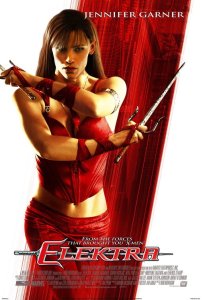 January is typically a cinematic wasteland. It’s the place where films go to die. So imagine my surprise when I heard that Elektra, a comic book movie built around a nimble sai-spinning assassin, was going to be released in January 2005. I remember at one time there were plans for a summer release, which means Elektra had fallen from the very top to the very bottom of expectation. After viewing Elektra for myself I can perfectly understand why anyone would want to dump this clunker.
Elektra (Jennifer Garner) is a feared assassin-for-hire (she even has an agent for her hits). She’s been brought back to life by a powerful sensei, but has ignored a possible higher calling to make her money killing folks. Apparently she is the mythical warrior that will keep the balance between good and evil, or something or other. Her next hit ends up being a nice guy (Goran Visnjic) and his teenage daughter. Elektra doesn’t have the heart to kill them, so she joins them and all three run away from the really bad guys, an ancient group known as The Hand.
Elektra doesn’t really bare comparison to other comic book films because Elektra feels more like a video game. In true video game fashion, I’ll numerically list the likenesses:
1) There is no such thing as characterization, just definition by super power. One assassin is super strong, another can suck the life out of creatures, and a third has the amazing ability to have his tattoos come to poorly rendered life (lucky this guy doesn’t have butterflies and fairies). With a powerful lack of imagination, these assassins are called Stone, Pestilence, and Tattoo (not the Russian girls who make out with each other. That’s Tatu.).
 2) The only sense of a story is pitting Elektra against one bad guy after another. There aren’t character arcs and subplots so much as there are end stage boss battles. It gets really repetitious.
3) The film seems like it’s bending over backwards to get character special moves into the story. With 1995’s Mortal Kombat, the writers, and I use that term in the loosest possible sense, had to work a story that included popular video game moves. Working so hard to include something so trivial and arbitrary really ties the storyteller’s hands. Elektra feels like the film would rather try and include some character’s special move rather than formulate a cogent storyline.
4) Once our assassins are vanquished they burst into clouds of yellow dust. I am not kidding. When they die they explode into clouds of mustard-hued gas. Just like in a video game, once you kill the bad guy they disappear with no necessary cleanup. It’s really thoughtful of them.
5) A second player can jump in at any time! In Elektra, different characters magically appear whenever it’s convenient and I?m not even talking about the super assassins.
6) Just like in a video game, you get an extra life! I don?t know why the producers of Elektra didn’t just make a prequel. With a sequel they have to work around their heroine’s untimely death in 2003’s Daredevil, and so we are introduced to the idea that a warrior of great mind can bring people back from the dead. So if Elektra dies (again) she can just be brought back to life. This whole idea practically eliminates any sense of danger and consequence.
So little of Elektra makes any kind of sense. Characters make rash choices and surprise appearances. The villains are a bland, cliched crop from some back order of ancient kung-fu brotherhoods. The plot is mysteriously oblique and has the frustrating habit of using cheats to get around logical roadblocks. About halfway through Elektra I gave up shrugging my shoulders and rolling my eyes. There is no definition on character limits, so anything can happen, and when it does it’s usually very stupid.
 Even worse is how dreadfully dull Elektra can be. The last two acts are compromised of nothing but a long, boring chase scene. The action sequences are brief and unoriginal, which include the thousandth inclusion of a hedge maze. There’s one moment where Elektra is battling in a room that has sheets flying all around for no good reason. It’s visually reminiscent of a Where’s Waldo? page. Take that for what you will.
The film is brisk, clocking in at just 90 minutes, but you don’t care about the characters because 20 minutes is spent establishing them, and the remaining 70 is spent watching them run.
The only redeeming quality of Elektra is its star. Garner is suited for the running, jumping movies, but she also has great acting chops behind her square jaw and impeccable physique. She casually generates intensity but also has a light, humorous touch. It doesn’t hurt that she looks fabulous in a red bustier. Her character is given OCD but then this plot is dropped entirely. Without the appeal of Garner, Elektra would simply be Catwoman.
Elektra is a flat comic adaptation that plays more like a video game, and just like in real life, watching a video game is no fun at all. Things happen, characters appear, people explode into clouds of yellow dust, and it’s all a bunch of uninteresting, half-baked nonsense. Elektra is frustrating, labored, ridiculous, and empty of thought and enjoyment. Why should I pay to watch Garner kick ass when I can watch Alias on TV and see Garner kick ass for free? And the plots of Alias are brazenly complex, fun, and high-spirited. I care about the people and events on Alias. With Elektra, the only thing I cared about was when the film was going to be over.
Nate’s Grade: D
Share this:

Inside Deep Throat (2005)
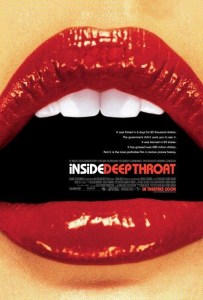 I find that there are generally two requirements that make a really great documentary: 1) have an interesting story, and 2) have an interesting way of telling it. I’ve seen documentaries on ripe topics squandered because of the dull and unimaginative ways they tell their tales. The skilled documentary team behind The Eyes of Tammy Faye and Party Monster has set their sights on a little smut film that changed the world in the early 1970s. Deep Throat was a “dirty movie” made for peanuts (25 grand) that ended up becoming the most profitable film of all time, eventually grossing more than $600 million. The story behind its meteoric rise, cultural acceptance, and damnation hits both requirements, thus making Inside Deep Throat a sensationally entertaining documentary.
It all started in 1971 when Gerard Damiano wanted to make an inexpensive pornographic film. Back in those days, many aspiring filmmakers actually got their start in porn (Wes Craven admits it). Damiano was in the planning process when he was visited by a man who wanted his girlfriend, Linda Lovelace, to appear in the eventual porno. He swore his girlfriend could do the most amazing trick. Lovelace demonstrated her trick, the full swallowing of an erect penis. Damiano was dumbstruck. He was determined not just to involve Lovelace but to base an entire film around her stunning ability. Deep Throat was written in three days, filmed in six days, but the furor it would bring would be irrevocably long lasting.
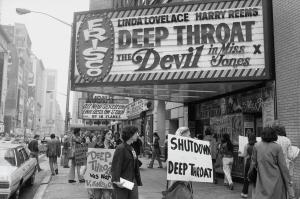 Deep Throat, as many of the crew will happily report, is not exactly a good movie. In fact, some call it the worst pornographic film of all time. Lovelace’s character found sex joyless, that is, until a doctor (Harry Reems) discovers that she has her clitoris all the way in the back of her throat. Thus to orgasm she has to swallow head-on (oh the double meaning). When the crew actually witnessed Lovelace’s cavernous abilities firsthand, they too were flabbergasted. But they wouldn’t be alone. Inside Deep Throat makes smart use of archival footage to prove how mainstream a small smut flick became. We see clips of Bob Hope and Johnny Carson cracking jokes about the film, and most amusingly of all are one or two interviews with little old ladies who “wanted to see a dirty picture.” Deep Throat crossed over and people went out in their Sunday finest to watch a hard-core porno.
Inside Deep Throat is rated NC-17 and with good reason. We do get to see Lovelace strut her stuff and the film almost playfully teases an audience with anticipation. We hear interviewees discuss their amazement; we see a close-up of Reems face as he gets pleasured. By the time the scene in question is shown uncut, we’re eager to witness this feat of fantastic fellatio ourselves. Let’s be honest, you can?’t have a documentary about Deep Throat‘s impact without showing the goods.
Filmmaking duo Fenton Bailey and Randy Barbato have a very visually satisfying way of telling their story. Images tear across the screen and animation pops, all set to what must amount to most of the soundtrack to Boogie Nights. The glossy visual flair reminds me of the swirling, near-pop-out book imagery of The Kid Stays in the Picture. The pacing of Inside Deep Throat is near break-neck, with the film clocking in at just over 90 minutes. I wish that the filmmakers had spent more time on their subject and gone more in depth into certain areas like Lovelace’s turnaround from girl next door goddess to anti-porn crusader back to fifty-something nude model (she was killed in a car accident in 2002).
 The cultural splash Deep Throat made is interesting enough, but the meat of the story is in the battles that would ensue. Damiano openly talks about how the mob controlled the early porn industry. He admits that he refused his share in the millions out of fear that he might have had his legs broken, or worse. There’s a long tangled web of mafia influence in the proliferation of Deep Throat. It was banned in over 30 states, but everywhere it went it became a hit. A Mafioso says that they were making so much money that they had to count it by the pound. Mob hits would materialize over the film’s profits and territory.
Even more fascinating, the U.S. government, to no one’s surprise, declared the film indecent. They couldn’t prosecute the director, or the distributors (unless they liked sleeping with the fishes), or anyone really making money off of the success of Deep Throat. So what’s a stubborn government to do? They prosecuted Reems for his involvement in a pornographic film. It was the first time an actor was ever prosecuted for his participation in art after the fact. Celebs like Warren Beatty and Jack Nicholson came to Reems’ aid, fearful of what might happen if a government could retroactively punish artists. Sadly, Reems was found guilty and sentenced to years in prison and was really never the same afterwards.
But instructional films on sexuality were still okay as far as government was concerned, and we see clips of them in all their medical film hilarity (apparently some positions are not meant for the obese we’re told). These were acceptable because they were meant to help and inform, whereas porn is meant to entertain.
The film’s interviews comprise some of its best and worst moments. Most of the Deep Throat crew is in their 60s or 70s now, and hearing them talk about porn and sexual acts does make you titter a bit. The crew provides funny anecdotes and some of the juiciest material. However, the film also curiously interviews people like Dick Cavett and Bill Maher. The expected talking heads are here like Dr. Ruth, Camille Paglia, John Waters, Hugh Hefner and Larry Flynt, but they regularly don’t have anything insightful to say.
 Inside Deep Throat goes back and forth with its objectivity. It’s obviously pro-freedom of speech and doesn’t mind ridiculing the government agents who tried taking Deep Throat down (oh the double meaning). Particularly telling is an FBI agent who wishes that terrorism could be tidied up so that he could finally get to the real importance, which is stopping people from seeing pornography. One of the main points of the prosecution of Deep Throat was that it “wrongly” purported the idea of a clitoral orgasm (I think many will find some error with this judgment). It’s easy in retrospect to chide government officials ruling on inaccurate information or just plain ignorance. It may be too easy for some viewers, but for me it’s fair game to lambaste any idiot trying to strip me of my Constitutional rights.
Inside Deep Throat is an engrossing if light-hearted look at a moment in time. Some of the seedier elements feel skipped over, but this is a documentary on a fascinating subject told with a pleasing visual style. Don’t be put off by the NC-17 rating or the subject matter. Inside Deep Throat is more than a behind-the-scenes featurette on a wildly successful porno. It’s a fast, funny, and greatly entertaining time capsule of an era where boundaries were still being pushed, both by artists and by censors. And in today’s FCC-fearing landscape, maybe not everything has changed since Deep Throat brought porn into the mainstream.
Nate’s Grade: B+
Share this:

Assault on Precinct 13 (2005)
 It seems that in American cinema, we have a long history of people being holed up in one location and fighting off outside forces. There’s instant drama in fending off forces that outnumber you, and Hollywood knows this. There are historical dramas (The Alamo), fantasy flicks (Lords of the Rings), and nearly every other horror movie (Night of the Living Dead) that have a central conceit of the good guys being outnumbered and with no place to go. Assault on Precinct 13 (a remake of the 1976 John Carpenter cult film) is the latest in this mini-genre. The film has big stars like Ethan Hawke, Laurence Fishburne, Gabriel Bryne and a mustachioed Brian Dennehy (there really should be no other kind) but even star power with facial hair can’t stop Assault on Precinct 13 from feeling run-of-the-mill.
On New Year’s Rockin’ Eve, Sergeant Jake Roenick (Hawke) is left to tidy up precinct 13, which will be shut down in days. The precinct secretary (Drea De Matteo) and seen-it-all veteran Jasper (Dennehy) will keep Roenick company. But alas, they have more company than they expected. A bus transporting prisoners makes an emergency stop at the precinct because of a blizzard. The bus has three small time criminals (John Leguizamo, Ja Rule, Aisha Hinds) and one very big fish, crime kingpin and cop killer Marion Bishop (Fishburne). Late in the night the precinct is besieged by a team of dirty cops led by Marcus Duvall (Byrne). It seems Duvall and his squad of corrupt cops have had many deals with Bishop, enough that they can’t let him live. Jake takes command of the precinct’s motley crew, prisoners included, and attempts to have everyone work together to fight off the invading forces.
 Hollywood upped the budget for this remake but they also upped the plot holes to match the firepower. How are the bad cops going to explain all those dead police officers in commando outfits? There’s likely enough forensic evidence everywhere to point a finger at the long arm of the law’s involvement. I suppose they could have burned the whole place down when they were done, but to paraphrase that great philosopher Ricky Ricardo, “Luuuuuucy, you got some ‘splainin’ to do.”
The acting is a non-issue. Hawke and Fishburne get to trade cool glances, Matteo gets to shake her Sopranos Joisey accent, and Dennehy gets to eat any scenery that isn’t bolted to the ground. I have no idea what Leguizamo was going for. His disturbed junkie performance reminded me of Mr. Ed, because whenever he spoke it looked like Leguizamo’s lip was being pulled up by an invisible string. Some may call this acting; I call it fun to watch.
Assault on Precinct 13 is constructed from so many familiar action elements you may think you’ve seen this movie before. Hawke plays a cop haunted by a bust gone wrong that, surprise, killed his partners. When the siege does go down, of course everyone can pick up a weapon (even a 1920s Tommy gun) and instantly become a trained marksman. There’s the whole “who can we trust” plot element that spurs Mexican standoffs between the cops and the crooks. All the characters are stock types, from Hawke’s reluctant hero, to Matteo’s saucy secretary, to Dennehy’s single-minded hothead to Fishburne’s calm and collected criminal mastermind badass. When a character opines a theory that someone on the inside is really working for the dirty cops, you should be able to immediately follow the falling anvils.
 Even when it comes to the action, Assault on Precinct 13 is too familiar. Because nothing interesting is going on inside the precinct, the audience relies on the spurts of action for their money’s worth. It all gets a little bland after awhile. Cops try breaking in. They get shot. They try breaking in with more cops. They get shot. Granted, replace “cops” with “monsters” and you have 30% of horror movies. There needs to be escalating action and some overall cause and effect with the plot, especially with action movies set in one isolated locale. In Assault in Precinct 13, rarely does the previous moment matter because both sides seem to shrug and move on. The only notoriety director Jean-Francois Richet brings to the action is a peculiar fetish for long takes of fresh head shots. He does enjoy the slow trickle of blood out of a bullet to the cranium (I counted 5 times; turn it into a drinking game at your own danger).
Assault on Precinct 13 is indistinguishable from what Hollywood pumps out every day. The characters are stock, the dialogue is short but stale, the plot holes seem to swallow the film whole, and, most tragically, the action seems meaningless except when paring down the cast (there’s a ten-minute whirlwind that cuts the good guys in half). People hungry for action might find something worthwhile but most will probably walk out of the theater with the same shrug the actors seem to exhibit. Assault on Precinct 13 is a routine action flick that replaces escalation with excess.
Nate’s Grade: C
Share this:

Hotel Rwanda (2004)
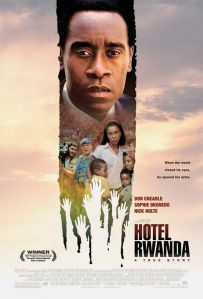 Hotel Rwanda almost didn’t get off the ground. You see, veteran supporting actor Don Cheadle is a favorite actor for directors but he’s not exactly box-office gold. Initial producers of Hotel Rwanda wanted none other than Will Smith to star. I don’t know about you good people but a sobering, challenging movie shedding light on the Rwandan genocide would lose some credibility if Smith was the above-the-title star. Producers also wanted Denzel Washington as a candidate; a better choice but still not right. The true-life portrayal of Paul Ruseabagina needed to be done by an actor that didn’t look like he could kick your ass. Paul was an ordinary man that didn’t ask to be a hero, not a hero looking for a fight. Cheadle was the perfect man for Hotel Rwanda. It just took a while for it to happen.
Back in 1994, Rwanda underwent a tumultuous civil war. In Rwanda, there are two ethnic groups, the Hutus and the minority Tutsis. Though the two look indistinguishable, there is an underlying tension because way back when Rwanda was under Belgian colonial control, the Belgians separated the Rwandan people by arbitrary rules like nose size, skin tone, etc. There is a rising tide of Tutsi resentment (radio propaganda refers to them as “cockroaches” needing to be exterminated). The Rwandan president has been assassinated and Hutu radio broadcasts are already pointing the finger at Tutsis.
 Paul Ruseabagina (Cheadle) is a Rwandan hotel manager that stocks up favors by scratching the backs of the right people. The wheels of Rwandan authority need to be constantly greased, and Paul knows when to deploy a well-timed gift, joke, or bribe. Paul?s wife Tatiana (Sophie Okonedo), a Tutsi as well as their children, is concerned when she starts seeing neighbors taken away at night. Paul assures her that their Tutsi relatives will be safe. Hutu rebels begin to start corralling neighborhoods to root out any Tutsis. Paul and his family retreat back to the hotel. As the violence increases more refugees arrive at the hotel for sanctuary, but Paul must keep the illusion that the hotel is still operational to ward off violence.
The United Nations promises to do something, but they remain only peacekeepers and not peace enforcers. The commanding officer (Nick Nolte) laments that he has only a handful of U.N. peacekeepers in charge of the whole nation. The United Nations and the West does do something: they evacuate all the white people. Citizens of Western nations are escorted out of the conflict, while they leave the rest of Rwanda to its own devices. Paul?s clinging hopes for Western involvement get bleak, and he assumes the responsibility for saving as many lives as he can, Hutu or Tutsi.
Cheadle gives one of the best performances of the year and he’s been nominated for a Best Actor Oscar. The strength of his character’s power lies in Paul’s ordinariness. He’s not a figure of intimidation, nor is he some kind of altruistic saint. There’s more than a passing resemblance to Oscar Schindler in Schindler’s List. Like Schindler, Paul is a man reluctantly pulled into risking his life for others and by the end he becomes consumed with saving as many lives as he can. Cheadle is so commanding that he can make you wince just by watching the weariness in his eyes.
There’s a moment late in Hotel Rwanda, where Paul is stalking the hallways trying to find his wife and children. And in an instant he suddenly remembers careful instructions he gave to his wife. Paul nearly bowls over with the sudden pang of terror but keeps his stride. It’s a sharp and powerful moment where the audience thinks alongside Paul and experiences the same awful gasp. In that moment, as well as countless others, Cheadle has worked his way so deep into his character that the two are one in the same. Cheadle has long been one of the most underrated actors, and now with Hotel Rwanda there is no doubt that Cheadle is one of the greatest living actors we have.
But Hotel Rwanda is not just a one-man show. Sophie Okonedo also garnered a Best Supporting Actress Oscar nomination. Okonedo is no pushover and she does more than needle Paul when it comes to the well being of their family. She’s a strong, caring, thoughtful woman. What makes her even more impressive is that, as a Tutsi, she could be murdered at any time. She gives an equally powerful performance of a woman finding strength amongst her own fear.
Writer/director Terry George keeps the emotion high by smartly relying on restraint when telling his portrait of horror. The events of the Rwandan genocide are so appalling, that it would have been so easy, and even understandable, had George loaded his film with scene after scene of graphic violence to jar the viewer. However, George refrains from numbing an audience with violent depictions, and instead chooses quieter, more somber moments that turn out to be far more terrifying than just seeing blunt violence. Hearing an aid worker recount witnessing a massacre of children to wipe out the next generation of Tutsis will chill you to the bone. There are some disturbing moments, like when Paul takes a very bumpy ride in the mists, but George refuses to numb an audience and works our emotions to a breaking point.
 Hotel Rwanda is sobering and very emotional, but you will also leave the theater with an overwhelming feeling of shame. It’s easy to watch films about dated atrocities like depictions of the Holocaust. You can say, “Well, I wasn’t alive. If I was, and people like me, surely we would not sit back and let such actions take place under our watch.” Not this time. Not with Hotel Rwanda. Everyone seeing Hotel Rwanda more than likely was alive in 1994, and we did exactly as a character warned: we watched what was happening on TV and went back to eating our dinners. Nolte’s U.N. rep tells Paul that the West refuses to see him and Rwandans as valuable (“You’re worse than a n****r [to them]; you’re an Af-ri-can.”). You?ll feel many emotions while viewing Hotel Rwanda and the deepest and longest lasting may be shame.
The film is clearly in the genre of “outrage cinema,” normally a genre that overpowers a viewer’s emotions. In lesser hands Hotel Rwanda would have been unrelenting to maintain a level of shock. George allows an audience to feel for the story’s characters before he lets the horrors loose. The result is that an audience attaches itself to characters because of who they are, not just because of the anguish they endure. As the intensity of the situation mounts we feel stronger ties to the people of Hotel Rwanda. That is good cinema.
Hotel Rwanda is an emotionally gripping portrait of the dignity found during our darkest days. George has skillfully created a sobering movie. Cheadle and Okonedo deliver wrenching performances as the faces of good amongst ongoing genocide. This isn’t like Black Hawk Down where the faces of screaming, angry black people merge into one black form the audience uneasily grows to hate. In Hotel Rwanda, the heroes are everyday Africans, the bad guys are everyday Africans, and the West is the apathetic referee unwilling to act. Hopefully after George’s film, it’ll be hard to hear about a million massacred and go back to eating your dinner.
Nate’s Grade: A
Share this:

Primer (2004)
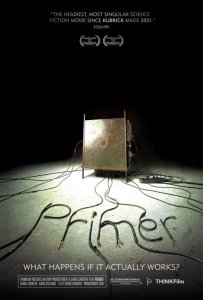 I was intrigued about Primer because I had been told it was classy, smart sci-fi that’s so often missing in today’s entertainment line-up (see: Sci-Fi channel’s Mansquito). It won the Grand Jury Prize at the 2004 Sundance Film Festival and the critical reviews had been generally very positive. So my expectations were high for a well wrought, high brow film analyzing time travel. What I got was one long, pretentious, incomprehensible, poorly paced and shot techno lecture. Oh it got bad. Oh did it get bad.
Aaron (Shane Carruth) and Abe (David Sullivan) run a team of inventors out of their garage. Their newest invention seems promising but they’re still confused about what it does. Aaron and Abe’s more commercially minded partners want to patent it and sell it. Aaron and Abe inspect their invention further and discover it has the ability to distort time. They invent larger versions and time travel themselves and thus create all kinds of paradoxes and loops and confusion for themselves and a viewing audience.
Watching Primer is like reading an instruction manual. The movie is practically crushed to death by techno terminology and all kinds of geek speak. The only people that will be able to follow along are those well-versed in quantum physics and engineering. Indeed, Primer has been called an attempt to make a “realistic time-travel movie,” which means no cars that can go 88 miles per hour. That’s fine and dandy but it makes for one awfully boring movie.
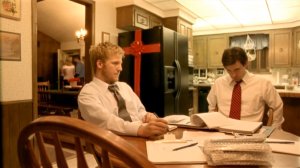 Primer would rather confound an audience than entertain them. There is a distinct difference between being complicated and being hard to follow. You’d need a couple volumes of Cliff Notes just to follow along Primer‘s talky and convoluted plot. I was so monumentally bored by Primer that I had to eject the DVD after 30 minutes. I have never in my life started a film at home and then turned it off, especially one I paid good money to rent, but after so many minutes of watching people talk above my head in a different language (techno jargon) I had reached my breaking point. Primer will frustrate most viewers because most will not be able to follow what is going on, and a normal human being can reasonably only sit for so long in the dark.
I did restart Primer and watched it to its completion, a scant 75 minutes long. The last 20 minutes is easier to grasp because it does finally deal with time travel and re-staging events. It’s a very long time to get to anything comprehensible. I probably should watch Primer again in all fairness but I have the suspicion that if I did my body would completely shut down on me in defense. Some people will love this and call it visionary, but those will be a very select group. It’s not just that Primer is incomprehensible but the film is also horrifically paced. When you don’t know what’s being said and what’s going on then scenes tend to drag because there is no connection. This movie is soooooo slow and it’s made all the worse by characters that are merely figureheads, dialogue that’s confusing and wooden, and a story that would rather spew ideas than a plot.
Writer/director/star Shane Carruth seems to have high ambitions but he has no empathy for an audience. Films can be dense and thought-provoking but they need to be accessible. Richard Kelly’s Donnie Darko is a sci-fi mind bender but it’s also an accessible, relatable, enjoyable movie that’s become a cult favorite. Carruth also seems to think that shooting half the movie out of focus is a good idea.
I’m not against a smart movie, nor am I against science fiction that attempts to explore profound concepts and ideals. What I am against, however, is wasting my time with a tech lecture disguised as quality entertainment. Primer is obtuse, slow, convoluted, frustrating and pretentiously impenetrable. After finally finishing Primer I scanned the DVD spine and noticed it said, “Thriller.” I laughed so hard I almost fell over. The only way Primer could be a thriller is because you’ll be racing the clock for it to finish.
Nate’s Grade: C-
Share this:

Closer (2004)
 A funny thing happened to me when I sat in a theater to see Closer. It was packed, surely due to the film’s heavy star power. As the film played out I began to notice that my audience was laughing consistently, at moments that weren’t necessarily meant for humor. I don’t think they were laughing at the film, instead I think it was a defense. You see, I’m sure the majority of those couples read Closer to be a much different film than it is. They saw the pretty faces of Jude Law, Natalie Portman, and America’s sweetheart Julia Roberts. They were expecting something, let’s say, lighter than the cruel savagery of Closer. When America’s sweetheart Julia Roberts compares the taste of two men’s semen, you know this isn’t any Gary Marshall movie (forgetting Exit to Eden, and please do).
Dan (Jude Law) is an obituary writer planning to pen a novel one of these days. He locks his eyes on Alice (Natalie Portman), a stripper from the States, while walking one day. She gets hit by a car and Dan takes her to a hospital. Flash forward and Dan and Alice are dating but his eyes are already wandering. During a photography session with Anna (Julia Roberts) he kisses her but is spurned. He takes his revenge on some soul in cyberspace, pretending to be Anna and arranging a meeting. That sap turns out to be Larry (Clive Owen), and they actually do start dating. Then things get messy. Couples leave one another, get back together, swap lovers, and come crawling and begging for forgiveness or punishment. The rest of Closer is like a long game of relationship Red Rover.
 Director Mike Nichols has a definite affinity for his four actors (they are the only ones in the film with speaking parts). He shoots Closer as an actor’s showcase, with constant close-ups and no handheld camerawork. He places the emphasis on his actors. The results are more familiar to Nichols’ early films like Who’s Afraid of Virginia Woolf? and Carnal Knowledge. However, Closer isn’t as insightful as it thinks it is. It presents cruel characters doing dastardly acts, but this is stuff that wouldn’t impress Neil LaBute (In the Company of Men). There is intelligence to the film?s dialogue but it’s wasted on a ramshackle story.
The acting of Closer both helps and hurts the film. It seems that the two primarily wronged characters (Larry, Alice) give the better performances.
Owen is the standout performer of the ensemble. Playing the Dan role onstage has given him an intimate feel for the story’s characters. He’s the most decent of all four until the weight of circumstances finally pushes him to the limit. He’s the character the audience sees themselves in, so it helps that Owen gives a great performance of quiet dignity and slow self-destruction. He expresses more emotional turmoil in his eyes than most actors do with their whole body. Portman is having a breakthrough year for herself. First she showed pluck and grace in Garden State, and now with Closer she has graduated to the adult table. She radiates a fragility that makes you want to hug her. Portman will probably always look like a little doll (which works for her role as a stripper).
The beauty of Roberts and Law hurts the ugliness of their characters. I make no bones about my general dislike of Roberts as an actress. Her acting in Closer is like a soft-spoken, pouty child. She jumps from man to man, looking sullen or pensive, but comes off more petulant. Law is better, but his handsome devil is not in the details. Dan is a womanizing cad but we never get any understanding for why he acts as he does. Law can be hypnotizing, but like Roberts, his pretty facade takes away from the impact of Dan’s ugly behavior.
 Despite the title, you get no closer to getting to know or understand the characters. It’s really almost a stretch to call them characters because they’re more accurately different positions in an argument. The only characterization Closer has to offer is suffering and inflicting suffering. Closer really has one voice coming out of the mouths of different pretty actors.
The film has the annoying habit of skipping ahead in time and not telling the audience. We’re left to catch verbal asides that time has passed. After a while you’ll get the hang of it simply by assuming that the beginning of every new scene is the start of a new date in time. Closer is nothing but a string of uncollected scenes, usually involving people leaving a lover or starting a new fling. The actors come on, do their part, then they leave and we move on to a different scene. This is not staged as a movie.
The trouble with Closer is that it never really feels like it’s going anywhere. There’s no progression. Sure, couples swap, people get revenge, but the connection of sequences is lacking. The way it is, Closer could have gone on forever. It’s a series of scenes smashed together, not a story that rises and falls and builds to a climax.
Closer is an exploration into the darkness of human behavior starring some of the prettiest actors Hollywood can spare. The story goes nowhere, the ending doesn’t accomplish much, the characters lack convincing depth, but some of the acting is good and there is a ray of intelligence to the film. Fans of the above-the-title actors should enter Closer with caution. It’s a dark film with little to feel good about. Closer is brooding, moody, and probably the first and last time we?ll hear Julia Roberts talk about the taste of semen. Unless, of course, Gary Marshall starts pre-production on Exit to Eden 2: Rosie O’Donnell’s Bondage Boogaloo.
Nate’s Grade: C+
Share this:

Million Dollar Baby (2004)
 Million Dollar Baby, much like its fledgling female boxing character, has come out of nowhere and made a considerable deal of noise. This little homespun film directed by Clint Eastwood didn’t have the glitz and sheen of other awards friendly movies, but now it seems that Eastwood?s own baby may clean up come Oscar time. Can Million Dollar Baby tackle the enormous hype surrounding it? Yes and no.
]Frankie (Eastwood) is a hardened boxing trainer too concerned for his fighters’ welfare to allow them to fight in championship bouts. He’s the kind of cynical old man that enjoys pestering a priest and causing him to unleash an F-bomb. Frankie and his longtime friend Scrap (Morgan Freeman) run a rundown gym and talk un-sentimentally about their older days as prize fighters. Then along comes Maggie (Hilary Swank), a 32-year old waitress who’s got nothing to believe in except her possibility as a boxer. She wants Frank to train her into the champ she knows she can be. He refuses saying he doesn’t train girls. She’s so determined she won’t take no for an answer. Frank finally agrees, especially after some help from Scrap, and starts to teach Maggie everything she needs to know to be a star pugilist. The two begin to open up to each other emotionally and Maggie seems destined to become a force in the ring.
 Million Dollar Baby‘s greasiest attribute is its trio of knockout performances. Swank owns every second of this movie. She’s unremittingly perky, conscientious but also dogged, stubborn, and irresistibly lovable. Swank embodies the role with a startling muscular physique and a million dollar smile. Her performance is equal parts charming and heartbreaking. Maggie’s the heart of Million Dollar Baby and Swank doesn’t let you forget it for a millisecond. Come Oscar time, I’m sure she will be walking onstage to grab her second Best Actress Oscar in five years.
No one does grizzled better than Eastwood, and maybe no other actor has made as much of an acting mark by squinting a lot. Million Dollar Baby is probably his best performance to date, though for a good while it sounds like Frank has something lodged in his throat (pride?). Frank has the greatest transformation, and Eastwood brilliantly understates each stop on the journey until landing in a vulnerable, emotionally needy place.
Freeman once again serves as a film’s gentle narrator. There isn’t a movie that can’t be made better by a Morgan Freeman performance. His give-and-take with Frank feels natural and casual to the point that it seems improvised on the spot. Freeman unloads some great monologues like he’s relishing every syllable, chief among them about how he lost his eye. It’s wonderful to watch such a great actor sink his teeth into ripe material and deliver a performance that may net him a long-awaited Oscar (I think he’s due, and likely so will the Academy).
For whatever reason, Eastwood is hitting a directing groove in his twilight years. First came Mystic River, an ordinary police whodunnit made exceptional by incredible acting. Now Eastwood follows up with Baby, an ordinary sports film made extraordinary by incredible acting. Hmmm, a pattern is forming. The cinematography is crisp and makes great use of light and shadow to convey emotion. Eastwood’s score is also appropriately delicate and somber. The boxing sequences are brief but efficient.
Million Dollar Baby is a very traditional story that is at times surprisingly ordinary. Maggie’s the scrappy underdog that just needs a chance, Frank’s the old timer that needs to find personal redemption, and Scrap?s the wise old black man. Once again, an old curmudgeon takes on a rookie and in the process has their tough facade melt away as the inevitable victories pile up. Million Dollar Baby is a very familiar story but then again most boxing tales are fairly the same in scope.
What eventually separates Million Dollar Baby from the pack is its third act twist. You think you know where Eastwood’s film is headed, especially given the well-worn terrain, but you have no clue where this story will wind up. The plot turn deepens the characters and their relationships to each other in very surprising ways. You may be flat-out shocked how much you’ve found yourself caring for the people onscreen. It almost seems like Eastwood and company have used the familiar rags-to-riches underdog drama to sucker punch an audience into Million Dollar Baby‘s final 30 minutes. We’re transported into an uncomfortable and challenging position, and Eastwood won’t let an audience turn away.
 Million Dollar Baby is not the colossal masterpiece that critics have been drooling over. For one thing, the group of antagonists is not nearly as textured as our trio of leads. They’re actually more stock roles that further enforce the ordinary story of Million Dollar Baby. Maggie’s trailer trash family is lazy unsupportive batch of stereotypes. The evil female boxing champ just happens to be a German who doesn’t mind playing dirty. One of the boxers at Frank’s gym is an arrogant showboat just waiting to be nasty while the teacher’s back is turned. Million Dollar Baby excels at showing depth and humanity with its lead trio, yet it seems if you aren’t in that circle you’re doomed to wade in the shallow end.
Eastwood shows that great acting and great characters you love can elevate a common framework. The package may be similar to a lot of films before about scrappy underdogs, but Million Dollar Baby lacks comparison in its genre when it comes to its enthralling acting and characters. The father-daughter bond between Frank and Maggie is heartwarming. The final reveal of what her Gaelic boxing name means may just bring tears to your eyes. The results are a very fulfilling movie going experience, albeit one that regrettably may not live up to such hype.
Million Dollar Baby has been showered with heapings of praise and become a formidable Oscar contender. The story treads familiar waters but its outstanding acting and deep and humane characters elevate the material. The film can’t match the hyperbole of critics but Million Dollar Baby is an ordinary but greatly satisfying ride led by compelling acting. The film hums with professionalism and seems to just glide when everything comes together magnificently, particularly in that last 30 minutes. Eastwood is hitting an artistic stride and it’s actually exciting to see what Clint will do next. Million Dollar Baby may not be a first round knockout but it definitely wins by decision.
Nate’s Grade: B+
Share this:

Beyond the Sea (2004)
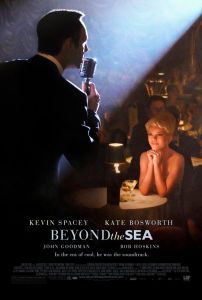 I really don’t think a lot of people know Bobby Darren. It seems that today most people would recognize him from singing “Beyond the Sea” over the closing credits of Finding Nemo. He wasn’t supposed to live past 17 but went on and wrote 400 plus songs including “Mack the Knife,” “Splish Splash,” and “Dream Lover.” Seems like there could be some interesting ground for a biopic. Kevin Spacey is one of our most celebrated actors and earned two very well deserved Oscars. Spacey has a strong passion for Darren and has been dreaming of portraying his life story for years. Passion is good for a role, right? Sam Raimi had passion for Spider-Man and look how those movies turned out. Well, with Beyond the Sea it seems that Spacey is less passionate about Bobby Darren and more passionate about his love of Kevin Spacey.
The film opens with the 37-year-old Darren (Spacey) reliving his life via a biographical movie he’s filming (yes, it’s a movie-within-a-movie). With the help of a younger movie self as a guide, Darren traces his rise from the streets of Brooklyn to headlining the Cococabana club. As a young child, doctors feared that Darren wouldn’t outlive his teens with his weak heart. Bedridden often, he found inspiration in music with his flamboyant yet supportive mother (Brenda Blethyn). Darren is driven to succeed and soon lands on top of the charts with a string of hits. Next he?s starring in movies with Rock Hudson and Sandra Dee (Kate Bosworth), a chickadee that Darren is just as determined to succeed with. They marry, have a child, but Darren doesn’t feel fulfilled. He needs to push his music further whether or not it alienates everyone around him.
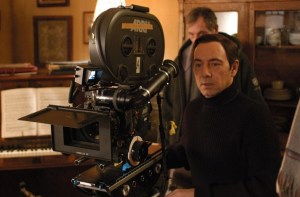 If you thought Beyond the Sea was the story of Bobby Darren, you’d be pitifully wrong. It’s really the story of Kevin Spacey, actor/writer/director/singer/dancer. That’s why we get to see flashy, superfluous dance numbers, that’s why we get to watch Spacey sing 12-15 times, and that’s why Spacey went to the trouble of re-recording all of Darren’s songs so that?s it?s Spacey belting out the tunes. Because, remember, this is a film about Spacey, not Bobby Darren.
Spacey is also much too old to be playing Darren, who died suddenly at age 37. He comes off lechery, especially during his courtship with the young Sandra Dee. Spacey isn’t unaware of this problem because in the opening minutes of Beyond the Sea someone accuses Bobby Darren of being to old to play himself in his movie. The response: “He was born to play this part!” There you go folks, case closed.
The acting in Beyond the Sea isn’t really an issue. Spacey has a genuine bounce to his song renditions and proves to be a capable dancer. John Goodman plays yet another gruff but lovable sidekick. It’s always good to see Bob Hoskins onscreen, no matter what the role may be. Bosworth comes away the best as she shifts from stars-in-the-eyes naiveté to a harder edge (you may rethink that whole song from Grease).
The dialogue is played so straight that it’s often hilarious: “Memories are like moonbeams, we do with them what we like.” With all due respect, what the hell does that mean?! I think I get the idea but what can anyone really do with moonbeams? If this line isn’t bad enough it becomes a central idea for Beyond the Sea which Spacey/Darren uses to excuse his flagrant gaps in time and fact.
Beyond the Sea gets so caught up in the Kevin Spacey Variety Hour that it fails to tell its audience why they should even care about Darren. Was he an inspiration because he outlived doctor expectations? Did he liven up old songs? Was he a remarkably versatile talent? Who knows? You’re on your own. Spacey’s too busy singing and dancing to explain the relevancy of Bobby Darren or why this movie should even exist.
There must be some interesting facts about Darren. I did not know that he wrote “Splish Splash” let alone that he wrote the whole song in 20 minutes. I didn’t know Darren required a toupee at such a young age. That stuff is interesting. It’s too bad it all takes a back seat because Spacey wants to emphasize his singing. Seriously, I get it; you can sing, Kevin Spacey. Can I see more of Bobby Darren and less of Spacey now?
 Beyond the Sea portrays Darren so single-mindedly. He’s always focused on his music and nothing else, whether that be a budding acting career (he was nominated for an Oscar), the advice of his friends, or the love of his family. Darren kind of comes across as a self-centered jerk a lot of the time in Beyond the Sea.
I don’t know which is worse, Spacey the director or Spacey the writer. It’s not that he’s inept at either end but he just makes decisions that kill the material. There has to be a better framing device than having Darren star in a movie about his life. There have to be better transitional ideas than having New York City explode into choreographed dances. To top it off, when the movie reaches its very protracted climax, we see the adult Bobby Darren in a tap duet with his younger self. Beyond the Sea loses whatever earnest intentions it had and melts away into one strange metaphysical song and dance revue.
Beyond the Sea has been a pet project for Kevin Spacey for so long that the focus has shifted from Bobby Darren to Spacey himself. This movie exists so that Spacey can celebrate himself. To say Beyond the Sea is a showcase of megalomania would be an understatement. Many scenes exist for no reason other than to give Spacey another opportunity to dance or sing. Re-dubbing all of Darrens songs seems a tad unnecessary and a whole lot about ego. Die-hard fans of Darren or Spacey may enjoy Beyond the Sea, but most people will grow tired of seeing Spacey congratulate himself for being an autuer. This is a self-indulgent nightclub act posing as a film. Memories are like moonbeams, and I’m forgetting this movie as fast as possible.
Nate’s Grade: D


 nathanzoebl
You must be logged in to post a comment.