Ghost Town (2008)
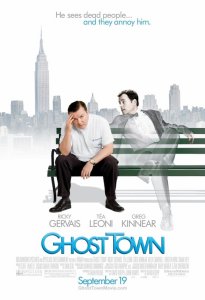 It seems the genesis for this flick was like someone asked what The Sixth Sense would be like with jokes (or someone rented Topper and said, “Why not again?”). The idea of a misanthropic man who sees dead people is elevated by the sheer comic genius of star Ricky Gervais. The famous British comedian is better known across the pond for his dry, sarcastic wit and penchant for awkward, pained comedy, but Ghost Town is a great mainstream introduction to the comedic chops of this squat Englishman. The film follows a familiar trajectory and even introduces a romance for the man who loathes other people, but Gervais and co-writer/director David Koepp make it worthwhile and endearing. I could watch Gervais and his beaming co-star Tea Leoni crack each other up for hours. The comedic premise is finely explored (there are more than enough scenes of people looking odd at Gervais talking to himself). The movie tilts toward being a supernatural romantic comedy in the second half but manages to stay snappy and character-driven. It’s a sweet movie with some nice comic jabs that don’t dwell on nastiness. Ghost Town is a charming and engaging light comedy that might cause a few sniffles in between chuckles. I have a warm place in my heart for this movie.
Nate’s Grade: B
Share this:

Lust, Caution (2008)
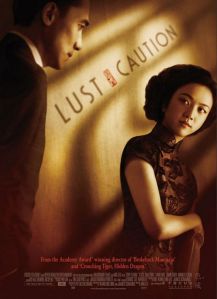 Ang Lee’s period romance is no Brokeback Mountain, though there is a heavy supply of thrusting. Lust, Caution is an NC-17 rated peak into life in China under Japanese occupation in the 1930s. Most of the film follows a school drama club that decides to become freedom fighters. They scheme to murder Chinese officials working with the Japanese government, and one gal (Wei Tang) is tapped to seduce and then kill a high-ranking official. For such a controversial movie, the sex scenes don’t even begin until 90 minutes into the flick (though our undercover heroine is deflowered by her drama club peer for the good of her mission). The movie is exquisitely shot, handsome in its details, and the lead performance by Tang is exceptional, simmering with conflicting emotions and some real sensual heat. The sex scenes doe have an erotic potency to them and they are more explicit than the kinder gentler fare found in typical Hollywood movies that consist of only seeing the slow-motion ecstasy result from a man on top. The offbeat love story gestates too late in the film’s run, leaving little time to delve deeper. Too much of the movie concerns back-story following the drama club’s road to becoming revolutionaries, and while it’s interesting it’s also rather needless on second thought. There’s a nine-minute difference between the R-rated version and the theatrical NC-17 cut; what’s in those nine minutes I do not know since I saw the edited version, but I’ve been told it’s a lot of thrusting. In lusty terms, the movie is heavy on foreplay and too short on a satisfying climax.
Nate’s Grade: B-
Share this:

Grace is Gone (2008)
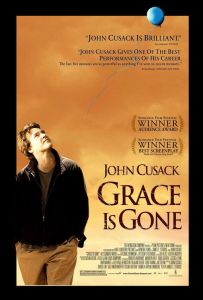 This Iraq War drama means well but it comes across as manipulative and morally questionable. John Cusack stars as a former military man who just found out his wife, on active duty in Iraq, has been killed. The bulk of the film’s conflict deals with how Cusack will tell his two daughters that mommy is not coming home again. Instead of being upfront with his children, he takes them out of school and whisks them away on a family trip to an amusement park. His reasoning is that he wants to squeeze in a few more happy memories before the kids hear the news. To me, this is irresponsible and psychologically damaging; those kids will resent their father holding onto such important information while he encouraged his kids to shop in ignorance. The film is about 80 minutes of watching a guillotine hang over someone’s head, just waiting for the moment to hit. It can get rather uncomfortable. Somewhere in this misguided drama is a poignant look at the domestic cost of the Iraq War from the family’s perspective, a perspective yet to be fully articulated by the movies. Instead, Grace is Gone is a well-acted but contrived drama that favors delaying the pains of reality to the point of incredulity.
Nate’s Grade: C+
Share this:

Be Kind, Rewind (2008)
 Be Kind, Rewind is a celebration of the love of movies and moviemaking, but it wants to shoot for a deeper message and stumbles. When the movie concentrates on remaking famous movies like Ghostbusters, Robocop, and Rush Hour 2, the movie has a ramshackle charm and great comedic spirit. When the film strays to tell a tale about community pride is when the movie gets dull and leaden. The concept of cheap, quick, homemade versions of Hollywood movies (the YouTube-ification if you will) is fun and Jack Black and Mos Def are definitely having fun in the process. But the movie has too many other elements that just don’t work together. The history of a local jazz legend feels awkward and bogs down the movie’s enjoyment. Director Michel Gondry can only do so much with his quirky visual sensibilities before you start to get bored. Be Kind, Rewind is occasionally entertaining and works best when it’s ripping off other movies than trying to stand on its own merits.
Nate’s Grade: C+
Share this:

W. (2008)
 Director Oliver Stone’s first draft at history is never boring but it’s rarely insightful. The film portrays George W. Bush (Josh Brolin) as a stubborn and simple man trying to live outside his abilities and the long shadow of his successful and emotionally distant father. George W. was not the favored son, as he is routinely reminded, and Ma and Pa Bush express their frustration. And yet the son who did not have his family’s support and acumen accomplished what no one else in the family had. He won reelection. He toppled Saddam Hussein. And then it all came crashing down. Ultimately, who was this movie made for? The detractors of Bush will view the film being too light, providing a psychological context that humanizes the man amongst his mistakes. You may even feel some sympathy as George W. repeatedly tries to earn his father’s approval. The movie is not a partisan or mean-spirited skewering. The fans of Bush will consider the film to be a cheap shot that restrings famous blunders and transplants Bush malapropisms into new settings. People may take offense at the idea of the current Iraq War being a result of unresolved daddy issues. Seriously, for a two-hour movie spanning the life and career of the most reviled modern day president, did Stone need to include the moment where Bush almost choked to death on a pretzel? Over the 2000 election debacle? Over the Air National Guard? Over 9/11?
W. lacks a strong point of view and the film’s timeline closes too soon, only going so far as January 2004, not even the halfway point for a two-term president who has only sunk lower in national approval from that moment. A miniseries would be a better medium to explore the failures and calamities and personalities of the Bush Administration. Brolin is terrific in the title role and he never dips into parody. The rest of the actors are hit-or-miss and the movie becomes somewhat of a game of identifying famous historical figures in their one-scene appearances. My biggest surprise was how much I felt emotionally connected to the first President Bush, played by James Cromwell in a performance that doesn’t even attempt to imitate the real-life figure. Stone and screenwriter Stanley Weiser (Wall Street) certainly don’t hide the characters they connect with (Colin Powell, often the voice of reason, is given a stirring speech calling for caution). Certain creative license is taken to provide dream sequences that can point toward the inner turmoil of Bush, like when his father admonishes him for destroying 200 years of the family’s name over the Iraq War. Overall, W. is an empathetic and sometimes dithering portrayal of the 43rd United States’ president that could have succeeded if it had more to say.
Nate’s Grade: B-
Share this:

The Duchess (2008)
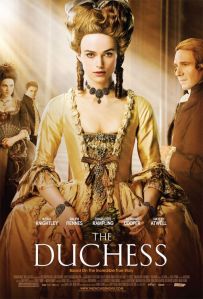 I think I understand the real appeal of costume dramas. No matter what else happens, the costume drama must seem smarter. You have actors, primarily British, waltzing in elaborate costuming in realistic historical settings, each offering demure statements and looking for love and acceptance in a time of chaste expression. You could place Saw 18 in that setting and it would automatically seem smarter. I think the ye olde setting for costume dramas automatically gives these films more plot leeway, but not every film actually proves that it should have earned that leeway. Saul Dibb’s handsomely mounted period drama The Duchess offers little beyond the superficial enjoyment of well-crafted costumes.
In 1770s England, young Georgina (Keira Knightley) has been betrothed to the older Duke of Devonshire (Ralph Fiennes). The newly minted 17-year-old Duchess of Devonshire is whisked away to live in a giant manor. The Duke is rather cold and seems uneasy with human interaction; he shows the most affection for his dogs. He expects Georgina to primarily bear him a son. Several daughters later, the Duke is engaged in affairs and siring illegitimate children. Georgina has become a star of the social sphere, and it is here that she befriends Bess Foster (Hayley Atwell), a woman who is trying to regain her children from her ex-husband. Things get even more complicated when the Duke takes a liking of Bess, and the two become an unofficial union. Georgina has had her only friend taken away and turned into a co-wife. The only solace for the Duchess is in her flirtatious relationship with a politician, Charles Grey (Dominic Cooper). Georgina feels like a prisoner in her own home and yet she cannot desert her children. What’s an oppressed woman to do in 18th century England? That answer should be sadly obvious.
 The Duchess breaks no new ground and, in fact, treads water for the majority of its second half. Georgina was an independent spirit in a time that frowned upon breaking from conformity and tradition. As a woman, she was the victim of a double standard that allowed her husband to sleep with whomever he desired but she could not find physical comfort outside her loveless marriage. Marriage was widely viewed as a means to an end for male progeny, not the culmination of romantic love. Women were pressured into delivering male heirs, despite the fact that men are the ones who determine gender. Typically marriages were family arrangements for class and land ownership, so true passion was procured through marital affairs. I get it because I’ve read Jane Austen novels and seen dozens of period movies that have made the same stilted points. The Duchess presents Georgina as a feminist before her time and then a patriarchal society crushes her spirit. During the second half, when aristocratic life keeps producing heavy obstacles for Georgina, the movie just piles it on. I was left questioning what the point of all this corseted drama actually was.
After a while with my downtime I determined whom this movie is really for – hat enthusiasts. This is a Big Hat movie that puts other hat movies to shame. There are gigantic floppy hats, hats that look like fruit displays, hats that look like eighteen-layer cakes, hats that look like they have their own hat, hats with feathers zigging and zagging in every direction, and hats that look like they are consuming their host’s heads. If you work in the haberdashery industry or have an above average interest in hats and hat-related products, then run, don’t walk to The Duchess. You will be enraptured by the orgy of towering hats that jostle for screen time. Rarely are women seen without hats, so you truly will get your hat money’s worth over the course of the film’s two hours. If there were a specific Oscar category for Hat and Hat-like Accoutrement then The Duchess would dominate. I expect it will get nominated for Costumes, and really that seems like half the point in making these powdered wig period dramas.
I think the other point of The Duchess is to channel the modern story of Princess Diana, who is actually a distant relative of Georgina. The two seem to lead somewhat similar lives since they both married young, both had their husbands prefer the mistresses, both were fashion trend setters, both were beloved by the public, and after death both had their husbands remarry the mistresses. The tagline for the film is, “There were three people in her marriage,” a paraphrased quote that Princess Di said in an interview. The Di parallels seem to be all that the filmmakers intended to do with Georgina as a character; she is the least interesting person in her marriage. The Duke and Bess are far more complex and intriguing figures. I’m sure the Georgina biography that serves as the movie’s source is rich in Georgina characterization and personal detail, but all the movie cares about is establishing her as a marital martyr. There is more to this character but she just endures disappointment and punishment; I cannot fully engage with a character when their only personal attribute is suffering. The movie fails to present any notable reason why this woman of history deserves having a feature film.
 Knightley seems to spend half her film life in corsets. I’m still undecided upon whether she possesses innate acting ability; to me she too often comes across as a pin-up with great cheekbones. That said her eyebrows do a great bit of acting in The Duchess. She has the habit of cocking one ever so slightly and imbuing a scene with a hint of sexual allure or mystique. They’re pretty thick eyebrows too. Knightley does acquit herself well with the material and I doubt this will be the last time I see her in a tremendous silk gown and a humongous hairdo. The most interesting actor is Fiennes because his character is so reserved and awkward in his own skin, so much must be said through the use of gestures, body language, and the perfect execution of line delivery. His character seems just as ill in his setting as Georgina. Atwell is given the most complex character to play. To say that Bess has conflicted loyalties is an understatement. She betrays Georgina but romancing the Duke can ensure that she sees her children once again. Bess should have been the centerpiece of the movie because, as presented, she is far more interesting with more dramatic conflicts and turmoil other than being wronged.
The Duchess is no more and no less than every other costumer period piece you’ve seen before. It starts well but then falls into boring and repetitious plotting (Georgina wants something, she’s denied, she wants something, she’s denied; rather, rinse, repeat, end). The Duchess will delight those in search of yet another unrequited period romance, but I feel that moviegoers should expect more from their entertainment that mechanically fulfilling the period-y checklist. The technical merits like the production art and the costumes, especially the hats, are first rate. There’s little feeling beneath all the fabulous fussing about. It’s too bad the actual drama couldn’t at least be as interesting as the hats.
Nate’s Grade: C+
Share this:

Burn After Reading (2008)
 The Coen brothers tend to follow serious works with silly, and now that they have a heap of Oscars from 2007’s No Country for Old Men audiences can expect extreme silliness. Burn After Reading is a farce in the best sense of the word; it’s a send-up of the spy thriller where morons inhabit every role. The incompetent characters repeatedly act impulsive and the whole movie’s tone is cranked to outlandish heights. The score by Carter Burwell is like a continuous thundercloud that underscores the ridiculous and faux ominous atmosphere. The Coens have been accused of ridiculing their characters and being too detached and clinical as screenwriters. I do not believe this for a moment. Anyone who watches Burn After Reading can tell that the Coens love their characters, especially Brad Pitt’s ebullient personal trainer. Pitt is a comic joy and brings fresh life to his fun character, a highly cheerful doofus who can’t stay still. Even the funky way Pitt walks is worth a giggle. Burn After Reading takes some surprising twists and turns and could have been much longer than 96 total minutes. The Coens go to such terrific lengths establishing great oddball characters and great comedic scenarios, and then the whole movie just comes to a close when it feels like it’s hitting another gear. Still, Burn After Reading may be no masterpiece but its yet another unconventional and mostly entertaining comedy from the reliably quirky Coen brothers.
Nate’s Grade: B+
Share this:

Over Her Dead Body (2008)
 This is abysmal comedy from beginning to end. It peaks in the second minute when Eva Longoria’s shrewish character is killed by a large angelic ice sculpture. It’s all down hill from there, my friends. Longoria stars as a deceased bride who won’t let her still-living fiancé (Paul Rudd) find happiness. The bland comedy could have more accurately been retitled, “Cockblock from Beyond the Grave” (it was at one time titled Ghost Bitch). I have no idea why Rudd is apart of this travesty and seeing him do his trademark smirk and shoulder shrug just made me weep. The comedy is nails-on-the-chalkboard obvious. There is nothing smart, clever, or interesting within any of this movie’s 95 minutes. Writer Jeff Lowell (John Tucker Must Die) felt the need to direct as well because surely there was no one else on this planet that could handle this. Longoria is powerfully obnoxious and egotistical until her last-minute personal epiphany that others deserve to be happy too. What did Rudd ever see in this ghost bitch?
Nate’s Grade: D
Share this:

Seed (2008)
 Uwe Boll had some things he wanted to say with his low-rent horror flick, Seed. Like much of Boll’s output it’s based upon a video game. However, Boll opens the flick with a warning that footage of animal abuse and disturbing images will be incorporated into the movie. Seed gets the ball rolling with a two-minute montage of animals being cruelly beaten and mutilated before the title ever finds its place on screen. Boll’s opening text says that he decided to use this disturbing snuff footage because he “wanted to make a statement about humanity.” Yeah, sure Boll. Isn’t it a bit trite and easy to castigate the human condition for evil when you just roll out visceral real-life footage of cruelty? By highlighting the real stuff Boll is calling into question the significance of his whole stupid slasher movie. It opens with real-life cruelty and then plays out 90 minutes of fake cruelty, so what’s the point? I don’t think Seed has any interest in the subtext that can elevate horror movies. I think Boll just wanted to make his own torture-heavy horror film and found some animal abuse footage on the cheap (PETA probably gave it to him free of charge). The opening smacks of exploitation and opportunism and has zero thematic connection to the flaccid and empty-headed horror movie that follows. If I sound angry that’s because I don’t need to see animals having their skulls crushed in to get it.
Seed (William Sanderson) is a killer of astounding proficiency (for further details: see below). Matt Bishop (Boll BFF, Michael Paré) is the detective that’s been tracking Seed all these years. You can tell he’s a haunted cop because he has a drinking problem and hears the cries of dead babies. Eventually, Bishop tracks down Seed’s hideout and he arrests the murderous fiend. Seed is sentenced to die by the electric chair. The problem is that the prison doesn’t have a pristine electric chair, and the law says that if a man survives three jolts of juice then he’s free to go (for further details: see below). The warden (Ralf Moeller) decides to take command. He and a group of prison employees bury Seed alive and tell the world he died on the faulty electric chair. Of course Seed comes back and rekindles that old killing feeling.

 If Sanctimony was Boll’s attempt to manufacture the clever Saw-esque serial killer, a higher scale of serial killers, then Seed is at the opposite end of the serial killer equation. This is a dull slasher movie and Seed is about as dull as killers can be. His main attributes are that he’s a huge guy with a sack on his head, which is kind of similar to about 1000 different slasher movies. He looks particularly close to Leatherface from The Texas Chainsaw Massacre. I guess the slasher recipe is add one obscure mask plus one set of overalls plus dirt = killer. The guy has zero personality and is merely a silent killing machine that, in typical slasher fashion, always roams around at a deliberately slow pace. Sanderson (star of SEVEN Boll films) is unrecognizable as Seed and this is mostly because he wears a sack on his head and says maybe one thing for the entire 90-minute running time. I don’t recall Sanderson being as bulky either. Boll’s attempt at a horror movie wallows in exploitation and prolonged torture. As always, he’s late to the party.
Seed is credited as bring solely written by Boll, and the man screws it all up within minutes. When it comes to horror movies there will always need to be a somewhat healthy suspension of disbelief but only up to a point. Every movie no matter the genre or internal logic will have a breaking point. Seed cruises through that breaking point alarmingly early. Through the use of newspaper clippings, Boll introduces us to the backstory of Mr. Seed (he uses newspaper clippings for 90 percent of all exposition, meaning someone at the police department has a big thing for scrapbooking). We are told that from 1973-1979, Seed killed an astounding, and numerologically convenient, 666 people in those six years. Just take a second and think that figure over. One person in a ratty cloth mask and overalls killed 666 people. Ted Bundy and John Wayne Gacey weren’t even anywhere near that figure and they are highly prolific serial killers. Boll wanted to make his serial killer scary but he totally overcompensates and destroys any credibility the film could possibly attain. Why 666? There’s no way it’s a coincidence considering the pull of that number in our pop culture. Was that a target quota for Seed? Did he make a chart to know when he was falling behind?
The sheer magnitude of that number obliterates the facade of “reality” Boll wants to create in his movie. These cops have to be the worst investigative unit in history. Seriously, could they not tabulate any clues or patterns or habits of Seed after 665 murders? I think the FBI would have stepped in hundreds of unsolved murders ago. And yet Boll then shows again how staggeringly inept these local cops are. They find out Seed’s home, which is of course a dilapidated shack in the middle of nowhere. This naturally begs the question that Seed would have to venture out long distances to find so many victims, and yet no witnesses of any sort? But Boll ignores this and steamrolls ahead. What showcases the utter stupidity of these boys in blue is that they ride out in the middle of the night, into the middle of the woods, and decide to raid Seed’s house with only six officers. I’m sorry, but if any man killed 666 people with his own hands then you don’t plan on taking him down with a small unit of cops who have already proven to be inept. You bring in tanks.
 The premise itself is deeply flawed and begging for mockery. Seed proposes that there is a law on the books that somehow mandates prisoners must be set free if you can’t kill them after three jolts from the electric chair. We’re talking 45 second long jolts of 15,000 volts of electricity frying your brain. Your heart will eventually explode with all that electricity. So how does this law truly work? Surely no one would actually abide by it or fear that the government would punish them for breaking this law? Seed never specifies where it takes place, though the vibe I get is more southern, and they love to kill people in the South, especially Texas. Did the electric company propose this three-strikes-and-you’re-alive policy as an incentive to inmates? Do low-income prisons have a higher turnaround rate? Does this law cover firing squads and hangings as well? A judge and jury have found Seed guilty and sentenced him to be executed. That judicial ruling is not absolved because an inmate could withstand a high degree of voltage. The premise turns an execution into a contest.
Most slasher movies involve a near superhuman antagonist, and Seed follows suit. He can attack and kill four prison guards who try to gang rape him in his cell (what part of 666 kills says, “please expose your penis near me”?). He can step on a prison guard’s forearm and crush it so that it looks like a swaying doll part. He can bust out of a coffin and dig himself out of a grave. Now I did some quick math and a 6 feet by 6 feet by 3 feet grave is 108 total cubic feet. The lightest dirt will weigh is 42 pounds per cubic foot. That means that Seed had 4536 pounds of force weighing down on him in that grave. Yet he was able to free himself and go on his rampage. If Seed is this indestructible force then it’s ridiculous that Pare could kick him a few times and the man went down during the police capture. Which is the worse screenwriting sin? Having Seed wiggle out of 4500 pounds of force or the fact that the prison guards did a lousy job of BURYING ALIVE a man who killed 666 people! Why would you ever bury this maniac alive?! That seems hardly definitive. Common sense begs cutting off the man’s head just to be certain.
When it comes to horror movies, building an atmosphere is essential but there’s a notable difference between building dread and simply killing time. Boll does not know this difference. Seed doesn’t even get placed on the electric chair until 46 minutes in. The first 33 minutes of the movie is pointless because it retells Seed’s capture via a flashback while he sits on death row. Watching Seed finally get captured isn’t really important to the story, and a good half of that misspent time is simply gross and grainy home videos. Seed sends videotapes to the police to taunt them. The tapes are shot in a dungeon-like location and involve living creatures rotting thanks to the miracles of time-lapse photography. Naturally this raises two quibbles: 1) No one had personal video recording devices in the mid 1970s, let alone a maniac living in the middle of nowhere, and 2) watching dogs and babies die of dehydration and then decompose to ash means that these video projects took many weeks to accomplish. That’s a lot of time. Boll spends five plus minutes of screen time just showing these grainy snuff videos with the police recoiling. Perhaps the extent of their investigation was watching these gross videos and making faces. How many videos do the police have from Seed? It seems like Seed’s version of the fruit of the month club.
 But getting back to misspent time, Boll thinks just holding onto a shot and not cutting makes it scary or tense. It doesn’t. I don’t need nearly two minutes uninterrupted of watching guards fiddle with Seed’s chains as they try and latch him into the electric chair. I don’t need almost a minute of one shot panning around a boat departing the prison isle. I don’t need nearly two uninterrupted minutes of watching the prison doctor’s bedtime rituals before he eventually gets murdered. I especially don’t need over five uninterrupted minutes of watching Seed hit a woman in the head with a mallet. I’m not being facetious when I tell you that he literally hits her 40 times until her head is purified into a bloody stump of a neck. Seed literally paints the walls with this old woman’s blood (how did this genius not get caught?). The soundtrack soars to laughable heights and the scene just goes on and on, figuratively bludgeoning the audience as well. Boll believes that just holding onto a moment of depravity makes it sinister. It doesn’t when there’s no audience connection whatsoever to the tired material. Boll does craft one nicely tense sequence where Pare and the cops capture Seed. There’s a moment when one officer is tiptoeing through the basement of Seed’s home and the only source of light is the flicker of the police siren. It’s visually appealing and works to create tension as well. But this moment is short-lived. I’ll never know how a burly guy can see through a cloth mask in the dark and sneak around in a dilapidated home filled with crap covered in tetanus.
It may be hard to notice for some, but Uwe Boll is actually improving as a filmmaker, at least from a technical standard. Seed looks like an actual movie. Seed is grisly and nihilistic and futile. The killer is a bore and the story is poorly structured, taking far too long to get Seed in the ground and wrecking havoc. Boll’s screenwriting shortcomings are fully evident as he strings together genre clichés and ridiculous plot points that obliterate credibility. He grasps at making statements about the human capacity for cruelty. Well I didn’t need a Uwe Boll movie to educate me on man’s inhumanity to man, especially one this shoddy and empty. This movie isn’t even entertaining; it’s a chore to sit through. This is the first Boll movie that I sat just waiting for it to be over. There is no reason to watch this thing. During the extended scenes of video watching by the police, one of the cops watches a baby decompose and replies, “Sick bastard.” I think Boll was projecting here. And I didn’t need footage of animals being slaughtered to reach that conclusion either.
Nate’s Grade: D-
Share this:

Disaster Movie (2008)
 Writers/directors Jason Friedberg and Aaron Seltzer couldn’t leave well enough alone. I had become accustomed to these two tainting the beginning of a new year with their deeply unfunny “spoof” movies. In February 2006, they released Date Movie, in January 2007, they released Epic Movie, and in January 2008, they released Meet the Spartans. One cinematic blight wasn’t enough for these two and so, on the third anniversary of Hurricane Katrina striking the Gulf Coast, these sultans of suck have unleashed the appropriately titled Disaster Movie.
I won’t even dignify this movie with a plot synopsis. To do so would acknowledge there was at any point a script. They even make fun of Oscar-winning Juno scribe Diablo Cody’s writing. That’s like George W. Bush mocking Barack Obama’s eloquence.
By pacing their horrible comedies a year apart, Friedberg and Seltzer at least have time to gauge what movies have become popular and what pop culture events have stuck in the public consciousness. But Disaster Movie was put on the fast track and was in production before many of the movies it deems worthy of attack were even released. As a result, it seems that the fail twins were watching trailers for upcoming movies and hedging their bets on what would be popular. This explains why they mention movies that made no cultural impact and flopped at the box-office, like Speed Racer and The Love Guru. Seriously, a “funny” reference to a bad Mike Myers movie months after it has opened and closed is, in itself, kind of humorous in how ridiculous and embarrassing this all is. Once again, Friedberg and Seltzer have assembled a highly disposable pop-culture yearbook except this time they took bets on what would be meaningful. Is anyone going to even get a reference to Jumper? How about in a few more months? Yet again Friedberg and Seltzer have assembled a movie that has a built-in expiration date.
 As expected, Friedberg and Seltzer apply their shallow level of comedy to the movies caught in their crosshairs. These guys simply don’t understand the difference between reference and parody, and once again they deluge an audience with cheap references to other movies and the reference is designed to be the joke. Just having a character appear as the Hulk isn’t funny. Having a character appear as the Amy Adams character from Enchanted isn’t funny. Friedberg and Seltzer don’t even mock the disaster movies befitting its title, like The Towering Inferno, The Poseidon Adventure, or the more recent Day After Tomorrow. The only partially relevant movie they make reference to is Twister because it affords them the opportunity to drop cows on characters (if it’s not funny once, it’s not funny the thousandth time). Disaster Movie cycles through a mix of movies from the fall of 2007 to last summer, including Juno, 10,000 B.C. (a film worthy of parody by smarter people), No Country for Old Men, Sex and the City, Superbad, Beowulf, Wanted, Indiana Jones and the Kingdom of the Crystal Skull, Prince Caspian (another movie that faded quickly), and others. Friedberg and Seltzer mix in attacks on pop culture figures like Jessica Simpson and Amy Winehouse, simplifying each to a one-joke premise (Amy Winehouse is drunk, never heard that one before). But wait; to prove how in touch they are, Friedberg and Seltzer have used their SECOND SPOOF MOVIE OF THIS YEAR to include jokes about Michael Jackson being a pedophile. Oh my good graces, how do these guys come up with such cutting-edge and timely material in the year 2008?
You want to know how truly terrible Friedberg and Seltzer are as filmmakers? Disaster Movie is the film debut of socialite and tabloid queen Kim Kardashian. This woman is known for one thing and that thing is her thang, namely her posterior. Friedberg and Seltzer fail to make even a single joke about Kardashian’s notable assets. Not only that, from a pure exploitation angle, they even fail to take advantage of Kardashian as a sex object.
 To honor Friedberg and Seltzer recycling the same garbage and calling it by a different name, I will stop writing about their newest example of cinematic ineptitude and simply copy and paste sections of my review for this year’s Meet the Spartans. Enjoy my attempt at Mad Libs style film criticism.
“Writer/directors Jason Friedberg and Aaron Seltzer are, and I do not say this lightly, the worst filmmakers of all time. They are worse than Ed Wood, they are worse than Uwe Boll, they are worse than Harold P. Warren, who wrote and directed the worst movie of all time, Manos: The Hands of Fate, because of a bet that he couldn’t make a movie (I’m fairly certain he still lost). Friedberg and Seltzer are the antithesis to funny. They mock funny, they spit at funny. [DISASTER MOVIE] is their [FOURTH] spoof in three years, or, as I see it, their [FOURTH] miscarriage of comedy.
[DISASTER MOVIE] would be hard-pressed to fit the definition of a movie, no matter how generous you are with the term. True, it is a collection of moving pictures, but surely we must have greater stipulations for our movie going entertainment. The actual flick is only [75] minutes long, barely a little over an hour, and then it’s crammed with 15 minutes of outtakes and needless extra scenes to be strewn over the credits [INCLUDING AN ALREADY PAINFULLY DATED PARODY OF SARAH SILVERMAN’S SONG “I’M F***ING MATT DMAON,” ALTERED TO PG-13 FRIENDLY LYRICS ABOUT “DATING” MATT DAMON]. I should be more upset by the total transparent laziness to even construct a film of suitable length, but every minute I was spared more of this junk was an act of divine mercy.
Friedberg and Seltzer are not filmmakers but regurgiatators, wildly lampooning anything that they feel approaches their young teen male demographic. [DISASTER MOVIE], like Epic Movie and Date Movie, cannot be classified as a “spoof” because all the film is doing is setting up references and the references are supposed to be the joke. The film is like a meaningless and random scrapbook for the year in pop culture; the film’s only function to pacify total idiots with attention-deprivation issues.
And yet, astoundingly, the movie still feels like it needs to set up its dumb, obvious gags. The film has one [PERSON] point off screen and say, “Look, it’s [HANNAH MONTANA],” and then we cut to [HANNAH MONTANA CRUSHED BY A ROCK]. Why did Friedberg and Seltzer feel the need to name check? It happens again when [A CHARACTER POINTS AND SAYS, “HEY, IT’S ALVIN AND THE CHIPMUNKS”]. I don’t need a handicap for non-obscure pop culture bon mots.
 From a production standpoint, this movie looks really cheap. The sets and costumes and props look horrible, like something a high school production would ditch. Just because it reuses the same camera setups as [ANY MOVIE] doesn’t mean it gets any closer to parody. For God’s sake, they couldn’t even come up with puns on character names.
The actors all seem mildly embarrassed and they do nothing with their roles. It’s not their fault the material sucks so deeply, however, it is Electra’s fault for appearing in her [FOURTH!] straight Friedberg-Seltzer spoof fest. The key to a good spoof is to play the damn thing straight. It’s annoying and redundant if the film keeps winking back at the audience.
[DISASTER MOVIE] is pop culture vomit. No, this is worse, this is cinematic diarrhea. It’s watery pop culture discharge masquerading as entertainment. This movie if offensive to anyone that appreciates laughter. This film and its ilk are offensive to mankind. And plus, it’s just not funny people, not in the slightest. There’s no wit here, no comedic payoffs, no running gags (besides gay jokes [AND COWS FALLING ON PEOPLE, HE HE HE]), no thought or upheaval of convention; instead, this movie is a lazy, cheap catalogue of pop culture events. Even at [90] minutes (really it’s [75]) this thing drags and feels exhausted long before it bows out. Just as I said in my review of Epic Movie, Friedberg and Seltzer must be stopped at all costs if comedy is to survive.”
In short, don’t see it and punch anyone in the face that ever thinks of seeing Disaster Movie.
Nate’s Grade: F


 nathanzoebl
You must be logged in to post a comment.