Baby Mama (2008)
 2008 is becoming a year dominated by Tina Fey. She won three Emmys for her Best Comedy TV series 30 Rock, including writing and acting, and her dead-on portrayal of vice presidential candidate Sarah Palin has branded the public perception of this political figure. Baby Mama is a mildly entertaining comedy that works because of the finely honed chemistry between Fey and her former Saturday Night Live co-star, Amy Poehler. The movie is at its best when these two women can play off one another. The banter isn’t laugh-out-loud funny but provokes plenty of smiles and chuckles. The movie goes in an unforeseen direction in the third act that attempts to raise the stakes through drama, but it feels like a disappointing direction for what is essentially a female buddy comedy. The jokes flow at a steady pace and the movie has a great supporting cast of big names that know how to leave their mark, like Steve Martin as a daffy New Age CEO and Sigourney Weaver as a amazingly fertile boss.
Nate’s Grade: B
Share this:

Fool’s Gold (2008)
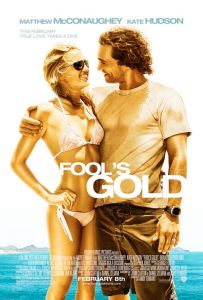 This may be the most boring film about treasure hunting I’ve seen in a long time. Clearly the filmmakers were intending to strike the comic/romance/adventure balance of Romancing the Stone, but boy does this flick flounder. It progresses but it never builds any sense of momentum; Fool’s Gold works almost entirely in lateral moves so no scene feels any more important than the other. It’s like the film succumbed to Matthew McConaughey’s foggy, stoner spirit and decides to just shrug its shoulders through gunfights and explosions. The characters are grotesquely annoying and yet the supporting characters keep elbowing into what should be a combative romance between Kate Hudson and McConaughey. It’s like the filmmakers thought exotic locations, sunny skies, and extremely tan lead actors would take care of the rest. Nothing in this movie ever crosses over into intentional comedy. The treasure angle is so contrived that it requires extensive sit-downs to just go over the convoluted exposition. Fool’s Gold is an empty-headed errand that takes far too long to go absolutely nowhere. For goodness sake, the movie has a puffy Malcolm-Jamal Warner (Theo from The Cosby Show) as a dreadlocked Caribbean gangster. You tell me if you think that sounds like a good idea.
Nate’s Grade: C-
Share this:

Harold and Kumar Escape from Guantanamo Bay (2008)
 I was a big fan of the first outing to White Castle, a crude stoner comedy that also happened to be clever in its outrageousness. The Harold and Kumar sequel returns the same writers but what the hell happened? The first film separated itself from its class of juvenile jokesters because it had charm and wit, but this mediocre movie just stumbles from one uninspired comedic setup to another. The boys get mistaken for terrorists and then the movie becomes a ramshackle road trip through America. The gags are lame and easily telegraphed. Regrettably, many jokes are reheated from the first film, like Kumar’s fantasies involving an anthropomorphic living bag of weed. The presence of the hysterically gifted Neil Patrick Harris gives the film a boost but even NPH cannot save these less-than-stellar shenanigans. The comic set pieces don’t add up together into something greater, and the only scene worth remembering is when the boys smoke weed with President Bush. You know you’re in bad shape when even the gratuitous nudity feels tacky and boring.
Nate’s Grade: C
Share this:

Zack and Miri Make a Porno (2008)
 It’s amazing how integrated pornography has become in our culture. Merely a few decades ago people had to wear disguises to venture out to a ratty theater to watch an adult movie alongside plenty of folks in raincoats helping to add to the sticky floors. Nowadays releasing a sex tape is considered a career boost. Porn stars have replaced supermodels as rock star arm candy, porn has become more socially acceptable, and a wealth of bizarre and explicit possibilities exist just a few keystrokes away. In the end, it’s all fantasy with bad acting.
And yet Kevin Smith’s newest comedy, Zack and Miri Make a Porno, got in trouble with advertisers because of people getting in a tizzy over the goofy word “porno.” Major League Baseball was told that a father was uncomfortably asked by his son what a “porno” was after seeing a commercial during a ball game. Heaven forbid our nation’s parents have to deal with an uncomfortable subject, so baseball banned any ads for the movie. Many newspapers nationwide have refused to list the full title. The original poster was deemed too inappropriate so Smith and crew devised a poster of stick figures. Poster version 2.0 then came under fire for being attractive to children because of the stick figure art. It seems Zack and Miri is getting it at both ends (no pun intended).
 Times are tough for lifelong friends Zack (Seth Rogen) and Miri (Elizabeth Banks). They’re scrambling to pay their bills and keep the electricity in their apartment during a chilly winter in Pennsylvania. Inspired by a conversation with a chatty gay porn star (Justin Long) at their tenth year high school reunion, Zack believes amateur porn can solve their money woes. The two will make their own porn video and sell it to the alumni list from their graduating class, who, Zack rationalizes, would buy a porn if they knew someone involved. Zack convinces his coffee shop co-worker Delaney (Craig Robinson) to help fund the project. Delaney agrees as long as he can have a say in casting; after many years of marriage he is eager to see something new. The team also recruits a squeaky-voiced stripper (current porn starlet Katie Morgan), an old bachelor party performer (former porn starlet Traci Lords), a cameraman (Jeff Anderson), and a man free from any inhibition (Jason Mewes). But Zack and Miri must confront their unspoken feelings for one another as they approach their own sex scene. Can they go from platonic friends to lovers?
Being a Smith film, naturally Zack and Miri is outrageous and often hysterical. The film manages to become witty and dirty at the same time, often stringing together vulgarities in exciting and imaginative ways (the curious “Dutch Rudder” as a means of escaping being deemed gay). Smith has a love of the profane. The movie is vulgar like most Smith movies but the beauty of its filth is in the sparkling, rapid-fire dialogue that adds eloquence to the scatological. This is Smith’s comedic brand, the verbose dirty joke. As in other Smith comedies, the true humor is not found in set pieces and set-ups but in the everyday camaraderie of the cast and through casual conversations. Smith writes characters that you just want to listen to for hours. Zack and Miri does have some funny moments that are specific to the production of randy moviemaking, like an unforgettable de-clogging that “frosts” a cameraman. The joke is swift. However, akin to the Judd Apatow brand of comedy, this is a movie where the charm is watching the characters interact, regardless of setting. I do think the movie unfortunately missed plenty of other potential gags on the silly minutia of homemade pornography. How about the crazy duties for a sound design? Imagine a guy trying to recreate the many weird bodily sounds during sex. I’m mildly shocked that Smith didn’t even touch the vagaries of pubic hair style.
 What the movie does nicely is dwell upon the distinction between love and sex. Now I’m not conveniently forgetting the thousands of movies that have come before and dealt with the topic of intimacy and carnality, but Zack and Miri goes into the nuts and bolts (no pun intended) of an industry that has turned intimacy into a mass-market business model. Zack and Miri stress out about their Big Scene and try to convince themselves that it won’t mean anything, but of course their body language betrays them. The actual deed is an obvious turning point for the twosome and count this as one sex scene that is actually, well, emotionally climactic and, yes, sexy. Though the camera only stays at shoulder-length and alternates between two angles, the actors convincingly convey an array of genuine feelings, notably love. It’s not easy for an actor to display honest-to-goodness love, but Banks and Rogen achieve this feat. The aftermath of their onscreen coupling extends into a seemingly unnecessary third act that divides them apart in a contrived fashion. Seriously, the typical third act misunderstanding in standard romantic comedy fluff is alive and well in a Smith vehicle. The characters do not react to this misunderstanding in a realistic manner; one character would rather be sequestered than easily prove their innocence.
While Zack and Miri has plenty of laughs and a nice, mushy center, I cannot help but feel mixed about the results. The characters are not nearly as sharply drawn as they have been in other Apatow comedies, even other Kevin Smith movies. I can go back and remember the multiple dimensions of the funny people that populated Superbad, Sarah Marshall, 40-Year Old Virgin and others, but Kevin Smith’s latest comedy suffers in comparison. Zack and Miri are the only characters with moderate sums of characterization, and yet their unspoken love is essentially the bulk of that. Neither character is well defined or explored in a substantial way that doesn’t involve the other. I get that the movie is a romance. But I expect more from characters than to be defined by whom they desire. I just wanted more. Yes Zack is a slacker who says he’s just looking for a good time, though we know he has his sights set on more, and yes Miri is a gorgeous gal with a lot of patience, but these characters are staples of Kevin Smith movies. The assorted side characters have fun moments but are mostly insignificant. There’s the stripper with a heart of gold, the been-around-the-block type, the henpecked husband, the secret freak behind the button-down exterior, the loudmouth, and the sex-crazed dude. Zack and Miri establishes the idea of filmmaking as a community by introducing this lot, but the movie then forgets to incorporate the supporting characters in meaningful ways. They’re mostly used for jokes that fail to extend beyond the immediate. A late scene involving Delaney’s angry wife (Tisha Campbell-Martin) relies on too many grating “white boy” japes that I tuned out. I’m not intending to slam Smith’s film, but the lack of character work hampers the audience investment in the central romance.
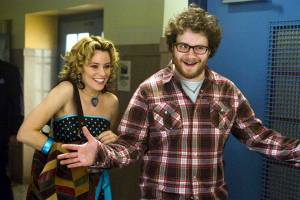 What is lacking on paper is nearly compensated by the great performances from Rogen and Banks. Both are on loan from the Apatow comedy company, and both are skilled at being raunchy one second and heartfelt the next. Rogen finds his comic groove easily and is an enjoyable schmo that taps hidden ambition in the most unlikely of scenarios. It really is Banks who comes across as the star of the flick. She can talk trash with the boys but she is radiant during the film’s dramatic moments, selling Miri’s emotional highs and lows with crinkling smiles and fluttering eyelashes. Banks has always been a solid actress underutilized by most of her marginal film roles. With Zack and Miri, Banks showcases a devilish comedic gleam. Of course yet again the audience must believe that a beautiful gal with a beaming smile would be down on her luck finding a good guy.
In the end (no pun intended), Zack and Miri Make a Porno is a crude romantic comedy that might have benefited by more attention spent on the romance or the comedy. The tone never breaks as sharply as with Chasing Amy, arguably still Smith’s finest accomplishment, but the dirty humor and the gooey romance have a hard time expanding because of the presence of each other. Too often the ribald humor doesn’t feel fully realized because the dirty jokes are just window dressing for the romance, and I had trouble fully engaging with the romance because the characters haven’t been rendered to have substantial depth. Smith may have been better served by making his movie longer; the film is barely an hour and 40 minutes long. Zack and Miri Make a Porno is a sweet movie with a dirty mind but it does not measure up to recent comedies like the best of Apatow’s brand. Smith is a talented wordsmith who certainly knows how to make an entertaining comedy, and Zack and Miri certainly entertains, but like pornography, it just made me want something more fleshed-out and real (no pun intended).
Nate’s Grade: B-
Share this:

Nick and Norah’s Infinite Playlist (2008)
 When you’re a teenager, sometimes there is nothing more important in life than music. Generally one of the most prominent means for a teenager to outwardly define his or her emerging personality is by music. Coming of age and maturing musical tastes seem to go hand in hand. I may date myself here but I can recall my own personal blossoming thanks to the likes of Green Day, the Smashing Pumpkins, and the Offspring (you couldn’t go anywhere in 1995 without hearing “Self Esteem”). Nick and Norah’s romantic interlude begins over common musical tastes and move from there. Having a person “get” you seems to be linked with having a person “get” your music. Nick and Norah’s Infinite Playlist is an inviting and mostly successful teen comedy that “gets” it.
Nick (Michael Cera) is nursing the common teen ailment of a broken heart. He’s one part of a queer core punk band and just happens to be the only heterosexual band member. Nick has been sending mix CDs to his ex-girlfriend, Tris (Alexis Dziena), but she’s been tossing them in the trash. Norah (Kat Dennings) has been fishing those mix CDs and falling in love with her unknown musical soul mate. Norah’s best pal Caroline (Ari Graynor) has informed her that her favorite indie band, Where’s Fluffy?, is playing a secret late-night show in New York City. The slew of characters, Norah and Caroline and Tris and her new boyfriend, attend a nightclub where Nick’s band performs. Awkward. Norah poses as Nick’s new girlfriend and the two take off together to drive a very drunk Caroline home. It is here that they begin an unforgettable odyssey filled with gross toilets, drag queens, Norah’s ex-boyfriend (Jay Baruchel), jaunts to recording studios, and many stops along the way to try and find Where’s Fluffy?
 Nick and Norah isn’t anything altogether remarkable but its charm comes in how, well, unremarkable it comes across. I do not mean this as faint praise or a backhanded compliment. The majority of teen-oriented films have the habit of slotting characters into rigid archetypes. Earlier this year, the documentary American Teen was released and barely made a blip. The director of this documentary condensed an entire high school year into a feature-length film, but she framed her characters as entrenched stereotypes patterned after movies (movies began the stereotype, now is life merely following its lead?). The marketing even had its main “characters” recreate the Breakfast Club poster with the requisite Jock, Geek, Princess, etc. It’s so easy to paint in broad, well-established strokes when it comes to teenage characters and a high school setting. So it’s genuinely entertaining and encouraging to see Nick and Norah where the characters just are people. Granted the gay characters are a bit too cutesy by half, though they never become swishy stereotypes and the slutty manipulative ex-girlfriend character is a pretty familiar and clichéd antagonist. But the real charm of the movie is seeing characters that cannot be painted in broad strokes, characters that do not hide who they are, and characters that refuse to be typecast. Just watching Nick and Norah interact, I felt like I was watching two friends instead of high school archetypes having the same tired class warfare. Making the characters reasonably realistic and unremarkable is a breath of fresh air.
Not all the elements in Nick and Norah entertain; some feel like they’ve been surgically attached from different movies. The entire subplot involving the sloppy drunk escapades of Caroline seems extraneous at best, providing an unnecessary plot point that keeps Nick and Norah together for the night. It provides some laughs due to Graynor’s highly amusing drunken performance, but the subplot also pushes the movie into outlandish gross-out humor, like when Caroline vomits into a toilet, drops her gum in the same toilet, and then decides to foolishly go after the gum. The same piece of chewing gum has its own fantastic journey. The coupling between Nick and Norah is also given a weird and somewhat unseemly addition. Clearly these two kids “like like” each other and the wild night presents different coupling obstacles before these fun kids eventually decide to make a move. In one scene Norah is taunted by Tris about never having had an orgasm. So then the movie makes it a point that when nick and Norah do hook up that we are presented with Norah earning her first O-face (the whole climactic sequence is done off camera and only with audio). Orgasmic proof was not needed to convince the audience that Norah has finally found a worthy guy. The fact that they’re high school-aged students brings an unsettling, seedy element into an otherwise wholesome film. It wasn’t needed.
The plot of Nick and Norah has a few bumps along the way because the emphasis is on the groovy and genial atmosphere. Watching the movie is somewhat akin to attending a party with some cool people. You leave the theater with your spirits lifted a tad, a smile on your face, and some fond memories for the time being. I’m not saying that Nick and Norah is comparable to the best teen comedies of all time but it manages to spin a little magic. I couldn’t help feel wistful as I watched the teen characters romp through the late night music scene of New York City, a character all its own. The movie manages to capture the exciting essence of being young and alive in an authentic way.
 The two leads are deeply enjoyable. Dennings (The 40-Year-Old Virgin) is a great find and comes across as a natural teenager. She’s not precocious or glib, but she seems grounded, unassuming, and yet intelligent in a way that doesn’t pass as hyper-literate. Dennings gives a spunky performance that is tinged with awkwardness and heartache, as she explores the scary yet exhilarating prospect of romance. She’s also got a bashful beauty to her, like the girl next door that would never admit that she could be attractive. She’s got lips like red licorice and classic features that could work in old Hollywood. Dennings gives every scene a boost of heart and the movie shines brightest every minute she’s onscreen. Cera (Juno, Superbad) seems to have patented his nervous stammer that he’s previously showcased. I wonder what Cera’s acting range actually is because he seems to be playing different variations on the same character. However, I have written before that Cera is the living master of comic understatement and the well-timed pause, and he proves it again. He mopes a bit too much through the movie but Cera manages to make him empathetic and not pathetic. The two of them have a sweet chemistry and it’s easy to yearn for their coupling.
Nick and Norah’s Infinite Playlist exists in a world that doesn’t exactly resemble our own but seems like a swell place to visit. The movie almost contains a certain innocence to its teenage shenanigans. Dennings and Cera make for engaging leads and an adorable couple onscreen. Not all of the parts come together as well as Nick and Norah do, but the movie’s overall vibe is authentic and low-key, apt to provoke cheerful smiles more than laughs.
Nate’s Grade: B
Share this:

Rambo (2008)
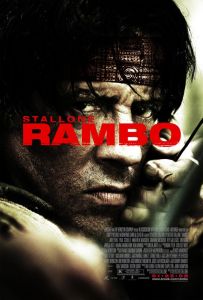 Count me as one of the many who were surprised at how effective Sylvester Stallone was when he dared to make a sixth Rocky movie. That 2006 swan song was an effective and somewhat emotional return for a character that had been dormant for over 15 years. Now Stallone is trying to work his resurrection magic yet again. Rambo was the epitome of the 1980s action star as he laid waste to vast stretches of enemy armies. What few remember is that Rambo’s first film, 1982’s First Blood, is actually more of a psychological drama about a Vietnam War veteran coping with adjusting to life back home. The action only comes at the end and a grand total of four people perish. Stallone had bigger plans for the character, I suppose. Just as he did with Rocky, Stallone has brought back an old character now with an older face.
John Rambo (Stallone) has been living outside the Burma (now known as Myanmar) border in Southeast Asia. He’s commissioned by a group of missionaries, including pretty blonde Sarah (Julie Benz), to transport them upriver into Burma. They want to do aid work, but Rambo says that Bibles cannot help a country overrun by men with guns. Eventually, all those Christian missionaries are kidnapped by a ruthless warlord. Rambo teams up with a group of mercenaries to go back and rescue them. A lot of people die horribly in the process.
Do we need another Rambo movie? The first one was linked to the Vietnam War, the increasingly cartoonish sequels involved John Rambo going back to Vietnam and then going to Afghanistan to help take out the invading Soviets. Perhaps the figure of Rambo should be added as a footnote to Charlie Wilson’s War. But the world has changed and the notion of a one-man army taking out the trash seems a tad ludicrous when a modern enemy isn’t a clear, identifiable source. Stallone wisely returns his scarred soldier to the jungle, back to where atrocities are going down in international lands. In some manner, Rambo becomes like a wishful force for justice, and instead of Vietnamese and Russian soldiers being shot out of jingoistic American glory, it’s Burmese military warlords that meet their makers. Stallone even opens the film with real archival footage of the Burma military junta committing violence acts. The bad guys feel real and relevant, which makes it partially more fulfilling when Rambo meets out his own brand of punishment.
 The dialogue is sparse and kept to an expository minimum. This is for good cause. Ladies and gentlemen, allow me to perfectly showcase for you why it is a blessing that Rambo is as dialogue-free as possible. This exchange happens early in the film and is a glimpse into the philosophical rumblings of one, John Rambo.
Sarah: Really? If everyone thought like you, nothing would ever change.
John Rambo: Nothing does change.
Sarah: Of course it does! Nothing stays the same.
John Rambo: Live your life cause you’ve got a good one.
Sarah: It’s what I’m trying to do!
John Rambo: No, what you’re trying to do is change what is.
Sarah: And what is?
John Rambo: Go home.
That’s the kind of dialogue you hear during fake audition scenes in movies, where the aspiring actors are saddled with ponderous drivel. There is some discussion over whether it is right to take a life. You get an idea of Stallone’s worldview when he has the pacifist preacher eventually kill his fellow man out of survival. After the twenty-five minute mark or so, Rambo essentially becomes a silent movie with added grunts.
The plot is as thin as possible; it’s essentially a rescue mission stretched to 90 minutes. Of course Rambo is a brutal and bloody action flick, but man is this thing tremendously gory, and it’s war gore so that means bodies being blown to bits. I’m somewhat awed at the sheer variety of ways bad guys have giant holes punched in them and through them. Limbs go flying, blood soaks the ground, heads go rolling, insides spend more time on the outside, and bodies are ripped apart. The blood and guts splatter the screen so much that sometimes even the camera can’t escape. There’s so much carnage that you may be advised to wear a poncho if you sit close to the screen. According to the Internet Movie Database, Rambo has 236 onscreen kills and that averages to 2.59 killings per minute. It’s a viscerally violent flick that can become occasionally entertaining, if you can stomach other people’s stomachs exploding in your face. In the end, though, the violence is just another bloodlust high that completely dissipates once the movie concludes, and you?re left with nothing of value. It’s somewhat fun while it lasts, but once it stops Rambo is an empty exercise. Then again, if you’re hungry for lean, mean action, and only action, then Rambo will certainly provide the gory goods.
 Stallone has somewhat re-energized his career by going back to the well. Rambo isn’t as nuanced as that big palooka Rocky, but the taciturn man of action suits Stallone. After a 20-year absence, Stallone eases back into the character and gives him a satisfying weariness, as solitary life has taken its toll. You won’t find me specifying the accomplished feats of acting in this movie because most of the acting is the equivalent of running and falling down, though perhaps not in one whole piece. Credit must be given to the 61-year-old Stallone, who still appears physically agile and spry when he could be cashing a Social Security check. Benz (TV’s Dexter, Saw 5) spends most of her time wailing through tears. It must have been exhausting for her tear ducts and her lungs.
Rambo is a movie that doesn’t pretend it’s anything but a grisly, masculine action flick. The story isn’t anything remotely involving and I doubt that Rambo was a character that needed to be reawakened. However, as a meaty old school action film, it aims to satisfy in the moment. Stallone does what he does well. It should be noted that the Myanmar military government has naturally banned this latest Rambo entry but rebel factions have actually used the film as a source to renew the spirits of the oppressed. They have even taken to using some of the dialogue as rallying cries. To think after all these years Rambo could still have an effect on the world. That’s more amazing than any of the creative carnage within the 90 minutes of Stallone’s rumble in the jungle.
Nate’s Grade: C+
Share this:

Religulous (2008)
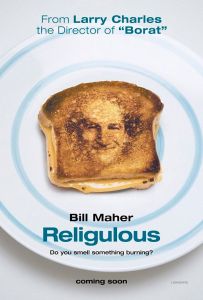 There is no topic in the world more volatile than religion. It dominates cultures, reshapes geography, inspires people to work with the poor, inspires people to attach bombs to their chest, and is as old as time itself. Most civilizations constructed a religion after they grew to a certain size. So who in the world would want to make a sacrilegious opinion-piece documentary that wants to open eyes as well as have a good laugh? Bill Maher is a comedian that respectfully never holds back his true feelings. He’s unflinching in his social commentary on his HBO TV talk show, and religion has often been a thorn in Maher’s side. He personally views it as a mental disorder. Religulous is his eviscerating and intriguing expose as he travels the holiest sites in the globe and asks, “Why?”
For the most part, Religulous doesn’t take a hammer to religion as it does the fundamentalist followers. There are several subjects that cry out for ridicule, like pastors living large and very un-Christ-like on the coffers of their congregations, egomaniacal televangelists that squeeze pennies out of lonely widows, those that babble in tongues, Joseph Smith, Scientologists, and people that celebrate scientific ignorance. Maher is attacking the hypocrisy of fundamentalism, but his condemnation isn’t only reserved for Christianity. He is an equal opportunity offender. In the most surprising venture, Maher takes a trip to the Holy Land and chats with Islamic practitioners about the double standard of its more ardent followers. I suppose repeatedly yelling “Death to Israel” is copacetic but an editorial cartoon that tweaks the religion over its extremist tendencies toward violence is an insult that cannot stand as freedom of speech? Maher really delves into un-PC territory and wants to know why he sees Islamic followers being so overly sensitive to criticism. I think given the fact that like 50 people died as a result of protests over cartoons, there may be room for discussion here. I credit Maher for not ducking away from provocative questions no matter the setting (he even got into the Dome of the Rock mosque!)
 Maher and director Larry Charles follow the same documentary techniques Charles honed as he directed 2006’s Borat movie – a small shambling camera crew that ambushes rubes with tough questions and watches them sputter and squirm. This technique can be amusing when we feel that the harsh inquisition is deserved. Your regular Joe who believes that Jesus is his co-pilot is not deserving of Maher’s smug stares. There’s a moment where he asks a nice guy if he believes that he will reach heaven upon death. He believes he will. “Then why don’t you kill yourself?” Maher asks coldly. It’s uncalled for, and I say all this as a genuine fan of Maher. Still, the movie is regularly funny as it deconstructs religious traditions with quick-cuts to old Hollywood religious epics as cinematic rimshots. One of the better and more convincing moments is when the film compares the theological coincidences between the Egyptian god Horus and Jesus Christ, all set to the Bangles instructional song “Walk Like an Egyptian.”
I personally don’t believe that having faith in the unseen/unknown or being religious equals being stupid. Quite the contrary. However, it’s easy to gather a specious view of religion when all you talk to are ignorant yokels. Maher has perhaps one or two sit-down interviews with people educated in theology, but mostly he sticks to interview subjects that he can mock or those that share his opinion (his extended interview with the leader of Amsterdam’s pot-fueled “cantheism” is irritating). I think Maher is doing a disservice to his film’s target by not discussing theology with learned scholars, with people that can articulate lucid and complete thoughts, with people that have all their teeth. Did he seriously think he was going to able to find a defense for Biblical contradictions at the Holy Land amusement park or at the trucker church? I strongly doubt it. In many ways Religulous strictly sticks to the sideshow of Christianity, peering at the fringe elements. I’m all for grilling fundamentalists that cannot square science and God, but if Maher wants to expose all religious followers as wrong-headed, and not just the ones that think Jesus rode a dinosaur, then he needs to tackle more substantial figures in the field.
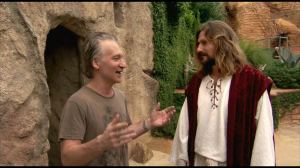 But then Maher fumbles his conclusion and loses me. It is in the closing five minutes that Maher attempts to string together his thesis statement, saying that in order for man to live that “religion must die.” Up until this point Maher has been irascible but committed to his ongoing ideology of “I don’t know.” He professes not to know what will occur after death and wants to press other people into a spirited discussion of the spiritual. But then comes the finish and Maher speaks with the same certainty that he castigated fundamentalists earlier. He is no longer preaching discussion but preaching immediate action to thwart belief. Maher becomes very agitated, his tone gets very sharp, and he steps on the soapbox to once and for all attest that religion of all shapes and measures is rubbish. It’s in these concluding moments that Maher sidesteps from his message of doubt and speaks in aggressive and alarmist hysterics. Maher spent most of [i]Religulous[/i]’ running time attacking hypocrisy but now he demonstrates his own.
I feel that Maher has many good points to make. Religion becomes extremely detrimental when it morphs into nationalism. The Founding Fathers did not envision the United States as a “Christian nation” and were mostly deists with little regard for traditional worship. Questioning and doubt are actually signs of a healthy relationship with faith, because it means that person is active with their faith. Maher showcases the well-known historical grievances caused by religion, or more accurately the followers of religion, but he brushes past the good of religion. It can be a unifying force that calls for people to love thy neighbor as thyself and to turn the other cheek (it’s amazing that the fire and brimstone Bible thumpers forget about the Be-attitudes). Religulous is an entertaining skewer of fundamentalism and close-mindedness, which is why it falls apart when it too turns close-minded.
Nate’s Grade: B-
Share this:

88 Minutes (2008)
 Typically you can smell something wrong when a movie is continually delayed or held from release for well over a year. The serial killer thriller 88 Minutes actually began filming during the fall of 2005 (!). It was released in the United States well after it had been available on DVD in Europe for over a year. After watching all 108 minutes of 88 Minutes, it’s easy to see why the studio and the film’s astounding 20 producers (!!) were trying to hide this from public eyes.
Dr. Jack Gramm (Al Pacino) is the top forensic psychiatrist in Seattle. His testimony is responsible for convicting Jon Forster (Neal McDonough) of a death sentence. Many years later, Jon is now hours away from execution and still professing his innocence, claiming the real “Seattle Slayer” is still out there. Gramm works as a college professor and he can still woo the young ladies and beds them regularly. His assistant (Amy Brenneman) informs Gramm that a woman in his class has been murdered and her murder is patterned after the “Seattle Slayer” killings. Gramm believes that Forster is collaborating with someone on the outside to cast doubt on his conviction. Then as Gramm walks to class he gets an anonymous phone call that tells him he has 88 minutes to live. Gramm scrambles to try and use the time to figure out who is targeting him, framing him, and why. Could it be his assistant, his T.A. (Alicia Witt), his skeptical students (Benjamin McKenzie, Leelee Sobieski), the skeezy campus cop, or maybe the starting second baseman for the Seattle Mariners?
 First off, the time frame doesn’t work at all. 88 minutes is too short a time frame to do crack investigation, and Gramm runs all over the city of Seattle at least three times without getting caught in any gridlock. The movie establishes a real-time ticking clock but then decides to follow a different set of time. Occasionally the movie will be faster than real life, meaning that it says 10 minutes have passed when only say 6 have, and occasionally the movie will be slower than real life, like when the third act probably takes all of 10 minutes in the film’s universe. It’s not consistent and points out the flaw of the structure. The 88-minute countdown was supposed to add a feeling of suspense but what it does is add an extra level of incredulity. There is no way that 88 minutes would be a sufficient time for the killer to stage murder and mayhem around a large metropolitan city known for inclement weather. Seriously, is the killer trying to set unreasonable personal goals? Why not a three-hour window of time? That way the killer could have a healthy planning period without worrying that everything would collapse if they got stuck in traffic. Also, the 88-minute time frame allows glimpses into the anal retentive nature of our killer. Gramm is harassed by phone calls updating him on his declining time, but what’s truly special is when the killer defaces Gramm’s car saying how long he has to live to the minute. The killer must have known to the second when Gramm would come by his car because had the doc taken a different route, gotten a coffee, gone to the bathroom, or performed whatever other million actions then the death threat would be inaccurate.
Next, all the women are helpless sycophants. They think the world of Gramm and several of these twenty-something college girls have big time crushes on the aged Pacino. It’s hard to take seriously the idea that Gramm, in this context, is still a Lothario that he can bed any coed he sets his sleepy eyes upon. The fact that the movie opens with him waking up from his latest and naked conquest already gives the film a squeamish start, but when multiple characters all confess to having crushes on Gramm then the whole idea transforms into an uncomfortable stroking of Pacino’s vanity and virility. I suppose I shouldn’t expect too much from the plethora of female characters because they’re all in need of comfort and every one of them winds up a pitiful damsel in distress. We’re supposed to believe these are strong and capable women, all of them working alongside a criminal expert so perhaps they know a thing or two about self-defense. They fawn over the man and then inexplicably wind up in danger. Occasionally the women will experience dramatic setbacks and they all take a backseat toward getting a hug from Gramm. These women react to the sight of death in puzzling ways and then will just as easily move on to another topic.
 This is the kind of wretched movie where a flashback tragedy is defined by a memory so inane that it becomes insulting. Gramm keeps flashing back to a simple memory of his long deceased younger sister; she is running along the bank of a rather filthy looking river with a kite trailing inches behind her. Now, 88 Minutes is the type of movie where she has to giggle innocently and say something ridiculously non-descript, which in this case is, “[Giggle], dad look at the kite.” Of course Gramm is not her father (or is he?) and her call to look at the kite makes little sense because 1) its string is about three feet so it cannot go very high at all, and 2) it’s usually flying lower than the girl. I just find this image, this idea, this whole flashback construct to be emblematic of how truly awful and derivative and excruciating 88 Minutes can be.
I must confess there is one scene in 88 Minutes that I will remember for the rest of my life specifically because of how ridiculously appalling it is. Few scenes cause me to simultaneously stare in wide-eyed amazement and resist the urge to vomit. Here goes. Gramm is confronted by his FBI agent pal (William Forsythe) who has some bad news for Gramm. It turns out Gramm’s semen was found inside the “vaginal cavity” of the victim. We know Gramm wasn’t sexually involved with her because he was sexually involved with our opening naked escort lady, Sara Pollard (Leah Caims). Gramm then argues that someone out there framed him by killing Sara Pollard (oh don’t act surprised), retrieving Gramm’s semen from inside her, and then injecting it into the “vaginal cavity” of the victim. Hearing an actor of Pacino’s credit verbalize this theory is akin to having the “sex talk” with your parents, nay, grandparents — it’s just so intensely uncomfortable to watch. I just picture a lab tech with a long syringe that has to run around Seattle to make his semen import/export deadlines. This one icky moment stands out as the most ridiculously awful in a movie that is nothing but collective scenes of awful.
88 Minutes has no characters, only red herrings. Each of the numerous supporting characters is given the chance to act suspiciously and for no real good reason. Gramm takes his turn going through accusing nearly every supporting character he comes across as being in league with Forster. The screenplay even establishes characters like the painfully named Guy LaForge (Stephen Moyer, True Blood‘s Bill the Vampire) who serves no purpose other than to wear a leather jacket and squint in backgrounds.
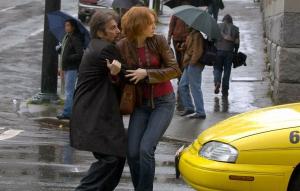 Forget anything approaching characterization because writer Gary Scott Thompson (The Fast and the Furious) has created a script that is woeful in every department, including thrills. The reveal of the killer is mishandled, as is most every plot point, and I’m at a total loss at the rationale of attempting to commit murder in a building the killer called in a bomb threat. Yeah there may not be students but there will be plenty of police sniffing around. More than half of the scenes involve people talking on cell phones. The dialogue is unintentionally hilarious more often than not, with lines like “Someone has penetrated my most secret place” and, “If I can’t forgive you I don’t deserve you,” and the killer taunting, “You see Jacko, I’m a true believer.” Need I remind you of the “vaginal cavity” conversation? This is a complete laughable mess that would have been just another half-rate direct-to-TV movies airing late nights on cable channels were it not for Pacino’s involvement.
Pacino doesn’t even try to hide his disillusionment with the movie. He comes across as sleepy-eyed to the point of being a zombie with a permanent case of bedhead (seriously, Pacino’s crazy hair steals the show). The man is going through the motions to collect a paycheck, and he even gets a couple scenes to work up the frothy barking Pacino voice that he has settled into for the past 15 years of acting. He never seems to be worried that he only has so many minutes to live, so why should we bother sweating? The rest of the cast is awful and they were likely lured to this doomed project because of the chance to work alongside Pacino. Leelee Sobieski must be singled out for being particularly atrocious, especially when she tries to play a tough girl. This has got to be her worst performance since she started speaking. Then again, she has worked with Uwe Boll (Fun fact: one of 88 Minutes‘ many producers is Boll’s longtime producer).
88 Minutes is bad in every possible manner of filmmaking. This is an embarrassment for everyone whose name’s is attached to this film. From the overly anxious musical score, to the choppy editing, to the lackluster cinematography, to the abysmal story and outlandish acting and the lazy direction, 88 Minutes is a cinematic catastrophe. It should only be watched at a safe distance and only with the intention of derisive enjoyment. Because while this movie fails at every level it may just end up becoming the funniest comedy of the year.
Nate’s Grade: D
Share this:

21 (2008)
 Glitzy, breezy, and 100 percent predictable, 21 is a simple con movie that goes through the motions with hyper realism. The most interesting part of the film, by far, is learning the systems that help these coeds fleece Vegas for thousands of dollars. In fact, the true story is far more interesting than this typical tale about a good kid who gets a big ego, pushes his true friends away, is humbled, and then learns a lesson while getting the girl too. What’s a MIT engineer want to go to Harvard med school for? And for that matter, you’re telling me there are no scholarships out there to brainy MIT students? Whatever the case, 21 will pass the time nicely without damaging your brain. The card games are ramped up with zooming camerawork and flashy special effects by director Robert Luketic (Legally Blonde), but it’s all window dressing to an interesting story that was white washed into a bland but undeniably commercial movie. It’s a fine time but, like Vegas, will leave you empty in the end. Still, you could do worse than overly stylized con movies about math whiz card sharks.
Nate’s Grade: C+
Share this:

Street Kings (2008)
 This is a wildly overwrought and sleazy drama is hoping to come across as edgy but everything is so overdone. It fulfills all the requisite elements of the modern crime picture; double crosses, forlorn anti-heroes, bloody violence, but Street Kings misses the mark big time when it comes to any nuance. Every beat of this murky, convoluted dirty cops mystery is plain and obvious. If you cannot guess within minutes who the eventual culprits will be then you haven’t seen enough movies. Every character is a cliché of a cliché, every unrestrained actor is constantly speaking in nothing but exclamation marks, and the dialogue is some of the worst I’ve heard all year. Keanu Reeves is a listless leading man who is blank and lifeless, unable to wrestle the dark and complicated emotions needed for a “cop on the edge” role. I can practically feel Forest Whitaker’s spittle every time he speaks. Street Kings feels like a route retread of rogue cop pictures, which are director David Ayer’s specialty. It wants to shine a light on the seedy underbelly of the law but it can’t stop from feeling like a lobotomized version of L.A. Confidential (Note to Ayer: Jay Mohr + mustache = an arrangement that benefits neither party).
Nate’s Grade: D


 nathanzoebl
You must be logged in to post a comment.