The Curious Case of Benjamin Button (2008)
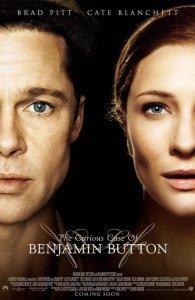 This lavish and long-winded spectacle is curious, all right. Director David Fincher (Se7en, Zodiac) has all the technical wizards at his disposal to produce a near three-hour fantasy about life, love, and death. The Curious Case of Benjamin Button works around the bizarre gimmick of a man going through the process of aging backwards. It’s loosely based on F. Scott Fitzgerald’s short story, adapted by Eric Roth (Forrest Gump), and the results are befuddling. Benjamin is a handsomely mounted and incredibly expensive work engineered for one purpose: to win Oscars. Benjamin Button is a film that strives for making grand statements and wringing a maximum amount of tears, but it’s also a film that lives more in a series of moments than as a cohesive whole. It’s a fine piece of work but feels overburdened by its urgent desire to be profound.
Benjamin Button (Brad Pitt) is born on the day the first World War ended in 1918. He is born as a small infant that better resembles an 80-year-old man (in Fitzgerald’s short story he is born as a full grown old man, which means it must have been fun for his mother). Benjamin is aging backwards but his mind is still as it should be, so while he is all wrinkly, arthritic, and covered in liver spots, Benjamin is like other small kids who want to make friends. Benjamin’s father (Jason Flemyng) is horrified by his son’s condition and abandons him at the steps of a nursing center. Queenie (Taraji P. Henson) raises Benjamin as her own child and he grows up (down?) surrounded by a colorful cast of elderly residents (one woman remarks that a young-old Benjamin looks just like her ex husband). It is here that Benjamin meets the love of his life, Daisy (played by Cate Blanchett in her older years). She’s enchanted by Benjamin’s condition but she has her youth to live and Benjamin is left behind. Daisy becomes a trained ballerina and tours the world. Benjamin goes on a series of escapades, like working on a tugboat, traveling to Russia and having an affair with a diplomat’s wife (Tilda Swinton), and discovering his biological father and the family business of buttons. But he’s always been waiting for Daisy, and eventually they “meet in the middle.”
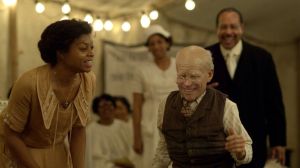 The very nature of the premise means that the movie isn’t going to have many pure, joyful moments. The idea of a romance that needs to take 40 years to connect, and even then has a limited shelf life before they go in their separate aging directions, is beautiful and heartbreaking. Waiting decades for a glimmer of your happiness with your mate, that’s a hard pill to swallow. Benjamin Button explores a similar situation covered by vampire-immortal romances, where you must endure watching your precious loved ones grow old and die. The entire movie radiates with an overwhelming sense of melancholy. The movie manages to find humor and grace amidst its melancholic dirge. The reflections on mortality are ever-present though rarely profound. It may not say anything new or original but it has many things to say about life, death, and the fleeting moments in between. By that notion, the film is structured so that the beginning, where Benjamin is a young old man, it’s more comic and beguiling, then as he and Daisy match up we finally get the pairing we’ve been pining for from the start. The pent-up passion provides great conflict, and then we barely get to enjoy the coupling before reality strikes. The final twenty minutes of the film, where old Daisy cares for old young Benjamin, are incredibly moving and have an indelible symmetry to them, watching an old lady lead a child by the hand.
 So then why do I feel so hesitant about fully accepting this movie? The story follows a similar Gump like pattern of incidents but the movie refrains from being mawkish. The main character is mostly passive with little personality; he’s nice but take away his unusual condition and not many folks would remember their time with Mr. Button. Before he gets with Daisy the film feels a bit episodic with the chapters of Benjamin’s life, and they are entertaining asides but they fail to amount to much more. Benjamin Button feels like something important is absent; it’s not cold as others have claimed but it feels, perhaps, remote, stopping just shy from being a full emotional investment by keeping the audience at a somewhat objective distance. This may be Fincher’s own design because Fincher ensures that a film about living life to the fullest doesn’t degenerate into sentimental claptrap. The end hits hard but not as hard as it could if I was more invested in Benjamin as a character. The Hurricane Katrina framing device seems tacked on, but then again the story mostly takes place in New Orleans and Katrina is rather noteworthy, you could say. The “elderly lady recalls her life story” is reminiscent of Titanic, and might not even be necessary though it offers Daisy the ability to look back over her years with added insight. The layers of realistic makeup piled onto Blanchett are impressive, though I worry what would happen if the actress had to go to the bathroom.
Technically, the movie is nearly flawless. The visual effects are astounding, seamlessly allowing Pitt to play the role even as a young child. The Curious Case of Benjamin Button is a glorious experience to watch but a mildly curious experience to register. The film is so meticulously crafted and it has all the right components of a tragic romance for the ages, but it somehow misses the mark. It’s an entertaining and moving film but it leaves something to be desired. The most resonant moments are also the ones that are the simplest, the ones that lack the window dressing of expensive special effects. I appreciated the film’s expressions of symmetry, but I have the nagging feeling that Benjamin Button both tries too hard and perplexingly doesn’t try hard enough. It keeps audience involvement at a distance, wishing to comment on humanity without embracing humanity. It is difficult for me to articulate what is lacking, because it is an enjoyable if overly long movie, but it falls into the “almost” category of poignant filmmaking. It’s almost a challenging movie, it’s almost an affecting movie, it’s almost a movie worth falling in love with. The film’s story and sensitivity and scope cannot match the technical audaciousness.
Nate’s Grade: B
Share this:

Marley & Me (2008)
 The dog dies. There. You’ve been warned. I feel that everyone walking into this movie needs to know exactly what they will endure. It’s not just that the cute, rambunctious yellow Labrador of the title dies, it’s how. The cause of death is fairly ordinary for an aged pooch, but it’s how the film Marley & Me goes about wringing every possible tear that should be known (so spoilers already, folks). The whole process is drawn out to maximum drama. We get the parents, John and Jennifer (Owen Wilson and Jennifer Anniston), discussing the sad realities of what must be done. We see each of their three children say goodbye to their beloved dog before he goes off one last time to the vet. We see the oldest child, who knows fully well what will happen, tear up and hug the dog’s face. But putting the dog to sleep in between scenes is not an option for this movie, and so we witness the slow process with John caressing his beloved dog as the life slowly ebbs away. And, to hammer home the sentiment ever harder, the movie cuts back and forth between the dog dying at the vet’s office and to John’s children watching a home movie montage of Marley through the years. John, who has been dubbing his canine “the worst dog in the world,” then whispers into Marley’s ears that he was, in fact, a “great dog.” Oh, but it doesn’t stop there. Then we have the kids return one more time for a doggie funeral. Each kid buries a message they wrote for their dearly departed dog including one that hopes that there is lots of things to chew on in heaven (the kid also drew a picture of the dog with angel wings and a halo). My friends, I am a grown man but even I was no match for this emotional onslaught. I felt like a battered prizefighter, thinking I had enough willpower to collect myself and then the movie hit me again with another blow. If you can sit stone-faced then I envy you and, at the same time, I pity you.
So there it is. I feel that every interested party in Marley & Me needs to know what will devastate them in the end. The film follows the marriage of John and Jennifer, who both work as reporters in Florida. She’s got the better gig, and he’s running around town tying to report on methane leaks and writing obits. John envies his friend Sebastian (Eric Dane) and the fame and credibility he has as a serious journalist who travels the globe. Sebastian suggests that John get his wife a puppy to delay her biological clock. And so one fateful day, John blindfolds his wife and takes her to a puppy farm. She picks the cheapest puppy out of a pack of Labradors (Note to self: there is always a reason a puppy is cheaper than its peers). They name the new addition Marley. John’s cantankerous editor (played by the cantankerous Alan Arkin) orders him to start writing a column. He’s absent column ideas until he starts writing about the comic misadventures of owning a dog. The column becomes a hit and Marley becomes a boon of inspiration, when he isn’t eating everything in sight, edible and non-edible alike.
 Marley & Me is a curious creature. Much of the plot follows a repetitious formula of Marley being destructive. He eats pillows. He chews on clothes. He eats drywall. He bursts through a screen door. He chases after people. He eats plants. He eats jewelry. He eats anything and everything. Probably half of this movie is watching Marley destroy something while John and Jennifer run around. For a decent portion, Marley & Me will play out as a cautionary tale to parents about dog ownership. Now, for pet owners, the movie will be seen as amusing and truthful, and I can attest to this. My two-year-old mutt Atticus will routinely chew on things he is not supposed to (we still love him). However, I’m not about to turn this quirk of pet ownership into the majority of a screenplay. If you eliminated Marley from the story all you wouldn’t be left with much to warrant watching.
The rest of the film really focuses on the nuts and bolts of holding together a marriage. John and Jennifer have three children and their marriage experiences some strained times, but they bounce back. They’re both fairly nice people. The non-dog moments of the film play out in equal amounts of mundane and fantasy. The mundane moments are mostly the marital glimpses between john and Jennifer, where we see them engage in realistic arguments and conflicts and reach believable resolutions. The fantasy angle occurs whenever we flash back to John’s writing career. John is ordered to take a column, and then when he’s offered it full-time he wavers. His editor then quickly says he’ll double his salary. The movie is also filled with little moments where everyone tells the main character how great they are, how special what they’re doing is, and this always feels too hackneyed for me when the main character is also the author. It’s ego stroking (look out for the main character of Nate Zoebl to be dubbed way too awesome by every other character in the upcoming film, “The Life and Times of Nate Zoebl — Man of Humble Awesomeness”). Most of the time spent at John’s work is boring, probably because most storylines would be boring when compared to the wacky antics of a dog.
 Director David Frankel (The Devil Wears Prada) shepherds the comedy along nicely. The pacing is swift for a two-hour dog movie. Frankel includes a peculiar sequence shortly after John is assigned his column. John rapidly narrates the next few months of his life with Marley, and the movie cranks up the speed on the visuals. It strongly reminded me of a similar experience in 2002’s Rules of Attraction, where Victor (Kip Pardue) quickly narrates his months of debauchery spent in Europe. It’s a strange connection to be made with a family film.
Marley & Me is definitely going to hit people in different ways. As a loyal dog owner, it made me want to rush home and hug my 45-pound fuzzy baby. The movie presents the chaos of life as something to be cherished, much like Marley. It channels Wilson’s lackadaisical charm and the movie comes across as amusing, chipper, and then downright wrenching once the old dog’s time has come. I’ve been reading about angry parents and grandparents that took their young ones to this movie and then left with crying, shell-shocked little tykes. These people feel that it is wholly inappropriate for young ones to be subjected to the trauma of losing a loved one. Apparently they didn’t read a review where the author’s first sentence was, “The dog dies.” I don’t think Marley & Me will be responsible for therapy bills but this flick examines the enjoyment and heartache of pet ownership like few others. And yeah, the ending is laid on really, really thick, but it shows how a creature could destroy many of your personal possessions and still be considered man’s best friend.
Nate’s Grade: B
Share this:

The Day the Earth Stood Still (2008)
 The 1951 original The Day the Earth Stood Still is considered a sci-fi classic for a reason. Versatile director Robert Wise (West Side Story, The Sound of Music) used a robot and an alien invader to help hold a mirror up to the world, asking how humanity was treating its brethren. The technology is easily dated and the tone a bit stately, but the movie is a complex, thoughtful, and relevant tale that begs for caution and kindness. It still holds up much better than most sci-fi chestnuts from yesteryear. And of course anything that film audiences have warm feelings for will be repackaged by Hollywood into a new more mass-appealing product. That means that big-budget Day the Earth Stood Still remake is likely to have no real improvement over the original. Well, it is in color. That’s an improvement for some.
A giant glowing spaceship lands in New York City’s Central Park. A glowing figure exits the craft and enters our world. This figure is Klaatu (Keanu Reeves) who is an alien creature in the guide of a human body. He has been sent by a community of planets to judge the inhabitants of the Earth. You see, the universe is an awfully large expanse of space but it has a limited number of habitable planets. The rest of the universe is taking note of how human beings have treated their home, and they may just decide that the planet is better off without us. Klaatu is helped out by a sympathetic scientist, Helen Benson (Jennifer Connelly). Eventually the alien escapes and the entire U.S. government is on high alert. Helen is trying to convince Klaatu to not rush to judgment. She’s also trying to connect with her angry step-son Jacob (Jaden Smith) after his father died in war. He’s not very trustful of Klaatu and, like plenty of other people, wants the alien dead.
 Whereas the original was a cautionary tale about the Cold War and mutual destruction, and Klaatu was a peaceful Christ-like figure, the new version skips all this. It would rather recycle a message that human beings need to be nicer to Mother Nature. Now, this is an important concern but it’s harder to take seriously when the movie pretends it’s all about doom and gloom and then basically wimps out on an ending. The film is ready to wipe humanity off the globe and even gets a head start with what looks like swarms of microscopic metallic locusts. But then Klaatu looks out at mother and child, embracing as the world they know may come to an end, and concludes that human beings deserve yet another chance because they have the ability to “change.” That’s all it takes? This kind of cop-out ending reminds me of The Happening, another eco-horror movie that wanted to kill off all those pesky humans but then decided they could walk the Earth a tad longer and hopefully wiser. I’m sorry but this is weak. Profess an environmental message but do something with it, don’t thump your chest about taking personal responsibility and then skimp on repercussions. Remember filmmakers that this is fiction. You have the ability, nay the right, to destroy mankind on screen while I safely watch and consume popcorn.
You know what else keeps hurting the weight of the environmental message? The lousy relationship between Helen and her step-son Jason. This entire storyline needs to not exist. I recognize that the original movie had a substantial storyline where a single mom and her precocious son befriend Klaatu, but that doesn’t mean this remake has to reignite old storylines if they just simply won’t work in this retelling. Every time the movie spends significant time with Helen and Jason I felt like the Earth was standing still. This storyline just does not fit. The kid comes across as bratty and dumb and I actually wanted him to be micro-locust food at some points. He’s angry because his father died and that makes him argue that “Kill them all” is a serviceable foreign policy position. Whatever. This storyline is handled so terribly that every moment of drama it is intended to evoke hits with a resounding thud. When the little kid suddenly turns on a dime and helps his alien fugitive, there’s no explanation. He says he’s afraid of being alone. Well what did you think would happen when you called the U.S. government to come and abduct you? I swear that I do not have a heart of stone, and I love children, but every moment of this character felt false and annoyingly so. That’s why The Day the Earth Stood Still grinds to a halt whenever it switches back to this kid. It makes the whole alien threat a lot less menacing when we spend more time with this kid. Don’t we have far more significant things going on in this story than one kid working through his grief and learning to be less bratty?
 Director Scott Derickson (The Exorcism of Emily Rose) doesn’t have a firm handle on how to establish an exciting action set piece, and he also makes his points very bluntly, though that’s also due to the script by David Scarpa. The beginning is the best part of the film, as scientists are whisked away by government authorities who can only say that the threat to the planet is grave. Interest is piqued at this point, as we, like the scientists, try and discover with a mixture of curiosity and anxiety what exactly the Earth is facing. It doesn’t much improve after the 15-minute mark. The movie just looks so drab. There is a discerning lack of action or excitement in a movie that threatens to eliminate the human race. The movie has long boring stretches that almost kill all momentum, and then the movie tries to compensate with an avalanche of special effects.
There are plenty of intriguing concepts and conflicts that fall by the wayside. In the original Klaatu hid among human beings and came to understand people, but in this new version he’s on the run from the start. I don’t necessarily need some tired fish-out-of-water comedy with Keanu, but seeing him learn about humanity before making a judgment is vital to his character. The remake opens in 1928 with aliens taking a DNA sample from a mountain climber (also Keanu Reeves) and then they use his blood to create a human host. What if that guy is still alive and sees his face on the news? What about his family going through and wondering what connection they might all have to the fate of mankind? Wouldn’t it have been easy just to swap Connelly’s character into this role and thus she is the descendant of that mountain climber and has to look in her grandfather’s face as he proclaims humanity’s end? That storyline would be more interesting and playful than anything with the step-kid.
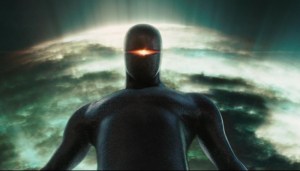
Occasionally sci-fi movies can be partially redeemed by superior special effects. The Day the Earth Stood Still has some pretty shoddy effects that didn’t look much better when I watched the film in IMAX. The aliens have scrapped the older model flying saucers and decide to travel in giant glowing spheres, which may be awe-inspiring to see in person but it’s mostly lame to watch on screen. It’s not even that hard of a CGI effect to perform. The new likeness is completely wrong for Gort, one of the most famous movie robots of all time. In the 1951 original, Gort was a teen foot tall robotic guardian for Klaatu. Derickson has made Gort 40 feet tall and he looks weirdly like an Oscar statuette. The awesome robot is ridiculously captured by the U.S. military so that they can try and drill into it, which makes no sense at all. Then the robot transforms into that swarm of robo-locusts and that’s the last we see Gort in action. That’s just dumb. I would much rather see a giant robot wrecking havoc than a swarm tear apart Giants Stadium. The filmmakers decided that a hazy cloud would be more visually interesting than a giant robot. Give me more Gort!
 I must say that hiring Reeves was the smartest move that the movie made. Reeves’ naturally stiff and aloof line delivery works nicely as an alien trying to some to grips with his new flesh and blood body. Reeves consistently entertains and adds a dash of fun that is mostly missing in this humorless and stubborn remake. Connelly works with what little she’s given, and man can she make her eyes glisten in the most beautiful manner, tearing up at a moment’s notice. Most of the other actors are wasted in stock roles, including Kathy Bates as the Secretary of Defense and Mad Men‘s Jon Hamm as a man who only serves to spout exposition. That’s the dashing Don Drapier, and you give him exposition? I won’t belittle Smith’s performance because in all honesty the kid is a fairly good actor. It’s not his fault he got stuck playing a dumb character that routinely hijacks the movie.
The newest Day the Earth Stood Still does little to justify its existence. This remake would have been better served either cribbing more of the superior original film or just cut off all ties. The remake tries to incorporate plot points that don’t work while also trying to tell its own environmental tale with bigger effects, which also doesn’t fully work. The Day the Earth Stood Still is a plodding and unnecessary remake that fails to stumble into an exciting scenario despite the fact that it involves aliens threatening the planet. But hey, it is in color.
Nate’s Grade: C
Share this:

The Wrestler (2008)
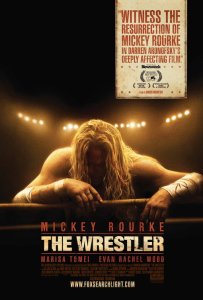 The Wrestler came out of nowhere to be hailed as one of the most stirring dramas of the year. Who would have possibly guessed that a movie that stars Mickey Rourke in spandex would be one of the best films of 2008?
Randy “The Ram” (Rourke) was one of the biggest professional wrestlers in the 1980s. His pay-per-view battle with “The Ayatollah” in 1988 is legendary to wrestling aficionados. But nobody ever stays on top forever. Twenty years later, Randy is a self-described “old broken down piece of meat.” He’s barely staying afloat working at a supermarket during the day. On weekends he adorns his old tights and fights in wrestling bouts at VFW halls, where small numbers still flock to see the scripted carnage. Randy is fighting against the ravages of time and is determined to stick it out with the profession that has both made him a super star and also left him broken and lonely. He can relate to Cassidy (Marisa Tomei), a 40-something stripper that gets disrespected by customers because of her age. Randy seeks out his teenage daughter (Evan Rachel Wood) to attempt to be a father for the first time in the girl’s life. Then a wrestling promoter wants to stage a twentieth anniversary rematch between Randy and “The Ayatollah” (who runs a successful used car business in Arizona now). The opportunity means Randy has one more shot in the limelight before his health sidelines him for good.
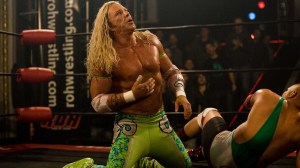 There isn’t a note in The Wrestler that feels misplaced or a moment of drama that feels false or contrived. The scenes of emotional revelation feel genuine and aren’t delivered with deliberate emphasis, like Randy’s moving speech where he tells his neglected daughter how rotten of a father he was, which he accepts bitterly, but he pleads to fashion enough understanding just for his little girl not to hate him. The Wrestler skews against convention and ends on its own terms, following the fated trajectory of its tragic hero. This isn’t a generic or sentimental tale of uplift and redemption. Randy is eager to make amends for a lifetime of bad decisions but he is also keenly aware that he has little to offer and that the outside world has little place for him. The Wrestler is a tender tale about a man trying to find his place in a world no longer familiar to him. Randy tells Cassidy at one point that the only place he ever truly feels pain is outside of the ring.
The film skillfully explores what is fake and what is real in the wrestling world. The matches may be predetermined but the injuries are very real. These muscled warriors are essentially pro stuntmen with some charisma and their bodies are their offering to the screaming masses. They give everything they have for the crowds but what do they get in return once the applause dies down? After witnessing the bloody aftermath of an especially brutal match, which included Randy being lacerated with barb wire and having a staple gun decorate his back, it’s easy to wonder why any sane person would subject themselves to this kind of punishment and for so long. Cassidy is in another profession that tends to grind up and spit out its star attractions. She reaches out to Randy not out of romance (a lesser film would have demanded she fall in love with the big lug) but out of a desire for human companionship, for something real. These two characters are both at a crossroads and must come to grips with the cold realization that the world has passed them by.
 The script by Robert Siegel came alive for me in the details. I love discovering that Randy endures shame that his real name is the more effeminate-sounding Robin. I love that the film shows a scene where a batch of old wrestlers sit next to folding tables and hawk tapes of their greatest matches that no one wants to relive but the old timers. I loved that Randy’s long walk through the bowels of the supermarket to greet his “fans” at the deli counter mirrors his entrances to wrestling bouts.
Astonishingly, Darren Aronofsky directed this movie. The film departs sharply from Aronofsky’s highly artistic yet stylistically mannered previous films, like Requiem for a Dream and The Fountain. He strips away the style pyrotechnics and follows a no-frills docu-drama approach. This dynamic helps accentuate the raw and harsh reality of the film. It’s the most relaxed direction the man has ever done. He’s able to churn the myriad of emotions and broken dreams into a powerful character study that never feels manipulative. The Wrestler feels remarkably intimate and emotionally bruising.
The Wrestler is built to be a one-man show and it’s a terrific show. Rourke’s performance is invigorating and the former Hollywood bad boy channels his own personal history of regret and missed opportunities. The line between character and individual is noticeably blurred. Rourke’s busted and mangled face tells a long history for Randy. The physical shellacking that the 52-year-old Rourke takes is brutal, and you realize that he throws his body into the performance with wild abandon for a man his age. I cannot imagine this film working or having nearly the poignancy with Nicolas Cage in the lead role, which is what was originally planned (Cage might have had a more bizarre haircut). Rourke is the role. It is a perfect marriage of actor and character. The character of Randy is the latest in the long film tradition of the noble loser that must fight to reclaim his victory, which makes for a deeply empathetic experience. Randy is a gentle giant, courteous even to the people that insult him and his glory days. You will feel the man’s every high and low. When he’s working at the deli counter and begins to have fun, joking around with customers, you’ll feel his sense of revelry too. When he’s lonely and invites a neighbor kid over to play an old 8-bit Nintendo video game featuring Randy, you’ll feel the same ache of sadness to connect. When Randy screws up, you’ll feel the same angry disappointment. When Randy is out shopping for wrestling props and playfully involves others in “testing” them, you’ll feel the man’s amusement and sense of peace. Other actors might have given in to the setting and played Randy as a caricature, but Rourke plays with subtlety when he could have gone big. He’s reflective and somber and has a well of repressed anger buried deep within. It’s a performance for the ages and cements Rourke’s cinematic comeback.
 The Wrestler is a rich and engrossing character study that aches and wheezes with the pain of real life. Randy is a man that’s lived a hard life, by design, but at his core he is a kind and decent man. The film takes after its star and proves to be quiet, unassuming, brutally honest, and deeply affecting. Rourke bares his own tortured soul by playing Randy, and his performance is unquestionably one of the best of the year. This is a surprising, heartfelt, and equally heartbreaking movie that finds many truths through the self-dawning of its title hero. It’s not the wrestling matches that I’ll remember most, no sir. I will remember the small interludes, like Randy dancing with his daughter, the beer he shares with Cassidy as they lament the 1990s, the love and brotherhood backstage between with the wrestling opponents, Randy delighting the kids in his trailer park by pretending to fight them. Randy may not find solace or stability outside the ring but the people around him prove that Randy was bigger than “The Ram.”
Nate’s Grade: A
Share this:

Gran Torino (2008)
 Clint Eastwood is an icon but he’s also proven to be a remarkable and thoughtful director in his twilight years. When the star first traveled behind the camera he mostly stuck with the action films that were his cinematic bread and butter. Then he showed something grander with 1992’s Unforgiven and rebounded back to that quality with a string of critically lauded flicks like Mystic River, Million Dollar Baby, Flags of our Fathers, and Letters from Iwo Jima. Three of those films were nominated for Best Picture, including three Best Director noms, and Baby won. The prolific screen icon has taken his directing skills up to another level in his older age and Eastwood has chosen to work on somber, mature, and meditative tales. Gran Torino is a movie caught between two different eras of Eastwood direction. It has the sheen and intentions of one of the recent loftier works and the film also taps into the suspense of his earlier action vehicles. It’s the only non-Batman movie targeted for Oscars this year that features ass kicking.
Walt Kowalski (Eastwood) is a retired Korean War veteran living in Detroit. He worked on the Ford factory lines for over 30 years and now has the pleasure of seeing his spoiled children driving foreign cars. His neighborhood has been inundated with Hmong immigrants from South East Asia. It seems the Hmong people sided with the Americans during the Vietnam War, and when the Americans left, well, it didn’t turn out so well for them. One old Hmong lady chastises Walt as a stupid old man and doesn’t know why he hasn’t fled like the other whites that used to live in the neighborhood. Things aren’t like they used to be. Gangs run rampant and terrorize the people into silence. We’re told that when it comes to the Hmong, the women go to college and the men go to jail. A Hmong gang keeps trying to recruit Tao (Bee Vang) into their ranks. He is looked down upon as a weakling and for doing women’s work, like gardening and the dishes. His initiation into the gang is to steal Walt’s pristine 1972 Gran Torino, the old man’s prized possession and one he helped build on the assembly line. Walt catches Tao in the act and eventually the boy works for Walt to repay the offense. Together, Walt and Tao form an unlikely bond. His Hmong neighbors cherish Walt for saving Tao from the gangs and the community opens its arms to him. Walt helps Tao find a job and stand up for himself, but the pull of the gangs is too strong. Walt realizes that Tao and his bright sister Sue (Ahney Her) will never be allowed to have a future as long as the Hmong gang is around.
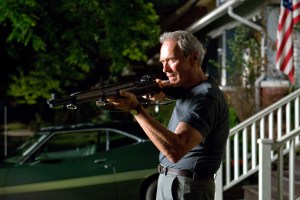 It’s hard to take the movie purely on the surface without some preparation. Because in synopsis, Gran Torino sounds like a ham-fisted after school special where Old Man Dirty Harry teaches the youngsters about the dangers of gangs and violence. The film is hard to fully describe without it sounding like a parody. Yet Gran Torino manages to come together along the journey. The movie balances gracefully even when it seems like it is going to dip into self-parody. Simply put, having Eastwood point a gun and growl, “Get off my lawn,” the quintessential geezer line, is almost calling out for ridicule. The gang storyline feels at times incredibly natural in approach and its casual, realistic dialogue, and at other times the storyline, like the film, feels like it is leading you by the nose. Some of the stock characters are sketched so thin, like the self-centered granddaughter who wears a midriff-bearing outfit to her grandmother’s funeral (all the better to witness your navel piercing, my dear). The spoiled children and grandchildren come across as too broad to be believable. The messages are all familiar, the characters are even somewhat familiar, but Gran Torino emerges as something more understated and perceptive than “Archie Bunker with a gun.” It’s a moderately rich character piece that follows one man resorting to his better nature in his golden years. Walt’s redemption may be predictable from the first minute but that doesn’t make Gran Torino any less satisfying. In fact, the movie on a whole is an embarrassingly entertaining experience. Sure, there’s a certain primal rah-rah vengeance angle to it, and watching a 78-year-old man kick around some youngster is always worth watching. But the novelty of the movie is not cheap xenophobic wish fulfillment, watching an old white war vet eliminate the immigrants in his neighborhood. The draw of this movie is an old-fashioned tale told well, which is equally earnest and glum.
The dialogue can be forcibly blunt as it spits out every offensive racial epithet, slur, and stereotype known to human ears (it’s practically the comedy routine of the unfunny Carlos Mencia). The screenplay by Nick Schenk confuses racist pabulum with comedy gold, like hearing an old lady cuss, but Eastwood manages to make it work. The rampant racist dialogue tends to get tiresome unless it begins to chip away and reveal more about a character. Naturally, Walt shuns being politically correct because he is uncompromising. He shakes his head and glowers at what the kids today have turned into. He’s meant to make others feel the same discomfort he feels in today’s world, and words are his weapons at his old age. The backbone of the script is the friendship Walt forms with Tao and his family. Because it begins so reluctantly and moves at a steady pace, the audience is emotionally invested and the friendship is rewarding to witness. The movie presents a fairly universal message about the redemptive power of human kindness, of helping one’s neighbor. It’s a petty big melting pot out there and there’s no reason to dig in and combat change. Gran Torino lacks the forced sanctimony and transparent manipulation of other “important” race-relations movies, like 2005’s Best Picture-winning Crash.
 The movie is impossible to view without it also becoming a commentary on an iconic actor’s screen legacy. What does a retired Dirty Harry at 80 look like? I imagine something like Walt, an embittered war vet grumbling about the change all around him that he is powerless to ignore. Eastwood takes great pains to be an angry curmudgeon even until the end, which allows the actor to tap his little seen comic ability. There’s a funny scene where Walt takes Tao to the barbershop for a lesson in how to “talk like a man,” which naturally involves playfully insulting your fellow man. Eastwood knows how to make a racist and standoffish character sympathetic and engaging. It’s a pleasure watching Walt become affectionate and protective, and yet the character’s redemption doesn’t ever feel contrived. His character is scarred and weary and wears his pants up to his armpits, but Clint makes it work. He can be sad and badass and appalling all at the same time. The character is somewhat similar to his character in Million Dollar Baby, a grumpy man closed off to the world who mentors a young kid. The flick presents a semi-dignified swan song to what happens when men of action grow old.
Eastwood directs with his typical steady hand and cool decision-making. The camerawork is intimate and sparing, never yanking the audience out of the story. The visuals mimic the characters in that nothing feels over polished. I enjoyed the small bits that pointed to something deeper, like Walt pointing his finger, a pistol and lining up his antagonists. I also enjoyed that Walt refrains from ever spilling his guts about his guilt during the Korean War except in a way that feels true to the character. Eastwood also shows a bit of his directorial prowess by hiring a bunch of Hmong actors that have had no acting experience. Some of them fare better than others, and some are in fact kind of bad, but this decision makes the movie feel more authentic. Now, it’s rare for me to cite sketchy acting as a plus for a movie, and that should be a testament to Eastwood’s directing skills. The man has a way with people; since 2003 he’s directed four different actors to Oscars. It must have been what Angelina Jolie was hoping for when she signed up for Changeling, the earlier Eastwood directorial effort from the fall. I think the biggest mistake Eastwood makes as a director is singing the closing song that unrolls right before the credits. Clint’s raspy singing voice is not the best way to close a movie.
 Gran Torino isn’t among the same ranks as Eastwood’s other output, like Letters from Iwo Jima or Mystic River, but it’s a small-scale story told with fortitude. Even as I write this review, and you dear reader read them, I feel like I’m failing in my attempt to make the movie sound good. True, on the surface it sounds like a bizarre after school special that would be destined to slip into self-parody and open mockery. Eastwood as star and director makes the material click. Walt’s journey from grumpy bigot to grumpy bigot who has opened up and made amends is greatly entertaining and humorous throughout. Gran Torino can be seen as a deconstructionist take on the fading era of Dirty Harry and Eastwood’s cinematic tough-guy legacy. Clint fans will eat all of this up.
Nate’s Grade: B+
Share this:

Let the Right One In (2008)
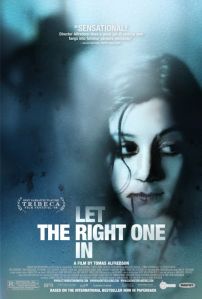 This is a pre-teen vampire love story that is miles away from Twilight folks; it’s solemn, mature, stark, violent, tense, and astoundingly ambiguous. Director Tomas Alfredson pares down the emotions and the entire film takes on a very reserved and curious atmosphere, which I feel heightens the sense of wonder and dread about a supernatural romance. The relationship between 12-year-old Oskar (Kare Hedebrant) and 12-year-old looking vampire girl Elie (Lina Leandersson) is entirely believable and constantly intriguing, as key information is doled out like breadcrumbs. Oskar is negotiating puberty and Elie is well aware of what awaits. The movie works as an example of methodical horror where emphasis is placed upon anticipation and the imagination. The climax at a community pool is one of the best film finishes of the year. I was a tense ball of nerves, and I love the movie’s closing shot. Even better, the movie works as an intriguing and intricate drama about human relationships. I can revisit Let the Right One In and dub it an unconventional and moving romance. Or I can revisit the film and dub it a melancholy examination of a manipulative and parasitic relationship, as Oskar might be doomed to a fated life like Elie’s former guardian. I can keep revisiting this Swedish horror film and discover more to discuss and diagram each time. And I didn’t need a single scene where the vampires played super hero baseball games.
Nate’s Grade: A-
Share this:

Happy-Go-Lucky (2008)
 I wanted to turn this movie off for the first 30 minutes or so and that’s because of Poppy (Sally Hawkins), the deranged optimist that the movie follows. Writer/director Mike Leigh’s latest semi-improvised tale following the English working class centers on a primary school teacher who makes the conscious choice to be happy in life, no matter what life throws her way. Her presence is somewhat exhausting, like a customer who doesn’t know when making jokes has gone from fun to downright annoying. But you know what? Poppy eventually won me over, and I’m all but positive it was the scenes of her and her raging, pessimistic, tightly wound driving instructor (Eddie Marsan) that did it. Before their first driving lesson, I felt like the movie was giving me a slice-of-life that I was hesitant about; Poppy, like anyone who is insanely happy, can be grating. The humor is extremely dry and most of the clever dialogue exchanges will likely go by unnoticed because the actors aren’t delivering big punch lines. Hawkins goes all-out as the unflappable Poppy and she will make you smile through sheer force of will. This was a film I liked more by the time it was winding down, perhaps because Poppy might be easier to take knowing that time is coming to a close much like spending time with a distant relative during the holidays.
Nate’s Grade: B
Share this:

The Visitor (2008)
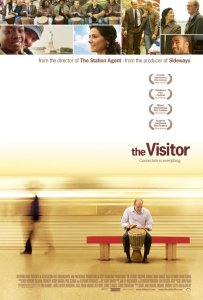 The follow-up by Thomas McCarthy, the writer/director of the sparkling Station Agent, is an affecting indictment on our nation’s immigration policies that manages to say a lot of important things in small touches, ditching histrionic messages. Walter (Richard Jenkins, in a commanding and deeply empathetic performance) discovers a pair of illegal immigrant squatters living in his seldom-used New York City apartment. He strikes up an unlikely friendship that moves in subtle strokes that keeps the movie very character-based. The second half of the film revolves around Walter’s attempts to work within the system to free his new friend from detention. I could have spent more time with Walter and Tariq, the Syrian immigrant who teaches Walter how to play the African drum. The Visitor explores a man learning in his autumn years how to reconnect with people, and it has moments of astonishing emotional clarity. McCarthy is a filmmaker that can spin narrative gold from just about anything; The Station Agent had a hot dog vendor, a single mom, and a dwarf. The Visitor is further proof that McCarthy is an extremely talented man who knows how to target and tap the humanity of his unique characters. There are very few moments in this movie that feel false.
Nate’s Grade: B+
Share this:

The X-Files: I Want to Believe (2008)
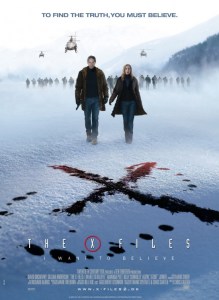 To all fellow X-Files fans out there, the movie is not nearly as bad as you may have been lead to believe. That said, it’s pretty much a so-so standalone episode of the TV show needlessly expanded. And yes, for all concerned fans, Mulder (David Duchovny) and Scully (Gillian Anderson) kiss on more than one occasion. The plot that reunites the characters is fairly mediocre, something about a ring of mad scientists that want to be a modern-day Dr. Frankenstein. You don’t need a two-headed attack dog to know that plot is way too hokey. The most intriguing aspect of the film is a priest (Billy Connolly) who also receives psychic visions, cries tears of blood, and, oh yeah, is a convicted pedophile. Could God be responsible for his special abilities as well as the abhorrent sexual urges? There is so much great conflict and human drama in this character worth examining, so it’s a pitiful shame that he just gets shoved off so the third act can concentrate on the lame mad scientists. A majority of the flick occurs in snowy West Virginia, which doesn’t translate into anything too special to look at. I’ll admit, my rating is inflated because I was an ardent fan of the TV show until the last years when it felt like they weren’t even trying any more. If you stripped away my allegiance, I’d say that the second X-Files movie serves little purpose other than to add a tiny coda to a TV show that went off the air in 2002. The characters are worth revisiting, just not in this tepid tale.
Nate’s Grade: C+
Share this:

Hellboy II: The Golden Army (2008)
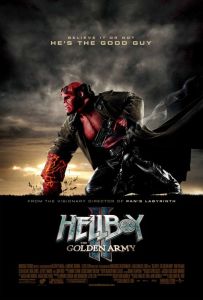 I disliked the first Hellboy, dubbing it the second worst film of 2004. The fact that I enjoyed the sequel is nothing short of shocking. Honestly, I think this mumbo jumbo is easier to swallow when it’s more fantasy based than science fiction based. I can accept an alternative magical world filled with elf princes, troll markets, and tiny “tooth fairy” creatures that act like piranhas with wings. Nazis and Zombie Rasputin trying to open a portal to giant squids? Hellboy II is even more imaginative and far more enjoyable. Writer/director Guilermo del Toro has refined the world and makes sure his story follows the rules it sets, which means that while the plot gets crazy it doesn’t feel cheap. I actually had some fun with Hellboy II and del Toro knocks out some pretty crafty action sequences. As expected, the makeup and creature designs are impeccable, which may explain why I had more fun watching the various magical creatures than following Nazis and slime wolves in the first flick. The lithe Angel of Death is particularly startling, with a head like a fried calzone and eyeballs dotted along expansive bird wings. This is a film that feels much more confident about its identity, thanks in part to getting rid of the rookie main character from the first film and focusing on the big red guy. If del Toro ever makes a third Hellboy film, I can honestly say I’ll be highly intrigued to see what weird wonders he cooks up. This statement is astounding considering I felt that there was only one 2004 film worse than the original Hellboy.
Nate’s Grade: B


 nathanzoebl
You must be logged in to post a comment.