The Love Guru (2008)
 While never approaching the realm of good, I’ll admit that Mike Myers’ latest is not the cinematic abomination is has been hailed. I laughed a few times, though rare. Myers’ brand of comedy mixes puns, juvenile bathroom humor, slapstick, celebrity cameos (Ben Kingsley, why?!) and a certain level of self-aware absurdity (I don’t think Myers has found a penis joke that he didn’t enjoy). I feel that the comedy world has moved beyond Myers’ once popular brand of yuks. Thanks to Judd Apatow, we’ve transitioned to smart and tender character-based comedies. The threadbare plot relies takes too many self-indulgent and lazy detours. Why do we have to endure Guru Pitka (Myers) sing “More Than Words”? It’s not funny and just wastes time. Here’s an example of the lack of thought: Pitka wears a chastity belt but he can still get injured being hit in the groin. It’s a movie that doesn’t even remember its own gags. I’m always wary when a movie resorts to extended scenes of the characters cracking up and adding lines like, “I haven’t laughed this hard in a long time.” I have no qualms over crude comedy but it needs to be done with some planning to context and character. Watching someone get hit in the face with urine is not funny. Having pint-sized Verne Troyer get hit in the head is not funny the 80th time it happens. The movie never even satirizes the self-help industry. The Love Guru is too indulgent, too forced, too pun-heavy, too ill conceived, and far too stupid to succeed. I never thought I’d say this in a comedy that includes Myers, Stephen Colbert, Jim Gaffigan, John Oliver, Daniel Tosh, and Romany Malco, but Justin Timberlake is the funniest man on the screen as a daffy French-Canadian goalie, and that probably says enough.
Nate’s Grade: D+
Share this:

Repo! The Genetic Opera (2008)
 In a dystopian future, organ failure has become an epidemic. Fortunately, the GeneCo Corporation and its CEO Rotti Largo (Paul Sorvino) have devised a solution. They will loan out new organs to those in need. However, if the customer happens to be late on a payment then GeneCo sends out the Repo Man. This hooded figure will track you down and surgically remove GeneCo’s property, and perhaps they’ll harvest the rest of you too. People become obsessed with surgery upgrades (just think what wonders a third kidney could do for you). Blind Mag (Sarah Brightman) is a famous opera singer that signed a contract for new corneas. She’s now reconsidering retiring from the stage, no matter what that means. There’s also a powerful pain killer known as Zydrate that can be extracted from fresh corpses. Anyone caught robbing graves will be shot on sight.
One repo man, Nathan Wallace (Anthony Stewart Head), is working to keep his daughter safe. Shilo (Alexa Vega) has a rare blood disease she inherited from her mother, who died in childbirth. Nathan must keep her locked away in order for her to survive. His daughter must never know his true identity as a repo man. Rotti is informed that he is dying from inoperable cancer. His trio of bratty, homicidally crazy children (Paris Hilton, Bill Moseley, Nivek Ogre) are all fighting over who will get to run GeneCo once dad’s dead. Rotti plans a big bloody finale for everyone at the Genetic Opera’s final curtain call.
To answer the most burning question, yes it is an opera. There are perhaps five spoken lines and the rest of the movie is completely sung; you will get a solid 85 minutes of people singing while they engage in plenty of questionable acts. To say that Repo is unique is a disservice to the flick. I cannot imagine watching another movie that combines opera, vivisection, surgery addiction, Gothic costuming, and Paris Hilton actually doing a credible performance. Knowing that it is indeed a full-fledged opera, it mostly eliminates the snickers that arise from watching actors break into song at curious moments; when they’re singing all the time you’re more aware when they stop. It’s a futuristic rock opera that exists in the realm of a horror movie. There are several dispirited elements that can be occasionally awkward but that isn’t necessarily the flick’s fault. I just haven’t witnessed too many folks singing while arm-deep inside an exposed chest cavity. The movie isn’t as bloody or gory as repulsed film critics have lead you to believe. There are about four sequences of horror gore, though the film does resort to casual violence that can be off-putting, like stabbing extras. Repo possesses a wickedly entertaining and gleeful spirit.
 But how is the music for such an avant guard enterprise? It’s pretty solid, actually. It won’t be everyone’s cup of tea, naturally with some vulgar lyrics, but the music is certainly well crafted, with strong melodies, catchy hooks, squealing guitars, and some rather impressive singing. The music is reminiscent of industrial rock acts but it also has some pretty flavorful pop styling (the pounding hard rock beats reminded me of the underrated band, kidneythieves). These are tunes that will stick in your grey matter. Some of the highlights include “Infected,” where Shilo laments her condition and says, “I’m infected/By your genetics!/Mother can you hear me?/Thanks for the disease!” The tune is likely the catchiest of them all and has a fun pop-punk melody that becomes a leitmotif. Vega also proves immediately that she can sing. “Zydrate Anatomy” is led by the charming vocals of the Graverobber (Terrance Zdunich, who co-wrote the music and lyrics) as he exposits to the audience the ins and outs of the drug market. The guitars careen and the backup junkie chorus (“A little black vial? A little black vial!”) add some depth to the tune. But least you think it’s all Goth rock, Repo mixes in traditional arrangements as well, including plenty of harried violins, cellos, and some classical opera music. There are also subdued ballads like “I Didn’t Know I’d Love You So Much” and “Genetic Emancipation” that conclude the film on a high note. It all blends together into a unique soundscape that’s well worth singing along to.
Unlike the big screen version of Mamma Mia, the cast of Repo can actually sing, and they sing quite well. Vega (Spy Kids) sounds like a better Avril Lavigne than Avril Lavigne. She’s an ingénue that actually gets some good songs. Fans of Buffy the Vampire Slayer will recall that Head gave a standout performance on the TV show’s musical episode, and here he shows his amazing lung capacity. Head has a rich tenor voice that is lovely to hear. He howls with soulful anguish and holds onto notes for long duration. It’s tricky to present a performance only through song and Head has the most complex role (in one song he laments that “I’m the monster!/I’m the villain!”). Head also switches over into a gravely demonic voice, like his maniacal “I’m on the job” voice to frighten his victims. The personality shift is a credit to Head’s vocal range. The rest of the cast includes singers with actual opera experience (Sorvino, Brightman) and musicians (Skinny Puppy’s Ogre), and then there’s Hilton. She’s already proven with one flop album that the hotel heiress is not the surest singer in the world. However, she works with the material as a spoiled rich kid consumed by her vanity (at one point her face literally falls off).
 Repo! The Genetic Opera plays better as a soundtrack than as a movie. The story is mostly simple but still manages to be confusing at points because of unresolved subplots. The characters are given glimmers of outgrowing their stock roles, but most of them just accept their underwritten fates. Repo seems like it’s on the verge of making social commentary on vanity, man’s compulsion to destroy himself to live outside one’s means, the disposable nature of beauty, destiny versus free will, but it never really delves deeper. The surface is barely skimmed and then the movie kind of chugs along at a super brisk pace. The movie has a trashy, campy atmosphere that can wear thin at times, especially under director Darren Lynn Bousman’s lackluster lens. I know this is low budget but Bousman doesn’t conceal the budget limitations too well and his shot selections can seem rather redundant and mundane for a music video, let alone a feature length film. With that said, this is still worlds more ambitious than Bousman punishing audiences with another Saw sequel (he directed Saw 2-4 and took time off from 5 for this flick). Some of the songs, while fun, seem out of place given the narrative, like the punkish “Seventeen” where Vega declares her womanhood and pretends to be a rock star and pounces around her bedroom, complete with dancing stuffed animals. It’s almost like a Miley Cyrus/Hannah Montana moment of strange daydreaming. The finale at the opera is a tad overwrought and yet it seems appropriate given the operatic backdrop.
I’m dumbfounded that some critics would cite Repo! The Genetic Opera as the worst film of 2008. How could something this ambitious, with such a killer soundtrack, be worse than 88 Minutes, The Hottie and the Nottie, and the atrociously harmful Meet the Spartans? The movie is far from perfect and is bizarre, messy, and somewhat shambling, but I have a healthy appreciation for a film that tries something different, whether or not it succeeds. A bloody rock opera seems like it’s begging to be considered midnight movie material, but it’s better than that. This curious experiment works better as a soundtrack than a movie, but it’s well worth seeing because, really, when are you going to catch another freaking movie like this? If you ever venture inside a Gothic-themed club, you can expect to see this movie playing on a TV somewhere until the end of time. My advice: buy the soundtrack and get ready to have the songs take root in your brain.
Nate’s Grade: B-
Share this:

Bride Wars (2009)
 In early 2007, it seemed like Eddie Murphy was destined to win a Best Supporting Actor Oscar for Dreamgirls. The funnyman was racking up honors for his fiery portrayal of a fallen Motown singer. Then came ads for the atrocious Norbit where Murphy played three roles, including a grotesquely overweight woman and a racist portrayal of an old Asian man. Was it much of a surprise then when Murphy lost out to Alan Arkin (Little Miss Sunshine) whose character died halfway into the film? I suppose Academy voters took long looks at those appalling Norbit ads and said, “Academy Award-winning star of Norbit? I don’t think so.” Earlier in 2008, Anne Hathaway starred in Rachel Getting Married and became a surefire Oscar contender with her bitterly funny portrayal of an ex-druggie released for her big sis’ wedding. Hopefully the Academy will ignore the awful comedy Bride Wars or Hathaway will be doomed to follow Murphy’s lead (personally I think this is Kate Winslet’s year).
Liv (Kate Hudson) and Emma (Hathaway) have been dreaming of getting married since they were little girls. Both girls were at New York City’s Plaza Hotel and witnessed a wedding reception. They both swore that day to get hitched at the luxurious hotel. The girls grow up and Liv works as a hotshot attorney and Emma is a schoolteacher. Both get proposed at the same time and the high-pitched squealing ensues. Emma wants Liv to be her maid of honor and vice versa. The ladies seek the services of Marion St. Claire (Candice Bergen), the greatest wedding planner in the city. She delights the duo by booking them for two June wedding dates at the illustrious Plaza Hotel. Then comes the bad news. The booking dates got mixed up and the weddings are booked on the same day. The next open date at the Plaza is in three years time. Both women refuse to budge. Then a bridal arms race begins. Each would-be bride tries to sabotage the other’s wedding preparations.
 Bride Wars is indulgent and tiring and occasionally obnoxious, much like the main characters. These characters are one-note and the movie drills that one note repeatedly; Liv is domineering and Emma is a pushover. I don’t care about these characters, and when the movie ramps up the sentiment in the final 20 minutes it doesn’t work because I feel no emotional attachment, and waning interest, in these people. Hudson’s Liv serves as the real antagonist for like half the movie’s running time. She comes across as brash, pushy, unlikable, narcissistic, and overbearing, and her unflagging desire to win is what pushes the conflict. Emma and Liv view their husbands-to-be more as accessories to their collective Big Days, and the movie seems to treat them the same way. The three bland male leads (Bryan Greenberg, Chris Pratt, Steve Howey) even look vaguely the same, and Bride Wars just allows them to slowly fade away. Like the Sex and the City movie, the women come across as deeply shallow and petty, people more worried about ceremony than every day after that fairy tale wedding. The film’s comedic focus is on uninspired slapstick and the pranks that the ladies play. Bride Wars practically excuses the bridezilla bedlam because it eventually makes Emma a stronger person who can stand up for her self after long last.
The initial conflict seems trite and readily negotiable. So the girls have their weddings scheduled on the same day, and they can’t work this out? Why such drama if they’re both lifelong best friends? They couldn’t just have a double wedding? Here’s what I don’t understand. Marion tells our ladies that the Plaza has three June openings, two on the 6th and one at the end of the month. Liv gets one date and Emma gets the other date, and then a third woman (co-writer and Saturday Night Live actress Casey Wilson) grabs the final June 6th slot. So when Marion announces that her assistant switched the dates, why wouldn’t the third woman want to swap back? She’s been planning for her wedding to be on June 6, so why wouldn’t she want to keep the date she already agreed upon? Likely this woman has begun to plan around the specific date and it would make much more sense to maintain continuity. And it is this contrived conflict that sets Bride Wars loose.
The script is lazy and the PG-rating all but neuters the bitch fest. This setup was begging for the claws to be unleashed but the filmmakers play it safe. It can’t get too messy because everything must be made nice and tidy by the conclusion. The acts of sabotage never get too out of hand. This is less a war and more of a scuffle. Bride Wars trades in nothing but stereotypes and stock characters (including the late addition of Liv’s brother who obviously has a decade-long crush on Emma), and I expect that from chick flick fluff, but the movie just misses so many obvious comedic opportunities. The girls have a group of friends that offer no commentary on the situation. One of their friends is unhappily newly married and could offer plenty of sarcastic quips. Liv has her hair dyed blue at a salon and nobody in the movie makes a single joke about the wedding staple of wearing something blue? How is this even possible for a movie about weddings? That’s just a glaring oversight.
 Hudson and Hathaway are far better than this material, though Hudson is credited as a producer. Perhaps she can explain why she chose a haircut that makes her head look humongous. Seriously, her head looks gigantic, especially when she stands beside the coltish Hathaway who has quite a cylindrical noggin. Hathaway comes across the better of the two. Hudson has proven adept at goofy comedy but she just comes across as a bully. Kristen Johnston (TV’s Third Rock from the Sun) looks alarmingly thin. Somebody should check up on her.
To dismiss Bride Wars as a chick flick is to miss the point. Women deserve better than this mediocre comedy that showcases women as harpies worshiping marital materialism. The characters are annoying and vapid, the conflict is boneheaded and contrived, the comedy is watered down, and the lead actresses are wasted. Because something is a chick flick does not excuse it for being poorly manufactured. Bride Wars does not reflect well upon anyone involved, from the actors, to the director, to the writers, to the people that got people coffee. The movie isn’t monstrously bad but it is a banal piece of entertainment. Women, men, and all people deserve better no matter the genre classification.
Nate’s Grade: C
Share this:

Doubt (2008)
 You know you’re in for some intellectual and moral ambiguity when the opening sermon covers the nature of doubt. Doubt follows a New York head nun (Meryl Streep) in 1964 that suspects one of the new parish priests (Philip Seymour Hoffman) of having an inappropriate relationship with a young male student. The acting by the four principal actors is phenomenal. This is a showcase of stellar acting. Streep is ferocious and unwavering, a one-woman wrecking ball, and yet she still manages to make an antagonistic character empathetic: she’s doing what she feels is right to protect her students. Are unethical deeds acceptable in a righteous pursuit? Does she truly believe her convictions, or is Streep striking back against an entrenched hierarchy that diminishes her value? There is a clear resentment between some of the nuns and the array of priests with all the power and all the say. Naturally, in a he-said she-said molestation case, the audience is more likely to side with the funny, caring, progressive priest than the scary nun who detests ballpoint pens and Frosty the Snowman. In the end, the accusations aren’t cleared up and the film lets the audience debate the results. Director/writer John Patrick Shanley adapts from his acclaimed stage play and does a mostly fine job bringing it alive on screen, though he has a penchant for relying on really simplistic visual metaphors. The supporting cast rises up to Streep’s level, notably Viola Davis as the mother of the boy accused of being mishandled. Note to future students of acting: study Davis’ 10 minutes of screen time to see how a truly talented thespian displays a range of conflicted emotions, none of them feeling inauthentic or cheap. Doubt isn’t just one of the best-acted films of the year but also one of the best, period, and I have little doubt to that.
Nate’s Grade: A
Share this:

Changeling (2008)
 This is one crackerjack of a story. The true-life tale of a mother, Christine Collins (Angelina Jolie), who loses her son, only to have the LAPD give her a different boy is easily gripping. The pace is a bit elegiac but the movie never gets boring, partly because Christine is beset by a multitude of adversity by the corrupt members of the 1920s LAPD who want the case to go away. Changeling can seem to fall prey to outrage cinema, and the audience is clearly going to demand some justice after watching Christine undergo a torture chamber of abuse. And justice is what we get. The last 45 minutes of this movie is protracted courtroom sequences where the antagonists get stomped upon with righteous fury. It just keeps going on and on, as if to compensate for the massive grievances Christine endures. Writer J. Michael Stracynzski (Babylon 5) makes the drama stick close to the facts of the case, which is admirable but it also makes Changeling anchored to reality when there is nothing, repeat nothing, subtle in this movie. It’s hardcore melodrama all the way through, but I didn’t mind one bit. Jolie’s frantic performance suits the melodramatic material. She leaves it all on the floor, as they say in sports. Clint Eastwood doesn’t seem to be too enraptured by the material, routinely slipping into his understated direction that seems at odds with such a juicy story. Changeling feels like a tremendously fascinating story that isn’t necessarily presented in the best fashion. Still, this is fine stuff.
Nate’s Grade: B+
Share this:

Frost/Nixon (2008)
 The adaptation of the hit stage play, with its original leads, is an intellectually stimulating experience and a fluid adaptation from stage to screen, thanks to director Ron Howard. The acting is top-notch; Frank Langella may not readily resemble President Richard Nixon but he inhabits the man completely. In a surprising twist, Frost/Nixon is not a heavy-handed story that merely beats up on an antagonist that can no longer defend himself. Nixon’s faults are not excused but the man is presented in a deeply humanistic portrayal. This isn’t a mustache-twirling rogue but a man who came from abject poverty, who rose above his critics who dismissed his humble beginnings, and who has regret and shame for what transpired while he was in office. And he’s funny. Nixon is a funny man. Characters are not just political punching bags here. Peter Morgan’s screenplay, based upon his stage play, brings tremendous excitement to the art of debate, framing it like a boxing match. The sparring side notes present some of the more fascinating details between the series of four interviews between Nixon and British personality David Frost (Michael Sheen). But here’s the thing. Frost/Nixon is an entertaining movie but once it’s over it completely vanishes from your brain. It leaves little impact. The movie tries to make Frost’s coup a bigger deal than it was. The film is constantly trying to convince you of its importance. It’s a swell time for two hours but after that, what? Obviously the grilling of the president for getting away with crimes in office is supposed to be a statement on the outgoing President Bush, but what? Should we hope that an unassuming figure much like Frost will be able to get Bush to open up his soul? Get Regis Philbin on the phone.
Nate’s Grade: A-
Share this:

The Bank Job (2008)
 An intelligent and rather crackling heist movie that also happens to be based on a true story. The 1971 British bank heist has so many characters involved that you may need a helpful cheat sheet, especially when it comes to varied loyalties. There are three separate groups all playing their own game, and when the heist doesn’t go exactly according to plan, and then the movie gets even more complicated. It’s a flavorful and funny heist movie that also doesn’t ignore the severe repercussions and life-and-death stakes. The Bank Job is an engrossing crime caper that still manages to thrill and surprise an audience.
Nate’s Grade: B+
Share this:

The Incredible Hulk (2008)
 Maybe the American public just doesn’t care for the jolly green giant. The second incarnation of a big screen Hulk flick is better paced, with more action sequences and better special effects, but I just kept shrugging my shoulders the whole time. I was never truly engaged by the movie at any point. Edward Norton fills the role of Bruce Banner for the second go-round and does an admirable job. The climax involving one giant CGI monster battling another giant CGI monster gets tiresome. This is a fairly middle of the road movie that might pass the time but does little else with style.
Nate’s Grade: C+
Share this:

Snow Angels (2008)
 Director David Gordon Green is likely the most observant auteur today when it comes to exploring the realities of life in small towns. Snow Angels is a somber drama that follows an estranged couple (Sam Rockwell, Kate Beckinsale) going through the hard times of life in a snowy rural town. The couple is also beset by some tragic accidents that come in at the appropriate time, an hour into the film, which means that we’ve gotten to know the characters enough to build a relationship with them and also that there will be plenty of time left to watch these characters react. The movie has a handful of interrelated characters that don’t all sustain the same level of interest. Watching a band geek lose his virginity to a smart girl (Oliva Thirlby, deflowering her second 2008 virgin) is just not comparable to other storylines. Snow Angels has an astute sense of resignation throughout, like the characters know they will forever be stuck in dead-end jobs and live the rest of their lonely lives as fated. The movie takes some very dark turns but they feel authentic to the drama. Green creates such a rich portrait of despair and the inequities of small town life.
Nate’s Grade: B
Share this:

An American Carol (2008)
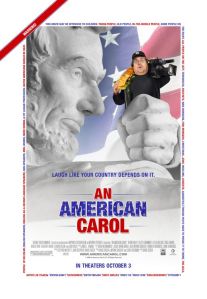 Being a conservative in Hollywood is like being a gay Republican – tough business. Director David Zucker has a notable history with comedy, having helmed Airplane!, the Naked Gun series, and the back half of the Scary Movies. He says that he converted to conservatism in the wake of 9/11, and Zucker actually wrote and directed a short for the 2004 Republican National Convention that was deemed too edgy for the Grand Old Party. Conservatives have also garnered the reputation for not having the best sense of humor, and Zucker’s An American Carol will do little to change this belief.
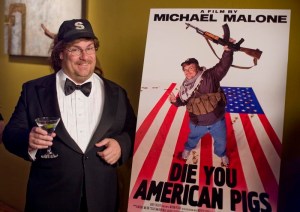
Michael Malone (Kevin Farley) is an egotistical, fat, liberal documentary filmmaker whose latest work is titled, “Die You American Pigs.” Catchy, ain’t it? Malone wants to abolish the Fourth of July (would we just skip to July 5th?) and plans to protest a Trace Adkins concert for the troops. A batch of inept Islamic terrorists want to bomb the concert and decide into tricking Malone into assisting their goal. He will score them media passes to get onstage at the concert venue. Following the Charles Dickens’ playbook, Malone is first visited by the spirit of his idol, John F. Kennedy (Chriss Anglin), who horrifies Malone by saying war is sometimes necessary (really, conservatives are trying to reclaim Kennedy?). Three spirits will visit him although he spends almost all of his time with the ghost of General Patton (Kelsey Grammer). The ghostly general takes Malone on a trip to see what the alternative versions of U.S. history had the country avoided war at all costs. Malone stays defiant until he meets up with the Angel of Death (also Trace Adkins, because?) and sees the error of his “America-hating” ways. I don’t want to spoil things too much but the movie ends with an expanded Trace Adkins concert saluting the brave men and women in the armed forces.
 Some from the opposing political viewpoints will find An American Carol to be infuriating. To those angry few I say get over it, because this movie is simply too lazy to get angry over. It barely reaches 77 minutes before the credits roll. Zucker and company tend to stretch their canvas too broadly, to the point that they aren’t exaggerating to lampoon but setting up cheap jokes. Michael Malone is fat. Michael Malone smells. Michael Malone falls down. Liberals hate America and want the terrorists to win. It’s so easy to write this material because there’s nothing topical or nuanced or even socially relevant. The movie beats reliable figures of conservative agita. When the movie tries to slam college professors as being dippy hippies brainwashing teens about the insurmountable ills of America, it just gets dumb (those people spend 10-15 years studying in a specialized academic field). There is no teeth to any of this satire because it’s all just recycled caricatures with the wit ground down. There isn’t anything of true satirical substance here. I don’t even get some of the satire, like the ACLU is depicted as a cluster of zombies with briefcases. What does that mean? Needless to say, the skewering of Arabs is mostly cartoonish and offensive. The flick constantly makes fun of the documentary art form, saying they are inferior to “real movies.” Because Michael Moore has an Oscar does that mean that the history of documentary film has to be slandered as being nothing more than transparent propaganda (at an awards ceremony, the top documentary is honored with the “Leni Riefenstahl Award”)? Marginalizing an entire art form seems rash, especially considering that Moore’s Fahrenheit 9/11 grossed over $220 million worldwide. As of this writing, An American Carol, a “real movie,” has grossed seven million and counting.
The film deals in distasteful absolutes. Every idea is presented crudely in black and white. By the film’s standards, being anti-war and anti-troops are inseparably linked. In my mind, and this might be crazy, but it seems to me that the most pro-troops one could be would be hoping for them all to return home alive and healthy. An American Carol attempts to justify the ongoing War in Iraq, though it conveniently only ever flashes to combat in Afghanistan, the war that a majority of the public agrees with. It makes a case that war is sometimes necessary, though it has to flash back to Hitler and World War II to find a morally justified military engagement that everyone can feel god about. I agree that war is sometimes a reasonable option, but the movie paints all pacifists as wimpy appeasers. George Washington (Jon Voight) even steps in at one point to argue for the necessity of war in reference to the War on Terror. Did the filmmakers forget that Washington spent great expense to keep the nation out of foreign wars in his two terms? Isn’t it also condescending and objectionable to have Washington say freedom of speech is misused when it goes against the government? I think the Founding Fathers would realize the importance of freedom of speech, including offensive speech. Isn’t it also somewhat ironic to use slave-owners as mouthpieces for the merits of freedom? An American Carol says that disagreement is the same as dissent; so refusing to support one’s government blindly during a time of war is traitorous. Criticism is not anti-American. It’s insulting to all rationale human beings. Zucker and crew make their case look just as myopic and dismissive as those they choose to ridicule.
The acting neither hinders nor helps the material. Farley is a game comedian but he cannot do much with such lightweight material. There are several celebrity cameos including James Woods, Dennis Hopper, Bill O’Reilly, Mary Hart, David Alan Grier, Gary Coleman, Leslie Nielsen, Zachary Levi, Kevin Sorbo, and Paris Hilton. When Zucker is calling favors into the likes of Paris Hilton, you know things cannot be solid.
 Here’s the problem. It’s harder to satirize from a conservative point of view. Conservatism believes that the status quo is best or that things were better back in the day. Liberalism believes that society can always improve, so a liberal point of view would tweak the present situation in order to call attention to remaining improvements. A conservative point of view would make fun of that possible change. This is the same reason why documentaries, like it or not, typically have a more progressive bent, and it’s because the filmmakers are presenting a case for change or outrage. Why would anyone devote himself or herself for years to create a film that says the world is peachy? Now I’m not saying that conservatism and humor are conflicting concepts, but it just makes it harder to be smarter. Making fun of Good Night, and Good Luck is not trying hard enough. How dare George Clooney make a film about the media cowering and failing to question our elected leaders and have it be applicable to today’s world.
The Zucker gag-a-minute spoof style doesn’t necessarily translate well to political satire. I wasn’t expecting much with An American Carol. When they exploit 9/11, taking Malone to the wreckage of the World Trade Center to make its case, well the movie stops being a satire and just implodes. It hits its tired targets with a sledgehammer. The satire is extremely lazy, the slapstick is dumb, and the movie specializes in being obnoxious, coloring the world in two extremes. This isn’t satire. This is just cheap and petty. Seriously, making fun of Michael Moore is like four years too late. Moore is a figure worthy of satire but the best that the movie can come up with is he’s fat and hates America? That he’s angry because he couldn’t get girls when he was younger and all those studly military recruits did? That’s not satire, that’s just excessive name-calling. An American Carol presents a new low for Zucker and I think even he knows it. On the DVD commentary track, Zucker, co-writer Lewis Friedman (BASEketball), and actor Kevin Farley basically lambaste the final product, often criticizing their own movie. The derisive commentary track is more enjoyable than the film itself.
Nate’s Grade: C-


 nathanzoebl
You must be logged in to post a comment.