Ghostbusters (2016)
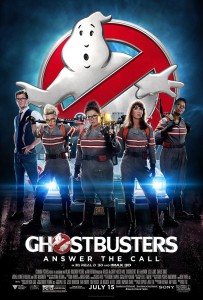 Growing up in the 80s, other kids had Transformers, or G.I. Joe, or He-Man, but I was a Ghostbusters kid. I fell in love with the 1984 original movie, slept below the poster for most of my childhood, and obsessively collected all of the action figures, watched with glee the animated TV series, and hold the world and its characters in a special personal place. The 1984 movie is such a perfect blend of buddy comedy, the supernatural, and action that nobody has really been able to fully replicate this special film alchemy as well since, including director Ivan Reitman (he tried in vain with Evolution). When the word broke that there was going to be a new Ghostbusters remake, some trepidation from fans could be expected. It’s sacred ground to many. Director Paul Feig (Bridesmaids) insisted that he wanted to have an all-female team of Ghostbusters, and that’s when the Internet lost its collective mind. The movie and its stars have been beset with hateful misogynistic (and, in the case of Leslie Jones, racist) harassment. The Internet didn’t want smelly girls playing with its toys. It became part of a larger war between feminists and retrograde men’s rights activist crybabies. Some people wanted it to be succeed just because of he gender of its leads, and others wanted it to fail for the very reasons. I just wanted a good Ghostbusters movie regardless of what bathroom the busters utilize.
Erin (Kristen Wiig) is an esteemed science academic trying to turn the page on her past. Her friend and fringe scientist Abby (Melissa McCarthy) has republished the book about paranormal they wrote together, which ruins Erin’s chance at tenure from her colleagues. Her ire is short-lived as Erin, Abby and her wacky nuclear scientist associate Jillian Holtzmann (Kate McKinnon) experience a real dead ghost. Their slime-filled encounter with the undead reawakens Erin’s love of the paranormal and the three of them join forces. Patti (Jones) is an MTA worker who leaves her job and joins the gals after her own experience with a ghost in the New York subway. Somebody is trying to open a portal between the living and the dead, and these Ghostbusters gotta bust some ghosts.
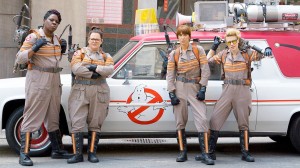 My initial apprehension melted away within the movie’s first twenty seconds when it already had me laugh out loud twice (“anti-Irish fence”). There’s a consistent genial absurdity that kept me engaged and entertained, and this is typified by the strong comic camaraderie of the four leads. I enjoyed spending time with these ladies and I enjoyed their interactions, so when scenes could creep up on overstaying their welcome from a pacing standpoint, something of a Feig staple, I gave them more leeway and felt my patience rewarded. I don’t know how to make it plainer than this: I am not a Leslie Jones fan and I liked Leslie Jones in this movie. I have found Jones to be all-too often on Saturday Night Live a one-note comic presence, always loud and brash and hitting the same joke again and again with little variation. With Ghostbusters, she actually plays a character, capable in her own right, and a straight man for the other characters. These women were goofy, gross (a queef joke within Holtzmann’s first appearance), but they also enjoyed one another’s company. There are internal conflicts, sure, but their enjoyment of working together, of displaying their know-how, of the joys of discovering the realm of the paranormal create a bond that helps seal the characters with the audience. Whatever the scenario, I was confident I would laugh from these characters, and I did.
There is a lightness to the movie that makes it all the more appealing, settling into pleasurable summer fare. This story is as much about the formation of the Ghostbusters as anything else. In the original film they just sort of have their ghost-busting gear all of a sudden. With the remake we watch the trial and error process of bringing all that tech to life. It’s a fun process to see their business from the ground floor, so to speak, and their fight for larger credibility. Murray himself even shows up as a paranormal debunker who scoffs at their claims. The ladies are the lovable underdogs in this world.
The real reason that Feig’s movies work is the interaction of his boisterous and often brilliant casts, and Ghostbusters is another example. Wiig and McCarthy have a natural chemistry together honed from Bridesmaids, and their back-and-forth banter will often find punch lines in odd places. McCarthy has always been her best under Feig’s direction (seriously go watch Spy if you haven’t). While Abby is a less outspoken character than we’re accustomed to from her, McCarthy still has a commanding presence and is the one who lassos the other funny characters back into a sustainable orbit (“You spell ‘science’ with a Y, and I don’t think you know that that’s wrong”). I’ve stated above my positive feelings on Jones. She brings a welcomed perspective to the team and often serves as the voice of the audience, like a moment where she looks inside a room filled with mannequins, calls it “nightmare stuff,” and wisely keeps walking. McKinnon is the true breakout star, going for broke in a deadpan, anarchic silliness that is Murray-esque. She also displays a funky, near pansexual sense of excitement with the world around her. She licks the radioactive barrels of her proton pack in jubilation. McKinnon is a constant source of mirth in the movie and has some of the best one-liners (“It’s 2040. Our president is a plant!”). Another breakout might be Chris Hemsworth in comedy. His dimwitted and inept receptionist is perhaps too dumb to even function. Hemsworth just commits to his character’s straight-faced stupidity and it produces big laughs.
Not everything in the movie works as well together as the ensemble. The movie’s tone takes a giant leap once the third act commences with its apocalyptic ghost showdowns. You can sense that Feig isn’t nearly as passionate about action heroics and CGI. Example: the movie sets up a large-scale dance sequence and we never see it until the scene appears during the end credits. That seems like a waste. The character arc between Abby and Erin isn’t quite as developed as the movie needs for the emotional re-connection at the very end to hit. As much as I loved McKinnon in the movie, her character is more a collection of quirks than a person. The cameos from the original cast are mostly awful and kill amusement. Watching Dan Akroyd as a cab driver say he “ain’t afraid of no ghosts” made me roll my eyes and wish I could delete this from my memory. The less obvious nods are better fan service, like a character referencing “mass hysteria” or Erin frantically pressing her body against a restaurant’s large glass window. The Stay Puft marshmallow man as a parade float is a nice touch, though. The main villain is feeble but I can see how a dude with a grievous sense of entitlement could itself be a feminist statement on the hostility that women face in today’s world. There are some logical consistency issues when the busters go from trapping ghosts to shooting them and blowing them up, but it wasn’t enough to derail my sense of fun. The worst thing about this Ghostbusters is the new theme song from Fall Out Boy and Missy Elliot.
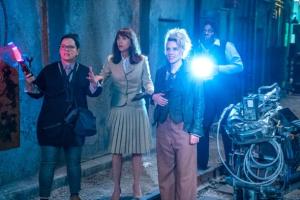 Is the new Ghostbusters a significant step in terms of feminism or is it overblown as some critics contend? The topic is unavoidable given the spirited furor over this remake; it has the most disliked trailer in YouTube history, though to be fair that was not a good trailer. First I’ll acknowledge that the world doesn’t need the opinion of a heterosexual white male on the topic of inclusion, but I’d like to say that there is something about positive representation. It’s the same reason I approve of Sulu being gay in the newest Star Trek. It’s not for me to say what is and is not empowering for a group of people who often lack positive representation in media. Nor am I arguing that every representation of a group needs to be positive; that swings in a direction where well intentioned “protection” becomes condescending. People can be good. People can be bad. People can be brilliant. People can be dumb. No one pool of DNA has ownership over these human traits. However, the reality of Hollywood is that it is often a poor representation of diversity. It is because of this that I say Ghostbusters deserves some praise for portraying a plot around four women that doesn’t involve boyfriends, weddings, marriages, pregnancies, any sort of romantic coupling, and doesn’t pit them against one another. This is an action movie with a female ensemble, three of whom are in their 40s, and all of whom don’t exactly fit with Hollywood’s standard conception of the attractive female lead. They don’t dress provocatively for the male gaze (the default setting for “strong heroine” in Hollywood is often “sexy deadly”). They don’t make fun of one another’s body types. They stand up for one another when people in power attack. They love what they do. I think there will be a swath of the public that recognizes themselves on screen, maybe for the first time, and I think there is genuine merit to this.
Somewhere amidst all the hype and hate, the new Ghostbusters emerges as a pleasant and enjoyably silly summer comedy. Feig’s movie pays homage to the original, including borrowing many of the general plot beats Force Awakens-style, but steps out onto its own territory. The 2016 Ghostbusters is not slavish to the original but recreates what made it work, a strong core group that meets the experimental and outlandish with droll irony. I think I laughed more with the 2016 Ghostbusters than the 1984 Ghostbusters. It has some flaws and some pacing issues but I was enjoying these characters so much to mind. As a lifelong Ghostbusters fan, I would gladly watch a sequel with these characters and this world once more. This won’t replace the fond feelings I have for the original, nor was it ever supposed to. This all-female Ghostbusters doesn’t take away what fans have loved. It simply adds another chapter with a new batch of entertaining characters, and if a part of the audience can better imagine themselves strapping on the proton packs and going along for the ride, then I don’t see what the harm lies with representation.
Nate’s Grade: B
Share this:

The Shallows (2016)
 Let me take a moment to dispel an expectation amplified by the movie’s first trailer: The Shallows is not the Blake Lively Butt movie you may have imagined. It would not be uncommon for this kind of setup to indulge in the forays of exploitation cinema, but aside from a few shots of Lively on her surfboard, The Shallows is surprisingly free of anything that would constitute leering T&A. Lively even wears her swimming vest to stay warm for the far majority of the movie. I cite this because I want to congratulate the movie on its accomplishments but also assure those wary from the trailer that The Shallows is much more than a tawdry genre movie with a bikini-clad blonde in sexy peril.
After losing her mother to cancer, Nancy (Lively) drops out of school and runs off to Mexico to retreat from her cruel reality. She finds a hidden beach few others know about but was a special place to her dearly departed mother. Nancy takes her surfboard out and happily soaks up the beautiful scenery. Her respite from reality is broken when a shark bites her in her thigh. Panicked, she finds refuge on a small rock sticking out of the water, though vulnerable to high tides. Nancy has to use all her strength and wits to observe the shark and her surroundings and make an escape before her injury gets too bad.
 The Shallows is an excellently paced and plotted survival thriller that keeps its audience involved from the start. I greatly enjoy survival thrillers that think step-by-step with the characters in their on screen predicaments, and every move made in The Shallows follows a logical progression that is intellectually satisfying. It helps that Nancy is a med school dropout and thinks through how best to keep herself alive with the tools that she has. She uses a pair of earrings as sutures. She uses her swimming vest as a tourniquet. She uses her watch to time the seconds it takes for the shark to swim in a perimeter. She is a smart and able heroine who assesses the situation in a manner that makes her a strong protagonist we root for until the very end. It’s also a smart device to have her calmly narrate her desperate medical improvisations as if she were treating a patient, a role-playing exercise meant to make her more objective and to ease her fear. It also provides a credible reason for Nancy to talk out loud. There’s also a seagull that Nancy bonds with, an injured bird marooned on the same small strip of rock. The bird deserves second billing as it has more screen time than any other human short of Lively. It’s not exactly a Wilson-kind of relationship necessity but if you’re like me you’ll feel enough bouts of dread and distress whenever that dumb bird is placed in dangerous scenarios.
Screenwriter Anthony Jawswinski (Kristy) makes every part of his story in play, and he even provides acceptable answers when plot holes do seem to appear. Take for instance my biggest initial question: why is this shark so obsessed with Nancy when it has a massive whale carcass to feast upon? I have a similar complain in all sorts of movies where the predator gives up the larger meal for the possibility of the smaller meal (the new King Kong and Star Trek both come to mind). Why give up a guaranteed food source? I could successfully ignore this plot hole for the most part since it’s essential to the conflict of human vs. shark, and then the script produces an answer. She’s in its feeding ground; this isn’t about food, this is about territory. That’s fair. I felt a similar quibble when this one seagull never flew away from Nancy’s rock. It makes sense to give her a companion to at least allow some one-way dialogue. Then it’s revealed the bird as a separated shoulder and is flightless, stranded too like its new friend. This presents a mini-goal for Nancy to accomplish and provides an accomplishment to carry her over. The only plot hole that stuck was Nancy explaining she’d just hail an Uber to get home from this secret beach in Mexico. I don’t think hey have many drivers in the area, lady. I was impressed with Jawswinski’s ability to develop his conflicts and utilize his surroundings. Every item introduced in this small location will be used at some point. Making use of previously introduced materials produces a string of payoffs, ensuring more fun.
 The technical elements are stunning, adding extra impact to the well-crafted suspense. Director Jaume Collett-Sera (Non-Stop, Run All Night) really draws out the tension, letting an audience simmer in discomfort. I know a movie has me when I start nervously tapping my leg, anticipating something bad at any moment. I was tapping often with The Shallows. The initial first strike is chaotic and frightening, leaving Nancy the morbid option of climbing atop a rotting whale body for momentary safety. Then there’s timing the shark’s laps to determine how much time she has retrieving floating items from her rock. We’re given the setup and Collett-Sera nicely goes from there. Even the requisite “chatting with the family” scene meant to impart enough exposition for our character’s starting point is given some flash thanks to onscreen graphics. The cinematography is absolutely gorgeous, especially the prolonged underwater sequences. If it wasn’t for the perturbed killer shark this could work as a vacation ad for this Mexican beach (it was really filmed in Australia). The editing, the music, the special effects, it all blends seamlessly together to construct a thrilling and stylish summer movie.
I’ll admit that there was a long dry spell for Lively after her mesmerizing turn in 2010’s The Town, enough so that I wondered if she was just coasting for good. Then with last year’s underrated Age of Adaline she reminded me there’s a capable actress here. It’s a one-woman show and Lively does a terrific job of anchoring her character while playing to all the shrieks and startles of the genre requirements. Her depleted mental and physical state is effectively communicated and her surge of purpose in Act Three is infectious. Her tearful “final message” in case she didn’t make it had me almost dabbing my eyes. It’s heartfelt and sorrowful without being too corny. There is an actual character here and a performance that treats her seriously and not merely as a tasty afterthought. There are far worse people in Hollywood to be stuck on a rock with than Bake Lively.
In a summer of disappointments, I’ll gladly take the simple pleasures of a contained thriller that’s as well developed, exciting, and as satisfying as The Shallows. It’s smart, often suspenseful, and boasting great technical accolades to make this harrowing survival drama all the more immersive and enjoyable. There is an escalation of tension and director Collett-Sera keeps the audience oriented throughout the terror so we know exactly what the stakes are of every life and death decision. It taps into a primal fear of humans versus Mother Nature in a way that feels smothering. Lively anchors the film and provides a thinking heroine who can also get the job done when the action calls upon her. The ending confrontation gets a little extreme and curiously vindictive for an animal, but by that point I was enjoying the movie far too much to argue. The Shallows isn’t too deep but it’s the kind of slickly produced and developed B-movie that I’ll happily indulge.
Nate’s Grade: B+
Share this:

Mike and Dave Need Wedding Dates (2016)
 Loose in narrative and derivative in nature, Mike and Dave Need Wedding Dates is a raunchy comedy that entertains thanks to the comedy interplay of its four leads. The “inspired by a true story” tale follows two rowdy screw-up bros, Mike (Adam Devine) and Dave (Zac Efron), who are given an ultimatum by their frustrated family: bring dates to their little sister’s wedding in Hawaii or don’t come at all. The guys’ online ad goes viral and two down-on-their-luck party girls, Alice (Anna Kendrick) and Tatiana (Aubrey Plaza), answer the call, posing as “nice girls” for a free tropical vacation. What follows is a comically episodic series of hit-or-miss set pieces, and yet what really shines is the energy between the foursome and the unexpected jokes. Kendrick and Efron, playing a very similar part from Neighbors, are positioned as more straight foils to the loud, obnoxious Plaza and Devine, though every member gets a chance to shine. Special mention must go to actress Sugar Lynn Beard, as the much beset bride, and her deft physical comedy skills. Mike and Dave is a movie that had me laughing fairly consistently and was mellow enough not to grate when it dipped into its fleeting dramatic portions. There are plenty of Neighbors vibes with the movie, not just from Efron’s efforts but also because this movie shares the same writers. It’s not quite as well developed nor are the characters as fleshed out. I’d rate Mike and Dave a small notch below Neighbors 2; it’s fun and consistently funny though hardly memorable. Something I found interesting, and I may be alone in the universe, is that all of the female nudity in Mike and Dave is played for laughs instead of titillation. Usually male nudity is the one played for laughs and discomfort. If this one small step toward progress, let the acceptably lowbrow Mike and Dave Need Wedding Dates exist as a footnote of history.
Nate’s Grade: B
Share this:

Free State of Jones (2016)
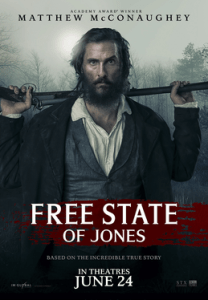 Well meaning and somberly recreated, Free State of Jones is a historical drama that wants to illuminate the story of Newton Knight (Matthew McConaughey) who deserted from the Confederate army and seceded from the very people who seceded from the United States. Knight and the people of Jones county Mississippi declared themselves independent and awaited the consequences. At first the Confederate army is annoyed, but as armed skirmishes increase and Knight’s team swells with poor farmers and runaway slaves, garnering Robin Hood-esque folk hero status, you’re expecting an escalating level of force that will doom Newton. We’ve seen this kind of historical drama before where men (usually men) of courage and politics ahead of their time are stamped out by the forces of oppression and we then celebrate their noble sacrifice. I kept waiting for Jones to go this route, and then (slight historical spoilers) the Civil War ends and instead the last half hour is an episodic history tour that includes the rise of the KKK, registering freed black men for voting, and early voter suppression acts. There is also a storyline strewn throughout that takes place in a 1940s Mississippi courtroom. At first you’re left scratching your head about the flash forwards, and then the connections come to bear. We’re watching Knight’s (great?) grandson and his legal troubles because the courts don’t know whether he’s the byproduct of Newton’s first wife (Kerri Russell), who left him, or his common law second wife (Gugu Mbatha-Raw), a former slave. It’s a storyline that just doesn’t really gel with the movie as a whole and really only serves to remind you that 100 years later Mississippi was still a pretty terrible place to live. Free State of Jones’ failure is that it doesn’t make this slice of history emotionally engaging. We don’t get a strong sense of whom Newton is as a person except for his 99% rabble rousing. His relationship with Mbatha-Raw’s character is the most engaging part of the film given its inherent conflict, and I’ll credit writer/director Gary Ross (Seabiscuit) with how restrained he is about dealing with her sexual abuse from slavery. The relationship is treated very tenderly and Mbatha-Raw aces her scenes. Also warning to dog lovers: there are several sequences of violence against man’s best friend that will be hard to watch. Free State of Jones works better as a history lesson rather than as a fully formed movie.
Nate’s Grade: C+
Share this:

The Purge: Election Year (2016)
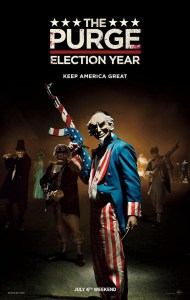 What once seemed like a premise fit for ridicule has become a franchise I actively look forward to now and swallow whole any incredulity. The Purge: Election Year is something of a lateral move from its predecessor, Anarchy, as it’s not an improvement but it’s still a fun and thrilling entry that provides just enough satisfying gonzo political commentary to temper its action. Finally with the second movie I got the Purge movie I wanted, experiencing the event itself outdoors, and Election Year continues this trend. We follow a small group of minority characters trying to survive the night, escaping from one location to another as they encounter a menagerie of weird, murderous citizens trying to make America great again. A presidential candidate (Elizabeth Mitchell) wants to do away with the barbarous Purge practice, and so this makes her a top target during that 12-hour free-for-all. Her head of security, and lone source of protection after an ambush, is played by Frank Grillio, returning from Anarchy and reminding you early and often just what a great action hero he can be. I enjoyed the ongoing shaping and texture of writer/director James DeMonaco’s kill crazy world, whether it was “murder tourists” coming over to America to experience consequences-free killing, the idea of a religious ceremony deifying purging, and even stuff I know is pure trailer candy, like an all-girl gang dressed in creepy masks, princess dresses, and chainsaws. There is some seriously unsettling imagery and moments, though the presence of a white supremacist hit squad dilutes some of the film’s tension simply by being a constant antagonist chasing down our heroes. There aren’t as many new set pieces to further illuminate the depravity of this world as there was with Anarchy. Still, there’s more than enough nasty bite in this franchise. How is this franchise not been turned into an open world survival video game yet? I wonder why everybody just automatically wants to murder during the Purge. I would just probably cheat on my taxes (don’t audit me IRS for this statement!).
Nate’s Grade: B
Share this:

Swiss Army Man (2016)
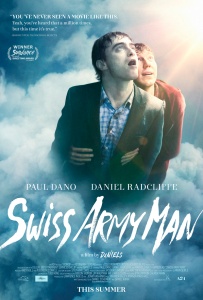 Swiss Army Man shouldn’t work as a movie, and in fact it will only work for a narrow swath of the world’s audience. There were plenty of walkouts during its Sundance premiere. The triumphant riding of a powerfully flatulent corpse in the film’s opening ten minutes should seal the movie’s fate. How does a movie survive such a juvenile, taste-obliterating moment, and one that is meant as an introduction to the film? Amazingly, stupendously, Swiss Army Man delicately walks that narrow tonal path and succeeds wildly, rapturously, and produces the rarest commodity in Hollywood, something daringly different and excitingly new. I fully anticipate that sizeable portions of readers are going to have an immediate and repellent response from just reading the plot synopsis, and I can’t blame them. I will do my best to try and explain why the movie worked so well even if I know this will be a fool’s errand for many, but if I can convince one more human soul to give Swiss Army Man a chance, then I’ve done the Lord’s work.
Hank (Paul Dano) is stranded on a desert island and about to hang himself when a dead body (Daniel Radcliffe) washes ashore. Unfazed, Hank is still determined to end his life, that is, until he can no longer ignore the farting of the body. That’s when he gets an idea and uses the power of the farting corpse to ride back to the mainland. Hank drags the corpse with him finding unique benefits, like his retention of drinkable rainwater. He’s still stranded and it’s at this point that Manny, the name he gives the corpse, begins speaking and inquiring about the world and what it means to be human.
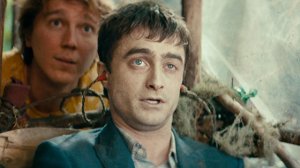 Swiss Army Man is a disarming buddy comedy that weirdly yet miraculously deepens as it goes, becoming a genuine relationship drama that touches on the profound and philosophical. For the first act, the movie is an unconventional survival drama with Hank finding peculiar yet helpful uses with his savior, the dead corpse. It’s a guy lugging around a dead body at the end of the day. I was wondering if this was really a story that was more suited as a short and didn’t have the substance to merit a feature-length runtime, and that’s when the magic realism steps up and when Manny comes into focus. This is easily one of the most oddball buddy comedies ever. Manny is an innocent, a proverbial babe in the woods, and doesn’t know much about himself and the world, and Hank becomes his teacher. Through this process he’s forced to examine his own life from an altogether different perspective and actually starts to vocalize and come to grips with his own life’s shortcomings, insecurities, and frustrations. It’s through Manny that Hank is able to open up and examine what it means to be human. Their interaction becomes a truly rewarding and emotionally honest buddy film where one of them just happens to be a talking corpse that farts a lot. Manny wants to learn about the world and to feel what it means to be alive, and it’s this new path that emerges that gives the film a new life.
You would expect something this strange to be drenched in irony or pushing the audience to laugh at the characters, but you would be completely wrong. Swiss Army Man is one of the most earnest movies you will ever see. It is completely genuine, heartfelt, sincere in every crazy detail, and it’s what gives the movie its emotional resonance. It treats the relationship between Hank and Manny with credibility. It’s a movie about celebrating and claiming ones weirdness, told from a movie that is proudly offbeat. Hank feels left out by normal social interactions. He’s the typically withdrawn and awkward Dano character we’ve come to expect from his catalogue of films; however, rarely has he seemed this artfully articulated. He’s a man who has some deep-seeded neuroses and fears, including farting aloud in public, and he’s using his ongoing experiences with Manny to exorcise some of these past failings, to become the determined, self-actualized man he wants to be. There’s a touching part where Hank talks about the poor relationship with his father; the two have signed up for one another to get birthday e-cards via email. That’s the extent of their connection at this point, and yet Hank remarks that even if he were to die his father would still get a birthday card from him in perpetuity. It’s a small little thing but it hits and makes one think about the impact and legacy we’ll have after we’re gone for good. Are we more than just an occasional birthday card? The fact that the movie utilizes a climax that incorporates farting in public as an emotional catharsis is amazing, but what’s even more amazing is that this moment is completely earned and gratifying.
Another aspect of Swiss Army Man that kept me specifically amused is the clever use of ambiguity. As the fantastical plays out with even-keeled realism, it’s easy and expected to believe that much of what we are witnessing is all in the mind of Hank. He’s projecting his needs and hopes onto this analogue for a friend that also represents himself. That’s why Hank uses Manny to relive personal experiences and to try and get them right. Then the third act comes along and causes you to question even more, putting the behavior of Hank into a muddier realm that makes you wonder if he’s this innocent wounded heart we had come to know previously. Then there’s Hank’s fixation over the pretty girl (Mary Elizabeth Winstead) he gravitated to on his bus rides. He looks to her as a goal, something he can return to once finally rescued and returned home. As he plays out his brief experiences with her, dressed as her, with Manny in the position of Hank, a faux courtship ensues. Hank, as her, and Manny, as stand-in for Hank, and it’s weird and wonderful and not afraid to accept the homoerotic qualities of its implications. This is a love story ultimately but a unique kind of love, and it’s up to the audience to determine what that means exactly. Is it romantic, bro-mantic, or simply a dude coming to terms with his own life in a very unusual therapeutic manner? The writer/directors The Daniels (Dan Kwan, Dan Scheinert) don’t outright tell you how to think or feel throughout any of this movie, which is a blessing. They present a complicated world with complicated and broken people doing their best to try and make their own sense, and they invite the audience along on this beguiling journey and just ask that they be patient and open-minded and then come to their own conclusions.
 The music is a wonderful element that is also another facet of the characters, layering in even more whimsy and character depth. The music is often accompanied by Radcliffe and Dano, their mutterings and ramblings becoming syncopated and layered into a soothing collage of sound. They’re providing their own soundtrack to the movie of their life. Early on Hank describes the music from Jurassic Park as the proper accompaniment for life’s big moments, with a little nestling of nostalgia as well. It’s especially enjoyable to listen to either of the guys break out into their rendition of the majestic Jurassic Park theme. It’s silly and sweet but it also gets at the psychological element of Hank being outside himself, seeing his life as a movie and he as its lead. He also hums what he remembers of “Cotton Eyed Joe,” which reappears throughout with comically incorrect and changing lyrics. The music is another reflection of the characters and it imbues the scenes with an extra sense of whimsy that helps to maintain its magic realism tone.
Radcliffe (Harry Potter and the… everything) and Dano (Love and Mercy) are terrific together and Radcliffe gives a tour de force physical performance. The way he’s able to contort his body, malign his posture, make use of stilted facial expressions is amazing. This goes leagues beyond the simple slapstick of Weekend at Bernie’s. The way he’s able to convey a character and a performance through this crazy decaying prism. Manny wants to help people, is eager to learn, and it makes his character so endearing, and then you remember he’s a corpse who might just be a figment of Hank’s diseased imagination. Radcliffe completely lets go of vanity and delivers one of the best performances of the year. Dano is in more familiar territory but shines again, serving as a dry comic foil for Radcliffe. The two of them form a highly entertaining and winning buddy team.
Swiss Army Man is a unique film experience and one that shouldn’t work. It’s filled with juvenile body humor. Its key supporting role is a dead body. It’s about a guy who may or may not be a stalker living in a fantasy world in his own head. This should not be, and yet like Manny himself, miraculously it has been birthed into existence and we are better for it. Every time it feels like the movie is heading for a more conventional direction that will weigh it down, be it a love triangle or some slapdash “he was dead the whole time” twist ending, it calmly steers away. This is a wonderfully humane, touching, earnest, and emotionally affecting movie, one that, yes, also involves farting. The body humor stuff is a reflection over confronting what we feel uncomfortable with and why that is, what social conventions tell us is in poor taste, tell us to box ourselves in and play by the rules. Here is a movie that gleefully plays by its own rules. It’s not going to be for everyone but if it’s for you, like me, there might not be much else that can rival its cinematic highs. Even if you think you will hate this movie, see it. See it just to have seen one of the strangest and most beguiling movies of the modern era. See it and judge for yourself. I’m still awed at how life affirming and profound a movie with a farting corpse can be. Swiss Army Man is a labor of love, an explosion of feeling, and a declaration to stay weird.
Nate’s Grade: A
Share this:

The Conjuring 2 (2016)
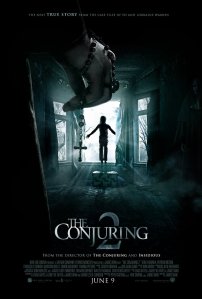 Horror is one genre where sequels rarely if ever satisfy. Usually the repetition is mind numbing and what was once scary has been eradicated. The true signs of great horror is the dread of what’s coming next, and to this end James Wan has shown tremendous skill at playing an audience and their fears. The Conjuring 2 isn’t quite the thrilling success that its predecessor was but it still upholds the best parts of what made the first movie frightening. We follow the Warrens once more, the husband and wife paranormal investigators, and this time to England where a malevolent spirit is haunting a family. One of the few miscues is delaying the meeting of the Warrens with the beleaguered family to almost an hour, pushing the running time to a needlessly overblown 133 minutes. The movie seems to be stretching out the ghost set pieces. Fortunately, Wan knows exactly how to build tension and let it simmer. The demon nun imagery is effectively unsettling, and there’s a brilliant sequence where Mrs. Warren (Vera Farmiga) has to slowly pull a light cord, all while the portrait of the demon nun hangs visibly in the dark. It’s a small scene that explains in full the clever construction of the whole. It sets up the parameters, develops them, and then lets the audience dread what it knows is coming. These are not cheap scares or lame jump scares but genuinely earned terror within a carefully constructed atmosphere. It might not be as good as the first one but The Conjuring 2 is still plenty good, which by default makes it possibly one of the greatest horror sequels of all time. Let’s hope the demon nun spinoff goes better than Anabelle.
Nate’s Grade: B+
Share this:

The BFG (2016)
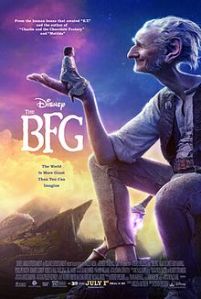 Roald Dahl is the kind of highly imaginative, inventive, and subversive children’s author that makes one wonder why more of his books don’t end up as movies. Charlie and the Chocolate Factory is the best known, and there’s Fantastic Mr. Fox, Matilda, James and the Giant Peach, and the rather spooky for kids 90s film, The Witches (it at least spooked me as a kid). For such a prolific author, it’s a little curious he has so few film credits. Steven Spielberg is one of the most successful directors of the modern era, so if anyone could wrangle Dahl’s wondrous worlds onto the big screen, he should. The BFG should be a transporting experience brought to vivid life with cutting-edge technology. All the special effects in the world, however, can’t solve a raft of nagging script problems that manage to take the fantastic and make it boring and predictable.
In 1980s London, little orphan Sophie (newcomer Ruby Barnhill) is abducted one night when she spots a giant blowing a mysterious trumpet into the windows of sleeping children. Fortunately for Sophie her captor is the BFG (Mark Rylance), which stands for Big Friendly giant, and he’s a vegetarian, having sworn off the bone-eating habits of his nastier giant peers. In Giant Country, the BFG collects and cultivates dream particles, concocting special mixtures that he then shares with sleeping children. The other giants bully and snidely dismiss the puny BFG. Sophie and the kindly BFG must work together to stop the larger giants from going back to London and dining on innocent children.
 The BFG has some pretty big friendly problems when it comes to its misshapen plot structure and its alarming lack of urgency or escalation. We’re all familiar, consciously or unconsciously, to the three-act story structure at this point, which is the principle formula for screenwriting. The BFG gets started pretty quickly, abducting Sophie and taking her to the land of giants by around the 15-minute mark, and from there the movie seems to take a leisurely stroll. I can’t really tell you where the act breaks are because the movie just sort of luxuriates in the meandering interaction between the BFG and his human pupil. There’s the initial threat that the other cannibalistic giants will discover her and this threat pops up in a handful of set pieces where Sophie has to constantly find new hiding places. Unfortunately, this threat never really magnifies or changes. She might get caught, and then she doesn’t. She might get caught, and then she doesn’t. There’s a repetition to this threat with our antagonists at no point getting more threatening. This is and a lack of a narrative motor make the movie feel rudderless, plodding from one moment to the next without a larger sense of direction. And then the third act comes (spoilers), presumably, when Sophie and the BFG travel back to London to try and recruit the Queen of England’s (Penelope Wilton) help. This sequence includes an extended breakfast that it punctuated by the memorable climax of watching the Queen fart and her little corgies fly around the room powered by their flatulence. It has to be the climax because what follows certainly doesn’t follow. Within five minutes, the BFG leads the Brits back to the land of giants and they restrain and airlift all the other giants in shockingly easy fashion. It’s a victory that feels relatively hollow because of its ease. These giants were never much of a threat to begin with, which is why we spent more time deliberating over dream ingredients than a retreat from man-eating colossuses.
Another aspect of Dahl’s novel that falls flat on screen is his verbal gymnastics and witticisms. It just doesn’t work with actors repeating the words without the text in front of your eyes. Listening to the BFG talk for any extended period of time is like being stuck with a crazy person muttering to him or herself. I would estimate that at least 60% of the BFG’s dialogue is folksy malapropisms. It’s not endearing and grows rather tiresome, especially with the unshakable stagnation of the movie’s plot. And so we get scene after scene of a big CGI creature talking verbal nonsense. Are children going to be entertained by any of this? Are they going to be engaged with the giant’s gibberish or will they find it one more impenetrable aspect of a movie and a story that seems to keep the audience at length? I couldn’t engage with the movie because it never gave me a chance to invest in what was happening. The BFG is a gentle soul and shouldn’t be bullied by his giant brethren, but that doesn’t mean I’m going to automatically love him. I didn’t.
 For a Spielberg movie this feels oddly absent his more charming and whimsical touches. There are scant moments where it feels like Spielberg is playing to his abilities in this fantasy motion capture world, like exploring the underwater land where the BFG gathers his dream ingredients, and in the narrow and messy escapes Sophie has not to be caught. It’s a shame that the creative highs of Spielberg in full imagination mode are too often absent the rest of the movie. He too feels like he’s coasting, allowing the technology and the fantasy setting to do the heavy lifting. The land of the giants is a bit too underwhelming as far as fantasy worlds go. It’s simply too recognizable except for slight peculiarities, like “snozcumbers.” It’s not an enchanting location and we’re not given enchanting characters, and with the little narrative momentum or escalating stakes. I experienced a lot more fun and whimsy from Spielberg’s other major mo-cap movie, the nearly forgotten 2011 Adventures of Tintin. The action sequences especially had such a lively sense of comic brio and imagination that was pure Spielberg. I get no such feeling from The BFG. If you told me that Robert Zemeckis had made this movie I wouldn’t have blinked. I don’t know if Spielberg was hoping to recapture that E.T. magic with screenwriter Melissa Mathison (who passed away in 2015) but this isn’t close.
I will credit the special effects department for the amount of work put into Rylance’s BFG visage, which looks eerily like the Oscar-winning actor. The range of the facial expressions is another sign that mo-cap performances are just as legitimate as live action flesh-and-blood performances. I can admire the technical feats of the character while not exactly feeling that much enjoyment from that character. The interaction between the computer elements and the real-life elements could be better, most bothersome with little Sophie interacting with the giant’s giant personal things.
I was left wondering whom The BFG is supposed to appeal to. I think kids and adults will be bored by its slow pace and stagnant, minimal stakes, weird and unengaging characters and their annoyingly impenetrable speech habits, and the overall lack of charm and wonder. It’s saying something significant when the most mesmerizing part of a fantasy movie is watching the Queen of England, her dogs, and a room full of her royal servants violently fart green clouds of noxious gas. That was the one moment in my screening where the kids in the room seemed to be awake. Otherwise the BFG character must have calmly put them to sleep with his prattling gibberish. It’s not an insufferable movie and there are fleeting moments of entertainment, but they drift away like a memory of a dream. There just isn’t enough going on in this movie to justify its near two-hour running time. Not enough conflict, not enough world exploration, not enough character bonding, not enough whimsy, and not enough entertainment. It feels too lightweight to matter and too dull to enchant. The BFG could have used more farts. That would be a sign of life.
Nate’s Grade: C+
Share this:

Independence Day: Resurgence (2016)
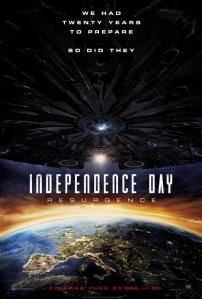 I can recall actively counting down the days until Independence Day was released in 1996, gobbling up every newspaper clipping and magazine article I could. I was a big fan of director Roland Emmerich’s Stargate, which is still a terrific movie, and I was eager to watch the end of the world, as we know it, in the privacy of my local theater. It was a blast, no pun intended, and one of the biggest box-office successes at the time. Surely there would be a sequel, especially after it helped launch Will Smith into another level of stardom. Flash forward twenty years, and here comes Independence Day: Resurgence, a sequel that misses what marked the original as escapist entertainment.
Twenty years later, human beings have been planning for the eventual return of their intergalactic invaders. Former president Whitmore (Bill Pullman) and CIA director David Levinson (Jeff Goldblum) have been trying to get the world prepared and studying our alien enemy. A psychic link is still formed from Whitmore’s brief bond in the first movie, and he keeps drawing mysterious symbols. Whitmore’s daughter, Patricia (Maika Munroe), is a former fighter pilot who works for the current president (Sela Ward). Patricia’s boyfriend and fellow fighter pilot, Jake Morrison (Liam Hemsworth), is stationed on the moon building a defense system. Then the aliens come back and pick up where they left off, annihilating Earth’s landmarks and population centers. It seems that their spaceship is going to suck out the Earth’s molten core, and by all accounts, that’s bad. Our ragtag group of characters must come together and overcome substantial odds once more to save the Earth from certain doom.
So where exactly did things go wrong? I’m not one to simply state that the filmmakers missed their window of making a quality sequel. While twenty years is a long time in between outings, it doesn’t mean that you will fail to come up with a compelling movie. Mad Max was 30 years between movies and this didn’t stop Fury Road from being a masterpiece. By most accounts, yes, there is certainly less of an appetite for an Independence Day sequel in 2016 than there would have been in 1998, but the first film is still fondly remembered and a worthy sequel would be welcomed regardless.
 I think one of the bigger causes to Resurgence not working is the fact that the rest of the moviegoing world has caught up when it comes to big screen spectacle, therefore spectacle by itself is not enough without a zeitgeist edge. In 1996, cutting-edge special effects-laden destruction on a global scale was reason enough to buy a ticket and the largest tub of popcorn. In the ensuring two decades, large-scale cataclysm has become commonplace on the big screen; just about every climax of a Marvel movie involves some world-devastating threat. What once quickened pulses has now become ho-hum. Emmerich himself has become a modern-day Irwin Allen since the first Independence Day, almost specifically focused on global disaster movies. I honestly don’t think there’s a better director working in Hollywood for that gig (his next movie is about the moon crashing into the Earth, so “familiar” territory). I think Emmerich’s skill and vision for big screen spectacle goes unheralded too often and he gets lumped in with empty visual stylists like Zack Snyder and Michael Bay. He’s better than that. However, the tide has turned, and audiences have become sated from empty spectacle. They need something more, or at least something compelling, and Resurgence struggles to achieve this. It feels like the aliens are back and they’re bigger, and that’s about it, folks.
Disaster movies are generally judged by their set pieces, and what is most surprising about Resurgence is that it really doesn’t have action set pieces as it does skirmishes. The movie is only two hours long, which seems like a rarity nowadays, but this is one of the few movies I think could have benefited from some extra breathing room. It feels too rushed, its internal logic often forcibly contrived, and this is evident most in its action sequences. A better term would be “skirmishes” because the sequences themselves are so curiously brief save for the climactic fight during the third act. We’ll get bursts of intensity or dread that comes to a head with violence, but then that’s it and the movie moves along. It’s usually mere moments of brief alien destruction. The action lacks proper development. One of the keys to great action sequences is naturally complicating and developing the events. Resurgence doesn’t even change gears. It provides exactly what you expect, and then it’s over, the surprise being how unsatisfying and short the unimaginative experience was for all parties. It’s a long wait until the third act where the alien queen comes outside to play. The movie shifts into a giant monster melee and it’s the one time where Resurgence feels most lively. It still follows a contrived logic (the Queen has a shield… now she doesn’t…) but I’ll credit the movie with at least saving the best for last and finally letting the action expand. I had enough fun with the final act of Resurgence that I was able to forgive some of its early transgressions.
The first Independence Day wasn’t by any means a cinematic milestone but it was fun and had a clean enough throughline. We spent the first hour in typical Emmerich fashion being introduced to the different characters and then watching the dispirit elements come together. The mystery of what was out there was intriguing and it became a step-by-step process of deducing how mankind should respond. When their hostile intent was revealed, it then became a learning experience as to how to fight back. Aerial dogfights won’t work. Nuclear weapons won’t work. It was a simplistic examination of the threat. While the solution of giving an alien operating system a virus is still a head-scratcher, at that point the movie had earned its ham-fisted solution because it had followed a logically satisfying path of discovery and response from the moment of first contact. Resurgence lacks any real internal logic. Things just sort of happen when the plot requires them and then don’t. If you’re establishing a science-fiction landscape, establishing the rules of what is possible and allowable is essential to the audience’s understanding and enjoyment. Otherwise it feels arbitrary, much like Judd Hirsch driving a school bus of children across the salt flats into danger. This literally happens in Resurgence.
Also fighting for time is a slew of new characters that are charisma-free and contribute little to nothing to the larger story. The biggest offender may be Dylan Hiller (Jessie T. Usher), the son of Will Smith’s character. What does Dylan offer as a character? His entire characterization is, and I kid you not, that he’s upset with Jake over a training accident. He punches Jake in the first act and then… he just sort of pilots ships and shoots things in the sky. That’s it. He doesn’t feel the burden of living up to his father’s reputation, or trying to make his own name for himself. He just has a quarrel to settle and does and then he still just sort of exists in the movie and the screenwriters were like, “Oh right, he’s still here. Well, have him fly something.” Jake and the rest of the young pilots don’t fare that much better as characters. Besides superficial distinguishing characteristics, they’re all variations on the same person. They’re a multi-ethnic collection of vacuous character placeholders; it’s like you took Randy Quaid’s kids from the first movie and made them on par with Smith and Goldblum. These bland characters inspire little love and are often boring with little investment. If the next movie started with them in a car and a giant pillar crushing it, I would not mourn their cinematic loss.
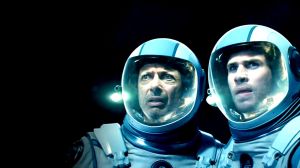 There are some familiar faces returning but none of them are able to compensate for the deficit of charisma and screen presence that is Will Smith. Goldblum is on autopilot and doing his stare off into the distance and talk deadly serious thing. Pullman shows up again as a warning of what was coming, though a superfluous one at that. The biggest screen presence from the first movie belongs to Brent Spiner (TV’s Star Trek) as the Area 51 scientist who conveniently has also been in a coma for twenty years. Some of his comic relief is rather labored and cheesy, but it’s at least something. Charlotte Gainsbourg (Nymphomaniac) collects a check as a psychiatrist who has little bearing other than to be Goldblum’s ex. The most interesting new character feels like he stepped out of a Street Fighter arcade game; he’s an African warlord (Deobia Oparei) who likes to use a pair of machetes to kill the aliens. “You have to get them from behind,” he keeps insisting, and I keep snickering. There’s also that Emmerich staple of an officious government weakling who comically grows a spine. It just so happens this part is played by one of the screenwriters of Resurgence, Nicolas Wright. He studied, apparently.
The best thing Resurgence has going for it is the expansive world building, one of the few aspects of the movie that shows actual thought and care. This is one of the few movies I can recall where people actually try and use the technology of their defeated invaders. Rather than just throwing all those dead spaceships on a junk pile, mankind has decided to backwards engineer technological advancements. As a result, the contemporary feels like a sci-fi hybrid of humanity and the alien technology. It’s interesting to see what advancements have been made and how these have been integrated into regular society. I do question why we only have one defensive weapon/colony on the moon when there’s also one as far as Saturn. I wanted a bit more of a sociological examination on what life post-War of 1996 means. Life would be so fundamentally altered by the realization we are not alone in the universe, and not only that but that we need to play catch up fast to survive. The assumption would be that they will be back. The threat of annihilation unifies the world but what are those consequences? What are the consequences of living in a permanent military state of readiness and anxiety, wondering is it all going to be enough?
If you have fond feelings for the original Independence Day, there may be enough good will with the sequel to appease your demands, though probably only barely. Resurgence suffers from CGI-heavy spectacle that has long lost its appeal without supplying helpful additions like characters to care about, exciting action sequences that develop and impact the plot, meaningful plot turns, and a story that follows some form of logic. It’s not a disaster in all senses of the word. In a summer that’s already building a reputation for its mediocrity, I think there may be enough that Independence Day: Resurgence has to offer that select moviegoers will walk away feeling momentary entertainment. It’s not that the first film was intellectually rigorous sci-fi, but it went about its destructive business with a satisfying precision. This movie all too often just feels like things happening, then not happening, and with characters that are there but without any compelling reason beyond survival. The end of the movie sets up an intended sequel and possible extended franchise of sequels with a larger galactic war against the alien invaders. It’s both hopeful and naïve, dangling the promise of another tantalizing humans vs. aliens throwdown. It’s also a bit aggravating because the premise of the hypothetical sequel (I’m going on record saying it won’t come to fruition for another 20 years) is much better than the “they came back again” sequel we get with Resurgence. Don’t make me pay my money and then tease me with a better movie down the road. Nothing should be taken for granted. Independence Day: Resurgence takes too much for granted, and that’s likely why this resurgence will stop with one entry.
Nate’s Grade: C
Share this:

Now You See Me 2 (2016)
 The first Now You See Me was a pleasant surprise that took a simple concept (magician heist) and injected enough sly fun, style, and humor and made a memorable action thriller. As success demands, a sequel was commanded, but I had hopes considering the blueprint of its success could be repeated because those core elements were strong. We all love heist movies, we all love to be fooled, we all love to watch a smart people befuddle those in power, and the reveals made it even more enjoyable. I wasn’t expecting Now You See Me 2 to drop much of what made the first film appealing and shamble through its set pieces with a disinterested sense of sequel duty. The magic is gone.
The Four Horsemen magic act (Jessie Eisenberg, Woody Harrelson, Dave Franco, Lizzy Caplan) has made quite a few enemies. They’re a group that attacks the fraud, exploitation, and greed of those rich and powerful who feel untouchable. This merry band of Robin Hoods is transported against their will to Macau, China by Walter Mabry (Daniel Radcliffe). Walter lost a lot of money from the Horsemen’s antics in the first film and demands they steal a super microchip that will allow him to erase his identity and stay private permanently. Meanwhile, the Horsemen’s handler, Agent Dylan Rhodes (Mark Ruffalo), is blackmailed by famous and currently incarcerated Thaddeus Bradley (Morgan Freeman). Bradley has a score to settle with the Horsemen and uses Rhodes to escape from prison. All forces are headed to Macau and much more will be learned of the Horsemen’s behind-the-scene organization, The Eye.
 It feels like the filmmakers aren’t even trying to keep one foot in reality this time. It’s not like the first Now You See Me was a deeply grounded movie but it took pains to at least offer varying explanations for how these illusions were accomplished. Some of the answers were clever and some were preposterous, but at least they tried to show you their work, which made the Horsemen even cleverer, in my book. Understanding the preparation for the illusions and the execution of them adds to their impressive aura. The characters in the sequel don’t even attempt to explain the far majority of their tricks, and it’s simply not as fun. The opening job is a fun refresher because we see the different characters working together but also because we can see how they’re getting away with their shenanigans. As the movie continues, those magic acts get bigger and bigger and more ludicrous and harder to explain and then the movie just stops trying to explain. At this point magic might as well be real and the Horsemen are wizards. There’s suspension of belief and then there’s simply obliterating all connections to reality. When Eisenberg can control the direction of rain itself without any explanation, it cheapens the thrill. Because if there isn’t some level of limitations, requiring the tricks to be based in reality, then the on screen efforts lose their appeal because it doesn’t matter. It’s like haphazardly just writing, “The Horsemen do some magic junk and get away.” It’s just not as satisfying when it feels like the trick is ultimately on the audience.
Another complaint I have is that the scattered script seems littered with missed opportunities. One of the bigger misses that comes to mind is Harrelson’s twin brother, an obvious Matthew McConaughey impression from his True Detective costar. The character isn’t nearly as funny as Harrelson or the producers believe. He isn’t particularly memorable or necessary to the plot at all, but that’s not even his biggest offense. In a movie about magicians playing sleight-of-hand trickery, how in the world do we not have a switcheroo with the twins? That would justify his existence for the plot. I was shocked this never happened because it seemed so obvious. Why is he a twin? What does being a brother to Harrelson have to do with anything related to the plot? The script also gets overcrowded with antagonists, introducing Radcliffe and then bringing back Michael Caine and Morgan Freeman. The characters don’t so much compete with one another as they operate in separate spheres until a “twist” reveals more about their connections. Their agendas are too opaque. Radcliffe wants them to steal a super microchip so he can fully be “off the grid.” A man of his means shouldn’t have a problem with this. It’s not like he’s hiding out from the law for some kind of corporate espionage. It’s a convoluted reason to bring the Horsemen to his hiding spot in Macau. It’s just one in a long line of ideas that never feel fully developed. Even the magic set pieces don’t feel as fun. Seriously, one of the climactic magic set pieces is a human game of three-card Monty.
 Director John M. Chu (G.I. Joe: Retaliation, Jem and the Holograms) has worked with action before and certainly knows his way around choreography, but he feels too hesitant this time. The action scenes are rare and the chase sequences are muted. Outside of the tricks, there isn’t a standout action scene in the whole movie. In the first film we had a pretty fun magic fight that was wild and surprising and loaded with small payoffs. In this movie we have a motorcycle chase that plays out as expected. We have a foot chase that plays out as expected. You have professional illusionists at your disposal; action set pieces should not play out as expected. The most fun sequence is fairly straightforward but easily the best developed, and that’s the Mission: Impossible-esque heist of the microchip that is outfitted onto a playing card. It’s also clearly the most visually inventive sequence as the Horsemen play a game of keep away and the camera literally at times tumbles into their clothes. I think what makes this easily the best sequence in the movie is because it’s moderately grounded, the stakes are explained, and the audience is in on the trick, enjoying all the flimflam obfuscation. It also means when there are complications to the plan the sequence generates suspense. When you don’t know what’s going on and don’t know when things are going wrong, or how they could go wrong, it’s hard to generate genuine suspense. Being involved in the action is much more fun.
The actors all seem on autopilot, falling back to the broader descriptions for their characters. Eisenberg is a smug and cocky. Harrelson is smooth and shrewd. Franco is awkward and insecure. Isla Fisher is replaced by the capable Lizzy Caplan (TV’s Masters of Sex) as the requisite Female Horsemen. She makes a good impression but part of it is that Capaln seems to be the only member allowed to be comedic. It feels like there are three straight guys to her comedy cut-up. She’s good but without variation it also starts to lose its appeal when only one character seems to be trying. Ruffalo (Spotlight) seems too often unrelated the Horsemen story as he discovers more info about his father. He’s the only character that actually has something of a storyline, though his playing of both sides and attempts to hide his role to the FBI is just another ludicrous element. I miss Melanie Laurent too.
Now You See Me 2 (how could this not be called Now You Don’t?) is a lackluster sequel that seems to have forgotten what made the first film the enjoyable caper that it was.
Nate’s Grade: C+


 nathanzoebl
You must be logged in to post a comment.