Hillary’s America: The Secret History of the Democratic Party (2016)
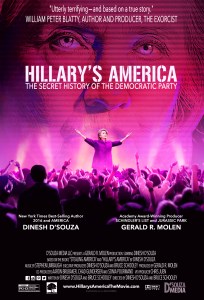 Conservative author and filmmaker Dinesh D’Souza is a man that has been uncharacteristically good to me, personally. He’s made two utterly abysmal political documentaries that are hatchet jobs and were my worst films of 2012 and 2014. However, the man has been a boon for me as far as my own exposure. My reviews for his 2012 and 2014 polemics exploded and became e-mail forwards. They were quoted in message boards, progressive websites, and all over. I still to this day have people that randomly message me to pat me on the back for my rational and methodical take-downs of this charlatan. I wouldn’t say I was looking forward to D’Souza’s next would-be documentary feature but I knew it would likely contend for the worst movie of that year and that I would profit from extra website hits and plaudits. Hillary’s America: The Secret History of the Democratic Party is the underwhelming Return of the Jedi of D’Souza’s trilogy of bad movies. They all exist in a galaxy far, far away from our own reality. Then again D’Souza has been catering to an alternate reality for the majority of his huckster career.
My first problem is that D’Souza tries to rewrite his own history (he has so much experience rewriting others’ history) and pretend that he’s a First Amendment victim instead of a man who knowingly violated federal campaign finance laws. He purposely donated $20,000 under a false name to skirt finance laws and lied about it to the FEC, and as a result was charged with a felony and served eight months in a halfway house. Even D’Souza said, “I knew that causing a campaign contribution to be made in the name of another was wrong and something the law forbids. I deeply regret my conduct.” However, in his own movie, his twists the facts to present himself as a free speech martyr facing a tyrannical president. “If you make a film criticizing the most powerful man in the world, “D’Souza intones with extra ominous relish, “Expect the empire to strike back.” I don’t think Obama needs to worry about a movie that made $30 million total. D’Souza’s deflecting his guilt as an act of imperial censorship and retribution, and not, you know, him committing a crime and pleading guilty. The fictional recreation of his halfway house experiences are resoundingly hilarious for how tone deaf yet ultra serious they are, as if D’Souza had to scrap for survival. What halfway house is also populated with murderers and rapists? I wish we had a scene of D’Souza giving himself a homemade tattoo from an electric toothbrush. His slimy misstatement of his own felonious failings sets the stage for his third cinematic expose that fails to advance a coherent, rhetorically sound case for his crackpot and disingenuous premises.
 Let’s tackle the man’s core argument and what gives his movie its subtitle: the secret history of the Democratic Party as one of blanket racism and oppression. D’Souza tries to make the leap that the Democratic Party is the biggest gang around, exploiting the vulnerable and naïve for nefarious, avaricious gain. He says the Democrats are planning to steal nothing less than American itself. His argument is that the Democrats have been conning the American public, and especially their contingent of minority and poor voters. He cites evidence that he feels is damning, though once again selectively removes context because it would undermine, or in many cases obliterate, his supposed point. D’Souza has to reach all the way back to the 1820s for his broadsides. Did you know that Andrew Jackson was responsible for the forced relocation of Native Americans, and, I hope you’re sitting down, that he was one of the first Democrats? Did you know that following the Civil War many Southerners resisted Reconstruction and joined the Ku Klux Klan and were Democrats? Did you know President Woodrow Wilson was such a fan of the 1915 movie Birth of a Nation, a film glamorizing the rise of the KKK, that he screened it at the White House? D’Souza feels like he’s stumbled upon his moral keystroke but he forgets that it wasn’t just the Democratic Party that was filled with racists during the nineteenth century and into the twentieth; the majority of America held racist views. To somehow suggest that those who registered as Republicans were immune from the casual racism of everyday society is preposterous. Case in point: at the time the Supreme Court rendered its verdict on the Loving case (tasteful movie coming soon), striking down miscegenation laws banning interracial marriage, a full three fourths of the American public disapproved. This was 1967, and the clear majority of the American public still held what could be charitably described as racially intolerant views. In the case of Birth of a Nation, an unquestionably repugnant movie, D’Souza is knowingly removing the fact that it was a groundbreaking piece of cinema and a global blockbuster. It wasn’t just President Wilson that enjoyed this newfangled moving picture, it was many, and it just so happened a majority of those people, Republican or Democrat, were racist.
D’Souza tries connecting the dots in a conspiratorial manner that demands painting mustaches on every former living Democrat just so they would have something to sufficiently twirl as they laugh maniacally. Jackson was apparently the progenitor of having slaves on plantations, as if this could be attributed to one person. D’Souza’s indictment of Jackson and abrupt empathy for the downtrodden Native Americans is in sharp contrast with his previous abhorrent documentary. In that movie, he argued that the Native Americans weren’t really doing much with their land anyway, that the pioneers were the ones who made it valuable, and that what happened to them should not be considered genocide. I don’t believe D’Souza’s phony crocodile tears over the Trail of Tears. If he’s going to decry Andrew Jackson for being a slave owner then why not the Founding Fathers as well? Why not George Washington? Because that would confuse his already confused argument. With D’Souza, the KKK wasn’t a grassroots organization of disaffected and angry Southern white men; no, it was a purposeful political arm of the Democratic Party. Wilson wasn’t just a fan of a popular movie; he and his cabinet were directly inspired to harass African-Americans. For him, the Democrats built ghettos, made sure to stuff them with immigrants, and wouldn’t allow them to leave. For him, Margaret Sanger wasn’t fighting for contraception for women’s health and equality but so she could stop black people from reproducing. For the record, Sanger spoke to whoever would listen to her cause, which did include the Klan at one point. For D’Souza, Planned Parenthood exists to wipe out minorities, and he even makes use of those undercover videos by conservative activists that got the activists charged with criminal activity, not Planned Parenthood, which was cleared for all outrageous charges. Everywhere he looks, D’Souza sees widespread conspiracy and the intent to do maximum harm. The shrill partisan attacks are amplified to the point that any points are muted. Not too many are going to defend Andrew Jackson to this day, but what about recent history, eh?
 It’s not long before you start to notice a hard cap on all of D’Souza’s historical anecdotes. They all seem to end just about the time of the signing of the 1964 Civil Rights Act, which is by no means a coincidence. When President Johnson signed the bill into law he said that the Democratic Party had likely lost the South for a generation. Almost sixty years later, I think he undershot that estimate. The party of Lincoln is no longer the party of Lincoln, judging by their policies and candidates. D’Souza has to reach back more than half a century to posit his case that the Democrats are the real party of racists. This line of argument is somewhat tainted with the 2016 Republican presidential nominee refuses to recant his excoriation of the exonerated Central Park Five, tells African-Americans they’re “living in hell,” and far too frequently retweets ugly messages from white supremacist groups. Which political history is more relevant to today, the actions of the last 30 years or over 200 years ago? The Republican Party doesn’t get a free pass because at one time certain members supported abolition and women’s suffrage. D’Souza even says, “As the South became less racist, they became more Republican.” Huh? The parties have held the same names for hundreds of years but their policies and platforms have shifted along with the nation and culture. To pretend that Democrats or Republicans today follow the exact same policies from hundreds of years prior is intellectually dishonest and thoroughly facile, which sums up the host of D’Souza’s feeble arguments.
D’Souza’s grandstanding and myopic personal crusade gets in the way of his larger message. You could easily construct a documentary about Hilary Clinton being unlikable or hard to trust. She is often her worst enemy and her penchant for secrecy can be reasonably unnerving. You can make an anti-Hillary doc without resorting to ad hominem attacks and worse. There are legitimate critiques over the Clinton Foundation and its lack of transparency, but D’Souza can’t help himself. He shouldn’t have to utilize bracingly absurd, offensive propaganda imagery like a young Hillary watching the bombs of the 1960s with unseemly fascination, the slow-motion horrors reflecting onto her youthful glasses, a fascination to her calculated expression. He shouldn’t have to resort to such incendiary charges like, “Now we know why Hillary let all those emergency Benghazi calls go. She couldn’t make a buck off of them.” Excuse me? She let Americans die because she couldn’t pad her wallet? “Hillary’s plan was to take over the institutions of government,” D’Souza intones, as if she was a Manchurian candidate who activated instead of a young political activist in law school. The main argument D’Souza musters against Hillary, well after 75 minutes of movie, is that her husband was a serial philanderer. In what may be the most outlandish accusation of the whole movie, D’Souza says that her husband’s infidelity is her fault and that “in many ways she orchestrated all of this.” Just take in that statement. It might take a while. Let it settle in. She “used his addiction to make him dependent on her.” Bill Clinton’s indiscretions have been well documented and are worth another examination in modern light, but this is new. And then this icky nugget took my breath away: “Bill, after all, is in a long line of Democratic ‘plantation owners’ who took power over women in their control.” We had earlier seen Andrew Jackson in bed with his slave, though again other Founding Fathers are left out of this charge, like Jefferson, because it would dilute the message. The level of projection and armchair psychology is staggering and often without coherent evidence.
The shady tactics and paranoid fear-mongering feel rather played out the third time around. Conservative boogeymen are thrown out there (Sanger, Alinsky, Daley, Chicago in general) but it feels like D’Souza cannot even be bothered to properly lambaste them. It’s like he’s checking the boxes of conservative agita and expecting that he doesn’t need to explain anything because of course Saul Alinsky was connected to Al Capone and ipso facto Hillary Clinton is a criminal. He sets them up and chiefly moves along, propelled by some other point that never fully materializes. He purposely blurs the line between archival footage and interview recordings and slanted fictional recreations. There’s a strange recreation where Obama’s father visits his classroom to present an African perspective on culture, including a spear and tales of killing lions. Why does the documentary even require a scene like this? D’Souza only deigns to say Obama learned how to “pitch” from his father. It’s an odious dog whistle to its core audience to remember that Obama is an “other.” There’s another strange moment when a fantasy Hillary leans into the ear of a dissatisfied man to whisper, “They are rich because they steal from you.” As the star of his trilogy of lunacy, D’Souza is the hysterically nonplussed face of his own madness. His interviews often set up his subjects with leaning questions and confirmation bias. It’s as productive as watching D’Souza interview himself, especially when there are perhaps only four interview subjects total, half of them partisans. D’Souza puts himself as the head of his own story of discovery as he wanders around and looks wide-eyed and forlorn over the symbols of America’s greatness, like a field of wheat he solemnly touches. It feels like D’Souza is going through the paces of what his audience is expecting and serves it up without mental taxation. The movie even ends on three straight musical performances, including one by D’Souza’s new wife, that sum up America’s greatness through stock footage montage of patriotism clichés.
 Hillary’s America wants to spare the nation at a critical moment in history, but D’Souza’s agitprop will only appeal to the converted or at least those viewers with an alarmingly low quotient for intellectual curiosity. “They can’t take America from us without our consent,” D’Souza rallies his crowd into mobilization (as a felon, he has lost his right to vote in the meantime). The reason I very much wanted to review this movie specifically today is because it’s Election Day and the country has been given a very stark choice. People talk about the deep divides in this country, and it’s men like D’Souza that are stirring those divisions, placating and agitating their audiences, and knowingly distorting facts and reality in a shameless attempt to milk money from the hapless. Here is a man who said Obama never truly lived the “black experience” because his mother was white. Here is a man who tried to mitigate the horrors of slavery in his previous documentary and termed it “theft of labor.” Here is a man who believes Christianity literally invented compassion. Here is a man who states that no Republicans owned slaves. He is not a man who tells truth to power but a man who willfully distorts the historical record in order to make people feel better about unhinged political takes that have no bearing in reality. It is people like D’Souza that have lead the way for the coronation of Donald Trump, and it should be people like D’Souza who are put to blame when that experiment crumbles. He couldn’t be an effective propagandist if he tried, and it really doesn’t feel like he’s even trying. Maybe at some level D’Souza is admitting defeat or at least sees the writing on the wall. He’s been on the wrong side of history and eventually history will judge him as well. Meanwhile, Hillary’s America is a disaster of a movie and the worst film of 2016.
Nate’s Grade: F
Share this:

Hacksaw Ridge (2016)
 Mel Gibson needs to direct more movies. End of statement. It’s been a decade since Gibson last helmed a movie, 2006’s visceral art film for jocks, Apocalypto, and he’s been in “movie jail” ever since a string of controversial drunken statements. His new movie is a completely earnest, classical example of storytelling that you just as easily could see faces of old appear (say John Wayne in place of curmudgeonly Vince Vaughn), and Hacksaw Ridge is a stirring war movie and a stirring character study. Andrew Garfield plays Desmond Doss, a conscientious objector who wanted to go to war but refused to touch a gun. The first half of the movie is the U.S. Army trying to make sense of this inherent conflict, looking for ways to intimidate him, make him compromise, or kick him out of service. Yet, he endures, and it’s in the second half that Doss single-handedly saves 75 wounded men as a medic left alone on a deserted battlefield in the Pacific. Garfield (Amazing Spider-Man) is a solid lead performance, though his cornpone West Virginia accent irritated me… until the real Desmond Doss is showcased in archival footage and he sounds exactly alike. The supporting characters are rich and have more depth than I was expecting, including Hugo Weaving as Doss’ father, a drunken shell from his WWI survivor’s guilt. There’s much more complexity to what otherwise could be a hateful drunk and one-note character foil. The one miss I felt was the courtship between Doss and his future wife (Teresa Palmer). It felt like an outdated perspective where a man’s insistence overrode a woman’s agency and he was rewarded for it. Admittedly, that’s a modern perspective applied to a generational relationship from long ago. The movie is naturally graphic but the bloody violence is stylized in a way that communicates the ugliness and chaos of war. The action develops and is grisly and engaging without losing sense of the characters and without falling into redundancy. When Doss is rescuing survivors in the final act, the movie finds new challenges that he has to overcome to keep things interesting and raise the stakes. Gibson’s images can be frightfully beautiful; his command of visual storytelling and its evocative power is too good for only one movie a decade. It may be impossible to make an anti-war movie without in some way glamorizing war, so even though Hacksaw Ridge celebrates the heroism of one man’s anti-violence values it finds a mainstream sense of entertainment in the carnage. It’s like a tentpole Oscar movie and I hope I don’t have to wait until 2026 for the next Gibson-directed vehicle.
Nate’s Grade: B+
Share this:

Doctor Strange (2016)
 After eight years and over a dozen movies, the unstoppable box-office juggernaut that is the Marvel Cinematic Universe (MCU) seems like it could successfully sell the public on any concept, no matter how undeniably bizarre. This is the same studio that made us weep over the death of a tree that said three words. At this point, I think I can argue that the MCU has a higher film-to-film consistent quality of excellence than Pixar, the other most trusted brand in cinema (Pixar’s creative/emotional highs are certainly higher but they’ve had their share of misses). Marvel has earned the benefit of the doubt. The common complaint is that their movies feel too formulaic and insubstantial. I would definitely argue against the latter and the former needs no real defense. Marvel has built an empire on a system that works because it delivers crowd-pleasing and character-oriented blockbusters that are packed with payoffs for fans and newcomers. The alternative, chiefly the dour bombast of the fledgling DC film universe, isn’t much more appealing, but then again I have been labeled a “Marvel shill” by those infuriated from my inconceivable pan of the very conceivably terrible Suicide Squad, so take my word with some skepticism. For any other brand, Doctor Strange could be too weird. With the MCU, it’s another comforting sign they really know what they’re doing.
Stephen Strange (Benedict Cumberbatch) is a brilliant New York neurosurgeon who loses full control over his hands after a horrible car accident. He travels to Nepal to seek out holistic remedies to aid his recovery and instead finds the Ancient One (Tilda Swinton), a powerful mystic. She takes a liking to Strange and invites him into their temple to train as a pupil of powerful sorcerers (Chiwetel Ejiofor, Benedict Wong). Former sorcerer, Kaecilius (Mads Mikkelsen), has gone rogue and believes the only way to survive the oncoming cosmic giant Dormammu is to join him. Doctor Strange must summon all the skills of multiple dimensions in order to save the day.
 Doctor Strange is at its core an origin tale and one that feels somewhat familiar at least for its first half. It’s likely not an accident that Stephen Strange bears more than a passing resemblance to Marvel’s other egotistical, arrogant charmer, Mr. Tony Stark. He’s a man who has to be humbled and learn the error of his ways and his outsized hubris, which makes for an effective character arc to structure an introductory movie around. It also makes fine work of Cumberbatch’s otherworldly sense of haughty superiority (I can’t wait to watch future Strange and Stark banter). The first half is essentially Training Montage: The Movie. Strange learns about the ancient mystic arts and, more importantly, super powers. The movie doesn’t follow Thor’s lead and argue that magic is another form of science. It declares magic as its own thing. Strange learns how to open portals, how to shift reality, how to astral project, and even how to stop time. Each new power is given proper attention and the learning curve adjusts as needed, allowing an audience to process the various rules and dramatic stakes. It’s a structurally smart assembly of mini-goals to keep an audience secure in what otherwise could be overwhelming for its New Age mumbo jumbo.
After the origin heavy lifting is taken care of that’s when Doctor Strange becomes everything I could hope for, namely a highly imaginative action movie with a breakneck pace and a boundless sense of imagination. This movie feels kinetically alive and unpredictable in ways that few Marvel movies even approach. Once Strange and Kaecilius meet at the halfway mark it becomes a gallop to the finish line with one highly entertaining action set piece after another, and even better they are wildly different. We don’t have battles about running and firing weapons or just punching bad guys extra hard; instead, it’s reality itself that bends to the will of the fighters. Characters walk on walls, shift the state of architecture, create teleportation portals to hop in and out of, shift the entire gravity of the world to force people away from said portals, and turn New York City into a kaleidoscopic playground. There’s an extended chase scene that literally feels like a series of M. C. Escher paintings come to starling life. The sequence is eye-popping in the best way and, shocking enough, it’s not even the climax of the movie. There are so many fun possibilities for crazy action sequences. There are other sequences that stand out, such as an out-of-body fight between two warring astral projection foes. The real climax of the movie is something I’ve never seen before, a battle that takes place as time resets. The smoldering ruins of a cataclysm are put together brick-by-brick and characters dodge the debris as it rapidly reforms. It’s visually thrilling to watch but it’s also a clever sequence because there are continuous opportunities for danger and in many ways that your brain cannot naturally suspect, like when a wall reforms and traps someone within. Whatever your feeling on the general MCU and its blockbuster formula calibrations, Doctor Strange is a great leap into something different, momentously exhilarating, and inventive.
Director Scott Derrickson (Sinister) was an intriguing choice considering his background in supernatural horror, but, as should be obvious, the MCU overlords score again with their foresight and risk-taking. Derrickson’s visual influences hew much closer to Christopher Nolan and the Wachowski Siblings than the greatest hits of the MCU, and that’s exactly what this world needed to stand out on its own. I cannot overstate just how enjoyable the last hour of the movie can be, though this isn’t meant as a backhanded slight against that first half. The action-packed hour only works because of the setup from before and laying a careful foundation for the characters, their dynamics, and the rules of this trippy universe that bends conventional physics. All the careful world-building and training montages set up the sprint through a fireworks factory of fun, and I had a smile plastered to my face the whole time, eagerly anticipating the next detour into crazy.
I’m even going to impart you, dear reader, with some advice I haven’t given since 2013: if possible, see this movie in 3D. The hypnotic visuals and elusively shifting reality demand to be seen with the added help of the third dimension. The movie will still obviously work in a non-3D format but why deny yourself the full impact of these incredible visual experiences? New York City contorting is worth the extra few bucks alone.
 The acting is another highlight for such an enjoyable movie. Cumberbatch (The Imitation Game) easily makes for a terrific lead actor, someone who can bring a sense of gravitas or dry sarcasm when called upon. His sense of comedy is underrated and this Sorcery Supreme gets his fair share of punctuating the weird and wild with a perfectly delivered joke. A bit with a sentient cape allows for great physical comedy. His American accent is also much improved from earlier far spottier efforts in 2013’s August: Osage County and 2015’s Black Mass, which featured perhaps the worst “Baustun” accent in recent memory. Cumberbatch is the charming smartass, the know-it-all who realizes how much he still has yet to learn, and his final showdown with the Big Bad Evil sheds large-scale disaster for something much more personal (no giant portal in the sky or faceless army of monsters/aliens, hooray!). His character arc of learning that it’s not about himself culminates in a brilliantly conceived sequence that satisfies. The other standout is Swinton (Snowpiercer) who once again melds with her character, who happens to be a mysterious Celtic mystic who may not even be human. The early half is instantly elevated when Swinton is on screen. She presents a matter-of-fact sense of the preposterous that is downright serene. It’s also a role that is more than just a requisite mentor as The Ancient One has some secrets that will be revealed. I was also genuinely pleased with how much screen time Mikkelsen (TV’s Hannibal, Rogue One) gets for his villain, who has a wicked deadpan. I pity Rachel McAdams (Spotlight) who plays the underwritten love interest role we’ve seen similar to Natalie Portman prior performances. She at least gets a few good scenes before being forgotten.
With each additional entry into the ever-expanding Marvel Cinematic Universe, the fan in me gets to reexamine and realign the pecking order of quality. In my own subjective rankings I would say that Doctor Strange is just below the top tier of the MCU (Guardians of the Galaxy, Civil War, Iron Man) and on par with Winter Soldier. This is a highly enjoyable and highly imaginative action movie teeming with eye-popping visuals. Many of the visual set pieces are stunning and demand to be witnessed on the largest screen possible. The movie never loses its sense of fun and wonder while still respecting the dramatic stakes of the cataclysmic events, and when it goes big it makes it matter. I have no previous attachment to this character and Doctor Strange was just about everything I wanted the film to be and then some. It’s another sign that Marvel can take any property and find the formula to make it a satisfying smash. I enjoyed Doctor Strange enough that I want to see it again, and this time even bigger to better soak up the strange.
Nate’s Grade: A-
Share this:

Inferno (2016)
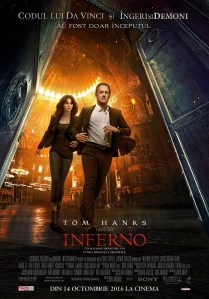 You know it’s a bad sign when the best part of your movie is the scenery. Inferno is the third in the Robert Langden series where Tom Hanks stars as the world’s foremost symbologist that traverses old European museums and cathedrals to solve mysterious puzzles. The Da Vinci Code was pretty bad, its sequel Angels & Demons was a marked improvement, and now Inferno is a depressing step backwards. Langden has to stop a madman (Ben Foster) from releasing a super virus that will kill half the world’s population. The villain’s plan requires him to wait and he has no reason to do so. Waiting only needlessly delays his goal and makes it more likely for him to get caught or fail. His plan is stupidly convoluted, but I didn’t expect that the good guys’ plan was also stupidly convoluted, relying upon fake blood squibs and disguises and for what? There are three competing, stupidly convoluted storylines that smash together. I simply could not engage with what was happening and felt I had little reason to care. The mystery aspect is pretty tame and the thriller set pieces are unmemorable save for a climax that at least feels like the highpoint. There was one interesting aspect that never fully gets developed and that’s the idea that Langden can’t trust his senses. He’s a man who relies on his arcane intellect and to turn that against him, as well as possibly draw in hallucinatory visions, was a smart move. It’s only more disappointing when they fail to do anything with this possibility. The myriad plot holes were clearer to me than the hackneyed plot itself. Inferno has some very nice footage as Hanks and Felicity Jones scamper from one Florence site to another and that’s the best thing I can offer about this mess.
Nate’s Grade: C-
Share this:

The Accountant (2016)
 How much do I have to pay for Ben Affleck to do my taxes?
Christian Wolff (Affleck) is autistic and one of the top accountants in the world, able to quickly penetrate stacks and stacks of numbers to analyze trends and problems. His clientele varies from an older couple trying to save their family farm to the mob. He’s also a very dangerous assassin who takes out bad guys with exacting precision. As a young boy, Christian’s autism caused great anxiety within his family, and his father was determined that his son would be able to fight back against a world that didn’t accept him. Ray King (J.K. Simmons) is a retiring Treasury agent trying to track down the identity of Christian and possibly bring him to justice for his vigilante status. On the run from hired guns, Christian decides to stay and fight rather than flee and start a new identity because a co-worker, Dana (Anna Kendrick), is also targeted. Together they must stay one step ahead of killers and the ensnaring investigation of Ray King.
 It would be easy to dismiss the movie as an autistic Bourne imitation, except that The Accountant is exactly that and takes ownership over its more ridiculous plot turns. The major problem with the Bourne series, which I believe is only now fully coming to light now that Jason Bourne has run out of legitimate past memories to remember, is that its lead character is a bore. Jason Bourne is a pragmatic and resourceful killing machine, but you wouldn’t want to talk to him at a party. He’s a boring character who is only interesting when he’s moving forward and inflicting damage. The Accountant has a lead character with the same set of skills but it also makes sure that he’s compelling even when he’s not killing the bad guys. Christian Wolff is a compelling lead character because he doesn’t fit in, he doesn’t relate easily to others, and he has social and emotional vulnerabilities that make him easy to root for while also serving to ground him. I’m not saying that those on the autism spectrum would make the world’s greatest assassins, though the job does require a dispassionate, detail-oriented mind. I was amused just watching Christian talk to others because I didn’t know how he would respond or how others would respond to him. He acts differently and it makes regular interactions interesting, and that’s before he becomes a superhuman assassin later. He’s leading a double life, and that provides just about every scene with an extra layer of irony, mystery, and intrigue. Christian is an intelligent warrior, working through strategy and improvisation but also luring his opponents into traps. He’s deadly but also efficient. He goes for headshots and dutifully moves along. He doesn’t play around and neither does the movie. When Dana is trapped in her bathroom with a hired killer on the other side, she takes the toilet lid and smashes the guy’s hand. That’s exactly what a thinking person should do in this life-or-death scenario. I appreciated that even with the action thriller heroics that the actions of the characters were still credible to their behavior.
The larger world is also populated with interesting characters and a complex story structure to match. I’ll readily admit that the screenplay by Bill Dubuque (The Judge) doesn’t need to utilize all of the subterfuge it does. We open on one perspective, circle back later with a richer understanding, jump around in time, and then we even sit down with Ray King and the movie takes a 10-15 minute pit stop to explain everything. It’s a strange moment where Ray gives us his full back-story, which is unexpected and unnecessary in the overall big picture but I enjoyed the commitment to larger world building. Another great addition was Brax (Jon Bernthal), treated as a parallel storyline for the first half of the film. In two very effective scenes he’s introduced with menacing efficiency and he’s a memorable foil we know will have to be faced later. I recently watched the atrocious revenge thriller I Am Wrath that was filmed in my city of Columbus, Ohio. There wasn’t one enjoyable moment, memorable villain, or even memorable death. In one scene with The Accountant, where Brax convinces his target the reasons why he should kill himself with an insulin overdose, I had an interesting and intimidating foe. The impression is immediate and unmistakable and in one scene you establish his danger. There’s a level of detail that isn’t seen that often in these kinds of films. There are several storylines and timelines and lingering questions but by the film’s end they’re all reasonably put back together and the audience is left satisfied. There will be some twists that a quick-witted viewer will be able to anticipate knowing the economy of characters but that doesn’t take away from their impact.
Affleck has rightfully earned serious acclaim as a director and screenwriter during his career rebirth but the man deserves his due for his acting as well. By most accounts, he was the best thing about the steaming pile that was Batman vs. Superman, and this is after the Internet exploded in apoplectic fits over his casting. With The Accountant, he gets to play a superhero and a socially challenged outcast, which must seem like the best of both worlds for an actor. Affleck is wonderfully dry and matter-of-fact as Christian. When he jumps into action he has a disciplined sense of purpose that can be fascinating. It’s a great lead role for Affleck and he finds interesting ways to demonstrate various emotions through an unorthodox lens. Christian doesn’t break down and blab his feelings, nor does he necessarily process emotions in the same conventional sense. He commands the screen whether he’s talking or running and shooting bad guys, and that’s all I can ask for.
 After leaving The Accountant, I desperately wanted more adventures with this lead character and this world, and I was even dreaming up the idea of adapting this concept into a weekly TV crime procedural. It’s rare that a movie leaves me wanting more, and it’s even more rare when a movie leaves me wanting to watch a weekly variation of Christian Wolff living as whiz kid accountant by day and enforcer of justice by night. Director Gavin O’Connor (Jane Got a Gun) has given me a glimpse of a world that has plenty of shades of moral ambiguity but still dishes out the action thriller goods. It begins like A Beautiful Mind, shifts into a Bourne adventure, and then concludes like a mixture of Haywire and O’Connor’s own Warrior. There is far more action than I thought there would be. It blends the influences and tones without losing its own sense of identity as well as its pinpoint sense of what an audience craves for entertainment value. The movie doesn’t treat those on the autism spectrum as freaks or as “others.” It feels far less exploitative or borderline manipulative with its inclusive message than, say, Rain Man. The reason he’s a super assassin isn’t because he has autism but because his insane father trained him to be Batman to combat his autism. The non-linear narrative doesn’t need to be as purposely hard to follow but it does keep the audience guessing until the climax. The Accountant is a character study, a twisty thriller, an exciting action movie, an overall satisfying slice of good vs. evil, and a world that I need weekly adventures, please.
Nate’s Grade: B+
Share this:

Boo! A Madea Halloween (2016)
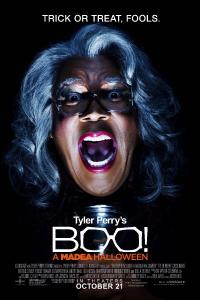 Tyler Perry is an industry unto himself, and the face of that industry is his matriarchal force of nature, Madea, the trash-talking, advice-giving woman of fear and esteem. I don’t know if I’ll ever truly enjoy Perry’s Madea movies, and I fully admit being outside the target audience, but I think I’m coming around on the Madea character and in particular Perry’s broad comic performances. Boo! A Madea Halloween is a flimsy excuse to re-introduce Madea and her elderly gang of colorful cohorts, including her gruff brother Joe (also played by Perry). The movie seems to barely have enough plot at all, aimlessly revolving around Madea babysitting a pair of teen girls on Halloween and thwarting them from going over to a nearby fraternity party. There’s perhaps a 10-15 minute segment that just… keeps… going involving Madea and her friends literally advising a weak-willed father (also Perry) to enforce discipline and beat his child. As a writer, Perry relies too heavily on transparently expository writing in between his funny. The story keeps circling around on itself, stretching the improv jags with diminished returns and needing more comic set pieces for a 100-minute running time that could clearly be trimmed. Perry directs his actors much like his plays as they go for broke, playing to the rafters. However, Perry as actor, especially as Joe and Madea, is an enjoyable and quite credible comic performer who definitely displays surefire instincts. I found myself laughing enough even during the more aimless lulls in conversation. The plot doesn’t have to be David Mamet when you just unleash Madea on others. I appreciated that she’s a moral authority who is also shamelessly irreligious and hypocritical. The character manages to beat down some of Perry’s more misogynistic and moralizing tendencies as a writer. Her former stripper past comes out in entertaining ways like trying to stop herself dancing during a hip-hop track at the frat party. The conflicting physicality on display in the scene is terrific. Boo! A Madea Halloween is going to be candy for its intended audience, and for those willing to push through the expected negative reviews, you might find enough moments to enjoy. I’m not going to say I’m on Team Madea but I wouldn’t necessarily mind more of this matron run amok.
Nate’s Grade: C
Share this:

Shin Godzilla (2016)
 Shin Godzilla is unlike just about any monster movie you’ve ever seen, and I don’t know if that’s a good thing. The newest rebirth of the famous giant monster takes a new approach to large-scale destruction: bureaucratic minutia. This feels like a state department underling’s doctoral thesis that was adapted into a feature film. We get a team of different intelligent operatives talking Aaron Sorkin-level fast and trying to work through the red tape of government to address the pressing needs of a giant fire-breathing lizard. It’s like 80% government bureaucratic milieu and 20% monster movie. We get treated to just about every meeting room in Japan as the majority of scenes last a whopping 10-15 seconds. The pacing is so clipped, the satire is so understated, and the characters so numerous, that I was easily lost in the weeds and that was before Godzilla made its less than auspicious debut on screen. It’s nothing short of what one of my friends described as a “turkey snake,” and the googly eyes aren’t helping. I’ll make the same demand that I made with the 2014 American Godzilla movie: I need more Godzilla in my Godzilla movie, please. For fans of the series, they’ll likely connect more with the social conscience platform and political critiques, but I couldn’t engage at all. I was eagerly waiting for this movie to just be over so I could shake it from my head. It felt like being talked at in the corner of a party by someone who just read a book on a topic that you couldn’t care less about. I’ll grant the filmmakers credit for finding a different approach and one seeped in the realistic details of government disaster response coordination, but if you’re like me, by the fifteenth conference room your eyes will glaze over. I don’t think this was the best approach for a film narrative and it completely drains the fun from giant monsters.
Nate’s Grade: C
Share this:

The Birth of a Nation (2016)
 Sold for a record $17.5 million at the Sundance Film Festival, there were big expectations for the Nat Turner biopic, The Birth of a Nation. Writer/director/actor Nate Parker was the toast of the town and the studio had its sights set clearly for a fall release and a big Oscar push. Then came the revelation from Parker’s past linking him to an accusation of sexual assault (it should be noted he was acquitted of the charge, though it should also be noted the woman declined to continue pressing charges during the second trial). Suddenly the Oscar hopes for Birth of a Nation were put into a tailspin and journalists were wondering if this salient news would provide older Oscar voters just the excuse they needed not to watch the movie. After having finally seen the film for myself, I can attest that this movie wasn’t going to go far into the Oscar race anyway. My friend Ben Bailey said it best as we walked out of The Birth of a Nation, making an apt comparison to the 2013 Best Picture Winner: “12 Years a Slave was a better movie made from a less interesting story; and this is a more interesting story but given a much lesser movie.”
In 1830, Nat Turner (Parker) is earning extra money for his friendly slave owner (Armie Hammer) as a preacher, convincing slaves on other plantations to work harder and obey their cruel masters. He reaches a breaking point and organizes a revolt, violently killing the same plantation owners that kept them in bondage. Nat felt his revolt could be the catalyst for slaves all over, but it was put down by overwhelming forces two days later.
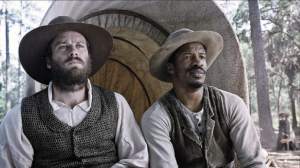 Nat Turner is a historical figure extremely deserving of a big Hollywood spotlight. The problem is that Parker’s movie feels like the arthouse version of the Hollywood Martyr Blockbuster, a field popularized by director Edward Zwick (Glory, Blood Diamond). This thing checks just about all the formula boxes you’d expect by showing the arc of a character called into action, forced to take a stand against an exploited people and series of injustices, and the eventual death for the cause. It’s meant to be inspirational but that sense of inspiration can be capped when you see the machinations. All storytelling at some level is about pulling the strings of an audience, but the storyteller must do their best to make this as nonobservant as possible so as not to disturb the experience. Parker doesn’t have that skill quite yet, either as a director or as a screenwriter.
His movie kept my interest but I felt oddly removed from it, unable to fully absorb the characters, which should never happen in a revolt against slavery. Case in point, we know how the movie is going to end so Parker needs to engineer something of a win for Nat, and that’s where Raymond Cobb (Jackie Earle Haley), nasty slave catcher, comes in handy as a conquerable antagonist. He ends up being the man responsible for chasing Nat’s father away, so it’s even more personal. During their final fight, Cobb implausibly wrestles atop a struggling Nat (this guy has to be at least 60 years old and it’s Haley, not Stallone). Parker even includes the knife that’s just… out… of… reach. I rolled my eyes. Parker shouldn’t have to resort to these tactics to rouse his audience, and as stated above, they’re just too nakedly transparent in their formula machinations. I wanted more suspense sequences like during the opening when Nat’s grandmother has to think on her feet to conceal contraband, smart uses of dramatic irony and ratcheting up the tension. The movie is structured too narrowly as Nat’s call to action, but Parker seems preoccupied with hitting all these other checkmarks to fully open him up as a human being.
Structurally, this movie is amiss because we don’t need 90 minutes to justify why slaves would violently revolt against their masters. The best part of Birth of a Nation is its final act when the revolts come and the slave owners get what they have coming. Some will equivocate that not all slave owners abused and terrorized their slaves to the same degree of abject cruelty, but the very nature of owning another human being is an assault on fundamental morality. 12 Years a Slave had an excellent 15-minute section where it disproved the notion of the “good slave owner” with Benedict Cumberbatch’s character. Even he too was corrupted because the institution of slavery is a corrupting agency. What that movie was able to communicate in 15 minutes is what The Birth of a Nation takes 90 minutes to do the same. The entire movie should have been the slave revolts with some choice flashbacks interspersed to give the movie even better context for the personal animosities against specific slave owners. That way we can better explore the emotional side of Nat Turner and his company without resorting to extended degradation. Parker deserves some credit for being very tasteful in his depiction of the brutality against slaves and the heavy heart of aiding and abetting an unjust system. It doesn’t whitewash, so to speak, the horror of slavery but also refrains from exploiting tragedy for easy gains. With that being said, and I may be alone in this observation, but I found it a bit peculiar that the sexual violence committed against women seems to be primarily framed as how it impacts the male characters, making them sad or angry at the mistreatment of their women. I may be over-analyzing this but it happens twice and stuck out to me. The structure of the movie does a disservice to the emotional power it demands, and Parker should have shown us the bloody campaign rather than the lead-up to the campaign.
Parker also shows some noticeable shortcomings when it comes to directing his fellow actors. His performance is a highlight and his moments where he’s trying to hold back the tide of mixed emotions working for the slave owners and using Scripture to justify the worst of the worst. This is a great showcase for Parker as an actor of suitable range. It’s not a great showcase for any other actor. The performances are a bit big when needing restraint, and a bit broad when nuance would be required. There’s no character that even comes close to the deeply wounding impressions left by the brilliant Lupita Nyong’o and Michael Fassbender from 12 Years a Slave. Hammer (The Man from U.N.C.L.E.) is given one note to play after the first act and that is aspiring drunk. I don’t know if there’s a scene where he isn’t accompanied by some bottle. It’s meant to communicate his increasing sense of shame he has to excuse, but it’s also a fairly facile acting crutch. The women in the film come across as angelic (there’s even a vision of an actual angel in the film) or maternally strong as steel. The lack of variance becomes frustrating, as it seems that Nat Turner is the only character, and by extension actor, allowed depth. You’ll enjoy the actors on screen but be scratching your head to recall anything memorable.
 The Birth of a Nation is very purposely meant to evoke the title of the famous 1915 D.W. Griffith movie, the world’s first film blockbuster and also virulently racist to its core. It’s about the formation of the Klu Klux Klan in a Reconstruction era to save all the honorable white people from the new hordes of wanton free slaves. It’s deeply offensive though an undeniable touchstone in the history of narrative filmmaking. I was looking for some kind of larger thematic connection beyond slavery but it seems that Parker’s movie is meant to be a reclamation of the title. There’s a moment at the very end that made me think that there was another possibility (spoilers). As Nat Turner is executed, one of the last images is a close-up on the face of a young teenage slave who witnesses his death. The camera then pulls out and that boy has aged into a man and is fighting with a battalion of other black soldiers during the Civil War (the movie literally becomes Glory!). I was wondering if we were going to continue skipping forward in time, next to the Civil Rights marches, next to protests against police brutality in the modern era, so that Parker was drawing a direct line from the experiences of old and how they have shaped the America of today, the birth of our current national racial injustices. This doesn’t happen, unfortunately. The Civil War flash forward is the only jump in time.
I’ve been critiquing Nate Parker’s movie for the majority of this review and I don’t want to leave you, dear reader, with the false impression that this is a bad movie; overrated and slightly disappointing, yes, but not bad. If it didn’t sound like faint praise I would say that The Birth of a Nation is a perfectly fine movie. It held my attention though I kept thinking of other ways this movie could have improved, from a restructured plot that begins with the slave revolts, to more attention to the supporting characters, to less fidelity to the patented formula of the Great Martyr Biopic. This was a passion project for Parker and took him over six years to complete. Walking out of my theater, I simply didn’t feel like that same passion was evident on the screen.
Nate’s Grade: B-
Share this:

Miss Peregrine’s Home for Peculiar Children (2016)
 Miss Peregrine’s Home for Peculiar Children feels like Tim Burton’s X-Men franchise, and it’s just as awesome as that sounds. Burton has always had an interest in the outcasts and misfits of society and now he has his chance to leave an imprint on the ever-present superhero phenomenon. His own personal group of gifted youngsters is looking to form a funky family and fight against fearful forces that have their sights set on exploiting these special children or worse. It’s a natural fit for a man who has become a Gothic industry unto himself over three decades of peculiar and spooky filmmaking. This is Burton’s chance to flex franchise tentpole muscles with a subject matter perfectly attuned to his offbeat sensibilities, and watching the fabulous final product is akin to watching a master musician dive into Beethoven’s Fifth. This movie was flat-out delightful.
Jake (Asa Butterfield) is reeling from his beloved grandfather’s (Terrence Stamp) mysterious death. The old man loved sharing his stories about tending to the shape-shifting Ymbryne Miss Peregrine (Eva Green) and her wards, a group of children with special abilities including starting fires, controlling plants, invisibility, and being able to float lighter than air. On a trip to Wales to investigate grandpa’s stories, Jake discovers a time portal and is taken back to the WWII era where Miss Peregrine is waiting for him. She and her children relive the same day and will never age. They’re hiding from Barron (Samuel L. Jackson) and his group of scientists who wish to hunt the children. Jake is tasked with being the new protector, as he is the only one that can see an invisible band of slender monsters known as hollows that feast on the children.
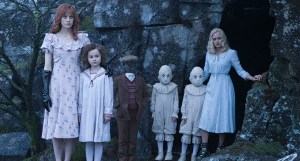 There’s a whimsical nature to the dark elements, and the script is rife with enjoyable payoffs and fun moments that cry out for a full visual immersion. This is Burton’s best film since 2007’s Sweeney Todd (I have a soft spot for that macabre musical), arguably best since 2003’s Big Fish, and maybe his most fun movie since his 90s heyday. If you’re a Burton fan, you’ll be tickled by all the imagination and humor. I grew up on the cinema of Beetlejuice and Edward Scissorhands and The Nightmare Before Christmas (yes, directed by stop-motion maven Henry Selick but still very much a Burton film), so I’ll admit that seeing Burton in high form once again warmed my little mischievous heart.
You get a sense just how involved Burton was in the filmmaking and its details, the degree of passion and involvement, and also his commitment to being a dark movie intended for peculiar children and adults with macabre interests all over the world. I kept thinking that the 12-year-old version of myself would have adored this movie, never mind the 34-year-old version of myself who greatly enjoyed it too. This feels like a natural evolutionary step for children and adolescents who gorged themselves on the works of Edward Gorey and R. L. Stine. It’s not a significant spoiler but it’s something I feel you, dear reader, need to know in order to properly assess just how wonderfully morbid the movie can come across. There is an entire visual feast of a group of villains dining upon the delicacy of… children’s eyeballs. You read that right. It’s a silver platter piled high with severed eyeballs, and they get slurped down like it’s spaghetti. I could only cackle to myself at the audacity of the movie to embrace the fun of the darkness rather than hiding from it, mitigating it, trying to be delicate with tone. The villains want to return to a normal state that can only be achieved by consuming the eyeballs of peculiar children, and so they are hunted not for sport or prejudice but for eyeballs. That’s wonderfully squirmy, and it definitely affected me, an avowed cinema patron who gets extra squirmy with any onscreen eye trauma. There are other creepy and memorable moments, like a dead child being used as a ventriloquist doll and the slenderman-styled hallows creatures. The moments are plenty but they don’t choke the story’s momentum, which hums along with great imagination and lucidity.
There’s a lot going on with Miss Peregrine, and Jane Goldman’s (Kingsmen) screenplay juggles a lot of rules and world building without losing momentum. I was intrigued early and the movie would widen its focus, providing more texture and connection to the world in calculated doses. It was enough that I always felt like I was learning something while still being able to see how the pieces snapped together in retrospect. There’s time travel that has to be done at a very specific point, the rules of who can travel back in time to these bubbles of safety, the history of this specific day stuck in time, the non-linear history of the protectors, the fact that the bubbles are also teleportation hotspots, the history with Jake’s grandfather, the history of the Ymbryne and their powers, the powers of all the peculiars, dream prophecy, mad scientists and their peculiar ailments, the differences between the hallows and the predatory scientists, and also establishing the character dynamics of several lost children and a budding YA romance. It’s amazing that Goldman’s script is as understandable as it is considering all that heavy lifting. It’s not completely free of muddled plot points and some hazy explanations, but those instances are a clear minority to what works so effectively. I wanted to know more about this world, and once they added time travel and teleportation, I was hooked. I enjoyed the movie so much that I’m considering reading the additional books for my next freaky fix.
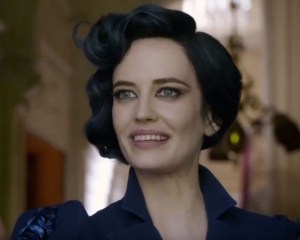 The acting ensemble is full of bright spots and none brighter than the new queen of genre gusto, Eva Green. I raved about Green’s magnetic performance in the considerably lesser 300 sequel. She was easily the best part of that movie and it suffered whenever she wasn’t on the screen. The same can be said for the too-long-in-the-making Sin City sequel. She was the best thing in Burton’s otherwise forgettable Dark Shadows feature. In short, this woman is incredible, and she digs into the vampy and ridiculous with the right degree of malevolence and glee. Green is a wonderful hostess into this magical world, and her foreknowledge gives her a caffeinated energy that makes her even a tad more peculiar. Her children are all fine actors who have uneven parts thanks to the unfair distribution of their powers. Not everyone gets super useful abilities. I felt sorry for the kid who projected his dreams from his eyeball especially during the third act scuffles. A mouth in the back of the head doesn’t seem very useful either. I enjoyed the idea that the invisible kid needs to be fully naked to be fully invisible, and everyone acknowledges this reoccurring fact with shoulder-shrug nonchalance. The standout amongst the peculiars is Ella Purnell as the winsome girl who will float away. She has an innocent and yearning quality that doesn’t sink her character. She’s more than just a love interest to Jake and Purnell helps channel great affection. Jackson (The Hateful Eight) is expectantly highly entertaining as the lead villain and Butterfield (Ender’s Game) is perfectly acceptable as an audience surrogate into this wild world.
I was duly impressed with just about every element, from the structure of the screenplay and its precision with information and intrigue, to the level of acting, to the dark and whimsical tone, to Burton’s own peculiar particulars that fill out the film with adoration. It may sound corny but there is an affection woven throughout the film, for its dispirit outcasts, for their strangeness, for the ardor of telling a spooky story that can appeal to children without pushing away adults. There’s a care that’s been absent Burton’s other recent films, especially Dark Shadows, which left me bewildered whether Burton had any genuine fondness for the source material. Miss Peregrine’s Home for Peculiar Children is a haven for fans of the peculiar, Burton’s oeuvre, and those looking for a quality children’s film that has some bite. I can only hope for more fantastical adventures.
Nate’s Grade: A-
Share this:

The Girl on the Train (2016)
 Consider it Gone Girl lite. The adaptation of the mega best-selling thriller The Girl on the Train seems to be on a runaway collision course with irony-free, amped-up melodrama and sundry “adult” sensuality reminiscent of the 90s boon of erotic thrillers like Jade and Sliver. The book by Paula Hawkins had three strong female lead characters each telling their own miserable worldview of trying to live up to social standards of motherhood and marriage. The movie seems to have shorn most of the focus on character and included every twist and turn, no matter how absurd. Take for instance just how insular this world is: Rachel (Emily Blunt) is the ex-wife to Tom (Justin Theroux) who left her for Anna (Rebecca Ferguson) who has a nubile nanny Megan (Haley Bennett) who is unhappy with her controlling husband Scott (Luke Evans), who happens to be the couple that Rachel voyeuristically observes and fantasizes domestic bliss. Megan goes missing and Rachel cannot account for her whereabouts because she has become a blackout drunk to kill her self-loathing and sense of internalized failure. The whodunit aspects of this movie can come across as rather hokey and overblown, but lacking the nasty nuance and subversive gender politics of the far superior Gone Girl. Every single person in the film has to come across like a suspect (Megan’s husband, Megan’s therapist, some guy in the road?) and talks in a curiously oblique style. The attempts at sexy lack heat but more than that they lack conviction. Director Tate Taylor (The Help) seems to think he’s directing a Hitchcockian thriller one minute and a tawdry art film the next. The screenplay is also unhelpfully nonlinear, frivolously jumping around in time and point of view and muddling the overall timeline. Anna and Megan are drastically underwritten; Megan is a sex kitten with a dark secret that’s trying too hard to be provocative, and Anna is an even more thankless role as the stand-in for Rachel’s swirling antipathy. The concluding moment of girl power feels unearned, and the answers to the mysteries leave a lot more lingering questions about train platform-sized plot gaps. The best thing this Girl has going for it is Emily Blunt, who delivers a better performance than the film deserves. She’s unrestrained, red-eyed, sloshing, and disturbing as a drunk. She’s wounded and lashing out ferociously at the world, at her self, and it’s fascinating and heartrending to watch. I bet it would be even better to read.
Nate’s Grade: C+


 nathanzoebl
You must be logged in to post a comment.