Category Archives: 2024 Movies
Furiosa (2024)
 Mad Max: Fury Road is not just a movie for me, it is without a doubt one of my favorite movies of all time, and watching any moment of this 2015 masterpiece elicits pure, unrestrained joy, a feeling of elevation pure and simple. It’s the kind of euphoric response we all look for with art and, tragically, find too rarely, and for me, Fury Road is my divine experience. Even after having watched the movie over a dozen times, I can still slip it on and feel the same rising excitement, amusement, and happiness like it was all happening for the first time. I was a fan of director George Miller’s other wild post-apocalyptic entries, but Fury Road was different, as also evidenced by the fact that it nabbed six Oscars that year and was also nominated for Best Director for Miller and Best Picture. The totality of this artistic achievement seems certainly impossible to replicate. Over decades of development, Miller and his many collaborators fashioned plenty of material about life in the deserted Wasteland and its colorful characters battling for survival among the scavenged scraps of humanity, so there was always more room for more stories. That’s what brings us to Furiosa, the prequel explaining the back-story that turned a child prisoner into the ferocious one-armed Imperator of Imorrtan Joe. As a Fury Road super fan, I was hoping against hope to feel a little bit of that same unique artistic high again.
Young Furiosa (Anna Taylor-Joy) is kidnapped from her mother and sold into slavery. Her main tormentor, Dementus (Chris Hemsworth), is the head of a marauding biker gang. Furiosa spends years rising through Immortan Joe’s ranks to gain her vengeance.
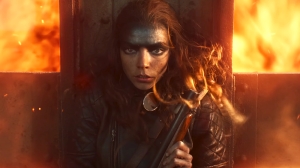 This is not Fury Road, to its benefit, and Furiosa is inexorably linked to Fury Road, which is also a mixed blessing. I kept telling myself, “It’s not Fury Road, and nothing can be, so don’t hold it to that standard.” Furiosa is not Fury Road. It’s slower, longer, and more plot heavy, taking its time to build around the edges of the world we were introduced to in 2015. Miller spends much of those two-plus hours filling in the missing pieces and histories of the other communities, like Gastown and the Bullet Farm, as well as the factional war between the different warlords and their territories. We also get an opening set in the much-heralded Green Place before it becomes the spoiled swamps. We get to see the construction of the war rig over time (it’s so shiny and chrome before collecting all that grime and singing). It fills out the wider world of Fury Road as well as the character connections and conflicts, so for those fans who felt Fury Road was lacking in its world building and overall plotting (the oft-spoken complaint that the movie is all about a woman turning left), this new movie might prove more appealing.
For me, dear reader, it made me reflect how Fury Road just hits the ground running and doesn’t let up, providing clues to the larger dystopian world that it lets you piece together, and I did. It was sufficient for me to get a sense of this world and its ongoing relationships and conflicts. What was implied in Fury Road is explicit in Furiosa, although there’s still plenty elided, like when we’re shown the 40-Day Wasteland War but only as a quick montage of violent images. In some ways, it reminds me of a director’s cut where the added material feels a tad secondary by nature, adding some better context and shaping but making you question whether that context was needed. Because the movie is tied to the events of Fury Road it can’t help but exist in its mighty shadow, ending in a very Rogue One fashion as it immediately sets up the story to be handed off, with clips from Fury Road playing throughout the end credits. I’m glad it wasn’t merely trying to replicate the same kind of entertainment as Fury Road, but I can’t help but feel slightly disappointed with Furiosa as it feels a bit overlong, unfocused, and extraneous.
 Miller’s dystopia is crazy and unique and the mayhem is energetic and enchanting, so I’ll happily spend two more hours in this gonzo Aussie universe, and while the highs might not be as uniformly high as my experience with Fury Road, there’s still a significant entertainment value in returning to this extraordinary world. Is there anything that comes close to the sheer glory of the action of Fury Road? Well, no. The action sequences are solid with a few nifty moments of sustained imagination and intensity, like the war rig’s first run that combats against raiders floating around their targeted prize in parachutes. I felt similar rousing feelings of discovery and immersion. The Bullet Farm attack has some great moving pieces that culminates in the biggest destruction of the movie. The action is still fun and morbidly cheeky, even if the effects used feel a little more cleanly green screen prevalent this time atop the moving vehicles. Fury Road is a monumental achievement and testament to the lasting appeal of practical in-camera effects, but it heavily used computer generated effects too, primarily for cleaning up the wire work as well as enhancing and replacing backgrounds. So the inclusion of computer effects in Furiosa isn’t new for the franchise, but it feels more noticeable and thus mildly distracting. It’s all intentionally smaller-scaled even as it’s looking at a wider scope of its weird universe.
The most interesting part of Furiosa is its primary villain, a wannabe fascist gang leader who proves repeatedly to be incompetent. Dementus has great presence, large and imposing and being drawn by a literal chariot of motorcycles. Hemsworth (Thor: Love and Thunder) is great and clearly having a ball, but what I loved even more about this villainous rogue is how hilariously bad he is at management. He’s the feared leader of a gang angling for respect and power, but he’s incapable of being more than posturing and sloganeering, and his huckster carny voice only solidifies this shading. He’s an unpredictable character, an agent of chaos, and he even undermines the established order of Immortan Joe and the other warlords who disdain him. I enjoyed little character touches like he keeps changing his moniker, going from Dr. Dementus to the Red Dementus (after being too close to a flare gun explosion). I appreciated that the final confrontation is also the talkiest scene in the entire movie, allowing both members ample time to state their perspectives, animosity, and fascination with one another (“No shame in hate. It’s one of the greatest forces of nature”). However, this climactic showdown 140 minutes in the making could have been even more impactful had the sprawling script not shelved Dementus for so long. This character drops out for long stretches of the movie and his absence is dearly missed.
 Originally, Miller intended to have Charlize Theron reprise her role as Furiosa by using cutting-edge de-aging computer effects, but after seeing 2019’s The Irishman he reconsidered (good call, George). In steps wide-eyed Anna Taylor Joy, who acquits herself fine, though doesn’t show up as the (younger) adult Furiosa for maybe forty-five minutes. This version of Furiosa speaks very minimally, so much of her intensity must be delivered through her eyes, so why not hire an actress with such striking and large eyes? The whites of her eyes are so notable that it reminded me of cartoons where we see floating white eyeballs whenever it’s unrepentantly dark. She also sounds exceptionally close to Theron’s voice at a few spots that it made me do a double-take.
Furiosa lacks the streamlined beauty of Fury Road, its immediacy and visceral energy that radiates from being dropped into the madness and keeping things in propulsive motion. It was also Miller’s first trip back to the Wasteland since 1985’s Beyond Thunderdome, so it was a 30-year leap for Miller to expand his crazy artistic vision onto an even broader modern canvas. Each one of the Mad Max films have existed on a mythical plane, eschewing ongoing continuity and treating Max like a drifter coming into a strange new world and aiding people in need. This is the first Mad Max movie, also minus Max, that attempts to connect to one of the other movies, and in doing so it’s less about creating its own identity than modifying an established identity. It’s different but also lesser. This is a longer and slower movie, but it’s also got fun action and zany humor and visual decadence. There is far more plot and world building, but it’s also only mildly interesting and too attenuated, feeling like fat cut off from the non-stop action movie sizzle that is Fury Road. I can declare Furiosa as a good movie and also a mild disappointment as well, but that’s coming from a Fury Road super fan. Perhaps I am merely coming to terms with my expectations being overinflated, to try and stubbornly catch that magic feeling once again. Witness me and celebrate Miller’s latest as it also makes me celebrate Fury Road even more.
Nate’s Grade: B
Share this:

Dune: Part Two (2024)
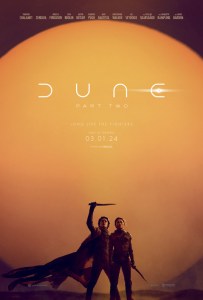 I wasn’t fully taken with the first Dune movie when it arrived in 2021. It was visually sweeping, with dense world building and careful development of characters and themes, but then it just hit the pause button without any certainty there would be a conclusion. Thankfully, director Denis Villanueuve was able to complete his vision, and what a spectacular science fiction landscape this man has fashioned, visually resplendent but also with a story that deepens and improves on all the promise and setup from 2021. The triumphant of Paul (Timothee Chalamet) becoming a hero and avenging his father from their betrayers is tempered by the tragedy of Paul, becoming the false messiah that will bring about mass genocide. The movie doesn’t hold back in its criticisms of its hero while also providing complexity that makes us root for him but uneasily dread what might become. The narrative structure is easy to follow with Paul ingratiating himself with the native culture, rising to power and influence, and organizing a resistance against the well-funded imperial overlords of Arakis. This is the kind of sumptuous, big screen spectacle with intelligence that is so rare in the Hollywood system, and Villaneuve once again shows his ability to perform artful blockbusters that put him in a rarefied class with hew others. After the first Dune, I was hopeful but a little wary. After the second Dune, I feel like all of my concerns were wiped away.
Nate’s Grade: A-
Share this:

The Idea of You/ Turtles All the Way Down (2024)

The Idea of You is the kind of movie that Hollywood used to crank out, a romantic drama star vehicle based upon a popular novel and with a skilled director, and now it forgoes any theatrical run and ends up as another option on a streaming channel. The Idea of You follows a 40-year-old divorced single mom played by Anne Hathaway who also happens to run an L.A. art gallery and has a meet-cute with a handsome boy band member (Nicholas Galitzine, Purple Hearts) at the Coachella music festival (oh the magic lives of people never having to worry about bills in rom-coms). they hit it off, and the rest of the movie is whether or not they can make a romance work. There’s a 15-year age gap that she feels very self-conscious about as an older woman (“older” by Hollywood standards). She’s this formerly normal woman who wants to date one of the most famous music stars in the world who isn’t always available, but most of the problems and conflicts stem from the perceived issues of the age gap. It’s a charming romance that’s more dramatic than it is comedic, and Hathaway is quite good as our lead plucked from obscurity. Though the many scenes of our smitten boy band member making googly eyes at Hathaway as he reminds her how attractive she is, and as she bashfully demurs, are a little much (it’s Anne Hathaway, notorious horrible-looking human specimen, right?). As a core romance, the movie works well under the guidance of director and co-writer Michael Showalter (The Big Sick), and it’s more adult than I was expecting. It’s rated R for language and it’s also more sensual, but it’s also more adult as in looking at the ramifications of this relationship in a mature perspective, from the terrors of paparazzi imposition to her daughter being harassed at school. The portrayal is thus more engaging and engrossing and feels above the more flippant and flimsy romances that would settle for far less. Though be warned: there are several sequences of singing and serenading which might cause you to shrink awkwardly inward on your couch. Surprisingly thoughtful, and relatively romantic, The Idea of You is a charming reminder of the appeal of comforting tales of love blossoming in unexpected places and pretty people allowing themselves the choice to be happy.
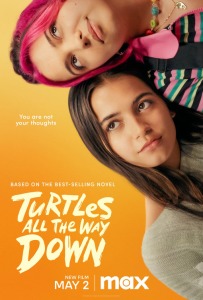
Based on best-selling YA author John Green’s 2017 novel, Turtles All the Way Down is a very accessible and very affecting glimpse at living with mental illness, obsessive compulsive disorder, and intrusive thoughts. Aza (Isabela Merced) has an overwhelming inner monologue that sabotages her daily life in high school and carries her along anxious thought diversions, constantly relating to some illness growing inside her that she needs to cleanse. This is the crux of the story, along with her relationship with her super eager best friend. There’s a romantic side plot where she helps out a rich classmate whose billionaire dad has gone missing, which feels like a plot device to necessitate the two characters spending time together. The standout aspect of this adaptation by writer/director Hannah Marks (Don’t Make Me Go) is its unsparing and honest yet hopeful depiction of mental health and intrusive thoughts. Merced (Dora and the Lost City of Gold, Madame Web) is excellent and deeply empathetic as this woman held hostage by her wayward thoughts and impulses. It’s a performance that goes beyond easy depictions of aloof detachment or exaggerated histrionics, shedding any acting techniques that are too mannered or attention-seeking. Marks’ direction helps reflect Aza’s troubled mind with rapid insert edits and voice over to communicate the intrusive thoughts and maelstrom of spiraling negative emotions. If you’re a fan of Green’s popular novels, or YA-themed literature, or even just honest attempts to empathize with teens in turmoil, then Turtles All the Way Down is worth battling through any negative thoughts to finish and relish the journey.
Nate’s Grades:
The Idea of You: B
Turtles All the Way Down: B+
Share this:

Unfrosted (2024)
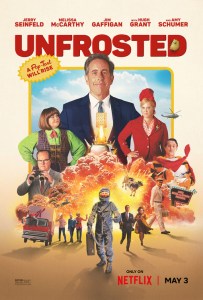 What to make of a movie like Netflix’s Unfrosted. It’s Jerry Seinfeld’s directorial debut, working off a screenplay he co-wrote, his first foray into film writing and acting since 2007’s Bee Movie. His eponymous sitcom “about nothing” was a 1990s mainstay and popularized an ironic meta form of comedy that still continues to dominate comedic tastes. Making a movie about the pseudo history of the invention of Pop Tarts, and the corporate rivalry between the major cereal brands, seems like a further exercise in that realm of humor, potentially satirizing a burgeoning sub-genre of late, the Biopic of Products (Air, Tetris, Flamin’ Hot, Blackberry). Except this supposed “biopic about nothing” is really a head-scratcher. Its humor feels pained and stale, the satire feels missing or glancing at best, and it seems like an expensive lark, wasting the nigh-infinite money of Netflix to purposely make a stupid comedy with all his friends.
Set in the mid 1960s, we follow two households, both alike in dignity, in fair Battle Creek, Michigan where we lay our scene. Kellogg’s has been the dominant cereal-brand for years but its chief rival, Post, is set to launch a new product that will revolutionize breakfast mornings. Bob (Seinfeld) is the head of development for Kellogg’s and reaches out to his old colleague, Donna (Melissa McCarthy), when it becomes evident that Post stole their unused research to develop a pastry treat designed to be cooked in one’s toaster. The warring CEOs, with Jim Gaffigan as Edsel Kellogg III and Amy Schumer as Marjorie Post, are desperate to one-up one another and be seen as more than an inheritor of their family’s wealth. It’s a race to see which company can get their treat to market first and capture the hearts, minds, and sweet teeth of America’s youth.
 I’d be lying if I said I didn’t laugh at points through Unfrosted, which operates like a spoof movie on a slower jokes-per-second pacing guide. There are zany sight gags amidst broadly drawn characters treating the silly straight, though occasionally you’ll have wisecrackers commenting on the inherent absurdity of moments, mostly confined to the stars making asides to the audience. Sometimes it’s lazy jokes that rely upon our foreknowledge, like when Bob coins a NASA beverage by saying it has a “real tang” (get it?). The movie frequently intensifies into goofy escalation when Kellogg’s impanels a team of mascots and inventors as a breakfast brain trust. Every one of these wacky characters is here to provide the exact same joke they will provide throughout the movie, and their inclusion is already suspect. Having the Schwinn bicycle guy (Jack McBrayer) comment on why he should be there is not enough. The hit-to-miss ratio will vary per everyone’s personal sense of humor, but overall I just felt mystified why this project would tempt Seinfeld from his comedy repose. What about this idea excited him? Was it just his lifelong love of cereal and Pop Tarts, a topic from his standup act decades ago? I ate a lot of cereal as a teenager too but I don’t want to make a movie about the Lucky Charms advertising campaign teaching children to beat and pillage the Irish (maybe Ken Loach could direct – to the three people on the Internet who appreciate this joke, I want you to know I appreciate you also).
It can be fun to simply watch dozens of famous people take their turns being silly in what is unquestionably a “dumb comedy.” When you have comedians of this quality in your movie, they’ll find ways to make even so-so jokes hit a little better, and that’s the case here. There’s an entertainment value in just wondering who will show up next, as many characters are only onscreen for a single scene or an abbreviated moment. Unfrosted becomes an example of Seinfeld’s industry power as he empties his Rolodex to fill even the tiniest of roles. Look, it’s James Marsden as Jack LaLanne. Look, it’s Bill Burr as JFK and Dean Norris as Kruschev (double Breaking Bad). Peter Dinklage as the head of the nefarious milkmen cartel? Why not? If you set your expectations low, maybe lower than what you were accounting for, there can be a mild amusement scene-to-scene just seeing who might show up next, almost like a modern-day version of those anarchic big ensemble comedies like It’s a Mad, Mad, Mad, Mad World.
 There is one segment that fell so flat for me that I was in utter amazement, and that was the unexpected January 6th insurrection parody. In a movie that has sustained a surreal and offbeat version of our universe, it evokes one of the most startling days of recent history. I think the humor is meant to derive from simply seeing a bunch of mascots in big colorful costumes as a mob running havoc, but there’s no jokes about like the challenges of a mascot costume in a fight, or say someone tipping over and being unable to get back up like a helpless turtle. There are jokes that can be had with this scenario, but instead Seinfeld is relying on the ironic juxtaposition of the ridiculous with the serious, and I don’t think it ever works as a joke. My sinking feeling began when Hugh Grant’s embittered mascot character wore a headdress resembling the QAnon shaman. It feels tacky and strange and the longer it persists the more I kept wondering what Seinfeld was doing with this. Why include this especially as the only form of relatively topical political humor, beyond, I guess, the depiction of business elites being complete morons? Why this? Again, it would be different if it was funny in execution, like the Saving Private Ryan D-Day parody from Sausage Party. This just isn’t funny, and its inclusion feels so odd compared to the stale nature of its other comedy.
As an admittedly silly enterprise, one that doesn’t even pretend to be accurate even as it flirts with the truth, Unfrosted is a successfully stupid comedy that feels a little too aimless, a little too edge-less and safe, and a little too dated and stale in its approach to comedy (lots of 1960s Boomer nostalgia ahoy). It’s hard to work up that much risible anger over a 90-minute movie that features a living ravioli creature. Clearly this movie wasn’t trying to be anything other than a gleefully stupid comedy, but I wanted more pep from its jokes and whimsy and general idiocy. I think the way to go may have been all the way in the other direction, treating the formation of a toaster pastry like international nuclear secrets and playing the corporate espionage completely straight while also making it patently ridiculous. Unfrosted did, however, make me want a Pop Tart that I ate afterwards, although it was my local grocery store’s generic brand, so I guess that doesn’t directly benefit Kellogg’s. This movie exists as a Seinfeld curiosity that ultimately left me hungry for more.
Nate’s Grade: C
Share this:

The Fall Guy (2024)
 The Fall Guy, loosely based upon the 1980s TV series starring Lee Majors, is not the best action movie, nor the best dedication to the efforts of Hollywood stunt performers, but walking away, I cannot help but think it’s perhaps the most summer blockbuster-y movie I’ve ever seen, a celebration of the magic of movies, the escapism of blockbusters, and the unsung heroes of the stunt community that deserve recognition and maybe even their own Oscar category. This is the kind of movie that reawakens feelings of cinematic elation, of what blockbuster cinema can accomplish with the right creatives in alignment, leaving a smile plastered across your face and a spring in your step leaving the theater. The Fall Guy is about our love of big stars, big explosions, big feelings, and the people responsible for making those big dreams a reality.
Colt Seavers (Ryan Gosling) is a professional movie stuntman who feels invincible until one stunt goes wrong, causing him to break his back. After a year of recovery, he’s parking cars when he gets a call that his ex-girlfriend Jody (Emily Blunt) is directing her first movie, a major sci-fi blockbuster called Metalstorm (which actually exists, it’s a 1983 movie directed by Charles Band and was the shares the same bombastic tagline: “It’s High Noon at the end of the universe”). They need a replacement stuntman and perhaps he can reconnect with her and start over. Also, Colt becomes entangled in searching for the missing star of the movie, Tom Ryder (Aaron Taylor-Johnson), a famous action star that Colt worked closely with, performing his stunts. Colt has to try and find this missing moron while keeping to the movie schedule, all the while hoping to win back Jody and make sure her movie finishes its costly production with its leading man.
 First of all, this is the Ryan Gosling show. If you’re a fan of the actor, especially his cavalier charisma that almost comes across as so cocksure to be enviably casual, then The Fall Guy is going to be a dream come true. It takes the Gosling of such comically committed, goofy, un-self-conscious performances from Barbie to The Nice Guys, and it builds a big Hollywood action movie around that persona, vaulting Gosling into his Big Movie Star phase with aplomb. He’s so effortlessly engaging as our hero, even when he’s being battered and bruised and exploded all over the screen. Colt is also immediately appealing as a capable man beset by challenges rediscovering his mojo. He’s been humbled by life and fights for his dignity while at the same time fighting to win back his girl, and it all plays on a breezy, light-hearted comedy wavelength that accepts the inherent and lasting appeal of movie stars being allowed to be movie stars. There might not be much to the characters of Colt and in particular Jody, but the movie just shimmers on their winning chemistry. You’ll yearn for them to be together again with quite little prompting. It’s a movie whose romantic force is front and center. It’s so unabashedly sincere too. When Colt is jamming to Taylor Swift’s “All Too Well,” it’s not an easy point of mockery, though some may take it as such seeing our strong hero in his feelings, but a point of reliability. It’s a movie unafraid of romance, of wearing its heart on its sleeve, and being a little square.
It’s also clearly a celebration of the unheralded stunt performers of Hollywood history filling in for the more dangerous derring-do of our big screen heroes and villains. Director David Leitch (Atomic Blonde, Bullet Train) came from the stunt world and stages his action set pieces to rely heavily upon real physical stunt work, practical effects, and giving extra time for the audience to understand various dangers and know-how, to learn about this often overlooked industry of professionals risking life and limb, and sometimes giving their own, to create the illusions. The action is varied and filmed in pleasing compositions to highlight the readability of the action. It’s big and propulsive and fun. That’s the key to all of Leitch’s moves here, making the fun infectious, extending the action into unexpected yet delightful directions for more payoffs. The climax involves branching out to an armada of movie stunt performers and technicians, and it feels like a communal effort to win the day, making the ending feel celebratory and satisfying.
 This goes along with the behind-the-scenes camaraderie of the found families of filmmaking, celebrating all the many collaborators that go into building these large-scale entertainment ventures. When they’re going through the steps of how to capture a big explosion or stunt, it’s educating the audience along to better anticipate and appreciate. The Fall Guy is clear about its sincere homages, recreating moods and style from action veterans like Michael Mann, James Cameron, and Michael Bay. It’s a movie celebrating movies, and if you’re a fan of the process like me, then you’ll easily join in on the revelry. I’m sure there are famous stunt performers littered throughout, getting Leitch’s favorite colleagues the platform they deserve. The movie’s insider satire is pretty glancing, without anything too vicious or specific about Hollywood stars, especially epitomized by Taylor-Johnson’s send-up of self-absorbed actors. The concept of Metalstorm, a sci-fi Western with elements of Dune and Mad Max, is a project where the silly mash-up of “cool” elements is the unspoken punchline, the sheer stupidity of this concept, magnified by Tom Ryder channeling his most laconic Matthew McConaughey impression.
There’s a special appeal about summer blockbuster movies and The Fall Guy understands that lasting appeal. It delivers a movie whose mission is to remind us why we love these kinds of movies, big and stylish and thrilling and romantic and enchantingly entertaining. It’s a movie that’s only interested in being two hours of excellent escapism, not setting up a cinematic universe or the next sequel leading to the next sequel and spin-off. It’s only concerned with telling its lone story, which is booed by the magnetic power of its leads and their buzzy chemistry together. Gosling is chiefly in the zone and supremely charming and funny. The Fall Guy is a treat for fans of action and the professionals that make all the action so incredible.
 As a personal side note, my lovely wife is almost five months pregnant and we were informed that our little baby boy would develop his sense of hearing around this time, and during the many action scenes roaring in the surround sound theater, the kiddo was moving around in utero. Either this kid was worried about the sudden shifts in volume and noise, or he was enjoying the experience and swimming along. Either way, I’ll consider this baby’s first movie, so thank you The Fall Guy for making this a personal landmark for me and my growing family.
Nate’s Grade: A-
Share this:

Abigail (2024)
 Abigail feels very much like a spiritual sister for 2019’s Ready or Not, as it is a follow-up from the same writers and directors. It’s a bloody, funny movie about a hunt in a big mansion with a heroine who is battling against supernatural forces over the course of one long hellish night. We have a team of thieves kidnapping the young daughter of a man with money and having to hold her overnight. They don’t know one another and there’s an initial bristle to their discovery, like when an ex-police detective (Dan Stevens) and a recovering addict (Melissa Berrera) have equal measure not to trust one another. Things get worse when it’s revealed that their hostage, the titular Abigail (Alisha Weir), is not what she seems, a fact spoiled in the trailer. What follows is a topsy-turvy game of cat and mouse with some effective creepy moments and some lively humor without losing sight of the escalating stakes as well as the acclimation of new rules. The acting ensemble is highly enjoyable, particularly Stevens as a scuzzy authority figure, Kevin Durand as a himbo with an emotional core, and Weir, who has tremendous range to pull off the changes her character goes through. It’s not as fulfilling and finely developed as Ready or Not, one of 2019’s best films and one of the best endings to a movie ever, but Abigail is a first-rate bloody B-movie that might not hit as high but still satisfies.
Nate’s Grade: B
Share this:

Rebel Moon – Part Two: The Scargiver (2024)
 Back in December, Zack Snyder offered his very Snyder-y holiday take on big-budget space operas with Rebel Moon, a project that began as his Star Wars pitch that was turned down. It was what you would expect from a Snyder movie: big, loud, silly yet played completely serious, and drained of all vibrant color. Rebel Moon Part One was on my worst of 2023 list and I felt was a waste of two hours. I was not looking forward to the concluding Part Two. I was worried it would be two more hours of the same, and now having seen Part Two, a.k.a. The Scargiver, the edgy nickname of our lead rebel Kora (Sofia Boutella) fighting the good fight against the Evil Empire, I can now say that the Rebel Moon duology is now a dreary waste of four of your waking hours.
Saying Scargiver might be minimally better than Child of Fire (did you remember that was the subtitle for Part One? Don’t lie to me, dear reader, you know you didn’t) is a nominal victory. There’s more action and a clearer sense of climax, with our underdogs planning their guerrilla war against the overpowering forces approaching (we’re basically watching the training of a Vietcong-like insurgency) and then pulling off their unexpected victory. The problem is that we’re still stuck with all the same characters from Part One, few of which will prove to be emotionally engaging or intriguing. We’ve assembled our fighting force thanks to the events of Part One, but far too many of them are interchangeable and punishingly free of personality besides the default character creation setting of “stoic badass.” There’s one lady who has laser swords so at least that sets her apart. When it comes to attitude, personality, perspective, and even skill level, these characters are awash, which makes the action falter when it comes to any sort of meaningful emotional involvement. The bare bones story is so plain with broadly drawn good versus evil characters from its obvious cultural influences. The fact that it’s derivative is not itself a major fault, it’s the fact that it does so little with these familiar pieces that the movie feels like it’s trying to skate by on your familiarity. After four hours, it’s clear to me that Snyder and his co-writers composed this not as a living, breathing universe with its own lore and history and intrigue, but as a story where he could have used the Star Wars universe to fill in the gaps.
 Snyder can be a first-class visual stylist but his sense of fluid and engaging action stops at “cool images,” like living splash pages from comic books. Like Part One, there is no sense of weight to these action sequences. Things are just happening, and then in the next shot things are just happening. Occasionally there will be a sliver of relation, but whether it’s 60 minutes or 6 minutes, the effect is still the same. The action feels like it’s all happening in a vacuum, and the momentum we feel the upstarts are gaining is hampered. We went through the trouble of explaining their counter-offensives, so why does so much of it feel like it’s just watching a jumbled, ashen group of characters fire guns? This is best epitomized by Jimmy the robot (voiced by Anthony Hopkins) who has gone rogue from his programming and sits out much of the action for reasons entirely unknown. Then he arrives, takes down a few evil tanks, and I guess decides to sit back out. If this is our fighting force, what exactly has it amounted to? This makes the entire movie, and its predecessor, a frustrating viewing even for forgiving action fans. Things blow up good, and there are a few impressive visual orchestrations, but it’s so fleeting and slim.
Over the course of two two-hour movies, totaling four hours, with the promise (threat?) of more, it’s clear that what we really had here was perhaps one underdeveloped movie at best that has been unfortunately spread out over two (and counting) movies of time. Part One was entirely about assembling the team of rugged defenders, and this could have served as the first 45 minutes of the overall movie, with the events of Part Two filling in the rest. With Scargiver, the defenders don’t even start training the villagers until 40 minutes into the movie and the big battle doesn’t kick in until a full hour. Structurally, this doesn’t feel like we’re using our time wisely, and this is best evidenced by the fact that after AN ENTIRE MOVIE of character back-story, Snyder still stops the action to have his characters sit around and share their sad back-stories. Did these characters just not talk at all to each other after initially gathering person-by-person? Tarak (Staz Nair) still hasn’t put a shirt on. I felt like yelling at my TV as the character took turns, and another 15 minutes, for each member to share their tortured back-story again but with different visuals. I was almost worried that right before the battle another character would say, “Wait, before it all really goes down, I need to share, yet again, more of my back-story.” It’s not like these extra glimpses give us new understanding or even meaningfully differentiate their characters; they’re all just victims of an abusive space government that imposes its terrible will most forcefully.
 There is one tragic back-story that does separate itself from the pack, notably because it literally separates itself from the pack and is told well before our group share. Kora explains her part in the assassination of the royal family, securing the military coup that left the Evil Empire extra evil, and I guess the guy named Balisarius as supreme leader (oh how this man must have been teased for his name as a schoolchild, which might be his own tragic back-story that we’ll get three helpings of with an eventual Part Three). This betrayal is personal and stands out, with Kora being the one to shoot the little princess, a girl who, in her dying breath, says she forgives Kora. That’s rough. This is actually a good sequence from a character standpoint as it establishes Kora’s accountability and guilt convincingly. However, Snyder makes some baffling creative choices that blunt the impact of this sequence. During the assassination, the musical score favors a string quartet, which is an emotionally plaintive choice. However, the music is actually diegetic to the scene, meaning it’s coming live from the room. There is literally a string quartet of musicians playing in the room while the royal family is betrayed and slaughtered. These guys are really dedicated to their art to keep playing throughout, and I assume they must also be part of the conspiracy or else big bad Balisarus (snicker) would kill them too. You might as well have them also start stabbing the royal family with their bows. It’s details like this that trip up Snyder, a man beholden to images and ideas but lacking the finesse to make them work.
An issue I had with this conflict was the disparity in scale between the forces, mainly my nagging question of why put together a ragtag group of space adventurers to defend this town if the Evil Empire could just nuke the planet from space? Well Snyder attempts to answer this early with Part Two, and the answer appears to be… grain. This community theorizes that the empire needs their grain yield so badly that they wouldn’t do anything to damage it, so their plan is to harvest all their wheat, turn it into grain, and then use the grain like human shields, hiding behind the valuable resource as cover and distributing it across the village. This is beyond silly. First, this isn’t like an entire planet harvesting grain, it’s one little village on the outskirts. It’s not like we’ve seen a giant warehouse that goes for miles and miles stockpiled with thousands if not millions of deposits of this food. Also, we’re talking grain here (stay tuned for my exclusive Rebel Moon-related podcast called “Talkin’ Grain”). It’s not like we’re talking about some super rare mineral or substance that is only found on this one planet, something linked toward like the power source for an ultimate weapon or space travel. We’re talking about grain here. Grain. You think this Evil Empire won’t nuke the planet because they’re worried they won’t get enough grain, the same crop that can be harvested on multitudes of other planets? How about they just kill everyone and then repopulate the planet with robots to harvest the precious grain? Or how about this simple village make some upgrades as we’re in a future world with space travel and artificial intelligence but people are still harvesting wheat by hand like they’re the Amish. Regardless, I hope you love slow-mo montages of grain harvesting because that’s what you’re getting for the first 40 minutes, as if Snyder is rubbing your face in his silly non-answer.
 In the conclusion to Rebel Moon Part Two, once the dust has settled, and long since that grain has been harvested, the last five minutes sets up a would-be Part Three, informing us that an unresolved storyline is next up on the docket. The characters gang up for their next adventure, and you’re expected to be chomping at the bit for this continuation. I openly sighed. Every movie feels like a tease for the next adventure, and it seems to promise that this one will be the real one you’ve been waiting for, but it feels like franchise bait-and-switch. It’s more than incomplete or lazy storytelling, it’s a scheme to leverage interest in a world and series that deserves little. The universe of Rebel Moon is not interesting. The characters of Rebel Moon are not interesting. The visuals of Rebel Moon are fine, though some of the costume choices again can rip you right out of the reality of this universe (a guy fighting in blue jean overalls?!). In short, not enough has been established, developed, or even paid off to make Rebel Moon an interesting and satisfying movie, let alone two, let alone three, let alone however many Snyder wants to leech out of Netflix. I would say Part Two is better because at least it provides an ending but it doesn’t even do that, merely an intentional passing of the baton to the next movie, and round and round we go. Rebel Moon is a living poster stretched to its breaking point. Leave this shallow universe behind.
Nate’s Grade: C-
Share this:

Civil War (2024)
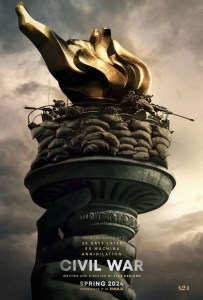 In writer/director Alex Garland’s Civil War, the United States has broken after a third-term president (Nick Offerman) has disbanded the FBI, attacked his own citizens, and used the power of the government to remain in office. The forces of California and Texas have joined an unlikely alliance to depose the American president. With this conflict escalating, we follow a group of journalists, primarily prize-winning war photographer Lee (Kirsten Dunst) and her would-be protege Jessie (Priscilla’s Cailee Spaeny), as they drive from New York down to D.C. with the intention of getting one more interview with the president before it all comes to a bloody end.
Civil War is Garland’s (Ex Machina, Men) attempt to evoke the ethos of journalists who stress merely trying to depict the world rather than question it. It’s a movie really about shared trauma, as these characters are plunged into a world where your neighbor might be stringing up men at the car wash. Garland’s sound design does him major credit at being able to keep his audience unsettled, not just in the melange of gunfire and explosions but also the absence of sound. After one close explosion, the sound drops completely for over a minute. During key parts of the frantic action, the movie will cut to the black and white images of our photographers, providing an immediate reprieve to contemplate as a depiction of what is taking place. Garland’s movie keeps things on a realistic level and is really less of a movie about an America on the brink than a story of journalists going about their dangerous job. It just so happens that instead of it being Afghanistan or Syria or other more familiar war zones that it’s the United States. As a simplified, point-A-to-point B war zone road trip, the movie works well enough, unless, that is, you’re expecting anything more than the quasi-objective documentation of terrible acts.
 However, that same ethos of centrist non-engagement also kept me struggling to really invest in the movie. I kept waiting for… simply more to happen, for insightful exchanges with our characters, for harrowing moments really crystallizing the state of this nation, for clues that gave a clearer picture of the larger conflicts and how the United States got to this point. For anyone expecting much from Offerman’s presidential character, he’s literally in the movie for, at best, two minutes. The far majority of the movie follows along on this road trip with these undeveloped characters taking pictures of occasionally upsetting and occasionally mundane events, although the totality of these events fails to add up to a clearer picture or more coherent social commentary. I just kept waiting for the characters to get more compelling, along with the conflict, and it just didn’t. I think we were following the wrong characters, people who are trying to stay objective and above it all, because then they’re just stand-ins for a camera and a microphone. We know Lee is a celebrated war photographer, and we get snippets of her past worldwide skirmishes, but what else do we know about her? What else do we know about Jessie, besides she’s an aspiring photographer who idolizes Lee? Does a mentorship relationship form? Not really. Does a rivalry form? Not really. The characters are just there, opaque, acting essentially no more than a stand-in for the audience. Now there’s a deeper conversation to be had about the ethics of embedded journalism, of documenting horror rather than intervening, or turning tragedy into digestible art for the masses. What are the ethics of non-intervention and holding to one’s moral objectivity in the face of the most objectionable? However, this is not the movie interested in having that conversation.
 The world of this civil war felt strangely unaffected. Hotels are going about their business, WiFi is carrying on, local shops are carrying on their discounts. I understand that part of this is meant to be surreal, the juxtaposition of a nation going about business as usual, even though these are unusual circumstances, but it makes the movie feel less significant, and the cavalier attitude of the characters continually betraying the stakes of the drama. If it’s just another assignment, how bad can it be? It makes Civil War feel like there’s hardly much of a civil war going on, which begs the question why even tackle this concept if this is it? If you have a movie about an American civil war but pussyfoot around on the why, forgo making the impact felt, and have the majority of the characters shrug it all off, then why are you even going through this story? The apolitical nature makes it so that many viewers will project their own perspectives and prejudices to fill out the unspoken history. It’s an interesting artistic decision but also one that nagged at me as a “both sides are bad” declaration to the middle to tell us that polarization is the real enemy.
There are a few sudden jolts and unsettling moments in the movie, but watching Civil War feels like I’m only watching 45% of a movie that will never be filled in. By that I don’t mean I need every point spoon-fed to my stupid plebeian brain, but I needed a movie where the time added up to something more substantial than “people do bad things during war.” I kept mentally going back to The Purge franchise, a concept that asked what people might do if they had a brief window of lawless freedom, and what that says about us as a society when the rules are put on hold. That is a franchise that embraces its genre roots and premise but finds ways to make its concept a reflection of our troubled times, and while it’s blunt commentary, when we have Nazis marching in the streets, maybe blunt times call for blunt commentary. Civil War feels so timid to say anything really that might be relevant to our current anxious and fractious political climate. Civil War was disappointing to the point that I was longing for the clarity and conviction of The Purge franchise.
 There are so many different versions of this story and concept that can prove compelling, so it’s all the more mystifying for me why Garland wanted to pick this version. Imagine a grueling Downfall-style drama about the last hours inside the White House of a three-term fascistic president who turned on his own people and enacted a bloody civil war, and imagine watching those closest to him reconcile with their own culpability as well as the resignation of the end coming for all of them and what they have done. Or even imagine a similar version about being behind enemy lines and looking for safe harbor, not knowing which American could be trustworthy and which might ultimately be a defector (as Jesse Plemons so ominously says in the movie’s intense high point, “Okay, but what kind of American are you?”). There’s a little known indie war movie from 2017 called Bushwick, starring Brittany Snow and Dave Bautista, that has a similar premise, following a military invasion of Brooklyn (Texas allies with the Southern states to attack the big cities, though they didn’t expect so much push-back from the locals). This is a better version of the similar modern civil war premise, with characters that are more compelling, a conflict that keeps upending our sense of safety, and some gutsy filmmaking choices, not all of them successful (the ending is too bleak and mean and deserved a ray of hope). There are myriad ways to tell this story and make it engaging and though-provoking, and Garland inexplicably chose this dull option. You could do worse than Civil War, but with such tantalizing dramatic potential, you could do better.
Nate’s Grade: C+
Share this:

Late Night with the Devil (2024)/ Immaculate (2024)
 Late Nigh with the Devil is an intriguing novelty, a found footage item of 1970s late night talk show fame reportedly documenting the last show of Night Owls, a talk show hosted by a man who recently lost his wife to cancer and is also slipping in the ratings and losing his traction in the industry. So Jack Delroy (David Dastmalchian, best known as Polka Dot Man in 2021’s The Suicide Squad) gets the great idea to hold an exorcism live on stage or his big spooky Halloween show. What could go wrong, right? The movie is dedicated to upholding the style and awkward tone of 1970s talk show, and its commitment is by far its most interesting aspect to the found footage sub-genre. I wouldn’t classify the movie as necessarily scary, but it held my attention and I appreciated the corny little nuances of recreating an older form of television and comedy schtick, with a growing sense of foreboding as things start to get progressively worse and Jack pressures his new girlfriend, an occult writer, to bring out her possessed pupil. It takes a little long to get going, and the overall conspiracy of Jack’s connection to an Ilumminati-esque showbiz cult feels so tangential to be important, but I was objectively impressed with the overall recreation of an archaic form of TV. The conclusion, once all chaos is finally unleashed, breaks the rules of the found footage setup but at that point it’s welcomed and things can get a little more weird and visually audacious. Late Night with the Devil works more as a late-night curiosity than a boo-style horror thriller. I appreciated the committed efforts and artistry, as well as the game actors and some wicked gross-out makeup prosthetics, more than the overall movie.
 Nuns in Distress has long been a horror genre staple, as the mixture of Catholic imagery and overwrought religious themes proves an unbeatable mix with classic exploitation elements, the depraved and the sanctity. To this we have Immaculate with rising starlet Sydney Sweeney (HBO’s Euphoria) as an American nun traveling to a remote Italian convent and becoming an unwitting victim in a sinister ploy to gestate a new potential messiah. While very serious and broody in presentation, Immaculate is a pretty by-the-numbers mystery that goes to its most obvious route and becomes an overextended hostage thriller for Sweeney. The movie is at its best when it gets crazy, and that includes Sweeney, when she’s allowed to be all-out histrionic. For too long, the movie is too somber and simmering, which works best if the mystery is at least involving and surprising or we build to a great gonzo finish. I wish the movie was more wild. The ending is the best part of Immaculate, where Sweeney is pushed to the point of intense madness, while splattered in blood as per genre rules, and is forced to make extreme and personal choices. In that regard, perhaps Immaculate best operates on a metaphorical level about the horrors of pregnancy, more forced birth from oppressive leaders, and restricting women’s autonomy in a post-Roe v. Wade world. It’s a long wait to that worthwhile finale, and you might get restless from your unholy wait.
Nate’s Grades:
Late Night with the Devil: B-
Immaculate: C
Share this:

Scoop (2024)
 It’s like a British Bombshell, a behind-the-scenes account of the media attempting to hold key political and public figures to account for gross sexual imposition. With the Netflix drama Scoop, it just so happens to be Prince Andrew (Rufus Sewell), interviewed by BBC TV journalist Emily Maitlis (Gillian Anderson) in 2019 and scrutinized heavily for his close ties to former friend Jeffrey Epstein. The first half of the movie is about the wheeling and dealing behind the scenes to garner the high-profile interview, to convince Andrew he can clear his name after his connections to Epstein resurfaced. The second half of the movie is pretty much just the interview, which is indeed interesting to watch for the inherent drama, but after a while, I wondered what this movie was adding that I otherwise couldn’t gain from simply watching the actual 2019 BBC interview? There aren’t really scintillating details or clever scheming to guarantee the interview or outfox its news rivals, and the newsroom personalities, lead by Billie Piper (Doctor Who), are hard-working and tireless stock types that don’t leave much of a distinct impression even after the time together. It’s really a plainly presented dramatized version of the infamous interview, the one where Andrew was professing his innocence against his Epstein accuser with his bizarre argument that he has a condition where his body doesn’t sweat. Anderson is great, and Sewell is terrific as he melds into this figure of complacent arrogance and self-delusion (the makeup is also quite impressive). Still, if you’re really interested in gaining further insight, you might be better off looking elsewhere, or just watching the original interview. Consider this a bonus epilogue to Netflix’s The Crown for any die-hard royal aficionados.
Nate’s Grade: B-


 nathanzoebl
You must be logged in to post a comment.