Category Archives: 2021 Movies
He’s All That (2021)
 I’m sure there aren’t too many who consider 1999’s She’s All That a great film, or even a great high school comedy film, but I know there are fans and I know nobody was clamoring for a Netflix gender-swap remake starring one of Tik Tok’s most famous users. We didn’t need the original but it was a mildly amusing version of My Fair Lady, or its older inspiration Pygmalion, set in the superficial class system of an American education system. It came out during the heyday of 90s teen cinema remaking older literary concepts (Ten Things I Hate About You) and made short-lived careers for stars Freddie Prinze Jr. and Rachel Leigh Cook. My amazement is Netflix rehiring the same writer, R. Lee Fleming Jr., now 50-something, and asking him to remake his twenty-year-old hit for the voice of Generation Z (It’s not even like “all that” has held up in slang parlance). This movie feels every bit the dismal corporate-sponsored, cash-grabbing, star vehicle that it is. Nobody in Generation Z cared about She’s All That, and now very few will really care about He’s All That.
This time we follow Padgett Sawyer played by Tik Tok star Addison Rae (83 million followers in real life!). Padgett is a high school senior who has millions of online followers who hang onto her every word of advice. She uses her position as an influencer to even help pay the bills at home to relieve her overworked mom (Rachel Leigh Cook, not the same character) and maybe pay for her college. She live streams catching her boyfriend cheating, loses her cool, and becomes a meme thanks to an unfortunately timed snot bubble. Now she has to earn back those lost followers and her respect or else she might not still maintain her ascendant social media standing and pay for school. Her catty friend challenges her to makeover a loser guy at school and the hopeless case ends up being Cameron Kweller (Tanner Buchanan), a sarcastic, arty loner who wears a beanie and has long hair (a wig) and rides horses and practices karate. What a loser. She buddies up to Cameron and through that friendship she starts to question her own sense of self and learns what’s really important as she physically changes this guy to be more acceptable to a mainstream opinion of people she’ll never meet in real life. Or something like that.
 The inordinate influence of social media is a very worthwhile avenue to explore for modern satire as a means of separating this He’s All That from its predecessor and making it relevant. The problem with He’s All That is that the movie refuses to go very deep or hard-hitting with this topic because it’s also meant to be a vehicle for fame to launch the feature acting career of Rae. I’ll fully admit, dear reader, that I had no idea who Rae was until watching this movie and I don’t really get the appeal (more on her acting ability later). In this movie, Padgett is obsessed with maintaining her carefully curated online image, a ruse that relies upon a fantasy that no human being could adequately maintain. She wakes up and goes through an entire routine of makeup and hair styling before she records herself “just waking up.” It reminded me of a joke from the fabulous TV series The Marvelous Mrs. Maisel where the title character makes sure her husband never fully sees her in the morning how she actually looks. It was funny then because it commented on the pressure of wives in the 1950s, let alone those from Jewish families, to live up to an impossible beauty standard to appeal to the man’s comforts and desires. With He’s All That, it really becomes the last joke at the expense of our main character. The movie is too afraid to delve any deeper for fear of directing negative attention toward its star and her influencer ilk. It even conveniently sets up the good of her position, what with her able to pay some bills. She can’t be all bad, you’ll say, because she’s helping her mom. I guess we like social media facades now.
Padgett’s plight really doesn’t make much sense in the context of the movie. She’s dropped perhaps a fifth of her many followers after the embarrassment of her public breakup with her louche of a boyfriend, a wannabe recording artist. First off, I don’t know why this personal incident would be so detrimental to her character. Her boyfriend was clearly bad, she stood up for herself, and I would think that would only make people like her more and draw more followers to her brand. The only reason she has to worry is because we’ve awkwardly included Kourtney Kardashian and an even bigger social media influencer. I don’t know why we have a Kardashian here, and I don’t know why she doesn’t merely play herself, unless that too would be another example of striking too close to home with the satirical depictions. Regardless, Padgett is worried she’ll have to, gasp, potentially take out student loans for college. She believes that picking someone to grant a makeover would get back lost followers, which makes some sense, but then her friend also elects to make a personal bet about selecting some campus schlub and turning them into a heartthrob. Why does our main character need two motivating forces for why she agrees to participate in this bet? It’s needlessly extra for a movie with so little else going on.
 Another fault is that there is no chemistry between our leads, which kills the investment in any romantic comedy. The two actors are not a good fit from the beginning, and this comes down to two factors, the underwritten characterization and the limited acting ability of Rae. It was a joke in Not Another Teen Movie, a not-so-great spoof over those popular 90s/early 2000s teen comedies, that the thing separating the obviously beautiful girl from “plain Jane” territory was merely glasses and a ponytail. Cameron is already an appealing guy so when he gets his big physical transformation it’s really just scrubbing off stubble dust and removing the beanie. His character, a self-described outsider, would be unlikely to be seduced by the wiles of popularity. There’s also precious little to be uncovered with the character of Padgett, so the movie can’t even have Cameron fall for Padgett as he realizes she isn’t like his preconceived notions. There’s no heat or sizzle or any point of intrigue between these two that would compel an audience to root for their eventual coupling. Cameron, we’re told, like “Kurosawa, Kubrick, and kung-fu movies,” and he’s basically the gender reverse of a shallow rendition of a manic pixie dream girl who is ultimately just there to get the protagonist to stop and appreciate life and then sublimate their own interests and desires to that of the protagonist. This is a romance where you root for irrevocable heartbreak.
Rae might be an overall pleasant presence but she’s not quite there in the acting department yet. Her limited range really dampers many of the dramatic moments. Her line readings are extremely monotone. There are moments where I thought she was just going to smile her way through a scene. There were several scenes where I was convinced they could only have filmed two takes because this had to be the best one by default. I don’t want to pile on Rae. I don’t know the woman and she’s only twenty years old and this is only one role. Except He’s All That has also clearly been tailored for her and she cannot live up to these standards at this time. There’s an egregiously long dance battle at the prom that goes on forever just to take advantage of Rae’s dance skills from her Tik Tok dances. It’s the same kind of contortion done to make room for Buchanan’s (Cobra Kai) martial arts skills with a silly fight with Padgett’s ex-boyfriend.
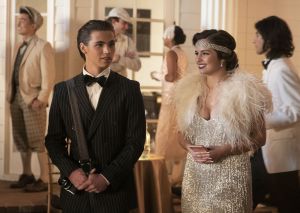 If I was overly cynical, I would estimate that the producers of He’s All That sought an older IP that might still have some pull with an older audience that could be stripped down to its parts and slapped together with a formula that could platform its young stars while also barely hitting that 80-minute feature running time requirement. Except that sounds exactly like what’s happened with He’s All That as well as the preponderance of product placement. This entire movie is a cynical enterprise. It’s not funny at all. It feels completely inauthentic with its portrayal of modern teenagers and social media lifestyles and even the appeal provided by a social media following of fans giving instant validation to every coordinated effort to be your phony best self. The director is Mark Waters, a man who helmed Mean Girls, the 2003 Freaky Friday, and the dark indie comedy The House of Yes. He has talent. He knows how to shoot a comedy. He knows that not every scene needs to be overly lit like night and shadow have no meaning and it all looks so cheap. While watching He’s All That, you’re left with the strong impression that everyone should know better, and you should know better than spending 80 tepid minutes of your time watching this cynical exercise.
Nate’s Grade: D
Share this:

The Green Knight (2021)

The Green Knight is an indie drama heavy on atmosphere and mood and a little lax on pacing, falling into yet another A24 discrepancy between critics and audiences. Much like the contentious differences of opinion over It Comes at Night and Hereditary, it seems like general audiences are a little more indifferent to hostile for this arty release than the critics. Maybe they were expecting something more conventional, which is a mistake considering it’s written and directed by David Lowery, who has dabbled in a studio sphere (Pete’s Dragon, the upcoming Disney Peter Pan remake) but seems more at home with introspective, quiet, occasionally overly obtuse art-house pictures, the kind like 2016’s A Ghost Story where Rooney Mara eats a pie for ten minutes (I will never forget this puzzling movie moment). It’s not surprising then that The Green Knight would be a polarizing film of differing expectations. It’s got good graces, an artistic vision, and a preponderance on atmosphere that can feel a little strained at points.
Gawain (Dev Patel) is the nephew to the King of England (Sean Harris). He longs to be accepted as a respected knight but he has no adventures to his name. Then one Christmas, a Green Knight (Ralph Ineson) enters the kingdom and challenges any daring knight to a game. That knight can inflict whatever blow or mark upon him, but then the Green Knight will return the exact favor in one year’s time. Full of bravado, Gawain takes mighty Excalibur and decapitates the Green Knight. Turns out the knight is not dead. He only picks up his fallen head and promises that in one year, he’ll deliver the same to Gawain. The months pass and Gawain is drinking and sleeping away his last remaining time before finally accepting to meet his fate. He rides out of Camelot in search of the Green Knight and perhaps a solution out of his predicament.
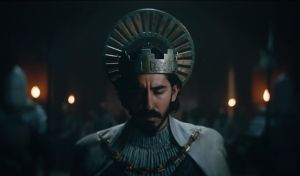
Where The Green Knight excels is with the distillation of mood and myth-making while not losing sight on its own sense of humanity. This is an Arthurian legend that is potentially a thousand years old, and when it comes to big screen adventures steeped in the mythology of cultures, it’s easy to get swept up in the fantasy spectacle of monsters and heroism. The vulnerability of the heroes is often cast aside to provide further attention to the grandiosity of the experience and entertainment. Lowery positions his movie from the perspective of an eager naïf yearning for a proper adventure to bring him respect and legacy, but he’s also a scared young man who is dreading the worst possible outcome that could be his only outcome. As Gawain sets off on his quest, he sets off proud, striding along his horse, not looking back at his home as he rides off to face his destiny, and then he’s immediately beset by treachery that removes the pristine shine off the tales of old. He’s taken advantage of by highway robbers and placed at an even greater risk of failure. As the movie progresses, Gawain becomes more and more anxious about the potential of getting himself out of his predicament. It truly seems like he’s marching off to meet his executioner, and that realization forces him to quickly adapt into the heroic mold he’s been aspiring for, the legendary knight, bold and brave and meeting death square in the eye. That sounds good in theory but it’s a lot harder to realize in real life. If any one of us, dear reader, knew that our lives were coming to an end with certainty, summoning the courage to meet that would be a herculean effort, and many of us would crumble under the pressure. It all doesn’t seem like enough time. This is what I appreciated throughout The Green Knight. It has its weird, atmospheric mythology and fantasy elements, but it also grounds the drama in relatable and nervous human emotions.
Where the movie goes astray, at least for me, is the time it devotes to achieving its poetic atmosphere. This is a two hour-plus movie that feels every bit of it, even if you’re enraptured by all the pretty style and ponderous pontificating. That’s because the movie is very episodic by nature, which at least breaks it up into manageable chunks each with something new to draw our attention, but it also makes it feel like less is being earned or amassed. In one segment, Gawain rescues the head of a ghostly woman (Erin Kellyman). In another segment, this one quite awkward to experience, he is tempted by both the lord (Joel Edgerton) and lady (Alicia Vikander) of a household, keeping his vow while something most distracting is taking place simultaneously. Another segment has Gawain interacting with giants, including one breastfeeding a little giant. There’s also a fox who occasionally talks and tries to plead with Gawain to turn away from meeting the Green Knight. I suppose if you’re being charitable you could surmise each of these stops is like a test of his skills of knighthood, from compassion to chastity to dedication, but it feels less like an accumulation and more like Lowery is simply finding time to explore other weird offshoots of this crazy fantasy medieval world.

A term I first used describing the films of Nicolas Winding Refn (Neon Demon), a filmmaker I’m not particularly fond of, is the use of empty space, where the narrative feels stretched out and the audience is intended to provide that extra level of meaning for the dead air. To me, it’s narrative forfeiture. The Green Knight could have been trimmed down, it could have been reordered, it could have been given more specific meaning, but that would potentially detract from its tone poem qualities. If that cinematic sensation works for you, and you fall under the film’s sway, then congrats. If you’re looking for more or at least more meaning in the plot and chain of events, then you’re going to be left grasping for more significance. Sometimes things just feel put into the movie because, beyond all else, it’s simply cool. That’s fine, though I found too many of the asides to be lacking once the initial obstacle was established. Lowery has a larger thesis under the surface about environmental awareness considering the Green Knight is literally made of wood and plants, he goes out to the forest to live on his throne amongst the wilderness, and there’s even an extended fiery monologue by Vikander about the enduring power of “green” and how it will outlive us all and grow over our corpses (if you were being pedantic, you could argue that all color will outlive us as I doubt there will be a nightmare future without, say, the color orange). The larger thesis, however, doesn’t feel supported by the asides and episodes of Gawain. I guess it’s about thinking of the consequences of our actions and, in a way, proportionality or response. Maybe more people would reconsider their carbon footprint if nature was going to cut off their heads as a consequence of using too many plastic straws. Maybe.
Where Lowery’s plot and ambition do come together, thankfully, is with his conclusion, which I will spoil in the following two paragraphs. In the original Medieval legend, Gawain meets the Green Knight who proves to be the lord of the manor in disguise. The man playfully chides Gawain for flinching and wearing a sash he felt would spare him of harm. He then says Gawain is “the most blameless knight in all the land,” which makes little sense, and then Gawain joins the other knights, and they all have a big laugh about the jape played on Gawain. That’s not exactly a satisfying ending and takes away any personal growth Gawain might have earned. In the movie, the Green Knight is for real. Gawain initially lowers his head, trying to summon the courage to meet his death, but he flees and apologizes, escaping the Knight’s retribution.

In a nearly wordless epilogue, we watch Gawain’s life over the course of decades, inheriting the throne, siring an heir, abandoning the mother, leading his people to war, losing his son, and eventually being such a disliked leader that his own people revolt including his own family members. All the while he wears that magical sash to thwart his own demise. This epilogue is revealed to be a flash forward for Gawain, who returns to the moment of consequence with the Green Knight. Rather than flee his fate, he now chooses to accept it, to avoid this future where Gawain goes down a path of corruption and neglect. Better to die now than become a cruel despot that will harm others. He even removes the sash. It is here where the Green Knight finally acknowledges Gawain with respect. It’s this ending that really hits home the themes and the character arc for Gawain. He’s become a knight worthy of legend but has no audience, and is choosing to have no audience, to die alone rather than live in infamy. He’s found his sense of bravery at long last because of his fear of what avoiding his fate will cost. It’s an ending that feels earned and when the Green Knight is giving him an “atta boy” you want to join in.
The Green Knight is going to be a different experience for each viewer depending upon your patience for ambiguity and pacing. I found myself at points marveling over the mood and visual style of Lowery’s vision, and at other points I found myself getting restless with the episodic side quests and the stalled character development. It all comes together by the end with a finale that really cements Lowery’s big ideas and drives homes the personal journey of Gawain. It’s all a mixture of bold and beautiful and a little bit boring.
Nate’s Grade: B
Share this:

Reminiscence (2021)

Reminiscent of other moody sci-fi/noir mashups like Dark City and The Thirteenth Floor (oh the 1990s), I mostly wish that Reminiscence had been less devoted to film noir trappings and explored more of its intriguing sci-fi setting and implications. Set in a future where seas have covered much of Miami, Hugh Jackman plays a memory specialist who helps clients/nostalgia addicts find peace by reliving their past experiences through tech tanks. It’s an interesting start and of course, as per noir rules, he’ll stumble across a mysterious woman (Rebecca Ferguson) with a troubled past that he can’t help but fall in love with even as it becomes clear she had ulterior motives for meeting our hero. There’s an obvious and potent commentary at play about worshiping the past at the expense of the future and the consequences of our actions, played on a personal level and a larger ecological warning. The problem is that it takes far too long for me to care about the movie. As expected, the mysterious woman vanishes, and Jackman is determined to find her, but I didn’t care about their relationship nor find this woman charming or anything other than a plot catalyst. We needed a more urgent sense of stakes to increase audience engagement. It wasn’t like she framed Jackman who then had a certain amount of time to clear his name with bad people or the police. There’s no real reason to root for Jackman to find this missing woman besides that he’s sad. This Chinatown-meets-The Cell movie is written and directed by Lisa Joy (co-creator of HBO’s Westworld), and there are interesting ideas to go along with its near-future world, and yet it all feels like a few drafts away from honing its real potential. I feel that the noir trappings strangle the storyline as far as what its ultimate imagination can be as it tries to fit into a familiar formula. Jumping into people’s memories as an investigation seems far more exciting than pounding the flooded pavement for answers. Reminiscence is a bit more conceptional than what it can deliver. It’s not terrible but it’s not terribly interesting either. Why isn’t there more with the police utilizing this technology to solve crimes or invade people’s privacy? That seems like a better starting point for conflict than “mysterious woman comes into shop.” There are some stunning visuals and points of excitement, like a fistfight that tumbles into a sunken concert hall. The ending is fitting and slightly poetic though heavily predictable given the preoccupation with repeating select conversations about the tragic nature of love stories. The problem with Reminiscence is it’s too reminiscent of too many other genre influences without providing enough of a story or characters or mystery or world to stand apart. If you’re a fan of Dark City, you might want to check out another stylish sci-fi/noir mashup, or you could just re-watch Dark City.
Nate’s Grade: C+
Share this:

F9: The Fast Saga (2021)
 Has a multi-billion-dollar franchise ever had this much confusion and inconsistency with a name? The Fast and Furious saga, which is what we’re now calling it I suppose, began twenty years ago in 2001 and has undergone all sorts of titular irregularity. We’ve had different adjectives favored (Fast Five, Furious 7) and even gone the route of number-related wordplay, like 2018’s very soap opera-sounding The Fate of the Furious (spelled F8 in some incarnations). The ninth entry is titled F9, and by the logic of the previous sequel, I would assume that was intended to stand for “Fff-nine,” or likely “Fine,” and at this point an implicit admission of the franchise just not even trying to be relatable to any kind of recognizable pattern or order or even coherency. Alas, the title is apparently only supposed to be read as F-9, followed by the also soap opera-sounding The Fast Saga subtitle (sorry, “Furious,” maybe you’ll regain credit billing in the tenth movie in 2023). Maybe that will include the soap opera-sounding subtitle, “As the Wheels Spin.” It’s all just a curious way to handle name recognition for a twenty-year blockbuster franchise. F9 was delayed a year from COVID, a phrase that will be repeated a lot with upcoming fall releases, and after watching the 130-minute sequel, I think the franchise has finally exhausted its general appeal for me.
 I’ll begin by stating my own apologist stance on the Fast saga. I’ve never been invested in this franchise for the characters (with the exception of The Rock because he is The Rock) or for the stories, and I doubt few others who even consider themselves fans would differ. I watch these movies for their ridiculous stunts and action set pieces that don’t just defy the laws of physics but make the ghost of Isaac Newton vomit. As long as those action set pieces delivered the goods, I was able to forgive much. And I have had to ignore or forgive a lot but until now I have found those set pieces able to clear an increasingly elevating hurdle, the baggage of these characters and trying to make me care even as they become impervious superheroes that have long left the earthbound trappings of a scrappy team of underground street racers lead by Vin Diesel back in 2001. Now Diesel is 54, every member of his beloved crew/family will never die even after they appear to die, and the filmmakers have decided to introduce a long-lost adult brother played by John Cena, never mind the fact that these two muscle men don’t look like they share a single shred of DNA. It doesn’t matter, and the question remains what even matters any longer for a franchise defined by its brain-melting excess? It’s a soap opera with spy missions. It’s dumb fun to eat popcorn to. That’s all.
I acknowledge the inherent absurdity in bemoaning the over-the-top nature of a franchise whose very appeal was its over-the-top nature. It’s hard to define but every movie universe has a line of sustainable believability. Once that line is crossed, you feel it. The Fast saga has played with this tenuous tonal demarcation line for over a decade. In the eighth movie, the cars were outracing a nuclear submarine and cracking ice floes and The Rock redirected a torpedo with his biceps. That’s crazy, but remember The Rock is a superhero among us mere mortals. In the seventh movie, the cars parachuted out of a cargo plane and drove through skyscrapers. In the sixth movie, they faced off against a tank. And yet, I happily accepted those flights of fancy because they kept me entertained ahead of that nagging sense of incredulity that they were able to somehow outrace. With F9, even with the return of director Justin Lin (Fast 3-6), it feels like the franchise finally crossed that line for me. I completely understand any reader that wants to point and shout “hypocrisy.” In the arms race of action imagination where the producers have had to come up with bigger and more wild set pieces, I think they have inevitably gone from self-parody into ironic self-aware self-parody and back into self-parody again. The best way I can describe it is with the two Expendables movies. The first was amusing action bravado self-parody but then the second film tried to be in on the joke, and all the winking “we get it too” meta commentary just sapped all the enjoyment out of it. The same thing happened with the two so-bad-they’re-good Birdemic disaster movies, with the first a sincere bad movie, and the second trying to be an ironic bad movie, and it just wasn’t the same. The appeal was gone. For me, F9 is the signal that this franchise has begun its descent into Birdemic 2 range and yes, they go to space in a space car and isn’t that what all us irony-drenched fans wanted? It’s like the disappointing be-careful-what-you-wish-for warning of Snakes on a Plane all over again.
 Another factor that sank the movie for me was the inclusion of the long-lost brother storyline, especially considering the Diesel character is all about the vague platitude of family. In order to justify this significant oversight, the storyline has to resort to numerous flashbacks to fill in the sordid family details between the feuding brothers. I cannot overstate just how much I do not care about the characters in this franchise, so devoting more time to introducing complicated family histories with melodramatic flashbacks is not what I want to experience during the downtime in between the next explosion. By trying to take these characters and their relationships seriously, or seriously enough, we’re forced to slog through personal drama nobody asked for or actively desires. Better to embrace the soap opera absurdity and just have Cena show up and then every other set piece another long-lost brother shows up, and then we keep cutting back to the same singular flashback but now it’s revealed that another brother was there too previously unseen on the peripheral of the camera. The same thing goes for having to bend over backwards to explain the re-emergence of Han (Sun Kang), a character killed in the sixth/third movie by the-then bad guy (Jason Statham) that we like too much now to be the bad guy. I don’t care that he’s alive again, and the convoluted yet still unsatisfying vague plot to explain his fake death is unwanted as well. Apparently, the only character who will remain legitimately dead in this series is Gal Gadot (for now).
For the hard-core fans, there may be enough nitro juice in F9 to still provide a satisfying jolt of high-octane entertainment. Lin still has a nice command on action sequence visuals and there’s some large-scale carnage that tickles even while it’s undermining every concept of magnetism. Unfortunately, the joy I felt with previous action incarnations from the series was not recaptured this time. It just doesn’t feel as memorable, at least in a positive way. Going to space is memorable, but not in a positive way, unless they had to race a universe of aliens on the moon to save the Earth. I genuinely like Cena as an actor, but he’s far too strait-laced and dull here. Watch the recent Suicide Squad reboot to be reminded just how charming and comically talented he can be in the right role. Diesel seems to be putting less and less effort into every performance almost like a dare to the audience on how little they will accept. There were a few shots I watched where I felt like he was on the verge of going to sleep. The villain is lame, the movie has too many competing comic relief characters, and it’s all too long. I’ve been a defender of the blockbuster bombast of the Fast saga. I’ve considered myself a fan of its outlandish set pieces and ludicrous stunts. I’ve been able to ignore what didn’t work. Alas, the time has come where I can no longer do that. I just felt mostly indifferent and bored for much of F9, and its action highlights couldn’t save the extra emphasis on convoluted soap opera melodrama. Your mileage will vary as far as what you can forgive, but F9 feels like the appropriate off-ramp for me.
Nate’s Grade: C
Share this:

The Forever Purge (2021)
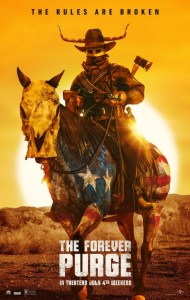 While the franchise is starting to diminish, there’s still enough blunt power and appeal to the Purge series that I welcome a new addition every few years. Coming at a time of renewed political peril, and where the world of its satire seemed to be indistinguishable from regular headlines, the Purge series for me has gained a renewed relevancy, and while many scoff at how blunt the filmmakers are with their commentary, I say we live in blunt times and sometimes a social sledgehammer is more applicable than a scalpel. Once again, the franchise seems prescient with its premise for The Forever Purge, a band of violent extremists refusing to accept the end of their murder party and thinking that the laws no matter apply to them because they are the real American patriots. There’s a definite perverse pleasure to be had watching these racist goons getting taken out one-by-one by the predominantly Mexican cast of heroes. In a post-Capitol insurrection universe, this movie can be a necessary release for many patriots who view that awful day with risible contempt. The U.S. government, once again under the control by the evil party that introduced the Purge, is now fighting against the white supremacist forces they have riled up and can no longer control for their own benefit. The Canadian and Mexican governments are offering a limited time open border to any American seeking refuge from the chaos and violence of its own government. There’s more heavy use of jump scares with The Forever Purge and the supporting characters and scenarios aren’t given enough attention to stand out or really savor (sadly, there is no Skeletor reappearance). It lacks a strong sense of climax; more so they just ran out of goons to kill. And yet, I appreciate that this movie reminds us how quickly outsized evil can come back when we think we have it vanquished, something to think about in a post-Trump presidency that doesn’t feel very post-anything close enough eight months later. This is probably the weakest movie of the franchise so far but it’s still a serviceable B-movie with enough action and comeuppance to please fans of the anarchic series.
Nate’s Grade: B-
Share this:

The Suicide Squad (2021)
 When Disney foolishly fired writer/director James Gunn for offensive past tweets, tweets the studio had already known about before hiring him to helm the first Guardians of the Galaxy Marvel movie, the brass at DC was more than happy to pounce. They offered Gunn the opportunity to tackle any of their many superhero properties. Gunn had earned a reputation as a blockbuster filmmaker whose bizarre sense of humor and style made him just as much as selling point as the property itself. Gunn gravitated to the Suicide Squad, though he didn’t want to be beholden to the 2016 film from writer/director David Ayer. The studio gave Gunn free reign. He could do whatever he wanted creatively, which just happened to be an extremely violent, R-rated sequel that also serves as a soft reboot. Gunn was the perfect person to tackle a project like The Suicide Squad and even with all his goofy humor, gallons of gore, and slapdash dispatching of numerous big names, there’s a real affection for these scruffy characters. Not that there was a big hurdle to clear, but this is clearly the superior big screen Suicide Squad.
Amanda Waller (Viola Davis) has assembled another team of criminals and has-beens and tasked them with a mission. If they fail, or deviate from their orders, she will detonate an explosive placed within the skulls of Task Force X a.k.a. the Suicide Squad. Skilled marksman Bloodsport (Idris Elba) is extorted into being the defacto leader of a band of squabbling misfits that includes Harley Quinn (Margot Robbie), the patriotic warrior Peacemaker (John Cena), the vermin-controlling Ratcatcher (Daniela Melchior), and even a giant living shark, King Shark (voiced by Sylvester Stallone), with a voracious appetite. The squad must destroy a scientific station on an island nation that has undergone a military coup and great political instability. Within that station, run by mad scientist The Thinker (Peter Capaldi), is a threat that could doom the world. Enter the Suicide Squad, but can they even be bothered to save the day?
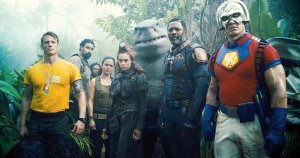 It feels like Gunn wanted to take the most ridiculous, pathetic characters in DC cannon and then find a way to make them appealing and worth rooting for. There is a strategy to take the scraps of the comic book universe and to make gold out of them. Case in point, Polka Dot Man (David Dastmalchian), a figure easily ridiculed by fans and populating just about every list of the worst villains of comic book lore. Gunn takes the maligned character and says, “Yeah, I’m going to keep his dumb power of flinging polka dots, and by the end, you’re going to care,” and you do care, or at least I did over the course of the film’s 132 minutes. Gunn is drawn to strange, dysfunctional found families, the misfits of society who find an unexpected kinship with one another. You can tell that even when Gunn is at his most irreverent, he still has an acute sense of reverence. The team-comes-together aspect of these sort of movies plays as a predictable but satisfying formula, and while I wouldn’t say anything took hold of my emotions like the best of the Guardians entries, I did come to care about the core of the team. I cared about the father/daughter dynamic between Bloodsport and Ratcatcher. I cared about Polka Dot Man coming into his own as a hero. I cared about King Shark feeling like he had a group of friends. The fact that I typed those last two sentences, which would sound insane absent context, is a testament to Gunn’s strengths.
The climactic villain, whom I will not spoil, is the greatest example of making the most with the least. It is immediately goofy to the point of laughter but still threatening and creepy. Gunn has taken one of the weirdest characters in comics and given it its due. Even by the end, as this villain is vanquished (not a spoiler), the movie finds a small moment to re-contextualize this absurd character as another victim. It was happier before being kidnapped and experimented upon by its devious captors. Even that extra passing consideration is impressive.
The movie also lets its weirdos have their fun. Watching bad guys, who are somewhat bad at being bad guys, try their hand at being good guys, but badly, or at least not as well, has plenty of comedic possibility as well as setting up the redemption and community payoff. The opening beach assault sets the sardonic and sloppy tone. I consistently enjoyed the contentious banter between the different members of the Squad and the jockeying for position. The gag about Polk Dot Man envisioning every enemy as his abusive mother is enjoyably goofy when visualized from his perspective (Elba’s line reading for “It’s YOUR MOM!” is a delight). King Shark’s dullard nature is a routine source of comedy that almost wears out its welcome. Nothing seems out of bound for him to say or do, whereas the others have more defined comedy boundaries. I laughed out loud frequently though some of the comedy bits feel a bit too stale and juvenile even for Gunn (a 69 joke?). This all feels very much like this is Gunn’s $180-million-dollar Troma movie he miraculously got to make with a studio blessing. The violence is over-the-top, occasionally gasp-inducing and occasionally beautiful. That’s an odd but an adept combination for Gunn as a filmmaker, a man who digs into the grimy bins of exploitation cinema and elevates it upon a bigger stage while still managing to stay true to his own silly style.
 Gunn hasn’t dulled the darker reality of his rogue’s gallery either. Bloodsport and Peacemaker get into a macho contest of killing foot soldiers in increasingly theatrical and flamboyant ways where their flippancy and hostility toward one another is the joke. King Shark is portrayed as a dumb brute who also tries to eat team members. Many, many characters have similar back-stories where their parent or guardian or captor experimented on them and live with the lingering trauma, trying not to have their pain define them. The 2016 movie wanted you to see the Squad as PG-13-approved antiheroes. The 2021 movie wants you to remember that they are indeed crazy, demented, dangerous, and murderers. Even Peacemaker, meant to evoke shades of the patriotic Captain America, says he will ensure peace “no matter how many men, women, and children I have to kill.” Harley isn’t fetishized as a punky pinup in short shorts like in 2016 (digitally shortened), but she’s still a psychopath who makes impulsive decisions. Her recognition about always falling for the wrong kind of man is a mixture of sadness, character growth, and a clear reminder that you should not let down your guard around this woman.
Spending time with these characters is made even better from the superb casting. Elba (Hobbes and Shaw) is the biggest welcomed addition; his character was likely initially intended to be the continuation of Will Smith’s Deadshot. Elba is charismatic and self-effacing and handles the comedy and action with equal measures of confidence. When he loses his patience, or opens up about his hidden phobia, it’s even more amusing because of how it contrasts with how naturally suave he is as a default setting. I wasn’t missing Will Smith at all with Elba and his natural accent. Robbie (Bombshell) was born to play Harley Quinn and should hopefully get many more opportunities. Cena (Fast and Furious 9) is so natural at comedy and slides comfortably into a macho blowhard coming into conflict with the other alpha males on the Squad. I loved the simple visual of him strutting around in vacation shorts for a long period of the second act. Viola Davis (Ma Rainey’s Black Bottom) is always excellent and might be the scariest character of them all. There are many joke characters played by actors firmly in on the tongue-in-cheek game.
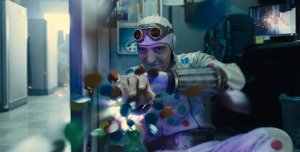 As a second chance at franchise-making, The Suicide Squad is a brash, bloody, and irreverent retake and the best DCU movie yet from a studio that seems to be throwing anything at the wall to see what potentially sticks. That has its benefits, like allowing Gunn the creative freedom to make a movie this crazy and schlocky and entertaining. It’s a shame, then, that this Squad movie looks like it will make a whopping hundred million less in its opening weekend at the box-office compared to its 2016 predecessor. It’s a sign that the traditional theatrical market hasn’t quite rebounded from COVID-19 (even Marvel’s own doesn’t look like it will crack $200 million domestic). It may also be a sign that audiences are not terribly interested about a sequel to a movie they didn’t really care for five years prior. Beforehand, I would have bet even money that the studio would give a blank check to bring Gunn back for more after he fulfills Guardians of the Galaxy volume 3 for Marvel, but maybe that’s not the case. Maybe The Suicide Squad will be more of an entertaining one-off than the start of a new direction for this lagging franchise. Regardless, if anything good came of Disney firing Gunn on dubious terms, it’s the existence of this movie in the interim for the in-demand filmmaker. While not everything works in The Suicide Squad, and the emotional depth is sacrificed for giddy gory bombast, it’s what you would hope for with the combination of James Gunn, wacky superheroes, and a commitment to an R-rating.
Nate’s Grade: B+
Share this:

Nine Days (2021)
 Oddly enough, over the course of less than a year, we now have two movies about young souls competing to find their sense of self before being born. Will (Winston Duke) lives in a small cottage in the middle of the desert. Or so it would appear. He’s a former human who now serves as a spirit who watches over the lives of a select group of others on Earth through P.O.V. monitors. After a car accident, one of his people is killed, leaving a new opening. It’s Will’s job to interview a group of candidates and determine who is best equipped to handle being born. Will takes the process very seriously but he is also more emotionally affected by the loss of life under his guidance than he admits. Where did he go wrong, or is right and wrong even the right markers for assessment? Will must choose wisely over nine days of deliberation and insight into what it means to be human and what it means to live.
 Nine Days is a tender and thoughtful movie that has much under the surface given its metaphysical context and probing questions about spirituality, identity, and existence, but it doesn’t simply rely upon the artistic weight of ambiguity. There’s a genuinely involving emotional drama here that’s accessible while offering greater depth to be unpacked by the viewer who enjoys metaphor and implication and debate. At its essence, the movie is about a series of job interviews but for a position that we don’t fully understand what the requirements are and if even meeting the requirements is enough for the hire. It’s a primarily dialogue-driven procedure but it’s also character-focused as the entire process examines what animates Will, what haunts him, and why he does what he does. Early on, the surreal nature of what should be an ordinary event, job candidates interviewing with a boss, gives the movie an air of mystery and offbeat humor. The candidates are showing up, going through a series of questions and role play scenarios, and with each session, the candidates evolve into the personas that will define them. There’s something mildly profound about watching the development of an identity before it’s even been born. As the movie progresses, Will turns down candidates and the news is truly devastating. Not only will these spirits/souls miss out on being born on Earth, they will cease to ever exist and fade away. That is some heavy stuff. Watching each one come to terms with that sort of death can be heartrending. Just imagining having to accept the end before life ever even began.
Rather than simply fade away into the blank of nothingness, Will chooses to help these souls get one last moment of peace before their ultimate end. He becomes a celestial one-man Make-A-Wish spiritual service. It’s unknown whether these “positive memories” are from the souls’ own development or their observation of the souls that have been placed on Earth. Regardless, each rejected candidate gets a moment that Will studiously recreates as an act of kindness. This section can be rather moving as each soul gets a personal sendoff and, in those final moments to savor, we watch them become affected with the generosity and the fleeting moment of life that will be tragically denied to them. One candidate climbs aboard a stationary bicycle, and Will positions one screen after another, each with projection from that angle of the street. When taken together, it creates the illusion of a nice bicycle ride through a town square. The homemade production, even sprinkling cherry blossoms and a swinging light to illustrate a traveling through a tunnel, provide small moments of affectionate conviction. I found each of these moments to be emotionally rich and beautifully rendered on screen. The care and craft Will puts into these acts is wonderful and a tremendous insight into who he is as a character and what he values in others.
 Will is haunted by the idea that he may have been oblivious to the pain of one of his pupils, and this indecision is coloring his interview process for a replacement soul. It’s unclear what exactly Will is, or his boss, or his duties, but he vaguely amounts to a guardian angel. He has a bank of old TVs that he monitors and obsessively documents the lives of a few. He takes particular pride in one soul on Earth and listens to her virtuoso violin playing as a means of personal relaxation. Her sudden death rocks him, and when it’s revealed that she was depressed, he tries to make sense of being able to see and hear everything these souls do but not fully knowing them. Did he get something wrong in his clerical assessment? Did his understanding of her have its limits? Could she have been hiding something so all-consuming without his suspicion? It all upends Will and fosters self-doubt. He’s trying to make sense of something that may not ever make sense. That is how inscrutable human beings can be and how tragically fleeting life can become in an instant.
The other change agent for Will is the presence of Emma (Zazie Beetz), a candidate who shows up late, questions the nature of the questions she is given, and is empathetic to a fault. The other candidates are playing within the rules of Will’s questions but she’s pushing back, and it only makes Will think more and more about her and her aims. I don’t consider it too much of a spoiler that Emma will be one of two final candidates for the open spot for life. Her character causes Will to reassess his own biases, his own way of doing things as they have, and his own conception of himself and what life can be about including his own time spent on Earth, which he likes to remind the others like it’s bragging rights. I suppose one could argue that, yet again, we have a quirky female character in service of teaching the male hero about the importance of embracing life to the fullest, but I think the general makeup of the characters is superfluous to the impact of the story. We’re dealing with spirits taking a physical form here. Their appearance is immaterial to their identity at this point, at least in an otherworldly realm that (hopefully) knows no sexism and racism.
 Nine Days is the film debut from commercial director Edson Oda and the movie is utterly gorgeous from a technical standpoint. The photography favors gleaming sunsets and pristine vistas to communicate the exquisiteness and otherworldly plane of existence. The desert landscape is beautifully filmed, and the interiors are also pleasing with their visual arrangements and the mingling of natural and artificial light. Oda won a screenwriting award at the 2020 Sundance Film Festival and for good measure. This isn’t just a good-looking indie, which it assuredly is, but there is deep melancholy and beauty and transcendence to be had with the very humane and compassionate storytelling trying to get at larger truths about our limited time. The storytelling has plenty of ambiguity and nuance and metaphor, but there’s an accessible core that I believe most viewers can align with and then, if they choose, can discover further meaning. There is a slightly basic “stop and smell the roses” moral, but I found there to be more lyrical beauty at different points that affected me deeper than any condensed message. The conclusion hinges on a recitation of Walt Whitman’s “Song of Myself” and it conveys not just Whitman’s celebratory humanism but also taps into Will’s own character arc. The poetic performance itself is an expression with multiple levels, celebrating life in multiple ways, and serving as a heartfelt and personal goodbye. It’s a lovely ending for a lovely little movie.
Nine Days is packed with recognizable acting faces (Tony Hale, Bill Skarsgaard), several of whom have graced Marvel superhero movies (Duke, Beetz, Benedict Wong), and there must have been something compelling for them to all accept this low-budget, contemplative indie about the human condition. It’s a little movie with a lot on its mind but it doesn’t feel the need to explain everything. There’s a sturdy foundation to begin with but enough ambiguous room for discussion and debate. It reminds me of 2003’s beguiling, divisive, and highly metaphorical indie Northfork. Both movies are poetic, understated, and deeply involved in human connection and spiritual meaning while providing room for interpretation. There’s plenty here to unpack but even on a literal level the movie works as an emotional experience. I found myself under the gentle sway of Nine Days and its mighty beating heart of humanism that extends even beyond the realm of flesh and blood.
Nate’s Grade: A-
Share this:

Jungle Cruise (2021)
 Disney turned a theme park ride that mostly involved sitting into a billion-dollar supernatural adventure franchise, so why not try another swing at reshaping its existing park properties into would-be blockbuster tentpoles? Jungle Cruise owes a lot to the Pirates of the Caribbean franchise, and actually owes a little too much for its own good. For the first half of the movie, it coasts on the charms of stars Dwayne Johnson and Emily Blunt and some light-footed visual misadventures. Then the second half turn involves a significant personal revelation, and that’s where the movie felt like it was being folded and crushed into form to closely resemble the Pirates franchise. It gets quite convoluted and littered with lackluster villains, too many and too stock to ever establish as intriguing or memorable (one of them is a man made of honey, so that’s a thing). I found myself also pulling away in the second half because of the inevitable romance. Their screwball combative banter between Johnson and Blunt gave me some smiles and entertainment and then, as they warm to one another, it sadly dissipated, as did my interest. The comedy is really labored at points. Johnson keeps referring to Blunt as “Pants” because she’s a woman and she wears pants in the twentieth century. It was not funny the first time and it’s not funny or endearing after the 80th rendition. The supernatural elements and curses feel extraneous and tacked on. With the Pirates films, at least the good ones, there are a lot of plot elements they need to keep in the air and you assume they’re be able to land them as needed. The competing character goals were so well established and developed in those movies and served as an anchor even amid the chaos of plot complications and double and triple crosses. With Jungle Cruise, it feels like a lot of effort but also a lot of dropped or mishandled story and thematic elements. This feels more creatively by committee and the heavily green screen action is harder to fully immerse with. As a wacky adventure serial, there may be enough to keep a viewer casually entertained, but Jungle Cruise feels too beholden to the Pirates formula without bringing anything exciting or fresh on its own imagination merits.
Nate’s Grade: C
Share this:

Val (2021)

Watching the documentary Val, comprised from thousands of hours of home videos shot by actor Val Kilmer over the course of 30 years, may make you realize just how little you know about the actor. His reputation is that he’s difficult to work with, conceited, and Method to the point of losing himself in roles and pushing his co-stars to the brink of sanity. Coming from his own words, narrated by his son Jack, naturally allows the most empathetic read of the man and his rationale for his personal and professional decisions. I never knew about his family life, losing his teenage brother who was an inspiration and early collaborator. I never knew Kilmer wrote his own plays, including a student production at Juliard that broke new ground. I never even knew he was an early adopter of technology and had a warehouse filled with his self-documentation and behind the scenes footage (Kilmer is even credited with the doc’s cinematography). You get the sense of a wounded and restless soul, a handsome movie star who so rarely found a film role that allowed him to feel like an artist in his element. Kilmer can be one of his generation’s greatest actors, as evidenced in classics like Heat and Tombstone and as Jim Morrison in The Doors, still one of the greatest acting performances I’ve ever watched. Kilmer languished through plenty of studio dreck as well. His time as Batman is marked by dejection and loneliness, stuck playing the straight man in a movie of oddballs and trapped in a suit of limited mobility and an inability to hear (actors and crew started avoiding him in the Bat suit because he couldn’t respond). Strewn throughout the movie is contemporary footage of Kilmer after beating throat cancer, though the subsequent surgeries have left his speech haggard. Listening to the labored and tortured sound of his voice is a direct jab to your sympathy. Given that this is produced by Kilmer from his own archives, and narrated by his son, the documentary isn’t as critical as it could have been. I wish the movie provided more self-analysis for Kilmer, especially on some of his rockier relationships and onset disruptions, like for the notorious Island of Doctor Moreau. I don’t think you can still fall back on his deceased brother for decades of his behavior. There’s a limit to the level of insight because it feels a bit like Kilmer managing his reputation and legacy within the industry. Still, for nearly two hours, Val can be a poignant and illuminating expose of an actor with a reputation for equal parts trouble and brilliance.
Nate’s Grade: B
Share this:

Woodstock 99: Peace, Love, and Rage (2021)

If you were entertained by the documented disasters of the Fyre Fest, then the re-examination of the many failures of Woodstock 1999 will provide that same rubbernecking fascination. With twenty years of clarity, the varied interview subjects, from wiser attendants to music journalists to the promoters themselves, try to best account for where things went so horribly wrong. Director Garret Price (Love, Antosha) methodically assembles the pieces that lead to Woodstock 1999 literally going up in smoke by the end of its volatile, three-day festival. Price opens the film, now available on HBO Max, by saying he viewed Woodstock ’99 not as some incredulous comedy, like the immediate response to the Fyre Fest, but as “a horror movie.” That’s an accurate summation, but it also plays out like a tragedy born of incompetence and ignorance.
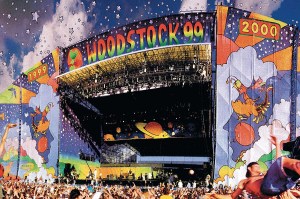
In some ways, this is far worse than the Fyre Fest, which drew widespread mockery and couldn’t even get off the ground with its fledgling festival. Woodstock ’99 was born of a desire to further cash-in on the brand of the seminal concert experience, but the promoters made significant decisions that would later spell their doom in the name of capitalism. Festival planners Michael Lang and John Schuer lament that in ’69 and ’94 so many people got in for free by slipping under flimsy fences. This was going to be corrected, and so ’99 was set on an old Air Force base with a razor-wire fence line. The base was woefully ill-equipped to host a multi-day festival. The copious blacktop was reflective of the scorching heat and the infrastructure wasn’t present for the human scope of waste management. The port-a-potties were quickly overrun and overflowing, and in one of the most stomach-churning moments, festival attendants are seen rolling in what they think is mud, much like in 1994, but it was actually human feces. Hundreds of people had to be carted out from dehydration, and one person died. Bottled water was four dollars, the same price as the beer, and the “free water” stations were quickly compromised by drunk festivalgoers breaking them or bathing in the supply. The hundred-degree temperatures were boiling the thousands of attendants who slept under meager shadows of boxes and carts where they could. The two main stages were literally a mile apart, which required long walks in powerful heat and without adequate hydration and hygienic installations. The festival put together a line-up packed with artists and points of attraction, from all-night raves to a skate park to a film festival to advocacy boards gathering signatures and passing out free candles (whoops). They just didn’t plan on the needs of the festivalgoers. They only saw them as consumers, people to buy buy buy, and not as guests needing to be properly cared for too. The old ’69 festival meant to symbolize the Counterculture was selling overpriced T-shirts and water on a military base? The cascading results of tragedy and chaos are already in play by day one of the three days. From there, it’s waiting and watching missteps add up until its calamitous and fiery conclusion.
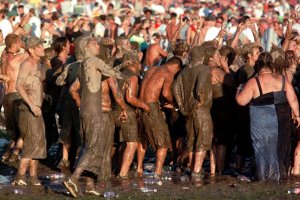
Where the movie starts to lose its focus is when it aims to make Woodstock ’99 a significant and important statement about a shift in culture. It seems clear to me that the reason that everything went so disastrously wrong in ’99 was because of its poor planning and lack of foresight, oblivious and enabling promoters, and its misreading of its audience. I’m not going to broadly categorize every lover of Limp Bizkit and Kid Rock as a wannabe fraternity bro looking for vulnerable women to harass. That’s unfair. Lang and Schuer place heavy blame on Fred Durst whipping up the audience into a froth of impressionable anger. The movie’s many interview subjects also take more time to describe the makeup of the people at the festival as young, white, male, and aimlessly angry. They blame the musical artists for the destruction and chaos of ’99, but who hired these bands and scheduled them, huh? Who hired Jewel to perform before Limp Bizkit and Rage Against the Machine? These same rock bands being singled out for blame toured together under the imprinter of the Family Values Tour, and not one of those stops resulted in the destruction and fury of Woodstock ’99. It’s the same crowd, right, and even more condensed together, so then why weren’t the results repeated? Because the music, whatever you think of it artistically, and there’s plenty to grouse about with its misogyny and general ear-sludge quality, is not to blame for the failures of bad management and lapsed security.
As a meaningful epoch in society, Woodstock ’99 doesn’t quite add up with the import that several interview subjects want to project onto it. The problem is the mystique of Woodstock itself. The 1969 festival is a cultural touchstone for the Boomer generation, but it’s also been cultivated thanks to selective memory, nostalgia, and media myth-making. The negatives and failures of the original three days, like the fires and deaths and logistical shortcomings, are mitigated by the perception of the festival and its five-and-a-half-hour Oscar-winning 1970 documentary. The reality of the festival was transformed into a transcendent experience that never really existed as advertised, and so when Land and Schuer repackaged Woodstock for a new generation, they had a willing audience ready to have their own generation-defining experience. The ’99 festival isn’t any more of a meaningful cultural statement as was the fabled ‘69 festival. It was just crass commercialism disguising itself as “peace, love, and rock and roll,” and no different than the hopeful influencers and Millennials that flocked to the Fyre Fest. It’s all selling a cultivated perception. Woodstock ’99 has no more lasting cultural impact than any Coachella festival. It came at a bizarre crossroads in time between music, technology, and a coarsening of masculinity, but that doesn’t mean that it was some larger truth being revealed. The assertions to provide larger, thematic meaning come across as too searching.

Another sticking point for me is that the film criticizes the exploitation of women and yet the movie falls under the same traps of exploitation for questionable value. Price’s gamut of condemnations for the ’99 promoters hits a level of extra righteous fury when it comes to the treatment of the female attendants, many of whom were groped, sexually assaulted, and raped. Lang and Schuer acknowledge the lecherous behavior of the heavy population of agro-males but dismiss the accusations of sexual violence as statistically minimal for the massive three-day festival. In the documentary’s most incendiary moment, Schuer accuses the very women who elected to go topless of being culpable for their own assaults. Rightfully so, Price immediately cuts from this noxious statement to a female journalist who calls out this jaw-dropping example of gross victim blaming. Not every woman who was groped or assaulted even chose to go topless; many of them were simply vulnerable and present and could not get away. The documentary discusses at great length the reality of the prevalence of sexual assault during the ’99 fest, enough so that even the lead singer from The Offspring was pleading onstage with the revved-up audience to stop molesting women who just wanted to crowd surf in peace.
The consideration the movie shows is just and justified; however, this advocacy is muddled by Price’s prurient editing decisions. His interview subjects, and by extension the perspective of the filmmaker, admonishes the pay-per-view cameras for seeking out as many exposed breasts as possible to satiate its young male audience. This included scenes of women flashing their breasts but also women having their clothes ripped from their bodies. This exploitation is echoed in Price’s problematic editing. There are dozens and dozens of topless women intertwined throughout the movie and, most troubling, scenes of women being molested, women desperately trying to pull their tops back into place while grabby hands reach for their exposed bodies. I can understand not wanting to dull the disturbing reality of what these women endured but how many visual examples do we need to make the point stick? How many examples of literal molestation, groping, and assault should the audience endure? Is this onslaught of visual examples not further exploiting these same young women and their trauma? Price could have even obscured the identities of the victims or blurred out their nudity, something that would have felt more in keeping with the righteous indignation and consideration to the victims. Even if you could argue seeing this is necessary to understand, do we need to see dozens of victims?

An unintentional connection I made with the documentary was with the promoters, who definitely come across as negligent and defensive. Lang and Schuer are combative early in the archival footage, jostling with journalists asking pertinent and critical questions about the failures of the festival as they are happening. These two old men, who misread the nostalgia the ’99 crowd had for their own Boomer culture, point the finger of blame at anyone else. To them, it’s MTV’s fault because their coverage made the festival look like a hellish nightmare. To them, it’s the band’s fault for not defusing audience anger. To them, it’s the fault of the women for being groped and abused. To them, it’s the fault of the security team for not upholding order, never mind that these people only had to pass a three-hour course where they were given the answers for. To them, it’s everyone’s fault but their own, and this dismissive scapegoating reminds me, in many ways, of President Donald Trump and his own complaints about media coverage. For the former president, it’s not his cruel and inept policies that were bad, it was merely the skewered media coverage and thus the media was to blame. Hey, if Woodstock ’99 interview subjects are going to make sweeping cultural statements, then why not me too?
The Woodstock ’99 documentary is a fascinating train wreck to relive with some questionable artistic decisions that can distract or mitigate its power and entertainment value. It’s a definitive look at a disaster of an attempt to recapture something that was ineffable and unattainable. I don’t believe there’s a larger lesson to be learned, beyond criticisms of capitalism and poor planning. It’s hard to watch at times, infuriating at others, and deserving of scorn and eye-rolls. There hasn’t been an attempted Woodstock festival since 1999 and it’s time to let it go.
Nate’s Grade: B


 nathanzoebl
You must be logged in to post a comment.