Category Archives: 2020 Movies
Class Action Park (2020)
 It feels like a tale ready made for a fun yet frightening examination, a New Jersey theme park famous for its dangerous and indeed killer attractions. Action Park, which operated out of Vernon from 1978 until 1996, was known for its poorly designed water and motor rides for thrill-seekers, often under the guide of going higher, faster, and being cooler. The documentary Class Action Park explores the park’s beginnings, a brainchild from disgraced Wall Street traders, and its heyday fondly remembered by many in a shared survivor’s bond. I was worried the movie was going to glorify the park and its rickety rides as some sort of macho “kids today are wimps and not like us” sort of generational braggadocio. I was worried the documentary would consist of a nostalgic ode to a dangerous theme park that would never be allowed to operate as it did today. And to some extent, Class Action Park does revel in the bizarre reality of its dangerous ride designs, apathetic teenagers given managerial and lifeguard power, and an owner who would simply refuse to pay any fines or punishments and freeze out the authorities. There is grand morbid curiosity as the film dissects different rides and explains, with the help of crude animation, why they would not work and could cause potential grievous injury. Dirty rivers filled with snakes, malfunctioning equipment, and ride designs that didn’t account for gravity and traction and other important physics. These jaunty, nostalgia-filled moments contrast sharply with the more somber tone the film is less successful achieving when it examines the human cost of the park. Over its tenure, six people are known to have died at the park, from drowning to electrocution to brain trauma. The movie doesn’t earn its somber reflection and doesn’t feel like the tones ever mesh. The interview subjects can also be pretty lackluster. Adults recalling childhood memories seems rife for reaching and generalization. The people who mattered most in this story don’t seem to be featured on camera, so instead we have a lot of people opining about a dead amusement park who went there many decades ago and still sing its virtues even while acknowledging its many flaws and safety violations. The movie never really digs deeper, asking the interview subjects what is the cost, what are the lessons of Action Park, and the entire enterprise feels too un-probing and superficial. Even the visuals can be pretty stale, like simply using cut-out newspaper clipping headlines repeatedly for insert shots. The subject has definite appeal for a documentary. This park is crazy. Unfortunately, Class Action Park only skims the surface and misses out on more engaging revelations about our collective love affair for danger at the expense of common sense.
Nate’s Grade: C+
Share this:

Kajillionaire (2020)
 If you’re not familiar with quirky writer/director/performance artist Miranda July, she specializes in a special kind of weird that borders on surreal and also a surprising emotional poignancy. It’s been 9 years since her last feature film, The Future, and she’s back with what might be her most narratively focused and accessible yet still wonderfully weird movie yet. We follow a family of grifters (Richard Jenkins and Debra Winger as the parents) and their day-to-day struggle to con, skim, or steal enough money to get by to the next day. Old Dolio (Evan Rachel Wood) is their only child, and her role in the family is thrown into question when a new member joins their team. Melanie (Gina Rodriguez) has connections to a raft of senior citizens so desperate for attention that, if they all pose as Melanie’s family, they should be able to con these old folks of possessions they can resell. From there, the movie becomes a push-and-pull relationship between Old Dolio and the influence of her shifty family, and she questions her place in this fringe unit and whether her parents actually love her or see her as another means to get a score. Kajillionaire is loose in plot but populated with interesting characters who feel fully realized by July’s writing. She’s so good at studying human behavior and capturing it that the quirky details all feel so genuine and meaningful. Even Old Dolio’s name is a reminder of her parents’ opportunism and problematic parenting skills. She was named after a homeless man who won the lottery under the hopes that he would be grateful and put her in his will (he ended up spending his fortune on experimental cancer drugs). That’s the difference with July. A silly name could just be a disposable oddity, but for her it’s a reflection of a character’s worth and history. There are moments in the movie that achieve a level of artistic transcendence where every piece is humming beautifully together, like one moment where a dying elderly man off-screen directs the grifter family to pretend to be like his own flesh-and-blood family. They play pretend at domesticity, each assuming a doting role, and the tranquil scene of a fake family feels beautifully attuned. The moments stand out more than the whole but July’s empathetic appreciation of human fallibility keeps her from ever condemning Old Dolio’s scheming parents too much. Even the very end finds a way to turn betrayal into a message of humility. Wood (Westworld) drops her voice several octaves, wears baggy clothing, and looks extremely awkward when it comes to human contact. Rodriguez (Annihilation) is the voice of the audience and her test of how far she’s willing to excuse the selfish behavior of this clan of cons. Her burgeoning friendship and maybe more with Old Dolio is a rewarding enterprise for the characters and the audience. Kajillionaire is a gentle little movie that plays at a low-key range of human emotions yet it can still be deftly funny and surprising and heartfelt on its own unique terms. With Miranda July, she makes weird entrancing and human.
Nate’s Grade: B+
Share this:

Worst. Christmas. Ever. (2020)
 I implore all filmmakers to be cautious about titling your movies. When you use absolutes in your titles, it’s laying forth a claim that you better be able to back up, and when you also present easy-to-apply summations of your movie in the title, it’s another dare I hope you’re capable of meeting. Nobody should name their movie Waste of Time and make a pointless and lazy movie because you can already see the summary blurb that awaits. In the case of the new low-budget Ohio-made comedy Worst. Christmas. Ever., you better be plenty funny to avoid the obvious put-down, “Worst. Christmas. Movie. Ever.” Unfortunately, while this low-budget movie has energy and bad taste to spare, it’s woefully short on ideas, jokes, characterization, and fun.
It’s Christmas Eve in East Jesus, Ohio and Sophia (Raychael Lane) has learned that she is pregnant. Her loser boyfriend Trey (Leonardo Mancini) is the father, though he doesn’t seem like a good prospective parent as he’s shiftless and cheating on her with Madison Fatcheck (KateLynn Newberry). Sophia doesn’t know what to do and definitely can’t tell her mom and stepdad. We interact with different bizarre locals, drug dealers, trigger-happy cops, crazy relatives, and an ex-con mall Santa (Craig Brophy) who breaks into homes. Over the course of one long crazy night, Sophia must decide what she wants to do with her life and the possible new life inside her.
 There is a grand tradition of the irreverent anti-Christmas comedy, a holiday setting brimming with sentimentality. Whether it’s A Christmas Story or Gremlins or Bad Santa, there’s something appealing about undercutting all that holiday good cheer with a little irreverent fun. The problem with Worst. Christmas. Ever. is that writer/director Johnny Chechitelli (a credited writer for FOX Sports and UFC fights) settles too often on the easiest joke, that is, when there are jokes. Sometimes it feels like the film has just gone on auto-pilot, like an improv session gone awry. That drifting, directionless feel pertains especially to the characters, which are uniformly boring. There are some strong archetypes that have potential, especially a lecherous Santa up to no good. There are just too many disposable characters cluttering this narrative that seem to exist in their own alternate universe movies with too few jokes. The world of East Jesus, Ohio feels wacky but without forethought. This is the kind of movie where a former overweight girl has the last name Fatcheck, and apparently this factor is what defines her character. There are small moments of satire but they’re never really honed into a more coherent or clever message. The stepfather plays a violent video game as an armed Jesus shooting Santa Claus to death. A rap song about a bad Santa seems to revel in gaudy cliches without providing commentary or entertaining contrasts. The treatment of African-American characters seems to play tragedy as cheap comedy, setting them up for traumatic police encounters that lack commentary on racism or ignorance. Sophia goes off on a team of carolers for their religious beliefs, but the movie seems too timid to go further with mocking Christmas rituals or religious hypocrisy. There are ideas here, not all of them good, but rarely do the ideas evolve into sustained plot beats or jokes.
Let’s analyze one scene in particular and why it doesn’t work from a comedy standpoint and what could have been done with a little more attention. Sophia and her pal Noah (Chase Crawford) go to her boyfriend’s house. Sophia is defending him but Noah says he’s likely just sitting around and getting high. When they peek through the window, they find Trey sitting around with marijuana, and Sophia tries to excuse it, not wanting to admit that Noah’s negative characterization was correct. Then he smokes a pipe and a scantily clad Madison Fatcheck comes in and nuzzles up beside him. Trey sees Sophia watching and freaks out. I ask you, dear reader, where was the joke? The fact that Trey is a loser is already assumed, so that reveal isn’t enough. What could have happened was Sophia’s pained attempts to continue denying the obvious reality. Rather than catch her bad boyfriend with drugs and then a new girl, this scene could have been extended to make things even more ridiculous. He had drugs, but Sophia was saying maybe he was just sorting it, and then he’s using the drugs, and Sophia says well at least it’s not hard stuff, and then he breaks out a hypodermic needle and she says, well maybe he just needs an insulin shot. It’s a comedy scenario that prospers from escalating desperation and absurdity. It could have been funny. Instead, we’re given maybe one joke, which is obvious, and little else. There is a lack of creativity when it comes to the comedy construction throughout Worst. Christmas. Ever.
 There is a difference between a gross-out gag and something that is simply gross. Making your audience experience discomfort can be a useful resource for comedy, but you have to be aware of what the returns are for the indulgence. I’m reminded of a scene in Seth MacFarlane’s A Million Days to Die in the West where Neil Patrick Harris defecates into a cowboy boot. He’s humiliated, it’s extended, and the joke lands, but then McFarlane cannot help himself and has to show a two-second insert shot of the messy feces inside the boot. The joke would have worked best without literally getting into the muck. Think back on Dumb and Dumber with Jeff Daniels and his epic diarrhea sequence atop that unfortunate toilet. It’s all in the performance and the cascading and noxious sound effects. The Farrelly Brothers didn’t need to put us in the bowl. This brings me to our Worst. Christmas. Ever. because I think its uses gross shock humor to cover for its poor comedy efforts. This happens early with Sophia throwing up in a Salvation Army collection bucket. That alone works as a joke, but then the director puts us in the vomit and uses this image to put his credit onscreen. There it is, he seems to say, I’m the guy responsible for this mess. There’s another scene where a character pees into a toilet and we just watch multiple seconds of a stream of urine and then on the floor as well. I kept thinking that maybe the movie would come back to this, that taking so much time to set up pee on the floor would lead to an accident later, but nothing happened. I guess just the sight of urine was supposed to be funny, just like the sight of vomit in a bucket was supposed to be funny. This lazy ethos pervades the movie and is dispiriting.
There are crude animated sequences in Act One that I initially had hopes for. It’s a stylistic touch to separate the movie but it could also have been a smart way around larger set pieces that would have been too expensive. These are mostly confined to Sophia’s flashbacks about her dead father and then this device is never seen again after the 20-minute mark. The six-minute segment about her bad drug addict father using the last of his money on drugs, then robbing a convenience store to also use on drugs is simply not a story demanding six minutes of our time. It’s not funny and it’s not informative and it gets tiresome and repetitive. This same information could have been conveyed with Sophia through a monologue of why she hates the holidays and it would have had a more immediate and lasting emotional impact than an animated interlude. The animated segments reminded me of MS Paint but with more detail. The style is fine but the purpose is questionable. The story we get through the animation isn’t necessary other than it provides an additional six-plus minutes of running time to desperately get us to a feature-length.
 This brings me to the fact that this 80-minute movie is really only a scant 63 minutes long. The end credits begin shortly after the one-hour mark and from there we’re treated to short additional scenes for resolution and then bloopers and then an extended music video of our rapping Santa. The actual credits move at a snail’s pace to reach that magical 80-minute runtime. This is the problem with a scattershot narrative that doesn’t seem like it’s going anywhere. One could argue that Worst. Christmas. Ever. is not the kind of movie beholden to character arcs and great strides in personal growth but you still need to do something with the time you have as a storyteller. For a comedy, we need more escalation than some dead bodies by the end. There needs to be amusing complications, there needs to be struggles, and there needs to be variation. Worst. Christmas. Ever. has the feeling of watching several short films that have been stitched together with minimal care. The consequences feel as throwaway as everything else in this movie. There is a dearth of satisfaction by the end because it’s missing all the important things like clear goals, meaningful character development, and culminating gags built around careful setups and escalation. I was a bit flabbergasted by the movie essentially giving up at 63 minutes but also grateful for the end.
It’s my duty to find some highlights to praise for Worst. Christmas. Ever. and I think the cast is generally a strong asset. Given the low-budget nature, not everyone is quite so polished, but the amateurism actually adds an authenticity to the proceedings of making a real small-town indie in Youngstown, Ohio. Lane (To See the Moon in the Morning Sky) has a wholesome appeal as our protagonist. Brophy creates a welcomed impression as a sleazy Santa, and his rap skills aren’t too shabby either. The entire rap video sequence is actually one of the best in the film. The song production is more accomplished than I would have expected given the low-budget. By far the actor I enjoyed the most was Wantatah (The Con) as the stepfather. His performance is the one where the actor melts into the character and you see the least amount of “acting.” He just is, and it’s entertaining to watch his grumpy incredulity and then inebriated disasters. I hope Wantatah can get even more work from here that takes advantage of his fine comedy instincts and commitment.
 I’m not going to lie, Worst. Christmas. Ever. was a difficult movie for me to watch. Even at little over an hour, I struggled to keep my attention and I rarely laughed. More often I was befuddled at the sloppy attempts at comedy that too often settled on shock value and bad taste because it couldn’t be bothered to actually think about jokes. There’s a difference where poop is a funny joke and when it’s just gross, and this movie doesn’t quite comprehend that distinction. Frankly, there just isn’t enough going on here to merit your time. From a comedy standpoint, there’s little to leave you satisfied. I laughed more from Killer Raccoons 2. From a character standpoint, there are weirdos who get their individual scenes but the main character’s unplanned pregnancy feels like an afterthought for how little it pushes the other characters. Imagine Juno if nobody paid attention to Juno’s pregnancy. From a production standpoint, there are definitely limitations given the lower budget and the wintry Midwestern climate but this doesn’t lead to necessary creative ingenuity. This is more a premise and an attitude than it is a full-fledged movie. Worst. Christmas. Ever. peaks at its poster.
Nate’s Grade: D
Share this:

The New Mutants (2020)
 The story behind The New Mutants is decidedly more interesting than the movie itself, the last of the twenty-year span of Fox X-Men movies. There was a three-year gap in between trailers for this movie, an adaptation of a Marvel comics series and fronted by co-writer and director Josh Boone (The Fault in Our Stars). It was originally supposed to come out in 2017, and then it was delayed with the rumors that Fox wanted to push for a more prevalent horror angle. There were rumors of extensive re-shoots, possibly half the movie, and then the Disney merger effectively froze the post-production process, and then the rumors were that the film was removing all the elements to tie it into the X-Men universe, to stand on its own. Apparently, all of this speculation and the talk of re-shoots was a lot of hot air and the finished film is what was originally back in 2017, before the X-Universe imploded with the great Disney takeover. Because of the many years of delays and gestating rumors, The New Mutants became a strange artifact of another time and fans began anticipating how bad it might be and whether they might ever really see it. Finally released at long last, The New Mutants is only aggressively mediocre and thoroughly boring.
Danielle Moonstar (Blu Hunt) wakes up in a strange asylum. She’s the only survivor from her reservation where something powerful and supernatural attacked. The medical facility is run by Dr. Reyes (Alice Braga) and secluded in the country. It’s also kept under a force field until the mutant patients make breakthroughs on their paths to processing their trauma and controlling their volatile powers. Rahne Sinclair (Maisie Williams) is from Scotland and was hunted as a demon by religious extremists. Illyana Rasputin (Ana Taylor-Joy) was terrorized by Slenderman-like intruders as a young girl. Roberto de Costa (Henry Zaga) accidentally burned his girlfriend alive. Sam Guthrie (Charlie Heaton) lost control in his town’s coal mine and is responsible for several deaths, including his hard-working father. Together, they uncover the sinister forces keeping them trapped and confront a powerful menace from the past to gain their freedom.
 Even with years of curiosity and anticipation, once it got started, I found myself nodding off during The New Mutants. This is because the script by Boone and Knate Lee (Kidnap) is predicated on predictability. Of course, you know exactly what will be revealed about this so-called helpful medical facility. Of course, you know who will be revealed to be part of that conspiracy. So then we wait for the obvious plot turns and bide our time for close to an hour with each mutant experiencing their own It-style scary encounter with a trauma of their past. Since we have four additional supporting players, each contributes a PG-13 studio spooky set piece until we reach our most obvious reveal about who is responsible for their worst nightmares coming to violent fruition. Seriously, just having read the above, I guarantee that the majority of you can figure out all the spoilers I’m dancing around. This is the kind of movie that quotes the “two wolves” metaphor (“Inside every person are two wolves…”) though the internal animal is changed into bears to align more with Danielle’s native culture. Makes me wonder if every person has two of different animals fighting for dominance within them (“Inside every person are two really irritable ducks…”). This metaphor is hammered home multiple times so you better believe it’s going to relate to our final climax. Normally, I would cite this as smart screenwriting, layering in setups and connecting theme to a personal confrontation. The showdown though is so goofy and the final villain free of personality, because ultimately the final villain is a symbol, an idea, and that is too vague and prone to basic platitudes on fear and responsibility.
The characters are also a major flaw for The New Mutants. It feels like somebody was trying to follow a formula of popular teen movies and sticks with the stereotypical stock roles but gave it a slightly modern twist. Our lead character is indigenous. There’s a chaste lesbian romance. There’s a level of diversity here even if fans of the comics also have expressed insult at possible white-washing of a Brazilian comic character’s ethnicity. At its core, the characters are still the same high school cliche roles: the Mean Girl (Illyana), the Outcast (Rahne), the Tomboy (Danielle), the Jock (Roberto), the Poor White Trash (Sam). It’s not too difficult to imagine The Breakfast Club faces being reapplied into these familiar roles onscreen. They even have a cheesy “cutting loose” montage when their authority figure is away that might remind you of that John Hughes classic. Worse, the characters just aren’t that interesting, each defined by their past that figuratively and then quite literally haunts them. This leads to some intriguing moments of them reliving horror but no sequence makes any character more interesting. The fears don’t provide further insight. Illyana might be the most annoying character of the group. She’s immediately pushy, malicious, racist, and her combination of powers just doesn’t make any sort of sense (teleportation and a disappearing arm sword, huh?). The boys are boring but Danielle is just as boring as our lead. The only character with a spark of possibility is Rahne and her push against religious harassment. If you’re going to be trapped in a contained thriller with a group of super-powered teens, could they not be more interesting than this sullen lot of underdeveloped high school cliches?
 For a movie that was supposed to be something different, it’s the flashes of horror that made me wish the extensive Fox re-shoots had been real. As a mystery or an action movie, The New Mutants isn’t going to be able to compare to the highlights of its fabled franchise. The action at the end feels rushed and sloppy. However, it could have found a tidy place for itself as a more adult horror movie within the broader X-Men fold. The spooky set pieces don’t have much to them because they’re meant as passing torment, reminders of negative feelings rather than extended sequences. They can be eerie and made me wish we could dwell further with this. A horror movie in a confined space with teenagers with powers they didn’t fully understand or couldn’t control, I can see the possibilities there aplenty. That’s what makes it all the more disappointing how predictable Boone and the filmmakers go with their one-off genre riff. The creepy Slenderman creature design is actually good, though I don’t really know if they are real in this world or a figment of Illyana’s childhood imagination. I don’t really know much about the rules of The New Mutants, so when it takes its turns, I was mostly shrugging and saying to myself, “Well, okay then.” Why do these super powered and angst-ridden teenagers never attempt to overthrow the one woman who patrols this otherwise empty facility? I watched Roberto repeatedly wash a giant soup vat in the empty kitchen when he could have been plotting escape. Who is consuming that much soup on a regular basis between the six of these people?
In short, The New Mutants was not worth its unceremonious three-year wait. It’s a middling super hero movie with flashes of potential, especially when it could have been something so different and new than any of the previous X-Men flicks. The movie is so easily predictable that I’m shocked more effort wasn’t put into its scary set pieces to better compensate. There are more twisted accents in the movie than genuine twists and genuine scares (your ears may bleed). It’s barely 85 minutes long and you feel like it’s gasping for breath by even that modest run. It never quite feels like the concept of a horror movie set with super heroes was ever really well imagined. If this is the actual preferred version Josh Boone always had in mind, it still manages to feel incomplete and underwhelming in execution. It’s not exactly a good comic book movie, or a good horror movie, or even a good movie. Thus ends The X-Men. Rest in peace.
Nate’s Grade: C
Share this:

Unhinged (2020)
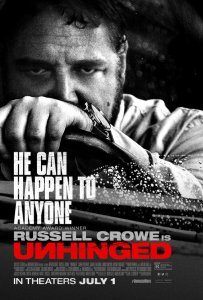 Russell Crowe (The Nice Guys) plays a deranged motorist with a serious case of road rage in Unhinged, an otherwise forgettable if competent thriller only notable for Crowe’s unnerving performance and as the first widespread movie in theaters after the COVID spring shuttering. It boggles my mind that enough people would rush out and risk personal safety to see this movie but I guess people can be desperate for a return to normalcy. In Unhinged, young mother Rachel (Caren Pistorius) is late dropping off her teen son to his school. She enrages Crowe in a traffic altercation and from there he plots her abject suffering for his twisted vengeance. Crowe’s character, simply labeled “Man,” is the wrong person to anger. The opening sequence involves him popping pills and then murdering his ex-wife and setting her new home ablaze. He’s an unstable psychopath who feels wronged by women and looking to hurt them for these perceived slights. He’s irredeemable, though the movie thinks it’s making him more “complex” with its slapdash attempts at back-story. The problem here is that Crowe’s antagonist is too powerful and omnipresent and our protagonist keeps making stupid decision after stupid decision. Even after her friends and family are threatened, or worse, she doesn’t seem to be making smart decisions, like involving the police or reaching for help. There’s a contrived reason to rob her of her cell phone but then she just gets a different phone, so why even bother? Even as she’s being hunted down by a guy who is sweating toxic masculinity, it can be strangely hard to root for Rachel because of the annoying bad decision-making. Also, her own back-story is weak. She’s going through a divorce and also might be bad at meeting deadlines, which relates to what later? The thriller sequences are serviceable but uninspired. Crowe is the only real reason you should watch Unhinged. He could have gone on auto-pilot for a standard paycheck psycho villain role and instead becomes truly terrifying, settling into a twangy American accent and leaving you wondering when his anger will snap. He’s at his scariest when he’s trying to sound reasonable or thinks he’s sounding reasonable. There’s a strange coda where Rachel withholds honking her horn after she almost gets run into by a speeding driver. The movie treats the concluding moment like a learned lesson but it feels more like bizarre victim shaming. She should have honked her horn at this driver, who was in the wrong, and she deserved to honk her horn originally with “The Man” for his vehicular infraction. She shouldn’t have to withhold her response out of fear that he other driver might overreact and seek out her friends and family and murder them. What a strange lesson for Unhinged to be imparting for its audience.
Nate’s Grade: C+
Share this:

The Craft: Legacy (2020)
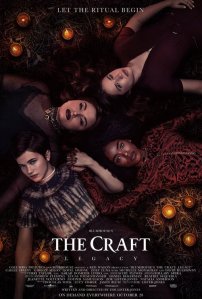 I don’t know who this new 2020 Craft is intended for and I don’t think the movie knows as well. If you’re a fan of the 1996 original, which has developed quite a reputation for many millennials, then I think you’re going to be relatively disappointed with this remake/reboot/sequel, whatever Blumhouse is calling this. By that description it should be evident that The Craft: Legacy has a bit of an identity crisis. It’s not exactly a remake because it retains so little from the original except in its witchy teenage premise, it’s not exactly a reboot because it doesn’t come together on its own for a new identity, and it’s not exactly a sequel because the only tangential connection to the original is tacked on in the literal final seconds of the movie. If it was trying to please fans of the original, it’s too lacking, and if it’s trying to chart its own course for a new generation of fans, well that doesn’t work either. As a result, it’s another PG-13 remake of an R-rated move that feels like it’s playing to a different crowd.
Lily (Cailee Spaeny, Bad Times at the El Royale) is the new girl at school. Her mother (Michelle Monaghan) is remarrying Adam (David Duchovny), a popular motivational speaker with three older sons of his own. She befriends a group of diverse teenagers when they suspect Lily might have the potential for special gifts. The girls try sending Lily a psychic message and then ask her to join their fledgling coven. The four of them combine their powers and promise to use their synchronicity for good to push back against the patriarchy.
 That narrative uncertainty of writer/director Zoe Lister-Jones (Band-Aid) seeps into every moment of the 97 minutes. You get a sense that Jones had a central topic she wanted to provide commentary and then a checklist of “witch stuff” to include that she wasn’t sure about. The activation of the powers in the original related to outcasts grabbing a power denied to them, getting even, going too far, learning some lessons, and then our protagonist having to topple her new friends and the danger they posed thanks to their new powers. With The Craft: Legacy, the magic feels like an afterthought to changing hearts and minds. We only really see one spell and its lengthy outcome where Lily makes her high school bully woke, and he stays that way and joins the girl group as their sensitive pal. This is, by far, the most interesting part of the movie, and yet there’s a larger implication that the movie ignores because it would place our heroines in an uncomfortable light. They’ve reformed the bully into a model citizen of a modern mature man who can admit his vulnerabilities, but they’ve also robbed him of agency and free will. Is this version of him what’s really hiding underneath, or is he simply being manipulated by their spell? This subplot gets more attention than any of the other witches combined. I don’t know anything about the other friends in the group, besides they take their witchy duties seriously and one of them is trans. They get assigned elemental powers later (Earth, Fire, Wind, Water) and that is more definite characterization than anything else. If you asked me what their names were or their defining personality traits I would be stumped.
After last year’s Black Christmas remake, it’s peculiar how closely The Craft: Legacy is following a similar formula. I applaud the diversity behind the camera and having female directors remake these stories for a new time and a new audience, and the concept of toxic masculinity as a threat to all women is potent and provides plenty to work into a horror/thriller dynamic. Yet Black Christmas had to go one step further by saying the evil fraternity that was preying upon women was secretly mind controlled by an evil magic goo of evil. It lets them off the hook. Now with The Craft: Legacy, we have an obvious villain as a symbol of toxic masculinity, and because he’s so obvious I kept waiting for him to be a more insidious foe, manipulating young men into a warped way of thinking about strength and virtue. However, this doesn’t happen. The antagonist feels like any generic abusive husband on any disposable Lifetime original TV movie. The topic doesn’t feel explored or nuanced for its big theme or cleverly matched up with the iconography of horror for extra genre commentary. What about the different sons? couldn’t they reflect different stages of his influence? Or the young and more innocent son, couldn’t he be a target of reprogramming? The movie doesn’t give us anything to really chart. It feels like much must have been left behind through several edits. If Jones and her team wanted to use their movie to make a pertinent statement on toxic masculinity, I was hoping for more than a relatively obvious, “It’s not good.” Even the Black Christmas remake gave its theme more consideration than this and talked about its generational impact.
 In the original, each member of the foursome has a backstory, a personality, a central conflict before and after developing her powers. While the conclusion was like Wicca X-Men, the rest of the movie was an effective high school drama with relatable characters. They were Catholic schoolgirls rebelling against their school and their families in the 1990s by practicing witchcraft. It was a statement. Now, the girls practicing witchcraft in a regular school during modern times just feels like an accepted experimentation from a culture that has become more tolerant, and that’s fine, but that means the movie has to provide other avenues to make new statements. The lackadaisical response to the supernatural really harms the movie. It makes it feel like the hook could have been anything. If the characters are given great power, use it sparingly, and then decide they might not be responsible enough so soon after, that’s simply boring storytelling. That’s the equivalent of a man finding a wish-granting genie, and then after the first wish where he asks for new pants he decides, “Oh, too much for me.” This is what I mean by The Craft: Legacy being too timid about being a supernatural horror thriller. It’s got the feminist perspective you’d expect from the underdog characters gaining powers, but it’s lacking a fundamental understanding or appreciation of its genre. It’s mostly confined to multiple nightmares and the occasional jump scare. The concluding good powers versus evil powers face-off is so awkward and cheesy that it deflates any good will earned.
The Craft: Legacy is a perfunctory remake/reboot that doesn’t seem interested in its characters, in its supernatural horror aspects (a sleepwalking brother that’s used as a jump scare and never explained?), or even in the exploration of its major theme on toxic masculinity. There isn’t much in the movie that is outright bad but there is nothing that shines either or proves to be memorable. The 1996 original isn’t exactly a genre classic but it looks so in direct comparison to this flat rehash.
Nate’s Grade: C
Share this:

Moondance (2020)

I didn’t even plan on writing this review. I knew of the indie musical Moondance because I was familiar with several crew members who worked on the $500,000 project and watching their pictures on social media, but when I discovered it had been filmed entirely outside the state of Ohio, primarily in Kalamazoo, Michigan, I decided to exclude it from my mission to professionally review Ohio-made indies. As of this writing, it was available on the website Tubi for free with ads, so I started it on a whim to show my girlfriend what I had intended to watch, and then I kept watching, and then I didn’t want to continue but I felt compelled to, and now I feel compelled to dissect this movie as best as I can, even with its tangential connection to the Ohio indie film scene. Moondance is a confounding experience for a lover of big screen musicals because it’s a musical that doesn’t really want to be a musical, a comedy that doesn’t know how to do comedy, and a drifting drama bereft of characters to root for and reasons to cheer.
The story is familiar. We have our boy, in this instance Oscar (Jonah Robinson), a composer suffering writer’s block, and he meets our girl, Abby (Carolyn Rabbers), a dancer. Oscar is instantly smitten and tries tracking Abby down, while his “best friend” Pat (Sam Jones) schemes with his very David Rose-esque assistant Sean (Brandon Stewart) to have her for his own. In between these shenanigans, Cooper Flannigan (credited as “Self”) appears to be a hipster friend of Oscar but also the god of this universe as he routinely breaks the fourth wall and is played by the actual writer/director.

I have to give credit for anyone having the gumption to try and create a low-budget musical. That’s a tall creative order and unfortunately Moondance can’t quite match its toe-tapping ambitions. There are only four songs in the entire musical before the end credits (I’ll get to those later). By the 45-minute mark, I had only experienced one legitimate song-and-dance number and I was wondering if the reality of this movie had simply abandoned being a musical. There are a couple additional dance numbers as one would expect with Abby being a dancer, some set to performances from musicians, but for the first hour there are only two honest-to-goodness moments where characters break out into song. Why is there no opening musical number that introduces the different characters and their different perspectives, stations, plights, goals? That would be an economical way to establish the world and its players. There seems to be real hesitancy onscreen with embracing its musical identity. The musical numbers are meant to give us insight into the characters who can’t help but blurt out their feelings, and yet during the requisite boy-and-girl-on-the-outs part, there is no musical number. There isn’t even a musical number for their growing affection for one another. We’re missing a love theme, and for a romance-heavy musical that’s meant to evoke the feeling of Old Hollywood, that seems like a massive oversight.
The staging and performance of the musical numbers, when they do appear, can also be underwhelming and counter-productive. From a choreography standpoint, much more emphasis is placed on the background players including a superfluous “intermission” dance. There is one number where the key characters do little more than literally ride a bicycle in a circle, and I would argue this is the best number in the film. There is more dancing than singing and that seems the primary reason why Rabbers was chosen as the lead female role. She certainly has talent as a dancer. As a singer is another matter. I feel unkind even articulating this but for a musical it needs to be said: Moondance would have been better off dubbing Rabbers. Her singing voice is just not there. I don’t see any harm to the production if the filmmakers had dubbed her singing. Another issue is that Abby’s dancing feels a bit too chaotic and chaotically edited. There’s a moment of sorrow where she dances out her feelings, but the choreography isn’t conveying the emotions of the scene any differently than a previous dance for us to compare with, and the editing isn’t helping, until it concludes with her pounding a wall in frustration and falling into a crumple on the floor. The camera could have locked onto her face, so as she moved and performed the emphasis was on her emotional state and what the dancing signifies. Whether it’s the lackluster songs, singing, and the nascent choreography that needs to communicate more personality for the big players, Moondance stumbles as a musical.

From a comedy standpoint, let me focus on one small scene that I think exemplifies the pitfalls of comedy construction that Moondance suffers from throughout. We start a scene with Oscar and Cooper at an ice-skating rink watching a curling team practice. Oscar opens the scene by declaring, “22 dance studios!” to tell us he has struck out trying to find Abby, and then for good measure he repeats the line to better establish his bafflement. “What am I supposed to do now?” he asks Cooper, who asks whether Oscar has considered the possibility his dream girl doesn’t exist. “No, I haven’t considered the possibility she doesn’t exist,” Oscar replies, weirdly echoing the exact wording just to hammer this home for the audience. He sees Cooper distracted, sighs, and says, “I’m going to go to the bathroom, or the parking lot or… something.” He then leaves and then Cooper addresses the camera and informs us on the mechanics of the sport of curling. This will never come up again in the entire movie. So, dear reader, let’s deconstruct this scene. It begins with Oscar stating his futility. He repeats his line twice. His friend offers no help, makes a reference to Oscar’s mental state, not a joke but a reference, to which Oscar simply repeats the assertion rather than supply a joke response or anything that can be constituted a response. Because of this, Cooper has nothing funny to build off from, so he asks a simple “what next” and rather than supply a joke that showcases Oscar’s pitiful state, he offers two suggestions, neither of them funny, then doesn’t even provide a third suggestion, instead giving up and not even following the age-old comedy rule of three. From there, Cooper informs us about something that will not matter and is not funny. Why does this scene even need to exist if even the characters can’t be bothered to come up with jokes?
I was dumbstruck by the ineffectual comedy throughout Moondance. This is the kind of movie that has characters devise a stakeout and disguise themselves in bear costumes for no reason. Do they do anything in these costumes? No. The joke, I assume, is that they’re in funny costumes. This is akin to a character walking into a room with a silly hat, and the director saying, “Hey you, look at this comical hat being worn. Isn’t it so unlike normal hats? A normal person would never wear a hat like this. What a cut-up to wear this hat. Are they going to do anything differently because of this hat? Well, no, but what a silly hat, right? Please laugh.” Just stopping at this conception and doing nothing else is not comedy. There need to be setups, payoffs, subversion, running jokes, subversion of running jokes, something, anything. There is a stark sense of desperation throughout Moondance when it comes to its sense of humor. Take for instance a dinner where the group is hob-knobbing but then the girls meet below the table to share their real thoughts under the excuse of retrieving a fallen fork. Why not repeat this setup, making it more outlandish and obvious as you go? Why not present one perception, above table, of the girls, and one below where they are their true selves and confessing distaste? There are moments where it feels like the writer/director just had little grasp on humor and lost track of opportunities. The jokes are rarely accessible; it feels like you’ve entered into a private conversation and are left to put the pieces together. Sean is definitely slotted as “comic relief” but he feels overexposed. I was confused what his relationship was supposed to be with Pat. Is he the assistant, lover, or friend? Eventually I learned that he was Pat’s brother, but why did I have to fight so hard to understand this fact? The writing doesn’t make it easy for the audience to follow along, and this extends to its comedy writing. The fourth wall breaks are tone-breaking but, again, not funny. They feel included just as a fun way to include the crew in the movie, which, again, feels like a private party indulgence. The comedy of Moondance is primarily dormant. It’s over-compensating a lack of funny on the page by asking its actors to dial up their performances, so all the unfunny dialogue and antics now just seem like they’re being performed by crazy people on illicit substances.

If this movie was going for satire, I think it missed it by a wide margin. I don’t know why we have a character with godlike powers and this is treated like a lame party trick. Why not refocus the entire movie from this perspective and have Cooper be the god of a rom-com musical universe, and he’s the only one who knows he’s in a movie, and he’s pulling out every stop to get his chosen guy and chosen girl to get their big happy ending. That way it would play upon our knowledge of genre tropes and bring something fresh, while utilizing the fourth wall breaks as essentially strategy planning and introducing a team of helpers that would see through his efforts. Instead, we get the jovial character of Cooper who strolls around and offers few insights into the nature of romance or the nature of romance movies and our association of them. He feels like a magic hobo. I sense the homage to the Old Hollywood musicals and the big band accompaniment for all those jazz hands and hoofing, but it’s more intention than actuality. It’s going through the motions, and without enjoyable characters and an engaging story, it’s an homage that ends up empty.
My final criticism might be the one that made it the hardest for me to embrace Moondance, and this is how aggressively unlikable nearly all of the characters come across. In a romantic musical, you can have less than stellar singing, dancing, and even songs but your audience needs to care about the people onscreen. You need to feel the desire for them to get together, find their happiness, and at a basic level, you have to enjoy spending time with your core group of characters. Otherwise you’re stuck, and dear reader, stuck is what I felt with these people. I never cared about Abby and Oscar getting together because I never found them to be remotely interesting. Oscar is a bland protagonist. The only thing we know about him is that he writes symphonies. He immediately becomes obsessed with Abby to the point that, even before he ever speaks his first word to her, he declares Abby “his girl” in a creepy act of possession. He’s in love with her but cannot explain why. Would have been perfect for a song there to articulate his new feelings, right? We know even less about Abby. She’s a dancer and wants to save an old dance studio, but anything else? Well during a scene where she lunches with a friend, she has a giant burger as her meal. Does she eat it? No, but just being seen with this pound-plus of beef is meant to do the work the screenplay hasn’t and imbue useful characterization. She’s not some prim “just east a salad” kind of girl, oh no, give her a honking burger. To my best estimation, Abby and Oscar go on two dates (one of which she apparently has harassed a waiter, and this is supposed to be endearing?) so when they part ways before Act Three, this short-lived breakup doesn’t exactly feel as earth-shattering as the characters try to convince us. We’re simply not invested. Rabbers and Robinson (Jack Jonah) don’t have strong chemistry together but it’s not their fault. The script gave them nothing to work with and no points of characterization to better define them as people or make either of them interesting to watch.

The character of Pat is pompous and entitled and I don’t know how anyone would remotely take his involvement in what is angled as a love triangle with any seriousness. He is a terrible character and a terrible person and he just seems to exist in a daydream of privilege. What does he do all day? He buys expensive paintings for his… Rubens parties (again, another point of accessibility made challenging for the audience when this is referenced without context and it took my third stab at understanding what it meant to gain clarity). Later in the film, he monologues to his paintings before setting them ablaze, and it’s played like the mental break of a serial killer, and it’s so tonally off to induce whiplash. Pat’s the cartoonish fop character that would be presented as the rich buffoonish bad boyfriend in any other movie, and yet here he’s supposed to be the best friend to Oscar, yet we see no behavior that communicates their close personal relationship. This is a trenchant problem throughout Moondance, the screenplay constantly having to tell you of something rather than show you. It’s like watching characters thrown into an improv game and grasp for any fragile means of escape from scene to scene.
With all of these words spent in constructive critique, it might seem like Moondance is without notable artistic merit and that is not the case. The photography by Greg Kraus (The Curse of Lilith Ratchet) is well lit and at its best when it has plenty of movement to give a sense of energy that is usually flagging from the page and performances. The smoky jazz number makes fun interplay with shadow to better establish an evocative mood. The musical productions are heavy with big band sounds and brass instruments, enough so that I started wondering if anyone has done a ska indie original musical. The opening segment involves a band performing in a studio space and it was a pleasant experience to set a tone. The musical performances are solid. The musical compositions are competent if unmemorable. I don’t know why the production didn’t just fully go the jukebox musical route with local artists if we were only getting four original songs (though the titular “Moondance” song lyrics were a bit childish, reminding me of the Hokey Pokey). Hey, they got TV’s Adam Conover (Adam Ruins Everything) to be a brief narrator, a role that seems even less necessary when Cooper is breaking the fourth wall repeatedly as a would-be guide for the audience since he’s already our stand-in god.

Moondance ends on a two musical numbers, the first a kind of curtain call on a theater stage that allows every character, including the dry cleaner guy, to get a sendoff and also break the fourth wall. Afterwards, Cooper addresses the audience and acts as emcee through the various departments and crew members who worked on the movie, with the camera moving in and out of rooms with an impressively agile tracking shot, and ending on several spirited dances, one of which serves as the still image on the Tubi page. The problem is that this is, easily, the most involved musical number and it’s reserved for the end credits. I can imagine Cooper and the filmmakers thought they were ending on a high note to say a fun goodbye to their audience, but by reserving it for the end credits that roll over the scene, it makes it harder to read the credits that are spaced so far apart and it makes it harder to pay attention to the song and dance because of the rolling credits. Why not go split-screen? For me, this sums up the misapplied application of Moondance and its throwback ambitions. It’s not whimsical. It’s not charming. It’s not funny at all. There aren’t characters to care about. The musical numbers are too few and far between. The potential hook to separate this, its satirical behind-the-scenes god at play in a musical world, is not incorporated in a vital and clever manner. Moondance is a strange passion project because it’s hard to feel any passion for this story and characters. It pains me to be as blunt as I am but there are too many issues to go ignored. I wish everyone with the production good luck in the future. This will stand as an artifact of bewilderment for me. See it for yourself on Tubi and whether it casts a bewitching spell on you, dear reader, or leaves you just as confused and disappointed.
Nate’s Grade: D+
Share this:

Trial of the Chicago 7 (2020)/ Borat Subsequent Moviefilm (2020)
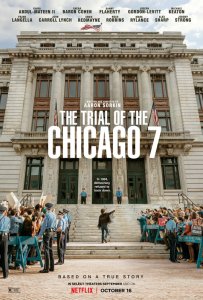 Two new movies have been released for streaming, both coincidentally starring Sacha Baron Cohen, and both are highly political, one by design and the other through fortuitous circumstances of history regrettably repeating itself, and both are simultaneously everything you would expect from their creative forces and worth watching in our tumultuous times.
The Trial of the Chicago 7 is a courtroom drama depicting the injustices applied to a dispirit group of anti-war activists who were charged with inciting a riot at the 1968 Democratic National Convention. The various men of different backgrounds and affiliations had their reasons for being there to protest, whether it was building public support to end the Vietnam War, to gain personal publicity, or to get laid, and tensions mounted inside and out the group as the police plan to send a message, harassed protesters, and in one amazingly prescient moment, remove their badges and name tags to then inflict state-sanctioned violence. This is an Aaron Sorkin movie through and through, and his second offering as a director after 2017’s Molly’s Game, and the best thing about the Oscar-winning wordsmith is that watching one of his movies feels like you’ve just downloaded a complete syllabus. The sheer audacious density of information can be overwhelming, but when Sorkin is able to get into his well-established rhythms, the actors feel like wonderful pieces in an orchestra playing to its peak. The real-life story of the activists has plenty of juicy drama and intriguing characters and intra-group conflicts breaking open, mostly between the divided poles of political leaders Tom Hayden (Eddie Redmayne) and counter-culture prankster Abbie Hoffman (Cohen). Bobby Seale (Yahya Abdul Mateen, HBO’s Watchmen) could have gotten his own movie and suffers many of the worst indignities as a member of the Black Panthers who was grafted onto the case in order to make the rest of the indicted men seem scarier by association. The consistent interference by the trial judge (Frank Langella) is shocking. It’s so transparently biased, racist, and unprofessional that I have to believe that many of these anecdotes actually happened because otherwise they seem so absurdly prejudicial that nobody would believe this happened. For a movie with such a sizeable cast of trial litigants, lawyers on both sides, friends and family, and maybe every police officer in Chicago, it’s impressive that Sorkin is able to provide so many with great Sorkin moments, meaning those grandstanding speeches, cutting one-liners, and intensive cross-examination. Not everyone is on the same level of importance. Several of the Chicago 7 are merely bodies on screen, two of the guys serve as little more than a quip-peddling Greek chorus. You sense there’s more being left out to fit into a crammed yet tidy narrative that plays to our demands for satisfying character arcs, reconciliation, and a morally stirring final stand. As a director, Sorkin doesn’t distinguish himself but he lets his meaty script and the performances of his actors get all the attention. The editing, like in Molly’s Game, can be a bit jumpy but it’s to serve the sheer size of information being downloaded during the 129 minutes. The political parallels for today are remarkable and a condemnation of our modern times. The Trial of the Chicago 7 is an invigorating and, at points, exhausting film going experience that can feel like a retro, overstuffed special episode of The West Wing. It’s everything you should expect and want in an Aaron Sorkin courtroom drama, so if you’re already in that anxious camp then this Netflix original will be preaching to the overly verbose choir.
 Secretly filmed over the past year, Sacha Baron Cohen reprises his outlandish Borat character to once again lampoon people’s not-so-hidden prejudices, anti-Semitism, xenophobia, and misogyny, which seem to have only gotten worse since the first Borat movie in 2006. The flimsy story follows international journalist Borat returning to America to help improve the standing of his home nation Kazakhstan by offering his daughter Tutar (Maria Bakalova) to the Trump administration. It’s really just a platform for Cohen to adopt a series of disguises (his Borat is too recognizable) and dupe some rubes while exploiting their ignorance and patience. Much of the entertainment comes from the cringe-inducing interactions of how far Cohen and Bakalova will go, marveling at their improvisational skills and also dreading what lines they might cross next. I was laughing fairly consistently, though the schitck naturally won’t be as funny the second time around, even with a 14-year gap in movies. I was really impressed by Bakalova and her own commitment and quick-thinking, keeping pace with a pro like Cohen and really stealing the show because Borat can’t go out in public as before. There are some outrageous moments that work, like Cohen imitating a country singer leading an anti-masking crowd into a singalong with ridiculous verses, and some that simply don’t, like an ongoing stretch where Bakalova explains the appeal of masturbation to a gaggle of deadly silent Republican ladies. Sometimes the comedy seems so broadly caricatured that it’s questionable whether its helpful or harmful, especially the anti-Semitic tropes that Cohen embraces as means of satire. Saying something outrageous to an outraged or shocked party isn’t quite enough. When compiling these hidden camera comedies, they thrive on the oxygen given to them by the targets of the prank. If they don’t really engage, it can feel a bit tired and desperate. I’d say the ratio of hits-to-misses is about half and half but the movie has enough big moments to keep fans happy. The most notorious moment has already been widely disseminated through social media and serves as the climax of the movie, strangely both as the high-point of pranks with big names but also as the emotional catharsis. Tutar poses as a foreign journalist and interviews Trump surrogate Rudy “America’s mayor” Giuliani, who drinks, goes into a hotel bedroom alone with Bakalova, and then lays on the bed while slipping his hand down his pants (like a gentleman does). Borat realizes he doesn’t want to offer his daughter to this creepy, sleazy man and rescues her because he truly does care about her. Borat 2, or Borat: Subsequent Moviefilm, takes a scattershot approach to satire and squarely aims at the science-denying MAGA crowd celebrating the excesses of their leader (who doesn’t sound that different from Borat, come to think of it). It might be more admirable in intent than execution but the new Borat can provide a few belly laughs and a more than a few groans as Cohen attempts to make American funny again.
Nate’s Grades:
Trial of the Chicago 7: B+
Borat: Subsequent Moviefilm: B-
Share this:

Love and Monsters (2020)
 Imaginative, quirky, and monstrously fun, Love and Monsters is a winning sci-fi monster movie and more evidence to the unique amusements provided in full from a Brian Duffield (Spontaneous, The Babysitter) story. In the near future, after blowing up a world-threatening asteroid, the ensuing chemical debris causes many lizards and insects to grow to world-threatening sizes, killing a majority of the population, and forcing the survivors to live underground in vaults. Our hero is Joel (Dylan O’Brien), a very Jessie Eisenberg-esque guy who isn’t so good at survival skills in this new world. His group looks at him like he’s a helpless kid who can’t defend himself. Joel discovers that his teenage crush, the girl he’s been writing letters to, is alive and he pledges to make the 80-mile trip on the surface to reunite with her. The resulting journey can be episodic but each section is impactful, each monster encounter is different and contributes to a fuller understanding to the world, and the character arc finds ways to surprise you, like when it acknowledges that Joel’s foolhardy romantic gesture is exactly that, him not fully accepting how the world has changed both he and the object of his desire. That sparkling creative voice of Duffield’s is alive and well throughout. His worlds feel well thought out, lived in, crazy but with purpose, and his characters are often teenagers with pointed attitude but they feel like characters rather than mouthpieces for overt stylized dialogue and pithy banter. O’Brien (The Maze Runner) is an interesting choice and gets to be far more neurotic and physically comedic than I’ve ever seen him. He’s an underdog that’s easy to root for. There are moments of wonder, moments of unexpected empathy, moments of suspense and terror, and plenty of moments of comic bemusement in the face of this crazy world. Joel befriends a very Woody Harreslon-esque father (Michael Rooker) with an adopted daughter in tow (the Zombieland character dynamics are pretty apparent but not a major detraction) and they form an enjoyable fractured family to help Joel become a better survivalist. I loved a small moment with a beaten down robot helper that manages to be sentimental as well as subverting sentimentality. The conclusion feels like a Walking Dead episode but it brings together many of the dangling storylines and proves satisfying for the character’s arc, a better understanding of the creatures in this world, and for Joel’s sense of self and community. The special effects are amazing for a movie that shockingly only had a tiny $28 million budget. Love and Monsters is a movie that makes the most of its time and money to tell a bigger story but one with enough wit, heart, and personality to draw you in and leave you happy for more post-apocalyptic monster adventures. All hail Duffield, king of spry and accessible quirk within the Hollywood system.
Nate’s Grade: B+
Share this:

Totally Under Control (2020)
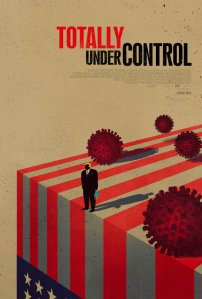 Over 220,000 Americans have died from COVID-19 as of this writing. We here in the U.S. are four percent of the world’s population and yet account for twenty-percent of the world’s deaths. I lament that this number will only go higher over the next many months of the pandemic that has defined 2020. Oscar-winning filmmaker Alex Gibney (Taxi to the Dark Side, Going Clear, Enron: The Smartest Guys in the Room) and his co-directors Ophelia Harutyunyan and Suzanne Hillinger conducted interviews around the world with special cameras and protective measures to complete the first major documentary on the coronavirus outbreak. Totally Under Control (title taken directly from Trump’s early February response to COVID-19) is their collaborative effort, and it’s both a timely work of criticism and destined to be inevitably out-of-date in short order.
Given the constant deluge of news about the by-the-minute Trump administration mistakes and questionable calls, the question for a documentary like Totally Under Control is whether or not it provides more insights than simply keeping up with the shocking and dispiriting headlines. I would argue that Gibney’s first pass at recounting our still-living history of calamity offers the benefit of hindsight but also an immediacy or urgency, considering we are still months away from a presumable vaccine. The movie feels like what the first part of the COVID-19 mini-series would cover, focusing on those first few critical months of bungled government response from January to April. The abbreviated focus allows Gibney and his crew to zero in on what the early mistakes were and how we have been paying for them ever since. The collapsed time also allows for more get-able interview subjects, people who might not currently be serving in the administration who feel comfortable or compelled to go on the record with their accounts. There are some great interview subjects here that were plugged in from the beginning, sounding the alarm, and who can give the public a clear understanding of just how woefully equipped a deeply un-serious administration was to handle the most serious public health crisis in a century.
 One of the more aggravating tragedies is that many of the thousands of COVID deaths could have been prevented if better steps had been taken early to contain its spread. Naturally, there’s always going to be clearer reflection when looking back on mistakes of the past, not knowing at the time that they were mistakes, but the Trump administration made a political calculus that would only exacerbate the spread of the coronavirus. Early on, the Trump administration’s guiding principle seemed to amount to stripping away anything and everything that the Obama administration had accomplished. It didn’t matter what it was, if Obama had built it, then Trump was motivated to tear it down. This included the pandemic response task force in 2018. This included ignoring the 70-page pandemic response playbook left behind. So when the early warnings appeared in December and January, the United States was already playing from behind. We could have been preparing with amping up production for necessary medical supplies and installing the infrastructure for a robust testing and tracing program; however, this all came into conflict with the other major political calculus that governed all of Trump’s decision-making. His mantra heading into 2020 and re-election was, simply, “Do no harm… to the economy.” Rather than take preventative measures or treat the virus as a danger, the Trump political apparatus was afraid acknowledging the threat so it would not spook the financial markets, a source of bragging for Trump to tout why the American people should re-elect him. When the CDC briefed government officials and media with updated predictions of normal life being uprooted, the markets responded negatively, and Trump fumed. From there, decisions were less about stopping the coronavirus and more about making everything appear like it was no big deal.
Totally Under Control keeps a running calendar of events to compare the U.S. response to South Korea, two countries that had their first official COVID infection on the same day. The Korean government had already taken preventative measures after the 2015 MERS scare to be ready if another frightening new contagion emerged. The politicians left the science to the scientists and followed their recommendations. The Korean people wore masks and were diligent about simple safety measures to stay safe. They had a system of contact tracing already installed. These moves are in sharp contrast to the American response, and while there would be some cultural roadblocks for Americans who consider themselves rugged individuals to submit themselves to a big data-harvesting consortium that contact tracing requires, we could have done so much better. In 1918, people wore masks because it made a real difference and saved lives. They took the Spanish flu epidemic seriously and they had fewer networks of knowledge at their disposal. Today, sadly, wearing a mask has become a political symbol and for many not wearing a mask has become a proud yet misguided act of defiance. Masks show consideration. Masks have been said to be even more effective at thwarting coronavirus spread than a vaccine. Masks work. The rest of the world, and South Korea, have showed what happens when you trust scientific recommendations. South Korea has less than 500 total COVID-19 deaths with a population of 52 million. Even if you multiply that figure by a generous seven to match the current U.S. population, that’s still only an estimated 3,500 total COVID-19 deaths during the same period.
 The level of ineptitude is highlighted by two key interview subjects. Rick Bright was the director of the Biomedical Advanced Research and Development Authority (BARDA) from 2016 to 2020. He filed a whistle-blower complaint about the Trump administration applying undue pressure to approve hydroxychloroquine, an experimental treatment that showed no signs of helping COVID patients. There was no medical reason to eliminate safeguards and protocols but the administration wanted a ready-to-market cure, and Bright was horrified that they wanted to make it widely available and over the counter, which would surely lead a panicked populace to request it and endanger their health. Recounting his experiences even brings Bright to tears as he recounts the disregard for safety and dereliction of duty of these political appointees dictating science. He’s a sobering and thoughtful voice to have in the documentary and also one of the biggest names of someone who worked inside the Trump response team. Another intriguing subject is Max Kennedy, who served on Jared Kushner’s White House supply chain task force. Kennedy thought he was going to be running errands or support tasks for the task force. He didn’t realize he and the other volunteers would be the entire task force. They were left to their personal laptops and emails to cold-call companies and perform Google searches to find personal protection equipment (PPE). They had no experience, no coordination with other government bodies, and they were competing against the federal government for the exact same dwindling supplies. Kennedy is breaking the NDA he was forced to sign to reveal the full extent of the chaos and inadequacy that Kushner’s “expertise” brought installing a solution to a very real problem. Kennedy and Bright’s first-hand insider accounts are both harrowing and maddening.
When it appeared that the Trump administration wasn’t going to be able to contain COVID-19, that’s when they pivoted to shifting blame and responsibility onto the states. The Trump administration could have authorized the Defense Production Act to force companies to begin manufacturing very needed PPE, but they didn’t. They thought, as conservative dogma has preached for decades, that government is the problem and the private market will solve it all. The problem with this line of thinking is that there are certain powers the states do not have in comparison to the federal government. State governments cannot run past their budgets. State governments do not have the power to set up a national system of testing. State governments were forced into a 50-way fight for supplies and were vulnerable to capitalistic gouging. The states were then also competing with the federal government, which was driving up the bids for these supplies and then overpaying for the same supplies by many times over their cost. The states were left on their own to duke it out and any slip-ups or shortages were disparaged from afar by a Trump administration that wanted to look in charge but didn’t want the responsibility.
 Totally Under Control is an essential documentary for our times but it also can’t help but feel like the beginning of an even bigger and more excoriating story. It’s frustratingly incomplete. It’s the opening chapter of the examination on the U.S. response to the coronavirus, and this story will likely only get more depressing and infuriating as the death toll rises and the regret of “what could have been” grows even more pressing with every week. Gibney and his fellow directors keep their movie pretty straightforward and efficient, and there is something powerful about putting all the relevant facts together into an easy to understand timeline and seeing all the dots connected. Gibney has always been blessed at his ability to artfully articulate a big picture with his films. Totally Under Control is a useful artifact for history and a denunciation of the early days when so much could have been so different if the United States had leaders that trusted science, didn’t dismantle key government bodies, took responsibility when the moment called upon rather than ducking leadership, and cared about more than their personal finances and standing. It’s only going to get worse from here, especially once we fully analyze all the important steps not taken.
Nate’s Grade: B+


 nathanzoebl
You must be logged in to post a comment.