Author Archives: natezoebl
A Christmas Carol (2009)
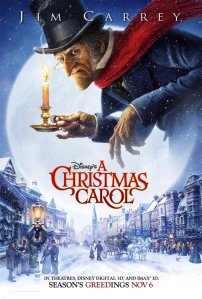 I still am at a loss over the appeal of the motion-capture system that director Robert Zemeckis fancies as of late. The creative mind that gave us classics Back to the Future and Who Framed Roger Rabbit? has embraced a technology that straddles the middle between live-action and outright animation. Motion-capture attaches electronic nodes to actors and digitizes their movements and facial features to later be conceptualized by computer wizards. And to this I say… so what? It seems like a whole slew of unnecessary work that adds little else than a vague starting point. Why not let the animators start from scratch? Why hamstrung creative professionals because Cary Elwes was feeling like making a certain gesture as “Portly Gentlemen #1?” I just don’t get it. To me, the motion-capture system is stranded in some artistic netherworld where it isn’t live-action and it isn’t animation. Zemeckis has cranked out his third mo-cap baby this decade, a retelling of Charles Dickens’ famous Christmas Carol. Why Zemeckis thought an old holiday chestnut would work best in this format, I’ll never know.
Cold-hearted Scrooge (Jim Carrey) is set to be visited by three spirits on a very magical Christmas Eve. The old man goes through Christmas past, present, and future to reevaluate his life and the true meaning of “peace on earth and good will toward men.” You know the drill, folks.
I like A Christmas Carol. I do. So do plenty of nice people. There’s a reason this oft-told tale still manages to resonate with generation after generation and that?s because it’s a good story. Of course it’s also an extremely familiar story to just about anyone outside of a womb at the moment. I expected Zemeckis and his crew to use their technology to jazz up the old story and give it a fresh new life on the big screen. Despite a handful of excursions flying through ye olde London, the extra slathering of special effects doesn’t enliven this holiday tale. I remember having great fun with Zemeckis’ previous motion-capture movie, 2007’s Beowulf (which does not play nearly as well in 2-D). That movie played around with the 3-D environment to great effect and made you feel apart of the experience. In contrast, A Christmas Carol does shockingly little with its depth of field, rarely placing distance between the foreground and the background. It’s a fairly lackluster 3-D experience. Maybe I wasn’t relaxing my eyes the right way, though I did notice how conscious I was of trying to elevate the 3-D experience myself. My disappointment is magnified by the fact that Zemeckis has been a pioneer for the 3-D playbook that Hollywood has now dubbed as the savior of the theater going experience.
 I wonder if Disney execs imposed limitations on the use of the 3-D immersion, not wanting to scare children by making them feel like they’re in the middle of a ghost story (there are some spooky moments already). The whole draw of motion-capture, and animation, is to transport an audience untethered by the limits of traditional practical filmmaking. This newest incarnation of A Christmas Carol fails to justify its existence. Why should I pay to see the most familiar story of modern day if there isn’t any new offering? At least The Muppet Christmas Carol gave me something different. And it had Muppets.
When I was younger in the mid 90s I was a huge fan of Carrey’s rubber-faced antics. I quoted Ace Ventura verbatim with my fellow seventh graders in 1995. So I understand the attraction of having him play multiple parts, but why exactly in a Dickens story? It’s not a comedy unless it’s adapted into one, and Zemeckis hews very close to Dickens and mostly recites the tale word-for-word. Scrooge isn’t funny, the ghosts aren’t funny, so why hire a renowned comedian to portray them all? This is a straight-laced adaptation and as such not the best use for Carrey’s talents. Is the move any better because Carey played all three ghosts? Is the movie any better because Gary Oldman gets to play Bob Cratchett and voice Tiny Tim? Is the movie any better because Elwes is credited for five inconsequential roles? Celebrity vocal casting is rarely effective in animation and so it seems the same in motion-capture.
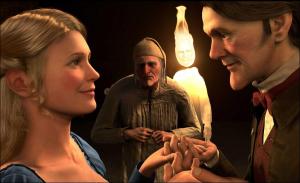 The technology has improved from the dead-eyed zombie children days of Polar Express, but it still seems like little more than less refined animation to my eyes. The movements are more fluid but the color palate is subdued into amber hues and candlelit locales. It doesn’t exactly use all the technological tools in the toolbox. It’s like a five-star chef toasting a Pop Tart: a waste of potential. I didn’t care for the skewed proportions on people either. Scrooge has a wiry frame with long spidery limbs and a triangular torso, and his character design kept reminding me of Jack Skellington. It’s too otherworldly considering nobody else comes across as a garish caricature in design form. The character designs for the three spirits are also fairly underwhelming. The Ghost of Christmas Past is a wispy flame. The Ghost of Christmas Future is nothing but a shadow. Is there a connection here? Otherwise, a shadow is pretty lame for the one ghost that can get really inventive and scary. Really, a shadow? I can do that myself without the aid of computers. And was it Carrey’s shadow to make it officially motion-capture? Because God forbid no other shadow could do or give the same performance of being draped over shapes.
I actually had to vehemently fight the urge to nap during A Christmas Carol. Maybe it was my poor sleep from the night before, maybe it was the fact that the 3-D glasses make everything darker (they still manage to hurt my eyes after prolonged use), but it was likely due to the fact that Zemeckis added a coat of polish to a holiday classic but declined to find purpose for doing so. Does this story get better with zooms through London, or Scrooge being shrunk and chased by demonic horses? It all seems like folly to me, like somebody’s idea to goose literary classics. Can you imagine Jane Eyre being shrunk and climbing through the walls of her Victorian era home? It all seems like an annoying distraction. Zemeckis? A Christmas Carol is exactly what you’d expect, which means you’d be just as well to flip through the TV channels and find any number of Christmas Carol versions. The Muppet Christmas Carol might even be on. Give that one a try instead. It even has some nice songs. And it’s got Muppets.
Nate’s Grade: C
Share this:

Sin Nombre (2009)
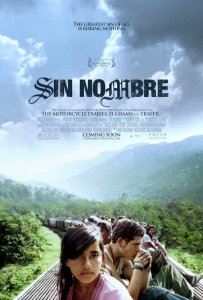 Part immigrant drama and part crime thriller, this stirring film is one of the rare instances where I was begging it to be longer. Writer/director Cary Fukunaga intertwines two tales, a southern Mexican family riding atop a train car to reach the U.S. border and the moral journey of a gang member who turns on his brothers during a crisis of conscious. Everybody is on the run, from the border patrols to the blood-thirsty gang members seeking vengeance. Fukunaga gives this tale startling realism without diverting to self-consciously docu-drama camerawork. I was fascinated by the details of life atop a train, the determination of these family members for a better life, and I was thrilled with the many near misses and escapes. Sin Nombre is such an accomplished movie that it’s hard to believe that it is Fukunaga’s first feature film. It mixes social commentary with film noir, an unlikely romance and plenty of naturalistic performances. The cinematography is gorgeous and crisp, beautifully showcasing the squalor and arresting countryside. My one complaint is that the movie gets into a new gear of added conflict, and then it quickly comes to an end at an all too brief 96 minutes. I really could have done with another 20-30 minutes of our main characters on the run for their lives. Sin Nombre roughly translates to “the nameless” and I can all but assure you that Fukunaga is a filmmaker who will most definitely not remain nameless.
Nate?s Grade: A-
Share this:

The Girlfriend Experience (2009)
 This may be Stephen Soderbergh’s most accessible throwaway experimental bobble, and yet even a movie about a high class call girl played by real-life porn star Sasha Grey gets tedious. Set amidst the economic meltdown in the fall of 2008, we toggle back and forth between the professional lives of Chelsea (Grey) and her boyfriend (Chris Santos), a personal trainer. Chelsea’s services are more akin to a date than a quick romp between the sheets. Said “girlfriend experience” includes dinner, talking, a deep knowledge of her client’s interests so she can relate, and perhaps some late night cuddling and maybe, just maybe, sex. There are multiple parallels involving the idea of prostitution, Chris sells himself and his services to his gym clients much like his girlfriend; but where does any of this add up? The movie is told out of order for little benefit and there isn’t so much a climax but a dissolution of plot. The realities of a New York City call girl having a committed relationship can be intriguing; at one point Chelsea says that the clients want her to be herself, but if that were true they wouldn’t be paying her. However, when Chelsea decides to ditch her man of 16 months because her astrology book told her this Hollywood client might be “the one,” the audience loses any sympathy. Once this happened I just checked out. At a mere 77 minutes, too much of the movie is consumed by Chelsea’s life style of high rises, fancy restaurants, limos, and powerful businessmen. It can feel like a big screen episode of MTV?s The Hills, following the empty exploits of shallow twits. Grey is flat throughout, and maybe that?s the point to display how disconnected she must be to make sexual encounters just work. Let’s just say that she shows more promise in I Wanna Bang Your Sister (actual title).
Nate’s Grade: C+
Share this:

Paranormal Activity (2009)
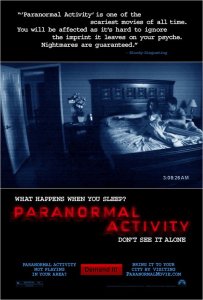 My eyes are bleary. I feel like a walking ghost. My body aches just a tad. I’m over responsive to sudden movement. Not only have I just seen Paranormal Activity, the small indie horror film that has been sweeping the nation, but also I’ve just endured my first post-Paranormal night of sleep. To say it was refreshing would be an outright lie. My then-partner was tossing and turning, routinely grabbing my arm to hold her, also sitting straight up to peer through the darkness of our bedroom, and occasionally she would request that our dog jump on the bed to sit with us for extra support. She and I have seen scary movies before but none have interrupted my sleep patterns like this low-budget sensation. That alone is the best blurb that I could possibly offer to the Paranormal Activity marketing gurus: this movie will make it difficult for you to sleep in your home.
The back-story to this Cinderella tale is that writer/director Oren Peli was hearing unexplained strange noises in his San Diego home. After some research he said, “Why don’t I set up a camera and make a movie about this?” He then hatched a plot involving a young couple, Katie (Katie Featherston) and Micah (Micah Sloat), who hear some bumps in he night while they sleep. Micah sets up a stationary video camera to record the strange happenings as a cool project. It begins with small, subtle noises, then the presence of something unwelcome becomes much more pronounced. Micah taunts the antagonistic spirit, coaxing some kind of response. Katie is terrified because, as they learn from a psychic, this is the same entity that has been following and haunting Katie her whole life; her family home burned down unexplainably when she was a child. It wants Katie. That was the story, though Peli says most of the dialogue was improvised (it shows). The actors doubled as camera operators, the movie was shot over seven days in Peli’s own San Diego home, and the total cost was $11,558, a pittance for a Hollywood movie. So how did this cheap home video haunting take the nation by storm, becoming the indie phenomenon of 2009 and one of the most profitable films in modern history?
 Let’s start with the fact that it’s actually scary. That’s likely what audiences have been responding to — competency. The film is presented as “found footage” much like the similar low-budget horror sensation, The Blair Witch Project (can you believe it?s ten years old already?). The story is presented as factual footage, and Peli makes a point of not breaking the terms of reality. Some of the spook stuff is easy to explain, like lights going on and off in the distance, but there are some moments that are more dramatic and give no hint of special effects. I am impressed by the ingenuity of Peli on his super low budget. I went from being startled to admiring the technical craftsmanship. Paranormal Activity isn’t a big scream movie, it’s more unsettling and the majority of its scary moments occur while the camera is on its bedroom tripod (the tripod should receive third billing in the credits, frankly). Sure, a creaking door or lights magically turning on doesn’t sound like surefire moments of blood-curdling terror, but the fact is that stuff is happening while this couple sleeps, a time when we are most vulnerable, is the point and why it’s scary. Peli structures the movie so that it fosters a slow burn of suspense. By making the camera the only viewpoint, we as an audience feel trapped, much like the characters. The idea that something will get us while we sleep isn’t new but it’s certainly creepy.
The actors work well enough not to betray the “found footage” motif as well. Neither gives a spellbinding performance, mind you, but Featherston and Slout are believable for almost every second onscreen. They’re a couple experiencing a home invasion of a different sort. Micah is more interested in his technical toys than the traumatic state of his girlfriend of three years, and Katie even admonishes him after a scare, “Did you actually run and get the camera first?” Featherston exhibits the most fear and trepidation, and her squeals and cries can be alarming. Their interaction and intimacy doesn’t really communicate a couple of three years time. However, this does not detract from the flick because the title isn’t Relationship Drama, now is it?
 So at this point I need to ask myself, why was I scared during Paranormal Activity and merely amused by the similar exploits in The Blair Witch Project? Maybe it’s the location. The bedroom is supposed to be your sanctuary, your respite. It’s a bit more universal than getting lost in the woods to make a movie. I also think the concept is responsible for my different reactions. In Blair Witch, they were being haunted by a forest ghost who had a thing for arts and crafts. Waking up to stone piles and stick figures just doesn’t resonate like footage of something happening to you while you sleep unaware. Peli does a fine job of making an audience dread what is to come next. Just as I wrote ten years ago for Blair Witch: “The anticipation of the unknown is far more frightening than being slowly chased by a man in a rain slicker. It’s no typical horror flick, it lets you create the fear in your head and let you drive yourself mad with it.” This is why Paranormal Activity works as well as it does. You can immerse yourself and then grip the armrest in fear and then laugh about it later. I also appreciate that Peli solved my number one problem with haunted house movies. You see, if your house is haunted then — MOVE! Simple, huh? Why try sticking it out to regain the resell value when the walls are dripping blood? At least in Paranormal Activity says that the evil spirit is attached to Katie.
Thanks to weeks spent at the top of the box office, even besting the lingering Saw franchise, it is inevitable that Paranormal Activity will balloon in hype that it cannot compete with. Rather than its budget limitations hindering the final product, Peli and his actors have embraced their low-budget aesthetics and produced something effectively eerie and occasionally ingenious. What these people have done with $11,000 (probably the budget for bagels on the pseudo true story, The Fourth Kind) is worth applauding. Like most horror movies, this one will play better with a full crowd ready to ride the roller coaster wave of screams and giggles. Paranormal Activity is proof that you don’t need stars and major budgets to get audiences scared. Your feelings of terror are the great equalizer, which is why cheap but smart and inventive horror movies can easily outpace their bigger budget brethren. Just be prepared for a few rough nights of sleep afterward.
Nate’s Grade: B+
Share this:

My Life in Ruins (2009)
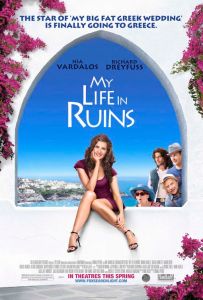 Tacky on nearly all fronts, this Big Fat Greek Wedding wannabe sequel features that hit movie’s star, Nia Vardalos, and plops her in Greece as an unhappy, uptight, undersexed tour guide. The movie follows her exploits to regain her “kefi,” Greek for “mojo.” My Life in Ruins paints in obnoxious broad strokes with its bus of fools, making sure the Australian tourists are never without a can of Fosters in their hand. The stereotypes are plentiful. The lame jokes are easily telegraphed and usually lowbrow (the bus driver’s name is “Poupi Kakas”), the acting is hammy, and the stabs of drama thanks to Richard Dreyfuss as a traveling widower feel alien. Being a romantic comedy replete with stock characters, naturally everything is predictable. Vardalos does a credible job here trying to hold this mess together, though she’s too prone to going for funny faces as a saving grace. Twice characters tell her that she’s not funny, and to this the audience will easily agree. I am dumbfounded that longtime Simpsons writer Mike Reiss wrote this crap. The only real enjoyment you’ll receive from this movie is marveling at all the fabulous Greek sights, from the ancient ruins to the seaside villas. I understand why the cast and crew would sign up to film this movie in Greece, but does that mean I have to subsidize their vacation with my own money? No thank you.
Nate’s Grade: C
Share this:

A Serious Man (2009)
 The Coen brothers, Joel and Ethan, have been making stupendous movies for three decades, but they have never really gone too introspective. Usually their movies follow quirky characters making poor decisions and getting in too deep in a cruel world. A Serious Man is the first Coen film that feels personal. Set in the same landscape of the Coen’s own upbringing, 1960s Minnesota, A Serious Man gives a few insights into how these two remarkable men became who the filmmaking geniuses they are today. But if that isn’t enough for film fans, the movie is also hilarious and brilliant.
It’s 1967 in suburban Minneapolis. Larry Gopnik (Michael Stuhlbarg) is a meek physics professor up for tenure. Larry is beset at all sides, from his redneck neighbor encroaching on his land, to being bribed by a Korean student unhappy with his grade, to the news that his wife, Judith (Sari Lennick) is leaving him for his colleague, the more dignified Sy Ableman (Fred Melamed). Sy suggests that the best course of action is for Larry to move out to a hotel: “The Jolly Roger is eminently habitable.” The tenure board is having second thoughts because of anonymous letters, Larry’s daughter is stealing money from his wallet for a nose job, his son spends more time getting high than practicing for his bar mitzvah, and Larry’s unemployed, socially awkward brother (Richard Kind) is sleeping on his couch. Larry seeks counsel from three rabbis and tries to find meaning as to why his life is spinning out of control.
 This is a bleak comedy with almost all of the laughs coming from how much worse things get for Larry. Now, it’s not a pitch black comedy, something akin to being loathsome and eager to push an envelope; you simply can’t help but laugh at how he universe is ganging up on this poor man. His life is spiraling out of control and he is helpless to stop it, and his search for some sort of theological wisdom just leaves him more confused. The various rabbis don’t really have an answer to explain his suffering, and instead they each give comically nonsensical answers or stories. The junior rabbi, projecting his own low stature, asks Larry to seek God in small things, like the parking lot highlighted by his office’s lone window. “Just look at that parking lot,” he gushes hopefully. One rabbi gives a fantastic story about a Jewish dentist discovering a strange Hebrew message carved on a patient’s (a goy’s) teeth. The story eventually goes nowhere and the rabbi’s advice is merely a shoulder shrug and this bit of feeble wisdom: “Helping others? It couldn’t hurt.” To the Coens, Larry is the modern-day equivalent of Job, befalling misery and looking heavenward to ask, “Why me?” He could easily be any one of us. In the face of turmoil, it feels like the Coens prescription is to laugh, the only way to remain sane in this world. And so we do laugh, dubiously, and this is how we cope with life and its ongoing uncertainty.
And A Serious Man is seriously funny. I snorted out loud three times, unable to control my growing guffaws. The supporting group of characters is all wonderfully utilized, popping in for a perfectly timed plot development or a joke. This movie is relentlessly funny, structured like a runaway car that picks up momentous speed. Not a single frame feels at waste. The conversations between the supporting characters are priceless; every character has their precise place in this narrative, and the Coens manage them brilliantly. The writing is intricate and the Coens again showcase their magnificent ear for local color. Each of these people has a different speech pattern, from one Hebrew school kid’s abundant use of the F-bomb, to Larry’s daughter insisting she has to use the bathroom to always wash her hair, to Larry’s bathroom-hogging brother’s conditional response of, “Out in a minute.” It’s almost like a musical how well the various comedic elements harmonize. The mostly unknown cast of actors is all superb; I love how the Coens select actors with such great, easily recognizable faces. These people stand out just visually. Stuhlbarg, a theater veteran, is a terrific lead, and his performance is steeped in pursed-lip incredulity. I loved every conversation with the powerfully unctuous Sy Ableman, a character who hides his distaste in pompous vocabulary. I loved Larry’s interactions with his South Korean blackmailer and his broken English. I loved how Larry’s son will interrupt important occasions just to complain about the TV picture quality of F-Troop. I loved that the only person concerned for Larry’s well-being is the Columbia records salesman who signed up Larry for a subscription because he failed to reject their offer.
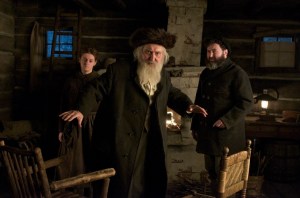 I haven’t done extensive research on this one, but A Serious Man may be the most Jewish film ever, or at least since Barbara Streisand cross-dressed in Yentl. I’m not talking movies that explore a significant chapter in Jewish history, like the Holocaust, but I can think of no other movie so steeped in the minutia of Jewish culture. A Serious Man even opens with a seemingly unrelated anecdote with a 19th century Eastern European Jewish couple arguing, completely in Yiddish, whether a guest is alive or a dybbuk (demon). Not only do we get notable religious events and observances like bar mitzvahs, sitting shiva, counsel from rabbis, the concept of a religious divorce known as a get so that a “serious man” could remarry in the faith, but the Coens get everything right down to the tiniest detail, like the exact sound of soup slurping. Even the overall tone, perseverance in the face of struggle, is an extremely Jewish perspective given what has transpired historically to the Jewish people.
The abrupt ending will likely win no favors from the people that thought they were shortchanged by No Country For Old Men‘s anticlimactic close, but it certainly fits the movie’s bleak worldview. Larry is, by his own accounts, trying to be a “serious man” in an ever-changing community, so beware what happens if he compromises his moral values. The pessimistic finale leaves much to the imagination and whether you want to connect the events as uncoordinated random plot points, or as an ongoing celestial judgment, well the Coens are canny enough to let you figure it out. They don’t have any more answers than the rabbi and the goy’s teeth.
This will not be a movie for everyone, especially considering 90 percent of the laughs come from one man’s unrelenting misery. Larry isn’t exactly the deepest character, making it spotty to emotionally invest in his troubles. However, I found him to be an everyman cipher allowing the audience a safe entry point into the Coen spectacle of doom. The Coen brothers have always been technical marvels, but they seem to have raised their inconsiderable talents at the close of this decade. No Country for Old Men was a genre masterpiece, Burn After Reading was an entertaining farce, but perhaps A Serious Man is the most lasting picture. How do we explain bad things and bad things happening to people striving to be serious men and women in the world? I?’m not sure if the Coens have an answer or even think the answer is important. I think their viewpoint is to enjoy the ride and laugh while you can. As the Korean student’s father puts it, “Accept the mystery.”
Nate’s Grade: A
Share this:

Where the Wild Things Are (2009)

Studio execs are always seen as the bad guys, right? They meddle in the affairs of artists, more concerned about dollar signs and marketing potential than in lasting, authentic artistic achievement. Director Spike Jonze, the most lauded video music director of all time, has gone through five years of trials to bring the adaptation of Where the Wild Things Are to the big screen. He’s had his funding cut, he’s been dropped by one studio, and the second studio contemplated starting over from scratch after seeing an early cut of the movie. The studio heads were worried that Jonze’s take was too sullen and too scary for children. They asked for something a tad more uplifting about a boy that runs away to have adventures with giant monsters. Jonze and co-screenwriter Dave Eggers (Away We Go) insisted on their vision and stuck it out, and 18 months later, that vision is what made it to theaters. Having now seen Where the Wild Things Are, it pains me to accept that maybe those studio honchos had a point all along. Jonze’s film is eclectic and visually wondrous but this is not a children’s movie; this is a movie about childhood intended for thirty-something adults and film critics. And man, it’s a downer.
Based upon Maurice Sendak’s masterful 1963 book about an unruly child “sent to bed without supper,” we follow Max (Max Records), a nine-year-old on a tear through life. His older sister is growing up and hanging out with older friends, his dad is absent, and his mother (Catherine Keener) is trying to juggle work, kids, and having a life her own. One night she has a man over (Mark Ruffalo, in cameo form) and Max gets upset. His mother isn’t giving him the attention he feels he’s owed. So he acts out, bites his mother, and when she responds with genuine terror, he runs away. He finds a small boat and sails away across the ocean to a mysterious island. It is here that he encounters the titular wild things, giant beasts that act out in very similar ways. Max declares himself the king of the beasts and they accept. Carol (voiced by James Gandolfini, a fabulously warm performance) is the happiest to have somebody new to play and listen. There’s also the small goat-creature Alexander (Paul Dano), the eagle Douglas (Chris Cooper), the elusive KW (Lauren Ambrose), and the married monster couple, the pushy Judith (Catherine O’Hara) and the subdued Ira (Forest Whitaker). Together they form an unorthodox family that still falls prey to in fighting and jealousies.

First off, Jonze does a magnificent job of creating the world of the wild things. The cinematography by Lance Acord (Lost in Translation) uses a lot of handheld cameras to trail after Max, communicating the kinetic energy of youth. The movie looks gorgeous but doesn’t resort to a self-conscious gloss. Acord makes the wilderness look inviting and dangerous. The wild things are amazing creatures to watch, brought to startling life by Jim Henson’s creature shop and seamless CGI artistry to provide facial expressions. If these creatures were purely computer generated, they would lose a sense of magic. Watching the furry suits interact with the real world brings so much more enjoyment to the movie. These giant creatures look real and intimidating. I liked the fact that there’s one character, The Bull, who just stands in the background alone, and the other wild thing monsters make a point of not noticing him. He’s the weird disaffected kid on the outside. I also appreciated that the movie doesn’t pander to make the monsters cute and cuddly. They continue to be scary. At one point Carol even chases after Max with the intent to eat him. Jonze and Eggers have made a movie about childhood that doesn’t coddle children. The production design by K.K. Barrett (Marie Antoinette) is nicely imaginative, though it only deals with a handful of stick huts. The fort that the wild things construct is fantastical, like an alien structure but made completely out of twigs.
Jonze and Eggers have made a movie all about the feelings of childhood; however, it seems that almost all of those feelings are negative. Sure Max bounces around with youthful energy, and his imagination goes to exuberant places, but the movie paints a broad picture of how painful and disappointing childhood can be. The movie doesn’t capture the wonder and excitement and possibilities of childhood; it focuses on the somber realities of what it’s like to be misunderstood, lonely, and incapable of changing anything. What about the pleasures of childhood? Even when Max engages in his fantastic creativity it usually leads to destruction and hurt feelings; everyone ends up in a worse place. A great example is in the opening sequence where Max tries to snare his older sister and her friends into a snowball fight. He gets them to play along and then everything is great, until the older kids accidentally take it too far and Max is left embarrassed, hurt, scared, and incredibly angry, which leads to lashing out, which then leads to regret and attempts to rationalize it as not his fault. This pattern is repeated throughout, where Max will get scared or confused and this triggers bouts of physical violence, like literally biting his mother. You might think his time on the island would be an escape, but really all of the monsters are manifestations of Max’s fractured psychology. KW represents his older sister’s approval so deeply longed for; Judith represents his defensiveness; Alexander represents his feelings of marginalization and helplessness; and Carol most closely resembles Max’s id, concerned that his family is falling apart, prone to jealousy and sudden violent outbursts when he doesn’t get his way. It all can make for an interesting psychoanalytical experience but it also can get tiresome. Listening to needy, whiny, morose monsters can be exasperating after awhile when there isn’t anything else resembling a plot. Where the Wild Things Are feels somewhat like Jonze and Eggers are subjecting everyone to their own therapy.

This shaggy, somewhat draggy movie has little else going on, so we watch Max boss around the monsters, commission colossal forts, run around, sleep in a big pile, and more or less try and hold a family together when they are moving in different directions. Things slow down a lot on this island. Max himself is a polarizing figure. Some people find him relatable, his pain and fears, and still others find him to be a wild brat. His behavior seems to go beyond that of a normal child acting out. I’m not going to prescribe the kid but me thinks there may be something else amiss with Max (am I alone in my diagnosis, people?). My friend thought Max was an insufferable and unsympathetic brat who learned nothing by the end of the movie. I feel that Max has to have learned something, since his entire time spent on the island was him working out his troubles to gain a little more perspective. Records is a real find as a child actor, and he’s the only human onscreen for like 90 minutes. I thought he carried the movie ably enough and finely displayed the conflicting emotions of being nine years old.
Will you like Where the Wild Things Are? That’s difficult to surmise. It may depend upon whether you can identify with Max; I couldn’t for the most part. This is a much easier movie to admire than to like. There’s very little fun to be had. The movie has an implicit sense of loss and melancholy throughout. Children’s movies don’t need to be all happy endings and feel-good lessons, but then again they don’t also have to be densely Freudian. Childhood isn’t all innocence and rainbows, but it’s also not all rain clouds and emotional meltdowns and feelings of impotence. The movie presents childhood as an unyielding hell. I know other people love Where the Wild Things Are, and I respect that artistry Jonze and his crew brought to this movie, but I doubt I’ll ever watch this movie again in my life. For once, the studio execs had it right.
Nate’s Grade: B-
Share this:

Away We Go (2009)
 Away We Go sort of came and went in the blink of an eye over the summer. Some critics dinged the indie production as being insufferable, hipster, smug, and unlikable. I agree that the plaintive guitar-strumming score grates, and the costumes have that trying-hard-not-to-be-hip coolness, which can be insufferable, but Away We Go is more than just faulty hipster packaging. There is a moving and entertaining drama inside here. The problem is, you have to sift through some of the junk to reach it.
Burt (John Krasinski) and Verona (Maya Rudolph) are in their early thirties and about to have a baby. They aren’t exactly hipsters but they have been living a somewhat fringe existence; Verona even points out that they have a cardboard window. Their existence has been mostly ramshackle and now its about to change forever. Burt and Verona decide to journey across the country and reunite with family and old friends. They’re studying widely different family units across the country to discover not just what kind of parents they will be but what kind of family they will be.
Just by the fact that nobody dies at the end, this is a big departure for director Sam Mendes (American Beauty, Revolutionary Road). This low-key road trip comedy is quite different from the meticulous prestige pictures associated with the Mendes name. Away We Go is a scruffy, small, and disarming little picture that wants to say something. I was taken aback at how affecting I found moments of Away We Go, though it is only moments. Burt and Verona are not exactly the best equipped to start a family right now, which makes them anxious and nervous, and anxious about not being more nervous. They haven’t exactly matured much since graduated college years ago. But amidst their search for the definition of a “working family” they must accept the uncertainty of life. Burt and Verona have a comfortable interaction, from his upbeat sarcasm to her grounded realism. There’s a great running gag where Burt tries to raise the baby’s heart rate, so his goofy bouts of fake agitation will be immediately followed by a stethoscope and an adorable grin of satisfaction. They are a compatible couple and it is refreshing to see a movie couple that compliments each other in personality. They actually love each other, are good for one another, and are not beset with contrived conflicts. In fact, the movie ends up pretty much exactly where it began, only with a smattering more of wisdom. The lesson learned in Away We Go is that it doesn’t matter what the bumps in life may be, it’s all about who you have as your co-pilot.
 Screenwriters and married partners, Dave Eggers and Vendela Vida, mix in small moments of weight and an overall tone of genial sweetness. The drama and the comedy are given equal share of the script, though the elements don?t mix that often. The funniest moment, by far, is when a little boy tells his mother exactly what he knows about babies (I won’t spoil the guffaw-inducing surprise). There are some quiet yet weighty moments of human observation here. There was a tender exchange between Verona and her sister Grace (Carmen Ejogo) that had me on the verge of tears. The sisters reminisce about their parents, long dead, and then Grace says that having this baby keeps their parents alive; the sisters can see parts of their mother in the baby’s face. Verona is giving back life to her dearly departed mother and keeping her parents’ legacy ongoing. This lovely thought struck me with such sudden force that I felt overcome with emotion. It could be dismissed as a common sense fact of genetic proliferation, but I had never thought of the birth of a child as a means of keeping the past alive and honored. To me, this is a simple yet wonderful and powerful statement. Another great moment is when Burt and Verona make lifelong promises to each other on a trampoline. Verona doesn’t want to marry, so the scene is the equivalent of the two lovebirds exchanging vows. It’s heartfelt and sincere and well within the bounds of the characters.
What?s frustrating to me is that the movie?s poignancy is undercut by its excisions with grotesque cartoon versions of bad parents. Burt and Verona visit different imperfect family units, but it isn’t until the end of the movie where we see anything resembling a semi-authentic brood. Alison Janney plays an obnoxiously loud parent who berates her children for laughs and accepts the brokenness of children; to her, she can’t fight against genetics and thus gives up parenting. On the flip side, Maggie Gyllenhaal plays a narcissistic earth mother who still nurses her children and condemns the very idea of strollers (“I love my babies. Why would I want to push them away?”). In each case, the depicted family is a caricature and readily ridiculed for some easy and snide laughs. Even Burt’s parents (Jeff Daniels, Catherine O’Hara) are figures set to be mocked for their self-absorbed bourgeois values. In some ways, Away We Go started to remind me of that awful movie North, where a young Elijah Wood travels the globe in search of new parents. At each stop, Wood encounters broad caricatures of different family units. In Away We Go, half of the movie is spent palling around with repulsive idiots who overstay their welcome fast. What’s even more frustrating is that the script becomes locked into a pattern, meaning that we spend the same amount of time (10-15 minutes) with each family. This is not helpful when Burt and Verona finally reach the relatable families, in Montreal and Miami, then the movie shortchanges the palpable drama. In Miami, Burt’s brother has had his wife run out on her family, abandoning their daughter. We’ve finally reached interesting and complex character, each with an aching sadness just below the surface about the hardships of parenthood, and the movie has to keep on moving because we spent too much time with the crazies for easy laughs. You’re supposed to spend more time with the good stuff, not the bad.
 The noisy, exaggerated supporting characters are balanced by the believably baffled Krasinki (TV’s The Office) and Rudolph (Idiocracy). He’s effortlessly charming and Rudolph plays her character with subdued texture, uneasily taking everything in for due consideration. Both actors are likable and we grow in empathy with them as they go from stop to stop. The couple is so charismatic that it makes the drama-free reality of functionality forgivable. The rest of the cast play their parts to the hilt, but special consideration should go out to Melanie Lynskey (The Informant!, Heavenly Creatures) who plays the mother of a large adopted clan of kids in Montreal. Her problem is that she cannot conceive and she’s endured five horrible miscarriages. Her slow and melancholy dance around a stripper’s pole is heartbreaking, and that?s something I thought I would never write in my life.
Despite some missteps, Away We Go is a sweet and affectionate little movie that fights against being overly twee and precious. It’s definitely not sentimental but at the same time it rejects cynicism and detached irony, embodied by the compatibility of a couple that truly love each other. At the same time, the movie can be annoying with its loud side characters that act as distractions. The best moments in Away We Go are the small ones centered on Burt and Verona. It’s those handful of small moments that pierce your heart. It’s strange but after writing this review, I realize that I like the good moments even more and the bad moments even less. It’s like Away We Go has become more entrenched in my mind. This is a sometimes promising, sometimes frustrating, drama that knows enough about life to not settle for easy answers. If only it didn’t settle for easy jokes with stupid characters.
Nate’s Grade: B+
Share this:

Year One (2009)
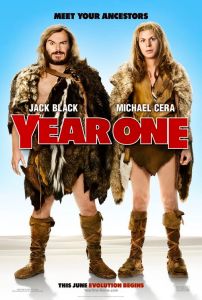 This is a slapdash comedy that?s too toothless to be satire and too dumb to be witty. Jack Black and Michael Cera play a pair of banished cavemen who stroll through various episodes from the Old Testament, like Cain and Abel and a circumcision-crazed Abraham, before settling in for a wild time at Sodom. This uninspired riff on the Bible rarely lands any laughs. The comedic aim of the film is extremely low; the scatological humor consists of farting peasants, bestiality, eating poop, urinating on your face, genital mutilation, and lots and lots of pedophilic jokes thanks to a grotesque, lispy Oliver Platt. Year One (of what exactly?) is a big step back for co-writer/director Harold Ramis and a general waste of everyone’s time and talent. Black and Cera do have an interesting and playful ying-yang chemistry but they have so little to do given the rambling, episodic nature of the plot. The characters make anachronistic pop culture references or talk in self-aware circles, the celebrity cameos do little, and the jokes lack any lasting momentum. Somewhere Ramis wants to make statements about religion and faith but the flick is too timid to do anything, so the movie limps to a finish with its lame “be your own chosen one” message. This is a prehistoric comedy with rocks in its head.
Nate’s Grade: C-
Share this:

Drag Me to Hell (2009)
 Sam Raimi returns to his spook roots in this delightfully disgusting horror flick. Drag Me to Hell has such a gleefully playful and perverse personality, alternating between being scary, being gross, being funny, and circling back for more. This is camp of the highest hokey order, and Raimi infuses every moment with inspired schlock. Poor Alison Lohman, the bank loan officer cursed to be dragged to hell in three days time. She gets a lot of fluids sprayed into her face (there’s an oral obsession to this movie; lots of mouth stuff) and she takes it like a trooper. She’s put through a physical wringer here and maintains her dignity and believability among staples to the head, grave digging, and talking goats. The ending seems to be coasting to a predictable finish and then it hits you in the head, upsetting your sensibilities. I loved it. Drag Me to Hell, ultimately, is little more than a glossy, entertaining blow-off, a reminder what an inventive director can do with the horror genre. It doesn’t all have to be nubile teenagers escaping a knife-wielding maniac. If there is one lesson I’ve learned from movies and television, you do not anger the gypsies. They have a monopoly on curses and they are not afraid to use them.
Nate’s Grade: A-


You must be logged in to post a comment.