Author Archives: natezoebl
The Box (2009)/ Capitalism: A Love Story (2009)
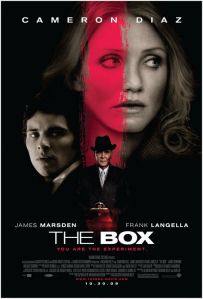 Both films on the surface seem so radically different and yet I found lots of common ground between a sci-fi conspiracy and a muckraking documentary about the biggest financial meltdown of the modern era. Both are centered around the concept of greed and whether humanity can forgo selfishness for empathy of their fellow man. Would you kill a stranger for a million bucks? Would you rig a financial system so that the richest one percent can gamble the life of a nation? Both movies also bite off more than they can chew and both movies exist as interesting yet dispirit elements that could use more cohesion and resolution.
You have been given a box with a button. If you press the button tow things happen: somebody you do not know will die and you will receive a million dollars. Do you press it? That’s the hook of writer/director Richard Kelly’s sci-fi morality tale based upon a short story by Richard Matheson. The Box is a messy and outlandish conspiracy sandwiched between two moral tests, the second a consequence of the first and a means to wipe the slate clean. There’s plenty of weird unsettling moments, including the horrendous wallpaper of the 1970s, but not everything really hangs together. Kelly’s intergalactic conspiracy can get readily outlandish with all the variables and needed participants, but like in Donnie Darko, he lays out enough tantalizing info to keep your attention and then keeps the narrative vague enough for personal interpretation. However, unlike Darko, this movie needed to cleanup its loose storylines. It just sort of ends in perplexing rush, and I sat in silence through the end credits waiting for some kind of scene to help tie together dangling storylines that were left to dangle for an eternity. The Box has a nicely tuned foreboding atmosphere, and it certainly keeps you guessing, but it will also keep you scratching your head to try and make sense of everything from button boxes to teleportation pools to Mars probes to sudden nosebleeds to Satre’s No Exit. Kelly, as he has done with his previous movies, packs a lot in two hours. Whether or not it all formulates is up to the viewer’s wearying patience. I’d rather have more movies like The Box than more thoughtless drivel from the Hollywood assembly line.
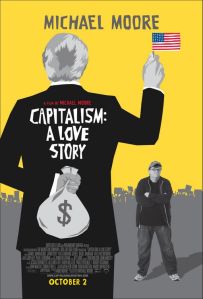 After 20 years, you pretty much know at this point what you’re going to get from a Michael Moore documentary. There’s the anecdotal evidence, emotional interviews of the downtrodden, the one-sided arguments, the nods to the depressive state of Flint, Michigan, and Moore trying to bully his way to see the powers that be that have no interest seeing him. In a way, Capitalism: A Love Story is like a greatest hits collection for Moore that reminds you of his better moments and better films. Despite all the outrage, Moore wants to throw the baby out with the bath water. He cites capitalism as an evil that needs to be eradicated. His thesis isn’t very cohesive and consists of a series of related and unrelated anecdotes, some of them grossly offensive like companies profiting from the death of employees thanks to “Dead Peasant” life insurance policies. But at no point do you walk away thinking, “Let’s start from scratch. What has capitalism gotten us?” Several of his points are easy to agree with. There is a flagrant disregard for the well being of others on Wall Street, who carelessly gambled the nation’s fortunes and then got the taxpayers to cover the loss. The bailout is a crime of pure capitalism and in a true capitalistic society there is no such thing as “too big to fail,” there is only fail. It’s not following an ideology built upon greed that has hurt the U.S., it’s unchecked greed, capitalism run amok without any oversight or regulation that has endangered the nation’s livelihood, and I’m surprised Moore didn’t emphasize the process of deregulation from Reagan to Bush more. The story of our financial meltdown is too large for a confined two-hour narrative window, and it’s too important a lesson for a man like Moore to use it as fire to ignite a people’s revolution.
Both movies: C+
Share this:

Obsessed (2009)
 When it comes to derivative, generic, formula-laden movies, usually you can predict every step of the plot with great accuracy from the trailer. Obsessed may be the first movie I could predict every moment based just from seeing the poster. This poor man’s Fatal Attraction follows a surprise-free trip to the end credits. Idris Elba is a family man who is harassed and stalked by his increasingly psychotic temp/temptress (Ali Larter). The movie doesn’t even have the temerity to have its lead cheat on his wife. There?s an interracial angle that is never really dealt with, meaning that the lone plot detail separating Obsessed from its peers is also swept under the rug. Everything here is borrowed from better movies with more style, substance, and heat. Larter doesn’t work as an antagonist or a figure of lust. She acts like a disinterested and icy when she should be flirty and smoldering. The plot quickly gets ludicrous as Larter’s repeated seduction attempts get brazen and confrontational. It strains credibility that Elba would keep trying to keep things under wraps. This girl needs to be referred to the police. Alas, I suppose these stalker thrillers wouldn’t be as interesting if people reacted realistically to psychotic behavior. Beyonce Knowles is the angry wife who gets to exact vengeance during the movie?s all-out, hair-pulling climactic catfight. But it’s a long slog until that catfight.
Nate’s Grade; C
Share this:

The Taking of Pelham 123 (2009)
 This needless remake is yet another nail in the coffin for the filmmaker that is (was?) Tony Scott. The director seems to have a love affair with irritating and superfluous visual artifice. Scenes will jump into slow-mo, or stutter-stop speed, or the visuals will all of a sudden turn into blurry shadows. Scott proves yet again that he’d rather fiddle around with film stocks and random jarring effects than aid his narrative. The story of Pelham is rather mediocre, as a tattooed gunman (John Travolta) and his crew take a subway car hostage. A train dispatcher (Denzel Washington) becomes the only one allowed to speak to the gunman. Travolta is wholly unconvincing as a profane criminal mastermind. The villains are gruff idiots, some of whom think at the end that maybe, just maybe, they can get the jump on 30 armed policemen surrounding them. They were not the top of their class at Henchmen School. The story is frustrating and the character motivations for Travolta remain vague and unclear. Sure, he gets financial gain, but what else? What about his shady past? Why this specific route to this mundane goal? It’s like Scott and the movie simply just didn’t care anymore because they knew it was time for the film to end in a big chase scene. Also, the movie seems to make a case that NYC cops are the worst drivers in the world. They crash more cars than Billy Joel (joke brought to you by the year 2003). This is one train to miss.
Nate’s Grade: C
Share this:

Julie & Julia (2009)
 Meryl Streep is as she always is, which means to say she’s terrific as famous jubilant chef Julia Child. She’s got the sing-songy voice down cold, and Julia comes across like a spigot of joy, yelping with delight like a child. It’s hard to not find it adorable, and her husband (Stanley Tucci) is a kind, caring man who complements her well. The scenes between the Childs can be heartwarming and delightfully comic. However, for some weird reason, the Julia Child section is only half of this movie. Writer/director Nora Ephron decided to frame the movie with the biography of Julie Powell (Amy Adams) writing a blog in 2002. Huh? Powell wants to prepare all 500 recipes from Child’s best-selling book on French cuisine in one year. As you might expect, this whole section turns into a lot of narration over food preparation and Powell becoming increasingly narcissistic about her blog fame. The only real purpose this modern storyline serves is to add perspective to the Julia Child storyline, giving historical context to what we see Streep and Tucci struggle over. The real resonance is with Streep as the larger-than-life cooking personality and her upward climb to be taken seriously as a chef and as an author. I don’t care about Julie Powell. She keeps interrupting a better storyline. Apparently the real Julia Child didn’t care for Powell either, because late in the movie Powell discovers that the real Child (who died in 2004) thinks the whole blog thing is a gimmick. And isn’t it? Then again, isn’t having Streep as Julia Child a gimmick of casting? Julie and Julia would have been better served if it had completely carved off the Julie section.
Nate’s Grade: B
Share this:

2012 (2009)
 Let’s get this out of the way. The world isn’t going to end in 2012. Well, it might, but it won’t be because the Mayans said so. Because truth be told, the Mayans didn’t say anything about the world ending. The Mayan calendar exists in large circular amounts of time, and the largest period of time is called a bactun. An epoch, 13 bactun, will be coming to an end somewhere around December 21, 2012, but this in no way is a signal for the end of days. It just means that one cycle of time has come full circle and we begin anew. This is entirely a Western invention. If you learn nothing else from this review, know that the world will be fine come 2012. At least in this regard. Who knows about nuclear holocaust, biological warfare, religious fanatics bringing about the end of days, Sarah Palin running for president. The world could still end, but don’t blame the Mayans. They’re already dead anyway. They didn’t see that one coming, either.
2012 is the latest disaster movie from director Roland Emmerich, who fondly destroyed the world in Independence Day and The Day After Tomorrow. In news interviews, Emmerich has insisted that 2012 will be his last disaster movie (yeah right!), so he wanted to pull out all the stops. And he does. 2012 is like the disaster movie to end all disaster movies. It’s great escapist fun but it’s also silly and cheesy and hokey and all things a great memorable disaster movie should be. The movie packs so much that you may likely experience fatigue by the end.
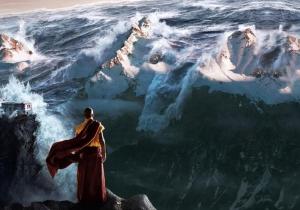 Like previous Emmerich movies, we follow a dispirit group of people from all walks of life who coincidentally come together. Jackson (John Cusack) and his wife Kate (Amanda Peet) are separating. Kate is currently seeing a new guy, Gordon (Thomas McCarthy, the writer/director of The Station Agent), and Jackson’s son thinks highly of new dad (maybe he saw the excellent Station Agent). Jackson is trying to become a better dad and take the kids camping to Yellowstone National Park. It’s there that he runs aground with government officials and a conspiracy radio host (Woody Harrelson) warning about impending doom. He puts enough pieces together to hatch a plan to save his family and escape. The government was alerted by a geologist (Chiwetel Ejiofor) in 2009 and has been preparing for massive seismic shifts. The president’s chief of staff (Oliver Platt) has been planning the “continuity of our species.” The elites have secured a place on massive arks built in the Himalayan mountain range. Jackson and his family must find a way to reach the arks in China for any hope of surviving the next chapter in human existence.
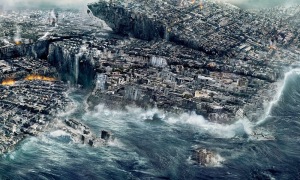
Emmerich packs so much earthly chaos into this movie that it can get flabbergasting. It’s not enough that California is upending by earthquakes and gaping chasms, it has to be thrown into the sea city block by city block. It’s not enough that Yellowstone National Park emits a thunderous volcanic discharge; it has to explode with the might of three mushroom clouds. It’s not enough that a 150-foot tidal wave strikes Washington D.C., it has to drag along a U.S. aircraft carrier that topples the memorable architectural sights of the city. It seems like Emmerich is trying to one-up everything that has come before in disaster cinema, but beyond the cheesy Irwin Allen movies of the 1970s, his only real competition is himself. No one wreaks havoc upon the world like Emmerich. He has the same destructive tastes of a mad scientist of Godzilla. He’s a big kid that likes to see things fall down and go boom. And in that regard, Emmerich has no equals. Not even Michael Bay, who certainly has panache to his record of ruination, can compete with this German master of disaster. No one can do enjoyable cheesy entertainment on such a mass scale like this man.
 The special effects in 2012 are first-rate and the true draw to see this thing on the big screen. Large-scale global devastation has never looked so pretty. This is a full-blown summer movie in the midst of the fall prestige season. The destruction is often awe-inspiring thanks to Emmerich and his team of visual wizards, and the buildup of suspense can be palatable as well. The pacing is better than you would expect for a movie that runs over 150 minutes, but that didn’t stop the contingent of teenagers in my theater from standing up and leaving whenever there wasn’t violent death. At least Mother Nature wasn’t taking out specific monuments with pinpoint precision like She normally likes to do in these things. And just like in disaster movies, the “chosen few” are gifted with the amazing ability to outrun fireballs, earthquakes, falling debris, falling buildings, and just about everything falling at high velocity. Sure the immediate heat from an explosion at Yellowstone would instantly fry the characters, and sure an airplane can?t fly through a pyroclastic cloud, but it’s all part of the territory for the genre. If it was really true to life than we’d all be dead and the movie would be considerably shorter.
So what is the protocol for enjoying mass entertainment that coincides with massive death? Emmerich is usually very good about his disaster sequences to keep his focal point at long distance angles, both so that the audience can get a full vision of the mayhem and also to make sure that we cannot concentrate on the little people fruitlessly scurrying away for their lives. If you stop and think, practically every second of on screen destruction in 2012 involves thousands of nameless, faceless people dying horribly, and these are the big moments when the audience chows down on greasy fistfuls of popcorn. It reminded me somewhat when the news kept repeating the planes crashing into the World Trade Center towers as pieces for their 9/11 segments, and I’d stop and think, “You know, you just paused an image and in that image is the reality that hundreds of people are dying.” It’s a strange thing to contemplate, which is probably why Emmerich overloads your senses with (safe distance) disaster carnage. There is an image that does cross a line, where we witness office building workers tumbling out of the crumbling high rise. That’s one 9/11 image that’s just too distasteful even for a disaster flick.
 Naturally the reason to see these kinds of movies is the big bangs for your bucks, but what happens during the downtime? I was genuinely surprised how involved I became with the collection of characters. I’m not saying that this is deep, penetrating writing, but it’s easy to wring some pathos out of a story when you have one character after another delivering a teary “Goodbye, I always loved you” speech to their soon-to-be-dearly-departed relatives. I cared about these characters enough to wince when they began being picked off one-by-one when the script called for heroic sacrifice upon heroic sacrifice. Burrowed beneath the avalanche of special effects, like really really buried in there, is an interesting philosophical argument about how people would behave during the end of the world. Would they be selfless or selfish? Would they step on their neighbor’s neck for another minute of life or would people sacrifice? Personally, I’m a bit of a pessimist, but the debate is intriguing. I also thought that 2012 had a vital conversation about who exactly gets to survive. In the story, a seat on the super arks are a billions Euros, which gives the insanely rich a huge advantage, but it’s because of the insanely rich private sector that the world’s governments are able to build these massive arks and plan for a future. So there you have it: a future world with the likes of billionaires and politicians. Who will get them all coffee? Who will pick up their dry cleaning? Who will take their calls? Is this even a world worth living in?
2012 is dopey and self-serious and way too long but man is it entertaining. The fabulous special effects are the real star of the movie, though the assorted cast does well. 2012 is deemed Emmerich’s last disaster picture, and if that holds true then he’s making sure there isn’t anything left to destroy. This is disaster pornography on a scale rarely seen in the movies. It deserves to be seen on the big screen for maximum enjoyment of maximum destruction.
Nate’s Grade: B
Share this:

New Moon (2009)
 Admittedly, I am not a fan of the Twilight series. I have never read one of the books but I didn’t hate the first Twilight movie. I thought it kind of worked on its own merits even if it wasn’t for me. However, New Moon is a crushing bore and a mess.
Bella Swan (Kristen Stewart) is celebrating her eighteenth birthday with her vampire boyfriend, the 119-year-old Edward Cullen (Robert Pattinson). She accidentally cuts her finger and the sight of blood sends one of the Cullen vampires crazy with instinct. Edward concludes that his love would be safer without him. He bids her goodbye and promises, “This is the last time you will ever see me,” forgetting that there are two more books to go. Bella is heartbroken and spends months in a stupor. She finds solace with Jacob (Taylor Lautner), her friend of many years. Jacob’s people are indigenous Native Americans to the area, and he holds a secret as well. Turns out that Jacob is a werewolf. Now Bella has to decide between a vampire or a werewolf (does a Frankenstein monster enter the romantic fray later?). Edward mistakenly believes that Bella has died, so he too wants to die and will seek execution at the hands of the illustrious Vultari, the ruling vampire clan in Italy. Bella must decide between her two loves.
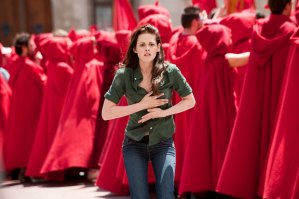 I can precisely indicate where everything goes wrong for the abysmal New Moon — the character of Bella Swan. For the majority of this sequel, I didn’t just detest and dislike her I downright hated her. I hated her. I understand her appeal to the millions of Meyer’s literary acolytes, but man does she come across as a self-centered, casually cruel, messed up girl who spends most of her time being whiny, mopey, and sulky. It’s not just that she has a guy interested in her, it’s the absurd notion that every man cannot get enough of this sullen gal. As presented in New Moon, Bella is such a dour and lifeless personality. I cannot see whatsoever why she is worth such effort. This criticism may be tracked all the way to Meyer’s source material, making Bella absent in defining character dynamics expressly so pre-teen readers can insert themselves as the character and swoon over being the object of universal desire. It is insultingly thin wish fulfillment that this girl has every man, vampire, and werewolf fighting over her in the Pacific Northwest. After Edward leaves, she shuts herself out and rejects all her friends. We see in one camera pan that she spends literal months in a stupor. I understand that teenagers think everything is the end of the world, but she and Edward were together for, what, a few months? Then again, heartache is something that knows no exact time frame for healing, so consider this but a quibble. Bella seems to push others away except when she needs a set of ears to whine.
It is post-Edward where Bella becomes insular, self-centered in her pursuit of danger placing herself in stupidly reckless scenarios, and hurtful. Where Bella really infuriated me is her treatment of her lifelong friend, Jacob. Obviously the big guy has a thing for his her and she knows this, which allows Bella to string Jacob along for almost a whole movie. She leads this little doggie along, teasing him with a “Maybe I will be with you, maybe I won’t” dance that becomes irritating and rather loathsome. Jacob is a swell guy who has looked out for Bella from day one, accepted her coupling with a vampire, sworn enemy of werewolves, and he’s been the best listener to all her self-involved drama. Plus this guy is ripped and has hip flexors that could cut glass. And he is there for her and didn’t abandon her like Edward. So Bella toys with her self-described “best friend” until she can hear the word “Edward” and then she can think about nothing else, even after months of complete separation. I understand that Edward has the sexy, brooding, bad boy appeal, where women think they will magically be the key ingredient to change the troubled man for the better. But on the flipside, Jacob thinks he?’ the key ingredient to finally get Bella to commit to a healthy relationship, and he gets screwed. Seriously, what’s the worse thing about dating a werewolf? You may have to take him for more walks. I suppose this makes me sound like I’m on Team Jacob, as the fans call themselves. I’m really on Team Bella Deserves to be Alone.
 I don’t want to sound unduly harsh. I don’t necessarily have an inherent dislike for characters that make bad decisions or who are, at their core, unlikable. I could forgive the sins of Bella Swan if she had even a hint of subtext. Bella Swan is a void of personality. I cannot recall if this was the same with Twilight, which I haven’t seen since I watched it on opening day in the theater a year ago.
What also sinks New Moon is how it repeats the same plot from Twilight. Once again Bella feels alone, she finds comfort in a boy that says they can’t be together, this intrigues her and pushes her into action, she’s warned of danger, and then finally she settles in with a pseudo relationship with a supernatural stud who makes blanket promises like “I’ll always protect you,” and, “I’ll never let anything happen to you.” It’s not complex folks; Meyer is just feeding pre-teen girls their fantasy of a male romantic interest. Because of this repetitious plot structure, very little of substance happens during the overlong 130 minutes of New Moon. Bella kinda sorta almost gets involved with a werewolf, there’s some lousy Romeo and Juliet allusions, and thanks to a delightfully hammy Michael Sheen (Frost/Nixon, The Queen), we learn a little bit about what makes Bella special to the world of vampires (it’s telling that her “specialty” is her lack of reaction). Beyond that, this is two hours of posturing and some gratuitous beefcake shots of shirtless men. My theater was sold out and packed with the Twilight faithful who swooned when they saw Edward strutting in slow-mo and openly hollering in approval when Jacob first whipped off his shirt. For supernatural creatures, they do more brooding than anything.
Director Chris Weitz (The Golden Compass, About a Boy) replaces Catherine Hardwicke to steer the second movie. I actually think Hardwicke had the right sensibilities for this franchise and she brought a youthful, rambunctious spirit that gave the first film a teenage synergy that made the romance feel pulpy. Weitz does away with this and makes the movie feel more ornate and chaste and dull. The execs spent major money to film in Italy for the vampire Volturi clan, but as near as I can tell some sets would have done the trick. Note to filmmakers: if you spend money to film in an exotic location, show it. As far as I can tell, Weitz was hired because of the bump up in special effects for this picture. Gone are goofy vampire baseball sequences and now we have cheesy wolf battle sequences, which come across like a less refined version of the polar bear brawl from Golden Compass. The special effects have improved but that doesn’t mean they?re good.
 This isn’t exactly the kind of movie that asks for much from its actors, and screenwriter Melissa Rosenberg distills Meyer’s text to the point that the actors pout and yearn. Stewart is an actress I have liked for years since Panic Room, so imagine how I would feel about the Bella character with a less capable actress. Pattinson is absent for almost the entire movie and it’s hard to say that his presence was missed. The best actor of this weird love triangle is Lautner who at least seems to have some fun with his role. He has an amiable spirit that penetrates all the gloom. He’s come a long way from being Shark Boy in 2005?s The Adventures of Shark Boy and Lava Girl.
The plot is a shadow of the first film, and the main character is annoying and hard to sympathize with, there?s so little of consequence that happens, it?s way too long, and, oh yeah, did I mention how much I disliked Bella Swan? At this point, the Twilight franchise is a juggernaut that cannot be contained (as I write this it’s poised to make over $70 million on opening day) and the Twi-hards will find the movie to be catnip, swooning at the visualized male sex objects. For anyone outside the cult of Twilight, the movie version of New Moon will fail to communicate the appeal of the series. The movie feels bloodless. Twilight is like a tedious soap opera scrubbed clean of teenage hormones. I think I’ll stick with HBO’s True Blood, a more nuanced, adult, sexy, and just plain fun series following vampire-human love. Bella could learn plenty from Sookie Stackhouse.
Nate’s Grade: D+
Share this:

The Blind Side (2009)
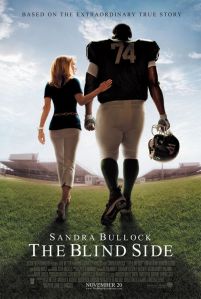 Based on a true story, The Blind Side tells the true-ish story of Michael Oher (Quinton Aaron) who was a lost, homeless black youth in Tennessee. He was adopted s a teenager by the Tuohy clan, a rich White family led by no-nonsense matriarch Leigh Anne (Sandra Bullock). Her husband (Tim McGraw) is a restaurant franchise owner, so they don’t have to worry about money or food budgets for Michael’s large appetite. The gentle giant is grateful but wary. He’s admitted into a private school because of his football potential, but at first they envision the hulking teenager on defense. Leigh Anne is the one who sees his protective instincts and assists in the switch to offensive tackle, whose job is to protect the quarterback’s blind side. With Leigh Anne’s steady influence and a stable home environment, Michael begins to feel like he has a loving family. Eventually Michael Oher becomes an All-American player in college and was drafted by the Baltimore Ravens in the first round of the 2009 NFL Draft.
The Blind Side might just sneak up and, forgive me, blindside you. Well, that?s not accurate, because this movie will not sneak up on anyone. There is not a single moment of surprise to be had. Michael Oher is portrayed as a gentle giant who is very tight-lipped. Much of his performance is in body movement and those dark, sad eyes of his, which means that the audience has to intuit a lot from the character. That might be why the most affecting moments come from Oher’s stunned, grateful reactions. It’s hard not to be affected by such an outpouring of earnestness. Stay during the end credits, watching the photos of the real family at the 2009 NFL Draft and try not to feel a smidge of their happiness.
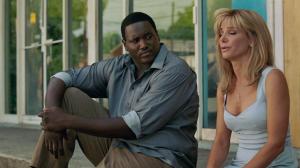 Bullock seems like a natural fit for this character and this material, and she does give the Southern spitfire life. She’s the heart of the movie and pretty much the driving force for the film, so it helps that Bullock taps her natural charms to make the character feel less like a cartoon and more like some approximation of a person. She’s formidable and brassy and pretty much gets her way on everything. The movie has the faulty belief that Leigh Anne saying anything folksy is funny, which is not the case. However, Bullock makes the character likeable and embraceable, and plus, she doesn’t fall down once. It must be a first for a Sandra Bullock movie.
Every scene is played into a moment of uplift and eventual triumph, which can be tiring but also has a respectable batting average for success. Structurally, the movie doesn’t have any overarching sense of conflict, which seems bizarre given the circumstances of an insanely wealthy white family adopting a troubled black youth in Tennessee. You might think Michael would take some adjusting, or that the students of privilege might not fully accept someone so different, or that the Tuohy children might need more convincing to suddenly add a new member. There are a few raised eyebrows and some slight hesitation, but the characters just barrel forward like what they are doing is common. The family is just resoundingly good-hearted and full of such moral clarity, though the husband seems to be content to be a powerless pawn to his vociferous wife. There is no real internal conflict within this family despite the burdens they tackle, and even worse the movie doesn’t really show any change occurring. At a lunch with her rich girlfriends, Leigh Anne remarks that Michael is changing her life. How? She seems like the same kindly woman from the beginning. Instead, the movie is packed with tiny little conflicts that get easily resolved and then move along. Will Michael feel at home? He does. Will he get his grades up? He does. Will he figure out the game of football? He does. Will he play well in a game? He does. Will he graduate? He does. Will he get a scholarship? He does. Will he reject the lifestyle of crime? He does.
Big Mike is sidelined in his own story by the firecracker of a character that is Leigh Anne. The saintly Tuohy family is yet another example of Hollywood feeling the need to tell a compelling African-American story framed as the story of helpful, White characters. Why can’t he film’s emphasis be on Michael instead of Leigh Anne, especially since she remains the same good Christian woman from the start? It’s probably because Oher, as portrayed on film, doesn’t have much of a personality. He’s a nice if soft-spoken kid but he mostly just shuffles his feet. Off the football field, he is written merely to take up space. He serves as the ongoing results to Leigh Anne?s teaching experiments.
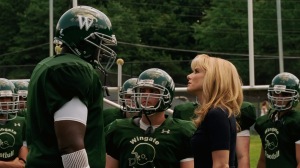 If you peel away the movie’s sentiment, it does have some niggling, potentially troubling aspects to the story. It sings the praises of insanely rich Southern Christians and makes us say, “How nice and rich of them.” Leigh Anne is the kind of woman with enough mettle to venture into the ghetto and even stand up to taunting gang members. She even threatens to shoot one of them. Every one of these “ghetto” sequences feels transparently written by somebody whose only understanding of an urban environment is from movies and TV. I wasn’t expecting The Blind Side to be as accurate as The Wire, nor would I normally care about the inaccuracy, but when it’s in the service of comparison (the comfy world of rich White people vs. the hopeless existence of poor blacks) the portrayal becomes ham-handed and morally questionable. Just to rub it in how good Michael’s got it, the movie resorts to ending with a montage of newspaper reports detailing gang slayings in Oher’s old neighborhood, highlighting every character we saw onscreen. The movie says they had no choice to end up as criminals because they could not escape the nightmares of the ghetto. If only those unfortunate black youths could have found rich families to adopt them.
Perhaps the funniest moment for me, as an ardent college football fan (go Bucks!), was a montage of South Eastern Conference coaches trying to recruit Oher in 2005. He’s visited by the head coaches for South Carolina (since retired), Tennessee (since fired), Auburn (since fired), Arkansas (since fired, now coach of Ole Miss), Louisiana State (left for NFL, now coach of Alabama), Auburn (since fired), and Ole Miss (since fired). The turnaround in just a four-year period is astounding for a major college conference. The coaches look like they’re having fun in the movie, probably because they get to pretend to be coaches again.
The Blind Side is a straight-down-the-middle genre picture that plays every expected note, it?s manipulative and formulaic for a sports drama, but I’d be lying if it didn’t get to me from time to time. If you go into The Blind Side under the right frame of mind, which means essentially ignoring the flagrant manipulations, then this movie will work on its sentimental sports genre sensibilities.
Nate’s Grade: B-
Share this:

Bruno (2009)
 Sacha Baron Cohen struck comedy gold and financial riches with Borat, his popular anti-Semitic foreign character that skewered American ignorance and xenophobia. Now, he’s back at it as Bruno, an extremely gay Austrian TV host who travels across America in hopes of being famous. The problem this time is that the Borat formula just doesn’t work the same with this character. Borat at heart had an innocence to him that made his outrageous statements tolerable, but Bruno is mostly obnoxious and you feel pity for the dupes that he annoys. The Cohen-Larry Charles technique of crash interviews snares some high profile victims like Congressman Ron Raul and Paula Abdul, but the movie is also thinly staged with corporate compliance from NBC/Universal opening doors for Cohen. There are a small number of worthy targets, from gay brainwashing counselors to stage parents willing to submit their children to anything for a buck, but the best is saved for an Arkansas fighting ring. It’s depressing that a bunch of people foaming at the mouth to see violence would become so incensed and repulsed by men kissing. Regardless, this movie is a string of unfunny skits slapped together with the message of breaking down homophobia. My question to Cohen: how exactly are you going to rid people of homophobia by inundating them with over-the-top gay stereotypes? Doesn’t that reconfirm what they feel? Bruno doesn’t make you feel uncomfortable because he?s gay; he makes you feel uncomfortable because he’s a jerk.
Nate’s Grade: C
Share this:

The Spirit (2008)
 This is the last time someone will let Frank Miller direct. Astoundingly bad, The Spirit is borderline camp for every absurd and bizarre second. It careens all over the place, never settling on a tone. So one minute it will be hard-boiled noir and the next it will break down the fourth wall and amp up the goofy slapstick to Looney Tunes levels. The story is threadbare, the characters are half-developed ideas, and each scene almost exists in its own five-minute world before Miller barrels forward. Sure the flick has some appealing visuals, but even those are derivative of the superior Sin City. As a director, Miller doesn’t cut it. He will shoot scenes with nothing but close-ups, giving no point of establishment for the audience, and he’s too prone to random diversions. Miller displays zero ability, or a complete disregard, for directing actors; they are terrible in different ways. Gabriel Macht, as the back-from-the-dead crime fighter The Spirit, sounds like Paul Rudd doing a Harrison Ford impression. Samuel L. Jackson, as the nefarious criminal/mad scientist/also semi-immortal The Octopus, overacts to a degree not even seen by Samuel L. Jackson. Scarlett Johansson, as an evil assistant, can’t even hide her disdain and boredom. This stuff just becomes unchecked lunacy, but it still manages to be boring through and through. The hero is a stiff, all the women are sex objects, and the conflicts are pointless when the combatants can’t be killed. The only thing worth mentioning is that Eva Mendes is still a gorgeous looking woman. Even Miller couldn’t fumble that one.
Nate?s Grade: D
Share this:

Zombieland (2009)
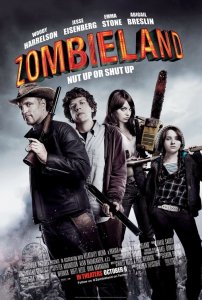 Zombieland is insanely entertaining and one of the most satisfying theatrical experiences of this year. It’s an American Shaun of the Dead, meaning that the zombie genre gets lovingly satirized with some wit, some bite, and a whole lot of blood. This movie isn’t nearly as clever as Shaun but it sure serves up the red meat of what you’d want in a crackling zombie action comedy. Woody Harrelson and Jesse Eisenberg make for an engaging odd couple pairing, director Ruben Fleischer posits a nice amount of visual whimsy with onscreen survival guide rules, and there is a glorious celebrity cameo midway into the movie that might qualify as my favorite 10 minutes of 2009. It’s funny and fiendish but it doesn’t break down the fourth wall. Zombieland does have some flaws to it, like a repetitious second act where the boys get duped by a pair of sisters (Emma Stone, Abigail Breslin) like three or four times, and the climax at an amusement park raises some obvious questions. Why turn on an amusement park and attract every zombie in town? Why dive out of a Hummer when you could drive off? The movie seems to take great aims to set up the damsels in distress, mostly because the inconveniently shut their brains off from survival mode. The silliness and macabre fun is infectious and Zombieland makes you hungry more adventures with these characters killing the undead in gross yet creative ways. I may be biased since Eisenberg’s character is from Columbus, Ohio (the crowd I was with cheered when we were informed our present home town had been decimated by zombies).
Nate’s Grade: A-


You must be logged in to post a comment.