Author Archives: natezoebl
Margin Call (2011)
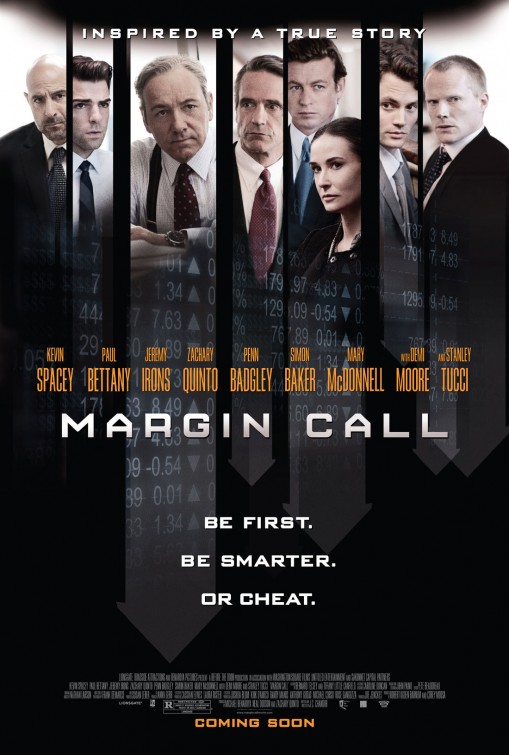 Set during the first twenty-four hours of the 2008 economic meltdown, Margin Call feels like David Mamet’s classic play Glengarry Glen Ross just set fifty floors higher. It’s a tense stew of ego and hubris and cunning and manipulation and self-preservation, peppered with some salty language. The corporate bigwigs of a fictional financial firm scramble to get out the door first before everyone else catches on to the looming market crash. “There are three ways to make a living in this business: be first, be smarter, or cheat,” says the CEO (Jeremy Irons). Debut writer/director J.C. Chandor brilliantly captures the rationalization of sociopathic greed; the CEO waxes about the historical inevitability of our own self-destructive influences, glibly recounting other market crashes and saying he will survive because the nation’s class systems are fixed. The behind-the-scenes scheming has a sick appeal, witnessing how Wall Street wriggled free of responsibility. This isn’t a far-reaching look into the financial meltdown; it’s more of an insular, thoughtful, occasionally meditative play about the moral questions at play. The prosaic pacing caused quite a slew of yawns in my audience. There does seem to be a never-ending cascade of scenes where two characters will just sit and talk. However, when the writing is this sharp and the actors are all at the top of their game (Kevin Spacey is emotionally spent in a test of loyalties; Irons is charmingly sleazy), then you can forgive some stagnate pacing. Margin Call has a few heavy-handed metaphors (Spacey putting his dog down = the economy!), but overall it’s astute, insightful, sophisticated, and compelling enough to forgive its overreaches.
Nate’s Grade: B+
Share this:

Red State (2011)
 Kevin Smith, love him or hate him, you can’t deny the man is a natural promoter. Earlier in the year, the indie filmmaker self-distributed his first foray into horror films, Red State, on a nationwide tour of screenings. I first saw Red State way back in March when Smith visited Springfield, Ohio to screen the film and then answer questions afterwards. I’ve been trying to wrestle with my critical opinion in the ensuing months. Fortunately for me, Smith has made it extremely easy to revisit my thoughts. Red State eschewed the traditional theatrical release pattern for a new digital-age model. It was available on demand through cable systems, available for download, and even broadcast in special theaters for a one-night only event. A month later the film hit DVD. In its better moments, Red State is the unholy union of Quentin Tarantino’s love of language, and penchant for jolting violence, and the Coen brothers’ nihilistic, cock-eyed sensibilities. This is strange new territory for the man. I wish I could say Red State is worthy of all the attention, though this sinister, messy, gritty little movie can work its wicked mojo, at least for a while.
The Five Points Church is a notorious family-operated cult. Under the guidance of their shepherd, Abin Cooper (Michael Parks), this fundamentalist Christian group pickets the funerals of dead soldiers, haranguing the grieved that their loved ones are dead because “God hates fags” (excuse me for failing to put two and two together). A group of teenage boys (Michael Angarano, Kyle Gallner, Nicholas Braun) is lured to Sara’s (Melissa Leo) trailer with the promise of sex. The middle-aged woman plies her young bucks with drinks and they are knocked out. The boys awaken to find they are inside the Five Points compound and witness to Abin Cooper’s solution to sinners. Rather than railing with signs, the family has decided to take a more hands-on approach and execute them. While this is going on, a sheriff’s deputy alerts the authorities and the ATF rolls up to the compound. Lead by Agent Keenan (John Goodman), the government agency engages in a firefight with the rightwing cult. Ordered to take down the compound, and all witnesses, the various characters will try and escape with their lives, never knowing when that fateful moment of atonement may drop.
 What Smith does well for a genre novice is to keep his audience constantly upended. Just when we think we’ve settled on a protagonist and a plotline, suddenly Smith switches gears. The surprises are sudden and often merciless, leaving the audience little room to adjust. In a genre usually beholden to formula, the consistency of Smith’s surprises makes for a darkly satisfying viewing. Watching Red State demands due attention. Naturally, not all of these tonal shifts work to the movie’s best interest. The final shift, to all-out action thriller, is the most leaden. The Ruby Ridge/Waco-style standoff allows for a lot of gunfire but very little action. We mostly just cut back and forth between the two sides firing and, inexplicably high numbers, being shot in the face. It can get repetitive and seem like all the mounting tension gets squandered. There is a nice storyline within of one family member, Cheyenne (Kerry Bische), forming a plan to save the compound’s children and escape. Bische (the lead on the last season of TV’s Scrubs) makes fantastic use of her limited screen time to render the anxiety and fear of her character. She’s second only to Parks in the performance department as far as I’m concerned. Then the climax comes along and Smith teases being audacious, going in a fire-and-brimstone angle that would completely obliterate audience expectations. And just when it seems like we’re about to get something radical… Smith falls back to what he knows – dialogue. For the final five minutes, Smith concludes his narrative with two government officials explaining what happened in florid detail. It’s a fairly big letdown.
The setup of luring teens to their doom is an old horror staple, though usually the ones doing the sacrifices are card-carrying Satanists. And when exactly would a Satanist be in a situation needing to prove their validity with a membership card (“I’m sorry Mr. Darkseed, but we can’t give you the ten percent discount on all those goat skulls unless we see some valid photo ID.”)? Smith flips the switch religious allegiance. Instead of Satanists or some other misunderstood fringe religion, the cult is a group of pious Christians. There’s plenty of room to work here and Smith refrains from making easy associations; the Five Points nutjobs aren’t meant to represent Christians as a whole or Christianity. They are extremists, and they will go to extreme measures. Ostensibly based upon the Westboro Baptist Church and Fred Phelps, you keep waiting for Smith to satirically carve up the clan, but this never really occurs beyond the superficial. Smith’s writerly instincts give Abin Cooper a ten-minute sermon/platform where the guy just unloads a hate-filled diatribe against homosexuals and progressives. For many, this will be the make it or break it point of the film. There are some genuinely tense moments to the first half of Red State. There’s one scene where the camera holds on Gallner (The Haunting in Connecticut) inside a wired cage. He rattles and screams and generally comes unglued, and we too piece together what he hears, dreading what is to come. The many escapes and narrow calls are also harrowing and finely edited to ratchet up suspense.
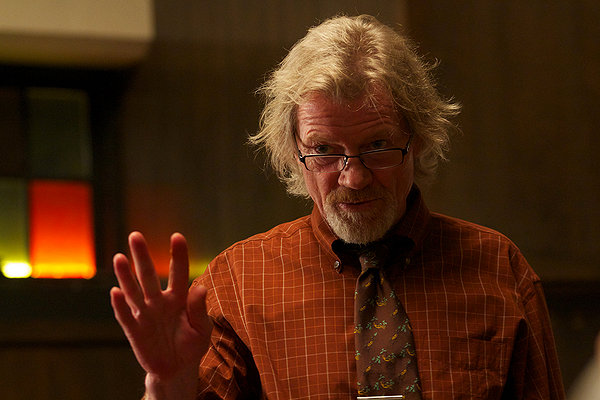 It seems, though, that Smith’s bleak screenplay does not present any characters we can truly root for. Horror has been shifting this way for the past twenty years. Thanks to the rise of the slasher flick, audience empathy has shifted from being with the running/screaming victims to being with the gruesome yet personable killers. Red State has a high body count but you won’t feel much when those bodies hit the floor. You’ll feel a jolt of shock, but from an empathy standpoint the needle barely registers. Sure, we don’t want people to be tortured and we want the abused to escape torment, but that’s not the same as characterization. The closeted sheriff (Stephen Root) feels like the start of an idea more than anything else. The trio of teen boys is presented with as little care as any other throwaway slasher flick. They are but meat for the grinder, our entryway into this hidden and spooky fundamental world. These aren’t so much characters as bodies waiting to be slain. The people are set up so they can be knocked down. This issue can become troubling when Smith wants us to rethink our loyalties, especially once the siege has begun. He wants us, dares us, to start feeling empathy for members of the Five Points Church. The problem is that the plot’s adherence to shock value and the underbelly of human nature has desensitized our empathy. When the ATF starts firing most in the audience will probably just cheer, not reflectively question the moral relativism. I doubt anyone will be switching allegiances midway through.
Cults are usually held together with a charismatic leader, and Red State has that in spades with Parks. The man just dissolves into his twisted character, a preacher that uses the Word of God to indoctrinate and arm for his own holy war. Parks has done fine supporting work before in the stable of Tarantino and Robert Rodriguez movies, but Red State is the actor’s biggest modern showcase yet. The man makes your skin crawl the way he can wrap hate into a honeyed, easily digestible product. Abin holds sway over his flock and likewise Parks commands the screen. He provides grandeur and menace to Smith’s words. It’s not a scenery-chewing performance; Parks doesn’t go for the obvious notes when he can hit something deeper and more unsettling. You get a sense that this man fully believes the dogma he teaches, and that makes him all the more terrifying. The other actors peopling Red State are fine, though Leo (Oscar-winner for The Fighter) seems a bit unrestrained especially in contrast with Parks. Goodman (TV’s Treme) gets to talk on the phone a lot to his unseen superiors. The end of the film just descends into frenzied yelling on everyone’s part.
Credited as a horror movie, though I view it more of a survivalist thriller but I suppose genre specifications are subjective, regardless, Red State is miles away from Smith’s usual output. The movie has its share of creeping dread and menace, thanks to Parks’ transfixing performance. The screenplay is unrepentantly dark, cruelly cutting down lives with shocking acuity. The constant surprises and upheavals are a way to keep the audience guessing, though the shock value starts to wear off by the noisy, repetitive gun battle climax. It’s hard to nail down exactly what kind of commentary Smith is presenting. Obviously he doesn’t side with the hateful fundamentalists (this is probably why he pulls back at the end), but he also shows the government’s reaction to religious zealots to be morally queasy at best. It’s hard to get a read what the commentary is, and with horror, if you don’t take a stab at commentary then you’re just watching high-gloss snuff films. Red State resembles a snuff film in several ways and not just in its grimy aesthetics. You feel a little dirty after it’s over, and you can’t help but question your motives for watching it. Plus you can’t help but think it could have been better done (note: I have never watched an actual snuff film, you sickos, but the point remains).
Nate’s Grade: B-
Share this:

The Thing (2011)
 Has any modern filmmaker endured more crappy remakes of their films than John Carpenter? The man has suffered through remakes of Halloween, The Fog, Assault on Precinct 13, and now his 1982 creep-fest The Thing, itself a remake of the 1951 Cold War allegory, The Thing From Another World, gets the same awful treatment. This new Thing is some hybrid of remake and prequel, because it’s set before the events of the 1982 film but it pretty much follows the same overall plot. Once again a group of scientists (this time they’re Norwegian!) on a remote Antarctic outpost discovers an alien body buried in the ice. Once again the alien breaks loose and can assume the fleshy form of man. But this new film forgoes the rampant paranoia and rising tension of Carpenter’s film for cheap Boogeyman thrills. The alien monster is introduced early and the rest of the film succumbs to people looking around pensively, afraid it will jump out and attack. This alien creation is an odd quirk of evolution; a species that seems to be made of nothing but gnashing teeth, spindly legs, and vaginal imagery. How these things built and fly spaceships, I have no idea. Some of the gore effects are crafty and stomach-churning, but nothing is as memorable as the practical effects used sparingly and to great effect in the 1982 flick. This Thing is too much of a familiar monster to make an impact.
Nate’s Grade: C
Share this:

Real Steel (2011)
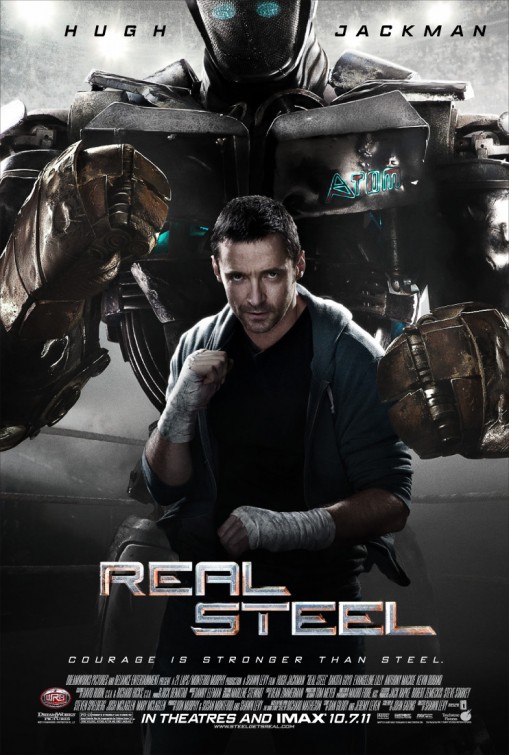 In the future world of Real Steel, set in 2020, robot boxing has become a huge sensation. It seems that audience bloodlust was not being satisfied with flesh and blood hitting the canvas, so robot brutality will do. Whatever happened to mixed martial arts, a sport arguably more popular than boxing in this day and age, popular enough it even got its own uplifting sports drama earlier this year (the overlooked Warrior). I strongly doubt that in only nine years we’d have giant fighting robots and that this “sport” would be nationally recognized. Did anyone see Comedy Central’s mechanical Coliseum showdown, Battlebots? There’s your answer, America.
In this future world where trucks have glass panels to show the world your feet (why? Because it’s “futuristic” you fool), Charlie Kenton (Hugh Jackman) is a has been. He enjoyed a fleeting career as a professional boxer before the mechanical men came into popularity. Now he goes from town to town trying to scrounge up some petty money with small-market robot boxing rings. His only pal is Bailey (Evangeline Lilly), his former flame and the owner of the boxing ring/chop shop that Charlie calls home. Charlie owes plenty of money to plenty of not nice people. His solution arrives in the form of his 11-year-old son, Max (Dakota Goyo). Charlie ran out on Max and his mother when Max was a baby, but now mom’s dead and custody is being discussed. Mom’s aunt (Hope Davis) and her rich hubby want Charlie to sign away his parental rights, which he agrees to do for the right price. Max spends one last/first summer with his estranged father before going off to live with his auntie. The two bond when Max discovers a beat-up old sparring robot when father and son are skimming parts illegally at a junkyard. The old bot, which Max names Atom, becomes a champion fighter. Father and son ride the success all the way to a championship bout with Zeus, a legendary robot that destroys all challengers. Can they stun the world? Can father and son bury the hatchet? If these answers are in doubt, I advise you to see any sports movie ever released.
J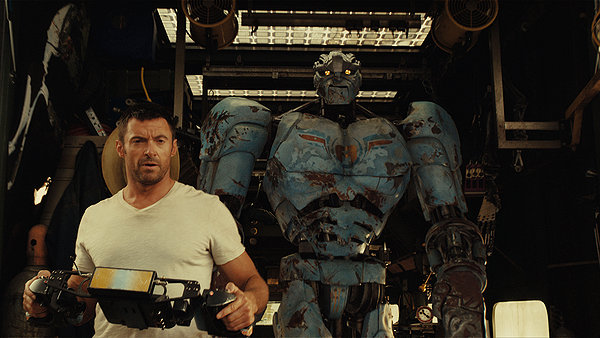 ust in case you stood clueless and slack jawed at the film’s storytelling prowess, you’re in luck because every character will take great pains to explain the significance of plot points, key metaphors and symbols, and personal motivations. Usually this stuff is tucked away as subtext, but Reel Steal decided that it would rather rub the audience’s nose in the architecture of its screenplay. Characters will just go around speaking blurting out their feelings in the most transparent way possible: “I can’t be with you again, I’m afraid of being hurt again, and seeing you in that ring is like seeing my father again in that ring, and fighting this fight is your attempt to regain redemption and prove yourself wrong, and the robot is old and busted but still has some fight in it left, just like you Charlie…” It gets tiresome. Max squeals, “All I’ve ever wanted was for you to fight for me!” Your dad’s kind of a lout, kid. You’d be better off being adopted by your preposterously rich aunt, which is really the moral we learned from Annie. Who talks like these people? It’s astounding how blatant the film is about explaining its sotry mechanics so that the dumbest common denominator in the audience can walk away feeling like Roger Ebert (“Did you notice how the robot was a metaphor for Charlie? I did.”).
Never in my life would I have anticipated that someone would watch Over the Top and say, “What if we added robots?” This movie essentially is a souped-up version of Sylvester Stallone’s 1987 flick where a dad fights for the custody of his kids through the weirdly court-approved process of the gentleman’s game of arm wrestling. First off, who in their right mind would make a movie about professional arm wrestling? There’s a reason this specific sports genre still stands with one entry. Charlie finds redemption over one summer spent with the kid he abandoned and then sold. The strange thing is that Max knows from the start that he’s more a commodity than a valued son. Yet he still bonds with dear old dad though he’s still going off to live with his rich aunt by the end. The father/son relationship becomes the heart of the movie, but what good can come from two annoying characters learning to get along? They’re still too annoying for me.
Charlie’s fight to become a better father is hampered by the fact that I wanted to strangle his kid. There was rarely a moment that passed where I didn’t want to punt this little brat. From the moment he first steps on screen, Max is surly and aggravating. Given that he’s meeting the father who abandoned him, I’d expect some confrontation but this little twerp cops a bratty attitude throughout. He hops on the boxing ring mic and walks around with a phony swagger and challenges the biggest baddest robot. The kid seems like a chip off the ole block, falling victim to hubris just like dead. When Goyo (Thor) screams it becomes a high-pitched caterwaul that caused me to writhe in physical pain. The subplot of Max teaching the robot how to dance is just embarrassing. You better believe the kid teaches his metal friend how to do the robot. The young actor deserves a fair share of the blame. Goyo flounders, overselling every emotion and hovering at a persistant petulant level of acting. I do not advocate the endangerment of children, obviously but I’d be lying if I failed to admit that I would have slept soundly had Max tumbled to his death in the robot junkyard. Goyo is so powerfully awful that he may well be the tarred as the Jake Lloyd of this decade (Lloyd infamously played the twerpy kiddie Darth Vader in the first of the regrettable Star Wars prequels). It’s hard for me to root for the reunion of father and son when I’d rather see father bury son in the ground.
 Real Steel is littered with nonsensical or dropped subplots, the worst offense being Atom’s secret. It’s revealed midway into the film that Atom is not just a sparring robot but a sentient being. It’s faking that it can only shadow human movement. When Charlie “teaches” Atom how to box he really is teaching the robot, though conveniently Atom seems to keep this knowledge to itself. Even when it’s being battered mercilessly, Atom doesn’t employ the skills it’s been taught. Maintaining his cover is more important than self-preservation, so suck on that Asimov. The fact that Atom is sentient is the filmmaker’s desperate attempt to add empathy to the robot. Without sentience, the robot is just a junky avatar that can be scrapped. It’s a piece of equipment but if sentient it becomes a character we can feel for. You don’t share empathy with a coffee maker. I kept waiting for this secret to somehow get out because it’s kind of a monumental deal. But it never does get out. The story never once revisits this gigantically important revelation. What does this mean about other robot boxers? Are they too sentient? What do they think about destroying each other for sport? There are important questions here that are ignored. What’s the point of making Atom sentient if you never do anything with it? It’s only a ploy to drum up empathy, but at no point does Atom feel like a character, only a collection of parts. It’s a coffee maker on steroids.
The movie borrows liberally from other sports movies, taking the emotional beats from Rocky and the family drama from a film like The Champ, though loses the downer ending. Everything is too recognizable, too formulaic, as if it was assembled on a factory floor. The only points of surprise are when Real Steel just carelessly drops plotlines, as mentioned above. What’s the point of introducing a plot point like the robots can malfunction if hit correctly in Act One and not have it resurface in Act Three? Jackman (X-Men) acts with all the power his neck veins can afford. He seems to be constantly growling or on the precipice of said growling. The romantic subplot with Bailey is an undeveloped thread only meant to tie back together into a pretty bow at the plot’s earliest convenience. Lily (TV’s Lost) plays the “girl,” which means all she’s given to do is remind the hero of his potential and be the warm body waiting in bed. But this is a family film, so we stop at late-night cuddling. Then Max ends up being a savant at mechanical engineering and electronics because… he plays video games? Give me a break. And it just so happens that every character we’ve been introduced to will be in attendance for the big fight, even the Texas bookie (the great and underutilized Anthony Mackie). Wouldn’t Detroit bookies take umbrage to this?
Do you like reaction shots? Real Steel is chock full of them: people wincing, people yelling and clapping at TVs, people muttering under their breath the optimistic instructions, “C’mon, c’mon, c’mon.” You accept some reaction shots as part pf the terrain of the sports movie, but when they’re presented in excess then it becomes a crutch, the director reminding the audience what to feel with the subtlety of a sharp stick to the eye. Then again subtlety was never the forte of director Shawn Levy, he of Date Night and Night at the Museum fame. The special effects are strong and the boxing sequences even have some livened suspense to them, though why would anyone build a robot boxer with two heads? What advantage does that offer other than two things to hit? Levy gets lost in the special effects and treats the actors with the same indifferent level of care that the humans show the robots.
Real Steel wants to be a rousing, family-friendly crowd pleaser; it just won’t ever let you forget that this is its primary function. This outlandish sports flick is much like its robotic pugilists: big, dumb, loud, and prone to malfunction. The film has no faith in its audience’s intelligence so every feeling and symbol is plainly explained with unwanted diligence. The characters are unlikable or underwritten, the story is shackled by lockstep devotion to formula, and Goyo’s wretched performance makes it damn near impossible to sympathize with the father/son reunion. Filled with unresolved plot setups and a mystifying similarity to Over the Top, Real Steel is just like every other boxing movie on record except this one has robots. I’m fairly certain the screenwriters were robots too. Why else would they make a robot becoming sentient seem like no big deal? Obviously this is propaganda to lull us into complacency before the impending robot war. Real Steel is a classic example of a movie done by committee; it feels like it was crudely assembled from the spare parts of other, better movies.
Nate’s Grade: C
Share this:

Season of the Witch (2011)
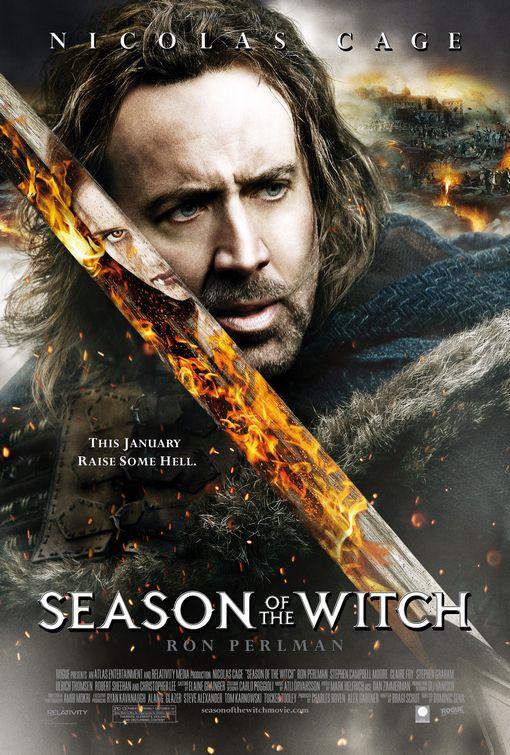 No actor has amassed a higher output of spotty choices than the reigning king of the paycheck film, Nicolas Cage. The man has a habit of appearing in mediocre trash, only notable because a star of Cage’s stature is participating. He’s in late Marlon Brando territory and Cage hasn’t even hit 50 (or blown up to 300 pounds). Every now and then he’ll make a movie that reaffirms how talented an actor he can be, like Adaptation. or Bad Lieutenant: Port of Call New Orleans. But mostly what we associate with Cage nowadays is tic-filled performances, exuberant weirdness, funny hair, and bad movies, two of which are so bad they’re skipping theatrical releases this year (Trespass and Seeking Justice). Season of the Witch will do nothing to change this association.
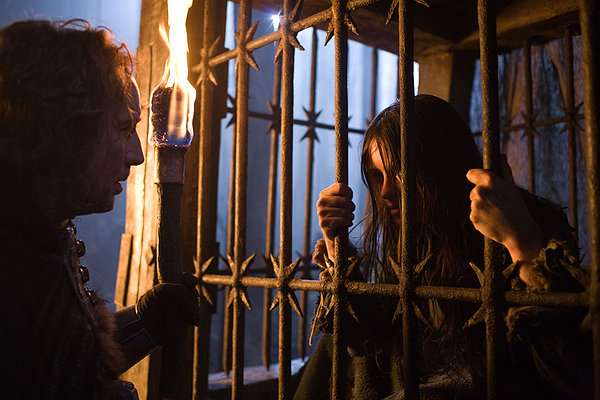
During the 14th century Crusades, warriors Behmen (Nicolas Cage) and Felson (Ron Perlman) are the best killing machines the Church could hope for. They desert their positions after becoming disillusioned with the Crusades. The duo ventures into a city where a girl (Claire Foy) has been chained in a dungeon. In an airtight piece of impenetrable logic, she’s being blamed for bringing the plague. Behmen and Felson, along with a former knight, a priest, and a young upstart, are tasked with bringing the girl to a monastery where she can be properly dealt with. This secluded monastery is the only place left with a copy of a rare manuscript that contains a spell that will end the pestilence. They put the girl in a cage with wheels and get rolling to that monastery, though not everyone is convinced that the girl is a witch.
 For the first ten minutes, you swear you’re watching a buddy comedy transported to the era of the Crusades. Cage and Perlman are in the front lines of “God’s army” but they’re trading competitive quips like, “You take the 300 on the right. I’ll take the 300 on the left,” and then they preposterously debate who is going to buy post-battle drinks while in the heat of battle. They’re literally slaying enemy soldiers and would rather be arguing over who buys. It’s like they have no attachment to anything happening. This opening Crusade sequence takes us through 12 freaking years of battle locations, but it’s only at the final battle that Cage and Perlman come to the realization that women and children might also be getting slaughtered as they siege city after city. It’s at this point that they get on their moral high horses and stick it to the Catholic leaders: “I serve God, not you. This is not God’s work.” Why did it take them 12 years of fighting to figure out that innocent people may die when you lay waste to cities? Naturally this epiphany only happens after they kill off a European looking innocent. The opening sequence is meant to introduce us to these characters, but it jars the viewer in mere minutes. These guys don’t feel a part of their place or time, and it only gets worse from there. Their nonchalant anachronistic behavior makes the movie seem like a Hope and Crosby vehicle.
This is one thunderously boring movie, putting me to sleep three separate times. I had to rewind what I had missed, and each time I came to the conclusion that I really had missed nothing at all. The problem with the plot is that it makes a mystery pretty obvious. The group is carting around a teen girl in a cage. You’d think this would be something of a conversation starter, perhaps even an opening for a critical analysis of the Inquisition and religious fanaticism at this perilous time. Nope. The whole of the Bubonic Plague is being blamed on a teen girl and nobody seems to bat an eye at this. Sure there’s a few passing references to how killing is wrong (again, remember this took at least 12 years of slaughter to sink in), but the movie’s central storyline seems to shift to a “Is she really a witch?” query. Judging from what kind of film this is, you’d probably be safe betting on “yes” and, well, you’d be partly right. The reason this is no spoiler is because it’s revealed at like halfway through the movie. The girl’s chief defenders suddenly jump on the “burn her” bandwagon. Strange things are following the troupe, so it’s pretty obvious who is at play. However, the girl is no witch but is inhabited by a demon, which seems like splitting hairs. When the super cheesy CGI demon/gargoyle shows its face, the creature actually speaks English but in a really speedy and comical voice that makes it hard to be taken seriously. An earlier cut of the movie did not involve this dumb CGI demon but the girl herself. At least that route would have saved the producers some money and unintentional laughter.
 The movie should be far more entertaining, even in a dubious fashion, than it finally is. Season of the Witch flirts with some messages (religion can exploit, women were unfairly persecuted) and silly genre elements amidst a Medieval setting (witches, demons, plague). That sounds like the makings for a campy treat but that treat never materializes. The boring plot lumbers, with the company encountering some setback that picks off their numbers one by one. It’s hard not to feel the drowsy effects of the dull repetition. They encounter killer wolf creatures. Then they encounter a rickety rope bridge, and you better believe that there are rotting boards and fraying ropes. Who keeps building these rope bridges that appear in so many movies, and why do they keep getting hired after continually doing substandard work? Do the regulators get fat payoffs from the rope bridge lobby?
The road to the monastery is a long trek and the movie’s momentum seems to lag with every step. There should be more internal conflict rather than this superficial “killing is wrong” moral that every warrior seems tormented with. The premise should be a ripe opening for a discussion on the perversion of religion for political and personal gain, for the abuses of power, for the archaic view of women as subhuman beings who will seduce men to destruction. There’s even a priest along the way to provide a counterpoint. But alas, Season of the Witch goes hog wild for the cheesy supernatural spooks and even at that it fails miserably.
As of late, the saving grace in a Nicolas Cage paycheck movie is a gonzo performance and some wacky hairdo. We don’t even get that much with Season of the Witch. Cage is oddly subdued throughout the whole movie despite all the swords and witchery. Even his hair is subdued. Without Cage’s typical nutty antics, the movie loses any chance of entertainment it might have ever hoped to have. The shame is that Cage and Perlman both have an easygoing chemistry. You like the two of them together; you just wish they had a better reason to trade insults and one-liners.
Far from bewitching, this movie is ponderously dull. It misses camp by a mile and just lands on mediocrity. There’s nothing about this movie that will stand the test of time, good or bad. This is the definition of a paycheck movie. It flirts with going darker before it settles on a messy monster-heavy ending. The special effects are cheesy, the scares are cheap, the plot is repetitious, the characters feel wrongly transplanted from a modern movie, and Cage sleepwalks through his role. I can’t say I blame him. Season of the Witch put me to sleep and I only had to put up with it for 90 minutes.
Nate’s Grade: D+
Share this:

Cedar Rapids (2011)
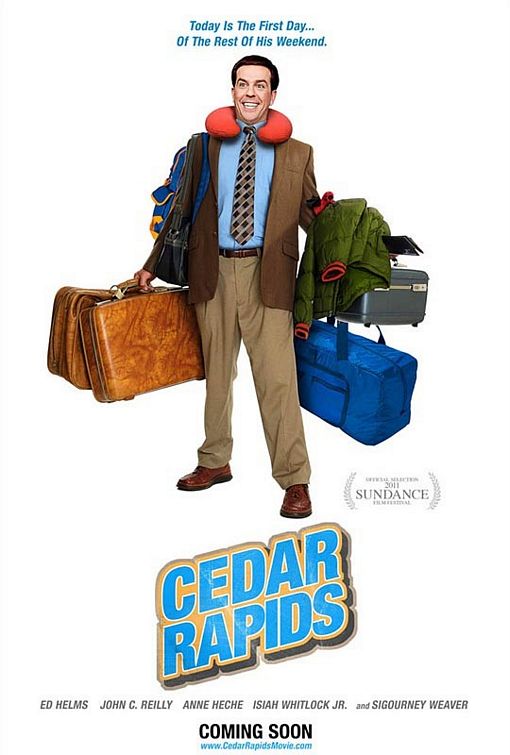 When people think about the temptations and sundry thrills of the Big City, most people are probably thinking of a sin-stained location like Las Vegas. Most people would not confuse Vegas with Cedar Rapids, and yet the Iowa city of note is the setting for a sweet and sometimes dirty, but still sweet, comedy of big-city adventures. To a guy from a town without a stoplight, Cedar Rapids is like New York City. It all depends on your perspective.
Tim Lippe (Ed Helms) is an insurance salesman from Brown Valley, Wisconsin. The town is small but the little insurance agency that could has won the coveted Two Diamond Award four years running at the annual insurance convention held in Cedar Rapids. Tim’s life is in a holding pattern. He wants to do big things but can’t find the oomph to get there. He’s involved in a romantic tryst with his (one-time) seventh grade teacher (Sigourney Weaver). Tim’s chance to make a name for himself comes when he’s selected to represent his company at the annual convention. He has to impress the right people to take home another Two Diamond Award. Never having been on a plane before, he leaves small-town Brown Valley for big-city Cedar Rapids. At the convention site, Tim rooms with Ronald Wilkes (Isiah Whitlock Jr.) and the more unsophisticated Dean Ziegler (John C. Reilly). The group meets up with Joan Ostrowski-Fox (Anne Heche), and together they work on helping Tim loosen up. Over the course of the weekend, bonds will be made, principles will be tested, and tom foolery of the first order will be had.
The premise is rather simple, small-town guy heads to the big city (well, bigger) and the culture shock that waits. But the film never looks down on Tim Lippe. While there is plenty of humor drawn from his naiveté, the movie doesn’t condescend or play up the small-town folks as rubes and squares. It’s funny to see Tim’s mild-mannered explosions of anger, mostly of the “horse pucky” variety of vulgarities, but the movie doesn’t say that the big-city folk are better than Tim. On the contrary, Tim is a principled and devoted insurance salesman, courteous to a fault. He could have stepped out of a Frank Capra movie from a bygone era (Mr. Lippe Goes to Town). Tim is sheltered, which provides some amusing fish out of water comedy, like when he initially is on alert because his roommate is African-American, a rarity in Brown Valley despite whatever the name may imply to some. Tim is a man out of time, but that can be small-town life in general. The Midwestern satire reminds me of the gentle yet knowing nudge of King of the Hill. Phil Johnston’s script sets up Tim’s dilemma as a crisis of conscience, the compromises we make in morality. Tim’s trip to the “big city” is the push the guy needs to get his life out of stasis. There’s something deeply satisfying in watching a character you care about triumph in the end, even if that triumph is a small victory befitting a small-town guy with a big heart.
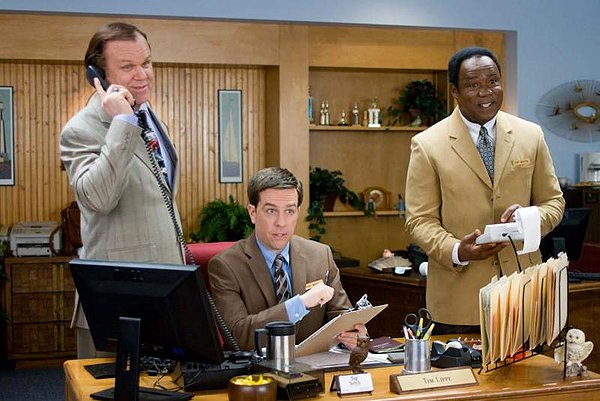 The real fun of the movie, however, is watching the effect the group has not just on Tim but on each other. They teach Tim to cut loose and live a little, but this is still Cedar Rapids, so cutting loose goes as far as nighttime pool escapades and drunken sex. His flirtatious fling with Joan brings the guy out of his shell, and the two of them are genuinely cute together without going overboard. It’s a reserved romance that feels true to the nature of both of the characters. Dean is the loudmouth knucklehead notorious for his oafish shenanigans, but once he feels accepted he goes to war for his friends. He’s a buffoon but not stupid. And then Ronald, though less developed than the other three, provides a nice foil as a straight-laced businessman who keeps it together impressively. Together it’s a team of likeable characters that have grown closer together over the course of that weekend in Cedar Rapids, and you’ll feel the same. You feel like they’ve formed a family around the earnestness of Tim.
Helms (The Hangover) is a suitable candidate for a nice, regular, Midwestern guy. Helms has honed his awkward comedy chops after several seasons on TV’s The Office, and here he sticks to what he knows. Tim Lippe is another in a line of embryonic men. Helms settles into his usual nervous tics that fans will be familiar with. His sunny naiveté wins over the audience and provides for several laughs in contrast with the jaded “big city” folk. Reilly (Step Brothers) can overdo his character’s intentional obnoxiousness. He’s chartered a successful second career as a winsome nitwit, so like Helms, Reilly relies on notes gleaned from past performances. Whitlock Jr. is mostly straight man to the others. His comedic highpoint is an impromptu impersonation of a character from The Wire to get the group out of a dangerous jam (Whitlock Jr. himself played a state senator on The Wire). Other than that, he’s more contrast than character. Heche (TV’s Hung) is a real surprise. She underplays her character, tantalizing us with tidbits that leave us wanting more, much like Tim. The way she plays Joan, you feel the connection.
 With all that said, Cedar Rapids still has its share of flaws. The naïve comedy can go so far before you start to question Tim’s senses, like his casual mistaking of a prostitute (Alia Shawkat, Whip It) for a fellow attendant. His relationship with his former seventh grade teacher is intentionally awkward, but the whole plotline presents an unseemly overtone that doesn’t fit. She’s made to be rather motherly, even when she’s rolling her eyes at her bedmate’s pie-eyed declarations of being “pre-engaged.” I think the motherly aspect makes the whole Oedipal mess even worse (Weaver just seems bored). Late into Act Three Tim goes on a drug-fueled bender that feels out of place for his character who, when first asked for a drink, requested a beer of the root kind. The character of Dean is given too many moments to just wander around and spout crude one-liners. It sometimes feels like the movie is resting while it lets Dean do his thing, and a little of this guy can go a long way.
The plot is relatively predictable and the ending is pretty pat. It works, but the actors and the characters were capable of more. The relationship between Tim and Joan also leaves something to be desired. There’s a great assembly of recognizable guests (Stephen Root, Thomas Lennon, Rob Corddry, Mike Birbiglia) that stop by but add little. Again, the potential for more feels missed. With a solid 80% of the movie taking place in a hotel, you can also start to feel a little cabin fever. And not that it matter much, but I’m disappointed that film with “Cedar Rapids” in its name was filmed in Ann Arbor, Michigan (Iowa did away with its in-state film tax credit).
The appeal of Cedar Rapids, the film, is much like the appeal of its central figure, Tim Lippe. It’s an unassuming, earnest charm, enjoying the company of likeable characters who we want to see succeed. I just wish the predictable plot had done more or trusted the actors’ capabilities. The core characters feel mostly authentic and easily recognizable, which makes the familiar, if at times bland, plot fairly forgivable. Helms and company are an easygoing bunch and you’ll be happy to tag along on their unspectacular hijinks in the “big city.” Cedar Rapids is the kind of low-key, charming little movies that often gets overlooked. It’s worth viewing for the pleasurable camaraderie of the core cast. Cedar Rapids, much like the city that bears its name, is worth a visit but does not require more commitment than that.
Nate’s Grade: B
Share this:

Scream 4 (2011)
 What do you do when your satiric self-aware take on pop culture becomes the MO for a generation? Back in 1996, Scream was a breath of fresh air by sending up dusty horror staples and having highly literate characters, with exceptional vocabularies, deconstruct genre elements while ironically falling victim to them as well. In 2011, Scream 4, an obvious paycheck grab, is showing its age. After a rather nifty series of opening fake-outs, which gave me hope that returning writer Kevin Williamson was going to finely skewer the conventions of horror since Scream last went dormant in 2000, but sadly this is not the case. “New decade, new rules,” one character says, but it’s all so much of the same. People run, they get stabbed, only the locations are truly different. There are a few witty jabs about the obsession with reboots and remakes, and Williamson does secretly work a crafty symmetry to the first film as far as characters go. The body count is much higher but the scare quotient is low. And then brining back the original cast (Neve Campbell, David Arquette, Courtney Cox) seems like a waste if they cede almost all screen time to a bunch of fresh-faced high school kids who were learning to walk when Campbell was learning to run for her life. The satirical elements feel so lazy; if you’re going to introduce technology-obsessed characters and the narcissism of social media, then do something with it. Don’t introduce an element like a webcam and then barely use it. The scares are about as flimsy as the commentary. The reveal of the killer(s) is stupid enough, as is the cracked motivation, but the ending just piles one absurdity onto another. It doesn’t know when to stop, and Scream 4 flirts with some daring possibilities to wrap up its bloodshed. Scream 4 is a drifting vehicle, wasting potential at every opportunity. The weight of all those red herrings, genre riffs, ironic twists, and self-aware characters has gotten to be too much. The Scream franchise has morphed into what it once parodied.
Nate’s Grade: C
Share this:

The Ides of March (2011)
 The Ides of March is that rare political thriller that pulls the curtain away to come to the stolid conclusion that our entire political system is incontrovertibly stuck in the muck. This is a deeply cynical movie that posits that politicos are just about spinning truth, cutting backroom deals, attaining power and influence, and living to fight another day. Even the ones who champion integrity have plenty of salacious skeletons in their closet. So while Ides of March is in one way a liberal reductive fantasy, casting co-writer and director George Clooney as an Obama-style change agent, and Clooney can assert all the rabble-rousing missing from the current occupant of the White House, it still sticks to its deep-seated cynicism. There is nobody that looks good by the film’s end. Ryan Gosling stars as a magnetic campaign director trying to push his guy over the top by winning the all-important Ohio Democratic primary. As the primary gets closer and the race gets tighter, Gosling has to cover up potential scandals while skillfully using his intimate knowledge of them for opportunistic deal making. The film moves at a great clip, the dialogue is intelligent, the characters are rich and ambiguous, and every one of the sterling thespians gets at least one big scene to stretch their acting muscles. The film has plenty of intriguing twists and turns, as the pieces all fall into play for one final power play. If you’re a fan of smart political thrillers, then do not beware The Ides of March.
Nate’s Grade: B+
Share this:

The Help (2011)
 Kathryn Stockett’s bestselling publishing phenomenon has now become a box-office smash. In 1963, Jackson, Mississippi, Eugenia “Skeeter” Phelan (Emma Stone) is coming home after graduating from college. Her ailing mother (Allison Janney) is convinced that she will die without any grandchildren and pressures Skeeter to find herself a man. Instead, she finds herself a job writing for the city newspaper. She answers reader household and cleaning questions as “Miss Mryna.” She seeks help from Aibileen Clark (Viola Davis), a middle-aged woman who’s worked as a maid to rich white people her whole life. Skeeter soon changes her focus and wants to interview other maids about the indignities they experience. She wants to get their story out there. This is a time where it was actual Mississippi law that anyone working against segregation could be imprisoned. They try reaching out to Minnie (Octavia Spencer), a maid recently fired from the services of Mrs. Hilly Holbrook (Bryce Dallas Howard), the queen bee of the Southern belles. Minnie is much more outspoken and her mouth causes her to get into trouble. The only job she can find is in the household of Celia Foote (Jessica Chastain, The Debt), a woman ostracized by Hilly’s forces. Skeeter transcribes the life stories of a dozen maids and the results become an anonymous bestseller that sets Jackson tongues a waggin’.
The Help enlists a colorful cast of characters (no pun intended) and tells a familiar story about people taking a stand during a tumultuous time in history. This is traditional classic Hollywood storytelling with the respective characters banding together, leaning upon one another, building camaraderie and victory, and then finally able to stand up to their antagonists, which in this case is really just Howard’s snooty racist character. It’s well told, well directed (both credits to Terry Tate, childhood friend of the author), very well acted by every member of the cast, and watching all 145 minutes is like being fed a heaping helping of home cooking. You leave feeling full and sated, and some may even feel nourished. You feel good about yourself. I tried to resist but resistance was futile. I can’t help but enjoy The Help. And even though I walked away liking the film, something stuck in my craw. It felt a little too prefabricated, too eager to be liked, to go down easy, gentle, a sweet Southern story about women taking a moral stand and finding their voices. But what is the film’s real focus when it comes to race relations?
 Naturally nobody is going to look as The Help as an exhaustive document of the Civil Rights era, but the movie seems to seriously downplay the intensity of that struggle. Sure it pays lip service to Medgar Evans assassination but by this time there were riots, churches being bombed, children being killed, open collusion between law enforcement and the Ku Klux Klan, and the Freedom Riders were being met by violent mobs. There are a lot of bigger things going on than black maids sitting down for interviews with a college girl. Come on, this is Mississippi we’re talking about here, the home of racism. I understand that the Civil Rights movement had thousands of anonymous acts of courage and the actions of these (fictional) women should not be out rightly discounted. However, the parting message of the film seems to be not about the courage of the black maids but the tenacity of Skeeter, a middleclass white woman who herself grew up with “help.” The Help’s mixed message on race relations reminds me of a similar situation with 2009’s beloved The Blind Side. That movie wasn’t so much about the triumph of a black athlete so much as a glowing picture to how great rich white people can be. And Sandra Bullock got an Oscar for it; that’s how great a white lady she was. The Help is another example of Hollywood taking a story primarily about minorities and having white people necessary to tell that story. Why are white people always necessary to tell some other race’s stories? Skeeter is an open-minded gal that speaks her mind and stands up to the Jim Crow South. That’s how she starts. By the film’s end, she’s now… an open-minded gal that speaks her mind and stands up to the Jim Crow South and now she has a publishing career. Good for her! Good for heroic white people! They had so much to lose back then.
I guess my main fault is that this is not Skeeter’s movie. I don’t even think she’s needed. Yes she provides the outlet for the stories and secrets of an undervalued class of people. But did she need to be the co-lead? Does she need her own storyline where she stands up to her mother cowing to racist social norms? She had her own maid (Cicely Tyson) unceremoniously dumped while she was at school. Surprisingly this does not give too many insights to Skeeter’s character. Do we need any scenes of her going out on dates so that we can forever be reminded how ahead of her time she was, how liberal and progressive she was and destined to be unappreciated by a pool of men who were looking for only pretty housewives? As my friend China Gentry said, we’d all like to think we’d be the forward-thinking progressive voice of change in these historical dramas, to make ourselves feel better, but we’d most likely just be another silent face in the background. The boyfriend storyline is a complete waste of time. Skeeter goes out with a drunk jerk, he comes back and apologizes, they go out again, then after she gets published he freaks out and storms out. And that is the last we see of this guy. That’s the end of his story. He apparently puts his foot down when it comes to dating a female author. This storyline adds nothing to the overall narrative or to the character of Skeeter. There’s entirely too much Skeeter in the movie, and I say this as a gigantic fan of Emma Stone (Easy A). It’s not the actress’ fault either because she performs well in her first dramatic film role. This is just not her movie. This is not a movie about heroic white people; at least it shouldn’t be. This is a movie about the help, so let’s devote more time to them, notably Minnie and Aibileen. The movie opens and closes with Aibileen’s voice over. She is the star of this story. Why do I need another character just to coax out her story? Yes, I understand the limitations to a woman in Aibileen’s position in those days, but that’s no excuse. She deserves to be the focus.
Davis crushes in this movie. She is a one-woman force of devastation. You can just see the wear on her face, the tremor in her eyes, the sadness etched into her face. This is a woman beaten down by her position, and Davis is excellent. How good is this woman? She’s so good she got nominated for an Oscar for a single eight-minute scene in 2008’s Doubt. That’s Judi Dench territory right there (Dench famously won a Best Supporting Actress trophy despite only appearing onscreen for about nine minutes in Shakespeare in Love). She has a few big acting moments but mostly she’s not an outspoken woman. She’s more a downtrodden woman used to the many disappointments of her lot in life. She raises other people’s children while seeing very little of her own son. She develops close relationships with those kids, and the kids feel more attached to their maids than their mommies. And there’s the shattering disillusionment that these children, who once loved their maids, will transform into spitting images of their parents. The help gets treated less like family and more like a disposable, impersonal employee. The ease of severing ties can be heartbreaking. And Davis lets you feel all that without even having to speak. Spencer (Dinner for Schmucks), in easily her biggest role of her career, is enjoyable with the more outspoken role. She’s more the mouthpiece for the audience.
 As I admitted in my review of 50/50, I don’t think there’s any role that Howard (fun fact: both Howard and Stone will play film versions of Gwen Stacy) can play where I won’t fall in love with her somewhat. This is more a hypothesis than a theory at this point. Hilly is a social queen, the Southern belle who likes things just the way they are. She has influence over the other middleclass wives in Jackson, but she does make for a pretty marginal main antagonist given the time period. She can threaten the livelihoods of the maids, so she is a threat, and her worldview is decidedly racist (she thinks using the same toilets will spread “black diseases”). She’s built up enough to be a threat but not enough to be unstoppable. She’s defeatable, unlike the intolerant ideology so prevalent in the South. We can’t defeat racism but we can topple one racist white lady. Well, we can laugh at her and bring up the fact that she ate something very gross once. I won’t go into spoilers, but this plot point where Minnie gets wreaks personal vengeance on Hilly via baked goods feels out of place for the tone of the film. It doesn’t fit.
I resisted seeing The Help for so long, believing it would be a painful experience with mushy emotions and many life lessons served up on an easy platter. And to some degree, the movie is exactly that. But it’s also hard to dislike the sweep of the old fashioned storytelling. The Help is a nice movie, extremely well acted, and filled with period details that will make the audience sense its authenticity. It’s easy to get caught up in the writing and the acting, so it’s easy to ignore the otherwise somewhat questionable examination on race relations. I don’t know why we still need white people to tell “their story.” The Help is a well-crafted movie but it fails to move the conversation forward. Perhaps that’s an unfair expectation. Not every Civil Rights era story is required to properly educate the public, let alone a work of historical fiction. Maybe I should just sit back and enjoy the story like so many million readers have. But the power of Davis’ performance claws at my memory, telling me she deserves a better movie focused on her character. For once, I’d like to see a Hollywood movie about race relations that doesn’t require white people as a framing device. Let’s let the right people tell “their story” for once.
Nate’s Grade: B
Share this:

Rango (2011)
 It’s Chinatown remade with anthropomorphic desert creatures. It’s a Western by way of Hunter S. Thompson. It’s a loving parody of cinema’s wide canvas. It’s one of the most wild, anarchic, oddball animated films to ever be released by a major studio, and it is stupendous. Steeped in weirdness and bravado, Rango has a playful and occasionally macabre sense of humor that kept me in stitches. Director Gore Verbinski (the Pirates of the Caribbean flicks) translates his visual verve into a animated movie that dazzles the eyes with its magnificently drawn features as well as the pointed personality in every stroke. This is a movie with character, not to mention some pretty entertaining characters (including talking road kill). Johnny Depp delivers an idiosyncratic vocal performance for a household lizard that finds himself pretending to play sheriff for a town in need of a hero. When you think Rango will fade into familiar territory, or easy moral messages, the film keeps surprising, forging its own unique path. This is a lively, peculiar, and overall enchanting animated film that’s suitable for families but may well play better for adults with eccentric tastes. I’m still scratching my head, and celebrating, how something like this slipped through the system.
Nate’s Grade: A


You must be logged in to post a comment.