Author Archives: natezoebl
Love, Wedding, Marriage (2011)
 I keep wanting to mistakenly refer to this movie as Love, Marriage, Divorce since that seems like a more prevailing plot element in this abysmal rom-com. Mandy Moore plays a couples counselor who’s a newlywed herself, having just gotten hitched with Charlie (the Twilight Saga’s Kellan Lutz). Her life is great, that is, until she learns her parents (James Brolin, Jane Seymour) are splitting up. Their pain will soon be felt by every person watching this wretched movie. Incompetently directed by actor Dermot Mulroney (My Best Friend’s Wedding), the movie’s tone approaches something like spastic cartoon. Mulroney frames everything in uncomfortable close-ups, which magnifies the exaggerated gyrations and facial expressions of his cast. It looks like every person onscreen is suffering a stroke at one point. The acting is so shockingly terrible. It’s like the actors have been replaced with the amateur dinner theater versions of themselves. Moore’s character is too shrewish and self-involved to be compelling, and Lutz, whose name rhymes with putz, is so wooden you’d swear they carved him out of a chunk of balsa right before cameras rolled. The sitcom plot suffers from every cliché imaginable in the rom-com genre. This is the worst case of bad drunk acting since 2006’s The Black Dahlia, where actors over-do just about every action. The funny part is that it’s only a slight difference from the way the characters are behaving sober. Criminally unfunny, I have only one theory how Mulroney was able to get this movie made because clearly the screenplay wasn’t reeling investors in. In the end credits are many producers and executive producers, several of them with Slavic surnames. There’s also a Slavic model with in a key role. Mulroney turned to the only people who would finance Love, Wedding, Marriage – the Russian mafia. If you see Mulroney in a wheelchair from an “accident” in the near future, you heard the truth here first.
Nate’s Grade: D-
Share this:

The Myth of the American Sleepover (2011)
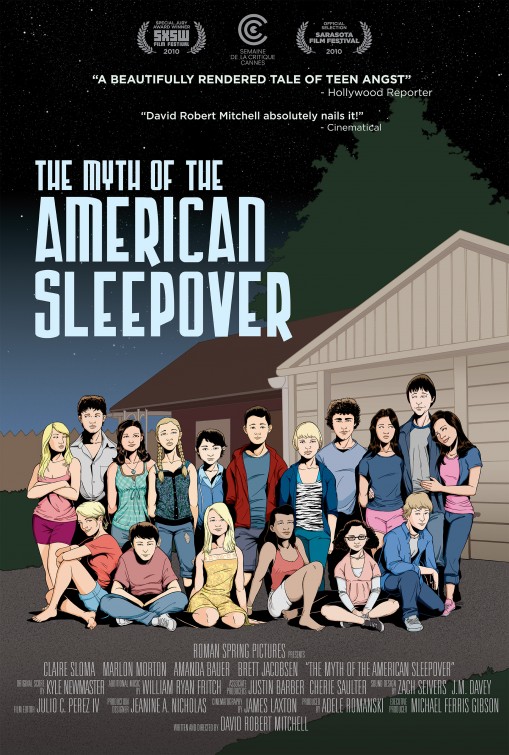 The curiously titled Myth of the American Sleepover owes as much to American Graffiti as it does to the works of John Hughes. This sprawling teenage opus by debut writer/director David Robert Mitchell resonates with all the beautiful aches and joys of adolescence, wonderfully understated but brilliantly realized. I fell in love with this movie.
Set over the course of one night in suburban Michigan, a slew of teenagers try and make the waning summer days worth remembering. Claudia (Amanda Bauer) is the new girl in school and invited to the cool gal’s (Shayla Curran) slumber party. She learns her boyfriend slept with the cool gal and plots a little boyfriend stealing of her own. Rob (Marlon Morton) is obsessed with a pretty blonde girl he once shared a look with in a supermarket. He is scouring the neighborhood, going from party to party, looking for her so he can reveal his true feelings. Scott (Brett Jacobson) is unsure of whether he wants to finish his final year of college, now the site of a painful breakup from his longtime girlfriend. One day while walking the halls of his former high school, he comes across a picture of him with twin sisters, Ady (Nikita Ramsey) and Anna Abbey (Jade Ramsey). He heads out to the University of Michigan, where the twins are enrolled, convinced he could win one, or both, of them over. Maggie (Claire Sloma) is navigating between the middle school sleepovers of her peers and the world of the cooler upperclassmen. She’s been nursing a crush on an older boy (Douglas Diedrich) who worked at the community pool all summer, and will find the courage to make a move.
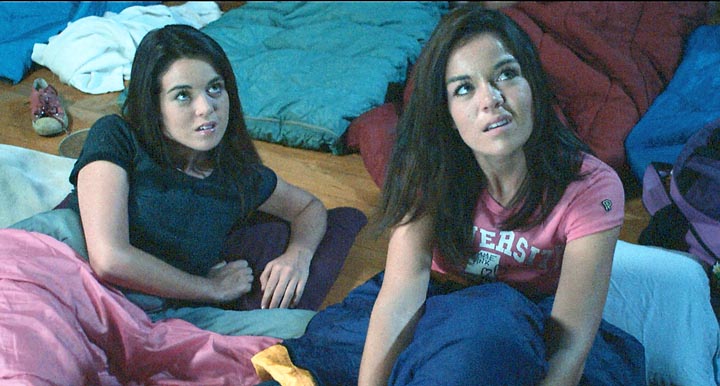 Unlike other coming-of-age entries, this is a movie that forgoes scatological comic setups and other Big Events meant to mark the passing into adulthood, like the loss of virginity, college admittance, or the prom; instead, Sleepover tackles a subject much more honestly and with tremendous naturalism. The level of detail is outstanding; set in what seems like the late 80s or early 90s, I was astounded at all the nostalgic artifacts of adolescence brought back to life. I kept going, “Oh yeah, I forgot about those,” or, “That’s totally something that me and my friends did.” I loved that the movie shows different social spheres and age ranges, so we go along with the late teen house party but we also get see a middle school/junior high sleepover that involves girls staying up late, talking about boys, and eating large bowls of chips. Obviously not everyone will have this reaction, but it just shows the commitment to recreating a very specific time, place, and sense of being. These feel entirely like real teenagers, and their troubles and desires are achingly articulated. You feel the powerful sense of yearning throughout, where the nudge of a knee, the closing distance between two hands that can cause your insides to fill up with a thousand butterflies. Sleepover is about teenagers grappling with emotional connection and personal identity, but it never drags out a soapbox or breaks from its verisimilitude. Every single character in this movie, even the ones meant to be seen in a questionable light, is deeply empathetic. Being an ensemble, you’ll gravitate to different characters and their pursuits, but the movie balances a nice mixture of storylines, cutting back and forth to build a graceful picture of the uncertainty of adolescence.
I found this movie to be so charming, so overwhelmingly affecting, and poignant without slipping into mock sentimentality, which would have been easy. It’s been a big year for nostalgia, but nostalgia is the “least authentic of all feelings,” according to Enrique de Heriz. It’s easy to sit back and say, “Oh I remember that too,” and feel the tingle of some wistful pull from the past, the yearning for a bygone time and place that has magically transformed in your mind into some idyllic spree. Does anyone remember those times, before there was an Internet, and cell phones, and social media, when you got together with your friends to witness the shared experience of a movie with female nudity (this might just be a guy thing), or when you didn’t know if you’d see your crush ever again? The Myth of the American Sleepover does, and so do I. In the words of Lou Reed: “I don’t like nostalgia unless it’s mine.”
 Indeed, it seems like the film exists in a bit of a cultural time warp, where sleepovers were the social apex and holding hands and making out were considered victories worth celebrating. There are no computers or cell phones, thank God. If you excuse the casual and extensive teenage drinking, Sleepover is a rather wholesome film. I was wary that some storyline might take an unexpected dark turn, especially with all the alcohol and hormones, but the movie maintains its sweet appeal without fail. While ostensibly existing in a late 80s/early 90s, I believe this movie is timeless and can be felt effortlessly by people of any age. The pains of adolescence and the anxiety of growing up, not to mention the peculiarities of the other sex, are universal. There is a superb scene where Rob and the girl who secretly likes him pass each other accompanied by friends. We get both sides of the story cut together; he tells his bud that one night he kissed her and then they made out. “It was a pretty good day,” he admits. She says she spent all night trying to get him to hold her hand and then just gave up. We instantly know that her side of this tale is far more accurate, but then this small exchange tells us even more about Rob, his fumbling attempt to be seen as cool with girls. Later, this same girl gives Rob a pep talk about unrequited crushes; she wonders if a person thinks hard enough about an individual, if they’ll know. Like most men, Rob misses her real meaning, but I’m happy to say that this story is tied up in such a sweet manner that I got choked up. The emotions of Sleepover are genuine and genuinely felt, no big overtures or outbursts, but the quiet moments of realizing who you are, who you like, and what you are and aren’t willing to compromise. It all feels utterly real and relatable.
The one storyline that seems to stand out amongst the rest of the panoply of sleepovers is that of Scott. He’s a college junior and at least three years outside the social realms of the majority of the other characters. You can’t help but feel at the start that he doesn’t belong and his presence, in a movie primarily about 14-15-year-olds, might feel a tad icky. Scott’s misguided attempt to get over his ex-girlfriend seems like some strange leftover plot from a sitcom. The fact that he’s trying to drown his sorrows in twin sisters almost seems skeevy. However, he comes clean early and opens up to reveal startling vulnerability, thanking the twins for a memory that would be incidental to them but has meant so much to him. It is this memory that gave him hope. The twins reveal that one of them had a huge crush on Scott back in high school, wishing he would one day reciprocate. But they won’t tell him who. He has to guess. The fact that this setup is actually a push toward personal growth and maturation is a great revelation and a relief.
 The cast of unknowns may be low when it comes to star-wattage but they lend the film another degree of authenticity. I wouldn’t say a single participant in this movie is a bad actor, though their characters are often understated, which under the wrong guidance can lead to blandness. None of these characters are exceptionally verbose or opinionated, which leaves the impression that they are thinly drawn. However, the characters coexist within the impressionistic nature of the film; it’s like a coming-of-age movie with the tone poem ambitions of Terrence Mallick. They are not as memorable or as sharp as the characters from Dazed and Confused and American Graffiti (Rob’s pursuit of his blonde dream girl, and his several near-misses, screams Graffiti homage), but the goal is a disarmingly sweet authenticity, allowing the viewer to discover relatable moments throughout the ensemble. I will say that Sloma imparts the biggest impression as the pieced, platinum pixie-gal feeling out the level of interest in her crush. I think we’ll be seeing more of Bauer and her cherubic, Scarlet Johansson-etched features as well.
The Myth of the American Sleepover is a sincere, observant, insightful, gentle, and overall wonderful little movie, brimming with life and the rocky experiences of growing up, but mostly it will make your heart sing. The details and small gestures feel completely believable; building an ode to youth that feels earnest without being sentimental and knowing without feeling like a know-it-all. There wasn’t a moment in this movie that didn’t leave me smiling, chuckling to myself, and feeling immersed in this innocent, heartfelt, exuberantly youthful world. The pleasures of Sleepover are small but numerous, and I don’t mind admitting to tearing up at several points, shaking in anticipation, and celebrating the personal triumphs of the cast of characters. The Myth of the American Sleepover made me feel like a teenager all over again, nervous, anxious, excited, and beguiled by the imprecise negotiations into adulthood. I’m sure some people will find this movie boring or too embryonic, a coming-of-age tale crystallized in dewy emo-earnestness. For me, I fell in love with this movie. It filled me with joy. I know it will do the same for others; Sleepover just needs a little tenderness and an open heart. The movie and its homespun magic will do the rest.
Nate’s Grade: A
Share this:

Cowboys & Aliens (2011)
 Never as good as a film should be given the talent involved, nor as bad as its detractors might have you believe, Cowboys & Aliens is an entertaining genre mash-up that’s about 60 percent Western, 30 percent alien thriller, and 10 percent naked Olivia Wilde, which is too small a percentage in my opinion. For a solid hour, the movie follows the rhythms of classic Westerns and Daniel Craig has a face vividly made for the Western canvas. The sci-fi elements feel well integrated in small doses, however, when the movie goes all-out intergalactic gun slinging is when the narrative gets swallowed whole by the crude blockbuster nature of this beast. The plot is pretty standard Man with a Dark Past stuff, and can we put a moratorium on people suffering amnesia and choosing to be better people? The characters never really feel real but they feel believably stock for their genre. For a PG-13 movie, the violence can get pretty gruesome, especially in its gooey disembodiment of the alien invaders. You almost feel sorry for these nefarious gold-hoarding (yes, you read that right, the aliens are after our gold – Glen Beck was right!) creatures. The action sequences are a notch above average, the emphasis on practical effects is appreciated, and the movie takes some darkly comic turns, which kept me amused even when the movie’s IQ was dropping at a precipitous rate for the last act. Cowboys & Aliens never pretends to be anything more, or smarter, than its blunt title.
Nate’s Grade: B-
Share this:

Coriolanus (2011)
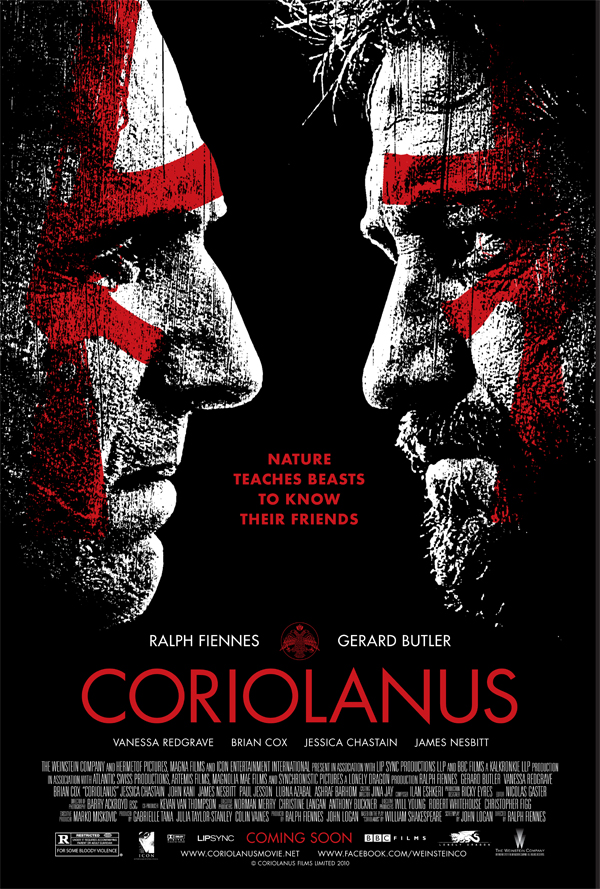 William Shakespeare’s little-known play has a surprising amount of cultural relevance: attacks on the border, suspension of civil liberties, political scheming, populist uprisings and riots, and a military elite arguing against the principles of appealing to the uneducated, mob-ruled masses. Plus Ralph Fiennes, taking on the hat of director for the first time, sets the play in modern-day. It seems like a struggle between Scotland and England, judging from the two mortal enemies, Coriolanus (Fiennes) and Tulius Aufidus (Gerard Butler). So it’s the Scotland/England struggle, termed ancient Rome, but set in what looks like the war-ravaged Balkans. Hey, at least Fiennes gets to have a nose in this film. The Shakespearean verbiage is certainly beautiful to hear, especially coming from the mouths of excellent thespians, notably Fiennes, Brian Cox, and Vanessa Redgrave. The actors achieve that synergetic level of excellence where it feels like they were always meant for the parts. Butler acquits himself well though his character sort of disappears unless needed by the plot. The elements that work best reside in Coriolanus’ refusal to play the game of political optics, neither serving a crowd of ignorant peasants he feels should remain out of the political process or the wily, double-crossing, self-serving politicians inflaming populist unrest. The movie sets itself up for some serious wrath to befall Rome, and besides the Greeks (and Koreans), nobody does revenge like this guy Shakespeare. We’re chomping at the bit for a cataclysm of death, but then the plot just sort of skips to a hasty conclusion, ditching the wrath. It makes you realize that, except for the intriguing title character, this isn’t one of the bard’s better plays. The characters are hard to empathize with, their conflicts too repetitive without deeper insight, and an ending that would be best described as a bit of a rush job. Still, even Shakespeare’s lesser work towers above most writers’ best material. Fiennes does a fine job as director, choosing lots of disorienting close-ups to communicate the rage of his character. Coriolanus is an interesting stab at something more, it’s just that sometimes it swings and misses.
Nate’s Grade: B
Share this:

The Smurfs (2011)
 What a smurfin’ terrible movie. This big screen debut for the little blue commune dwellers is a painful experience, magically transporting the little creatures to New York City. They find themselves in the care of Patrick (Neill Patrick Harris), an ad man who’s pretty much a jerk, especially to his doting, pregnant wife. At one point, in his ad man frenzy, he yells, “ I never wanted any little people running around here!” Oh no, what a bizarre outburst that somehow cuts directly to his fears of being a father. The movie spends so much time with the human characters, who are shrill, exasperating, and dull form the get-go. The comedy is a mixture of slapstick and insufferable kiddie wordplay, replacing “Smurf” for just about any word in a sentence for a miserable attempt at humor. It’s like the screenplay was a Mad Libs page (Am I being too generous crediting a whole page to the script?). The Smurfs is clearly designed for a 3D audience, hence there is crap flying at the screen at every turn. Yeah, another stupid thing thrown at the screen. Hank Azaria plays the thankless role of Gargemel, the man who created Smurfette (voiced, not too badly actually, by pop singer Katy Perry) but schemes to capture Smurfs for their… smurfness. I don’t know. If this guy could create his own Smurf, why doesn’t he just keep doing this? Instead, Azaria runs around New York speaking in an arch manner, falling down a lot. I suppose the real question is whether this piece of blue excrement could entertain children, its target audience. Perhaps the youngest of tykes will be tickled by the Smurf adventures, but I think most kids will be puzzled and bored and weirded out by the movie, wondering what they had done wrong to deserve watching this dreck.
Nate’s Grade: D
Share this:

11/11/11 (2011)
 Here’s a lesson for you. Not all elevens are the same. Case in point, the apocalyptic horror film 11/11/11, picking this eleven-friendly doomsday. That’s because there are two movies released in 2011 that have this exact same concept. The other movie was written and directed by Darren Lynn Bousman, the man behind three Saw films and Repo: The Genetic Opera. That one, actually released on 11/11/2011, has a bit more publicity to its numerological case. The only thing separating the two movies is their choice of numerical separation. You see there’s the direct-to-DVD 11/11/11 and the theatrically released, Bousman-directed 11-11-11. It’s dashes or slashes, folks. I’d have to imagine that the dashes movie is better than this, the slashes movie, just on Bousman. But then again, expecting a better movie from the guy behind the middle section of the Saw franchise might be asking for too much. Still, I’d have to assume that a blind monkey could make a movie better than 11/11/11, a horror movie that could only scare you with how bad it is.
The basic plot is that a family moves into a new home. Jack Vales (Jon Briddell) is teaching a college course, taking over for a professor who killed himself. The professor’s widow just happens to live next door, and she’s batty. Melissa (Erin Coker) has found out that she’s pregnant again. The town’s doctors are keeping her sedated an awful lot. Then there’s 10-year-old Nathan “Nat” (Hayden Byerly) who is turning eleven on November 11, 2011, and it seems like everybody wants to celebrate. The neighbor lady knows the truth: on that date (Veteran’s Day?) the gates of hell will open and Nat is the key. The boy must be stopped, though there is a whole nest of Satanists trying to arrange events so that Nat does bring about the end of the world as we know it.
 To call this movie low-rent is a disservice to grungy pornographers, exploitation peddlers, and inept amateur filmmakers. This movie is pathetic on just about every conceivable metric of filmmaking. First off, the premise is vague. We have this magical date looming, but what exactly happens? We’re told later that hell will open and maybe it’s the apocalypse or the rise of Satan or whatever. The kid, Nat, which by the way is the most annoying nick-name for somebody named Nathan (what was wrong with “Nate”?), is never made clear what role he will take. He’s the key to this whole deal but is Satan going to take over his body, as we see when he does some dastardly “no no” activities, or is Satan going to use him to release himself from hell? It’s never made clear, like much in the film, so the screenwriters make sure to cover their bases. Nat’s a demon child. Nat’s possessed. Nat’s scared of what’s under his bed. Nat’s mute. Nat can see into the future. Nat’s everything you need him to be. You’ll watch this movie constantly scratching your head, trying to get a feel for the rules or the boundaries of the narrative, grasping for nothing.
What you will be able to identify is the stupidity, which this movie has a never-ending supply of. Let’s tackle this numerological boogeyman thing head on. The shaky premise of 11/11/11 is that on that fated day the devil will rise up and… something. I’ll let the crazy old neighbor lady explain it best: “11 is God’s perfect number. One plus zero equals one [Editors note: Then shouldn’t one be the perfect number?]. Eleven is Satan’s number, it shows his arrogance, one more than God. Don’t you see? 11! Your son must die!” Well, I don’t need to hear anything else, pass the sacrificial blade this way. So I guess 666 just became passé and now 11 has become the new Satanic number of choice. Has anyone ever heard about this change? You know what, I’ll even go with this stupid idea. Let’s say what she said is true, so why does that mean that the year 2011 is the ultimate date of Armageddon? What about 1911, or 1811, or the first year 11 AD, or, God help us all, the year 1111? If eleven is Satan’s favorite integer then he missed a golden opportunity with that savory Middle Ages palindrome. Never mind the fact that our calendar is actually years off, but I’ll just assume that 11/11/11 takes place on its stated date even if people don’t know when that was. As a result of this numerological fanaticism, we’ll see lots and lots of clocks with some form of 11, like the very appearance of this number is meant to fashion fathomless dread. Oh no, the clock says it’s 11:40! Oh no, the clock says it’s 3:11! The clock face you dread the most is your own watch indicating that this movie is still not over. I thought we covered this numbers-are-evil nonsense with The Number 23. Once again, we have characters bending over backwards to try and make numbers fit into a pre-ordained pattern, supposedly enlightening us on all the spooky coincidences. So we have a character saying stuff like, “Flight 92 on September 11. 9 plus 2 equals 11.” Let me try: Wal-Mart has a special on PopTarts for $3.99. If you buy two, now 2 times 4 is 8, plus 10, divided by 8, times .5, and take the square root of who gives a shit?
 What else is stupid in this movie? Where do I start? The conspiracy of Satanists feels like a terrible rip-off of Rosemary’s Baby, as these people form the worst neighborhood watch imaginable. They’re scheming to get Nat to unlock the End of Days, so they all do their checking up on the Vales family and eliminate any neighbors who say too much. This cozy little neighborhood is replete with death, including the fact that the Vales home was the scene of a massacre. One skittish neighbor informs Jack and Melissa that somebody had an “accident” on the block. “Is he okay?” Melissa asks. “Well, he fell and got impaled on his fence. So, I’d say… no.” I kid you not, that’s his exact wording. This skittish neighbor is also murdered later. This band of secret Satanists includes the new Vales nanny, Denise (Aurelia Scheppers, looking like a poutier Denise Richards). This new nanny murdered the other prospective nannies, which is one way to move ahead of the competition. This nanny is bad news. She teaches Nat all sorts of bad behavior, from frying butterflies with glass to hurling rocks at joggers. And the dumb kid does it with glee, making me lose all interest in whether or not he is Satan’s seed/host/whatever. Then Denise gives the kid a birthday present – an old, spooky-looking comb. To demonstrate, in case Nat is unfamiliar with comb technology, she drags the teeth across her arm and draws blood. Then she gives it over to him to do the same. What? What kid is like, “Oh, wow, a way to ritualistically injure myself? That’s the best birthday present an eleven-year-old could want.” I’m pretty sure the kid would have liked an Xbox over a strange demonic comb. And wouldn’t you know it, this comb makes a return appearance when our Satanic neighborhood watch collects to conduct their business in, I kid you not, a station wagon parked on the side of the street. It’s literally a station wagon with eight or nine people crammed in it, and it’s there all hours of the day.
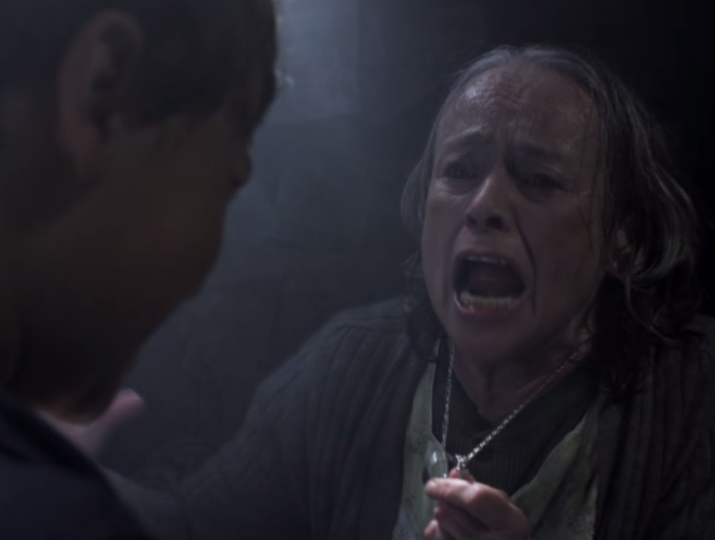
Then there’s our crazy neighbor lady, whose name I can’t even recall. The screenwriters want us to distrust her from the beginning, and that’s fairly easy when we see how weirdly creepy she’s behaving. She’s obsessed with luring young Nat into her shed, and she keeps offering promises of toy trains, glasses of (poison) lemonade, and promises of cool, fun things. If only she knew a comb was all it would take. This woman is trying to lure Nat with all the verve of a child molester. She’s frantic to kill Nat, even calling Jack at work to lecture him on the necessity of killing his son. Why does the Satanic neighborhood watch let this woman slide on by when they kill any other neighbor for the slightest slip-up? Anyway, this woman just so happens to have a machete in her shed and you can imagine what happens from there.
One more scene of ridiculousness, please indulge me. After Jack sees his son covered in bloody scratches, he accuses the nanny and has her arrested. In a scene of great hilarity for myself, we cut to a scene where the cop and nanny are already in the home, and Denise is dressed like she’s going out for a night on the town, and she’s twirling her hair in her fingertips. The image is so absurd. She gets arrested and thrown into the cop car. “You’re going to regret this,” she warns. Then, magically, wasps come out of a crevice in the side door and the car fills up with a swarm. The cop tries swatting them away and drives headfirst into a telephone pole. I need to note that the editing is so bad in this scene, cutting back and forth between the cop swatting and the car swerving, that the shots never match, so it seems like the longest reaction shots. The car crashes and mysteriously this has caused Denise to magically remove her handcuffs. She strolls out of the car, down the street, and then the car takes its cue and promptly explodes. If this wasn’t dumb enough, we then see different shots of characters around the block reacting to the explosion, heard over and over. One of the Satanic neighbors, still sitting in the damn station wagon, has adept hearing: “That must have been that cop car.” You see, her sense of hearing is so sharp that she can distinguish the make, model, and employability of the car via explosion. Just imagine how useful/useless she’d be in a Michael Bay movie.
 If 11/11/11 was just a supremely dumb movie it might work as camp, but it’s also inept as a scary movie. I don’t think director/co-writer Keith Allan could find an interesting looking shot if it held up a giant “11” sign. There is nothing scary about this movie whatsoever. All the shots of things with 11, it just doesn’t work, yet Allan keeps hitting it ad infinitum, mistakenly believing that while not effective on attempt 51, perhaps it will become effective on attempts 52-68. There’s a scene where Jack is standing watch at his son’s bed and the camera takes turns focusing on every stupid stuffed animal in the room, and Allan’s brilliant idea is to play a sound of the animal as we see its stuffed iteration. The stuffed bear is followed by a bear growl, etc. The fact that this series of animal noises continues for over a minute shows that Allan has no concept of what can scare or even what can entertain. His handling of actors is atrocious, as every single actor just bounces around the place, unmoored, unsure of what direction to take, so they take the wildest one. The actors are either monotone and flat or over-the-top, never believable for a second. Then there’s the “gotcha” ending which makes no sense considering Melissa is only three months pregnant and very much incapable of giving birth to a child, even if that unborn child is an unholy demonic terror.
11/11/11 is a date that will live in infamy, birthing this laughably awful, painfully ridiculous, atrociously inept movie, even by low-budget direct-to-DVD standards. The only entertainment you’ll find with this movie is the derisive sort, yukking it up over the unintended comedy bonanza that awaits. The movie is vague, silly, and overwhelmingly dumb, beholden to an inane numbers conspiracy that doesn’t hold up to scrutiny. I know my expectations should be kept at the minimum when dealing with this kind of movie, but that doesn’t mean I just ignore and excuse every artistic blunder, especially when I feel assaulted by them. 11/11/11 did bring on the apocalypse, and every audience member has left to go to a better place – the bathroom. Bousman should take some comfort knowing that the production house behind this movie, The Asylum, is somewhat notorious for rip-offs. I give you The Asylum releases: Battle of Los Angeles, Paranormal Entity, Transmoprhers, and The Day the Earth Stopped. 11/11/11 can hold one more numerical distinction: it’s the worst film of 2011.
Nate’s Grade: F
Share this:

Tuesday, After Christmas (2011)
 Who knew that Romania, of all places, was the wellspring of tremendous artistic talent? Over the last five years or so, Romania has been home to a burgeoning renaissance of daring, provocative, and naturalistic films, its own New Wave of Eastern-bloc cinema. Some of these gems include The Death of Mr. Lazarescu, 12:08 East of Bucharest, the understated, cerebral Police, Adjective, and the award-winning, grueling abortion drama, 4 Months, 3 Weeks, and 2 Days, winner of the prestigious 2007 Cannes Palme d’Or. Director/co-writer Radu Muntean’s Tuesday, After Christmas is a worthy entry into the ever-growing canon of stupendous Romanian cinema. It and many other of these Romanian renaissance pictures are available via Netflix streaming, so if you’re unfamiliar with these great movies, now is as good a time as any to play catch-up.
Paul (Mimi Branescu) is a middle-aged man coming to a crossroads at his life. He loves two women: Adriana (Mirela Oprisor), his wife of ten years who they share a young daughter, Mara; and Raluca (Maria Popistasu), a dentist in her late 20s. His mistress has accepted her role but wouldn’t mind reaching out to Paul’s daughter. Paul is unhappy with his wife but is he unhappy enough to come clean about his infidelity? Over the course of a few days around Christmas, Paul will decide which woman he will stay with.
 This movie is something of a small miracle in how naturalistic it plays. The dialogue is splendid, reverberating with the rhythms of real speech but also giving weight to the characters, fleshing out personalities, relationships, and penetrating subtext. I was luxuriating in the dialogue and its nuances. To some people Tuesday, After Christmas will be a boring movie, but for me I was on the edge of my seat thanks to the dialogue and characterization. If ever Richard Linklater (Dazed and Confused, Waking Life) were to make a Romanian film, it would be this. Like Linklater’s Before Sunset, watching these actors speak such truthful, personable, revealing dialogue is like listening to birds sing. It’s such a pleasure for the ears. Take the first scene, a sexy, nearly six-minute unbroken shot of a couple in bed. Over the course of those six minutes Muntean (Summer Holiday) and his actors peel away the layers, revealing more and more of these characters and their situation. We can tell from their playful, affectionate, and relaxed manner that they are lovers. Also the fact that they are naked seems rather telling. Then we learn who they are naturally. He pretends to take offense at her admission of other lovers’ penis sizes, and pretends to bite her nipple, which makes her examine his teeth and chide him that smoking harms his teeth. Right there we learn about her sexual past, his mixed feelings about it, their teasing relationship, and her profession. And then, of course, we learn that the man is married and this is the “other woman.” That six-minute scene is near perfection. It sets up the characters, the conflict, and not a single point felt false or contrived. The rest of the movie follows suit, from the mundane moments of married life (the manner of rubbing a spouse’s feet) to the quiet storm of indecision.
There isn’t a wasted line of dialogue or a camera shot in this entire movie. Part of that is because Muntean deals in extremely long takes. There isn’t one camera shot that lasts under a minute; most of the camera shots last for several minutes, some approaching double digits. In other hands, the glacial pace of the camerawork would make the movie feel trapped and stagnate, as I felt watching the clinically dull movie, Shame. Instead, this movie is captivating because of the draw of the characters and the inherent drama/irony presented with the romantic triangle. A dental appointment for Mara becomes an uneasy, squirmy situation of great ironic tension, watching Paul shift uncomfortably and trying to mentally figure out what direction to take as his mistress speaks to his wife. Tuesday, After Christmas feels more like a stage play than anything cinematic, unless you’re counting John Cassavetes or the French New Wave (and why shouldn’t you?). The scene where Paul mulls over whether to tell his wife is more suspenseful than most Hollywood movies. The devastation that follows is heartbreaking but completely absorbing. This tiny Romanian film is so astutely well observed when it comes to human foibles and interaction that the film almost feels like a documentary. The patient, deliberately elongated takes further crystallize this sensation, making us feel like we are inappropriately eavesdropping on some very serious personal drama.
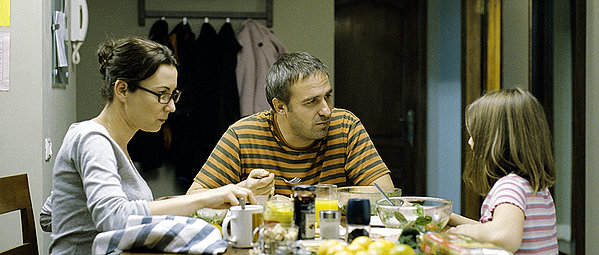 The acting is equally remarkable. For this movie to really work the three actors must step up their game, and all three came to play. First off, Branescue (Outbound) has to do his best to engender empathy because our introduction to the guy is during a romp with his mistress. But in those early moments we see how kind, lively, and peaceful he can be. Maybe this arrangement is good for him, we question. Then we see his interaction with his wife, and they are less lively, as the day-to-day grind of marriage can take its toll, but their interaction is warm, personable, and even through the mundane activity of Christmas shopping, we can piece together their relationship, which doesn’t seem troubled but resting in that comfortable position long-term relationships can plateau. Branescue never comes across as a scheming cad to vilify or a romantic victim. Instead his performance makes him spookily identifiable – this could be anyone. This could be you, assuming “you” are male and possibly living in Romania. The everyday nature of the character and his conflict, and Branescue’s nuanced performance, makes the guy empathetic even when his world is crashing around him and it’s his fault.
The women of Tuesday, After Christmas are also unforgettable. Popistasu (Midnight Man), as the mistress, is mesmerizing, a beautiful woman reminiscent of a Romanian Melanie Laurent (Inglourious Basterds), able to communicate so much with her body language. That first scene with her nude in bed establishes her as a charming, intelligent, rationale ingénue, neither calculating nor flighty. She feels like a real woman, and her relationship with Paul seems to bring out her spark, judging from that sparkling opening sequence. Likewise, Oprisor (Youth without Youth), as the wife, is equally compelling a figure, a woman settled into her marriage and her job and being a mother. Her reaction to Paul’s admission of infidelity is the movie’s dramatic highpoint, and we witness the actress seemingly go through every stage of grief in a manner of minuets, from anger and betrayal to thinking out the next course of action.
I know “Romanian relationship drama” probably doesn’t sound like a rollicking night out at the movies, but Tuesday, After Christmas is such an expertly crafted film, carefully observed, impressively acted, gloriously naturalistic in dialogue and direction, and even humorous. Yes, for a movie about infidelity and the possible explosion of a marriage, there is plenty of humor to be found naturally. You may feel stirring of romantic intimacy with Paul and Raluca, so much so that you too share in Paul’s guilt. You’ll feel the disquiet during that meeting of mistress and wife. You’ll feel the ache when Adriana really lays into Paul, a deserved and withering attack. You’ll understand where every person is coming from. But mostly you’ll feel like you’ve watched a really good movie. Tuesday, After Christmas is richly attuned to the subtleties of human joys, conflict, and reactions, and a movie that will linger with the ring of truth. Don’t be a stranger to Romanian cinema. Start here and work your way back. The rewards are worth it.
Nate’s Grade: A
Share this:

Senna (2011)
 I have never been a fan of racing of any sorts, be it horse or NASCAR or Formula One, the subject of the biographical documentary, Senna. So naturally I never felt like I’d been interested in a documentary about Ayrto Senna, the brilliant Brazilian driver who was the head of the pack. I was wrong. Even non-fans like myself can get enjoy Senna, a lean doc that doesn’t waste a second. In fact, never do talking heads, interviews, or reenactments enter the frame. The movie is completely made up of archival footage, some of it astonishing like Senna’s dashboard recordings that immerse you into his world of speed. The vintage race footage is thrilling. The film ably portrays the driver’s life, his passion, his controversies with league officials who disliked the young man’s style, his competition with rivals, and his impact on the sport. Here’s an instance where being completely ignorant of the subject and its sport will come in handy, since you don’t know what befalls Senna, though most will be able to pick up the ominous tones and markings of tragedy. This is a doc that just flies by with skill, precision, and enthusiasm, much like its charismatic and confounding subject.
Nate’s Grade: B+
Share this:

Warrior (2011)
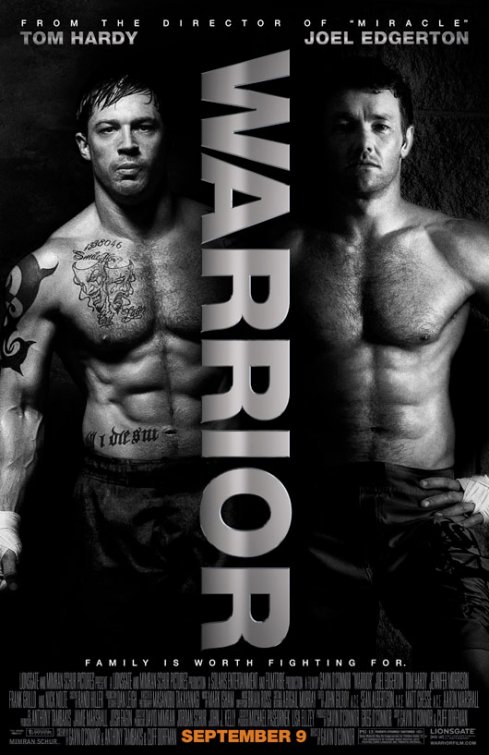 This may be a mixed martial arts (MMA) movie in appearance, but really Warrior is put together like a traditional boxing movie. Director/co-writer Gavin O’Connor (Miracle) takes a kitchen-sink approach to storytelling; just about every damn dramatic thing you can think of, short of emergency baby deliveries, is stuffed into this movie. You’ve got two brothers, one a hard luck school teacher (Joel Edgerton) trying to save the bank from taking his home (his family is broke due to his sick daughter’s medical condition), and the other (Tom Hardy) an Iraq War vet who saved lives and wants no glory, for he’s haunted by the men in his platoon who did not survive. Add a drunken father (Nick Nolte) trying to live life on the straight-and-narrow who wants to get back in his sons’ good graces, the teacher’s community rallying around him, the Marine’s comrades in service rallying around him, and some major personal issues between brothers (Hardy feels that his bro abandoned him and their sick mother), and two competing underdog tales, and my God, it’s hard not to feel beaten into submission. But damn if it isn’t effective stuff. I was tearing up at multiple points, completely sucked into the drama, riveted by the brutal, adrenaline-pumping MMA fight scenes, and pining for family reconciliation. Hardy and Edgerton flex more than their muscles on screen; each gives terse, heartbreaking, completely convincing performances as broken-down men struggling for redemption. You don’t have to no a lick about MMA to get hooked by the heavy emotional beats of the movie. Warrior is by no means a subtle movie, but it pushes all the sports genre buttons expertly, presenting a gratifying, affecting meat-and-potatoes drama that grown men are given permission to get weepy over.
Nate’s Grade: A-
Share this:

Passion Play (2011)
 You would think that a movie where a jazz musician (Mickey Rourke) gets in trouble with a mobster (played by Bill Murray!) and while on the lam he discovers a girl (Megan Fox) with angel wings working in a circus sideshow would be interesting. How could you go wrong with all those interesting elements? Mobsters, circus freaks, angels, Mickey Rourke! Well Passion Play found a way, a triumph of failure. This would-be parable just sleepwalks from scene to scene, rarely making much of its fantastical sci-fi elements. Fox swears she’s no angel, just a girl born with bird wings, and people let this be a conversation ender. Rourke’s character is a pathetic coward who nets little empathy. Not reverent or weird enough, Passion Play was the passion project of writer/director Mitch Glazer but the movie feels devoid of anything approaching passion. The actors seem bored, the romance between Fox and Rourke is a non-starter, and the lame ending borrows a page from An Occurrence at Owl Creek as a last-ditch attempt to interject some meaning into this unholy mess. The only reason I can foresee (sober) people watching this is for the mistaken belief that they might glance upon some heavenly nudity from Fox. Sorry boys, the gal keeps her purity. The entire production is just so wrong-headed and listless; I can’t even work up a good dose of bile to proclaim its utter inanities. This is a terrible, silly, puzzling, dopey movie made even worse by its pseudo-intellectual twist ending.
Nate’s Grade: D


You must be logged in to post a comment.