Blog Archives
Challengers (2024)
 The sweaty, sexy indie hit from the spring is about a tennis throuple told over the course of one pivotal match, where our two male athletes are at very different points in their careers and the woman who came between them. Patrick (Josh O’Conner) and Art (Mike Faist) are the best of friends when they started on the tennis circuit with dreams of making the big tournaments. They both set their sights on Tashi (Zendaya), a tennis phenom since her teenage years who is starting to reach her prime. The movie bounces back and forward through time (like a tennis ball!) to chart the changing relationships between the three, as we’re left to pick up the pieces as to what happened, who fell for who, who broke up with who, and how it relates to the central battle of wills playing out in the present-day match. The best part of Challengers are its characters and ever-shifting power dynamics, which makes each scene rich to digest and examine, especially once Tashi’s career takes an unexpected turn. Director Luca Guadagnino (Bones and All, Call Me By Your Name) keeps things lively with plenty of style including exercising every POV imaginable from the floor, to a tennis balls, and the players with racket banging in hand. We might have gotten a POV from a passing bird had it only gone longer. The movie is electrified by a pulse-pounding score by Trent Reznor and Atticus Ross, a propulsive energy that reminded me of the similar service of the Run Lola Run soundtrack. What holds back the film for me is that the last act is dragged out and it culminates in an ending that is the most obvious as well as underwhelming, which makes the extended dragging even more ultimately tedious. The acting is good all around with each member getting to experience a high-point and low-point of their career and personal lives. However, it’s really Art and Tashi’s movie as Patrick serves as an elevated supporting role. And for a movie with such heat and hype, I guess I was expecting a little more action, if you will. Challengers is an intriguing, entertaining, and refreshingly adult sports drama that I wish had, forgive me, some more balls.
Nate’s Grade: B
Share this:

Dune: Part Two (2024)
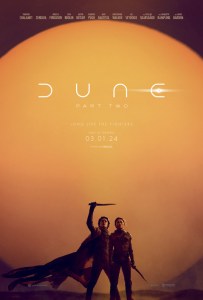 I wasn’t fully taken with the first Dune movie when it arrived in 2021. It was visually sweeping, with dense world building and careful development of characters and themes, but then it just hit the pause button without any certainty there would be a conclusion. Thankfully, director Denis Villanueuve was able to complete his vision, and what a spectacular science fiction landscape this man has fashioned, visually resplendent but also with a story that deepens and improves on all the promise and setup from 2021. The triumphant of Paul (Timothee Chalamet) becoming a hero and avenging his father from their betrayers is tempered by the tragedy of Paul, becoming the false messiah that will bring about mass genocide. The movie doesn’t hold back in its criticisms of its hero while also providing complexity that makes us root for him but uneasily dread what might become. The narrative structure is easy to follow with Paul ingratiating himself with the native culture, rising to power and influence, and organizing a resistance against the well-funded imperial overlords of Arakis. This is the kind of sumptuous, big screen spectacle with intelligence that is so rare in the Hollywood system, and Villaneuve once again shows his ability to perform artful blockbusters that put him in a rarefied class with hew others. After the first Dune, I was hopeful but a little wary. After the second Dune, I feel like all of my concerns were wiped away.
Nate’s Grade: A-
Share this:

Spider-Man: No Way Home (2021)
 This is going to be a difficult review to write. It’s the third Spider-Man movie in the Tom Holland era, though his sixth Marvel Cinematic Universe (MCU) appearance as the character, that much can be said. The MCU has been teasing a universe of parallel universes for a while now, even famously in 2019’s Far From Home, the previous Spider-Man film, and which No Way Home opens seconds later to deal with its immediate aftermath. The scuttlebutt with this new Spider-Man movie is that it is the most Spider-Man in all senses, bringing past iterations from the original Tobey Maguire run (2002-2007) and the maligned Andrew Garfield reboot (2012-2014). We know villains from each non-MCU Spider-Man film are making special appearances, and there are expectations for plenty more special appearances, so by that notion, writing a film review about a movie built upon surprise inclusions and secret revelations can be daunting to even be readable without giving too much away. I’ll do my best, dear reader. Spider-Man: No Way Home is not the best Spider-Man movie, in the MCU or prior, but it’s a rollicking adventure that will play like catnip for fans of the series, all iterations, and has some of the strongest moments of any web-slinging blockbuster.
In the wake of Mysterio framing Spider-Man (Holland) and revealing Peter Parker’s real identity, life has not been kind to your friendly neighborhood Spidey. The public has turned on him and even his best friends are suffering the consequences of their personal relationship. It’s enough that Peter seeks out his old pal, the wizard Doctor Strange (Benedict Cumberbatch), to cast a spell to erase the world’s memory of who Spider-Man really is. The magic spell, naturally, goes wrong, and villains of Spider-Man from other universes begin to appear. These larger-than-life characters are dangerous but also confused; this isn’t their universe, and this isn’t their Peter Parker. Doctor Strange is happy to send them all back to their primary universes, to correct the loose ends of the spell, but Peter doesn’t want to send them all to their fated deaths. He wonders if maybe they can be cured or reformed and if it’s too late to still do the right thing.
 First things first, you need to know that this movie is going to play much, much better if you are familiar with, and especially if you’re a fan of, the previous Spider-Man movies. No Way Home almost feels like it was written by a fan who has been nurturing a desire to do right by all past Spider-Man films. This feels like someone who had assembled a list of unresolved issues from different Spider-Man movies for over twenty years and said, “Hey, could I write these characters another ending that can redeem them and provide better closure in a way that is meaningful?” Because of that, each new character that comes through has a definite jolt of fan excitement like an all-star reunion, especially for characters you never thought you would see again. Certainly, some characters have more meaning than others, but I was pleasantly surprised how well integrated and written so many of the villains come across. Returning screenwriters Erik Sommers and Chris McKenna have ret-conned and redeemed the various Spider-Man missteps of old and have given characters more attention and fitting resolution, which makes this a surprisingly emotionally deep Spider-Man in ways you weren’t expecting. There are character reunions and resolutions that I didn’t know I needed, and I was smiling and even battling back tears of my own at various points. If you’re a fan of the recent Holland run, then the movie will still play well, but if you’ve been with Spider-Man from his cinematic beginning (if you really want to feel old, the original Spider-Man teaser involved the World Trade Center) then this movie will feel like a nostalgic blanket to warm you all over.
I think it’s safe to discuss some of the villains that have been prominent in the advertisement and later trailers, but if you wish to skip any character details, then skip to the next paragraph. It shouldn’t be much of a surprise that the two biggest villains are the ones with the biggest screen time and most allowance at redemption. Willem Dafoe as Norman Osborne (Green Goblin) and Alfred Molina as Doctor Octavius (Doc Ock) are treasures. It’s so good to see them again in these roles and each actor is just as good as you recall from their time 15-plus years ago. I was worried that bringing Doc Ock back could spoil the redemptive turn he has at the end of 2004’s Spider-Man 2, sacrificing himself to save the day from his own dangerous experiment. Little did I know that the entire movie was going to seek redemptive arcs for a veritable Sinister Six-worth of Spider-Man villains. It becomes the backbone of the movie, and I was skeptical at first but the movie found ways to win me over with just about every character’s inclusion. Norman and Octavius are similar in that they are battling other sinister personas in their heads, and when the real versions of each man break through, it’s often in heartbreaking moments of existential confusion and sadness. This is a movie that has time to fit in Spider-Man memes as well as question the moral culpability. It’s fascinating that a huge Marvel movie is so concerned with providing glimpses of humanity and compassion to bad guys from movies that the general public didn’t even generally like.
 This is the best acting of Holland’s Spider-Man run. He really gets put through the wringer about the consequences of trying to make the moral choice, both good and bad. His most emotional moments got me each time because of the investment in his character growth over six movies as well as the added investment in the supporting characters too. This is the most integrated and important both Ned (Jacob Batalon) and MJ (Zendaya) have been to the plot, and they have a platonic hug at the end that sent me into a tailspin of emotions for what it meant. The humor and natural camaraderie of the actors is still there, a hallmark of the MCU Spider-Man series. I laughed plenty, especially with certain characters deconstructing their parallels and connections (“Gotta watch where you fall,” a villainous understatement). However, this is the most emotional Spider-Man likely ever, and the actors all perform ably. I want to single out Marissa Tomei as Aunt May because she’s been undervalued in these movies until now. This is the biggest role Aunt May has played and she serves as the voice of morality to push Peter to do what he knows is right even in the face of outlandish adversity and personal cost.
No Way Home works better thematically than as a well-constructed plot. The solutions to the villain redemption are laughably convenient, and while it’s not as expressly magic as Doctor Strange’s spells, it’s pretty much the equivalent of technological magic. That’s fine, because it’s less the struggle of invention and more the choice that matters for each character. The mechanics of the ending also feel overly convenient and tidy (you could have just done this the whole time?). When Doctor Strange is chastising characters for hasty decision-making, it’s the movie calling attention to its own cheats. The movie splits so much of its time across multiple villains and drafting off of your old feelings. There are other narrative shortcuts taken and abbreviated, especially Strange’s involvement. He’s left out of much of the movie for the same reason Captain Marvel was left out of much of the final battle with Thanos in 2019’s Avengers: Endgame: he’s too powerful to have on the board. I’m not saying the screenwriters made the wrong choices on what to emphasize. The emotional beats of this movie hit strongly, and if they have to rely on a few cheats and nit-picky hand-waves to get there, then so be it.
 From an action standpoint, I think this might rank last for me in the series. Returning director John Watts has never wowed me as an action director. He’s not bad at staging the big moments but he seems more present in zippy tone than in style on a big stage. The added wow factor of seeing the various characters assembled on screen will compensate for much of the action feeling contained to dank sound stages. I think this was done as a cautionary measure to keep the secrets from being leaked, but it also shortchanges the action possibility. There’s nothing in this movie, from a pure action standpoint, that rivals the Venice or London sequences in Far From Home. The movie utilizes portals, and it got my hopes up for clever action inventions, but it serves as more plot device than action complication. There have been some artistic sacrifices, narratively and visually, to accommodate the Spider-Man Movie All-Stars approach, and while I think the filmmakers have emphasized the correct parts, it does still feel like there are some nagging shortcomings to an overall experience that plays exuberantly.
Finding a comfortable medium between fan service and creative constriction, Spider-Man: No Way Home is not the best Spider-Man movie but at the same time it just might be. It serves as a salve to the rest of the franchise, five iterations across two different runs, and because of that level of attention and compassion, the past movies get a little bit better, with more added resolution, more character moments, and second chances to correct miscues and blunders. Who among us wouldn’t want another opportunity to correct our mistakes? While ostensibly setting up the troubles ahead for the MCU (the trailer for 2022’s Doctor Strange: The Madness of the Multiverse is the final post-credit scene), the movie feels entirely backward-looking, rewarding fans of the character and resolving to do better where other films had gone awry. Maybe (Disney)Fox could do something like this for the bad X-Men movies? I don’t know if the same punitive charges of being slavishly nostalgic will hit No Way Home like they’ve done for the new Ghostbusters and Star Wars. It’s definitely still accessible for newer fans but plays best to the people with the longest investment, but isn’t that every continuing movie series? No Way Home is a rewarding cinematic experience of many highs and fun surprises and cameos as well as a humane redemption for the sins of Spider-Man’s past. It’s not the best superhero movie but it might be the most joyous one yet.
Nate’s Grade: B+
Share this:

Dune (2021)
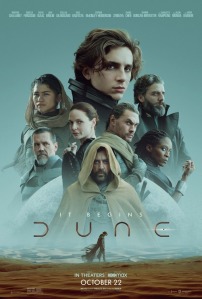
I attempted to read Frank Herbert’s novel Dune when I was in the seventh grade. I had begun to read more fantasy literature and was looking at older, heralded novels. I can still recall my frustration of reading those first five pages and having to repeatedly flip back and forth to a twenty-five-page glossary of terms so that I could even start to comprehend what was happening on the page. After those five excruciating pages, I gave up. Maybe I was too rash, and maybe my older present self would be more accommodating to the struggle, or maybe it just wasn’t worth the effort. I never watched the 1984 David Lynch adaptation that was met with great derision from critics and fans alike, although it does have its vocal defenders (Hindsight alert: Lynch turned down directing Return of the Jedi to helm Dune). So when acclaimed filmmaker Denis Villeneuve (Arrival, Blade Runner 2049) became attached to direct a big-budget, large-scale adaptation of Herbert’s novel, I was finally interested for the first time in my life. It was originally slated to be released in 2020, and after the studio planned to release Dune onto its HBO Max streaming service, Villeneuve and the production company negotiated to make sure a theatrical release would still be an important part of the plan. Alas, I watched the 2021 Dune at home, and I found myself enjoying the experience and development of the world building. However, it’s unlikely to watch this version of Dune and feel like you got a full movie for your money.
In the distant future, like 10,000 A.D., mankind has colonized worlds and the most important planet of them all is Arrakis. It’s a desert world inhabited by poor natives, Freeman, who live a moisture-preserving life mining the natural “spice,” a special substance that makes space travel capable as well as prolonging human life. The top family houses are vying for dominance and House Atreides has been assigned by the unseen Emperor to rule over Arrakis and bring it and its spice production back in line. Duke Leto Atreides (Oscar Isaac) sees great opportunity but also great danger. The other houses will scheme to engineer the failure and desolation of House Atreides, especially House Harkonnen, led by the Baron (Stellan Skarsgard), who is like a mixture between Marlon Brando from Apocalypse Now and Marlon Brando from The Island of Doctor Moreau (plus with levitation powers?). Paul Atriedes (Timothee Chalamet) is his family’s heir and much is expected of him, especially from his mother, Lady Jessica (Rebecca Ferguson), who believes he may be long-prophesied messiah. On Arrakis, Paul and his father must tackle this very delicate new mission while keeping the many adversaries at bay.

As anticipated, Dune is yet another visually stunning and gorgeously immersive visual experience from one of the greatest visual filmmakers working today. If you can watch the movie on a big screen, or at least a bigger screen, then you owe it to yourself to do so. The sweeping vistas and startling science fiction imagery have so much power and grandeur to them. If Lynch’s movie inspired a generation of devotees and impressionable children, I imagine that this superior modern version will do likewise. The production design and costumes are terrific and perfectly in keeping with the larger scope of the expansive visuals. You really feel the size of this world and its imposing weight. Villeneuve has such a natural keen eye for pleasing visual compositions, but he also has the patience many famous big screen stylists lack. He allows the moments to linger and to let scenes breathe in a way that feels more transporting and immersive. If you were simply looking for a visually resplendent movie-going experience, then Dune is the ticket. The sound design is also very smartly aligned and makes use of unconventional and alien sounds to make the movie feel even more like its own thing. When Dune came out in 1965, this was before much of the modern building blocks of our sci-fi pop-culture, so in a way while Dune was the influence it feels partially like an odd after-effect rather than a predecessor. The same thing happened with 2012’s John Carter, based upon a novel a hundred years old that influenced many sci-fi adventure serials and now seems derivative even though it came before the many imitations. I was happy with the first 90 minutes of Dune and felt like the slow pace of the first hour, and its heft of needed but spaced-out exposition, was paying off with a thrilling assault. The concept of the protective shields is a smart way to communicate the casualties of battle, where “kill shots” are illuminated in red, informing the audience of a mortal wound. It makes for an easy to read visual to keep up with the development of battle and stay in a safer PG-13 realm. The whole rescue sequence on the mining station is thrilling at every step.
The cast is another major credit to the success of Dune. Chalament (Little Women) has a soulful yearning to him, to learn, to be his own man, to prove his father wrong and then prove worthy of his father’s faith. Surprisingly, the next biggest role isn’t Zendaya (Malcolm and Marie), the woman that Paul dreams about (prophetically?); it’s Rebecca Ferguson (Doctor Sleep) as Paul’s mother. She’s a woman with deep secrets belonging to a powerful religious sect that might be the real power behind the throne. Lady Jessica is more Paul’s mentor than any man. She teaches him to hone and focus his mind, to use the “Voice” to impart his will, and to prepare for the hardships to come. With every new exposition dump, and she has many, we learn about her growing concern for the fate of her son and her possible culpability for that fate. There’s a genuine warmth between them that serves as the film’s emotional core. I enjoyed watching Jason Momoa (Aquaman) and Dave Bautista (Army of the Dead) as opposite ends of Super Good Fighter Guy, though Momoa looked unsettling without a beard. Needless to say, the 2021 movie is far more diverse than the 1984 movie. It makes space feel more lived in when it’s reflective of a diversity of people that we already have at this point in our history.
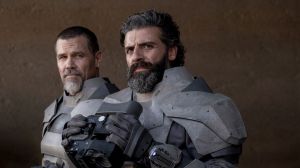
And then, after the hallway mark, Dune became a protracted sequence of chases and then I started to worry that things were just going to end in an unsatisfying manner, relegating the 150 minutes as setup for the as-yet-unplanned sequel, and that’s exactly what happened. My mood began to deflate somewhat during the last hour of Dune. I was still interested and the visuals were still mighty captivating, but the events had the unmistakable feeling of being stretched out to meet a frustrating stopping point, a pause that didn’t produce a satisfying endpoint. I just kept thinking, “Oh, they’re not going to resolve this,” and, “Oh, Zendaya is barely going to be in this movie,” and the movie proved my predictions correct. It’s hard to judge the movie as its own entity since it’s so dependent on a Part Two that has yet to be greenlighted (though its strong opening box-office returns are hopeful). This is an expensive movie, possibly pushing $200 million, so it’s quite a gamble to declare you would only be adapting roughly half of the story. Villeneuve’s Blade Runner sequel, a movie I loved, had a budget of $150 million and a worldwide gross that didn’t make the producers comfortable going forward with a Blade Runner 2050. To be fair, that was an original story, a sequel, and rather well contained. Still, it’s an expensive sci-fi movie that has as much in common with dry art house fare as it does blockbuster adventures, like Villeneuve’s Dune. The promise of a second movie is not secured. If Dune doesn’t do well enough, we’ll forever be left with a movie that feels designed to only be a teaser. It reminds me of the hubris of 2007’s The Golden Compass where the filmmakers had a whole 20-minute finale that they carved out with the intention of having it be the opening for the assumed sequel (welp). Even when designing a multi-movie arc, it’s necessary to plan each entry so that it can exist as its own beginning-middle-end and with a suitable intermediary climax. The Lord of the Rings movies each had their own climax, each moving the larger picture forward, and each had storylines and subplots that came to a head by film’s conclusion. Dune doesn’t. There are more dead characters by the end and certain characters are displaced, but it feels less like the end of the big-budget Dune movie and more like the conclusion of episode two of the Dune mini-series.
My resonance with the source material is minimal, but the world of Dune feels stuffed with stuff and not as deep in the realm of commentary. Fans of the book series will likely thrill at the level of minutia the 2021 movie luxuriates in, allowing fans to lap up the lore. For those of us uninitiated into the fandom, it feels like there could be more going on behind the scenes. The book was released in 1965 and has clear parallels to Middle East occupations and quagmires, a subject even more relevant in the first quarter of this new century. There’s the occupying force coming in to manage the supposedly primitive natives on a desert planet, replacing the last occupier who made bold promises that were unable to be met by the reality on the ground. The parallels of colonialism are there and obvious, but that’s because everything in Dune seems obvious to me. The bad guys are corpse-white and dressed in all black. They look like the alien zombies from 1998’s Dark City (itself referencing the silent sci-fi classic, Metropolis). The leader of House Harkonnen is this noxious man who bathes in black goo and sucks the life force from others. I don’t need my sci-fi to be ambiguous about its heroes and villains. We clearly recognize the bad guys because they’re grotesque. However, the lessons learned by the heroes seem a bit stilted. Its attacks on capitalism are a little more nuanced but not much. The planet of Arrakis could produce water but that’s not in the interest of the power brokers of the galaxy. They need the spice for the economy and thus keep the exploitative status quo. The parallels are there but there’s not much more to be had other than direct summations. The movie has more to say with religion and messiah figures but at this point we’re grading on a curve, and the more complex commentary attached to messiah figures seems reserved for a Part Two.
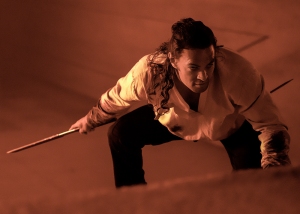
Another aspect I want to highlight that seems trivial but no less intriguing to me is how Herbert chooses his character names. We’re eight thousand years into the future, spanning multiple planets with names like Arrakis and Giedi Prime and Salusa Secondus, and then we have such anodyne twentieth-century names like… Paul and Jessica? It’s funny to me that Herbert goes to the trouble of coming up with so much jargon and terminology and alien-sounding names and then he says, “Hey, this guy’s name is… Duncan Idaho,” like he’s a supporting character in Point Break. I realize this is a very dubious criticism, and there are other character names to conflict with this assertion, but it made me laugh at the different levels of effort Herbert put into his world-building and universe than selecting character names for that same far away land.
After watching the new Dune, I went and watched the 1984 David Lynch version for the first time and was, quite simply, dumbfounded. I’ll credit Lynch for many of the weird choices in style and how it never stoops to even be accessible for a mass audience, despite having characters explicitly narrate their schemes and motivations out in the open (by scene one, the power play that took up 90 minutes of Dune 2021 is awkwardly explained in full). By the end of Lynch’s movie, it is an incomprehensible campy mess. I only have more appreciation for the 2021 Dune after watching the goofy (those eyebrows!) 1980s version that Lynch has disowned entirely, although that stirring guitar riff from the score still rocks thirty years later. The new Dune is only intended as Part One as its presumptive title promises, and because of this key artistic decision, there’s a feeling of padding and wear by the end. I found myself reflecting back on the first 90 minutes more fondly. It’s not that the last hour is absent great moments or audacious style, but it’s hard to fully judge this Dune when its last line is its own conditioning of expectations: “This is only the beginning.” The 2021 Dune is a visually remarkable movie experience with fantastic artists executing at some of the highest points of their talent. I’m eager to see if a Part Two can provide the satisfaction lacking in this beginning half. It’s a hell of a start but it feels too incomplete and in need of an ending.
Nate’s Grade: B
Share this:

Spider-Man: Far From Home (2019)
 Spider-Man: Far From Home arrives as the tasty dessert to the epic five-course meal that was Avengers: Endgame. It picks up weeks after the events of the climactic chapter, starting right away with the consequences in a clever, albeit light manner. Peter Parker (Tom Holland) is excited to go on a class trip to Europe and has big plans to confess his true feelings to his crush, MJ (Zendaya). He’s pulled into hero work by a testy Nick Fury (Samuel L. Jackson) who needs Spider-Man to stop a group of inter-dimensional elemental monsters. Quentin Beck (Jake Gyllenhaal), dubbed “Mysterio” by the Italian media, is the last survivor of that other dimension and looking for assistance to thwart them and save this Earth. Peter tries to live a “normal life” and balance his superhero duties, but his secret life is increasingly intruding upon his actual life, especially as the world looks for the next superhero to step up in the absence of Tony Stark. Far From Home is an enjoyable road trip movie that feels like Junior Spy Hijinks for the first half. It’s funny but I definitely felt like the filmmakers weren’t fully engaged in telling that story, so I was left a tad disengaged. There’s a big reason for this and it’s a turn that comes halfway through, and from there out the movie is mostly great. The action sequences are directed with flair and even better visual acuity by returning director John Watts (Cop Car), there are some vivid nightmarish hallucinations that are glorious and disorientating. Gyllenhaal (Nightcralwer) becomes much more interesting in the second half and makes better use of the actor’s comic and dramatic range. It almost feels like some of the staid back-story from the first half is a satirical point of the second half, but you have to get through it all first. This bait-and-switch storytelling structure leads to certain pluses and minuses, and had it gone on much longer it would have more negatively affected the overall enjoyment factor. The first post-credit scene is definitely a game-changer in the world of Spider-Man and has a fantastic character debut that made me cheer and will be big especially for fans of the recent hit PS4 game. Far From Home doesn’t have the polish and brilliant structure of 2017’s Spider-Man: Homecoming but it’s a Spidey sequel that doesn’t lose track of the characters, presents an interesting villain as something we haven’t quite seen before, and has a good sense of humor while still being able to thrill and chill. The MCU is in a different world now after Endgame and with Holland and company leading the way, I could use more of this Spider-Man pronto.
Nate’s Grade: B
Share this:

The Greatest Showman (2017)
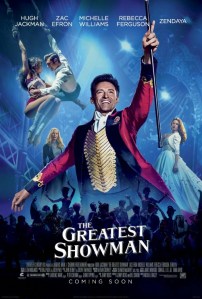 It’s rare to see an original musical given this sort of stage and attention. We usually reserve this space for tried-and-tested properties from Broadway or whatever animated film Disney has deigned to remake for an extra billion dollars in goodies. Another question is whether the movie will make the use of its big screen potential, as we’ve been inundated with smaller-scale musicals that are satisfying but lacking in an awe-inspiring sense of scale. The Greatest Showman is a big, splashy, 80s-styled Broadway musical that deals with big moments, big characters, and big emotions. It wears its mighty sincerity on its sleeve and challenges you not to get swept away with all of its charming pomp and circumstance, and for the most part I did just that.
P.T. Barnum (Hugh Jackman) is an unemployed salesman trying to provide a life of luxury and imagination to his wife Charity (Michelle Williams) and two daughters. He opens a theater in New York City and hires folks with unique appeal, a bearded woman (Keala Settle), a little person dressed as Napoleon, other so-called “freaks” and several trapeze artists. The show garners some controversy but still attracts a crowd. He reaches out to a rich playboy Phillip Carlyle (Zac Efron) to better shore up the finances. Phillip is reluctant but eager to step away from the pull of his parents, which includes falling in love with Anne (Zendaya), a trapeze performer. Barnum achieves enough success to force his way into the moneyed world of New York high society but he doesn’t feel they accept him, so he reaches out to renowned opera singer Jenny Lind (Rebecca Ferguson) and convinces her to come to America. Barnum plans a cross-country tour for his newest star and plans on going with, soaking up every standing ovation from the upper class. With his focus distracted, Barnum is in danger of losing those closets to him.
 This is a loving throwback to those old Broadway days and it succeeds admirably on the big screen, taking its circus setting and opening up the space. There’s a rooftop dance among hanging sheets that reminded me of classic Rogers/Hammerstein. I was particularly fond of the choreography of two duets, both with Efron. The first, “The Other Side,” he is being wooed by Barnum in a bar and the two men circle each other in negotiations, eventually jumping on tables, the bar top, and pounding and sliding shot glasses to naturally match with the percussive elements of the catchy song. The “Rewrite the Stars” lovers’ duet is playful and romantic as envisioned in its location, the center ring of the theater . Zendaya swings along ropes, rings, and weights, making their “will they won’t they” song a literal flirtatious dance, their orbits getting closer to one another, and the staging makes the emotions of the song feel even larger and more resonant. If you’re a fan of the unabashed, big audacious musicals of old with a sincerity that could approach mawkish, then you’ll definitely be in for a treat with what The Greatest Showman offers.
Reading that the Oscar-winning musical team behind the listless tunes from La La Land was the ones cooking up the original Showman songs did not inspire me with confidence. Well, apparently what they really needed was people who could sing and a canvas that allowed for a wider array of musical instrumentation. The songs mimic the movie in its presentation of exploding emotions and earnestness, and the big group numbers have a habit of feeling very kitchen sink in their melisma. It’s all the notes, all at you, with a thundering backbeat, and it can be a little overpowering at first to process, but eventually you adjust to its ecstatic rhythms. The opening number “The Greatest Show” threw me for a loop, with quick audience foot stomps cut with a millennial whoop and then laid over a dozen other musical tracks. It hits you hard but serves as a fine introduction, teasing you about the world to come and Barnum’s showcase. The song is also emblematic of my biggest quibble with what is otherwise rousing musical numbers insofar that it’s overproduced. There are solid melodies with each song and its reprise; however, it feels like the arrangements cannot settle on when to stop adding stuff. The songs can feel cluttered, weighed down by the added production. Barring that, it’s 39 minutes of original music that puts the Oscar-winning La La Land to shame.
 With any musical, different numbers will strike people differently, so I’ll highlight some of my favorites. The aforementioned “The Other Side” has a playful jaunty beat that builds and builds, nicely lending itself to showoff moments for Jackman and Efron as they try and outsmart and eventually out dance (the musical equivalent of persuasive speaking?) one another. the lyrics are also sharp (“I live among the swells/ We don’t pick up peanut shells”). It’s also a nice change of pace from the anthems and ballads that populate much of the soundtrack. Speaking of ballads, “Never Enough” might come from the least important character in the overall story but my goodness does Voice alum Loren Allred, providing vocals for Ferguson to lip synch, give it such a wallop. The emotion in the singing is crystal clear and made me wince because it’s so good. I’m one of those crazy people who care more about the performances in my big screen musicals than hitting all of the correct notes (see: Les Miserables), but it’s nice when a performer can grant you both. There’s no shame in lip-synching, La La Land. “Tightrope” is Williams lamenting her martial changes but the real revelation is her singing. She takes a fine song and makes it better. The song getting the most awards attention is the anthemic “This is Me” about accepting one’s self like a “Let it Go.” Keala Settle takes complete ownership with her booming vocals and passionate intonation. It’s a calling for all outcasts and delivers the inspirational groundswell into a millennial whoop pinnacle. There wasn’t a song that didn’t engage me at some level, either musically, performance-wise, or even presentation, and that’s one of the most important aspects for a musical.
Jackman (Logan) might just be blessed with more charisma than anyone on the planet, and so when he has that twinkle in his eye, you’re willing to go on whatever journey with the man. This has been a passion project of his for years and Jackman and he puts his all into being a captivating conman who can get high on his own hokum. He’s leaping off the screen to entertain and his dexterity and natural showmanship parlay well into bringing great, bustling life to his character. Efron (Baywatch) is an appealing actor who can so easily pull you in with his adeptness at comedy, acting, dinging, and dancing. It’s been a while since Efron hoofed it up on the screen and he hasn’t missed a step. Zendaya (Spider-Man: Homecoming) is a born star. She has a moment late in the film where her hoarse voice repeats the chorus of “Rewrite the Stars” and she pushes it from being cheesy into being touching. Williams (All the Money in the World) is better than her underwritten material affords and brings warmth to her understanding, doting wife. For fans of the excellent Netflix series GLOW, which is also all about showmanship, that’s Sheila the She-Wolf as a young Queen Victoria (Gayle Rankin) greeting Barnum.
 Now, the direct sincerity of the entire production is somewhat called into question by its very sanitized approach to P.T. Barnum. One way of looking at his “freak show” was that he was empowering the less fortunate and providing a safe space for them to call a community and earn a wage in a discriminatory job market. Barnum gave them a sense of dignity. Another way of looking at it is that Barnum was exploiting people who had no other options and selling tickets for the public to indulge its morbid curiosities. Barnum is a fascinating figure before he even conjures up the idea for his circus. He was an abolitionist who dropped out of school at fifteen, owned and operated a newspaper by age 21, was jailed for libel, exposed a credit scheme to gain his theater, four in the Civil War, and was a purveyor of any ridiculous and ghastly theatrical stunt, including an enslaved African woman’s autopsy to prove she was really 160 years old. Barnum is a complicated historical figure with a wealth of anecdotes that would make great storytelling potential.
The movie invents a Barnum for an invented tale, which isn’t necessarily a problem except that what we get is absurdly simplistic in comparison to the complex source. Barnum becomes a poor kid with great aspirations, most of which seems to be either joining the rich elites or sticking it to them and their snooty sensibilities. Likewise, being a champion of the “freaks” is naively unsophisticated for a man as craven for publicity as Barnum. The simplicity also extends into the supporting characters that have meager morsels to work with considering the considerable attention Barnum draws. An interracial romance between Phillip and Anne has tremors of importance but falls back on easy signifiers lacking greater examination, like Phillip’s agog family response to him being interested in “the help.” It’s a shame because Efron and Zendaya are terrific together and a simple gesture like reaching out to hold hands can have such power. Charity is the put upon wife we see all-too often in the stories of Great Men, and her domesticity represents the source of Barnum’s true happiness. You see, dear reader, Barnum’s character arc is that he wants to stick ti to the rich elites, than he wants to be accepted by them, and then he learns the errors of his ways and goes back to appreciating his family and life’s smaller pleasures, those pleasures are still living comfortably. It’s a strange stop-and-smell-the-roses sort of lesson, and it’s even weirder when Barnum seems to lose interest in his community of performers he’s gathered. The subplot where Barnum abandons his theater to tour with Jenny Lind feels both obvious and unnecessary. The only tension is whether or not there will be an affair, and the impact of Jenny Lind seems overall fleeting, forcing conflict in contrived fashions. For a man whose life story was writ large and fascinating, The Greatest Showman conjures a sedate replacement.
 As I was watching and smiling to the soaring emotions and tunes, I kept thinking how 17-year-old me would have likely tore this movie to shreds, lambasting its earnestness as a mawkish attempt to wring out a feel-good story from a questionable source. 17-year-old me would have snickered about how gloriously unhip The Greatest Showman is. Mid-30s me has a much easier time not just accepting sincerity but also appreciating it. The performances are charming, the performers able, and the songs slyly catchy. The story of P.T. Barnum is sanitized with mixed results but the ebullient feeling coursing through this film is undeniable and worked its magic over me. If you’ve been missing the big Broadway musicals of old, The Greatest Showman will be a three-ring treat.
Nate’s Grade: B
Share this:

Spider-Man: Homecoming (2017)
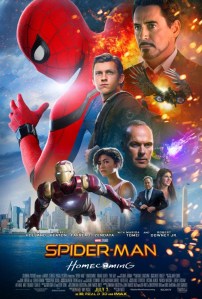 15 years. 6 movies. 3 different lead actors. 2 reboots. I wouldn’t be surprised if a majority of the American public likely knows more about Spider-Man than their relatives. In 2002, the first Spider-Man movie kicked off the new century by affirming to studios that superhero movies are a sound financial investment. Director Sam Raimi and Tobey Maguire kicked off the glut of superhero cinema, paving the path for the massive Marvel Cinematic Universe (MCU) and its own unparalleled run of financial and critical success. Then the overreach killed off Raimi’s Spider franchise in 2007 and overreach again killed off Sony’s Spider reboot in 2014. Sony wisely sought out an assist from the gurus of Marvel, striking a deal and having the web-slinger return to the MCU. Fans rejoiced. Spider-Man: Homecoming announces itself as a brash, exhilarating, hilarious, and amazingly assured film that immediately lines up with the upper tier of the MCU. Marvel should use this as Exhibit A, submit it to Fox, and say, “Here’s how we can do your franchises better.”
Peter Parker (Tom Holland) is your ordinary 15-year-old from Queens, New York who was given amazing powers after being bit by a radioactive (or genetically modified) spider. It’s been weeks since he was called into action by Tony Stark (Robert Downey Jr.) to thwart Captain America (Chris Evans). Now Peter is back home and waiting for his literal call to adventure, for Stark to officially call him up to join the Avengers. Peter anxiously waits for school to end so he can don his Spider-Man suit, modified by Stark Industries, and fight local crime and injustice. This mostly amounts to stopping bicycle thieves, helping old ladies with directions, and other inglorious tasks. Peter’s Aunt May (Marisa Tomei) would prefer he focus on his studies rather than the time he’s been spent on the “Stark internship” (his fib to cover said crime-fighting). New weapons begin appearing on the streets, built from the discarded alien technology from The Battle for New York. Spider-Man investigates the source, Adrian Toomes (Michael Keaton), a pilot who adopts the moniker of The Vulture while in the sky with his winged jet pack. The formidable weapons pose a real pressing danger to society, and Peter pushes further, at his own peril, to confront the Vulture and stop the flow of high-tech weapons.
 For many fans of the webhead, this will feel like the first time they’re watching the Spider-Man of the comics on screen. This is the first film incarnation where Peter remains in high school for the entire duration of the movie, and it’s also thankfully the only telling that eschews an origin story. He just is Spider-Man, however, the arc of the movie is him settling into that identity. It’s in many ways a coming-of-age story for the superhero set, as Peter has to come to terms with his earnest desire to help others and his own maturation, both as Spider-Man and as a high school sophomore. He’s learning just as much to be Peter as he is Spider-Man. Just because he has these powers doesn’t mean he’s ready for the rigors of the world. Homecoming is very much a high school movie. There are familiar John Hughes influences throughout, and the film smartly subverts certain high school tropes (driving lessons, prom dad from hell). It presents our hero struggling with asking the cute upperclassman (Laura Harrier) to the dance just as much as the demands of being a fledgling local superhero. His interior life is much more available and relatable but he’s still a teen navigating the world. Also, by having Peter be the youngest film incarnation yet, it allows for the satisfying indulgence of superhero wish-fulfillment. Whereas the X-Men powers are naturally linked to the progression of puberty, those are usually portrayed as a curse, something that ostracizes, confuses, and produces great anxiety and fear. With Spider-Man, being a superhero is the coolest thing in the world. He’s not consumed with angst like Andrew Garfield’s broody Peter Parker and his weirdly special DNA (what was the deal with his parents and that conspiracy? Oh well). Watching this exuberant Peter Parker embrace his new abilities with glee is a great way to keep the movie light and bouncy.
This is also, bar none, the funniest film yet in the MCU (yes, even dethroning Guardians of the Galaxy). With the lighter tone, the movie finds consistent opportunities to inject comedy, from the irony of Peter trying to lead a normal life, to the awkwardness of Peter’s attempts at crime-fighting, to his over eager demeanor, to misunderstandings and hasty excuse-making to conceal his double life, to the sterling supporting cast of characters that contribute different flavors of jokes when called upon. If anything there is so many talented supporting players I wanted even more time with them (Donald Glover, Hannibal Buress, Martin Starr). This cast is a comedic embarrassment of riches.
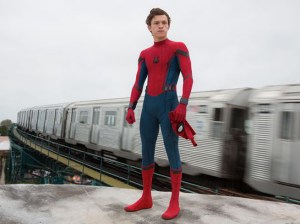 I was laughing pretty much from beginning to end with Homecoming. Just thinking back on the school’s morning announcements (complete with anchor Betty Brant) makes me giggle. Peter’s best friend Ned (Jacob Batalon) is the movie’s chief source of comic relief, and in less careful hands he would become rapidly annoying. Instead, he’s a reliable presence and given a character arc with a payoff of his own, his desire to be Peter’s “guy in the chair.” It’s genuinely impressive screenwriting when even the comic relief sidekicks have arcs. Zendaya does an impressive job of selling every one of her jokes, which traffic in a very specific smart-aleck, apathetic tone. She’s graduated from the Disney Channel to the bigger leagues. There’s a hysterical series of inspirational education videos featuring Captain America, and if you stay past the end credits there’s a great payoff for that. There’s even some sly meta jokes calling back to Raimi’s Spider-Man. Every joke at least lands and most of them hit hard, benefiting from strong development and timing.
Nevertheless, just because it happens to be one of the funniest movies of the year, Spider-Man: Homecoming still finds plenty of space to be dramatic and thrilling. The comedy doe not tonally detract from the other elements. This is not an insubstantial movie just because it knows how to have some fun (take notes, Zack Snyder and DC). This is not a flippant movie because of tone or the heavy joke quotient. There are sincerely sweet moments born out of the characterization, like when Aunt May takes it upon herself to teach Peter how to dance (this would not be possible with a geriatric Aunt May). Director Jon Watts (Cop Car) has a steady command with his high-flying visuals and maintains the tight walk of tone that allows all the elements to work together as a blissful whole.
There are superb action sequences that advance the story forward and allow for the characters to grow. It’s exactly what good action is supposed to do, besides, you know, quicken the pulse. The humor can also arise naturally from these set pieces. Take for instance Peter suiting up while attending a suburban house party. He spots some alarming energy discharges on the other side of the suburb, but without any tall buildings for him to latch onto, he has to hoof it the whole way on foot. It’s a smart comedic aside and it helps to remind us that this Spider-Man isn’t an instant pro after getting his powers. It all comes together best in a D.C. rescue at the Washington Monument. It bridges the personal with the action. The bifurcated ferry set piece serves as the Act Two break and it’s a killer segment that pushes Peter to his limits to solve a dilemma that seems incapable of being fixed. There may not be any action scene to rival Raimi’s finest but the character-centric action and the organic development of the complications lays a foundation for a consistently entertaining film littered with joyful payoffs.
 The biggest fear I’ve read from Spidey fans was that the involvement of Robert Downey Jr. would tip the scales, turning a Spider-Man movie into a defaco Iron Man sequel. Considering America loves Iron Man, I don’t see how his inclusion is a problem. Civil War was still very much a Captain America film even though Iron Man was the co-lead. Tony Stark represents a distant mentor for Peter and also the gatekeeper. Peter is anxious to become an Avenger and looking for Stark’s approval, which brings an enjoyably unorthodox paternal side from Downey. If there is a complaint I can foresee, it will be that Spider-Man is too similar to Iron Man thanks to the special suit. Spider-Man’s suit has its own Jarvis-style A.I. program (adeptly voiced by Jennifer Connelly, wife to Paul Bettany, former voice of Jarvis) and extra special gadgets including a spider drone and unusual web shooting options. It provides a new sense of discovery for the character since we’re already starting with him powered. The second act is Peter getting accustomed to the boost his suit gives him, becoming reliant upon them, and then having it stripped away as a natural Act Two break so that the conclusion has even more stakes without the security of the suit. It makes Peter much more vulnerable. The Iron Man parts are more a background motivational force and this is still very much a Spider-Man film.
Holland (The Lost City of Z) is already my favorite Spider-Man. Period. He made such an immediate and strong impression in Civil War that I was greatly looking forward to his first big starring venture, and Holland does not disappoint. This is the first Spider-Man that doesn’t feel crushed by the heavy burden of being a superhero. He’s a kid eager to grow up and join the world of other caped crusaders, but he’s modeled his crime fighting from what he’s seen on TV. He doesn’t really know what he’s doing. He’s still an awkward kid, and Holland brings great authenticity to the smaller character moments and the bigger heroic strides (while maintaining a convincing American accent). This is a more relatable, vulnerable, and interesting Peter Parker. Even though he thinks he should be beyond the mundane life of high school, he doesn’t ever act pompous or look down on other characters, which is endearing. At times Holland feels like he’s going to explode with energy, as if life is too much to process in the intermediary. He’s a teenager and the world feels so big and open. It’s an instantly engaging and likeable portrayal that wonderfully capitalizes on the introduction from Civil War. This is a Spider-Man, and his spider world, that I want multiple sequels to further explore and challenge.
 Keaton’s Vulture already ranks as one of the best villains in the MCU (a low bar, I admit), and that’s because the movie humanizes him and gives him significant moments. He’s just a regular working-class man trying to provide for his family. In fact the first five minutes of the movie focus exclusively on Toomes and explains his sticky situation. He feels cast aside by those in the upper echelons of power. His eventual “you and I are the same” speech to Spider-Man has credible points. You can see, from his perspective, how he’s an underdog sticking it to the rich elites. Shockingly, there’s only one death in the entire movie and even that is an accident. Toomes is not your standard comic book villain, and there’s a brilliant third act twist that makes him even more centrally involved in the narrative. That opens a delicious sequence of dramatic irony. Keaton has a quiet menace to him that’s very unsettling. It’s all in the lower register. His character doesn’t blow up. He just narrows his brow and intensifies that scary stare. I’m glad the filmmakers realized that more Keaton was an asset to the film.
Let’s also take some time to celebrate the sixth Spider-Man movie for having a diverse population of characters that would actually represent Queens. Peter’s best friend is of Filipino descent, the girl he crushes on is biracial, the loner girl is biracial, and even the high school bully, Flash Thompson, is Hispanic, played by Tony Revolori from The Grand Budapest Hotel. This might be Marvel’s most diverse cast yet, though “yet” being the operative word considering that Black Panther is arriving in early 2018.
This movie is a total blast. Spider-Man: Homecoming actually manages to give new life to a character that has already appeared in five other movies. That’s an amazing feat. Another amazing feat is that six different screenwriters, including the director, are credited with this movie, yet it feels fully coherent in its vision and presentation. This is Peter Parker, the teenager struggling with self-doubt, hormones, and an eagerness to grow up, and the movie feels much more human-scaled, forgoing giant CGI smash-em-ups for something more grounded, personally involving, and ultimately successful. Just because Homecoming is fast-paced and funny doesn’t mean it lacks substance. I was elated during long portions of this movie, impressed by the steady stream of setups and payoffs, the incorporation of the many characters and comedic voices, and the varied action set pieces that were focused on character progression. If you are tired of superhero stories, I’d still heartily recommend this movie. Dear reader, I feel like I’m failing you and turning into a frothing fanboy because I can only think, at worst, of negligible quibbles against the film. Everything in this movie works. Everything. It’s everything I was hoping for and then some.
Nate’s Grade: A


 nathanzoebl
You must be logged in to post a comment.