Blog Archives
Thor: The Dark World (2013)
 Loosely based off the Norse mythology, Marvel’s hammer-wielding hero isn’t exactly the easiest character to relate to even as a superhero. Thor is a god after all. Not to be outdone, the man is also royalty, next in line to be king, so he’s in a special class of privilege. And yet 2011’s Thor was a pleasant surprise, a superhero movie that didn’t take itself too seriously, had modest aims, and embraced its sci-fi fantasy mélange. It was a movie where the sillier it got the better it worked. Now Thor: The Dark World, a.k.a. Thor 2, is ready to dominate the fall box-office and prove that Joe and Jane Popcorn can cheer for a pagan god.
Following the events of The Avengers, Loki (Tom Hiddleston) is taken back to his home world of Asgard and put in prison. Loki’s brother, Thor (Chris Hemsworth), is trying to get back to Earth to reunite with his love, scientist Jane Foster (Natalie Portman). Thor is being groomed for the throne of Asgard by his father, Odin (Anthony Hopkins). Meanwhile, the nine worlds are nearing a convergence and dimensional gateways are opening, including one that infects Jane with an ancient biological weapon, the aether. The aether was used as a weapon by the dark elves, a race of creatures that was long ago defeated but its general, Malekith (Christopher Eccleston), has been dormant and in hiding. Alterted, he assembles his surviving army to attack Asgard, kidnap Jane Foster, retrieve the aether, and destroy all life in the universe.
 Thor is still a second tier character when it comes to Marvel superheroes (the guy just isn’t that interesting) but his franchise has, in only two starring films, become the most interesting. The scope of the Thor movies seems infinite. Whereas the other Marvel heroes are Earthbound and straightforward, Thor transports an audience to all sorts of alien worlds/cultures/conflicts, all of which open up more tantalizing storytelling avenues. Nothing seems out of place in a setting such as this, and so the surprises are more satisfying. I thought the best parts of 2011’s Thor were the Asgard moments, less the strained fish-out-of-water comedy of Thor assimilating on Earth. Thankfully, almost all of Thor 2 takes place off Earth save for a rousing, creative, inter-dimensional hopscotch of a climax. The realm of Asgard is given suitable scope thanks to the screenwriters and first-time feature film director Alan Taylor, who worked in TV for years. Taylor’s notable work on HBO’s Game of Thrones is probably what got him this gig, and his vision with fantasy is given significant breadth here. The Thor universe is an interesting mix of fantasy and sci-fi, reminiscent of Star Wars, and Taylor provides the necessary sweeping visuals, exciting action, and glorious shirtless close-ups we come to expect from our fantasy vistas. I was consistently impressed with Taylor’s command of visuals and shot selection, particularly how the man was able to juggle the various tones and needs of the script while still keeping an exposition-heavy film fun and light.
With rainbow bridges, dark elves, and enchanted hammers, thank goodness that Thor 2 keeps a steady and welcome sense of humor, never getting too serious even with the end of existence on the line. This jovial tone is refreshing when properly executed and contributes to the overall fun of the picture. We’ve had such sturm und drang when it comes to our superhero movies, particularly last summer’s Man of Steel misfire. I appreciate a dark and gloomy superhero tale like Nolan’s Batman films, or a satirical swipe like the original Kick-Ass, but we need stories that fit with their tone. When it comes to Thor, he’s still saving the world, rescuing his damsel, but the attitude, while on its face regal and serious, is anything but. The Thor movies accept the absurdities of its setting and just shrugs, plowing along. And now with Jane on Asgard, the fish-out-of-water comedy gets a different perspective. She gets to meet Thor’s parents (awkward) and an Asgardian who has a thing for the hunky Norseman (double awkward… I’ll stop the 90s catch phrases now). Thor 2 also gives Jane Foster much more to do, placing her front and center as a person integral to the stability of the universe. During the snazzy climax, she gets to run around and contribute in a meaningful manner. The there’s the plucky Kat Dennings (TV’s 2 Broke Girls) who gets to rattle off one-liners like a pro, many of them grounding the elevated levels of silliness. Much of the humor comes from the cocksure characters and their quips, particularly Loki.
And that’s as good as any place to interject my notion that Thor isn’t truly the main character in this film, despite what the title preceding the colon may lead you to believe. That honor goes to Loki, the greatest villain in any modern Marvel movie by far. He’s got the clearest arc in the movie, going through arguably the most personal pain, coming to a crossroads, and his conclusion certainly sets up sizable ramifications down the road for the presumptive Thor 3. Played by Hiddleston (War Horse), the character draws you in, even when he’s throwing his self-aggrandized temper tantrums you want to spend more time with him. He’s far and away the most developed and interesting character onscreen, and Hiddleston has such a gleeful malevolence to him that makes the character all the more electric and unpredictable. Thor 2 is really the story of Loki coming to terms with his life’s choices, the choices his adopted parents made, his sense of self and birthright, and moving forward, becoming his own man again. This is why Thor 2 ascends another entertainment rung by tying Loki into the main story, forcing him and Thor to work together against a common enemy.
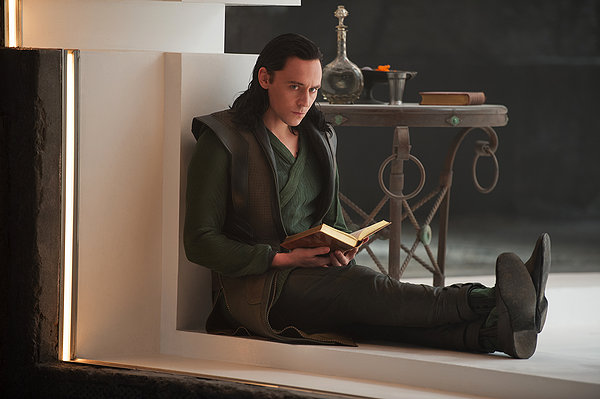 In a film dominated by a charismatic Loki, it’s no wonder that Thor 2’s real bad guy falls woefully short. Malekith is a confusing and altogether lackluster antagonist in every conceivable way. He has no personality to him; he’s simple-minded with the goal of eradicating the universe. I don’t know about you, but my bad guys better have a pretty good reason for destroying the universe since they kinda live there too. This is one of the lazier villain plot devices because it has no nuance, no shading. Apparently before there was a universe there were dark elves. I don’t want to get caught in a chicken-egg paradox here, but was there a universe before the universe, cause I look at the universe like existence’s garage. The cars inside may change but the garage was standing before it all. Anyway, Malekith wants to destroy all life because he wants to, because certainly you’d think there would be enough space in space. He’s not even that threatening or given any particular advantage beyond some firepower. It’s no wonder that Loki runs circles around this chump in the villain department. Eccleston (Unfinished Song) is not at fault. The heavy makeup he’s under smothers the actor’s ability to polish this terrible character.
The rest of the acting fares better. At this point, we know what we’re getting with Hemsworth (Snow White and the Huntsman) as the title character. He’s a sturdy leading man with just enough appeal to satisfy, though part of it is that Thor is just dull as a hero. He was more entertaining when he was cocky and irresponsible. Portman (Black Swan) holds her own though the romance between her and Thor feels more forced. Hopkins (Red 2) strikes the right mix between regal and camp. While their roles aren’t exactly integral, it’s nice having a superhero movie stuffed with great actors like Idris Elba, Ray Stevenson, Adewale Akinnuoye-Agbaje, Clive Russell, and there’s even an amusing appearance by Chris O’Dowd, who effortlessly oozes charm (take note, Thor).
This a superhero movie that separates itself by its sheer sense of fun. Thor: The Dark World takes what worked in the previous movie and provides more of it. The campy, silly Asgard stuff is given even more time, the mischievous sense of humor is renewed, the fantasy worlds given more depth and better action/effects, and fan favorite Loki gets a big starring role this time with extra brotherly bickering. It’s not the best superhero movie, nor is it the best Marvel film of recent years, but Thor 2 knows what kind of movie it wishes to be and how to best achieve this. It’s a loopy, droll, and rather imaginative big-budget superhero film, while still finding ways to be somewhat generic with its overall plotting and character turns. While the action is suitably epic, it’s the character interactions that are the most enjoyable aspect. It seems excessively lazy to say that if you enjoyed the first Thor, you’ll probably enjoy the second one as well, but there it is. Perhaps next time the storyline won’t be as convoluted and we can get even more Loki. Barring that, I’ll accept additional Chris O’Dowd screen time.
Nate’s Grade: B
Share this:

Kick-Ass 2 (2013)
 It’s hard for me to discuss Kick-Ass 2 without sounding like a hypocrite. I enjoyed the first film’s visceral thrills, style, and satire of superhero tropes. The sequel gives me more of the same except not nearly as well polished, and in typical sequel mentality, it goes bigger, expanding the world and the height of the sick puppy violence. Kick-Ass (Aaron Taylor-Johnson) and Hit Girl (Chloe Grace-Moritz) are trying to live ordinary lives but keep feeling the need to don their suits and fight crime. Kick-Ass joins a ragtag team of other costumed vigilantes to battle a super villain team, lead by the former Red Mist (Christopher Mintz-Plasse). For long stretches, the movie seems like an unwanted Heathers knockoff as Hit Girl attempts to fit in at high school. She has some particularly nasty vengeance against a popular bully, and if there is a line, it may have been crossed here. I don’t know what it says about me, but I guess I’m fine with a pint-sized kid slicing up bad guys and cursing like a sailor, but making a woman simultaneously vomit and defecate herself, watching both projectile streams spray out her ends, is too much for me. This is a darker, cruel, and mean-spirited feel with the material, and writer/director Jeff Wadlow fails to compensate for the lack of creativity this go-round (I miss you Matthew Vaughn). The humor is still lively, but the plot is predictable at every step, the characters behave in ways that don’t make sense, and the action sequences are poorly filmed, leading to an anticlimactic ending that simply peters out. Kick-Ass 2 won’t be knocking anyone out.
Nate’s Grade: C+
Share this:

The Wolverine (2013)
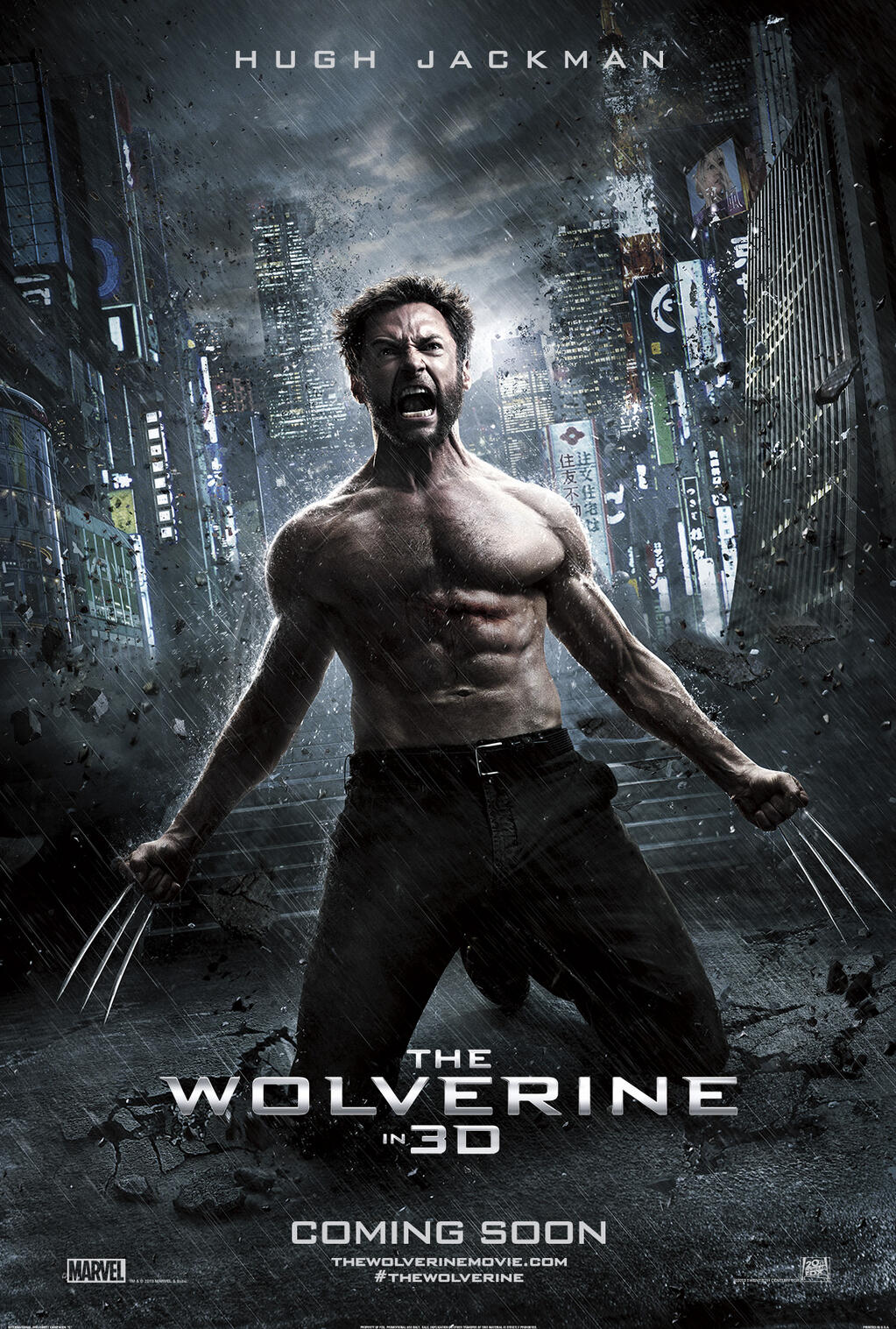 For a character universally beloved by comic and movie fans, Wolverine has fallen on some hard times. It’s hard to find too many supporters for either 2006’s X-Men 3: the Last Stand or 2009’s X-Men Origins: Wolverine. He had a fun cameo in 2011’s retro X-Men First Class, but other than that we’ve gone almost a decade without a respectably good movie starring Wolverine. It looked like Darren Aronofsky was going to be the answer to that drought of quality. The Black Swan director, who worked previously with Jackman on the intensely personal The Fountain, spent six months developing a Wolverine film set in Japan. Then Aronofsky dropped out, making this the second superhero franchise he missed out on (he was tapped to reboot Batman before Christopher Nolan landed the job). James Mangold (Knight and Day, Walk the Line) stepped into the director’s chair and now we have the directly titled semi-sequel, The Wolverine. It’s a step up quality-wise but even that comes with qualifiers.
Many years after the events of X-Men 3, Logan (Hugh Jackman) is living a solitary life amid the Canadian wilderness. He’s looking to lay low and he’s haunted by visions of his lost love, Jean Grey (Famke Janssen), the woman he was forced to kill to save the world. Yukio (Rila Fukushima), a mutant with the ability to foresee people’s deaths, finds him for her employer. He’s invited to Tokyo at the request of a wealthy and dying businessman, Yashida (Hal Yamanouchi). Back during World War II, Logan saved Yashida’s life, shielding him from the atomic blast that wiped out Nagasaki. Yashida has an offer for Logan. He can make him mortal again and take away his advanced healing ability. Thanks to a sketchy mutant, Wolverine loses that ability and goes on the run to protect Yashida’s granddaughter, Mariko (Tao Okamoto), from gangs and rival businessmen.
 Benefiting from low expectations, The Wolverine is a solid summer superhero tale that’s more interesting in its divergences from… summer superhero movies than it is when it follows that basic script. I appreciated that here is a superhero movie that actually doesn’t have to be wall-to-wall action. It allows a story to take place. Now, that story has its problems most certainly, but at least it has room to breathe. Also, there are barely any mutants in this movie at all. Excluding the title character, we get two super-powered mutants though neither really has a power that lends itself well to combat. I appreciated that there was hardly any gunplay at all in the movie. Mangold allows the hook of Wolverine, the hand-to-hand combat, to flourish amidst teams of adversaries following the ways of the samurai. I also appreciated the lack of familiar faces. While Jackman and Janssen will be recognizable to fans, I doubt too many others have a deep familiarity with a wide selection of Japanese actors. Then there’s an excellent post-credits scene that sets up the forthcoming X-Men universe crossover, Days of Future Past, arriving summer 2014. For all of these reasons, and some decent action, I’d say The Wolverine is worth seeing especially by fans burned by the character’s last two starring ventures.
With that said, this is a movie that still feels like it has problems that stop it from reaching its potential. The crux of the plot hinges on Wolverine losing his healing ability, thus becoming mortal. I understand that it’s hard to make an indestructible man vulnerable, but his friends and loved ones aren’t. The loss of powers doesn’t seem to raise the stakes because there isn’t a noticeable difference in the dude’s actions. He still acts the same except he recoils a bit longer from punches. The guy gets shot a bunch of times and stabbed and even clings to dear life atop a bullet train (more on this later), but he never really seems fazed. There’s also the nitpicky comic book nerd criticism that, if removed of his healing ability, there’s no way his body could sustain an entire skeleton made of metal. I’ll overlook it. This storyline seems even weaker when Wolverine (spoilers) gets his powers back for the third act (is that really a spoiler?) so he can fight the giant bad guys. The movie needs him back at full strength. It doesn’t feel like much was accomplished narratively or with the character to rob him of his invulnerability. That storyline could work, as it has in the comics before, but it just doesn’t seem like the ramifications are really explored beyond the surface.
Then there’s also to the issue with how cluttered the plot is with characters. There are far more characters in this than necessary, many of whom contribute very meagerly or could have been combined. The entire Yashida corporate storyline is just overburdened. There’s Mariko’s gruff father, there’s her mysterious boyfriend, there’s her would-be fiancé who works as a justice officer, there’s a snake-like mutant who really doesn’t add anything but poison samples. And you don’t really care about any of them. Whenever the story takes too many steps from its core (Wolverine protecting Mariko, getting his power back) is when the movie loses your interest. The final showdown and the participant involved should also be obvious, especially since Yukio point blank tells the audience about a red herring. Speaking of Yukio, I think she was easily the best addition to the movie. She forms a buddy relationship with Wolverine, a notorious loner, and watching them spar is just fun. Plus she’s a badass with a soul. Her mutant power also curses her with knowing how every loved one, every dear friend, every family member will die. She must see it, live it, all the while knowing what is to come. And that’s all you ever see – people’s deaths. That is some heavy stuff, and the movie treats it with sincerity, showing how haunted Yukio can be with these unsolicited peaks into the future. I would have greatly preferred more screen time for Yukio, who ducks out for far too long for my tastes. Plus the actress has a very striking, unique look to her. I don’t know if there are plans to continue her character into Days of Future Past, but I hope they do.
 Then there are moments that strain credibility even for a summer superhero movie. It’s funny, because if you’re being entertained, your brain will ignore these moments. Well there’s one action sequence that stands out that seems to break every law of physics. I know we’re dealing with mutants, I know we’re dealing with superheroes, and I know it’s a summer action movie, but my God this bullet train sequence just does too much. There is a fight scene between Wolverine and a standard Yakuza thug atop the speeding top of a bullet train zipping by at 300 miles per hour. It’s actually the most memorable action piece in the film, but it’s also memorable for wrong reasons. Wolverine is using his claws to pin himself to the top. The Yakuza thug is using a standard knife. Are the tops of the bullet train this easily penetrable? I’d worry, Japanese commuters. Then they hop over signs and ledges, still landing atop the train. This isn’t a Western with a locomotive that one could feasibly keep their footing atop. This is a train going 300 miles per hour. You think you can jump onto something going that speed and keep your balance? Think you can hold onto something while you speed at 300 miles per hour? How can a human arm maintain that sort of physical exertion? It’s too ridiculous to enjoy. If the rest of the movie had a similar over-the-top tone, then this sequence would be acceptable. However, The Wolverine plays itself so seriously that moments like this truly negatively stand out.
Jackman (Les Miserables) is a perfect fit for this character. I agree with my friend and colleague Ben Bailey; while the X-Men movies have faltered in quality, Jackman never has. He’s played this role six times now and it’s still a pleasure to watch. There is a question of how much longer the man can keep this up, though. Even at 45, the man can still get jacked with the muscles; just look at Stallone, or don’t. The real problem is presented in the mythology of the character developed in the first Wolverine solo outing, namely that the man is close to immortal. He doesn’t stop aging; he just ages very slowly. This is the same problem with twenty-somethings playing vampires, or Arnold as a timeless robot (why would they make slightly older looking models?). Age catches up to all of us, though Jackman’s own constricts the use of the character in the future. Regardless, this man can play this part until he’s in a nursing home and I’ll be happy.
There are elements that work, particularly Wolverine’s thematic relevance to the samurai of old and the feudal system of honor, and I enjoyed his buddy relationship with badass-in-training Yukio. The action is serviceable, there are some sweeping visuals with referential touches to Kurosawa, and Jackman is still a strong and capable hero. There’s just so much more this film could have been. The setting could have been fleshed out, the characters pared down to essential storylines, and the plot of Wolverine losing his powers could have actually mattered rather than just play out like a momentary setback. There’s just as many things I enjoyed as I didn’t, so this is a tough call for me. The Wolverine is clearly a step above the previous two movies, but those were both fairly bad films, the solo one poisoning the well for future X-Men solo bids. If you enjoy the character and want something slightly different but recognizable, then The Wolverine will pass the time acceptably. It’s hard for me to work up much passion for this film, and I’ll be surprised if any hardcore fans feel otherwise. Here is a superhero movie that lands right dead center between bad and good. I suppose most would call that mediocrity, but given how poor X-Men 3 was and Origins, I think I’ll call it progress.
Nate’s Grade: B-
Share this:

Man of Steel (2013)
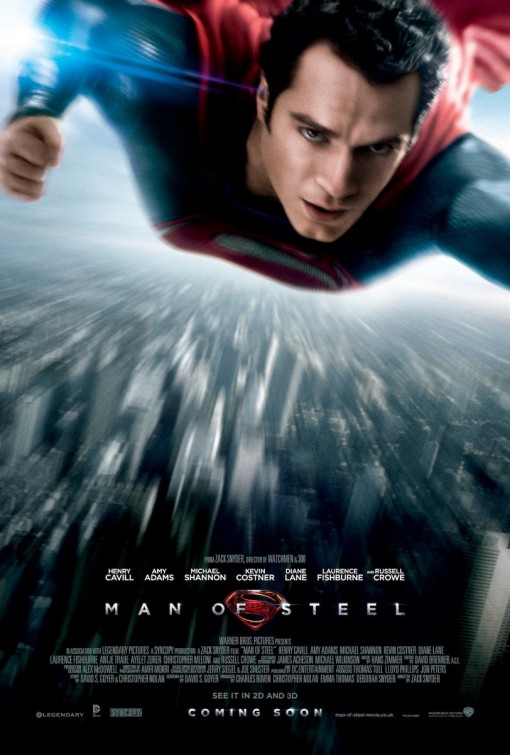 I think I began my review for 2006’s Superman Returns the same way but I don’t care. Does Superman have any relevant appeal in today’s society? I understand being a moral pinnacle has been his MO from the start, and I understand that today’s generation likes its heroes dark and broody and tortured. I know you can make Superman into an interesting figure (the man just celebrated his 75th anniversary, so there have to be some people who identify), though it is a bigger challenge, surely. I think taking a darker tack can be achievable but needs finesse. Christopher Nolan and David Goyer, having fashioned the highly successful Dark Knight trilogy, seem like a formidable pair to shepherd a darker Superman into the twenty-first century. Combine that with director Zack Snyder (300, Watchmen), and you’re guaranteed a pretty movie. Where does Man of Steel go wrong?
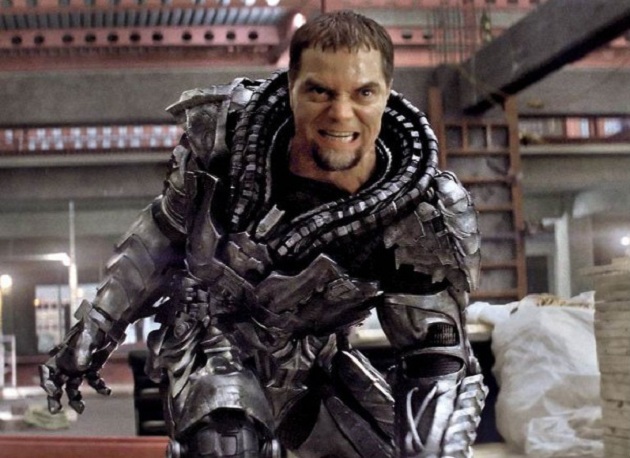
You know the drill at this point: Superman a.k.a. Clark Kent (Henry Cavill) was originally born on the doomed alien planet Krypton. His biological father, Jor-El (Russell Crowe), sent his son to Earth with the hope that he could survive and achieve great things. Raised by Jonathan and Martha Kent (Kevin Costner and Diane Lane), he then accepts his destiny to be mankind’s protector, butting heads and flirting with dogged reporter Lois Lane (Amy Adams). Except now Superman has the entire genetic code of Krypton’s history (?) transported into him via a “codex” (whish resembles a charred baby skull). General Zod (Michael Shannon), imprisoned off planet when Krypton was destroyed, is determined to retrieve that code and start his race anew. He and his crew travel to Earth and demand superman turn himself in, or else Earth will suffer.
 Where this movie gets into deep trouble is that it fashions Superman into an inactive loner, turning him into a super bore. He has such superhuman strength at his command but his doubtful dad has taught him that humanity would lose its mind if he revealed himself. And so Superman goes through half this movie hiding his super ability. He actively avoids conflict and confrontation. It’s basically the same formula as the Incredible Hulk TV show, where Bruce Banner would drift from town to town, warning others not to make him angry, then mournfully have to leave yet again. He can’t help himself save lives but, in flashback, dearly departed dad admonishes him for it (Clark: “Should I just have let them die?” Pa Kent: “Maybe.”). I think the isolation the character endures is essential to understanding his heavy burden, but at the same time this was compensated by Clark Kent, Superman’s opportunity to blend in with the natives, assume a frail phony identity, and to flash some much needed personality. In Man of Steel, he doesn’t become Clark Kent, news reporter, until the very last scene. It’s not a movie about a man becoming Superman but Clark Kent, experience-free reporter.
Two of the chief complaints about Bryan Singer’s 2006 Superman movie were that it was too reverent to its source material, namely the Richard Donner films, and it lacked sufficient action. Well, both of those issues are tackled in the very opening of Man of Steel. Goyer reworks plenty of Superman mythology from a science fiction angle, and so we get stuff about alien invaders, genetic bloodlines, clone baby labs, teraforming, and all sorts of spaceships. The characters keep referring to Superman as “the alien,” and dad worries that the knowledge of his super son will upset people’s worldviews about humanity and God (have no fear, there’s still messianic imagery to sledgehammer you with). I’m fine with Goyer playing fast and loose with Superman’s history but his alterations need to have solid reasoning. Nolan played around with Batman’s history and it worked because, in the context of the world and characters he developed, it fit. Does Jor-El riding a dragon like a live-action Heavy Metal fit? Does a billion people’s DNA transposed into Superman’s cells fit? Do Superman’s actions during the quite controversial ending fit? Does Clark’s stepdad, Jonathan Kent, willingly dying in a tornado fit? Does Lois Lane immediately knowing who Superman is, before he even adopts the Clark Kent disguise, fit? I doubt it, though it still could have worked. However, Goyer’s script is a mess structurally, preventing the story from gaining serious traction. First, we start with twenty-something minutes on Krypton, which could be condensed in half, then we slam into the present and this new formula appears: present, flashback, present, flashback, present. That happens for another twenty minutes. Then there’s 40 minutes of Superman dithering as the reluctant hero. Then the last hour plus is a nonstop barrage of meaningless action that squeezes out room for character growth.
I’ll credit Snyder and company for likely tripling the action quotient of any previous Superman movie (maybe even all of them combined), but I never thought such action would be so boring. Oh sure, it delights for a while with advanced special effects and Snyder’s eye for visuals, but the action sequences drag out far too long. A long action sequence? Isn’t that what you’re always demanding, critic Nate? Well anonymous and theoretical detractor, yes, I enjoy a well-developed and sustained action sequence. The problem with action sequences is that they have to matter. They have to accomplish something even if it’s just there are less enemies or the hero got from point A to point B. There has to be, at bare minimum, something that is accomplished. Sadly, this is not the case with the action in Man of Steel, which is why the sequences drag and feel like they are twice as long as their already bloated length. There’s a brawl between two evil Kryptonians and Superman and after a whole 10-15 minutes of sparring, the bad guys get on a ship and leave. Come on, Zod has like a crew of twelve henchmen. Can’t one of them at least die in a preliminary battle? Worse, the final confrontation between Zod and Superman could just as easily been eliminated. They punch and yell and punch and yell and stuff gets all smashy, but by the end of the fight, nothing has substantially changed, except the foundational surroundings (more on that below). Having two invincible beings punch each other for a half hour is not engrossing. For a lengthy action sequence to work there need to be complications, organic to the situation, and the stakes should escalate. James Cameron and Steven Spielberg are masters at crafting escalating action. J.J. Abrams is pretty good himself. Even Michael Bay has his merits. I don’t know whether to lay the crux of the blame on Snyder or the screenplay he had to give life.
 As the plodding action continued to pound me senseless, I was left to seriously ponder just how epic the scale of Superman’s collateral damage truly is. At one point, when Supes is fighting in the small-town center of Smallville, he tells the residents to, “Stay inside. It’s not safe.” What then proceeds to happen is a fight that rips up almost all the pavement in town, takes down a helicopter, a few fighter jets that crash in town, exploding, as well as a train car, plenty of ricocheting gunfire, and debris everywhere. But have no fear because those citizens stayed away from the windows and locked their doors! More than likely they are dead. The concluding clash in Metropolis is like 9/11 times eight. I counted three different skyscrapers that came tumbling down, and this is after the Krypton gravity field has ripped up the city and smashed it to dust, as well as missiles exploding around the city and Zod’s various spaceships. Then there’s the fight where Zod and Superman are blasting through just about every high-rise office building, and even when they collide outside it creates such force that buildings crater. They even fly into space, destroy a satellite, which then comes down as fiery debris that rains down on poor Metropolis. The final plan to foil the bad guys involves, get this, opening a black hole above a major city. It’s not like that sounds as if it will have catastrophic blowback.
The 9/11 imagery is unmistakable and I don’t care if it has been 12 years now. Couldn’t Superman at least react to the desolation he was causing? I really hope some enterprising soul via the Internet tallies the number of estimated deaths because I sincerely believe it would reach into the millions (Update: Ask and ye shall receive). Superman decimates the city and I thought less about the gee-whiz factor of the special effects and more about the innocent lives being lost amidst the CGI devastation. It looks like an atomic bomb went off. Perhaps a sequel will start with Lex Luthor rebuilding Metropolis.
And that’s the problem when you try and make sense of Man of Steel’s more realistic, grounded approach. This is a Superman that came of age in the 80/90s. While touches like young Clark experiencing sensory overload with his powers, like a scared autistic child, are clever and nice avenues toward relatability, you still have to square the more bombastic, over-the-top, and downright stupid moments that clash with that refined tone of greater realism. Nolan wanted Batman to exist in a recognizable world, so it makes sense that he and Goyer would attempt to do likewise with DC’s other champion. The prospect of an invincible alien among us is a potent source for some thoughtful and topical drama. It’s just not going to happen when Superman can demolish cities without blinking an eye or when anyone else fails to register the scale of this tremendous trauma. We don’t even have outside reactions or opinions to the earth-shattering revelation that we are not alone in the universe.
Then there are just the little things that annoyed me. Jonathan Kent dies in an effort to save the family dog. This comes off as lame, especially when Superman could save dad but has to hold back, per pa’s wishes, so as not to expose himself. Except, by the end, when the United States accepts Superman, doesn’t this invalidate all of Pa Kent’s worldview? If so, then the man died for nothing. Also, General Zod wants to transform Earth into Krypton. Except… on Earth all Kryptonians have godlike powers. Wouldn’t the man just want to keep that? Also, why does Zod never dispatch more than two Krypton lackeys to fight Superman? He has all these godlike warriors and decides to just keep them locked away in his spaceship. That just doesn’t make sense from a tactical standpoint. Also, Pa Kent tells his son to do his best to blend in, but in one scene bullies harass Clark as he’s reading from Plato. Yes, because your typical teenager can’t rip himself or herself away from the likes of Plato. Careful: Plato is a gateway read to Epicurus. Then there’s the overbearing product placement. Usually I give movies a pass if they’re not obnoxious with product placement; however, Man of Steel stages entire action sequences so we can get long-lasting looks at the logos for Sears, 7-11, and IHOP: “This callous destruction brought to you by the good (surviving) people at Sears.”
 Cavill (Immortals, TV’s The Tudors) sure has the look for the part. He’s appropriately bulky but because the role is too often inactive loner, always holding back, that makes his performance somewhat bland and more reticent than necessary. Part of this is also that Snyder has historically been a poor actor’s director. You can tell throughout the film as talented, Oscar-nominated and winning thespians like Crowe and Shannon will just give off deliveries, little tinny trills that clunk, moments that a director should have stepped in for. Shannon (Take Shelter, Premium Rush) is one of our best working wacko actors, but even he comes across as a bit too unrestrained and stiff, especially when he has to scream “I will find HIM” half a dozen times in a row. I thought Zod’s second-in-command played by German actress Antje Traue (Pandorum) had more personality and better moments. Adams (The Master, Trouble with the Curve) is a good choice for a plucky Lois Lane, especially one sharp enough to see through Clark’s disguise. The movie is packed with good character actors like Laurence Fishburne, Harry Lennix, Christopher Meloni, Michael Kelly, Richard Schiff, Mackenzie Gray, and two actors from Battlestar Galactica. That’s nice. The best actor in the movie is Dylan Sprayberry as teen Clark.
Snyder’s reworked Superman for our modern age just doesn’t cut it as popular entertainment. Its misshapen structure, heavy with exposition, doesn’t provide enough space for the characters to develop, and the general edict to make Superman an inactive loner on the fringes of society is a surefire way to keep an audience at bay. The CGI-heavy action sequences feel like they go on for an eternity, straining and struggling to keep your attention because the stakes fail to escalate or have consequences outside ridiculous amounts of collateral damage to rival the worst of Mother Nature. The over-amped sci-fi reworking tries to make a clean break from the demands of Superman’s mythology, and while some revamps work, most feel needless and ham-fisted, like Pa Kent’s somewhat pointless death. But the worst charge is that the movie is just too boring. I know people have levied this charge against Superman movies in the past, particularly the 2006 Singer film that I will still stand by my positive review for. Man of Steel is a good looking movie for certain, often a great looking movie, but all those pretty pictures are for naught because of a flawed approach and overindulgence with tedious action sequences. Given its box-office riches, I expect this Superman retread will garner the sequel that Singer’s film did not. I just hope the next chapter in the new adventures of Superman experiences a Dark Knight-level rise in quality.
Nate’s Grade: C+
Share this:

Iron Man 3 (2013)
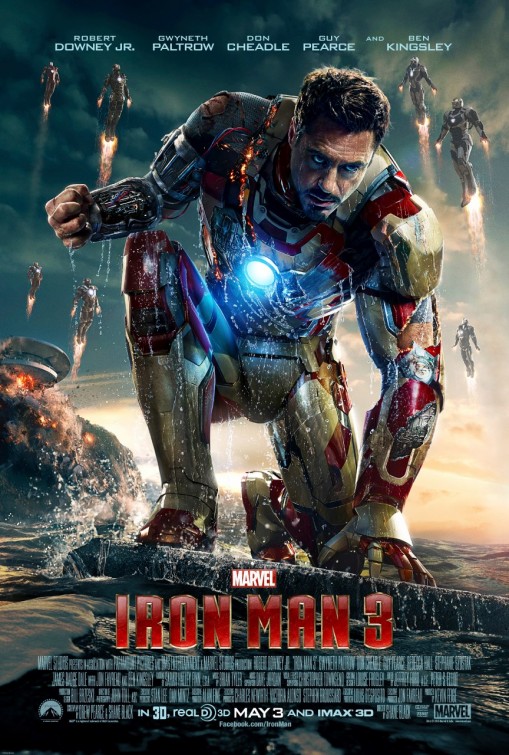 Third movies in superhero franchises always seem to be a precarious proposition; X-Men 3, Spider-Man 3, Superman 3, all graveyards of rushed productions, artistic compromises, and general complacency. Usually the third movie is when the hero has what he or she (but mostly he) has built up stripped down. It’s the same case with Iron Man 3, which short of a noisy finale has a surprisingly small amount of actual Iron Man, much like the scant amount of Batman in last year’s The Dark Knight Rises. That’s fine with me because the appeal of this franchise has been Tony Stark the character, not the mechanical heroics. Iron Man 3 is co-written and directed by super Hollywood scribe Shane Black, the man who gave us Lethal Weapon, The Last Boy Scout, The Long Kiss Goodnight, and the 2005 gem that resuscitated Robert Downey Jr.’s career, Kiss Kiss Bang Bang. It was this fact alone, especially after how disappointing Iron Man 2 was, that got me jazzed about a third outing. Black’s characteristic sense of humor, genre blending, and mass appeal thrills helps to make Iron Man 3 an enjoyable if flawed movie-going experience and a suitable kickoff to the summer movie season.
Tony Stark (Downey Jr.) is having trouble sleeping, haunted by the near world-ending events in New York City from his time with the Avengers. Pepper Potts (Gwyneth Paltrow), head of Stark Industries and Tony’s main squeeze, wants her man to take a mental health break. He’s spending as much time as possible in his lab, concocting a whole army of different Iron Man suits. His latest invention allows him to control a suit prototype with his body, compelling pieces of his amour to his person with a wave of his arms. He’ll need the help because the Mandarin (Ben Kingsley), a fearful terrorist leader, is staging a series of bombings around the United States, leaving behind videos taunting his foes. After an attack that hits close to home, Stark challenges the Mandarin and the bad guy brings the fight to the man of iron, decimating his home and forcing Stark to flee. In Tennessee, Stark unravels the mystery behind the Mandarin, which involves a brilliant scientist (Rebecca Hall), a nefarious biotechnology businessman (Guy Pearce), and even the president of the United States himself.
 The best part of the first film was watching a brilliant guy become Iron Man; sure the superhero stuff was fun but it wasn’t what made the movie special. Downey Jr. as a charismatic, egotistical, self-involved but ultimately redeemable middle-aged playboy is what made the movie special. With Iron Man 3, he has to rely on his wits for large portions, which are still considerable. It’s a clever way to make a billionaire playboy with out-of-this-world technology empathetic. He’s never going to be an everyman but that doesn’t mean we can’t empathize. With that said, I still find his whole PTSD ordeal after events from The Avengers to be shaky. He’s already had near death experiences before so unless we get a bigger explanation (proof of alien existence and superiority? Knowing a return is inevitable?) I find it hard to fathom that a guy as outwardly unflappable as Tony Stark would be hobbled by his super team-up activities. Also, now that we exist in a post-Avengers universe, wouldn’t the ongoing attacks by the Mandarin warrant some sort of S.H.I.E.L.D. response or monitoring?
Likewise, I really appreciated how Black developed his action sequences, routinely giving Stark limitations. The concept of a suit that can assemble by itself and fly hundreds of miles is silly, sure, but it also opens up fun possibilities and questions of identity. At one point, Stark has one arm and one leg of his suit, allowing him to fight back but having to get creative with his moves. A fight while he’s handcuffed also provides enjoyable thrills. During the home attack, Stark’s suit is a prototype and will not allow him to fly, so he has to get inventive, literally shooting a grand piano at a helicopter. The best action scene is when Iron Man has to save a dozen people from plummeting to their deaths after being sucked out of Air Force One in midair. I wish the solution hadn’t been so quick but it’s a thrilling sequence with terrific aerial photography.
Until the finale, which is all-robot action, you could accuse the film of being too shrift in its action sequences, rarely lasting longer than a few brief minutes. They’re still quite entertaining, and well directed, with Black nicely drawing out organic complications and making good use of geography. We know that Black can write a glorious action sequence, but unless you were one of the lucky souls who saw Kiss Kiss Bang Bang, it’s a surprise that the man can direct one so well. There’s a nice sense of style on display but it never becomes overpowering, and thankfully it’s presented in a manner that you can, shocker, tell what is happening onscreen. Black definitely has a good eye for visuals and scene compositions but he also knows how to deliver great crowd-pleasing moments that we want in our summer movies. The climax is pretty busy with lots of keen Iron Man suits that you just know are there to be purchasable toys first and foremost. The sustained action is pretty involving, and Black is an expert at establishing mini-goals and developing naturally. Even as it starts to devolve into a hectic video game-like frenzy, there are enough changing goals and reversals to keep you satisfied for the long haul.
The movie’s villains are somewhat nebulous and employ an Evil Plot that is too convoluted by half. The Mandarin is an intriguing figure but undergoes some changes that will surely leave fans of the comic steaming mad. I accept that movies are an adaptation from the source material, and have no real personal affinity for Iron Man or his rogues’ gallery, so I wasn’t bothered by the notable change. It fits the tone of the movie as well as becomes another plot point in a convoluted Evil Plot. I will agree with detractors on this point: after the invasion in The Avengers, alien technology, the source of the Mandarin’s powers in the comic, is credible. I don’t really understand the political commentary at play with the Mandarin either. More so, and I’m trying to be delicate with spoilers, Iron Man 3 is really a movie about Tony Stark versus… lava people. Sure they have superhuman brains that provide regeneration and superior human ability. It just seems that all these super humans decide to do is… heat things up. They glow red, melt through walls, and are essentially lava creatures. Apparently Tony Stark needs to take some cues from that old U.S. Marines ad where the guy fights a giant lava monster (“Have you been attacked by a lava monster recently? No? You’re welcome – signed, the Marines”). The villains, while weak, are still probably the best in the series. It’s been a fairly weak franchise for antagonists.
 Coming from Black, you’d expect an increase in the implementation of comedy, though Iron Man 3 probably walks just up to the line. It almost gets too jokey but pulls back enough. Adam Pally’s (TV’s criminally underseen Happy Endings) small bit as an obsessed fan of Stark is probably the testing point. Tony Stark has issues sure, especially if Disney will ever let the movies explore his history with alcoholism, but the man is never going to challenge Bruce Wayne for the brooding loner throne. Stark is a quipper, a loudmouth who uses humor as a weapon and a shield, and brought to vivid life by Downey Jr., the man will always be a comedian. That’s not to say that the drama lacks proper seriousness. However, Black pushes a lot more comedy into the film than we’ve seen in the earlier installments. Most of it is welcome and even when the movie goes into mass appeal mode, especially in Act Two when a plucky kid aids Stark, Black covers the familiar without losing his edge. You’ll likely recognize the buddy cop patter from Black’s other movies but it still works. There are several setups that look like we’re getting Big Hero Moments, and then Black decides to undercut them for a good laugh. Iron Man 3’s consistent sense of humor makes the movie feel even faster paced.
Downey Jr. (The Avengers) is still the MVP of the modern Marvel-verse in my eyes, and even two years removed from 50, he’s still got enough energy to power a small army. He’s still pulling the same schtick so to speak, which may wear thin for others after four starring appearances as Tony Stark, but I still find him naturally appealing. Paltrow (Contagion) gets a chance to do more than the standard damsel in distress that the women function in these movies. I regret that after being given a tantalizing new direction the movie reverts her back to standard damsel sidekick so speedily. Ho hum. Kingsley (Hugo) just seemed wrong for the part from the start, never mind the nebulous ethnicity issues. His vocal fluctuations and strange emphasis proved too distracting for me. However, he proves to be a better match after the Mandarin’s twist. Pearce (Lawless) is a pretty solid, smarmy bad guy and man has he got an impressive physique going on. It’s just nice to see great character actors from Hall (The Town) to Miguel Ferrer (Traffic) to Dale Dickey (Winter’s Bone) in a high-profile mega blockbuster. Even little Ty Simpkins (Insidious) is pretty good as the kid who helps out Stark. My tolerance for child acting has gone downhill as I have gotten older, but the kid is genuinely good without falling into the common trappings of being cloying or overly precocious.
Iron Man 3 is a definite improvement over the overstuffed, undernourished 2010 sequel. It ends on a moment that feels like something close to closure, but you know, as the credits helpfully indicate, that Tony Stark will appear again, at least in 2015’s Avengers 2. The bigger question is can this franchise exist without the participation of Downey Jr.? I’m sure we’ll all find out eventually considering the character is too profitable to simply retire once Downey Jr. decides he’s had enough. We’ve had five Batmans after all, not counting Adam West. However, never has a character seemed so intrinsically linked with an actor before. Downey Jr. just is Tony Stark, and while some capable young male lead out there in Hollywood will put up a valiant effort, it will never be the same. Iron Man 3 is further proof that the appeal of the franchise is not the explosions and action set pieces, which it does a fine job with; it’s the man inside the suit and the formidable actor that gives this franchise its juice. Spending more time with Stark is a bonus, and Black’s zippy sense of comedy and acute knowledge of the architecture of popcorn thrills allows the movie to fly by with ease. While the first film reigns supreme, Iron Man 3 is a fitting and pleasurable enough blockbuster that reminds you why we still love this guy.
Nate’s Grade: B
Share this:

The Dark Knight Rises (2012)
 Let’s be honest, The Dark Knight Rises movie was never going to meet fan expectations after the high-water mark between superhero movie and crafty crime thriller that was the pop-art masterpiece, The Dark Knight. Whatever director/co-writer Christopher Nolan put together was fated not to match the pulpy big blockbuster alchemy that he worked so well in 2008. Minus Heath Ledger’s instantly iconic performance, a role that set the film on fire whenever he was onscreen, there is going to be a certain void to this capper to the trilogy. Now having seen the movie twice, including once in sphincter-rattling IMAX, I feel that I can truthfully state the most obvious: The Dark Knight Rises is not as good as the previous movies. While a fine finale for an ambitious series, this is definitely the weakest movie of the trilogy.
It’s been eight years since Gotham City last saw the likes of Batman. Bruce Wayne (Christian Bale) is an older man, hobbled by age, and living as a recluse in his mansion. His trusted friend and butler Alfred (Michael Caine) keeps encouraging Bruce to seek a life outside that of Batman. In those eight years, Gotham’s police have cracked down on organized crime thanks to the Dent Act, a law named after the late district attorney Harvey Dent (a fallen idol that only a handful know the real truth about). Commissioner Gordon (Gary Oldman) is growing sick with the secret of Harvey Dent and looks to retire from the force. Miranda Tate (Marion Cotillard) is a businesswoman eager to restart Wayne’s clean energy project, and a woman interesting in getting Bruce back on his feet. There’s also Selina Kyle (Anne Hathaway), a.k.a. Catwoman, a master thief who gives Bruce a new challenge. But then along comes Bane (Tom Hardy), a master terrorist and figure of brute strength. His goal is to fulfill the League of Shadows’ plan and destroy Gotham City and expose its rampant corruption. He sidelines Batman and takes over the city, unleashing criminals and hordes of the downtrodden upon the wealthy. There is no escape from Bane’s plan, his wrath, but Bruce Wayne must rise to the occasion and be ready to sacrifice the last of himself for the people of Gotham.
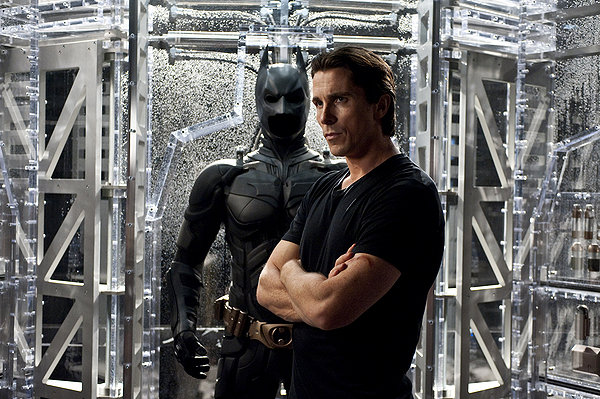 Firstly, Bane is no Joker. The bad guy lacks the fiendish charisma of Ledger’s Joker and he’s not as well integrated thematically into the movie. The Joker was an anarchist that wanted to tear down the pretensions of society and watch people “eat each other.” And we watched a city come unglued. We explore the notion of escalation and what the blowback would be for a man fighting crime in a costume. With Dark Knight Rises, Bane wants to take up the mantle of Ra’s Al Ghul (Liam Neeson) and wipe Gotham off the map. He’s got moments of being a master planner but really he’s just a big heavy. He’s the big tough guy that beats up old man Bruce Wayne, and Bane is continuously diminished in the film as it goes. A late revelation with the character completely diminishes his role and turns him into the equivalent of a mean junkyard dog. His big plan is simply to rile up the masses and wait for the inevitable. Hardy (Bronson) is a great actor prone to mesmerizing performances. This isn’t one of them. He’s super beefy but the facial mask, looking like some sea urchin, obscures half his face. It’s all physicality and eyes for his performance, along with very amped-up dialogue that you can tell was rerecorded after filming. Every time Bane speaks it’s like he has a speaker system installed in his face. And then there’s the matter of his sticky accent, which to me sounds like German mad scientist but to my friends sounded like drunken Sean Connery.
Bane keeps espousing about the corruption of Gotham but you really never get a strong sense of what that corruption has lead to. Catwoman talks about the Gotham elites living large while the rest of the city struggles; but rarely do you get a sense of this. So when Bane flips the tables, and the elite and wealthy are stripped of their decadence and put on trial by mobs, it feels improperly set up. Just because you have characters talk about wealth disparity and the city’s corrupting influence doesn’t mean it’s been established. Nolan’s Batman movies are a reflection of our modern-day anxieties in a post-9/11 world, so I wasn’t surprised to see a society rotting away from the sociopathic greed and wanton excess of the 1%. But rather than serve up a wealth disparity parable of class conflict, the movie simply turns to mob rule, a far less nuanced and interesting dissection of current events and fears. It’s like the French revolution took a trip to Gotham City (Gordon even quotes from A Tale of Two Cities). It’s a society built upon a central lie, the idol of Harvey Dent, but the movie fails to make the corruption felt. In the end, this is all pretty weak social allegory. And would it have killed Bane to be a little more brutal to stock exchange short-sellers?
 Then there’s the typical Nolan origami plot with the myriad of subplots intersecting. This is the first time in the series where the plots felt poorly developed. Rewatch Batman Begins or The Dark Knight, as I recently did, and you’ll see there is not an ounce of fat in those movies, not one wasted scene or one wasted line. Sure they got secret super ninjas and Katie Holmes, but those movies were well built blockbusters. I could have done without Bane entirely and certainly would have loved more of Catwoman. Hathaway (Alice in Wonderland) is terrific in the antihero role and brings a very interesting dynamic relationship with Batman. She may be the only person who understands him. I wanted more Catwoman, the movie needed more Catwoman, but alas she is just a plot device to connect Wayne to Bane. She has a larger role in the concluding melee but essentially becomes Batman’s reluctant wingman. The whole theme of the 99% vs. the 1% could have been generously explored with this character, and her spark and charisma would certainly be enough to get Bruce Wayne out of bed again. Then there’s the regular cop (Joseph Gordon-Levitt) doing the unheralded good deeds that so easily get overlooked. Here is an interesting character that, due to some leaps in logic, connects with Bruce Wayne on a unique level. He presents a counterbalance to all the souped-up superheroes, a recognizably regular human trying to do good. It’s then a shame that he gets entirely relegated during the third act so that the superheroes and their super toys can make some noise.
For a Batman movie there’s hardly any Batman in it. The caped crusader has been in retirement for eight years, so it takes some time before Bruce puts the suit back on. But then he’s also sidelined for a good third of the movie, stowed away in a far-off prison. The entire Indian prison sequence really could have been exorcised. It essentially becomes a Rocky training moment for Bruce Wayne to recover and a plot device to explain why there needs to be a time gap in the story. But this part of the movie just feels like it goes on forever, and we all know where it will go so we just keep waiting for the movie to get there. No one wants a Batman movie where Batman sits the middle out. The end feels relatively fitting but any fan of The Iron Giant will recognize some similar key elements.
And while I’m on the subject, let me do some estimates here. The timeline between Batman Begins and The Dark Knight is about a year, as the Joker notes to a congregation of mobsters. I’ll be generous and say that the events of The Dark Knight last two months. We learn that Batman never appeared again after the death of Harvey Dent, and now we flash to eight years later with The Dark Knight Rises. So you’re telling me that we only really got a solid year of Batman being Batman? That over the course of nine years he was Batman for only one of them? That’s very little Batman-ing for a Batman franchise.
But even with these flaws in tow, The Dark Knight Rises is still an exciting, stimulating, and mostly satisfying close to a trilogy of unprecedented ambition and scope for a modern blockbuster. The action sequences in this movie are huge and exhilarating. I loved Bane turning Batman’s armada of weapons against him. The Bat fighter plane is a nice addition that gets plenty of solid screen time. The sheer scope of what Nolan produces is epic; from a plane being hijacked in mid-flight and torn apart, to a city being leveled by explosives, to a face-off between a bevy of armored Batmobiles and the Bat plane through the streets of Gotham, the movie does not disappoint when it comes to explosive, large-scale action set pieces. This is also the first Batman movie where the climax is the best part of the film. The last half hour is solid action but also a fitting sendoff for a beloved character. Some will grumble with certain hat-tipping moments at the end, but I found it entirely satisfying. It all comes back to the central thesis of Nolan’s Batman films about becoming something more than just a man, becoming a symbol, and that symbol is meant to inspire others. By the end, you feel that the inspiration has been earned as so has our conclusion.
 I want to single out Caine (Harry Brown) who has very few scenes but absolutely kills them. He’s the emotional core of the movie, perhaps even the series, and has always been hoping that his charge, Bruce Wayne, would never return to Gotham. He’s the voice of reason in the movie, the man that reminds Bruce about the costs of a life spent seeking vengeance and sacrificing his body. I wish Caine was in the movie longer but his scenes are pivotal to the plot, as is his absence.
The Dark Knight Rises doesn’t rise to the level of artistic excellence of its predecessors, but it’s certainly a strong summer blockbuster that works as an agreeable finale to the premier franchise of the era. It’s not quite the knockout we were expecting from Nolan but it still delivers where it counts. I wish it had give a fuller, richer portrait of a city corrupt from the inside out, a society rotting away and ready for revolution, and plus I also wish we had plenty more Catwoman and plenty more shots of Anne Hathaway in her Catwoman cat suit (Michelle Pfeiffer still has nothing to fear), but these are the things of dreams. Nolan’s aim has always been to place Batman in a world that is recognizably our own, and with that comes the responsibility of bringing a stolid sense of realism with all the blockbuster pyrotechnics. This artistic ethos has given us some extraordinary movies, though some Batman purists would object that Nolan’s hyper-realism is not the Batman they grew up with. It’s hard to really get a sense of the accomplishments that Nolan and his team has been able to pull off over the course of three bladder-unfriendly movies and seven years. He’s taken the superhero movie and redefined it, brought it unparalleled psychological depth and philosophical analysis, and given a human quality to what normally gets dismissed as escapism. The Dark Knight Rises isn’t as revelatory as its previous entry but it sticks the landing and puts to rest what is indisputably the greatest superhero trilogy of all time.
Now get ready for the reboot in three years.
Nate’s Grade: B
Share this:

The Amazing Spider-Man (2012)
 It’s only been a mere ten years since Marvel’s signature web-shooting, wall-crawling super hero leaped onto the big screen and smashed box-office records, and yet he’s already getting the reboot treatment. Usually we reserve reboots for movie franchises that ended in colossal artistic failure. I don’t know anyone that will ardently defend director Sam Raimi’s Spider-Man 3, but I know of no one that puts its in the same vicinity as the atrocious, franchise-slaying Batman and Robin. Spider-Man 3 suffered in comparison to its predecessors, which formed the gold standard of super hero films (even in my review I called out for some new blood if this was any indication what we had left to expect). But then in 2010, Sony decided that it would rather start all over with its billion-dollar franchise, so Raimi was out, so too were stars Tobey Maguire and Kirsten Dunst, and 500 Days of Summer director Marc Webb was tapped to direct. The (rebooted) Amazing Spider-Man swings into theaters with a serious case of déjà vu attached. Are we far enough out to forget about Raimi’s accomplishments? My spider sense is telling me we’ve been here before and better.
Peter Parker (Andrew Garfield) is a geeky high school student living with his Uncle Ben (Martin Sheen) and Aunt May (Sally Field) ever since his parents had to vanish mysteriously one night. Peter is picked on at school and crushes on cutie-pie Gwen Stacy (Emma Stone) but all that changes when he’s bitten by a genetically engineered spider. He gains super spider-like abilities including improved dexterity and the ability to stick onto surfaces. He designs his own webbing devices that allow him to shoot long tendrils of super-strong spider webbing he can swing around with. Peter is trying to unravel the mystery of what happened to his parents and he seeks out Doctor Connors (Rhys Ifans), a notable genetics scientist who worked with Peter’s long lost dad. Peter supplies his father’s secret math formula and gives Connors the breakthrough he was hoping for in genetic replication. When injected with a serum, creature should be able to regrow lost appendages. Connors turns himself into a human guinea pig because he’s desperate to grow back his amputated right arm. But the serum causes Connors to transform into a hideous lizard creature for periods of night and only Spider-Man can stop him.

Simply put, I liked Spider-Man when it was made the first time and called Spider-Man. I understand the desire to reboot after the disappointing mess that was 2007’s Spider-Man 3, but did we need to start completely from scratch? Could we not have just eased into a Spider-Man 4 and replaced the original actors? Though I personally had no problem with Bryce Dallas Howard as Gwen Stacy (yum). I don’t need to see another version of the Spider-Man origin tale because it was already covered just ten years ago. The worldwide public is familiar enough with Spidey’s back-story that I don’t understand why we couldn’t just start with our hero already doing his business. I don’t need another hour of setup for the guy to become Spider-Man. This “sameness” seems to sap much of the energy out of Amazing Spider-Man, a competent and occasionally thrilling superhero flick. It does plenty of things well enough but you just can’t shake the feeling that the movie, at its core, is unnecessary or at least tripping over redundancy. Do we really need to see Peter Parker discover his powers again? I understand that we want to experience part of his joy at discovering his fantastic new abilities, but it just feels like all too familiar. I don’t think we would have missed anything by simply condensing all the back-story and doling it out as a series of concise flashbacks.
Despite some serious déjà vu, The Amazing Spider-Man has some other serious issues. Firstly, the tone just seems like a bad fit. This is a much darker, somber, and angsty tone for a character that was never intended to be as brooding as, say, Batman. Just because the dark tone worked for Christopher Nolan’s Batman films doesn’t mean it’s the right fit for every comic character. I’m not saying that Peter Parker doesn’t have his issues and plenty of guilt to struggle with (more on that in a moment), but this movie feels like the fun has been squeezed out. It’s a kid who was abounded by his parents, bullied at school, and he teems with repressed frustration. Peter Parker is not meant to be a brooding antihero. He’s supposed to be the high-flying jokester. Regardless, you can interpret the character however you’d like, I just don’t think this darker, gloomier incarnation works despite the best efforts from Garfield. The spirit of the movie feels like it’s being suffocated at times. Raimi’s films had their dramatic material but they never lost a sense of fun. It’s hard to tell if anyone is enjoying himself or herself for much of Amazing Spider-Man.
Now let’s talk about one of those areas of Parker’s guilt, namely his guilt over the murder of dearly beloved Uncle Ben. Peter chooses not to get involved and from that action Ben is murdered by the same criminal Peter could have thwarted earlier. In Amazing Spider-Man, it’s transformed into an inane example of being at the wrong place at the wrong time. Ben just so happens to run into the same guy and he stupidly wrestles for the man’s gun. It’s hard to make any real connection for Peter to blame himself. Spider-Man 3 did something similar by rewriting the back-story so that the Sandman was responsible for Uncle Ben’s death. I wrote: “By introducing a new killer it means that Peter has no responsibility for his uncle’s death. This completely strips away the character’s guilt and rationale for what compels him to swing from building to building to fight crime.” Now, this new Spider-Man, since he’s so edgy and dark, is only hunting for bad guys who bear a likeness to the robber who killed Uncle Ben. Yes, Peter Parker has become a vigilante defined by his all-consuming sense of vengeance. And guess what? He never finds the guy. Get used to all sorts of storylines being dropped or forgotten throughout the film (I guess we’ll have to wait for future films to explain what happened to his parents).

While I think a darker interpretation of Spider-Man is mislead, I wish the movie would see it through rather than keep having moments to break the reality of this more grounded approach. I’ll buy that Dr. Connors turns into a giant lizard creature from the magic DNA serum whatever. I’ll even buy that he goes mad with power because of it. However, what I won’t buy is that this guy, all of a sudden, decides to relocate his lab into the sewers. What? The guy has everything he needs in a giant scientific tower, and he says he “gave the staff the week off.” Well then do your crazy mad scientist science stuff in your lab. Why the sewers? Do you know how many trips this guy would have to make to haul all that equipment down into the sewers, and remember he’s only got one friggin’ arm! The entire character of the Lizard feels so poorly developed and adds no greater thematic message to the movie. And then there’s the case of Peter Parker being a world-class dweeb mocked in high school. As presented, he’s a pretty hunky, smart, athletic kid who has fabulous hair. It makes no sense that he has absolutely zero friends and that there wouldn’t be girls crawling all over this guy. Are there no alternative-style girls in this school besides the one girl with glasses we keep cutting back to for reaction shots? And how many times is Aunt May going to watch her nephew come home at odd hours and covered in bruises before she says anything?
Then there’s just the forehead-smacking number of coincidences in the movie. With most movies you accept that the characters exist in a small universe where they will regularly continue to run into one another, but in Amazing Spider-Man it’s absurd. As my pal Mike Galusick noted, you have Peter who just happens to have the last steps needed in a formula who just happens to go to Oscorp and poses as another student with shocking ease who just happens to wander off a tour and much up with lab stuff because security cameras do not exist in this universe and who just happens to meet the same scientist who is responsible for his parents missing and the guy also happens to have a head intern who just happens to be Peter’s crush and she just happens to be the daughter of the police captain (Denis Leary) trying to hunt down Spider-Man. Phew. I haven’t even mentioned the construction worker dad (C. Thomas Howell, for real) whose kid was saved by Spider-Man so he makes sure to rally all his fellow construction workers to synchronize their beams for Spidey. It is moments like this that undermine the filmmakers’ grounded approach.
It sounds like I really disliked this film, and I didn’t. Amazing Spider-Man is a completely serviceable superhero tale and the cast does a great job of covering up for many of the narrative shortcomings. The action, what there is, seems a little too rushed and missing that spark that Raimi had in abundance. There is one nifty sequence that Webb deserves credit for: in the foreground a librarian listens to classical music, which drowns out the background action as the Lizard and Spider-Man smash through shelf after shelf of books. This was the only moment in the movie where it felt fresh and exciting and I wanted to see where it would go. It’s just that the movie cannot capitalize on its potential. Take for instance a late incident where the Lizard unleashes his mutant gas and transforms a cadre of police officers into giant lizard creatures. You’d naturally expect that if you were introducing a lizard army that we’re upping the stakes and that the movie would do something with this new team of antagonists. Wrong. No ramifications. Webb’s film does benefit from advances in computer wizardry as the CGI is far more advanced and Spider-Man doesn’t resemble the cartoon character he often did in Raimi’s trilogy. The brief moments swinging through the city, feeling the rush of exhilaration with the character, are the movie’s visual highpoint. I found the Lizard’s face eerily similar to the goombahs in the reviled Super Mario Brothers movie.

Garfield (The Social Network) and Stone (The Help) certainly feel like a step up from before. Even though Garfield seems a bit old for high school, he does a more than credible job of being a super smart kid who slowly grows in confidence and demeanor. He can do it all, handle the comedy, the emotional angst, the formation of courage. Garfield is a great addition and he gets along wonderfully with Stone; the actors have great chemistry, which may explain why they started dating after the production ended. Stone brings a comedic zeal to the part and seems far more approachable and les standoffish than Dunst’s Mary Jane ever did. While the movie seems to indicate a fully formed romance for its stars, what we see on the screen plays out more like a nervous flirtation. The actors are cute when they seem to be stammering in awkwardness and mutual attraction. I wish the movie gave us more development rather than skipping ahead, but hey, these kids are great together.
The Amazing Spider-Man, when you get down to it, is less than amazing. It’s a capable super hero movie with some fancy effects and stunt work, but the mounting plot holes, incongruities, tonal conflicts, and overwhelming sense of sameness prove to be a foe even Spider-Man cannot topple. This aims to be a leaner, more emotionally engaging, realistically grounded Spider-Man, but it just can’t pull it off. Garfield and Stone are great but it’s impossible to erase Raimi’s original trilogy from your memory. His films weren’t perfect, though Spider-Man 2 came closest, but they were loving odes to the character and knew how best to link action with character for maximum impact. I can’t think of any real memorable moments in this movie, which is troublesome given its hefty budget and its hefty mission of supplanting the Raimi films. I didn’t have a bad time while watching The Amazing Spider-Man but my involvement and enjoyment was very limited. Even with a glossy reboot, I guess The Amazing Spider-Man is proof enough that sometimes it’s better to go forward rather than reliving the past.
Nate’s Grade: B-
Share this:

The Avengers (2012)
 For the past four years, Marvel has been seeding its all-star super hero collective in the storylines of its summer blockbusters. And with six super heroes, The Avengers carries some super expectations. The creative mind behind the film is none other than Joss Whedon, best known for creating and shepherding cult TV shows like Buffy the Vampire Slayer, Angel, and Firefly. Not exactly the first name you’d think Marvel would assemble to front a $200 million movie. For geeks, Whedon has become a reliable standard of quality (the patchy TV show Dollhouse notwithstanding). Here is a man who can marry big ideas with sharp characterization and delightfully skewed dialogue. In Whedon, geek nation has a savior, and Marvel knew this. The Avengers is 142 minutes of geek arousal stretched to orgasmic heights.
Nick Fury (Samuel L. Jackson), head of the agency S.H.I.E.L.D., has a dire need for Earth’s mightiest heroes. Loki (Tom Hiddleston) has traveled through a portal and plans on conquering Earth thanks to an approaching alien army. Fury has tasked Tony Stark (Robert Downey Jr.) a.k.a. Iron Man, Steve Rogers (Chris Evans) a.k.a. Captain America, and special agent Natasha “Black Widow” Romanof (Scarlett Johansson) with stopping Loki and rescuing one of S.H.I.E.L.D.’s own agents, the skilled marksman Clint “Hawkeye” Barton (Jeremy Renner), who is under Loki’s devious mind control. Loki’s brother, Thor (Chris Hemsworth), would like to cite jurisdiction and bring his wicked brother back to his home world. The only person who may be able to locate Loki’s path is Dr. Bruce Banner (Mark Ruffalo), a guy with his own anger issues. With this many egos, it’s bound to get dicey. As Banner puts it, “We’re not a team. We’re a time bomb.” Can they put aside their differences to unite to save the Earth? Does a Hulk smash?
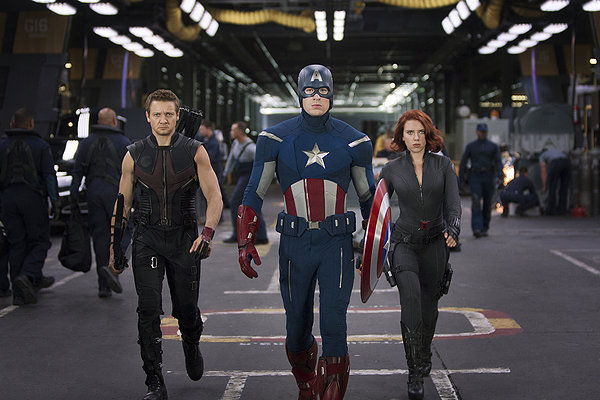 Whedon, the king of clever genre deconstruction last seen in the excellent meta-horror film Cabin in the Woods, plays it relatively straight, giving his big, effects-driven film a straight-laced sense of sincerity. It’s not making fun of these sort of big-budget, effects-driven smash-em-ups, it just wants to deliver the biggest smash-em-up yet. To that end, The Avengers achieves maximum smashitude (trademark pending). By its rousing finish, the movie has become so massively entertaining that you forget the draggy first half. The scope of this thing is just massive. The last thirty minutes is solid action across miles of crumbling, just-asking-to-be-exploded city landscape. But the trick that Whedon pulls off is how to orchestrate action on a monumental scale without losing sight of scale, pacing, and character. You’d think with a full deck of superheroes that somebody would be shortchanged when it came time for the rough and tumble stuff. Not so. Instead of fighting one another, the prospective Avengers work together in all sorts of combinations. The characters are well integrated into the fracas, making particular use of their abilities, and finding new locations of focus every few minutes. This expert hero shuffling keeps things feeling fresh amidst the constant din of chaos.
In fact, the movie finds time to give every hero his or her due, finding a small moment to reveal some characterization. I thought Whedon’s biggest challenge was going to be the juggling act of balancing so many heroes and so much screen time, but the man found a way, like he regularly does, to squeeze in character with ensemble action. The Hulk fares the best. After two movies, it feels like Whedon has finally nailed the character; granted, this success may be credited to the fact that Bruce Banner (all hail Ruffalo) is kept as a supporting character. The struggle of the character being likened to a recovering addict is a smart way to present the character without getting too morose (I enjoyed the revelation that the “Hulk” half prevented Banner from killing himself). When he’s told his mission is to smash, you can feel the exuberant joy of an unleashed Hulk id. The Hulk had two great audience-applause moments that made my theater go berserk. I also really liked the attention given to Black Widow and her lonely back-story. Hawkeye was a complete badass, though he only gets to do fun stuff in the madcap finale. The trouble with the hero team-up franchises is that not everyone’s on the same level of power. Thor is a god for crying out loud, Iron Man has super weapons, Hulk is Hulk, Captain America at least has superhuman strength but what do Hawkeye and Black Widow bring to the team? When you’re competing with all that power, being good with guns or a bow seems pretty puny. And with Hawkeye, there’s going to be a limit to his effectiveness unless he has a magic bag of replenishing arrows. Still, Whedon finds ways to make the heroes badass and humane in equal measure, and surprisingly funny, which is welcomed.
It’s hard to believe that Whedon had only directed one feature film before (2005’s Serenity, based upon Whedon’s canceled Firefly show) being given the keys to the Marvel universe. He’s directed several TV episodes of his signature shows but the man has never produced anything on this scale before. Given a gigantic canvas, Whedon delivers the goods. His action sequences are rollicking and fun and, best of all, shot and edited in a fashion where you can understand what is happening (take some notes, Hunger Games franchise). The action is well choreographed and elevated with organic complications and particular attention paid to location, like the Nicky Fury airship. Whedon is a master of the plot payoff, setting up his elements and then piloting the narrative to satisfying conclusions and integrations (Cabin in the Woods is also a pristine example of this gift). If you’re going to introduce an airship, you better believe that sucker is going to threaten to crash. I’m glad that Loki was brought back as he was the best Marvel big screen baddie yet, though I’m disappointed they essentially put him on ice for an hour.
 The technical elements are ably polished even for this kind of film. The cinematography by Seamus McGarvey (Atonement) is terrific, utilizing bright color in a way that the visuals pop. The special effects are top-notch and you just feel immersed into the action. The destruction is cataclysmic but rarely does the movie feel phony. I was impressed by the Hulk designs and the sequences in inky space with our alien adversaries. For that matter, are these aliens robots? It’s unclear whether the giant flying centipede-like ships are creatures. The 3D conversion is one of the better outings due to the fact that it doesn’t keep throwing stuff in your face. Plus, viewing Johansson’s leather-clad assets in 3D certainly has its own appeal, as does Gwyneth Paltrow in jean shorts. Hey How I Met Your Mother fans, Cobie Smulders looks practically smoldering in her S.H.I.E.L.D. agent outfit too. Okay, I swear I’m done with the female objectification.
I hesitate calling The Avengers the greatest super hero/comic book movie of all time, as the teaming hordes of Internet fanboys foaming at the mouth are wont to do. If your definition of a comic book movie is a giant sandbox with all the coolest toys, then this is your film. This is a comic book turned flesh. The Hulk and Thor fight and prove who is the strongest Marvel man, that’s got to be a geek’s wish come true. Many of the infighting sequences felt like, servicing the tastes of the fanboys, and after a while the constant hero on hero action felt tiresome. I get that we have a clash of egos going on here, but the movie suffers from a lack of narrative cohesion, by which I mean that the first hour of the movie feels like a series of guest appearances by heroes on loan. The movie doesn’t fully come together until the point where the team comes together; I doubt Whedon intended that symbiotic relationship. The movie feels more like a patchwork of standout scenes and memorable moments that a fully formed and cohesive story. If you haven’t seen the previous four Marvel movies (Iron Man, Iron Man 2, Thor, Captain America), you’ll be pretty hard-pressed to follow the story. Loki’s motivation and plan seems rather sketchy other than causing discord amongst the heroic ranks. His powers seem inconsistent and vague. Also I found the musical score by Alan Silvestri to be bland and unworthy.
The Avengers is sure to be geek nirvana for many of the comic book faithful. It’s an audience pleaser of mass scale, and I’m sure that your theater will be cheering in abundance. Whedon has pulled off the near impossible. The movie is a thoroughly entertaining, exciting, and witty popcorn spectacle of the first order. But where the movie hits the ceiling, at least for me, is that it ONLY wants to be the best super hero movie and this seems like limited ambitions. It’s like making the very best possible women in prison movie (great, but is this really all you set your sights on?). I had a great time watching Whedon’s handiwork but I wish it mined the outsized territory for bigger themes, a little more than audience-satisfying pyrotechnics, something I feel that X-Men: First Class did a better job of handling. Don’t get me wrong, I greatly enjoyed The Avengers and it’s a fantastic start to the summer movie season, but by no means is it The Dark Knight or even aspiring to be, and that’s okay. Enjoy the busy escapades of Marvel’s next smash franchise. Who knows when they’ll be able to wrangle everyone together for another adventure, but judging by the sounds of ringing cash registers, the answer is sooner than we think.
Nate’s Grade: B+
Share this:

Chronicle (2012)
 I’ve learned a valuable lesson when it comes to genre movies – do not trust the marketing department of 20th Century Fox. Every promotional clip, trailer, TV spot, even the notion that people were flying around in cities as an attempt at viral marketing, it all coalesced into making me turn up my nose at Chronicle. It just looked like a bad movie. Then the critical reception was rather glowing and I took a chance, pleasantly surprised by the skill and execution of the flick. What made this thought-process notable was that it was almost an exact repeat of what I went through with Rise of the Planet of the Apes. Every piece of promotion stoked my disinterest into outright loathing, and then after the positive press I saw the movie, begrudgingly, and was floored. I guess when it comes to future 20th Century Fox genre releases, I’ll try and figure out my reaction and then turn that upside down. If a movie looks like utter crap, then under this new value system it must be good. I’m sure my new cinematic equation will prove me wrong as soon as the latest Eddie Murphy family vehicle terrorizes theaters (“This fall, Eddie Murphy is… The Governor. And his political opponent? His wife! Also played by Eddie Murphy”). In short, the marketing department at 20th Century Fox sucks but Chronicle does not.
Chronicle is the chronicle (heh) of three high-school friends who contract telekinetic powers. Andrew (Dane DeHaan) is a social outcast, determined to videotape his life as a means of escape from his ailing mother, his violent, alcoholic father (Michael Kelly), and the torment of school bullies. His cousin, Matt (Alex Russell), is trying to read up on philosophy to impress Casey (Ashley Hinshaw), a blogger/amateur documentary filmmaker. He’s more than some dumb jock. Steve (Michael B. Jordan) is the popular athlete planning to run for political office one day. The three guys discover what looks to be an alien craft underground. After coming into physical contact, the guys discover they suddenly have the ability to control objects with their minds. They test out their new powers in small ways at first, stopping speeding balls, assembling Legos. Matt insists they establish some system of rules to ensure they use their new powers for good. Andrew chafes at the idea of holding back, especially since he is by far the most powerful member of the group and eager to settle a few scores.
 Just as the found footage motif is starting to get old along comes a movie that makes creative and clever use of the narrative structure. Documenting one’s life, including the endless trivialities, has become normal habit for a younger generation accustomed to Twitter-style instantaneous information dissemination. Given that Andrew is abused and harassed, it makes sense for his character to use his camera as a means of security physical and emotional: the promise of being recorded should at least keep some of the bullying and physical abuse at bay, and it also provides a barrier for him and the real world, letting him stand outside himself. As John Malkovich said in Shadow of the Vampire, “If it isn’t in the frame, then it doesn’t exist.” This is one of the few found footage films where I didn’t feel constrained by the limitations of its concept. I suppose it helps when your main characters have super powers and can fly into the sky for a game of pigskin. The climactic battle is plenty thrilling but also subtly ingenuitous, as we cut back from various camera footage to piece together our super smackdown; we jump from security cameras, police dashboard cams, helicopter cameras, to even personal video cameras of people doing what people do… document the strange and unusual (I’m just curious who assembled the footage, though I have my theories).
The key to Chronicle’s success is that it’s a well-written, character-based piece that just so happens to morph into a superhero cautionary tale. Andrew has a pretty hard life and it’s easy to see why this insecure, neurotic, and angry young man takes his new-found gifts as a cosmic opportunity for retribution. In a way, Chronicle is like an all-male version of Carrie for the digital age; incidentally, Andrew was set to perform in a school talent show and I was cringing, saying to myself, “Oh no, here comes the Carrie moment.” He’s a tragic figure and you feel for the kid, which gives him a little more leeway when he starts to veer to the dark side. Until the very end, you can follow Andrew’s motivation for every action, so when he dresses up in his father’s firefighter outfit to shake down the neighborhood bullies, you can justify it to yourself, saying, “Well, he’s desperate and needs to pay for him mother’s super expensive medication. Oh, and those guys had it coming. Jerk.” The power of empathy is a mighty one, and writer Max Landis (son of director John Landis) takes a measured amount of time to connect everything back to the character. The best compliment I can give Landis is that nothing feels out of place. The characters behave in a relatively believable manner, the action intensifies at a natural incline, and the characters manage to have some brainy, existential debates about power and responsibility in between typical teenage pranks/antics (it’s only natural that teen boys would somehow use telekinesis to improve their sex life). Sure these characters aren’t terribly deep and the multitude of Andrew’s misery heaped upon misery almost seems ridiculous. In another universe, perhaps Andrew uses his powers to lash out at his tormentors at school, though that approach would questionably glamorize school shootings. However, by the time the big action hits, we’re emotionally invested in the characters and have watched Andrew’s long fuse finally blow.
The special effects are even more impressive given the low budget and the found footage gimmick. The camera makes some nifty telekinetic moves, floating around and giving the film a bigger space to play within. The flying effects are pretty convincing, especially when one of our guys ends up tumbling back to Earth in one tense sequence. Whether it’s floating Pringles or cars crushed inside out, the effects are smooth and well integrated, and any noticeable lack of polish just fits in with the fuzzy nature of our video recording as lone record of the events. There’s a notable solution for sub-par special effects in movies: blame the nature of the movie (Uwe Boll, that suggestion is free of charge).
 But the best special effect is young actor DeHaan (HBO’s first-rate show, In Treatment). Looking eerily like a young Leonardo DiCaprio, the guy manages to channel pent-up rage, frustration, and helplessness in a way that doesn’t feel histrionic or twerpy. His character is the point of view for our tale given that it is Andrew’s camera after all; we’re mostly locked into his perspective. Good thing that the character is interesting enough and so well played by DeHaan that I didn’t feel stuck with a loser. He reacts like most teenagers would react when bullied and harassed, trying to be aloof and ambivalent but only able to hide the pain and resentment for so long. When Andrew does start to give in to the allure of his powers, DeHaan seems practically seduced by his sense of superiority. There’s a dangerous look in his eyes that turns on that cues the audience for trouble to come. Russell is an amiable actor even if his character is bland and somewhat inconsistent as a foil to Andrew. Jordan (TV’s Friday Night Lights) is a charming guy who finds the right balance of exuberance and sarcasm with his character. Together, the threesome of guys has a winning chemistry and character dynamic. When they’re getting along and the good times are rolling, you feel part of the gang.
Being a super hero has become a dominant male fantasy as of late in the movies, so it’s invigorating to see a movie that puts a fresh spin on what seems ad infinitum. Chronicle is something of a small wonder, bringing new life to the found footage concept, making smart use of its narrative confines rather than chained by its limitations. The story is just as involving from a character standpoint as much as its sci-fi genre elements and superhero wish fulfillment. Landis and debut director Josh Trank are talents that I have no doubt Hollywood will snatch up. They’ve given the super hero genre a necessary human element, too often lost in the splashes of action and merchandising. Along with its engaging character-work, Chronicle also happens to be a clever action movie with some soaring thrills. Ignore the shoddy marketing and take a chance on Chronicle.
Nate’s Grade: B+
Share this:

Captain America: The First Avenger (2011)
 In the summer of superheroes, you’ll be excused for feeling some fatigue when it comes to men in tights. Captain America: The First Avenger is a surprisingly enjoyable sepia-tinted action film that flexes enough might to pleasantly hark back to the days of 1940s adventure serials. Taking place almost entirely in the era of World War II, the film, and its hero, and unabashedly square and earnest. Steve Rogers (Chris Evans) begins as a 90-pound weakling determined to fight for his country and gets transformed into a behemoth of beefcake by the Army. Captain America is devoid of the dark brooding that has come to encapsulate modern superhero movies, but it’s also playing its B-movie silliness straight. The flick has more in common with Raiders of the Lost Ark and Sky Captain than most other superhero product. Better yet, the movie finesses the in-your-face patriotism of the title character. I mean the guy is called Captain America. Yet the film finds a way to resonate a sincere nationalistic pride without falling back into Michael Bay-level jingoism. And who’s going to make for better villains than Nazis? Director Joe Johnston (The Rocketeer, Jurassic Park 3) turns out to have been the perfect choice to helm this rah-rah retro enterprise. The pacing is swift, the acting is engaging, the special effects are terrific particularly Evans’ transformation into a weakling, and the film is unexpectedly emotional at points. This is a comic book movie that would appeal to an older generation not normally interested in superheroes, namely people like my dad.
Nate’s Grade: B


 nathanzoebl
You must be logged in to post a comment.